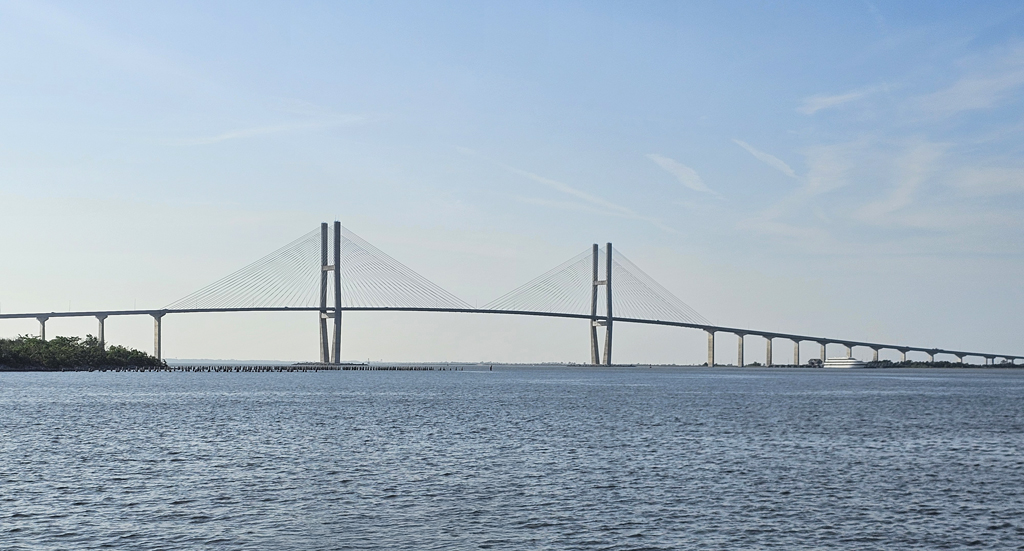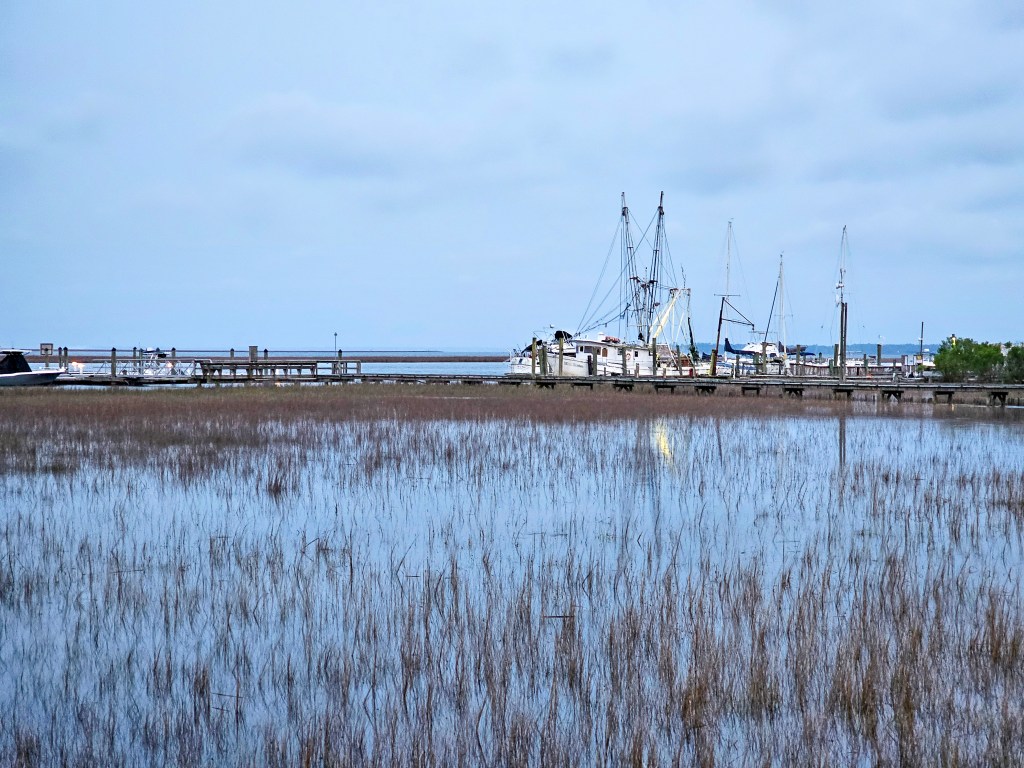
April 17th to May 2nd, 2025: Jacksonville to Hilton Head

Our first full day in Jacksonville was enjoyable.  Dick set off early to collect the rental car, while I made apple cake in anticipation of visitors.  Fellow gold Loopers Debbie and Steve dropped by to visit Nine Lives and share the apple cake.

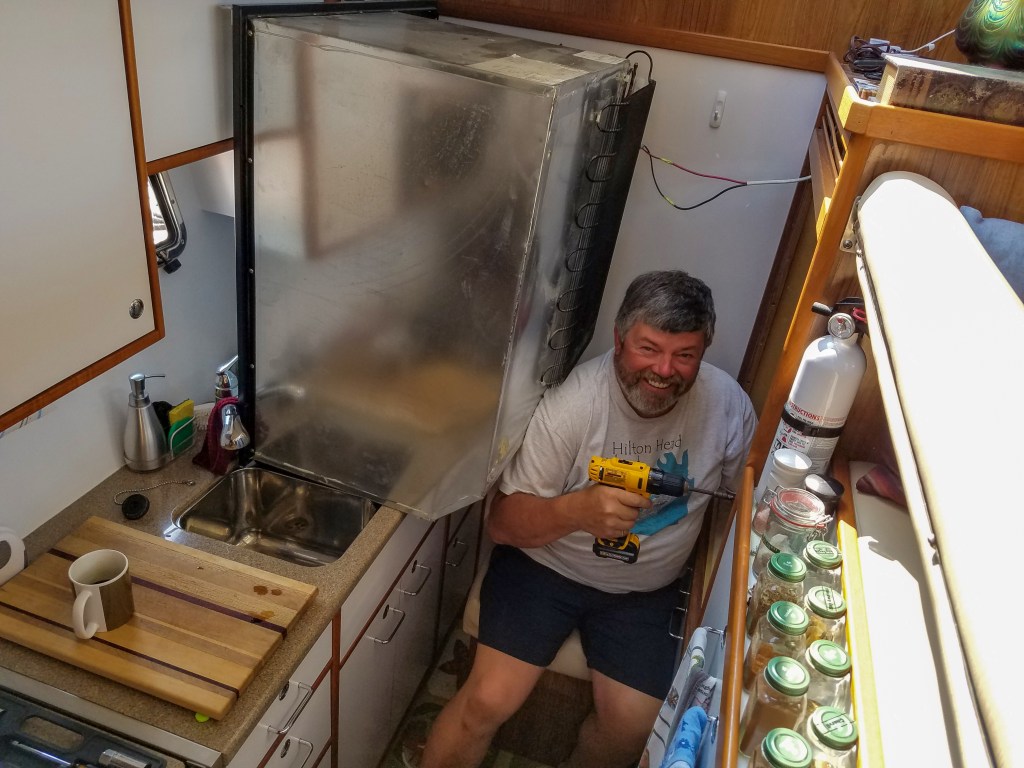
Later in the morning the local harbor host came over to see if there was anything we needed.  I chatted with him, but Dick was tied up with the lighting project and didn’t realize we had a visitor.  I finished and published the next installment of the blog while Dick replaced the fluorescent light fixture in his bathroom.  This was another electrical project that required 3 hands and a certain amount of adult language to complete.  The bathroom is now exceptionally well lit!

Our dinner in the evening was at a French bistro, Restaurant Orsay.  It was an enormous place, and at first it looked as though we would be seated in a very crowded, noisy place with tiny tables and uncomfortable looking chairs.  However, our hostess led us through a rather dark concrete tunnel-like corridor (where the heck are we going!) past the kitchen, and out into a pleasant, spacious, and quiet area.  We were also delighted to be seated at one of the larger tables.

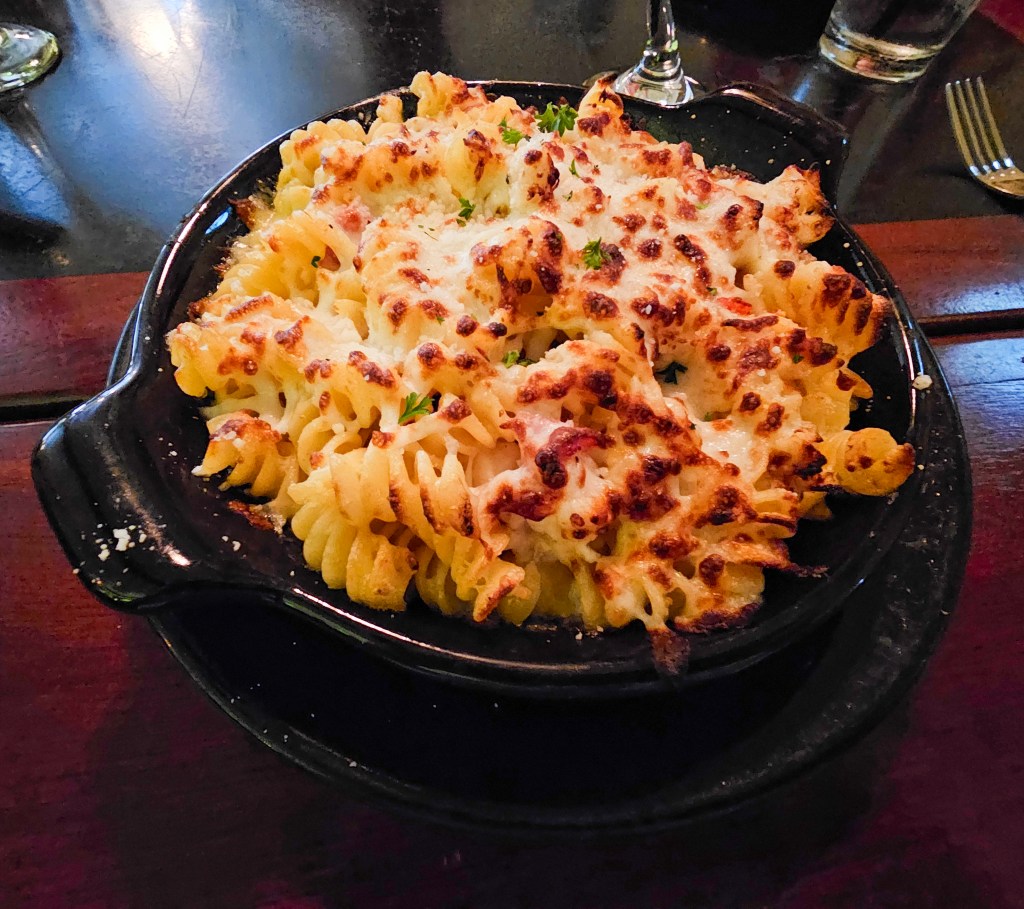
The meal was mostly very good.  I started with a smoked trout dip, served with interesting cornmeal biscuits.  Dick ordered escargots, that came in puff pastry with a lovely mushroom sauce.  I tried lobster pot pie for my main dish.  The lobster was absolutely delicious, perfectly cooked, not tough as it can be sometimes, in a delicate sauce.  The dish fell short because of roasted vegetables that were well overcooked.  It may be an easy option, but it really is time to get rid of the fashion for roasting vegetables!  Too often it is an excuse for using up produce that is past its prime, although that was not the case on this occasion, they were just burnt. The biscuit that served as the “pie” was a tasty traditional southern style biscuit, but the flavour was too intense, and it overcame the delicate lobster and sauce.  I ignored the biscuit and enjoyed the dish with French bread instead.

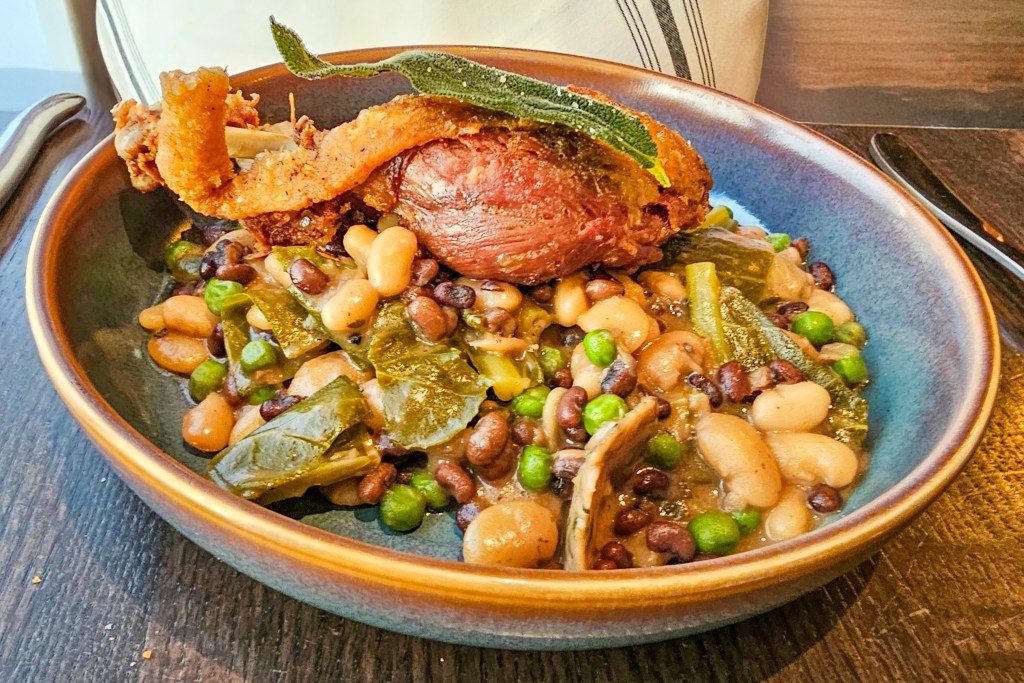
There were several favourite offerings for Dick to choose from, but he decided on cassoulet, which he enjoyed.

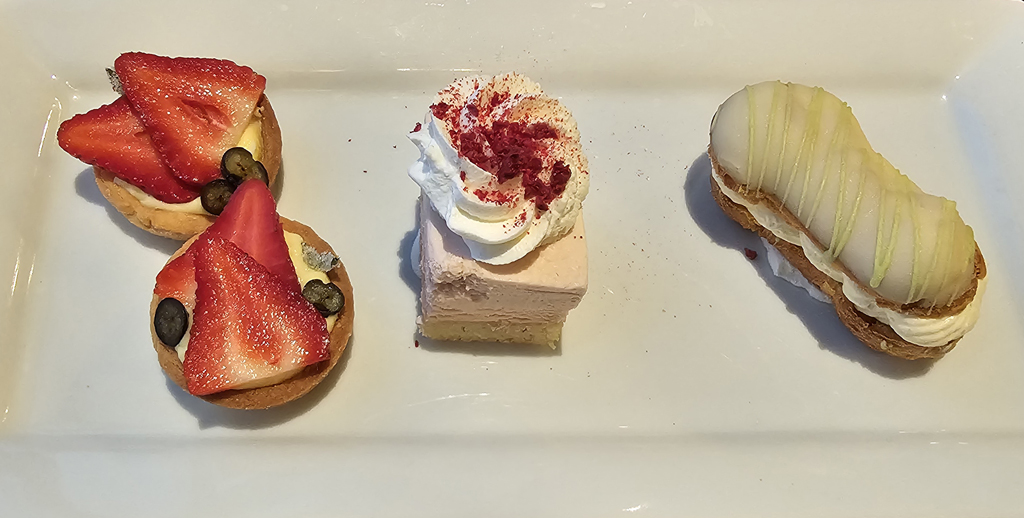
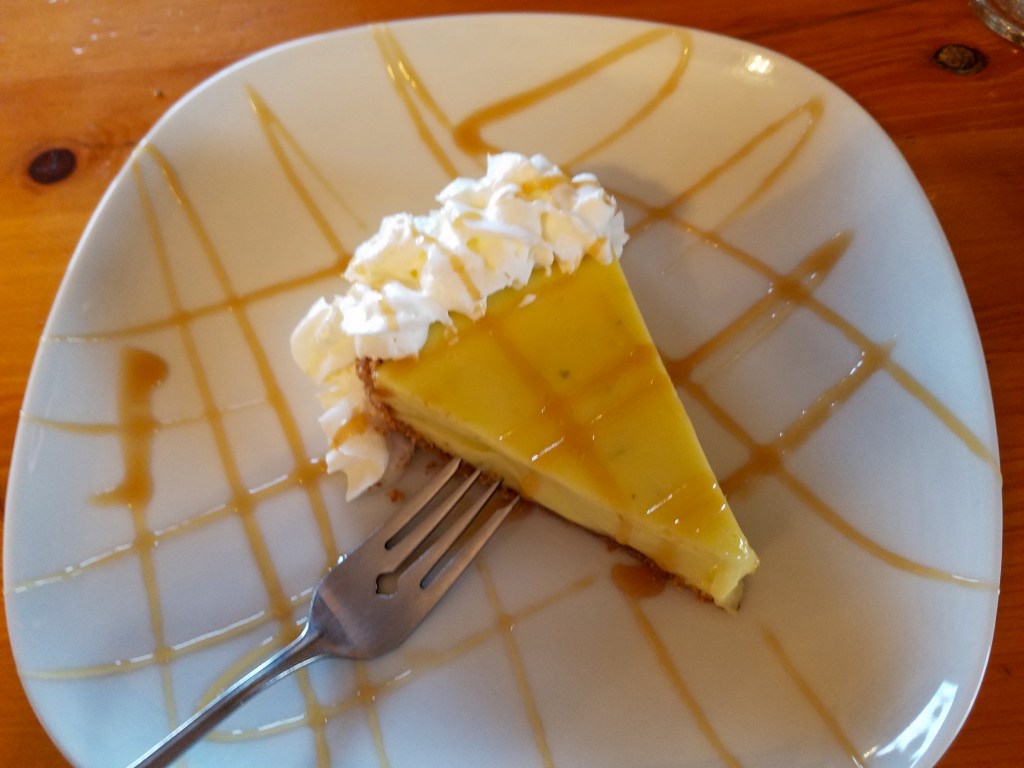
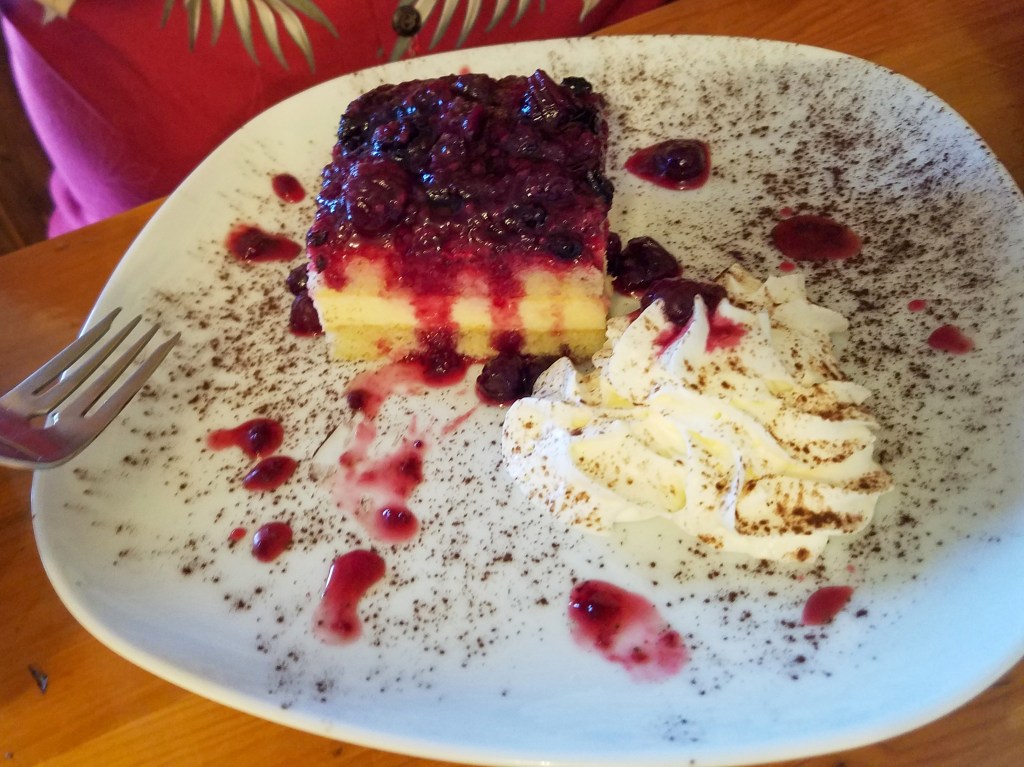
The restaurant has a dedicated pastry chef on staff, and it showed.  So often a meal is let down by mass-produced or frozen desserts.  Here, one could choose a small version of several of the dessert offerings, so we decided to share 3.  Dick’s favourite was a beautiful fruit tart, while I loved the raspberry mousse.  We both liked the éclair, unusually presented with key lime filling and glaze instead of chocolate.  It was a wonderful finish to an excellent evening.
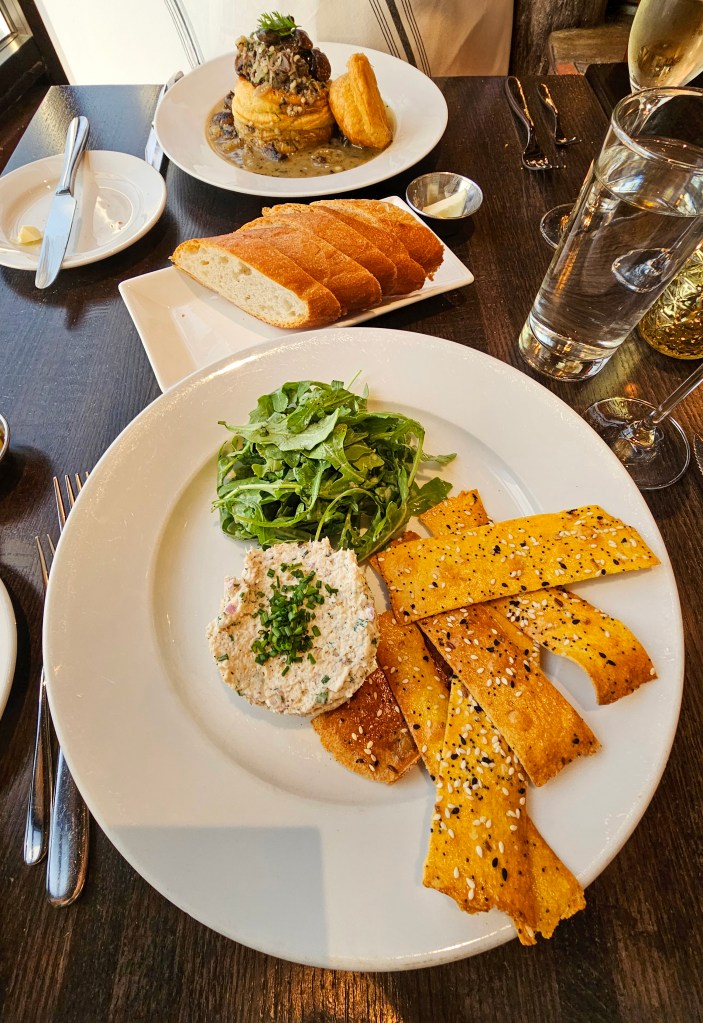
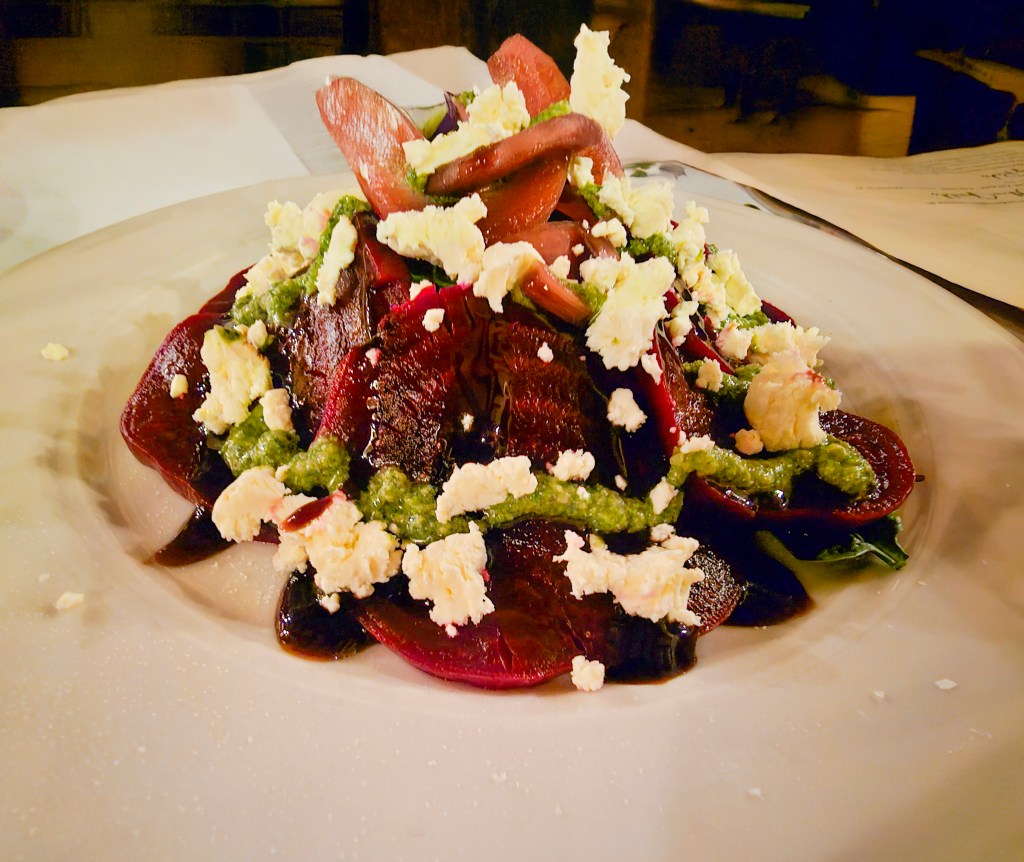
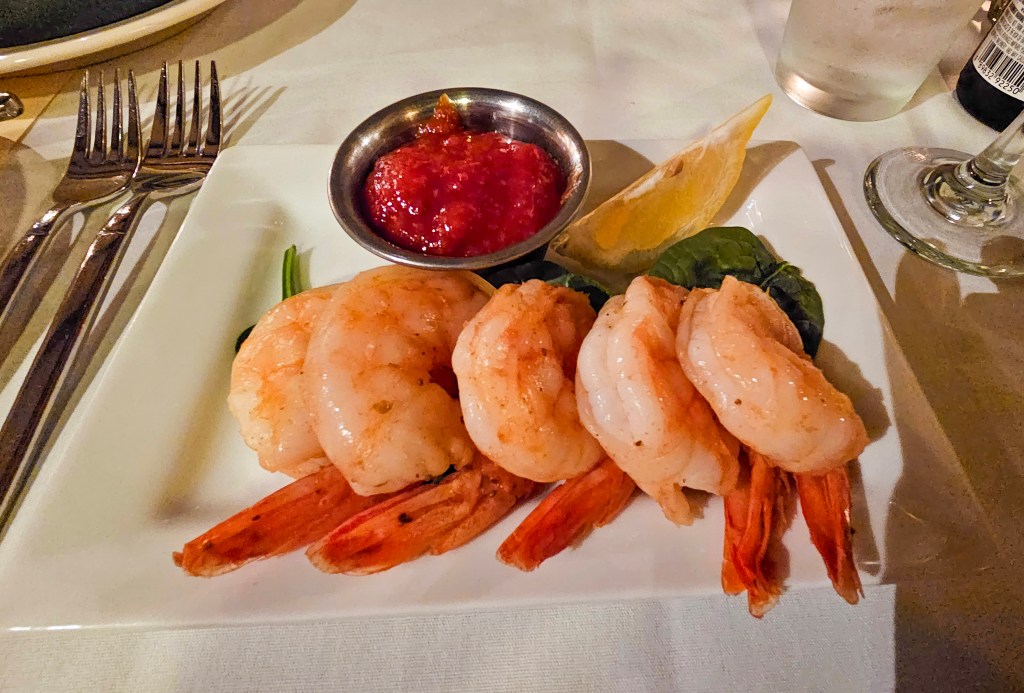
Restaurant Orsay starters
Lobster Pot Pie at Restaurant Orsay
Cassoulet at Restaurant Orsay
Delicious desserts at Restaurant Orsay
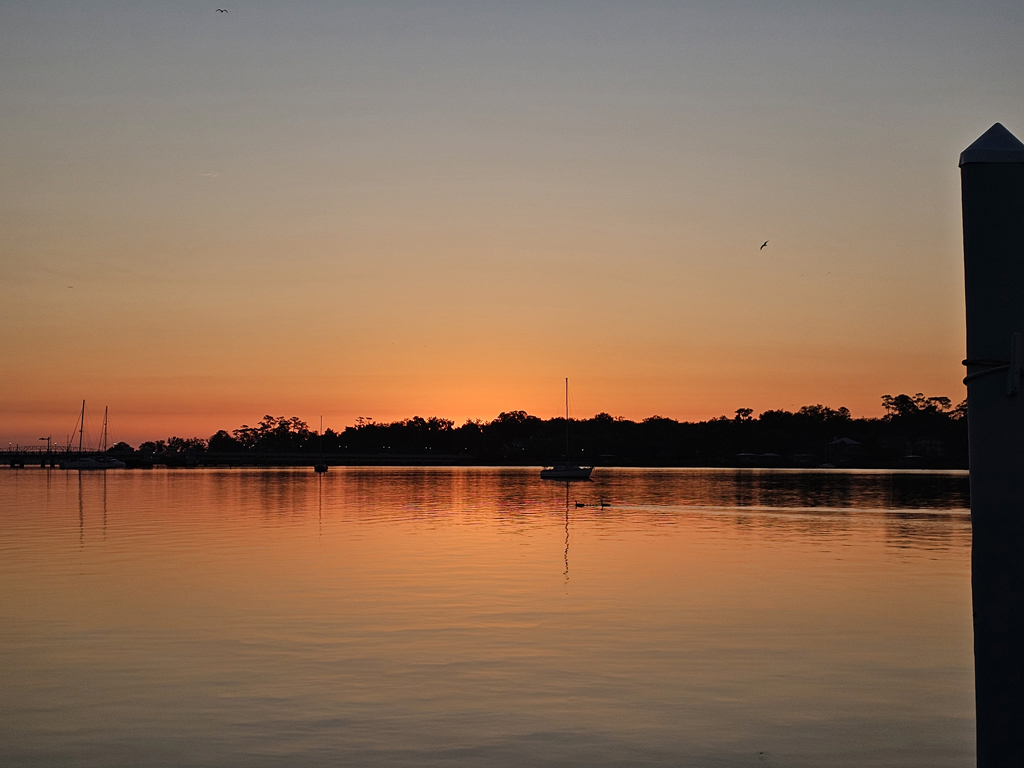
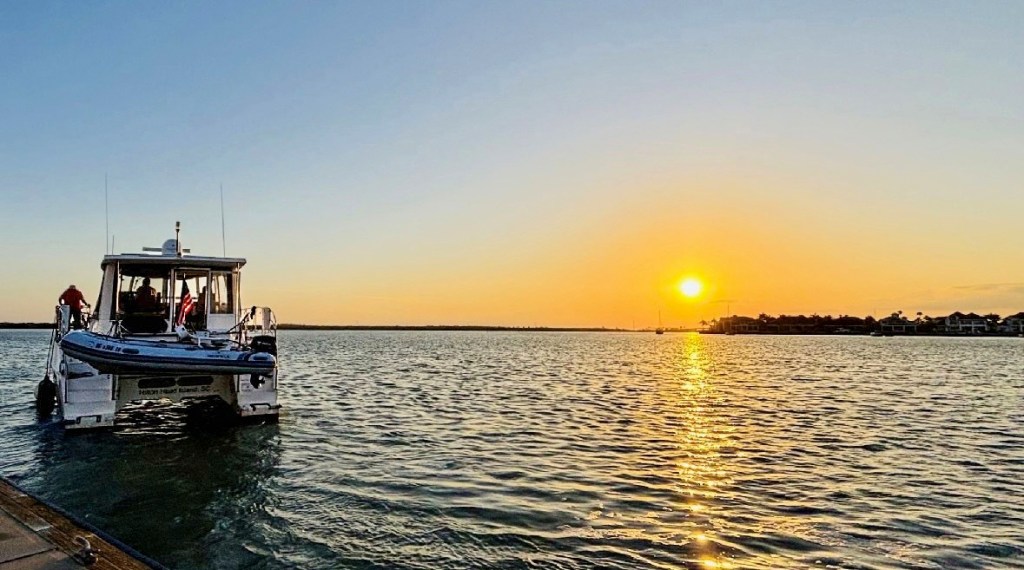
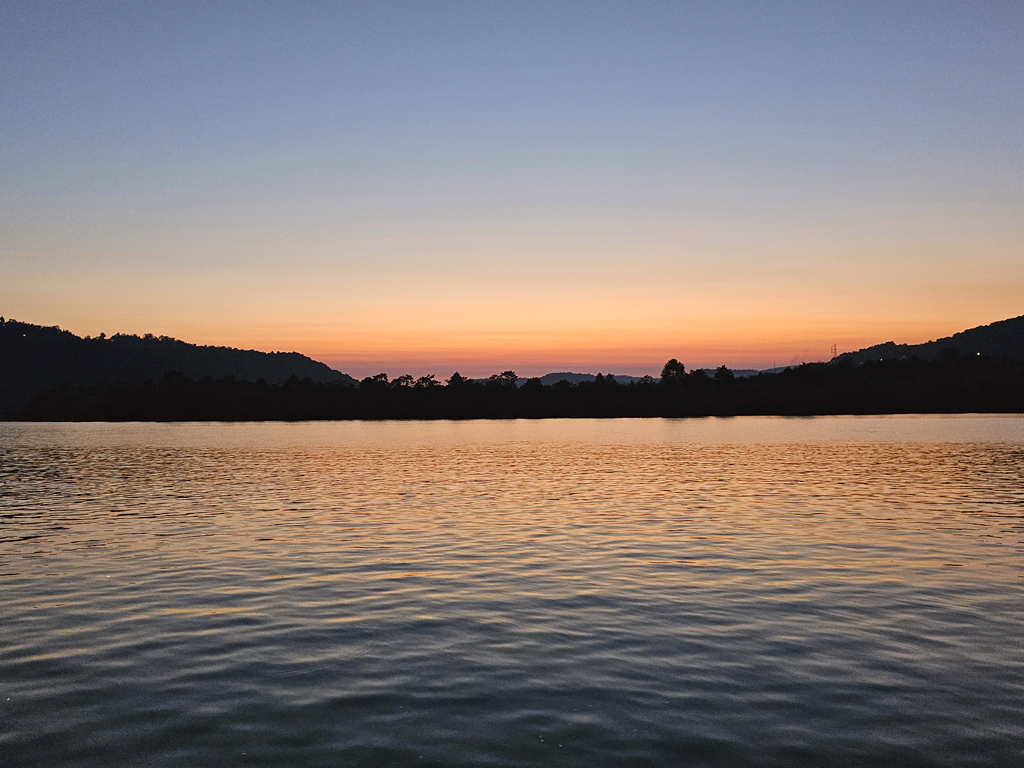
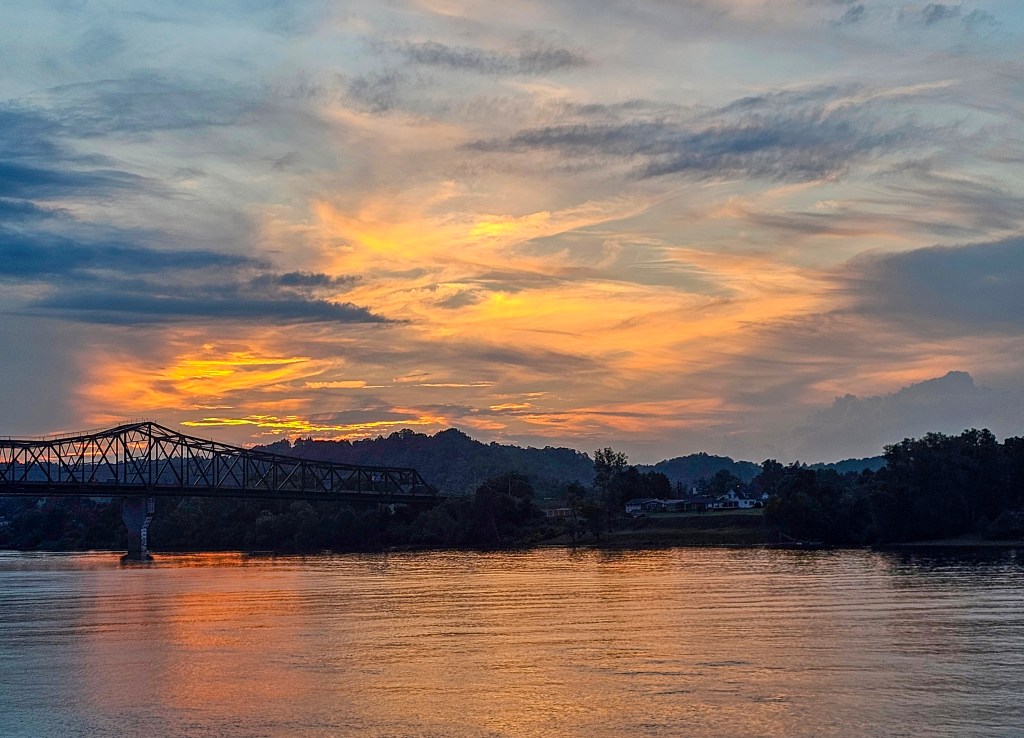
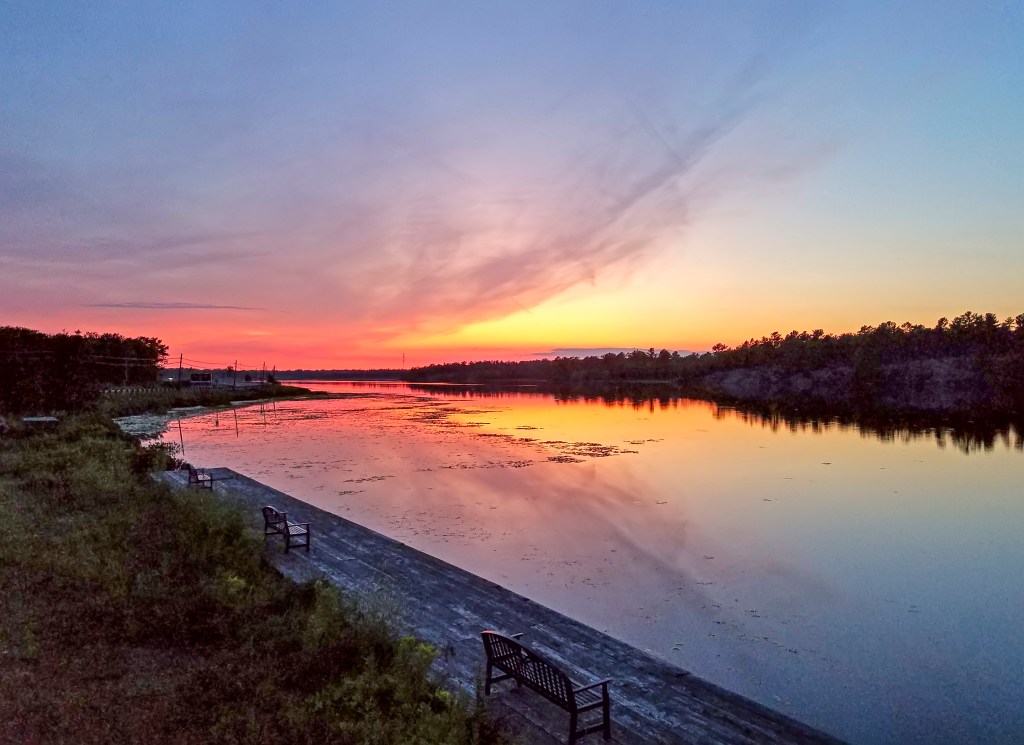
Jacksonville sunset

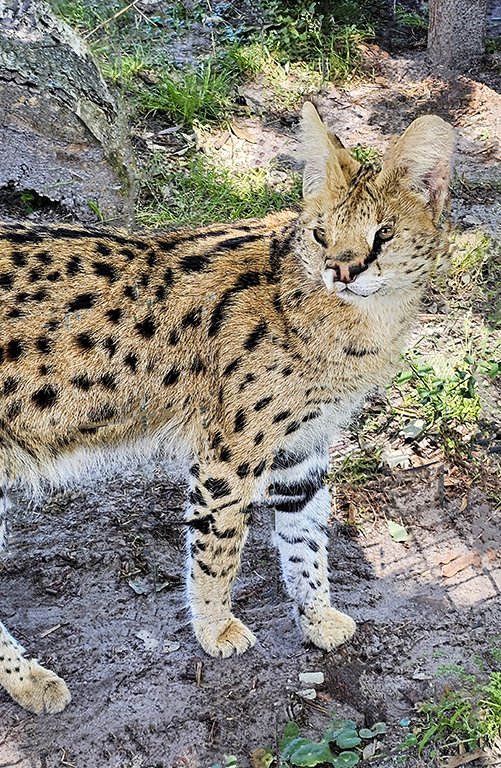
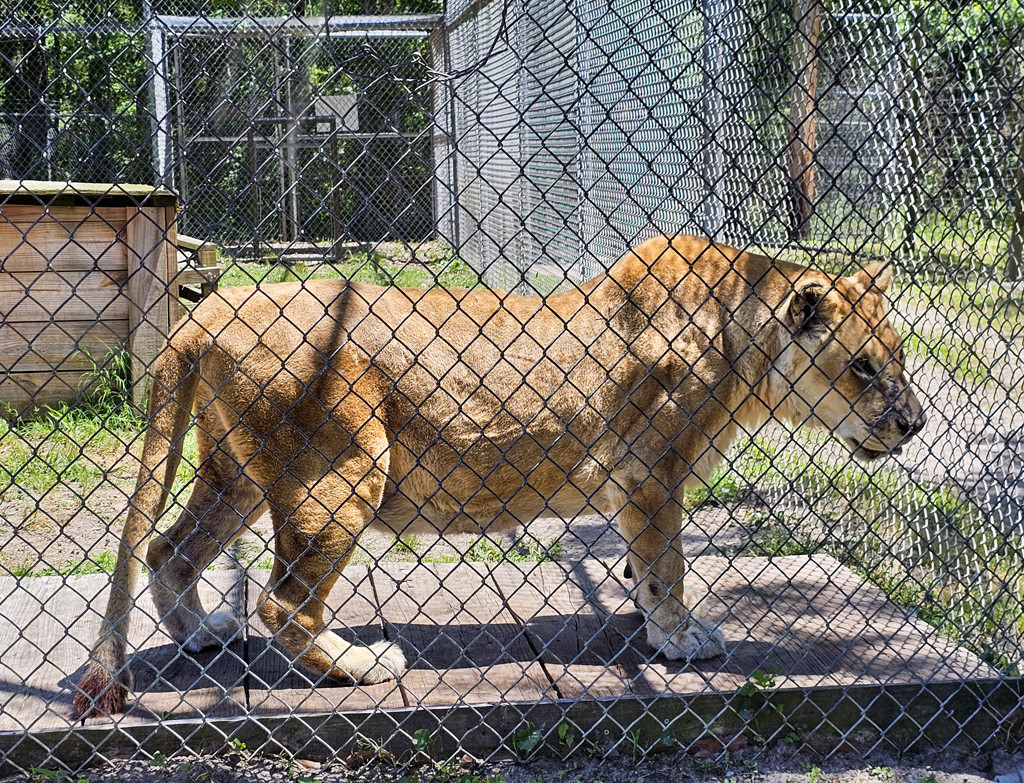
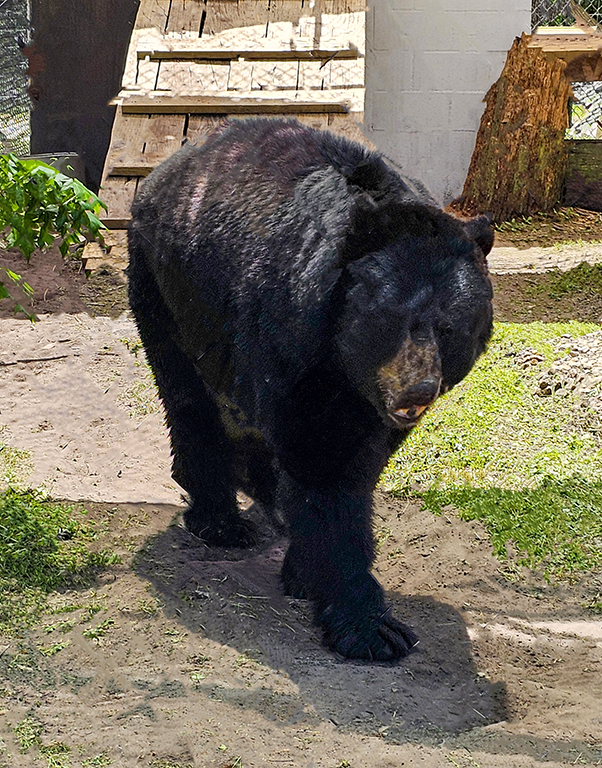
Friday was a busy and interesting day.  Dick set off for groceries in the morning.  Shortly after noon we drove to Catty Shack Ranch Wildlife Sanctuary.  Their mission is to rescue large cats that have been seized by law enforcement or are made homeless by zoos or private collections closing down.  They have expanded to include other animals, and now have 2 bears and some coatimundi.

We enjoyed the visit, even though, as expected, most of the cats were sleeping as they do through most of the day.  It is possible to attend the night-time feeding, so we may consider a future visit for that.  These animals have spent their lives in captivity, some of them in terrible conditions, so they are used to being in enclosures.  There is plenty of stimulation, including giant plastic balls, that given their scratched condition, are popular for playtime!  The owner and volunteers get around in golf carts, and we were amused to see that if a golf cart stopped near an enclosure, the fast asleep kitty would immediately get up and come over to the fence, in anticipation of a little snack.

Even when the animals are elderly or infirm, they are looked after and provided with special ramps in their enclosures to allow them to enjoy a peaceful old age.
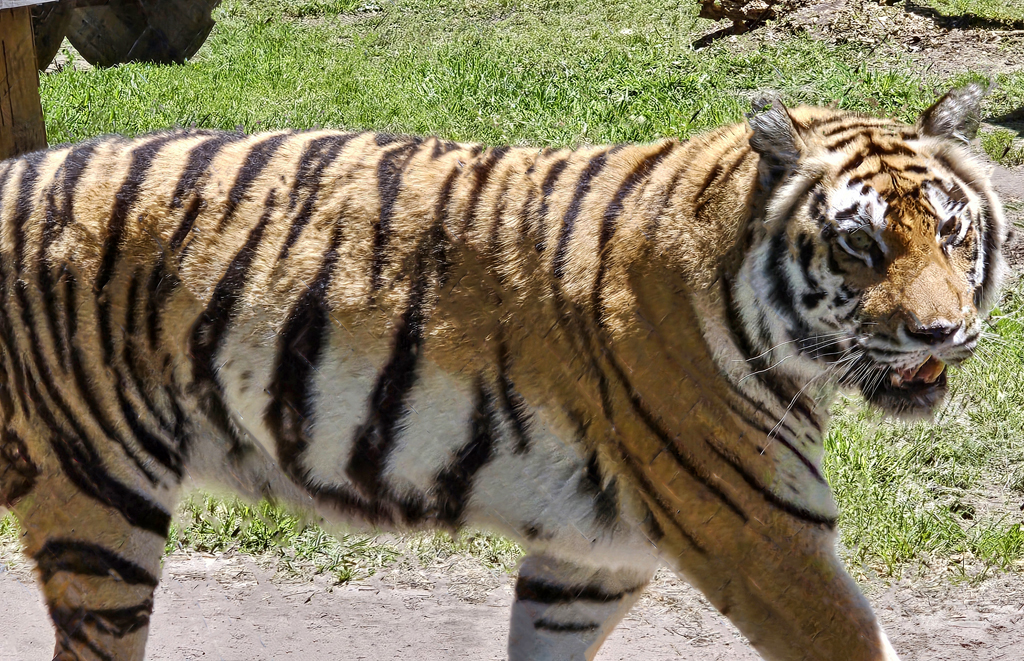
Catty Shack tiger
Catty Shack bear
Serval at Catty Shack
Serval expressing an opinion
Elderly and infirm animals are well looked after and allowed to live out their years in comfort

In the evening, we went to La Cena Ristorante, a well-regarded Italian eatery.  It was an odd experience.  Reservations are only taken by phone, and the owner stresses the first of many rules, no young children, and no strong personal scents.  A sign also repeats these requirements at the door.  The whole first page of the menu sets out more rules in great detail.  The rules are basically a push-back on the increasingly common practice of diners sharing just one appetizer and entrée.  You can share an appetizer, but if you share an entrée, the upcharge will be the same as if 2 entrees are ordered.  The same if you order a second appetizer instead of an entrée, you will be charged an entrée price.  The whole meal must be ordered all at the same time.  We fully understand why a restaurant may wish to make these policies, but we did notice that on a Friday evening, the venue was less than half full.

The meal was delicious, and we followed the proper Italian custom of a second, small pasta course between the appetizer and the entrée. A salad was included, as was the most delicious bread.  As we arrived early for our reservation, the whole restaurant smelled heavenly.  The bread is baked inhouse.  In response to our compliments, a whole loaf was given to us to take home, just as we were wondering whether we dared ask if we could order a loaf to go

Saturday turned out to be a quiet day.  After Dick completed the grocery shopping at a supermarket he had forgotten to visit the day before, I walked the docks in the marina and issued some invitations for docktails the next day.  After that, it was very hot and humid, so we decided we would not do the afternoon outing we had planned.  Either the heat or something I ate disagreed with me, so we also cancelled our dinner reservation for the evening.  Dick’s wallet was happy for the reprieve, but we were both sorry to miss the venue – a steakhouse in a historic former bank building in downtown Jacksonville.
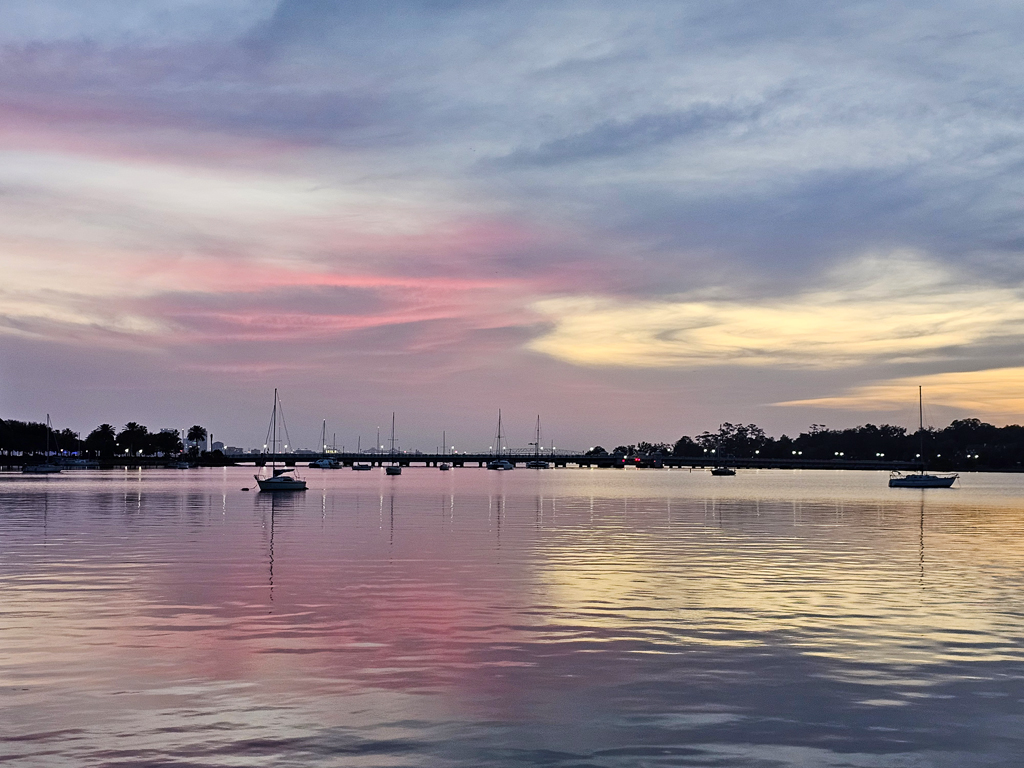
Sunrise in Jacksonville

On Sunday we went for a short drive through some very attractive neighbourhoods near downtown.  The housing is all different styles and sizes, at a guess, most date from between the wars.  We also drove across the bridge over the Ortega River and through another attractive suburb.  Here, the houses on the shoreline are much larger, many of them with imposing gates, while the homes further inland are smaller as the cross-streets get farther from the waterfront.

Late afternoon, we hosted docktails.  There were just 5 of us, as we were competing with a marina pot-luck gathering.  George joined us, he is a solo Looper from Texas.  We enjoyed meeting him and sharing stories.  It was great to spend time again with Sandy and Frank, and afterwards we went for pizza together.  Their boat has just sold, and they are moving to a larger one with plans to go through the Panama Canal and up the West Coast.  It is good news that higher-priced boats are still selling, gives us hope that Nine Lives will soon find a buyer.
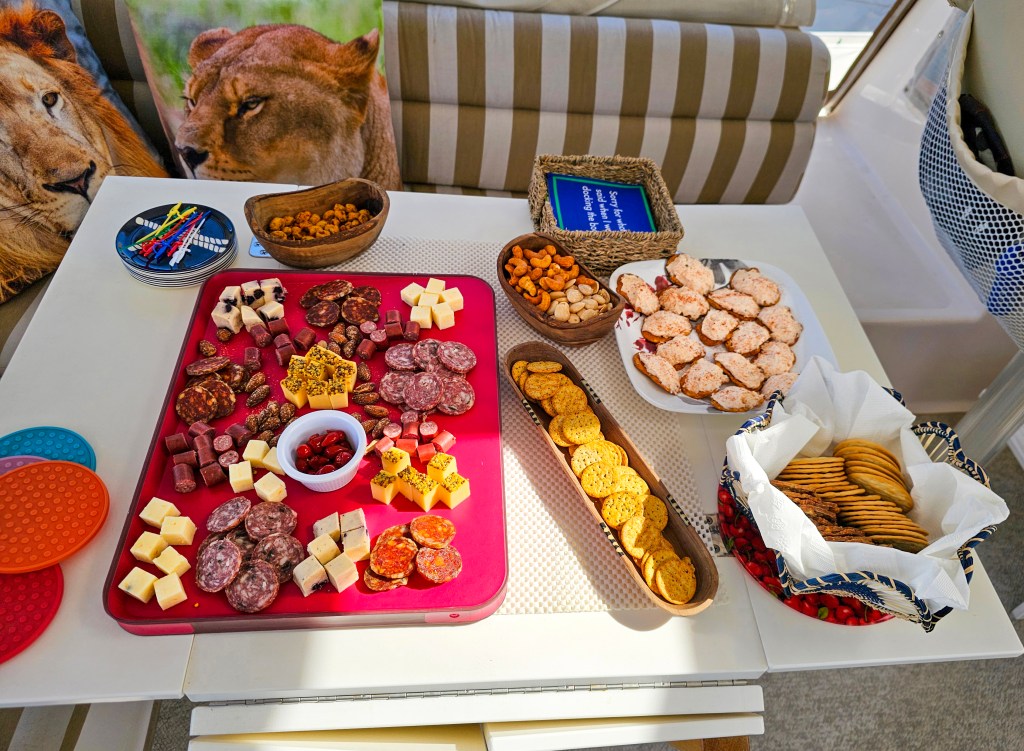
Docktails spread

Leaving the marina the next morning, we had to wait a few minutes for the railway bridge downtown.  Then, as we passed the highway bridge, a gentleman in a waterfront high-rise took pictures and posted them on Nebo, wishing us safe travels.
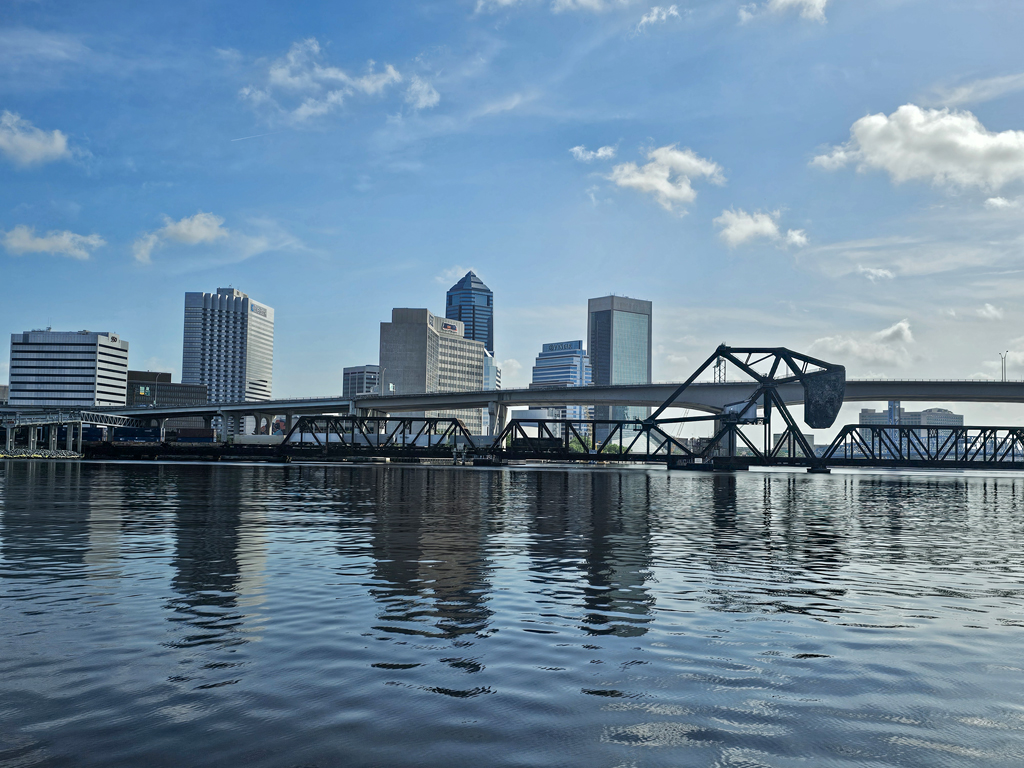
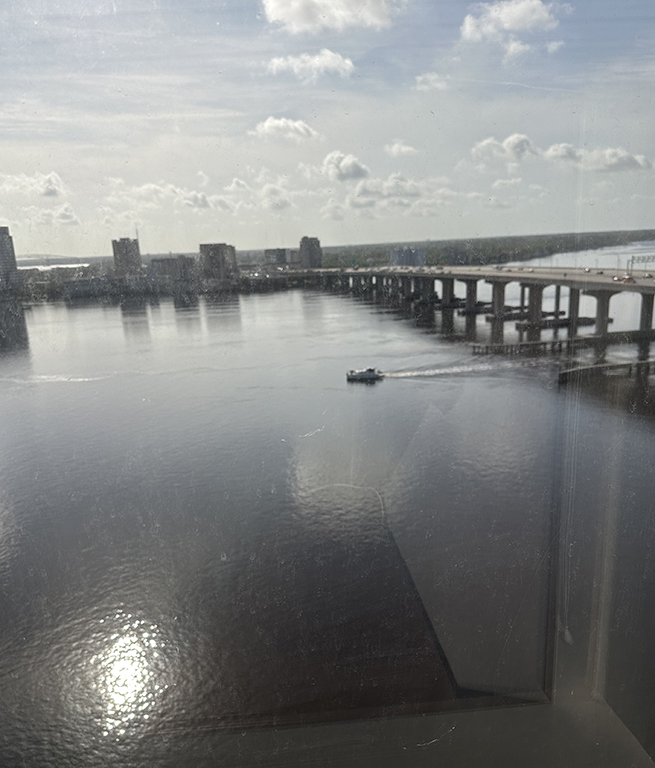
Jacksonville downtown railway bridge
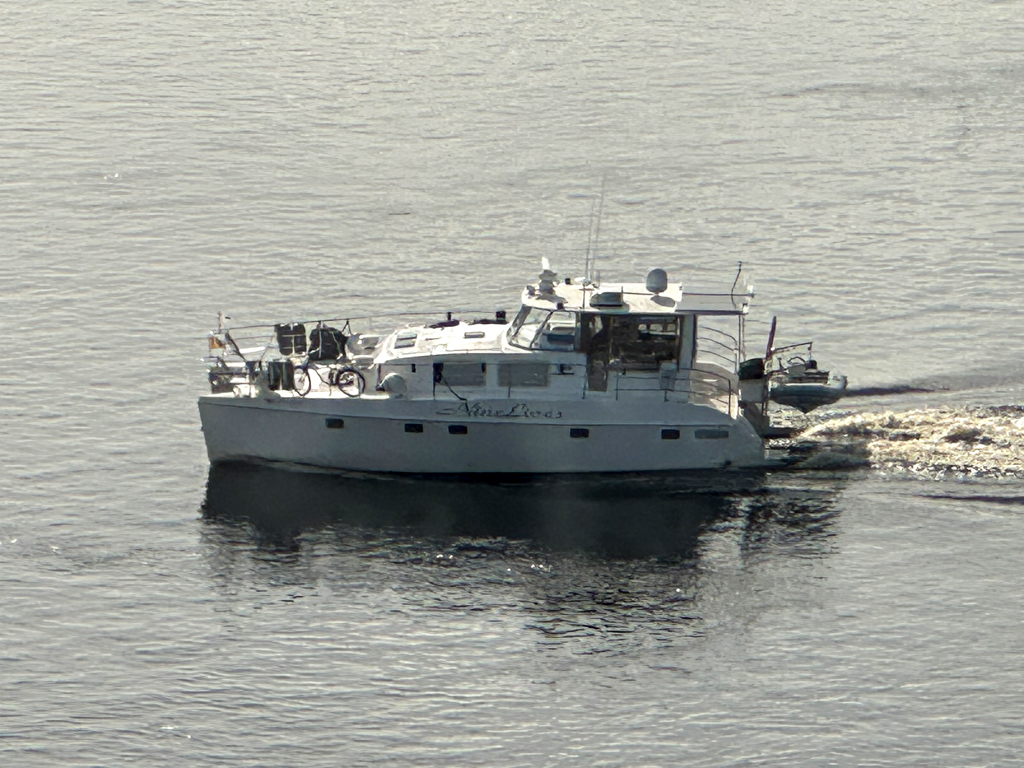
Nine Lives leaves Jacksonville
There she goes!

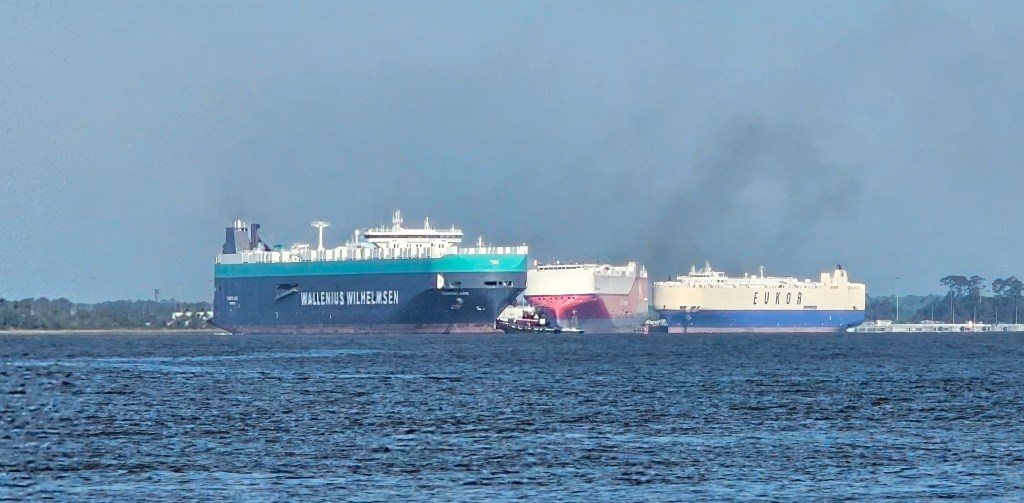
East of downtown, the Saint Johns River is an industrial port.  We met a huge vehicle carrier making its way upstream.  Further downriver was an even bigger one, maneuvering into dock with no less than 3 port police boats hovering to direct other boat traffic if needed. Our timing was good, and their docking was completed before we got there.
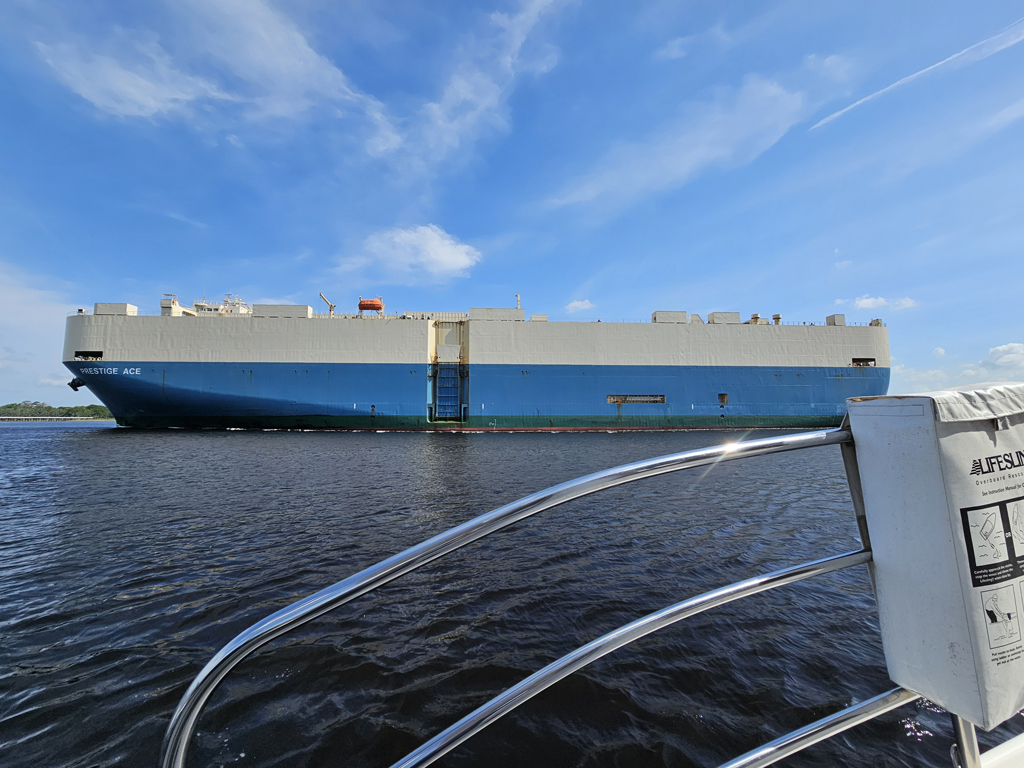
Car carrier entering Jacksonville Port

The next excitement was two Coast Guard boats practising something, tearing back and forth, apparently chasing each other.  The one doing most of the chasing had a gun in the bow.  I decided that it would be prudent to take my pictures from inside the cockpit, rather than going out on deck as I usually do.
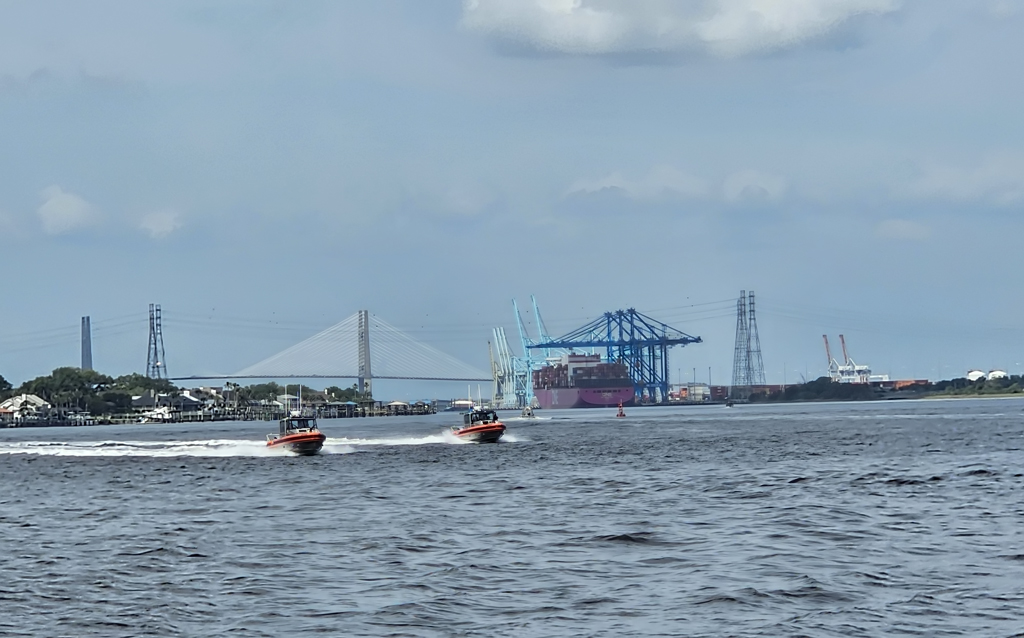
Coast Guard boats practising in Jacksonville Port

We are certainly back in the “Low Country”, with a lot of shallows and the channel meandering back and forth.  We have to pay close attention to both charts.  We passed the railway bridge, and the very narrow channel to one of the marinas on Amelia Island.  In 2017, we tried multiple times to get into that channel with zero success.  Although dredged, it was V-shape rather than U-shape, and Nine Lives with her two well-spaced hulls simply did not fit.  It was our first really tough setback on our maiden voyage to bring Nine Lives round to Hilton Head.  We had to continue on, into the inlet, and up the St Mary’s River with a small craft warning and very difficult dockage at the end. We shuddered as we passed that channel, which looks no better today than it did in January 2017!

We docked without incident in downtown Fernandina Beach, one of our favourite towns.  As we enjoyed our early evening cocktail, we noticed a young woman with a skateboard.  The docks here are only secured at night, and as we have seen in other places, it is a common thing for people to walk around and look at the boats.  This young lady had the kind of skateboard with a large ball or wheel in the middle.  Research suggests that they are highly controversial and quite dangerous.  She was clearly wobbly, still learning how to use the board, and we wondered whether she and her skateboard were about to enjoy an unplanned swim.  Sadly, it was a lot more serious.  She hit the cover that goes across the dock (ironically, it’s there so people don’t trip on boat power cords and hoses), and she came off at speed onto the concrete dock.  A nearby boater with medical training helped and medics were called.  It was a reminder that NO wheeled vehicles of any kind should be ridden on docks.
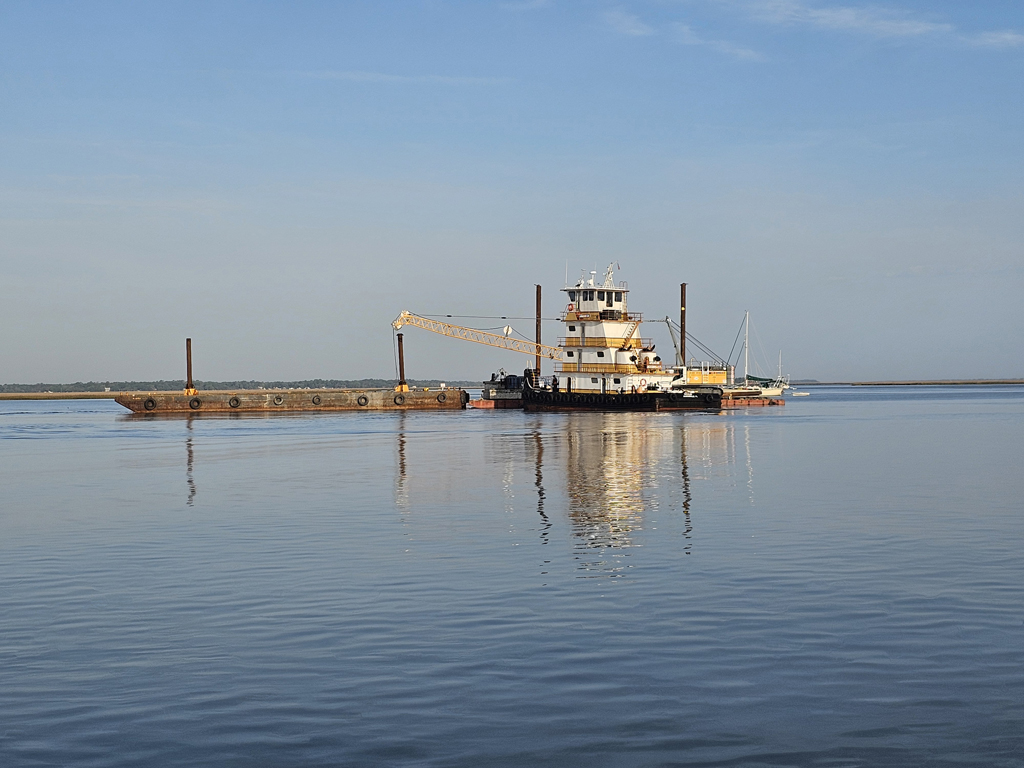
A barge moves a dredge in Fernandina Beach. We called this the wedding cake barge!

We enjoyed a lovely walk around the town the next day.  We bought some nice things, paused for a refreshing beverage at the famous (or infamous) Palace Saloon, and then we ate lunch in the form of some excellent ice cream.  After that, a nap was required.
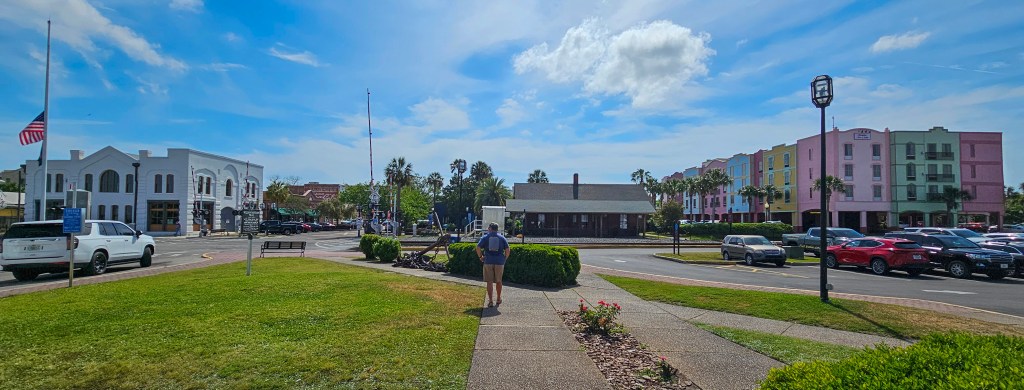
Fernandina Beach downtown from the marina
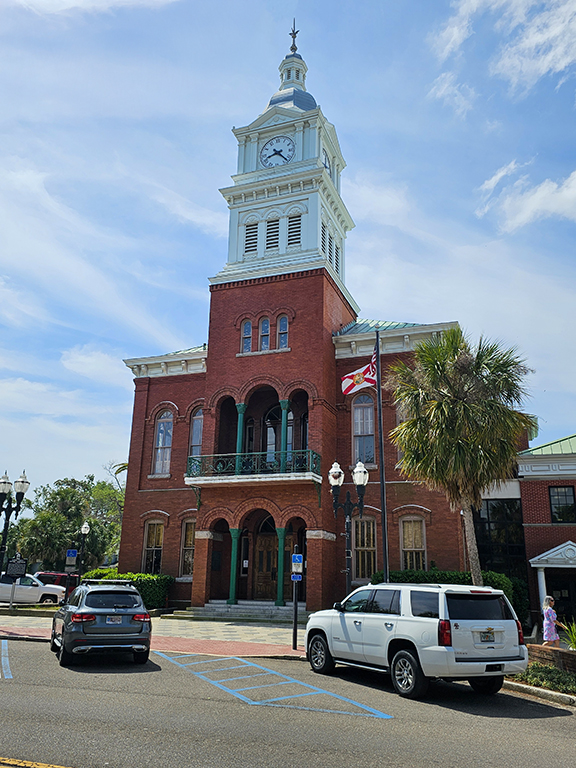
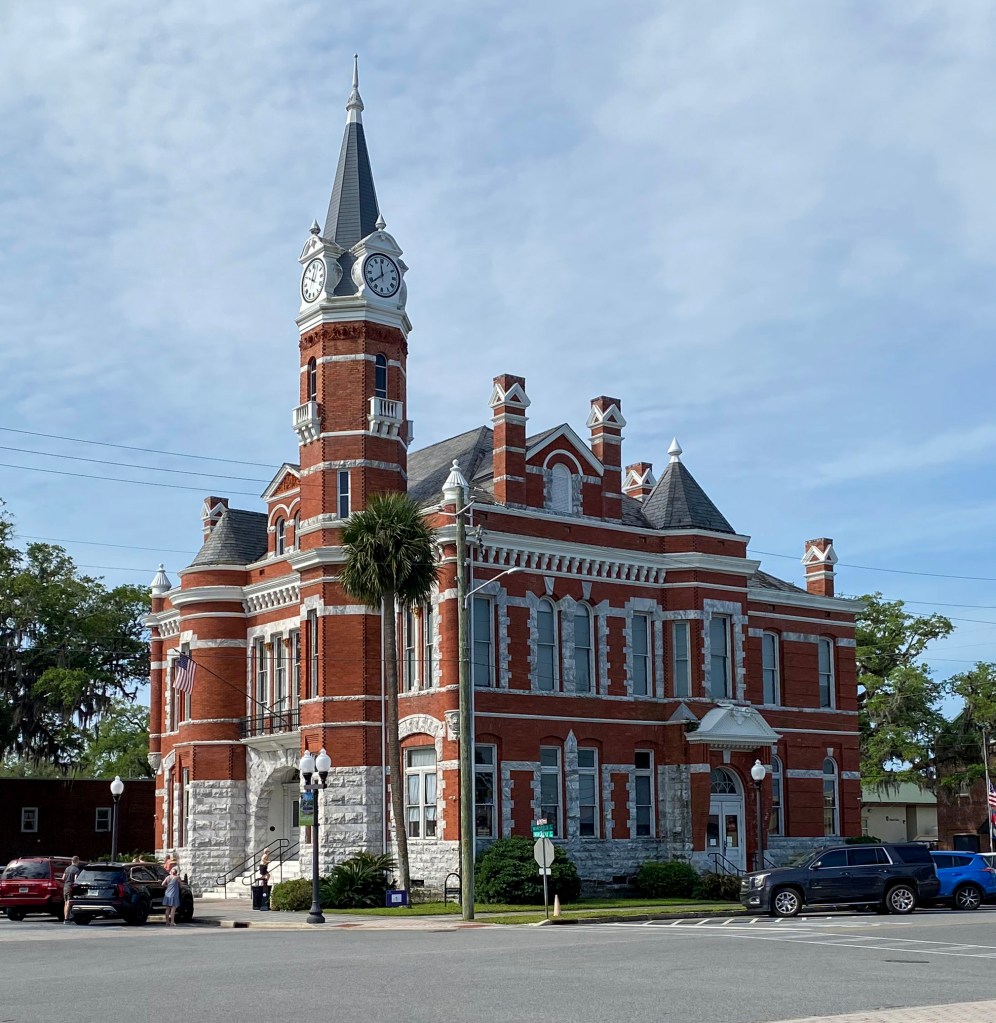
Fernandina Beach County Courthouse
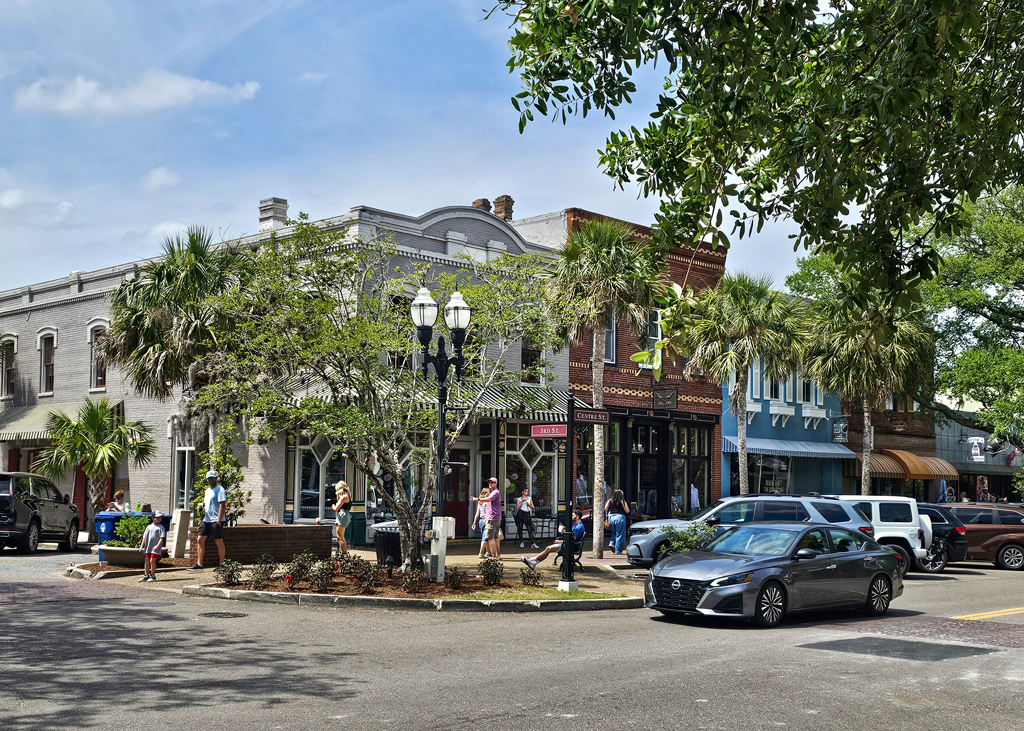
Downtown shops in Fernandina Beach
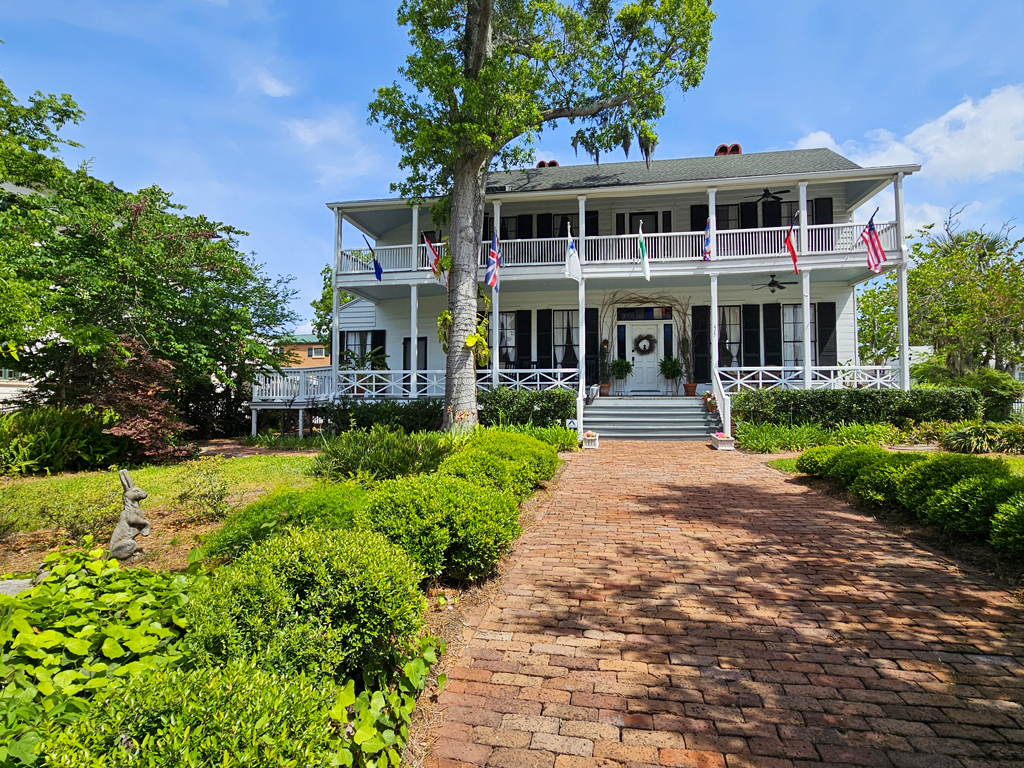
Lesesne House
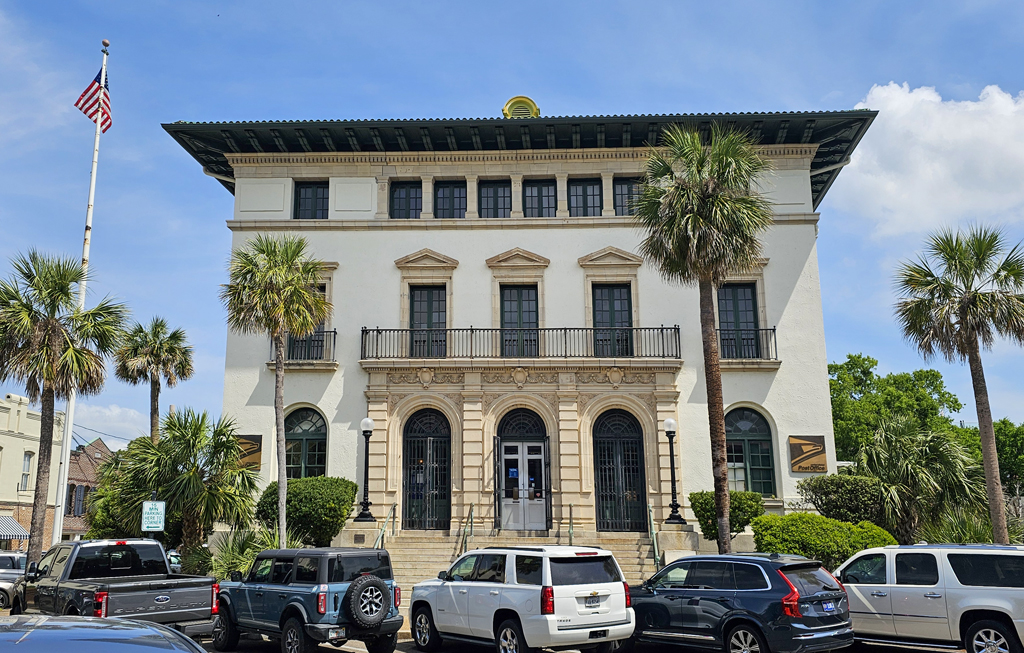
Fernandina Beach Post Office
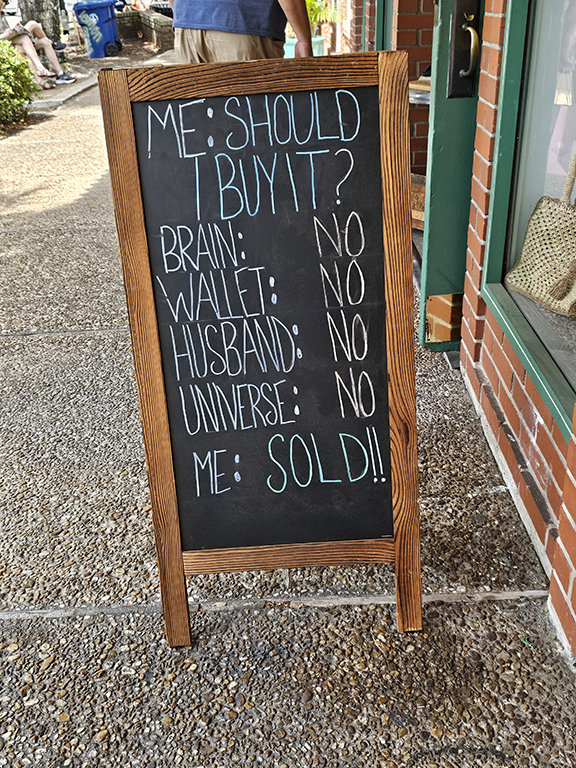
Shopping in Fernandina Beach
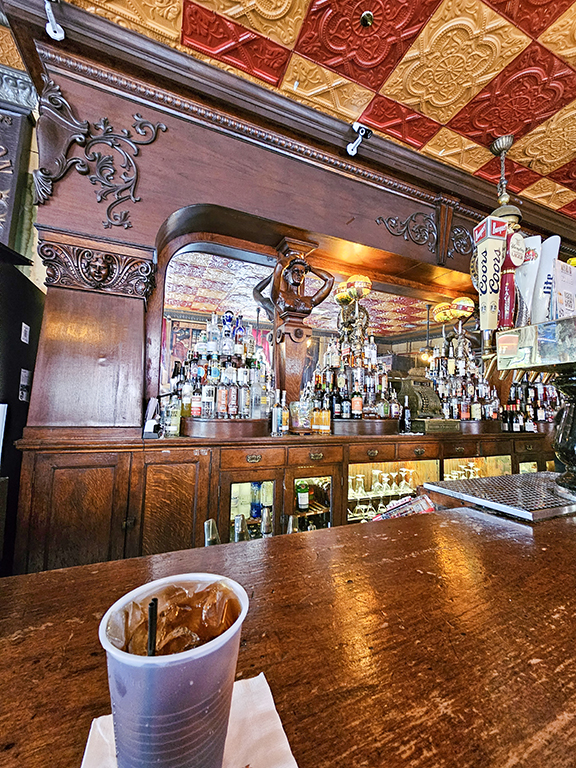
Drinks in the Palace Saloon

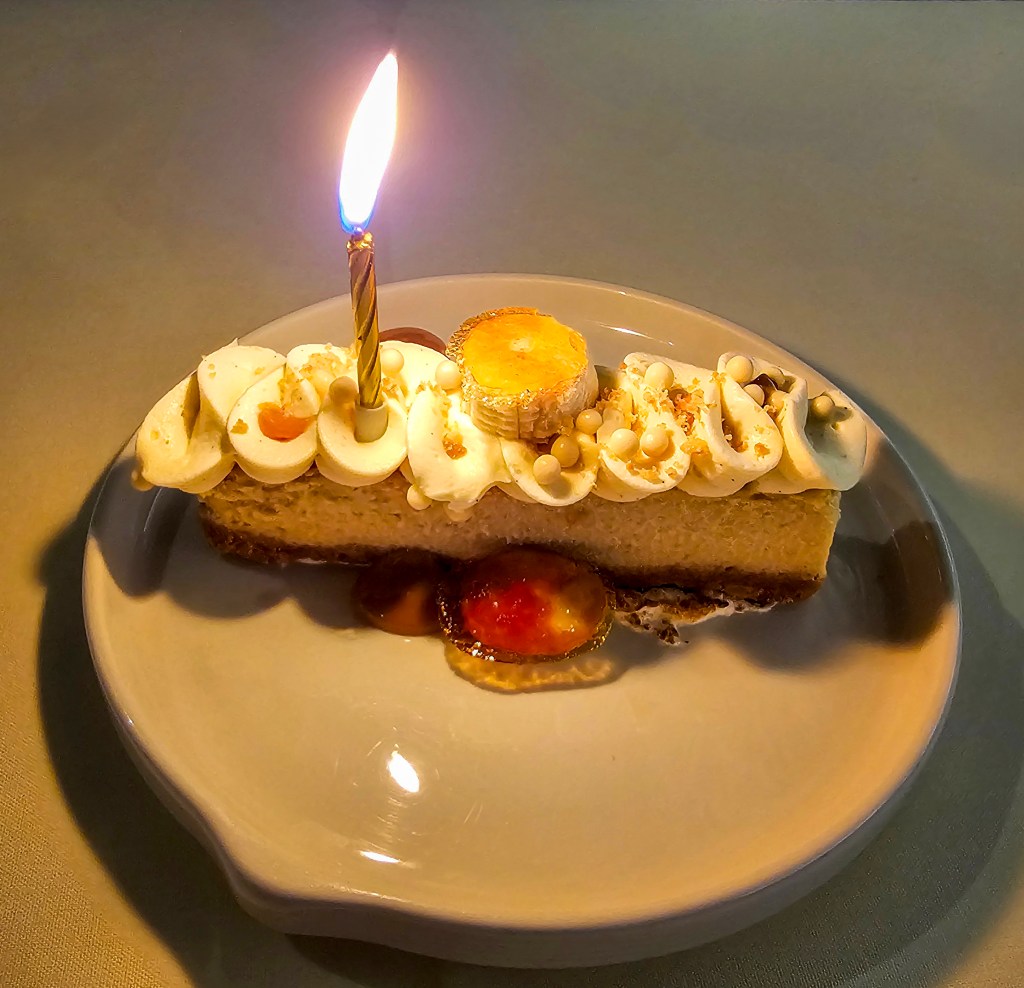
In the evening, we walked down a road with beautiful old homes to David’s, a restaurant we had visited a few years ago.  It was a day early, but a lovely birthday dinner for me.  There was even a candle on the dessert!  We returned to a pretty sunset and enjoyed a postprandial glass of whiskey in the cockpit.
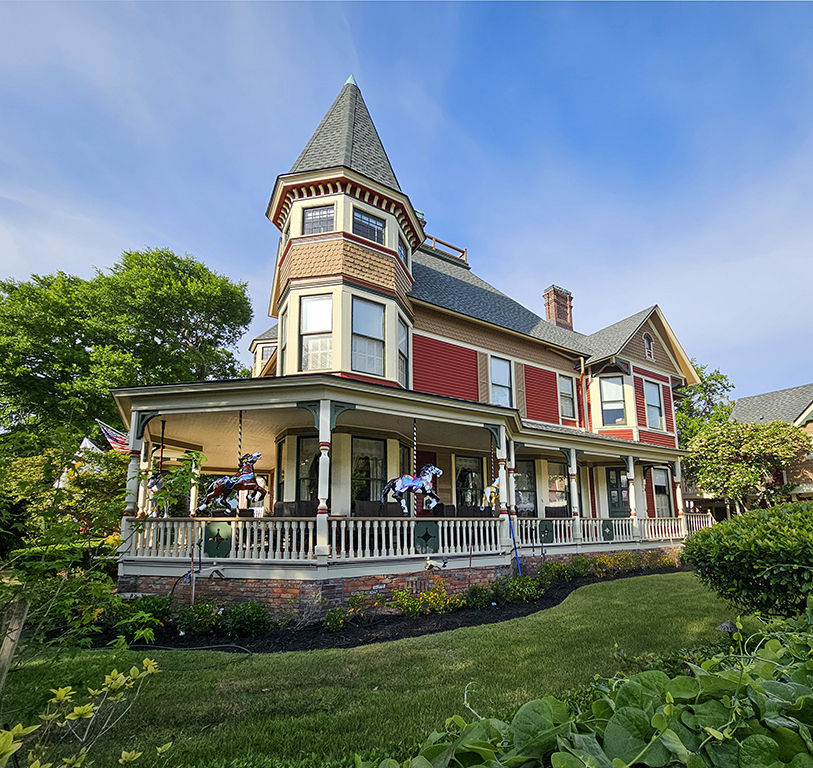
Bailey House, Fernandina Beach. Note the carousel horses on the porch.
David’s Restaurant starters
Dick’s surf and turf was filet steak and a lobster tail
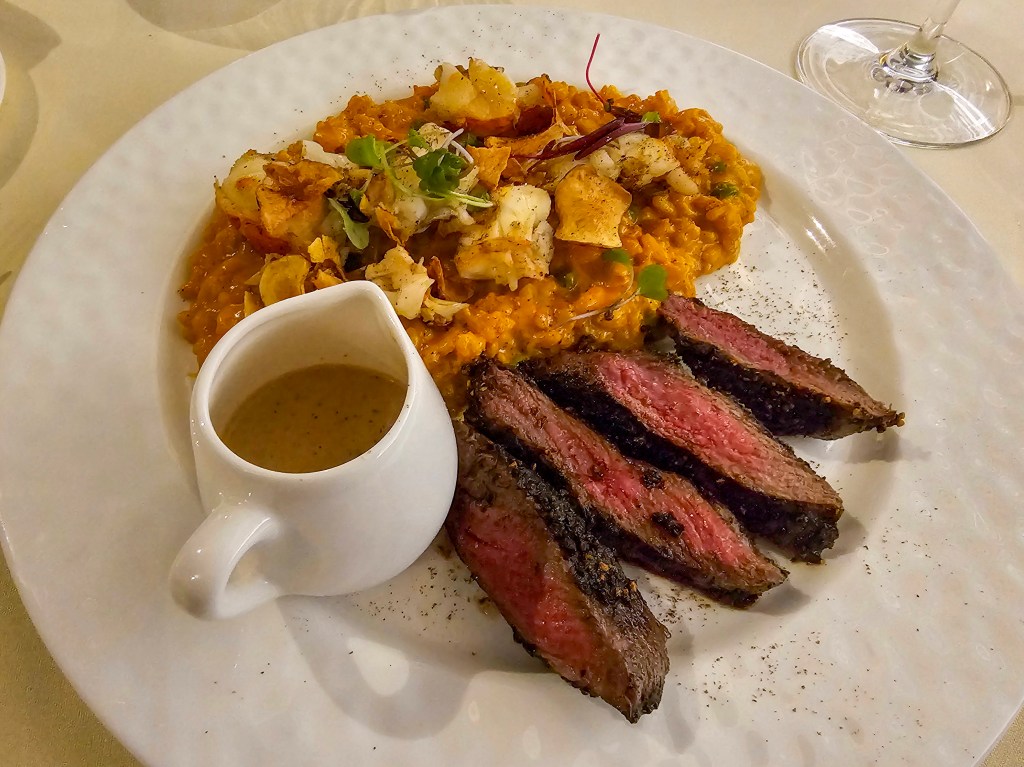
My surf and turf was filet steak and lobster risotto
A birthday candle on the dessert at David’s Restaurant
Sunset at Fernandina Beach

We left very late (after 11am) the next morning, because we only had a little over an hour to travel to St Marys.  Even then, when we arrived our slip was occupied.  They untied quickly and our docking was accomplished without drama.  After we had time to settle in, the dockhand took us on a golf cart tour of the town.  It was an interesting, and very opinionated tour!
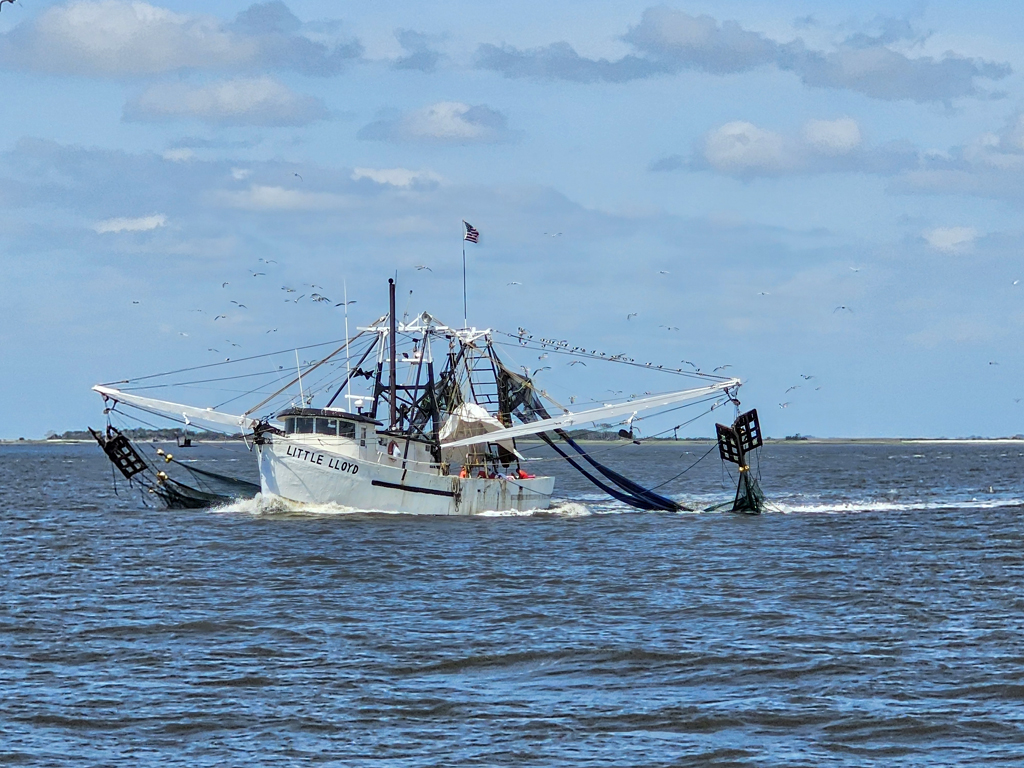
A shrimper in St Marys River

In the 1700’s the Acadian diaspora took place in 3 waves, beginning in 1755.  The British had been ceded what are today the Maritime provinces in Canada and some parts of Maine as part of the Treaty of Utrecht in 1713.  Over the next years, some of the French residents at the time, the Acadians, participated in French military operations against the British.  By 1755, if the Acadians refused to take an oath of allegiance, they were removed.  Initially, they were sent to the 13 colonies, and the more troublesome the individuals, the farther south they were sent.  500 were sent to South Carolina, and 300 were sent to Georgia.  Families were split up.  Keep in mind that these would have been large, farming families, with grown sons and daughters.  In some cases, women were sent to one place, fathers to another, and the children to a third destination.  Some of the women are buried in the St Marys cemetery.  What I found amazing when I researched the story was how determined the Acadians were.  Many of them simply returned to their homes in Acadia, and were deported again.  The second wave were sent to Britain and France, and even then, they took ship and tried to return.  Many were shipwrecked or died from other causes.  Ultimately, although none were sent to Louisiana by the British, it became a destination for the displaced Acadians, and they made their way there from the various places they had been sent.  They became the Cajun people, and contributed to the rich heritage of Louisiana.

The land for laying out the town was purchased in 1787, and the City of St Marys was incorporated in 1802.  It was the County Seat, twice, finally losing that status in 1923.

St Marys is the jumping-off point for visits to Cumberland Island.  I have stayed in the very characterful Riverside Hotel twice.  It was both eccentric and comfortable, and I am sure the dust on the stairs dated back to the 19th century!  According to our guide, much of the commercial property in the town has been bought up by a billionaire.  Most of the restaurants and shops are owned by him, although some are leased back to the previous owners.  He built a huge marina (still partly under construction) to accommodate his 100-foot yacht.  The docks appear to be fully functional, but there is no marina business there and no docked boats. We stayed at a small marina at the other side of town.
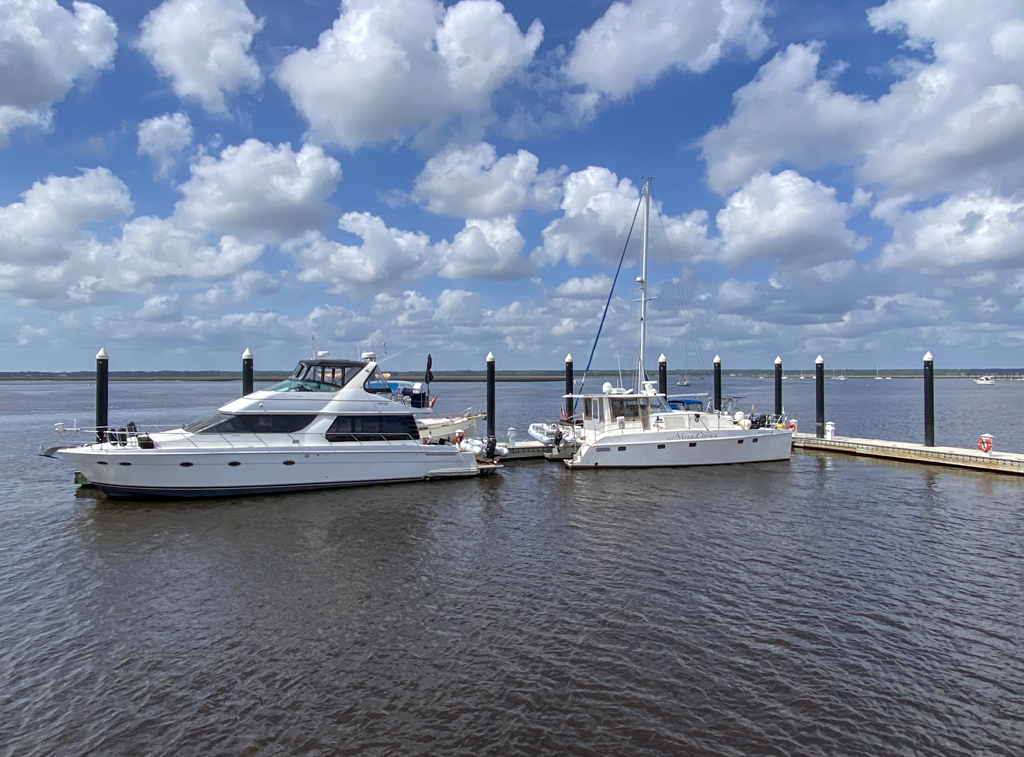
Nine Lives in the marina in St Marys

The town has always been quirky, and in the 8 or so years since I have been there, I saw definite improvements.  We are told there is a huge housing tract of over 3000 homes about to be built nearby, but at the moment, there are no jobs or local industry.  20% of the current residents are below the poverty line.  The nearby Kings Bay Submarine Base apparently does not provide much employment for outsiders, even though there are over 9000 people working there.

St Marys downtown
Orange Hall, a historic home in St Marys

We ate on board, then participated in a Loopers’ Zoom docktails session.  We chose the “Misadventures on the Loop” section, and were able to regale the participants with several of our mis-judgements and “I told you so” stories.  It was fun hearing other scary tales, although I suspect the lady who is just a few days into her Loop came away considerably more worried than amused.

We enjoyed a pleasant day in St Marys.  The farm to market shop was a bit of a hike, so Dick took his exercise and came back with some interesting goodies.  He also visited the small submarine museum.  In the afternoon, we explored the shops.  What looked like two similar home goods stores turned out to be something like an antique mall, but with lots of crafts and bric-a-brac as well.
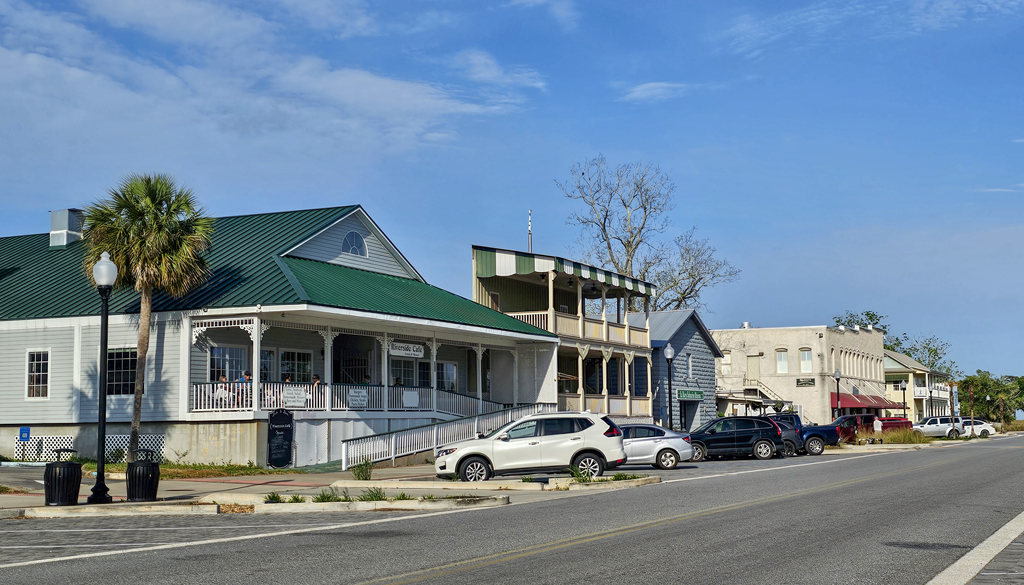
Another part of downtown St Marys

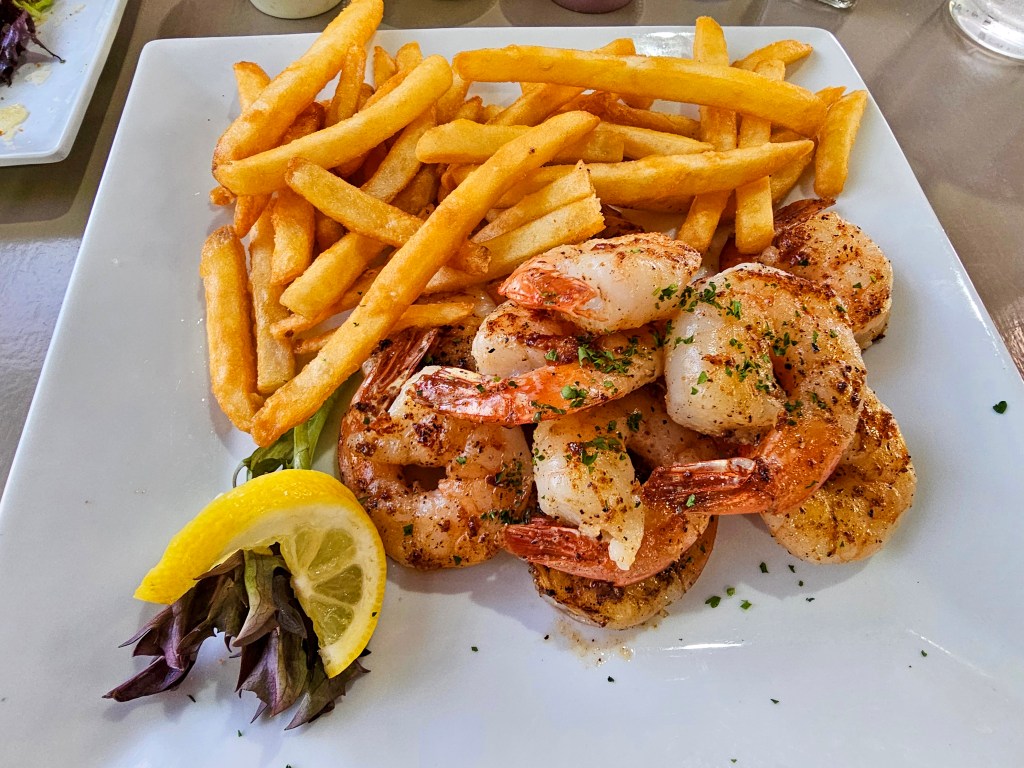
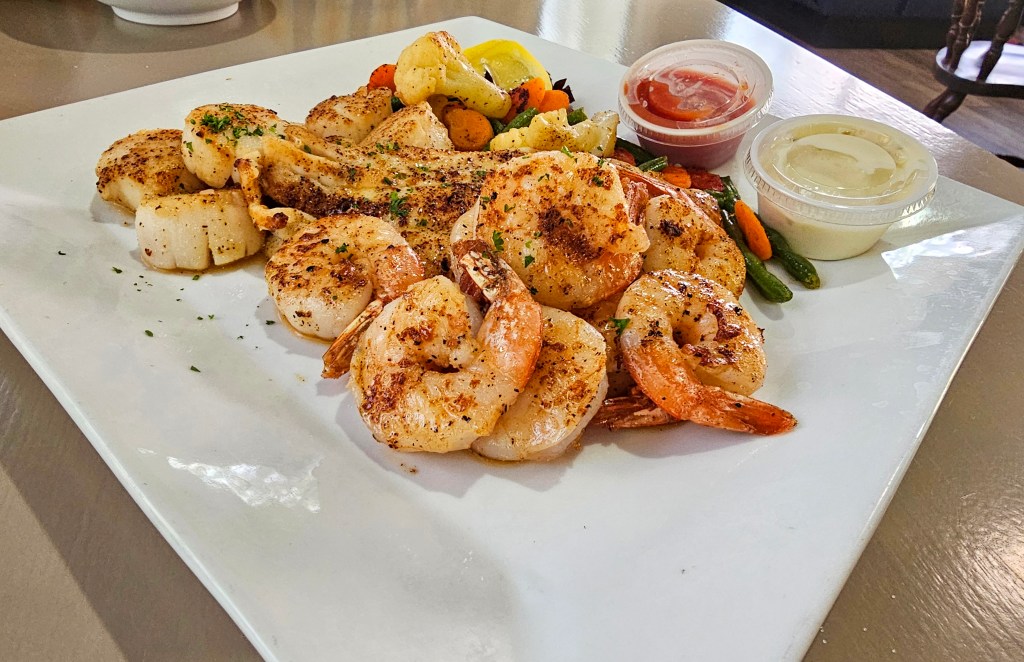
We continued on to Locals Dockside, a waterfront seafood restaurant.  We had a good meal with great service, perfectly cooked shrimp and fish, and piping hot fries.  The side salads were very fresh and extremely generous in size.

Cheese sticks at Locals Dockside
Grilled shrimp at Locals Dockside
Grilled seafood and vegetables at Locals Dockside

After the sun was low enough on the horizon to not be shining in our eyes, we sat in the cockpit for an evening whiskey.  The Thermocell gadget was required, there were far too many no-see-ums!  It did work well, so we will certainly be buying refills and using it on our balcony in Hilton Head.

In the morning, the bugs were impossible, so I had to give up my usual peaceful coffee hour in the cockpit.  We wanted an early start anyway.  The previous day, another large (Looper) boat had arrived and docked behind us, so getting out of the marina was going to be tricky, and best done at slack tide. For our landlubbers, that is the time when the tide changes, so the currents are at their least strength.  We had about 10 feet in front of us for Dick to maneuver away from our berth.  Good help from the dockmaster and his helper was needed to keep the stern and the dinghy from running into the dock, but it all went very well and we looked like pros!

We listened to the Coast Guard calling boats near the Amelia Island Inlet.  There was a nuclear submarine about to enter the channel and make its way to Kings Bay Submarine Base.  Several small boats were not paying attention and required multiple calls.  When it became clear that the sub might be catching us up as we made our way past Cumberland Island, Dick speeded up so we didn’t have to heave to and wait, or possibly be asked to turn around.
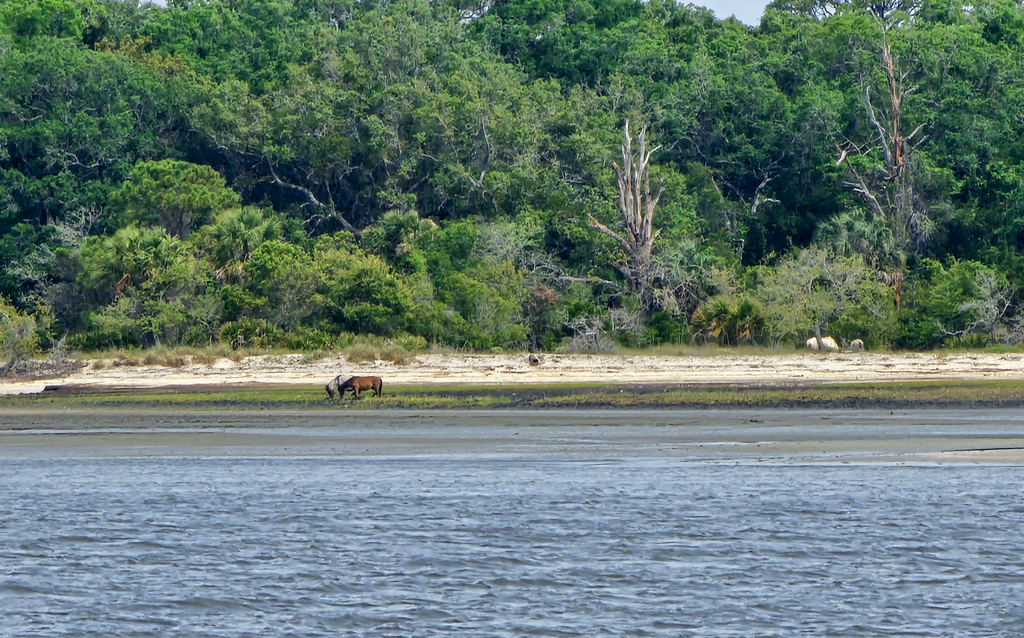
Wild horses on Cumberland Island

Kings Bay Submarine Base is the largest construction project ever undertaken by the United States Navy.  It was started in 1980, took 9 years to complete at a cost of $1.5 billion, and employs over 9000 people.  As we passed, a gunboat eased out and hovered with its bow (and gun) pointing at us.  Just making sure we were proceeding on our way and not getting any closer to the base.  I did NOT step out on deck to take pictures!

Kings Bay Naval Submarine Base

As we arrived in St Andrew Sound we had wind opposing tide, giving us a roll on the bow.  Dick cooperatively sped up for me.  It didn’t really help with the motion, but it meant that it was only a few minutes before it was time to make the turn up the sound and the waves were off the stern.  St Andrew Sound is one of several ugly inlets in this part of Georgia.  It is wide and shallow, and shoaling means that you have to zigzag across rather than taking a direct route.

The channel that passes Jekyll Island is notoriously skinny, and we went through it at low tide.  This may have been a misjudgement! After passing the marina and the public dock, both with extremely shallow water, even bare mud, on the land side, we came into a particularly shoaled section of the channel.  Suddenly, Nine Lives was going uphill!  We were in the mud.  We were only slightly to the west of Bob’s Tracks, but for a few minutes it seemed as though we might run fully aground.  We gently pushed through the mud, and eventually it got slightly easier and we were back in the channel.
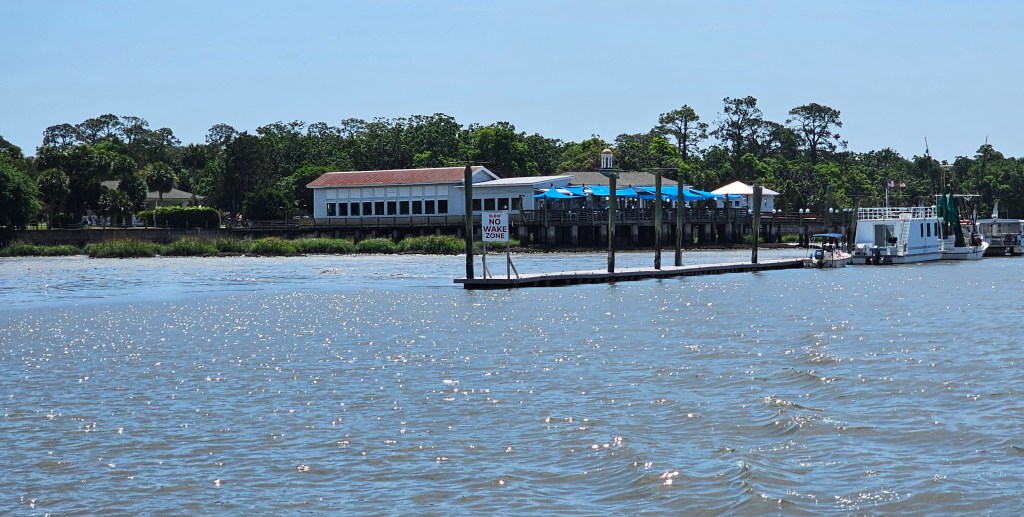
Shallow water in Jekyll Creek. The inside of the dock is mud with just a few inches of water!

Bob’s Tracks is an app you can download to your charts.  It is crowd-sourced, created by a number of boaters who travel back and forth along the ICW each year, and record their exact tracks.  These are then combined to produce a single best recommended routing.  Much of the time, the tracks are pretty much where the regular magenta line is, but it is in areas of continuous shoaling that it comes into its own.  When we last passed through this area, there was no such app to help us.  What’s more, we didn’t even have the contour features that are now part of Navionics on the chartplotter, nor did we have Aquamaps on our second, iPad-based charts.  It has taken us a bit of adjustment to work out how I can best convey where we need to be for Dick at the helm. Bob’s Tracks are on my iPad, not the chartplotter that Dick has in front of him.

Later, Dick read the Waterway Guide advice for the Jekyll Island Creek.  It says, “Do not go through Jekyll Creek at anything less than half tide rising.”  We did it at dead-low tide, which was also a foot lower than normal because of spring tides!  Might possibly have been a good idea to read that section before we arrived, rather than afterwards.

After that excitement, the rest of the journey to Brunswick went well and we docked without incident shortly after 1pm.  Our friend Bob arrived to welcome us, just as we were adjusting the lines, so we roped him into helping (pun intended)!  Later, we carried the makings of cheese and charcuterie across to their boat, because Asea is recovering from a mishap that resulted in a broken leg.  It was great to spend time with them again.  We always laugh a lot when we are together!
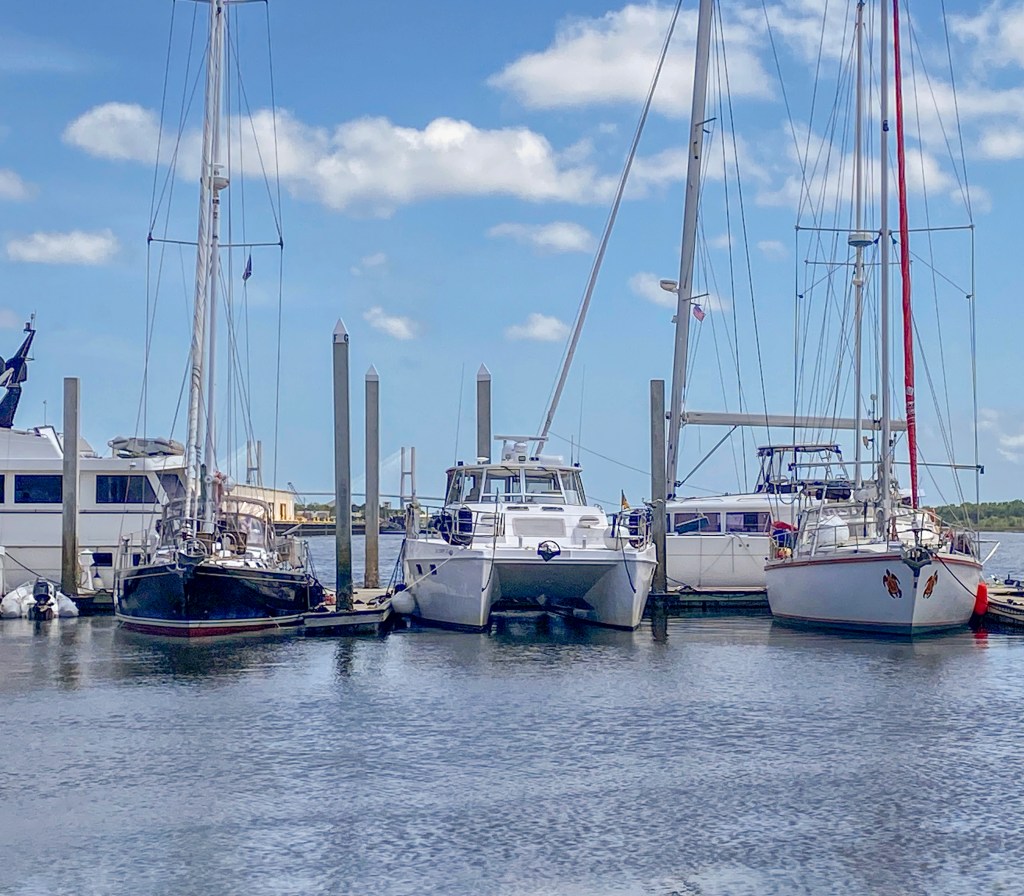
Nine Lives in the marina in Brunswick

The next morning, Dick visited the farmers’ market, and then explored the town.  The no-see-ums were impossible, so I stayed below and did some work on the blog and photoshop.  This is not a good time of year to be living “outdoors” in the Low Country.  When we are at home in Hilton Head in late spring, we stay inside.

Brunswick is a city with a somewhat checkered history. It was very prosperous in the mid to late 1800’s.  During the mid-20th century some of the beautiful old buildings that remained from earlier, more prosperous times, were allowed to become derelict and were pulled down and replaced with mid-century modern establishments.  The 14 fine leafy garden squares had nobody to save them, and roads were built through the middle of some of the ones that remained. Only 2 of the squares today retain their original size and shape.

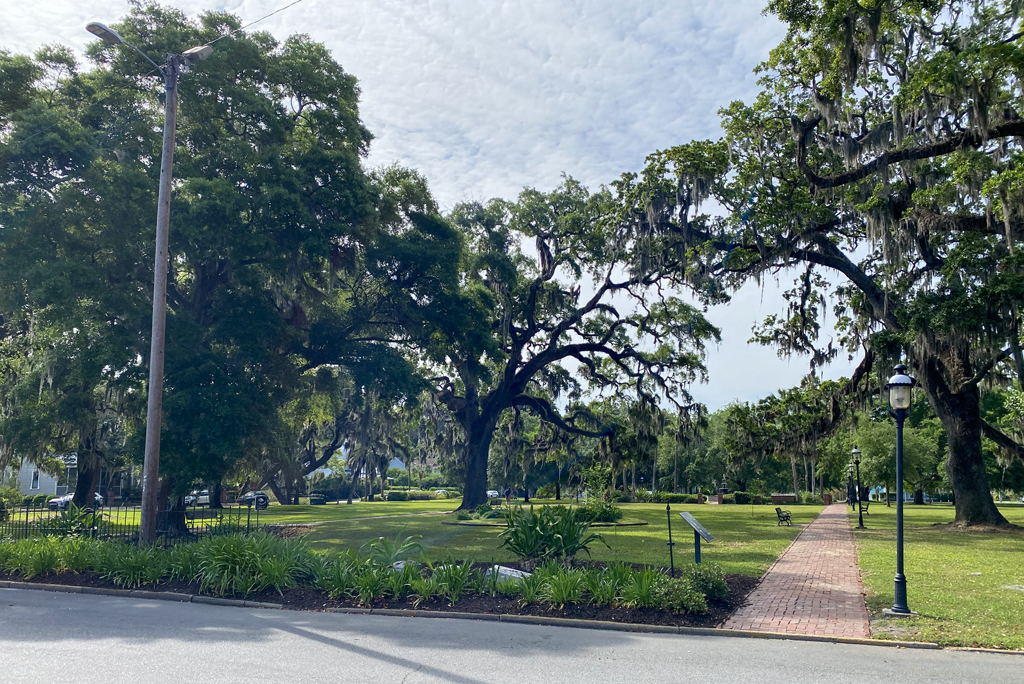
Brunswick downtown shops
One of the remaining squares in Brunswick
Former City Hall in Brunswick
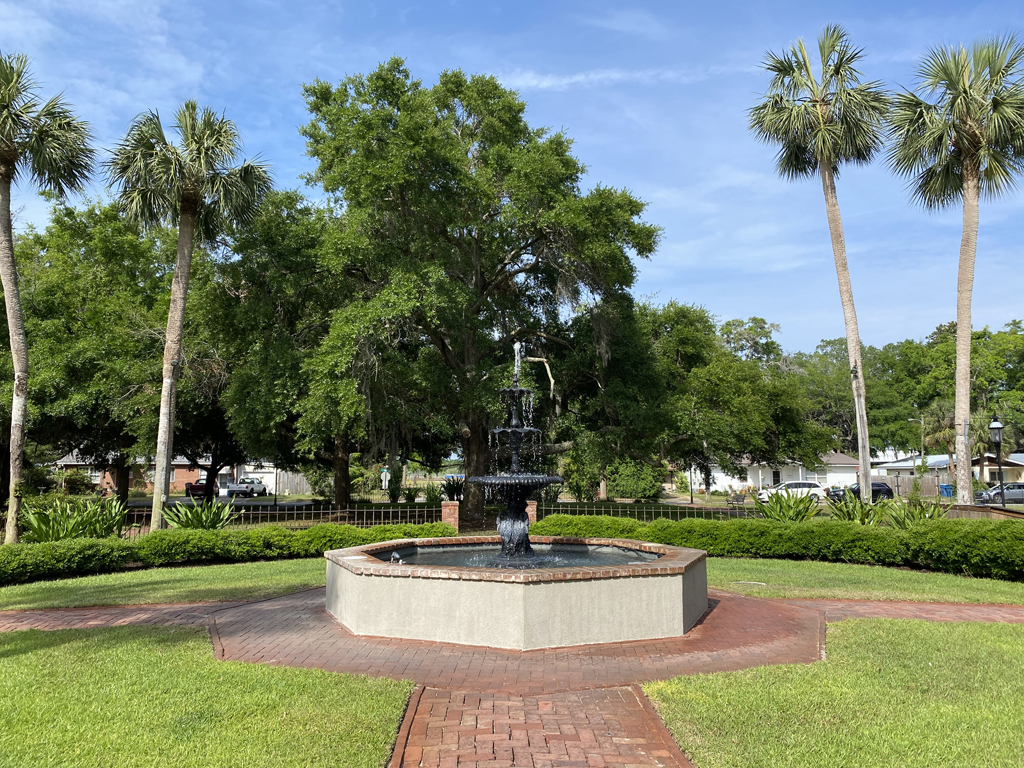
Hanover Square fountain
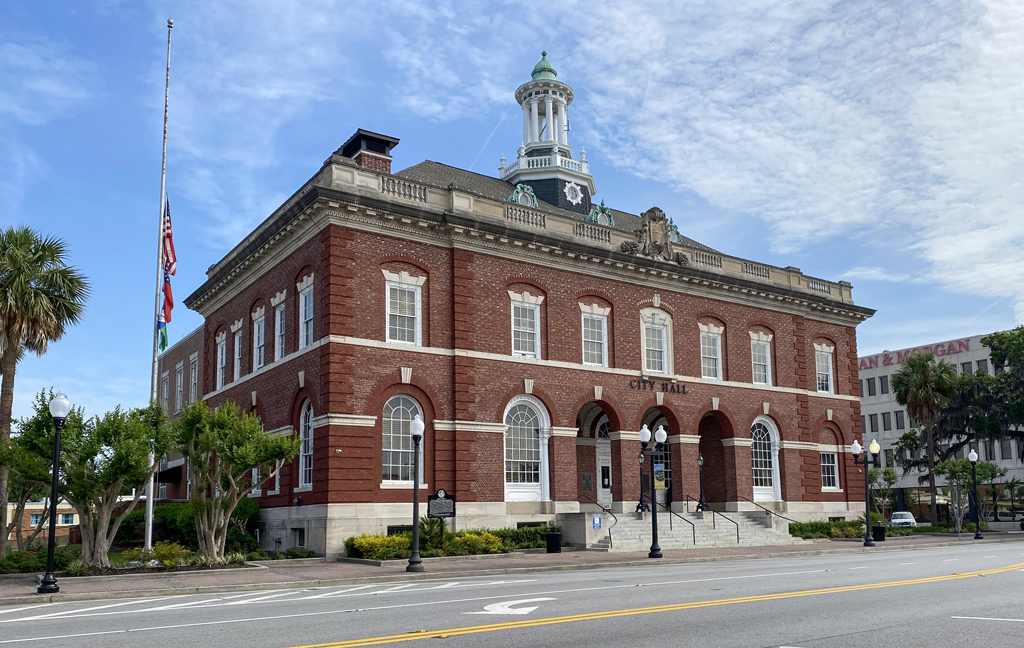
City Hall, Brunswick
Ritz Theatre
Another of Brunswick’s lovely squares
Mary Ross Waterfront Park

During WWII the Liberty Ships were built in Brunswick.  There were steel hulled ships, 447 feet long, weighing 3500 tons.  They served as cargo vessels and troop carriers.  99 were built for the U.S. Merchant Marines with the shipyard producing about 4 per month.  In 1944, the Navy asked for 6 ships to be built, and the shipyard managed to build 7 of the vital ships in a single month. 
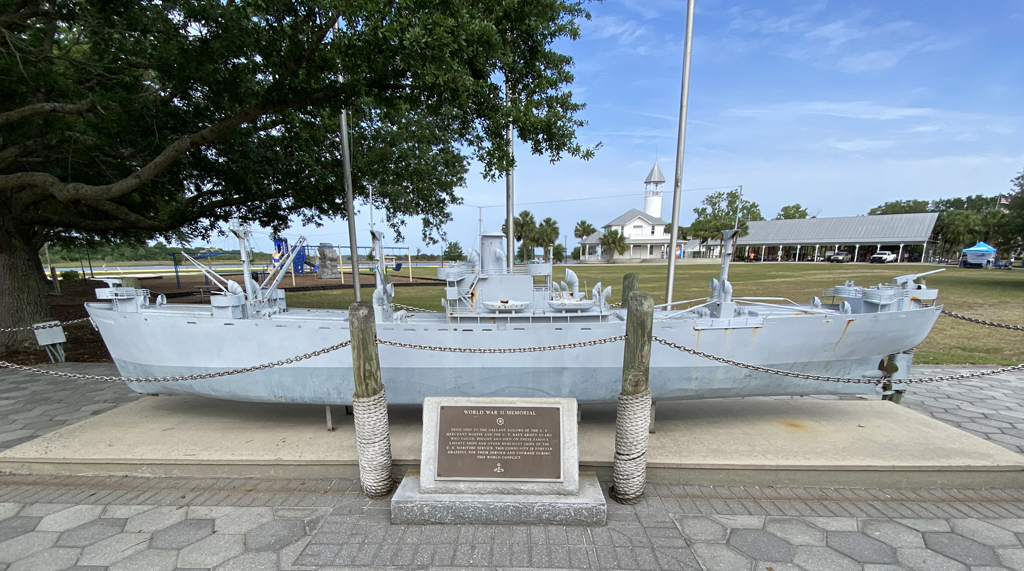
Replica Liberty Ship

Both Virginia and Georgia claim to have developed Brunswick Stew.  It is traditionally a tomato-based stew with beans, vegetables, and originally small game meat such as squirrel or rabbit.  Today it is usually made with chicken.  Georgia’s claim includes the original stew pot!  One story says that the stew was invented by a group of hunters.  One man was left to look after the camp and make dinner.  He was lazy, and simply threw all the ingredients into one pot.  When the hunters returned, cold, and tired, a delicious stew was ready for them.
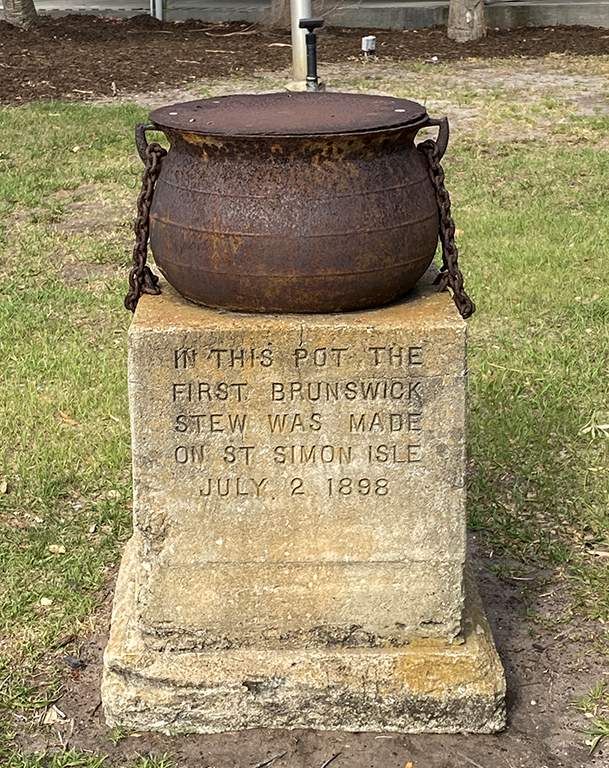
The first Brunswick Stew

Today, Brunswick is a major seaport, one of two in Georgia, and its economy is mainly based on tourism and logistics.  In the afternoon we walked into town to have a look around.  There are a surprising number of restaurants, and it seems to be something of an antiques destination.  Karen drove over from St Simons and joined us with Asea and Bob for dinner at Reid’s Apothecary.  It was a great evening with good food and congenial company.

America Liberty, a 100-passenger cruise ship, was docked downtown.  We saw her again later, passing us on the ICW when we were docked in Isle of Hope.  As we approached the Highway 17 bridge, we could see the casino boat.  Also, there were 3 car carriers docked in the South Brunswick River.  It’s a busy port.

A barge collecting debris including derelict boats
Car carriers in the port
Highway 17 bridge. We have see this from I-95, many times!

It was a long day, initially boring, but with areas of extreme shoaling where we had to pay close attention to the hazard warnings on the charts and follow Bob’s Tracks meticulously.  In the charmingly named Old Teakettle Creek, we passed some markers that were high and dry with the spring low tide.
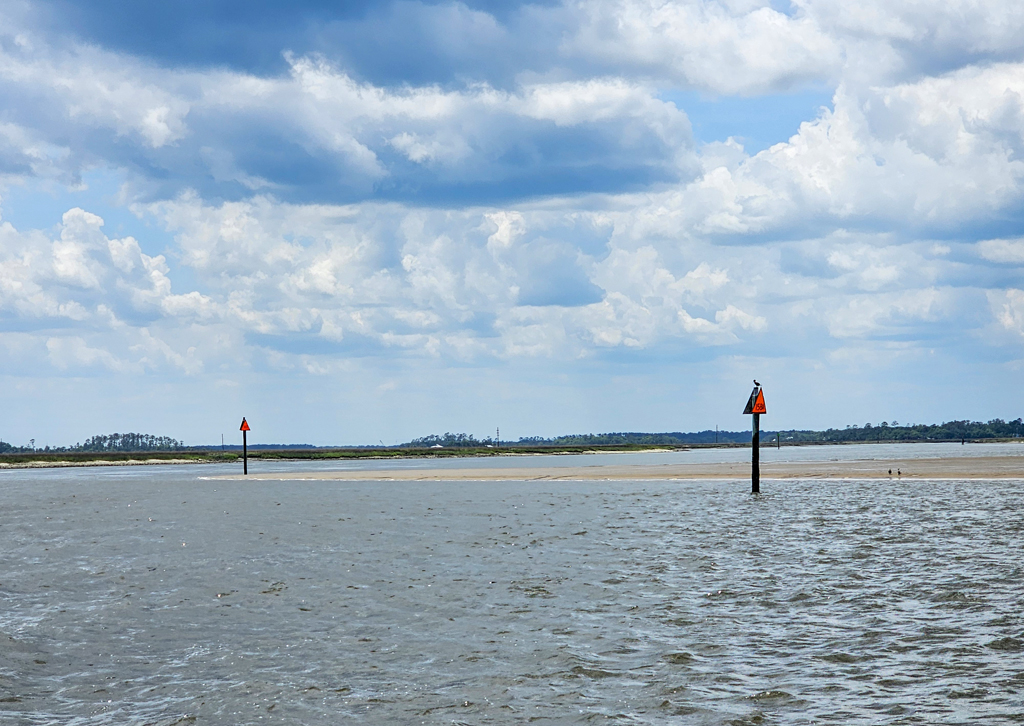
Markers high and dry on the ICW north of Brunswick

As we turned into Sapelo Sound, we could see whitecaps, so Dick decided to run fast until we were back into South Newport River.  It was like stepping through a door – one minute it was very calm and very hot, and then we were in strong winds and cloudy skies to make me shiver.  It even rained a little.  Not enough, we decided, to need the windows rolling down.  In hindsight, we should have rolled them down and swapped out the screen doors!  As we entered St Catherine’s Sound, the waves got higher, and soon we were plunging up and down, and spray was coming over the bow like a giant green wave.  Salt water came right over the cockpit and washed over me and everything on the starboard side of Nine Lives.  Naturally, Dick was completely dry.  As the huge waves crashed over the bow, Nine Lives slammed down into the troughs.  Dick had already speeded up, and it helped somewhat, until it didn’t, and he had to slow down to keep control.  Some waves threw us sideways.  Fortunately, that part of the trip, although scary, nasty and wet, was short, and even as we made the turn into the Medway River, the waves were never quite broadside.  As we made our way up the river, the waters gradually calmed, and we heaved a sigh of relief.  This was probably our worst experience with waves, surpassing even our awful memories of the Neuse River from 2017.  Our no-go criteria is 2-foot waves and 15 mph winds.  This was 4-to-5-foot waves, and 20 to25 mph winds.

The excitement was not over.  We were nearing the part of the river where we were to turn off, cruising in the centre of the channel as is prudent, with both charts showing 27 feet of depth. I looked over at the depth sounder, and said to Dick, “That’s odd.”  That is one of the worst things you want to hear on a boat.  The depth sounder was showing just 6 feet under us.  Suddenly, we came to a juddering halt.  Aground.  Dick was right on it, and immediately put the engines into neutral.  We were lucky, the high winds, and waves coming from behind, lifted us and we floated free.  We can only conclude that the shoal marked on the charts has encroached far into the channel since the last time the Army Corps of Engineers passed this way.

After that, we were happy to have an easy docking with good help and the wind blowing us onto, rather than off, the dock.  Once we were in, we could see the mess our adventure had made.  Fortunately, we have good discipline and keep the cupboards latched, so nothing had fallen out inside the boat.  The salt water that drenched the starboard side of Nine Lives came through the screens, which were quite dirty after weeks of travel.  All of that dirt, plus the salt, was deposited on the windowsills, cushions, and even onto the back door, right up to the ceiling!
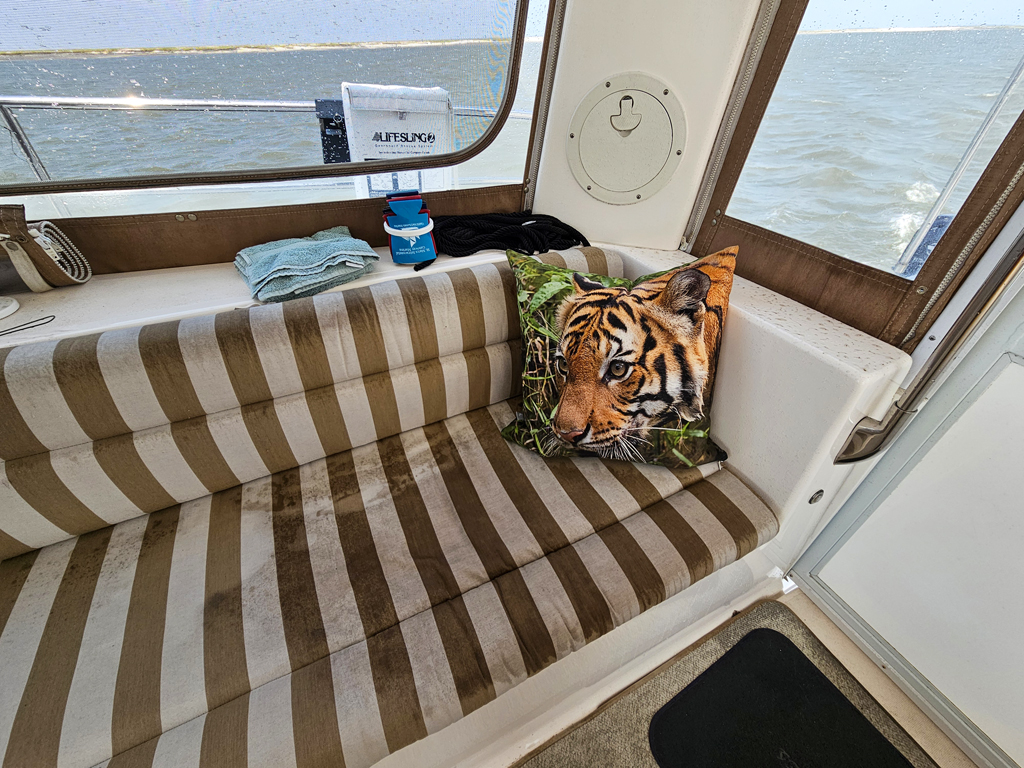
Salt water through the screens made everything filthy!

We ate at the rustic Sunbury Crab Company.  We had been there once before (by car), so we knew that the food would be good.  Great service, and a very chatty owner, made for a pleasant evening.

Sunbury Crab Company
Sunbury Crab Company marina
Commercial boats docked at Sunbury Crab Company
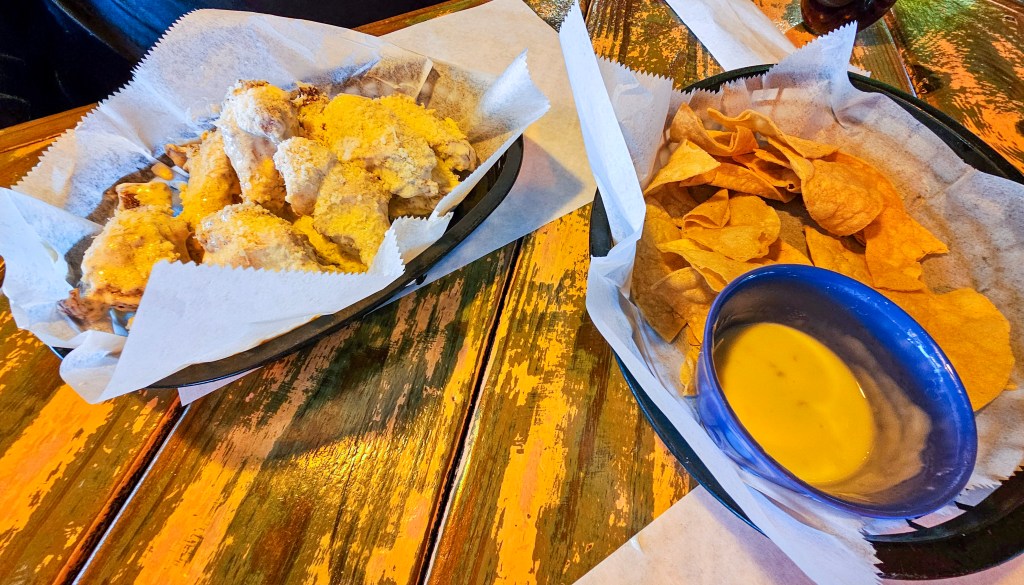
Queso and chicken wings at Sunbury Crab Company
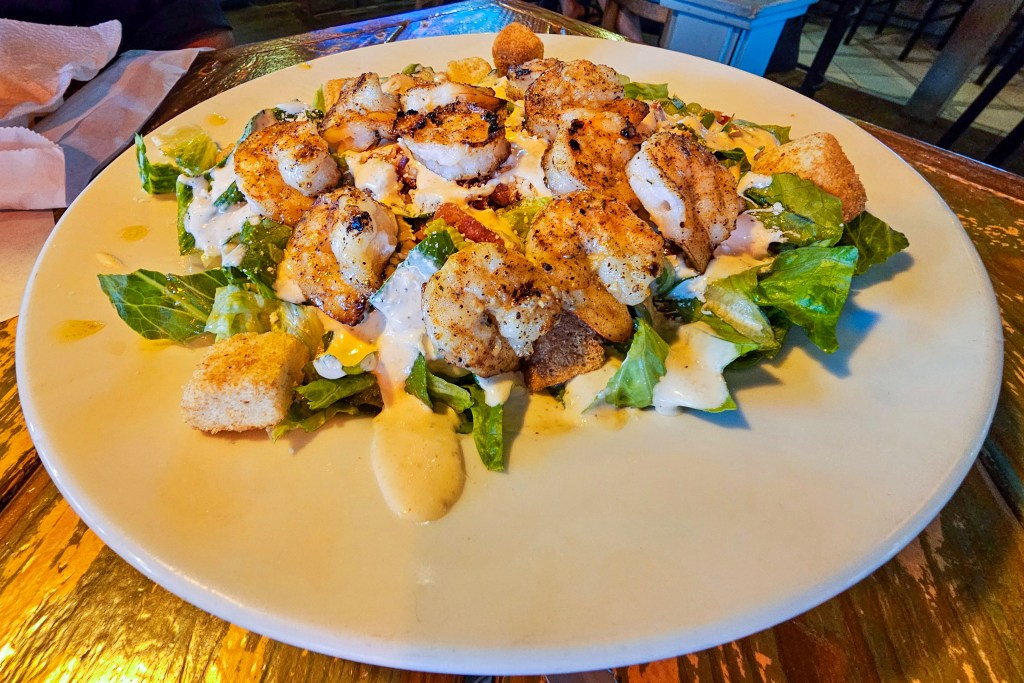
Caesar salad with grilled shrimp

There were heavy thunderstorms during the night, so everything was soaked in the morning.  The side of the boat that faced the dock was coated with an amazing variety of insects.  We debated whether the forecasted rain and wind was such that we should stay put for another day, but the next day was going to be even worse, albeit sunny.  The no-see-ums buzzed around us as we untied and got underway.  We timed our departure so that it would be slack tide when we got to St Catherine’s Sound.  The plan worked, and the waves were not as bad as the previous afternoon.  The period was also shorter, that is, the waves were closer together, so Nine Lives was not riding up and slamming down as she had the day before.

The next challenge was Ossabaw Sound, which is in two parts, joined by a channel called Hell Gate (really, even on the charts!)  This is extremely narrow and shallow, and subject to wind tides.  That means that a sustained wind can actually blow the water out of the channel.  Fortunately, the wind was in the “right” direction, and we were still only a little after high tide, so the passage, much dreaded by Loopers, was uneventful.  Once through Ossabaw Sound, the rest of the journey was pleasant and smooth, just the way we like it!  We arrived at Isle of Hope Marina, our last stop on our Loop voyages, by 1pm.

There are incredible numbers and variety of bugs in this part of the world.  Not only no-see-ums, which are as tiny and sneaky as the name implies, but also the large greenflies that give a very painful bite.  Annoying, but fortunately not biting, are strange long-legged spider-like things, and of all the unexpected pests to find on a boat, grasshoppers!

The heat and the bugs kept us inside for most of the day on Isle of Hope, but we ventured out in the marina courtesy car to stock up on beer and to have a late lunch.  The Driftaway Café has earned TripAdvisor’s highest accolades, and the food was certainly very good.  The venue was decorated throughout by sea creatures painted on the walls and ceilings, and quirky tchotchkes.  There were plants everywhere, and the decks and garden were lined with an amazing number of small pots with colourful flowers.  Cleo, the customer support feline was dozing on one of the outside tables, waiting with the menu to greet the next diners.
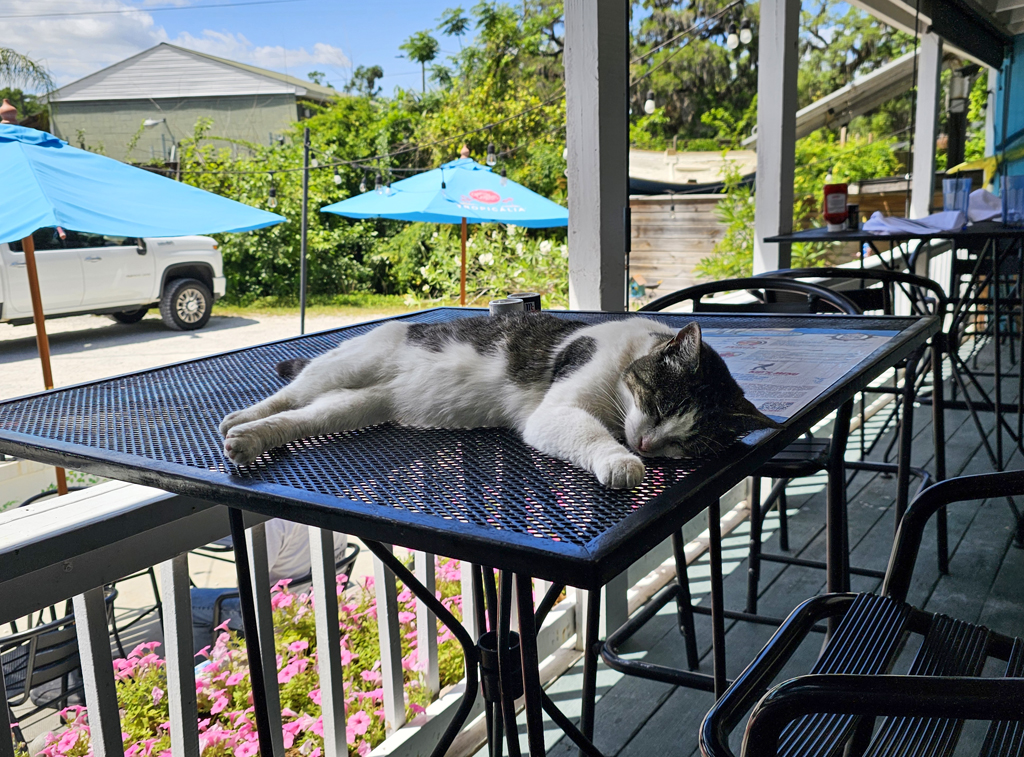
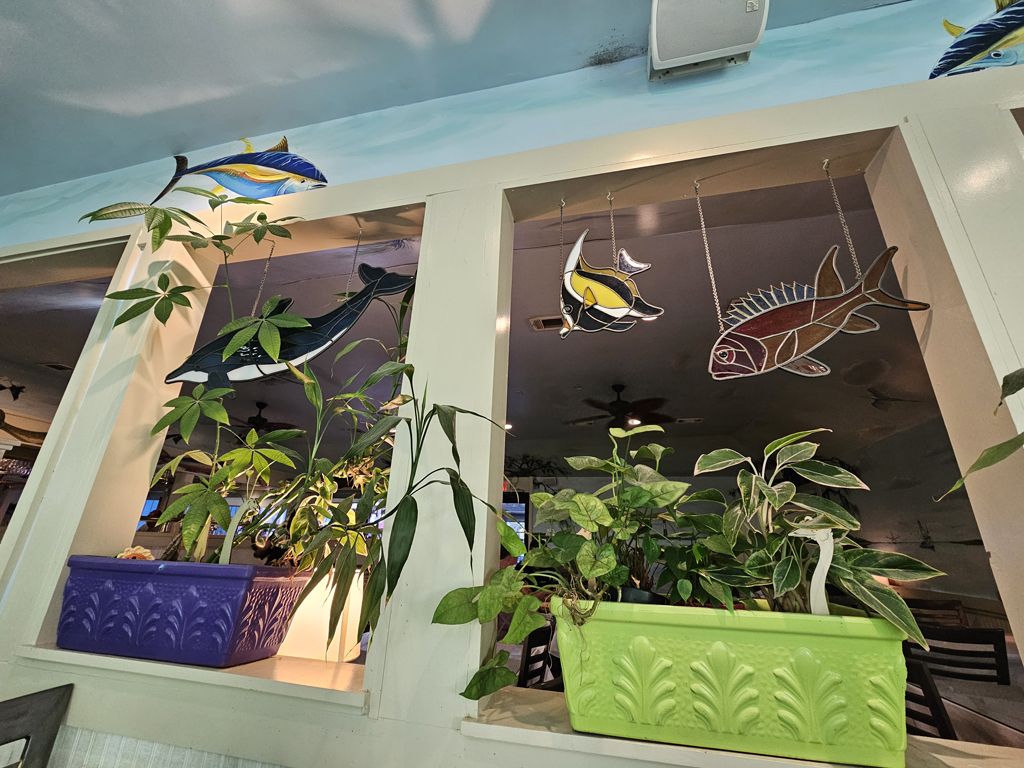
Driftaway Cafe Customer Support Feline, Isle of Hope
Colourful interior of Driftaway Cafe
The terrace at Driftaway Cafe
Garden steps at Driftaway Cafe

The bugs were awful in the evening and first thing in the morning.  We headed out at 9am for the final leg of our 8-year voyage.
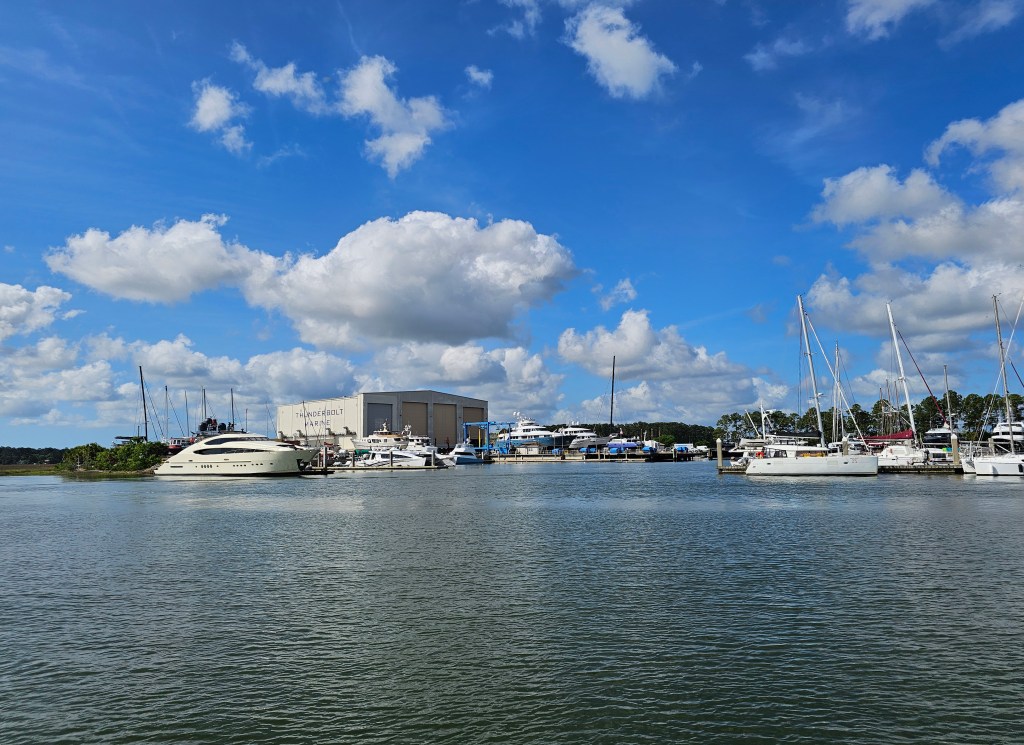
We passed Thunderbolt Marina. Nine Lives will come here for new bottom paint and when a new buyer asks for a survey.

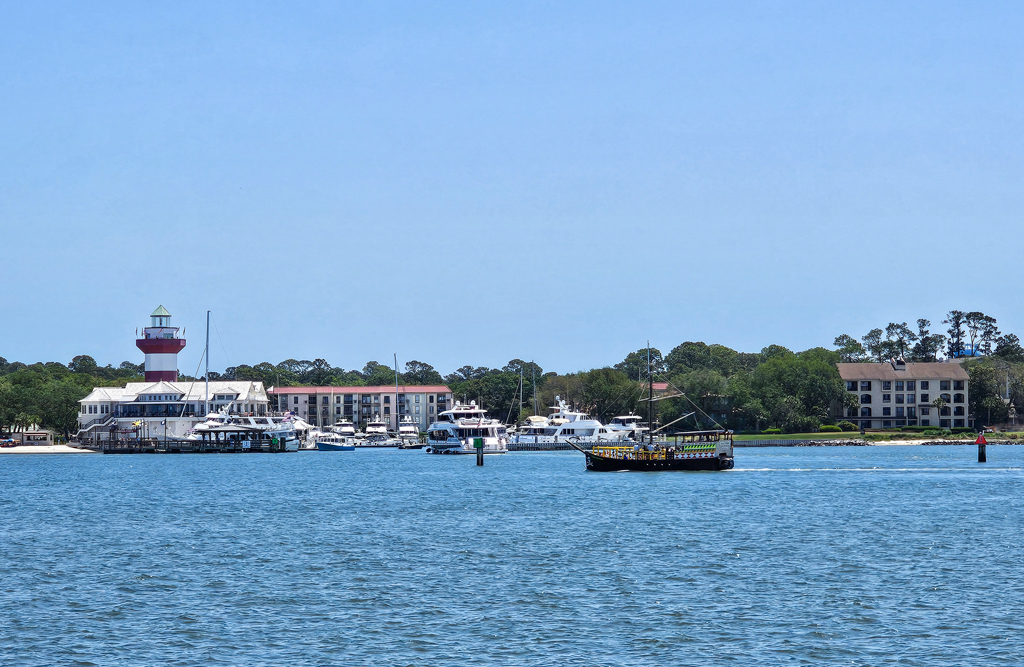
Crossing the busy ship channel of the Savannah River and going through the shallow Fields Cut were uneventful.  We followed a gorgeous 100-ft yacht.  Her name was the engaging, and slightly disrespectful Waddle We Do.  As we came into Calibogue Sound we were surprised to see not one, but two cruise ships anchored off Harbour Town.  One of them was American Liberty, who we first saw in Brunswick and again when she passed Isle of Hope.  The other was American Eagle.  Both are 100-passenger coastal cruising ships.

American Liberty anchored off Harbour Town, Hilton Head
Busy Harbour Town, Hilton Head
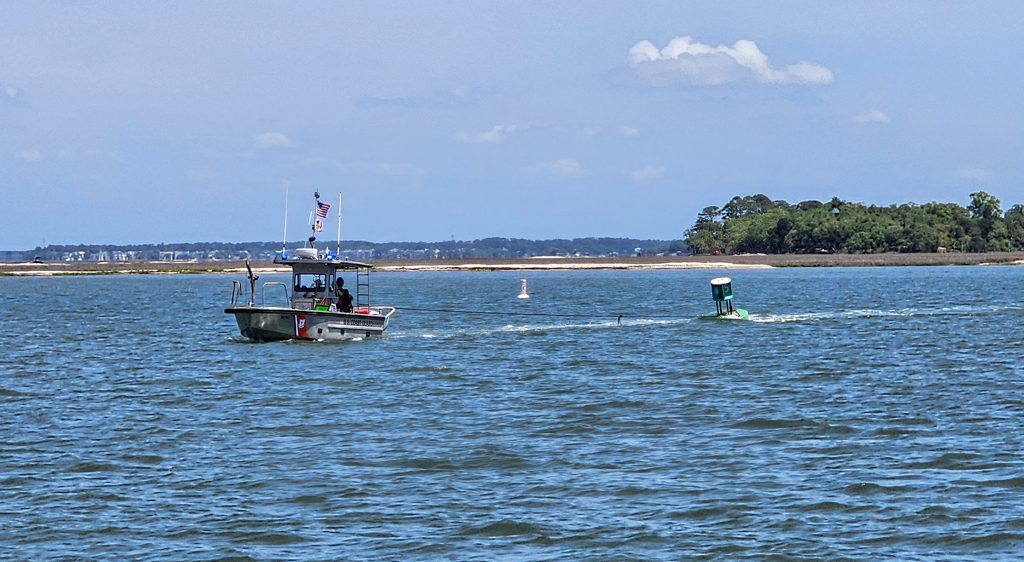
We have never seen a Coast Guard boat towing an ATON before!

We arrived at the lock at Wexford, where we departed from in April 2018.  Somehow the channel leading to the lock seemed narrower!  Once in the lock, with only inches to spare on each side, Nine Lives looked huge!  We were soon tied up on the guest dock, and had time to relax and watch the construction.  Wexford is building a new, much larger harbour building and is also doing a major renovation to the clubhouse.
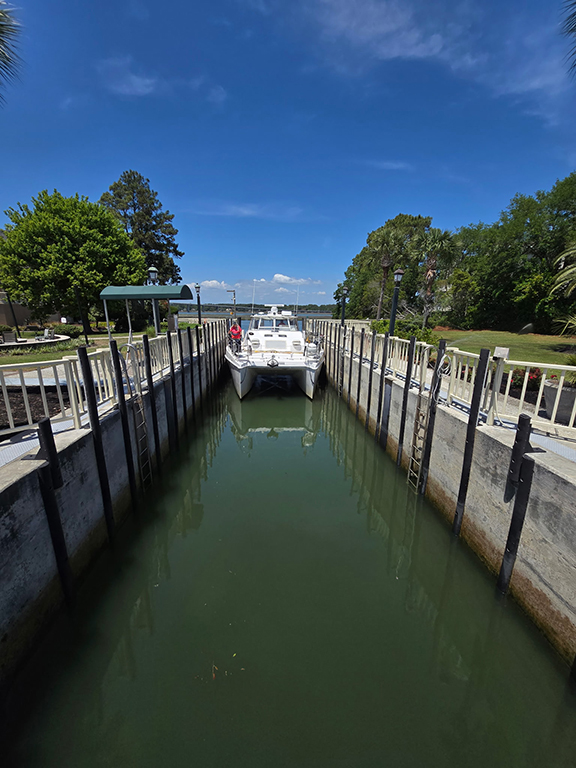
She fits with inches to spare!
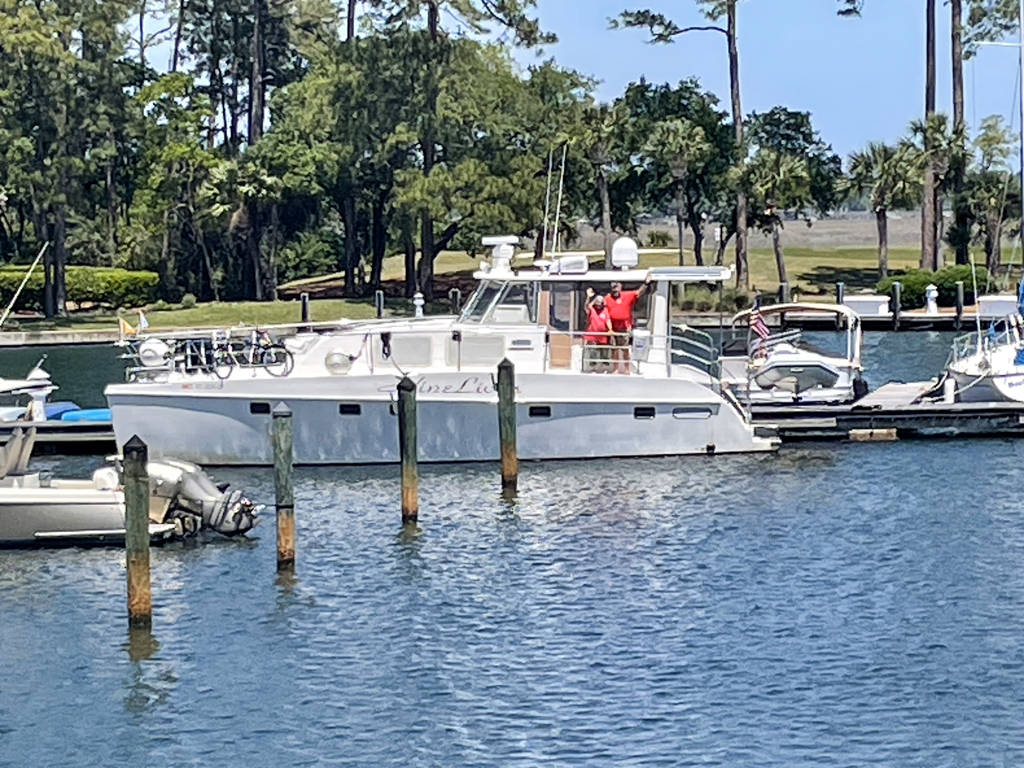
Nine Lives has returned to Wexford for a final visit

Later, I was able to join my bridge friends, even filled in for a hand, before the traditional wine and gossip afterwards.  We spent a quiet evening (blessedly with many fewer no-see-ums) and woke to a pretty sunrise over the golf course.
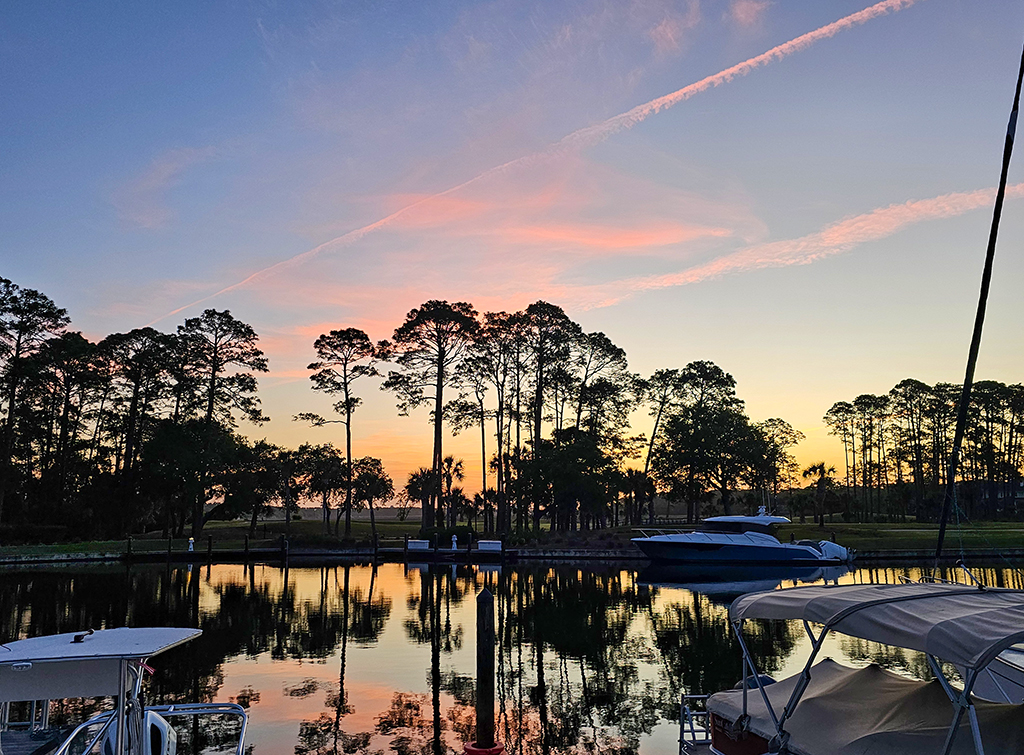
Sunrise over the golf course and the harbour in Wexford

For the eagle-eyed, and mathematically inclined readers, you might notice a slight disconnect between some of our stated statistics.  We collected Nine Lives in January of 2017, in St Petersburg.  So we technically finished the Great Loop, and earned the gold burgee, this February when we passed under the bridge in Tampa Bay.
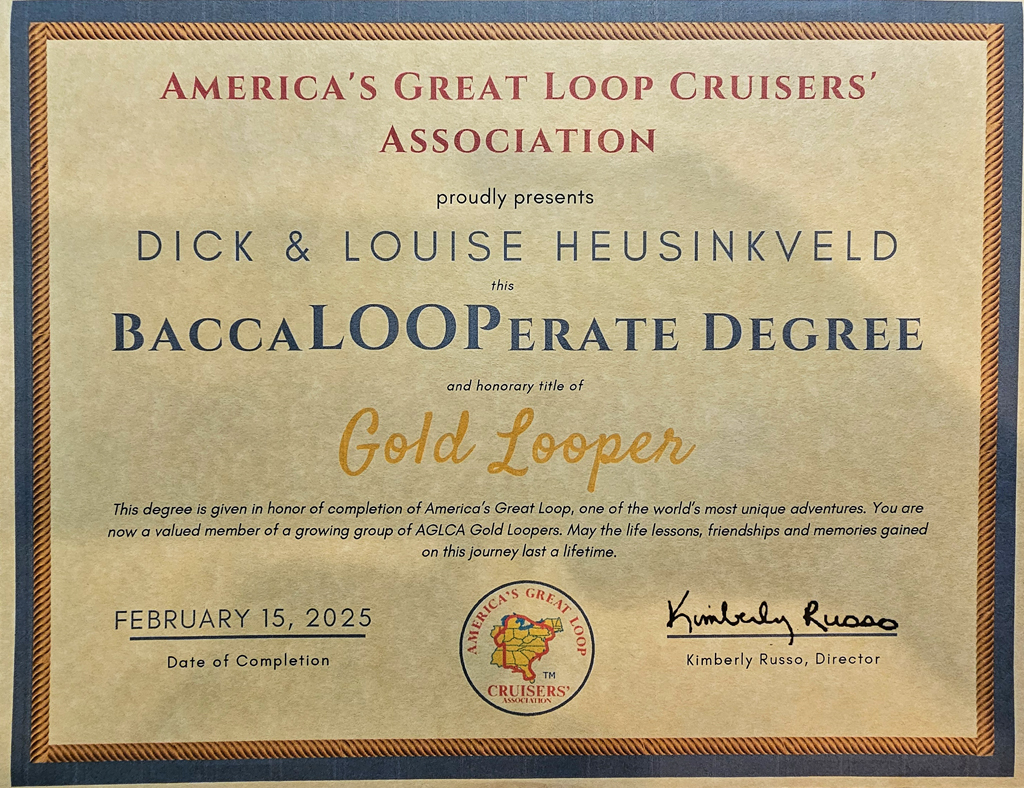
AGLCA awards the BaccaLOOPerate degree when we complete the Great Loop

In 2017, we spent a few weeks bringing Nine Lives to Hilton Head, where she was based in Wexford, behind our house, until April of 2018.  During the summer of 2017, we went on a 3000-mile shake-down cruise (yes, 3000 miles, only Dick would call that a shake-down cruise).  We went north, following the traditional route of the Great Loop, as far as Oswego on Lake Ontario and then returned.  We had a decent boating resume before we bought Nine Lives, but we had never owned a large boat, and much of our most relevant experience was on sailboats and narrowboats.  We did not know what we did not know!  So we sailed off into the wild blue yonder, ever so slightly unprepared, but full of confidence. There were adventures and misadventures, and it was on this cruise that Tucker-cat decided that he is NOT a boat-cat, and prefers to remain on dry land.  The following year, having added Nine Lives to the annual AGLCA fleet t-shirt, we set off on the first of our 7-year segments of the Great Loop.
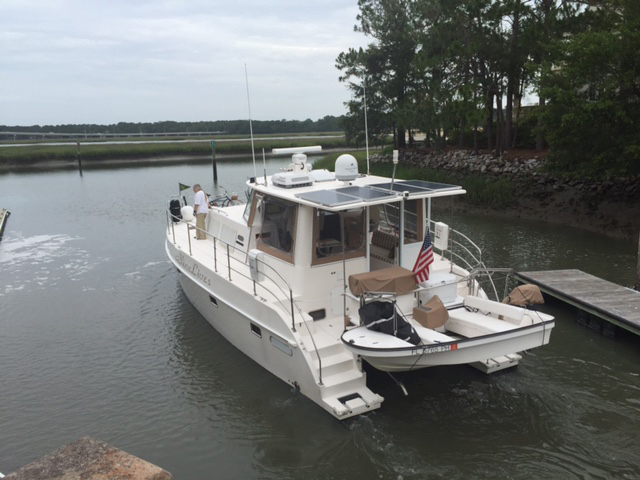
Nine Lives leaving Wexford in April, 2017

To resume this year’s story, the next morning, Dick rode his bike to our friend’s house to retrieve his car, which he then parked at Palmetto Bay Marina.  I spent the morning cleaning, including polishing the outside railings and cleaning the cockpit of accumulated salt grime. This was the day of our big party to celebrate Nine Lives and the completion of our epic journey.  Perhaps it should be referred to as a pawty?  Or, given that Nine Lives is a cat, we could talk about the purrrty.

Then there was nothing to do for a few hours, since the party was to be catered!  In due course, a huge table arrived and was set on the dock.  There was a certain amount of concern because there was a gusty wind blowing.  We decided that drinks would be on the dock, and food on the boat.  Five enormous trays of an amazing variety of hors d’oevres arrived next.  Sausage rolls, quiche, cheese and charcuterie, shrimp, tiny flatbread slices, and a whole tray of beautiful macarons and fruit were spread out in the cockpit and downstairs in the salon.

We can certainly say that the party was a success.  37 people managed to fit themselves onto Nine Lives, spreading out between the cockpit, the salon, the foredeck, and even on the back platform.  The food was excellent, and our serving helper kept the wine and beer flowing.  Most of the guests had not been on Nine Lives before, so it gave them a chance to see what our floating home looks like.
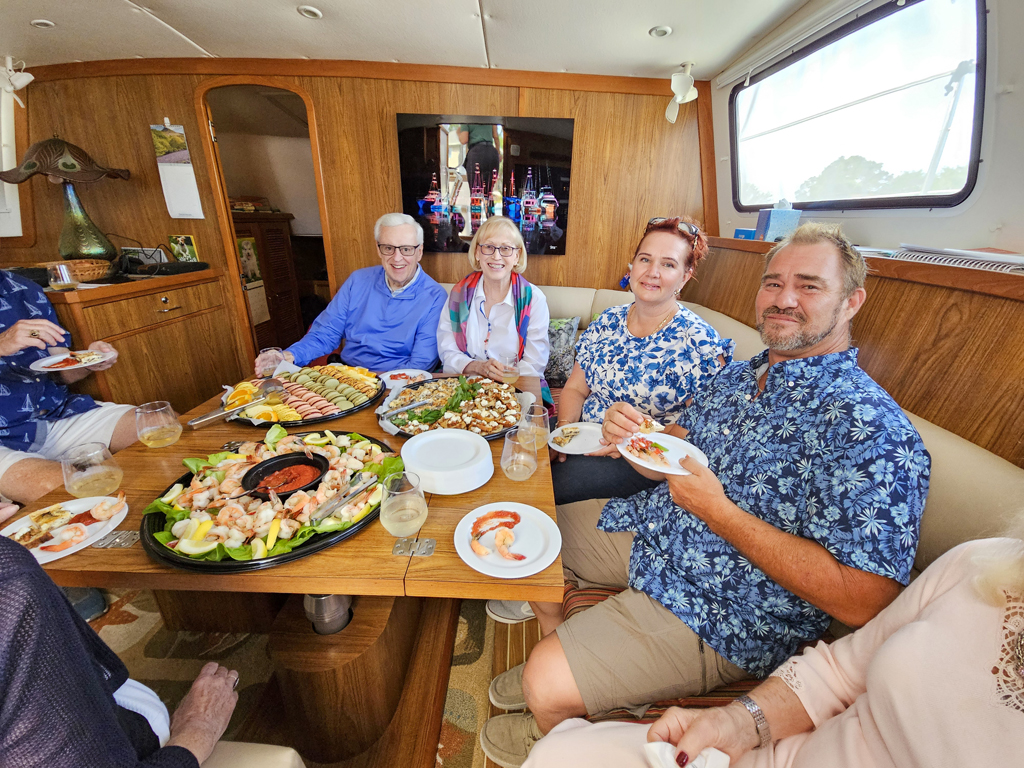
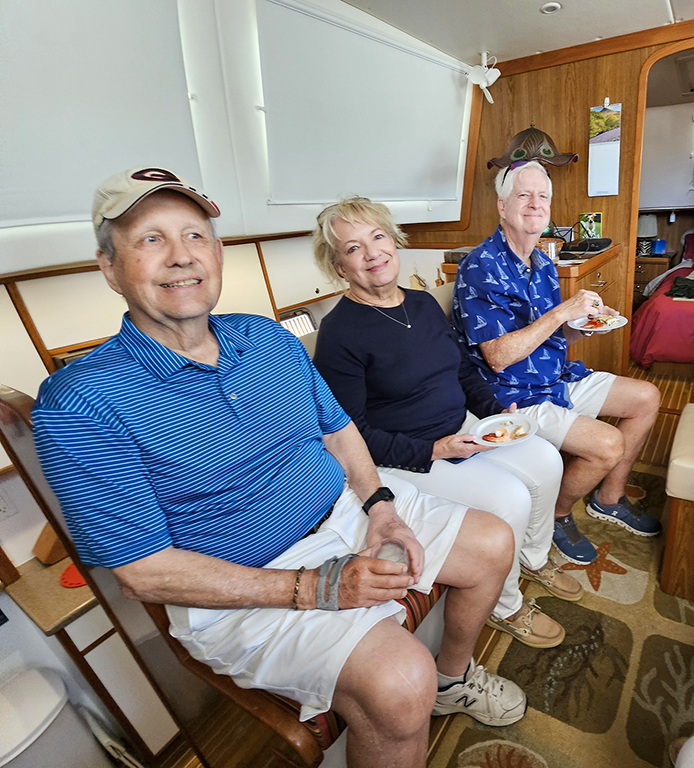
Guests and food for the Nine Lives Pawty
More of the purrrty guests

In the morning, we took Nine Lives around the whole of Wexford Harbour for a last look at the lovely homes and gardens, and then out through the lock and the very short trip down Broad Creek to Palmetto Bay Marina.  Nine Lives will stay there until she finds a new owner to take her on new adventures.
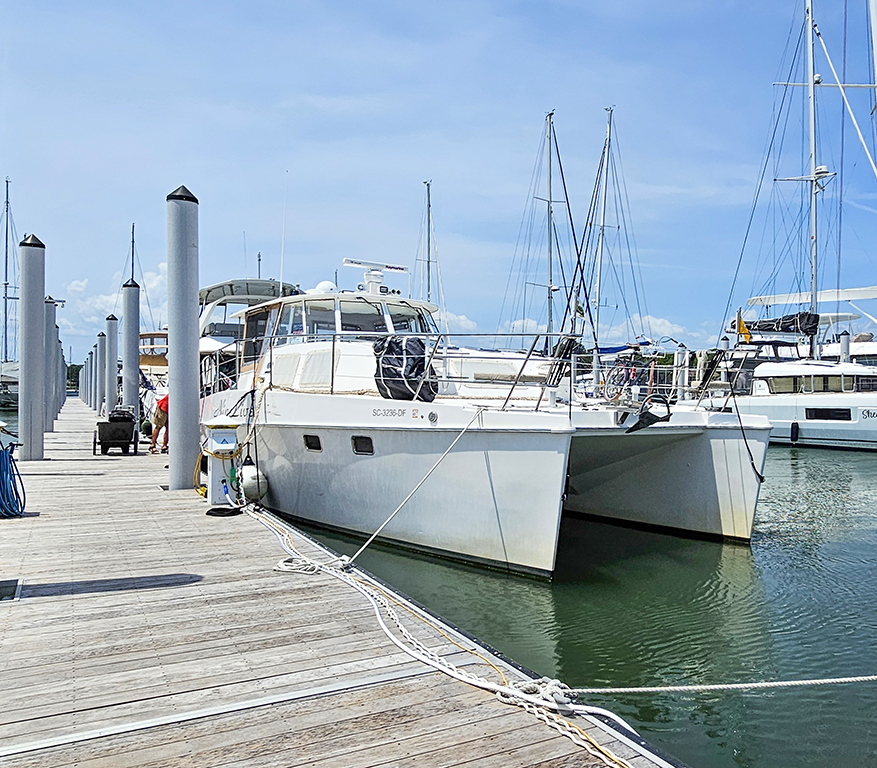
Nine Lives in Palmetto Bay Marina
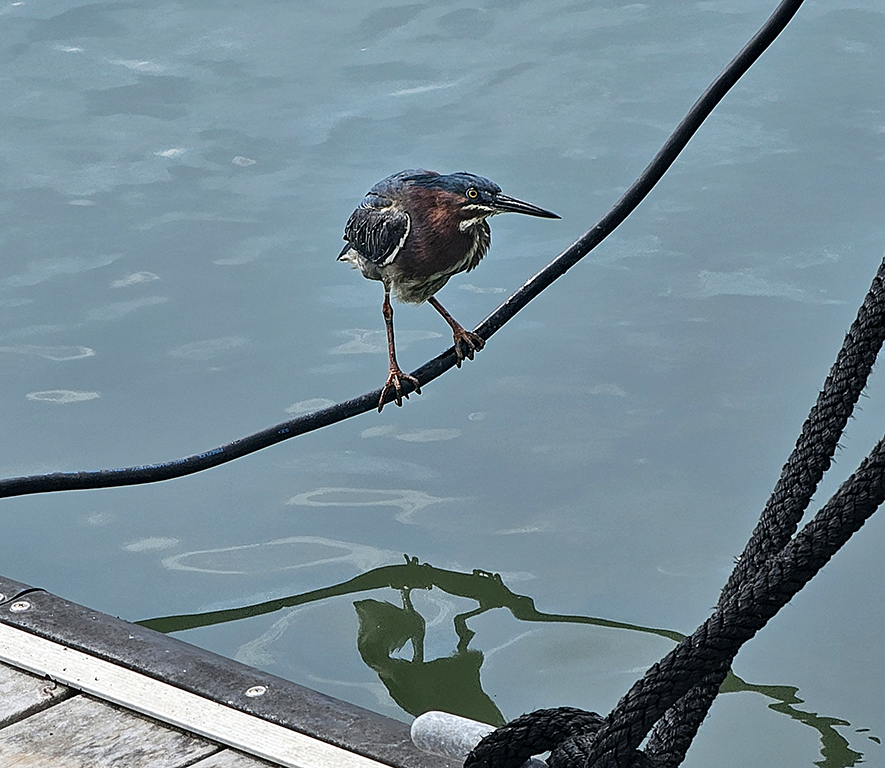
A Green Heron welcomed Nine Lives to Palmetto Bay Marina

As the helpful dockmaster assisted with our arrival and tying up, he commented, on seeing the gold burgee, that we were finishing the Great Loop, and he made the assumption that we had taken the usual one year and travelled the traditional 6,000 miles.  We explained that in fact it had been 8 years and 20,000 miles, and his exclamation was “Did you get lost?”  So yes, we got lost by seeing all but one of the Great Lakes, by going up the Mississippi, by venturing up the Ohio, the Monongahela, and the Cumberland Rivers, and this winter by following the Gulf Coast all the way around the Florida Keys.  And let’s not forget, we also went through Lake Champlain and the Chambly Canal, followed by the Rideau.  We visited places that most Loopers don’t see, including Lake Huron and Detroit, Cleveland, Sault Ste Marie, Minneapolis St Paul, Cincinnati and Pittsburgh, and Nashville.  And all the wonderful small towns in between.

This is the close of the Nine Lives Voyages story.  We anticipate that soon Nine Lives will sail off into the sunset with new crew, who are sure to love her as much as we do.  There will be new adventures, and perhaps she will revisit many of the places that she has been with us.  Thank you to all of you who have been with us on this journey.  I am continually surprised and so grateful to hear that people are reading this story.
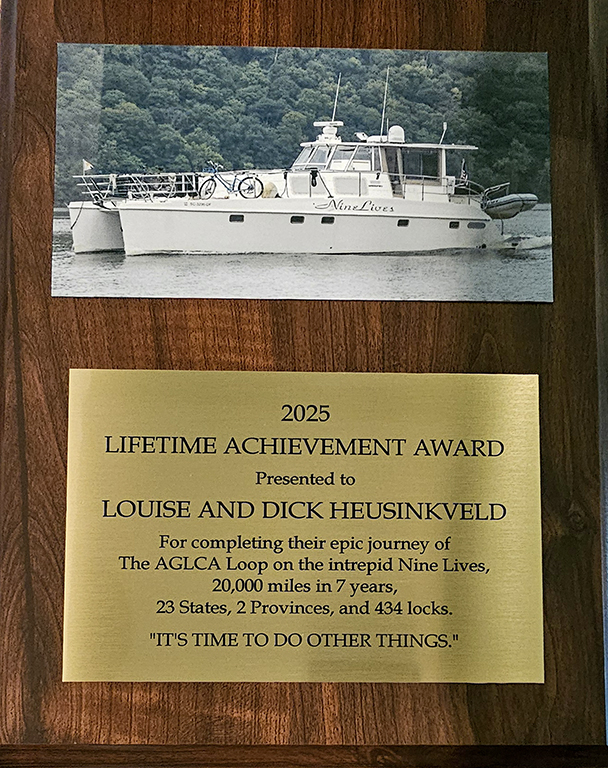
Our friends Sherry and Shel gave us this lovely plaque to celebrate our Great Loop

We are going to do other things, travel more and farther, visit friends far and wide, play some golf, and take some time to enjoy all that Hilton Head has to offer. One of the party guests left us some advice, that is entirely apropos:

Advice from a Sea Turtle

Swim with the current

Be a good navigator

Stay calm under pressure

Be well travelled

Think long term

Age gracefully

Spend time at the beach!

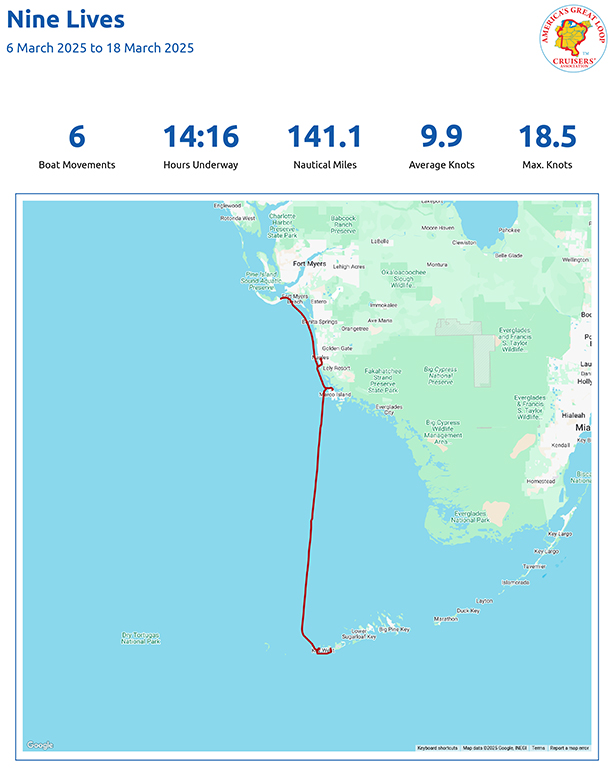
March 6th to 18th, 2025: Sanibel Island to Stock Island

Wednesday the 6th was a busy, social day.  Early in the morning, I met our slip neighbour just as the harbourmaster delivered fresh, hot, blueberry muffins to our boat.  Our neighbour had just taken possession of a 15-year-old Back Cove, and was preparing to take it across Florida and then north to his home in Cape Cod, after some much needed work in a couple of boatyards along the way.  Dick took MOKE for a final run to stock up on heavy grocery items, while I worked on getting the next issue of the blog completed and published.

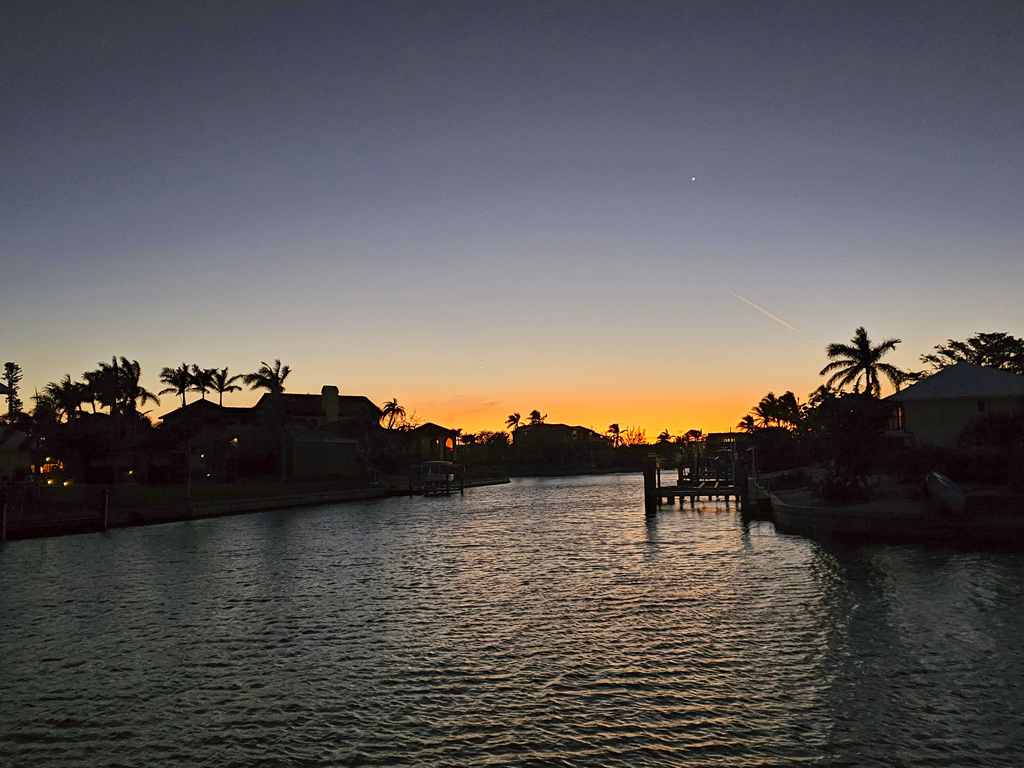
Sanibel, the canal at sunset

Local Harbor Hosts Mike and Deb came over from Fort Meyers and we had a pleasant lunch at the onsite restaurant.  Later in the afternoon, we enjoyed a great reunion with Jim and Marilyn, who we met in 2021 on Lake Michigan.  We all tucked into cheese and sausage and exchanged stories of our various boating experiences, as well as interesting international business travel stories.

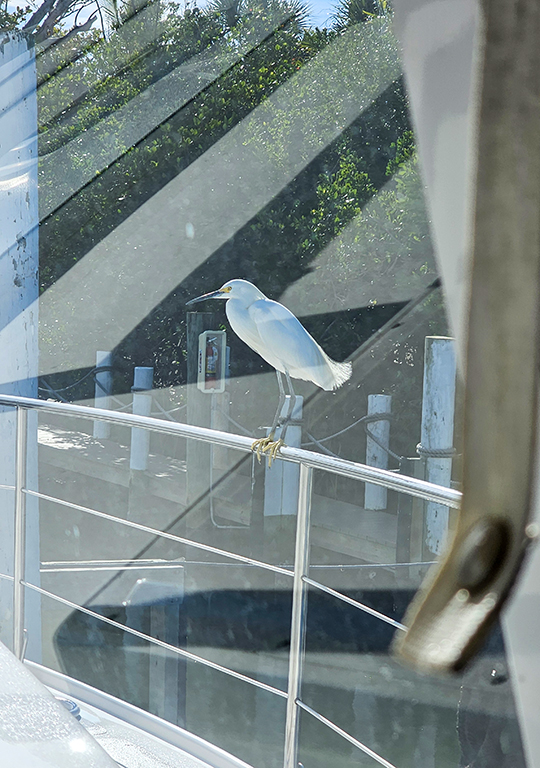
A Snowy Egret visits Nine Lives

Very high winds and waves were forecast for the next day, so we stayed put.  It was a good day for boat chores.  In the afternoon, we took a walk to have a look at the beach – we were very glad we weren’t out in that weather!
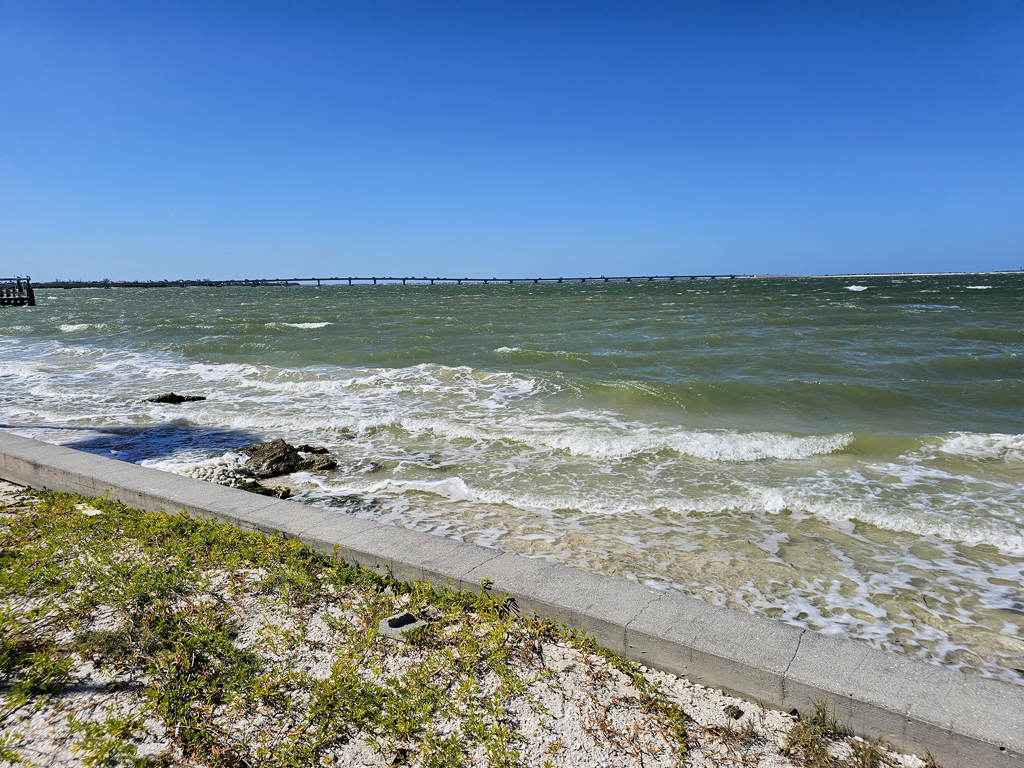
The seas were rough, so we stayed put!
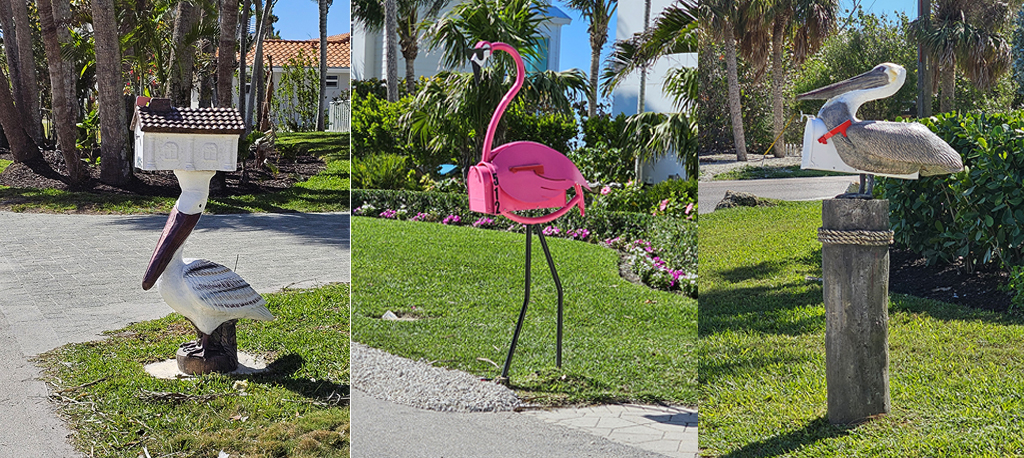
A few of the fun mailboxes in front of Sanibel homes

Our voyage to Naples was straightforward, with relatively smooth seas, although unfortunately in a direction that gave us a certain amount of corkscrew motion.  Not enough to require medication or wrist bands, but I certainly was not going down into the cabin in those conditions.

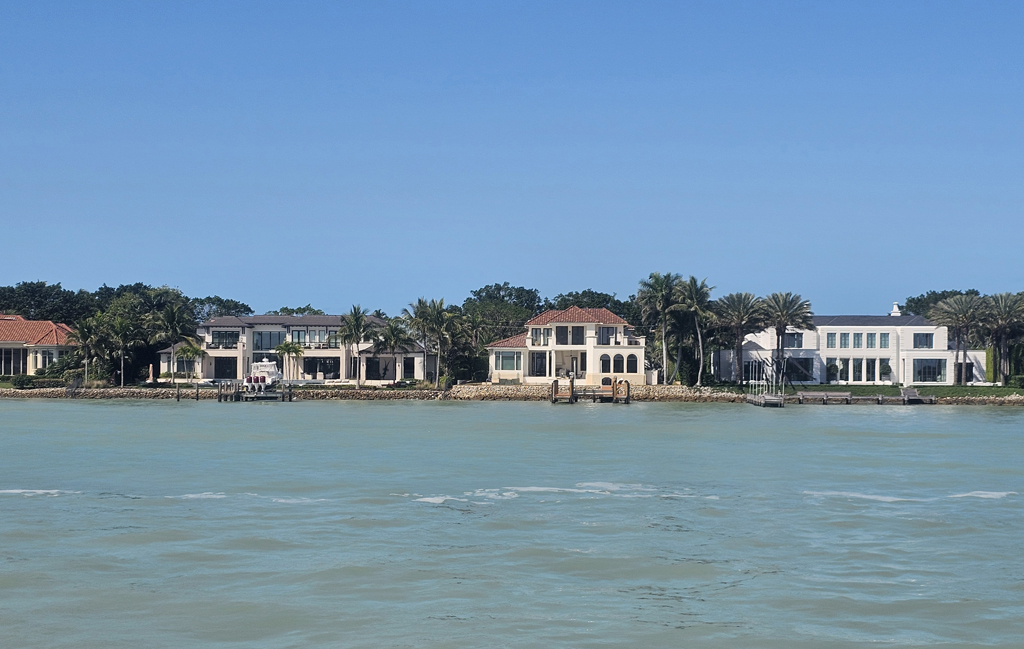
Naples is reached by turning into a very narrow and shallow channel with a lot of shoaling.  We could see breakers on one side of us, and an optimistic surfer waiting his chance.  I can’t imagine a more dangerous place to surf, one miscalculation could put you right into the path of an oncoming boat.  Once you are through the cut, the waterway opens up and winds north for several miles.  The shores are lined with beautiful homes.  Here again, the speed limit in the channel is 30mph, and outside is a no wake zone.  This is to protect the manatees, but it makes things difficult for slower boaters, as they are subject to wakes they can’t avoid or turn into.

Beautiful waterfront homes in Naples

On arrival at the city marina, we went straight to the fuel dock for a pump out.  Staff were efficient, answering the radio when we called, and helping to tie up.  I would not call them friendly, as some reviewers have experienced, and as often happens, the man who took the midships line refused to cleat it tight, making it difficult for Dick to bring the stern in. Our overnight dockage was just along the dock, but it required slotting between two large sportfish boats, so Dick had to go out, turn around, and then maneuver back in.  This time the dock hand was more understanding of how Nine Lives ties up, having seen what is needed.

Our spot on the outside dock meant some motion from passing boats, but it was worth it to be able to watch the traffic.  There is no security in the marina, and it seems to be a “thing” to walk around the docks and look at the boats.  One man was explaining, quite loudly, to his family that we obviously bring Nine Lives from Hilton Head and stay for the winter.  When he saw me looking, he asked how long it had taken us to get to Naples.  I was amused at the look on his face when I told him, 8 years!  Explanations were then offered, but it’s always fun to be able to correct mansplaining.  There must have been at least 50 people wandering around and commenting on the various craft.  I have never seen so many tourist boats, all doing a roaring trade.  There were lots of tiny floating tiki bars with just 4 or 5 people sitting on bar stools while the vessel puttered around the harbour.  There were the usual dolphin watch pontoon boats, also at least 2 very large sailing cats as well as monohull sailing boats heading out for cruises in the Gulf.  There were also the expected sport fishing boats, and a large dinner cruising yacht.

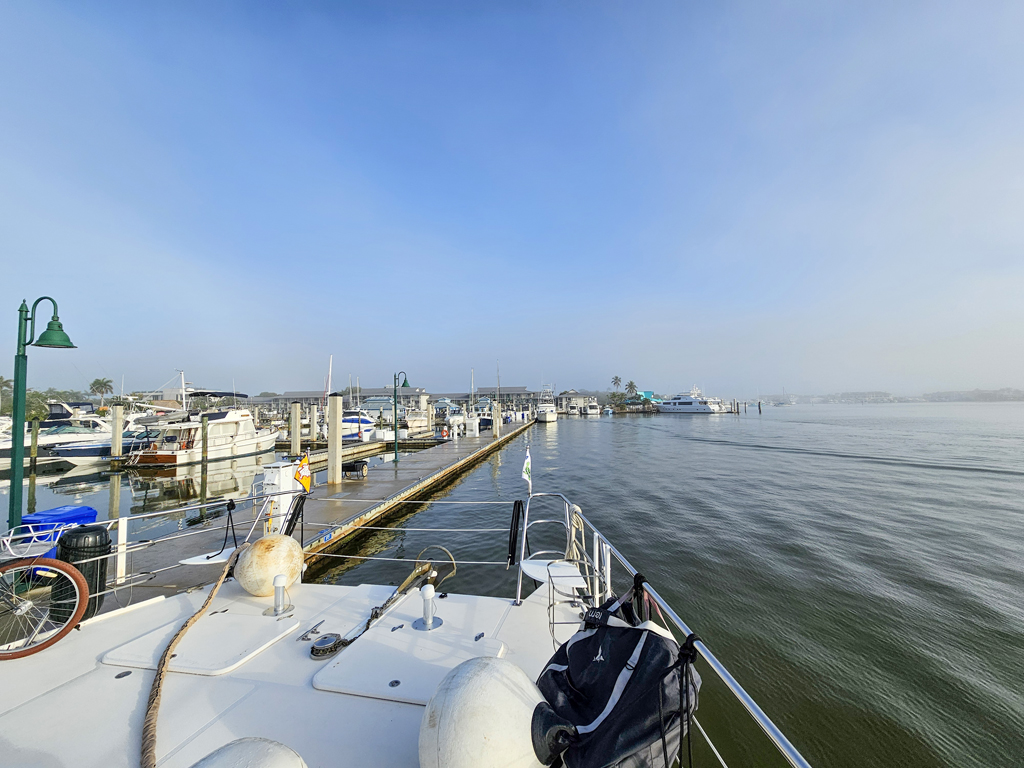
Naples City Dock on a misty morning before the traffic starts

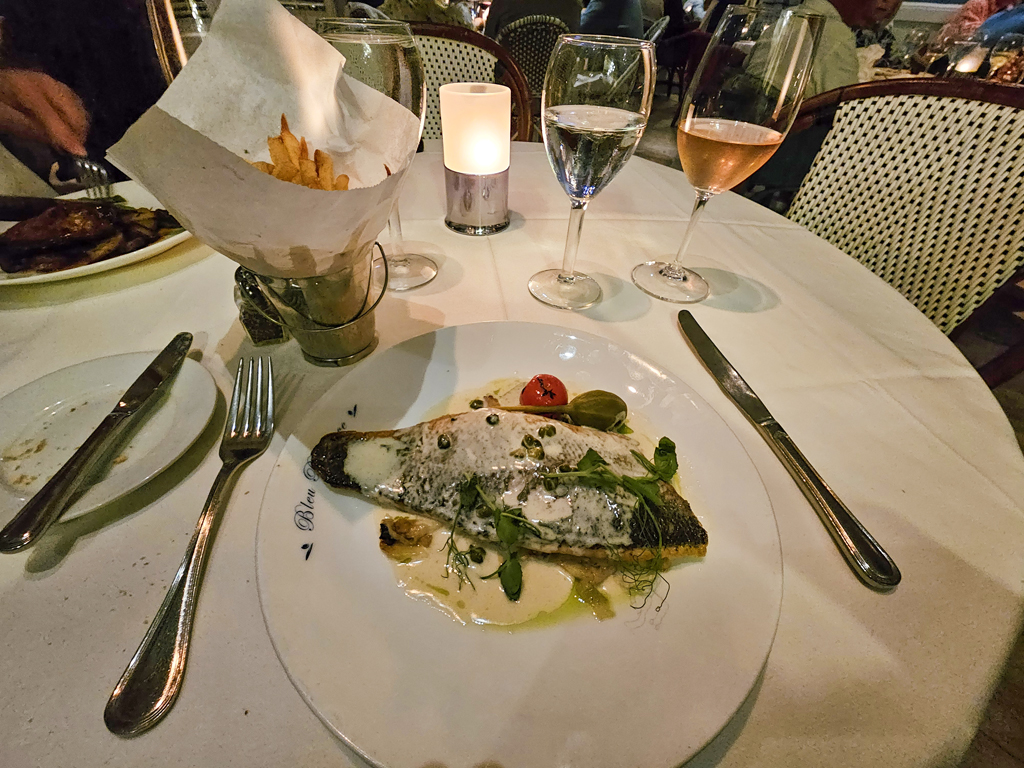
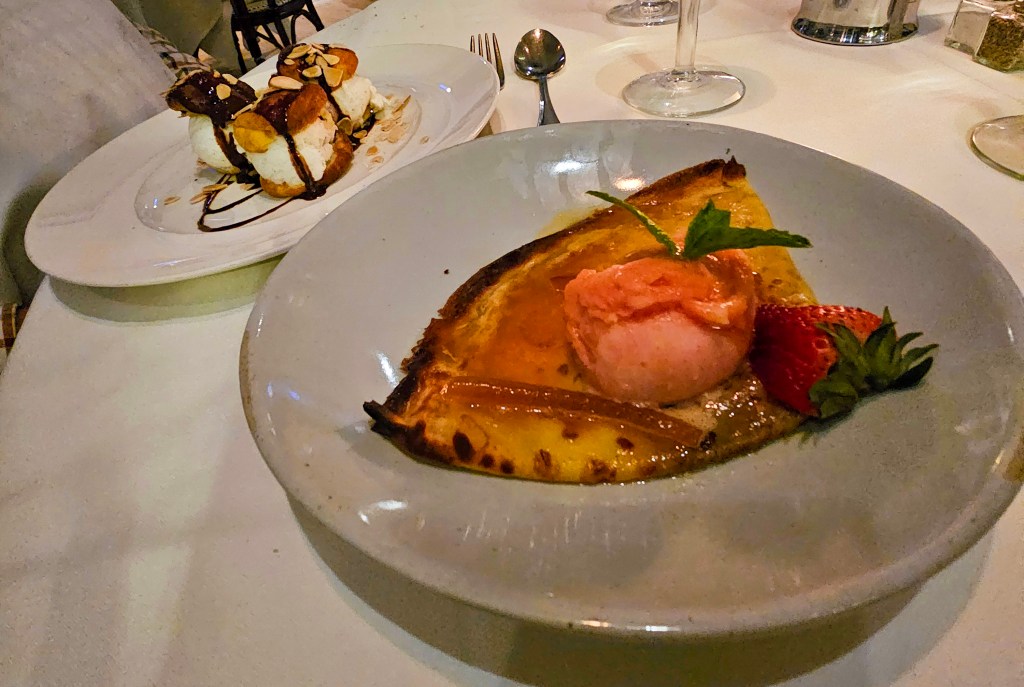
Dick took time to explore the town, finding a couple of very interesting shopping precincts that we would plan to return to later with a rental car.  In the evening, we walked to the nearby Bleu Provence, another outstanding French restaurant.  Service was excellent, and the food was delicious.  Once again, the noise was incredible, it seems to be the main downside of dining in Florida.  Dick commented that it has been our luck lately to be seated at a table next to one with a particularly loud man who holds forth at length on topics that are of zero interest to nearby diners.

Bleu Provence pork shank
Bleu Provence seabass
Bleu Provence desserts, profiteroles and a crepe

We didn’t have far to go to Marco Island, so we left at 11am.  It should have been an enjoyable trip through the Naples channel, looking at all the beautiful houses.  Sadly, because of the 30mph speed limit and the huge number of Saturday boaters, it was just an unpleasant half hour of being thrown around by wakes.  Not the fault of the boaters, they are doing the speed limit that they are allowed, and looking forward to getting out onto the Gulf.  Once we got out there, it was unpleasant in a whole different way.  Long, rolling waves on the bow meant that wristbands were required, and I was very unhappy.  The official trip planner, when questioned, indicated that the sea state was not at all as predicted.  Fortunately, it wasn’t a long trip, and once we were into the channel for Marco Island everything calmed down.  All the waterways around the Island are strictly minimum wake or no wake, so travel is much more enjoyable.

Naples, busy channel

We arrived at our marina, and our slip neighbour offered to catch our lines.  For a change, when asked to cleat the midship line tight, he did!  Docking was very quick and easy with such great help.  Dick checked in with the dockmaster, and then walked over to the other marina on the bay, hoping that one of the two would have had a cancellation and we would be able to avoid some or all of the expected nights at anchor.  No luck.

In the evening, we walked to a nearby steakhouse.  They have very good reviews, but sadly, our experience did not live up to expectations.  My steak was charred on the outside, and the asparagus was yellow and bitter, should never have left the kitchen.  The dessert we shared looked gorgeous, but it did not taste very good and neither of us wanted to finish it.  It was a very pricey meal for what it was.

Steakhouse dessert, attractive, but only the strawberry tasted good!

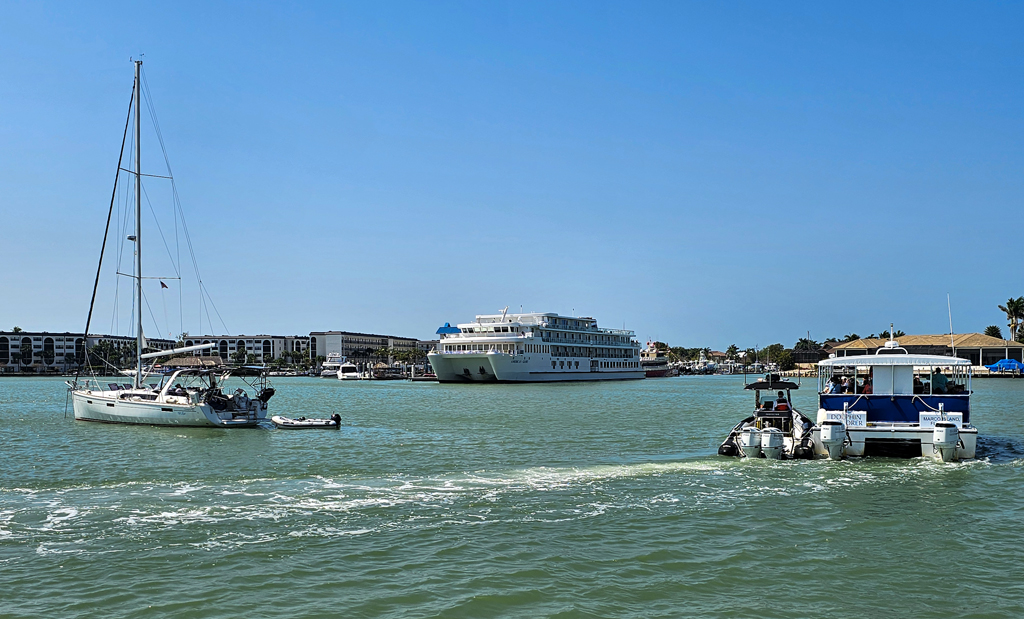
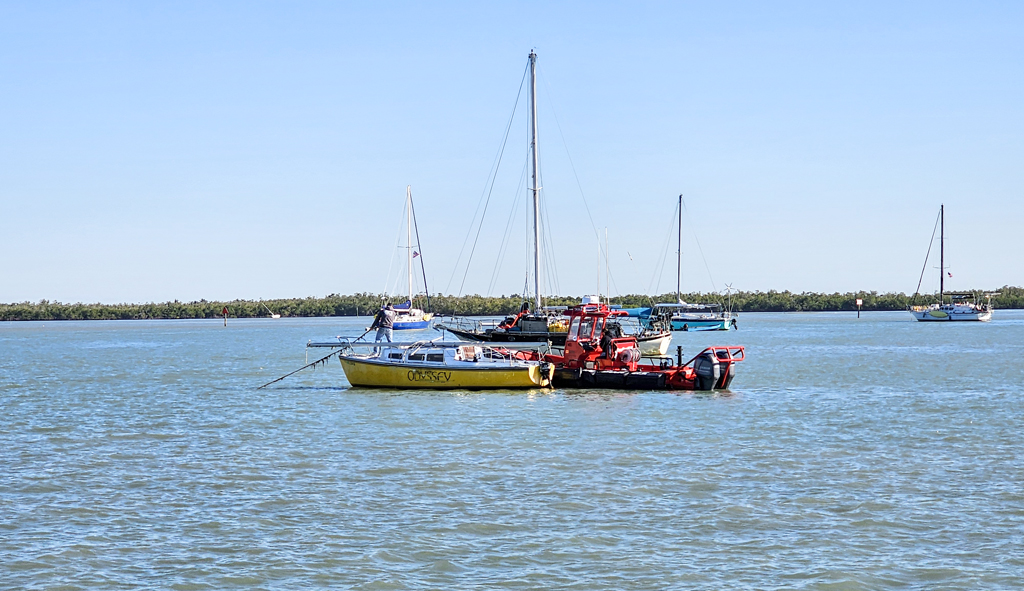
Next morning, Dick checked again to see if we could remain in the marina.  He was offered an 18-foot-wide slip, and thought we might just squeeze into it (one thinks about a large lady and a corset). At the waterline, we are less than our 18’8” width at the widest point, our rub rail.  We untied and made the attempt, but sadly, we couldn’t fit as the dock was just that bit higher than we had hoped.  Instead, we anchored just outside the marina, between 2 sailboats as planned.  We spent an interesting afternoon watching boats to-ing and fro-ing.  There was a small cruise ship in port (100 passengers).  Some of the passengers were taken on a dolphin cruise, and their boat got into trouble and had to be rescued and towed back by Sea Tow.  An interesting experience for the passengers, if not quite what they were expecting.

Sea Tow rescues the dolphin watching tour boat
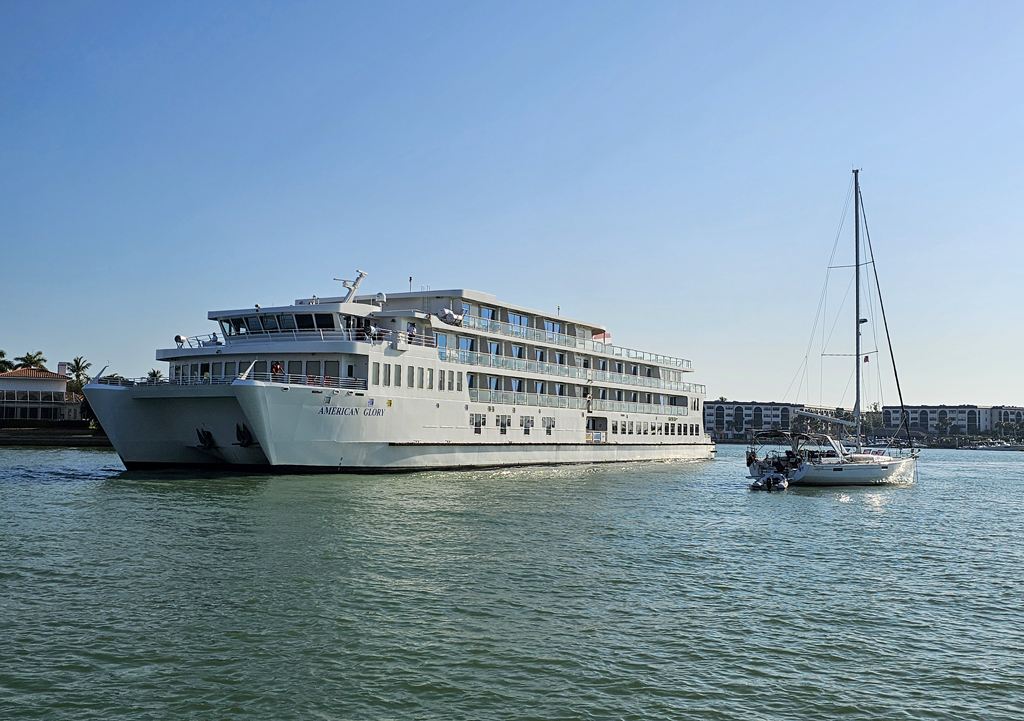
American Glory leaves port in the evening

After a quiet night, we re-recorded the podcast we had done earlier for AGLCA.  The topic is “Segment Looping”, that is, doing the great Loop in segments rather than all at once as is more usual.  We were asked about how we chose our boat, how we decided on the length of the segments, where we put the boat when we were not aboard, and of course, the advantages and disadvantages of segment looping. 

We dropped the dinghy, and Dick set off to collect the rental car he had arranged.  The weather in the afternoon went from interesting to exciting.  We started with heavy rain and some rumbling thunder.  After the rain stopped, the wind really came up and we began to swing from side to side.  There was a small craft warning for the entire west coast of Florida.  The wind howled, and we swung faster through 180 degrees.  Earlier, Dick had chatted with the couple on the sailboat anchored next to us.  They were having a bad week.  They had gone out in rough weather, and were lifted by a big wave and slammed down on something, debris, sand bar, possibly the broken marker off the Marco Island Channel?  The impact was enough to bend their floorboards, so they had concerns that there was serious damage to their hull.  A haul-out was scheduled for later in the week, and meanwhile, they were anchoring while they waited for their appointment.  Next piece of bad luck, their dinghy motor died.  Dick gave Bill his card, and offered a ride if needed to shore the next day, to save them having to row.

A couple of hours later, the phone rang, it was Bill to say that their dinghy had broken free and was floating away.  Fortunately, it was floating into one of the canals rather than out into the bay.  Dick quickly donned life vest and shoes, and headed out.  He managed to capture the runaway, not without some challenge, as it had slid under the only open dock on the canal.  He returned it to the sailboat, and in due course it was pulled up onto its davits, instead of just being tied.  Everyone then settled back to what they were doing, and listened to the wind howl.

Dick rescues the neighbour’s dinghy
Dick’s dinghy delivery service!

The afternoon excitement was not over by any means.  I looked over at our sailboat friends, and realized they were dragging their anchor.  As I tried to work out the best way to get their attention, they noticed the situation, and started their engines.  They began the process of resetting their anchor.  Dick decided to check ours, and saw that one of the lines of the bridle had come off.  Life vest, headsets, start engines, and we began a little resetting of our own.  It didn’t take long, and once we were set again, we poured well-deserved adult beverages and sat watching.

A small trawler that had come into the bay, and anchored behind us, decided to relocate for the second time that day.  Meanwhile, our sailboat friends seemed to be set, and put on their snubber (this is a line that functions as our bridle does, taking the weight of the anchor chain off the anchor roller).  Within a few minutes they were in motion again, and trying to get the anchor to set.  We suspect a couple of issues.  The type of anchor they have does not appear to swivel like ours, so as the boat swings back and forth it is less likely to remain set.  We also suspect that they are backing down too hard and too soon, and then not putting out enough rode (that’s the chain, rope, or combination of the two that goes between the anchor and the boat).  Dick and I always put out at least 7:1, that is, 7 times the depth from the bridle attachment points.  We have seen advice for 5:1, or even 3:1, but 7:1 was what we were taught for an overnight stop.  Ultimately, they were unable to get their anchor to hold, but meanwhile, Dick left a message to tell them about the vacant slip we couldn’t fit into, or the alternative of tying up at the fuel dock, since it was now after hours.  They chose to head for the fuel dock.

Just to finish their rather sad story, Bill let us know later that after the haulout and inspection by the insurance adjuster, it is certain that their beautiful Oceanis 45 will be written off, as it cannot be repaired.  They are selling everything portable and fortunately had an “agreed value” insurance policy, so they will get back what they paid for the boat.  An object lesson, reminding all of us not to go out in conditions that are worse than we should be in.

Eventually, the chop subsided, but the wind was still high, so Dick had to cook the burgers on the frying pan in the galley.  The wind would have blown out the flame under the grill!  As it happens, the burgers were delicious, and perfectly cooked, and in my opinion, we should always do them in the frying pan in future.

Tuesday turned out to be a busy and interesting day.  After a leisurely start, we got into the dinghy and motored over to the fuel dock, which doubles as a dinghy dock.  There is a $10 plus tax charge, which is pretty unusual, although it does allow in/out privileges.  The biggest issue is that after 6pm, you are supposed to have left, because the dock is behind the security gates and they do not provide the code to dinghy owners.  Fortunately for our plans, we already knew the code, although we kept that quiet and told the cashier that we had friends in the marina who would let us in.

Our first stop was a high-end shopping center at another marina.  Dick’s sources for marina selection had suggested that it was not suitable for boats of our size, and that the access was too shallow, so he had not tried to get a reservation there.  Having seen 2 Looper boats in there this week, we could have fit.

The shops were disappointing, with the exception of a jewellery shop that offered unique pieces of shells and marine glass, set in silver.  We would have bought something there, but the saleslady was unable to help us while a couple dithered over their purchase.  After a very long wait, we gave up.

Next, we drove to the end of the island, marvelling at the sheer number of high-rise condo buildings.  Assuming that each unit has one vehicle, the traffic jams must be horrendous, and we now know why the restaurants at that end of the island are fully booked.

We parked in another shopping centre that happened to have a branch of my favourite ladies’ shop, as well as being the location of our (early) dinner reservation.  Having bought two nice things at Chico’s, I was delighted to discover that there were more shops with very unusual, and flattering, clothes that just had to be added to my wardrobe.  Dick can occasionally be a good shopping buddy, and this was one of those rare times.  He selected several garments that subsequently found their way into shopping bags.  Exhausted by our efforts, we fortified ourselves with ice cream before heading out for some grocery shopping.  It was late enough by the time we finished that we decided not to return to the boat, instead we went directly to the restaurant.

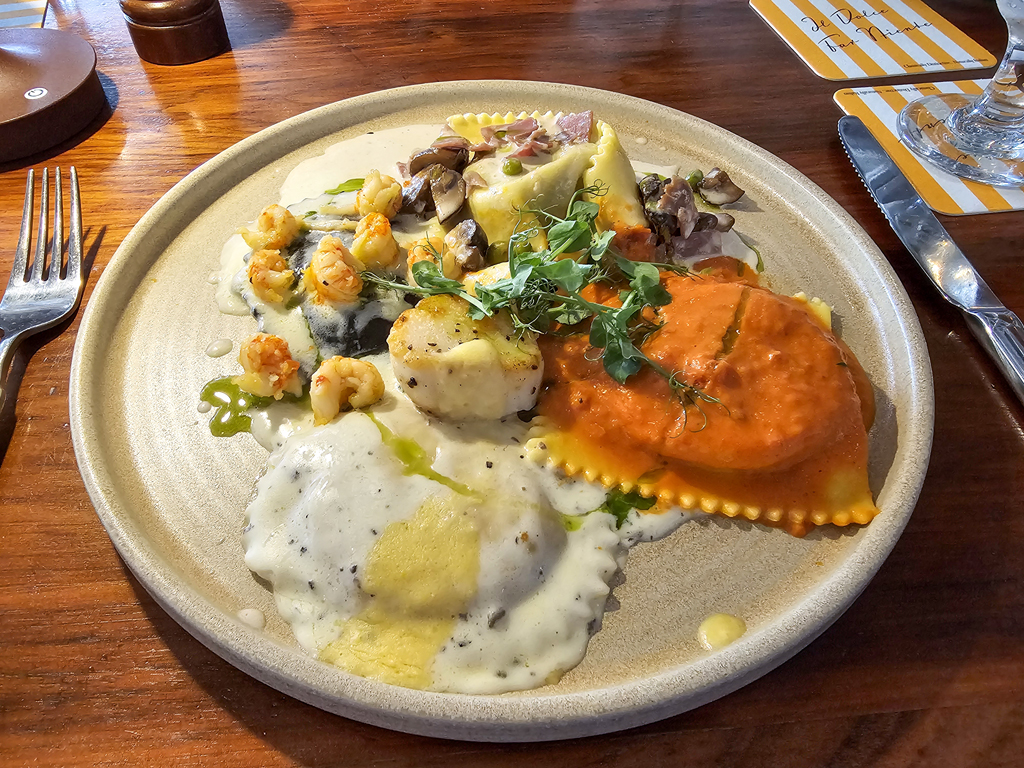
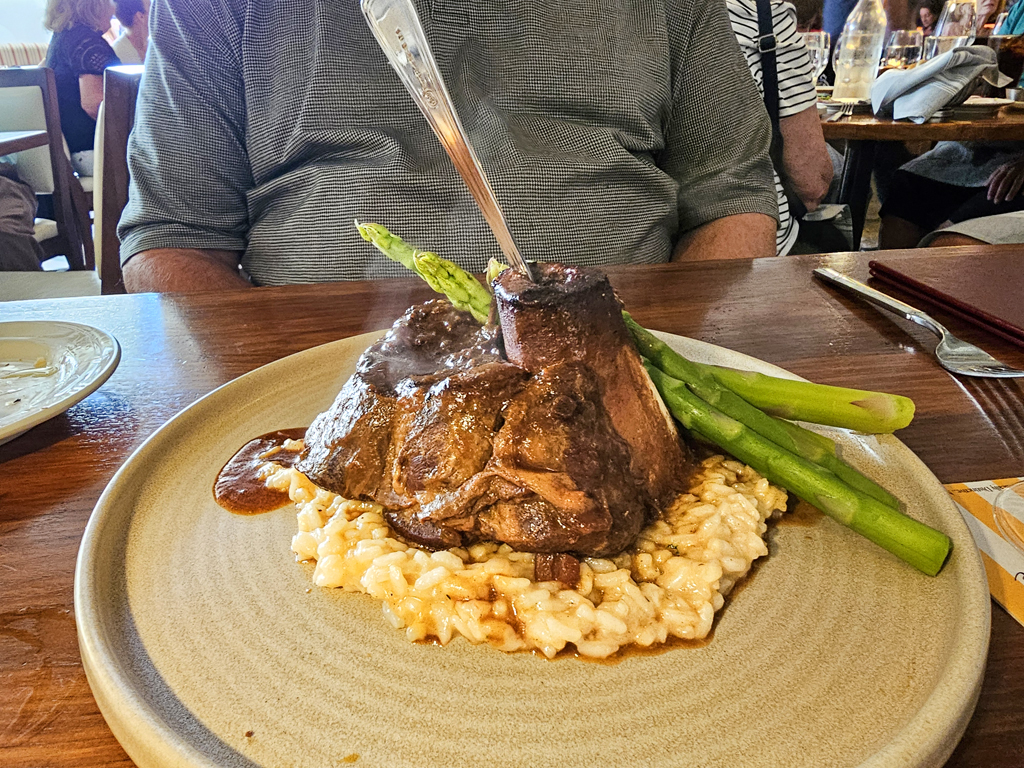
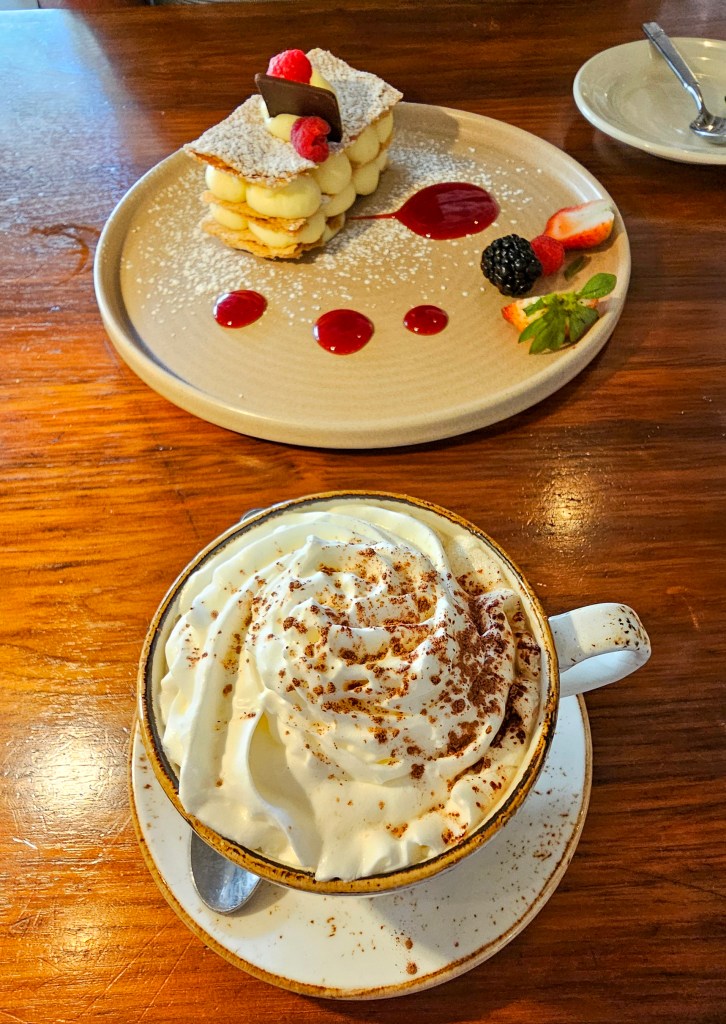
Da Vinci’s is a huge venue, that was completely filled by shortly after 5pm.  Many of the diners appeared to be family groups, grandma and grandpa, parents, and grandchildren on vacation.  Dinner was excellent, and service was also very good.  It just shows that having enough staff makes a big difference to success, especially in restaurants that cater to families and vacationers.

Da Vinci’s ravioli trio
Da Vinci’s osso bucco
Da Vinci’s desserts, Napoleon and a Spanish coffee

Returning to Nine Lives was accomplished without drama, and we had a very peaceful night.  We suspect the anchor had dragged a small amount with tide changes, but it always dug in again and we remained within the circle I set for the anchor alarms.

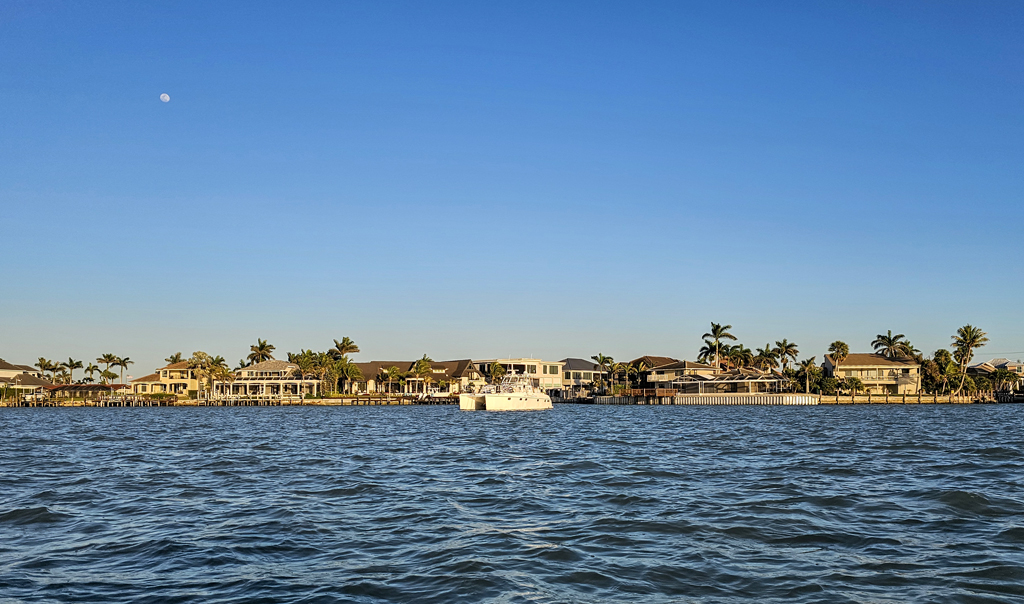
Nine Lives at anchor in Factory Bay

The next morning we were fascinated watching TowBoatUS retrieve the derelict sailboat that had been anchored beside us.  Derelict boats left at anchor are a huge problem in southern US, especially in Florida.  Wealthy homeowners don’t want to have to look at deteriorating vessels outside their expensive properties.  We find this completely understandable.  The problem comes when communities and counties try a shotgun approach and put forward legislative bills to forbid anchoring entirely.  There are already laws and procedures in place to deal with the situation, but instead of following them, a draconian approach is proposed again and again in the form of new and ever more restrictive laws.  Concerned boating organizations do their best to counter the proposals but are not always successful.  We were happy to see the derelict retrieval, as it shows that measures can be taken to handle the problem.  It took less than an hour from the time the towing company came out to dropping the derelict at the dock and heading out on another job.

TowBoatUS retrieves a derelict sailboat

We were able to get into our slip across the bay a little early.  The anchor took a while to come loose from the mud – three days of wind and fetch with almost continual swinging back and forth meant it was well dug in.

Two Endeavourcats at Factory Bay Marina. Nine Lives is the further of the two.

As soon as Dick had retrieved the rented vehicle, we set off for Naples.  Another successful shopping day!  I said to Dick, we have made up in just 2 days for 3 years of scarce shopping on the inland rivers.  This extravaganza was a little more even, 2 shirts for Dick, a necklace and an outfit for me, and a very nice silk flower arrangement for the condo.

Naples
Naples

Next stop was Bha! Bha!, a Persian restaurant.  The food was beautifully presented and absolutely delicious.  I started with gravlax, while Dick had lamb meatballs.  His main course was the Persian chef’s interpretation of paella, which he loved.  I had a wonderful dish of beef tenderloin pieces with tomatoes, eggplant, and red peppers in a spicy sauce.  The desserts were also beautifully presented, but sadly they were too sweet for our taste.

Bha! Bha! Persian Restaurant gravlax and lamb meatballs to start
Bha! Bha! paella
Bha! Bha! beef tenderloin
Bha! Bha! beautiful, but very sweet desserts

On our travels to and from Naples, there was a road sign warning about panthers crossing.  I would have loved to have seen a panther.  Instead, I saw two wild pigs foraging along the verges. I suppose they would make a good lunch for a panther…

Naples

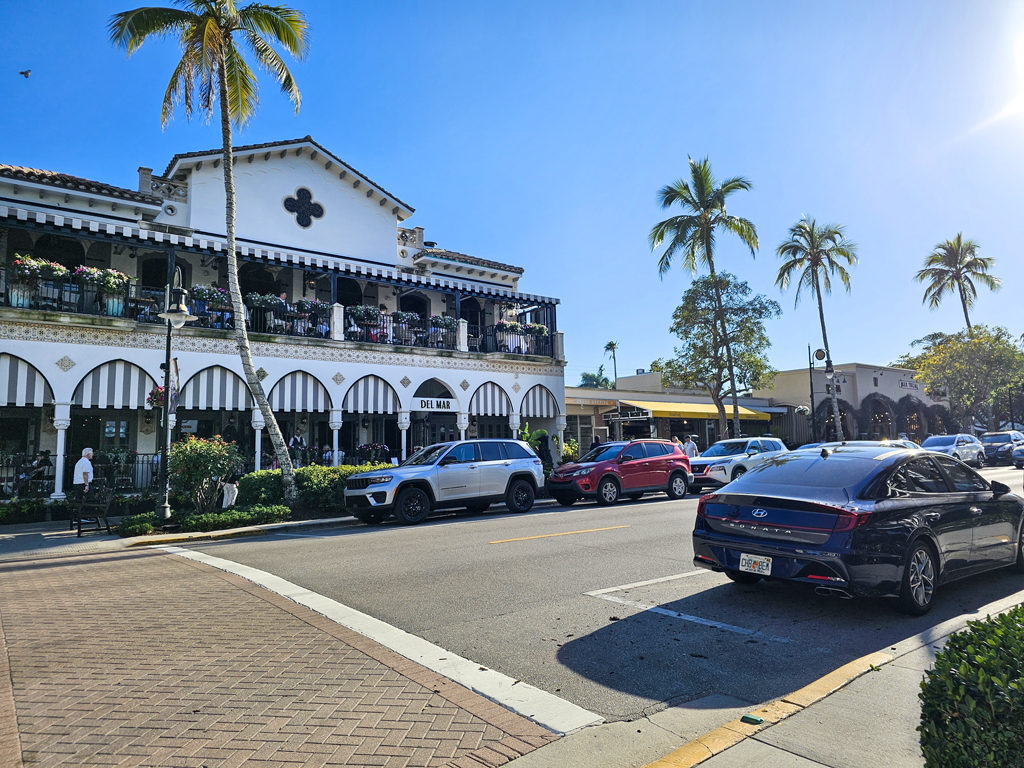
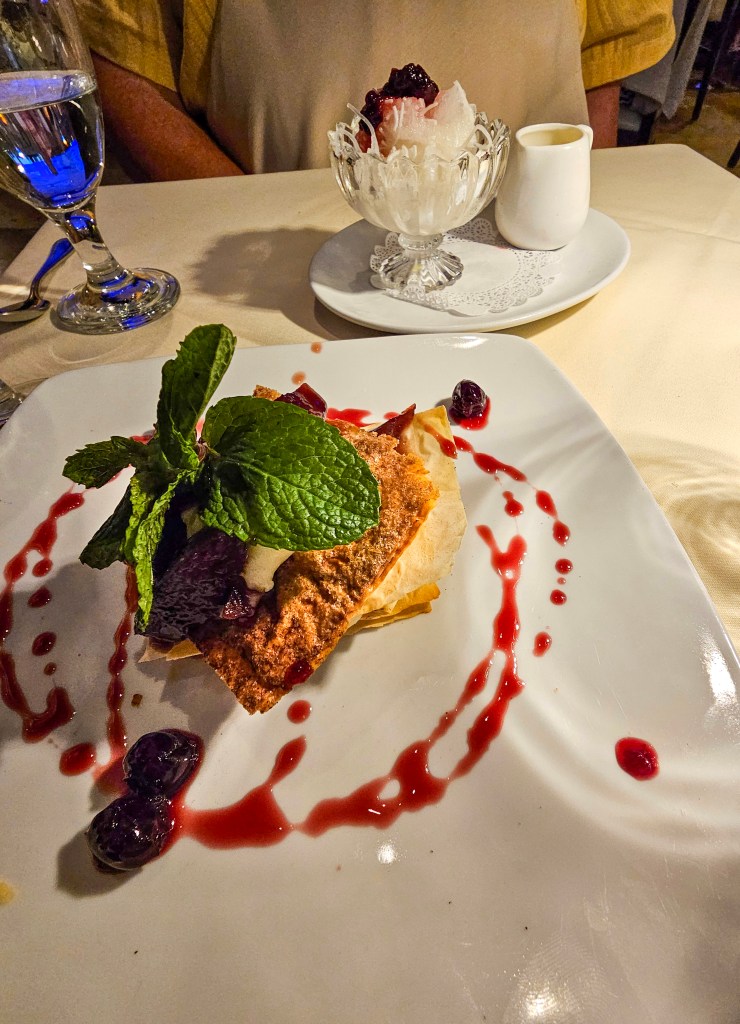
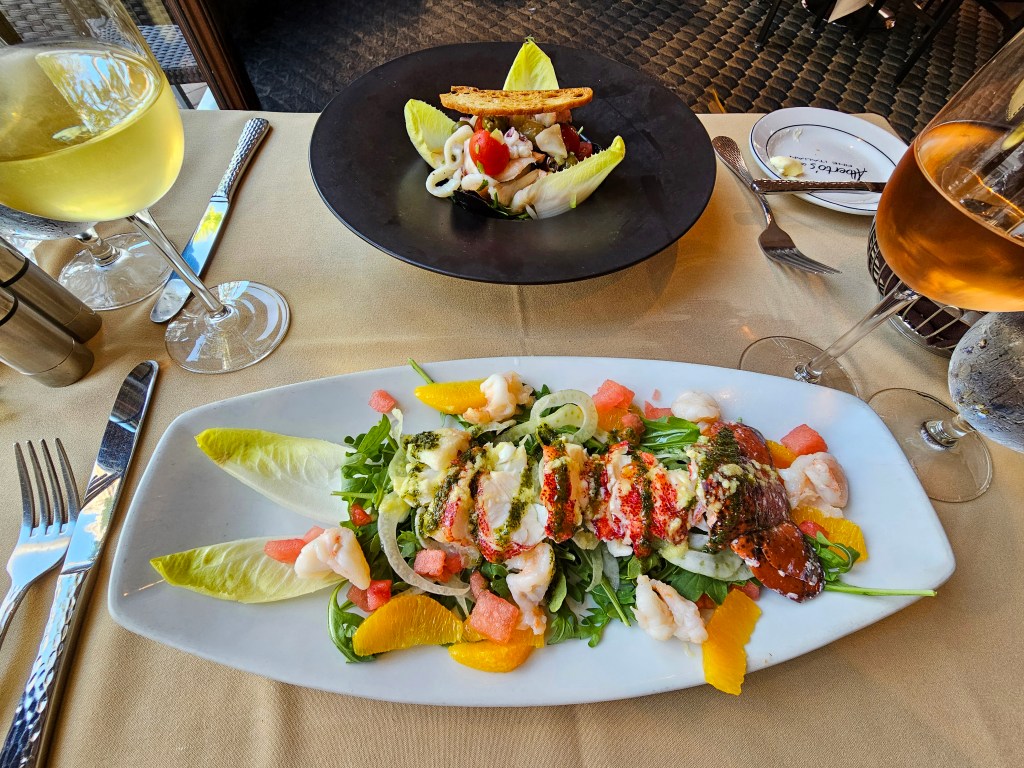
The next day was another full day.  We returned to Naples, to the second upscale shopping precinct that Dick had scouted earlier in the week.  We found a couple of very interesting, eclectic boutiques with things for the home.  The clothing shops were less interesting, probably just as well!  Lunch was at Alberto’s, an Italian restaurant.  We chose the cauliflower soup to start, which was delicious.  We both ordered salads, Dick’s with mixed seafood, and mine with lobster and shrimp.  They were excellent.  Desserts were interesting.  Dick enjoyed a parfait made with limoncello, and I ordered Grand Marnier crème brulee.  It was a bit startling, as it arrived with 5” of flames creating the sugar crust.  I can’t remember a dish being delivered on fire before.

Pizzas on display in a window
Seafood salads at Alberto’s
Limoncello dessert at Alberto’s

We returned to Marco Island, and after Dick returned the rental car, we spent a quiet evening.  We hoped to have an evening drink with our slip neighbours, fellow Loopers, but it didn’t work out, so we made plans to get together in Key West.

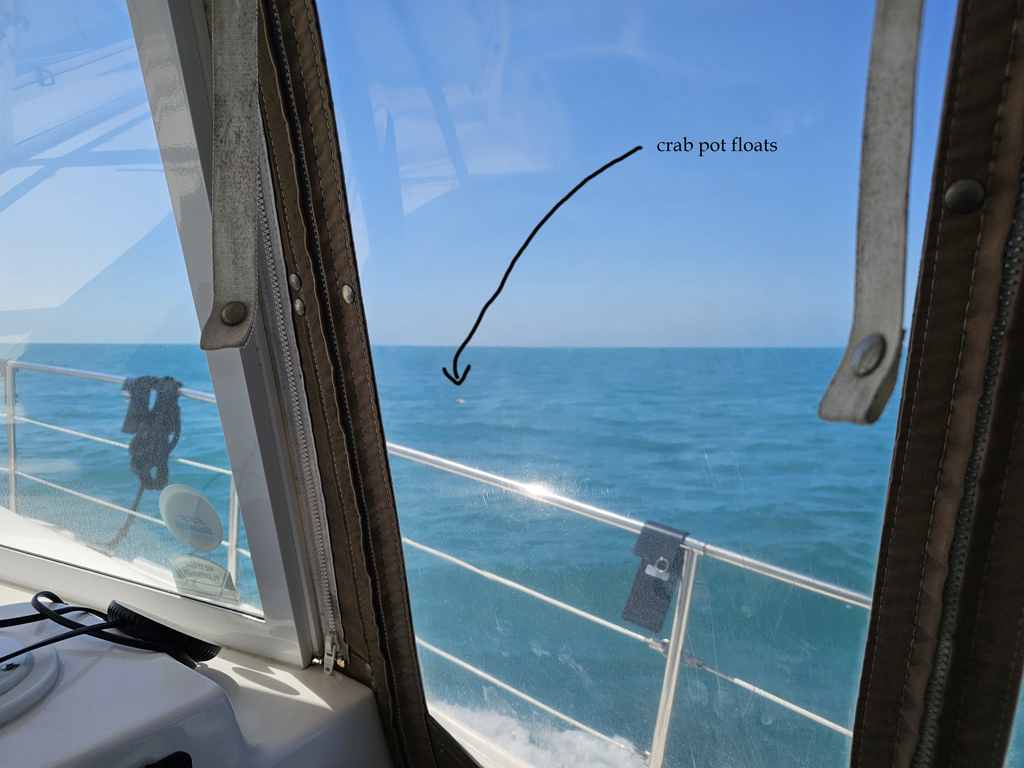
It was an early start for our second Gulf crossing.  This one would be daylight only, with plans to shorten the duration by running fast.  We ran the whole way at about 85% of WOT (wide open throttle, that is, the fastest the engines can go), giving us between 13 and 15 knots.  This was partly for comfort, but also to make sure that a prolonged journey at this speed was fine for the engines.  One unexpected challenge was the crab pots.  We did not expect them so far off shore and in water depths of 50 feet.  The pots are marked by floats, each about 6” to 8” in diameter.  Here they were mostly in groups of 3, but they were still very difficult to see.  They bob up and down in the waves, and between the sun glinting on the water and the small whitecaps, they were practically invisible.  Dick’s chair is further forward than mine, and of course he is taller, and with the bow slightly elevated at the speed we were travelling, I had no hope of seeing them except through the side window.  By then they are pretty close for Dick to find the next in the line and maneuver around it.  These crab pot floats are not something you want to just run over.  If you cut the line or damage the float, you are hurting the fisherman’s livelihood.  Also, you risk damage to your hull and running gear.  Get the line wrapped around the prop and you are instantly dead in the water.

Nine Lives leaves Factory Bay at dawn
Nine Lives speeds up and makes a rooster tail!
Crab pots are hard to see!

We arrived at the marina in Key West by 3pm.  The basin is huge, but there are 4 separate marinas, and it is both crowded and higgledy piggledy.  Nine Lives was salt encrusted after her fast run, so Dick’s first order of business was a washdown of all the decks, railings, and windows.

In the evening, we joined fellow Loopers Beth and Calvin for dinner at a local steakhouse.  The food was very good, as was the service, and they were great company.  Their boat was behind us in Marco Island, and they made the same crossing a couple of hours after us.

We set out to explore Key West the next morning.  Dick booked 2 days for the hop-on-hop-off trolley tour, so we began by taking the full 90-minute round-trip tour of the island.

Key West Mallory Square
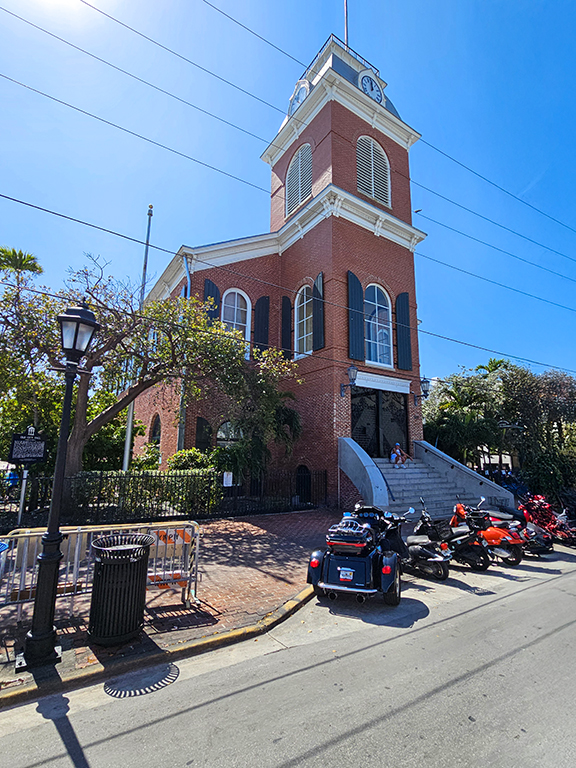
Key West Old City Hall
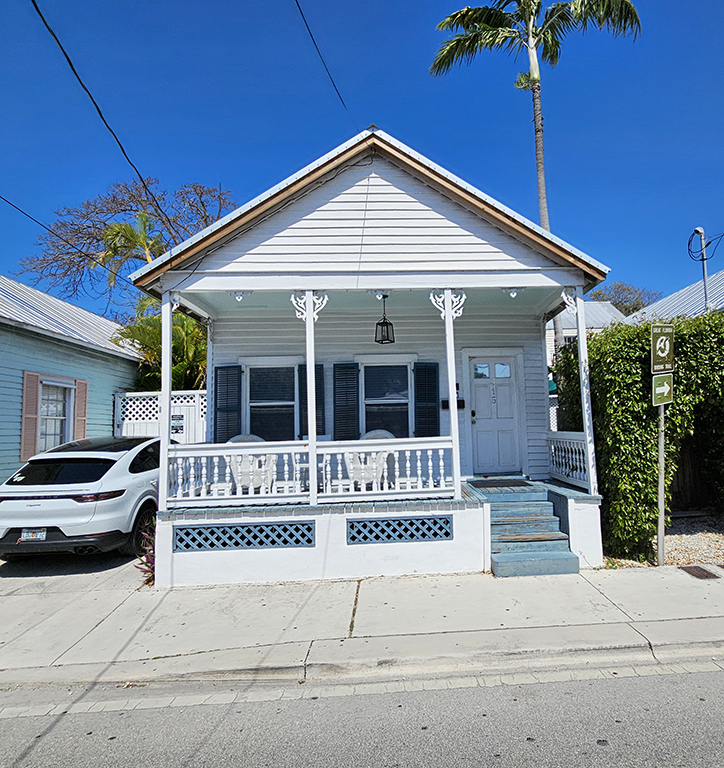
Shotgun House in Key West. The front and back doors are in line, for ventilation.

The Saturday before St Patrick’s Day is a big celebration in Key West, so students on spring break, cruise ship passengers, and hundreds of other tourists wandered the streets, in and out of the many bars, and generally enjoyed a raucous good time.  Crowds and drunks are never my thing, so I was reminded of being told by friends that you either love it or hate it when speaking of Key West.  I was well on the way to the latter until after dinner, as we walked back to the boat along quiet, leafy streets of gracious old houses with lovely tropical gardens. 

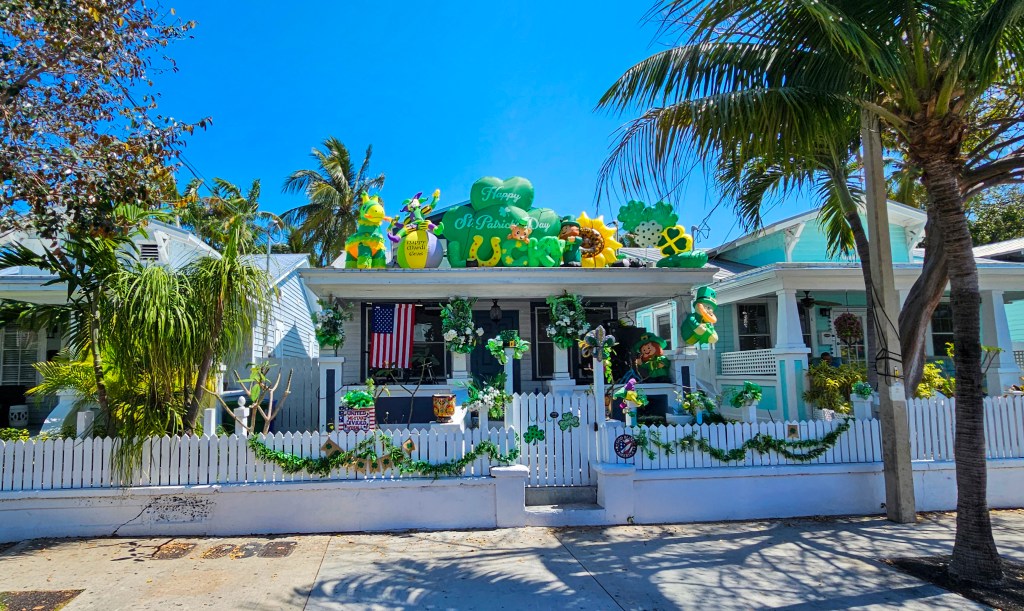
Key West celebrates St Patrick’s Day with enthusiasm
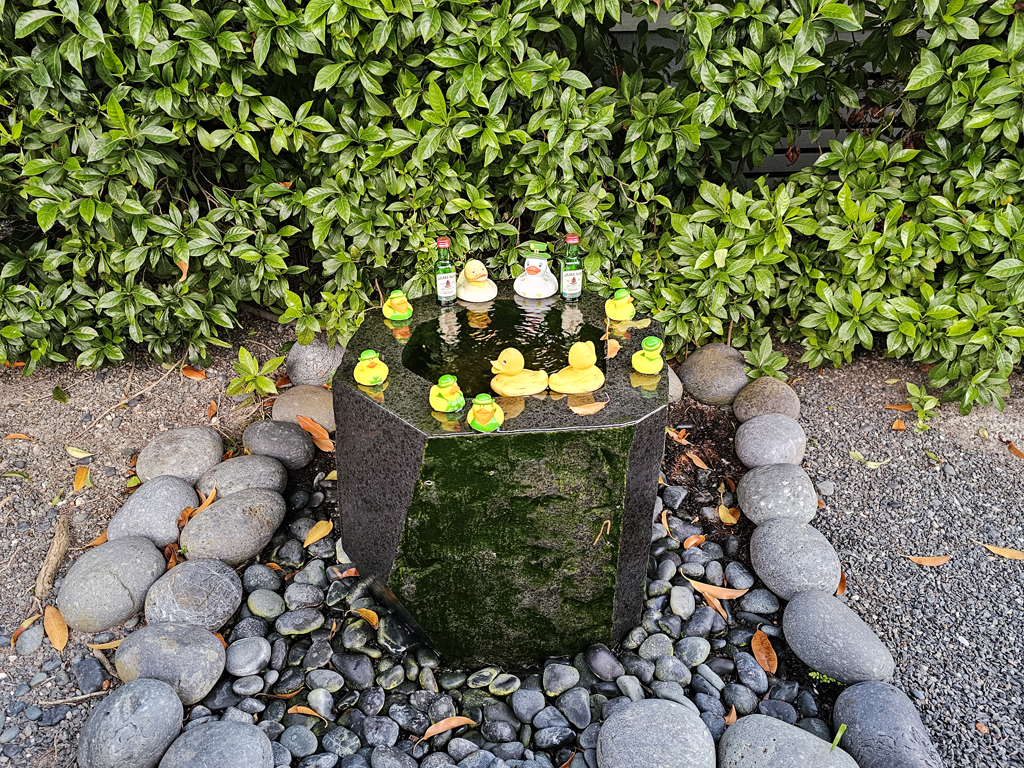
A St Patrick’s Day display of rubber duckies
Taking a break from celebrating

There were some interesting stories on the trolley tour.  One must always assume part fantasy, I have heard the most outrageous lies told by tour guides!

One story goes that in the mid 20th century, the island was populated by the navy and the shrimp fishermen.  These groups hated each other, but there was only one bar on the island at the time, so they found themselves drinking together after hard days at sea.  The bar, The Red Doors Saloon, was also known as “The Bucket of Blood”.  Fights broke out regularly, and brawling was a way of life.  Apparently, when you arrived at the bar, you were searched for weapons before being allowed to enter the premises.  If you didn’t have one, they gave you one – just to ensure that everyone had an equal chance. One can look up the true story.  Research shows that the building dates from 1868, and was at various times, a cigar factory, a ship’s chandlery, a grocery and hardware store, and a bar.  It was always a shrimper’s bar, and its reputation as a place of beatings, stabbings, assaults, and even quiet murders was well earned.  By 1972, the regulars had moved on and the bar was no longer viable and closed its doors.  Today it is an upscale lady’s boutique. There is another story about this building’s colourful history.  At one time, the upstairs was used as a bordello.  When the building was renovated, inside one of the upstairs walls were found a great many mens’ wallets.  Apparently, the ladies of the evening would rob their patrons and toss the empty wallets into a cavity in the wall.  The tour guide commented that given the clothing sold today in this shop, men are still leaving without the contents of their wallets.

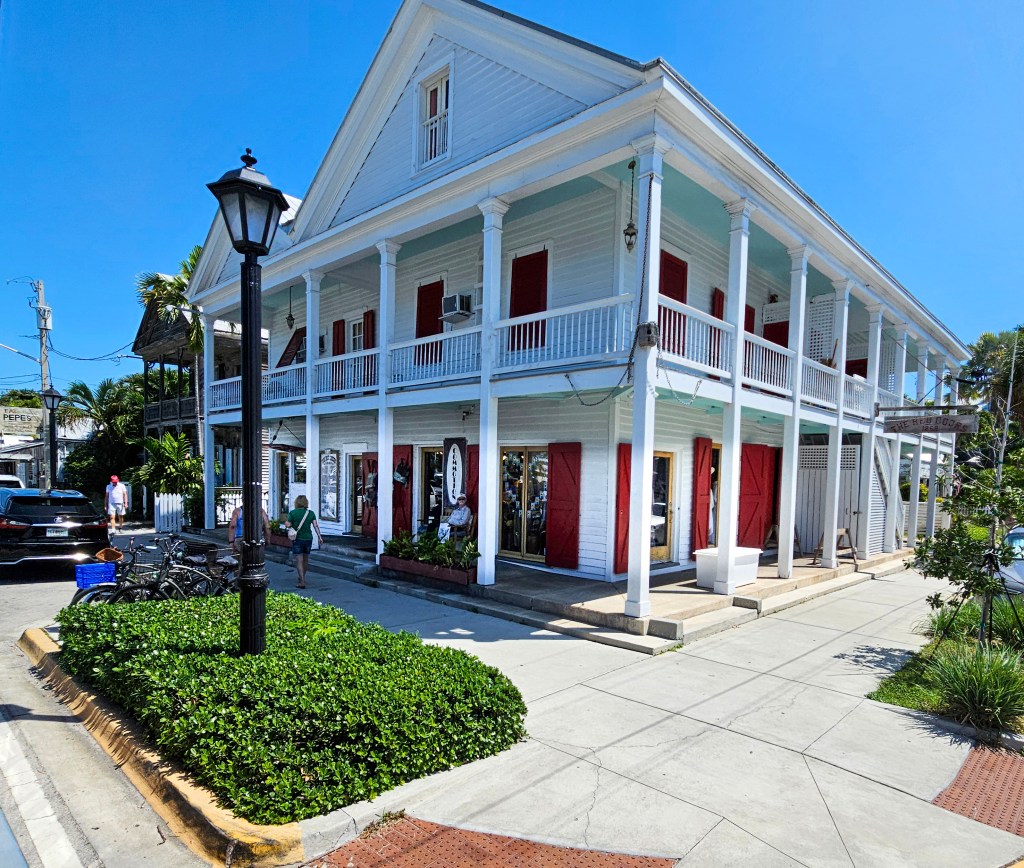
Red Doors Saloon, or The Bucket of Blood, today a more genteel ladies shop.

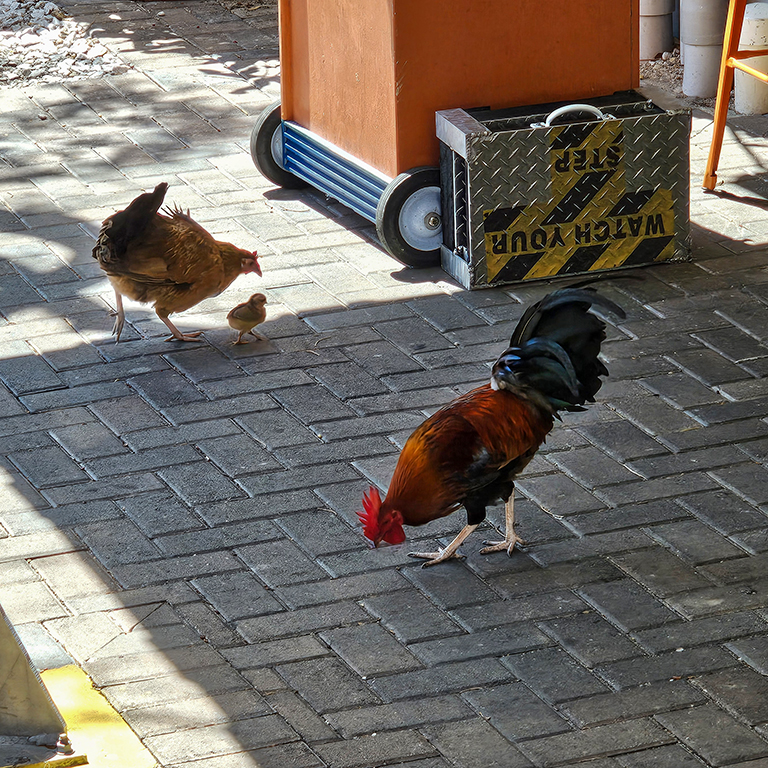
In the 19th century, many Cubans came to the island to avoid troubles in their own country.  They brought with them their culture and cuisine, and also their chickens.  These ran loose, and inevitably multiplied.  Early in the morning, while I sat in the cockpit enjoying coffee, I could hear roosters crowing all over town.  I imagine that would not help much with the inevitable morning-after hangovers suffered by the St Patrick’s Day revelers. The chickens are feral, and are considered a nuisance by residents, but they are an important part of the island’s history and are now protected.

Chicken family

The southernmost part of USA is supposedly on the south side of the island.  There is a marker to designate the spot, and it is considered obligatory for visitors to have their picture taken in front of the large painted concrete buoy.  The queue was a block long.  We decided to pass on that particular experience.  In fact, the marker is not at the southernmost point of the US, it’s not even the southernmost point of Key West.  It is also not the remains of the Key West lighthouse that was wrecked in a hurricane.  It was set up as a tourist attraction in 1983 by the city.

Southernmost marker (picture snapped between tourists, the queue was a block long).
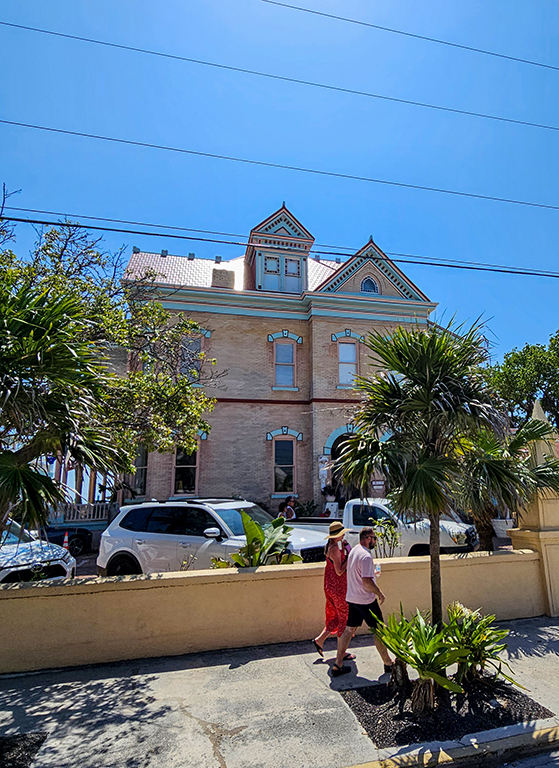
Southernmost House. It has only one bedroom. The owners loved to entertain, and much of the house is a ballroom, but guests slept in one of three other houses nearby, because the owners did not want their company overnight.

When the navy first arrived, with the mission to clear out the pirates in the Caribbean, Key West was a one mile square island.  The navy needed more space, so they started dredging, using the coral they dug to fill in the wetlands and increase the size of the island.  By the time it had grown to 4 miles square, it became clear that they were dredging faster than the coral could renew, and doing irreparable damage to the only coral reef in United States waters.  The expansion stopped, and that end of the island is called “New Town”, as distinguished from “Old Town”, the site of the original settlement.

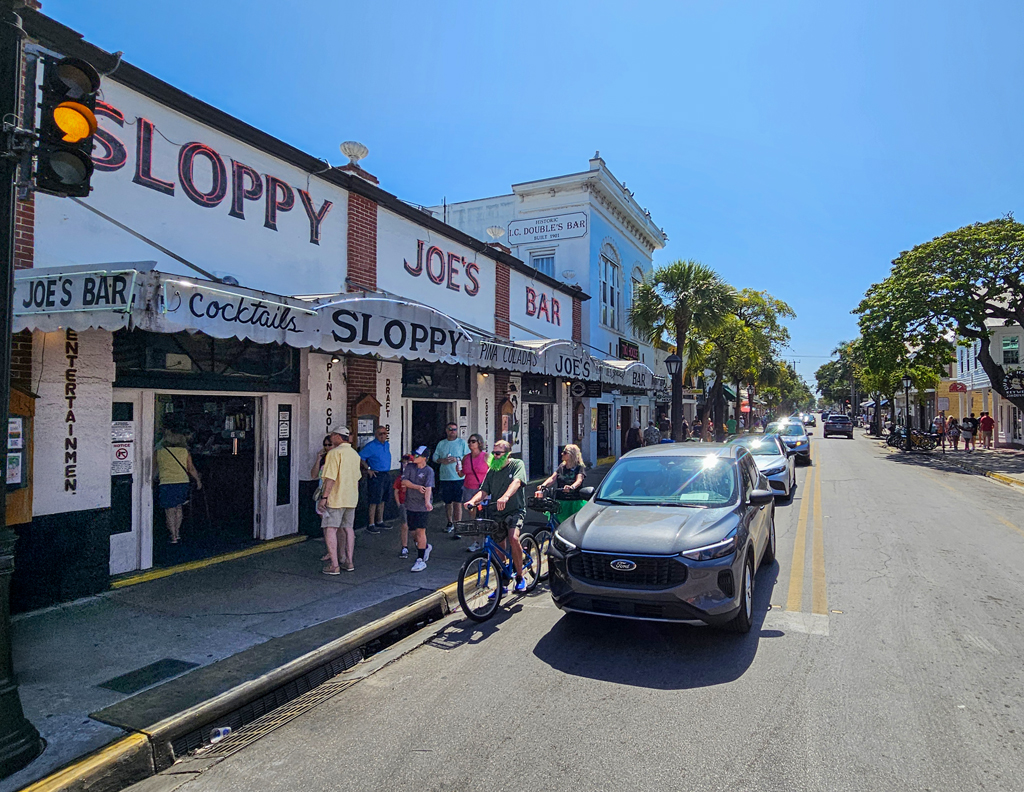
Sloppy Joe’s Bar officially opened in 1933, the day that Prohibition was repealed.  In fact, the island was full of speakeasies, the Island being a bastion of free-thinkers who considered that Prohibition was an amusing exercise dreamed up by the government.  It was Ernest Hemmingway’s favourite bar, and while it originally had several other names, Sloppy Joe’s was the one that stuck.

Sloppy Joe’s, Hemmingway’s favourite bar. Note the guy on a bicycle wearing a green beard for St Patrick’s Day.

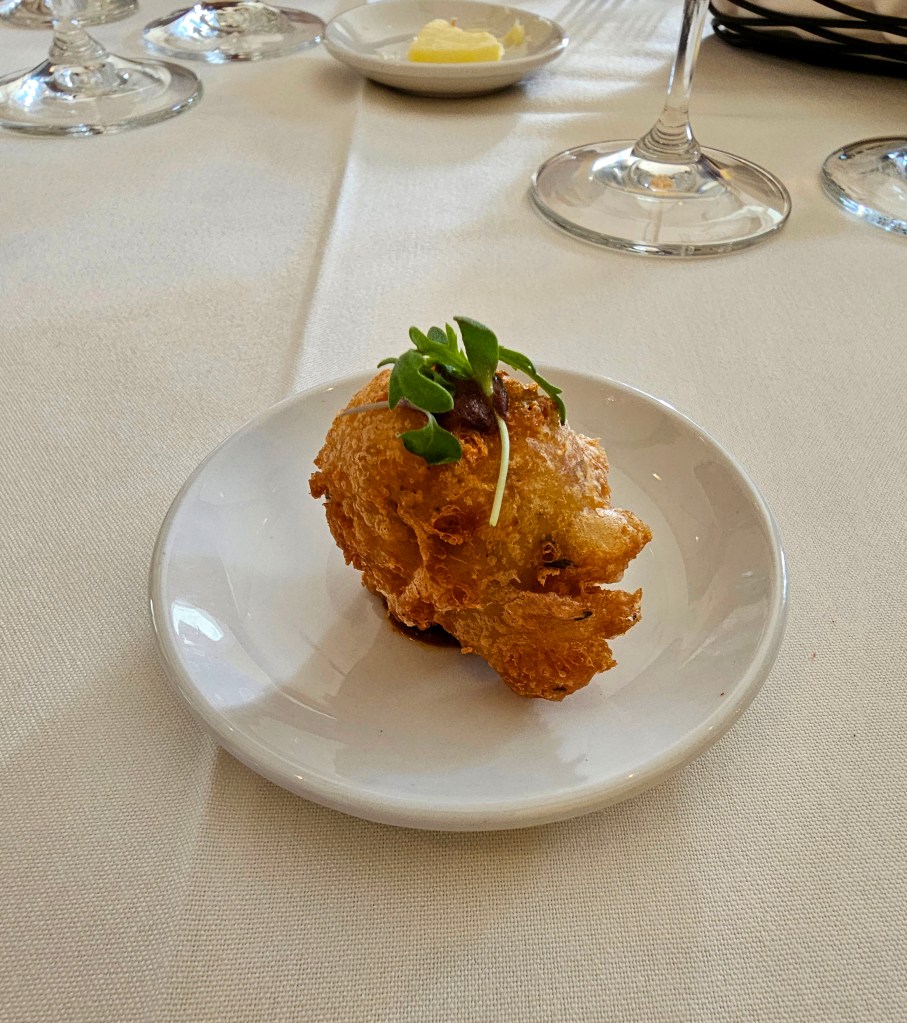
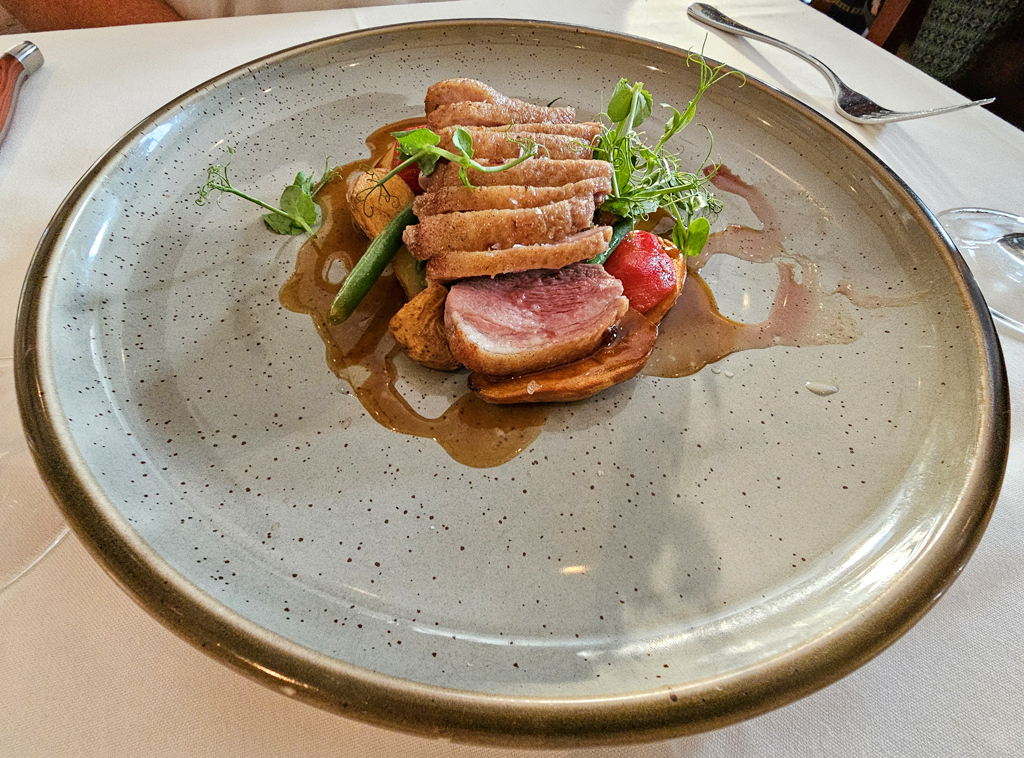
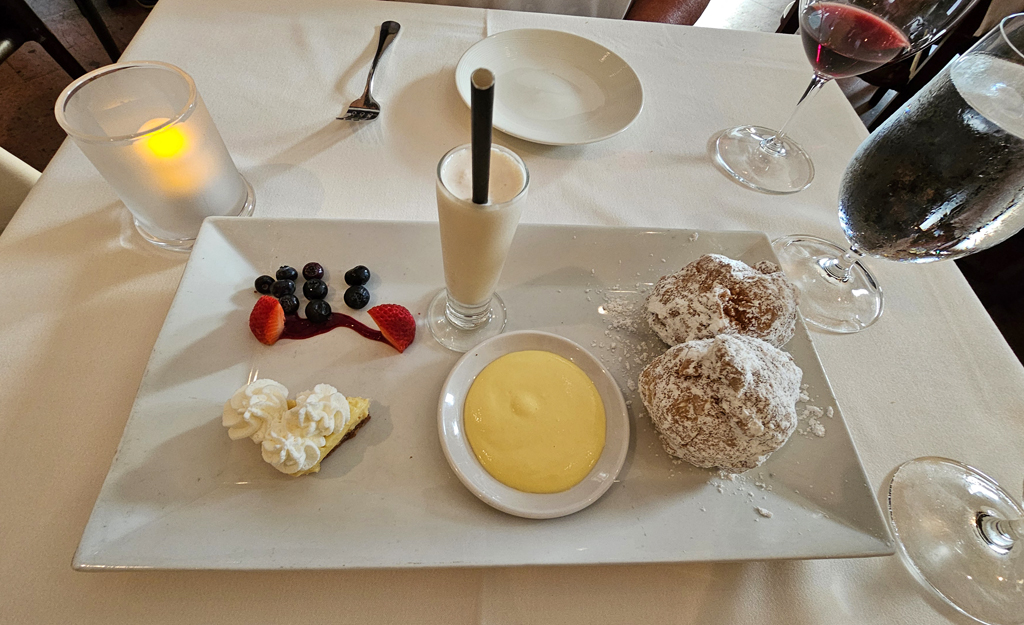
Dinner was at Café Marquesa, a beautiful, elegant restaurant that is part of a very upscale hotel, spread over several historic homes.  The owner (manager?) met every guest as they entered, and checked back with them during the meal to make sure everything was as expected.  The restaurant offers what is described as “gourmet coastal cuisine.”  The meal was excellent, starting with an interesting amuse bouche, a small beignet, filled with cotija cheese, resting on a lightly spicy chili sauce.  The courses and portions were designed to put together a 4-course meal, so Dick enjoyed what was very similar to a tasting menu.  I decided to try the salad to begin, and Dick had she crab soup.  After a small pasta dish with crawfish tails, Dick’s main course was duck breast, while I had filet mignon Oscar, topped with a small crab cake and served on a perfectly executed roesti potato cake.  We shared a dessert trio.

Cafe Marquesa amuse bouche
Cafe Marquesa she crab soup
Cafe Marquesa duck breast
Cafe Marquesa filet mignon Oscar
Dessert trio at Cafe Marquesa

As we walked back along the beautiful streets of the residential part of the old town, we saw a hen shepherding her chicks across the road, watched by an interested golden retriever, fortunately well secured on his leash.

Why did the chicken cross the road?

We sat in the cockpit and enjoyed a nightcap.  Clearly, the Key West spirit is contagious, because we decided a second glass was called for, and we stayed up long past Looper midnight!

We set off the next day to repeat the trolley tour – different guide, different stories, and sitting on the opposite side to get different pictures.

Green Iguana
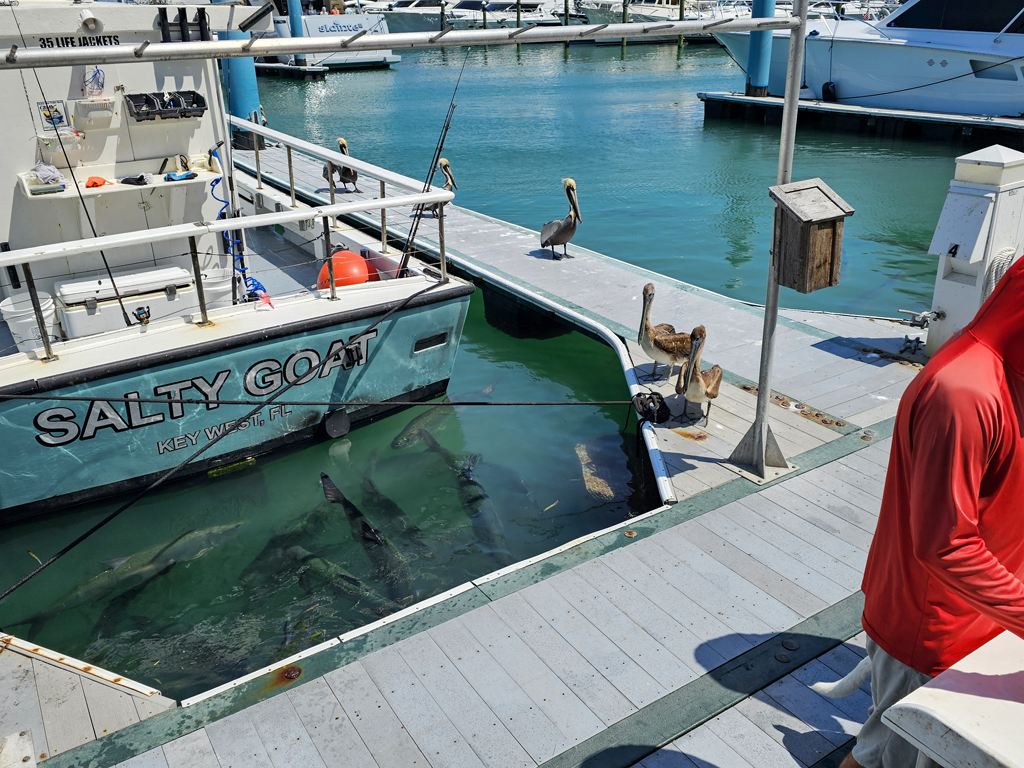
Tarpon
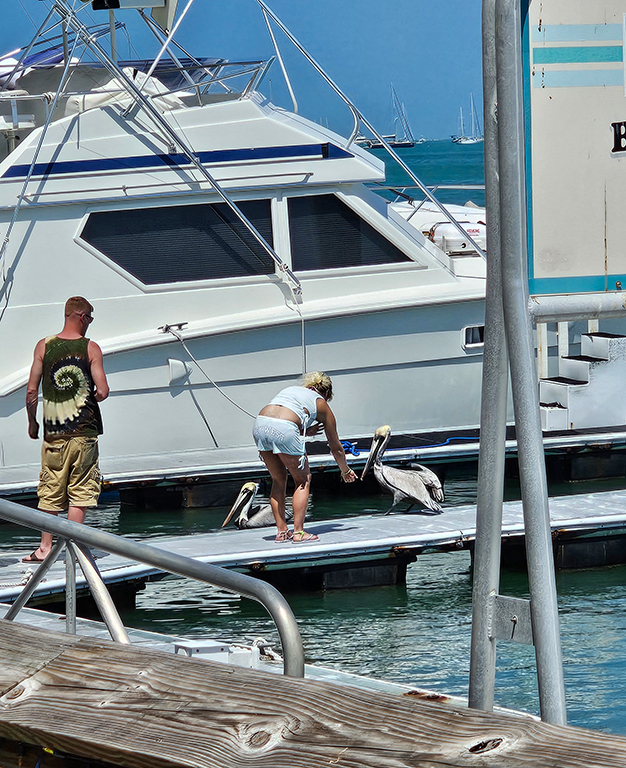
The tarpon and the pelicans are waiting for the guy in the red shirt to toss them the scraps as he cleans the fish caught that day.

From my perspective, we probably couldn’t have chosen a worse week to be there.  It was hot – between temperatures over 80F and high humidity, it felt like 90F, and the sun beat down on the concrete sidewalks.  The St Patrick’s celebration and spring break combined to create my most disliked scenario, crowds and drunks.  The next week might have been a perfect time, cooler, quieter, but we are not there then.

The tour driver had a great sense of humour, but he was clearly hungover and did not have as many interesting stories as the previous day.  Afterwards, we did the Key West thing, and repaired to a bar for tropical beverages.

Better Than Sex, a dessert only restaurant
Mile Zero on US Highway 1
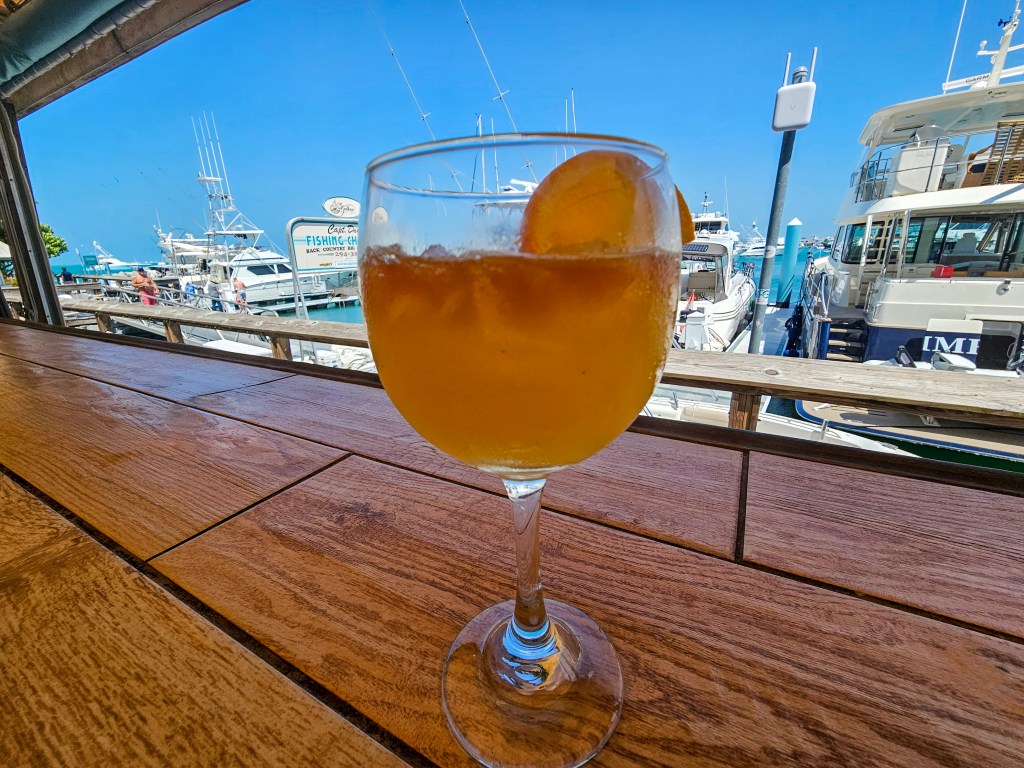
Pause for a tropical beverage
A foolish tourist tries to feed a pelican

Our dinner plans were for a late meal at Hot Tin Roof, having reserved one of the coveted outside tables.  It was still hot and muggy, and on arrival we realized that the outside tables are on a balcony overlooking a popular bar with live music, all very loud!  We were able to get a table inside instead.  The meal started with delicious and unusual garlic toasts with Manchego butter.  Dick’s choices for the meal were good, but I found that my food was overwhelmed by the sauces.  The key lime pie for dessert made up for everything.  It was delicious and nothing like what we have had before.

Key Lime Pie at Hot Tin Roof

We were not able to stay longer in the marina in Key West because they had a previous booking, and we don’t fit into the slips that were vacant.  Dick booked 3 nights at Perry Hotel Marina on Stock Island, which is across the bridge from Key West.  It would take just an hour, especially if we ran fast, to get there from Key West.  We knew that conditions would be bad.  The wind was howling.  Calvin helped us untie, if he hadn’t been there, we would have had trouble.  Dick had spoken with a couple of fishing boat captains, who confirmed his expectation that the worst would be just outside the harbour, with the wind coming from the north and the waves directly on the beam.  Once in the lee of Fleming Key, it would be better, and then as soon as we rounded the point and were on the south side of Key West we would have greater protection from the wind.

The “adventure” unfolded pretty much as predicted.  Dick was pleased with the way Nine Lives handled the conditions, although he commented that we have never had the waves splash the roof of the cockpit before.  Later, after we were safely tied up, the Coast Guard issued a small craft warning for the Florida Keys (by definition, Nine Lives is a small craft).  The winds were predicted to get worse through the day, hence our 8:30am departure in 25 knot winds.  On arrival, I felt that a large whiskey was required, but given that it was not even 10am, I settled for coffee.

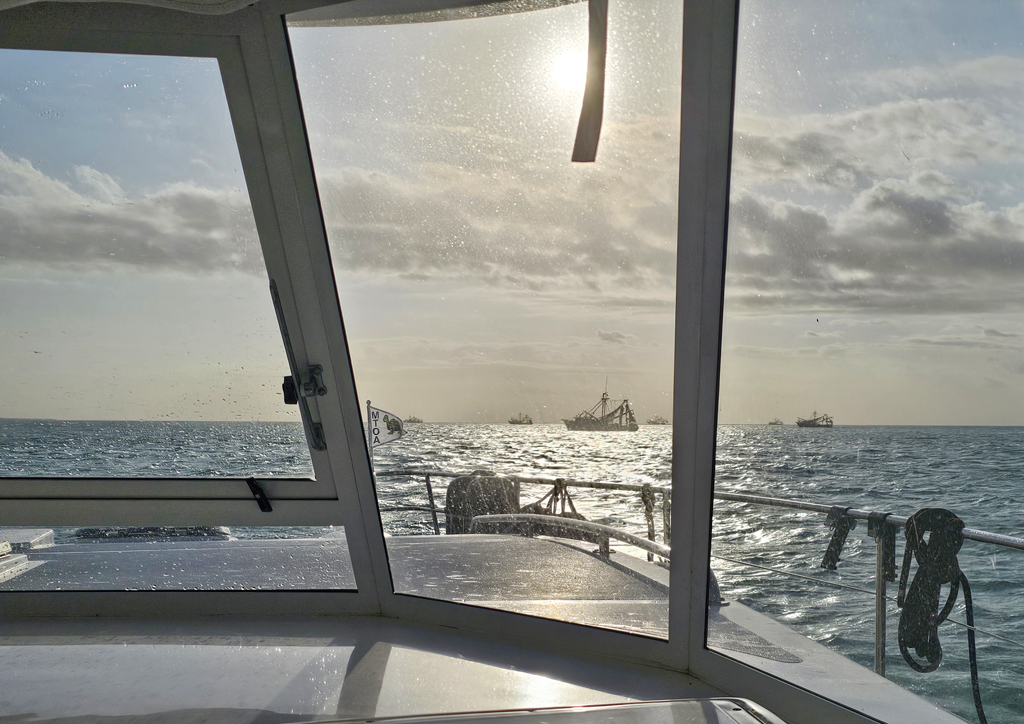
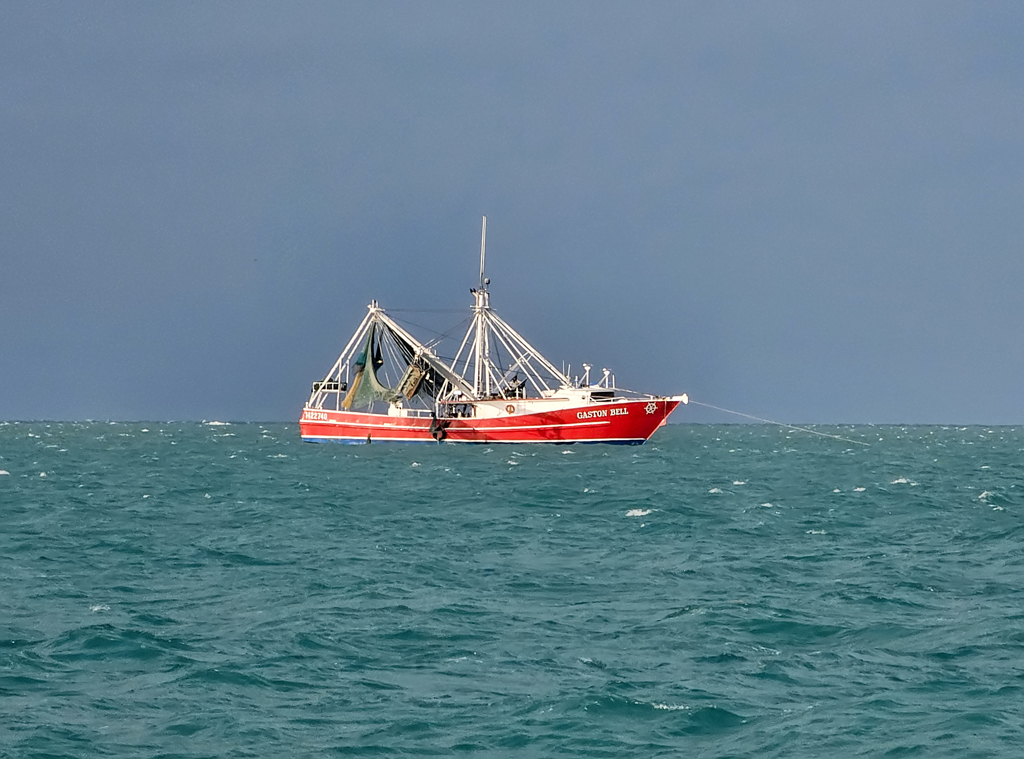
We travelled through part of Hawk Channel, the passage that connects the Atlantic Ocean with the Gulf.  The Florida Reef Tract, the only living coral barrier reef in the continental USA, lies along the channel and helps to protect the Keys (and us) from heavy surf.  Pink shrimp are caught by shrimpers anchoring between the reef and the shore.  These shrimp are nocturnal, that is, they move around at night, and bury themselves in the sand and mud on the bottom during the day.  The story goes that they were discovered by accident, when a shrimp boat captain left his nets down in the water overnight, and when they were lifted in the morning, they were full of a new species of shrimp.  A nice story.  As we made our way along the south shore of Key West, we could see the fishing boats anchored, with their nets out but not down in the water.  One presumes that they had already lifted the nets and were processing the catch.

Shrimp boats on the horizon as we make our way to Stock Island
Shrimp boat, anchored. Note the nets are out of the water.

In the harbour we saw a saildrone, a very interesting unmanned vessel that Dick had read is being used by the Navy and by NOAA.  The Saildrone website is very interesting, these vessels can be used for infrastructure on oceans (think undersea cables), offshore energy surveys and development, ocean monitoring and climate science, and of course national security and defence.

A Saildrone

We arrived at the Perry Hotel and Marina, quite relieved that we were there as planned and without extra drama.  It is a nice facility, with many features including swimming pool, fitness center, onsite restaurant and a bar with live music nightly, laundry, bath house, captains lounge, etc etc.  They even have an hourly shuttle to Key West Old Town, that runs until 10pm, so all of the restaurants of Key West are easily accessible.  We saw as we came in that there was an Endeavour Trawlercat Skylounge called Remember When.  The name was familiar, Dick thought we had met them on the Alligator River in North Carolina in 2017.  When we looked at our filed boat cards, there was their card, and Dick was quite right.  He chatted with them later, and they remembered us too.

Hosing off the salt after a rough passage

We are planning a quiet few days here before leaving for Marathon.  A good time for laundry and boat chores, and a rest from the hustle and bustle of Key West.

August 18 to 31, 2023: Pittsburgh to Cincinnati

Our departure from Pittsburgh was a little tricky.  That morning, my slightly sore hip that began the evening before was much worse.  Cause likely to be too much sitting still and not enough fluids the previous day.  I was almost completely incapacitated, so Dick had to single-hand Nine Lives to the pump out machine.  It was quite a challenge, with the strong current pushing us onto the dock, not to mention having to step carefully around the copious goose poop.  The power pedestal ended up with a slightly greater lean than it already had (bad positioning, right on the edge of the dock and too close to the pump out machine, we were not the first to nudge it!)  Apart from that, the maneuver was well executed.  As we initially pulled away from our docking position, and turned around to come back to the pump out, I looked up and saw that we had an audience of about 10 construction workers from the high-rise going up above the waterfront, all standing at the railings watching us.  Sometimes, you’re the audience, sometimes, you’re the show!  Fortunately, we were out of their sight for the minor pedestal mishap.

By the time we arrived at the first lock of the day, I was able to drive the boat in as usual, and bring it to the wall for Dick to handle the long line.  However, Dick had to do all my usual tasks with fenders, moving them and deploying them, as well as bringing them in after the lock.  He got a small taste of what single-handing and/or a non-participating spouse would be like.  (We have met a surprising number of Looper couples who divide up the responsibilities in such a way that the lady has almost no involvement in any aspect of boat handling, certainly that would never be our preference). 

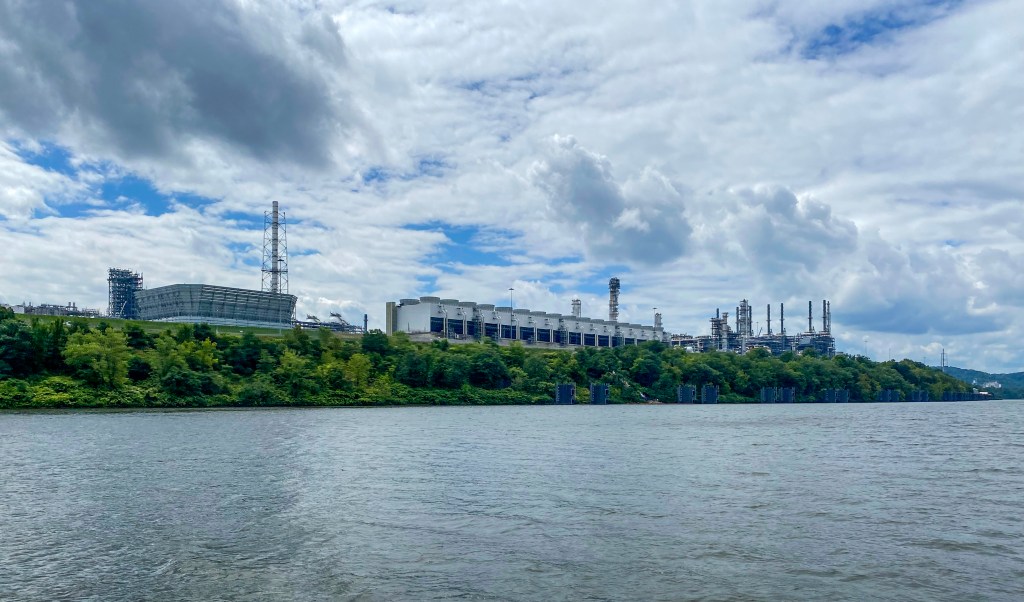
We passed the Shell Ethylene Cracker Plant.  Dick said they were just completing this plant when he retired.  It was built in Pennsylvania rather than Texas, because of all the cheap gas available from Utica and Marcella Shales fracking operations.  It is good to see new industry on the Ohio, after so many abandoned and derelict factories. 

The new Shell Ethylene Cracker Plant

We got through 3 locks and tied up in the marina in Chester, with Dick doing all the work except for maneuvering in the locks.  Holiday Marina is a nice small marina, set in a basin off the river, so very little wakes to bother us.  There is lots of grass, and several pavilions and grills for the use of boaters.  It is also a small RV site, and has immaculate and spacious shower/rest rooms.  We had been happy with our stay on the upbound journey.

As we sat enjoying the evening, one of the occupants of an RV made his way down to us and welcomed us back.  He likes chatting with transient boaters, especially Loopers.  In addition to offering to lend us a car to get groceries or run errands, he mentioned that he had hoped to invite us to breakfast on our last visit, but we had already left early that morning.

He told us an interesting story, that we had entirely missed because we were sitting facing away from the river.  Earlier, he and his wife had seen a car sink near the shore across the other side of the Ohio River.  The man’s wife called the police to report it, and got the story.  Apparently, a couple had a snapping turtle in a cooler, that they were trying to release unharmed into the river.  The man backed his SUV down to the water, and planned to gun the engine forward with the back open, so the cooler would open and the turtle fall into the water.  Unfortunately, he mistakenly put the vehicle into reverse, and when he stamped on the accelerator, the SUV went straight backwards into the water at speed.  It sank.  Fortunately, the windows were open, so the couple were able to get out and swim to shore.  No word on the fate of the turtle.  Attempts to retrieve the vehicle by emergency services had not succeeded by the time it got dark.

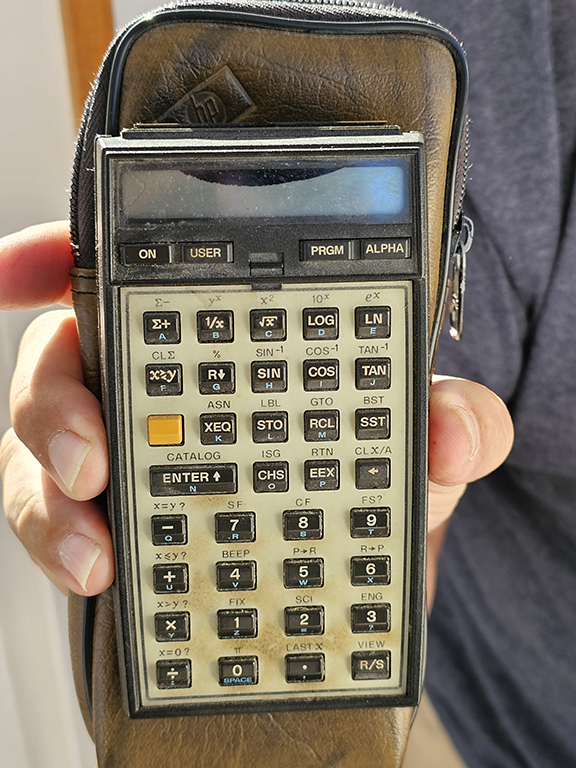
We had plenty of time the next morning, with a short distance and only one lock, so Dick was busy with his computer when he discovered the sad demise of his HP41CX calculator.  He had it for the better part of 40 years.  It was working fine until the previous day when Dick reached behind him and it leapt off the shelf and down the stairs, a drop of about 6 feet.  The landing proved to be too much for the venerable machine.  Dick particularly liked that calculator for its sophisticated engineering functions.  Not to mention that the Reverse Polish Notation method of use is so obscure (IMHO) that there was no possibility that his light-fingered wife would abscond with it!  I offered him a basic solar powered calculator that I found in a cupboard, but it was soundly rejected in favour of using the one on his phone.  R.I.P HP41CX.

Dead after 40 years of good service

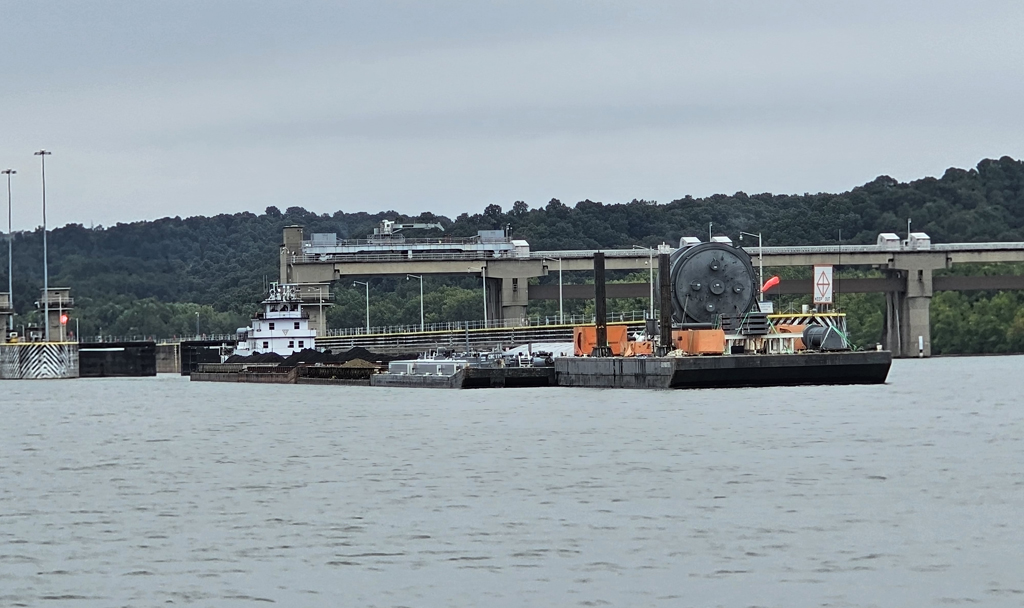
Once Dick recovered from his tragic loss, we set off for the day, still with Dick having to do all my line and fender handling jobs.  Unfortunately, we arrived at the lock as it was being prepared for an up-bound tow, and there was a 15-barge tow just behind us, who had priority.  Altogether, it took over 4 hours before we were through.  It was our first real delay since we started on the Ohio and waited at our first lock for 4 hours, so we can’t complain.  Most of the Ohio locks have two chambers, a large one and a smaller one.  We are generally put through the small chamber, and usually with no delay, but at this lock the small chamber is out of operation.  We have heard that the last two locks we will encounter on the Ohio are using only their small chamber while the large ones undergo repairs.  This will likely mean very long delays for us, as the tows will have to split to go through, and thus will take twice as long.  We use an app called Nebo.  It has various useful functions, including allowing anyone to track us or see where we are at any given time.  We have a device installed on Nine Lives, that automatically starts tracking when it senses motion.  This is designated as a “journey”, and it ends the journey when we stop.  Our Nebo track for the day showed an amusing number of stops, as Dick maneuvered and held position in front of the lock while we waited for our turn.

Waiting for the lock, each red flag represents a “journey” started, so each time we stopped moving while we waited, a new “journey” began

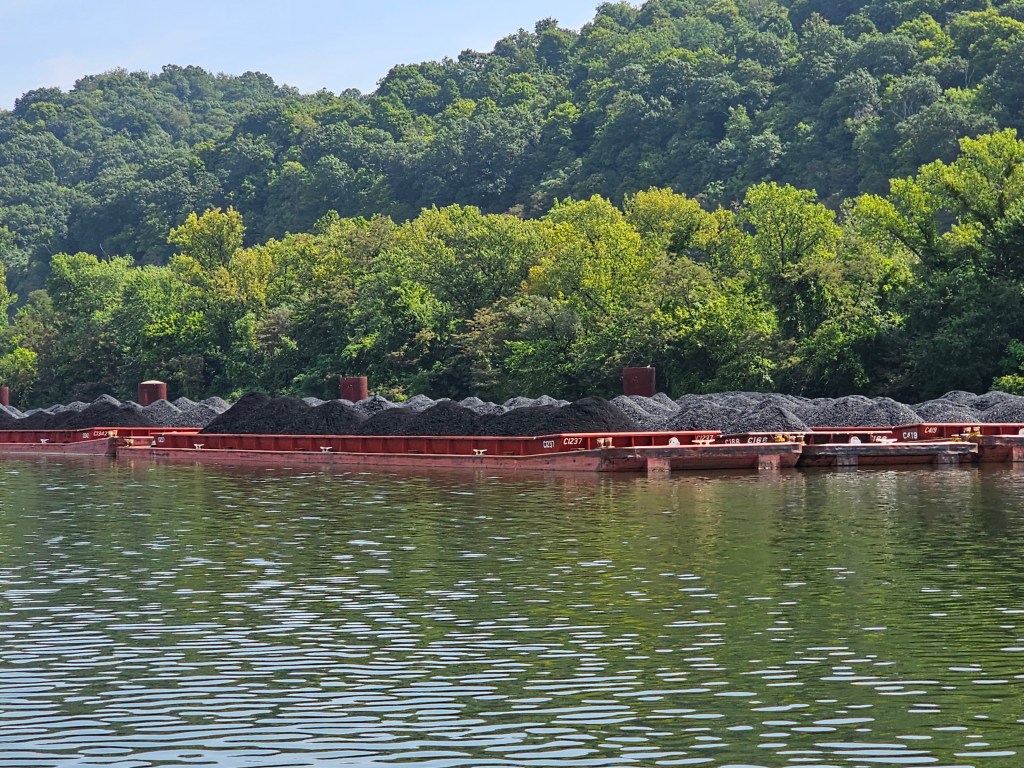
I have been noticing that all summer we have been passing loaded barges with coal, going in both directions.  This day, we saw some loaded barges with a clear difference in the piles of coal.  Dick tells me that there are several kinds of coal, but in this country the two most used are bituminous, and anthracite.  Bituminous coal is common coal used in power plants, while anthracite is a harder coal, considered a metallurgical coal, and is typically used in steel manufacture.  Anthracite is the highest quality, and has fewer impurities, which is important for use in steel making.

Barges carrying coal, note that some of the coal is different

We passed through Wheeling, with its historic bridge.  For a short time, it was the largest suspension bridge in the world.  When it was built in 1849, it was the first bridge to cross a major river west of the Appalachians.  A bridge to cross the Ohio River and connect the important National Road (also known as the Cumberland Road) was first proposed in 1816, but it took many years before a bridge was actually built.  Different cities wanted a bridge, the federal government didn’t want to fund it, and neither did any of the states.  By 1847, with mail being lost and commerce disrupted, Ohio and West Virginia agreed to approve a suspension bridge.  It was immediately controversial, because the steamboats that carried goods and passengers up and down the Ohio had tall smokestacks, that were continually increasing in height.  By 1849 the objections reached the Supreme Court, with lawyers for Pennsylvania claiming that the new bridge was a nuisance that obstructed commerce on the river.  At the time, there was considerable dispute over whether river transport was a federal or a state matter.  By 1850, when the case was finally heard, the Court refused to require the bridge to be torn down, instead it ordered that the height above the water be raised to 118 feet.  The bridge company was allowed to “study” the concept of a removable portion rather than attempting to raise the entire bridge.  Arguments, court cases, and accusations continued after the bridge deck was destroyed during a windstorm in 1854.  It was rebuilt in spite of injunctions.  Ultimately, it became a non-issue, as the increasing power of the railroads destroyed the steamboat business, and the Federal government found that having bridges over major rivers was in its favour, both for mail delivery, and for movement of military supplies and troops.  Because the bridge was designed for horse and buggy traffic, it is unable to safely handle the weights of modern-day vehicles, whether it be volume of car traffic, or heavily loaded trucks.  Attempts were made to limit weight on the bridge, but drivers continuously ignored the limits.  For this reason, the bridge was closed to vehicular traffic in 2019.  It remains open to pedestrians and cyclists, and will be preserved due to its historic importance.  As we passed under it, we could see that it is currently undergoing renovations.

The suspension bridge at Wheeling

Last month, when we were northbound, passing Weirton, a fellow in the marina hailed us on the radio and invited us to stop there.  As Dick prepared the itinerary for our return trip, he couldn’t find a phone number or email address, so we just cruised close to the docks and called out to a member who was there working on his boat.  He made a phone call, and we were all set, with power and water as well!  After giving us time to get settled, Steve came on board for some beer and chat.  In due course we were joined by his wife and also his mother.  I got out cheese and charcuterie, and made it a proper docktails.  Later the commodore and his son the dockmaster dropped by as well to welcome us.  It was a delightful evening, and we hope to see Steve and his wife in a few years on the Loop in the trawler he is currently restoring.

Sunset at Weirton

I have discovered an interesting thing about the Ohio River.  Notwithstanding the name, and contrary to normal usage when a river forms the border between states, no part of the Ohio River belongs to Ohio.  This has been a matter of debate since the 1700s, with the most recent challenge from Ohio in 1980 (they lost again).  In 1783, the Ohio River was fully within the commonwealth of Virginia, which encompassed the land as far west as what is now Illinois and north to Wisconsin, including all of today’s Ohio, West Virginia, and Kentucky.  In 1784, Virginia ceded its territory that was “to the northwest of the river Ohio”, but not any of the river, with the boundary being the low-water mark on the western bank of the Ohio River.  This border was made under the Articles of Confederation, and carried over under the Constitution.  Ohio tried to take some of the river when it became a state, by claiming that the state boundary should be in the middle of the river (as it is in most states where the border is a river).  However, the Supreme Court ruled against them.  Ownership of the River transferred to West Virginia, when they seceded from Virginia, and when Kentucky became a state, it also got its part of the River.  Even when the River changed its route, moving north into Ohio, the state lost a claim to change the boundary.  Still today, if you fish from the Ohio side of the river, you must follow West Virginia fishing regulations, or those of Kentucky.  I find myself wondering about other things, like docks, that extend into the river, whether property owners need permission from Kentucky or West Virginia.  Not to mention using river water for various industrial or agricultural purposes.

We passed the Cardinal Power Plant, planned to be converted to natural gas by 2030.  Next door is a fly ash plant.  Cardinal was ordered by the EPA to stop storing fly ash in waste ponds (chemicals and metals leak into the river).  Fly ash can be used in the manufacture of concrete.

There was no wait at the lock, and we were tied up at Prima Marina by 2pm.  There was no power suitable for Nine Lives, and no water on the docks, but at $25 it was a reasonable charge for overnight dockage.  The evening meal at the onsite restaurant was decent, mostly basket food, hamburgers, and chicken dishes, with a few more upmarket choices.  All the food was served piping hot, which I always appreciate in this country, and don’t always get.  Dick’s broiled whitefish was a nice change, and I enjoyed a grilled ham and cheese sandwich.

We returned to the boat, and worked in the salon while we waited for the evening entertainment to begin.  This was a local singer, playing guitar and harmonica.  When we realized he had started, we followed our usual practice and sat in the cockpit with adult beverages, ready to enjoy the music.  It was awful.  After a truly dreadful composition of his own, the singer moved on to Jimmy Buffet b-sides.  One would hope that someone being paid to entertain would show at least some skill with their guitar, and be able to sing in tune.  Eventually we decided that we couldn’t stand the butchery of what are very nice songs and ballads, so we repaired to the salon.

At this point we realized that the cool weather, welcome though it was, did not work in our favour.  With no need for air conditioning, we opened the hatches and windows for air flow, and were then treated to the so-called music we had escaped!  The finale was an appalling version of Country Roads, the song that begins, “Almost heaven, West Virginia…” The poor man couldn’t come close to hitting the high notes.  The set ended, then to our dismay, an impromptu singalong began, with the participating audience every bit as bad.  We hope that our previous positive experiences with live music have not come to an end!

Prima Marina in Moundsville, live entertainment

August 20.  We passed the Marshall County Mine Barge Loading Facility, with the Mitchell Power Plant next door.  I was amazed at the long, covered chute that carries the coal from the Powhattan Mine, situated well inland, to the docks.

Late summer colours in early morning
Marshall County Barge Loading Facility with long coal chute

Bellaire Harbor Services was interesting, with a drydock and many tugs waiting for service, or possibly waiting for hire.

Bellaire Harbor Services

We had wondered several times about the lids that cover some of the barges.  We could see that they were all the same, as the barges are standardized, but we couldn’t figure out how the lids would get onto the barges.  At last, that small mystery was solved when we saw a crane with a special attachment placing lids onto a waiting barge.

Now we know how the lids get onto the barges

It was a short day, leaving Prima Marina at 9:20 and tied up on the free town dock at New Martinsville by 1:15.  This with a 30-minute delay for the lock.  The town has very clean, wide docks, with good rubber and cleats.  I was nervous because of the request that you advise the Police Department if you will be staying overnight.  The only other place we have seen that is a notoriously unsafe stop on the Illinois.  In fact, the clean docks and surroundings meant that, after all, I felt quite safe.  We were out of sight of the streets, which probably also helped.  Several pleasure boats docked for a while and people visited the town.  We needed the generator for the first half of the night for air conditioning, but the outside temperature dropped enough that Dick could turn it off later and it was a very peaceful night.

New Martinsville downtown
A charming coffee shop and pub in New Martinsville, sadly closed on Mondays, but we met and chatted with the owners
Looking across the River in early morning in New Martinsville

The stop was only slightly marred by discovering in the morning, that the two teenage boys who had been fishing on the docks when we retired for the night, had left plastic bags, empty drinks bottles, and takeaway cartons on the end of the dock, ready to be blown into the river.  Dick often picks up trash on docks and town walls.  Young people accuse us of destroying their future with the use of fossil fuels, yet they are using the rivers as a trash dump for plastics that will never disappear, and are damaging the very fish they are trying to catch.

Rubbish left on the dock by teenagers
Dick collects other people’s rubbish

I learned that Western Pennsylvania’s version of the South’s y’all, or Southern Ontario youse, is yinz.  Interesting!

We arrived at Marietta Boat Club by 1:45, but unfortunately, although we were expected, there was nobody to tell us where to dock.  Our instructions had been to tie up at the fuel dock, and find somebody.  It was hot, humid, and no breeze, so we had to run the generator.  Eventually, we were able to move to a spot, but after we were tied up, we were told that a mistake had been made, and we would have to move after 2 nights.  Once we were finally settled, we dropped the dinghy for the first time this season.  The motor started immediately, such a difference from the old one!

We went to dinner by dinghy.  The Boat Club is about a mile up the Muskingum River from the Ohio.  There is a concrete dock on the Ohio at the foot of downtown.  It was very hot and humid, so getting to the restaurant by dinghy was a lot nicer than riding bikes, even though there is a good bike path.

Downtown Marietta

Austyns proved to be an excellent choice of restaurants.  The food was a delicious combination of innovation and familiarity in a sort of Asian fusion style.  We shared 2 appetizers.  Prosciutto wrapped shrimp with a spicy remoulade sauce was very good.  Spring rolls stuffed with glass noodles and crab were quite unique.  Dick had a pasta dish with mixed seafood in a red pepper cream sauce with a filet of mahi mahi on top.  I opted to try another starter instead of a main-sized course.  Beef tips, marinated in truffle oil, and served in a delicious fondue of several cheeses was outstanding.  For dessert, we shared an interesting Bailey’s chocolate cake that was just the right size, and not dreadfully sweet.

Spring rolls at Austyns
Austyns shrimp with prosciutto
Austyns seafood pasta with mahi mahi
Austyns beef tips in fondue
Austyns Baileys chocolate cake

The next day was laundry day again.  We have a Splendide washer/dryer on board.  It is a typical European-sized machine, so with quite a small capacity compared to large American appliances.  However, I don’t need to find a laundromat, deal with quarters, or schlepp laundry back and forth in hot, humid weather, as I would in marinas that have a facility.  I can stay on the boat (or go out if I wish), and be comfortable instead of sitting in the laundromat.  I find that once I sort the clothes, my loads are similar in size to what I would have at home –it’s only sheets and towels that I have to split into smaller amounts.  The dryer is slow – a typical load takes 80 minutes on medium heat (the hot setting is too hot and will damage the fabrics).  I hang most clothes to dry except socks and underwear anyway, so no difference in that respect from at home.  There is always a debate among boaters, whether or not to look for a boat with a washer/dryer.  I have noticed that most women tend to be in favour, while men (who, let’s be honest, are not usually the ones doing the laundry), are against.  One does have to get used to the idea of smaller loads and long drying times, but anyone I have met who has one, would never choose the laundromat again.

We have a washer dryer on board

I carried on with the laundry while Dick prepared, and then recorded, a podcast he was asked to do for AGLCA about our trip up the Mississippi last year.  The podcast is now available on U-Tube, and has been well received.

In the evening it was another pleasant dinghy ride to the dock at the foot of the town.  The restaurant was quite a contrast to the previous evening.  It was full, even thought it was Tuesday, but it was an entirely different demographic, with nobody I could see under 50-years old.  The food was good, but not exceptional.

In the morning, we lost about 2 hours out of our day while we moved Nine Lives to a different spot on the docks.  Since we had to untie anyway, we decided to do the pump out then, instead of the day we left.  The pump out machine had some quirks, and Dick stood there for nearly half an hour thinking it was a very weak machine before discovering the technique for making it actually pump.  We slid Nine Lives into her new, shorter, spot very professionally, sadly without anyone around to watch and appreciate our skills.

Rowing on the river in early morning

Indigenous cultures lived along the Ohio River for thousands of years.  Some of them built large mounds, for purposes that are not fully understood, but are thought to be connected to cosmology and astronomical events.  Moundsville is one location, and there are 3 large mounds in Marietta, known as Marietta Earthworks.  19th century settlers in Marietta preserved what was known as the Great Mound, by putting their cemetery around it.  By 1900, the Mound Cemetery had the highest number of burials of Revolutionary War officers in the United States.  At the close of the Revolutionary war, officers were given grants of land, and George Washington particularly favoured the Marietta area for land grants.  The location of the town at the confluence of two navigable rivers, ensured its commercial success, and we can see from the beautiful old buildings downtown that this was a very prosperous city in the 19th century.  Oil was first drilled in Marietta in 1860, and succeeding oil booms added to the wealth of the town.  The longest running, and until recently the only, ferromanganese refinery in the United States is located in this city.  Ferromanganese is used as a deoxidizer in the steel making process. We would have loved to be here for the Sternwheeler Festival, an annual event since 1976.  As many as 35 authentic steam driven sternwheelers are expected to participate.  We have noticed that there seem to be a lot more sternwheelers, both commercial and in private hands, on the Ohio River, than we saw last year on the Mississippi.  Some have been lovingly restored, while some are just sad relics of a bygone age.

Historic sternwheelers docked in Marietta. One is a museum, others are still operating as tour boats on the Ohio River

Dick enjoyed a day of exploration and a little grocery shopping, while I continued with the laundry.  The man on the boat next to us came over to chat, very friendly, and offered us the use of his car.

Another pleasant dinghy ride took us to the courtesy dock at the foot of Harmar, the small town across the Muskingum River from Marietta.  It is a well-preserved historic village, with some beautiful old houses and storefronts.  One of the properties is occupied by someone with a sense of humour.  Instead of a bottle tree in the garden, they have a bicycle tree, with a number of bicycles hanging from the branches.

Harmar
Harmar architecture
Harmar
A bicycle tree beside a historic building in Harmar

Spagna’s was a reasonably good meal.  We shared pepperoni rolls and stuffed mushrooms.  My lobster mac and cheese was improved by not having crumbs on top, but for my taste, there was not nearly enough sauce.  Dick liked his lasagna.  We shared a very tasty lemon cake for dessert.  For a change from bubbly, I started the meal with a local Manhattan.  It was a very generous pour (something that does not happen in UK, where the number of ounces in a drink is strictly regulated).  In fact, it was such a good pour, that after that and a glass of wine, I felt decidedly merry.  Not so much that I was at risk of an impromptu swim when we returned to the dinghy though.

The art deco bar at Spagna’s in Harmar
A manhattan to start
Stuffed mushrooms and pepperoni rolls at Spagna’s
Spagna’s lasagne
Spagna’s lobster mac and cheese

We stopped to have a look at the Harmar Bridge.  This was originally a wooden, covered bridge, constructed for use by pedestrians as well as horse and buggies by the Marietta and Cincinnati Railroad in 1856.  18 years later, rails were added, and it was converted to use as a railroad bridge.  A swing span was added to the Harmar side in 1880, to allow larger boats to pass under it.  Destroyed and reconstructed several times over the next 20 years due to floods, it was converted to an iron bridge in 1900. The Great Flood of 1913 took out all spans of the bridge except from the swing part, as well as the train that had been put on it to try to anchor it down against the floodwaters.  The bridge was rebuilt, and some years later the swing section was moved to the Marietta side.  Closed for rail traffic in 1968, the pedestrian walkway was left open until it became unsafe, and it was fully closed in 2020.  Efforts continue to raise enough money to rebuild and preserve the historic edifice.

Historic bridge between Harmar and Marietta, sadly derelict.

We enjoyed our stay in Marietta, although we could have wished for a less chaotic arrival and a more friendly welcome from other boaters, something we have enjoyed at several boat clubs on the trip so far.

It rained all night, and was still raining the next morning.  That means wet lines, and my particular dislike, wet gloves.  Disdaining his waterproof jacket, Dick filled the water tanks and retrieved the dinghy, and we prepared to cast off.  I was glad to wear my jacket, plus a hat!  Visibility was good in spite of the rain.

It was an uneventful day, with only a slight delay at the lock to allow a big tow to get into the main chamber.  We anchored behind Buffington Island, where we stopped on our northbound trip, by 3:15.  The owner of the land where we anchored stopped on his boat to chat.  He was a nice guy, even offering us the use of his fully plumbed outhouse if we needed it!

I made shrimp sandwiches again for our dinner.  Cooked shrimp are chopped and melted butter with crushed garlic is poured over them.  A mixture of mayonnaise, Dijon mustard, chopped chives, celery, lemon juice, and lemon zest is then stirred into the shrimp and the bowl is chilled.  The remaining garlic butter is brushed on the inside of the rolls, and they are toasted, and lined with butter lettuce and then the shrimp is added.  We will definitely be making these sandwiches again.

Our night was mostly quiet and peaceful, but thunderstorms woke us at about 5am.  There was little wind, but enough to turn us a full 360 degrees several times, as the current was not strong enough to hold us straight in the channel.  We later learned that others had a pretty wild night, with strong winds and lashing rain, and some areas were without power by morning.  Obviously, the island was a great place to have stopped.  We were away before 8:30. The anchor came up easily, and the rain stopped.

A bridge under repair south of Marietta. Bridge work requires a strong stomach and no fear of heights!

We passed Blennerhassett Island, now a Historical State Park, served by an authentic sternwheeler ferry.  The island was settled in 1789 by Harmon and Margaret Blennerhassett, wealthy Irish aristocrats who were fleeing what is described as political persecution and personal scandal.   Call me cynical, but I suspect a lot more of the latter than the former! Their mansion became the headquarters for Aaron Burr’s military expedition to the Southwest in 1805.  The Blennerhassetts fled the island when Burr’s treasonous plot collapsed, but the mansion remains. It has been reconstructed, and volunteers in period costumes show visitors around and describe what it was like to live there in its heyday.

Blennerhassett Ferry, an authentic sternwheeler
A glimpse of the mansion at Blennerhassett Island

As we approached the lock, slowing down to allow a big tow to exit towards us from the big chamber, we saw that it was carrying an unusual load.  It was a huge cylinder.  We have no idea what it was, Dick is not prepared even to hazard a guess!  Once we were in the lock, the doors took a long time to close.  I suspect the lockmaster was allowing time for another tow to enter the large chamber.  When it was finally time to exit, they only opened one gate.  At this point I relinquished my position at the helm.  Nine Lives fits through one door with space to spare, but I prefer not to be the one responsible in that situation!

An unusual barge load exiting the lock
We have no idea what that huge thing is!
A classic old pleasure boat on the Ohio north of Gallipolis

Steam from the Gavin Power Plant was visible for miles.  It is the largest coal-fired facility in Ohio, and one of the largest in the USA.  In 2002, to avoid lawsuits relating to air pollution, the operating company decided to buy out the residents of the nearby village of Cheshire, by offering 3.5 times more than the market value of their homes.  The plant has been using unlined pits to store its fly ash, and was denied a permit to continue.  In November 2022, it was ordered to stop dumping coal ash into the ponds, and speed cleanup of the site.  This is such a big project that in order to comply the plant would probably need to be shut down.  The company had 135 days to comply, but they were also allowed to present arguments against shutting down because of the effect on the grid.

Steam from the Gavin Power Plant was visible for miles

Kyger Creek Power Plant is immediately next door.  This plant is older, built in 1955 to service the Portsmouth Gaseous Diffusion Plant, a uranium enrichment plant.  When that plant was shut down, the Kyger Power Plant had to begin selling its power on the open market.  In 2019, customers of First Energy were ordered to pay extra to subsidize the plant.  This scheme was part of a public corruption scheme revealed by the Department of Justice a year later.  We could see that both plants are still operating, and while the steam coming out of the cooling towers looked appropriately clean, the smoke from the tall stacks was tinged with brown, suggesting that not all pollution mitigation measures are working as well as one would wish.

Kyger Creek Power Plant

We tied up in the town of Gallipolis by 2:30, on a very good town dock, with even some rubber to preserve Nine Lives’ delicate hull.  Dick had chosen a restaurant, but it was a bike ride away.  When he went out for his usual recce, he discovered that this is the most bike-unfriendly town we have visited.  There are no useful bike paths, and the streets are busy and lined with parked cars, forcing you to ride in traffic.  Further investigation of closer dining options suggested that this would be a night to eat on board.

The history of Gallipolis is more about failure than success.  It began with a group of 500 French aristocrats, merchants, and artisans, who were fleeing the French Revolution.  They were sold land in Gallipolis along the Ohio River by the Scioto Company.  On arrival, they discovered that Scioto Company had no right to sell the land, and their deeds were worthless.  Eventually, the settlers were granted land nearby, but with a proviso that they had to live and farm the land for 5 years before they could sell it. They were city people, and not prepared for farming life in undeveloped America.  Many of them had to buy the land they thought they owned from the Ohio Company in order to settle in Gallipolis.  In 1967, the Silver Bridge, that I wrote about earlier, that connected Gallipolis to Point Pleasant, collapsed.  The city is still a bedroom community, with employment at nearby power stations, healthcare providers, and universities.

Gallipolis downtown
Gallipolis downtown
Gallipolis waterfront gardens

We were visited by a man who had seen us on our northbound trip, and had looked us up online.  I sent him a note that morning, and he stopped by to say hello.  He didn’t have time to join us for a beer, but we did enjoy a nice chat.

Nine Lives at the dock in Gallipolis

Once it started to get dark, I felt the least safe of any of our free docks so far.  There were a great many young men driving up and chatting with each other before driving away again.  Dick tells me that not everyone is a criminal or a drug dealer, and I guess in a small town, there are limited options for the young on a Friday night, but I was not very happy.  All was well however, nobody bothered us, and it was a quiet night apart from rocking from occasional tows.  The next morning there was a town employee picking up rubbish in the parking lot, even though it was the weekend – more towns should do this!  Later, a group of ladies gathered and seemed to be enjoying themselves in a Zumba class.

Rubbish pickup after a Friday night on Gallipolis waterfront

After a big breakfast, we were underway by 9:30 for a short journey to Huntington.  The drop in the lock was considerably less than the expected 23’, and below the lock we could see that the trees at the edge of the banks were in the water.  There was also almost 2 knots more current than the previous day.  All this would have been the aftermath of Thursday’s big storm.

Trees in the water, higher than usual water on the Ohio River above Huntington

We docked in Huntington by 2:30pm.  This time, we went for the lower, upstream wall, where there were good cleats (the downstream wall we had docked at before had widely spaced bollards).  It was very shallow, to the extent that the depth finder stopped registering, but docking was made easy by a fellow boater who caught the lines.  There was a festival going on, so we had a big audience.  Both the boater who caught our lines, and another one who tied up later, warned us that it was too shallow to stay overnight, but Dick felt that with the higher water we would be fine.

Huntington is the second largest city in West Virginia.  Federal money for urban renewal in the 1970’s resulted in the tearing down of many of the beautiful old downtown buildings, and replacing them with ugly concrete boxes.  An attractive downtown shopping centre is quite lively, with many shops and restaurants, but another effort to convert an old railway station to a venue for artisans and coffee shops has not been a success.  The Huntington greater metropolitan area spans 3 states and 7 counties.  I read that the port, called The Port of Huntington Tri-State, is the second busiest inland port in the United States. Industries include coal, oil, chemicals, and steel.  The city’s beginnings were rooted in the railway business, from its beginning as the western terminus of the Chesapeake and Ohio Railway.  The railroad expanded east, and west, and after several mergers, it is now CSX Transportation.  Huntington was the second American city to use electric streetcars.  Today, the largest employers include Marshall University, a hospital and medical centre, Amazon, and Direct TV, as well as the City itself.

We had a wonderful evening.  We booked a meal at 21 The Frederick, a historic hotel that has been sympathetically converted to luxury rental apartments.  We wandered around the lobby and admired the beautifully preserved period surroundings.  This is the top fine dining restaurant in Huntington.  The restaurant décor was an interesting mix of styles, some clearly dating from its heyday in the early 20th century, some definitely a 60’s unsympathetic makeover, and there was a most extraordinary frieze of golden elephants, of undetermined vintage, around the edge of the room!

The rotunda at 21 The Frederick in Huntington
The hallway, with a display from the former apothecary at 21 The Frederick
The dining room at 21 The Frederick

Our meal was excellent, the best since Pittsburgh.  It is clearly a venue for special nights out.

Beet salad at 21 The Frederick
Shrimp cocktail at 21 The Frederick
We both had filet steak and garlic mashed potatoes at 21 The Frederick
Cheesecake at 21 The Frederick

Those of my readers who wish to avoid social commentary should avert your eyes for the next paragraph.

For some time, Dick and I have noticed that some of our generation, many of generation X, and almost all of the next groups seem to lack any sense of respect for the standards of dress for fine dining restaurants.  Not the women – they clearly still enjoy the chance to dress up.  No, it is the men who continually let the side down and show a complete lack of respect for the establishment, the staff, and the chefs, who go to a lot of trouble to create and present a special night out.  Not to mention their dining companions.  The US is not the only place.  We have seen it in Europe, the Mediterranean, and Britain.  However, there is something uniquely North American (yes Canada, you are right up there in this too), in the concept of shorts, t-shirts, and baseball caps as reasonable attire for a fine dining restaurant.  On this occasion, there was a group of 12, seated across from me.  There were 9 women in the group.  Every one was dressed up, and I could see that the older lady even had her hair done for the occasion.  Of the 3 men, one was very metropolitan sophisticate, but the other two were what we see again and again.  Tight cotton t-shirts, baggy cargo shorts, and baseball caps that were not removed.  To be fair, one of these men held the chair for his lady.  It is a sad lack of respect for appropriate social norms.  I suppose some might suggest that these are new social norms.  And here endeth the rant.

Underdressed fellow (male) diners at 21 The Frederick
Back on board, there was a lovely sunset in Huntington

August 27th.  There was rather more excitement in the morning than we wanted.  As we had our first cup of coffee, I realized that we were not floating.  A leisurely start had been planned, with only a 2-hour trip that day, but we decided to abandon any thoughts of more coffee or breakfast, and see how bad the problem was.  We were free at the bow, but firmly aground at the stern.  Dick is strong, but he couldn’t push us off.  The dinghy adds about 300 lbs to the stern, so we dropped it into the water and brought it alongside, giving us about 2 more inches.  With some unpleasant noises from protesting props, Dick managed to wiggle us free.  We then put on life jackets in case of mishap, and floated in the middle of the river to bring the dinghy back in and up onto its davits.  Ultimately, we were underway by 7:30am.  At least the local boaters had left the night before, so we did not have the humiliation of either an audience or an “I told you so”.

Lessons learned – when the depth gauge shows no water below the boat, believe it and back away.  When local boaters advise against docking, believe them.  When potential problems can be avoided by repositioning, do it, even though it is a big pain once you are set and tied up.

Two hours later, and with no locks to transit, we arrived in Ironton, and tied up at their great floating dock (with plenty of depth).

Ironton began as a centre for the iron industry in 1849.  Between 1850 and 1890, it was the biggest producer of iron in the world.  At the peak of production, there were more than 90 furnaces in operation, producing high quality iron that was used for warships as well as other industries.  When the transition was made away from iron and toward steel, the city lost its economic base.  The city has tried hard to attract other industries to the area, but the initiatives were not successful. Ironton is notable for having one of the first professional football teams in the United States.  In the early 1930’s, the team was amalgamated with another local team, and was moved to Detroit, renamed the Lions.

A beautiful old church in Ironton

The restaurant we had planned to eat at was closed on Sunday.  It looked interesting, as it was in an old railway depot.  Instead, we went to a local Italian restaurant.  Dick liked the food, I did not.  Either that makes me a picky eater (Dick’s verdict), or more discerning than my beloved. The first surprise was being told that, as it was Sunday, there could be no wine or cocktails, but beer was okay.  That seemed strange, but as Dick said, blue laws tend to be strange anyway.  I looked it up.  In Ohio, you can serve beer on Sundays without a special license, but for intoxicating beverages (that would be wine and spirits), you need a special license.  Who decided that beer is not intoxicating??

Later in the evening a houseboat tied up on the dock below us.  In the morning, Jim came along the dock and introduced himself.  We had a very pleasant chat.  He was taking an elderly, but new to him, houseboat north to Marietta and up the Muskingum to his home.  We don’t envy him single-handing through all those manual locks!  After a big breakfast, we were on our way by 9:45.

Hanging Rock is a town just south of Ironton.  In addition to being known for giving punishing speeding tickets to unsuspecting visiting motorists, it is the location of a former iron mine that had particularly high purity iron.  The Hanging Rock Region produced some of the best iron in the United States between 1818 and 1916.  The rusted old loading facility is visible just downstream.

Hanging Rock
Interesting house on the Ohio north of Portsmouth. A house has been built to resemble an old sternwheeler.

Our next stop was a return to the Shawnee Boat Club in Portsmouth.  It’s a strange and difficult dock to tie to, set up with small eyebolts with a rusty cable running through them, along the edge of the dock.  On our last visit, the dockhand came down and helped us, but he was mowing the grass and did not bother this time.  Dick says the system is easier for small boats, especially pontoon boats, but it is a royal pain in the you-know-what for bigger boats.  I couldn’t get a boat hook under the cable from above, so Dick had to get off the boat and take the lines off the deck while I held Nine Lives steady.  The system, including the water lines, also create a nasty tripping hazard right at the edge of the dock.  Not our favourite stop, but after 4 nights on town docks, we needed to fill up with water.

Shawnee Boat Club, eyebolts with rusty cable, plus a waterline, run along the edge of the dock

The Shawnee Boat Club is located in Portsmouth.  Although I can find no other records of it, a plaque tells us that there was once a canal that ran from Portsmouth north to Cleveland.  The Ohio and Erie Canal was built between 1825 and 1832.  Boats leaving Cleveland had to climb 500 feet to get to Newark, and then descend 500 feet to Portsmouth and the Ohio River.  There were 55 locks on the descending stretch alone. Although there are the remains of a few of the locks, there is no longer any trace of the canal.

Portsmouth architecture and civic park
Portsmouth riverfront park
Some of the murals in Portsmouth, showing modern industries
Another Portsmouth mural, showing many of their historic churches

It was a day with an early arrival and no plans to eat on shore, so I was able to try a new recipe, pork fricassee with mushrooms and artichokes.  The first challenge in preparation, was finding that I don’t have a meat mallet on board, to pound the pork pieces into ¼ inch medallions.  Being an intrepid cook, I borrowed Dick’s hammer.  Once wrapped in two layers of foil, it worked very well.  I just had to be careful not to hit too hard, or the head of the hammer would go right through the meat!  The dish turned out very well, and was delicious, definitely a keeper.  Afterwards we sat in the cockpit and watched the sun set with a postprandial glass of bourbon, since we have left West Virginia and are now back in Kentucky.

Pork fricassee with artichokes and mushrooms

We are seeing more eagles on this stretch than we did on the upbound trip, both mature and juvenile bald eagles, although not as many as we saw on the Mississippi.  The wide Ohio River makes it hard to see them unless they fly across, and photographs are out of the question.  Considering that bald eagles had disappeared from the Ohio, along with herons and other large birds, this is a good sign.

We tied up at Ripley Boat Club before 3:30.  It had been a 60-mile day, but with no locks to delay us.  The Boat Club has a long dock with a restaurant.  The dock has nice big cleats, freshly painted, so there is now a little blue decorating our black lines.  A first time for us, the wooden docks have old tires on the sides, and boats are protected from the black rubber by tarps hanging over them.

Ripley downtown
A nice garden in Ripley
Ripley home of abolishionist John P. Parker

The restaurant was very popular, but we had already decided to eat on board, and basket food and burgers were not enough to tempt us.  There was some noise from trains across the river, and a few wakes from tows, but it was a mostly quiet night.

August 30th.  We chose an early start, and were out by 8:10, with a lot to do on arrival in Cincinnati and one lock for the day.

We were put through the big chamber, and there is always a bit more motion in that circumstance, but Nine Lives likes going down, so we just swung gently back and forth on the floating bollard at midships, while the fore and aft fenders kept nudging us off the walls.  As the gates opened, we saw an opportunistic heron, standing in the gate door, ready for any fish that might be hanging around inside the lock.  He watched as we approached, critiquing our lock exiting technique.

A heron fishing from the lock door

Down the river, we saw a barge being loaded at a lime operation.  We find it hard to believe that the barge doesn’t sink the way they are loaded!

Loading a barge, note how far down in the water the stern is as they load

Approaching Cincinnati, we passed a still under construction French chateau, and later a beautifully landscaped Moorish-style villa, both high on the hillside with stunning views.

A French style chateau on the hills above the Ohio north of Cincinnati
A home in the style of a Moorish villa, north of Cincinnati
Tower on the Ohio north of Cincinnati, we don’t know what it is for

We were in the marina by 1:15, but stopped for a pump out first.  We were tied up and all set by 2pm.  It was disappointing to find goose poop on the end of our finger pier, staff at the marina should clear it off when a boat is coming in with a reservation.  It was nothing like the messes at South Side though, and Dick quickly got rid of all of it as he prepared to fill our water tanks.

Dick collected the rental car we had reserved for our stay in the city.  While he was doing that, another boater dropped by to admire Nine Lives.  After he learned that we would be here over the weekend, he kindly offered to lend us his car.  This is easily the 5th or 6th time strangers have made this offer!  In Canada, only close relatives typically lend vehicles, and in UK, you have to call your insurance company and add the additional driver before you can lend.  However, in the US insurance companies are more agreeable.

We had an interesting dinner at a Hungarian restaurant.  Having lived in Eastern Europe, we like Hungarian food.  We tried a local specialty, Goetta, a pork sausage made with steel cut oats.  These were quite spicy.  I liked the taste, but not the texture.  For his main course, Dick had a combination plate, so he could try their cabbage rolls, goulash, and Hungarian schnitzel.  I had an interesting version of Wiener schnitzel with poutine.  The schnitzel, gravy, and melted cheese curds were excellent, but as so often happens, the French fries were not very good.  Our desserts were delicious.

Appetizers at Lazlo’s Iron Skillet
Combination dinner at Lazlo’s Iron Skillet
Schnitzel with poutine at Lazlo’s
Desserts at Lazlo’s, chocolate mousse cake and cherry streudel

We looked for the super blue moon, and eventually found it, but from our location on the boat, it was basically a non-event.  We would have had to drive somewhere to view it at its best.

All day and evening, we watched the progress of Hurricane Idalia.  Our kind neighbours in Hilton Head took in our balcony furniture for us, as Kathy was out of town.  One positive thing that happened, at some point there must have been a brief power outage, because our router was reset.  It had stopped working a few days earlier.  So I now have my security camera back online and can see what happens in our condo.

August 31st.  In the morning, we went to Findlay Market, probably the best market we have visited since Ottawa, several years ago.  There was a wonderful cheese shop, and we also picked up some treasures of the foodie kind in an international food shop.

Findlay Market in Cincinnati
Findlay Market
Prepared food at Findlay Market
Excellent cheese shop at Findlay Market

In the late afternoon we hosted a most enjoyable docktails.  Our guests were Audrey and Ted, truly Looper royalty, who completed their loop in 1998, and still participate regularly in AGLCA events.  Ted is also involved with two of the most useful guides for the waterways, Waterway Guide, and Skipper Bob.  As a complete contrast, Mike, who also joined us, will start the Loop next week.  He and his wife Darlene hope to drop by for some more chat and advice on Saturday.  It was an evening with lots of great stories and some good laughs, a great time.

Docktails snacks ready for our visitors
Ted, Mike, and Audrey joined us for docktails

We had been aware of huge delays at one of the locks further south on the Ohio.  The large chamber is under repair, and all boats are being put through the small chamber.  This requires most tows to split, and go through in two halves, turning what would usually be a one-hour lift or drop, into a minimum of 3 hours for each tow.  Also, tows have to avoid each other, so the queue has to be well stretched out.  The lock has been reporting delays of as much as 60 hours (yes, six zero), for tows in the queue.  Dick called the lock, and explained that we were planning to come through in about 10 days, and asked what procedure we should follow.  He was told that no recreational boats would be put through the lock until November.  This gave us a couple of days of concern and thinking about options.  Fortunately, it seems that the person Dick spoke to, made the assumption that he was a fisherman, and they are indeed refusing all small fishing craft until after work is completed in November.  However, we have been advised that yachts, such as ours, will be accepted, and there is a procedure to follow.  We will need to call ahead, and make an appointment for a specific time.  Since locks operate 24 hours a day, there is a good chance we may be on the River during nighttime hours, something we prefer to avoid.  So that is the cliffhanger, the story to be told in the next issue of the blog!

Nine Lives stats and track for her August voyage

August 16 to September 9, 2019: Gore Bay to Drummond Island

We left Gore Bay on a calm morning.  The water was as smooth as glass, and, unusually, continued so all the way to Meldrum Bay.  We had read about the restaurant at Meldrum Bay Inn, and decided that, with so many Loopers raving about it, we had to try it.  Fortunately, we made a reservation.  It is a difficult dilemma for Loopers.  On the one hand, making, and trying to follow a schedule, is considered a no-no.  It will tend to lead to poor decisions with respect to weather conditions and sea state.  On the other hand, marinas fill up during high season, as do the nicer restaurants.  Dick and I try to take a middle road.  We have a plan, with rough dates, but the plan is adjusted as we travel, to allow for weather delays and to add some flexibility to destinations.  For holiday weekends, or if we know there is to be a festival in town, we make marina reservations several weeks in advance, since they can always be cancelled.  Most other marina bookings are made less than a week ahead, and we also make restaurant reservations as soon as we know there is a reasonable chance that we will get there on the day we expect.

This has stood us well this summer, both for the marinas and also for the restaurants.  We felt bad for several boaters who arrived in Meldrum Bay expecting a great dining experience, only to be told that the restaurant was fully booked.  There are no other eating out options, and not much reason to stop there without the restaurant.  Later we were surprised to discover that in fact those boaters could have been accommodated, had we known.  The owner takes bookings for tables, most of which seat 4 to 6 people, and once her tables are booked, she refuses reservations.  I overheard her saying “I let the boaters sort it out among themselves”, in other words, we could easily have asked the people on one of the other boats to join us, had we known, as almost all of the tables had only two people seated.  A strange way to do business.  As it happened, the meal was reasonable but not the exceptional experience we had been led to expect.  A night in one of the anchorages we had chosen to miss would have been more enjoyable.

Key Lime Pie at Meldrum Bay Inn
Berry Shortcake at Meldrum Bay Inn

Yes, because we had a schedule, we skipped some of the highly recommended experiences of Georgian Bay’s North Channel.  Dick’s mother’s 90th birthday party was coming up, so we needed to be in Sault Ste Marie by a specific date in order to pick up a rental car and return to Trenton for the festivities.

From Meldrum Bay we were expecting an easy crossing of the North Channel to Blind River.  Sadly, both the wind direction and the wave heights were quite different from what was forecast.  We had a very uncomfortable ride, with the waves broadside, causing a corkscrew motion that was most unpleasant.  We ran fast, and were in by 10:30am, after which I needed to just sit still for a couple of hours in order to feel more like myself!  Blind River has little to offer boaters, as the marina is about a mile from the town, but we were delighted to get a message to say that our friends Brenda and Bruce on B-Side were on their way.  Their upcoming plans required a weather window that was likely to close if they didn’t make some adjustments, giving us an unexpected reunion.

Like much of Georgian Bay’s North Channel, the area was first settled by fur traders, loggers, and miners.  A sawmill was built at the mouth of the river originally known as the Penewobecong.  Europeans named it the Blind River, because the mouth of the river was hard to see along the canoe route of the voyageurs.  The protected estuary with deep water offshore was a good location for a mill at a time when all trade was carried by water. The copper mine at nearby Bruce Mines was a good customer for the logging industry and sawmill, providing timber and planks for the mine.  For 40 years from 1929, the McFadden Lumber Company operated the largest white pine sawmill east of the Rockies.  The mill finally closed in 1969, but a few years earlier, uranium was discovered in the area.  While a local mine was short-lived, a refinery was built nearby in 1983 and still operates, producing uranium trioxide and providing employment for the area. The Trans-Canada Highway runs through the centre of the town.

The old burner unit from the sawmill at Blind River

That evening we all decided to ride bicycles into town to the best rated restaurant.  We got our bikes off the boat, and after walking them along the dock we were ready to ride them along the boardwalk towards the road.  As my companions headed out, I prepared to get on my bike when it decided to lean affectionally towards me, rather like a large and friendly dog.  There was a moment where I realized what was in my immediate future, and then I subsided gracefully to the boardwalk, with the bike landing on top.  At this point I was very glad I had decided to carry my bike helmet on my head!  I was also glad the landing surface was wood instead of gravel.  The only damage was to my dignity. And I did subside gracefully, that’s my story and I’m sticking to it!

We rode to the restaurant and enjoyed such a convivial last evening together that we rather lost track of the time and ended up riding back in the dark.  Fortunately, we were able to take back roads with little traffic, since the bike lights I had purchased had been deemed unnecessary by the man who would have had to take the time to clip them onto the bikes (that would be Dick).

Sunset at Blind River

Our planned very early start the next morning was somewhat delayed by fog.  After about an hour it cleared, so we set off, only to have it close in again.  For only the second time this season we needed to run with the radar on a split screen with the chart, luckily no other boats were around.  It is a strange and eerie feeling to be out on the water with nothing to be seen around you except your wake!  The fog lifted fairly quickly and we were in Thessalon by 11:15. In the afternoon the wind and waves really kicked up and we were glad to be off the North Channel.  There was one other Looper boat in, Idyll Time, and we enjoyed docktails later that evening aboard Nine Lives.

travelling in fog 3
Travelling in fog means using the radar on a split screen with the chartplotter.
travelling in fog
Looking back, fog all around us

Our passage to Richard’s Landing on August 20th was very pleasant, although the wind picked up later and again, we were glad of our early start.  Richard’s Landing is a tiny but well-kept town with a very popular Italian restaurant on the dock.  It was completely filled outside on the deck and a fair few tables occupied inside even though it was a Monday night.  We enjoyed a wander around the town and spent some time in a very nice shop that featured all kinds of local arts and crafts.  After buying a beautiful new wooden chopping board and a pair of moccasins for Dick, both destined for our home in UK, we felt the need to refresh ourselves with ice cream!  The next morning, we departed for Sault Ste Marie and a two-week break.

North Channel lighthouse 2
A historic lighthouse on Georgian Bay’s North Channel
The North Channel on our way to Richard’s Landing
Another historic lighthouse on the North Channel
Pretty scenery in the North Channel
Richards Landing
The village of Richard’s Landing built this picturesque lighthouse on their harbour
Richards Landing 2
A gardener in Richard’s Landing with a sense of humour

Mum’s birthday gathering went very well, with all members of the family present including Dick’s sister Judy’s family.  They made the long trek from northern Alberta, camping on the way.  It was wonderful for Mum to be surrounded by all of her children, grandchildren, and great grandchildren for this momentous birthday!

Dick and I enjoyed the trip very much, returning by road to some of the special locations we had visited earlier by boat.  We stocked up on chocolates in Lakefield, and finally managed to try Cassis Bistro there.  We also returned to Picton to collect our beautiful sculpture and enjoyed a very nice afternoon chatting with Paul Verrall and his wife Donna in their garden.  We picked up our vehicle from Dick’s brother, and returned in convoy by a different route, that took us through the heart of Ontario’s cottage country.  I may say that I enjoyed the Kawarthas, Muskoka, and Haliburton much more from the water than I did driving.  We stopped for a night at the Log Cabin Inn at Parry Sound, having had such a nice meal a few weeks earlier.  Sadly, I think we had the b-team in the kitchen on our second visit.  The meal was acceptable but nothing to write home about.

Nine Lives was waiting for us in Sault Ste Marie, having snoozed for a week.  Other boaters had kept an eye on her, and even adjusted her lines on a rough day without asking, just another example of how helpful and considerate the boating community can be.

The marina at Sault Ste Marie is brand new, but there were very few boaters by the last week of August.

The twin cities of Sault Ste Marie sit across from each other on the St Mary’s River.  The Ojibwe used the location at the bottom of the rapids as a meeting place during whitefish season. The treaty that ended the War of 1812 set the border between United States and what was to become Canada along the river, dividing what had been one city into two. The rapids drop the level of the water from Lake Superior to the lower lakes of Michigan and Huron by 20 feet, so a canal and lock was built in 1798 to solve the problem of having to portage around the rapids.  This first canal was destroyed during the War of 1812, and after the treaty, trade passed through Soo Locks, on the American side of the river.  In 1895 a Canadian canal was built after an unfortunate diplomatic incident between the two countries.  At the time it opened, the Canadian Sault Ste Marie Canal contained the largest lock in the world, and the first to be electrically operated.  This lock was shut down in 1987, and a new, much smaller lock was built within the old lock, completed in 1998.  Today the Canadian lock carries recreational and tour boat traffic, while the much larger commercial ships use the Soo Locks.  The Soo Locks are the world’s busiest canal in terms of tonnage, in spite of being closed each year from January through March.  We watched a number of freighters and tankers pass into the locks from our vantage point in the marina.

Dick spent a summer working at what was then Algoma Steel in Sault Ste Marie when he was a student.  At the time it was a huge and important steel mill, today it is owned by an Indian company, and is a much smaller operation.

The international bridge connecting the twin cities of Sault Ste Marie
Steak and shrimp at Gliss Restaurant in Sault Ste Marie
Nine Lives in Sault Ste Marie marina at sunset.

The commentary on the Agawa Canyon train told some of the story of the visionary businessman Francis Clergue, who arrived in Sault Ste Marie, backed by a consortium of Philadelphia businessmen, in the early 20th century.  A hydro-electric dam, a paper mill, the steel plant, part of the Algoma Central Railway, and two mines were all part of the interconnected empire he created.  Sadly, like many fast-growing businesses before and since, cash flow was insufficient to fund the growth, and while most of his enterprises continued, some to this day, Clergue was unable to maintain the empire and in 1903 he was forced out.  He left Sault Ste Marie and never lived there again.  The paper mill closed in 2011, and has now been repurposed into a mixed-use cultural and tourism hub.  The Algoma Conservatory of Music occupies one of the restored buildings, while another contains several restaurants and an events venue.  A farmer’s market is also on the site, and a new station for the Agawa Canyon Railway Tour is planned.  We ate in the steak house and also the pizza restaurant, and enjoyed both the food and the ambiance.  It is so nice to see beautiful historic industrial buildings being preserved instead of knocked down.

The beautiful converted paper mill in Sault Ste Marie now houses several restaurants and an events venue
We enjoyed breakfast one morning at The Breakfast Pig, I tried a breakfast pizza, it was delicious!

On August 30th we set off very early for the famous train journey to Agawa Canyon.  The Canyon was not formed by glaciation as one would usually expect in this part of the world.  Instead it is part of an ancient rift valley, created through faulting, 1.2 billion years ago. This trip is 8 hours of travel for a 90-minute stop.  It was nice enough, but not worth either the long journey or the very costly ticket price.  I believe that 15 or 20 years ago it was a very different experience.  We could see that the brush and small trees have been allowed to grow up all alongside the tracks, so that the scenery is almost entirely a green tunnel punctuated with very quick glimpses of the views that would be marvellous if you could actually see them.  The trip is likely nicer once the fall colours develop further, but even that will not change the complete lack of the views of the rivers, lakes, and Lake Superior that we had looked forward to.

View of the Trans Canada Highway from the Agawa Canyon Tour Train. This was pretty much the only decent bit of scenery we saw on the whole train ride in both directions.
One of the few interesting moments on the train, as we passed over a trestle and could see the power plant far below
Agawa Canyon park
Agawa Canyon River
A root cellar in Agawa Canyon. We have no idea who or what it was for.
One of the two waterfalls you can visit in Agawa Canyon
The train waits to begin the 4 hour return journey to Sault Ste Marie

A few days later we went for a drive along the route taken by the train.  We had hoped to see the railway trestles from the land, as well as the dam and possibly some of the fall colours, but we were frustrated in those goals.  However, it was an enjoyable drive and we did get to see some of Lake Superior and the very pretty Chippewa Falls.  The Falls demonstrate some of the fascinating layers of geology that we were told about on the train.  We could see ancient rocks smoothed by glaciers, and darker areas that were laid down by lava flows.

Chippewa Falls. Notice all the different kinds of rock.
Clear water and a hint of autumn at Chippewa Falls
Wildflowers by the roadside

SS Edmund Fitzgerald was an America Great Lakes freighter that sank in a storm in November 1975 with the loss of all aboard.  When launched in 1958, she was the largest ship on the Great Lakes, and is still the largest ever sunk there.  Although the story was later immortalized in Gordon Lightfoot’s song, “The Wreck of the Edmund Fitzgerald” the following year, I can definitely remember listening to the radio as the tragedy and the search for the missing freighter unfolded.  The sinking led to improvements in Great Lakes shipping regulations and various safety practices.  As we looked out into Alona Bay at the deep blue waters and endless horizon of Lake Superior it was not hard to imagine very different conditions in November.  We have experienced changing forecasts, and conditions that are not as expected often enough on our own voyages to be able to understand how it is possible to run into problems.  Whether it is the ocean, lakes, or even rivers, it is important to respect the dangers and remember that boating is nothing like driving on roads.

This was the view from the scenic outlook at Alona Bay. Why they build a pullout on the highway and don’t cut down the brush so one can actually see something, I do not know.
A better view of Lake Superior from further down the highway

The Trans-Canada Highway began construction in 1950, intended to provide an unbroken transcontinental route across Canada.  In several places along the route there is more than one designated route, and the numbering is not consistent from province to province.  However, the entire length and all the variations carry a white on green maple leaf route marker.  The highway officially opened in 1962, and was completed in 1971.  At Chippewa Falls we read about “The Gap”, a 56-mile portion of the highway that was considered one of the most difficult parts to construct due to topography and the hardness of the granite.  Construction was stopped until 4 men from Wawa walked the route through the bush to Sault Ste Marie and met with officials to demonstrate the desperate need for the highway for the residents of Wawa.  This area is considered the half way point of the transcontinental highway.  Dick and I found the story interesting, having driven nearly all of the highway, including most of the variations, over the years.  One day we will have to complete the piece in Newfoundland and the last part of Quebec that we have not visited.

We enjoyed great docktails aboard Nine Lives one evening with other boaters, not Loopers this time.  One couple are Sault Ste Marie locals.  He is a commercial diver and instructor, and owns a restored tug as well as a large trawler.  They seem to divide their time between his work and a farm, and live partly aboard the boat as well.  The other couple are from Ohio, he is a firefighter.

September 3rd was very rainy and windy.  Dick visited both the Bush Plane Museum and the historic lock while I made a set of prints of the birthday gathering for Mum.  We were also watching the progress of Hurricane Dorian as it threatened the east coast and Hilton Head. After a few days of increasing concern, I am glad to be able to say that our area was essentially unaffected, apart from the inconvenience of the mandatory evacuation.

Dick enjoyed red snapper with pumpkin ravioli at Arturo’s in Sault Ste Marie
Excellent shrimp pasta at Arturo’s

Eventually it was time to leave Sault Ste Marie and continue the last week of our summer voyaging.  Our first stop was the very picturesque town of Bruce Mines.  The mines here were known to the First Nations, and early explorers arrived in search of the copper.  The first copper mine was opened in 1846, and was worked by miners who emigrated from Cornwall. The mine managers would not allow any stores to open in the town, instead settlers were forced to buy everything from the company store.  The enterprising Marks brothers from Hilton Beach would load fresh produce and various goods onto a barge that they would anchor off the town because they were not allowed to dock.  The townsfolk would row and paddle out to the barge to shop.  The copper was worked for about 100 years before it played out. Today the mine is a quarry for an exceptionally hard rock that is used for road building.  The town is a few miles west of the quarry, and I was surprised at how pretty it is.  It is also right on the Trans Canada Highway, and boasts several restaurants of previously excellent reputation.  Dick was particularly looking forward to the Bavarian Restaurant.  Sadly, the restaurant has been sold.  The current reviews of both that and the other local eatery were so bad that we decided to eat on board.

The pretty village of Bruce Mines


leaving Bruce Mines
Calm seas as we leave Bruce Mines

Our last night out was at an anchorage in Milford Haven, a long narrow inlet, still in Canadian waters.  We anchored near a picturesque abandoned boathouse.  We were surprised to be completely alone in such a pretty spot, usually we would have expected a few sailboats and possibly some Loopers to join us.  It just shows how much the weather has changed since the middle of August.  We are seeing far fewer days of fine weather, and the nights are now considerably colder.  I imagine most boaters that are still underway prefer to stop in marinas with power, rather than anchoring out.

We anchored near a deserted boathouse in Milford Haven

We arrived in Drummond Island Yacht Haven just before noon, followed by several other Loopers.  We were invited for docktails on board Vitamin Sea, together with the crew of Misty.  It turns out that we had met both couples before, last year at Rendezvous in Norfolk and then Misty again on the Hudson.  They are all great storytellers with an excellent sense of humour.  Afterwards we went to a local Tex-Mex restaurant for an outstanding meal.  It is fortunate we have our vehicle here, because the town is several miles from the marina.

Drummond Island sits between the Georgian Bay’s North Channel and the open waters of Lake Huron.  It is the seventh largest lake island in the world.  The Canada United States border runs north and east of the island, so it was our port of entry for our return to USA.  It used to be necessary to meet in person with a US Customs and Immigration officer, but these days technology has improved things, at least for boaters.  Dick has an app on his phone that he uses to notify Border Protection of our entry.  An officer may ask to have a short video conversation, and will then approve our entry.  A few minutes later a number is emailed, that we enter into our online profile details and that’s that!  We did learn last year from other Loopers that answering all questions accurately is important.  For instance, when asked if you have any fruit and vegetables on board, the correct answer is yes.  If you lie and say no, they will know you are lying, because boaters of course have food on board!  When asked, you simply tell them you have “ship’s stores”.  As commented by a fellow boater the other day, Loopers, who tend to be retirement age, and travel at 7 knots on trawlers do not exactly fit the profile of drug dealers and smugglers.

Drummond Island stormy weather
Stormy weather approaches Drummond Island

Drummond Island is connected to the mainland by a ferry that runs all year round.  There are around 1000 permanent residents.  There is a small air strip, and a primary school, but most children are bused to school on the mainland via the ferry.  The island is a year-round tourist destination for those who enjoy outdoor pursuits, boasting miles of trails for off-roading, more than 13 unique ecosystems, water trail systems for paddling, access to both Lake Huron and Lake Michigan for boaters, and excellent birdwatching.  Dick and I caught sight of sand hill cranes as we drove to dinner one evening.  The underlying rock is dolomite, used in several industries including glass, paper making, agriculture, and even medicine, but the main use is for steel manufacture.  The Drummond Island Quarry, now owned by Carmeuse, ships out nearly a million and a half tons of dolomite each year.  The quarry is located inland, and we could just see the road specifically created to support 75-ton capacity haul trucks that bring the quarried rock to the processing plant on the shore.

Crispy potatoes with bacon, cheddar, and green onions was a specialty at the Drummond Island restaurant

The Yacht Haven where Nine Lives will stay for the winter, has a number of huge buildings, one of which is heated.  This means that we can leave food (pantry items), clothing, bedding, etc on board.  We also do not have to put chemicals into the fresh water and blackwater tanks as we would if we had to winterize the boat.  There is quite a bit of work to be done even so.  We take home flour, since it does not last well, also anything that needs refrigeration of course.  I like to take large laundry items like bath mats and some of the bedding home, so it can be washed (and ironed) in my big machines at home.  Dick took samples of the oil from the engines, which are sent away for analysis.  The report will tell him whether there are any problems with the engines, and also whether he needs to change the oil when we return in June for next year’s voyaging.  We like to take the carpets home for steam cleaning.  A final cleaning of bathrooms, the salon, and galley gets the boat ready for a winter rest, although of course another cleaning will be needed when we return.  Dick gets together the various spares and parts that he will ask the boatyard to install, and also spends a lot of time making lists of needed maintenance and replacements.  Boating is not an inexpensive lifestyle!  This winter we will need a new air conditioning unit to replace the useless forward unit, a replacement side by side fridge freezer, and a new water pump.

On Monday morning the head tech from the boatyard came on board to go over the to-do list with Dick and see where everything was located.  At last Nine Lives was ready for haul out.  We have not seen her hauled out since the survey when we bought her in 2016, so we made a point of staying to see it.  The boat is driven into a narrow channel, and is positioned above two large slings under the travel lift.  Slowly, the boat is lifted in the slings, and then the travel lift drives away from the slip and conveys the boat to its destination on land.  The heated shed was not quite ready for Nine Lives, because boats are located in the shed in reverse order to when they are expected to leave.  Instead she was positioned on blocks of wood so the travel lift could be unhooked and driven away.

Nine Lives is lifted out of the water
Nine Lives is taken down the road to the boat sheds

The first thing we wanted to check was the status of the sponsons, the extra flotation that is unique to Nine Lives, and that had the hole in it last year.  To our surprise and dismay, we could see that in spite of having taken considerable extra care this year, the starboard side sponson was cracked, and so was the one on the port side.  Dick had arranged for plugs to be installed last spring, and as soon as they were opened gallons of water gushed out from both sides!  So not only was the extra flotation not doing its job, we were hauling around all that extra weight of water!  This impairs fuel efficiency, and also creates an imbalance on the boat.  Water puddles in the showers and the kitchen sink, and the ice maker gets iced up as the automatic refill spills out of the back of the tray and onto the bottom of the unit. Dick will be getting in touch with the boat builder to find out exactly where the extra flotation part begins and ends, and of course the Drummond Island boat yard will need to make repairs.  We will have to look into some different fenders to try to protect this vulnerable part of the boat in future.  Apart from that, Nine Lives is in good condition, props and rudders looking good.

Placing blocks of wood for Nine Lives to rest on above the concrete.
Oops! Water poured out of the sponsons once the plug was removed.

We were able to stay overnight in cabins associated with the Yacht Haven.  They were rustic, but well equipped and absolutely spotless.  There was a lovely view over the bay and beautiful sunsets.  The only inconvenience was a dearth of power points, including in the bedrooms.  In fact, one of the bedrooms had a very nice bedside lamp, but the cord was left lying on the bed because there was absolutely no place to plug it in!

A last dinner cooked on board, shepherd’s pie with vegetables and garlic cheese bread to accompany.

The next morning, we finished packing up the car and said goodbye to Drummond Island until next summer.  It has been a wonderful voyage this year.  The weather could not have been better, not too hot, and very little rain.  The rain we did get was mostly at night.  We seldom needed the air conditioning, and when we did, the aft unit was sufficient.  This was fortunate, since the forward unit is not working and is scheduled for replacement this winter!  We had few weather delays, only one major (more than a day), and there were also few days when the forecast for wind and waves was not as expected.  We met many Loopers this year, because we were travelling at the same time as most of the “pack”.  Lots of enjoyable docktails and dockside chats.

This will be the final blog update for 2019.  Look for Nine Lives again some time in June, 2020.

August 1 to 15, 2019 – Henry’s Fish Camp to Gore Bay

Henry’s Fish Restaurant, on Frying Pan Island, is considered a must stop on the Great Loop.  We knew it would get crowded, so we set off in good time and arrived around 11am.  It was quite something watching all the arrivals, including seaplanes, a large charter group, and pleasure boats as large as 50 feet and as small as wave runners.  Arrivals were wrangled by the new owner’s father acting as dockmaster, and wrangled is the right word.  Only the larger pleasure boats call on the radio and ask for dock assignments, the smaller boats just zoom in and park wherever they please, regardless of whether they are blocking other boats.  The docks are long fingers, designed to hold several boats one behind the other, so it matters who ties up where! Henry’s is on an island, and typically serves about 350 meals on a weekday, and over 700 every day on weekends.  Lunch is busier than dinner.

The busy dock at Henry’s, just before the lunch rush begins

We met a few Loopers who stopped for a meal and then anchored elsewhere.  Carefully timing our dinner for a less busy period, we enjoyed our fish, although portions were huge and we certainly didn’t need the appetizers!  Something strange is going on with the reviews.  The owners took over the restaurant last year, and locals have been trashing the place on both Trip Advisor and Active Captain, and even spreading unfounded rumours at nearby marinas.  We enjoyed our visit very much, and felt bad for the owners, who are certainly putting great efforts into making it a great experience.

Dick enjoyed fish chowder to start
A large portion of smoked salmon with cream cheese was too much with what was to come!
Fish and Chips at Henry’s, battered pickerel, chips, coleslaw, and baked beans!
After dinner at Henry’s you can sit on the dock and watch the world go by

Leaving Henry’s, we had a pretty trip to Parry Sound.  Georgian Bay was unusually calm, so we chose to avoid the white-knuckle channels and go around outside.  In Parry Sound there were 8 Looper boats in the first evening, and a get-together for docktails on the shore.  Among the stories exchanged was an experience with Canada Customs.  The wife happened to have some CBD oil on board, which she declared when asked.  They were immediately told to stay on the boat and wait for an inspection.  Said CBD oil was confiscated.  What made everyone laugh, was the helpful Customs inspector told the lady she could buy a replacement at a shop less than half a block from where they were tied up!  The chuckles were not over. We next heard that upon arriving in the store, the husband noticed pre-rolled joints for sale.  Suddenly feeling nostalgic for his student days, he decided to buy one.  Returning to the boat, he smoked a little of it, concluded that the experience was not quite the same as his memories, and tried to put it out.  He had us all laughing as he described trying to get this thing to go out, without success.  A great storyteller!  He concluded “they don’t make ‘em like they used to!”

The sun sets behind one of Georgian Bay’s distinctive tall pines in Parry Sound.

While in Parry Sound we booked a meal at Log Cabin Fine Dining.  Dick discovered that Trip Advisor had the location wrong, instead of a .8-mile bike ride it was 4 miles away.  For only the second time in our Looping travels we had to call a taxi.  We were joined by our friends Brenda and Bruce from B-Side, and the meal was worth the taxi and then some.  In fact, we are booked to stay there when we travel south later in the month to attend Mum’s birthday party.  The next day was occupied with general maintenance, Dick changed the oil on the generator and replaced a burned-out fan, while I did the laundry.

Elk carpaccio at Log Cabin Inn
The trestle bridge that crosses the river in Parry Sound is the longest east of the Rockies. Built in 1907, it is 1695 feet long and 105 feet high. It is still in regular use. A tall ship can be seen leaving the docks.

Monday was a holiday, so we continued our stay in Parry Sound. Boat cleaning day, inside and out, and then Dick did a provision run on his bike while I scrubbed the white ball fenders of all the grunge that had accumulated in the locks.  The barrel fenders got their covers back on (we take them off for locks, because we find the knit fabric hangs up on the rough lock walls), and Nine Lives again looks shipshape!  In the afternoon we took a seaplane tour of the 30,000 islands.  It was an interesting experience seeing where we had been from the air, including flying over Henry’s, but we both agreed that the very limited sight lines of a Cessna compared to a helicopter make it not really worth the trip.  I have never been in a seaplane before though, so it was a new experience.

Refuelling our seaplane before we got on board.
Georgian Bay from the air. Note the boats rafted up in one of the many anchorages.
Many of the islands have large homes on them, often built and maintained at great cost and only visited for two or three weeks a year.
We flew over Henry’s, quiet at that time of day.
Parry Sound from the air, just before landing.

I have been musing over boat names lately.  It is interesting to speculate on why someone names their boat as they do.  Some are clever, such as our friends Brenda and Bruce on their catamaran B-Side (you gotta be old enough to remember 45rpm records).  Last year we met Loopers whose boat was Fun.  When calling marinas or bridges, they of course follow protocol, repeating the boat name 3 times.  They told us half the lockmasters who hear something like “Lock 23, Lock 23, Lock 23, this is Fun Fun Fun” have trouble responding they are laughing so hard.  (Not to mention hearing The Beach Boys in their heads for the rest of the day). Apres Sail ensures that everyone knows there are former sailors on board, and of course Nine Lives is named because she is a CATamaran.  Red Boat is a beautifully kept sailboat with a bright red hull and matching dinghy.  Some names clearly have meaning to their owners, but are not so obvious to the observer.  A boat called French Toast?  Sailboats are often evocative, North Star, Windrunner, Orion.  But I could not believe the one I saw at Henry’s.  This was a large, sleek, fast motor yacht, about 45 feet, (the kind that throws us around as they speed past us, throwing wakes that rock our boat madly from side to side), with a middle-aged couple on board.  The name?  Grand Wazoo.  Now I realize there is a recording by Frank Zappa by that name (quite nasty lyrics), but I cannot imagine the owner has actually looked up the meaning of Wazoo.  And what’s more, he is boasting that he is a really big one!  (my gentle readers are going to have to look this up for themselves).

We ventured through the narrow channel known as Hole in the Wall as we left Parry Sound.

On August 6 we were again underway, this time hoping to tie up at what was called a “Government Dock” in Point au Baril Station.  After traveling a long way up the channel, we arrived in what looked like an interesting village to find no evidence of the so-called government dock, and a clear sign on the public dock saying that boats longer than 30 feet are strictly forbidden from docking.  Retracing our steps part way, we found a very pleasant anchorage in Kitsilano Bay for the night.

Our anchorage in pretty Kitsilano Bay in early morning.

Heading out the next morning we passed one of the iconic lighthouses of Georgian Bay.  In fact, almost all of the Canadian lighthouses I have seen follow a similar design.  Instead of the tall round tower that is more familiar in the USA or Britain, Canadian lighthouses are often a fairly short clapboard structure that tapers to the light.  They are painted white, with distinctive red trim.  Many are still in use, although most are now unmanned.

Pointe au Baril Lighthouse

The next day our destination was Britt, in Byng Inlet.  We planned to stay just one night, but high winds in Georgian Bay kept us there for 5 nights.  Not really complaining, it was only our second weather delay of this year’s voyage, compared to how much time we were stormbound in previous years.  Unfortunately, there isn’t much to Britt.  We rode our bikes into “town” to visit the post office, and ate a meal at the only restaurant on the way back.  We got together with other Loopers the first evening for docktails.  A few boats left the next morning, but we didn’t like the forecast.  Instead we spent a most enjoyable afternoon playing bridge with Brenda and Bruce and listened to the wind howling around us.  Saturday morning one of the remaining Loopers left at 7am, but were back an hour later reporting 4-foot waves (instead of the 1.5 foot that were predicted) and double-digit winds.  We had been just about to start our engines, but we shut everything down and made another afternoon bridge date.  Finally, Sunday with a 6:30am start we were able to say goodbye to Byng Inlet.  We are too large for the so-called small craft channel, especially on windy days, so we ran outside at our top speed of 18 knots.  It was unpleasant at first, but gradually the waves settled down.  We were glad we had taken the picture off the salon wall and generally prepared for rough seas.  We had forgotten that when it is very rough the water actually splashes up into the bathroom sinks.  Dick thinks this is an excellent way of clearing the U-trap of any accumulated crud.

We turned off Georgian Bay into Beaverstone Inlet and then made our way along Collins Inlet.  This was one of the most scenic routes we have seen.  It was a geology lesson in miniature, more rugged than further south, but stunning.

Spectacular scenery of Collins Inlet
A sailboat leaves the narrowest part of Collins Inlet.

In Killarney we tied up at Killarney Mountain Lodge.  The marina has good docks but inconvenient showers and unusable wi-fi.  Nevertheless, it is an enjoyable stop and I always like watching the boat traffic.  Docks there are long, requiring boats to be moored two-deep.  We arrived and were trying to tie up behind another boat, with a very strong current pushing us off the dock and dockhands who were very young, confused, and incapable of taking instructions.  The owner of the large boat in front of us was also trying to explain to us that he would be leaving in the morning and we should tie up elsewhere.  Apparently the dockmaster had left for the day, and the young lady in charge was clearly inexperienced.  Announcing ourselves before arrival as a 44-foot catamaran with a 19-foot beam was apparently unclear to her.  Eventually we were moved to a more suitable slip.  Meanwhile, the other captain proved to be a very friendly and chatty individual.  He entertained us with his story of the morning before.  He had bought a muffin at the small kiosk on the shore, and was eating it when he noticed a small dinghy coming into the dock.  Helpful chap that he is, he stepped up and took the line and was just starting to tie it up when the Labrador on board lunged forward, snatched the rest of the muffin out of his hand and wolfed it down!  Apparently, the dog’s owner was desperately embarrassed and insisted on replacing the muffin.

Killarney Mountain Lodge 2
Killarney Mountain Lodge

We ate at the nearby Sportsman Inn that evening.  Nice aspect, overlooking another marina in the channel, food very tasty but rather overcooked.  The next morning Dick prepared one of his special breakfasts on board.  Later, I began working on the blog and became aware that someone else obviously likes Scottish music.  The music got louder, and I looked up to see the tall ship Madeline moving majestically down the channel with a piper on the foredeck!

Fish supper at Sportsman Inn, tasty, but sadly overcooked.

Killarney is a small village about 25 miles from the mining city of Sudbury.  It relies mainly on tourism, including fishing camps, boating, and general wilderness pursuits.  It was first settled in 1820 by a French Canadian fur trader and his Anishinaabe wife, who established a trading post.  Road access to the small community did not arrive until 1962.  The town population is less than 500, but between the 4 marinas and two large hotels, it is bustling in the short summer season.

Breakfast is ready, dishing it out!
English bacon, two eggs (lots of pepper), mushrooms, hash browns and toast, yummy!
Killarney tall ship
Tall ship Madeline cruising through Killarney Channel. A piper was playing bagpipes on the foredeck as they passed through the channel.
One of the large fishing vessels we have been seeing on Georgian Bay

We were delighted to see Brenda and Bruce arrive on B-Side the next day.  We keep saying goodbye and then find ourselves once again in the same place.  One of the great joys of Looping!  We relaxed in the shade on the very comfortable chairs and then repaired to Nine Lives foredeck for docktails.

That’s B-Side on the left. Nine lives is behind on the right hand dock.

Dinner that evening at the Lodge was excellent, such a contrast to the experience at Sportsman Inn, even though they are under the same ownership.  Afterwards we went to the lounge to listen to the live entertainment.  This was a young man, who brought with him at least 10 instruments.  His music was a mix of Celtic and Canadian folk, with a few light rock songs thrown in for variety.  He was a very talented player.  What made his performance absolutely fascinating was a machine he called a “looper”.  He would begin playing an instrument, and the looper recorded it.  He would then play back the recording and accompany/harmonize, laying a new recording over the first.  It was quite an amazing presentation, especially when he would switch instruments to add to the mix.  He sang one song a capella, using two mikes, and gradually building up the chorus while singing the verses with the single voice.  A most enjoyable evening!

Crab Cakes at Killarney Mountain Lodge
The special was venison en croute, Dick said it was delicious!
Killarney entertainment
Evening entertainment at Killarney Mountain Lodge
The well stocked general store in Killarney, you can drive up by car, or by boat!

The next morning, we set off for Little Current on Manitoulin Island.  One must pass under a bridge, formerly a railroad bridge, now converted to a single lane highway bridge.  It opens only on the hour, but normally we would easily pass under its 20-foot height when closed.  We still approached very carefully, knowing that this year’s high water is at least 5 feet above chart datum, and were preparing to ease under when the bridge tender kindly stepped out of his hut and called down that the bridge height is 13 feet.  That would be 1.5 feet lower than we can duck under, so Dick had to reverse and wait for the opening, fortunately only 10 minutes later.  Holding near the bridge was not an easy job, the current under the bridge in Little Current is not so little!

Once a railway bridge, now a single lane highway bridge at Little Current. It opens only on the hour to allow boaters to pass.

Little Current was first settled in the late 1860’s, and is the main town on Manitoulin Island.  An important port for Great Lakes shipping taking on wood for fuel in the 19th century, today lumber is still an important part of the economy, along with agriculture and tourism.  It is a well-kept village, with an outstanding municipal waterfront facility.  The town wall is available for short term docking, and several floating docks make up the marina.  Dick reports that the washroom/shower facilities are excellent, and well-spaced for access from all parts of the marina.  This should be obvious, but believe me, in so many places it isn’t.  We were docked right beside the boardwalk.  It is always enjoyable to watch people and boats coming and going and chat with passers-by.

Little Current

Our next stop was Gore Bay, a deep V-shaped bay on the north side of Manitoulin.  Docks at the marina are so long that the dockhands ride bicycles to get to the slip and help tie up.  It is interesting how different people have different perspectives and reactions to the places we visit on the Loop.  One Gold Looper we met waxed lyrical about Georgian Bay’s North Channel, telling us it is the most beautiful place he has ever cruised.  In addition to completing the Great Loop, his usual cruising ground is the San Juan Islands off the west coast, and he spent last summer in Alaskan waters.  To be honest, once we left Killarney and entered the North Channel, Dick and I are still waiting to see this amazing scenery he was talking about!  So far it is attractive, but by no means the most beautiful we have seen since beginning the Great Loop!  Another couple who cruise these waters most summers, when asked for recommendations by Dick, suggested spending two nights in Gore Bay.  Once again, we are wondering why!

Gore Bay Marina

The next afternoon we rode our bikes the 3 kilometers to Janet Head Lighthouse, at the top of Gore Bay.  The lighthouse is in private ownership, but it is open to visitors during summer months.  Janet Head Lighthouse was built in 1879.  The light, still operational, although now unmanned, can be seen for 11 miles into the North Channel.  The building was built as a combination light station and home for the keeper and his family.  The first keeper had 11 children.  We wandered around inside, and found it surprisingly spacious, with 4 reasonable bedrooms, parlour, kitchen, and another front room.  We could see that there is also a cellar, which would have been used as a cool room.  During summer months the lighthouse was a warning beacon for Great Lakes shipping.  In winter months it also directed sleighs carrying the mail along an ice highway from Gore Bay to Spanish between 1910 and 1924.  This 35 kilometer route is still followed by snowmobiles in winter.

Janet Head Lighthouse

After visiting the lighthouse, we retraced our route and followed the bay around to its southern end.  There is an important wetland and salmon run, and a boardwalk with interpretive signs offers visitors a chance to enjoy nature.  We finished the day with excellent pizza at the restaurant near the marina.

Wetlands at the southern end of Gore Bay
Still water in Gore Bay in early morning

This update will likely be the last for a few weeks.  Upon arrival next week in Sault Ste Marie, we will be taking 10 days to return to Brighton for Dick’s mother’s 90th birthday party.  Returning to the boat, we will visit Sault Ste Marie and then make our way to Drummond Island, where Nine Lives will enjoy a well-earned rest for the winter.

July 1 to 15, 2019 – Bath to Peterborough

A relatively short hop on a calm day took us from Kingston to Bath, Ontario, a historic community settled in 1784 by United Empire Loyalists. A sheltered harbour and road access to the important town of Kingston helped the town to become prosperous.  United Empire Loyalists moved north to British North America during and after the American Revolution.  Many settled in what are now the Maritime provinces and Quebec, but some started new towns in Upper Canada, that eventually became the province of Ontario.  The Crown gave the Loyalists land grants of 200 acres, to encourage settlement, and this began the first major influx of English-speaking immigrants to Canada. Not all stayed, many returned to the new United States, and others retained close ties, including commercial interests, with those they left behind.  Initially a bustling lakefront manufacturing centre, Bath began to lose importance as it was bypassed by important rail and road connections, until in 1998 it was disincorporated and added to Loyalist Township.  Today it is a sleepy village with some surprising subdivisions of prosperous looking middle class homes, presumably occupied by commuters to Kingston and retirees seeking a relatively quiet waterfront community.  We arrived on Canada Day, the July 1st celebration of Canada’s birthday.  The town puts on an outstanding fireworks display, which we enjoyed from the cockpit of the boat, only slightly obscured by an inconvenient tree.  We later learned that Bath’s display is well known, and considered far better than the one put on by the much larger town of Kingston.

The marina we stayed in had a boatyard, so Dick asked them to see if they could solve the problem with the dinghy motor failing to start.  I unfortunately missed the photo opportunity as Dick launched it and paddled it away to be hauled out.  The technician spent quite some time, but ultimately failed to diagnose the problem.  He did, however, suggest a work-around until Dick can find a Yamaha specialist.  This low-tech solution involves taking the cowling off the motor and stuffing a rag into the air intake.  A certain finesse is required to get the right moment to pull the rag out and replace the cowling while still keeping the motor running.  All this to be accomplished without falling out of the admittedly somewhat tippy craft, and preferably before untying the painter (that’s the rope that secures the boat to a dock or mooring) and risking an unplanned voyage!  Dick was surprised when it came time to settle the bill, as the technician felt badly that he could not solve the problem and charged for only one hour, even though he worked on it for several.  Excellent customer service.

The next evening was the main event for our stay in Bath, a reservation at a farm-to-table restaurant in nearby Portsmouth.  Dick had wanted to try it last year, but had decided it was too far from Kingston to ride bikes.  So of course, this year we stayed even further away and had to take a taxi.  It was an outstanding meal, the chef very involved with taking orders and serving.  He seemed to particularly enjoy chatting with Dick about boating and the Great Loop, and even offered to drive us back to the marina!  Dick may have ever so slightly regretted his gracious refusal when he paid for the taxi.  To add insult to the injury to his wallet, his phone slipped off his belt and was left in the cab.  A phone call the next morning was successful, the phone was found and they agreed to hold it for us at the depot for collection on the weekend.

Beautiful presentation of a cheddar tart with tomatoes, shallots and arugula at Bayview Farm Restaurant in Portsmouth.
Dick enjoyed a main course of Arctic Char
The dessert special was a maple cheesecake. Irresistible! And note the reasonable portion size.

Onward to Picton, a charming and artsy town in Prince Edward County.  The art and sculpture offered in the galleries is to a high standard, and the town is very tidy and prosperous looking.  Many of the historic buildings have been sympathetically repurposed, and there are interesting boutiques and restaurants.  On our first evening we found an outstanding fine dining restaurant in a gorgeous old house.  We had a wonderful meal, and hope to return at some point.

Merrill House in Picton
I chose vegetarian, a delicious concoction of asparagus and chevre with quails eggs.
Dessert was as glorious as the rest of the meal.

Prince Edward County is a beautiful peninsula, essentially an island, jutting out into Lake Ontario.  In early years Picton was a schooner port, manufacturing and distribution centre, first settled in the late 1700’s by Loyalists. Today the County is known as region producing good wines, as well as being a mecca for tourism and the arts.

Picton’s town centre

The next day we walked to the studio of a fantastic sculptor.  Paul Verrall retired from a successful career in Graphic Art and Design in Montreal, and returned to his first love, sculpture.  He carves wonderfully tactile pieces inspired mainly by Canadian wildlife, using the softer stones such as Soapstone, Serpentine, Alabaster, Cola and African Wonderstone (pyrophyllite).  We were truly blown away by his work, and spend quite a long time chatting with him and his wife.  For some reason Dick failed to correctly interpret my increasingly broad hints and eye movements, and we briefly left the studio empty handed.  However, it took zero negotiation before I rushed back to discuss and arrange to buy the piece we had both agreed was the one we could not resist.  A polar bear stands on the ice, with seals swimming below.  Like many of Paul’s works, it can be lit from behind or below to give an entirely different impression of the piece as the light creates a soft glow through the stone.

sculpture
Paul Verrall’s beautiful sculpture of a polar bear and seals under the ice floe. He documented the whole process, from the stone block through to the beautiful finished piece.

Later that afternoon we were delighted to entertain Paul and his charming wife Donna on board Nine Lives for docktails and nibbles.  We are looking forward to renewing acquaintance when we return in August to collect our piece.

This year’s high water has had an impact on the marina, with some docks and even the new landscaping under water. But the ducks like it!

As we left Picton we passed a huge cement plant and quarry.  It is quite an eyesore, visible from miles around from the water, and of course from the opposite shore. Cement has been used since the times of the Greeks and the Romans, and the world uses a lot of it. The total world production of cement in 2010 was 3,300 million tonnes (according to Wikipedia), and use continues to rise.  It just seems rather sad that quarries and manufacturing plants seem to be located in some of the country’s great beauty spots.

Picton cement plant
The cement plant outside Picton
Picton quarry
Next to the cement plant is an enormous quarry

We arrived in familiar Trent Port Marina, happy to be located slightly closer to the showers this year.  This is the town where Dick was born, and his Mom lives nearby in Brighton.  We had hoped to dock in Brighton this year, but the high water has put so many docks under water that the only marina that would have been suitable is not available.  Trenton is a convenient place, with an Enterprise car rental within walking distance and plenty of shops and restaurants.  The first evening we took Mom to dinner at one of the Brighton restaurants that overlooks the waterfront.  We returned to Trent Port to hear the sounds of Celtic music floating over the marina.  It was coming from a fellow Looper and Endeavourcat, Aisling Gheal (Bright Vision).  Jeff and Barbie play banjo and flute in their cockpit in the evenings, a delightful sound for the rest of us to enjoy!

I watched with interest as a large crane lowered a sailboat into the water in Trenton.

The next day we took the rented car to Brewerton (stopping on the way to collect Dick’s errant phone), and collected our vehicle that had been left in storage at the boat yard.  We drove back in convoy, and then left the Range Rover in Mom’s unused parking space at her apartment for collection when we return next month for her birthday party.  While in Trenton we also shopped at the Dutch delicatessen, picking up yet more goodies for docktail offerings.  Dick borrowed some of his brother’s saw horses but unfortunately, they were just not quite the right size and height.  The project was to take the fridge out of its slot and install a new part that the manufacturer had sent, in the hopes that it would solve our mysterious issue with cooling the fridge part of the side by side fridge freezer unit.  Last year two fans were added to the rear of the unit to try to provide more air circulation around the coils, but that didn’t work.  The new resistor should have worked, but sadly did not, even after Dick removed a couple of the wooden slats that were restricting air flow to the rear of the unit.  For now, we are referring to it as our “warm fridge”, and keep only items that are happy being stored between 40 and 50 degrees F in there.  We are very fortunate that Nine Lives has a lot of extra refrigeration space, so we can wait and try different solutions for this particular issue.

A shoulder is almost as good as saw horses at holding the fridge balanced on the counter while repairs are attempted!
Weeds are an ongoing problem in marinas. Trent Port has this very interesting floating machine that scoops the weed out of the water for later disposal.

Eventually it was time to start north on the Trent Severn Waterway, repeating a part of last year’s voyage.  We planned to stop again in the places that we liked, and also choose some alternatives along the way.  The first glitch in the plan occurred the first night.  To our vast surprise, the somewhat lonely, and particularly salubrious stop above Frankford Lock proved to be a great magnet for Loopers.  Not only were there three boats that left Trent Port ahead of us who decided to stop, a further three boats that had arrived the previous day were enjoying themselves so much that they decided to stay a second night!  Six boats filled up all the spaces and we were forced to find an alternative stopping point further up.  Glen Ross was a safe if boring spot for the night, and the next day we continued on to Campbellford.

A quiet section of the Trent River

Here we enjoyed an excellent meal at Antonia’s, a lovely restaurant tucked away on a back street that we had visited twice last year.  The chef retired from the Toronto restaurant scene, and was somewhat shocked at the lack of dining options in rural Ontario, so he and his wife opened their own restaurant.  Summers are good, but he told us that the winter was very difficult.  On our return to the dock we enjoyed some well played and very familiar sixties and seventies music by a great local family band in the gazebo in the park.

Boats tied up on the wall by the park in Campbellford
Concert in the park at Campbellford

Leaving Campbellford early to be first on the “Blue Line” for the lock, we managed to nip ahead of Visions, a beautiful boat that had been on the dock near us in Trenton and across the canal in Glen Ross.  The captain came up, hoping to negotiate a fit into the lock with us and another large trawler, to no avail.  However, we got talking, the usual stuff, “So are you really from Hilton Head?  Where do you live?  Wexford?  Really?  We lived in Wexford for 10 years!”  It’s a small world.  Jan and Bob were part timers in the plantation before we moved there.  Later we got together with them in Hastings for docktails, and then again in Peterborough.  One of the wonderful things about boating is that you meet such nice people, and then later you might well meet them again!  In Hastings, after docktails on Visions, Dick and I headed for the dockside restaurant.  It did not really seem like our kind of place, somewhat loud and a considerably younger crowd.  We had arrived on Karaoke Night.  Dick asked the friendly host to seat us “Somewhere away from this racket”, thus irredeemably relegating himself to Old Fogie status.  He got that indulgent look that the young give to the old and very eccentric, and the nice young man (who honestly looked like an Amish biker if there is such a thing), seated us outside.  We ate an indifferent meal and were in turn eaten by mosquitoes, but at least we weren’t deafened.

The next morning our friends on Visions were up and away at a seriously uncivilized hour to ensure that this time they would be first on the Blue Line.  We chuckled and finished our coffee and then enjoyed a very nice breakfast across the canal at the excellent local eatery.

Hastings
The dam at Hastings

We had tried to make a reservation at the marina in Peterborough some time ahead. Notwithstanding the requirement to avoid having a strict schedule, it does pay to make reservations in popular marinas for the weekends as soon as you can be reasonably sure that you will get there when you say you will.  We were told that they were fully booked with several large boating groups coming in for the music festival, but if we didn’t mind being without power, they would “fit us in somewhere”.  Upon arrival, we discovered that the “somewhere” is the free dock, at the far south end of Little Lake, that we were familiar with from last year when we met Dick’s uncle Hans and his wife there.  This T-shaped concrete dock is in good deep water, but it is popular with fishermen and geese.  The fishermen are not a problem, the geese, and their copious leavings, rather more so.  As the dockhands (who had transported themselves by golf cart) tied us up, I was, possibly, somewhat undiplomatic in my comments.  Once we were settled, Dick rode his bicycle over to the marina, prepared with many arguments (including no security, power, water, or wifi) as to why he should be given a substantial discount, only to have the wind taken entirely out of his sails when he was told they don’t charge for that dock!  We did get to move to the marina for our last night, allowing us to do laundry and take on water.  Our spot on the free dock was immediately taken up by two other Looper trawlers.  It is a pretty location, as long as you don’t mind the geese.

After an excellent meal at an Indian Restaurant, we returned to the boat in time for the outdoor concert that had the marina filled and people parked on the side streets for miles around.  I gather the Crash Test Dummies were a very big Canadian band in the 90’s, and there was great excitement that they were reunited and performing at this concert.  Their music is described as Alt Folk Rock, but, sadly, from our perspective, there is an awful lot of Alt and not so much folk or rock… Being a famous band with commercial success, they of course played entirely their own music.  I could go to great lengths to describe and critique, at risk of sounding exactly like my parents, but suffice to say, not our scene.  Not that we had any choice, in spite of the bandshell facing away from us and being behind a large building, the sound was such that even with the doors closed we could not watch TV below on Nine Lives.  Fortunately, nobody plays very late these days, so by about 9:30 everyone was leaving.  Our dock was then infested by a different kind of pest, teenagers, girls huddling and flirting, boys loud and showing off.  Eventually, the large gang left, but one of the boys stood swaying on the dock and asked, “Do you have a bathroom on board?”  I passed that one to Dick for fielding, and he very diplomatically (I thought), said, “No one is allowed on the boat.”  The fellow complemented Nine Lives and staggered away.

The next day we rode our bikes to several foodie shops.  The first is a British food shop that we visited last year, where we stocked up on English style bacon and Warburton’s crumpets.  Then on to a wonderful cheese shop.  In addition to all sorts of interesting condiments, they offer hundreds of different cheeses, both local and imported.  The shop owner is very enthusiastic and knowledgeable, and delights in offering tastings of all the cheeses.  I spied the Ossau Iraty, a sheep’s milk from French Basque country that was a favourite of mine when we lived in Paris.  I said I just wanted to buy a big piece, didn’t need a tasting, and the owner was actually disappointed.  We made up for it though, by sampling about 10 different cheeses and then of course buying quite a few!  From the cheese shop it was a short step to a gourmet butcher and fishmonger.  We do have quite a bit of meat already in the freezer, but Dick failed to resist some steaks for the grill.  So far this year we have eaten very few meals on board, instead seeking out the nicest restaurants on our travels. Dick says that so far, our food budget is exceeding our marina budget!  This will likely change and we will be working our way through our freezer hoard when we get into Georgian Bay and the North Channel, with many fewer towns and opportunities for eating out.

In the afternoon Dick’s uncle George came and spent a few hours with us on the boat.  He retired from dairy farming some years ago, and now lives in Peterborough.  It was great to see him, and Dick enjoyed reminiscing and conversation about dairy farming and how it has changed since his parents and grandparents first emigrated from Netherlands in the 50’s.  Later on, Dick launched the dinghy and tested the low tech solution to starting the motor.  It worked well.  After a short tour around the harbour, Dick returned to the mother ship in a freshening wind.  It took several tries to position Minnie so that I could catch the line and secure it.  I wanted to assure the audience (there is always an audience, especially when execution of a tricky maneuver is not quite flawless), that we are much slicker when we dock Nine Lives!

Peterborough Marina 2
Dick taking Minnie, the dinghy, out for a spin in Peterborough
Peterborough Marina
Oh my! The wind came up!

The next morning we headed out towards the Peterborough Lift Lock and further adventures.