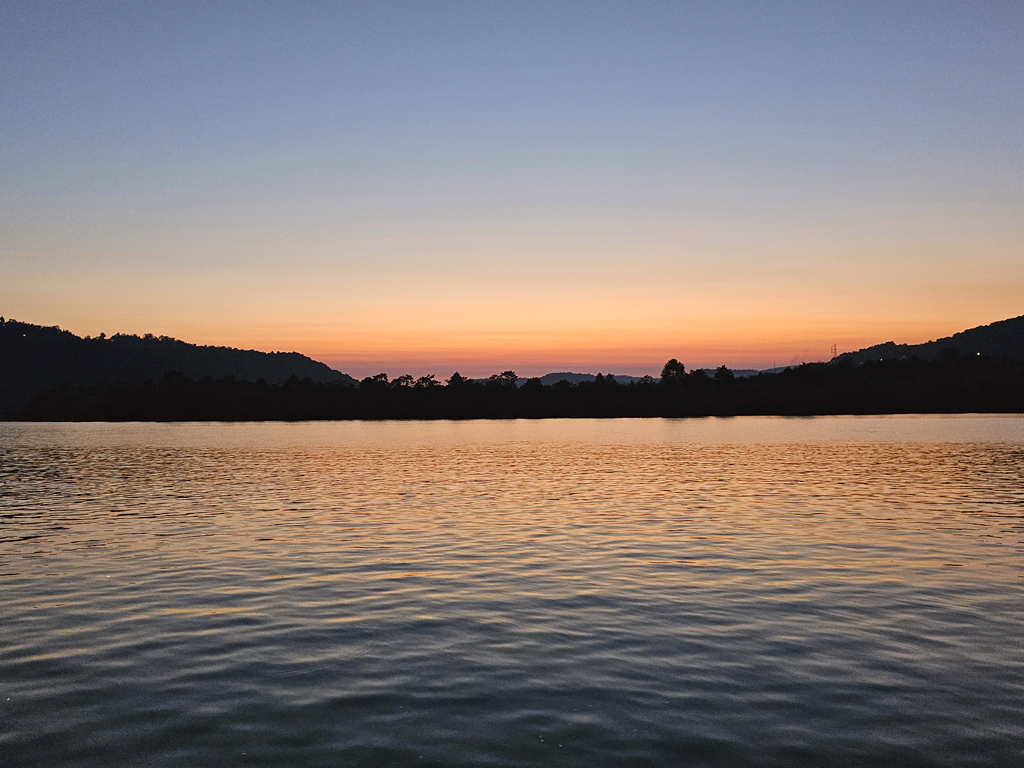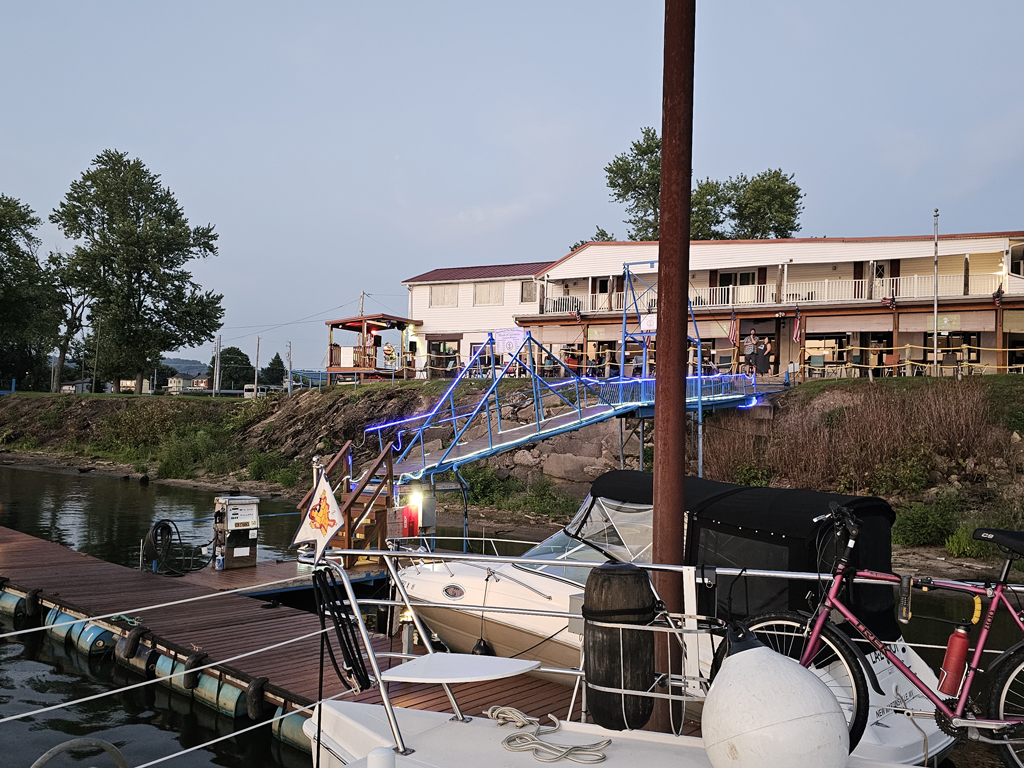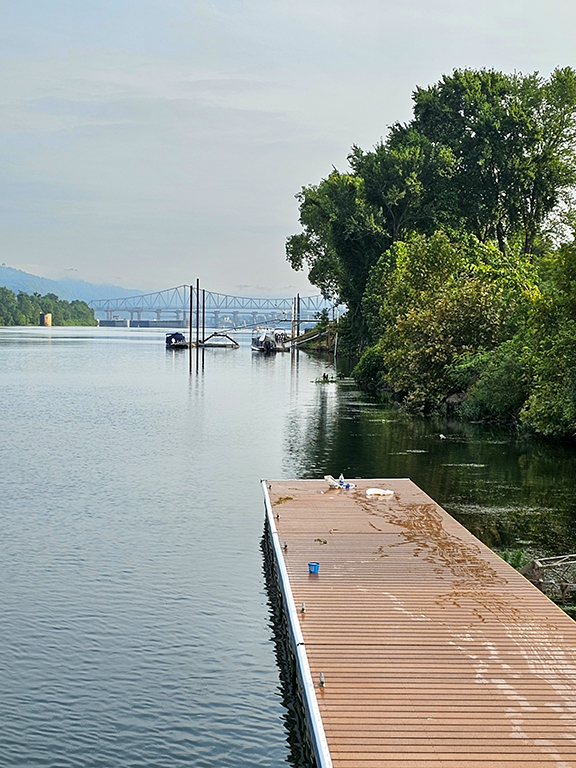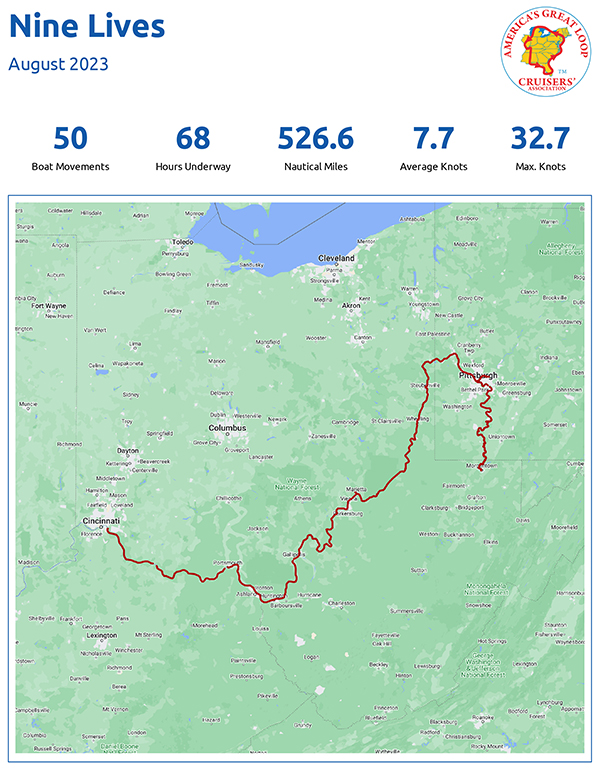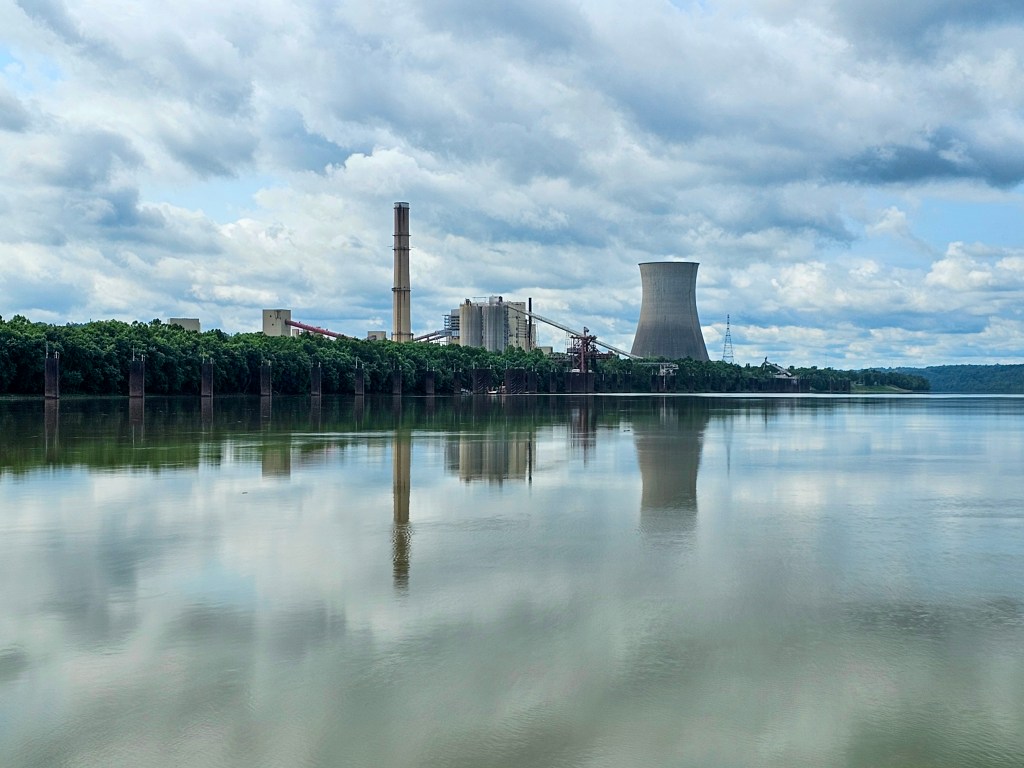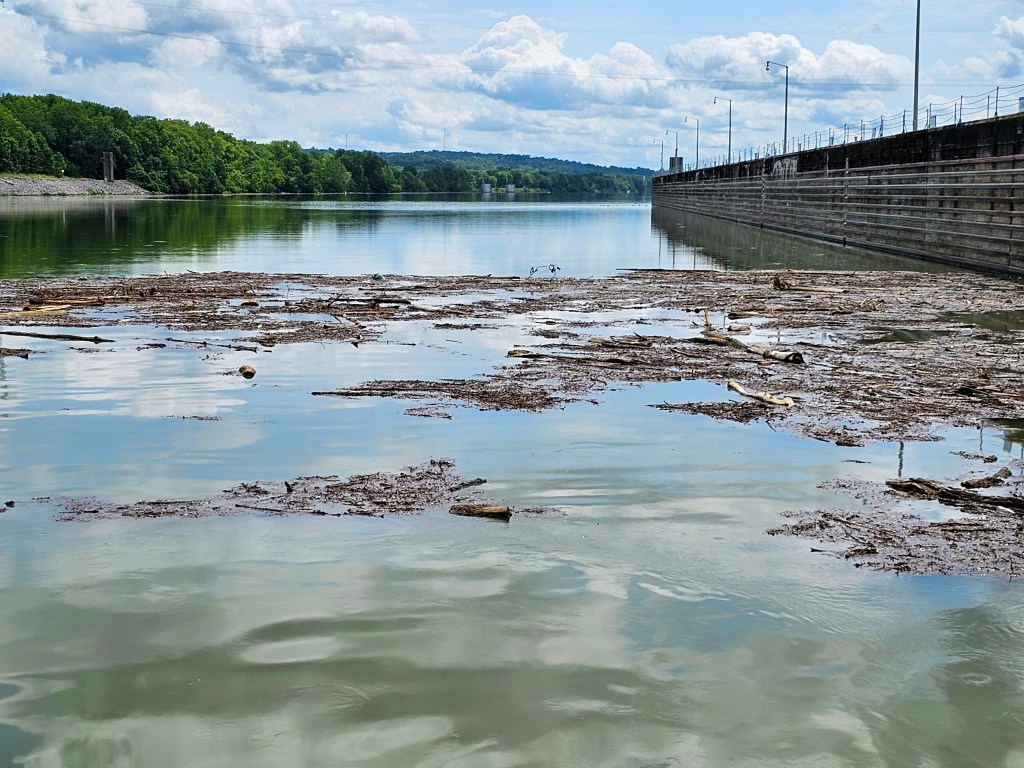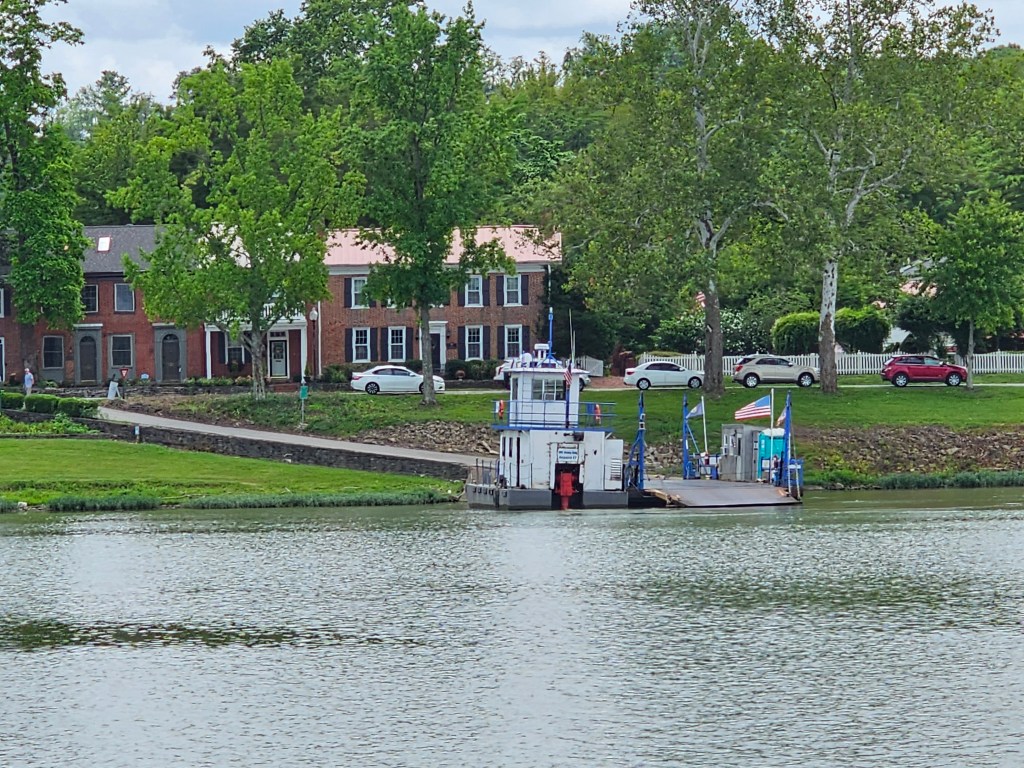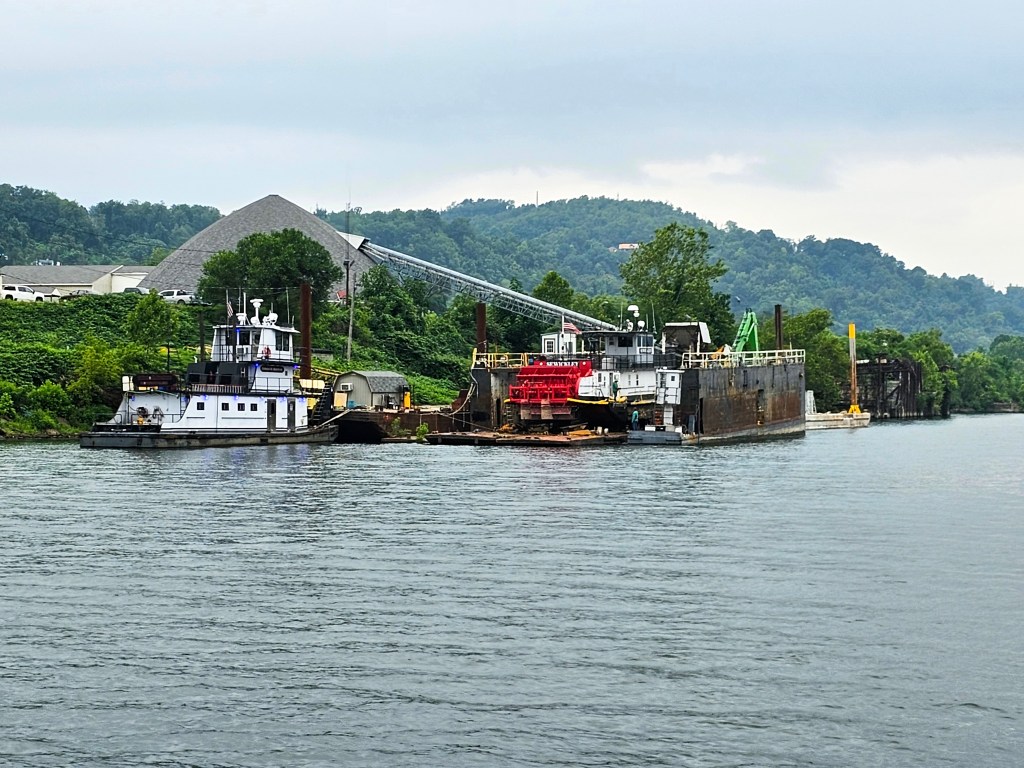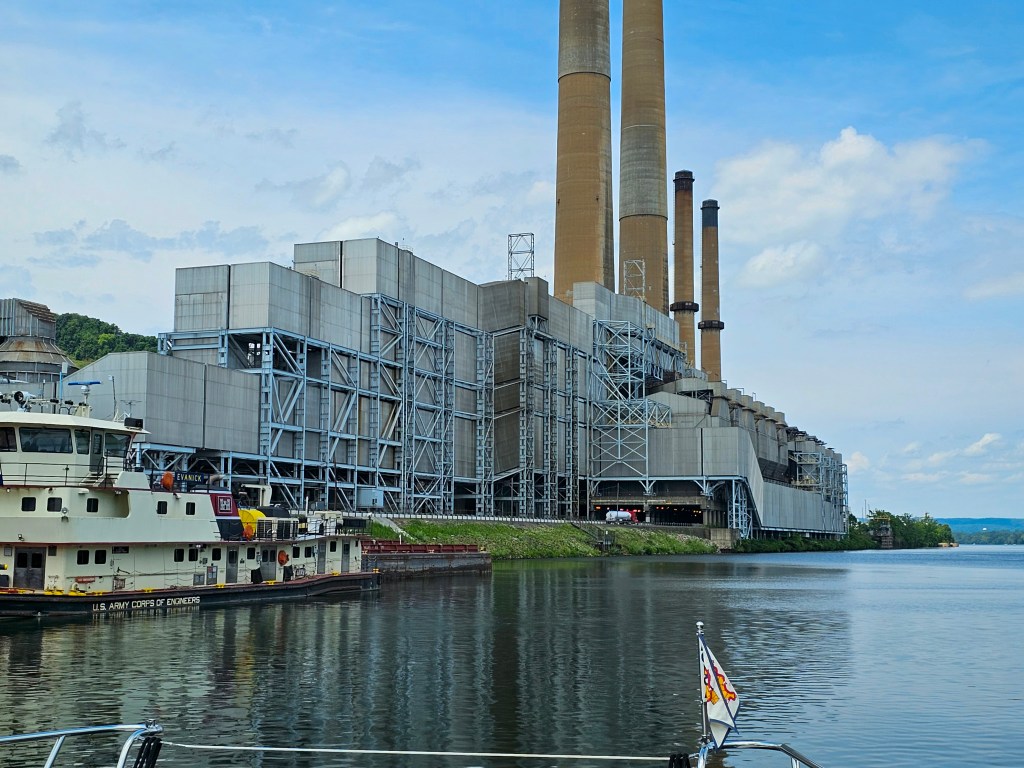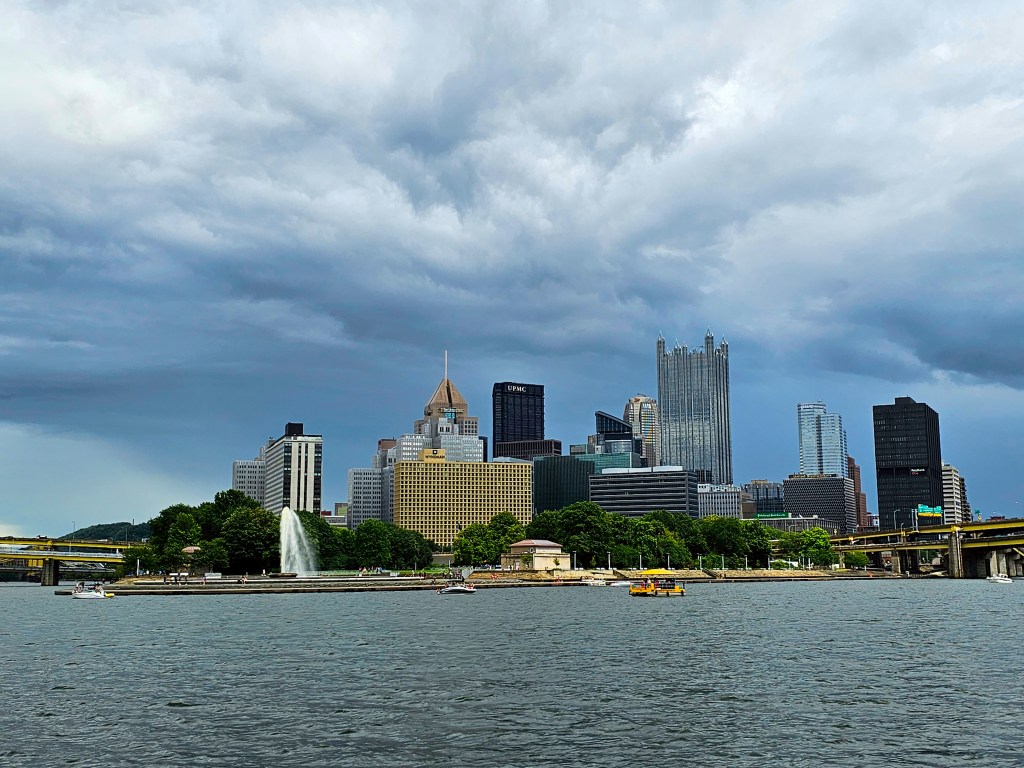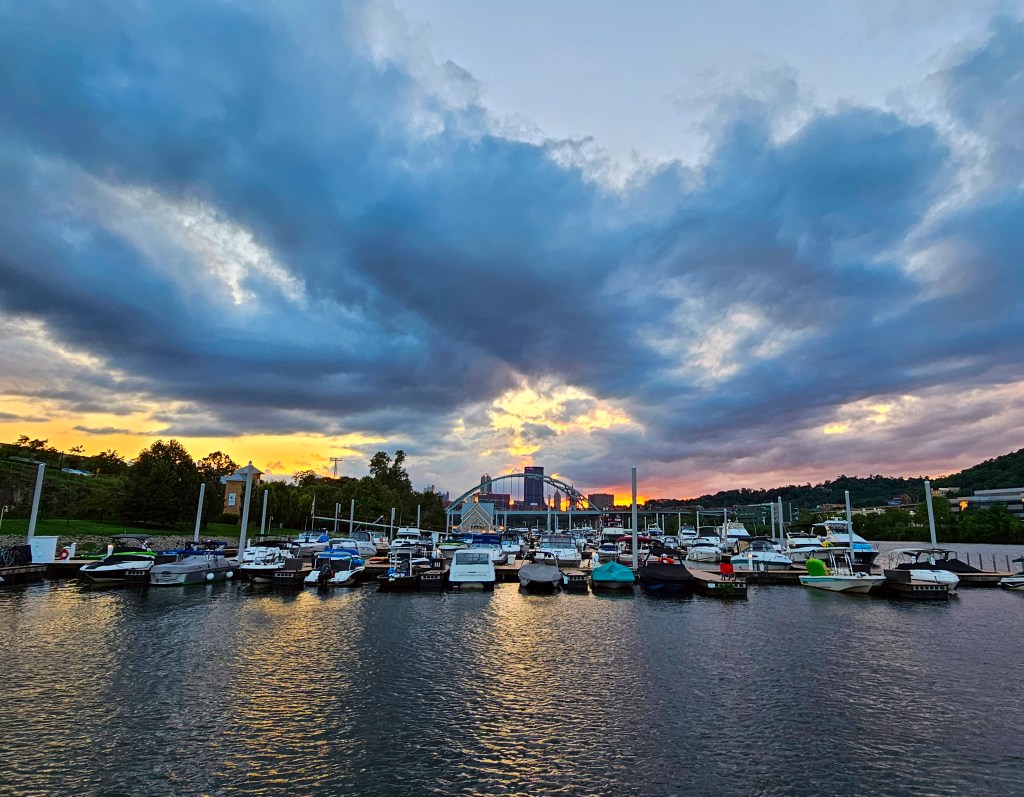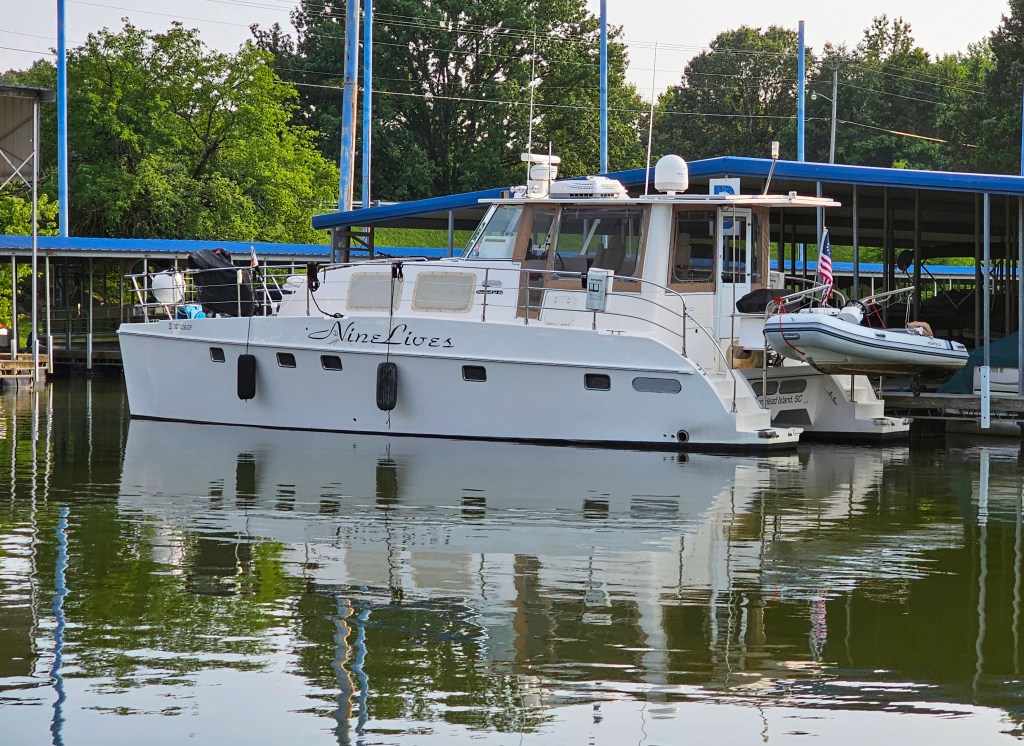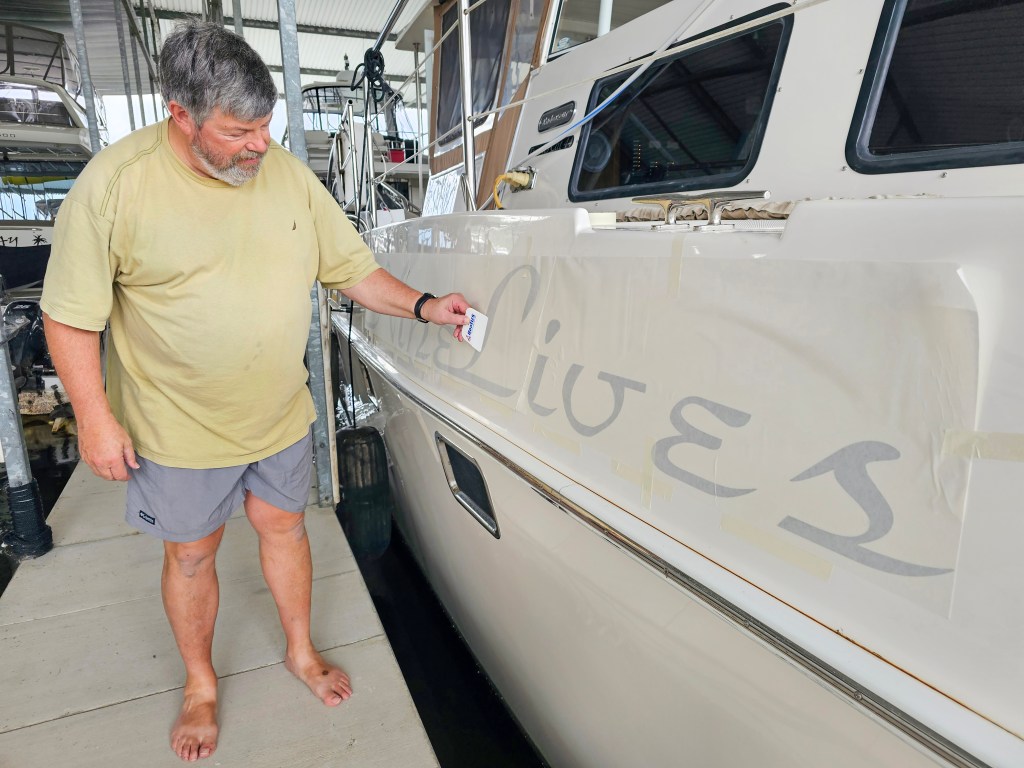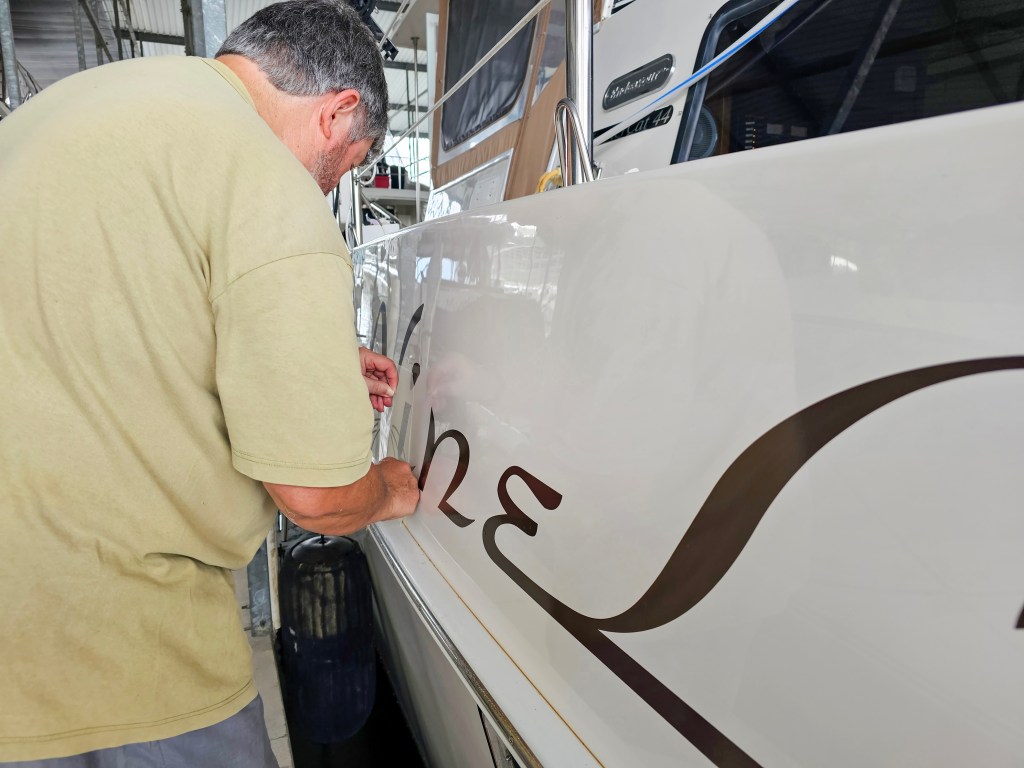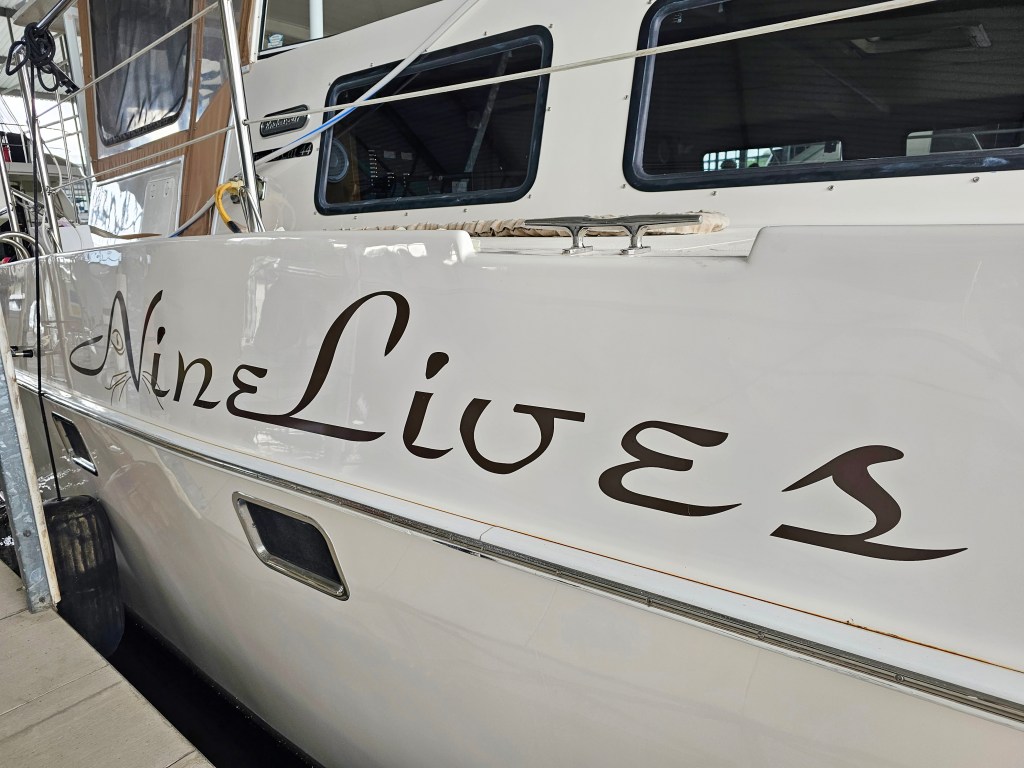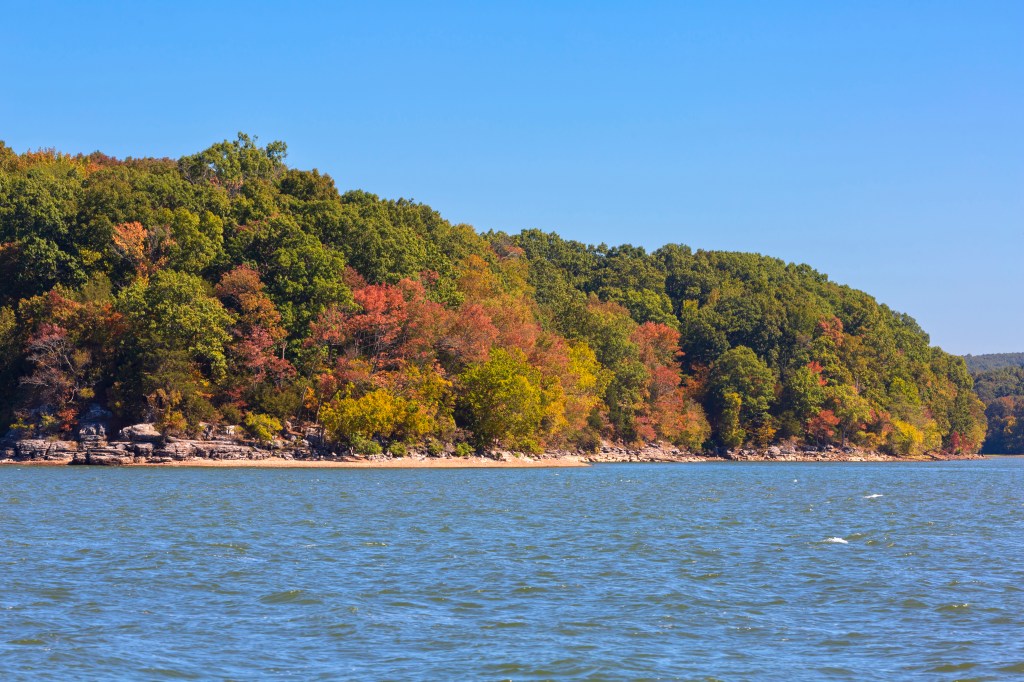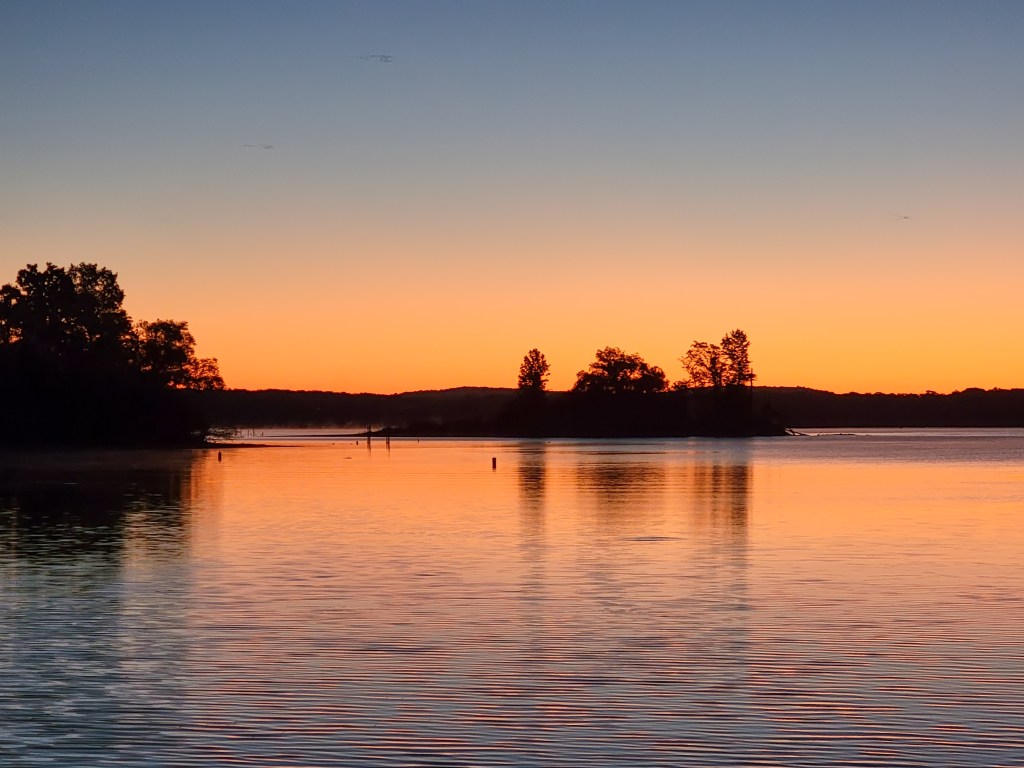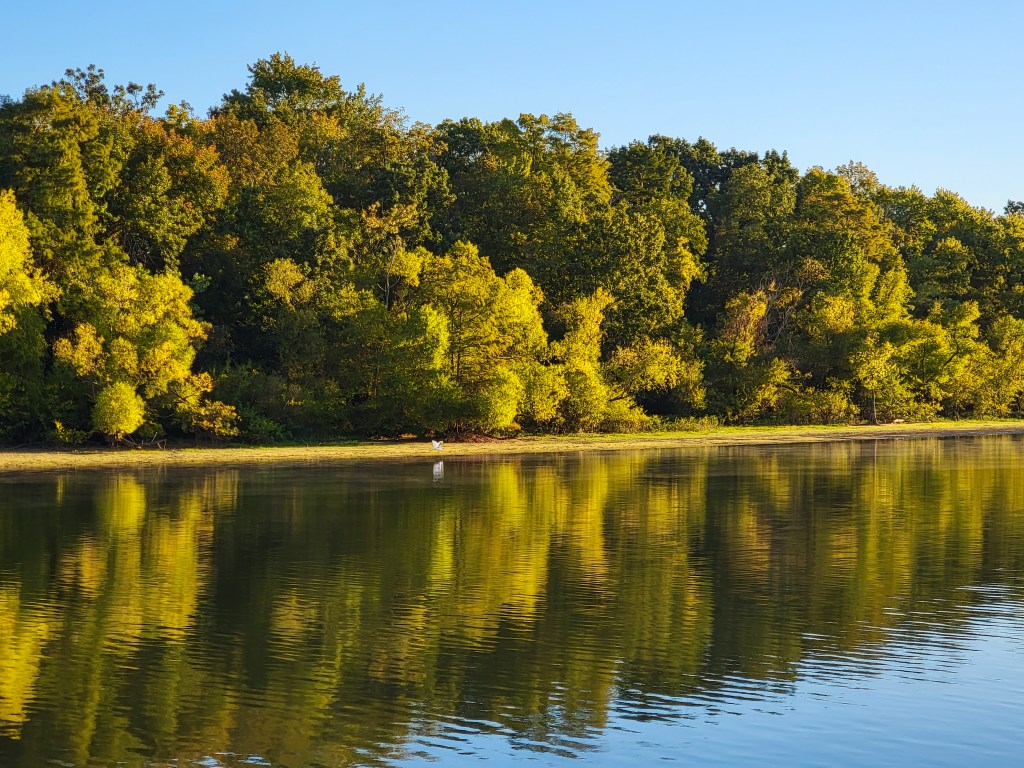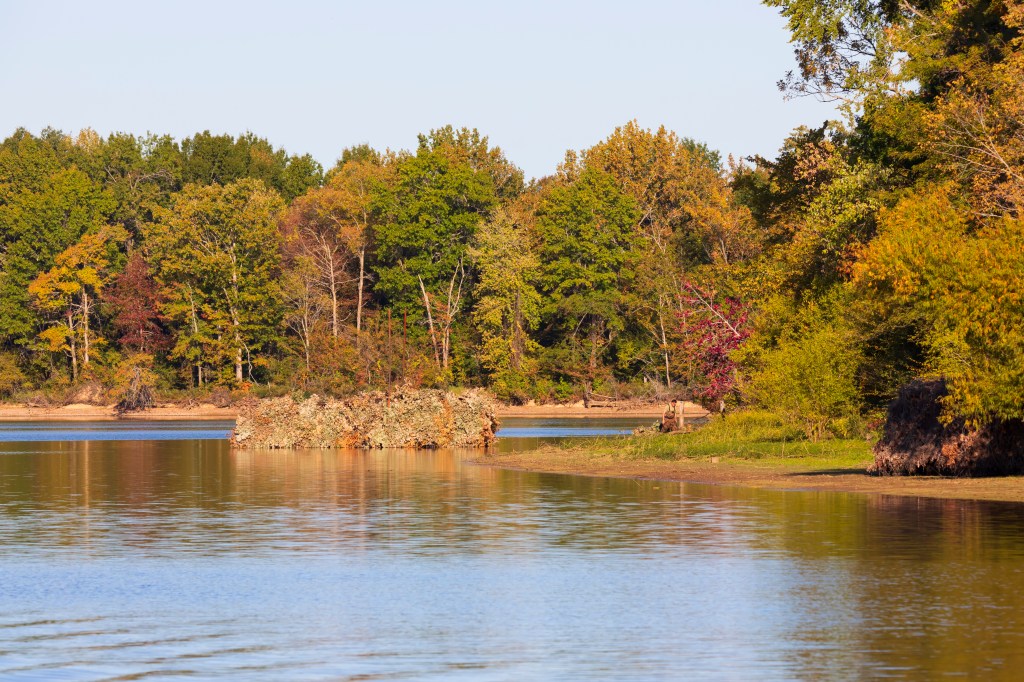
September 1 to 14, 2023: Cincinnati to Paducah

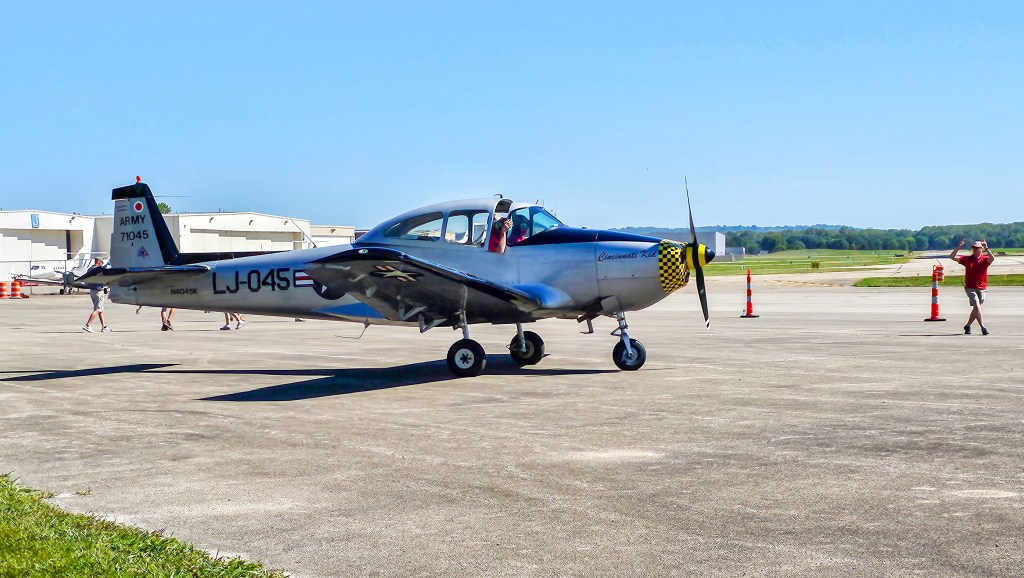
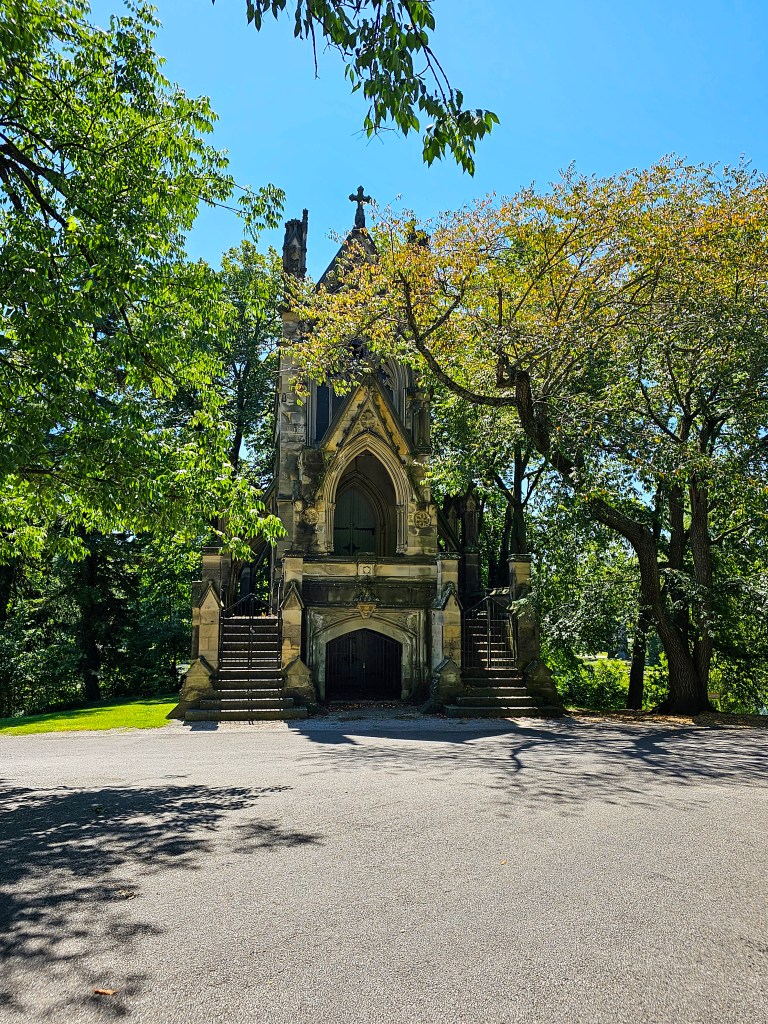
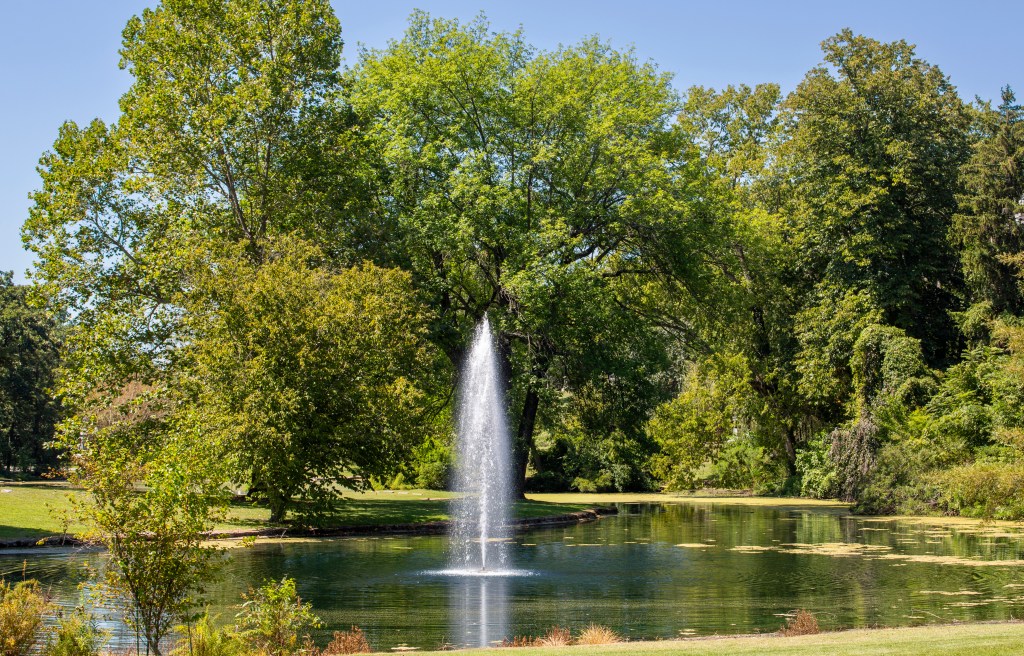
September began with a fascinating driving tour of Cincinnati with Audrey.  She was a great guide.  After a brief stop at the Lunken Field Airport to see the historic planes that were in town for the long weekend, we drove across the river to Newport.  Once a lawless and dangerous place, it became a city of gracious homes with beautiful gardens.  Back across the river, and a highlight was the Spring Grove Cemetery.  It is a beautiful place with many imposing monuments reflected in peaceful lakes.
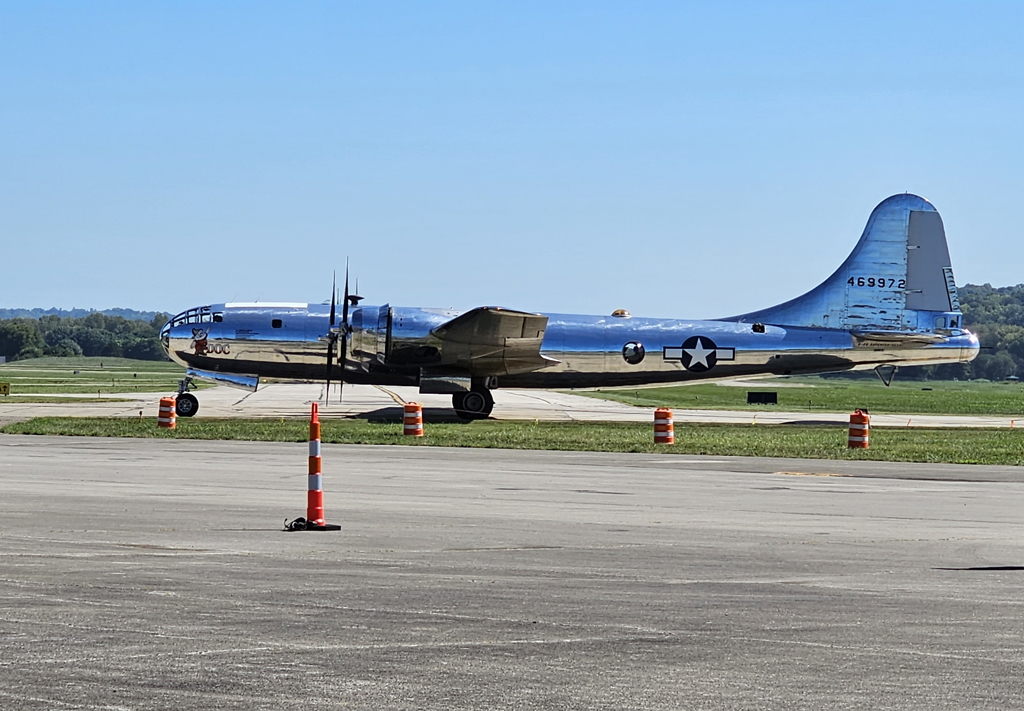
Historic bomber at Lunken Airport in Cincinnati
Another historic aircraft
Another of the historic planes, this one is called Cincinnati Kid!
Spring Grove Cemetery
Spring Grove Cemetery and Arboretum

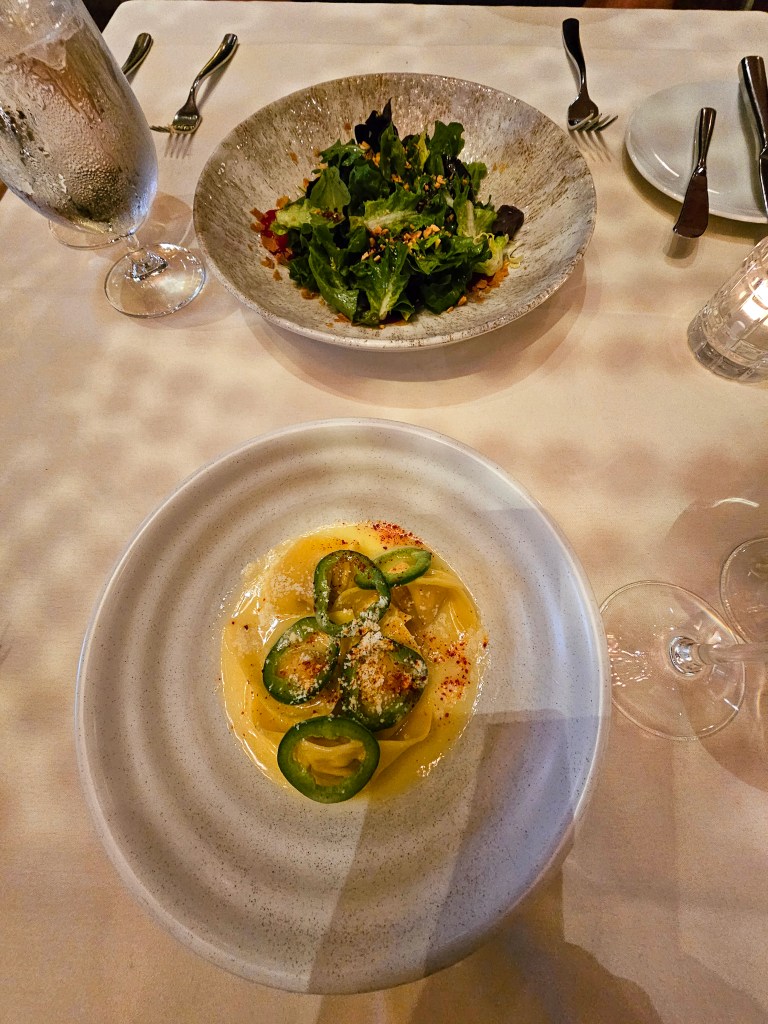
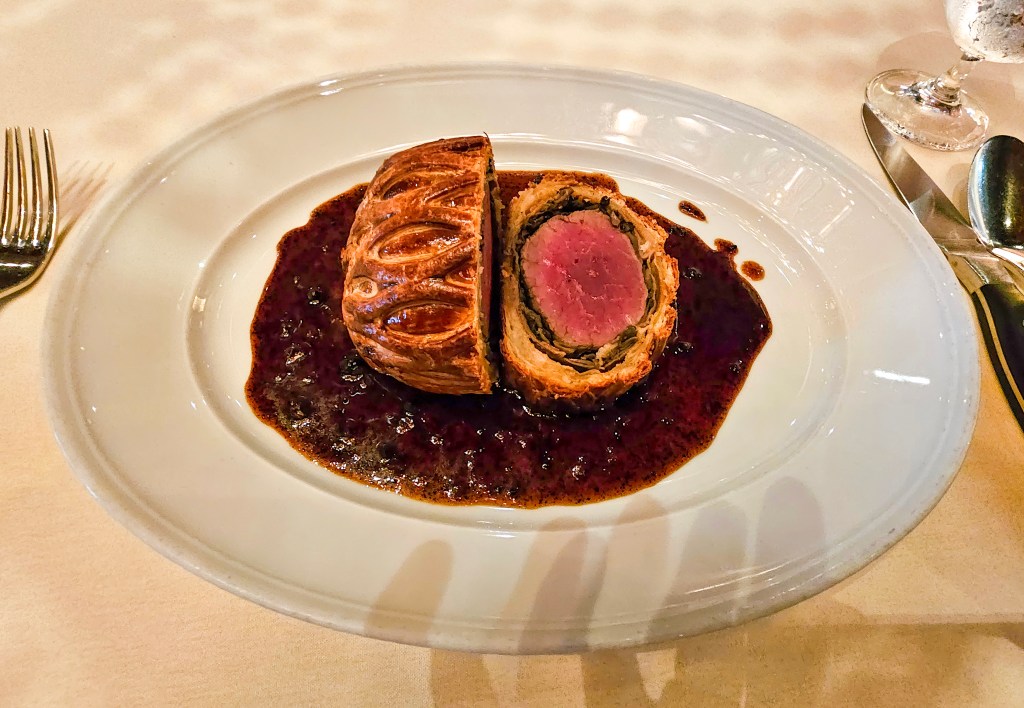
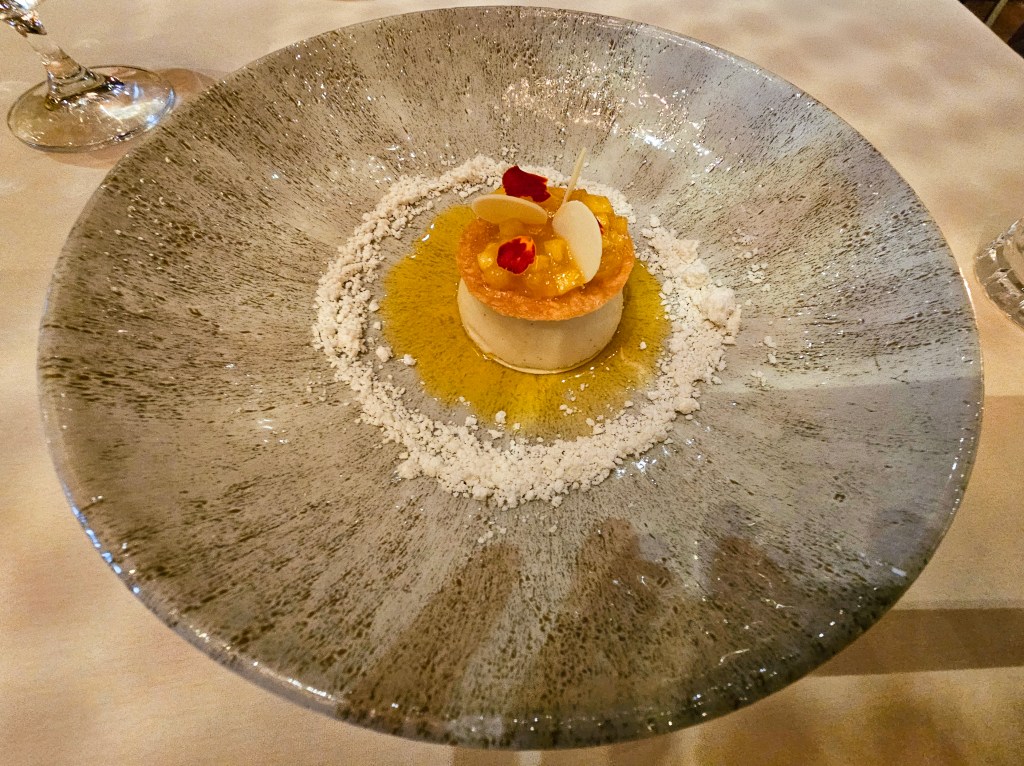
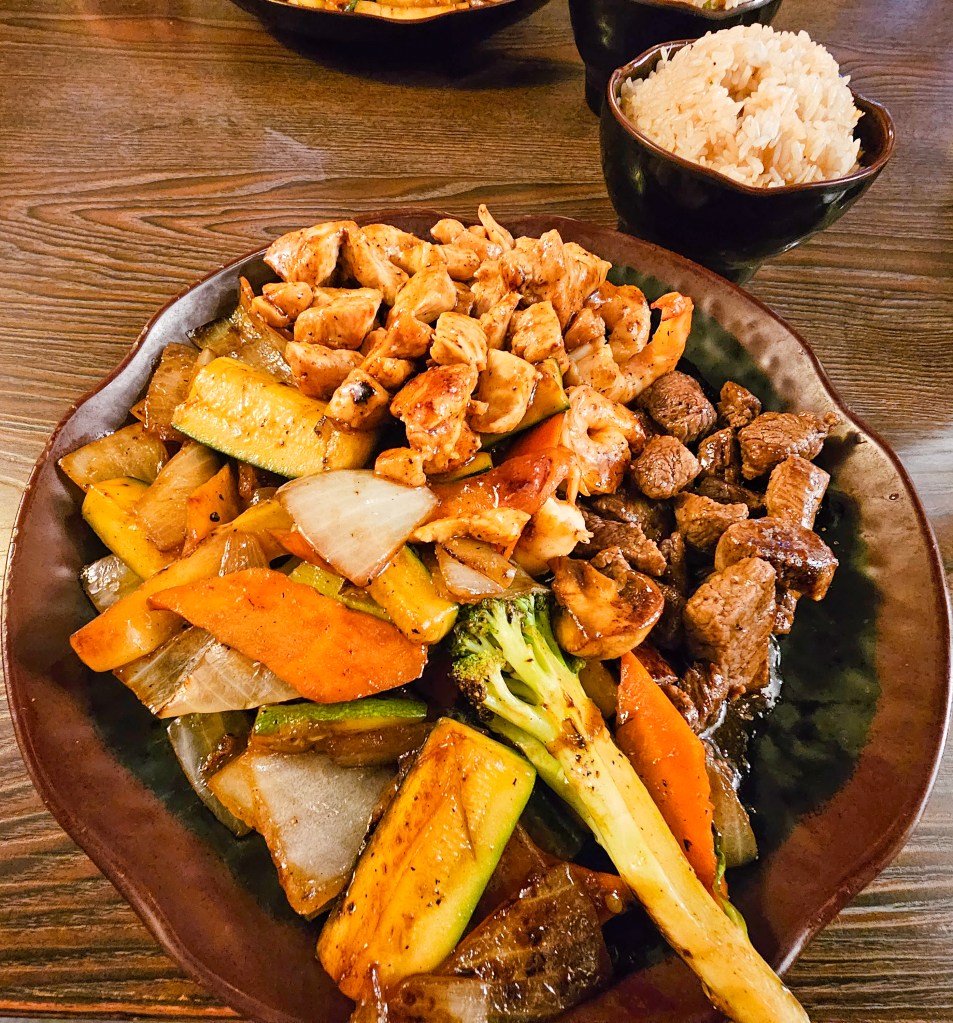
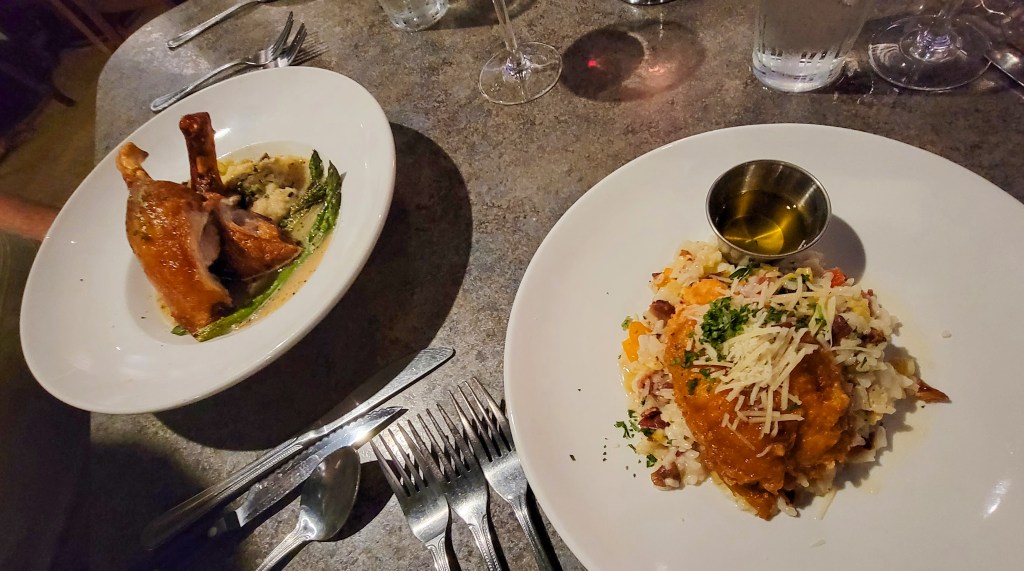
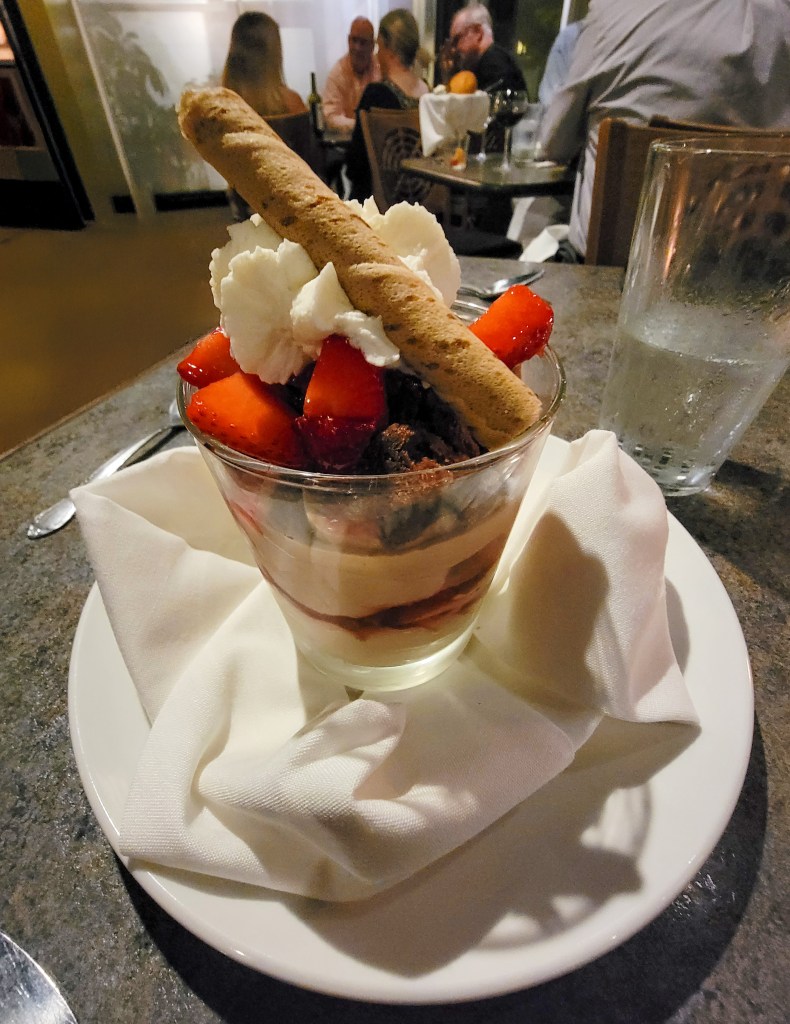
Our dinner at Boca was one of the best this trip.  It was a strange menu, with “small bites”, that are not sharing size, followed by “petits plats”, which include small individual or sharing portions.  The idea is that you order two or three in each category.  We began with two of the tiny plates, a lobster roll, and pommes souffles, puffed potatoes with dipping sauce.  I tried a sort of corn dish with pasta and jalapenos, and Dick ordered a salad.  We shared a delicious pasta Bolognese dish, and then we ordered the beef wellington.  That was definitely sized for sharing, and was delicious.  We were also delighted that it was plated in the kitchen, so much more civilized than expecting us to divide it into messy portions ourselves.  Desserts were a highlight.  Dick ordered panna cotta, and my dessert was “Le Citron”, a lemon dish that I will remember for a long time.  It arrived on the plate, looking just like a real lemon, set on a lemon shortbread in Italian meringue.  I was a bit disconcerted to be presented with a steak knife, but it became clear when I used it to cut the “lemon”.  It was a hollow form made with white chocolate.  Inside was lemon curd, and preserved meyer lemon.  There was also some sort of cheesecake filling.  It will be a long time before I have a dessert that is as creative and delicious as that one.

Boca, Lobster Roll and Pommes Souffles
Boca, Corn pasta and a salad
Boca, Pasta Bolognese
Boca, Beef Wellington
Boca, Panna Cotta
Boca, Le Citron

We were invited for the coffee and donut gathering at the Yacht Club the next morning.  Audrey joined us.  Later we visited Darlene and Mike’s boat, Riversong, and then they walked over to see Nine Lives.  They will begin their loop later this month, and we hope to see them further down the rivers, or perhaps in Hilton Head.  We were quiet for the rest of the day.  Dick made a run to the liquor store to replenish our stocks, and I finished the blog for the previous two weeks.

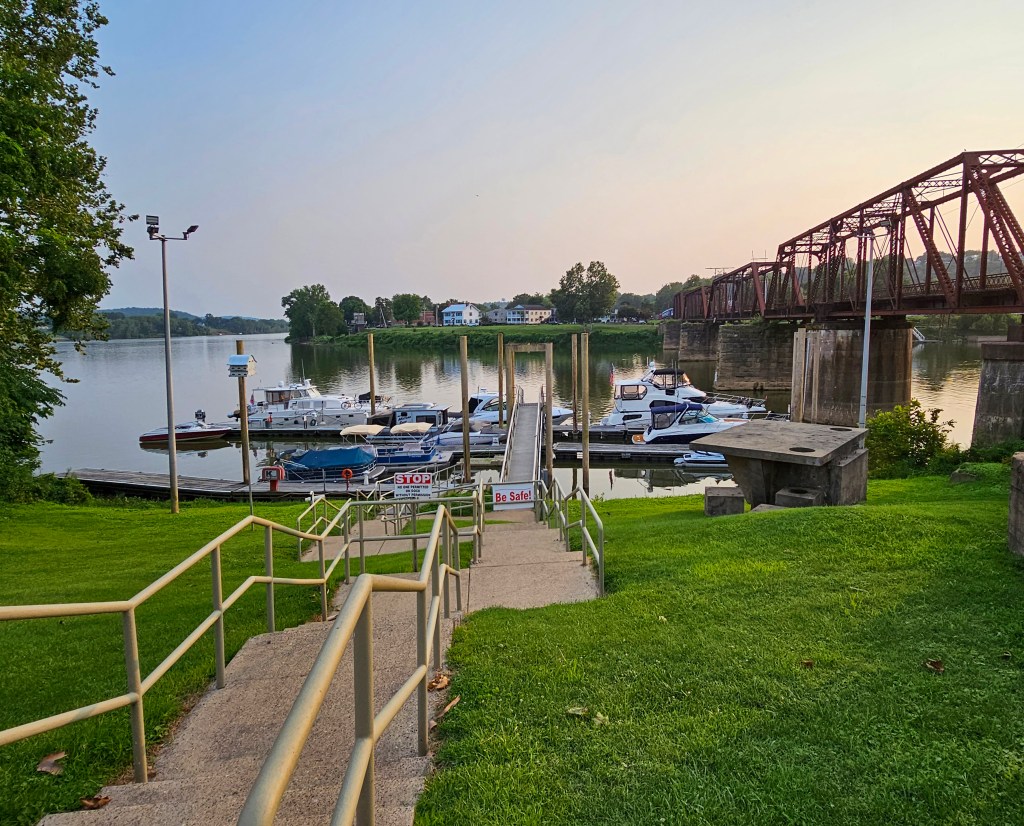
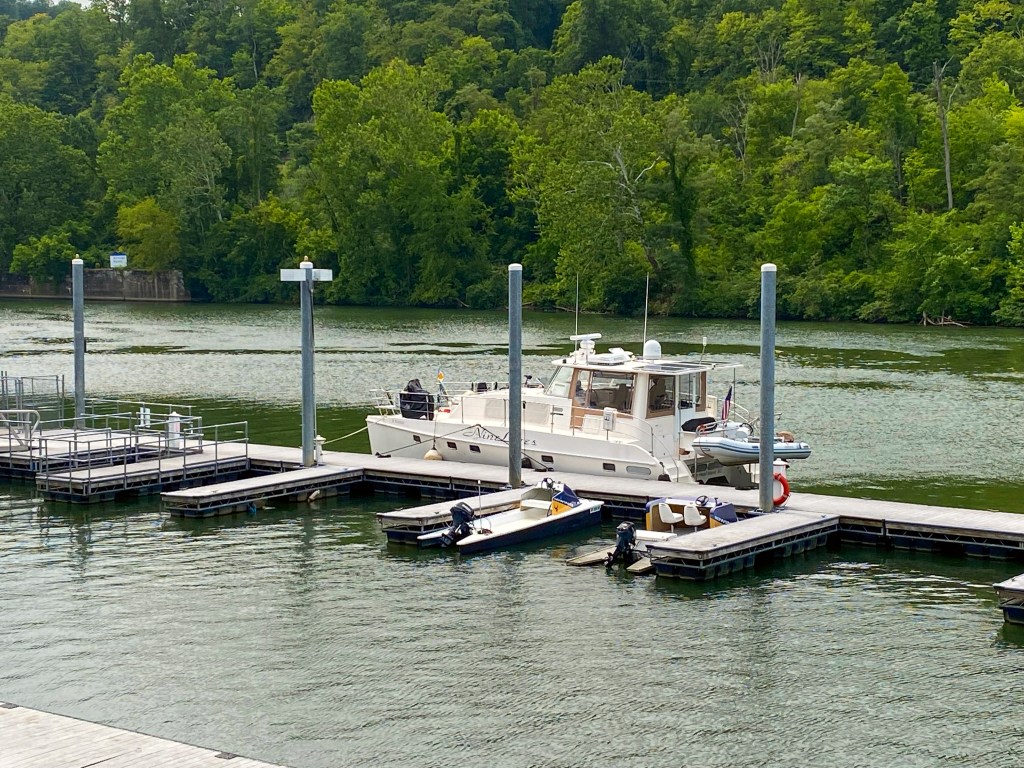
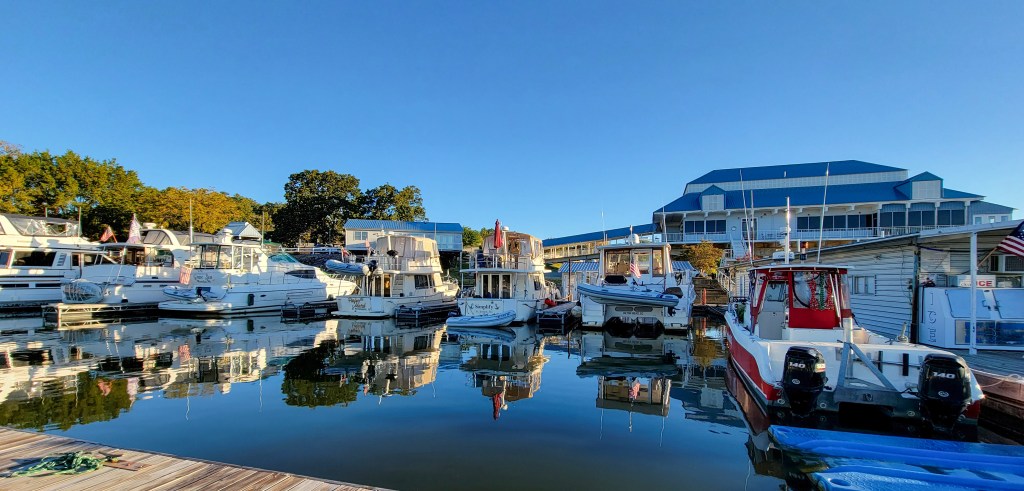
Four Seasons Marina, Cincinnati

We had a nice, and very authentic dinner at The French Crust.  The evening started poorly though.  Dick tried two different parking places, and the charge to park was a flat rate $25 to park until 4am.  Since we only wanted 2 hours, he was very annoyed.  As my Mum used to put it, “I want to park, not buy the lot!” (she was objecting to a $3 charge!)  Once Dick decided to accept the inevitable (with much grumbling), we arrived at the restaurant to discover that it is so authentic that there is no air conditioning.  It was 93F that day.  Apparently, they do have AC, but it has been broken for 2 months!  Our waiter had been there since 9am – we felt very sorry for him.

Dick’s escargot were good, but as in other places, not garlicky enough.  My pork pate was very tasty.  We both ordered the vol au vent with shrimp, scallops, and vegetables in a white wine cream sauce for our main course.  Dessert was pot de crème (a dense chocolate mousse), delicious, but double the size it is supposed to be.
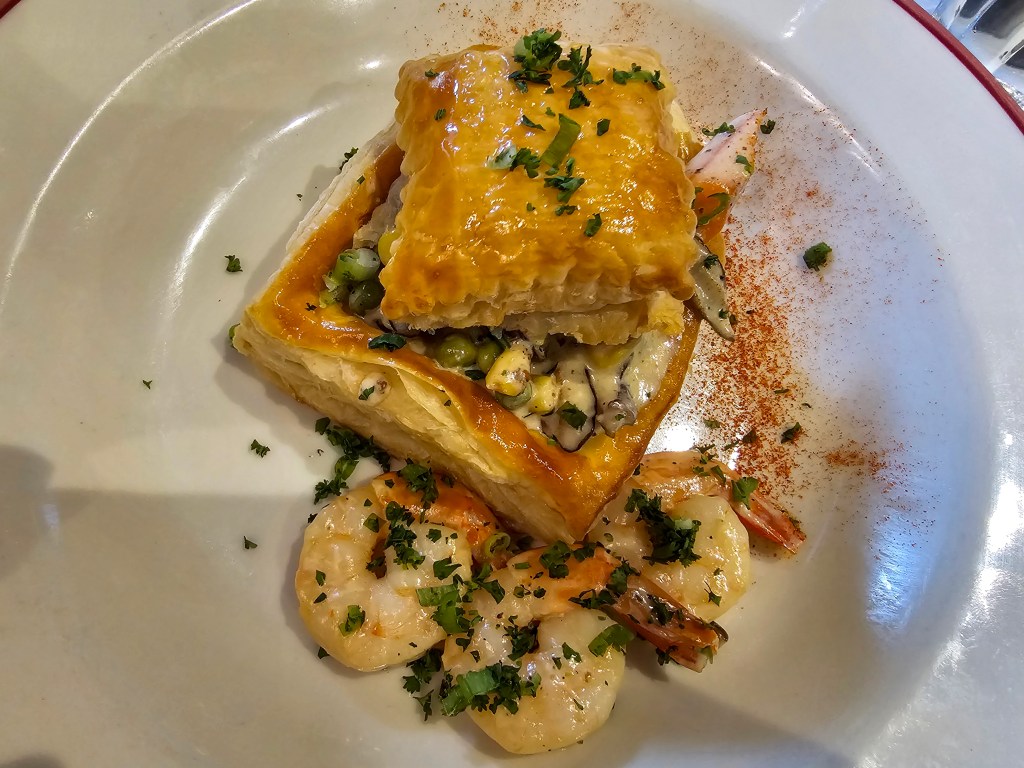
French Crust, Vol au Vent

Later, I looked up the parking information, and sure enough, all city parking is $20 to $30 on a “special” weekend.  Note to self, avoid “special” weekends in cities, not that we had a choice on this occasion.

After our return to the marina, we met a couple we had chatted with on the radio on the Ohio River as we passed each other a few days earlier.  They came on board for an evening drink and chat.  It was most enjoyable, and went well past Looper midnight (generally accepted to be 9pm)!

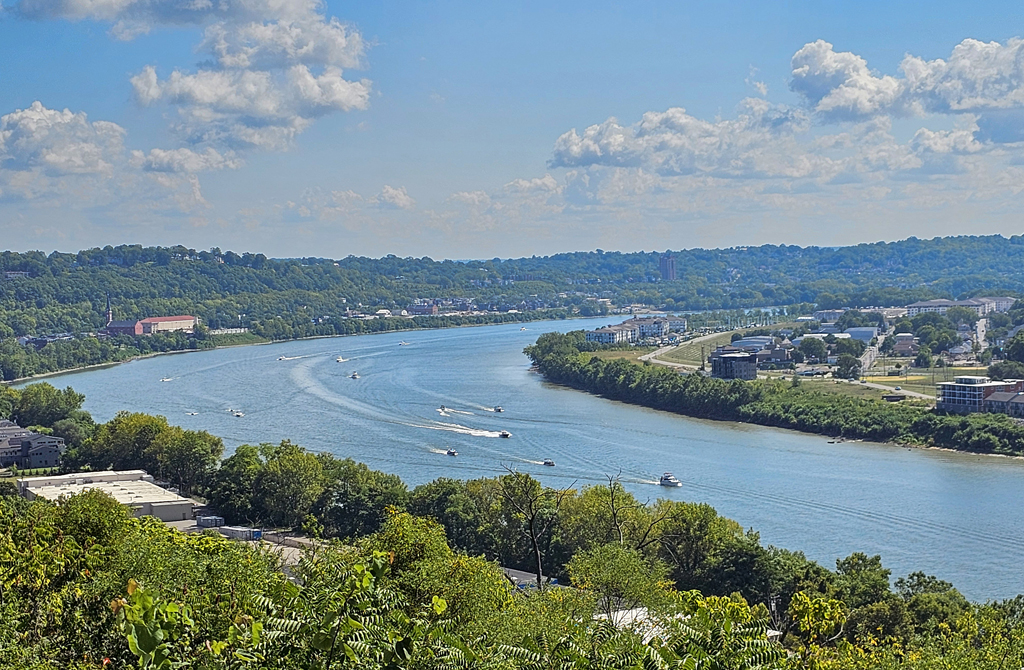
September 3rd.  We had booked a Segway tour for the morning.  It was supposed to be in the downtown riverfront, but that was not allowed due to the big fireworks weekend.  Instead, we toured Eden Park.  It was a good tour, with nice views of the river with boaters gathering for the fireworks.  For a change the other people in the group arrived early as requested, so we didn’t lose time while they learned how to ride the Segways.  They also were good, careful riders, another nice change from our last experience!  After the tour, we went to Jungle Jim’s, a huge international supermarket.  We found a few things to add to our pantry.

Eden Park
Boats already rafted up on the Ohio River in the morning, waiting for the fireworks
More boats hurrying to get a good spot for the fireworks

We had the boat exterior cleaned by a local boat cleaner.  She didn’t do a particularly good job, merely adequate, but it did get rid of the hideous Ohio River moustache that was marring Nine Lives’ once pristine hull.

Dinner at Nicholsons was a disappointment, mainly for Dick, as I had no great expectations.  I knew that the so-called Scottish Pub had few choices for me.  They were busy, and clearly short of wait staff, as we were looked after in a sporadic manner by a lady who was a supervisor, not a waitress.  We were left sitting with no drinks or orders taken for 15 minutes after we arrived, and it never got any better.  The food when it was delivered was cold.  Dick’s Scotch egg was the only highlight.
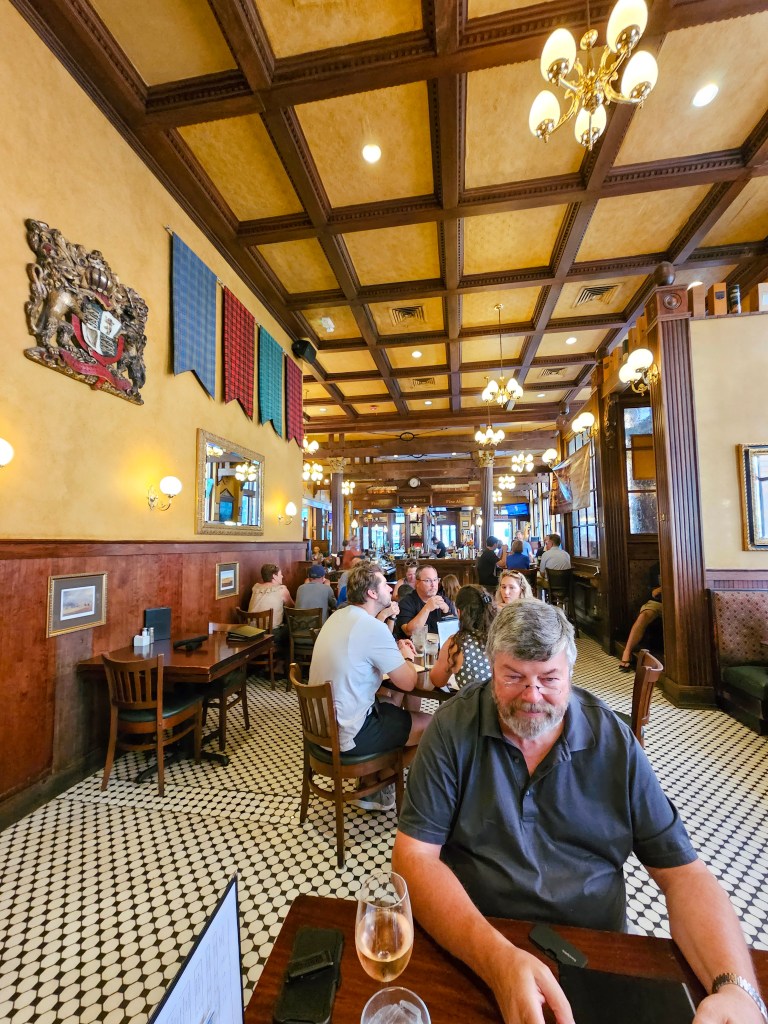
Nicholson’s Scottish Pub, Dick looking tired of waiting!
The Scotch Egg was the only success at Nicholsons

Fortunately, we had found a parking garage with “Event pricing” for $15, so not quite as bad as the $25 or $30 we would have paid on the street or in a city lot.  At least Dick didn’t have that extra stressor to spoil his evening!  As we drove back over the Ohio to return to the marina, we could see all the boats anchored for the fireworks.  Many were rafted up 4 or 5 boats.  Sadly, there was no way to take a picture, as it was an amazing sight, seeing the river completely filled with small craft.  All barge traffic is stopped for the fireworks event.

We could not see the fireworks from the marina, and had no intention of either driving to a viewing spot, or worse, taking the boat and anchoring with people who go out once a year and had been drinking all day!  Locals were mystified to hear that we would not see the fireworks, it would seem to be mandatory for everyone who lives in Cincinnati.

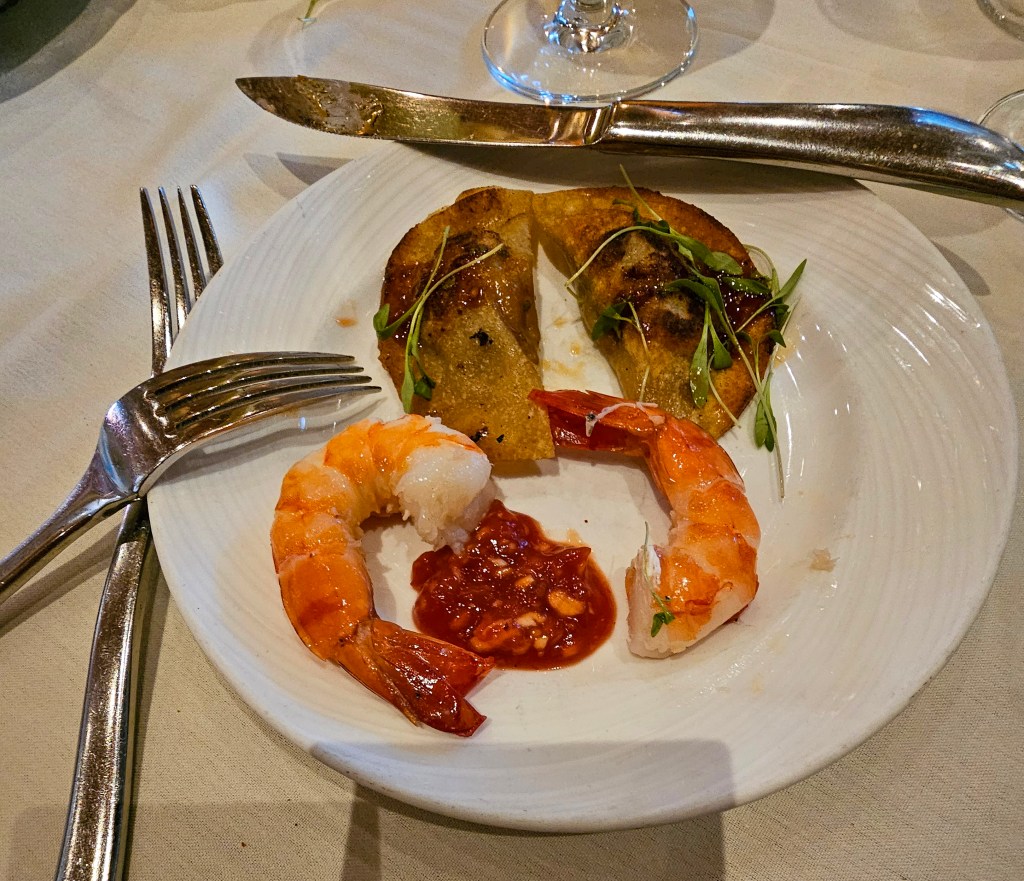
On our last evening we had an excellent dinner at Eddie Merlot’s, a small chain of steak houses.  The food was delicious, and the setting was a gorgeous modern restaurant with stunning décor, artworks,  and stained glass.  Back at the marina, we were joined on board for a nightcap by Jon, another Looper who we had met in Pittsburgh.  Jon is single-handing, occasionally joined by friends and relatives.  We enjoyed exchanging stories of our adventures.
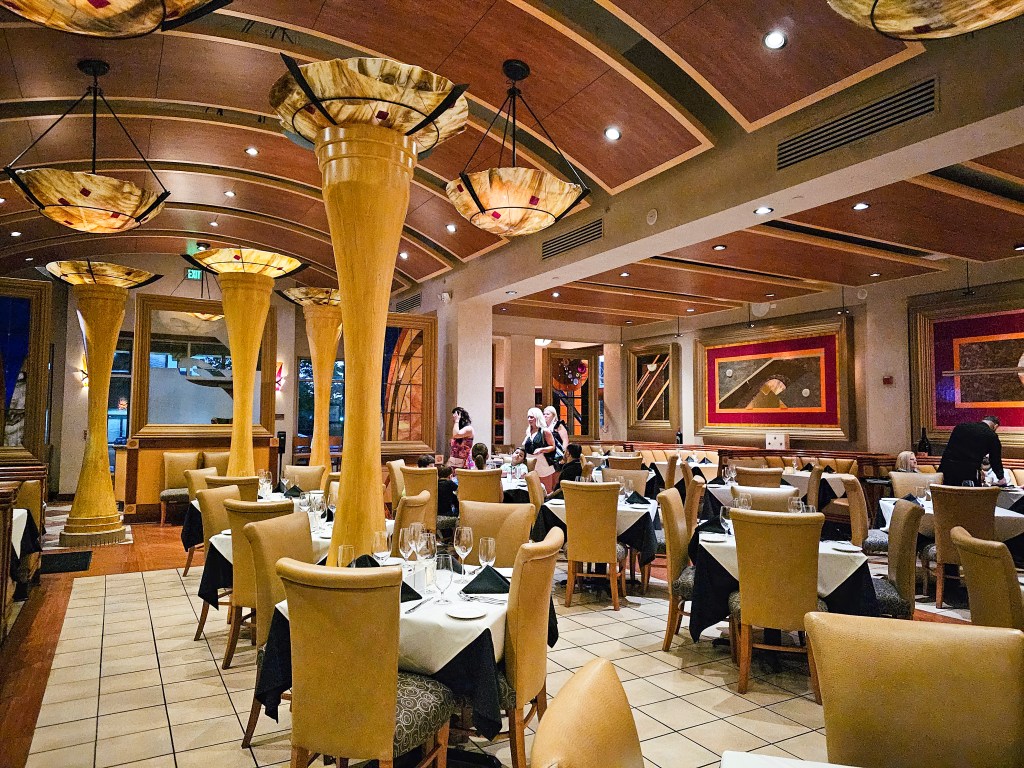
Eddie Merlot’s in Cincinnati
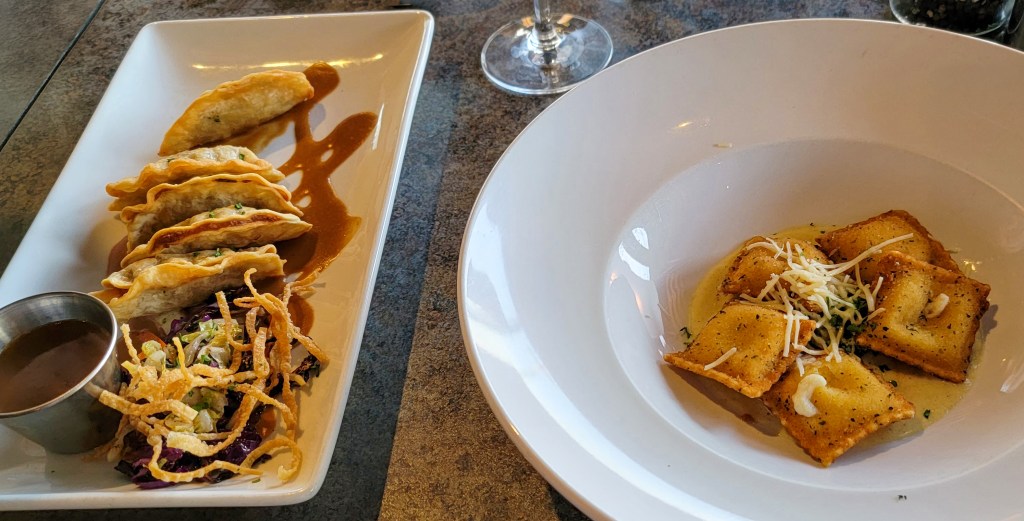
Eddie Merlot’s, Potstickers and shrimp cocktail
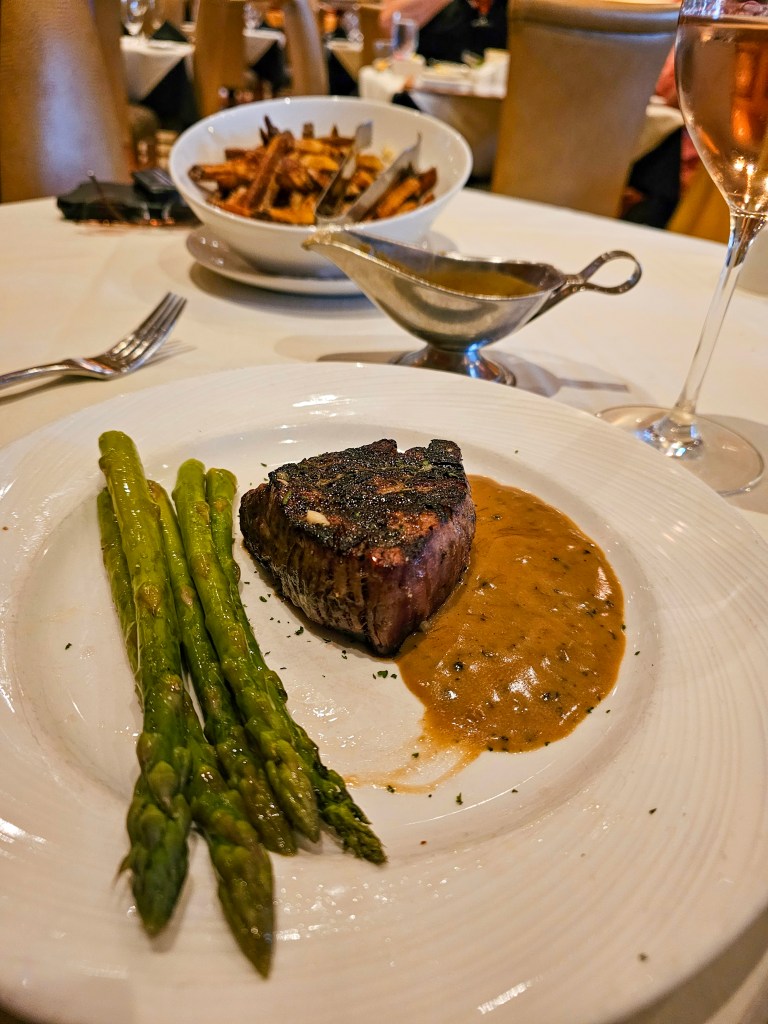
Eddie Merlot’s, filet steak with peppercorn sauce
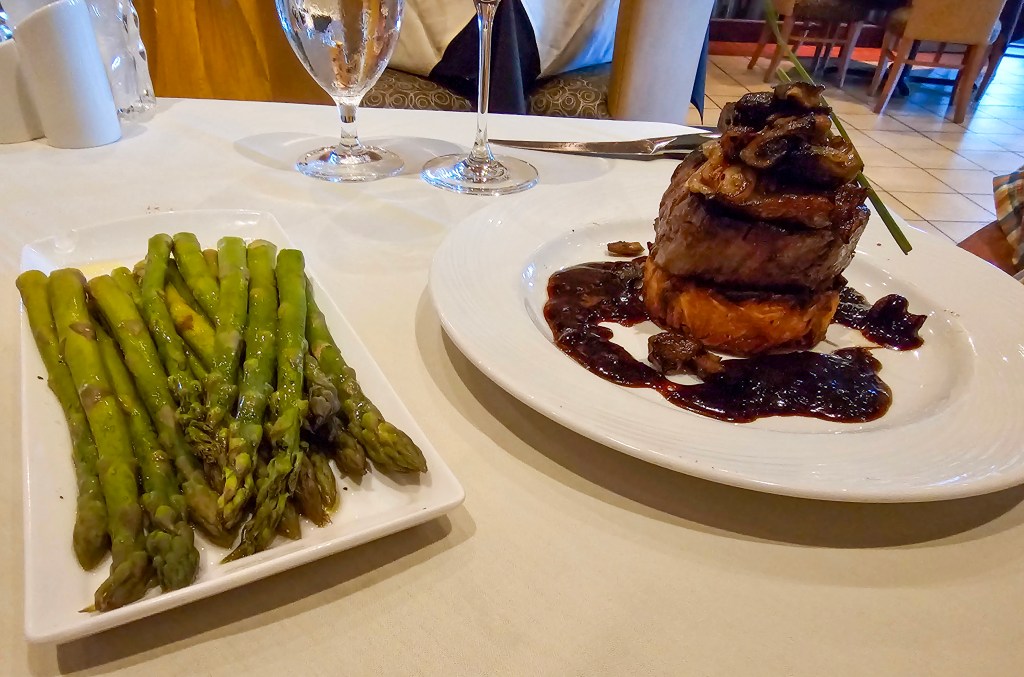
Eddie Merlot’s, Filet Steak Bordelaise
Eddie Merlot’s, carrot cake and special coffee

We liked Cincinnati.  It is a very clean city, and there is clearly a lot of wealth and prosperity.  We saw a lot of the city while we drove to restaurants and shops, and there was very little evidence of the usual big city poor neighbourhoods and homeless people.

Flood gauge on the side of a Cincinnati church with historic flood markings
The same church, seen from the river. You can get a sense of just how high the waters can get.
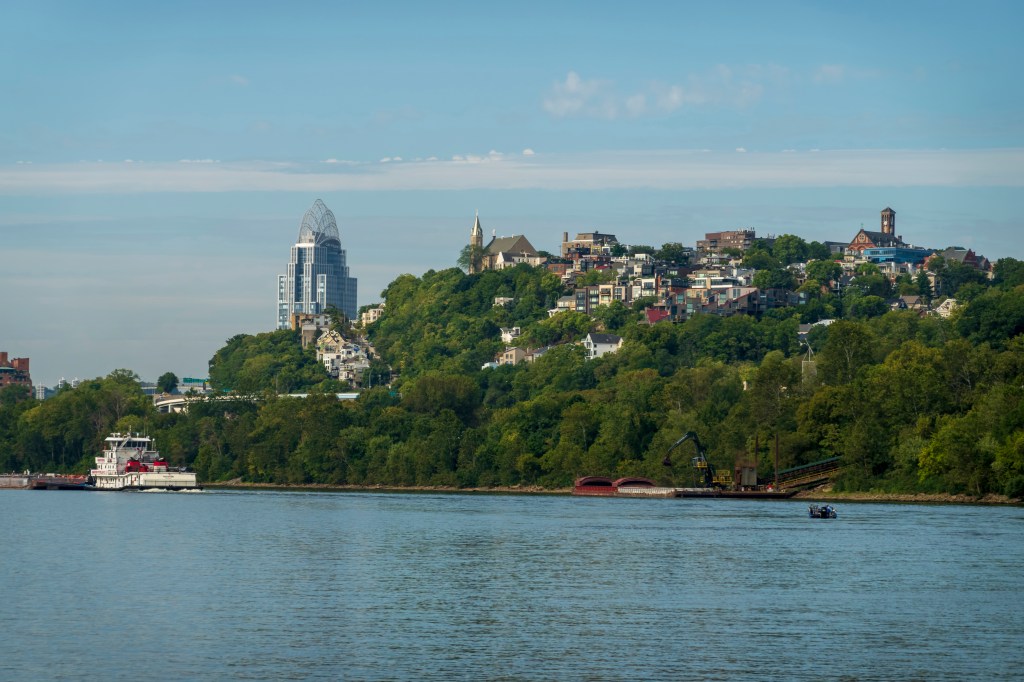
Cincinnati from the Ohio River. The Great American Tower is seen past the hillside community of Mt Adams.
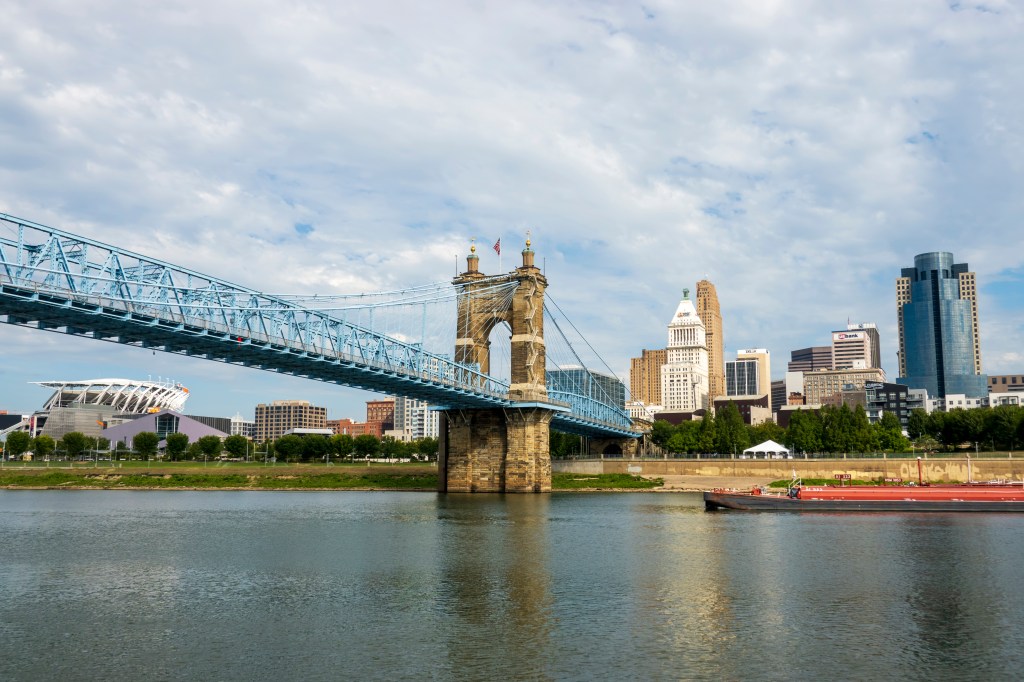
Cincinnati skyline as we headed downriver
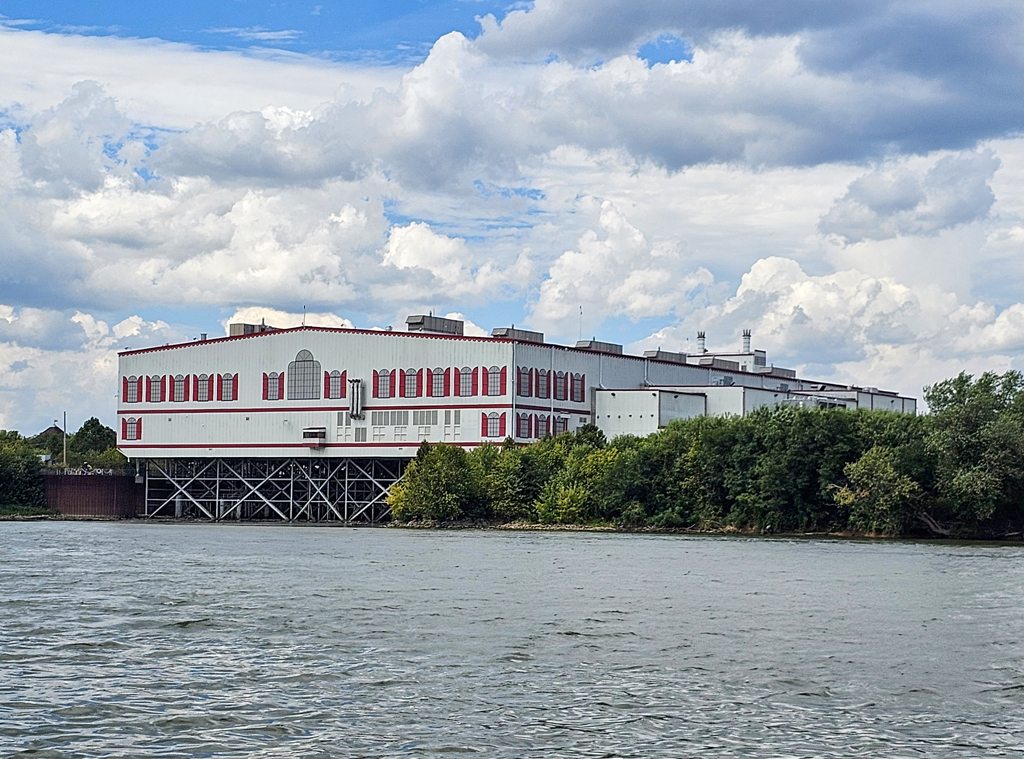
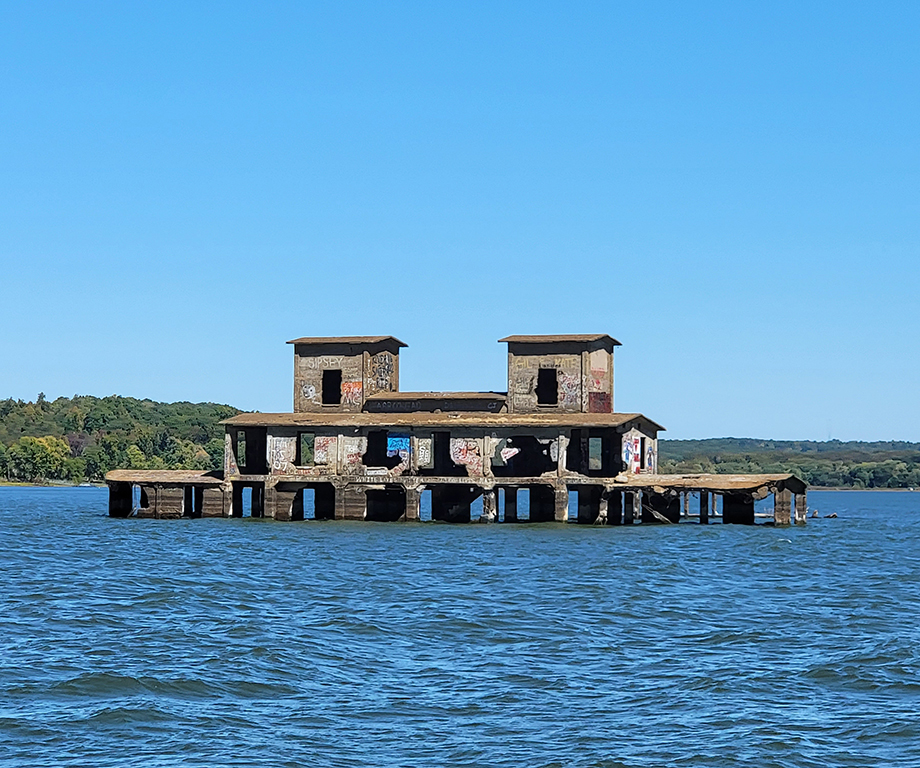
A warehouse, painted and done up to look like a sternwheeler, south of Cincinnati

Leaving Cincinnati, we arrived at Rising Sun at 2:30.  It was an incredibly hot day, the weather report said “feels like 99”.  It did.  The city has an excellent dock for visitors.  Dick was struck by how clean and tidy the town is, real civic pride.  Rising Sun has a seaplane repair shop.  We were surprised to see this, as we have seen no evidence whatsoever of seaplanes anywhere on the Ohio River.

Seaplane service at Rising Sun

Rising Sun, although small, was a center of invention.  J.W. Whitlock invented an automatic harp, that is considered to be a precursor to the jukebox.  He also invented a coin operated horse racing game.  His biggest achievement was a racing boat, that set the speed record for travelling the 267 miles from Cincinnati to Louisville and back, at just over a mile a minute in 1924.  This record still stands.  The attempt was made on a day that the river was full of debris.  When Whitlock arrived back at Cincinnati, there were cheering crowds waiting to congratulate him, but he just waved and then turned around and returned to Rising Sun.  His boat, The Hoosier Boy, had been holed by debris during the race, and if he had stopped to accept the congratulations from the crowd he would have sunk. The record will never be matched, because the Markland Lock and Dam has since been built between the two cities.  Another Rising Sun resident, Henry Clore, was a blacksmith who set up a shop to produce ploughs.  By 1880, his company was shipping 6000 ploughs a year down the Ohio to southern markets.
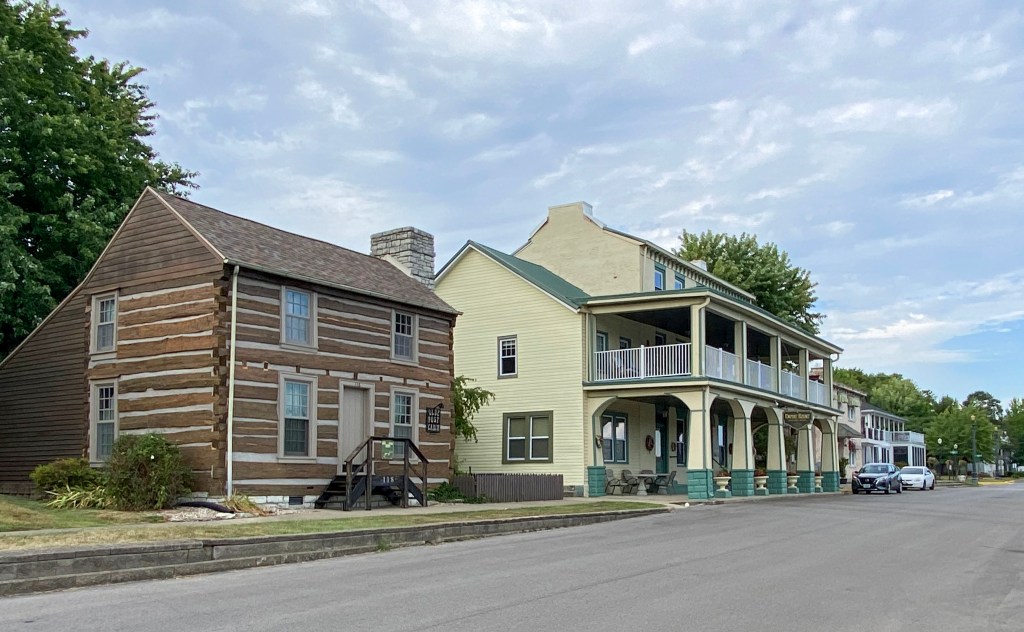
Rising Sun, historic buildings
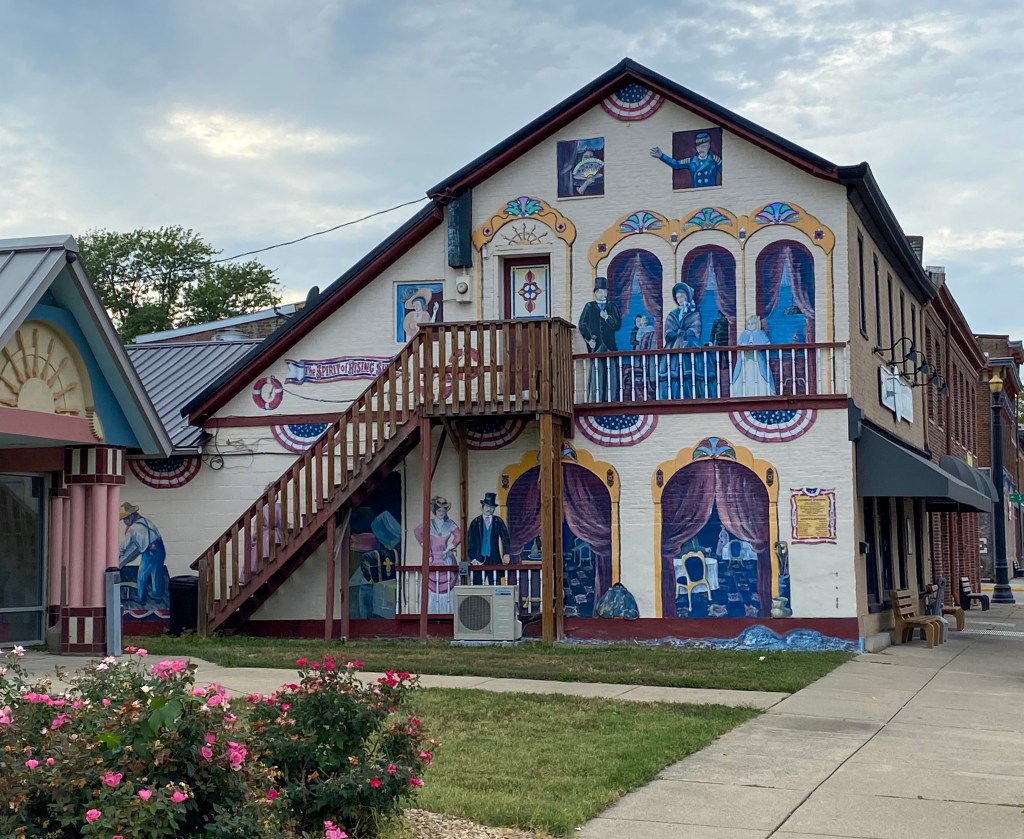
Rising Sun, a beautiful mural on one of the old buildings

A horse ferry operated across the Ohio to Rabbit Hash (famous today for its succession of canine mayors).  There were two ferries.  They were propelled by a team of horses on a treadmill.  Apparently, blind horses were preferred, because they had no fear and were thus easier to manage.  A ferry still plies the waters between the two towns, but the horses have been replaced by diesel engines.
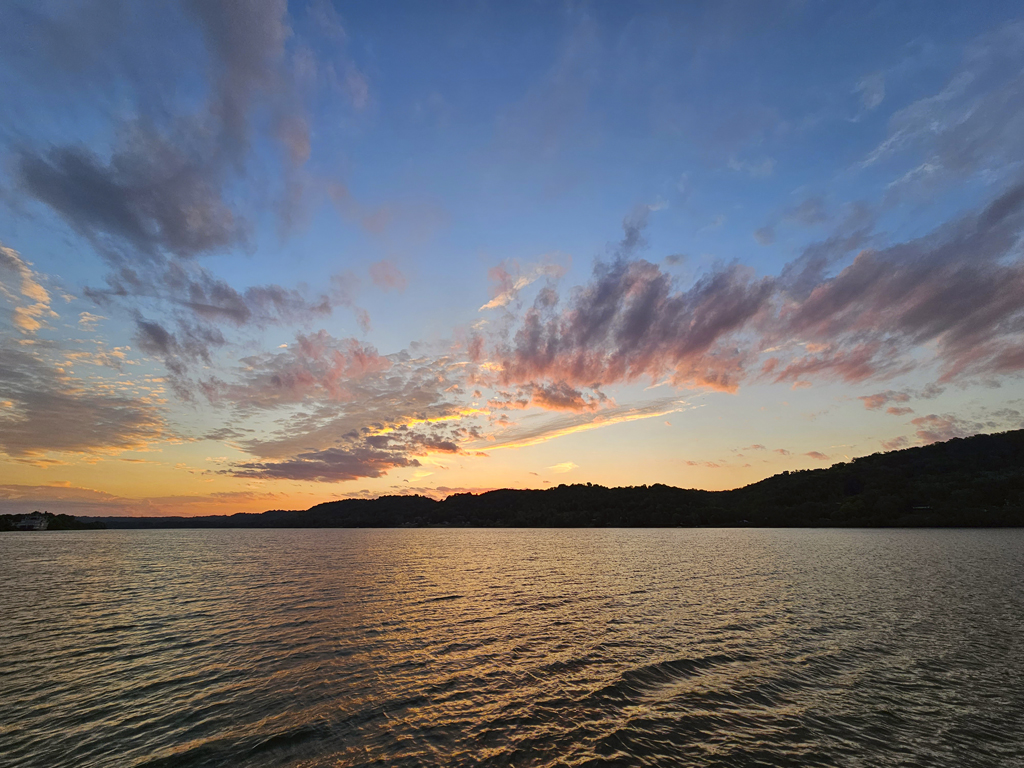
Rising Sun, the sunrise the town is named for

September 16. We were out by 8:30, with a fairly long day and one lock to transit.  There was a little bit of waiting at the lock while a large tow pushed into the other chamber.  We had planned to stop at Madison town dock, but although it is a good dock, they are strict about no overnight stays.  Another Looper boat was planning on stopping at the marina, so we decided to try that, not wishing to pay the exorbitant $3/ft that we paid last time at the riverfront restaurant and dock.  The marina is better, at $1.75/ft, but even that is more than what is usual on the Ohio.  The challenge was that it is very shallow, and there was a dredge parked in a very inconvenient spot in front of our assigned slip.  Dick managed it, with 2 feet under the boat, and then we discovered that the expected 20-foot-wide slip isn’t. Nine Lives could go no further forward, she was tight against the side posts, and that was before her widest part!  Dick called the dockmaster, who was making his way over to help us tie up, and his comment was “I see your problem”.  Fortunately, there was another, wider slip, that we could get into (although with zero depth showing below the boat).  We were at the opening end of the 80 ft slip, and we thought that the power pedestal would be too far away, but the helpful dockmaster promised a solution.  Sure enough, a few minutes later, he produced a long cord to attach to ours.  We could only use half the available power (we would have needed a second long cord, which was offered), but we were able, with careful power management, to use both air conditioners, so all was well.  Dick has an extra hose on board, so reaching the water tap was not an issue.

We met the gold Loopers who we had been watching on Nebo and also had corresponded with online about the J.T.Meyers lock closure.  They joined us on board for docktails, and then we all walked to town and enjoyed some truly excellent pizza.  Chance meetings like this really make the whole Looping experience special!

We were wondering how challenging our departure was going to be.  Dick had a word with the dockmaster in the morning, who used a special high-tech device to check the water depths for us from his workboat.  Non-tech folks would refer to the device as a stick – poke it down to the bottom and see how far up the stick is wet. Dick executed a perfect 180 degree turn just outside the slip.  It was very impressive, and an excellent demonstration of just how maneuverable Nine Lives is.  The rest of the departure was just as smooth.

As we approached Louisville, we were hailed on the radio by a boater on a Sea Ray runabout.  He told us that he has been following our blog, and watching our progress on Nebo, and he made a point of coming out to meet us as we passed his marina so he could take pictures of Nine Lives.  Bill and his wife are segment Loopers, on a Ranger Tug called Cookie.  We were highly amused that the name of the Sea Ray is Cookie’s Cutter.

Cookie’s Cutter
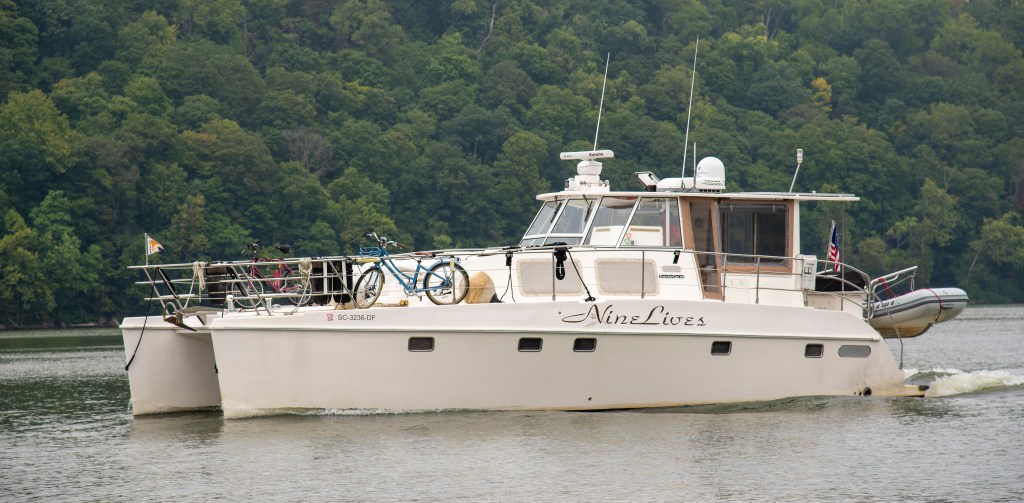
Bill took pictures of Nine Lives, this is one of the best. Unfortunately it was a very dull day.

Later, Bill met us at our destination at the pump out dock near Louisville, caught lines, and helped out, and then helped again as we tied up at the restaurant.  We spent some time on board chatting, but we couldn’t quite manage to lure him to stay for some proper docktails.  I now have a set of great pictures of Nine Lives underway. Thanks Bill!
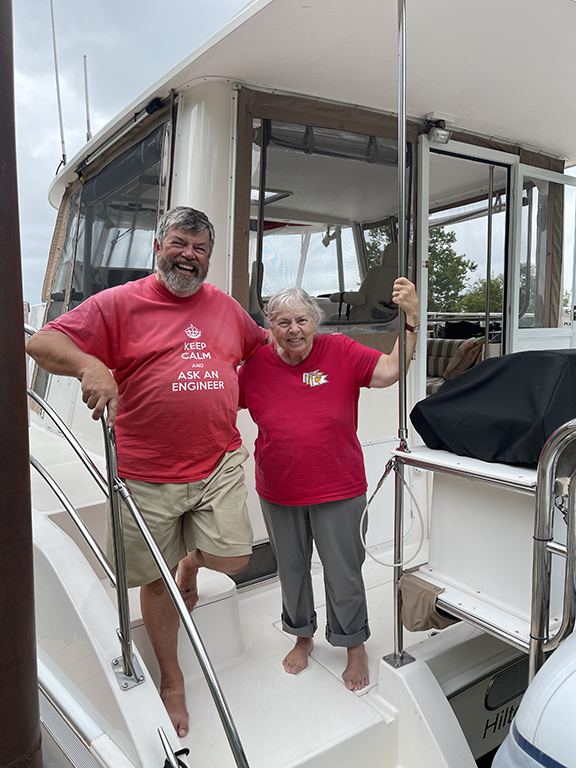
The crew of Nine Lives

After a quiet afternoon, we joined Lucy and John in the restaurant for dinner.  It was great to see them again.  We were lucky that the timing worked, because they had just returned from Paris the day before!  We enjoyed the evening very much, and hope to see them again.

John, Lucy, Dick, Louise at Captains Quarters

The dock at Captain’s Quarters Restaurant is strictly for dining, no overnight stays are allowed.  It is a very popular restaurant, and on a weekend, it is heaving.  Waiters will even deliver food to your boat if you prefer to stay on board!  After making our reservation, Dick asked if an exception could be made to the overnight rule, and he was told that it should be okay, as they were not busy, but to speak to a manager after arrival.  The manager asked Dick to call and ask if the neighbouring private marina had space, but said that although he is not supposed to allow it, he would make an exception if there was no space in the marina.  Dick sent an email, and left a phone message, and later in the evening he got a call to say there was no room for us.  We decided not to talk to the manager again, just stay put, as he had already given tacit approval.  Nobody bothered us, and we were out by 8am with a long day ahead of us and one lock before our planned anchorage.
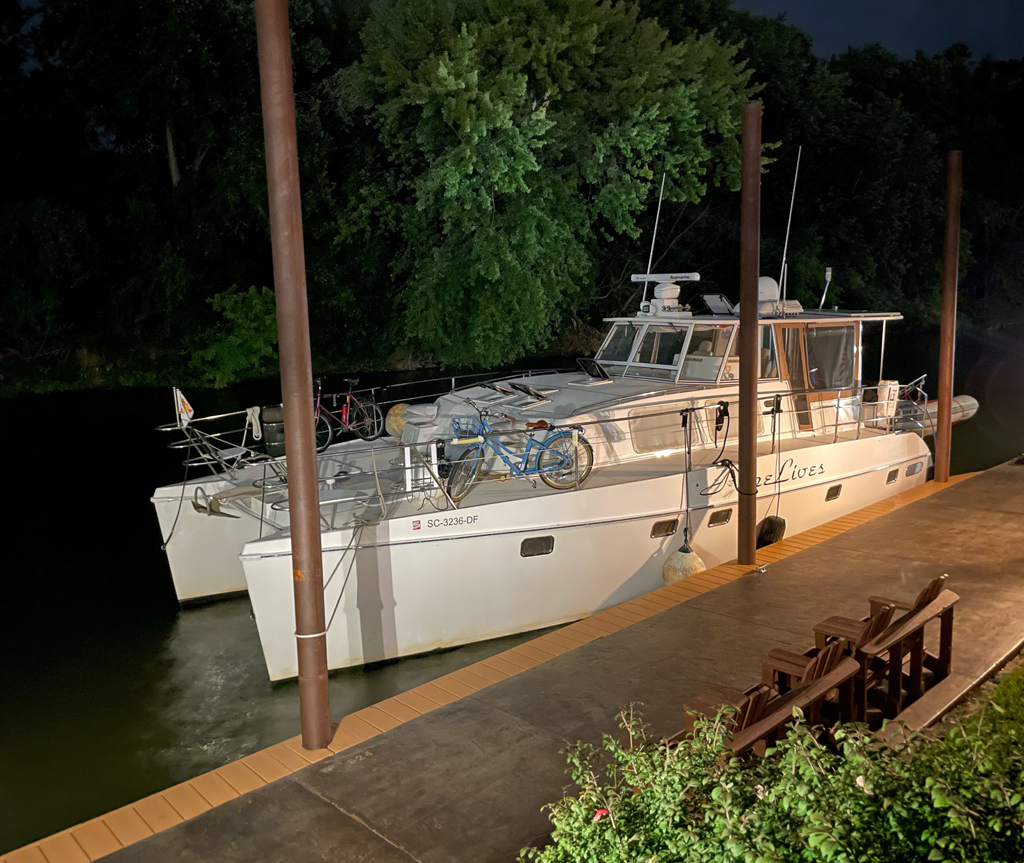
Nine Lives, trying not to be noticed on the dock at Captains Quarters

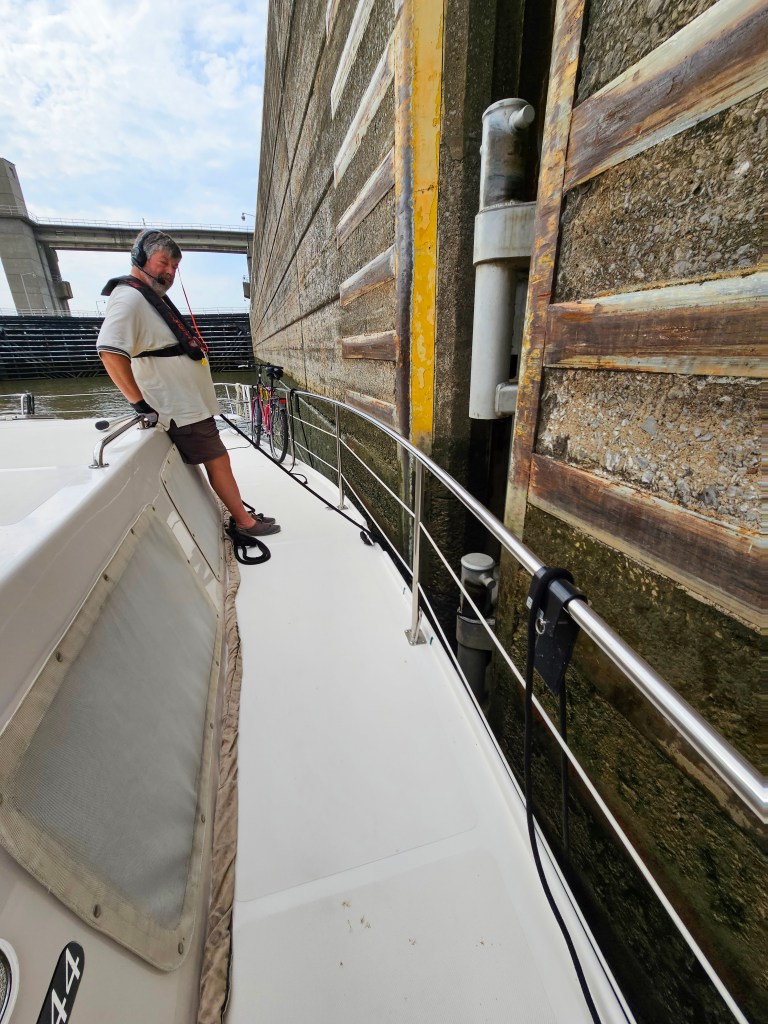
There was a bit of a flurry after we entered the lock.  We were rigged for a port tie to the floating bollard, and the lockmaster called on the radio and asked us to move over to the starboard side so he could see us from his control cabin.  Dick had to scramble and move 3 ball fenders and a barrel, plus prepare the midships line, while I eased into the lock very slowly.

We passed under the Matthew E. Welsh bridge in Brandenburg.  We found it notable because it is the only bridge we can remember seeing that is considerably higher on one bank than the other. 
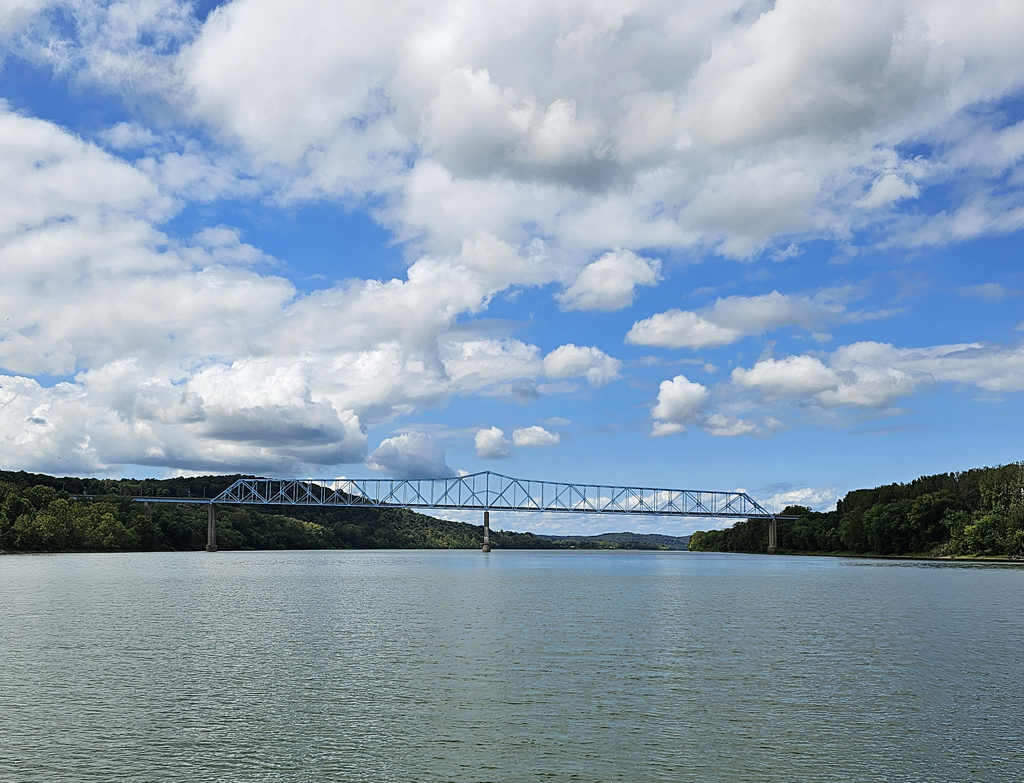
Matthew E Welsh bridge at Brandenburg. No, the perspective in this picture is not wrong.

We anchored on the Ohio River, in a wide area just below Old Blue River Island, with the anchor down and set by 3:30.  We anchored in about 16 feet of water.  As always, I set 2 anchor alarms, but I had to increase the alarm radius because Dick had put out about 130 feet of chain.  We expected the current to keep us in line, parallel to the shore, but the wind blew us around.  We went right to the edge of the allowed alarm circle and stayed there all night.  Even after the wind died, we stayed nearly perpendicular to the shore.  The effect on the boat of wind and current is often mysterious and unexpected.  A good reason to set our anchor in a location with enough space to swing in a full circle. We tested the spotlight after it got dark.  It had been replaced, along with its controller, in the spring, but we do not travel after dark, so we have never used it.  It was likely that we were going to need it during the J.T.Meyer lock delay, hence the need for testing.

The anchor monitor showing Nine Lives right at the edge of the permitted circle before the alarm sounds.

The next morning, we had another early start, with over 70 miles to go and one lock.  It was 61 degrees and misty, although there was plenty of visibility.  As we headed down the river, I had shoes on, a windproof long-sleeved shirt over my usual t-shirt, and my fleece-lined vest (gilet) draped over my knees.  Dick, on the other hand, had just his usual t-shirt, shorts, and bare feet, and was perfectly comfortable.  I am not complaining – I will take those temperatures over 90F any day!
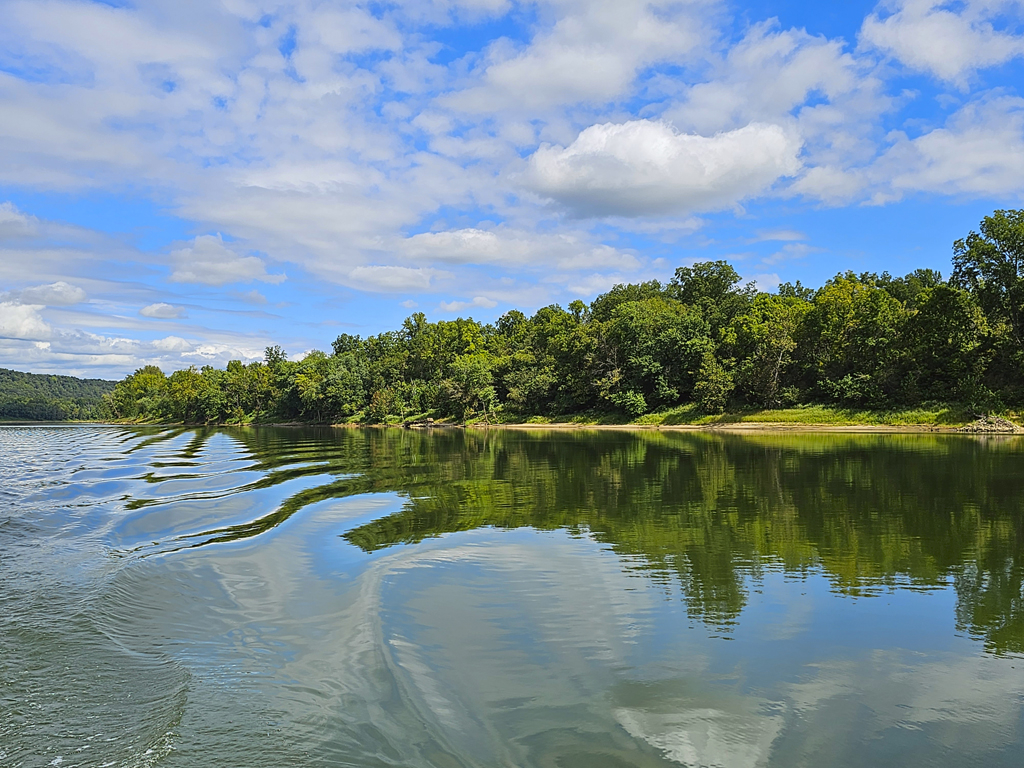
September on the Ohio River south of Brandenburg

We saw a pair of bald eagles fishing.  An interesting observation, any bald eagles I have seen perched on trees on the Ohio River have been well down in the branches, among the leaves and hard to spot.  On the Mississippi, they seemed to prefer the top of a dead tree, well above the canopy.  Perhaps this is learned behaviour from parents?

I have spent the last week looking for flamingoes.  Yes, flamingoes.  Apparently, they were blown far north by hurricane Idalia, and have been seen outside Pittsburgh!  Naturalists are sure that once they recover from the journey, and are feeling less stressed, they will have no problem making their way south before winter.  So far all I have seen are a few great egrets, and the expected great blue herons.

This was the same two-day stretch of pretty but all the same scenery, that we found so boring when we travelled upstream.  Add to that, little and patchy mobile signal, so I couldn’t even keep up with the Marine Traffic app that lets me see what commercial shipping (tows with barges) are coming up.

The time zone changed from Eastern to Central, so the long day became an hour shorter.  Yes, I know that’s an illusion, but as far as I am concerned, we expected to stop at 4:30 and instead it was 3:30!

We passed Mason’s Lighthouse Landing Castle, a stone folly built by hand over a period of 15 years.  It is now a wedding venue.  It’s called Mason’s Landing, but there is no place for any boat to dock or even beach.
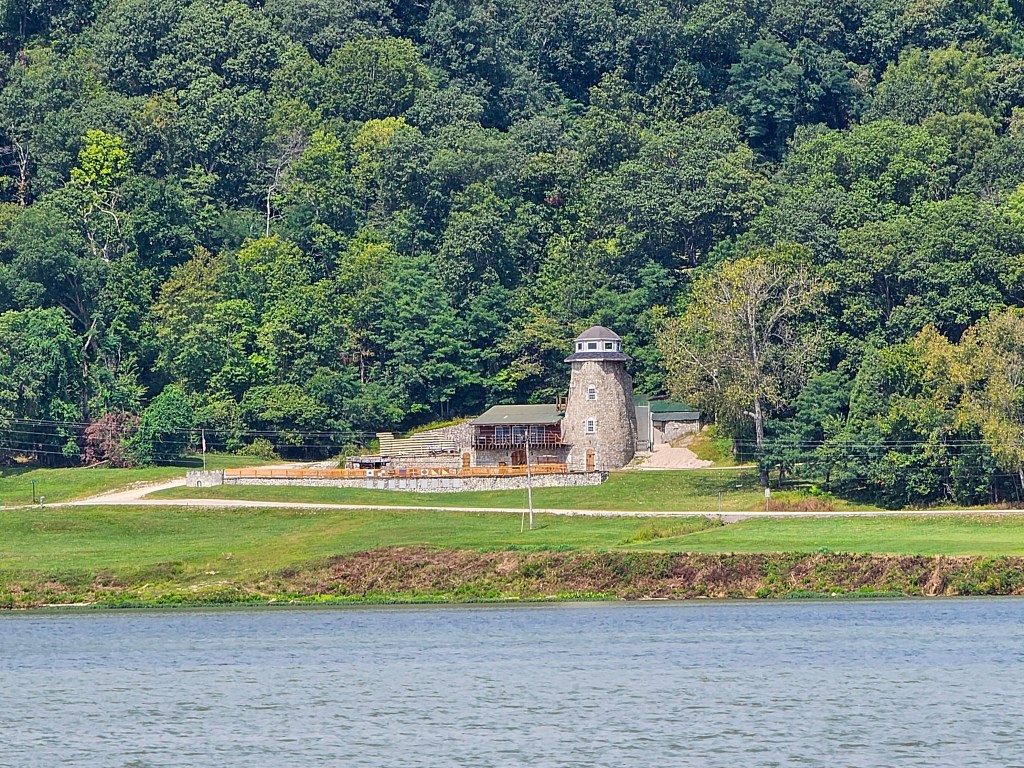
Mason’s Lighthouse Landing Castle

At Cannelton Lock we were treated to a demonstration of how not to lock through a USACE commercial lock.  Start by waking the pleasure boat (that would be us) as you rush to get past and into the lock first.  No life jackets (USACE rules state that they are mandatory for everyone on board).  No lines, holding on by hand only.  Let go before the locking is finished.  Exit before the horn goes, before the doors are even open.  Start fishing in the lock channel, forcing the much larger pleasure boat to detour around.

Guys in a fishing boat demonstrate how NOT to go through a commercial lock

We were anchored by 3:15 behind Anderson Island, a little closer to the shore than I was happy about.  All was well though.  Overnight there was little motion from tows, and the slight breeze did not move us much against the current.  We were up anchor and underway by 8am.

We passed American Heritage, a passenger cruise ship at Henderson.
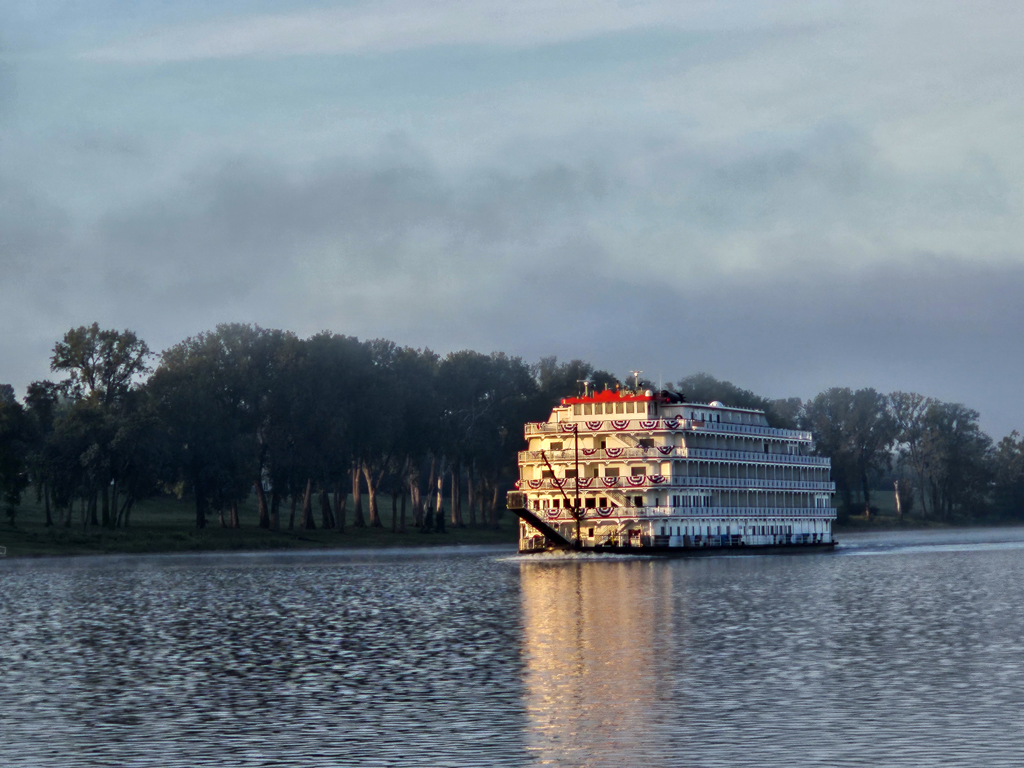
American Heritage, early morning at Henderson

As we headed downriver, we discussed various options for the J.T.Meyers lock.  Readers may remember that I mentioned in the last issue that they are operating only the small chamber while repairs are made to the large chamber.  This means that any large tows have to split, requiring a 3-hour transit instead of the usual 1-hour.  Dick spoke to the lockmaster and was advised that a downbound pleasure craft will only be passed through when they transition from upbound to downbound, and the helper tow repositions.  When a tow splits, the first half of the barge train is pushed in and uncoupled from the rest of the train, and then, when those barges have been lifted or dropped, the helper tow pulls them out of the lock.  The lock is then turned around (i.e. filled or emptied), and the remaining barges, plus their tow, go through and are reunited with the rest of the waiting barges.  Hence the need to reposition the helper tow.  It is faster overall to run a series of waiting tows in one direction, and then change, than to follow the normal procedure of one up and then one down.  The only other option for us, would have been if there was a short tow (although not a chemical barge), who would agree to share the lock with us.

The lockmaster Dick spoke to said that no appointment could be made, even though we had been told to make one by another lockmaster.  Instead, we should get to the lock as early as possible, and we would then be added to the queue to go through, either with a short tow, or, more likely, with the helper tow the next time they change from upbound to downbound.  We can look online at what is called the “Queue Report”, to get a sense of how many tows are waiting, and their size.  (As it happens, Dick does this anyway, even when there are not extraordinary circumstances).

We were scheduled to stay in Evansville overnight, but it is 5 hours’ travelling time from there to the J.T.Meyers lock.  One option is to leave at first light (6am), and run fast to get there as soon as possible.  Another option would be to stop briefly in Evansville, just to take on fresh water, and then run south using the remaining daylight and anchor close to the lock.  Another critical consideration would be having good cell phone service.  A Looper, who came up a few days previously, reported that they waited 9 hours, and went through in the dark, but they had no phone service where they waited below the lock.  They could see later that they had missed 2 phone calls.  It is possible that they were being called forward and did not know it.
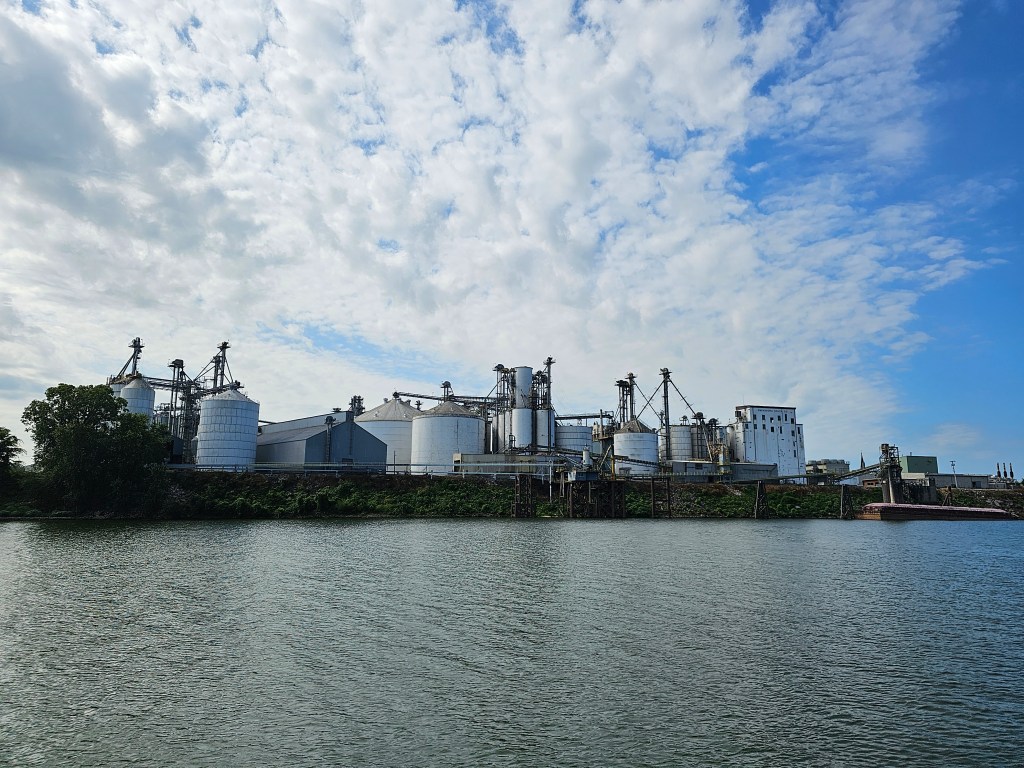
A large grain terminal at Owensboro, the first we have seen on the Ohio River although they were common on the Mississippi

We passed Scuffletown Island, all that is left on the map of the former city of Scuffletown.  It was a notorious stop for the captains and crews of the flatboats that plied the river during the 19th century.  After a few hours of getting liquored up, fights would break out between the crews, so the city got its name.  It was mostly destroyed in the floods of 1913, and the subsequent flood of 1937 finished the job. Probably just as well.

We were asked to float free in the main chamber of Newburgh Lock because so many of the floating pins are broken.  Not our preference, having done it a couple of times on the Mississippi, we prefer to be secured.  I rushed to put out our remaining fenders on the port side (we were already rigged for starboard), just in case we bumped the lock sides, but it was a very gentle drop of only 18 feet and all was well.
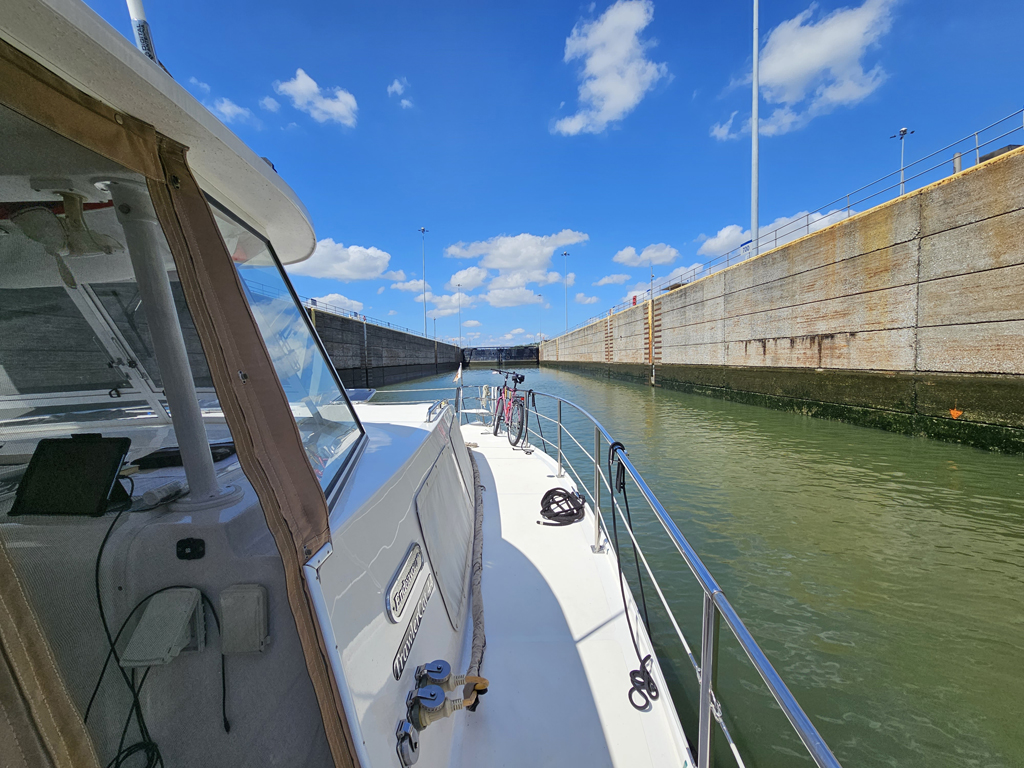
Floating free in Newburgh Lock

As we approached Evansville, I took the helm, and Dick got onto his computer to check the lock queues for J.T.Meyers lock.  It appeared that after the then current upbound tow, there were no others waiting, and many in line to go down.  There would be no point in rushing to get there, only to have to wait for many hours.  We decided that we might as well stay overnight in the marina as planned.  We were at the dock by 2:45.

We got up at 5am, and were underway by 6:10, after checking the queue report and consuming our essential morning coffees.  Dick had spoken to the lockmaster the evening before, and would call again after he came on shift at 7am. It is always good to try to speak to the same person after you have made a connection.
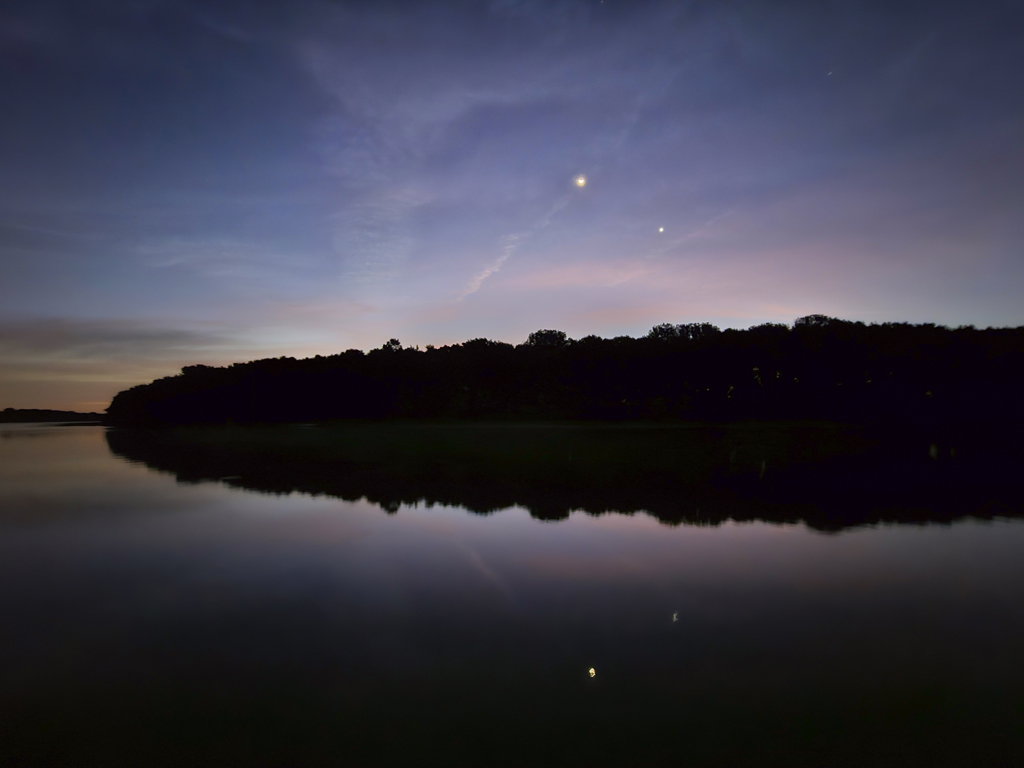
Up before dawn at Evansville

Dick took a walk around the boat to be sure the running lights are working.  This, in addition to our earlier testing of the spotlight, were precautions we hope never to have to use.  All boats over a certain length must have and turn on running lights in times of poor visibility.  There are slightly differing requirements, depending on size.  At the bow, we have a red light on the port side, and a green light on the starboard side.  These must be visible from a mile away on a dark, clear night.  Above, at the stern, is a white light.  This is also our anchor light, visible 360 degrees. The white light must be visible for 2 miles on a dark, clear night.
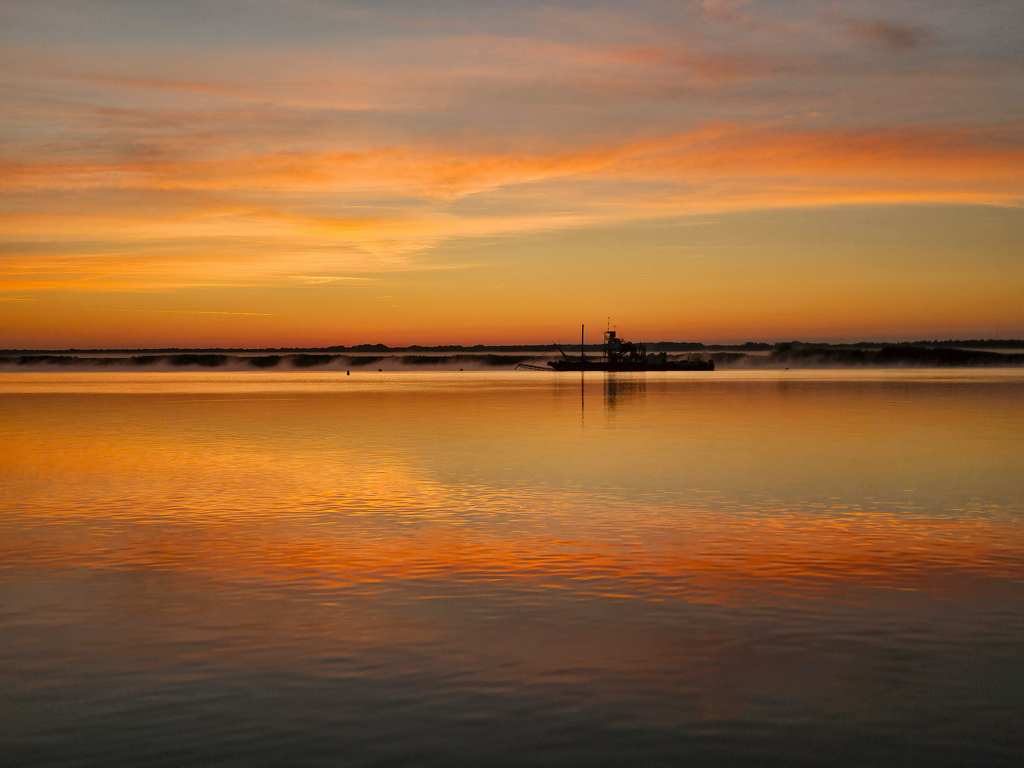
Sunrise as we left Evansville

We ran fast for an hour, to arrive at the lock as early as possible.  Conversation with the lockmaster from 5 miles away suggested that it could be a six-hour wait, but we should get close, and he would try to sneak us though.  He took Dick’s phone number.  We needed to watch for options for anchoring as near to the lock as possible, with good cell service and out of the way of the waiting tows.  We arrived at the lock at 10:10, just as the helper tow was pulling the first set of barges out of the lock for the last of the upbound tows in the queue.  After the tow brought up the second set of barges and re-attached, we were able to go through the lock with the helper tow.  Not only does the lockmaster have to arrange this, the captain of the helper tow has to be willing for us to share the lock.  We entered the lock at 11:35, so we only waited 85 minutes.  We had expected, and been prepared for 6 to 9 hours!
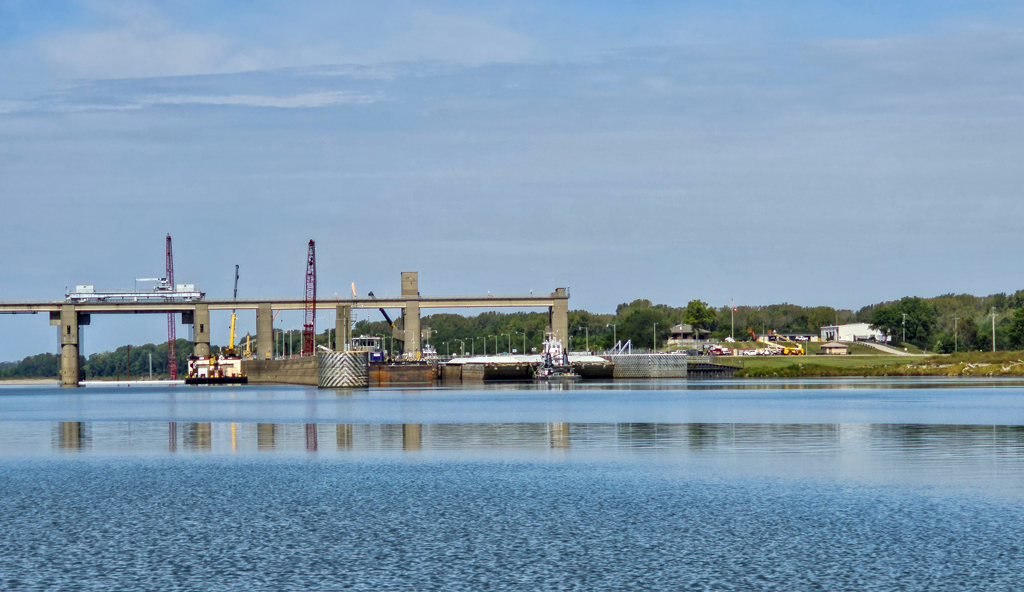
When we arrived at J.T.Meyers lock, we could see the helper tow pulling a set of barges out of the lock. It would be our turn when the rest of the barges and the tow joined them.
In the J.T.Meyers lock with the helper tow

We passed Old Shawneetown, all that remains of what was once an important city.  It was a major government administration centre for the Northwest Territory.  In 1816, the first bank to be chartered in Illinois started in a log cabin.  This bank refused to buy the first bonds issued by the city of Chicago, considering them a poor investment, on the grounds that no city located that far from a navigable river could survive.  In the 2020 census, Chicago’s population was 2.7 million, while Old Shawneetown’s population was 75.  If you visit Old Shawneetown, you can still see the brick building, one of the first two in the city, that was built to house the bank in 1822.
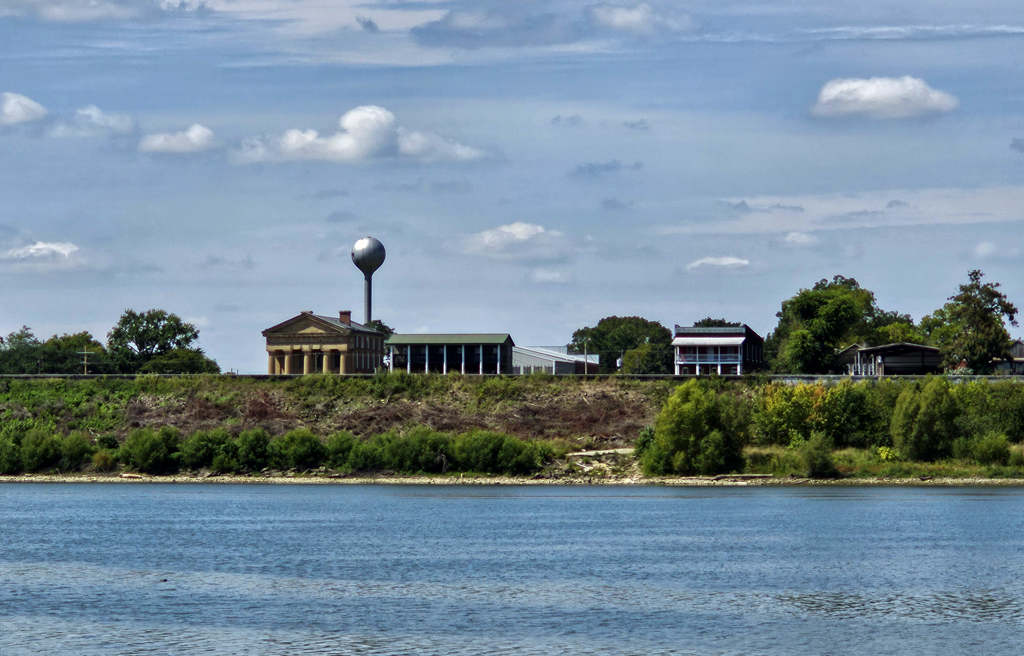
Old Shawneetown
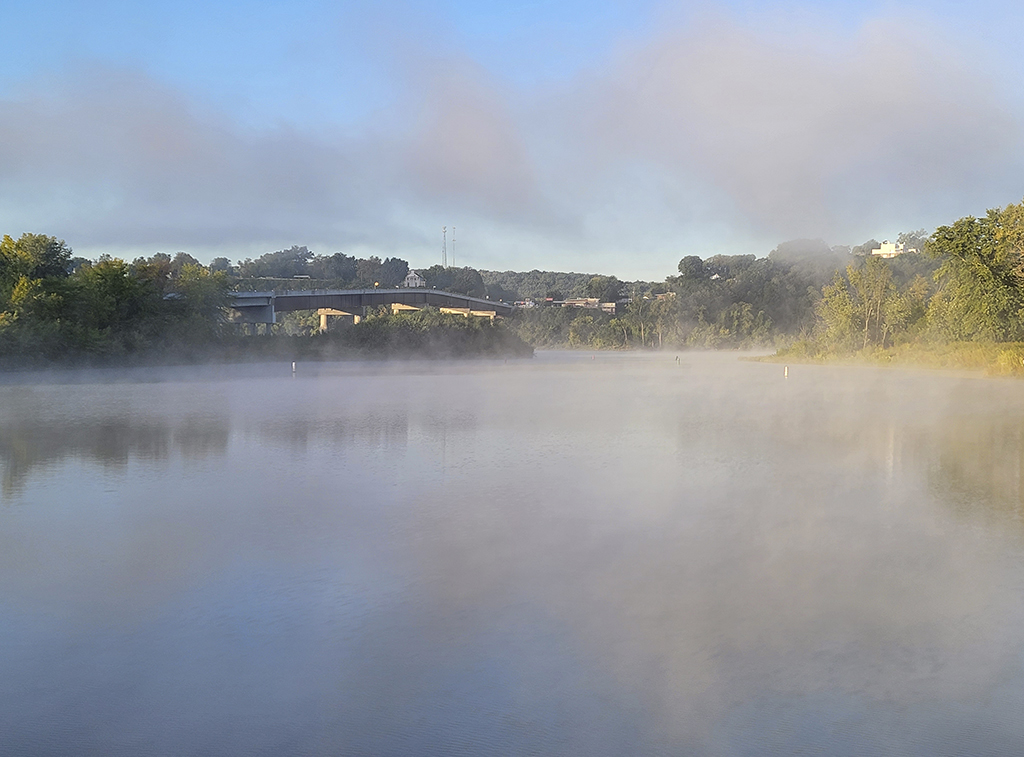
Still water in early morning on the Ohio River near Henderson, Kentucky
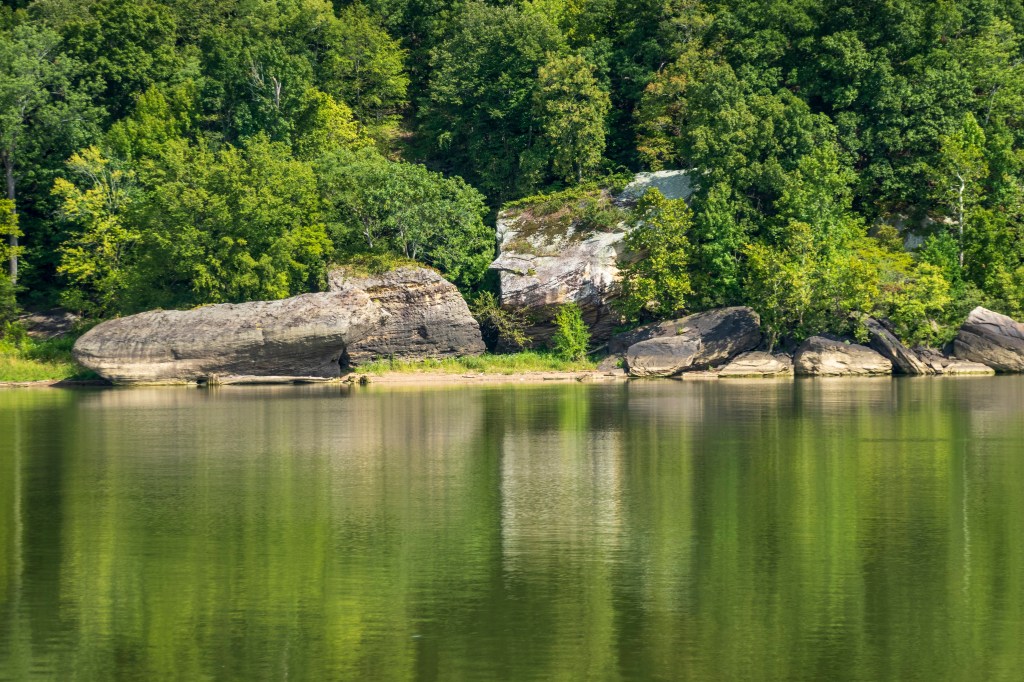
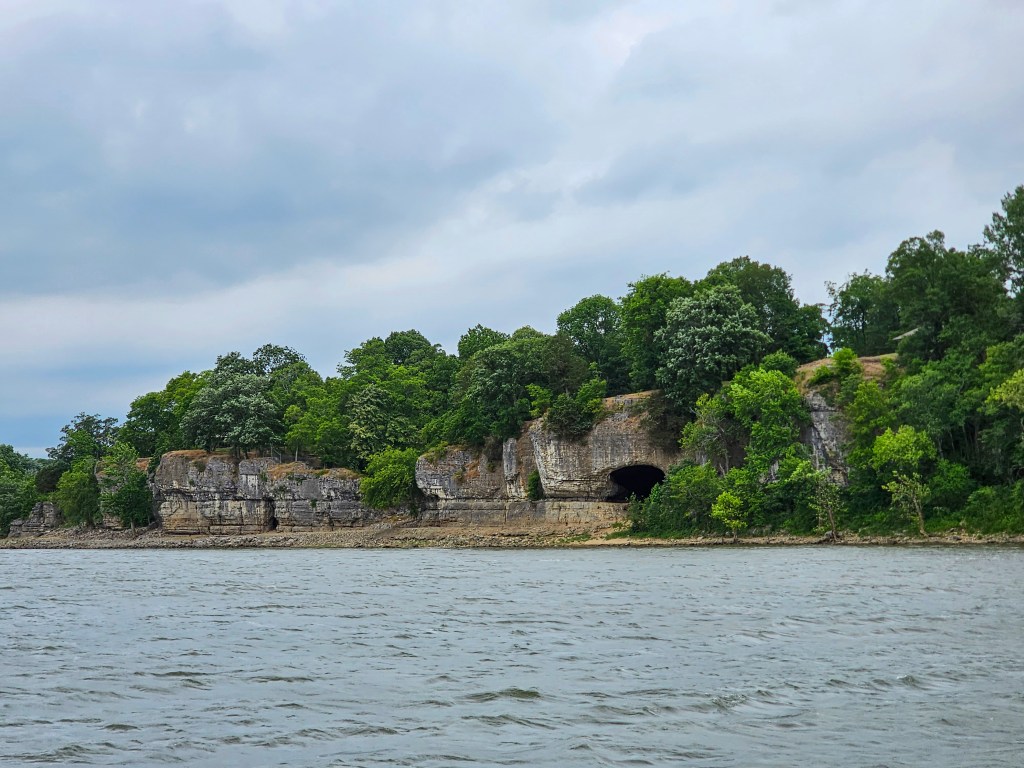
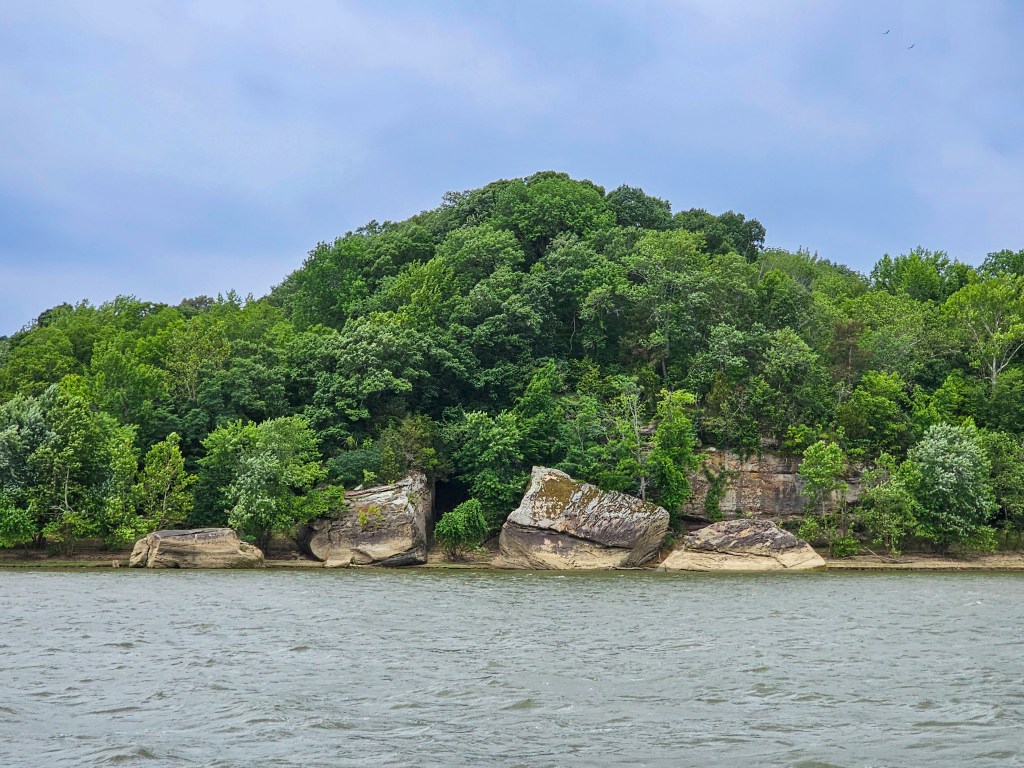
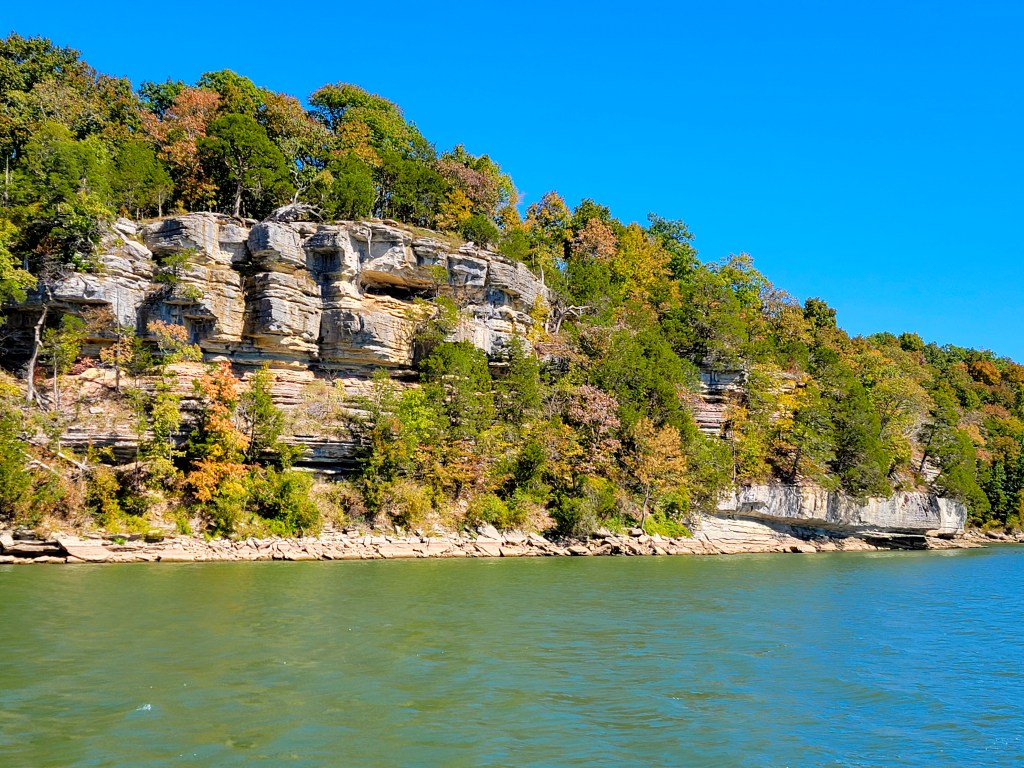
Rock formations and still water on the Ohio River south of Saline Landing, Illinois

On an island in the middle of nowhere we passed a johnny-on-the-spot, a very long way from any town.  Dick wondered how often it is emptied, and by whom?  You know you are on a boring stretch of river when the only thing of interest to photograph is a biffy.

A biffy on an island in the middle of nowhere

We anchored just across the river from Cave in Rock State Park, and below the island, giving us protection from floating debris.  We were set by 3:15. After 9 hours underway, it had been a long day.  Dick grilled burgers for dinner, then we sat and watched the sunset, except it was cloudy, so there wasn’t one. There weren’t any flamingoes either, just an egret and a few turkey vultures.

Rain started at about 6am, but we were already buttoned up, as it had been forecast.  It was the first rain we have seen for nearly 3 weeks.  We were anchor up and away before 8am.

A visitor

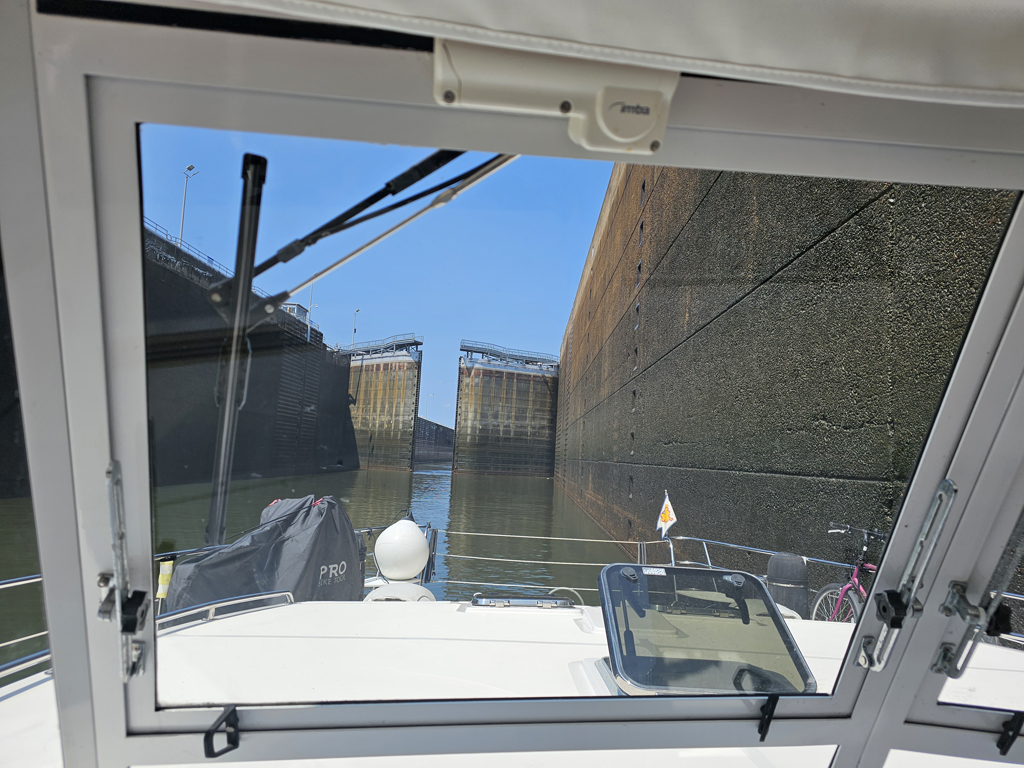
We were somewhat surprised to discover that the Smithland lock had both chambers working, so we went straight in.  We had expected as much as 4 hours delay.  Again, we were asked to float instead of tying off.  We arrived in Paducah and were tied up by 1:30, better than the most optimistic forecast Dick had for the day.
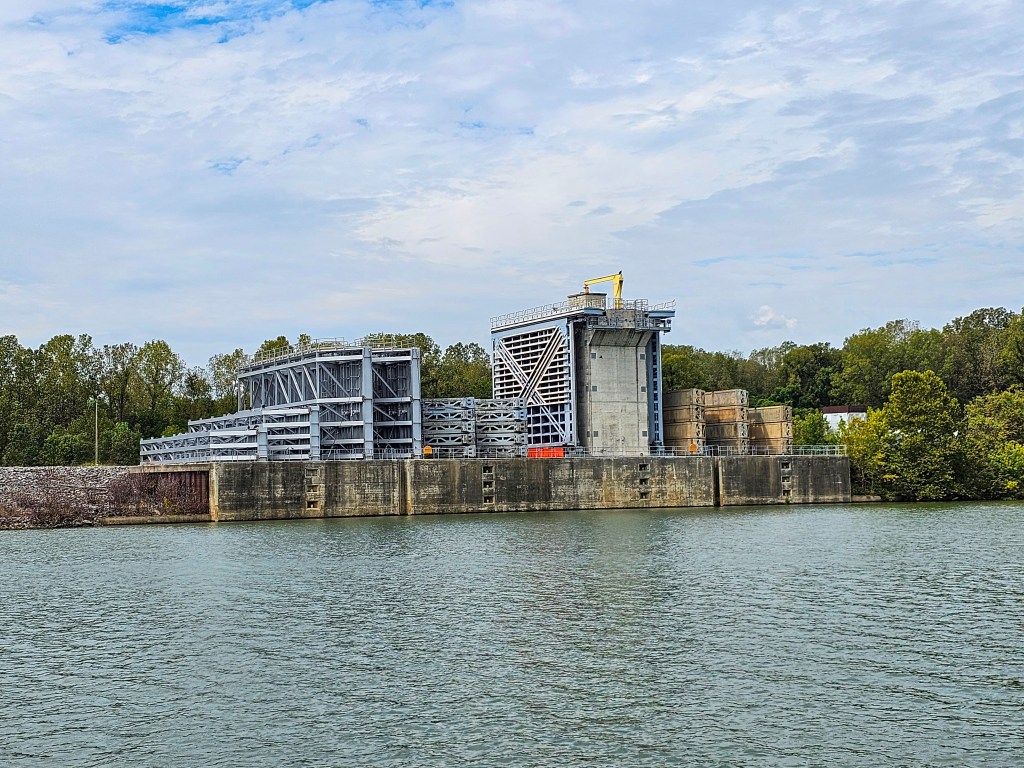
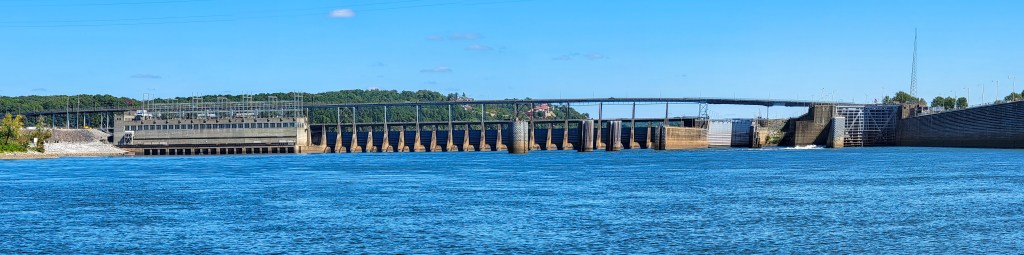
New lock gates under construction at Smithland Lock

I know that some of my readers may wonder why we so dislike having to move the boat once we are tied up, as happens on occasion.  When we arrive at a dock or marina, I am ready with a line at midship, that I throw over the cleat on the dock, and then secure back on board.  I then move to the stern, and the midships line will hold us in place while Dick reverses against it to bring in the stern, where I am ready to throw a second line over a cleat and secure it.  Dick can then stop the engines, and the real tying up begins.

Dick gets onto the dock, while I stay aboard, and we first make sure that we are where we want to be with respect to cleats and power pedestals (and possibly other boats).  Adjustments are made if required, by pulling on one line, while letting out the other to move us into position.  Next, Dick will loosen the midships line, and add a second one to the same deck cleat.  One of the lines then goes to a cleat on the dock that is forward, and the other goes aft.  Tightened, these lines ensure that the boat does not move forwards or backwards, but still floats independent of the dock. These are called “spring lines”.

After putting down fenders as needed, we then take a line from the stern pontoon opposite the dock, across, under the dinghy, and secure that to the dock.  The initial short stern line is then removed and stowed for when we leave.  A bow line is taken loosely to the dock, just to make sure Nine Lives cannot move and twist farther away from the dock at the front.

The way these lines are set allows the boat to move independently of a floating or fixed dock, without the lines continually snapping tight, which is hard on the cleats, and will eventually fray the lines.  We’re not done yet.

Power needs to be connected.  The plug is nothing like what one has at home or in a garage.  It is a thick, heavy line (or two lines, which in our case are held together in a long brown canvas tube).  The ends have 3 prongs, one with a hook on it, that ensures that it can only go one way into the outlet on the power pedestal.  Once in, it twists, to lock into place.  Often Dick must first brush away spider webs, and he always has to kneel on the dock to fit the cord into the receptacle under the pedestal’s cover.  Occasionally, the only way to accomplish this is from a prone position.  I am very glad that lying down on a dock with spiders (and splinters if it is a wooden dock), is not part of my share of the boating responsibilities!

Last, and new to our routines this year, location permitting, Dick will attach the water hose to the inlet at the back of the boat.  First, he allows the water to run for a while by hosing down Nine Lives’ deck, to ensure that no stale water is going into our tanks.

When we leave, or if we have to move, the whole process, that takes us 20-30 minutes, is done in reverse, although it is much quicker to untie.  In addition to not snapping the lines when wakes, or even just the wind, moves the boat around, this way of tying also allows for a change in water depth due to tides.  Even on the rivers, the depth may change after heavy rain upstream.

So, if you are still reading after that long explanation, you can understand why we hate being asked to reposition once we are all set!

How we tie up Nine Lives

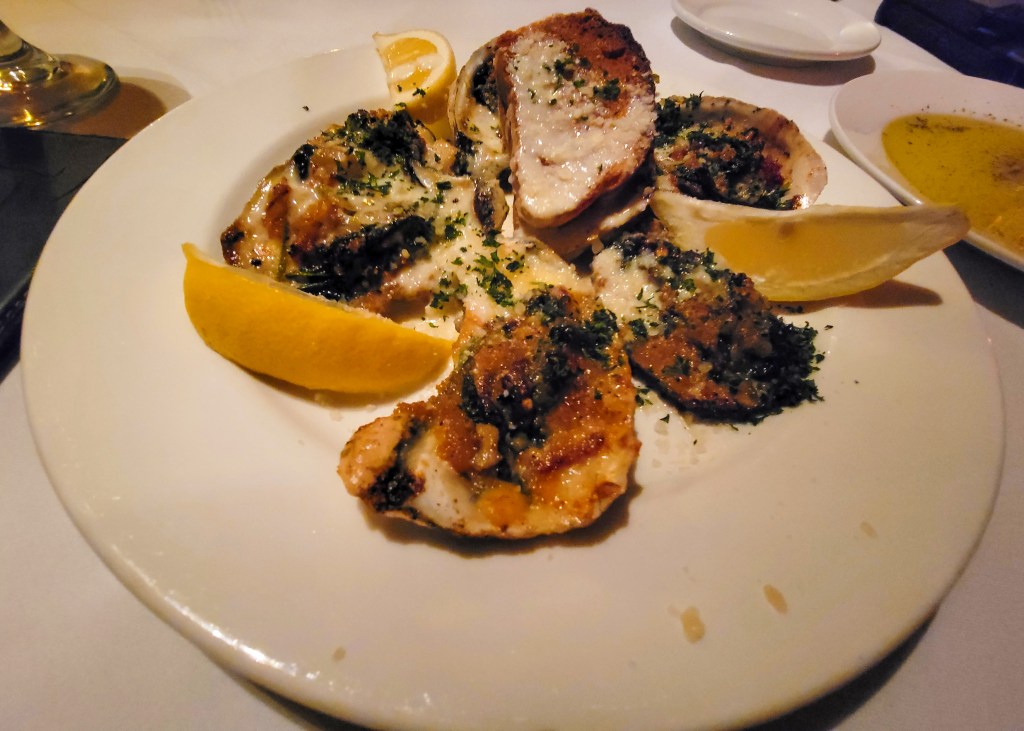
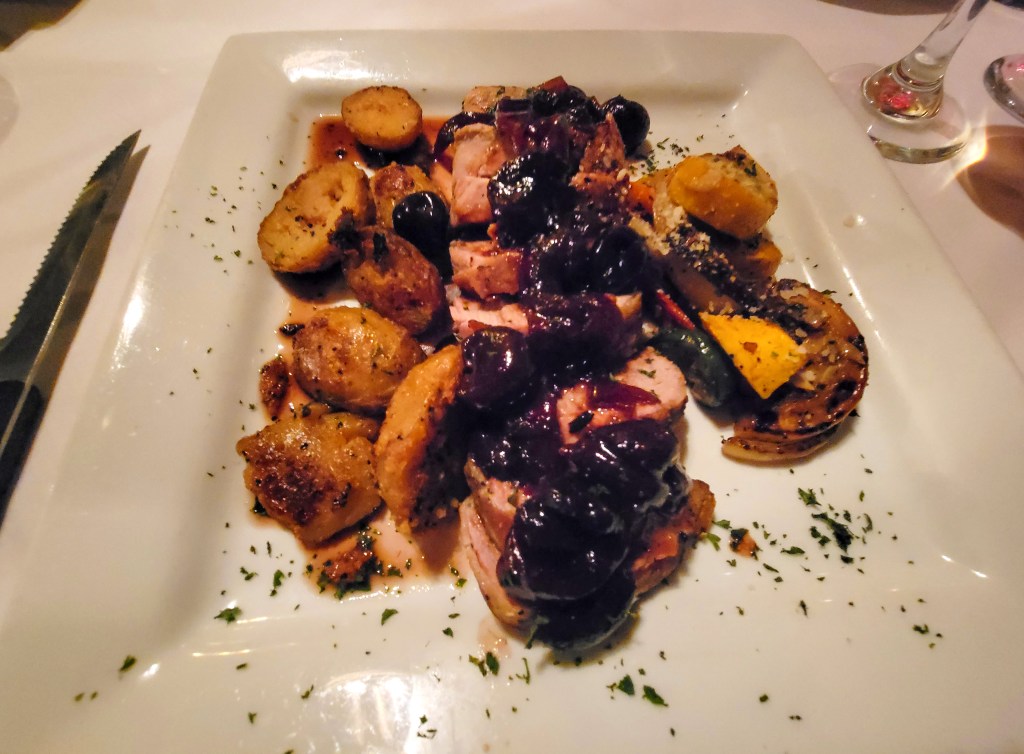
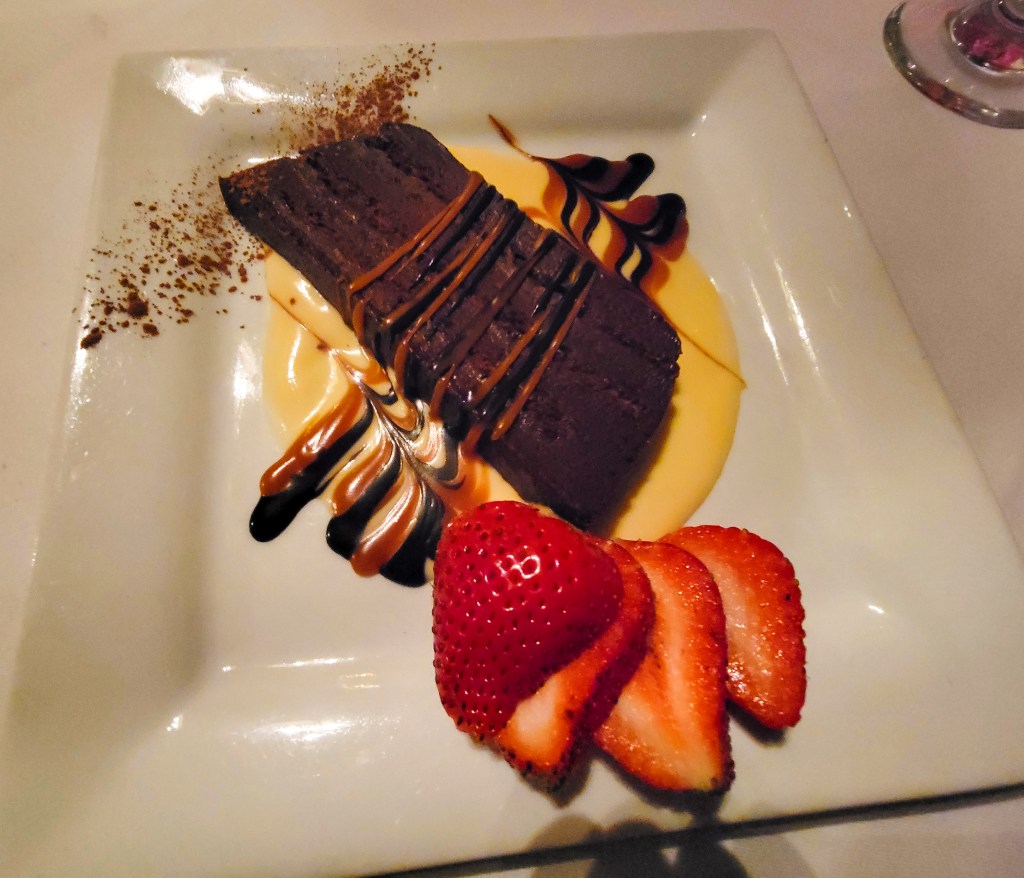
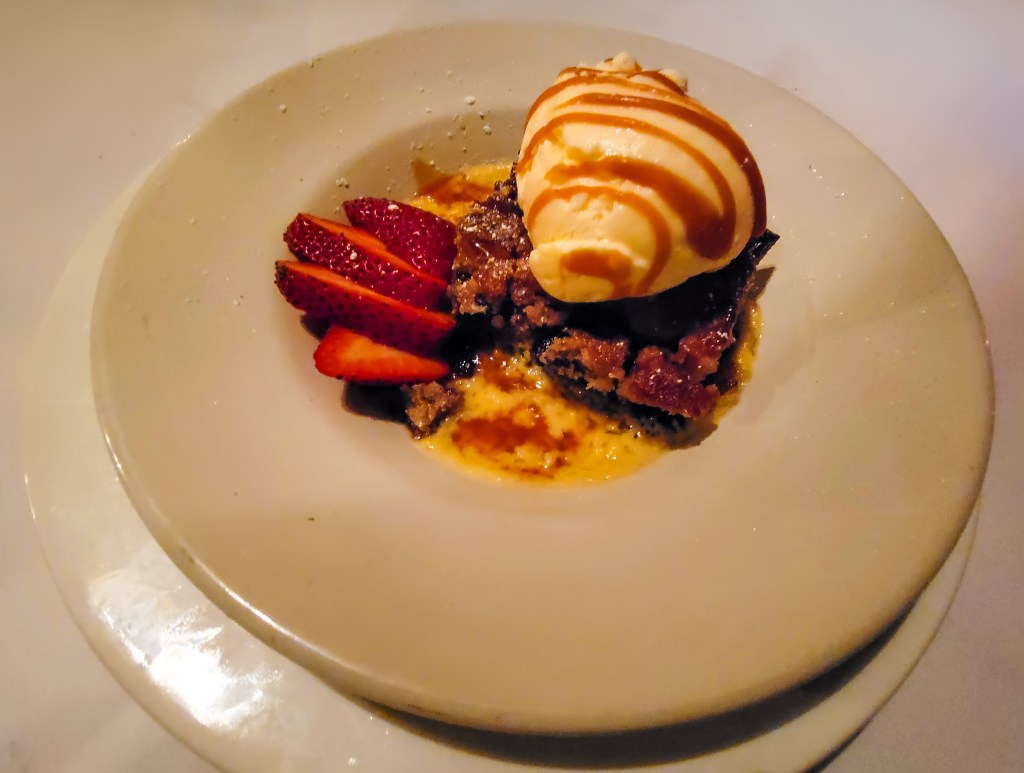
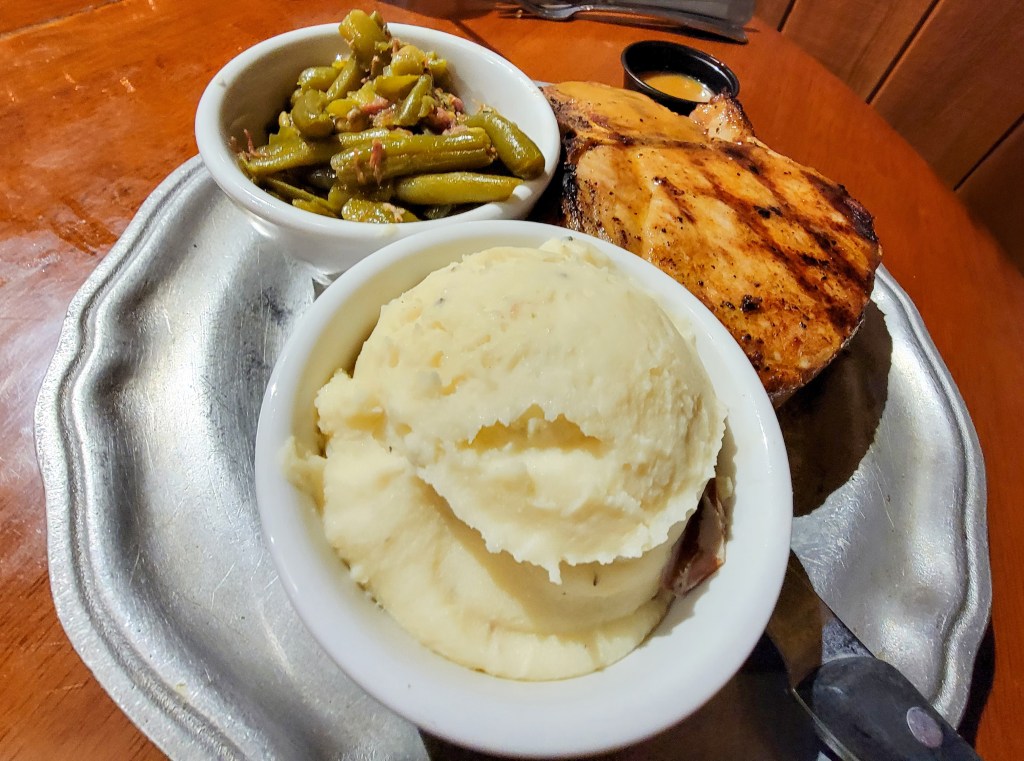
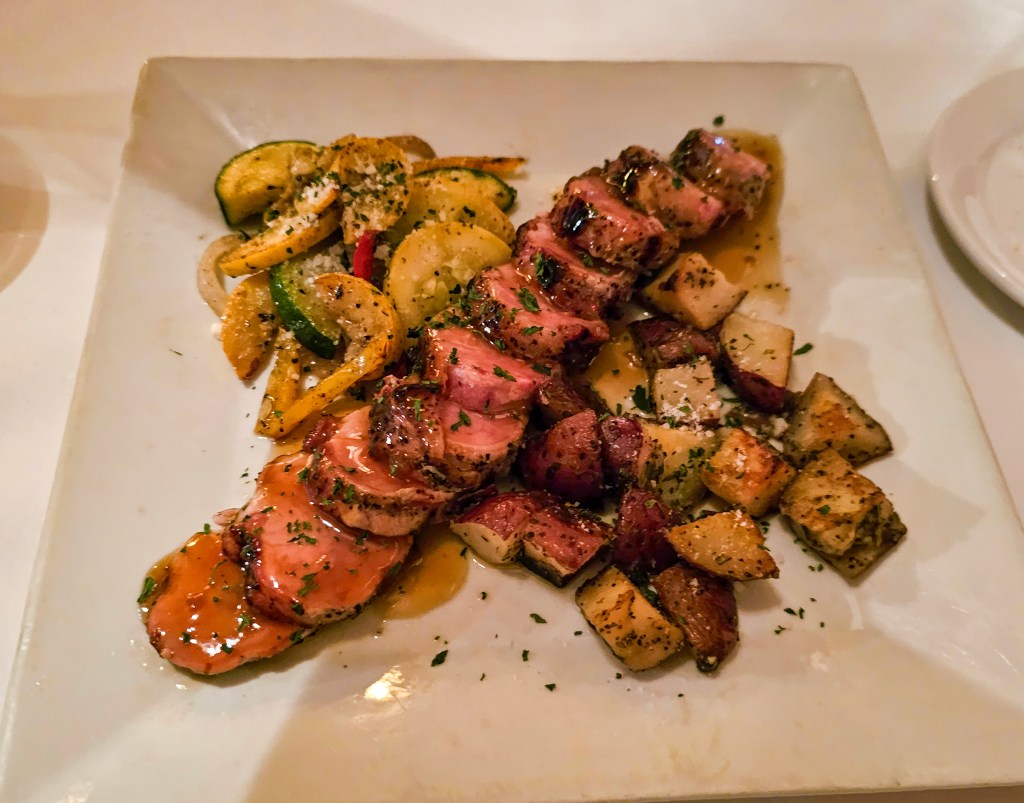
After a quiet afternoon, we made our way to Cynthia’s, one of our favourite restaurants on the Loop.  Dick started with their excellent smoked salmon, and I tried a new offering, tempura shrimp with fried green tomatoes with chopped peppers, tomatoes, and tomatillos.  Dick’s main course was bacon wrapped pork tenderloin with a bourbon and honey sauce, and I had the veal scallopini with a wild mushroom and port wine reduction.  Desserts completed the meal with the signature flourless chocolate slice for me, and crème brulee for Dick.  It was a lovely evening in a beautiful historic setting.  For the first time in 4 visits, we are in Paducah with the temperatures in the 70’s, instead of the 90’s, making the walk to and from town a pleasure as well.
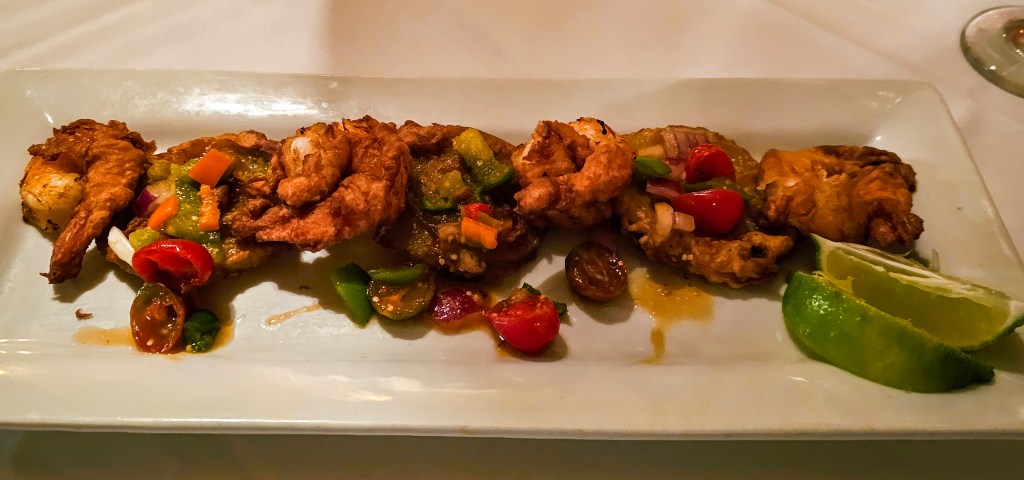
Cynthia’s Tempura Shrimp with Fried Green Tomatoes
Cynthia’s Pork Tenderloin

The next day was all about catching up and laundry.  Dick was busy with planning for the next few weeks of the voyage, booking marinas and checking fuel prices, while I worked on the blog and the pictures.  We were thrown about more than usual by wakes.  Paducah has always been subject to a lot of wakes, but this year, on the rivers, there is even more low water than there was last year.  There have been complete closures of the Ohio River just above the confluence with the Mississippi, followed by a one-way system for tows.  Add to this the partial closure of the J.T.Meyers lock north of Paducah, and there are many more barges and tows sitting on the river around Paducah.  For the first time, we have seen crew changes for the tows.  A workboat races around, picking up crew and dropping them off, before heading to the next meeting point for more.  This workboat has powerful outboard engines, and follows the usual Ohio River custom of completely ignoring docked vessels, throwing huge wakes from very close to us.

I won’t be writing much about the city of Paducah this time, as it is our 4th visit, and I have written in past years.

Nine Lives, alone on the dock at Paducah
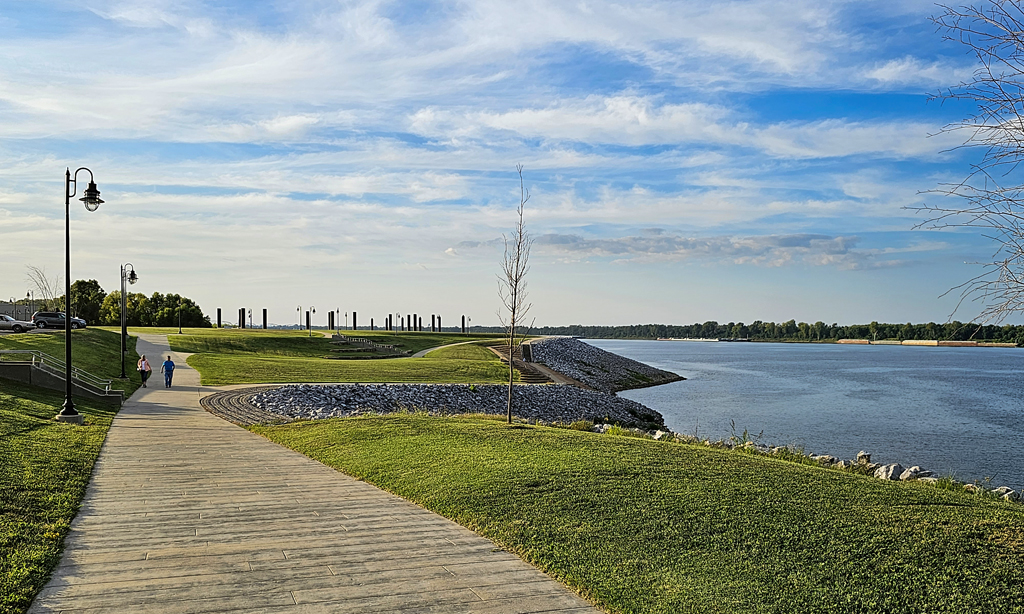
The waterfront park at Paducah. If you understand that the high flood wall that protects the town is built above the rise on the left of the picture, you can get a sense of just how high the Ohio River waters can be when it floods.
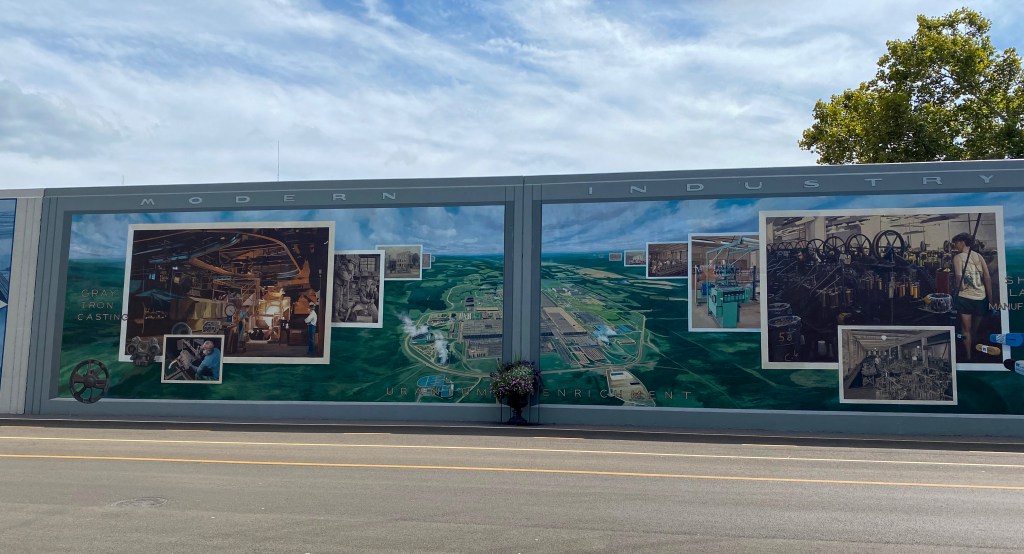
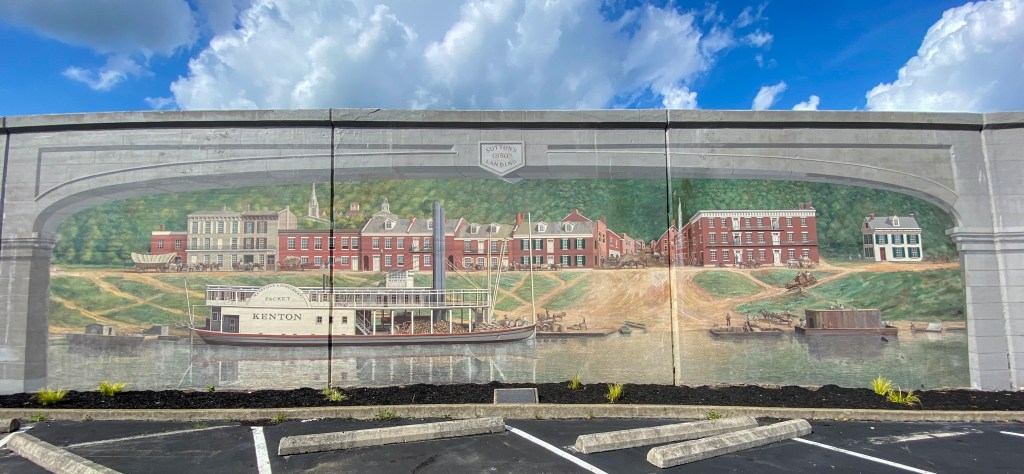
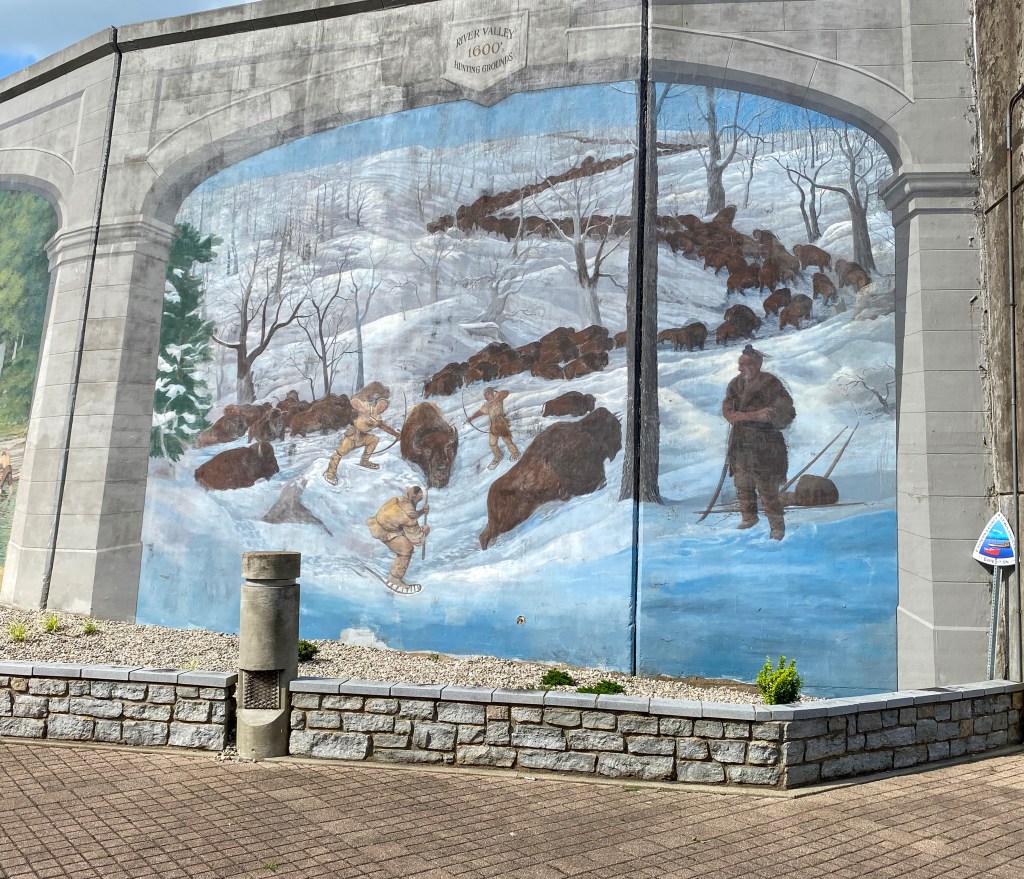
Paducah’s flood wall has many beautiful murals depicting the history of the city.

In the evening, we decided to give Grill 211 another try.  We had a less than stellar experience on our first visit to Paducah, but reviews were very positive recently, so we made a reservation.  As we walked through the park, I pointed out to Dick that I was wearing a new outfit.  I had chosen a new, black and white sleeveless top, with black trousers, and a white sun shirt.  Dick paused to look (many years of marriage ensures that as long as there is a vague shape next to him, who speaks with a familiar voice, nothing else is noticed).  His immediate comment was, “oh yeah, you look like a referee!”  Later he tried to row back a little by complimenting my choice of matching onyx and jet jewellery, but it was far too late for flattery!

Our thoughts about Grill 211 are mixed.  The setting is what we always enjoy, a historic building, repurposed.  The mixed tile floor and the brick walls were particularly interesting, and I love to imagine all the things those walls and floors have witnessed over the years.  The menu seemed a bit odd for a steak house, with several Thai curries, and other items that were definitely Asian, as opposed to fusion cuisine.  We had not been able to look at the menu earlier, because the restaurant has only a facebook presence, with no information or menus.  The steaks were tasty, but not the expected restaurant quality.  What made it worse was the truly dreadful, cheap plastic steak knives, that were unable to effectively cut the vegetables, let alone the meat.  A poor steak knife always makes the meat seem tough. The restaurant was nearly empty, by comparison, Cynthias had been hopping the night before.

Grill 211
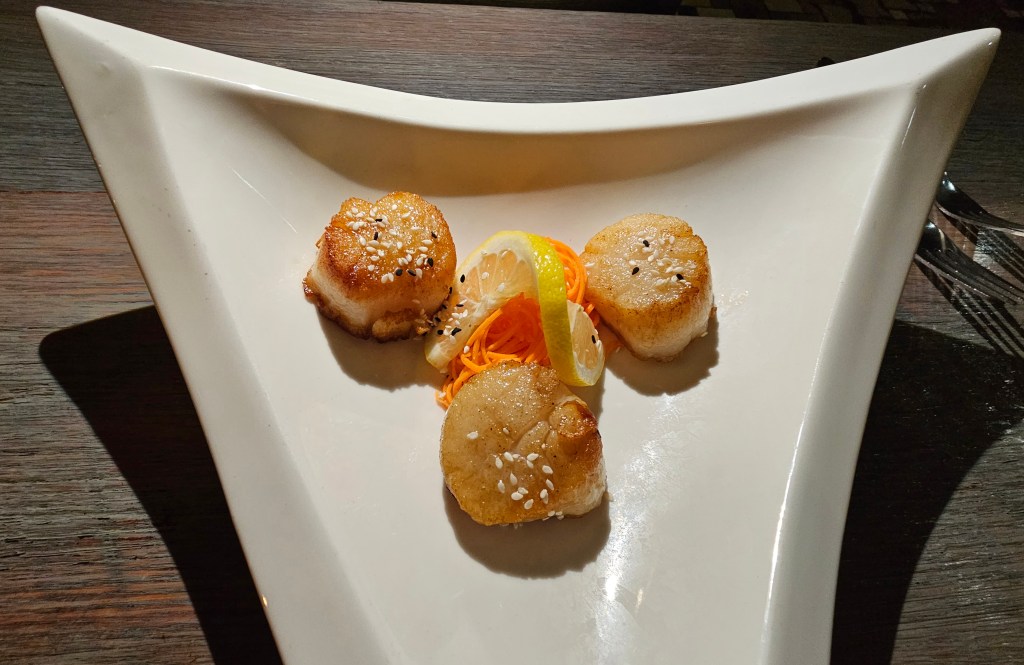
Grill 211, Scallops
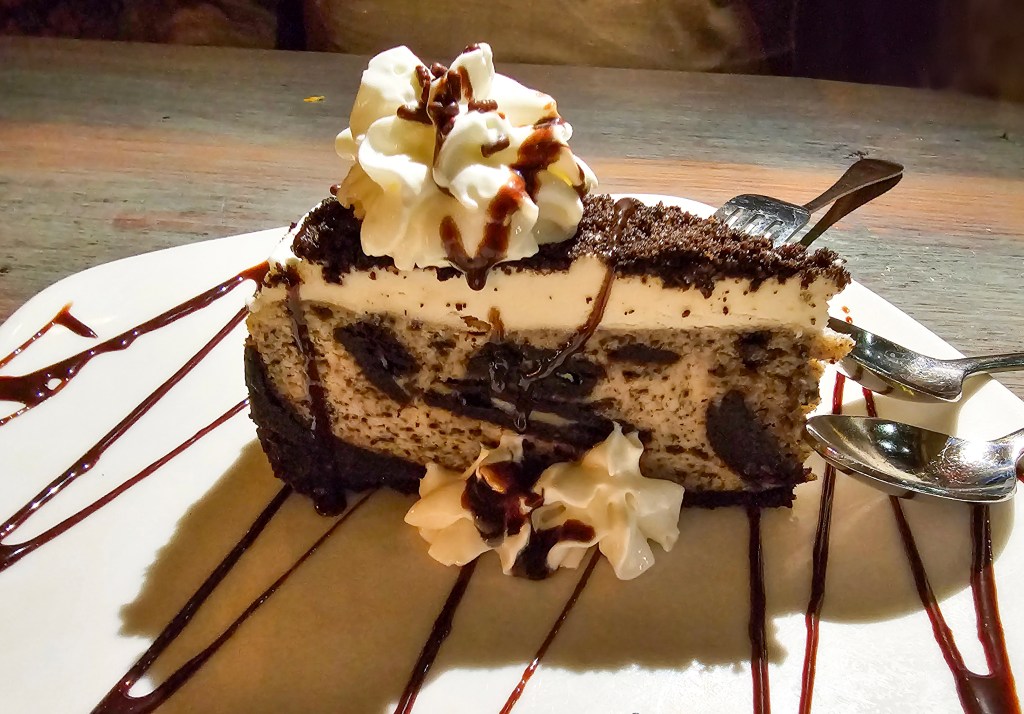
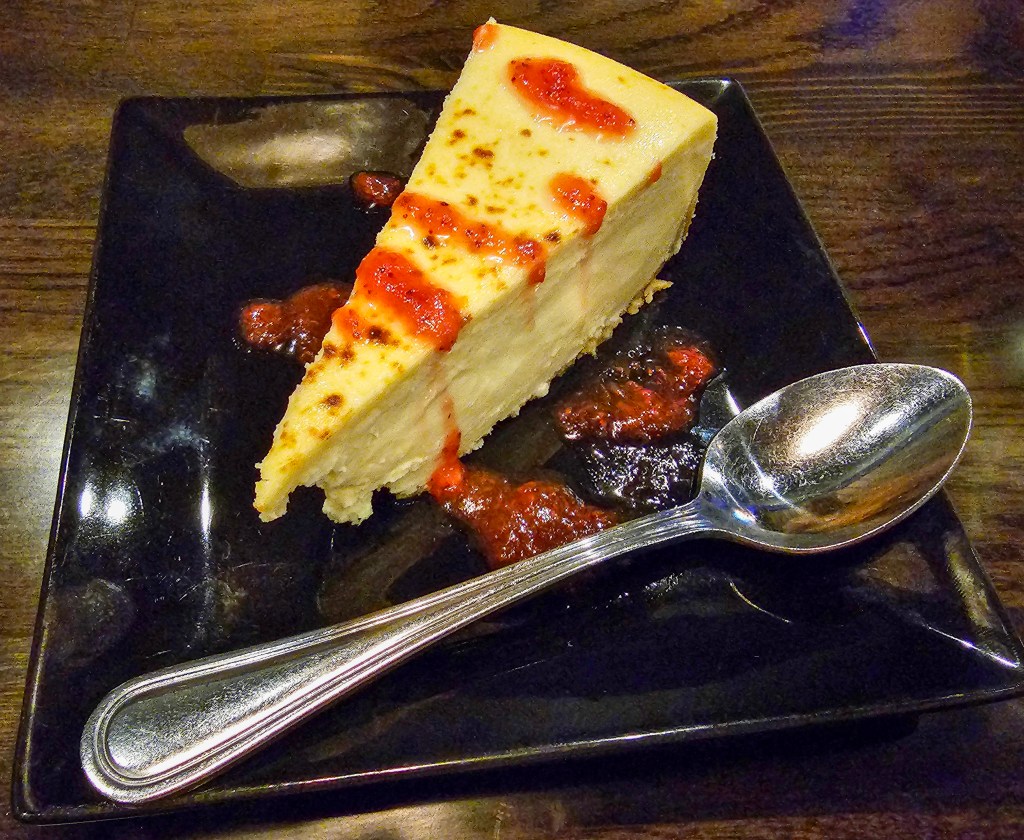
Grill 211, Cookies and Cream Cheesecake

We will be giving Freight House another try this evening.  It was a disappointing experience last year, but they seem to have upped their game somewhat and it is now the top-rated fine dining restaurant in Paducah.  We have booked the tasting menu (48 hours notice required), and we are interested to see how it compares to the tasting menus we enjoy in UK.

Paducah sunrise

August 18 to 31, 2023: Pittsburgh to Cincinnati

Our departure from Pittsburgh was a little tricky.  That morning, my slightly sore hip that began the evening before was much worse.  Cause likely to be too much sitting still and not enough fluids the previous day.  I was almost completely incapacitated, so Dick had to single-hand Nine Lives to the pump out machine.  It was quite a challenge, with the strong current pushing us onto the dock, not to mention having to step carefully around the copious goose poop.  The power pedestal ended up with a slightly greater lean than it already had (bad positioning, right on the edge of the dock and too close to the pump out machine, we were not the first to nudge it!)  Apart from that, the maneuver was well executed.  As we initially pulled away from our docking position, and turned around to come back to the pump out, I looked up and saw that we had an audience of about 10 construction workers from the high-rise going up above the waterfront, all standing at the railings watching us.  Sometimes, you’re the audience, sometimes, you’re the show!  Fortunately, we were out of their sight for the minor pedestal mishap.
By the time we arrived at the first lock of the day, I was able to drive the boat in as usual, and bring it to the wall for Dick to handle the long line.  However, Dick had to do all my usual tasks with fenders, moving them and deploying them, as well as bringing them in after the lock.  He got a small taste of what single-handing and/or a non-participating spouse would be like.  (We have met a surprising number of Looper couples who divide up the responsibilities in such a way that the lady has almost no involvement in any aspect of boat handling, certainly that would never be our preference). 

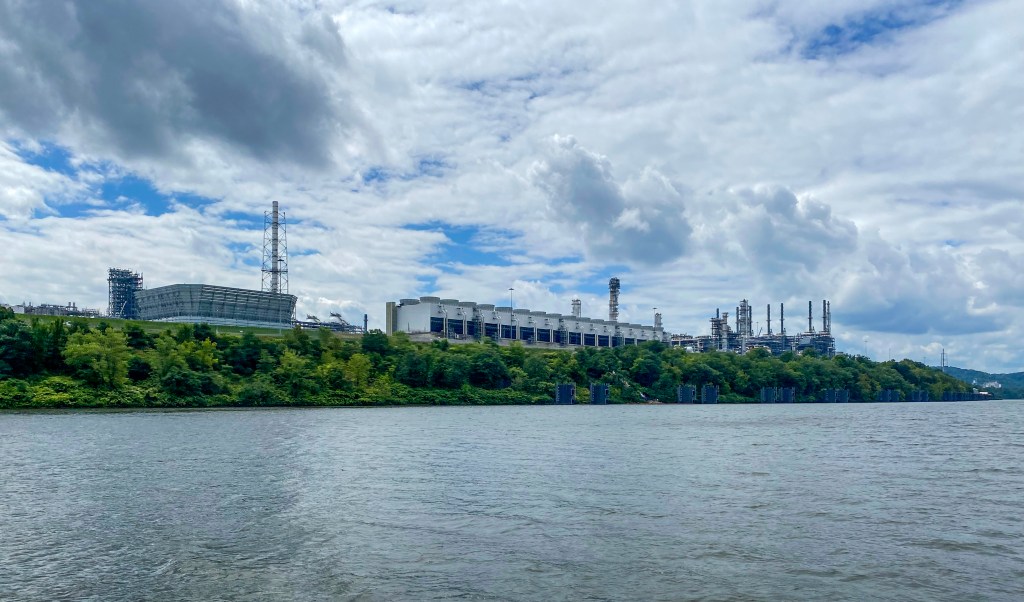
We passed the Shell Ethylene Cracker Plant.  Dick said they were just completing this plant when he retired.  It was built in Pennsylvania rather than Texas, because of all the cheap gas available from Utica and Marcella Shales fracking operations.  It is good to see new industry on the Ohio, after so many abandoned and derelict factories. 

The new Shell Ethylene Cracker Plant

We got through 3 locks and tied up in the marina in Chester, with Dick doing all the work except for maneuvering in the locks.  Holiday Marina is a nice small marina, set in a basin off the river, so very little wakes to bother us.  There is lots of grass, and several pavilions and grills for the use of boaters.  It is also a small RV site, and has immaculate and spacious shower/rest rooms.  We had been happy with our stay on the upbound journey.

As we sat enjoying the evening, one of the occupants of an RV made his way down to us and welcomed us back.  He likes chatting with transient boaters, especially Loopers.  In addition to offering to lend us a car to get groceries or run errands, he mentioned that he had hoped to invite us to breakfast on our last visit, but we had already left early that morning.

He told us an interesting story, that we had entirely missed because we were sitting facing away from the river.  Earlier, he and his wife had seen a car sink near the shore across the other side of the Ohio River.  The man’s wife called the police to report it, and got the story.  Apparently, a couple had a snapping turtle in a cooler, that they were trying to release unharmed into the river.  The man backed his SUV down to the water, and planned to gun the engine forward with the back open, so the cooler would open and the turtle fall into the water.  Unfortunately, he mistakenly put the vehicle into reverse, and when he stamped on the accelerator, the SUV went straight backwards into the water at speed.  It sank.  Fortunately, the windows were open, so the couple were able to get out and swim to shore.  No word on the fate of the turtle.  Attempts to retrieve the vehicle by emergency services had not succeeded by the time it got dark.

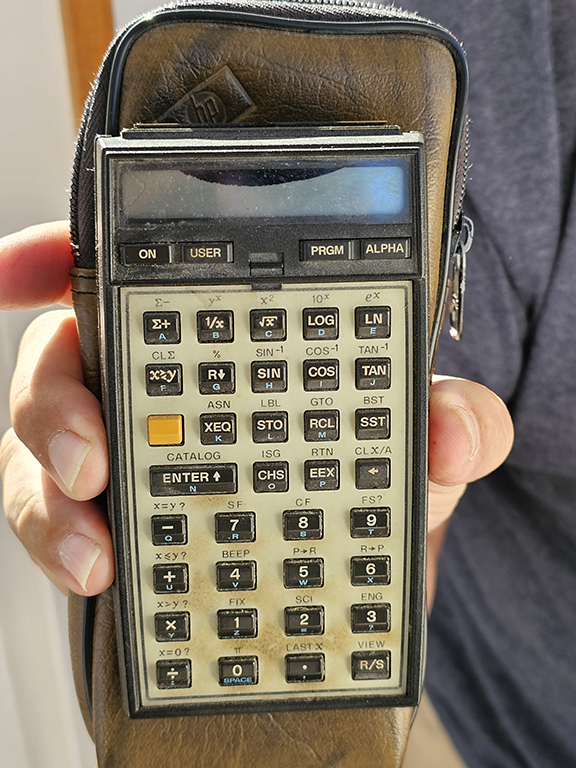
We had plenty of time the next morning, with a short distance and only one lock, so Dick was busy with his computer when he discovered the sad demise of his HP41CX calculator.  He had it for the better part of 40 years.  It was working fine until the previous day when Dick reached behind him and it leapt off the shelf and down the stairs, a drop of about 6 feet.  The landing proved to be too much for the venerable machine.  Dick particularly liked that calculator for its sophisticated engineering functions.  Not to mention that the Reverse Polish Notation method of use is so obscure (IMHO) that there was no possibility that his light-fingered wife would abscond with it!  I offered him a basic solar powered calculator that I found in a cupboard, but it was soundly rejected in favour of using the one on his phone.  R.I.P HP41CX.

Dead after 40 years of good service

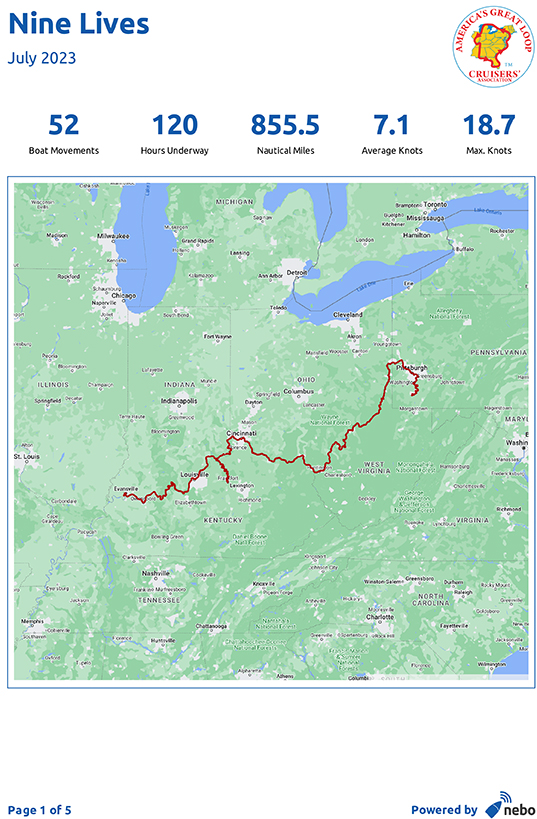
Once Dick recovered from his tragic loss, we set off for the day, still with Dick having to do all my line and fender handling jobs.  Unfortunately, we arrived at the lock as it was being prepared for an up-bound tow, and there was a 15-barge tow just behind us, who had priority.  Altogether, it took over 4 hours before we were through.  It was our first real delay since we started on the Ohio and waited at our first lock for 4 hours, so we can’t complain.  Most of the Ohio locks have two chambers, a large one and a smaller one.  We are generally put through the small chamber, and usually with no delay, but at this lock the small chamber is out of operation.  We have heard that the last two locks we will encounter on the Ohio are using only their small chamber while the large ones undergo repairs.  This will likely mean very long delays for us, as the tows will have to split to go through, and thus will take twice as long.  We use an app called Nebo.  It has various useful functions, including allowing anyone to track us or see where we are at any given time.  We have a device installed on Nine Lives, that automatically starts tracking when it senses motion.  This is designated as a “journey”, and it ends the journey when we stop.  Our Nebo track for the day showed an amusing number of stops, as Dick maneuvered and held position in front of the lock while we waited for our turn.

Waiting for the lock, each red flag represents a “journey” started, so each time we stopped moving while we waited, a new “journey” began

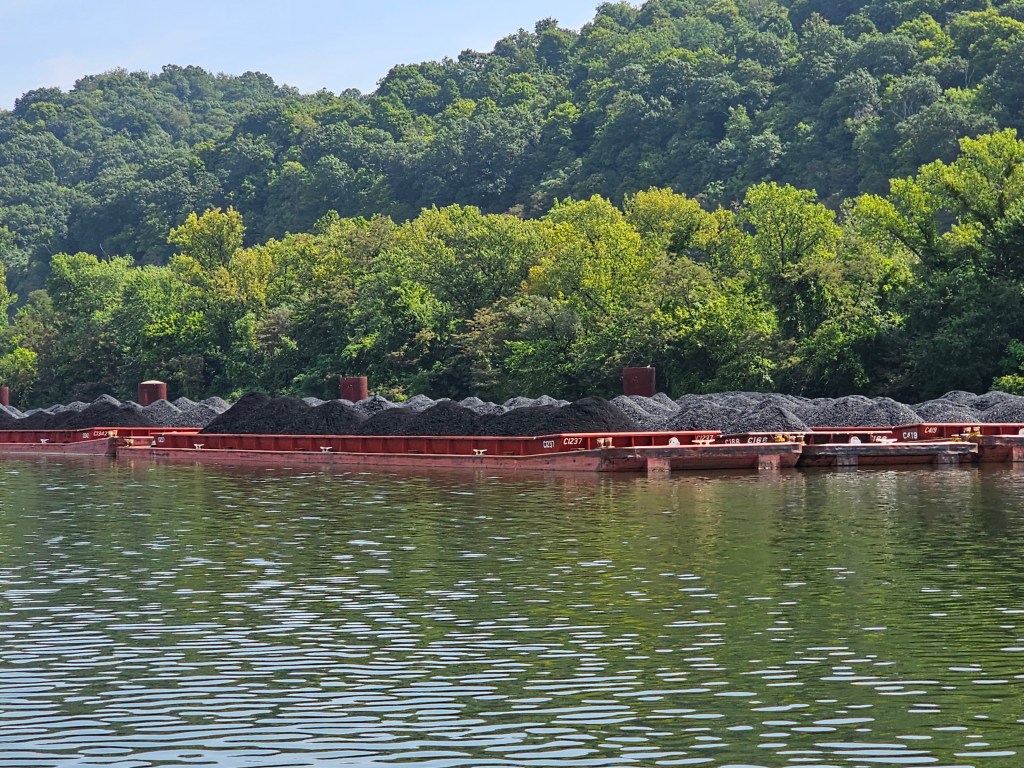
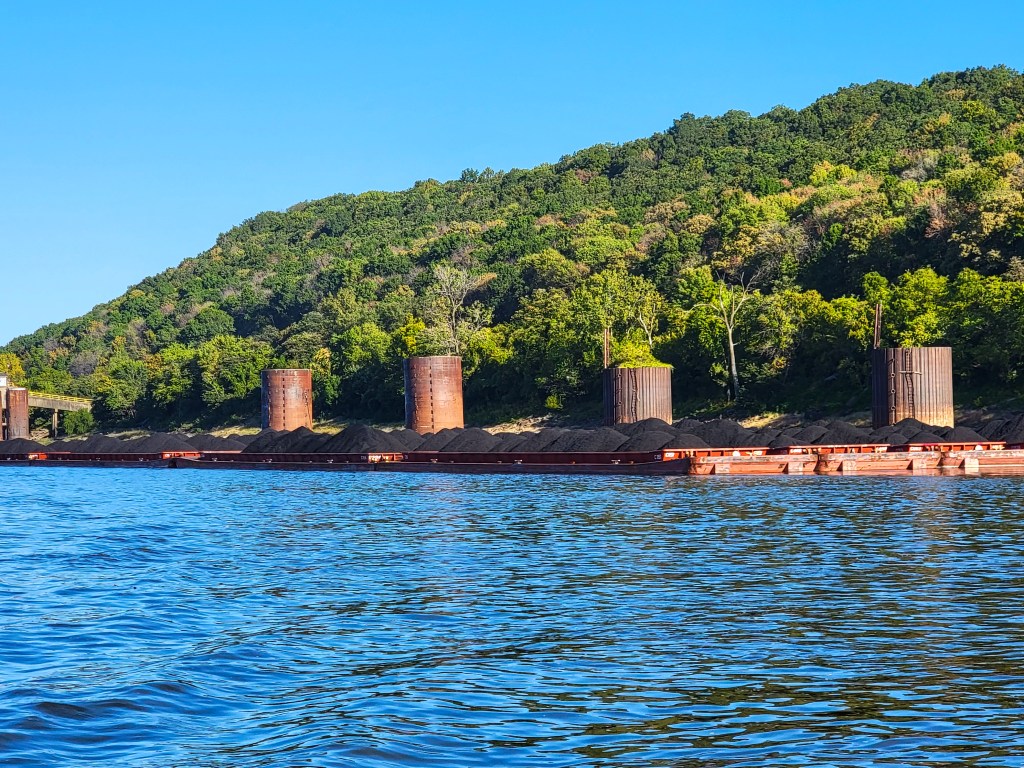
I have been noticing that all summer we have been passing loaded barges with coal, going in both directions.  This day, we saw some loaded barges with a clear difference in the piles of coal.  Dick tells me that there are several kinds of coal, but in this country the two most used are bituminous, and anthracite.  Bituminous coal is common coal used in power plants, while anthracite is a harder coal, considered a metallurgical coal, and is typically used in steel manufacture.  Anthracite is the highest quality, and has fewer impurities, which is important for use in steel making.

Barges carrying coal, note that some of the coal is different

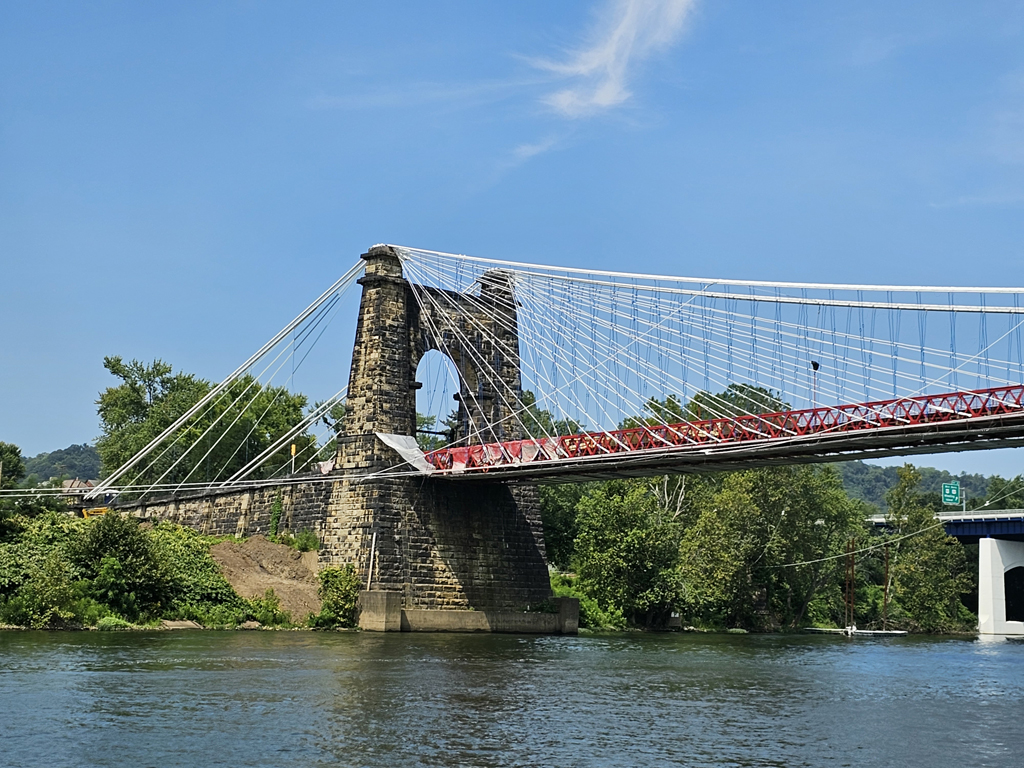
We passed through Wheeling, with its historic bridge.  For a short time, it was the largest suspension bridge in the world.  When it was built in 1849, it was the first bridge to cross a major river west of the Appalachians.  A bridge to cross the Ohio River and connect the important National Road (also known as the Cumberland Road) was first proposed in 1816, but it took many years before a bridge was actually built.  Different cities wanted a bridge, the federal government didn’t want to fund it, and neither did any of the states.  By 1847, with mail being lost and commerce disrupted, Ohio and West Virginia agreed to approve a suspension bridge.  It was immediately controversial, because the steamboats that carried goods and passengers up and down the Ohio had tall smokestacks, that were continually increasing in height.  By 1849 the objections reached the Supreme Court, with lawyers for Pennsylvania claiming that the new bridge was a nuisance that obstructed commerce on the river.  At the time, there was considerable dispute over whether river transport was a federal or a state matter.  By 1850, when the case was finally heard, the Court refused to require the bridge to be torn down, instead it ordered that the height above the water be raised to 118 feet.  The bridge company was allowed to “study” the concept of a removable portion rather than attempting to raise the entire bridge.  Arguments, court cases, and accusations continued after the bridge deck was destroyed during a windstorm in 1854.  It was rebuilt in spite of injunctions.  Ultimately, it became a non-issue, as the increasing power of the railroads destroyed the steamboat business, and the Federal government found that having bridges over major rivers was in its favour, both for mail delivery, and for movement of military supplies and troops.  Because the bridge was designed for horse and buggy traffic, it is unable to safely handle the weights of modern-day vehicles, whether it be volume of car traffic, or heavily loaded trucks.  Attempts were made to limit weight on the bridge, but drivers continuously ignored the limits.  For this reason, the bridge was closed to vehicular traffic in 2019.  It remains open to pedestrians and cyclists, and will be preserved due to its historic importance.  As we passed under it, we could see that it is currently undergoing renovations.

The suspension bridge at Wheeling

Last month, when we were northbound, passing Weirton, a fellow in the marina hailed us on the radio and invited us to stop there.  As Dick prepared the itinerary for our return trip, he couldn’t find a phone number or email address, so we just cruised close to the docks and called out to a member who was there working on his boat.  He made a phone call, and we were all set, with power and water as well!  After giving us time to get settled, Steve came on board for some beer and chat.  In due course we were joined by his wife and also his mother.  I got out cheese and charcuterie, and made it a proper docktails.  Later the commodore and his son the dockmaster dropped by as well to welcome us.  It was a delightful evening, and we hope to see Steve and his wife in a few years on the Loop in the trawler he is currently restoring.

Sunset at Weirton

I have discovered an interesting thing about the Ohio River.  Notwithstanding the name, and contrary to normal usage when a river forms the border between states, no part of the Ohio River belongs to Ohio.  This has been a matter of debate since the 1700s, with the most recent challenge from Ohio in 1980 (they lost again).  In 1783, the Ohio River was fully within the commonwealth of Virginia, which encompassed the land as far west as what is now Illinois and north to Wisconsin, including all of today’s Ohio, West Virginia, and Kentucky.  In 1784, Virginia ceded its territory that was “to the northwest of the river Ohio”, but not any of the river, with the boundary being the low-water mark on the western bank of the Ohio River.  This border was made under the Articles of Confederation, and carried over under the Constitution.  Ohio tried to take some of the river when it became a state, by claiming that the state boundary should be in the middle of the river (as it is in most states where the border is a river).  However, the Supreme Court ruled against them.  Ownership of the River transferred to West Virginia, when they seceded from Virginia, and when Kentucky became a state, it also got its part of the River.  Even when the River changed its route, moving north into Ohio, the state lost a claim to change the boundary.  Still today, if you fish from the Ohio side of the river, you must follow West Virginia fishing regulations, or those of Kentucky.  I find myself wondering about other things, like docks, that extend into the river, whether property owners need permission from Kentucky or West Virginia.  Not to mention using river water for various industrial or agricultural purposes.

We passed the Cardinal Power Plant, planned to be converted to natural gas by 2030.  Next door is a fly ash plant.  Cardinal was ordered by the EPA to stop storing fly ash in waste ponds (chemicals and metals leak into the river).  Fly ash can be used in the manufacture of concrete.

There was no wait at the lock, and we were tied up at Prima Marina by 2pm.  There was no power suitable for Nine Lives, and no water on the docks, but at $25 it was a reasonable charge for overnight dockage.  The evening meal at the onsite restaurant was decent, mostly basket food, hamburgers, and chicken dishes, with a few more upmarket choices.  All the food was served piping hot, which I always appreciate in this country, and don’t always get.  Dick’s broiled whitefish was a nice change, and I enjoyed a grilled ham and cheese sandwich.

We returned to the boat, and worked in the salon while we waited for the evening entertainment to begin.  This was a local singer, playing guitar and harmonica.  When we realized he had started, we followed our usual practice and sat in the cockpit with adult beverages, ready to enjoy the music.  It was awful.  After a truly dreadful composition of his own, the singer moved on to Jimmy Buffet b-sides.  One would hope that someone being paid to entertain would show at least some skill with their guitar, and be able to sing in tune.  Eventually we decided that we couldn’t stand the butchery of what are very nice songs and ballads, so we repaired to the salon.

At this point we realized that the cool weather, welcome though it was, did not work in our favour.  With no need for air conditioning, we opened the hatches and windows for air flow, and were then treated to the so-called music we had escaped!  The finale was an appalling version of Country Roads, the song that begins, “Almost heaven, West Virginia…” The poor man couldn’t come close to hitting the high notes.  The set ended, then to our dismay, an impromptu singalong began, with the participating audience every bit as bad.  We hope that our previous positive experiences with live music have not come to an end!

Prima Marina in Moundsville, live entertainment

August 20.  We passed the Marshall County Mine Barge Loading Facility, with the Mitchell Power Plant next door.  I was amazed at the long, covered chute that carries the coal from the Powhattan Mine, situated well inland, to the docks.

Late summer colours in early morning
Marshall County Barge Loading Facility with long coal chute

Bellaire Harbor Services was interesting, with a drydock and many tugs waiting for service, or possibly waiting for hire.

Bellaire Harbor Services

We had wondered several times about the lids that cover some of the barges.  We could see that they were all the same, as the barges are standardized, but we couldn’t figure out how the lids would get onto the barges.  At last, that small mystery was solved when we saw a crane with a special attachment placing lids onto a waiting barge.

Now we know how the lids get onto the barges

It was a short day, leaving Prima Marina at 9:20 and tied up on the free town dock at New Martinsville by 1:15.  This with a 30-minute delay for the lock.  The town has very clean, wide docks, with good rubber and cleats.  I was nervous because of the request that you advise the Police Department if you will be staying overnight.  The only other place we have seen that is a notoriously unsafe stop on the Illinois.  In fact, the clean docks and surroundings meant that, after all, I felt quite safe.  We were out of sight of the streets, which probably also helped.  Several pleasure boats docked for a while and people visited the town.  We needed the generator for the first half of the night for air conditioning, but the outside temperature dropped enough that Dick could turn it off later and it was a very peaceful night.

New Martinsville downtown
A charming coffee shop and pub in New Martinsville, sadly closed on Mondays, but we met and chatted with the owners
Looking across the River in early morning in New Martinsville

The stop was only slightly marred by discovering in the morning, that the two teenage boys who had been fishing on the docks when we retired for the night, had left plastic bags, empty drinks bottles, and takeaway cartons on the end of the dock, ready to be blown into the river.  Dick often picks up trash on docks and town walls.  Young people accuse us of destroying their future with the use of fossil fuels, yet they are using the rivers as a trash dump for plastics that will never disappear, and are damaging the very fish they are trying to catch.

Rubbish left on the dock by teenagers
Dick collects other people’s rubbish

I learned that Western Pennsylvania’s version of the South’s y’all, or Southern Ontario youse, is yinz.  Interesting!

We arrived at Marietta Boat Club by 1:45, but unfortunately, although we were expected, there was nobody to tell us where to dock.  Our instructions had been to tie up at the fuel dock, and find somebody.  It was hot, humid, and no breeze, so we had to run the generator.  Eventually, we were able to move to a spot, but after we were tied up, we were told that a mistake had been made, and we would have to move after 2 nights.  Once we were finally settled, we dropped the dinghy for the first time this season.  The motor started immediately, such a difference from the old one!

We went to dinner by dinghy.  The Boat Club is about a mile up the Muskingum River from the Ohio.  There is a concrete dock on the Ohio at the foot of downtown.  It was very hot and humid, so getting to the restaurant by dinghy was a lot nicer than riding bikes, even though there is a good bike path.

Downtown Marietta

Austyns proved to be an excellent choice of restaurants.  The food was a delicious combination of innovation and familiarity in a sort of Asian fusion style.  We shared 2 appetizers.  Prosciutto wrapped shrimp with a spicy remoulade sauce was very good.  Spring rolls stuffed with glass noodles and crab were quite unique.  Dick had a pasta dish with mixed seafood in a red pepper cream sauce with a filet of mahi mahi on top.  I opted to try another starter instead of a main-sized course.  Beef tips, marinated in truffle oil, and served in a delicious fondue of several cheeses was outstanding.  For dessert, we shared an interesting Bailey’s chocolate cake that was just the right size, and not dreadfully sweet.

Spring rolls at Austyns
Austyns shrimp with prosciutto
Austyns seafood pasta with mahi mahi
Austyns beef tips in fondue
Austyns Baileys chocolate cake

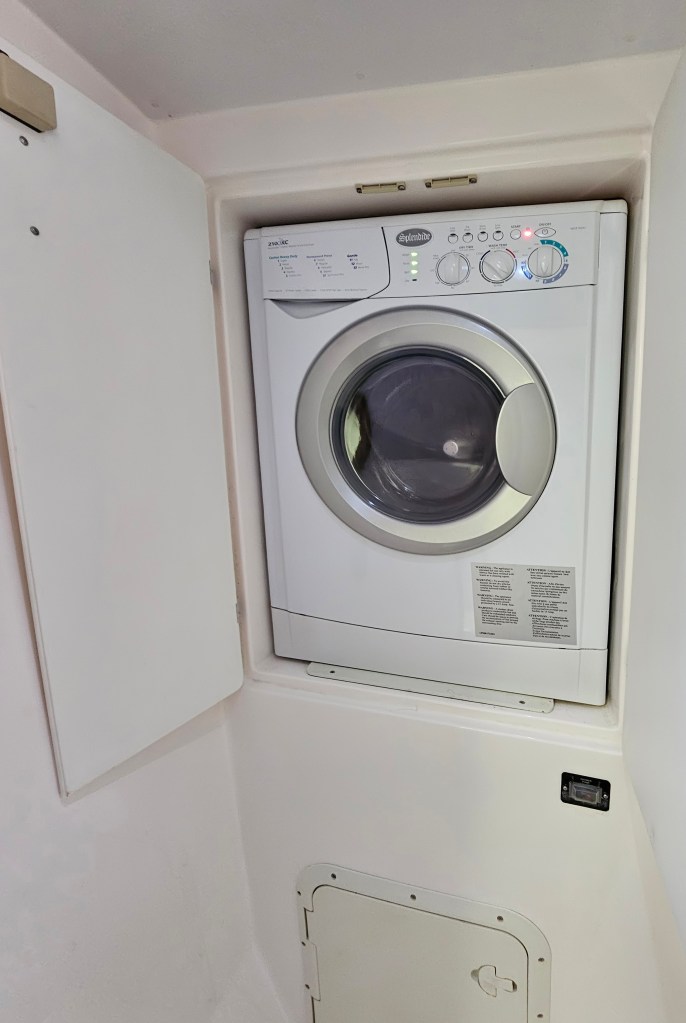
The next day was laundry day again.  We have a Splendide washer/dryer on board.  It is a typical European-sized machine, so with quite a small capacity compared to large American appliances.  However, I don’t need to find a laundromat, deal with quarters, or schlepp laundry back and forth in hot, humid weather, as I would in marinas that have a facility.  I can stay on the boat (or go out if I wish), and be comfortable instead of sitting in the laundromat.  I find that once I sort the clothes, my loads are similar in size to what I would have at home –it’s only sheets and towels that I have to split into smaller amounts.  The dryer is slow – a typical load takes 80 minutes on medium heat (the hot setting is too hot and will damage the fabrics).  I hang most clothes to dry except socks and underwear anyway, so no difference in that respect from at home.  There is always a debate among boaters, whether or not to look for a boat with a washer/dryer.  I have noticed that most women tend to be in favour, while men (who, let’s be honest, are not usually the ones doing the laundry), are against.  One does have to get used to the idea of smaller loads and long drying times, but anyone I have met who has one, would never choose the laundromat again.

We have a washer dryer on board

I carried on with the laundry while Dick prepared, and then recorded, a podcast he was asked to do for AGLCA about our trip up the Mississippi last year.  The podcast is now available on U-Tube, and has been well received.

In the evening it was another pleasant dinghy ride to the dock at the foot of the town.  The restaurant was quite a contrast to the previous evening.  It was full, even thought it was Tuesday, but it was an entirely different demographic, with nobody I could see under 50-years old.  The food was good, but not exceptional.

In the morning, we lost about 2 hours out of our day while we moved Nine Lives to a different spot on the docks.  Since we had to untie anyway, we decided to do the pump out then, instead of the day we left.  The pump out machine had some quirks, and Dick stood there for nearly half an hour thinking it was a very weak machine before discovering the technique for making it actually pump.  We slid Nine Lives into her new, shorter, spot very professionally, sadly without anyone around to watch and appreciate our skills.

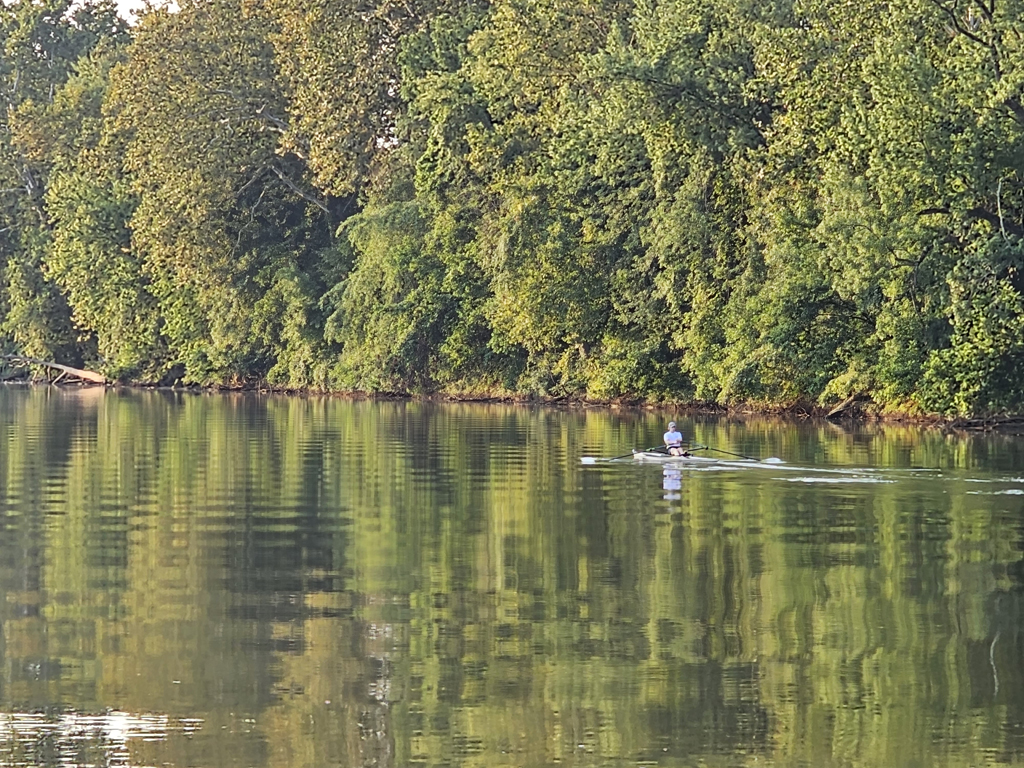
Rowing on the river in early morning

Indigenous cultures lived along the Ohio River for thousands of years.  Some of them built large mounds, for purposes that are not fully understood, but are thought to be connected to cosmology and astronomical events.  Moundsville is one location, and there are 3 large mounds in Marietta, known as Marietta Earthworks.  19th century settlers in Marietta preserved what was known as the Great Mound, by putting their cemetery around it.  By 1900, the Mound Cemetery had the highest number of burials of Revolutionary War officers in the United States.  At the close of the Revolutionary war, officers were given grants of land, and George Washington particularly favoured the Marietta area for land grants.  The location of the town at the confluence of two navigable rivers, ensured its commercial success, and we can see from the beautiful old buildings downtown that this was a very prosperous city in the 19th century.  Oil was first drilled in Marietta in 1860, and succeeding oil booms added to the wealth of the town.  The longest running, and until recently the only, ferromanganese refinery in the United States is located in this city.  Ferromanganese is used as a deoxidizer in the steel making process. We would have loved to be here for the Sternwheeler Festival, an annual event since 1976.  As many as 35 authentic steam driven sternwheelers are expected to participate.  We have noticed that there seem to be a lot more sternwheelers, both commercial and in private hands, on the Ohio River, than we saw last year on the Mississippi.  Some have been lovingly restored, while some are just sad relics of a bygone age.

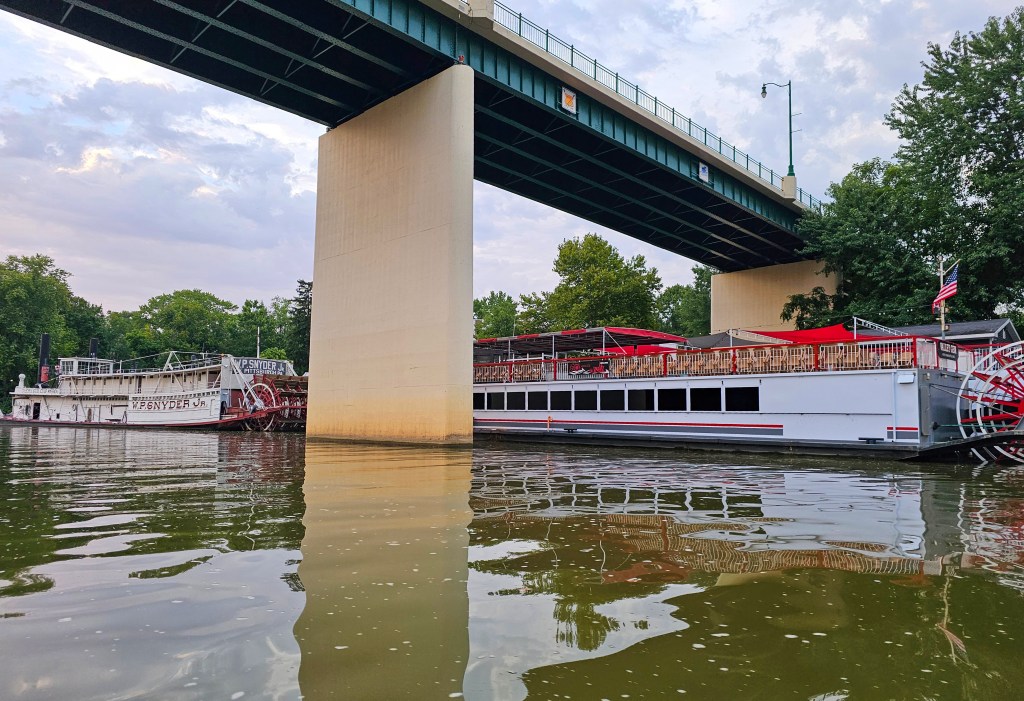
Historic sternwheelers docked in Marietta. One is a museum, others are still operating as tour boats on the Ohio River

Dick enjoyed a day of exploration and a little grocery shopping, while I continued with the laundry.  The man on the boat next to us came over to chat, very friendly, and offered us the use of his car.

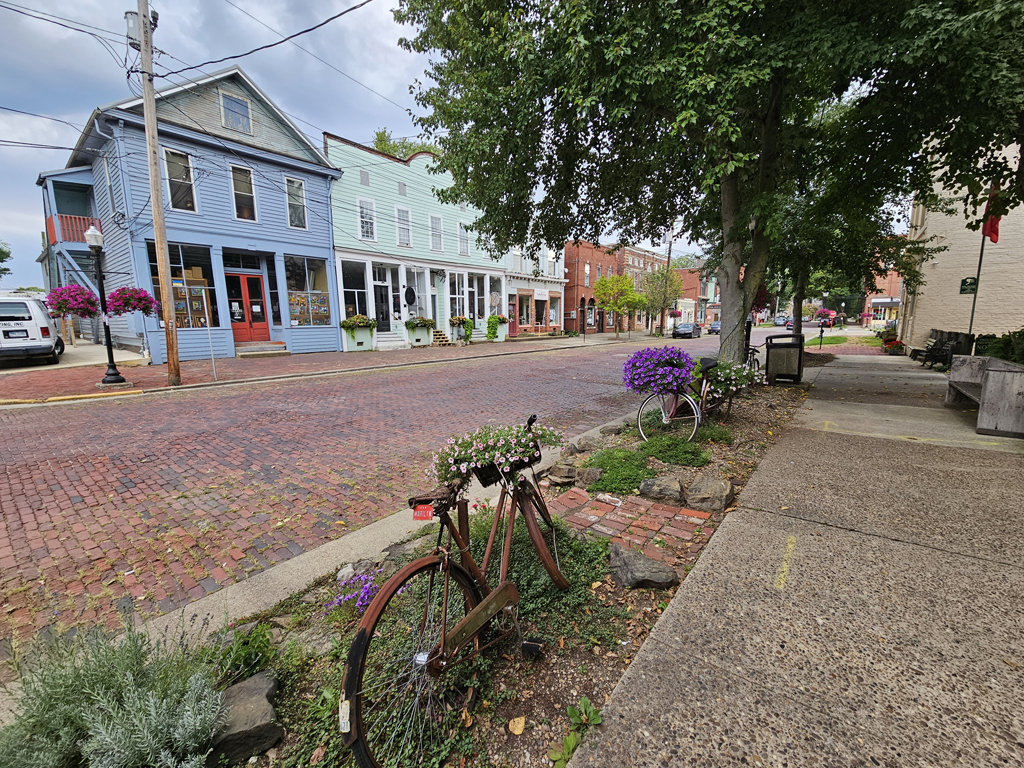
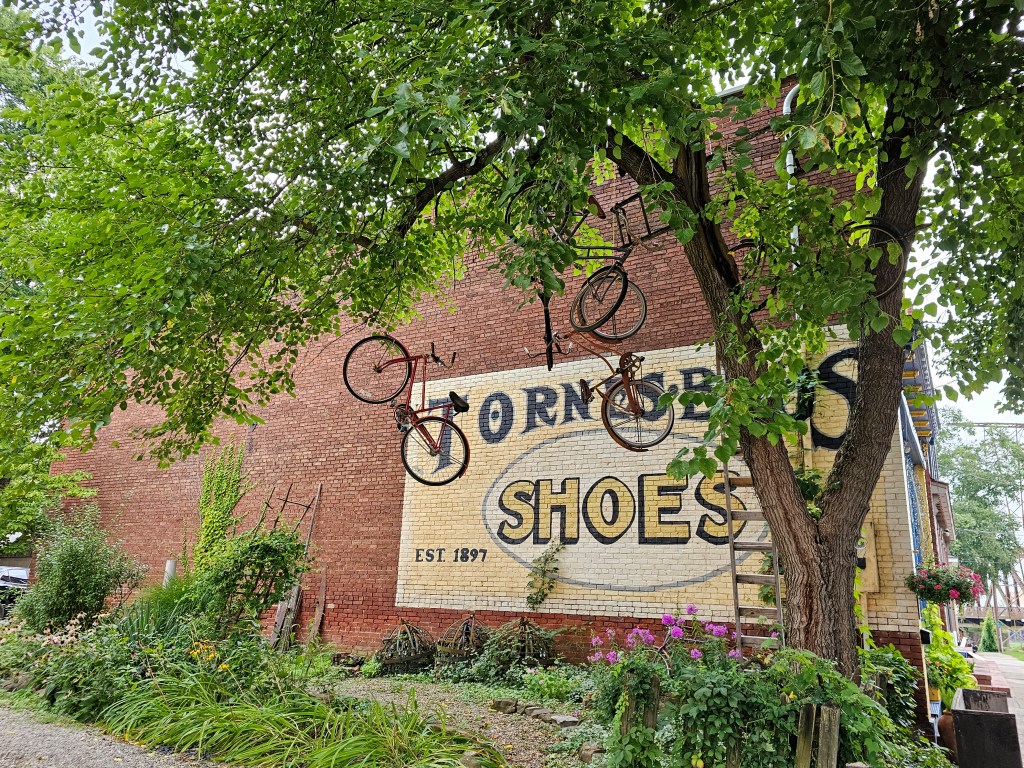
Another pleasant dinghy ride took us to the courtesy dock at the foot of Harmar, the small town across the Muskingum River from Marietta.  It is a well-preserved historic village, with some beautiful old houses and storefronts.  One of the properties is occupied by someone with a sense of humour.  Instead of a bottle tree in the garden, they have a bicycle tree, with a number of bicycles hanging from the branches.

Harmar
Harmar architecture
Harmar
A bicycle tree beside a historic building in Harmar

Spagna’s was a reasonably good meal.  We shared pepperoni rolls and stuffed mushrooms.  My lobster mac and cheese was improved by not having crumbs on top, but for my taste, there was not nearly enough sauce.  Dick liked his lasagna.  We shared a very tasty lemon cake for dessert.  For a change from bubbly, I started the meal with a local Manhattan.  It was a very generous pour (something that does not happen in UK, where the number of ounces in a drink is strictly regulated).  In fact, it was such a good pour, that after that and a glass of wine, I felt decidedly merry.  Not so much that I was at risk of an impromptu swim when we returned to the dinghy though.

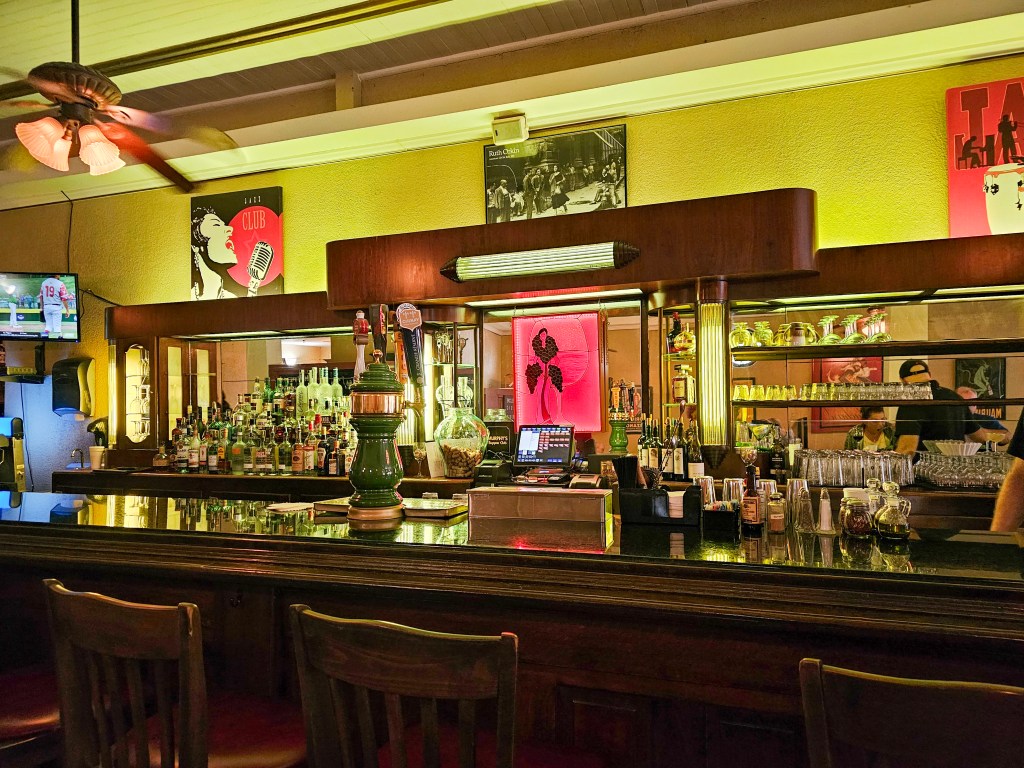
The art deco bar at Spagna’s in Harmar
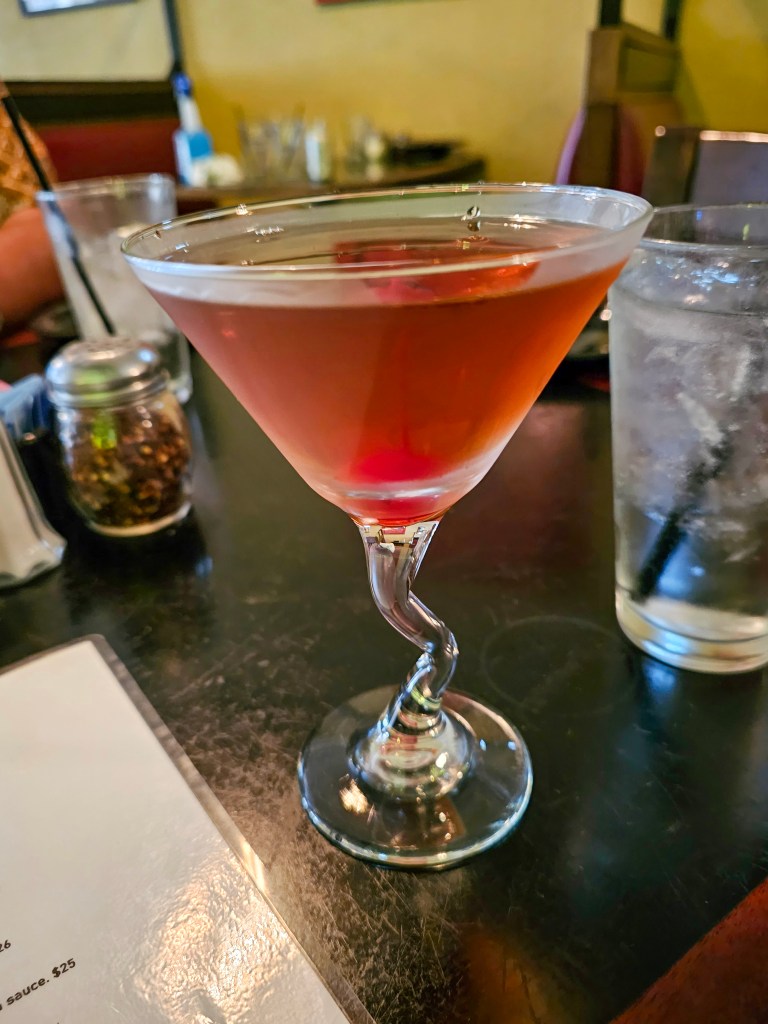
A manhattan to start
Stuffed mushrooms and pepperoni rolls at Spagna’s
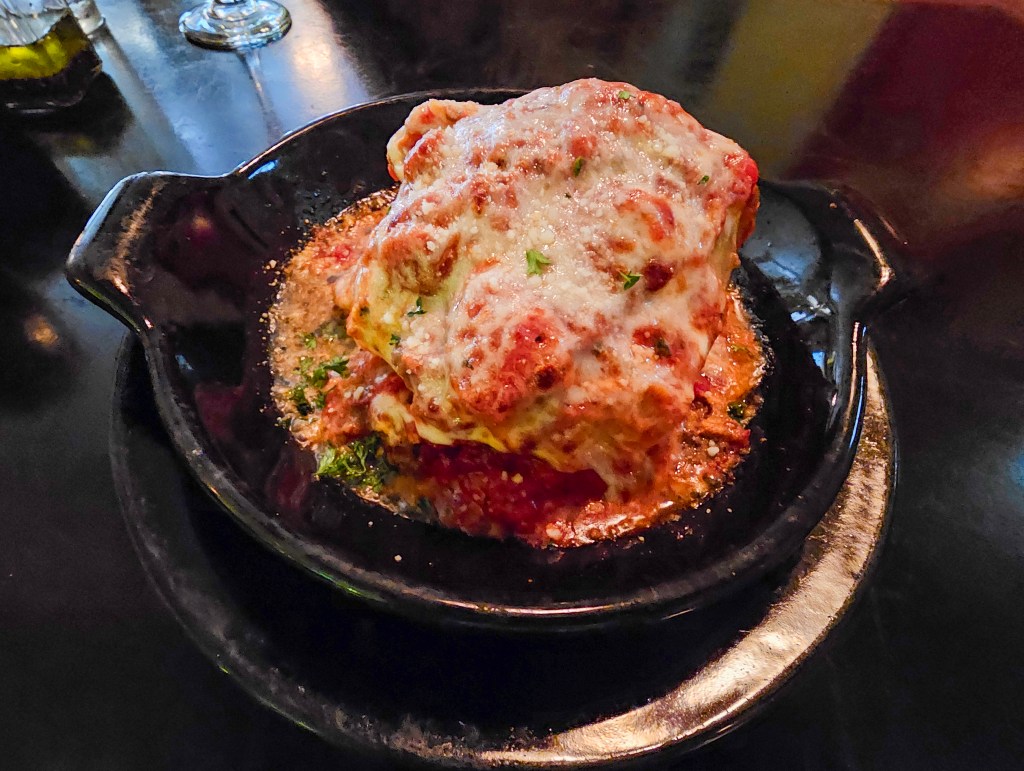
Spagna’s lasagne
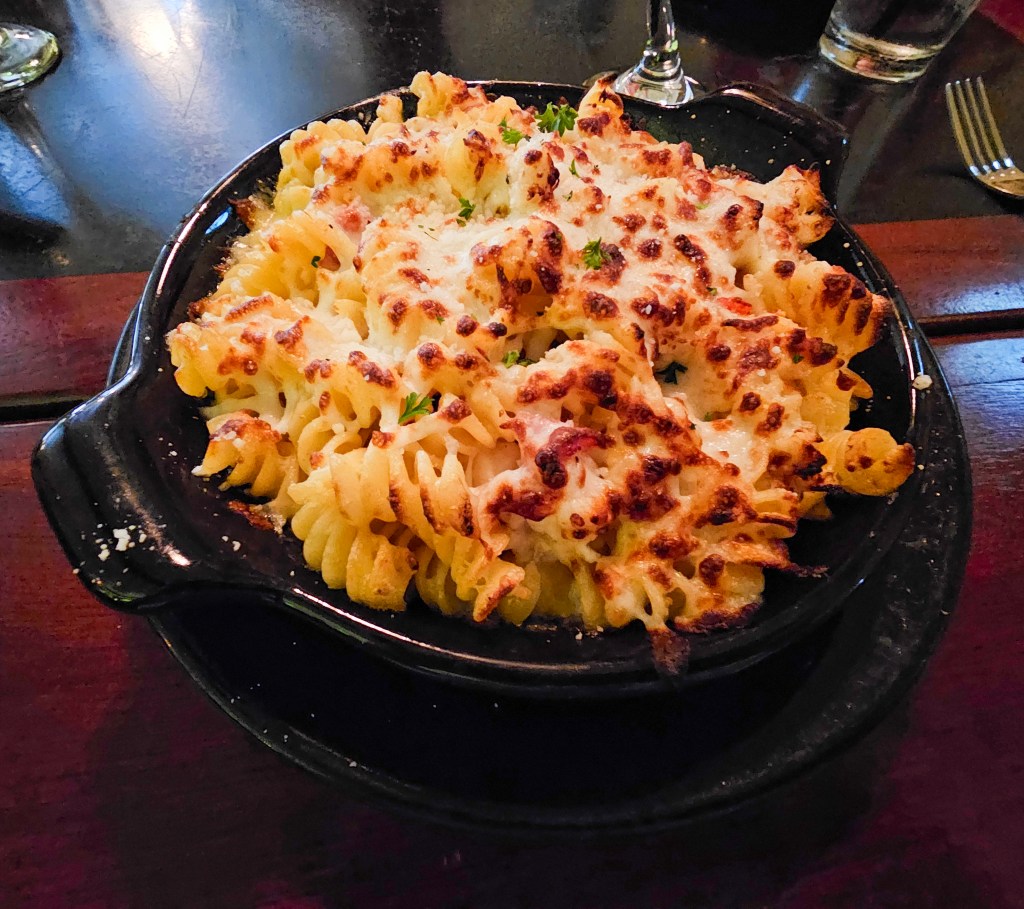
Spagna’s lobster mac and cheese

We stopped to have a look at the Harmar Bridge.  This was originally a wooden, covered bridge, constructed for use by pedestrians as well as horse and buggies by the Marietta and Cincinnati Railroad in 1856.  18 years later, rails were added, and it was converted to use as a railroad bridge.  A swing span was added to the Harmar side in 1880, to allow larger boats to pass under it.  Destroyed and reconstructed several times over the next 20 years due to floods, it was converted to an iron bridge in 1900. The Great Flood of 1913 took out all spans of the bridge except from the swing part, as well as the train that had been put on it to try to anchor it down against the floodwaters.  The bridge was rebuilt, and some years later the swing section was moved to the Marietta side.  Closed for rail traffic in 1968, the pedestrian walkway was left open until it became unsafe, and it was fully closed in 2020.  Efforts continue to raise enough money to rebuild and preserve the historic edifice.

Historic bridge between Harmar and Marietta, sadly derelict.

We enjoyed our stay in Marietta, although we could have wished for a less chaotic arrival and a more friendly welcome from other boaters, something we have enjoyed at several boat clubs on the trip so far.

It rained all night, and was still raining the next morning.  That means wet lines, and my particular dislike, wet gloves.  Disdaining his waterproof jacket, Dick filled the water tanks and retrieved the dinghy, and we prepared to cast off.  I was glad to wear my jacket, plus a hat!  Visibility was good in spite of the rain.

It was an uneventful day, with only a slight delay at the lock to allow a big tow to get into the main chamber.  We anchored behind Buffington Island, where we stopped on our northbound trip, by 3:15.  The owner of the land where we anchored stopped on his boat to chat.  He was a nice guy, even offering us the use of his fully plumbed outhouse if we needed it!

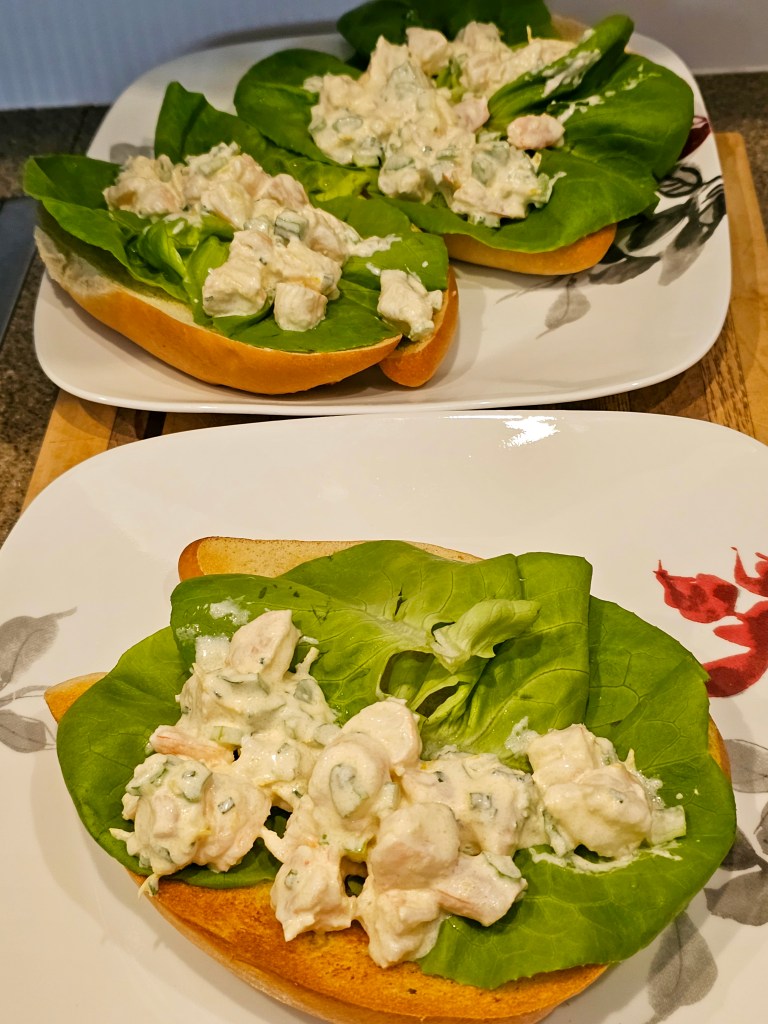
I made shrimp sandwiches again for our dinner.  Cooked shrimp are chopped and melted butter with crushed garlic is poured over them.  A mixture of mayonnaise, Dijon mustard, chopped chives, celery, lemon juice, and lemon zest is then stirred into the shrimp and the bowl is chilled.  The remaining garlic butter is brushed on the inside of the rolls, and they are toasted, and lined with butter lettuce and then the shrimp is added.  We will definitely be making these sandwiches again.

Our night was mostly quiet and peaceful, but thunderstorms woke us at about 5am.  There was little wind, but enough to turn us a full 360 degrees several times, as the current was not strong enough to hold us straight in the channel.  We later learned that others had a pretty wild night, with strong winds and lashing rain, and some areas were without power by morning.  Obviously, the island was a great place to have stopped.  We were away before 8:30. The anchor came up easily, and the rain stopped.

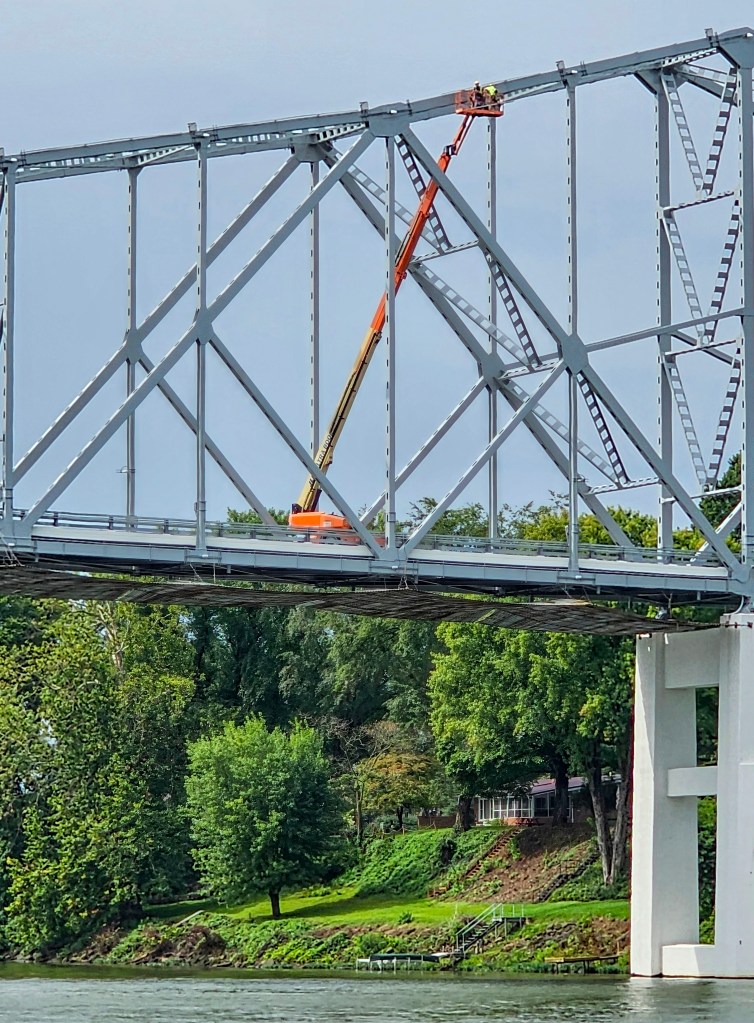
A bridge under repair south of Marietta. Bridge work requires a strong stomach and no fear of heights!

We passed Blennerhassett Island, now a Historical State Park, served by an authentic sternwheeler ferry.  The island was settled in 1789 by Harmon and Margaret Blennerhassett, wealthy Irish aristocrats who were fleeing what is described as political persecution and personal scandal.   Call me cynical, but I suspect a lot more of the latter than the former! Their mansion became the headquarters for Aaron Burr’s military expedition to the Southwest in 1805.  The Blennerhassetts fled the island when Burr’s treasonous plot collapsed, but the mansion remains. It has been reconstructed, and volunteers in period costumes show visitors around and describe what it was like to live there in its heyday.

Blennerhassett Ferry, an authentic sternwheeler
A glimpse of the mansion at Blennerhassett Island

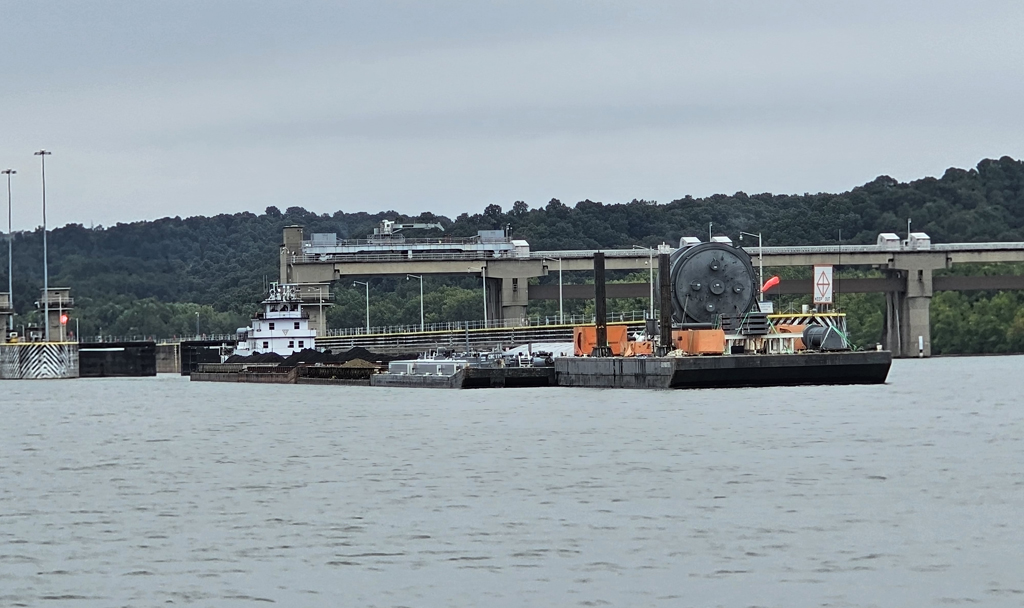
As we approached the lock, slowing down to allow a big tow to exit towards us from the big chamber, we saw that it was carrying an unusual load.  It was a huge cylinder.  We have no idea what it was, Dick is not prepared even to hazard a guess!  Once we were in the lock, the doors took a long time to close.  I suspect the lockmaster was allowing time for another tow to enter the large chamber.  When it was finally time to exit, they only opened one gate.  At this point I relinquished my position at the helm.  Nine Lives fits through one door with space to spare, but I prefer not to be the one responsible in that situation!

An unusual barge load exiting the lock
We have no idea what that huge thing is!
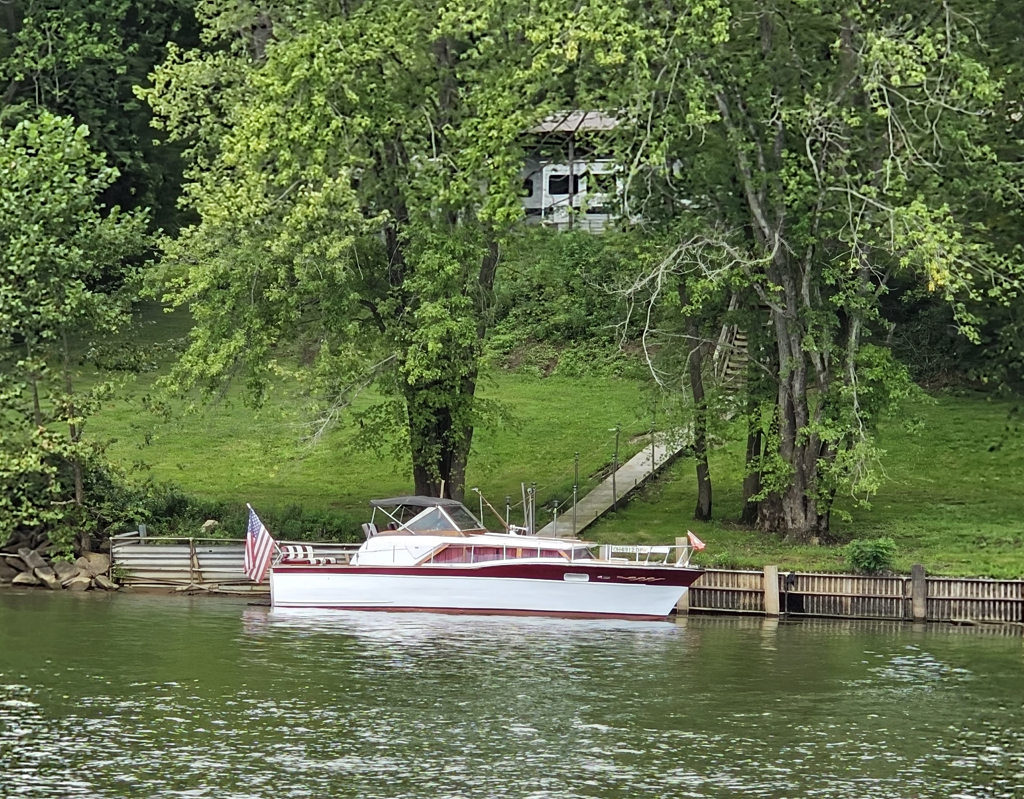
A classic old pleasure boat on the Ohio north of Gallipolis

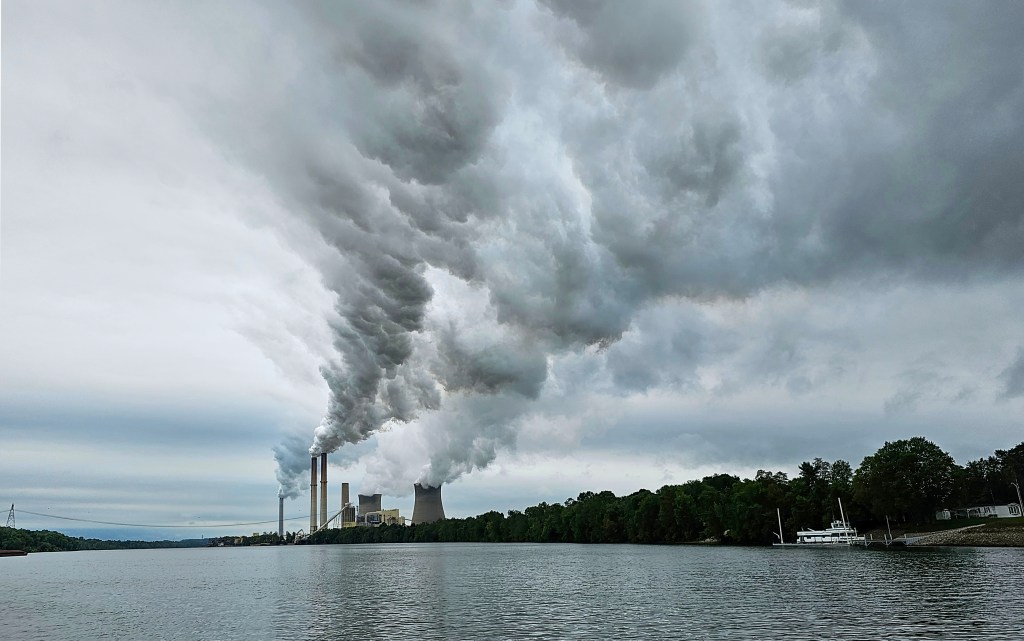
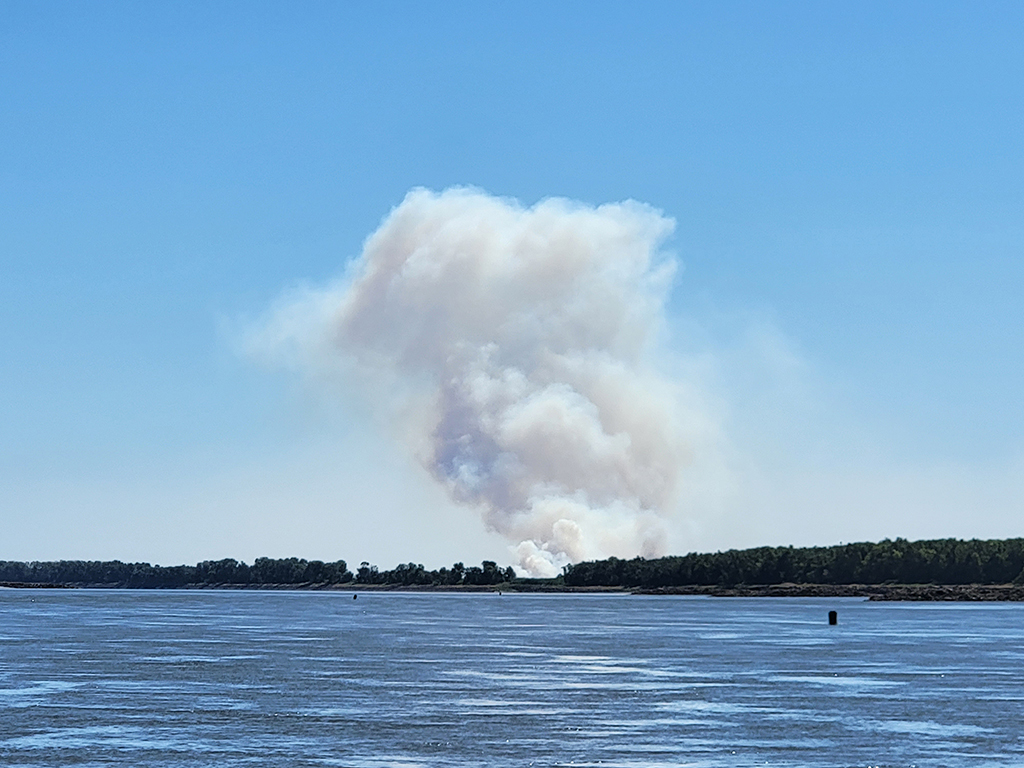
Steam from the Gavin Power Plant was visible for miles.  It is the largest coal-fired facility in Ohio, and one of the largest in the USA.  In 2002, to avoid lawsuits relating to air pollution, the operating company decided to buy out the residents of the nearby village of Cheshire, by offering 3.5 times more than the market value of their homes.  The plant has been using unlined pits to store its fly ash, and was denied a permit to continue.  In November 2022, it was ordered to stop dumping coal ash into the ponds, and speed cleanup of the site.  This is such a big project that in order to comply the plant would probably need to be shut down.  The company had 135 days to comply, but they were also allowed to present arguments against shutting down because of the effect on the grid.

Steam from the Gavin Power Plant was visible for miles

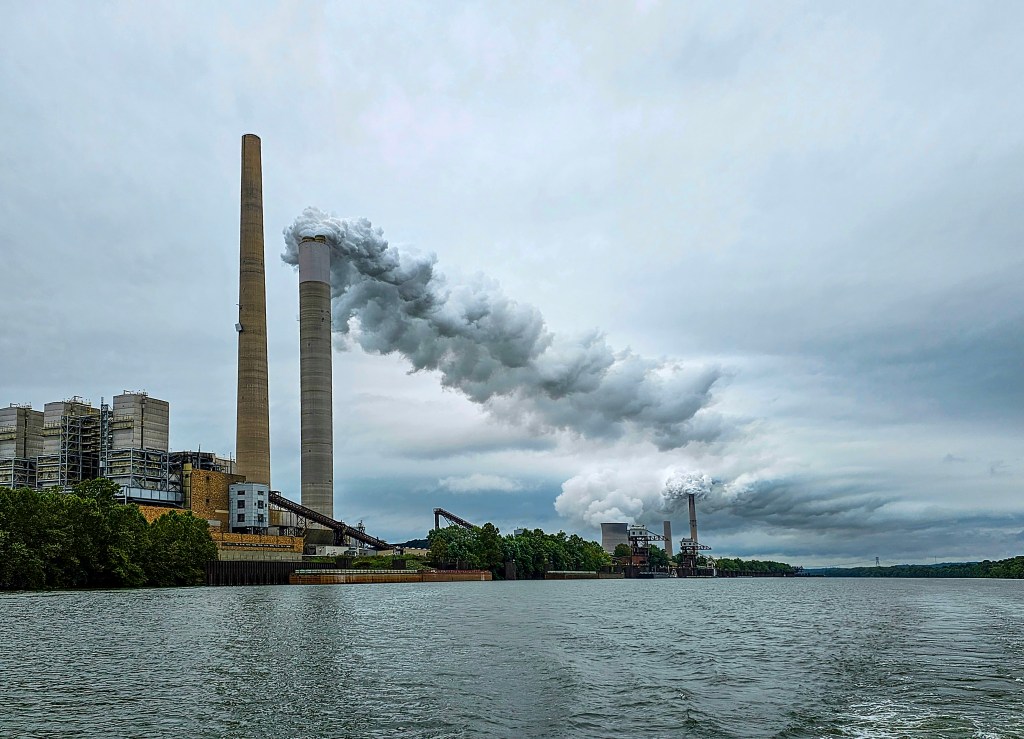
Kyger Creek Power Plant is immediately next door.  This plant is older, built in 1955 to service the Portsmouth Gaseous Diffusion Plant, a uranium enrichment plant.  When that plant was shut down, the Kyger Power Plant had to begin selling its power on the open market.  In 2019, customers of First Energy were ordered to pay extra to subsidize the plant.  This scheme was part of a public corruption scheme revealed by the Department of Justice a year later.  We could see that both plants are still operating, and while the steam coming out of the cooling towers looked appropriately clean, the smoke from the tall stacks was tinged with brown, suggesting that not all pollution mitigation measures are working as well as one would wish.

Kyger Creek Power Plant

We tied up in the town of Gallipolis by 2:30, on a very good town dock, with even some rubber to preserve Nine Lives’ delicate hull.  Dick had chosen a restaurant, but it was a bike ride away.  When he went out for his usual recce, he discovered that this is the most bike-unfriendly town we have visited.  There are no useful bike paths, and the streets are busy and lined with parked cars, forcing you to ride in traffic.  Further investigation of closer dining options suggested that this would be a night to eat on board.

The history of Gallipolis is more about failure than success.  It began with a group of 500 French aristocrats, merchants, and artisans, who were fleeing the French Revolution.  They were sold land in Gallipolis along the Ohio River by the Scioto Company.  On arrival, they discovered that Scioto Company had no right to sell the land, and their deeds were worthless.  Eventually, the settlers were granted land nearby, but with a proviso that they had to live and farm the land for 5 years before they could sell it. They were city people, and not prepared for farming life in undeveloped America.  Many of them had to buy the land they thought they owned from the Ohio Company in order to settle in Gallipolis.  In 1967, the Silver Bridge, that I wrote about earlier, that connected Gallipolis to Point Pleasant, collapsed.  The city is still a bedroom community, with employment at nearby power stations, healthcare providers, and universities.

Gallipolis downtown
Gallipolis downtown
Gallipolis waterfront gardens

We were visited by a man who had seen us on our northbound trip, and had looked us up online.  I sent him a note that morning, and he stopped by to say hello.  He didn’t have time to join us for a beer, but we did enjoy a nice chat.

Nine Lives at the dock in Gallipolis

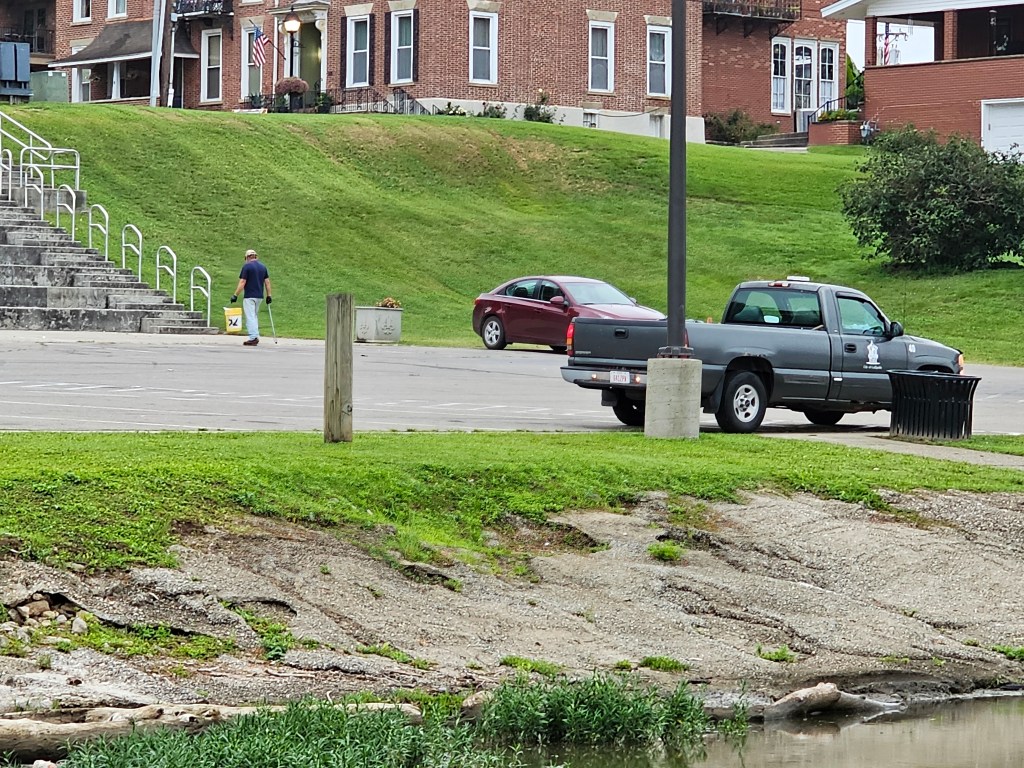
Once it started to get dark, I felt the least safe of any of our free docks so far.  There were a great many young men driving up and chatting with each other before driving away again.  Dick tells me that not everyone is a criminal or a drug dealer, and I guess in a small town, there are limited options for the young on a Friday night, but I was not very happy.  All was well however, nobody bothered us, and it was a quiet night apart from rocking from occasional tows.  The next morning there was a town employee picking up rubbish in the parking lot, even though it was the weekend – more towns should do this!  Later, a group of ladies gathered and seemed to be enjoying themselves in a Zumba class.

Rubbish pickup after a Friday night on Gallipolis waterfront

After a big breakfast, we were underway by 9:30 for a short journey to Huntington.  The drop in the lock was considerably less than the expected 23’, and below the lock we could see that the trees at the edge of the banks were in the water.  There was also almost 2 knots more current than the previous day.  All this would have been the aftermath of Thursday’s big storm.

Trees in the water, higher than usual water on the Ohio River above Huntington

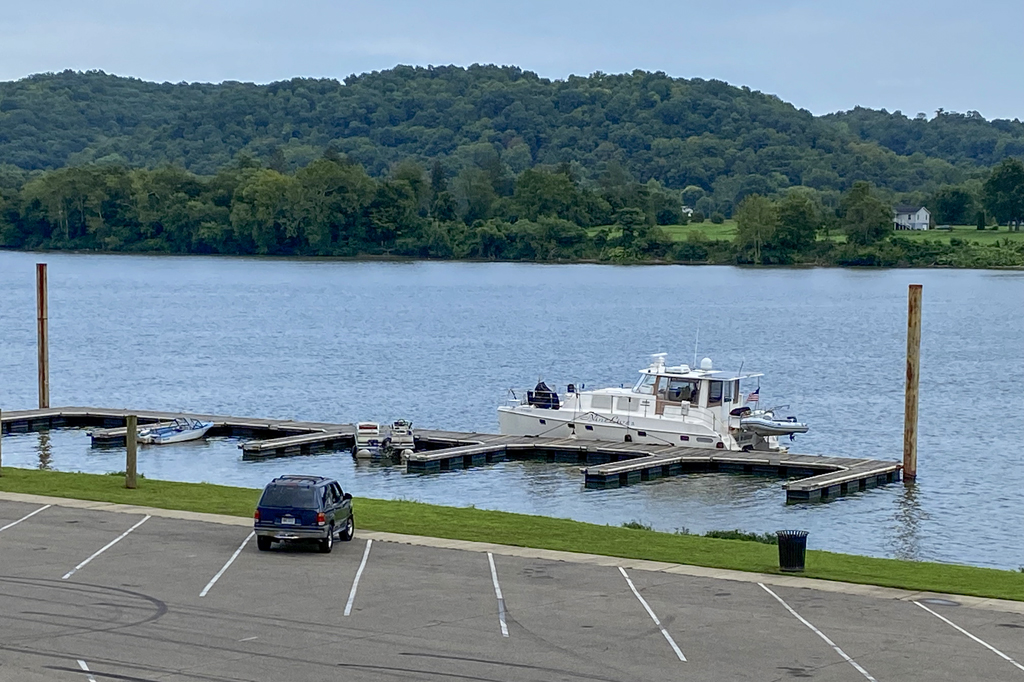
We docked in Huntington by 2:30pm.  This time, we went for the lower, upstream wall, where there were good cleats (the downstream wall we had docked at before had widely spaced bollards).  It was very shallow, to the extent that the depth finder stopped registering, but docking was made easy by a fellow boater who caught the lines.  There was a festival going on, so we had a big audience.  Both the boater who caught our lines, and another one who tied up later, warned us that it was too shallow to stay overnight, but Dick felt that with the higher water we would be fine.

Huntington is the second largest city in West Virginia.  Federal money for urban renewal in the 1970’s resulted in the tearing down of many of the beautiful old downtown buildings, and replacing them with ugly concrete boxes.  An attractive downtown shopping centre is quite lively, with many shops and restaurants, but another effort to convert an old railway station to a venue for artisans and coffee shops has not been a success.  The Huntington greater metropolitan area spans 3 states and 7 counties.  I read that the port, called The Port of Huntington Tri-State, is the second busiest inland port in the United States. Industries include coal, oil, chemicals, and steel.  The city’s beginnings were rooted in the railway business, from its beginning as the western terminus of the Chesapeake and Ohio Railway.  The railroad expanded east, and west, and after several mergers, it is now CSX Transportation.  Huntington was the second American city to use electric streetcars.  Today, the largest employers include Marshall University, a hospital and medical centre, Amazon, and Direct TV, as well as the City itself.

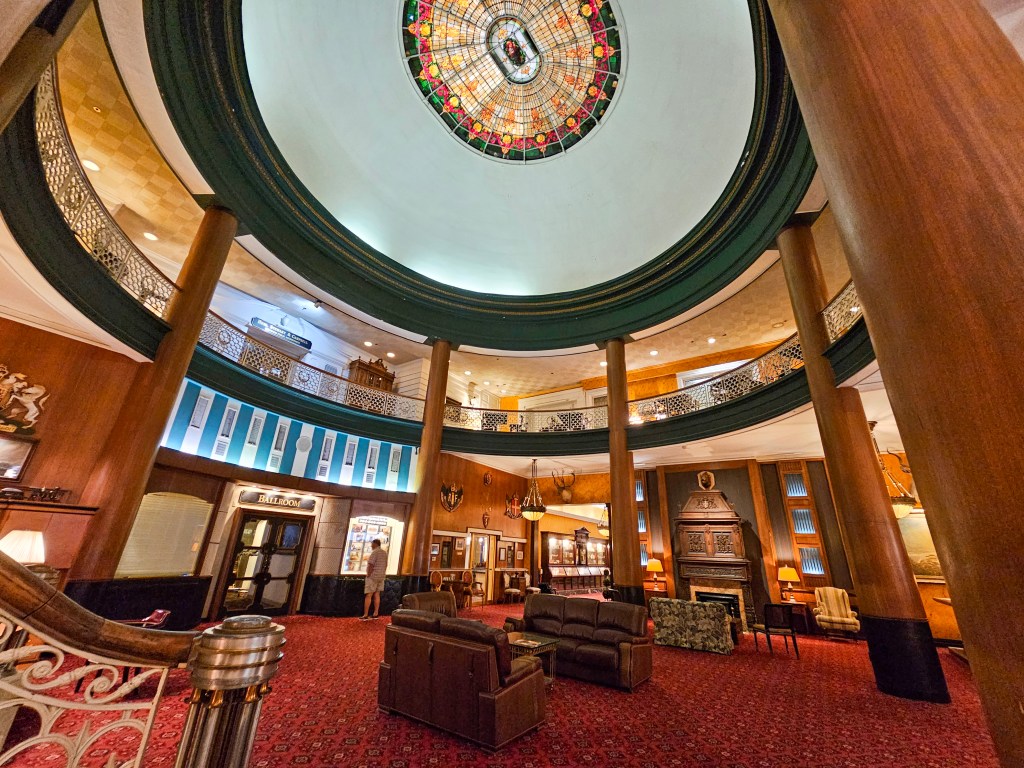
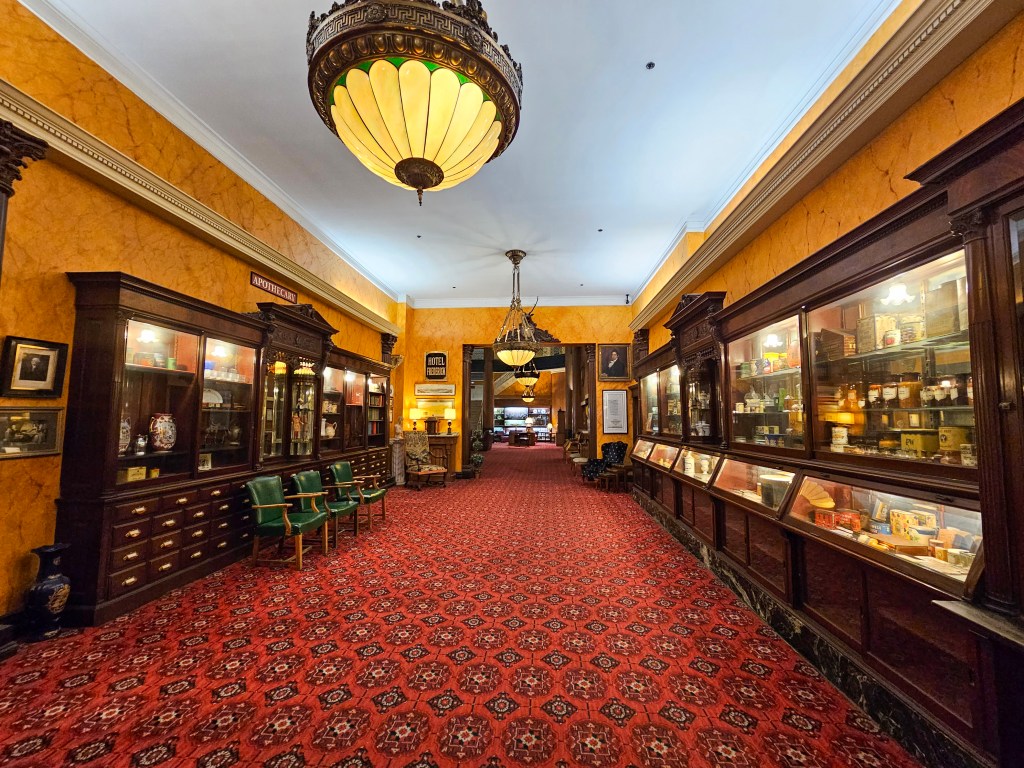
We had a wonderful evening.  We booked a meal at 21 The Frederick, a historic hotel that has been sympathetically converted to luxury rental apartments.  We wandered around the lobby and admired the beautifully preserved period surroundings.  This is the top fine dining restaurant in Huntington.  The restaurant décor was an interesting mix of styles, some clearly dating from its heyday in the early 20th century, some definitely a 60’s unsympathetic makeover, and there was a most extraordinary frieze of golden elephants, of undetermined vintage, around the edge of the room!

The rotunda at 21 The Frederick in Huntington
The hallway, with a display from the former apothecary at 21 The Frederick
The dining room at 21 The Frederick

Our meal was excellent, the best since Pittsburgh.  It is clearly a venue for special nights out.

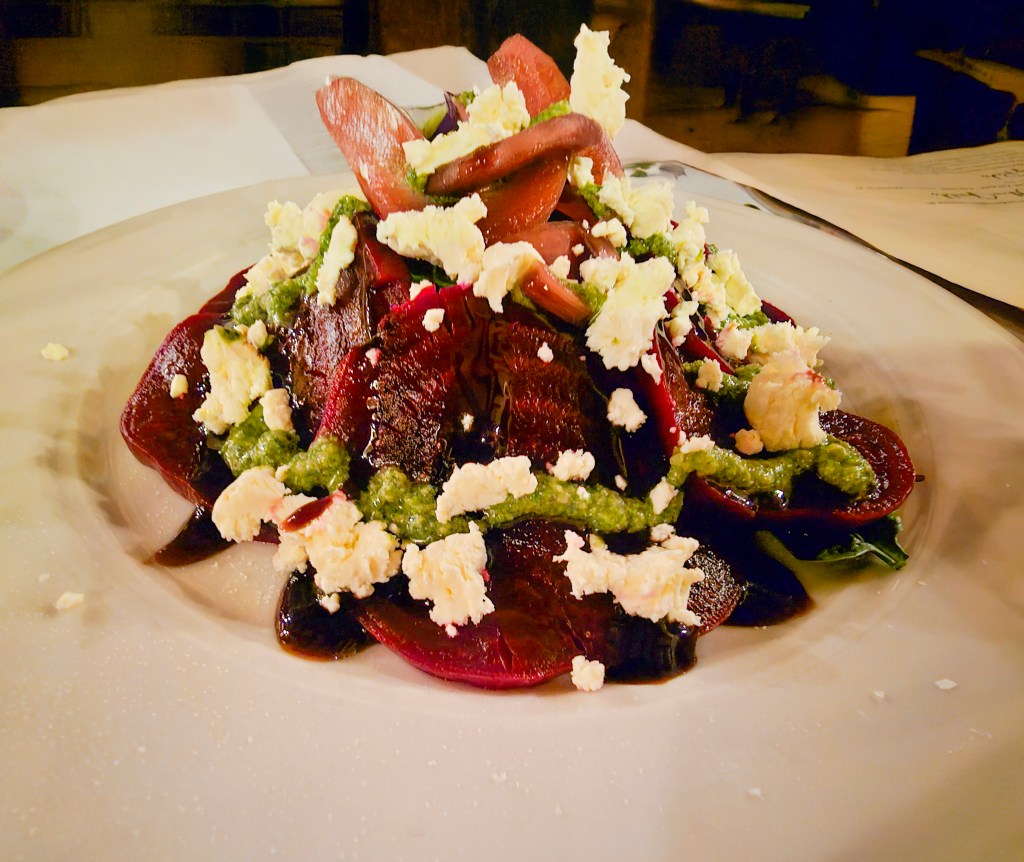
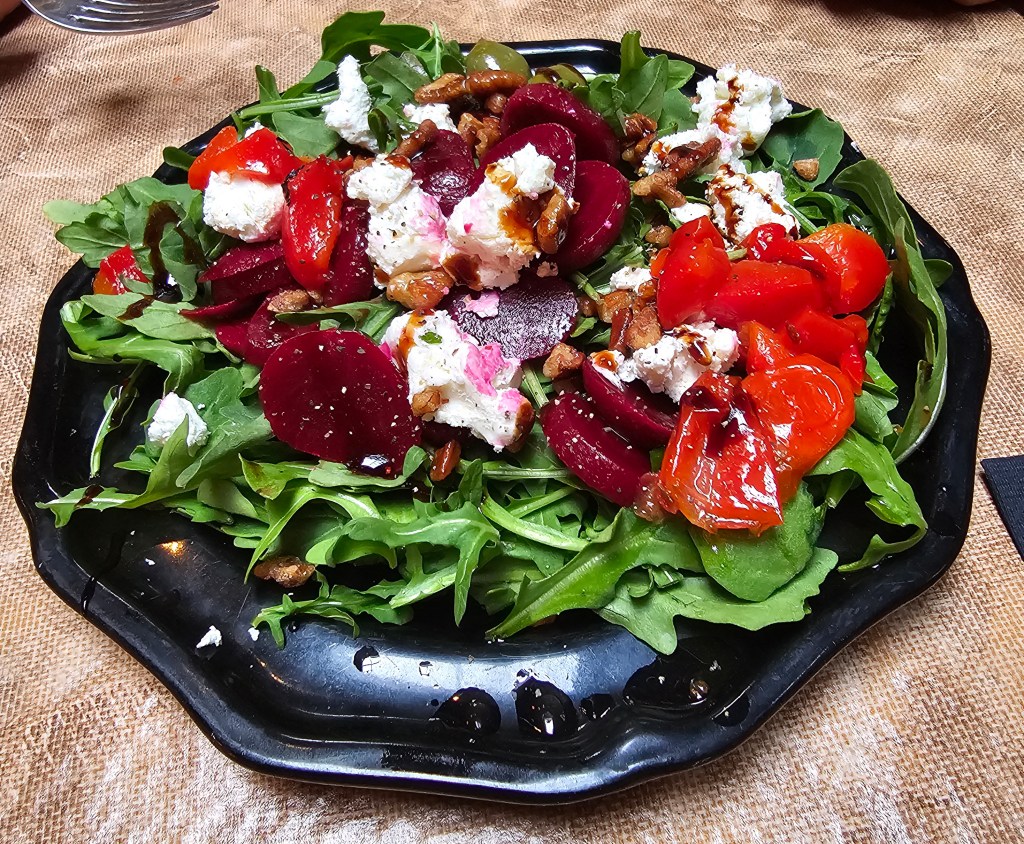
Beet salad at 21 The Frederick
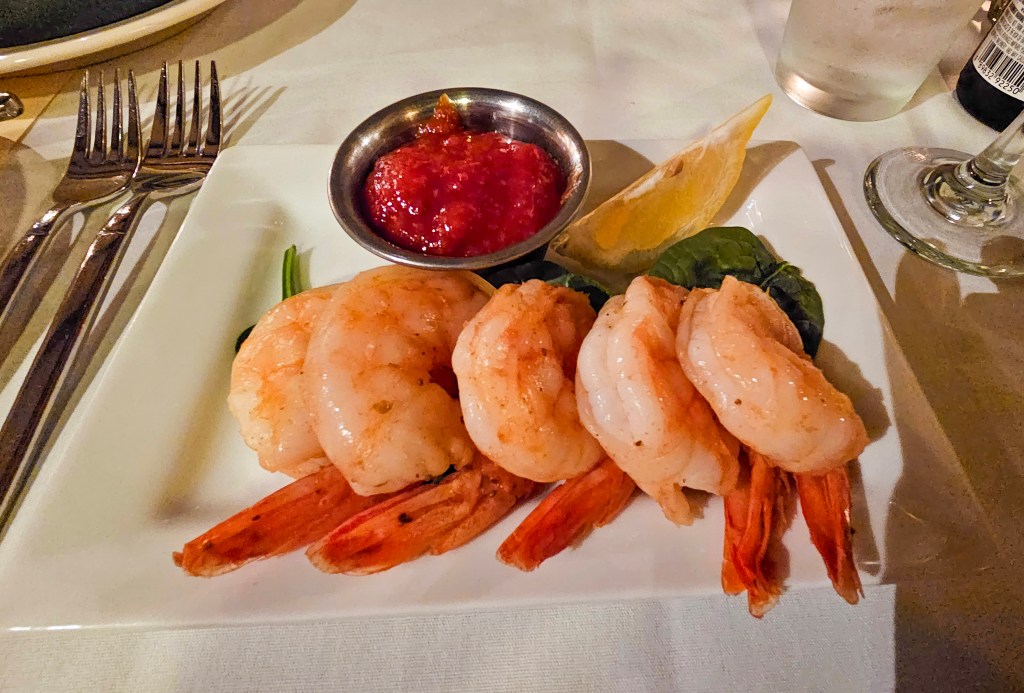
Shrimp cocktail at 21 The Frederick
We both had filet steak and garlic mashed potatoes at 21 The Frederick
Cheesecake at 21 The Frederick

Those of my readers who wish to avoid social commentary should avert your eyes for the next paragraph.

For some time, Dick and I have noticed that some of our generation, many of generation X, and almost all of the next groups seem to lack any sense of respect for the standards of dress for fine dining restaurants.  Not the women – they clearly still enjoy the chance to dress up.  No, it is the men who continually let the side down and show a complete lack of respect for the establishment, the staff, and the chefs, who go to a lot of trouble to create and present a special night out.  Not to mention their dining companions.  The US is not the only place.  We have seen it in Europe, the Mediterranean, and Britain.  However, there is something uniquely North American (yes Canada, you are right up there in this too), in the concept of shorts, t-shirts, and baseball caps as reasonable attire for a fine dining restaurant.  On this occasion, there was a group of 12, seated across from me.  There were 9 women in the group.  Every one was dressed up, and I could see that the older lady even had her hair done for the occasion.  Of the 3 men, one was very metropolitan sophisticate, but the other two were what we see again and again.  Tight cotton t-shirts, baggy cargo shorts, and baseball caps that were not removed.  To be fair, one of these men held the chair for his lady.  It is a sad lack of respect for appropriate social norms.  I suppose some might suggest that these are new social norms.  And here endeth the rant.

Underdressed fellow (male) diners at 21 The Frederick
Back on board, there was a lovely sunset in Huntington

August 27th.  There was rather more excitement in the morning than we wanted.  As we had our first cup of coffee, I realized that we were not floating.  A leisurely start had been planned, with only a 2-hour trip that day, but we decided to abandon any thoughts of more coffee or breakfast, and see how bad the problem was.  We were free at the bow, but firmly aground at the stern.  Dick is strong, but he couldn’t push us off.  The dinghy adds about 300 lbs to the stern, so we dropped it into the water and brought it alongside, giving us about 2 more inches.  With some unpleasant noises from protesting props, Dick managed to wiggle us free.  We then put on life jackets in case of mishap, and floated in the middle of the river to bring the dinghy back in and up onto its davits.  Ultimately, we were underway by 7:30am.  At least the local boaters had left the night before, so we did not have the humiliation of either an audience or an “I told you so”.

Lessons learned – when the depth gauge shows no water below the boat, believe it and back away.  When local boaters advise against docking, believe them.  When potential problems can be avoided by repositioning, do it, even though it is a big pain once you are set and tied up.

Two hours later, and with no locks to transit, we arrived in Ironton, and tied up at their great floating dock (with plenty of depth).

Ironton began as a centre for the iron industry in 1849.  Between 1850 and 1890, it was the biggest producer of iron in the world.  At the peak of production, there were more than 90 furnaces in operation, producing high quality iron that was used for warships as well as other industries.  When the transition was made away from iron and toward steel, the city lost its economic base.  The city has tried hard to attract other industries to the area, but the initiatives were not successful. Ironton is notable for having one of the first professional football teams in the United States.  In the early 1930’s, the team was amalgamated with another local team, and was moved to Detroit, renamed the Lions.

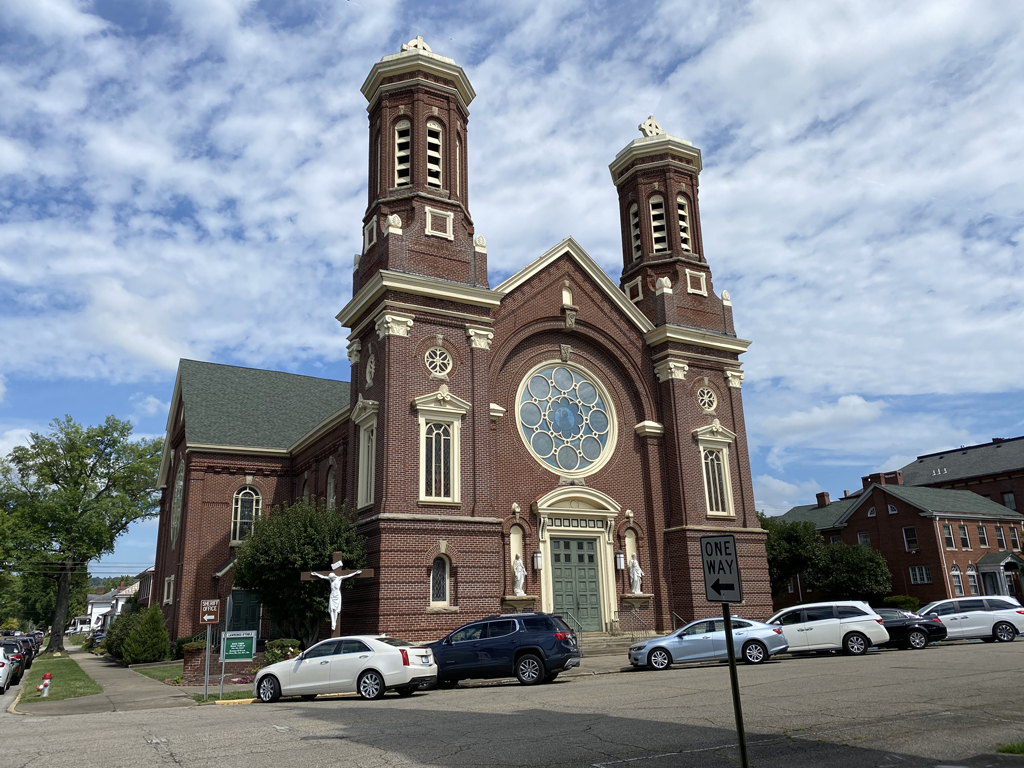
A beautiful old church in Ironton

The restaurant we had planned to eat at was closed on Sunday.  It looked interesting, as it was in an old railway depot.  Instead, we went to a local Italian restaurant.  Dick liked the food, I did not.  Either that makes me a picky eater (Dick’s verdict), or more discerning than my beloved. The first surprise was being told that, as it was Sunday, there could be no wine or cocktails, but beer was okay.  That seemed strange, but as Dick said, blue laws tend to be strange anyway.  I looked it up.  In Ohio, you can serve beer on Sundays without a special license, but for intoxicating beverages (that would be wine and spirits), you need a special license.  Who decided that beer is not intoxicating??

Later in the evening a houseboat tied up on the dock below us.  In the morning, Jim came along the dock and introduced himself.  We had a very pleasant chat.  He was taking an elderly, but new to him, houseboat north to Marietta and up the Muskingum to his home.  We don’t envy him single-handing through all those manual locks!  After a big breakfast, we were on our way by 9:45.

Hanging Rock is a town just south of Ironton.  In addition to being known for giving punishing speeding tickets to unsuspecting visiting motorists, it is the location of a former iron mine that had particularly high purity iron.  The Hanging Rock Region produced some of the best iron in the United States between 1818 and 1916.  The rusted old loading facility is visible just downstream.

Hanging Rock
Interesting house on the Ohio north of Portsmouth. A house has been built to resemble an old sternwheeler.

Our next stop was a return to the Shawnee Boat Club in Portsmouth.  It’s a strange and difficult dock to tie to, set up with small eyebolts with a rusty cable running through them, along the edge of the dock.  On our last visit, the dockhand came down and helped us, but he was mowing the grass and did not bother this time.  Dick says the system is easier for small boats, especially pontoon boats, but it is a royal pain in the you-know-what for bigger boats.  I couldn’t get a boat hook under the cable from above, so Dick had to get off the boat and take the lines off the deck while I held Nine Lives steady.  The system, including the water lines, also create a nasty tripping hazard right at the edge of the dock.  Not our favourite stop, but after 4 nights on town docks, we needed to fill up with water.

Shawnee Boat Club, eyebolts with rusty cable, plus a waterline, run along the edge of the dock

The Shawnee Boat Club is located in Portsmouth.  Although I can find no other records of it, a plaque tells us that there was once a canal that ran from Portsmouth north to Cleveland.  The Ohio and Erie Canal was built between 1825 and 1832.  Boats leaving Cleveland had to climb 500 feet to get to Newark, and then descend 500 feet to Portsmouth and the Ohio River.  There were 55 locks on the descending stretch alone. Although there are the remains of a few of the locks, there is no longer any trace of the canal.

Portsmouth architecture and civic park
Portsmouth riverfront park
Some of the murals in Portsmouth, showing modern industries
Another Portsmouth mural, showing many of their historic churches

It was a day with an early arrival and no plans to eat on shore, so I was able to try a new recipe, pork fricassee with mushrooms and artichokes.  The first challenge in preparation, was finding that I don’t have a meat mallet on board, to pound the pork pieces into ¼ inch medallions.  Being an intrepid cook, I borrowed Dick’s hammer.  Once wrapped in two layers of foil, it worked very well.  I just had to be careful not to hit too hard, or the head of the hammer would go right through the meat!  The dish turned out very well, and was delicious, definitely a keeper.  Afterwards we sat in the cockpit and watched the sun set with a postprandial glass of bourbon, since we have left West Virginia and are now back in Kentucky.

Pork fricassee with artichokes and mushrooms

We are seeing more eagles on this stretch than we did on the upbound trip, both mature and juvenile bald eagles, although not as many as we saw on the Mississippi.  The wide Ohio River makes it hard to see them unless they fly across, and photographs are out of the question.  Considering that bald eagles had disappeared from the Ohio, along with herons and other large birds, this is a good sign.

We tied up at Ripley Boat Club before 3:30.  It had been a 60-mile day, but with no locks to delay us.  The Boat Club has a long dock with a restaurant.  The dock has nice big cleats, freshly painted, so there is now a little blue decorating our black lines.  A first time for us, the wooden docks have old tires on the sides, and boats are protected from the black rubber by tarps hanging over them.

Ripley downtown
A nice garden in Ripley
Ripley home of abolishionist John P. Parker

The restaurant was very popular, but we had already decided to eat on board, and basket food and burgers were not enough to tempt us.  There was some noise from trains across the river, and a few wakes from tows, but it was a mostly quiet night.

August 30th.  We chose an early start, and were out by 8:10, with a lot to do on arrival in Cincinnati and one lock for the day.

We were put through the big chamber, and there is always a bit more motion in that circumstance, but Nine Lives likes going down, so we just swung gently back and forth on the floating bollard at midships, while the fore and aft fenders kept nudging us off the walls.  As the gates opened, we saw an opportunistic heron, standing in the gate door, ready for any fish that might be hanging around inside the lock.  He watched as we approached, critiquing our lock exiting technique.

A heron fishing from the lock door

Down the river, we saw a barge being loaded at a lime operation.  We find it hard to believe that the barge doesn’t sink the way they are loaded!

Loading a barge, note how far down in the water the stern is as they load

Approaching Cincinnati, we passed a still under construction French chateau, and later a beautifully landscaped Moorish-style villa, both high on the hillside with stunning views.

A French style chateau on the hills above the Ohio north of Cincinnati
A home in the style of a Moorish villa, north of Cincinnati
Tower on the Ohio north of Cincinnati, we don’t know what it is for

We were in the marina by 1:15, but stopped for a pump out first.  We were tied up and all set by 2pm.  It was disappointing to find goose poop on the end of our finger pier, staff at the marina should clear it off when a boat is coming in with a reservation.  It was nothing like the messes at South Side though, and Dick quickly got rid of all of it as he prepared to fill our water tanks.

Dick collected the rental car we had reserved for our stay in the city.  While he was doing that, another boater dropped by to admire Nine Lives.  After he learned that we would be here over the weekend, he kindly offered to lend us his car.  This is easily the 5th or 6th time strangers have made this offer!  In Canada, only close relatives typically lend vehicles, and in UK, you have to call your insurance company and add the additional driver before you can lend.  However, in the US insurance companies are more agreeable.

We had an interesting dinner at a Hungarian restaurant.  Having lived in Eastern Europe, we like Hungarian food.  We tried a local specialty, Goetta, a pork sausage made with steel cut oats.  These were quite spicy.  I liked the taste, but not the texture.  For his main course, Dick had a combination plate, so he could try their cabbage rolls, goulash, and Hungarian schnitzel.  I had an interesting version of Wiener schnitzel with poutine.  The schnitzel, gravy, and melted cheese curds were excellent, but as so often happens, the French fries were not very good.  Our desserts were delicious.

Appetizers at Lazlo’s Iron Skillet
Combination dinner at Lazlo’s Iron Skillet
Schnitzel with poutine at Lazlo’s
Desserts at Lazlo’s, chocolate mousse cake and cherry streudel

We looked for the super blue moon, and eventually found it, but from our location on the boat, it was basically a non-event.  We would have had to drive somewhere to view it at its best.

All day and evening, we watched the progress of Hurricane Idalia.  Our kind neighbours in Hilton Head took in our balcony furniture for us, as Kathy was out of town.  One positive thing that happened, at some point there must have been a brief power outage, because our router was reset.  It had stopped working a few days earlier.  So I now have my security camera back online and can see what happens in our condo.

August 31st.  In the morning, we went to Findlay Market, probably the best market we have visited since Ottawa, several years ago.  There was a wonderful cheese shop, and we also picked up some treasures of the foodie kind in an international food shop.

Findlay Market in Cincinnati
Findlay Market
Prepared food at Findlay Market
Excellent cheese shop at Findlay Market

In the late afternoon we hosted a most enjoyable docktails.  Our guests were Audrey and Ted, truly Looper royalty, who completed their loop in 1998, and still participate regularly in AGLCA events.  Ted is also involved with two of the most useful guides for the waterways, Waterway Guide, and Skipper Bob.  As a complete contrast, Mike, who also joined us, will start the Loop next week.  He and his wife Darlene hope to drop by for some more chat and advice on Saturday.  It was an evening with lots of great stories and some good laughs, a great time.

Docktails snacks ready for our visitors
Ted, Mike, and Audrey joined us for docktails

We had been aware of huge delays at one of the locks further south on the Ohio.  The large chamber is under repair, and all boats are being put through the small chamber.  This requires most tows to split, and go through in two halves, turning what would usually be a one-hour lift or drop, into a minimum of 3 hours for each tow.  Also, tows have to avoid each other, so the queue has to be well stretched out.  The lock has been reporting delays of as much as 60 hours (yes, six zero), for tows in the queue.  Dick called the lock, and explained that we were planning to come through in about 10 days, and asked what procedure we should follow.  He was told that no recreational boats would be put through the lock until November.  This gave us a couple of days of concern and thinking about options.  Fortunately, it seems that the person Dick spoke to, made the assumption that he was a fisherman, and they are indeed refusing all small fishing craft until after work is completed in November.  However, we have been advised that yachts, such as ours, will be accepted, and there is a procedure to follow.  We will need to call ahead, and make an appointment for a specific time.  Since locks operate 24 hours a day, there is a good chance we may be on the River during nighttime hours, something we prefer to avoid.  So that is the cliffhanger, the story to be told in the next issue of the blog!

Nine Lives stats and track for her August voyage

July 20 to August 3, 2023: Cincinnati to Morgantown, West Virginia

Leaving the marina in Cincinnati, we made an early start, expecting a long day.  The river was up 2 feet due to all the heavy rain and thunderstorms in the Northeast.  There was a lot of debris in the water, not small stuff, big logs, that needed continuous dodging, so it was tiring for Dick on the helm.

We are now well into the part of the country known as the Rust Belt, or, more flattering, the Industrial Northeast.  As we travel up the Ohio and see the derelict factories and decommissioned but not mitigated power plants, the term Rust Belt takes on even more meaning.

A derelict suspension bridge, only partly demolished. Ospreys nest on top of one of the towers.

We passed the Zimmer Power Plant.  It was planned to be nuclear, and was 95% complete and 1.6 billion dollars spent when construction was found to be inadequate.  Investigations into quality assurance resulted in large fines, and by 1983 the costs had escalated, further legal problems were looming, and the project was cancelled and the plant was mothballed.  Conversion of the plant to coal was started in 1987, and by 1991, when it finally began generating power, more than 3.3 billion dollars had been spent.  This was not the end of the story, as by 2021, the operator was fined by the EPA for exceeding pollution emissions for more than 20 years.  By 2022 the plant was considered no longer viable, as it could not make enough money to justify keeping it open, and it was shut down.

The Zimmer Power Plant

The Ohio River is more interesting north of Cincinnati, with lots of properties on the waterfront, campgrounds, small boat docks, and pretty countryside.

We went straight through the lock with no waiting.  There was an incredible debris field outside the upper doors, no way around it, so we had to push gently through and hope nothing got into the props.

Debris on exiting the lock

In Augusta, KY, there is a ferry crossing the Ohio River that has run continuously since 1798, although it is not the same hand-propelled vessel they started with in the 18th century.

The ferry at Augusta

We arrived at the free town dock in Maysville, Kentucky.  Reviews of the mooring were confusing, so the plan was to make a slow pass before docking, to see what would be needed in the way of lines and fenders.  At the last minute, Dick just decided to dock.  I was not ready, we did not have headsets on, but I did at least have gloves on to handle the lines.  It was an easy docking, and we were settled by 3:30pm.

According to one of the many historic plaques, Maysville considers itself the “Birthplace of Bourbon”.  The town was a major shipping port for bourbon from the 1780’s, and the first documented advertisement for bourbon whiskey appeared in 1821 by Maysville merchants Stout and Adams.

Part of Maysville’s flood wall mural, showing the port during its heyday

We walked to Caproni’s, a venerable Italian American restaurant.  It opened in the 1930’s, as a sandwich shop for railway workers and travellers.  The meal was enjoyable, with friendly service.  We decided to try special cocktails for a change from our usual glass of wine or bubbly.  Dick’s concoction was made with iced tea, he requested unsweetened, and it was apparently very refreshing.  Mine was not a success.  I had not expected a recipe with peach schnapps and bourbon to be sweet, but it was impossible!  From now on I will stick with wine, or water.

Extensive selection of bourbon at the bar at Caprioni’s

Maysville has some lovely old buildings, but like so many places in small-town America, it is struggling.  We noticed a high school building that has been re-purposed to condos, which is a good start towards revitalizing the downtown.  One of the many murals on the town wall depicts a buffalo hunt in the 1600’s.  It has been noted on several occasions when I read about the history of the Ohio Valley, that the local native people were displaced by the Iroquois during the 17th and 18th centuries, with the Iroquois maintaining the area as their own hunting preserve.  The Iroquois were themselves displaced by French and British settlers, and later by the movement west into what was called the Northwest Territory.  What goes around comes around.

Another part of Maysville’s floodwall mural. This shows a bison hunt from the 17th century.
Downtown Maysville
Another view of downtown Maysville
Downtown Maysville
One of the historic homes in Maysville
Washington Opera House, Maysville, Kentucky
Detail of one of the downtown buildings in Maysville

There were heavy thunderstorms in the night.  As I lay there listening, and watching the rain sheeting down the back door, I realized that the rain never hits the back door because of the extended hardtop.  I scrambled out to close the rolled up eisenglass at the back.  It took only a moment, but my pajamas were soaked.  The rain blew in far enough to wet the table, the gloves on it, and our deck shoes underneath.

The next day we passed the J.M. Stuart Generating Plant.  It was the 11th most polluting power plant in the USA.  It was shut down by agreement with the Sierra Club and other interested parties, and is in the process of being demolished.

Partly demolished J.M Stuart Generating Plant

We passed the attractive and historic Selby 100 Mile House and Gardens.  This is now a B&B.  It looks very nice, but it is truly in the middle of nowhere, and there are no restaurants nearby for guests to find an evening meal.

Selby 100 Mile House and Gardens

Further upriver, we passed the Majestic Showboat.  This is another sad example of a historic fixture that has been allowed to fall into ruin.  The boat was built in 1923, and was the last floating theatre to be built in the USA, and the longest running.  It was declared a National Historic Landmark in 1989.  The showboat has no propulsion, and requires a tug to move her from place to place.  In 1965 the boat was shut down, as her wooden hull was considered unsafe.  She was drydocked, a steel outer hull was added, and she was purchased by the University of Cinncinati for use by theatre students for summer stock.  This lasted until 2019, when she was sold to a couple who planned to use her as a tourist attraction and airbnb.  Disputes arose over permitting and the plan to have her docked in Maysville fell through.  She is now sitting at a quiet stretch of the Ohio River, untended and unloved, a sad end to a long and interesting history.

Majestic Show Boat

We arrived at the Shawnee Boat Club in Portsmouth by 3:30, but it took us more than half an hour to tie up, even with help from a dockhand.  There are no cleats on the docks.  Instead, there are eyebolts, with a braided steel line running through them along the edge of the dock.  It would be impossible to tie up without help, or one of us jumping off the boat.  To add to the tripping hazard, a waterline runs along beside the steel line.  Fortunately, after a quiet night, it was a very calm morning, so Dick could untie us completely before stepping back onto the boat, while I stood ready at the helm if we drifted too far into the river. 

Dick rode up the hill to Kroger, which featured an interesting mural of the town on the side of the building.

Portsmouth, mural on the wall of the Kroger Supermarket

The Sciotoville Railroad Bridge, known as the Colossus on the Ohio, was an engineering marvel in 1916, at the time of building.  It was the largest rivetted truss bridge in the world until 1945.

Colossus of the Ohio, the Sciotoville Railroad Bridge
Detail of the Sciotoville Railroad Bridge

We arrived in Huntington, and were tied up on the town wall by 2:30.  We walked into town for dinner at Le Bistro.  This is the Rust Belt’s idea of a French restaurant.  The chef was very fond of garlic and pepper, and was perhaps overly generous with both, although we are also fond of them, so we enjoyed the meal.  It was the evening before our wedding anniversary, so Dick had pre-ordered the Chateaubriand.  It was supposed to be “prepared at your table by our chefs”, but it arrived on a wooden board, ready for us to help ourselves.  Overall, the food was okay, but nothing special.

Nine Lives tied up on the wall at Huntington
Le Bistro Onion Soup
Le Bistro Caprese Salad
Le Bistro Chateaubriand
Le Bistro Blueberry Cake

The next day we tied up at Point Pleasant, again on the town wall.  There was a floating dock, but it was very low, so we used the concrete wall, which had good cleats and huge rubber bumpers.  We did need to take care with the fenders, partly to make sure the rubber wasn’t making black marks on the boat, and also to be sure the fenders weren’t trapped.  The next morning, I had a notice from WordPress, and an email through the blog site to say that a local resident had seen us tied up at Point Pleasant, and had found us on the internet.  Nine Lives is famous!

Nine Lives at the wall in Point Pleasant

Point Pleasant town dock is just above the site of the Silver Bridge.  This was an eyebar chain suspension bridge, named for the colour of its aluminum paint.  It was built in 1928.  In 1967, the bridge collapsed under the weight of rush-hour traffic, with the loss of 47 lives.  The bridge was carrying more weight than it had been designed for, and had been poorly maintained.  A single eyebar in one of the suspension chains failed, due to a small defect just 1/10 of an inch deep.  Most suspension bridges have been built with multiple redundancy in the eyebar links, but the Silver Bridge had just two, so the failure of one link resulted in catastrophic failure of the other.  Inspections, using the technology available at the time, could not have seen the flaw or prevented the disaster.  The collapse led to the creation of the first National Bridge Inspection Program in 1968.  Despite this program of inspections, bridges still occasionally collapse.

Early morning fog in Point Pleasant. Looking south at the replacement for the Silver Bridge
The Silver Bridge disaster led to a program of bridge inspections. Here, engineers inspect a highway bridge.

We walked into town and had dinner at a Japanese restaurant.  It was a nice change, but although there was a huge amount of food, it was a little uneven.  Great fried dumplings, strange tasting tempura vegetables, and enormous portions of hibachi chicken, filet, and shrimp.  Returning to the boat, we found the concert that had been setting up was about to start.  It was very sparsely attended.  The music was religious light rock, played for about an hour and a half, and then everyone went home by 8pm.  It seemed like a lot of expense and effort to set up (stage, power, lighting, and a pavilion for the privileged few), for a very short concert.

Hibachi dinner in Point Pleasant

The weather was finally cool enough overnight to turn off the generator and do without air conditioning.  There was mist on the water in the morning, although there was more heat to come, according to the forecasts.

Point Pleasant is famous for the Mothman legend, a larger than human creature with wings and glowing red eyes, sighted over a period of about a year in 1967.  It was first described by a couple who saw it, and claimed that it chased their car (could they possibly have overindulged in a bad batch of moonshine?)  As soon as the encounter was reported, there were many more sightings, and in due course the story was picked up by the national press.  Eventually the tale was made into a movie with Michael Keating.  Sober heads suggest that the initial encounter most likely was a Sandhill Crane, that was off its migration route.  They are the largest crane in America, and have red patches around their eyes.

Statue of the famous Mothman of Point Pleasant

The next day we anchored behind Buffington Island, anchor set by 2:30.  We watched a young deer browsing the vegetation along the shore.  Apart from one pontoon boat and a fishing boat, we saw nobody.  It was a quiet location, with barely enough current to keep the boat in line, so it might not do so well in a strong wind.  We had heavy thunderstorms overnight, and once again I got soaked zipping up the back window.  Talk about fool me twice!  Why are you the one getting soaked, I hear you ask!  Dick does not wake up for anything short of a very loud siren.  By the time I get his attention, I can just deal with the problem.

Deer browsing on the shore at Buffington Island
Common Merganser, foraging near a lock
Hibiscus moscheutos, we have seen these pretty flowers on the banks of the rivers.

We arrived in Marietta well before 2pm.  Dick had been told he couldn’t make a reservation, and to call on the day.  Repeated phone calls, and messages were left, but no answer.  We needed to take on water anyway, so we tied up at the fuel dock.  When Dick went up to the office, there was a sign on the door saying, “Closed Monday and Tuesday”.  He came back and we set our lines properly, and plugged into the power post.  Dick took on water immediately, just in case we got kicked off, but nobody troubled us.

Marietta City Docks

It was a very short walk to the restaurant.  The food was okay.  Dick fell into the trap that always used to catch my Dad.  He heard “rack of lamb” and ignored the rest, so he was quite surprised that it was prepared as tagine, with couscous and tomato sauce!  Not what he was expecting, but he enjoyed it anyway.

Marietta was the first town to be settled in the Northwest Territory, west of the Ohio River.  The settlement began in 1788.  It was named after Marie Antoinette, in acknowledgement of France’s role in the American Revolution.  We were told that after the Revolutionary War, George Washington arranged for any soldier who had fought in the war, to be awarded a land grant in the new Northwest Territory.  Apparently, there are more Revolutionary soldiers buried in Marietta’s cemeteries than anywhere else in USA.

Sternwheeler tourist boat in Marietta
An old steam engine

One of the attractive homes in the town is the Lockmaster’s House, built in 1899.  Clearly, the position of lockmaster in the 19th century was one of great prestige. The lockmaster was on call 24 hours a day.  The lock was one of the hand-operated locks on the Muskingum Waterway.  Ten of these locks are still in use, and they are still hand-operated.  The Waterway might have been an interesting detour for Nine Lives, but advice from other boaters was that it was not worth taking the time.

We had a very quiet night, and heavy fog on the water in the morning.  I watched a man in a small boat net fishing.  I have seen quite a few optimistic fishermen using these nets, that are large, circular nets with weights.  One tosses the net out into the water, and then gathers it in, supposedly full of fish.  I have yet to see a single successful cast. There was still nobody about when it came time to leave, so we enjoyed a night of free dockage with power and water!

Net fishing in the river at Marietta

Reviews of our planned stop at Sisterville suggested that there could be shallow water at the dock.  We made a close pass, and seeing the weeds in front of the dock, and a pile of mud and sand beside it, we decided not to attempt it.  Ten miles further up the Ohio, is a State Park with a good concrete wall.  The depth at the wall was 19 feet.  The bollards were about 50 feet apart, so docking was a bit of a challenge.  I threw a line over a bollard at the midship, and that allowed Dick to jump off and then walk the boat back to put a loop over a second bollard with a longer line.  We even managed a spring line, essential on the river with all the wakes from passing tows and pleasure boaters.

Sudden, unexpected rain, and the need to close everything up in a hurry got us both soaked, and proved that my weather app may just be more reliable than the one Dick is using!  There was another sharp shower at dawn, but otherwise it was a peaceful night.

The lock was just upstream, and there was no wait for the small chamber, so we were through by 9:30am.  We tied up at Wheeling Landing by 1:30pm.  There were a number of boats already on the lower part of the wall.  A guy came over to us and warned us that we should use a chain to lock the lines in place, because there is apparently a problem, getting worse each year, with teenagers untying boats at 3am.  We use multiple lines anyway, including some tied back on the boat, so Dick decided not to do anything beyond our usual routine.  A lot of preparations were underway for a big festival to start the next day.  Huge trailers parked in nearby streets included Veterans Affairs, Homeland Security, and Disaster Response.  We were not sure what any of those would have to do with an Italian Heritage Festival.

By dark, there were lots of boats docked, including several rafted up, as the lower, easier docking part of the town wall was full.  A friendly guy near us told me that he leaves his boat tied up on that wall often, and has never had a problem.  That relieved my mind somewhat, but when we walked to dinner we saw more homeless people in the park than we have anywhere else.  The town is in poor condition, with many buildings closed up.  A lot of the streets are torn up, possibly to install new water mains or sewers.  Dinner at a nearby diner was quite good, but we have no need to return to Wheeling.  Without the festival and other boats around, I would not feel at all safe overnight.

Construction in downtown Wheeling
Historic building in Wheeling
Another of the old buildings in Wheeling

We passed the factory in Newell, WV, where they make Fiesta Tableware, first introduced in 1936.  In 1871 two brothers, Homer and Shakespeare Laughlin, started a pottery factory in East Liverpool to produce whiteware, that was becoming more fashionable than the yellow pottery that had been common in USA.  In 1897, the successful business was sold to Edwin Wells and his partner Louis Aaron.  The pottery is still managed by the Wells family today.  In 1936, Fiesta Tableware was introduced, and was an immediate success with its high gloss, bright colours, and practical Art Deco shapes.  Despite its popularity, Fiesta was retired in 1978, but it was re-introduced in 1983, and continues to be manufactured today.

We were booked into Holiday Marina, on the Chester side of the River.  We were on the wall, which has metal edging and no rubber. The slips, although wood, are low, with narrow finger piers and also no rubber.  Regardless, it was a decent place to stop for the night, especially in the location we were assigned.  Dick was pleased that the showers were spotless.  We plan to stop there again on our return journey.

We passed a marina near Weirton. Note how close the barge is on the right of the image. The marina is located just around a bend next to a barge fleeting area. If a tow loses control of a barge, it will completely crush the docks and any moored pleasure boats.
Drydock with a sternwheeler being repaired
W.H.Sammis Power Plant at Cumberland Lock. Note that the highway passes through a tunnel under the generating station.

There were huge thunderstorms again overnight, and in the early morning, so we considered staying there a second night.  However, there seemed to be a window of opportunity, so we left shortly after 8am.  We had 3 locks to transit that day.  We were surprised to be told at the first lock, that the small chamber requires that you supply a line.  Dick was prepared for that on the Monongahela River, but this was unexpected on the Ohio locks, and the line was still coiled in the locker.  This meant that there was a bit of a scramble to get it ready.  100 feet of line is easily tangled, and too much to hold a coil even for Dick’s big hands!  The lockmaster passes down a hook, you put your line on it, and he pulls it up and wraps it round a bollard or hangs it on a hook.  We cleat the line in the middle of our bow, and then after it passes round the bollard on the lock wall, Dick holds the other end on the lower cleat at the stern. It worked well for two locks, and then the third was a mess.  The wind had come up, and blew us about, but the big problem was a small speedboat that came in behind us.  They were not ready at all.  They didn’t have a line to pass to the lockmaster, and the line they took out of the bow of their boat was all tangled up.  The man attached it to another line, also tangled, and meanwhile the wind blew them around the lock, nearly into the stern of our boat.  The lockmaster moved us up a bit further into the lock, while the man continued to try to get himself organized.  His wife apparently had no role, she simply sat at the back of the boat while the man jumped back and forth, trying to steer away from the lock wall, and also get the lines sorted.  It all got a bit easier when the lockmaster finally closed the doors, so that at least the wind was no longer a factor.  It was an object lesson for boaters, everyone should have a role, be able to assist, and needs to understand what is happening in the various situations one encounters, particularly locking and docking.

At last it was time for the lock to start filling.  The review I read said it was a “turbulent” lock.  This is the understatement of the trip.  I had to use the engines to even come close to holding Nine Lives somewhat aligned to the lock wall.  The lockmaster was very chatty, and he and Dick enjoyed a conversation about the Great Loop and catamarans.  Then the heavens opened.  All the windows were rolled up, so we had to jump to close everything, while still trying to maintain the boat in position as the lock filled.  I stayed mostly dry, but Dick had to go back out and tend the line (and resume his conversation with the lockmaster).

Locking with our own (red) line, tied at the bow, passed around a bollard on the lock wall, and held at the stern by Dick (he is behind the cockpit at the left of the picture).

Arriving in Pittsburgh, we had planned to stay on the wall at The Point, a park where three rivers meet.  It is the confluence of the Ohio, the Monongahela, and the Allegany Rivers.  There were no cleats or bollards that we could see, just rings set in the very low concrete wall.  We needed a pump out first anyway, so proceeded to the marina where we had made a prior arrangement.  We will be returning to that marina later in the month.

Pittsburgh, The Point, the confluence of the Ohio, Alleghany, and Monongahela Rivers

The pump out was self-serve.  The machine cooperatively ate Dick’s $10 bill, but declined to turn on and start pumping.  Then the heavens opened again.  Dick phoned, and the marina manager, who fortunately lives on site, came over and got the machine started.  He said we would be all right to stay for the night, for the usual charge, of course.  This means we get power and water.  There were a lot of strong wakes from boats going up and down the Monongahela, so we needed good fendering.  As the rain came down in buckets, I asked Dick if he wanted his waterproof coat.  As usual, he said no, because he was very sure the rain would stop.  Once he was wet through, he asked me to get the coat.  Struggling to get it on, over wet clothes, and not drop the headset into the water, took a few minutes, but as soon as it was accomplished, the rain stopped.

Lots of very chatty people dropped by and admired Nine Lives and talked about the Great Loop.  This was more friendly conversation than we have had on the dock for ages.

Sunset at South Side Marina, Pittsburgh

The next morning, we passed the Elrama Power Plant, a coal-fired plant that closed in advance of pollution regulations.  The buildings were imploded in May of this year, local news reports said the plant was “reduced to rubble”.  It is certainly a mess, but not quite rubble yet.  It is really a depressing sight to pass the incredible number of closed power plants and factories.  We know that they were huge polluters, and were closed with lawsuits and to avoid fines, but nobody requires the sites to be properly cleaned up.  Apart from being a huge eyesore, there have to be chemicals and metals leaching into the water table and of course running off into the rivers. No longer quite as shiny as when we started out, Nine Lives is now sporting a brown moustache at the waterline from the murky water of the rivers.

Partly demolished Elrama Power Plant

We were tied up at Beach Club Marina in the town of New Eagle, by 1pm, a nice early finish in spite of passing through 2 locks.  Unfortunately, after we had all our lines set, and power started, we had to reposition and do everything again.  It is always a bad sign when there are lines already on the cleats, and sure enough, the space the dockhands had put us in belonged to a seasonal slip-holder.  The location is very pretty (not a factory or power plant in sight), but subject to a lot of rolly-poly due to wakes as boaters rip past at speed.  The building that had once been the fuel dock and office was shut, so payment for dockage was a bit problematic.  Normally we would pay with a credit card, but apparently this would be quite a difficult prospect, and cash is preferred.  In this day and age it is hard to imagine that cash is the only option.

Dick took a walk to investigate the town and buy a few groceries.  He reported that there is really nothing else there.  We walked up to the on-site restaurant for dinner.  It has recently opened, and had 22, 5-star reviews, all dated the same day…  The food was quite tasty, although from a limited menu, but they were very short-staffed, and our meals took forever.  Meanwhile we were surrounded by badly behaved adults with their equally badly behaved children (handstands in a restaurant?).  We feel no need to return to either the restaurant or the marina.

There was very heavy fog in the morning, we couldn’t see the shoreline across the river.  Dick cooked one of his signature breakfasts, which gave the fog time to lift.

Dick’s signature breakfast

Arriving at Lock 4, we saw a dredge working just outside the lock doors.  It was interesting to be so close, as a crane lifted buckets of gravel from the riverbed into a waiting barge.  The lockkeepers were very chatty, told Dick that they had been expecting us, as they had a phone call from the downstream lock.

Dredge at Lock 4
Barge construction plant on the Monongahela. You can see a nearly finished barge, waiting to slide down the tracks into the river.

We arrived at Ten Mile Yacht Club by 2:30, and had help from our member contact to get into the slip.  It was slightly worrying for me as we got closer to the rocks at the bow (Dick couldn’t see them), but with knowledgeable help we stopped in time.  There was no phone signal at all, so we planned a very quiet evening of working on the blog.  Dick prepares a print version, so we both need time for it.  As it happened, our plans changed, and we enjoyed one of the nicest social evenings we have had this trip.  Docktails were arranged with our hosts and some other members of the yacht club.  I put together a cheese and charcuterie plate, that was well received, and it was a most convivial evening.  Dick took a group of engineering students for a tour of Nine Lives including, of course, the engines.  Our hosts are in the initial planning stages for doing all or perhaps just part of the Great Loop, so they had lots of questions.

Dick’s initial contact with the Yacht Club was via a phone call.  He left a message for the man who was listed as the contact in the 2022 Quimby’s Guide that Dick is using for planning.  It happens that guy died some years ago, but fortunately his widow is still in touch with the Club, and passed along Dick’s message.

Ten Mile Yacht Club, note the jolly paint on the bollard!
A little whimsy at Ten Mile Yacht Club
US Steel, Mon Valley Works, one of the few steel plants still in operation
Another view of US Steel, Mon Valley Works, you can see how huge this plant is.

We left by 9am the next morning, and were tied up on the City Marina dock in Morgantown, WV, by 2pm.  They are excellent docks, but the power pedestals are not working, and there is no water.  We will have to be careful of water use over the next few days, and will need to run the generator if we want air conditioning.  Fortunately, it is cool at night, so AC not required at the moment.  The docks are in the Wharf District of Morgantown, an area in the process of revitalization, with lots of restaurants but no shops.  There is a bike path right beside the waterfront that goes for miles.

Morgantown City Marina docks

We walked up to Oliveri’s, an Italian restaurant very nearby.  This was the best meal we have had in a while, although the service was a bit chaotic.  We shared truffle fries to start, and then Dick enjoyed his beet and feta cheese salad.  My salad was not delivered, but there was plenty of food without it, so I didn’t bother to chase it.  Dick had seafood linguine that was excellent.  My lobster ravioli in a seafood cream sauce with grilled shrimp was outstanding.  Desserts were mixed, Dick loved his pistachio ice cream bombe, but my flourless chocolate cake was far too sweet.

Oliveri’s truffle fries
Oliveri’s beet and feta salad
Oliveri’s pasta dishes

Morgantown’s early history was one of conflict between British and French settlers and soldiers, and Native Americans.  The Treaty of Paris of 1763 ceded the area to the British, but fighting continued until after the American Revolution.  The University of West Virginia has three campuses in Morgantown, connected by an unusual driverless personal rapid transit system built as an experiment by the US Department of Transportation in the 1970’s.  It is still in use.

Morgantown Personal Rapid Transit Pod. Although the system is still in operation, it does not run when the University is closed for the summer, so we can only show you the example from the UWV Welcome Center
Morgantown Rapid Transit System pod interior

Morgantown has excellent bike paths that cover much of the city safely.  The Mon River Trail runs alongside the Monongahela River.  It is built on the right of way of the former Fairmont, Morgantown, and Pittsburgh branch of the Baltimore and Ohio (B&O) Railroad.  In 1996 the corridor was acquired to be railbanked as a non-motorized trail system.  The process of railbanking refers to a 1983 amendment to the National Trails System Act.  There was concern in Congress that the railway infrastructure of the United States was rapidly disappearing, and that some of the disappearing railroads might be needed in future.  The railroad company no longer owns the corridor, but it can be returned if it becomes needed to transport goods or people.  Given the variety of alternate modes of transportation of goods and people, I imagine it is highly unlikely that these trails will ever be repossessed.  Town and City Councils must agree, as there are quite a few of these bike and walking trails built on former railroad corridors.  We have enjoyed riding on several in other states as we have travelled around the Great Loop.

Mon River Trail, Morgantown

On our second evening in Morgantown, we walked along the Mon River Trail for about a mile to a so-called fine dining restaurant.  The food was sometimes strange, but mostly acceptable.  Perhaps not worth a long walk on a hot and humid day.

Mosaic sculpture on the Mon River Trail, Morgantown

The next morning, we were surprised to hear loud sirens from the city, starting around 6:30am, and sounding continuously for several hours.  There were different sirens from different parts of the city, and they continued to sound on and off throughout the morning.  No explanation was available online, and there were clearly no tornadoes in the area, so the reason remains a mystery.  Dick occupied his morning with making arrangements for delivery of diesel to the marina we will stay at in Pittsburgh.  The only marina that has diesel on the dock is charging more than the highest price we have ever paid, 50% more than the current price in other locations.  Having the fuel delivered by truck will still be expensive, but it will be less than the outrageous price charged at the other marina.

So far there has been no sign of any officialdom asking to be paid for mooring here at the Morgantown City Marina.  The rate was reported to be $15 a day, something of a bargain, but on the other hand, the power and water pedestals are not working.  This evening we will walk to the nearby restaurant in the Marriott Hotel, and we will start our return trip down the Monongahela River tomorrow morning.

Black-eyed Susans beside the path in Morgantown
July route and statistics for Nine Lives journey

June 19 to July 6, 2023, Pickwick Lake to Fort Knox, Kentucky

Nine Lives is on the move again.  She is looking particularly shiny and beautiful, with a new ceramic coating, and fresh lettering.  This year’s voyages will take her north on the Ohio River to Pittsburgh and beyond, and then south on the Cumberland River to Nashville.

Nine Lives at dock in Clifton

The crew left Hilton Head, with the vehicle packed tightly with all the items we take back for the winter, lots of frozen and fresh food, and bicycles on the rack at the back.  It had been our experience that grocery shopping in the Iuka area offered poor selection and quality, so as usual, we planned a number of meals ahead and shopped for them in Hilton Head.  It was an uneventful 9-hour drive to our destination, a cabin at Pickwick Lake State Park.  Again, past experience showed that it makes everything so much easier if we stay in a nearby cabin while making our preparations for the summer’s voyaging, rather than trying to work around piles of boxes and engine parts to sleep on board.  We stopped briefly on the way to check on Nine Lives and meet the cleaner, who was just finishing up.  We also confirmed that the existing lettering had been removed and Nine Lives was ready for her new script.

We ate at the lodge that evening, and after a good night’s sleep we were ready to begin.  In addition to the usual chores, the first priority was to install the new lettering, as the final ceramic coating is put on after the letters are installed. I was able to find a company that would use my design again for the name, and this time we chose to have the main script somewhat darker, while the cat’s eye and whiskers are gold.

After starting the process to shock (sanitize) the water tanks, we gathered the various tools and started with the letters for the hailing port that go at the back of the boat.  This process was made somewhat tricky by the need to stand in the dinghy to do it.  We learned a few things in the process, so it was a good plan to start with the smallest and least visible.  Next, the big job, 10 feet of the Nine Lives name (to be done twice, one for each side).  We decided to do it in 3 pieces, plus the separate eye and whiskers.  Doing it in smaller sections was definitely more successful.  The next day when we added the registration numbers we felt like old pros after all the practice.

The place where we put the hailing port, Hilton Head Island, is tricky to access
First steps in replacing the lettering
Carefully pull off the paper
It’s a tricky job!
She has her name again!

Flushed with our success, we set off to have dinner at The Outpost.  Dick had enjoyed a good burger there earlier in the year, so we were expecting a nice meal.  Sadly, this was one of the worst we have ever had.  Our cheese curd starter was well overdone, and the loaded waffle fries with pulled chicken was stone cold.  We sent it back and got a slightly warmer replacement that was still pretty much inedible.  Dick’s “Hungry Man” dinner was huge.  He ate the ribs and some of the pulled pork, and took the rest of it and the half chicken away in a box.  My dish was so awful that not even Dick was willing to eat it as leftovers.

The next day Dick drained and refilled the water tanks.  The tech was already there preparing Nine Lives for the final ceramic coat over the lettering.  After buffing she looks quite gorgeous!  I prepared the usual bags of cloves that discourage ants and other critters from visiting the kitchen cupboards and drawers.  Dick made multiple trips from the vehicle to unload and bring all the boxes and bags on board for putting away.  His next project was collecting the bags of steel shot that had been delivered to the marina office.  He ordered 10 bags, to be used as ballast at the front of the boat.  Interestingly, they were shipped in “flat rate” boxes by US Post Office.  Each bag weighs 50 pounds.  Only 9 actually arrived, and one was already out of the shipping box.  Dick had to make 3 trips, as 150 pounds is the absolute maximum that can be safely transported in the loading cart down the ramp to the docks.

50 lb bags of steel shot shipped in flat rate boxes

That evening we made a quick stop for last-minute groceries at the Kroger in Corinth.  It was a much better shop than any other we had found, so we may be able to consider provisioning there in future, instead of transporting everything from Hilton Head.  The highlight was, as usual, dinner at our favourite restaurant in the area, Vicari’s.  I could not resist my usual smoked trout pate to start, while Dick enjoyed his calamari.  Dick’s choice for main course was sea bass on a bed of spinach, and I had fried lobster tail with a quite delicious creamy blue cheese hash brown potato dish.  Desserts (always a must at Vicari’s) were crepes with strawberries Romanoff for Dick, and crème brulee cheesecake for me.

Calamari at Vicari’s
Vicari’s fried lobster tail with blue cheese potatoes
Vicari’s sea bass
Strawberries Romanoff crepes at Vicari’s
Creme brulee cheesecake at Vicari’s

We decided on an early night after all the hard work and a big meal, but Dick had just settled down when he had to get dressed again to meet the boat cleaner at the lodge and hand over cash to pay for the job.  She had been unable to find a bank that would cash the personal check.  This is the unfortunate situation here in USA.  The mechanism used by small businesses in UK, where one simply does a bank transfer to pay for goods and services, is not done here.  There are a few options, besides cheques or cash, but they are seldom used.  Making everything more difficult, personal checks are accepted in very few places, and rarely for cashing, just a deposit and funds held until the money clears.  Very difficult for a small individual business like our boat cleaner.  In future we will know to be prepared with cash.  We will certainly hire her again, as she did a great job.

Next morning, we packed up the food from the cabin and transported it to Nine Lives, where the fridges and freezers had been cooled ready.  While Dick played with bags of steel shot, I cut up the celery into single stick packets and put them into the freezer.  We use so little of the celery bundles that one buys in the supermarket, that this is a good alternative to buying fresh every time.

Chopped celery for the freezer

It is amazing what things you find that you haven’t seen for ages when you have to completely empty lockers.  There was a rotary laundry hanger, and even a toolbox with spare parts.  Getting the bags of shot into the forward pontoon on the port side was tricky.  There is a water line across the pontoon that the bags had to be lifted over, and there was no way that Dick could get in there past the watermaker to lift them over.  He had to settle for sort of tossing them from a prone position halfway into the pontoon.  I decided that a photo of Dick’s backside sticking out of the cupboard was not required for this account of our travels, but I did manage a picture of the small pile of heavy bags after he vacated the space.

Bags of ballast tossed past the water line in the forward port pontoon

The starboard side was much easier.  Just as well, as more bags were to be put in there to balance the boat.  All the extra refrigeration, the generator, and the propane tank are on the port side, and Dick is certain we added the better part of 1000 lbs of provisions, thus giving Nine Lives a distinct list to port!  I am not sure it’s really 1000 lbs, but the man who loaded and unloaded the car, then wheeled it all the better part of ¼ mile down the docks to the boat in multiple trips says that’s how much it was.  There is access to the starboard pontoon from above, through the locker where we keep chairs and extra canvas and fenders.  Dick cleverly used one of the fender boards (after first tying it off to avoid disaster) and slid the bags down into the pontoon.  He could then use the boat hook to reposition them.  The final two bags are just sitting in the locker, so can be removed if we are now front heavy.  I can say that the ballast certainly does make a difference.  We can see that the bottom paint at the waterline is now very close to equal at both bow and stern, and less water pools in the corners of the showers.

Sliding the ballast into the forward starboard pontoon

June 23rd.  Underway at last!  We added a small amount of diesel, but we already knew that fuel is cheaper further north by about $1/gallon, and we want absolutely full tanks before heading up the Ohio.  Diesel is reportedly scarce on that river.  We had a short wait at Pickwick lock.  The lockmaster initially said 2 hours, and we could tie up on the lock wall while a split tow finished, but he decided to put us through the auxiliary chamber early, so our wait was less than an hour.

Waiting for passage through Pickwick lock

Here is a good spot to review how we handle these big Army Corps of Engineers locks on the rivers.  I prepare the boat (fenders and a mid-ships line ready), and then we change places and I drive the boat into the lock and maneuver Nine Lives close to the wall where there are floating bollards.  Dick uses the boat hook to get the line around the bollard, which floats down (or up) as the lock empties (or fills).  I remain at the helm and may occasionally need to use the engines to realign us to the wall if turbulence starts us spinning out of position.  Keeping the engines running is somewhat controversial, but we only need to do this in the very big locks, and we have never been asked by a lockmaster to turn them off.  Locking complete and doors open, Dick retrieves the line and I drive off, and then we switch places again so I can put away the line and stow the fenders until the next lock.  We use headsets to communicate throughout the process.  These make a huge difference, no need for shouting or trying to make hand signals while wrestling with lines.

Dick tends the line beside the floating bollard
Pickwick lock, doors opening

As we made our way north on the Tennessee River, we passed several houses that had all but collapsed.  It appeared to be tornado damage, one house looked as though a huge fist had smacked down in the middle of the roof.  The houses are a write-off, and yet other buildings nearby were untouched.  One was completely reduced to rubble that had slid down the river bank.  It is confusing that we are travelling north, but going downstream.  The Tennessee climbs up from the Ohio River into the foothills of the Appalachians, navigable as far as Knoxville.

Tornado damage on the Tennessee River

We arrived at Clifton by 3:30.  Dick walked into town, but as the marina owner had told him, there was really nothing to see!  We had dinner at the marina restaurant (a major contrast to Vicari!)  Pretzels with beer cheese to start.  Dick was conservative and ordered bangers and mash, but I was adventurous and tried the bacon popper grilled cheese.  Bacon poppers are jalapeno peppers, filled with cream cheese and wrapped in bacon.  They were put inside a traditional grilled cheese sandwich.  It was very tasty!  That evening the entertainment was a highlight, we always enjoy live music.  This was LOUD, but very talented (older) guys.  They played rock and country rock, including Rolling Stones’ “Satisfaction”, Brooks and Dunn “Lost and Found in a Border Town”, and a fantastic blues version of Happy Birthday for a member of the audience.  Another audience member joined the group and sang “Green River”, one of Credence Clearwater Revival’s big hits.  At the break the group came over to our table and introduced themselves.  The lead singer had lived and worked in Bluffton, so he knew Hilton Head well.  He is now based in Nashville, and his day job is installing air conditioning units for hospitals and clean rooms.  For a change Dick was happy to stay nearly to the end of the evening without my having to nail him to the chair!

Beautiful ironwork on balconies on a historic former hotel in Clifton
Bacon popper grilled cheese sandwich
Live music in Clifton, great rock and roll
A rendition of Green River

We made an early start the next day and anchored in Birdsong Creek before 3pm.  There were a lot of little boats out on the water, but nobody else anchored in the place we enjoyed last autumn.  We had thought about visiting the pearl farm, but it was very hot, so we just stayed on board.  We enjoyed our traditional first night at anchor bottle of bubbly with a few snacks, followed by grilled steaks, baked potatoes, mushrooms, and corn.

First night at anchor in Birdsong Creek

It was a quiet night, although several times we were gently rocked by wakes.  Chef Dick cooked his signature full breakfast, eggs, bacon, sausage, potatoes, mushrooms and toast.  The anchor came up easily, the new motor and gear unit on the windlass working well.  The weather app said it was 94F, “feels like 104”.  It did.

It was a relatively short trip to Paris Island, and we were tied up by 1pm.  Dick scouted the area, and arranged for a ride to the conference center where we had dinner.  To our surprise, the waitress refused to serve alcohol to me because I did not have ID with me.  Research suggests this is a new problem in Tennessee, seniors being carded and refused drinks without proof of age.  The waitress was wrong, there is an exception for anyone who looks older than 50 (!), but there was nothing to be done, she was adamant.  It was also irritating that Dick had been served a beer in the bar earlier without any ID requested.  The food was indifferent.

We had an uneventful, if windy ride north on a somewhat lumpy Kentucky Lake to Green Turtle Bay.  We were fine, but some of the small boats that were out and about were bouncing a lot, and sailors were in their element!  We were tied up in Green Turtle Bay by 1:45.  Nine Lives enjoyed the compliments from the dockmaster, “beautiful boat”, and we also enjoyed hearing “you’ve done that before” as Dick maneuvered into the 22 foot wide slip without touching the sides, and I passed the lines to the waiting audience.

The next entertainment (for us) was watching TowBoatUS bring in a 45-foot Silverton aft cabin to the slip near us.  On a windy day it took several tries.  There were only women on board, a lot of boat for 3 of them.  Apparently, they made a mistake when topping up with fuel that morning, adding gasoline to the diesel tanks.  Very bad for the engines!

We were delighted to learn that GTB now rents golf carts that can be taken into town.  We had dinner at Patti’s, an easy bike ride, but having had problems with hip and back, I was happy to postpone the bike riding until another day.  It was a good dinner, but we were carded again for alcohol.  Here it was apparently a new town ordinance.  I believe it is an attempt to reduce teenage drinking (in US the drinking age is 21), but carding seniors would seem to be pointless.  This time I was prepared and had put my licence into my pocket.

Patti’s at Grand Rivers

Just as we left for dinner, we realized that there was no water, the tanks were empty but the gauge showed ¾ full.  We hoped it was just the gauge and not the pump.  On our return from dinner Dick added water to the tanks and we were happy to find that everything worked as it should.  It would seem that the gauge is now defective, so we will have to take extra care not to run out of water.

One of the tachometers was not working, and had not corrected itself after several days of cruising.  This has been an ongoing issue for some years, but only after the boat has been left for a while.  Two electrical techs came on board to see if they could diagnose the problem.  They wiggled some wires and then said that it wasn’t what Dick had thought, and could not easily be fixed in the time available.  To Dick’s great surprise, the tach started working the next time the engine was started, so whatever they wiggled must have fixed the issue.

We had an enjoyable day.  We went into town and were surprised and pleased by the selection of food at the small grocery store.  We could have bought frozen alligator tail meat, crawfish, oysters, or catfish, but we contented ourselves with some shrimp.  We visited the various boutiques that are part of Patti’s complex, surrounded by beautifully kept, shady gardens.  We found a throw pillow that will work in place of the short cockpit seat cushion that was inadvertently left at home.  In the afternoon we played bridge online with our English bridge club.  We enjoyed the game and finished in the top half, but it was embarrassing that after two years of rock-solid performance, the mi-fi (internet router) cut out 3 times.  We are noticing reduced performance, especially by afternoons, and have our suspicions.  It is just a couple of months since the 24-month purchase contract was complete and the gadget was paid for, and one thinks, hmmm, planned obsolescence.  If we have a lot of issues, we will give up on T-Mobile for internet service on board, and go with the newly available Starlink system, which is satellite based.  Later in the afternoon we went over to another boat and enjoyed docktails with new Loopers.

Frozen food choices in Grand Rivers
Bird houses in the gardens at Patti’s in Grand Rivers
An old truck on display at Patti’s… note the sign on the door, Please Don’t Climb On Me, I am old and tired.
Pink Tractor, a boutique in Grand Rivers

The next day we needed an early start, with 2 locks and 54 miles to go, plus getting fuel and a pump-out on the way out.  There was no wait at the first lock, other than for the lockmaster to turn it around.  We have seen lots of osprey nesting on the daymarks.  Other wildlife has included at least one bald eagle, golden eagles, turkey vultures, cormorants, and one pelican.  On the Cumberland River we saw what was probably a coyote, but might also have been a large fox.  Asian carp seem to be under better control.  An electronic barrier has been installed below Barclay Lock, and we saw few above it.  There were many dead carp below the dam and the barrier.  The Cumberland River was enjoyable as always, industry can be as interesting as scenery.  We were glad that we didn’t meet any tows on the narrow, winding river.

Turkey Vultures on the Cumberland River
Ospreys nesting on a daymark in Kentucky Lake

At Smithland lock our luck ran out and we lost 4 hours.  There were 2 upbound tows waiting.  The lockmaster said he would have sneaked us through, but one of the tows was carrying chemicals.  He said he would not put any tows down until after our passage, but eventually he came on the radio to say that the downbound tow had empty barges and he would be putting it through.  Once we were finally in the lock, we found out what had happened.  The lockmaster came and told us that a crewmember on the downbound tow had been threatening to kill the other crew (!) so the police came to the lock to arrest him and take him off.  I am glad we knew nothing about that until it was over!

Downbound tow leaves the lock after the arrest

Leaving the lock, we ran fast to make up some time and burn off the carbon that would have accumulated while we were idling.  We were anchored by 6:40, a long day.

So far the Ohio looks like the Mississippi, not very interesting.  We are hoping it improves, especially as we get nearer to the mountains.

We passed a quiet night, although I was most unhappy about our position in the anchorage, very close to the shore.  We were out by 9am, after one of Dick’s signature breakfasts.

Dredging on the Ohio River

We passed Cave-in-Rock, an unprepossessing place, with crumbling buildings and a huge LaFarge quarry just north of the town.  Now a state park, the cave in the rock is easily seen from the river, and was a notorious base for pirates and outlaws from 1790 thorough the 1870’s.  In the mid-1800’s, the cave was being used as a church, despite its history as a tavern, gambling den, brothel, and base for a range of criminal activities including piracy, murder, extortion, and counterfeiting. Several unfortunates were murdered by pushing them off the cliff above the cave, including one fellow who had been the only survivor of a pirate raid, but was subsequently tied to his horse and forced off the cliff.  While some of the victims survived the drop, neither the man, nor the horse were among the fortunate.  The church services clearly did not do much to engender human kindness and upright living, as the succession of outlaws and criminal behaviour continued until the last leader of the local gangs was assassinated in the 1880’s.

Cave-in-Rock
Rock formations on the Ohio south of the Saline River

We were anchored by 3pm, lots of swinging room and plenty shallow, but certainly not what you would call a pretty spot.  Dinner was a tasty new recipe, a one pot meal of ground pork, peppers and onions, marinara sauce, pasta, and thickened with mozarella cheese.  It was delicious, definitely a keeper!

Pasta on board
Threatening sky at the anchorage south of John T Meyers lock

The next morning, Dick consulted the lockmaster, and was advised that there were 4 big tows coming up.  We pulled anchor at 6:30am, to make sure we were ahead of them, and were through the lock by 8am.  This allowed us an early arrival at Evansville, tied up by 2pm.  Dick had seen how spread out the city is, so he arranged a rental car for our 3-day stay.  Enterprise will pick you up if they are not too busy, so our timing was good.

We had dinner at a German restaurant in a historic hardware building.  The beautiful interior has been sadly neglected.  Dick picked it because it was the top restaurant in the area as chosen by local residents.  This might have been an error in judgement.  I am not fond of German food generally, but they offered Wiener schnitzel (Austrian), so I thought it would be good.  Beer was served in a frosted fish bowl, a good start, but it went downhill from there.  We started with ham rolls, sort of croquettes, that were overdone and lacked any trace of ham.  Dick was in hog heaven with a dish of pig’s knuckles. Ugggh.  My Wiener schnitzel was the worst I have ever tasted.  Even the fries were awful.

Beer served in a fishbowl, a good start!
Ham rolls, sadly overcooked and no ham
Wiener schnitzel with soggy fries and Dick’s Pig’s knuckles

Although we rented a car, there is sadly little that we would want to do in the area.  A zoo with most of the animals missing, an arts and science museum firmly directed at children, and various wetland parks.  Walks in the heat and humidity with the opportunity to get eaten alive by mosquitoes do not appeal.

We found 3 interesting shops to visit.  Dick tried to visit the Tourist Information Bureau, but it is inexplicably closed on weekends.  The shops were a long way apart.  Evansville is a strange city, crisscrossed by highways and the interstate.  There is an odd mix of homes, manufacturing, and big box stores all mixed together.  One area of downtown is being revitalized with converted buildings turned into loft apartments, and lots of coffee shops and gathering places, but no shops.  The lovely old Post Office building has been beautifully renovated and turned into an events venue and office space.  I also liked the distinctive Greyhound Bus station building, now a burger bar in trendy downtown.  We took time to look at the other marina in the area, that Dick had planned to stay at, but they said they could not fit us in.  A fortunate escape, as it was every bit as dreadful as the online reviews suggested, so we were glad to be at the alternate location.  The cookery shop was a highlight, and we came away with several items that we could not possibly live without, even though we had previously been unaware of their existence.

The Old Post Office building in Evansville
Repurposed Greyhound Bus Terminal in Evansville, now a burger bar

An evening gathering with a cookout, live music, and fireworks was planned, and it carried on in spite of quite a lot of rain and thunderstorms drenching the proceedings.  The fireworks didn’t happen.  We didn’t join the gathering (although we were invited), as it seemed to be very local, with a lot of people in bathing suits, well lubricated before arriving!  Three sheets to the wind, if we want to use a nautical metaphor!

Sunday, we stayed on board, taking care of laundry, catching up with emails, and I began writing this first installment of the blog.  Thunderstorms came through with heavy rain, so it was a good day to stay in.  The rain cleared just in time to go out for dinner at an Italian restaurant, Biaggi’s, a small chain.  The food was excellent, nothing like the usual chain fare.  Dick had a beet and walnut salad to start, and I tried two different bruschettas.  One was mushroom, the other was shrimp and crab.  My white pizza with mushrooms was a taste sensation, and Dick said his rigatoni was also excellent.  For dessert we tried a tiramisu special, with fruit juice and berries instead of the usual coffee flavours.  This was less successful, as it was far too sweet for our taste.  We tried to figure out how we could eat there again on our return trip, Uber being the only possibility, as it is a long distance from the marina.  Evansville is very spread out.  There is a nice waterfront with a park, and boat launching facilities, but no dockage at all.  Also on the waterfront is the LST-325, a WWII landing ship tank that can be toured.

An unusual fruit tiramisu (and lots of delicious leftovers) at Biaggi’s
Evansville waterfront
LST-325 on the Evansville waterfront

Next morning, July 3rd,  we got an early start so Dick could return the rental car.  We filled the water tanks, and got a pump-out in anticipation of 3 nights anchoring after our next stop.  We were put through the lock with no wait, so we were tied up in Owensboro by 2:30pm.  Dick had told me this was a rusty, nearly derelict dock, so I was pleasantly surprised to find sturdy, wide wooden docks, albeit with no rubber.  There are no facilities, and it is quite a distance from town, but so far the town has not acted on an approved proposal and existing funding for a transient marina downtown.

Owensboro waterfront park
Sunrise, July 4th south of Owensboro

July 4th was a quiet day.  I watched the antics at the very busy boat launch, while Dick got some exercise.  He took a 20-mile bike ride to explore Owensboro, visit the Post Office, and get a few groceries.  Later, we were made an offer we simply could not refuse without giving great offense, prime rib and hanging out with some good old boys in the pavilion on the shore.  One of the fellows was beyond drunk, and engaged each of us in long conversations.  He was past the stage of slurring his words, having trouble even finding them!  Our host, the fellow who invited us to join them, was considerably less inebriated, and was very interesting to talk to.  He is a former tow captain, who used to take barges up and down the Lower Mississippi and the Ohio.  Now he is working on the marina, installing and repairing the docks, etc.  Later Dick enjoyed talking with a fellow from Michigan who now lives in Owensboro. The prime rib was very good, according to Dick, but I didn’t try any, far too rare for me!  As a guy the next morning put it when we chatted, “knock the horns off and serve”.  The fireworks looked very good, but we were not able to see more than glimpses, because of the tree covering.  After our evening of local culture, we turned in early, with a long day ahead of us.

Next morning, we passed Owensboro.  We could see pilings for a large dock just south of downtown, but no dock installed.  There is an extensive riverfront park and $9 million allocated for a marina, but the project was put on hold in 2021.  It is always hard for us to understand the lack of willingness to welcome transient boaters to a town.  Unlike local pontoon boaters and fishermen, bigger boats and crews bring a lot of money to the shops and restaurants of a town if they are able to visit.  Even a safe dinghy dock works, but we don’t even find those in this part of the country.

Owensboro waterfront from the River

We passed a number of interesting and historic towns, all with boat ramps, none with docks.  Visitors NOT welcome!  We had an early start in anticipation of a long day, but we ran fast for a few miles as we needed to pass several large tows going in both directions.  We arrived at our anchorage earlier than expected.  The planned spot was a river inlet, but it was quite narrow, and there was a lot of debris and no current to hold us in line and stop Nine Lives from swinging into the shore.  We backtracked down the Ohio for ½ mile and anchored in a wide area of the river, well off the sailing line.  We anchored in 30 feet of water, a lot deeper than usual, so Dick was glad he had increased the length of chain when he replaced the anchor rode.

The anchor rode is the stuff that goes between the anchor, and the boat, the line, if you like.  It can be rope or chain, usually a combination of the two.  I find it interesting to learn that the amount of chain vs rope is in fact cultural.  Here in North America, the most common is a few meters of chain and a lot of rope, and those who care about such things will defend their choice fiercely, in technical terms that include tension, elasticity, catenary, and other important aspects.  The story in Europe is the opposite, there, an all-chain rode is the most common.  Dick has always preferred the European model, but after reading all the discussions on the AGLCA forum, when he replaced our 180 foot all-chain rode with new, he opted for 200 feet of chain with a further 20 feet of rope.  This allowed us the safer option of 7:1 scope in 30 feet of water.  (Scope is how much anchor rode you play out.  7:1 is considered safest for overnight anchoring, 5:1 is acceptable, and as little as 3:1 is doable in a shallow area for a short stop, not overnight).  We were anchored, alarms set, and ready for adult beverages by 3:45.

Overnight, we moved less than 10 meters, in spite of a number of tows passing through the night.  We had left the radio on, so we knew what was happening, and in case a tow needed to hail us, although we were well off the channel and our anchor light was on.  Debris had collected around the anchor rode and bridle, but it slid away as Dick began the process to raise anchor.  We have noticed a lot of debris in the river, especially in the mornings.  There have been heavy thunderstorms in the area, that will always tend to wash down dead trees and branches, but the sheer amount of debris is unexpected.  I would not want to recommend a go-fast boat make this trip, unless they were prepared to wallow at trawler speed.

Debris on the Ohio River

Underway, we passed the replica of the Pinta.  She was built in Brazil, using the same methods and hand tools as the original used by Christopher Columbus 500 years ago.  She had been visiting Cincinnati and other stops on the Ohio.  We remembered seeing her sister ship, the Nina, in 2017 on the Hudson River.

The Pinta, a slightly oversized replica of Columbus’s ship

The scenery has improved, with more varied topography.  It is certainly pretty, but it is miles and miles of the same thing.  After a while it becomes very boring with no changes to look at, and unlike the Mississippi trip, we are seeing almost no wildlife.  We decided that one very long day of boredom was better than two shorter ones, so we cut one anchoring spot from our plans and arranged to arrive a day early in Louisville.  We also went for miles with no internet signal. Unprecedented these days.  It is definitely the land that time forgot.  There weren’t even any pleasure boaters or fishermen.

At one point we passed a huge quarry, Mulzer Crushed Stone, at Charleston, Indiana.  Crushed limestone, sand, and gravel is used in construction projects, including aggregate for highways and commercial and residential construction.  We were fascinated, watching enormous dump trucks filling waiting barges.  In one area the trucks backed up and tipped the load directly into the barge.  At another location, the stone was tipped into a hopper, and from then carried on a conveyor and poured into the barge.  As soon as each truck was empty and drove off, another full one took its place.  Looked at on google earth, the quarry is an enormous scar on the landscape, and there are an amazing number of quarries alongside most of the big rivers in this industrial heartland.  In addition to road construction, aggregate is also used for making cement, lime, and for agriculture.  Wikipedia tells us that concrete is the most widely used material in existence, and second only to water as the planet’s most consumed resource.  If the cement industry was a country, it would be the third largest carbon dioxide emitter on earth, behind China and USA.  Concrete and cement require huge amounts of power to manufacture.  In many cases on our travels, we see an entire power plant next door to a cement plant.  Perhaps those who wish to put a stop to the use of fossil fuels need to learn a few lessons about what other aspects of human endeavour require power, not just home heating and running our personal vehicles.

Mulzer Crushed Stone, Charleston Indiana
Loading a barge at Mulzer Crushed Stone
Dumping directly from the truck into a barge at Mulzer Crushed Stone

Social commentary over, and back to the voyage, we passed the town of New Amsterdam, which claims the distinction of being the smallest town in the United States, with a recorded population of 1 in the 2000 census.  It is possible that only one person responded to the survey, this being a part of the country that is not in favour of government oversight and interference.  Smallest town makes a good story, but the reality is that there are, in fact, a surprising number of towns in the USA that are smaller than New Amsterdam with its more accurate current recorded population count of 13.

New Amsterdam, Indiana

We planned to anchor in the Salt River at West Point, Kentucky, but again there was debris and no current in the river to keep us aligned.  It is possible to set out a second anchor, but that would be quite a bit of trouble, and it was much easier to backtrack a mile and again anchor in the river, on the Indiana side this time.  We were across from the Fort Knox Military Reserve, and yes, the Reserve is adjacent to the United States Bullion Depository, which houses a large portion of the United States’ gold reserves.  We were finally set by 6pm, but after starting at 7:30am, it had been a very long day.

Apple Cinnamon Beer bread to enjoy with a cup of tea
Shrimp rolls for dinner on board

September 22 to October 4, 2022: Quincy to Pickwick Lake

Our second day in Quincy was a good day for chores.  I took care of laundry, Dick defrosted the fridge, and then made a run for grocery shopping.  Sid on Tranquility arrived mid-afternoon, and joined us for dinner at Boodalu in the evening.  Good steaks and enjoyable company.

Nine Lives and Tranquility on the dock at Quincy
Quincy highway bridge at night
Quincy sunrise

The next morning, as we prepared to leave, the strap that I use to keep the power cords from sliding into the water jumped out of my hand as I undid it and landed in the water.  “Catch it!” I said to Dick, who instantly flopped full length onto the dock and retrieved it, just as it began to sink.  He learned the flopping technique in high school football.  You never know when lessons learned as a teenager will pay off in later life!  Sadly, Dick’s favourite white t-shirt is now relegated to painting and oil changes, as the Quincy dock had just that week been resealed and was still a bit tacky.  So a $30 shirt was sacrificed to save a $.99 strap…

Our trip to Two Rivers was very cold.  I needed to get out warm socks, insulated vest (gilet), winter gloves, and rain jackets.  It was certainly a big change from our trip up-river, when the temperatures were well over 90.  Fortunately, the rain let up at both locks, and we had no waits.  It also slacked off for our arrival and tying up.

Dredging the Mississippi south of Quincy

We had a bit of an adventure as we entered the channel to the marina.  I was standing on the deck waiting with the lines, and I felt the port-side pontoon climb a hill!  We had run aground at the channel entrance, with just one pontoon.  It was a very strange sensation.  We were fast aground, and the dockmaster was preparing to contact a helper to pull us off.  Dick powered backwards, hard, for several minutes, and we sort of slewed sideways without actually coming free.  At last, with a surge of very black smoke from the engine, we floated back out into the channel.  The engine stopped smoking almost immediately, but a muddy brown stream shot out from the exhaust for quite a while before it ran clear.

Dick changed the approach to come from downstream and we got through the channel without further ado.  Later, when Dick checked, the starboard strainer was empty, but the one on the port engine was ¾ full of mud.  The rest of the uncaptured mud would have gone through the engine heat exchanger and into the water-cooled exhaust before washing out of the side of the boat as a muddy stream.  Not recommended for the health of the engine.

Strainer full of mud

That evening we had homemade pizza on board.  This last couple of weeks there are fewer opportunities for eating out, and more for eating up what we have on board.

Misty morning at Two Rivers Marina

The next day was a very pretty trip to Alton, with no locks to contend with.  We passed many tows with a full load of 15 barges, all empty.  These barges were being repositioned to be ready for harvest time further north.  Also, the Missouri River was very low, and tows were being advised by the Coast Guard to get off that river entirely.

Tow with empty barges on the Mississippi River. Many barges are repositioned in preparation for the harvest in the Mid-west.
Fishing on the Mississippi south of Rockport

We arrived in Alton with enough time to get fuel and a pump-out.  We discovered that we had been put at the end of the furthest pontoon in the marina, and as far from all the other Loopers as it would be possible to get.  We had hoped to resume friendly chats and possible docktails, but this was unlikely at such a distance. We did make an effort to visit one of the other docks, and Dick collected a few boat cards, but there really wasn’t the same easy interaction as happens when you share a dock.

Gentelin’s, on our third visit, started out wonderfully with delicious appetizers.  We shared potstickers, and toasted ravioli.  Dick ordered the duck for his main course, and it was good, although it was two legs instead of the half duck that was on the menu.  My tempura lobster was nothing like previous visits.  The wrong batter had been used, and the lobster was the mushy texture that you get when you overcook it from frozen.  Dessert did not salvage the evening, as it was too sweet.

Potstickers and toasted ravioli at Gentelin’s
Gentelin’s main courses
A pretty dessert, but far too sweet for our taste

A meeting was called for any Loopers who were planning to leave the next morning.  It is always more successful if only one boater contacts the lock, so coordinating the leaving times and appointing a spokesman is a good idea.  Unlike a similar meeting last year, nobody brought food or drink, and there was almost no socializing apart from polite introductions.  A very different group from our previous experiences.

We were up at 5am, and our group was in position in front of Mel Price lock at 6:45, 4th in line after 3 tows.  It took until 9:30 for our group of 9 boats to be locked through together.  The next lock south is Chain of Rocks, at St Louis.  Their second chamber was operating, and they were ready for the group to go straight in.  We had a lot of trouble holding Nine Lives in the lock, as we had misjudged the length of line needed to wrap around the floating bollard.  Dick didn’t want to use our normal long lines, but with the very short line and a strong wind, we were corkscrewing.  It took some jumping about to get a longer line in place plus a second stern line, and even then, I had both engines in gear to prevent corkscrewing for almost the whole lockdown.  Two boats had to raft up, as there were not enough floating bollards for everyone.  Normally we would enjoy that, but as soon as we realized we were having trouble we had let the group know we could not be available.  We were all through that lock by 11:30am, a pretty good time for the morning.

Looper group waiting at dawn for Mel Price lock
Loopers leaving Mel Price lock 3 hours later
St Louis
Parked tows on the Mississippi at St Louis

Once past St Louis we speeded up, and with help from the current we got up to 20.4 knots, our fastest speed to date.  We had two long days in the plan, and needed to run hard to be able to make the distances.

Normally we would tie up to the lock wall at Kaskaskia, but we happened to be there in the week that they were dredging the area, so boats had to anchor.  The lock keepers were very cooperative, allowing anchoring, even though they could have just closed all access.  Given the distances involved, that would have been very difficult for many Loopers.  We were the first of our group to arrive, but 5 other Looper boats were there first, and had taken up most of the available anchoring space.  We tried to go well forward of the others, but the lockmaster sent us back as being too close to the dam.  It was clear from our interaction and that with later boats, that the lockmaster really didn’t understand anchoring and how far back a boat needs to go from where the anchor is dropped.  We made 3 tries, complicated by a large stump in the area, wind that pushed us too close to the shore, and unhelpful advice from another boater that we were too close to his anchor.  All this was done with an audience, and at the end I didn’t know whether we should take a bow or hide our heads.

Once we were finally set, a boat that had locked through with us earlier arrived, and when asked by the lockmaster if he was the last, he said yes.  This was not true, as he could not help but know, as he had passed the other boat on the river.  The final boat had a very difficult spot to try to fit into.  On the following night, the lockmaster arranged for all the boats to lock up and anchor above the lock.  This made more sense, and ensured less interference with the dredge as well.  The dredge had to move their boom out of the way for every boat that came through, so it would have been much more considerate if everyone had left together in the morning. They didn’t.

Loopers anchored at Kaskaskia

Next morning the anchor came up much easier than it went down.  We avoided the stump and provided no entertainment for our watching neighbours.

On our second day of fast running and long distance to go we passed a loading terminal for coal with many full barges.  I was reminded of a country song on an album from Kathy Mattea, written in 2011, but still very much on point:

>>> 

You might think I’m outta date
But if I’m out of style and old
Why do men still dig me
All around the globe?

Hello, my name is coal
And around here I’m the queen
Some say I’m cheap and easy
Oh but they still bow to me
….
They curse me now for what I am
But not that long ago
They sang my praises everywhere
Hello, my name is coal

(excerpt from Coal, written by Jenee Fleenor and Larry Cordle, 2011)

Loaded coal barges

We passed through the Shawnee National Forest.  This whole area of the Mississippi is part of the Trail of Tears, when 60,000 members of the “Five Civilized Tribes” of Native Americans were displaced and sent west between 1830 and 1850.  American settlers, mainly from the South, had pressured the government to remove Indians from the southeast, in order to free up the land for settlement.  Population growth, the expansion of slavery, and the rapid development of cotton cultivation after the invention of the cotton gin created tensions and the subsequent land grabs. Although there was some opposition, the Indian Removal Act was passed in 1830 and allowed the government to extinguish any Indian land claims in the southeast.  Over the next 20 years this law was used to remove entire tribes from their ancestral lands and send them to newly acquired territories west of the Mississippi.  Up to 12,000 deaths during the journeys were caused by disease, malnutrition, and exposure during harsh winters.

Something was burning near the river, but we never found out what it was

We had decided not to stop at the usual anchorage at Boston Bar.  We found the two previous experiences quite unpleasant, with a very strong current, and high risk from riprap and bridge abutments if the anchor let go.  As we passed, we could see that the whole area where we had previously anchored was completely above water.  The next option also did not appeal to us, although many Loopers do choose to anchor there.  As we passed that anchorage, Angelo Towhead, we could hear chatter from tow operators that they were bumping the bottom in the area of the bridge, and to stay close to the red markers.  This put the tows with their large barge trains very close to the area where boats would anchor, so we certainly were not going to risk it.  We turned the corner into the Ohio River and headed towards a highly recommended anchorage at mile marker 974.

Boston Bar. When we anchored here in June there was over 8 feet of water under the boat, now it is high and dry

We heard from the Coast Guard that there had been a grounding at mile 974, and, sure enough, when we got there, we saw a tow with two barges full of coal, stuck fast beside the red markers.  We turned toward the shore, and fortunately Dick proceeded very slowly, as we suddenly had only 3 feet under the boat.  At that point we decide to back off and attempt to get to safer locations above the next lock.  The next day, Looper friends tried to anchor at mile 974, and they ran aground suddenly and did some damage to their props, so our decision was the right one.  By this time, it was getting quite late, and we knew that going through the lock plus 5 miles further upriver would take at least an hour.

Approaching Olmstead lock. Last year the wickets, the part of the dam on the right side of the picture, were well underwater and we were told to just drive over them instead of locking through.

The anchorage was straightforward to get to, and has plenty of depth.  It was not easy to tell whether the anchor had grabbed, so I set both alarms with a small radius.  It was peaceful, with little current.  Dick decided we would put on our underwater lights as well as the required white anchor light, just to be more visible.  So the blue lights went on, and we looked like party animals!  Later, Dick had second thoughts and turned the blue lights off to save battery power overnight.

The sun set as we anchored on the Ohio above Olmstead lock

After running hard so much, and forgetting to turn the icemaker off, a major defrosting project was required.  Nine Lives tends to sit a little low at the stern anyway, but when running hard, she digs in even more, and the bow is even higher, although she does tries hard to level out on plane!  If we forget to turn it off, as the icemaker adds water it slops over and runs down behind the ice bucket, creating a frozen block at the back of the machine.  Not the project Dick had hoped for at the end of a very long, stressful, and tiring day!

We had a short run to Paducah the next day, so a leisurely start with time for a bacon and egg breakfast.  We were there and tied up by mid-afternoon.

We had a good meal at Cynthia’s.  So far this seems to be the most consistent of the nice restaurants we have revisited.  We started with house smoked salmon for me, and oysters for Dick.  For main courses, I enjoyed bacon wrapped pork with cherry sauce, while Dick’s veal scallopine with mushroom sauce was delicious.  Dessert is never to be missed at Cynthias, and I could not resist returning to the chocolate slice as previous visits, while Dick loved his peach cobbler. 

Smoked salmon at Cynthia’s
Oysters at Cynthia’s
Pork with cherry sauce at Cynthia’s
Veal scallopini at Cynthia’s
Chocolate slice at Cynthia’s
Peach cobbler at Cynthia’s

In the middle of the night, we, and several other boats were boarded.  The masked intruder was almost certainly casing the joint, planning to steal.  He even peered down one open hatch at the Loopers sleeping below!  Oh, and did I mention that he had a stripey tail? Apparently, this raccoon likes to visit the boats, and was checking them out on several nights.

I went to the National Quilt Museum.  I had missed it on our previous two visits, and I found it quite surprising.  I particularly enjoyed the more traditional quilts, but it was interesting to see some of the other exhibits, including one room with fabric totems, and another Black Lives Matter project with quilted swing coats.  While I enjoyed the Quilt Museum, Dick visited the Railroad Museum.

National Quilt Museum, Paducah

Our Looper friends limped in with damaged props (after attempting to anchor at mile 974), but they were still ready to join us for docktails, followed by dinner at Grill 211.  They had booked a haul out and were hoping for a quick repair at Green Turtle Bay. (note, we think the repairs were completed quickly, as they are now on their way again)

Paducah has changed their procedures with their docks.  Previously, there was one Parks Department employee, plus a helper, who had dedicated cell phones so that boaters would get straight through to them.  They would come to the dock, and help tie up, and also arrange where each boat would be best, knowing what other boats were expected.  For some reason, the Parks Department has decided that they are now completely hands off, and boaters are expected to “sort it out”, with no assigned dockage.  This can result in small boats taking up the outside spaces, leaving the inside (with shallower water) for bigger boats.  It also means (as we saw) that nobody with authority is there to arrange for boaters to close up and leave enough space for the rest.  The day we arrived there were two rafted up on the inside, and the next day one boater refused to close up and left a very tight space for the next boat to try to get into between the dock and the rocks.  I will mention that while we have met some lovely people as always, overall we are not impressed with either the friendliness or consideration for others of many of the Loopers we have encountered this year.  Dick has received a request for his opinion on his Paducah experience, so he is hoping to suggest a return to the previous system, at least for the 6 weeks when they are fully booked each night by the Looper pack.

The next day, as we headed up the Cumberland River, we heard the Coast Guard reporting historic low water on the Ohio River between Cairo and Olmstead Lock, and also shoaling around mile markers 972 to 974.  It is quite a pretty trip up the Cumberland, in spite of some large quarry operations.  There must be good fishing in the river, as we saw many herons, and also eagles and egrets.

Cattle drinking on the Cumberland River
Fishing on the Cumberland River
Nine Lives on the Cumberland River

Dick phoned Green Turtle Bay to ask for our dock assignment and check that they were not putting us into a narrow slip.  He was very disappointed to be told we were to be on a t-head on the far side of the marina, once again, as far from other Loopers as possible.  When he told the lady that we were planning to walk to town for dinner, she told him that from that t-head, instead of a mile, the walk would be two and a half miles.  He must have sounded very sad, because the nice lady had a rethink, and changed us to Slip Number 1, right beside the bathhouse and the marina office.  She said it would be a bit tricky to get into, and she was right!  There is a rescue boat permanently docked at the end of that slip, and Nine Lives had to wiggle quite a bit to get in there.  I was glad to see our neighbour take his bikes off the finger pier, as I had visions of sweeping them into the water as we made the corner.  With lots of help ready from fellow Loopers and dockhands (and thus a large audience), Dick made it look easy and sashayed into the spot without any difficulty.

Green Turtle Bay Slip 1, a tight fit and a tricky maneuver for Nine Lives

We met fellow Endeavourcat 44 owners, and enjoyed looking through each other’s boats and comparing the similarities and differences.  They did the Loop in 2018, and sold their boat and planned other retirement activities.  Instead, they found that they did not enjoy RVing, so they looked for a new boat, specifically an Endeavourcat, that they could live on full time and repeat the Loop, taking a lot more time.

Deer at Grand Rivers

In the evening we walked over to Patti’s 1880 Settlement Restaurant.  It was a bit more than a mile, and undulating, with no sidewalks, but quite a nice walk and we saw deer in the gardens.  We had a great evening.  The restaurant was extravagantly decorated with lighted greenery with an autumnal theme.  The waitresses are dressed in flower print long dresses, and the waiters wear bib overalls.  There is a large shop with loads of junk that they hope you will buy while you wait for your table to be ready.  We started with an appetizer sampler platter.  It had fried pickles, something we have been seeing on menus everywhere this year.  I don’t eat pickles, Dick tried a few, but won’t be ordering them in future.  The loaded home-made potato chips were very good, as were the mozzarella sticks and the chicken tenders with accompanying sauces.  Dick ordered one of the signature pork chops for his main course, while I decided to be adventurous and try a Kentucky Hot Brown.  This was slices of ham, smoked turkey, and tomato, on toast, topped with cheese sauce and bacon, and completely buried under homemade potato chips.  It was delicious!  For dessert Dick went for their famous mile-high coconut cream pie, and I decided on a chocolate martini that was both pretty and tasty.  Given the distance and lack of sidewalks (or street lights), we asked for a ride back to the marina, and they took us straight away.  The restaurant will pick you up and return you to the marina if you call them, so we had been reasonably confident that we would get the ride back.  We will certainly return to Patti’s on our next visit to Green Turtle Bay.  It is a complete departure from our usual fine dining options, but very good food, and lots of character.

Autumn decorations at Patti’s
Appetizer sampler platter at Patti’s. We have no need to try fried pickles again.
The signature pork chop at Patti’s
Patti’s version of the Kentucky Hot Brown
Mile high coconut meringue pie at Patti’s
Patti’s chocolate martini

We were planning several more long days, so we set out shortly after 8am the next morning.  We had lots of help and good wishes from fellow Loopers.  Our exit was not quite as perfect as the entry, but still impressive.  One of the Loopers commented to Dick that he had been watching our progress on Nebo and could not believe how fast we were going.  We did set another new record at 22 knots.

Green Turtle Bay Marina in early morning

We were now into Kentucky Lake, a huge, long reservoir created from the Tennessee River by the Tennessee Valley Authority in 1944.  The TVA was created by Congress in 1933 as part of Roosevelt’s New Deal.  Over time it evolved primarily into an electric utility.   We passed a derelict building that we have wondered about previously, and this time I was able to identify it as the Old Danville Grain Elevator/Terminal.  It is an enormous concrete structure.  It was built on the banks of the Tennessee River in 1914 for the purpose of transferring barge loads of grain and other products to railcars above on the L&N Railroad.  It was 6 stories high, and used two huge elevators to move goods from the barges to waiting trains above.  Cargos included peanuts, grain, limestone, iron, and cotton.  When the TVA began clearing land for the creation of Kentucky Lake the terminal ceased operations.  Nobody knows for sure, but the suggestion is that because the structure was so big, and made entirely of concrete, it would have been prohibitively expensive to remove it.

Old Danville Grain Elevator/Terminal on Kentucky Lake. Only the top 3 of 6 storeys are above the water level.
Autumn colour on Kentucky Lake

That evening we anchored for the first time in Birdsong Creek.  Some of the reviews suggested a very complicated entrance and high risk of grounding, but Dick had good sonar detail on his chart, and seeing another Looper boat already in added to our confidence.  We stayed close to the green markers and always had plenty of water below us.  We anchored in 10 feet, beside the other Looper boat and well away from shore.  It was a very pretty, peaceful spot, in the middle of the Tennessee National Wildlife Refuge.  Further up the estuary is a freshwater pearl farm, that we might visit on a future occasion.

After a quiet night I enjoyed watching the sun come up and egrets fishing in the shallows.  As we pulled anchor, a hunter showed up with his dog to refurbish the duck blind across the creek.

Sunrise at Birdsong Creek
Egret in early morning at Birdsong Creek
Duck blind in Birdsong Creek, Tennessee National Wildlife Refuge. A hunter gathers brush to refurbish a duck blind.
Fishing at the mouth of Birdsong Creek

A check on our fuel situation suggested that we had used more than expected on the fast runs from Alton.  We decided it would be prudent to add some, rather than risk running dry before we got back to Pickwick Lake.  Dick made some phone calls, and found that the next marina south no longer sells diesel, and the further one was not answering their phone and has a reputation for being very expensive.  We decided to turn back north and get fuel at Pebble Isle.  It was an hour back, so the whole operation added nearly 3 hours to our day.  The dockmaster at Pebble Isle was very friendly and chatty, with a real Tennessee country accent.  We managed to figure out most of what he said, and guessed the rest!

Three men fish from a small boat on Kentucky Lake

The detour meant that we were very late into our planned anchorage at Swallow Bluff Island.  We set anchor just as the sun went down.  Fortunately, we had stopped there on the way north in June, so we were confident about the location.  It was a very quiet night, little wind, and no wakes, and the light current kept us perfectly in place.

Anchored as the sun sets at Swallow Bluff Island
Sunrise and mist on the river at Swallow Bluff Island

The shoreline was sandy, and it was easy to see the evidence of the recent lowering of the water to winter pool.  The pool refers to the depth the water is kept at on rivers and lakes when they are controlled by locks.  Kentucky Lake has a winter and a summer pool, with a difference of about 5 feet.  Winter pool allows room for winter and spring flooding from runoff and precipitation, while summer pool keeps the depth for greater numbers of tow traffic and allows for drought conditions.  The pool is measured as the number of feet above sea level.  On the Mississippi, the locks and dams are there to maintain navigable depth of the water for commercial traffic, they are not for flood control.  Kentucky Lake and the Tennessee River are controlled by dams that generate electricity for the TVA.

It is easy to see the difference between summer and winter pool a few days after the water has been lowered for the winter. The dark brown sand on the shore was covered at summer pool.
Bluffs on the Tennessee River
Turkey vultures gather on the shore on the Tennessee River

Our last lock for this season was Pickwick lock, a 50-foot lift.  It was a very ugly experience.  Nine Lives twisted and I couldn’t get her straightened with the engine.  I had to take over handling the line on the floating bollard while Dick pushed off at the bow with all his strength to keep the bow from scraping on the wall.  We won’t forget that experience in a hurry, and will put out another fender as close to the bow as possible for future locking.  We will also request a spot further back in the lock, where there may possibly be less turbulence.

Pickwick lock and dam

Once in Pickwick Lake it was an easy run to our winter marina at Aqua Yacht.  We decided not to stay on board for the last 3 nights, which makes everything easier for packing up, cleaning, and preparing for winter maintenance.  We booked into a cabin at Pickwick Lake State Park, where we stayed at the beginning of the season.  They have a decent restaurant on site, so no trying to cook either. 

On our second evening we treated ourselves to a return to Corinth and Vicari Restaurant, that we enjoyed in June.  In this instance our return meal exceeded our previous great experience!  I ordered the trout pate again, while Dick tried the stuffed mushrooms.  We went onto the chef’s menu (last fine dining experience of this season!) and shared the chateaubriand.  It was absolutely delicious.  To finish we had crepes with fresh strawberries.  Although it is a half hour drive, we will plan to return when we are back to the boat next year.

Appetizers at Vicari
We shared the chateaubriand at Vicari
Strawberry crepes at Vicari
In case anyone thought we actually eat all that food at the restaurants, here is the stack of take home leftovers!

Dick has spoken with the service manager at Aqua Yacht, and handed over his list of maintenance projects for this winter.  He is feeling a lot more positive that the work will in fact be completed as requested, as the staff seemed to be more engaged with the projects this time.  The 2000-hour engine service is already on the schedule for next week, and the refurbishing of the gelcoat will be done shortly afterwards.  Poor Nine Lives is looking like a stray cat these days, especially after a season on the muddy Mississippi.  The gelcoat was already dull when we started out in June, with far too many black rubber marks and other dings and scratches.  The previous name was showing through as well, most unfortunate.  After refurbishment, the plan is to refinish Nine Lives with a new ceramic coating.  There will also be fresh lettering.  The owner of the boat cleaning company has also assured Dick that she will be properly cleaned once a month.

This is the final blog issue for 2022.  We will resume in late June next year, with plans to go north on the Ohio River to Pittsburgh and then beyond on the Allegany and Monongahela Rivers to the end of navigation.  We will return again to Pickwick Lake for the following winter.

Nine Lives 2022 Statistics

States: 8, Mississippi, Kentucky, Tennessee, Missouri, Illinois, Wisconsin, Iowa, Minnesota

Locks:  58 (that’s 29 in each direction)

Miles:  2359

Bottles of Jack Daniels: 5 half gallon bottles

I will mention that unusually this summer, several of our guests shared our enjoyment of Manhattans as an adult beverage, so I am sure that contributed to the high number of bottles emptied.  That’s my story and I’m sticking to it.

Fastest speed at wide open throttle, 22 knots, fastest speed at normal throttle, 12.4 knots.

Rivers:  5, Tennessee, Cumberland, Ohio, Mississippi, St Croix

The map of our September travels. You can see the sections where we ran fast south of St Louis
I will leave you with a nice photo of Nine Lives passing the Arch at St Louis taken by a fellow Looper