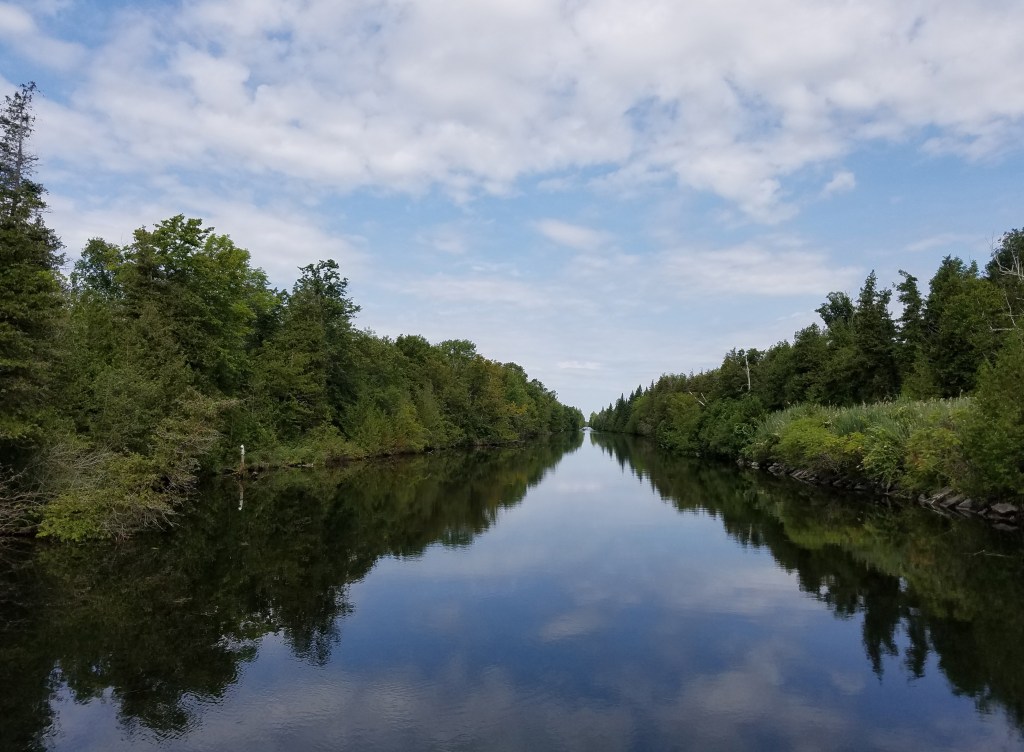
September 5 to 16, 2018: Cleveland to Brewerton

Our second day in Cleveland was spend exploring the Rock & Roll Hall of Fame.  We both enjoyed the experience, although we were most interested in the songs and artists of our own generation.  I expect some people could spend days there, looking at memorabilia.  I found the clothes fascinating, it was hard to believe the performers were so small.  There were dresses belonging to Diana Ross and the Supremes, and they were tiny! The clothes worn by the giants of rock and roll, the Beatles, the Rolling Stones, the Who, and many more recent rockers, show that these men had to be well under 6 feet tall, and extremely thin by today’s standards. There was an excellent film with clips of Elvis Presley, and we also loved a 30 minute film of Dick Clark and American Bandstand.  In the evening we walked a little further into town for an outstanding meal at Blue Point Grille.
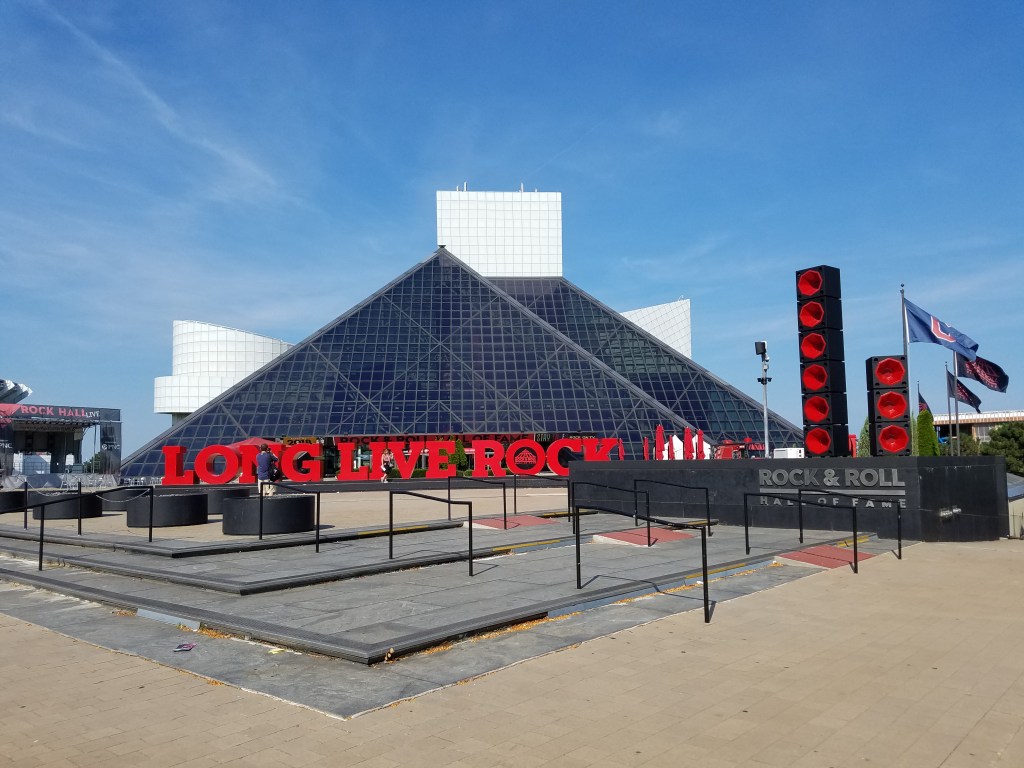
The Rock and Roll Hall of Fame
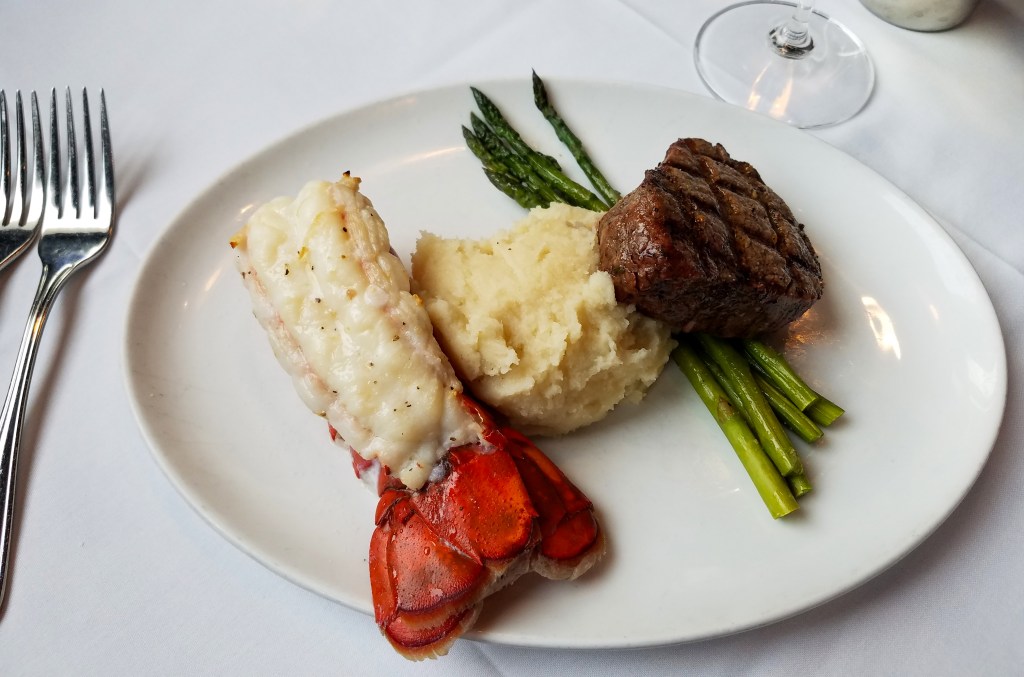
Surf and Turf, one of the best I have ever eaten, delicious tender lobster tail with drawn butter, and a perfectly grilled steak in a simple presentation with mashed potatoes and fresh asparagus at the Blue Point Grille in Cleveland.

From Cleveland it was a long day, 100 miles, to Erie, Pennsylvania.  This year we made a conscious effort to reduce the distances we travelled each day, so a normal day has been 30 to 40 miles.  The weather was glorious, although hot, with a bright blue sky and a good forecast for wind and waves. With no rain in the forecast we replaced the side doors with the screens, which involves two large stiff zippers each side and one on top.  Just after lunch the clouds started to build up and the sky got dark.  We were caught in an afternoon thunderstorm with accompanying squall out on the water.  The rain lashed the boat from the side (of course it was the side I sit on) and the cushions, carpet, and my chair, with me in it, got absolutely soaked.  Eventually I managed to undo the top zipper and secure my door at the top, but with the strong wind the only way it could even partly reduce the amount of rain coming in was for me to stand with my back to it and hold on.  Drenched doesn’t even begin to describe the experience.  Dick, from his dry seat at the helm, was highly amused. In fact, he was shaking with laughter, which is why the picture is so blurry!
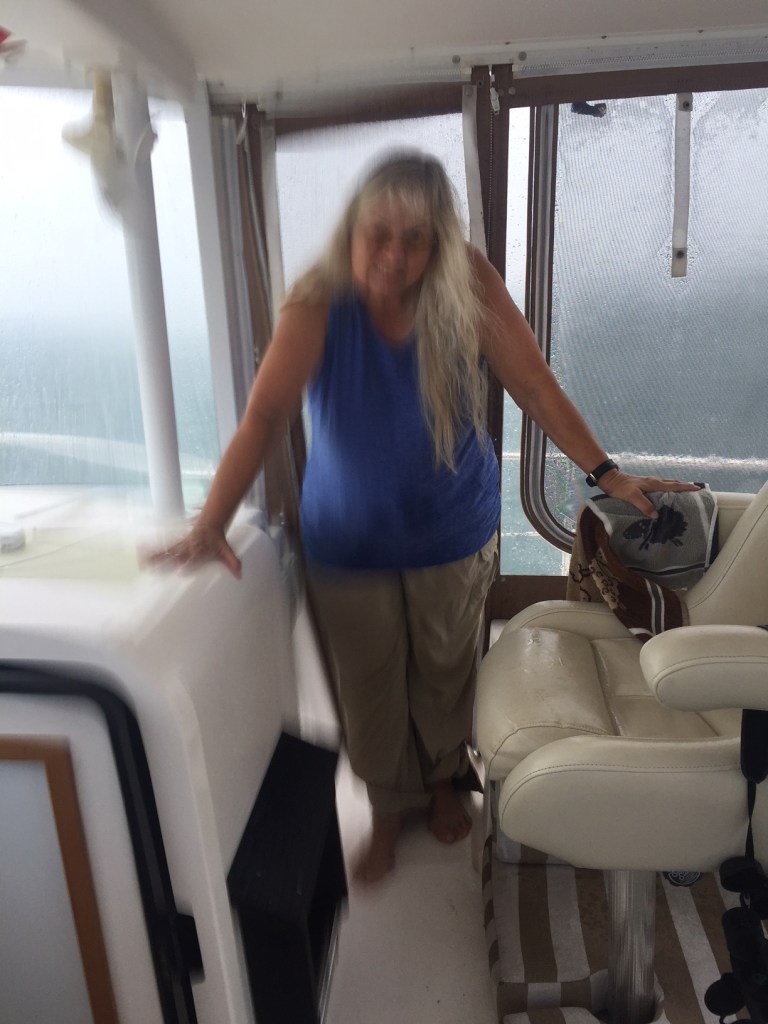
It’s a terrible picture, but this is me, the human door, holding back the driving rain!

The rain, low visibility, and choppy water were not the only matters for concern.  We had heard a securite announcement from a tow that he was headed into port with 3 loaded barges.  We could see his position on the chartplotter, but he didn’t seem to be moving, and we were headed directly for him.  Dick went well out into the lake to make sure we gave him plenty of room.  We were able to see through gaps in the rain as we passed that he was indeed stopped, repositioning the tow from the front of the barge train (pulling) to the rear (pushing it into port).  In due course the rain stopped, the waves settled down, and the sky was blue again.  The carpet took a while to dry though, and it was surprising how very dirty that rainwater was after it passed through the screens.

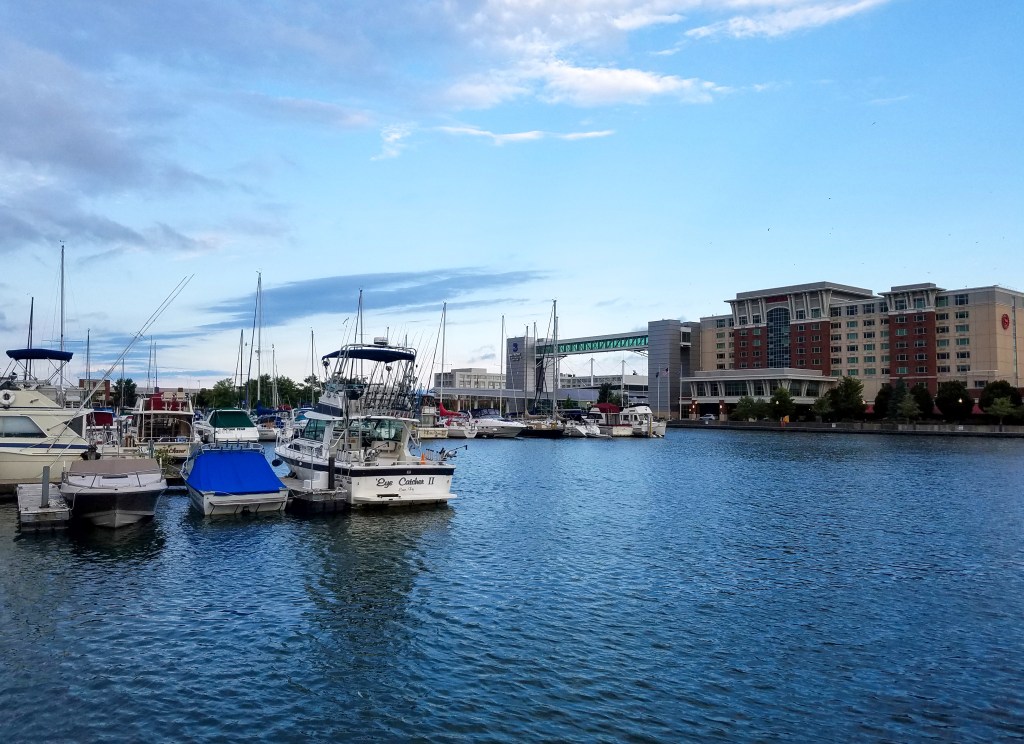
Erie is the fourth largest city in Pennsylvania, and the state’s only major port on the Great Lakes.  As heavy industry and shipping have declined, health care, plastics, tourism, and service industries have taken their place.  The harbour was interesting, divided into several parts, with the one we were visiting requiring passage under an elevated walkway that connects the Sheraton Hotel with the Bayfront Convention Center.  Unfortunately, the harbour itself is still something of a work in progress, but in a few years it could be very pleasant.  There is a large maritime museum and library, and a 187 foot Bicentennial Tower along the waterfront.
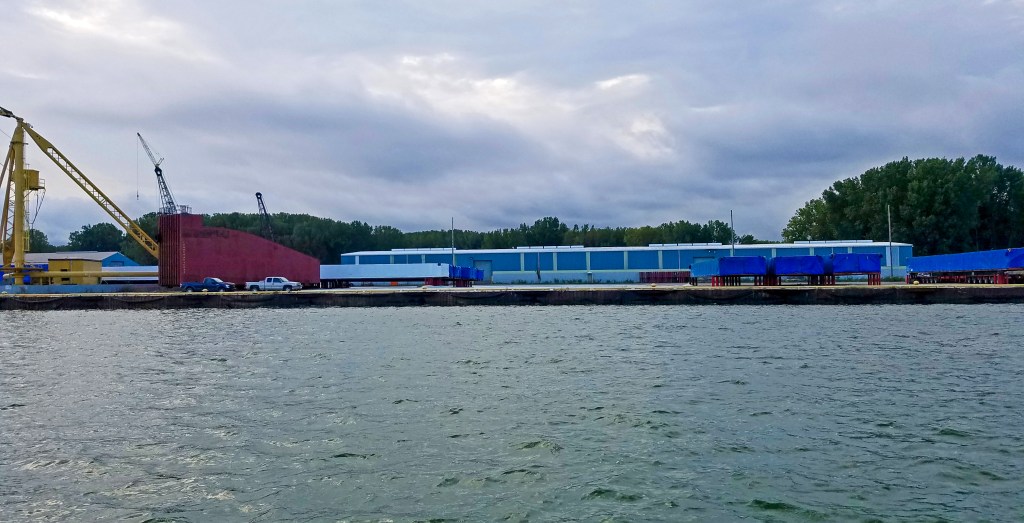
Erie, PA is an industrial port. A shipyard with a vessel under construction. At the left you can see the large rust red bow (or stern), while on the right are blue plastic covered sections of the midship. We don’t know whether this is a Lake freighter being constructed, or a large barge tug.
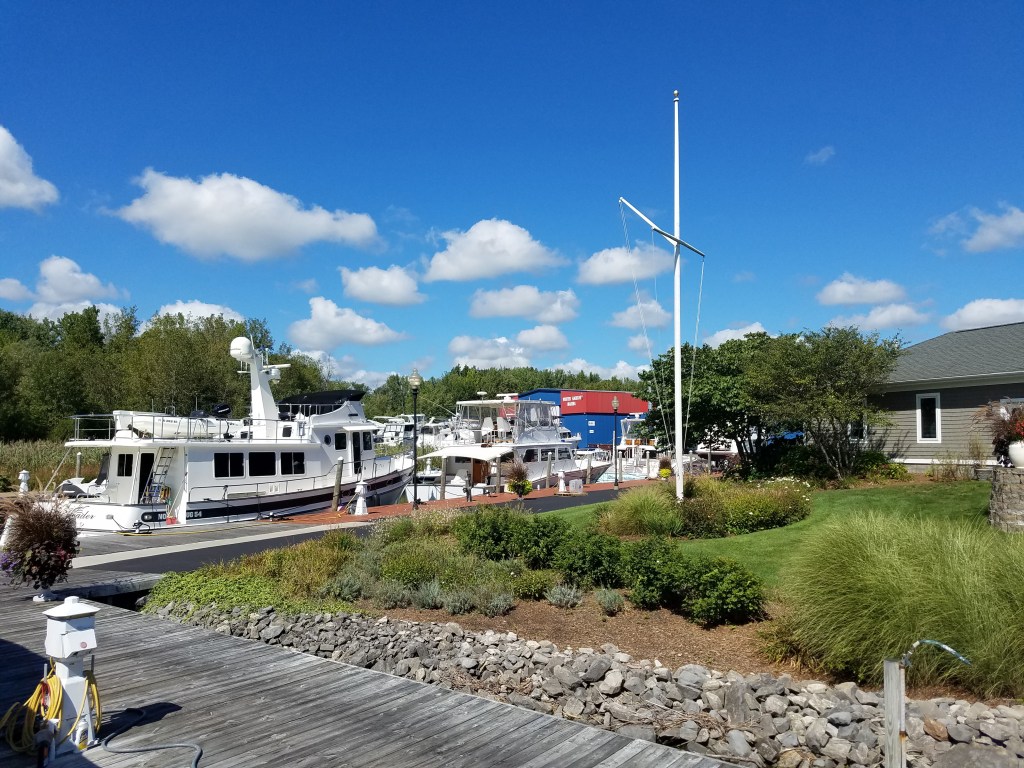
The excellent marina in Erie, Pennsylvania

Our next stop was Buffalo and a grateful goodbye to “big water” for this year.  We stayed at the marina that is closest to downtown, and once again were pleasantly surprised by the waterfront parks and development of what was once a very unattractive industrial port.  When we were growing up, and even after graduation and during the first few years working in Toronto, Buffalo downtown was a no-go zone with derelict buildings and a lot of crime. The marina is situated on a spit of land that also includes a waterfront park with attractive gardens, a lookout tower, and two restaurants.  From the marina it was easy access to an extensive network of cycle paths. We rode our bikes right into downtown for dinner, and we never felt unsafe.


Beautiful gardens in the park on the waterfront in Buffalo
The downtown skyline behind the gardens

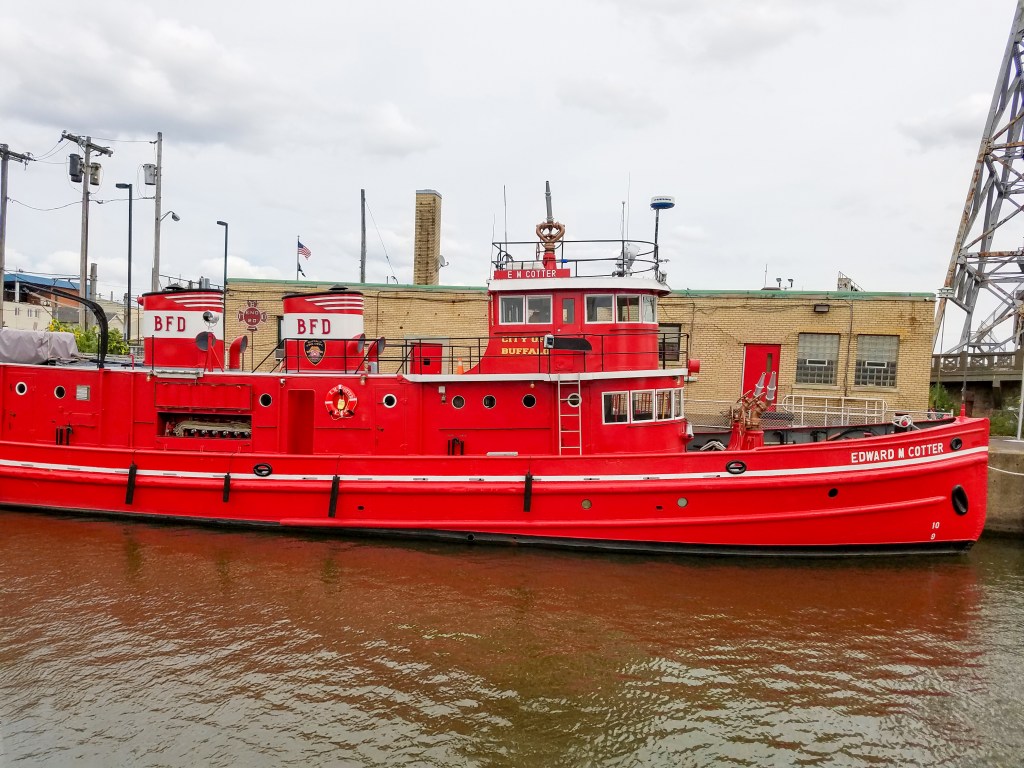
We rode our bikes through what looked to be a very interesting naval museum, the Buffalo and Erie County Naval & Military Park.  There are a number of decommissioned ships, including a submarine, a cruiser, and a destroyer.  Further along the Buffalo River is the oldest active fireboat in the world.  The Edward M Cotter was built in 1900 and rebuilt in 1953.  In addition to being a fireboat, she is used as an icebreaker on the Buffalo River in winter. She has a colourful history, including being burnt out in 1928 while fighting a fire on a barge carrying 5,000 barrels of crude oil.  Rebuilt, she continued in service, and crossed Lake Erie in 1960 to help put out a fire in grain elevators in Port Colborne, Canada.  We only saw her at dock, but I gather she is a regular sight in Buffalo Harbor.
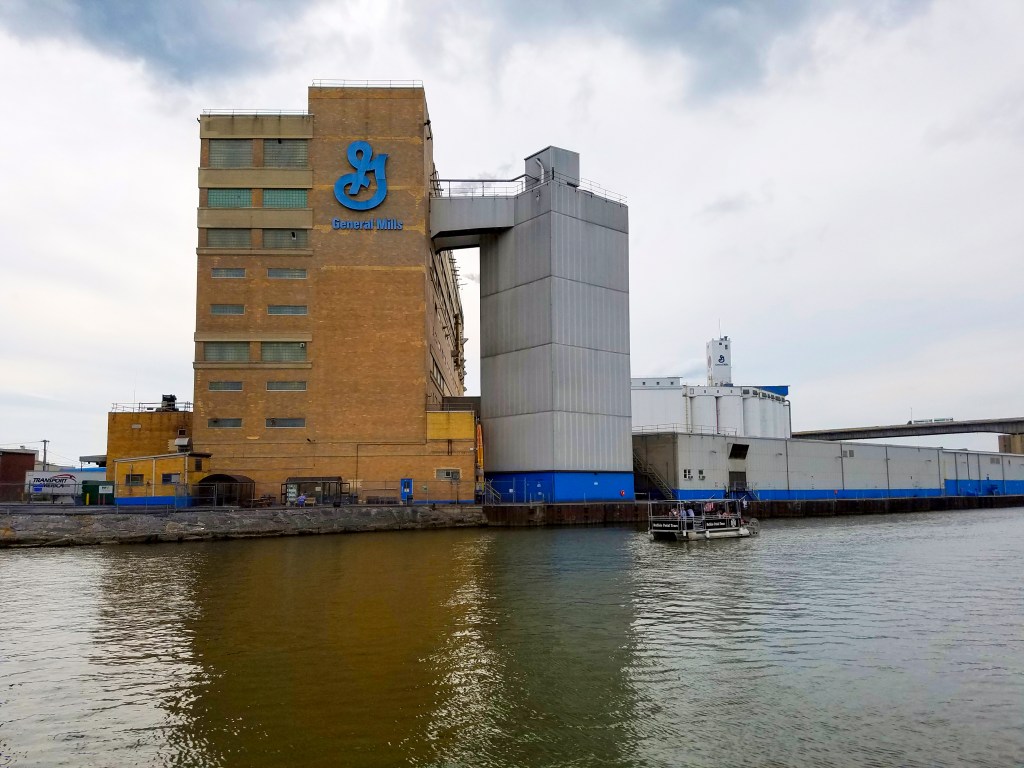
General Mills is still a grain milling presence on the Buffalo waterfront. The high rise manufacturing facility is of unusual architectural interest, so we are told. It is also the place where familiar brands such as Cheerios, Gold Medal Flour, Bisquick, and Wheaties are made.
The Edward M Cotter, a historic fireboat, is still in service, and is also used in winter as an ice breaker in the Buffalo River.

After a two night stop in Buffalo it was time to make our way into the Western Erie Canal. We had planned our usual 9am start, but we were delayed somewhat at the pump out dock by a very slow pump.  As it happened, that delay didn’t matter, because of limited service at the lock on the Black Rock Channel.  This three and a half mile channel parallels the Niagara River, and allows boats to avoid the strong current and rough waters of the river.  It was built as part of the Erie Canal, but somehow it is no longer part of the Canal and the lock is a Federally operated lock.  It is in need of refurbishing, so the operators have decided to limit openings, and while two different phone numbers are provided to call to get the schedule, neither of the lines are manned.  On arrival at the lock we found a sign that told us the first opening would be 11am, so we had to tie up and wait for over an hour.  As is his wont when there is any expected delay, Dick set off along the lock wall to investigate.  On his return, he met the lock keeper arriving for work, a surly individual who was not at all impressed with Dick’s friendly smile and told him in no uncertain terms that he was forbidden to be on the dock and to “Get back on that boat and stay there!”

After exiting the Black Rock Channel, we were into the Niagara River, which was unpleasantly choppy until we turned into Tonawanda River.  Not the most attractive waterway we have been on, and even after making the turn into the Erie Canal proper, it was somewhat unprepossessing until we had passed through the double lock at Lockport.  The stretch between Lockport and Rochester is very pleasant, with small towns that are making the most of their waterfront and the opportunities for tourism.  There are many lift bridges, all freshly painted in soft green with contrasting bright yellow trim.  Most of the towns have free docking at the town walls, and many have installed power pedestals and shower facilities.  One of the lock keepers told Dick that she is employed full time, all year round.  During the winter when the canal is closed, they take apart and refurbish all the lock and bridge mechanisms.  She said her winters are spent “up to the elbows in grease!”  At each lock we were asked how far we planned to go that day, and the keepers called the next lock to tell them to expect us.
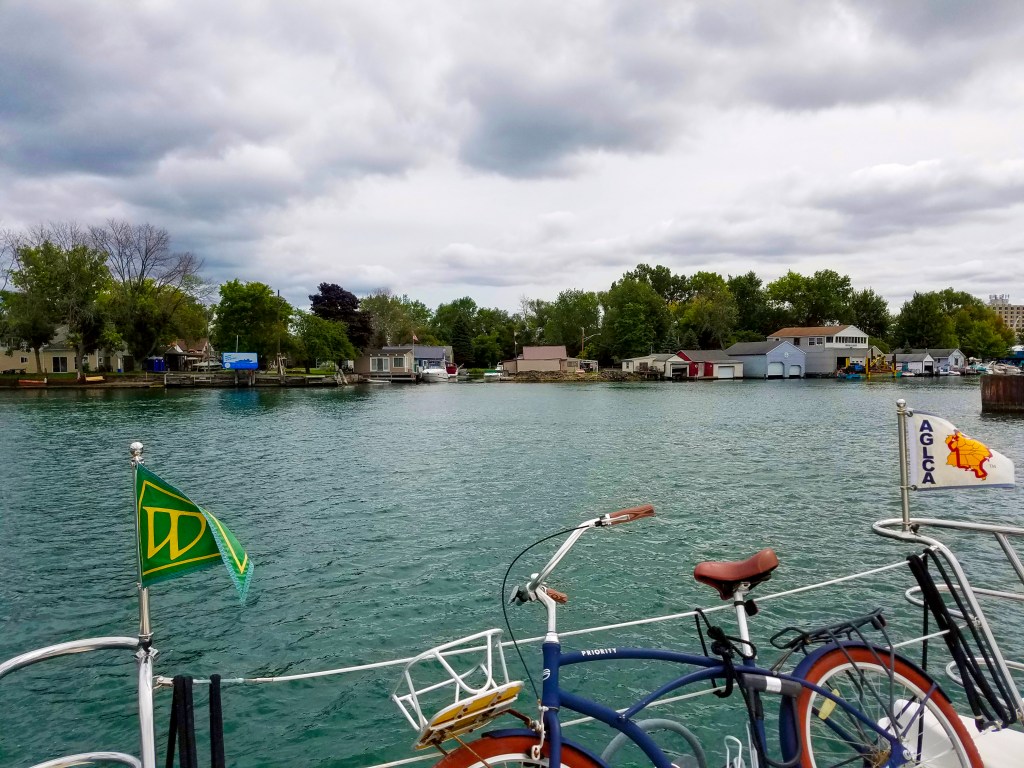
We turned into the Erie Canal, somewhat unprepossessing for the first few miles.

In Middleport we were joined for the evening by Wade, a talented photographer I met when we lived in Olean some years ago.  It was nice to catch up and hear about his extensive world travels and his photography.  The next day we travelled to Spencerport where we were met by another friend from the Olean Camera Club.  Barbara was not able to stop for a meal, but we had time for a chat and a cup of tea and hope for a longer visit, perhaps next year when we are in the Finger Lakes.
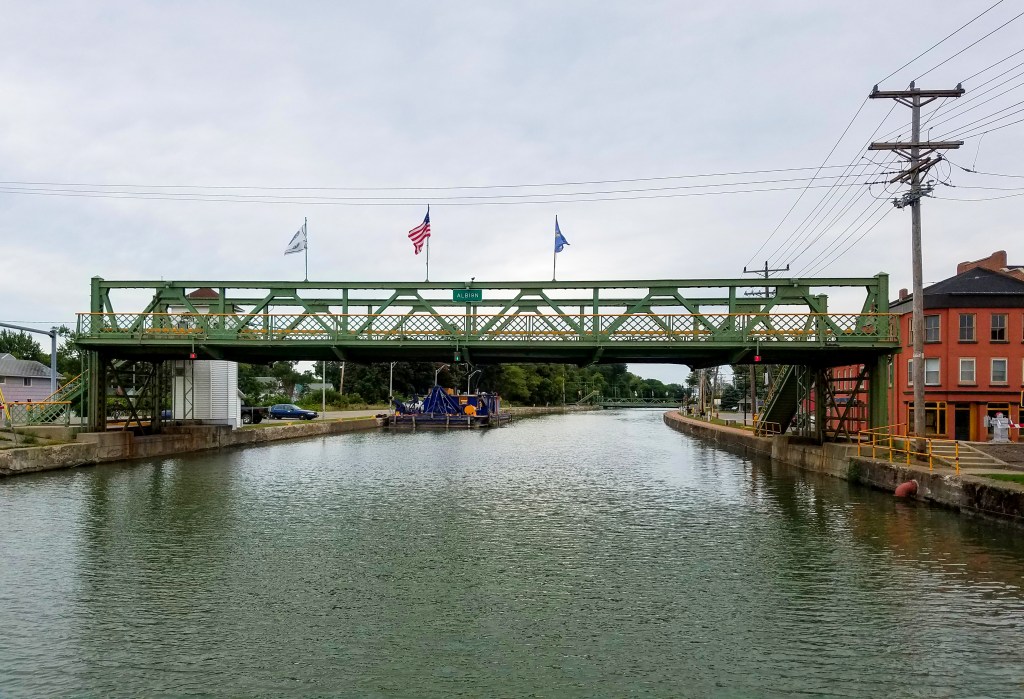
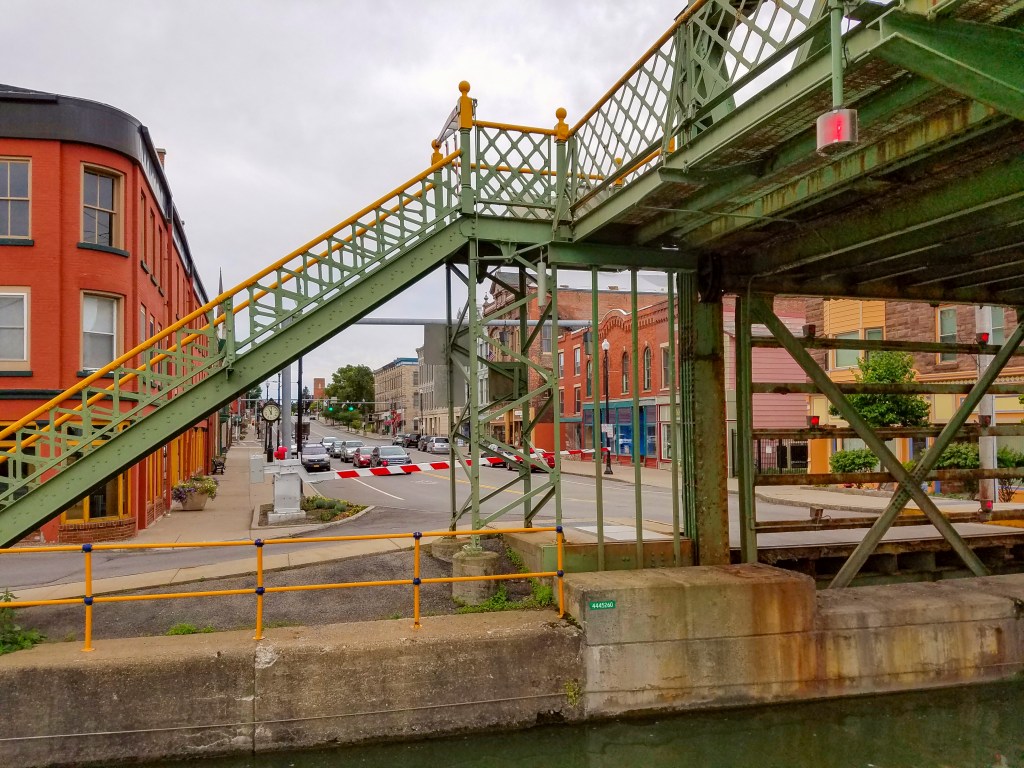
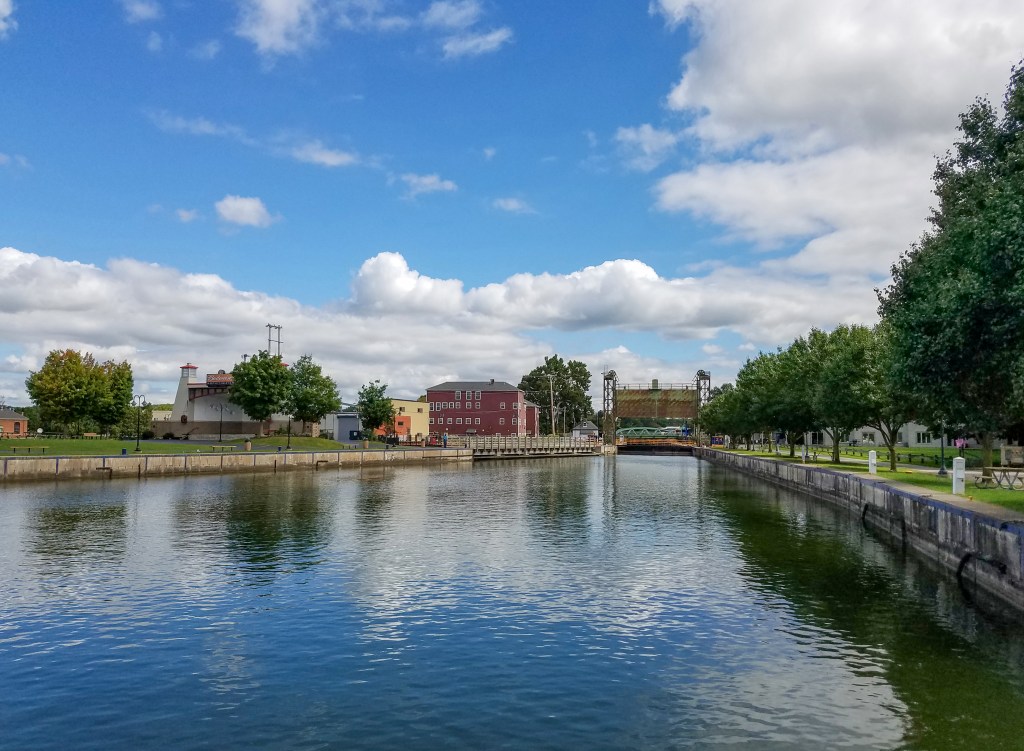
Bridges cross the canal frequently and need to be opened for us. This one is on the main street in the town of Albion. The whole span slides up to raise the bridge over the canal. Pedestrians can climb the stairs and cross when the bridge is lifted, but cars must wait.
A closer look at the mechanism for raising and lowering the bridge.
Spencerport
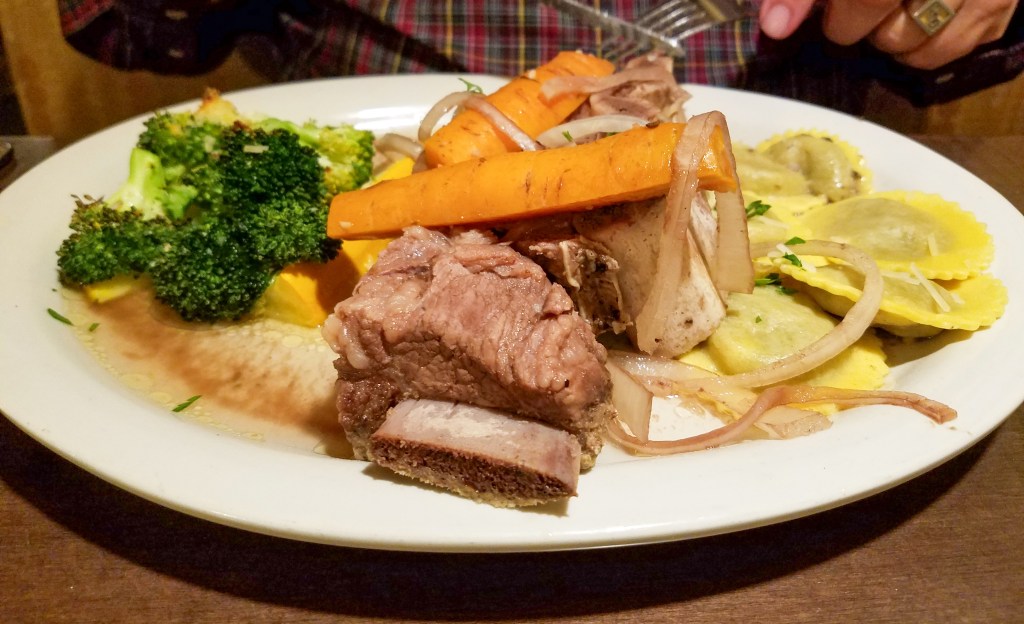
Beef short ribs at a restaurant in Spencerport. Dick’s favourite dish, served with mushroom ravioli. Sadly, it was not as tasty as he had hoped. As he put it, “it tastes the way it does when I make it at home, and I know I don’t do it very well!”

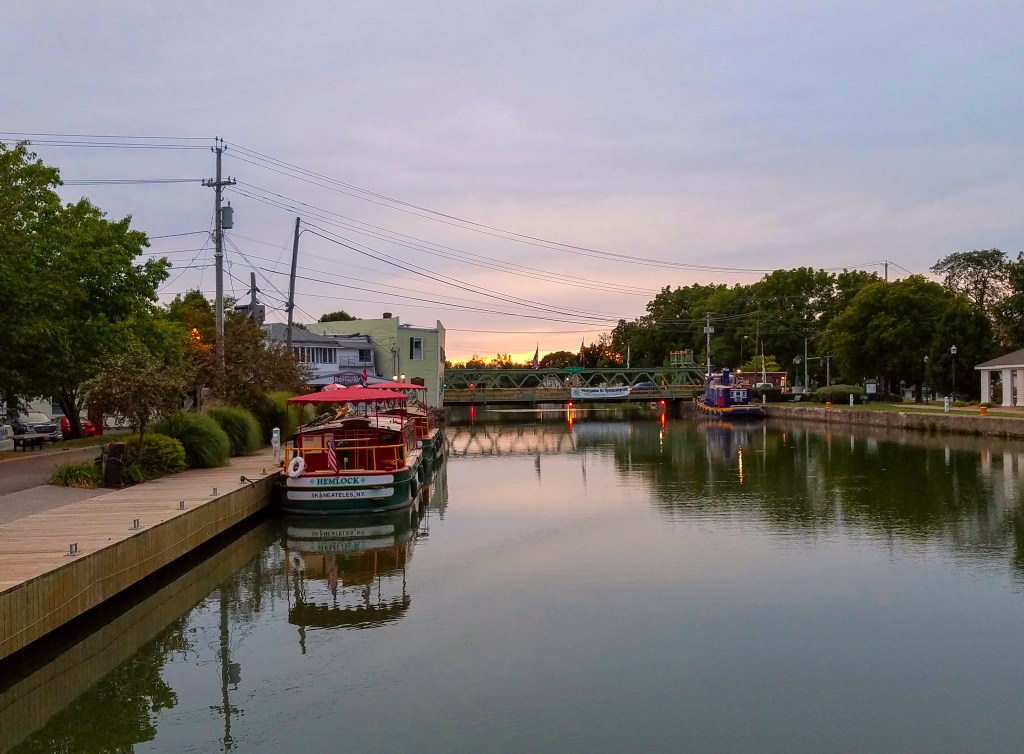
A frequent sight on the Erie Canal are English-inspired canal boats that appear to be a popular vacation choice.  The boats are a little wider than UK narrowboats, and generally shorter at a maximum of 43 feet, but they are driven by a traditional tiller at the stern, and they all look very clean and in good condition.  You can rent them from Midlakes Navigation, and they offer 3, 4, and 7 day rentals. We do not wish to be disloyal to Nine Lives, but we were intrigued by the possibilities!

English-inspired canal boats on the Erie Canal
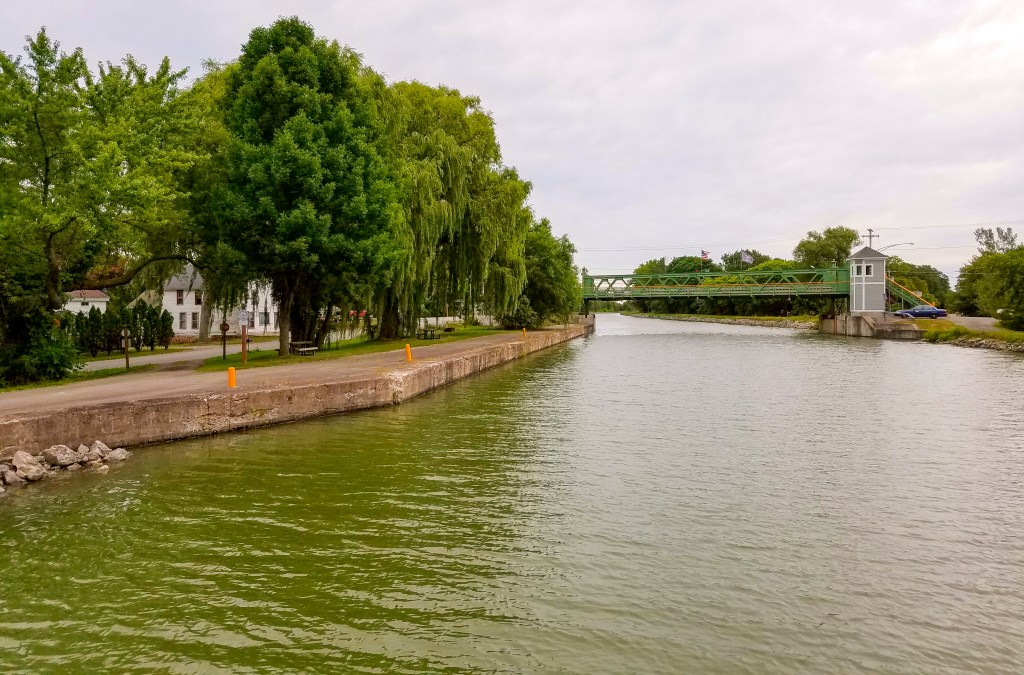
Approaching one of the bridges over the canal. “Low bridge, everybody down!” “If you’ve ever navigated on the Erie Canal” Can you stop singing that song??? The car parked beside the tower belongs to the bridge keeper. Typically, one keeper will be responsible for 2 or more bridges, and must shuttle between them when boats need to pass.

Rochester is another city with an attractive downtown.  We turned off the Canal into the Genesee River, navigable almost to the city center.  We tied up at a good dock in Corn Hill Landing, a revitalized historic neighbourhood. The waterfront complex of rental apartments includes several restaurants, one of them is a very pleasant wine bar.  We walked over and each ordered a wine flight, sparkling for Dick, and rose for me.  To accompany we had a meat and cheese board, with fresh French bread, local honey, and grainy mustard.  It was a delightful way to spend an hour in the afternoon, particularly as we were planning an “eating up” evening of leftovers on the boat!

Wine flights with cheese and charcuterie in Rochester

The next day Dick rode his bike through downtown to Lake Ontario.  He reports that Rochester is a very clean city with lots of parks and waterfront paths.  It is strange that a canal has never been cut to bypass the waterfalls in the river and allow access between the Erie Canal and Lake Ontario.  Apparently, it has been proposed many times, but so far nobody has found the money.
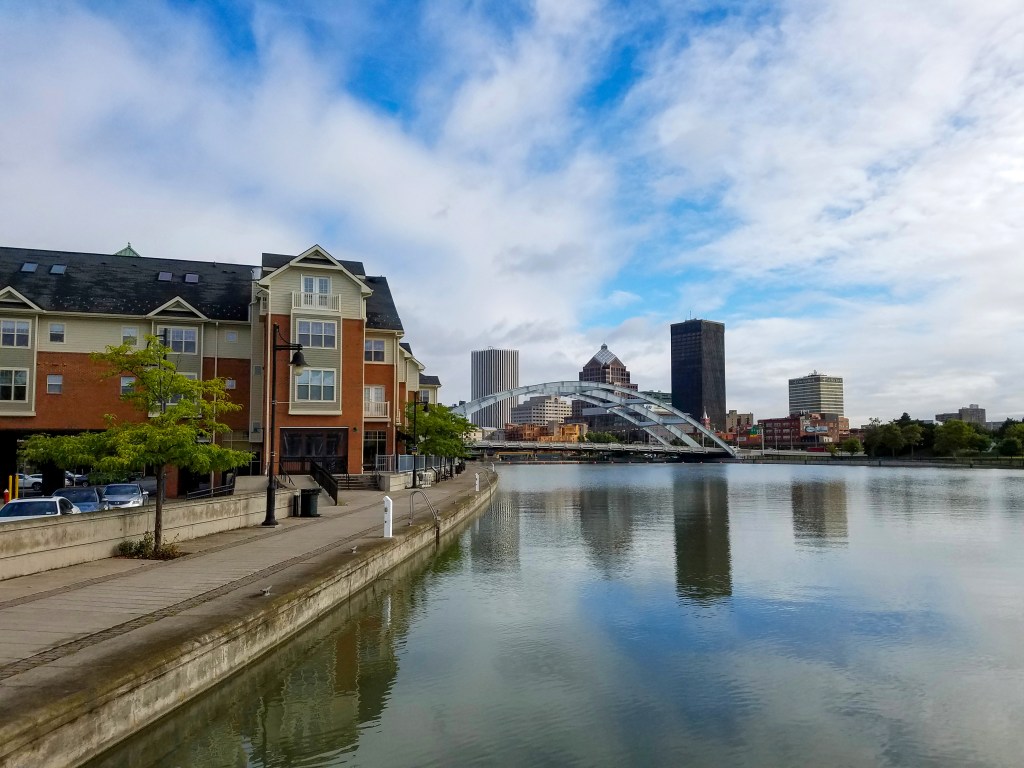
The docks in Rochester were a wall in front of a new apartment and restaurant complex on the Genesee River in historic Corn Hill, with a view of downtown. There was power and water, and we tried, but could find no office or way to pay for dockage!

In the afternoon we took a rental car to Ithaca, and after a very nice meal in a French restaurant we went to a concert by Joan Baez.  What a remarkable woman she is.  She played straight through without an intermission (or a chair), and returned to sing three more songs for an encore.  It was a mix of old favourites and new material from her latest album.  Although she can no longer sustain the high notes, at 77 years old, she is still an amazing performer, and we were very glad we were able to take the time to see her on what is expected to be her last tour. The theatre is also of historic and architectural interest.  The building, originally constructed in 1915, began as a garage and Studebaker showroom.  In 1926 it was transformed into a cinema and vaudeville palace.  The extravagant combination of Moorish and Gothic architecture is striking. After struggling for many years as a movie theatre that closed in the 1980’s, the building was condemned in 1997 and slated for demolition.  It was saved by strong community support and fundraising from both municipal and private donors, and has been operating as a concert theatre since 2001.
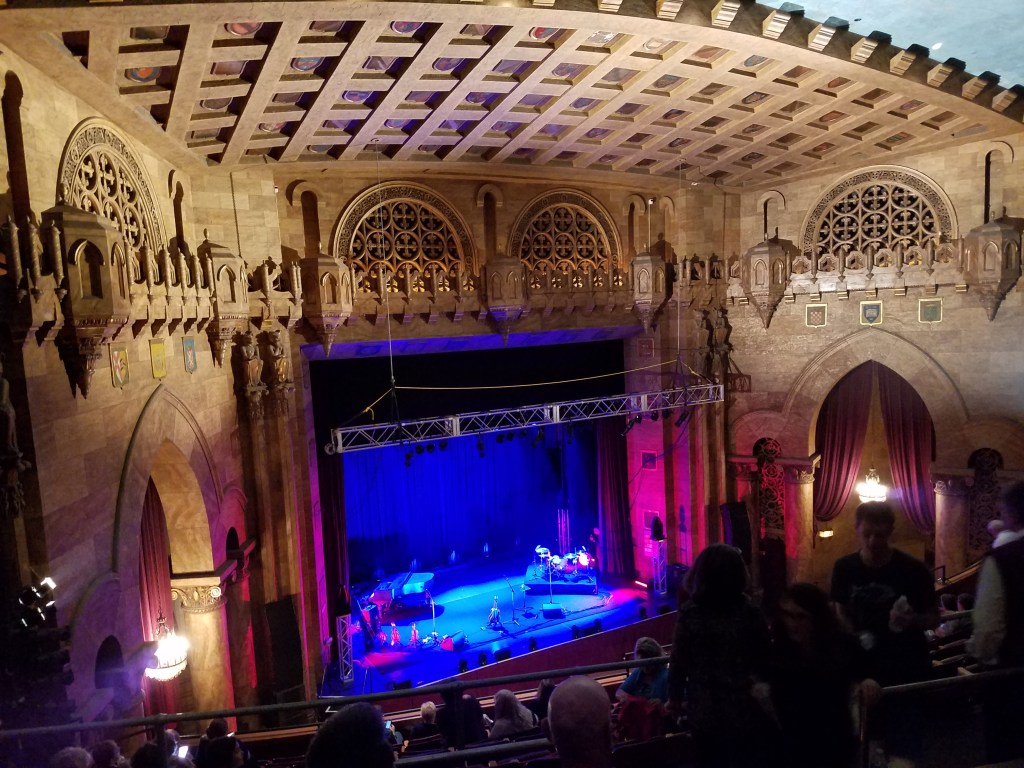
The concert hall in Ithaca. The historic State Theater was saved from demolition after it was condemned.

Returning to the boat at midnight, we planned a slightly later than usual departure, but our Rochester experience was not yet complete.  At just past 4am I became aware of footsteps and a slight rocking of the boat, as well as conversation from outside.  I got up and shouted at Dick to wake up.  No response.  Shouted again as I opened the hatch and went up to the cockpit to find the absolute cliché of a black man in a hoodie sitting on the boat.  I shouted at him “GET OFF THIS BOAT”, and somewhat to my surprise, he did, with profuse apologies and compliments on the boat.  He told me it was such a beautiful boat he just wanted to try to get a picture of himself sitting on it.  His girlfriend on the dock also apologised and paid compliments.  As this was happening, Dick finally woke up, just long enough to understand what had happened, to hear the apologies, and know that his intervention was not required.  Then back to sleep he went, while I lay awake for hours getting over the shock!  Thinking about the incident, I came away with a few thoughts.  Given how well spoken and truly apologetic the man and his companion were, we are assuming they were simply walking to or from work, saw the boat and thought it was unoccupied and that they would not disturb anyone if they took a picture.  It would have been very easy to over-react.  By coincidence I have been reading in the AGLCA forum about several boats being boarded while tied up on the Illinois River.  The boaters reported that they used wasp spray and other unspecified deterrents to get rid of the intruders.  I know that many boaters (legally) carry firearms.  In our case, while it was, for me, a disturbing experience, the trespassers were quite innocent, and over-reacting could have been disastrous.  One thing we did agree on, in future we will make a point of connecting the lifelines and rail as well as bringing in the boarding ladder if we are using it.  Just to make it a little less easy to get on board.

After Rochester we stopped at Newark, with a well maintained town wall, excellent shower facilities, and a nice little canal museum.
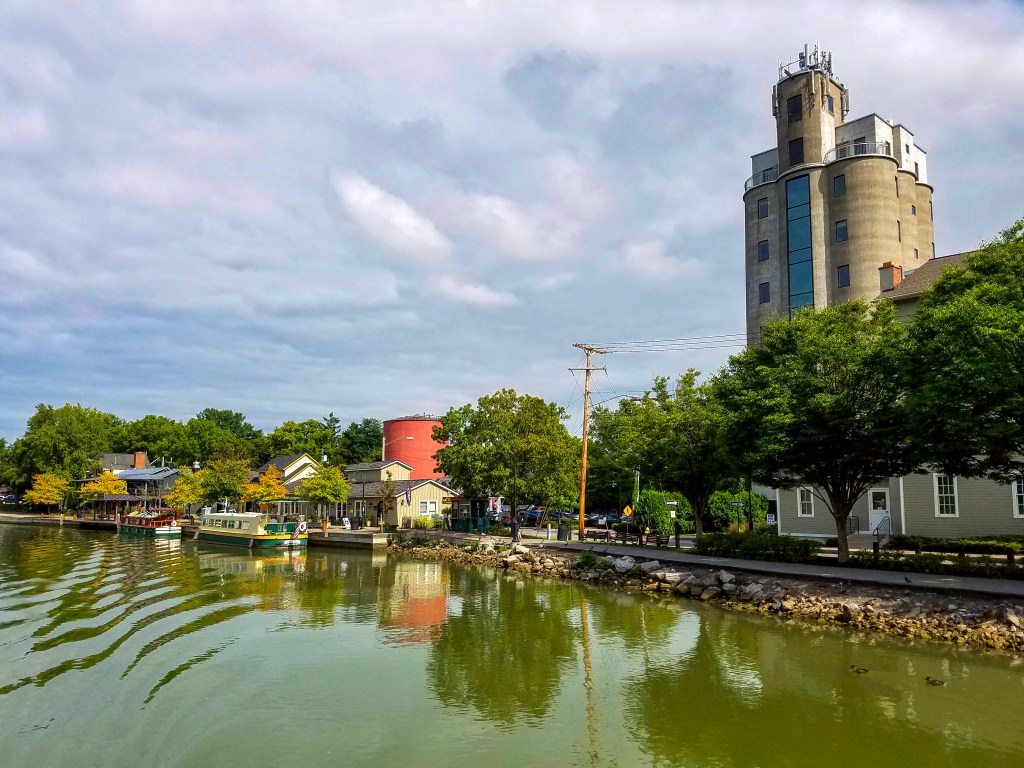
The pretty town of Pittsford. Creative use has been made of the former grain elevators, they have been turned into luxury flats.
Newark

From there the Canal became less scenic, and the towns not quite as pretty.  There followed long stretches with no towns or signs of habitation.  The next night we tied up below a lock, truly in the middle of nowhere (Tripadvisor reported the nearest restaurant was 4.5 miles away).  It was an incredibly peaceful stop, almost like anchoring.  We also noticed a somewhat different attitude on the part of the lock keepers (with the exception of the one we tied up at.)  They seemed to be less likely to be paying attention to their radio when we called for a lock-through, requiring several phone calls before we could see any activity at the lock, and often no response on the radio at all.  They were no longer interested in how far we would be travelling, and certainly not willing to call the next lock to let them know we were coming.  The attitude seemed to fit with the general condition of the houses we saw along the canal in this stretch.  Tumbledown shacks, yards full of junk, and lots of derelict docks.
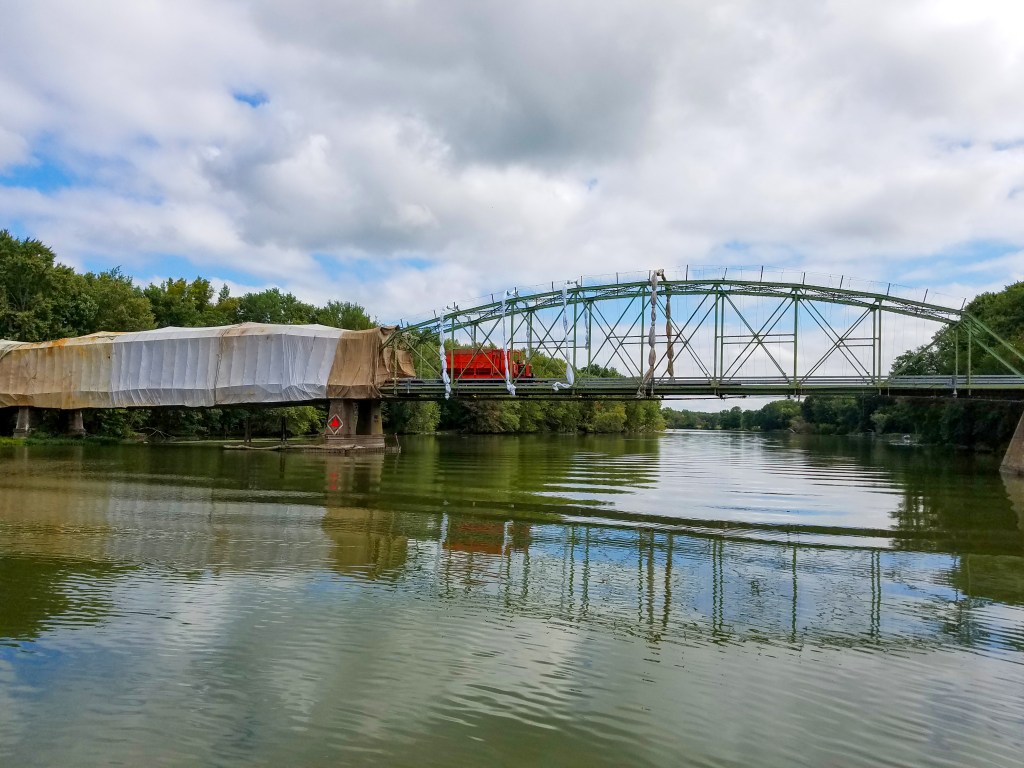
One of the bridges was being repainted. This was interesting to see, they set up a tent to completely wrap the bridge so that the paint does not contaminate the water. As we passed under the bridge we could hear the high pressure paint sprayers at work in the covered section.
Approaching lock 25. We spent a peaceful night tied to the wall in front of the lock.
Still water in the early morning at lock 25

Shortly before Baldwinsville we began to see an improvement.  New homes and tidy cottages with well kept grounds and well maintained docks lined the Seneca River (the Canal becomes the river for much of this stretch).  Baldwinsville is a very pleasant town of about 8,000 people.  It is built on both sides of the canal, and includes an island between the canal lock and the dam.  On the island is a large park with an amphitheatre, and we understand that concerts are held regularly through the summer months.  The town wall has power and water, at $5 a night on the honour system.  Here we met a couple of Loopers who have been spending summers on their boat for the past 8 years.  They completed the loop in 2010-2011, and since then, they have been twice to Maine, spent two summers on Lake Michigan, and this summer they went to the north side of Lake Superior.  Now me, I think of the Canadian side of Lake Superior as rocks, pine trees, and mosquitoes big enough to carry off your boat!  However, Jill told me they loved it, anchoring most nights for nearly a month.  The Lake was far more peaceful and the weather predictions more reliable than Lake Michigan, and as for mosquitoes, when they were there it was far too cold!  It was certainly interesting chatting with them.

A pleasant park in Baldwinsville
The town wall at Baldwinsville

From Baldwinsville it was a short morning’s run to Brewerton, at the north end of Oneida Lake.  At Winter Harbor, an aptly named marina where we will leave Nine Lives until next June, we found several other Looper boats in various stages of getting ready for winter storage.  Nine Lives will be hauled out and stored in a huge heated and humidity controlled storage shed.  While considerably more expensive than non-heated storage, there are a great many advantages, including being able to leave the water tanks full, most of the pantry food on board, and the security of knowing that damp will not be an issue. Since this is also a working boat yard, a quite long list of maintenance and repair items will be dealt with before launch next spring.  Today is being spent packing up the clothes we will be taking home, doing a lot of cleaning, and generally getting Nine Lives ready for a long winter’s nap.  We expect to leave tomorrow late morning, driving to Hagerstown, PA, and then get home to Hilton Head by early evening on Tuesday.

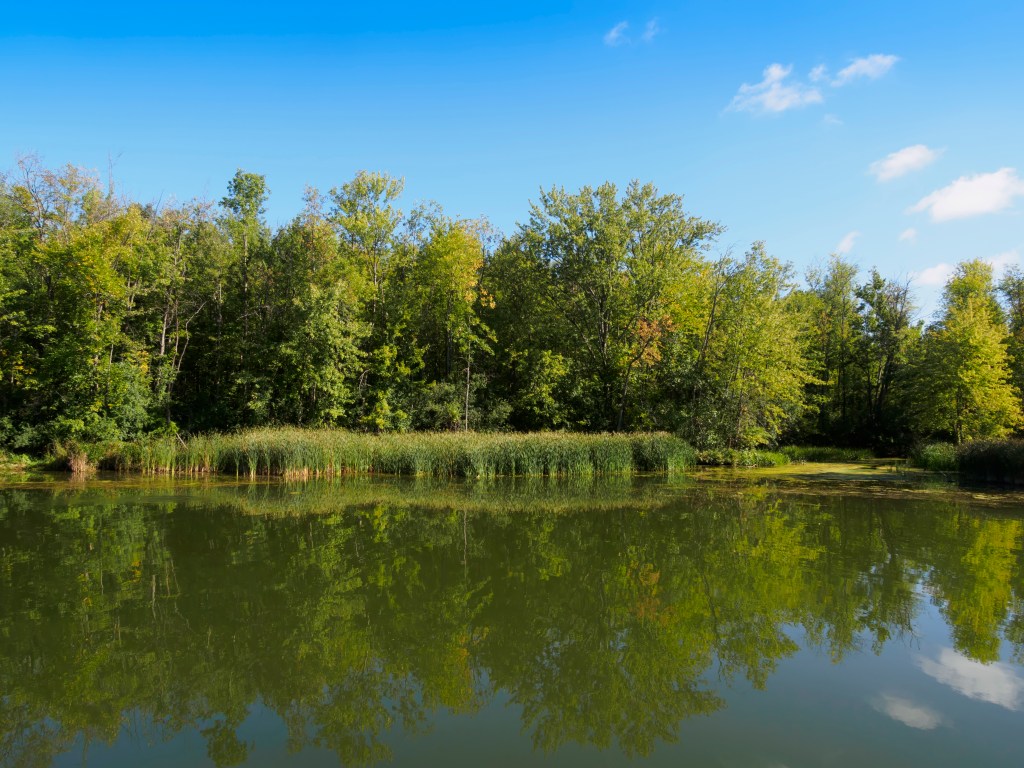
Erie Canal – our last morning on the Canal and on this year’s voyage. The leaves are beginning to turn, and it is time for us to return home.
Between Baldwinsville and Three Rivers the canal follows the Seneca River.
Brewerton, Winter Harbor – the aptly named boatyard where Nine Lives will sleep for the winter. You can just see one of the huge red and blue sheds in the background of the picture.

Look for the next instalment of the Nine Lives blog some time in June 2019.
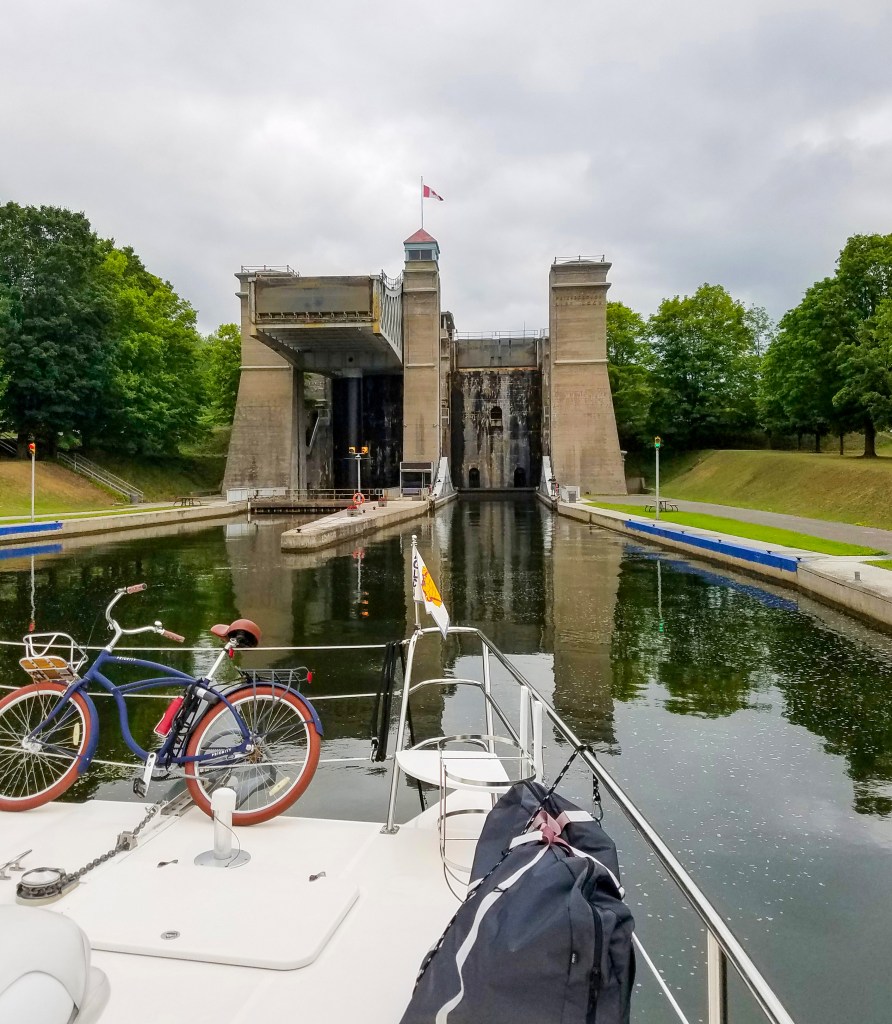
August 7 to 20, 2018: Peterborough to Port Elgin

Our second day in Peterborough was wet, so we didn’t go out for the promised Indian meal at a restaurant.  The next morning we set off for the first big adventure in this segment of the Loop, the Peterborough Lift Lock.
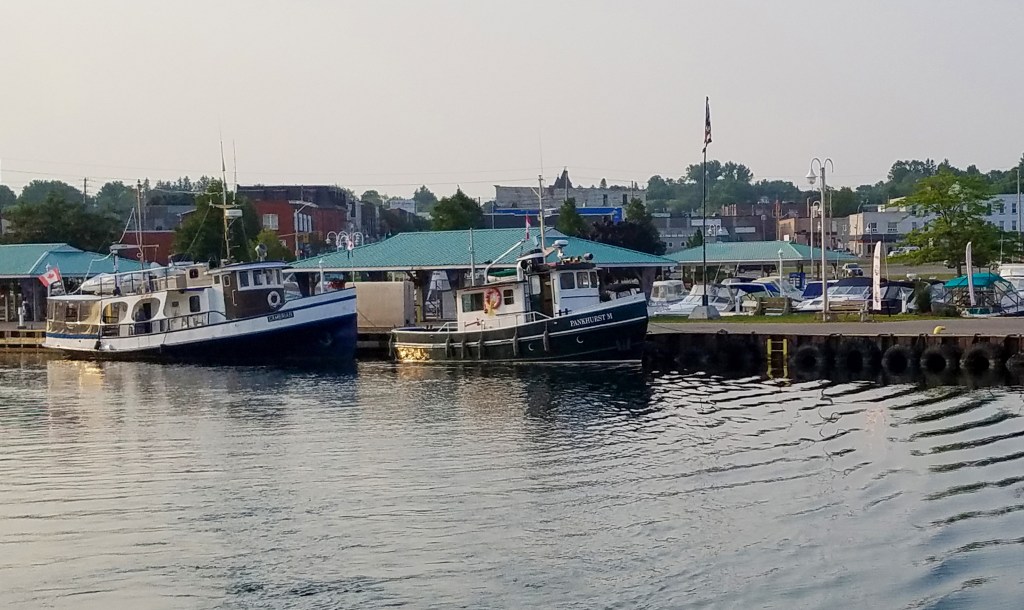
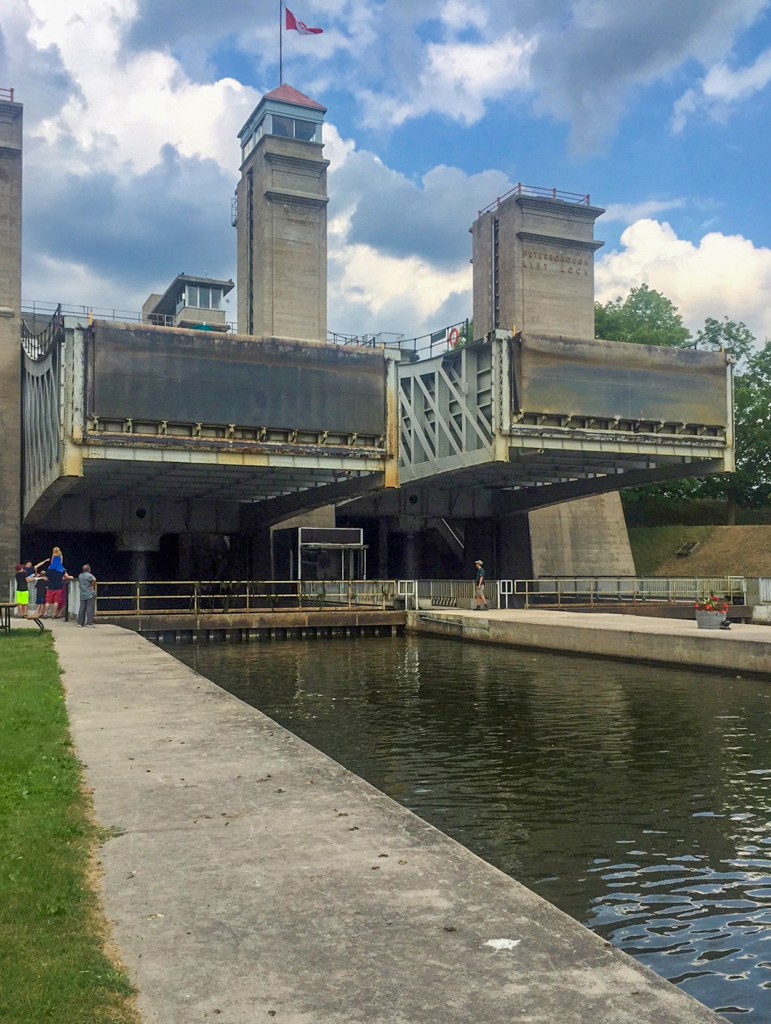
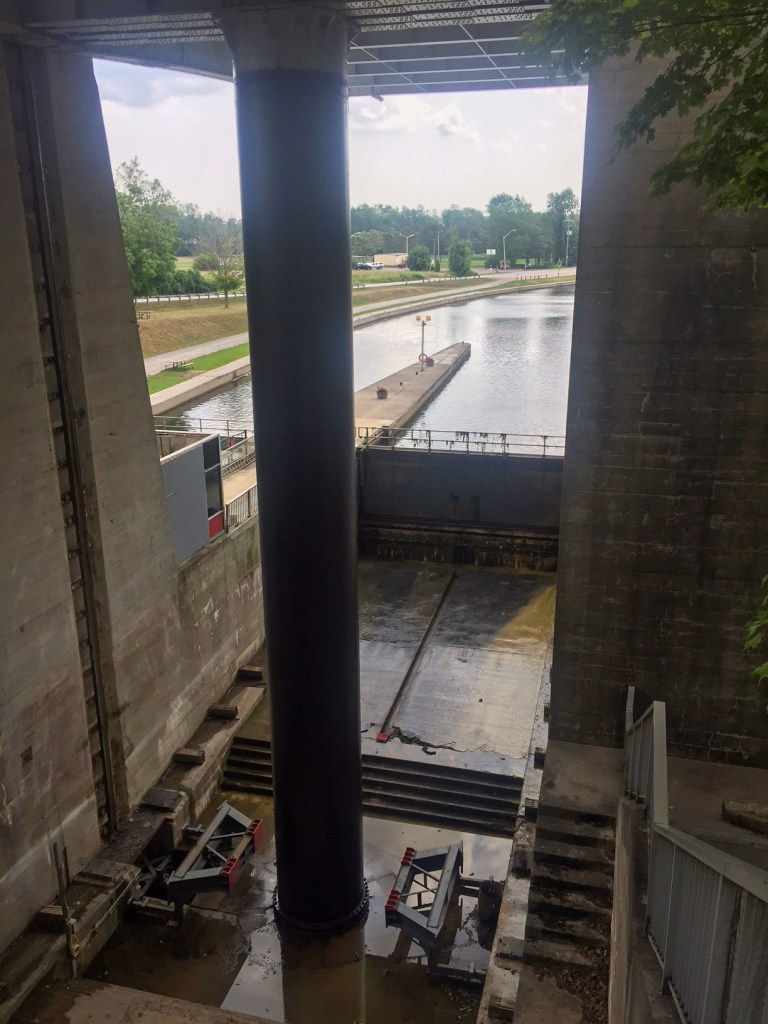
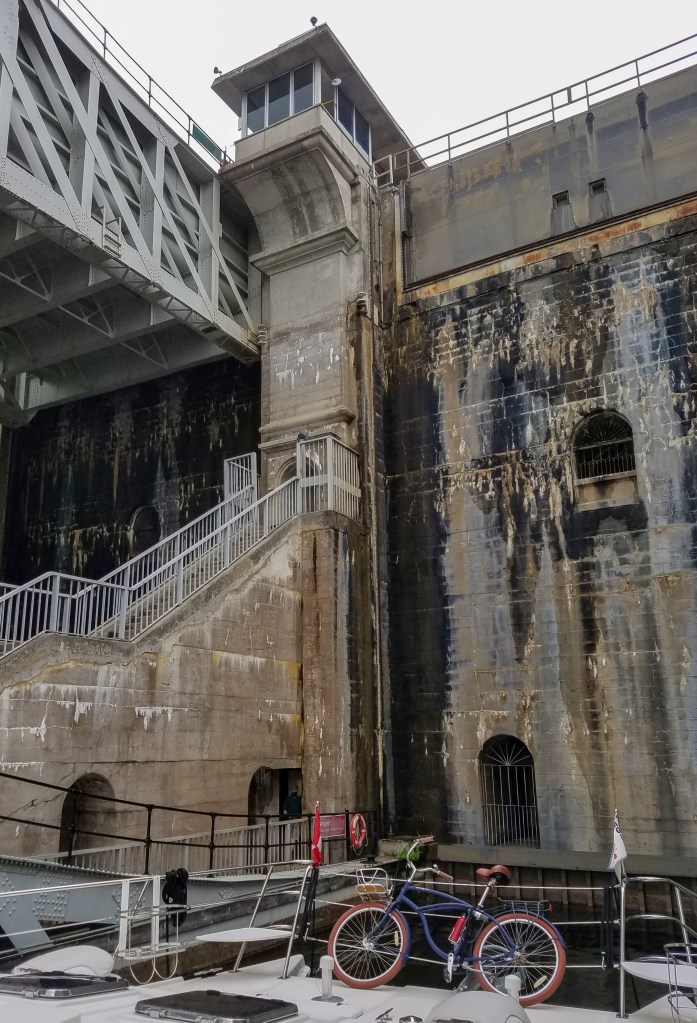
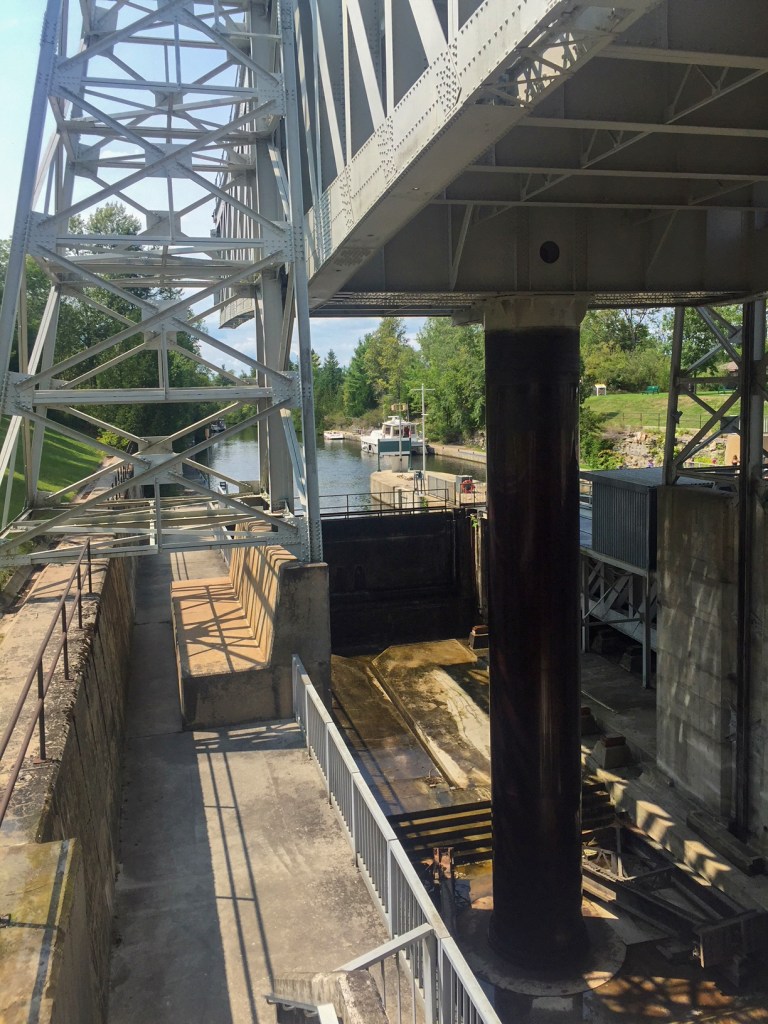
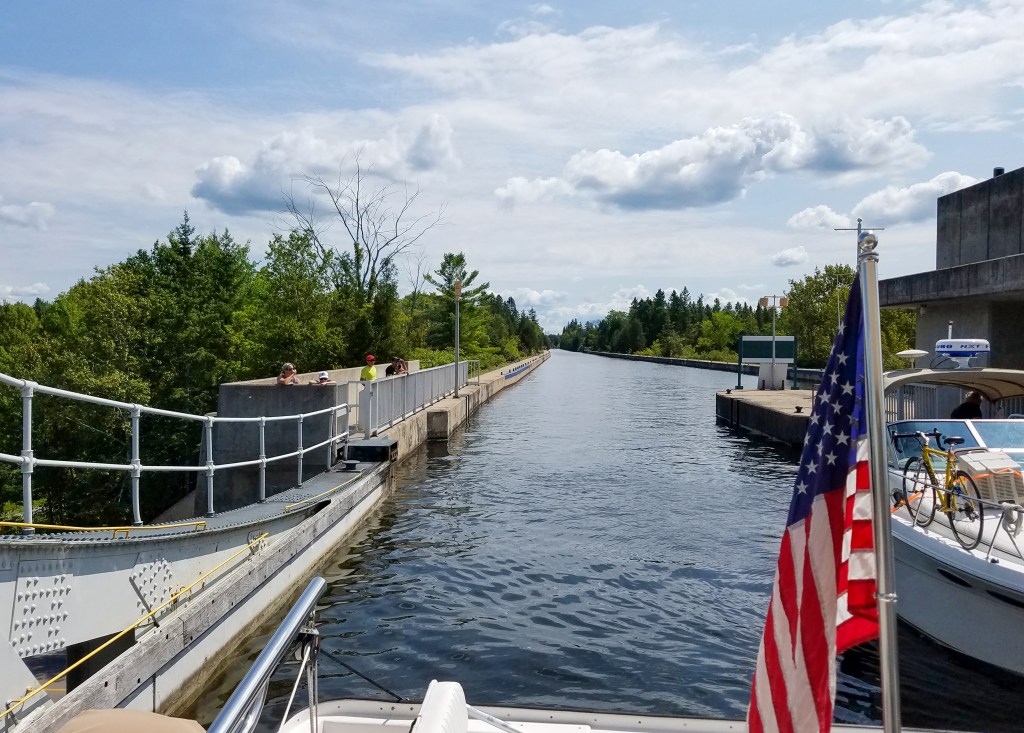
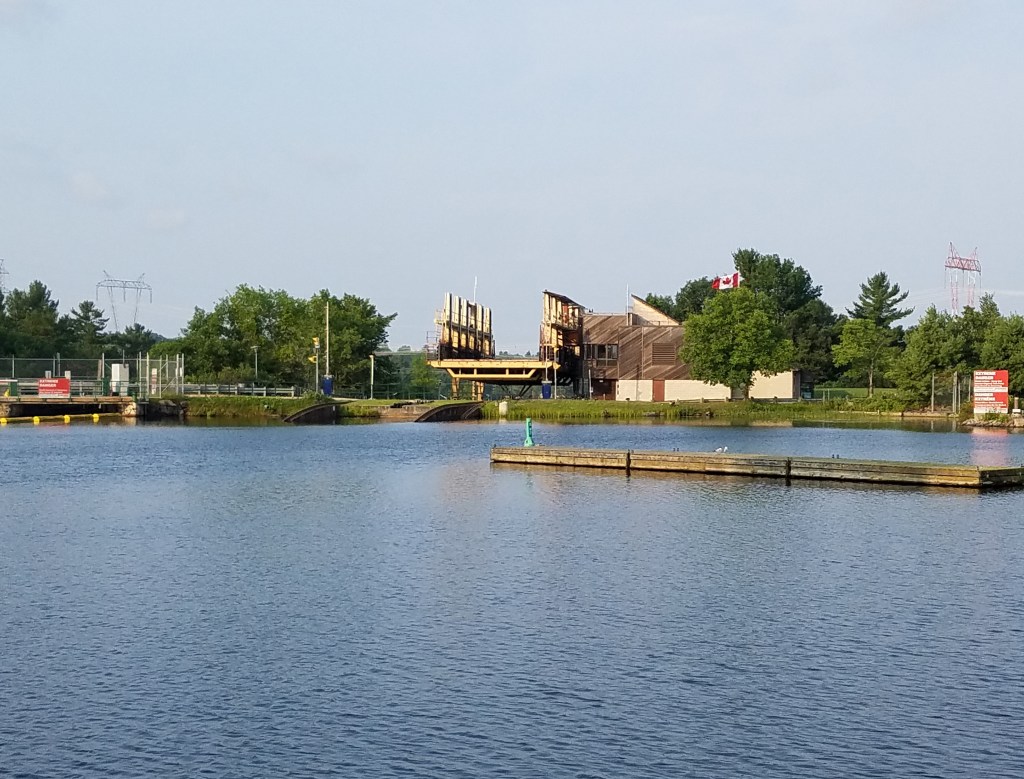
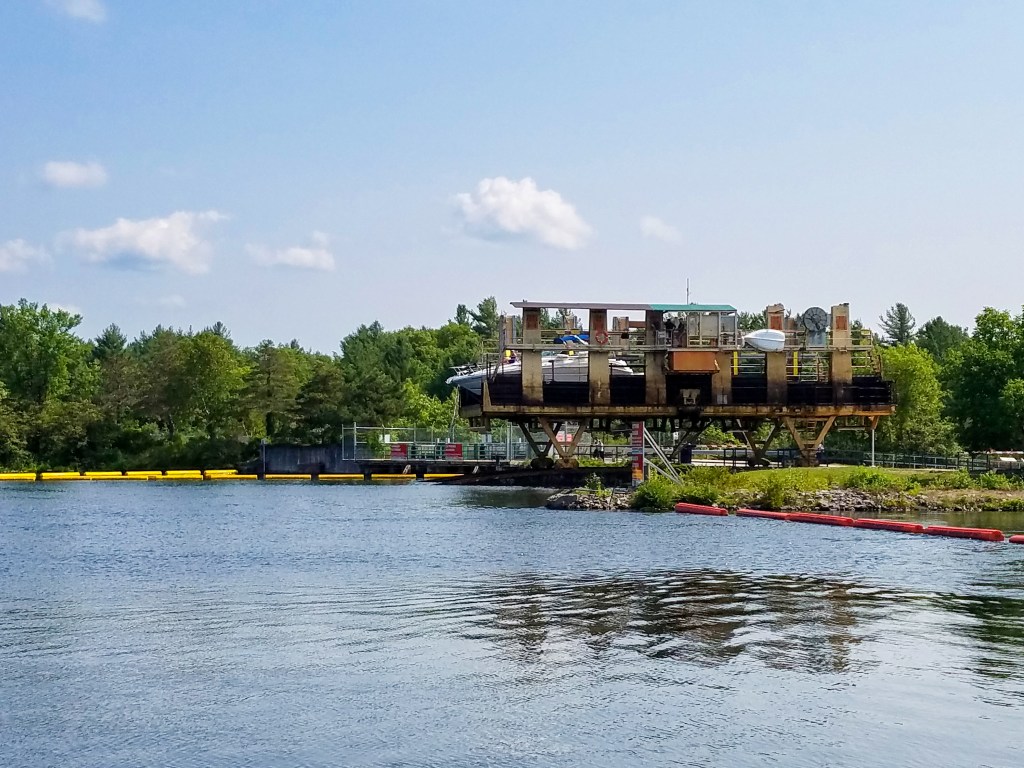
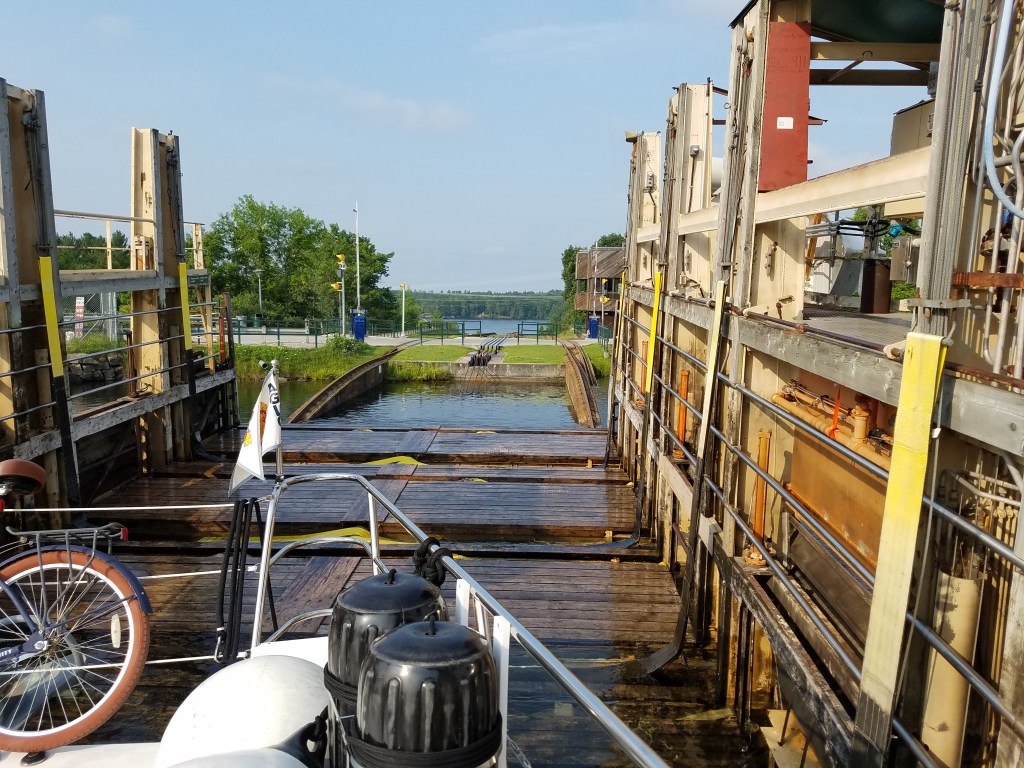
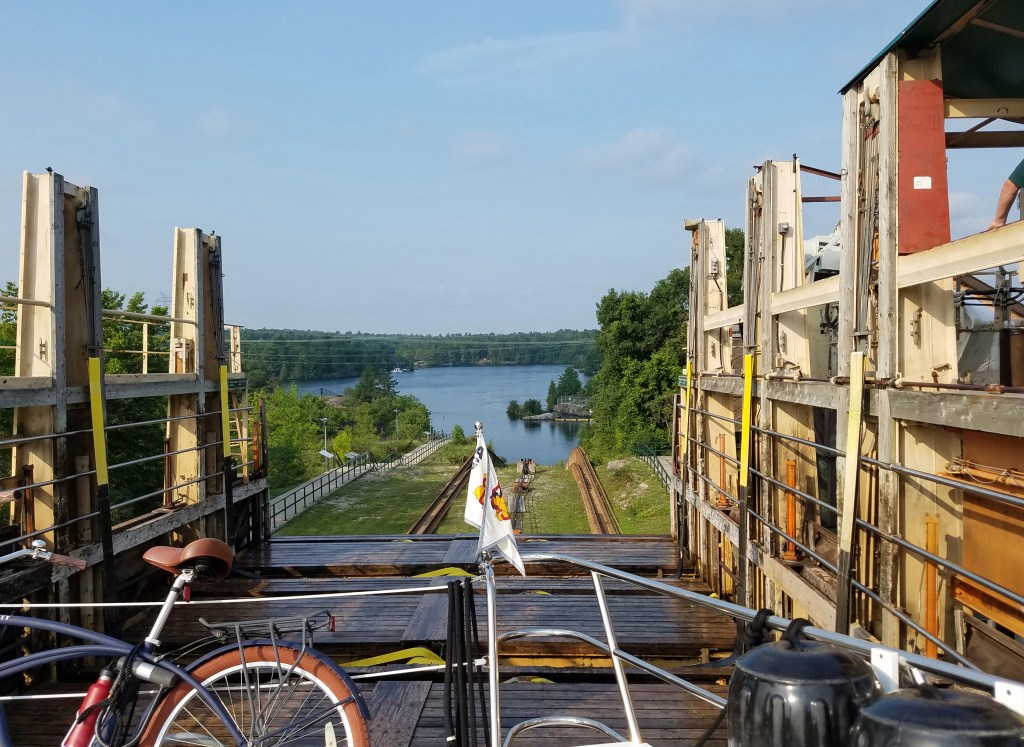
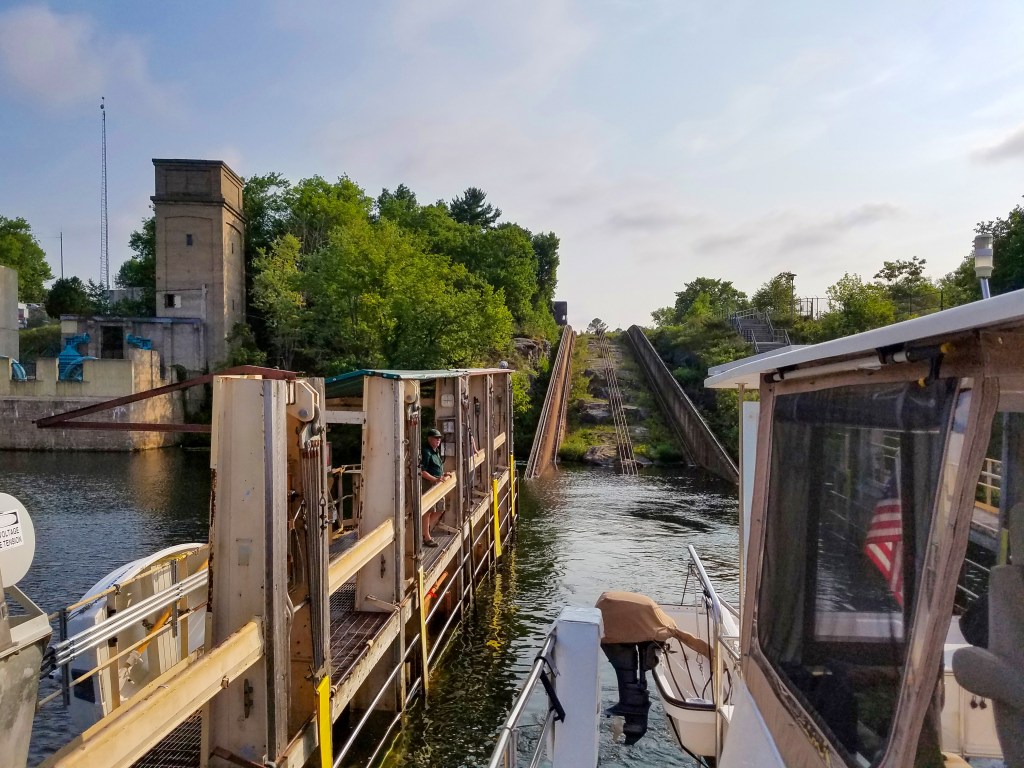
The Lift Lock was opened in 1904, and until recently was the highest hydraulic boat lift in the world, raising and lowering boats 65 feet in just about 60 seconds.  The lift consists of two large chambers that are filled with water.  Boats drive over a dropped gate into the chamber, the gate closes, an extra foot of water is let into the top chamber, and the weight of the water in the upper chamber counterbalances the lower, so one drops while the other ascends. It was quite exciting, although a very smooth and easy operation. It was a dull day, but I did take quite a few photos, plus Dick took pictures the day before when he walked up to the lock to see the operation.

Approaching the Peterborough Lift Lock
The two chambers pass each other
Looking down, underneath one of the chambers
Nine Lives in the chamber at the bottom of the lift lock
Looking back from within the chamber after the lift
Leaving the lift lock

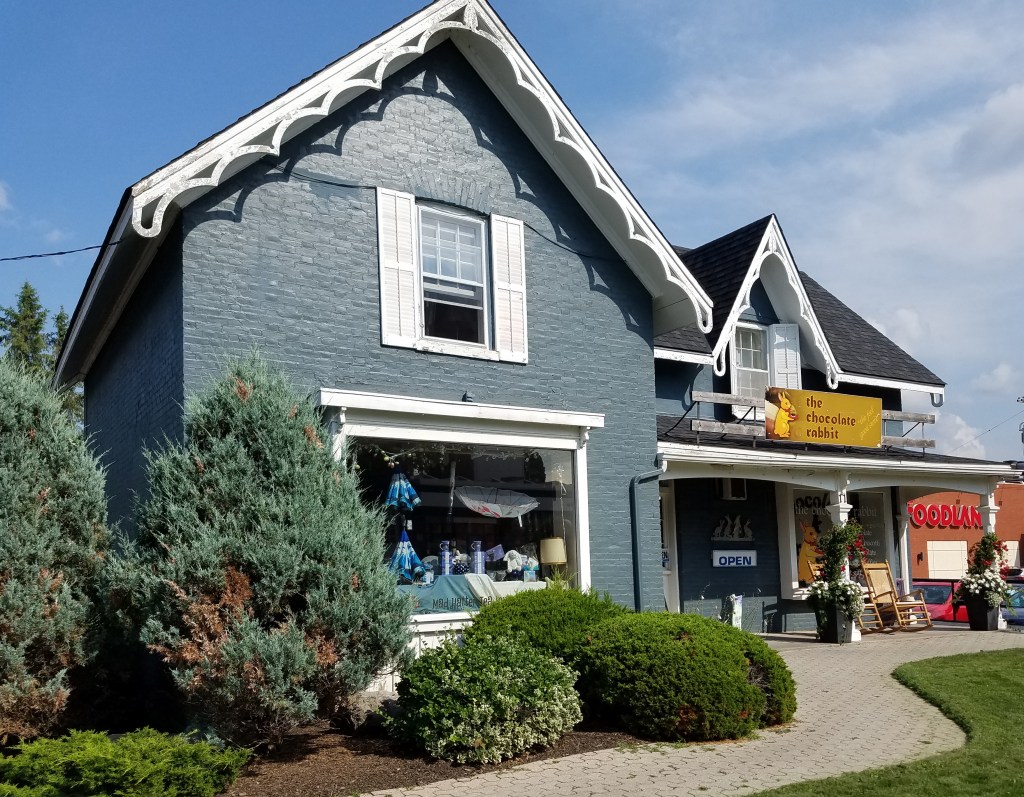
We stopped for the night at Lakefield on the wall just above the lock.  Lakefield is a pretty town with a tidy main street with restored buildings, interesting shops, and an excellent restaurant. A highlight was a wonderful chocolate shop in a lovely old house at the edge of downtown.  We made several selections and enjoyed them with tea for the next few afternoons.  They were so good we wished we had bought a larger box!  The next day was forecast to be rainy, so we wimped out and stayed another night on the lock wall. I had fun that evening cooking an Indian meal, papadums with dal, chick pea curry, chicken curry, naan bread, and basmati rice.

Lakefield
The wonderful chocolate shop in Lakefield
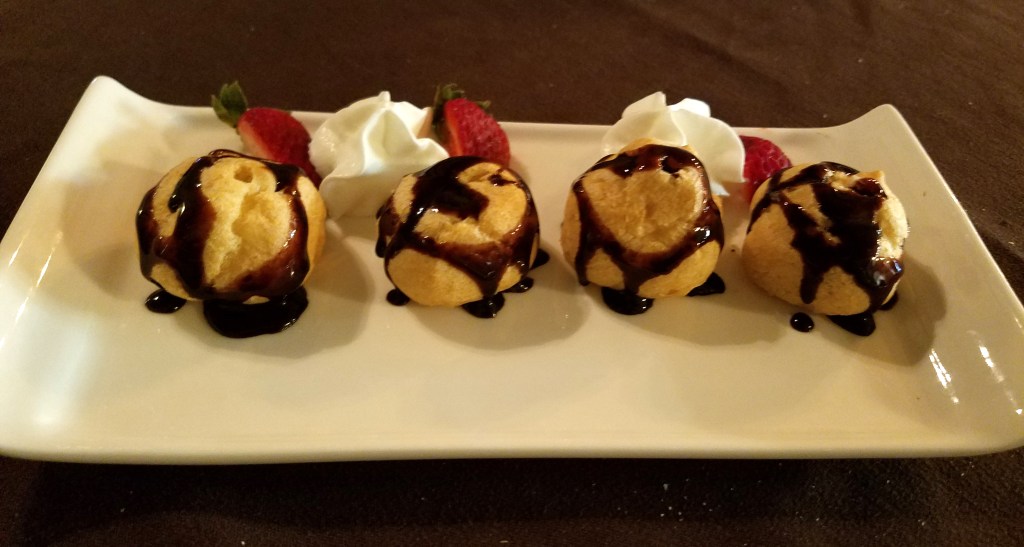
Who can resist profiteroles?

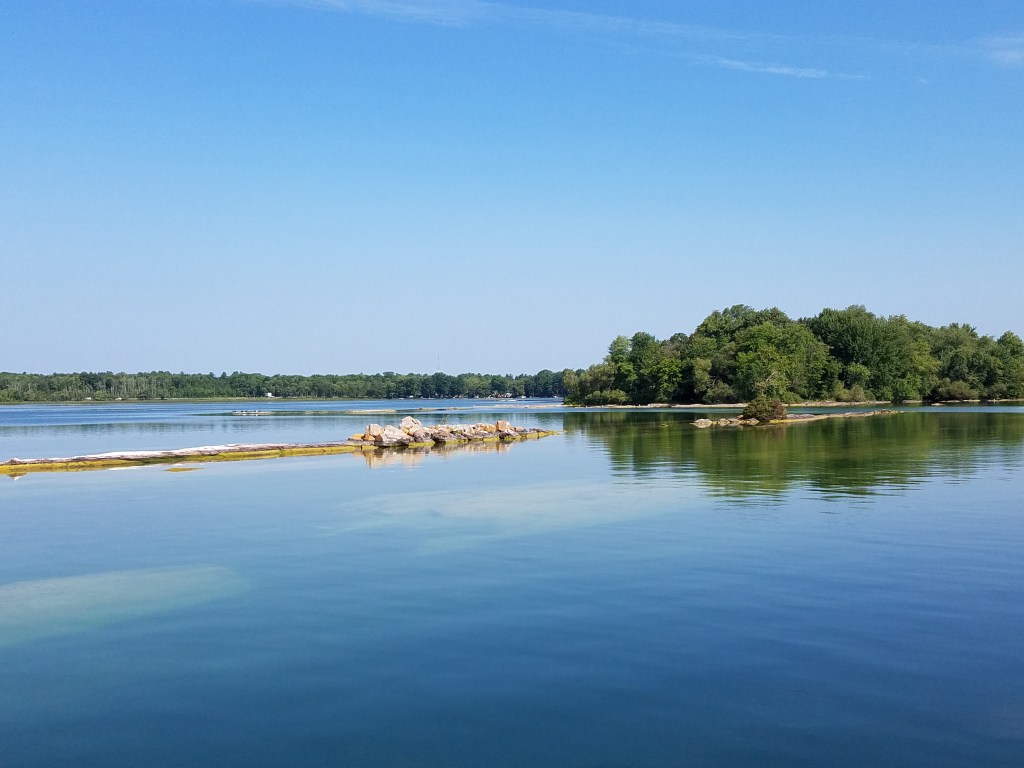
Kawartha Lakes is an area of lakes and small communities north and west of Peterborough.  Since it is only 90 minutes from Toronto, the lakes and connecting rivers are dotted with cottages and there are usually lots of boaters out for the day travelling through the various locks of the Trent Severn Waterway.  The village of Buckhorn was our next stop.  The lock keepers manage the tie-ups above the lock, and we were shoehorned in between several houseboats.  Houseboat rentals are apparently a thriving business in the Kawarthas, and we passed a lot of them as we travelled through the area.  Four of the houseboats at Buckhorn were occupied by a large group of young teenage girls with older girls as leaders.  They were not girl scouts, although most of them wore burgundy kerchiefs around their necks, and I heard the leaders speaking in what I recognized as a Slavic language.  I found out the next day that these were Ukrainian girls, on a special outing.  I think the leaders were in Canada for work experience, while the younger girls were from Canadian families of Ukrainian heritage. They were all well behaved, and very quiet.  We were glad it was group of girls, suspecting that a similar gathering of boys would not have been such good neighbours!  There are several restaurants in Buckhorn, including a Chinese restaurant that we were told too late was excellent.  Instead we decided to go for pizza.  A poor choice, as it turned out.

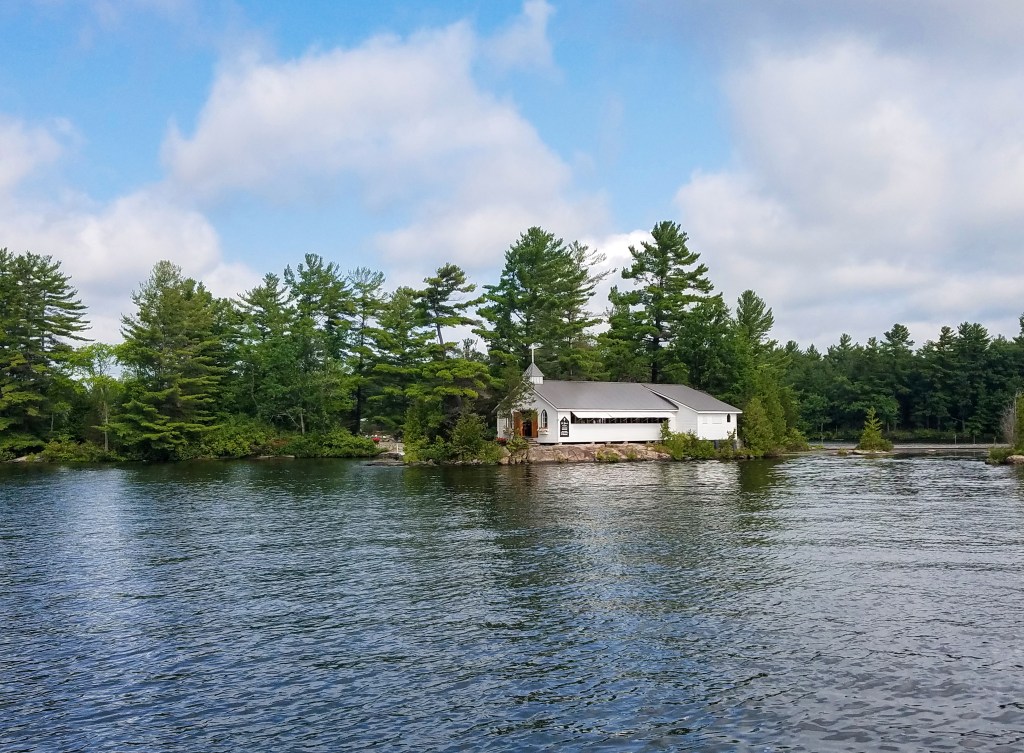
St Peters on the Rock, an Anglican Church that is still in use after over 100 years on an island in Stony Lake. The only way to get to it is by boat. There are services twice a week through the summer.
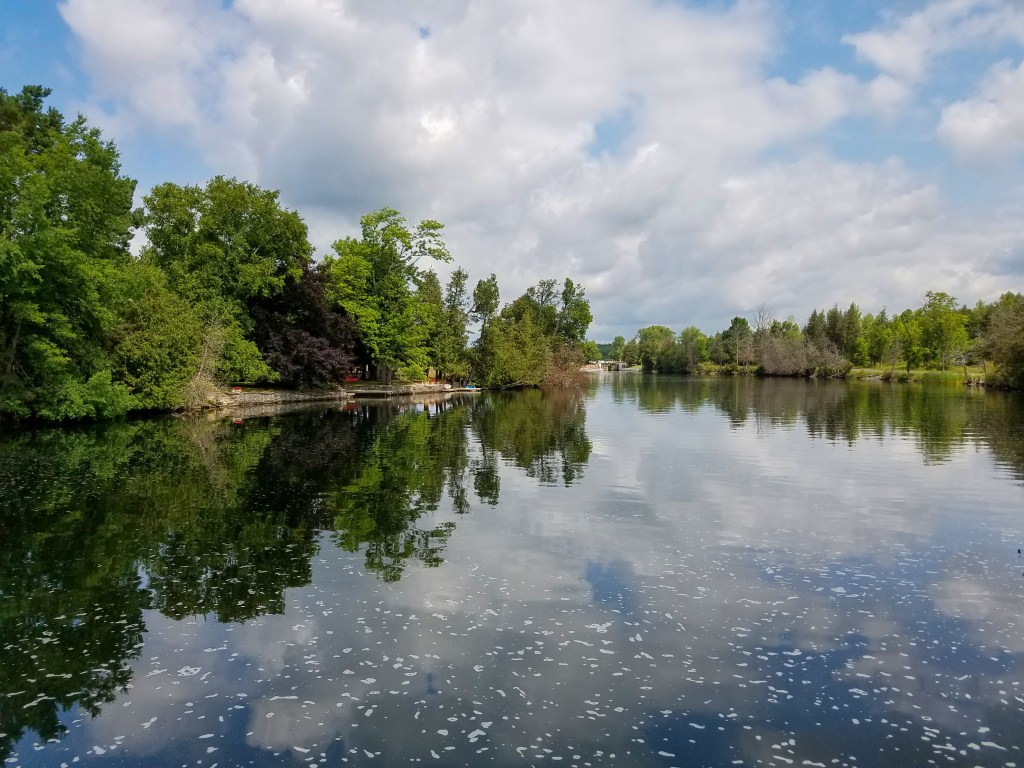
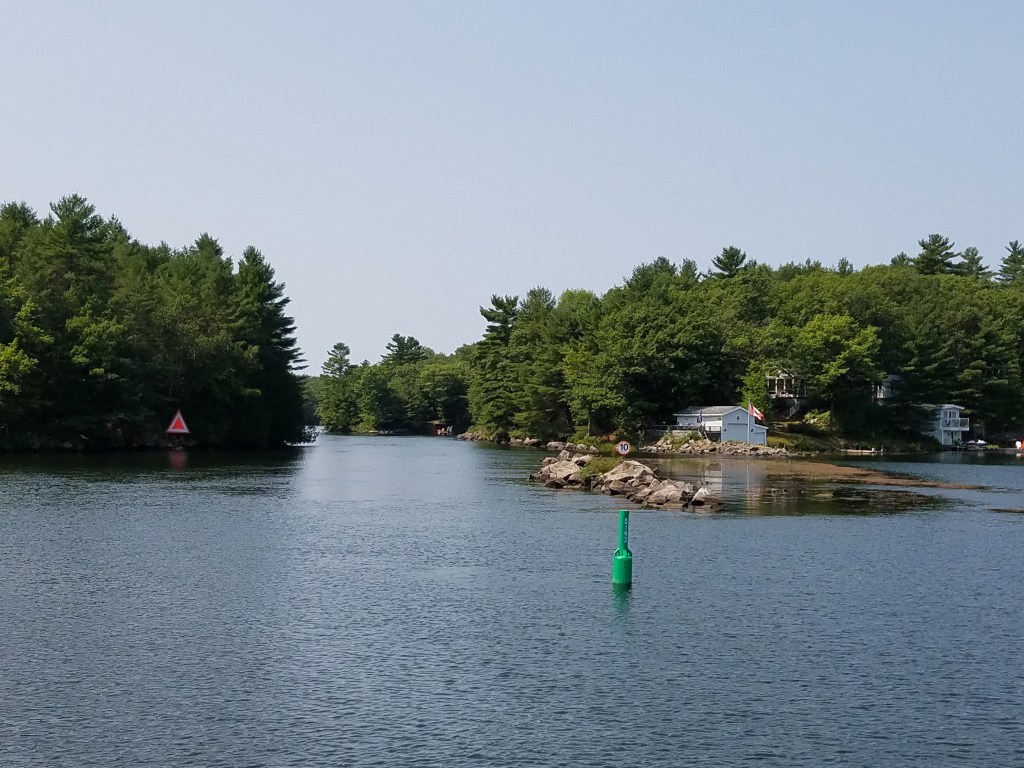
More of the pretty Kawarthas scenery
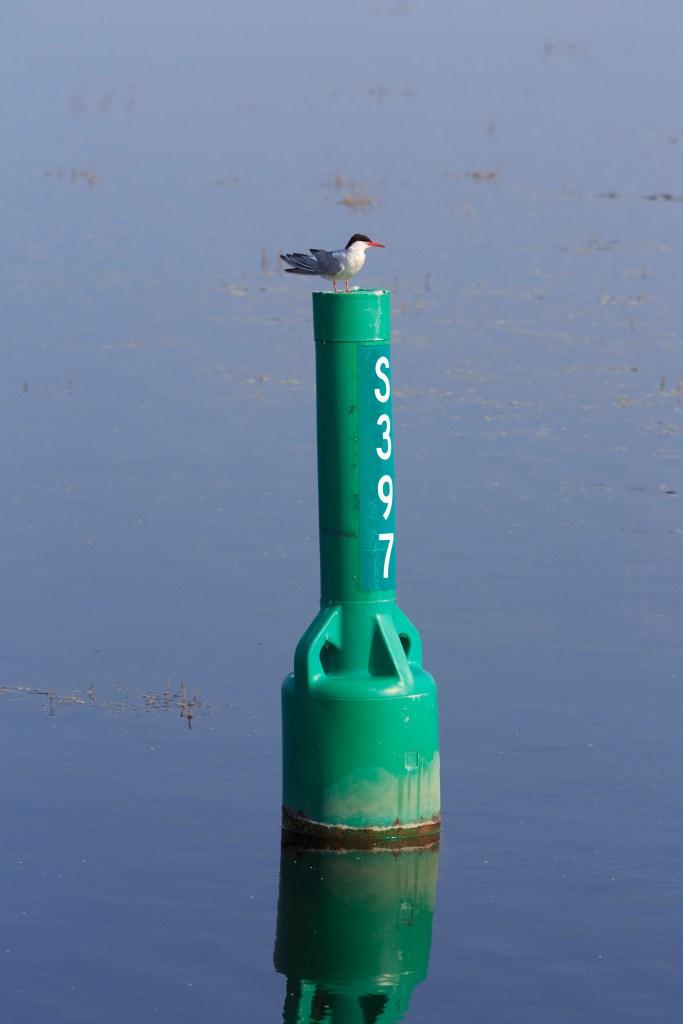
Common Tern, Sterna hirundo sitting on a channel marker in Canal Lake, Kawartha Lakes, Trent Severn Waterway, Ontario

The next day we went on to Fenelon Falls.  We arrived just in time to snag the last spot on the town wall above the lock.  This meant that I had a front row seat while a great many boats of various sizes locked up and down throughout the afternoon.  Nine Lives gathered a great deal of interest.  There are very few catamarans of any size in this part of the country, and now that we are behind the main group of Loopers, people are surprised to see a boat that has come all the way from South Carolina. Tourists and dog walkers stop to chat and ask questions, and I can hear people talking about the boat even when they don’t pause for conversation.

Above the lock at Fenelon Falls

Kirkfield is the second lift lock on the Trent Severn.  The lift was completed in 1907, and extensively modernized in the late 1960’s.  The concrete piers were removed, so the lock construction is more easily seen.  We stopped for the night just below the lock, so it was interesting to watch boats going up and down for the rest of the afternoon.  A friendly boater stopped by to chat, and eventually told us that his two sons would love to be able to see inside the boat.  We are always happy to show off Nine Lives, so the fellow and his sons came aboard.  It was quite clear that the boys had zero interest, while the father asked many questions and enjoyed the visit!  Beyond Kirkfield the Waterway became much quieter, with fewer boats out and about.

Kirkfield lift lock in operation
The chamber below the lift lock
Looking back as we drive into the lift lock
It’s a long way down!

After a quick succession of 5 locks we were out into the open water of Lake Simcoe.  Although not considered one of the Great Lakes, it is 19 miles long and 16 miles wide.  It can become quite rough and is known for pop-up thunderstorms on hot summer afternoons.  We gave Nine Lives a nice run and skipped across most of it after we noticed some building thunderheads.  Lake Simcoe is connected to Lake Couchiching by a narrow channel with a fierce current.  We needed to stop at a marina at the end of the channel to get a pump-out, and the current slammed the boat into a corner of the fuel dock, creating a nasty gouge in the side of the boat, fortunately above the waterline.  The dockhands offered some waterproof tape to prevent any splashed water getting in, and later we were able to get more tape and complete the temporary repair.  The tech at a local boatyard told us that as long as we keep the tape intact we will be fine with the temporary repair until the boat is hauled out of the water for winter storage. The tape is the same colour as the hull so it doesn’t show.  Nobody wants other boaters to see the results of an “oops!”

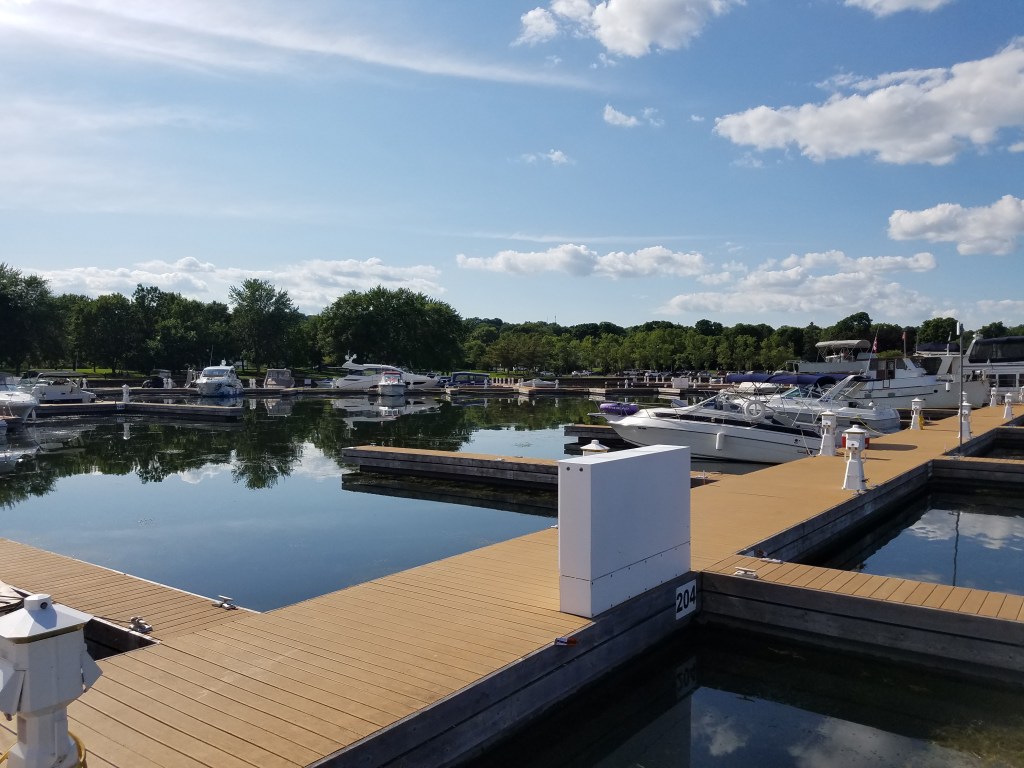
The site of the town of Orillia has been occupied for at least 4 thousand years.  Evidence has been found of fishing weirs constructed in the narrows between Lakes Simcoe and Couchiching, and there were also trading, fishing, and hunting camps in the area.  Samuel de Champlain visited in 1615, but the settlement of Orillia was not laid out until 1840.  There is some manufacturing in the area as well as farming and of course tourism, but the largest local employer is a casino run on the nearby Ojibway Reserve.  A beautiful marina has been built in the harbour, and there are bicycle paths running for several miles in each direction along the waterfront.  Dick disappeared on a beer run that somehow incorporated all 5 miles of the bike path!  There were several Looper boats in the marina, and we enjoyed docktails followed by Chinese food at a local restaurant with the couple on the boat next to us.  They are also doing the Loop in small pieces like us, instead of the more common all at once over a single year, so it was nice to compare notes.

The marina in Orillia
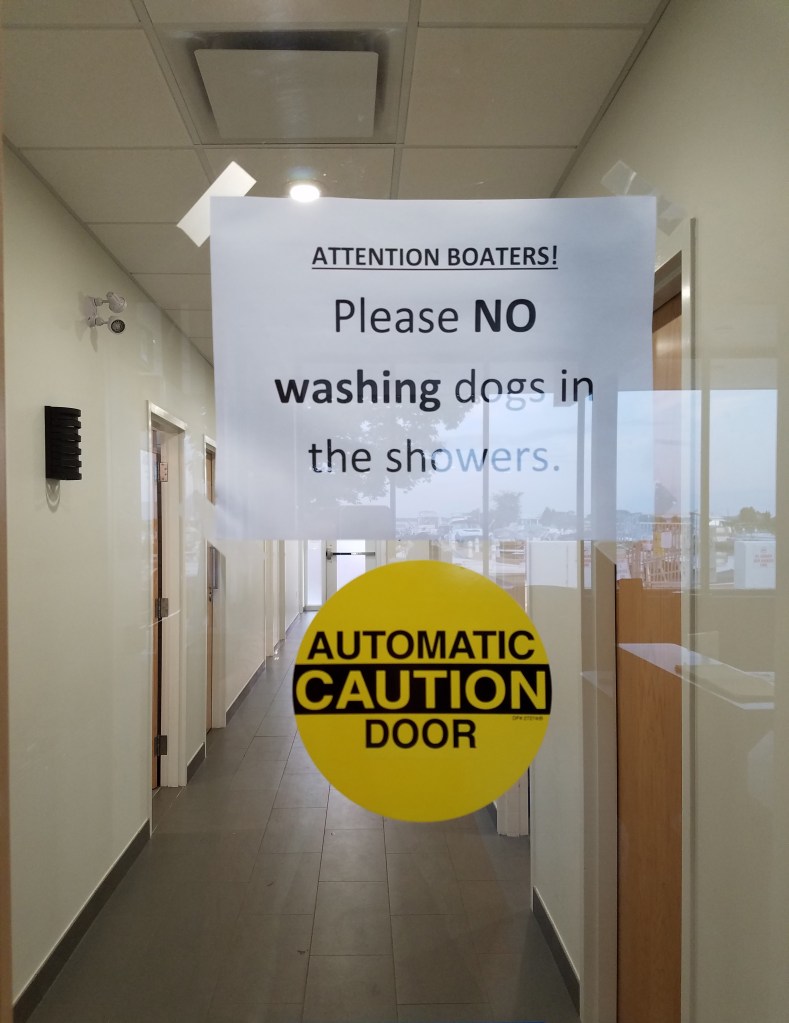
A slightly surprising sign at the marina in Orillia. Not so much the objection, but why would anyone assume that washing their dog in the showers was acceptable practice?

North of Orillia we travelled through some “interestingly” shallow and narrow stretches of the waterway.  I say interesting, there were at least 2 cuts that were too narrow to allow large boats to pass each other, and one long stretch where we had to stop in place to allow big boats to inch past us.  The channels are rock sides and bottom, and the sides slope, rather than being cut straight down.  Unlike in some of the notoriously shallow areas of Georgia and New Jersey on the ICW, when you touch bottom here it is not soft sand but unyielding rock!  We managed to traverse the whole section without incident, just those few nail-biting moments as we passed other boats.  Our stop for the night was at the top of Big Chute Railway.

This is Ontario’s “cottage country”
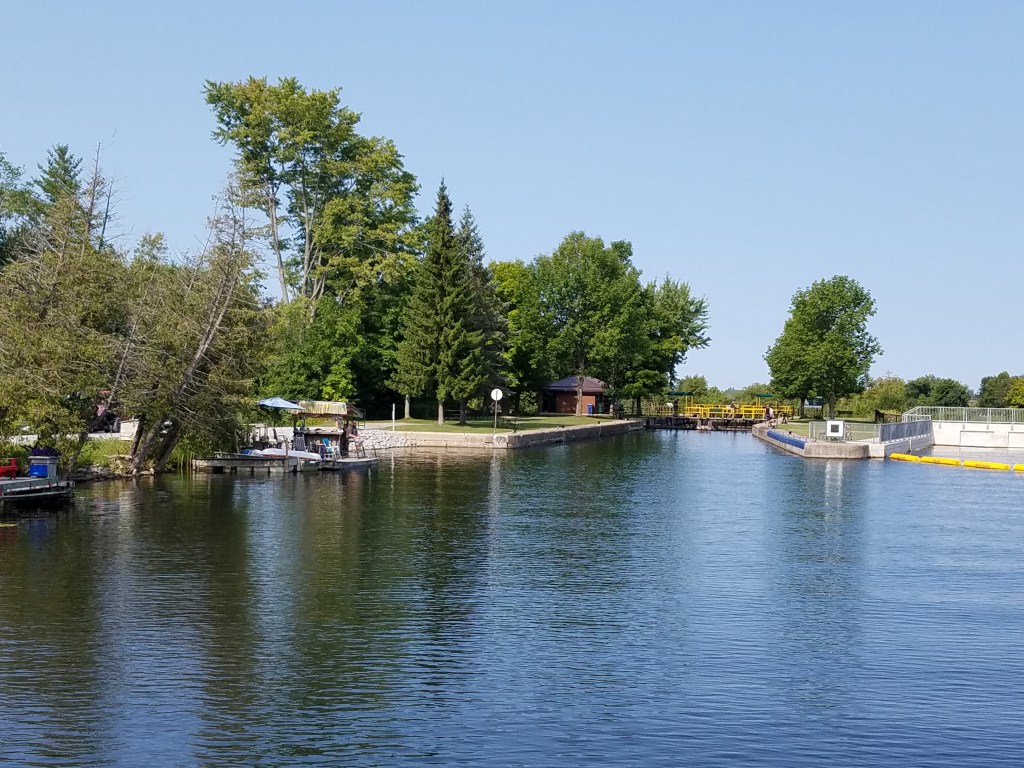
Trent Severn Waterway, one of the locks before Lake Simcoe. The fellow in the tiki bar at the left has a sign offering free beer, we did not test whether or not he meant it for all passing boaters.
Beautiful, but a bit worrying for those of us on larger boats, as rocks line the narrow channel.
The entrance to one of the narrow sections where you cannot easily see oncoming boats
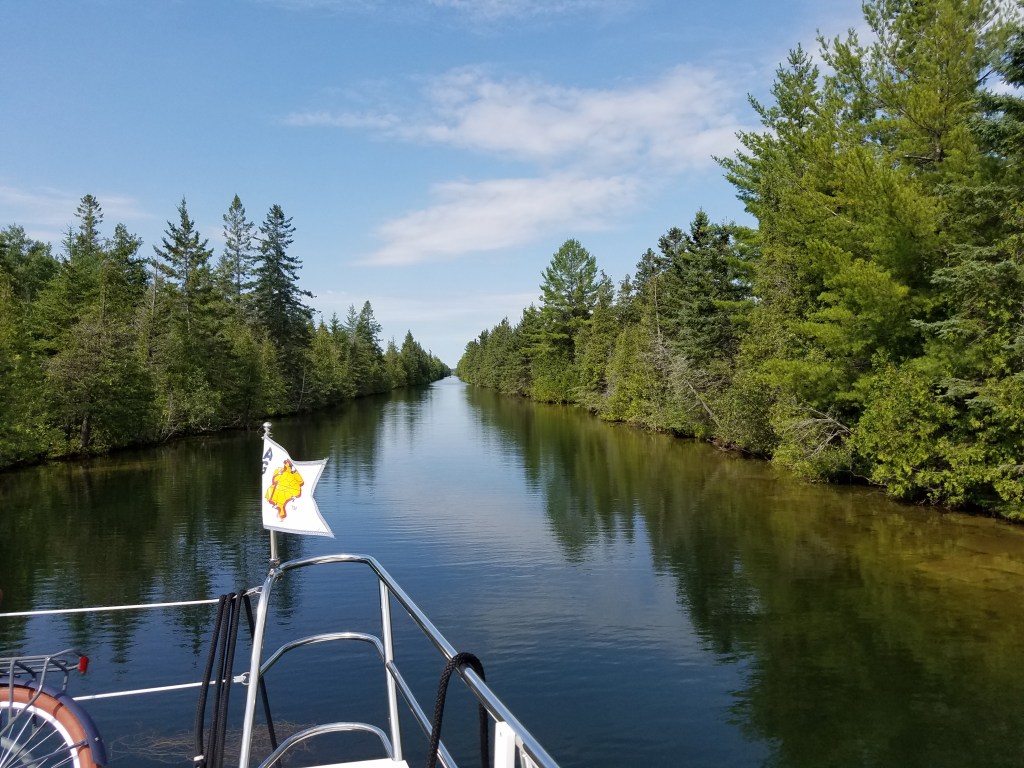
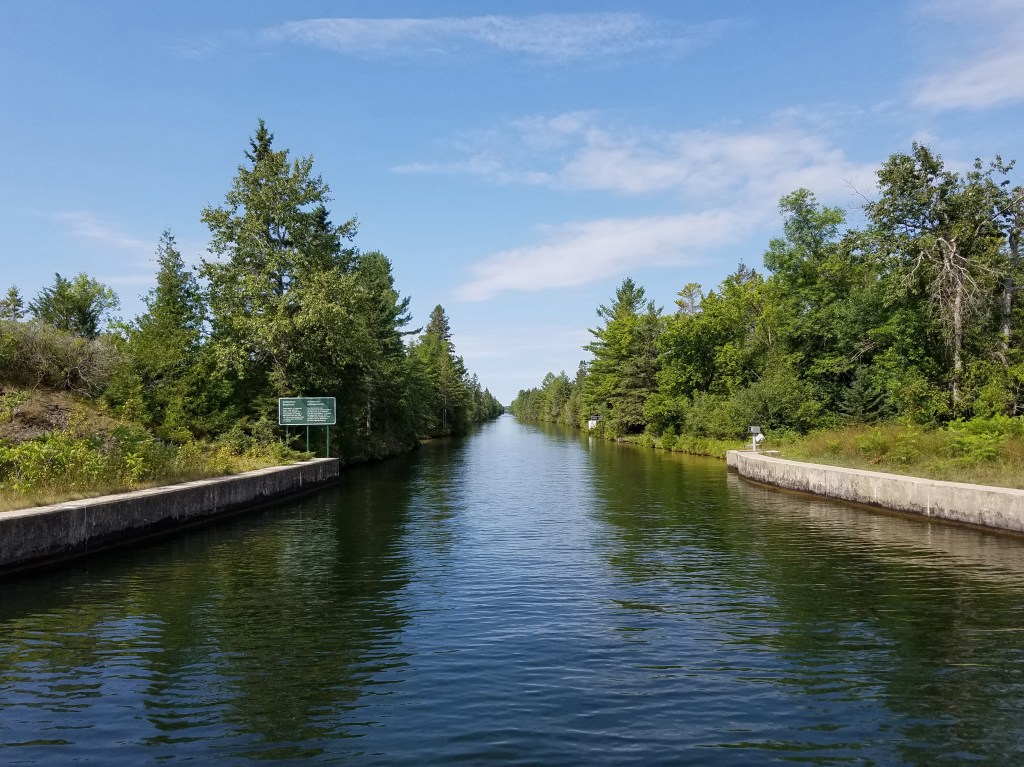
Narrow cut on the Trent Severn Waterway between Mitchell Lake and Canal Lake.
The shelved sides of the cut are rock.
The sign warns that boats over a certain size must make a radio call before proceeding.
Two boats in the distance, that we had to squeeze past.
Our Tucker, at his other home in Hilton Head, wondering whether he should ask to be posted to us so he can try being a boat cat again. I sure miss him.

Big Chute was the second grand adventure on the Trent Severn.  There were supposed to be 3 locks built to carry boats between Georgian Bay and the Severn River at Swift Rapids.  One small, so-called temporary lock (it’s still in use) was built at Port Severn, and two marine railways were built between that and Swift Rapids.  The Swift Rapids railway was eventually replaced by a lock, but Big Chute Marine Railway is still in use.  The current carriage was opened in 1978, and can carry boats up to 100 feet long and 24 feet wide.  The carriage rolls down into the water, and the boat drives in and is held at the side of the carriage while large slings are raised underneath to keep propellers and rudders off the bottom of the carriage and to steady the boat through the transit.  The carriage then rolls out of the water and down (or up) the rails to the other end.  It is cleverly designed to keep horizontal during the transit, even though the railway is very steep.  This marvellous piece of engineering is getting rather long in the tooth, and breakdowns are not uncommon.  In fact, a local boater had described it as “a white elephant that keeps breaking down”, not what we wanted to hear before our transit!  Our keels completely enclose our props and rudders, so we were simply resting on the bottom of the carriage, not lifted in the slings.  The carriage shakes and rattles alarmingly, and it was not exactly confidence building to listen to the operators chatting about all the reasons why the government is “going to have to work on this all winter!” Nine Lives survived the adventure without incident.

Big Chute
A boat has just come up in the carriage
Two small pleasure boats getting ready to be lifted.
From the side, you can see the track and the wheels that run on it.
It’s our turn, Nine Lives has entered and the carriage is out of the water
At the top of the hill, just before we start down
Looking back up the hill as we are lowered into the water at the bottom of the slope. Nine Lives was much relieved to find water under her keels again!

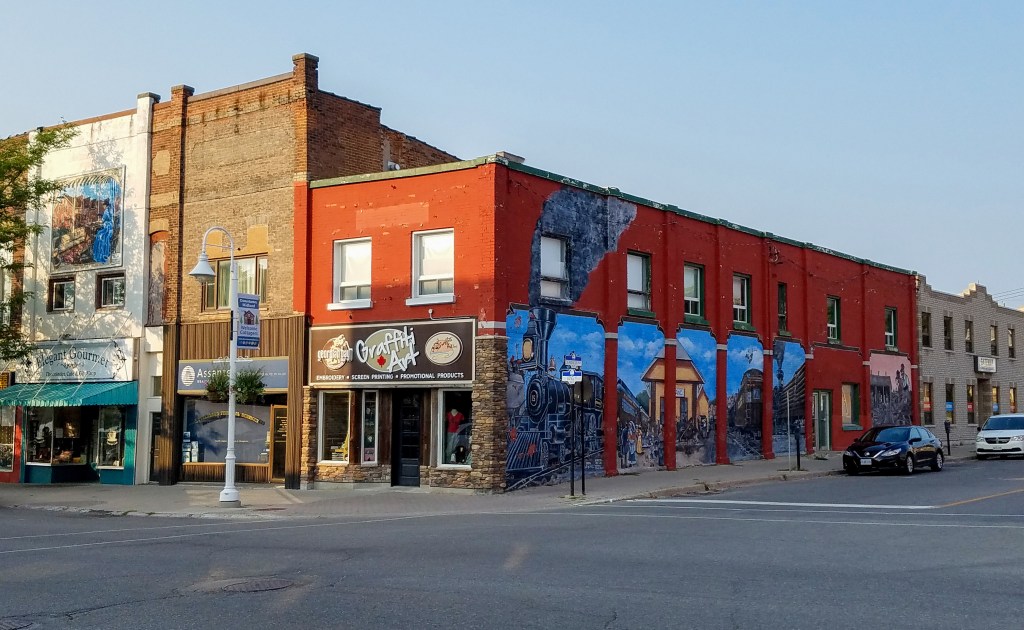
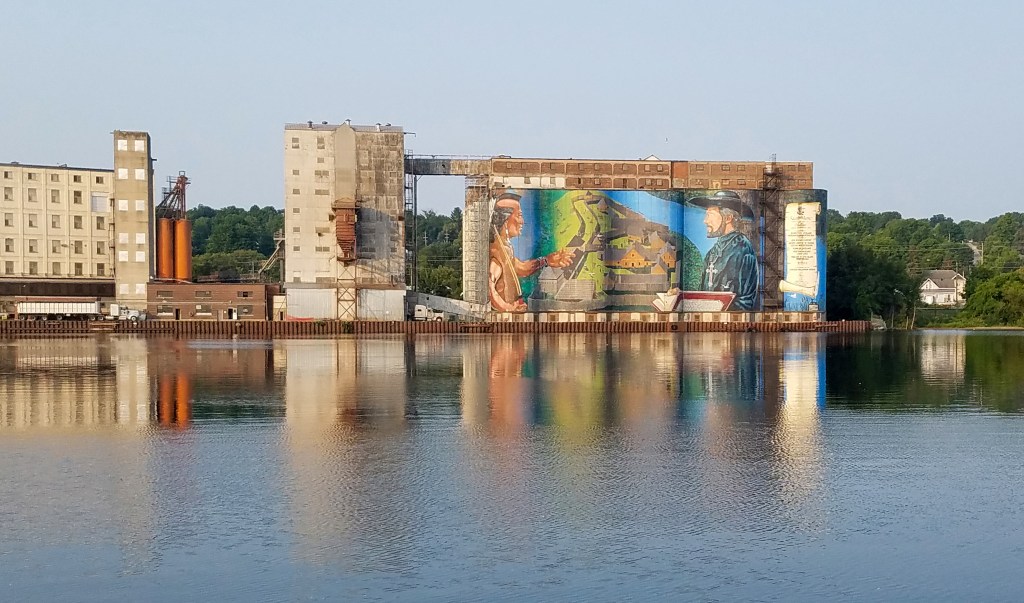
After the small lock at Port Severn we were into Georgian Bay.  Our first stop was Midland, founded as a railway town in 1871.  Of particular interest are a number of murals found around the town, painted by a local artist at the close of the 20th century.  The largest covers what would otherwise be very unsightly grain elevators overlooking the harbour.  The day after we were there was the start of a tugboat meet.  They were expecting at least 20 tugboats to gather for tours and races over the weekend.  The day we arrived there were already 5 at the docks.  Just as there are people who enthusiastically restore old steam trains, there are those who buy and restore old tugboats.  The ones we saw ranged from a very large 70 footer, to a small one painted bright red and named Maggie.  We were sorry we couldn’t take time to stay and watch the meet.

Midland has wonderful murals depicting various aspects of its history
Another great mural in Midland
A beautiful way to deal with grain elevators
Tugs gather for the meet at Midland

Skipping quickly across the southern end of Georgian Bay in advance of threatened thunderstorms, we arrived the next day at Meaford.  We have now seen the last of our fellow Loopers, most of whom are heading north to the North Channel and Lake Michigan.  Meaford is known for its apple orchards and an annual scarecrow festival.  It also has an arts and cultural centre and some lovely old houses and civic buildings.  As with most Ontario small towns, many of the downtown shop spaces are taken up by banks and various social services organizations and government offices.  The nearest supermarket is 5 miles away, and while there are a few restaurants, there seems to be little to attract tourists to the town.  The harbour is nice, and protected by a huge breakwater.  We noticed that most of the slips are taken up by sailboats, and there is an active sailing school for children operating out of the harbour.  We stayed three nights due to a poor weather forecast, and were very glad of the decision when we moved the boat the first morning to take on fuel.  The waves in the short hop around the breakwater blew up while we refuelled, and the return trip to the harbour was very lumpy, knocking things over in the cabin.  Now that we are back into “big water” we are experiencing the weather delays that have been mostly absent this summer.

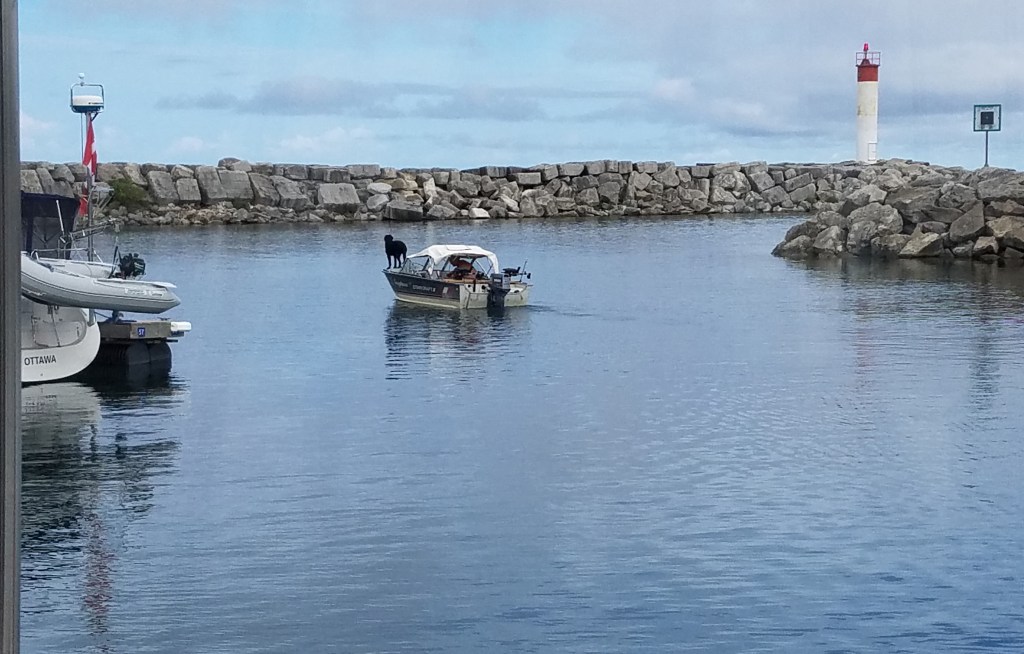
The substantial breakwater at Meaford Harbour. A small boat heads out past the lighthouse, with the fish and wildlife spotter standing on the bow!

Our next stop was Tobermory, a bustling town at the northern tip of the Bruce Peninsula.  As we made our way north along the shoreline of the Peninsula I spent some time refreshing my memory of the geological feature known as the Niagara Escarpment.  Dick and I both learned in school that the Niagara Escarpment is a high bluff that runs from the tip of the Bruce Peninsula south through Hamilton and Niagara Falls.  Looking it up, I was surprised to learn that in fact, the formation rises from Waterton New York, through Ontario, Illinois, and Wisconsin, ending northwest of Chicago near the Wisconsin border. What a pompous and parochial attitude of a school system that suggests that the importance and magnitude of a geographical formation is limited to the piece that falls within political borders.

Running fast – a look back at our wake as we run fast. The yellow buoy marks the edge of a Canadian Armed Forces training area north of Meaford. Live fire exercises are conducted, so boats need to stay well off shore!
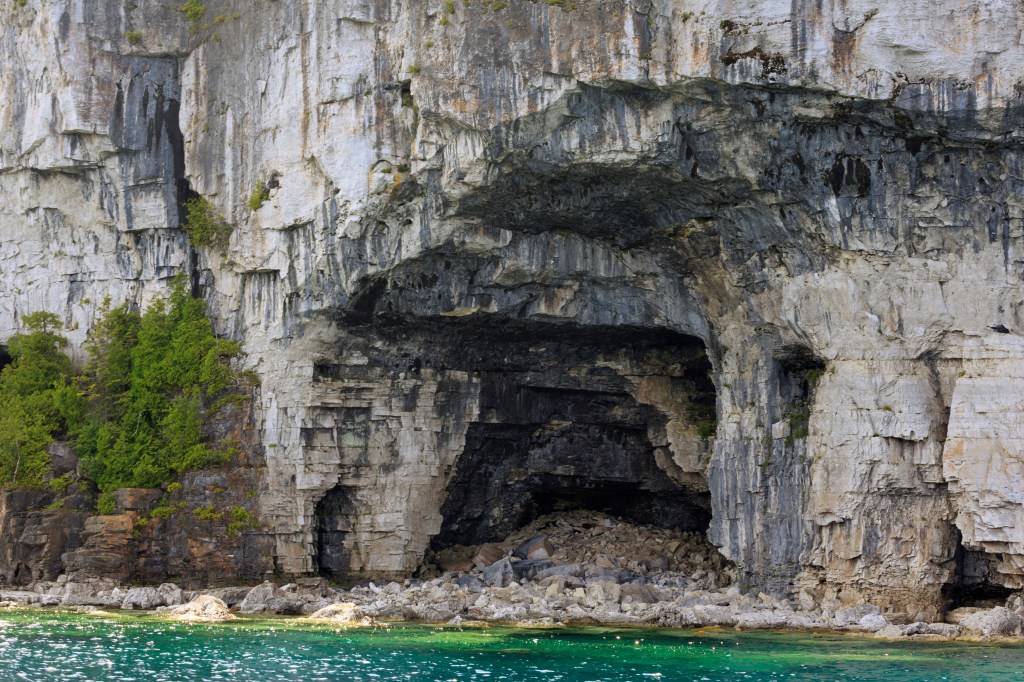
Limestone caves on the shore of the Bruce Peninsula, Georgian Bay
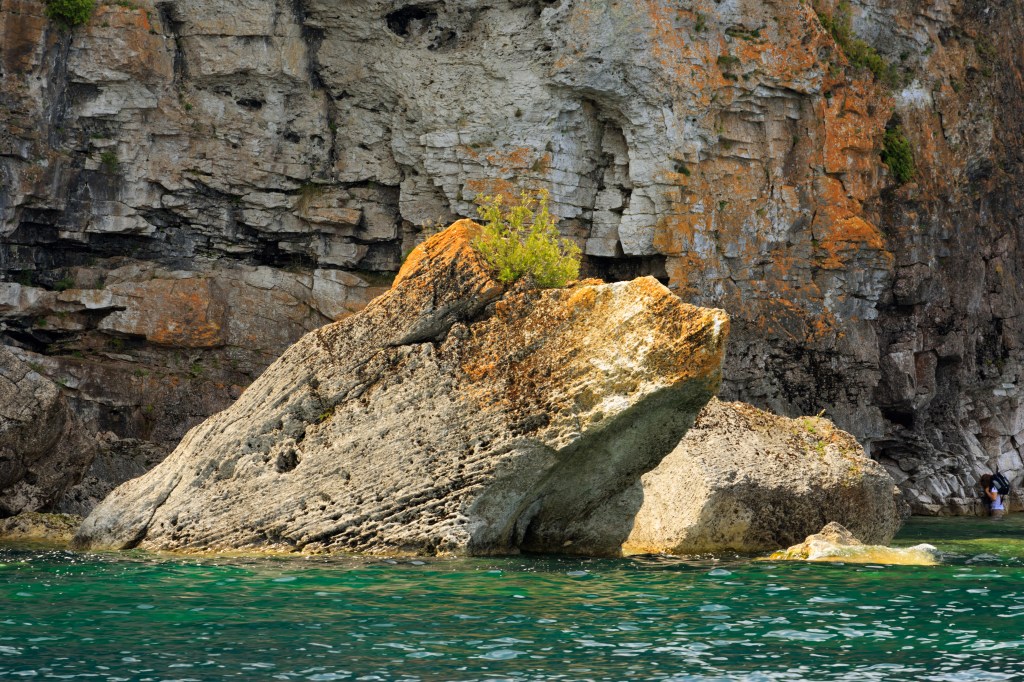
Lichen coats limestone of the Bruce Peninsula in Georgian Bay

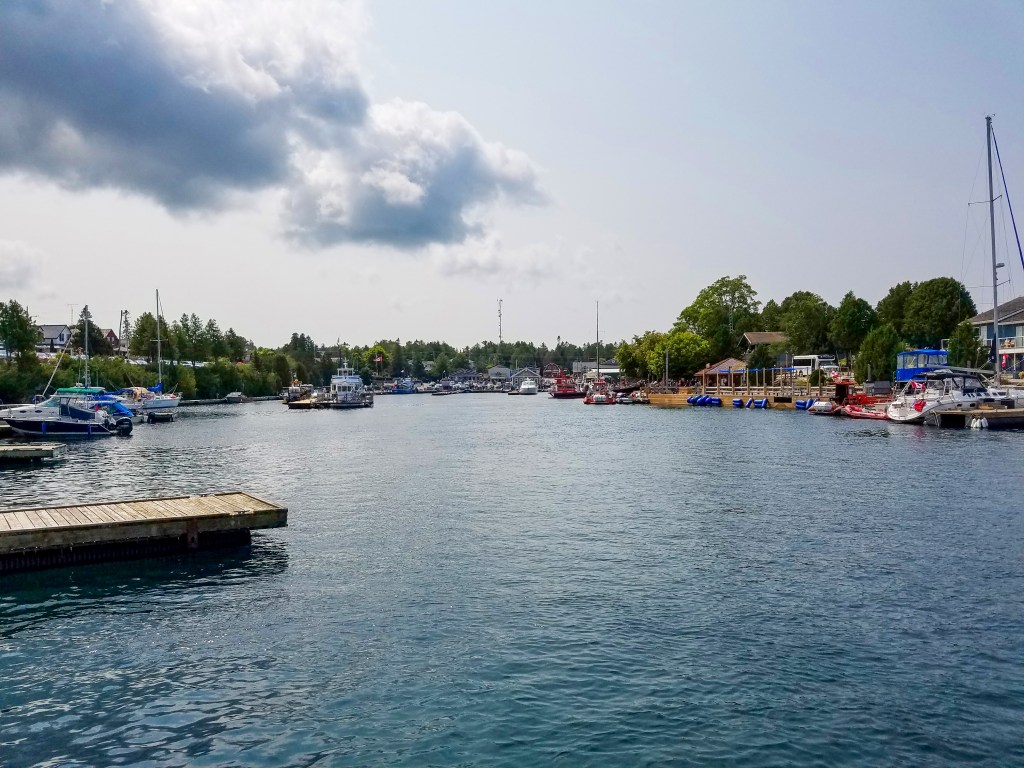
Tobermory is a popular tourist destination. Nearby is Fathom Five National Marine Park, which we saw from the water as we made our way around the point.  Part of the National Park is Flowerpot Island, with a distinctive rock formation just offshore that attracts thousands of visitors on the many boat trips that ply the waters between Tobermory and the island. The area is also a magnet for diving, with many dive boats going out to explore the shipwrecks in the treacherous waters of north Georgian Bay.  We arrived in town in early afternoon, and I enjoyed watching the harbour activity.  In addition to at least 10 tourist cruise and diving boats every hour, there is a car ferry that goes to Manitoulin Island, and lots of large and small pleasure boats.  All this activity is complicated by kayakers weaving around the harbour, seemingly unaware of the “law of gross tonnage” that suggests that even though kayakers may have the right of way, the bigger the vessel, the less easy it is to stop or turn and give way!  I would have liked to spend another day or two in the busy little town with its interesting shops and lots of people watching, but the weather is getting chancy and we had to leave the next morning.

Tobermory
Tobermory is a “harbour of refuge” for Georgian Bay and Lake Huron. In a storm, space will be found for any boats caught on the lake.

Turning south into Lake Huron we were surprised to find ourselves in much rougher water than the forecasts had suggested.  Nine Lives doesn’t really cut through the water the way a sailboat or ocean-going trawler does, instead she dances on top of the waves.  Our extra speed is helpful in smoothing things out so we are not wallowing or corkscrewing, but the ride is uncomfortable to say the least.  The hulls and the centre section pound on the waves, and gradually the furniture in the salon begins to make its way aft, as each wave smacks the floor and makes everything bounce.  At one point, Dick had to go below and rescue the small seat that happens to be our liquor cabinet, before it reached the galley stairs with potential disastrous results!  Fortunately, the pounding only lasted about an hour before the promised smoother water showed up and we made our way into Port Elgin.

We were delighted to be able to entertain a friend from our university days on board for dinner that evening.  Jan was in the same residence with us at Queen’s ..ahem.. some few years ago.  We all agreed that none of us has changed a bit, even though we have not seen each other for a very long time.  We spent an enjoyable evening catching up and exchanging stories.  We would have liked to stay a little longer in Port Elgin, but once again with an eye on the weather we had to take advantage of a short window to make our way south.  If we did not leave in the short hour between squalls that afternoon we would have been stuck there for at least 4 or 5 days.

Chantry Island Lighthouse and Lightkeeper’s cottage, Lake Huron, Ontario

Nine Lives and America’s Great Loop

This is the story of one couple’s voyaging on the waters of eastern North America.  Frequent travellers from the first years of their marriage, they embarked on an eight-year boating adventure, and enjoyed the many places they saw and the people they met.

Nine Lives and her Crew

Dick was born in Canada, first-born of Dutch parents.  His family were farmers, and from his early teens they owned and operated a dairy farm in Southern Ontario.  Dick attended Queen’s University in Kingston, Ontario, graduating in 1976 with a degree in Engineering.  He went to work for a supplier to the oil and gas industry, and stayed with them for his entire career, although there were several iterations and changes of location over the 40 years.  He met Louise (that’s me) at Queen’s and we were married in 1977.  Dick’s career took him around the world, and included expat assignments in England, Czech Republic, Malaysia, France, and Brazil, as well as several assignments in Calgary, Canada, Upstate New York, and Houston, Texas.  He retired in 2016. Being a Mechanical Engineer with a keen interest in how things work was an excellent qualification for owning and living on a boat.

I (Louise) was born in England, but was transported to Canada with my parents at the age of 3 as they went in search of a better life with more opportunities.  After growing up in suburban Toronto, I attended Queen’s University, where I met Dick, and graduated with a degree in Arts.  My early career was spent in various accounting clerical jobs, and a brief stint selling real estate, before I discovered my true calling and started work in scientific research libraries.  Eventually I earned the qualification (Masters degree) to go with the experience.  I worked for research companies that included Xerox, an oil and gas joint venture, and a National Laboratory in Long Island.  Ultimately, Dick’s various overseas assignments stopped my career progression as I dutifully followed him around the world.  In later years, I reinvented myself as a photographer, specializing in landscapes and wildlife, and I continue to sell my images to books, magazines, newspapers, and various internet buyers.

We both had quite a lot of boating experience before retirement.  When I was a teenager, there was a family cottage with canoes, speedboats, a runabout, and a small sailboat.  Dick’s experience began with the speedboats at our cottage.  We will gloss over his earliest involvement with the canoe.  We also enjoyed a number of one- and two-week rentals of narrowboats on the English canals.  In later years, we joined my parents on several sailing vacations in the Caribbean and the Mediterranean, learning the ropes as it were, under the tutelage of my keen sailor father.  These experiences instilled the same love of boating in Dick that I had already found when, at the age of 5, I set off on a solo adventure in a small rowboat.  Eventually, we took the ASA sailing courses and tried a sailing vacation on our own; our first and last.  Let’s just say that we do not get on well on a sailboat (too many captains).

Some time around 2012, having been repatriated to USA and living in Houston, we began to think seriously about our retirement plans.  We knew that boating was going to be part of them.  We also knew where we were going to live, having bought a home in Hilton Head Island some years earlier.  The only problem was, Dick really wanted a sailboat, and I, knowing my husband quite well after many years, wanted no part of sailing with “Captain Bligh”.  After many years of drooling over sailboats at marinas wherever we travelled, Dick announced that we would never own a sailboat in these (Hilton Head) waters, because it takes such a long time to motor out of the Sound and into open water for sailing.  Suddenly, we were on the same boating page for the first time in 20 years!

I was looking at a map of USA one wet afternoon in Houston, and I thought to myself that it might be possible to take a boat all the way up the east coast, through the Great Lakes, and down the Mississippi.  There was just the minor detail of how do you get from the Great Lakes to the Mississippi?  More detailed maps suggested that there was probably a route from Chicago.  We were already thinking about the boat we hoped to buy for retirement travels, and Dick began looking at Yacht World and other boat selling sites.  Here he noticed boats that were advertised as being “Loop ready” or “Loop veterans”.  Further investigation led him to America’s Great Loop Cruisers’ Association and the realization that circumnavigation of eastern North America is in fact, a Thing!

We spend the next few years visiting boat shows and watching Yacht World.  Dick had ideas of what would be the perfect boat, and I had different ideas.  Throughout the search, Dick refused to consider catamarans, even though we had enjoyed the catamaran on our last sailing charter with my parents.  He was certain they would be too wide for many of the locks, especially those in Canada, that boats must go through on the Great Loop.

In 2013, we bought our retirement home in Hilton Head Island, with the plan that I would move there immediately, while Dick continued to work for a few years, commuting between Houston, his then current assignment in Brazil, and Hilton Head.  We soon bought our first boat, a 24-foot Bayliner pocket cruiser.  The cabin was big enough for two people to get away for a weekend, and it was complete with a head (toilet and shower) and cooking facilities.  This was our “practice boat”, a chance to review and learn more about the many aspects of power boating, in the protected waters of the Intracoastal Waterway around Hilton Head.

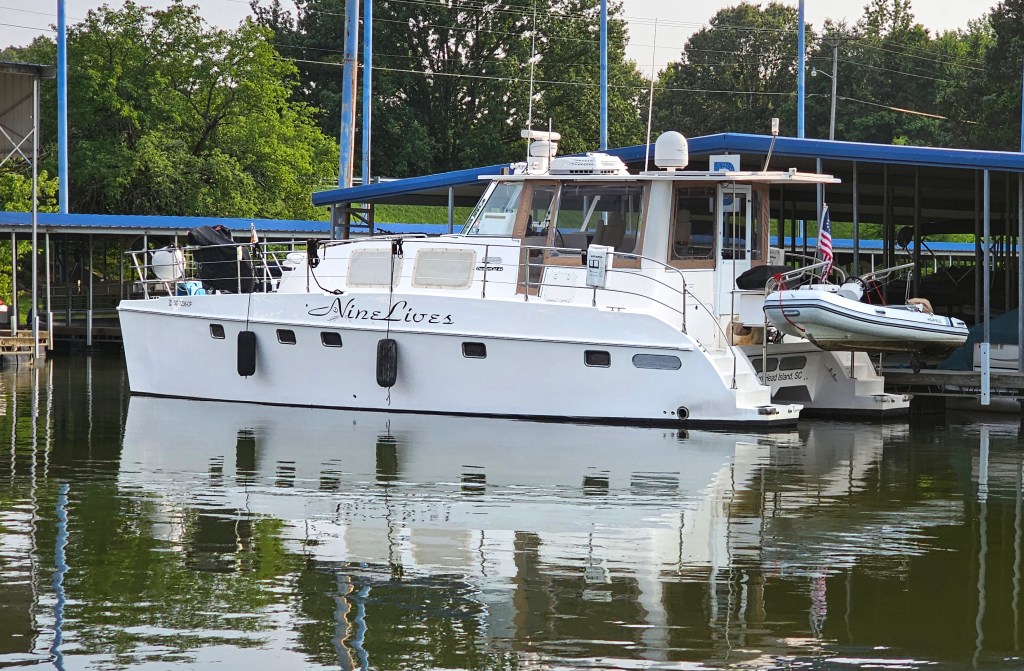
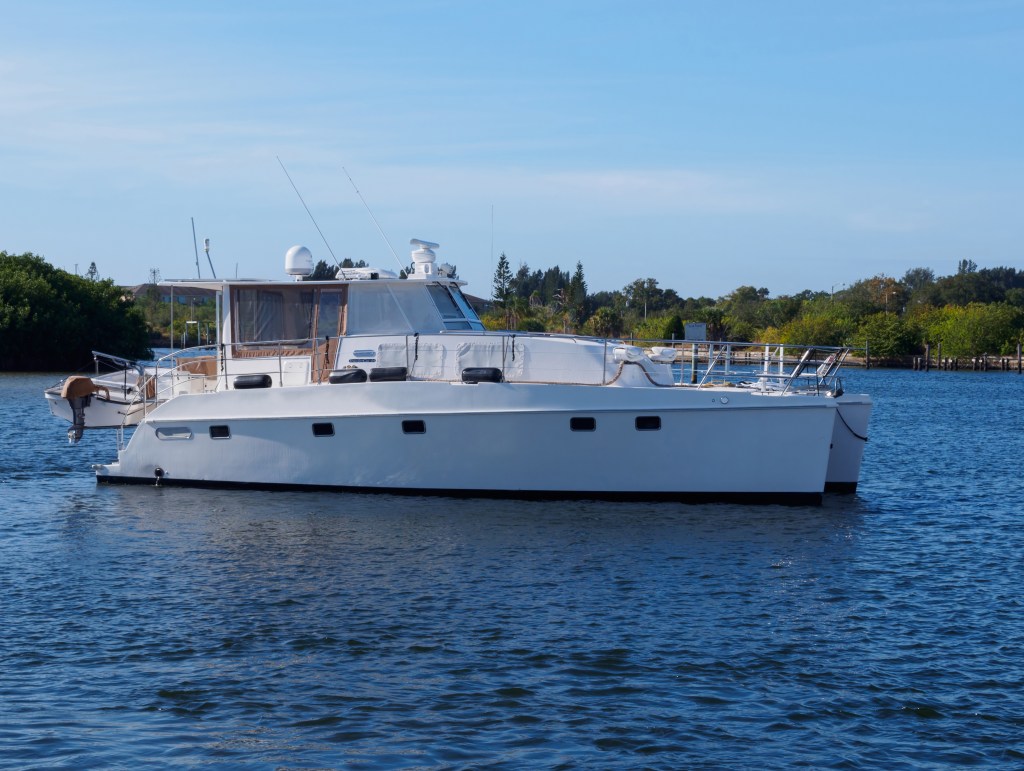
Dick retired in 2016, and it was time to get serious about choosing our Loop boat.  We had just about settled on a Sea Ray Motor Yacht, when Dick discovered Endeavour catamarans.  Endeavour had a long history of building highly-rated sailboats, and around 2002 they started building catamarans with much bigger engines, designed to be Trawlercats.  They came in 2 lengths, a 36-ft (soon replaced by a 38), and a 44-ft.  The Endeavour Trawlercat 44 has 3 staterooms, 2 heads with separate showers, a full galley, and a pilothouse design that eliminates the need for a flybridge.  Wide decks mean safe and easy access for locking and docking.  The beam width is just under 19 feet, perfect for the Great Loop.

The EndeavourCat 44 has a shallow draft (3.5 feet), allowing for (relatively) easy passage through some of the very skinny waters at various points on the Loop.  It has a 14 ft air draft, so it fits under all of the fixed bridges on the various alternative routes.  It is very fuel efficient.  Normal speed is “trawler speed” at about 8 knots, but she can also do 18 knots to get away from a storm, or help to smooth out lumpy water.  The catamaran configuration allows for a lot of interior and exterior space while keeping the length down to 44 feet, so is less expensive for docking in marinas compared to monohulls with the same interior space.

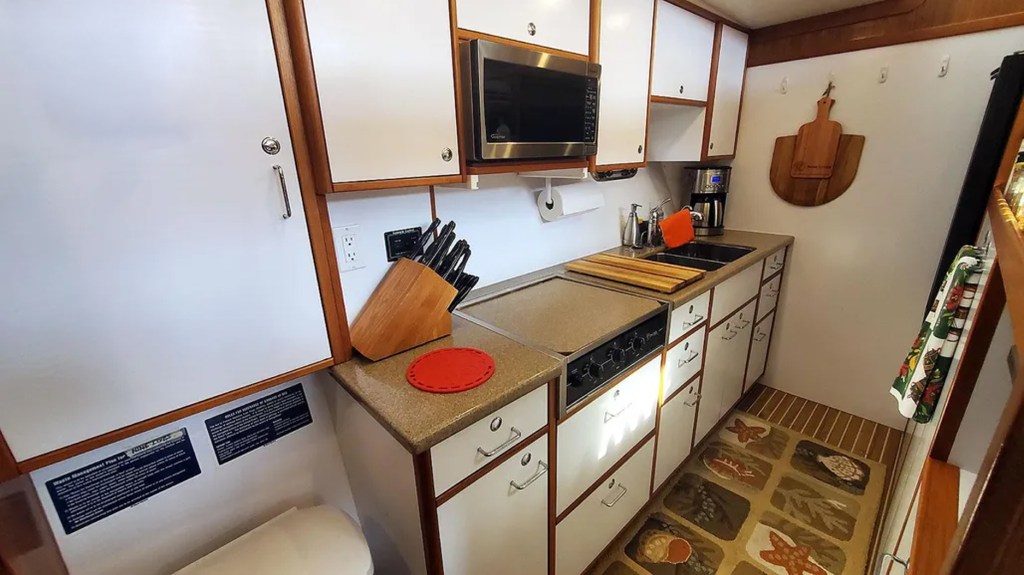
Below, the Trawlercat has a master suite with an olympic queen-size bed, plus two additional staterooms with double beds.  There are two heads, each with separate showers, a galley (kitchen), and a salon (living room dining room). Above, the cockpit has seating for 6-8 people (depending on how friendly you are) with a captain’s and mate’s chairs, plus lounge seating and a fold out dining table, all in covered space with roll-down isinglass and screens.  Three separate heat pumps ensure that all spaces can be cooled or heated as necessary.

The salon
The galley
The spacious cockpit

The Endeavour factory was in Clearwater, Florida, with a service yard nearby in St Petersburg.  Bob Vincent, the boat builder, was willing to feature used boats that owners wished to sell on his company website.  There were two of the most recent models (2012) for sale at that time.  Dick contacted Bob, and we set off in the car a few days later to go and see them.  One of them had considerably more upgrades and enhancements than the other, so even though it was slightly out of our budget, we settled on that one, and closed the deal in December of 2016.

The 44 foot Endeavour Trawlercat arrives for the survey.
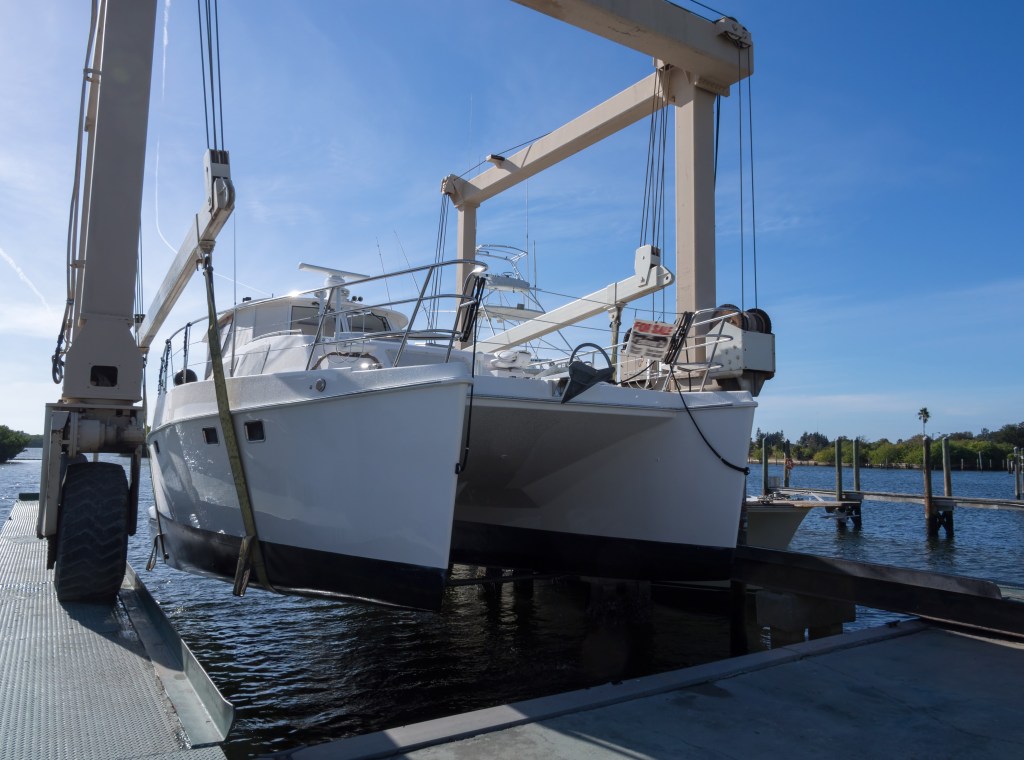
The Trawlercat being lifted out of the water for the survey.
Let’s buy it!

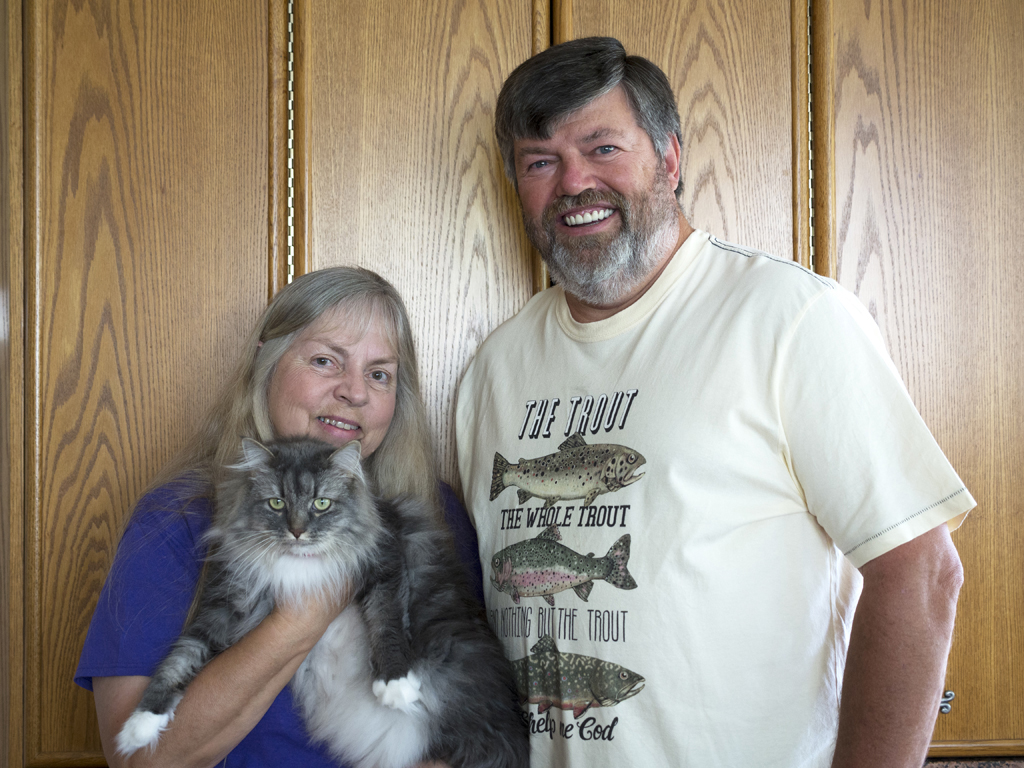
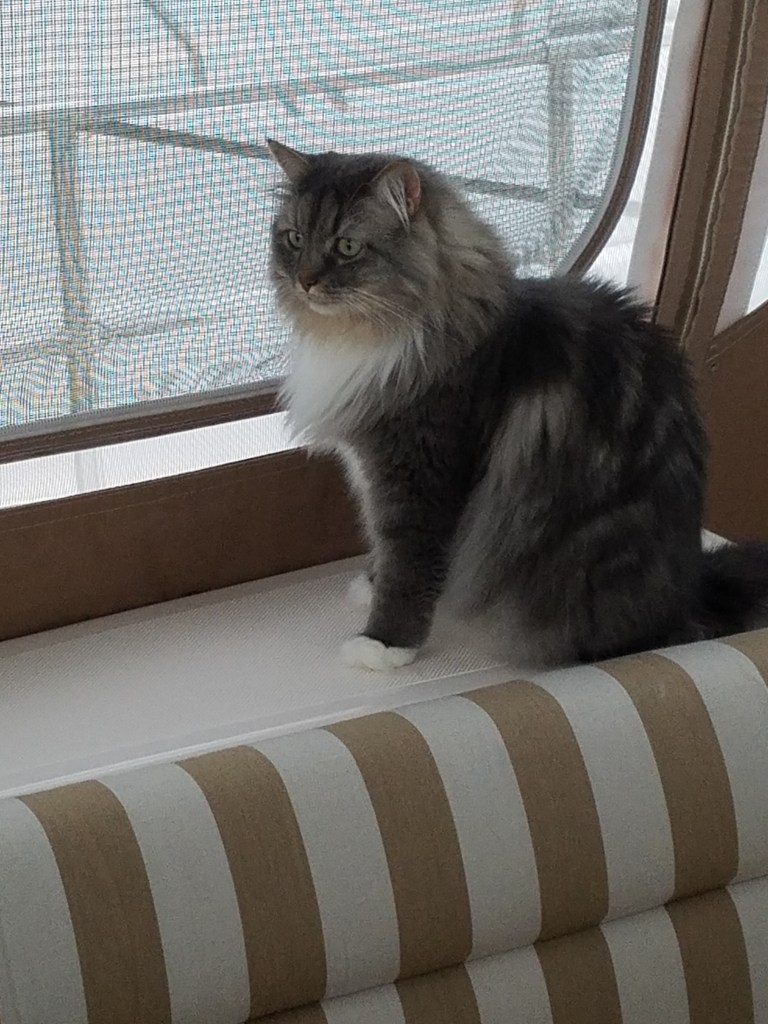
Before I go on to tell you about our Great Loop, I must mention our third crew member, Tucker the Siberian Forest Cat.  Tucker is a very pretty grey and white, long-haired kitty, with a personality that is both laid back and happy.  He is fortunate to have two families, as we have always been travellers, and local friends have been delighted to have him in their home whenever we are away.  A great deal of thought and preparation went into planning for Tucker’s role as the official boat cat and mascot.  Much research was done to find a suitable life jacket.  Once the right one was acquired, it was duly fitted onto the somewhat mystified cat, who promptly did what most cats do in these circumstances, and flopped down on his side and played dead.  The life jacket was planned to be only a precaution, as Tucker is an indoor cat, and there was no expectation that he would be outside on the decks and at risk of falling overboard.

The other precaution we took was to obtain a scissor style baby gate, and fix it at the top of the companionway steps.  Although Siberians are good jumpers, Tucker would not be able to get enough purchase from any of the steps below the gate, and could thus be kept below when we needed to have the cockpit doors open for locking and docking.  While we were underway, he was able to come up and join us in the cockpit.  He particularly enjoyed sitting on the window ledges, watching the world go by.

A good place to watch the world go by

I am pretty sure that wave motion did not agree with our little boy, as he was really not himself for the entire three months of his first voyage.  That story will be told later, but the result was that he shed far more than normal.  All that fur floated around the boat, and inveigled itself into inconvenient places, particularly the air conditioning units.  The handy central vacuum system got a big workout on a weekly basis, as Dick tried in vain to keep the cat hair out of places it did not belong.  Not only was Tucker unhappy during the voyage, so was Captain Dick, who was never a big fan of cat hair in the first place!  Ultimately, Tucker’s first long trip on Nine Lives was also his last, and Shel and Sherry were delighted to enjoy an extra four months of his company each year.  Captain Dick breathed a sigh of relief.

America’s Great Loop

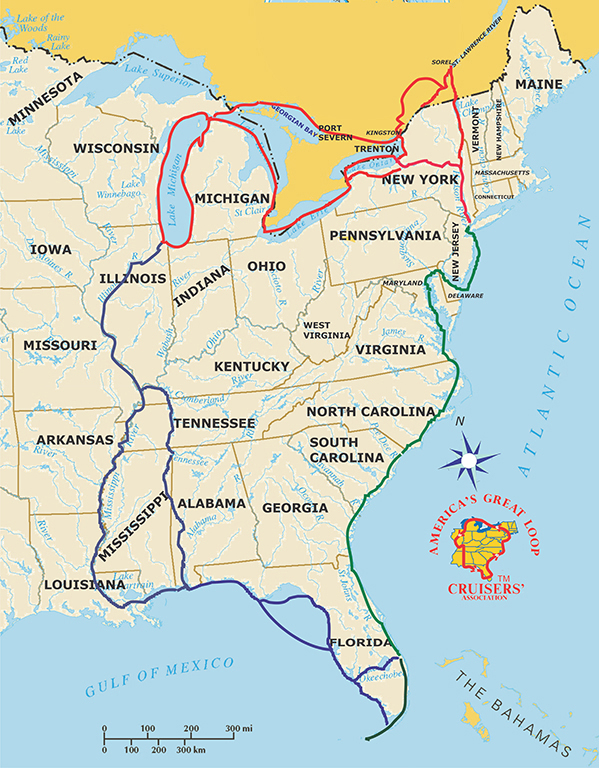
America’s Great Loop is roughly 6000 miles long, following the US East Coast north via the Atlantic Intracoastal Waterway, Chesapeake and Delaware Bays, the Hudson River, the Great Lakes, Illinois River, Mississippi River, Tennessee and Tombigbee Rivers and Waterway, the western Gulf of Mexico, and the Florida Keys.  The passage includes more than 100 locks on the various rivers and canals, and several times more bridges, some of which must be opened.

Map of The Great Loop

The route is completed by as many as 300 boats each year; trending upwards as more people become familiar with it.  Most make the trip once, maybe 30% do it twice, and a very few have been going around every year or so for 10+ years.

Variations and extensions of the Loop include Lake Champlain and the St. Lawrence River, the Canadian canals, Lake Superior, north on the Mississippi to Minneapolis, up the Ohio River to Pittsburgh, the Cumberland to Nashville, the Tennessee to Knoxville, Florida’s Lake Okeechobee and the St John’s River, and the Bahamas.  There is also a “Down East” extension that includes the St. Lawrence River, New Brunswick and Nova Scotia and follows the New England coast south to Long Island Sound.  These are rougher waters than Nine Lives (or Louise) is happy with, although both would manage if using only the very best weather windows.  Like Superior, this wasn’t on our bucket list.

We planned to do all the variations (except Lake Superior and Down East) in one Loop.

The “conventional” way to do it would be to retire, buy a boat, sell your house, do the Loop in one year, possibly do it again for a second year, buy the retirement house, sell the boat. We did it 3-4 months at a time, leaving the boat where we finished each year, over 8 years.

The “normal” passage of the Loop moves round with the seasons – spring up the East Coast; early summer the Hudson and into Canada; late summer on Lake Michigan; September into the Illinois; autumn down the Mississippi and into the Gulf; winter in Florida and possibly a side trip to the Bahamas.  The reason for the seasonal movement is that the water gets extremely hard (frozen) in the north in winter, insurance restrictions mandate avoiding the June through October hurricane season in the south, and the Erie and Canadian canals open in May and close again in mid-October.

The route typically involves about one hundred 50- to 70-mile travel days, with the remaining 250 days at anchor or in a marina to explore the local area.  This exploration time is often extended due to weather delays.  Many parts of the Loop have speed restrictions, so the 6- to 8-knot speed of the average trawler or sailboat is a useful guide for planning.

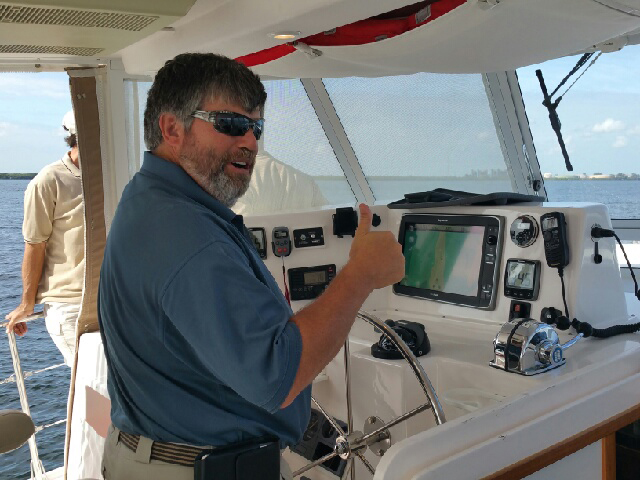
Both of us took classes to update and further our boating education.  Also, it was very important that both of us be capable of handling the boat alone.  For various reasons, Dick did most of the driving, but we made sure I had both the skills and the practice to dock and manoeuvre the boat as needed.  The helm was never unattended when we were underway, and when Dick was driving, I followed along on a separate chart, making sure of navigation marks and hazard warnings as they came up.  It was also critically important to keep a 360-degree watch at all times.

We enjoy anchoring, when a safe anchorage is available in salubrious surroundings.  Dick handled the anchor while I manoeuvred the boat.  We set an anchor watch on the chartplotter and also on a cell phone.

One of the great joys of Looping is the people you meet.  The distinctive burgee meant we recognized other Looper boats on the voyage, and it was easy to introduce yourself and compare notes.  There are often one, two, or up to 15 or 20 other Looper boats in any given marina or anchorage, and docktails on shore or on board are very popular.  Some boaters prefer to join up with several other boats and travel together, sometimes for a substantial part of the Loop, while others are like us, following their own itinerary, but enjoying meeting and sometimes leapfrogging other Loopers.

Weather dictates everything.  We each had several weather apps we consulted on a daily basis.  We knew (from tough experience) that Nine Lives can handle much worse conditions that we are comfortable with.  And Dick handles roll and chop far, far better than Louise. We had a go-no-go formula that takes into account predicted wave height and period, wind, and precipitation.  Over our 8 years of Looping, we have easily lost more than a month of travel while waiting for weather.  This is not an endeavour to take on in a hurry or with strict deadlines.  Even when we had a place we had to be (for family or other obligations) we always had a fallback plan for where to stop if we couldn’t safely and comfortably get to our primary destination.

Every Loop is different; every Looper does it in their own way.  Dick and I liked to try local restaurants, so we stayed in marinas and ate out more often than on board.  On the other hand, I had a fully equipped galley, and we both enjoy cooking, so when we anchored or didn’t care for the local restaurants it was no hardship to cook.  Nine Lives is better equipped than most Looper boats for fridge and freezer space; I probably had close to the same capacity as at home.

Dick did all the planning, producing a spreadsheet of the expected itinerary, easily adjusted for weather delays.  I was the photographer and record keeper, producing the blog of the journey at roughly two-week intervals during our travel season.  Dick was in charge of maintenance and all handyman tasks, while I was usually fender maid and galley slave.  That said, I am also co-captain (DON’T call me Admiral!) and go-no-go decisions were taken by mutual agreement after consultation of our various weather apps.

Loopers say that the best part of the journey is the people that you meet along the way.  We agree, although a close second is seeing and feeling the history of the places we pass by and stop at.  It is only in the last 150 years or so that settlements reached only by road or by rail became possible.  Anything older than that is on the water, because that was how people and goods moved about, and that was what provided the power for manufacturing and milling.  Viewing from the water often gave us a much different perspective than if we’d come by car.

We have also found ourselves visiting a number of places we would never have thought of as destinations:

Detroit, with its amazingly revitalized downtown.

The smaller towns on Lake Huron including exceptionally beautiful Goderich.

The Chambly Canal and delightful French towns of Quebec’s Eastern Townships.

Historic Delaware City.

Other stopping places have offered a surprisingly different experience from what one normally enjoys as a tourist, from the waterfront marinas, including Montreal, Ottawa, and downtown Buffalo

Anchoring off Royal Military College in Kingston was fascinating, watching students learning to sail, as well as the expected marching and team sports.

Experiences on the water have included the two Canadian lift locks, which raise the boat in a chamber of water.

Big Chute is the marine railway on the Severn River near Georgian Bay where you drive the boat out of the water and onto a railcar that transports you 60 feet down a steep incline;

We transited a great many locks, some of them very large, and some surprisingly small.

The water-access-only restaurant at Henry’s Fish Camp on Georgian Bay is considered a required Looper experience.

The rivers of the mid-west offered a view of a different lifestyle and perspective. We loved visiting Cincinnati and Pittsburgh.

We also fell in love with Saint Charles (now a suburb of St Louis).

La Crosse in Wisconsin remains one of our favourite destinations, whether visiting by water or  arriving by road.

The towns on Green Bay and the western side of Lake Michigan are unique.

The fascinating small towns of the Florida Panhandle and the Gulf Coast were a great pleasure.

On the east coast, highlights included the historic Erie Canal, the busy Hudson River, and some of the fascinating towns and villages in the Carolinas.

Here are the stories of our voyages.