
This is the story of one couple’s voyaging on the waters of eastern North America. Frequent travellers from the first years of their marriage, they embarked on an eight-year boating adventure, and enjoyed the many places they saw and the people they met.
Nine Lives and her Crew
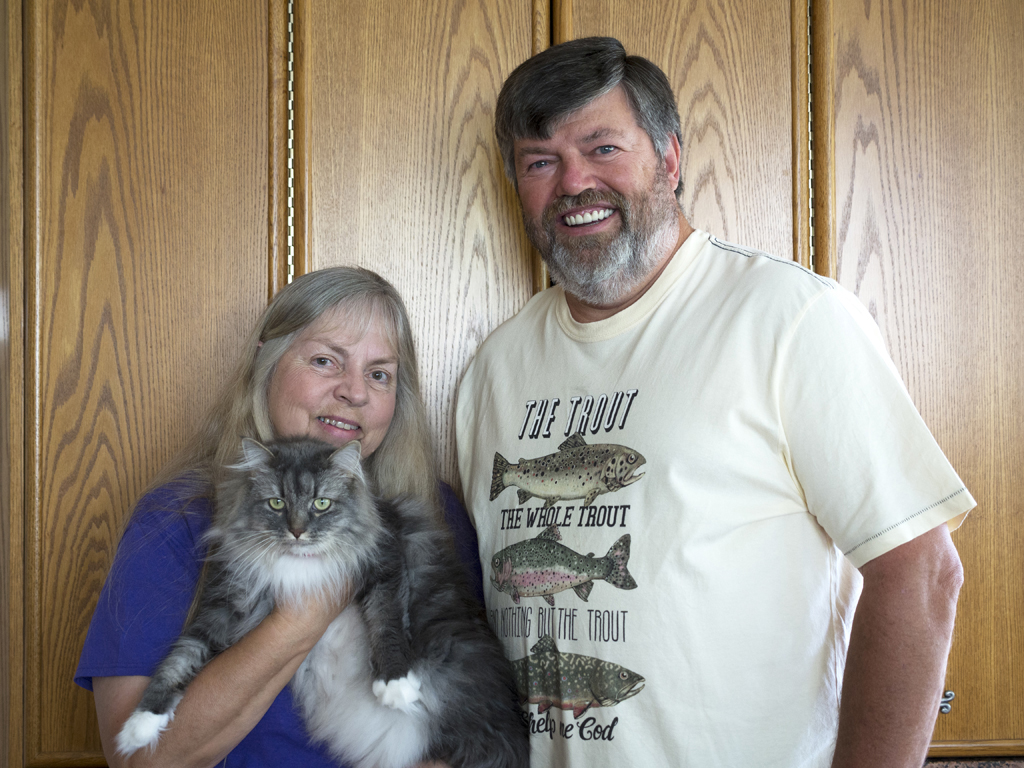
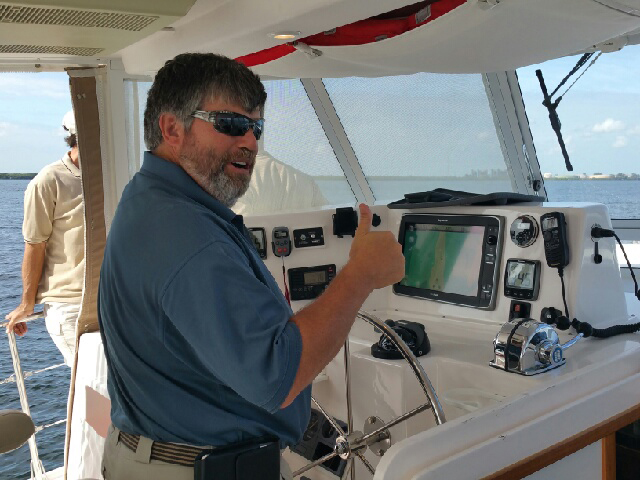
Dick was born in Canada, first-born of Dutch parents. His family were farmers, and from his early teens they owned and operated a dairy farm in Southern Ontario. Dick attended Queen’s University in Kingston, Ontario, graduating in 1976 with a degree in Engineering. He went to work for a supplier to the oil and gas industry, and stayed with them for his entire career, although there were several iterations and changes of location over the 40 years. He met Louise (that’s me) at Queen’s and we were married in 1977. Dick’s career took him around the world, and included expat assignments in England, Czech Republic, Malaysia, France, and Brazil, as well as several assignments in Calgary, Canada, Upstate New York, and Houston, Texas. He retired in 2016. Being a Mechanical Engineer with a keen interest in how things work was an excellent qualification for owning and living on a boat.
I (Louise) was born in England, but was transported to Canada with my parents at the age of 3 as they went in search of a better life with more opportunities. After growing up in suburban Toronto, I attended Queen’s University, where I met Dick, and graduated with a degree in Arts. My early career was spent in various accounting clerical jobs, and a brief stint selling real estate, before I discovered my true calling and started work in scientific research libraries. Eventually I earned the qualification (Masters degree) to go with the experience. I worked for research companies that included Xerox, an oil and gas joint venture, and a National Laboratory in Long Island. Ultimately, Dick’s various overseas assignments stopped my career progression as I dutifully followed him around the world. In later years, I reinvented myself as a photographer, specializing in landscapes and wildlife, and I continue to sell my images to books, magazines, newspapers, and various internet buyers.
We both had quite a lot of boating experience before retirement. When I was a teenager, there was a family cottage with canoes, speedboats, a runabout, and a small sailboat. Dick’s experience began with the speedboats at our cottage. We will gloss over his earliest involvement with the canoe. We also enjoyed a number of one- and two-week rentals of narrowboats on the English canals. In later years, we joined my parents on several sailing vacations in the Caribbean and the Mediterranean, learning the ropes as it were, under the tutelage of my keen sailor father. These experiences instilled the same love of boating in Dick that I had already found when, at the age of 5, I set off on a solo adventure in a small rowboat. Eventually, we took the ASA sailing courses and tried a sailing vacation on our own; our first and last. Let’s just say that we do not get on well on a sailboat (too many captains).
Some time around 2012, having been repatriated to USA and living in Houston, we began to think seriously about our retirement plans. We knew that boating was going to be part of them. We also knew where we were going to live, having bought a home in Hilton Head Island some years earlier. The only problem was, Dick really wanted a sailboat, and I, knowing my husband quite well after many years, wanted no part of sailing with “Captain Bligh”. After many years of drooling over sailboats at marinas wherever we travelled, Dick announced that we would never own a sailboat in these (Hilton Head) waters, because it takes such a long time to motor out of the Sound and into open water for sailing. Suddenly, we were on the same boating page for the first time in 20 years!
I was looking at a map of USA one wet afternoon in Houston, and I thought to myself that it might be possible to take a boat all the way up the east coast, through the Great Lakes, and down the Mississippi. There was just the minor detail of how do you get from the Great Lakes to the Mississippi? More detailed maps suggested that there was probably a route from Chicago. We were already thinking about the boat we hoped to buy for retirement travels, and Dick began looking at Yacht World and other boat selling sites. Here he noticed boats that were advertised as being “Loop ready” or “Loop veterans”. Further investigation led him to America’s Great Loop Cruisers’ Association and the realization that circumnavigation of eastern North America is in fact, a Thing!
We spend the next few years visiting boat shows and watching Yacht World. Dick had ideas of what would be the perfect boat, and I had different ideas. Throughout the search, Dick refused to consider catamarans, even though we had enjoyed the catamaran on our last sailing charter with my parents. He was certain they would be too wide for many of the locks, especially those in Canada, that boats must go through on the Great Loop.
In 2013, we bought our retirement home in Hilton Head Island, with the plan that I would move there immediately, while Dick continued to work for a few years, commuting between Houston, his then current assignment in Brazil, and Hilton Head. We soon bought our first boat, a 24-foot Bayliner pocket cruiser. The cabin was big enough for two people to get away for a weekend, and it was complete with a head (toilet and shower) and cooking facilities. This was our “practice boat”, a chance to review and learn more about the many aspects of power boating, in the protected waters of the Intracoastal Waterway around Hilton Head.
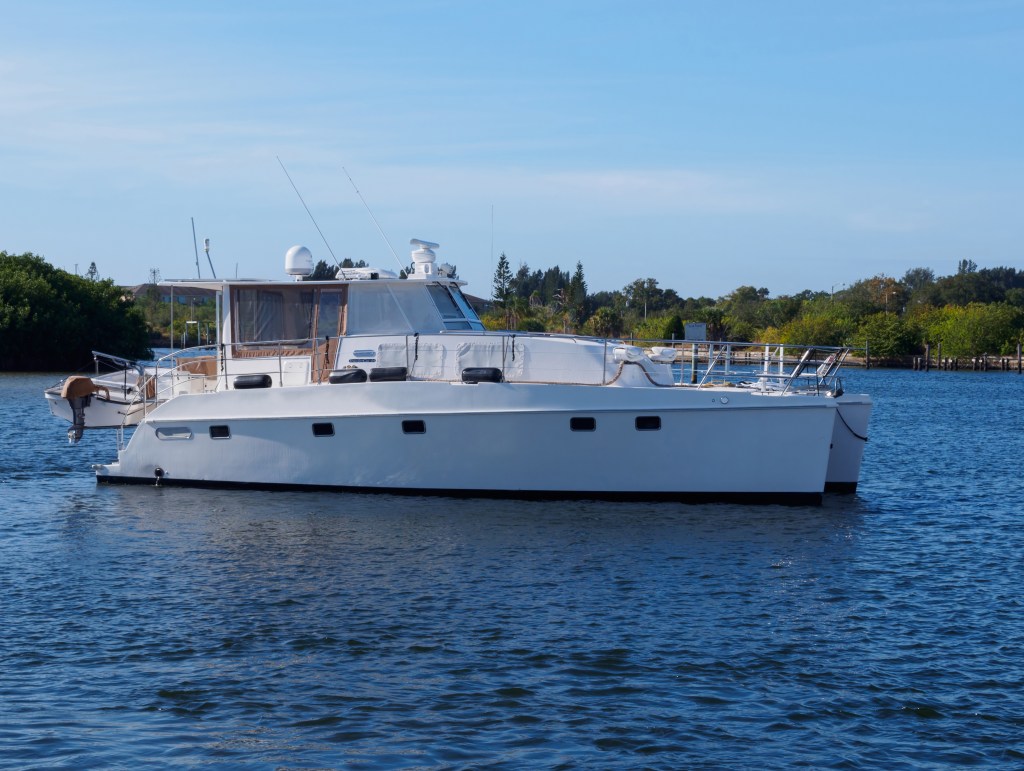
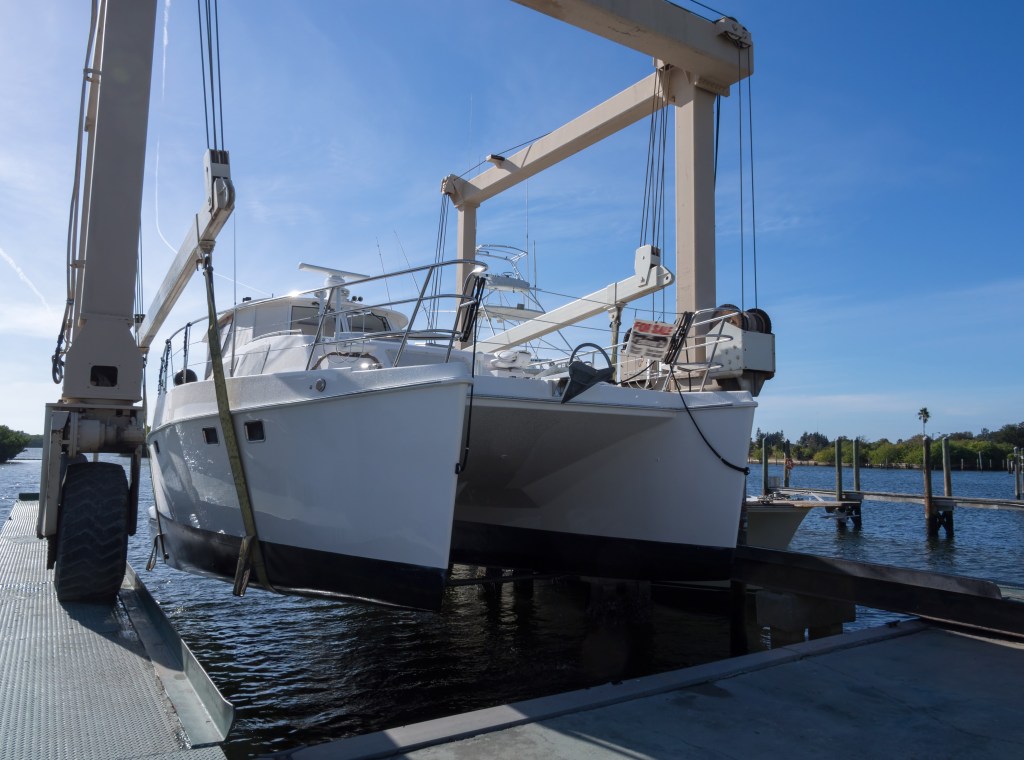
Dick retired in 2016, and it was time to get serious about choosing our Loop boat. We had just about settled on a Sea Ray Motor Yacht, when Dick discovered Endeavour catamarans. Endeavour had a long history of building highly-rated sailboats, and around 2002 they started building catamarans with much bigger engines, designed to be Trawlercats. They came in 2 lengths, a 36-ft (soon replaced by a 38), and a 44-ft. The Endeavour Trawlercat 44 has 3 staterooms, 2 heads with separate showers, a full galley, and a pilothouse design that eliminates the need for a flybridge. Wide decks mean safe and easy access for locking and docking. The beam width is just under 19 feet, perfect for the Great Loop.
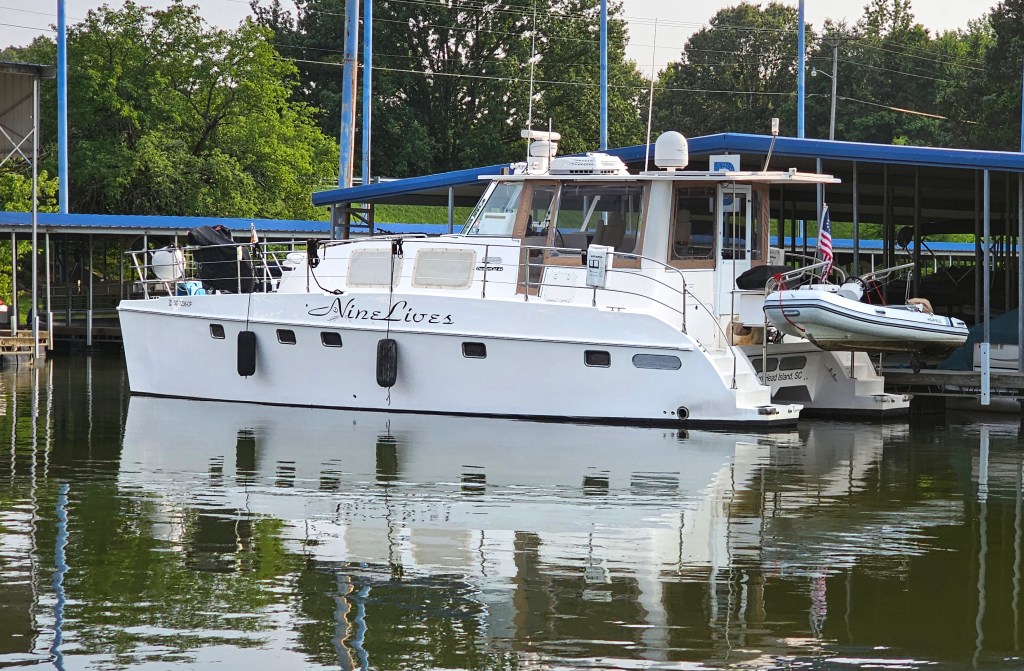
The EndeavourCat 44 has a shallow draft (3.5 feet), allowing for (relatively) easy passage through some of the very skinny waters at various points on the Loop. It has a 14 ft air draft, so it fits under all of the fixed bridges on the various alternative routes. It is very fuel efficient. Normal speed is “trawler speed” at about 8 knots, but she can also do 18 knots to get away from a storm, or help to smooth out lumpy water. The catamaran configuration allows for a lot of interior and exterior space while keeping the length down to 44 feet, so is less expensive for docking in marinas compared to monohulls with the same interior space.
Below, the Trawlercat has a master suite with an olympic queen-size bed, plus two additional staterooms with double beds. There are two heads, each with separate showers, a galley (kitchen), and a salon (living room dining room). Above, the cockpit has seating for 6-8 people (depending on how friendly you are) with a captain’s and mate’s chairs, plus lounge seating and a fold out dining table, all in covered space with roll-down isinglass and screens. Three separate heat pumps ensure that all spaces can be cooled or heated as necessary.

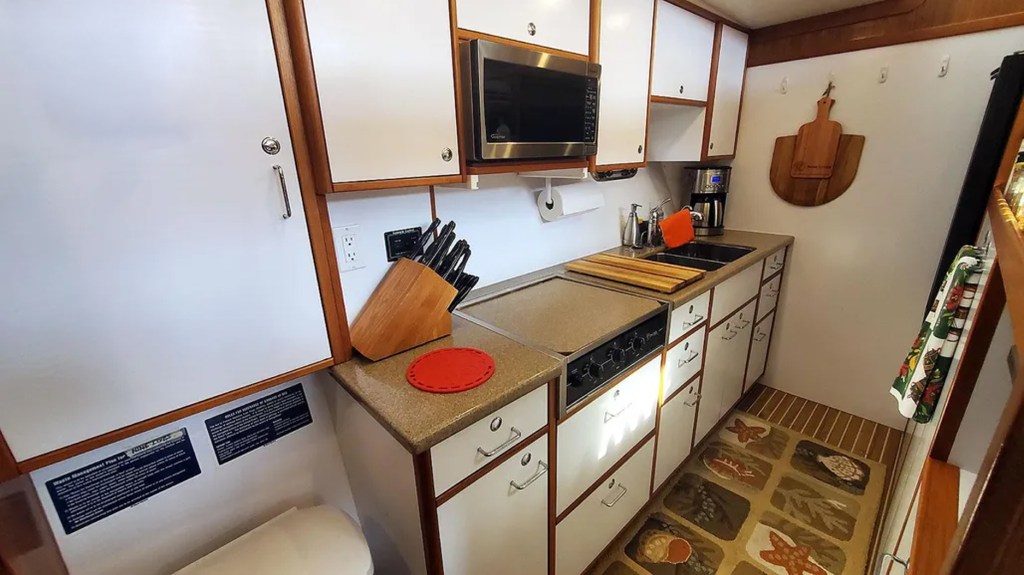

The Endeavour factory was in Clearwater, Florida, with a service yard nearby in St Petersburg. Bob Vincent, the boat builder, was willing to feature used boats that owners wished to sell on his company website. There were two of the most recent models (2012) for sale at that time. Dick contacted Bob, and we set off in the car a few days later to go and see them. One of them had considerably more upgrades and enhancements than the other, so even though it was slightly out of our budget, we settled on that one, and closed the deal in December of 2016.
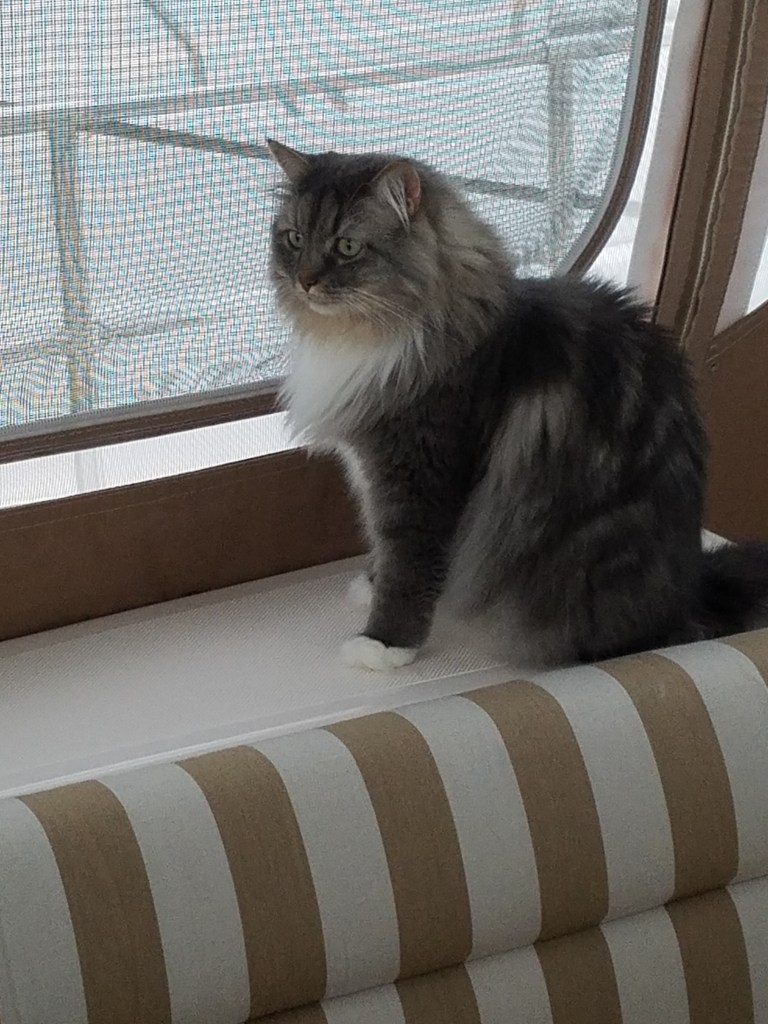
Before I go on to tell you about our Great Loop, I must mention our third crew member, Tucker the Siberian Forest Cat. Tucker is a very pretty grey and white, long-haired kitty, with a personality that is both laid back and happy. He is fortunate to have two families, as we have always been travellers, and local friends have been delighted to have him in their home whenever we are away. A great deal of thought and preparation went into planning for Tucker’s role as the official boat cat and mascot. Much research was done to find a suitable life jacket. Once the right one was acquired, it was duly fitted onto the somewhat mystified cat, who promptly did what most cats do in these circumstances, and flopped down on his side and played dead. The life jacket was planned to be only a precaution, as Tucker is an indoor cat, and there was no expectation that he would be outside on the decks and at risk of falling overboard.
The other precaution we took was to obtain a scissor style baby gate, and fix it at the top of the companionway steps. Although Siberians are good jumpers, Tucker would not be able to get enough purchase from any of the steps below the gate, and could thus be kept below when we needed to have the cockpit doors open for locking and docking. While we were underway, he was able to come up and join us in the cockpit. He particularly enjoyed sitting on the window ledges, watching the world go by.
I am pretty sure that wave motion did not agree with our little boy, as he was really not himself for the entire three months of his first voyage. That story will be told later, but the result was that he shed far more than normal. All that fur floated around the boat, and inveigled itself into inconvenient places, particularly the air conditioning units. The handy central vacuum system got a big workout on a weekly basis, as Dick tried in vain to keep the cat hair out of places it did not belong. Not only was Tucker unhappy during the voyage, so was Captain Dick, who was never a big fan of cat hair in the first place! Ultimately, Tucker’s first long trip on Nine Lives was also his last, and Shel and Sherry were delighted to enjoy an extra four months of his company each year. Captain Dick breathed a sigh of relief.
America’s Great Loop
America’s Great Loop is roughly 6000 miles long, following the US East Coast north via the Atlantic Intracoastal Waterway, Chesapeake and Delaware Bays, the Hudson River, the Great Lakes, Illinois River, Mississippi River, Tennessee and Tombigbee Rivers and Waterway, the western Gulf of Mexico, and the Florida Keys. The passage includes more than 100 locks on the various rivers and canals, and several times more bridges, some of which must be opened.
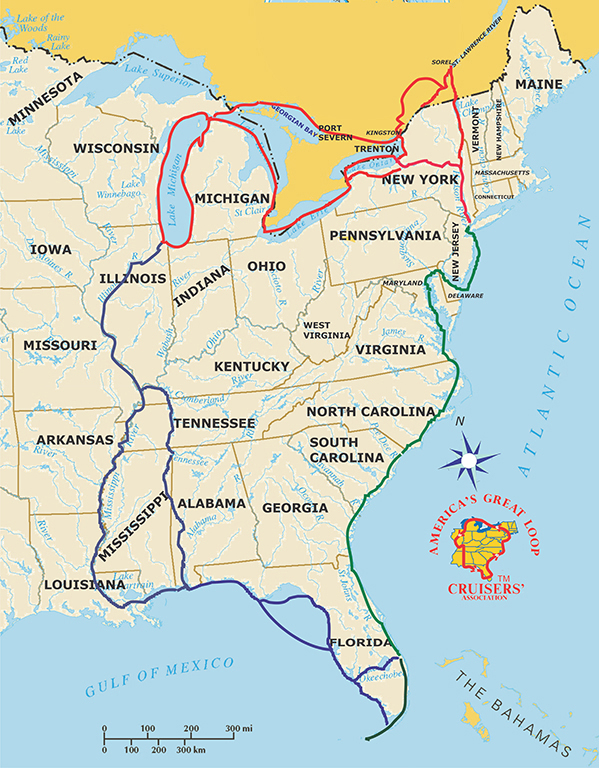
The route is completed by as many as 300 boats each year; trending upwards as more people become familiar with it. Most make the trip once, maybe 30% do it twice, and a very few have been going around every year or so for 10+ years.
Variations and extensions of the Loop include Lake Champlain and the St. Lawrence River, the Canadian canals, Lake Superior, north on the Mississippi to Minneapolis, up the Ohio River to Pittsburgh, the Cumberland to Nashville, the Tennessee to Knoxville, Florida’s Lake Okeechobee and the St John’s River, and the Bahamas. There is also a “Down East” extension that includes the St. Lawrence River, New Brunswick and Nova Scotia and follows the New England coast south to Long Island Sound. These are rougher waters than Nine Lives (or Louise) is happy with, although both would manage if using only the very best weather windows. Like Superior, this wasn’t on our bucket list.
We planned to do all the variations (except Lake Superior and Down East) in one Loop.
The “conventional” way to do it would be to retire, buy a boat, sell your house, do the Loop in one year, possibly do it again for a second year, buy the retirement house, sell the boat. We did it 3-4 months at a time, leaving the boat where we finished each year, over 8 years.
The “normal” passage of the Loop moves round with the seasons – spring up the East Coast; early summer the Hudson and into Canada; late summer on Lake Michigan; September into the Illinois; autumn down the Mississippi and into the Gulf; winter in Florida and possibly a side trip to the Bahamas. The reason for the seasonal movement is that the water gets extremely hard (frozen) in the north in winter, insurance restrictions mandate avoiding the June through October hurricane season in the south, and the Erie and Canadian canals open in May and close again in mid-October.
The route typically involves about one hundred 50- to 70-mile travel days, with the remaining 250 days at anchor or in a marina to explore the local area. This exploration time is often extended due to weather delays. Many parts of the Loop have speed restrictions, so the 6- to 8-knot speed of the average trawler or sailboat is a useful guide for planning.
Both of us took classes to update and further our boating education. Also, it was very important that both of us be capable of handling the boat alone. For various reasons, Dick did most of the driving, but we made sure I had both the skills and the practice to dock and manoeuvre the boat as needed. The helm was never unattended when we were underway, and when Dick was driving, I followed along on a separate chart, making sure of navigation marks and hazard warnings as they came up. It was also critically important to keep a 360-degree watch at all times.
We enjoy anchoring, when a safe anchorage is available in salubrious surroundings. Dick handled the anchor while I manoeuvred the boat. We set an anchor watch on the chartplotter and also on a cell phone.
One of the great joys of Looping is the people you meet. The distinctive burgee meant we recognized other Looper boats on the voyage, and it was easy to introduce yourself and compare notes. There are often one, two, or up to 15 or 20 other Looper boats in any given marina or anchorage, and docktails on shore or on board are very popular. Some boaters prefer to join up with several other boats and travel together, sometimes for a substantial part of the Loop, while others are like us, following their own itinerary, but enjoying meeting and sometimes leapfrogging other Loopers.
Weather dictates everything. We each had several weather apps we consulted on a daily basis. We knew (from tough experience) that Nine Lives can handle much worse conditions that we are comfortable with. And Dick handles roll and chop far, far better than Louise. We had a go-no-go formula that takes into account predicted wave height and period, wind, and precipitation. Over our 8 years of Looping, we have easily lost more than a month of travel while waiting for weather. This is not an endeavour to take on in a hurry or with strict deadlines. Even when we had a place we had to be (for family or other obligations) we always had a fallback plan for where to stop if we couldn’t safely and comfortably get to our primary destination.
Every Loop is different; every Looper does it in their own way. Dick and I liked to try local restaurants, so we stayed in marinas and ate out more often than on board. On the other hand, I had a fully equipped galley, and we both enjoy cooking, so when we anchored or didn’t care for the local restaurants it was no hardship to cook. Nine Lives is better equipped than most Looper boats for fridge and freezer space; I probably had close to the same capacity as at home.
Dick did all the planning, producing a spreadsheet of the expected itinerary, easily adjusted for weather delays. I was the photographer and record keeper, producing the blog of the journey at roughly two-week intervals during our travel season. Dick was in charge of maintenance and all handyman tasks, while I was usually fender maid and galley slave. That said, I am also co-captain (DON’T call me Admiral!) and go-no-go decisions were taken by mutual agreement after consultation of our various weather apps.
Loopers say that the best part of the journey is the people that you meet along the way. We agree, although a close second is seeing and feeling the history of the places we pass by and stop at. It is only in the last 150 years or so that settlements reached only by road or by rail became possible. Anything older than that is on the water, because that was how people and goods moved about, and that was what provided the power for manufacturing and milling. Viewing from the water often gave us a much different perspective than if we’d come by car.
We have also found ourselves visiting a number of places we would never have thought of as destinations:
Detroit, with its amazingly revitalized downtown.
The smaller towns on Lake Huron including exceptionally beautiful Goderich.
The Chambly Canal and delightful French towns of Quebec’s Eastern Townships.
Historic Delaware City.
Other stopping places have offered a surprisingly different experience from what one normally enjoys as a tourist, from the waterfront marinas, including Montreal, Ottawa, and downtown Buffalo
Anchoring off Royal Military College in Kingston was fascinating, watching students learning to sail, as well as the expected marching and team sports.
Experiences on the water have included the two Canadian lift locks, which raise the boat in a chamber of water.
Big Chute is the marine railway on the Severn River near Georgian Bay where you drive the boat out of the water and onto a railcar that transports you 60 feet down a steep incline;
We transited a great many locks, some of them very large, and some surprisingly small.
The water-access-only restaurant at Henry’s Fish Camp on Georgian Bay is considered a required Looper experience.
The rivers of the mid-west offered a view of a different lifestyle and perspective. We loved visiting Cincinnati and Pittsburgh.
We also fell in love with Saint Charles (now a suburb of St Louis).
La Crosse in Wisconsin remains one of our favourite destinations, whether visiting by water or arriving by road.
The towns on Green Bay and the western side of Lake Michigan are unique.
The fascinating small towns of the Florida Panhandle and the Gulf Coast were a great pleasure.
On the east coast, highlights included the historic Erie Canal, the busy Hudson River, and some of the fascinating towns and villages in the Carolinas.
Here are the stories of our voyages.

