
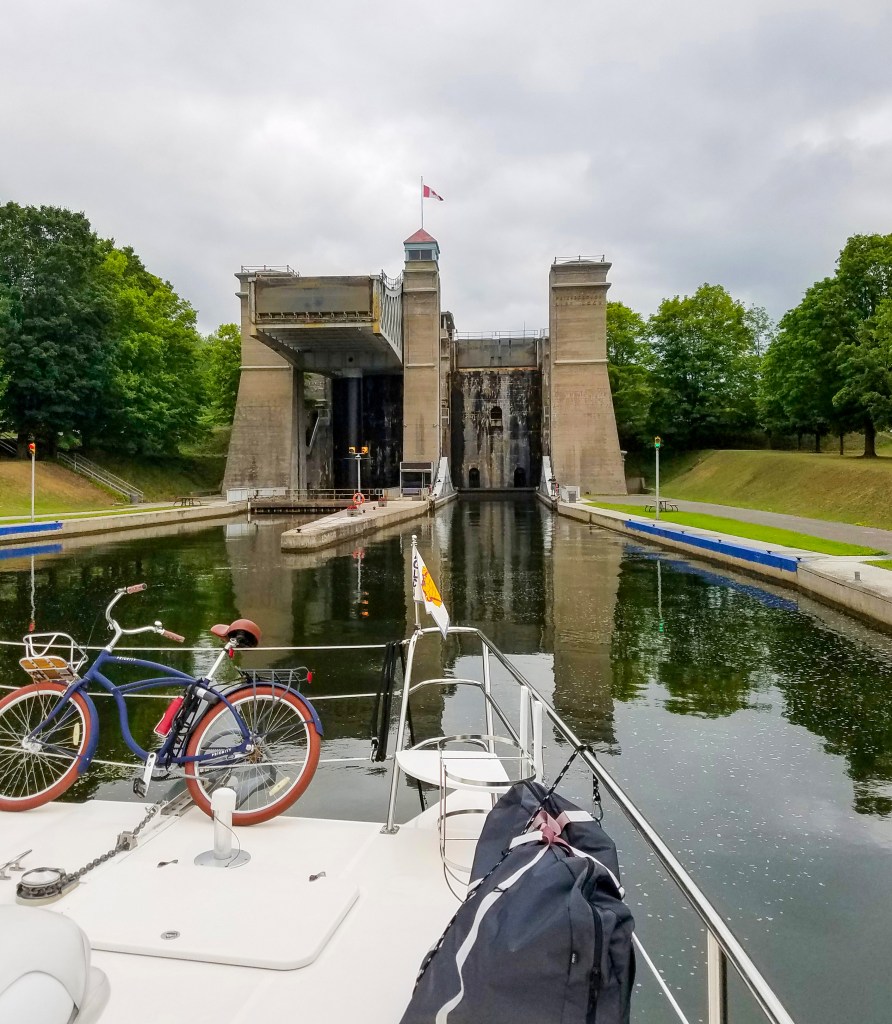
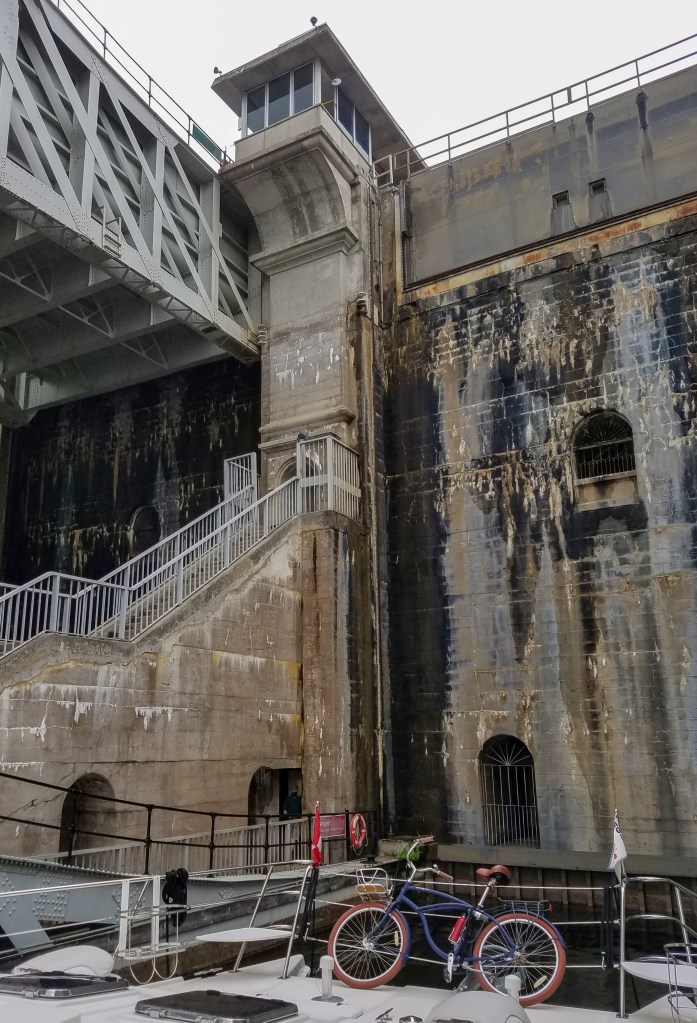
Our second day in Peterborough was wet, so we didn’t go out for the promised Indian meal at a restaurant. The next morning we set off for the first big adventure in this segment of the Loop, the Peterborough Lift Lock.
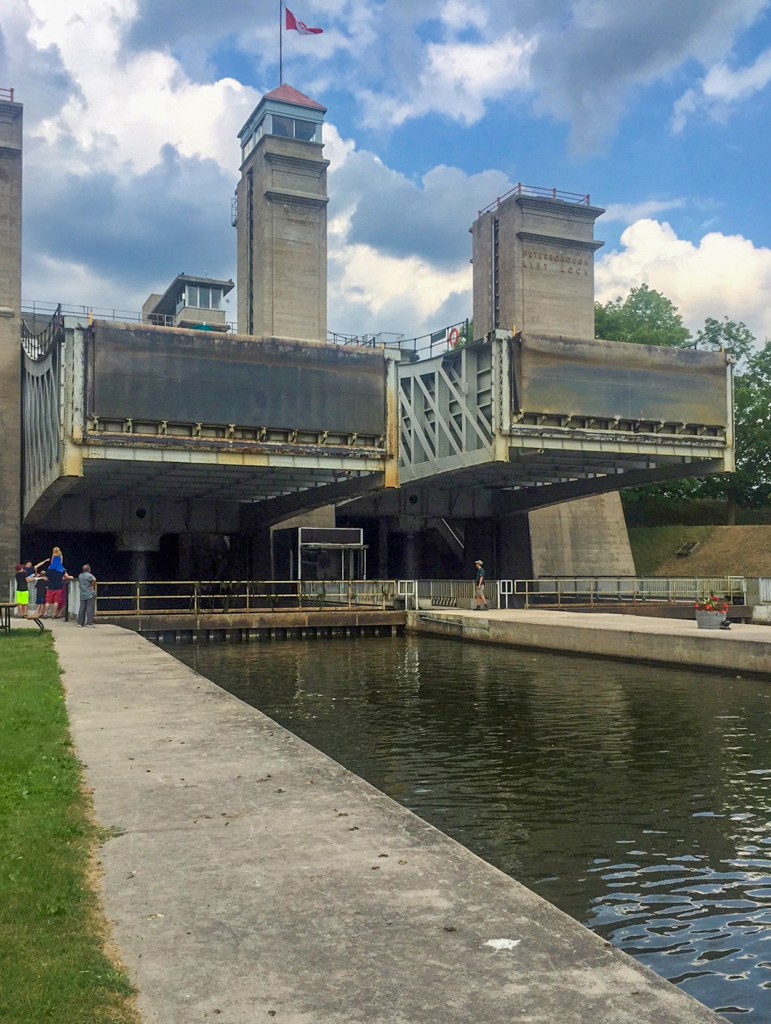
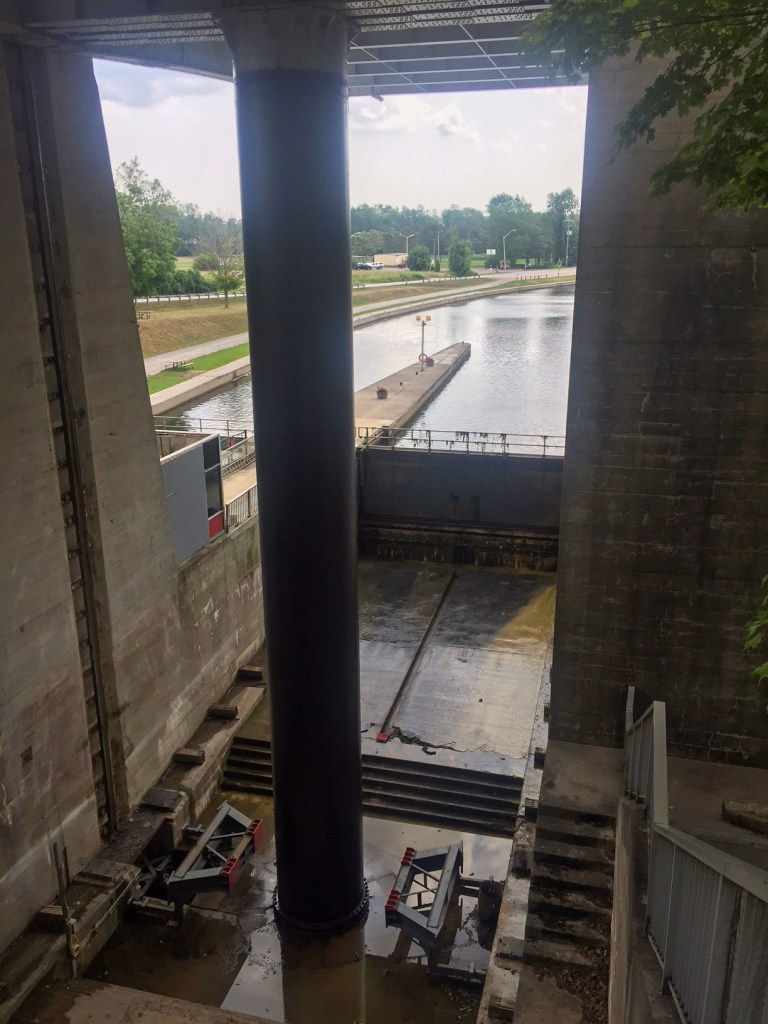
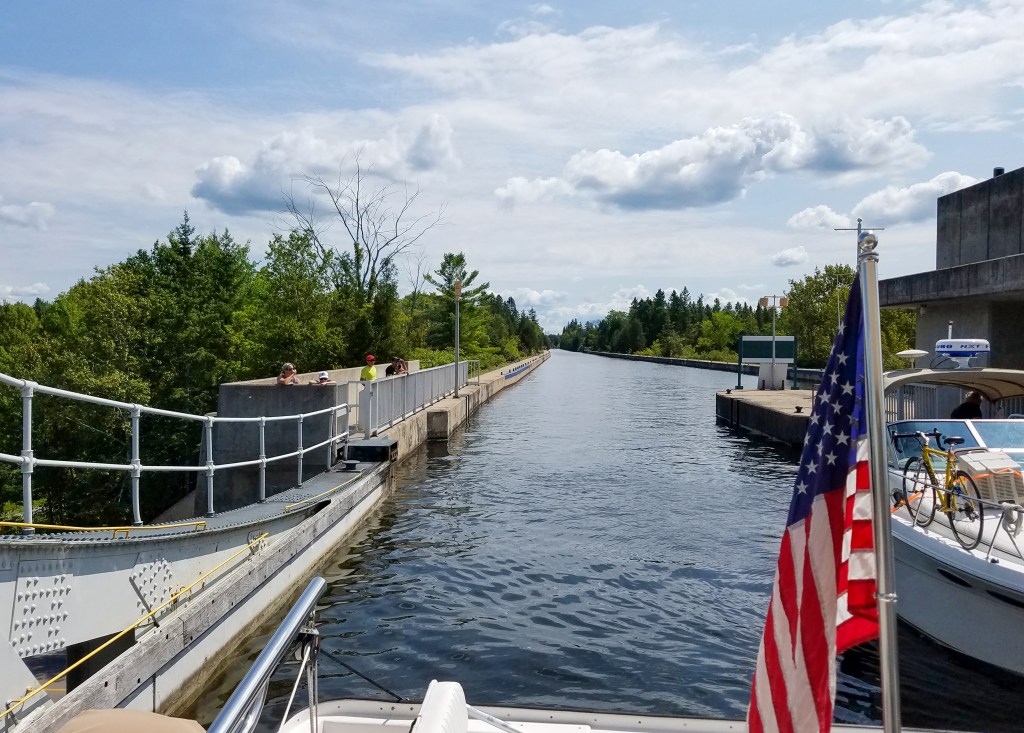
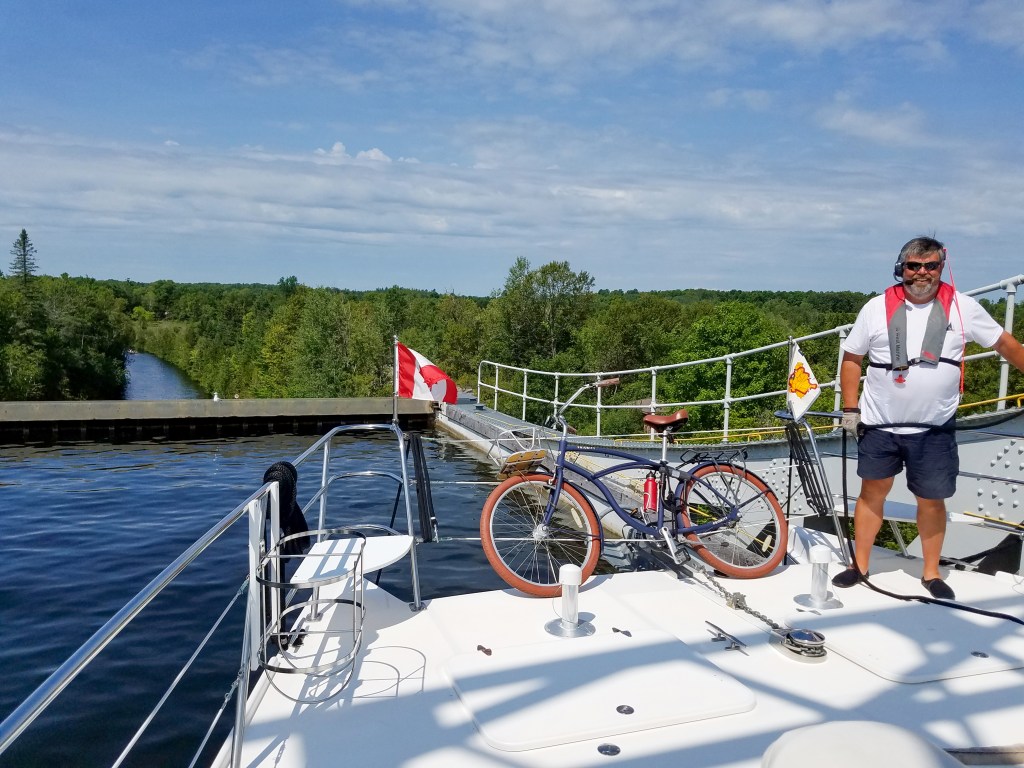
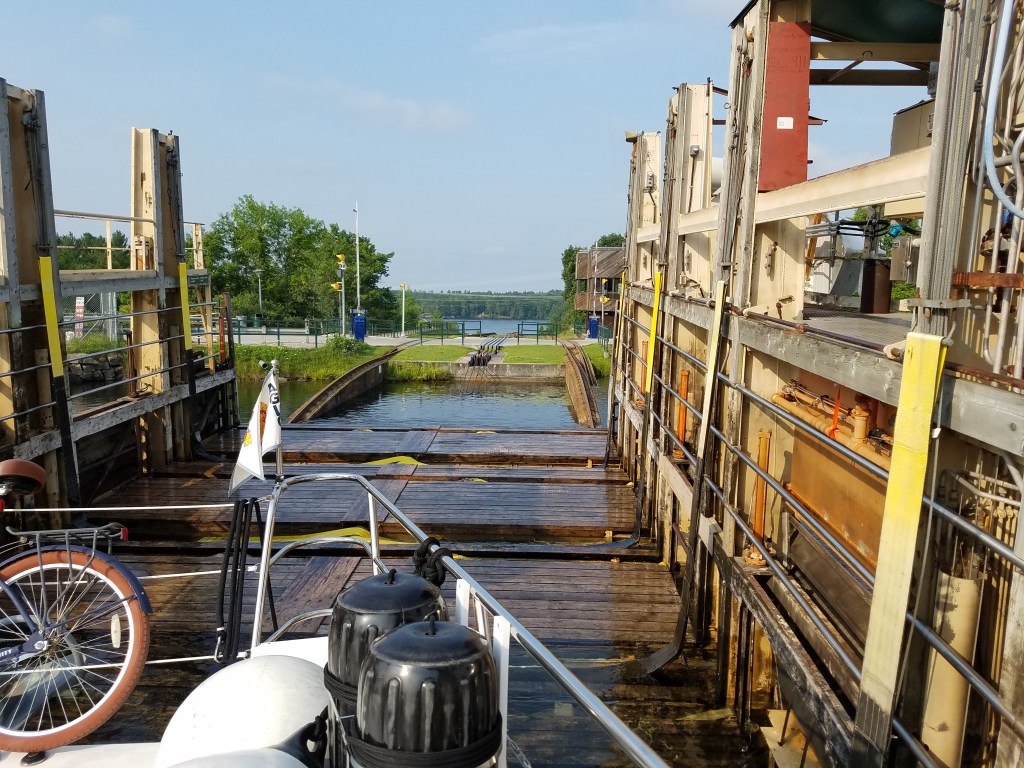
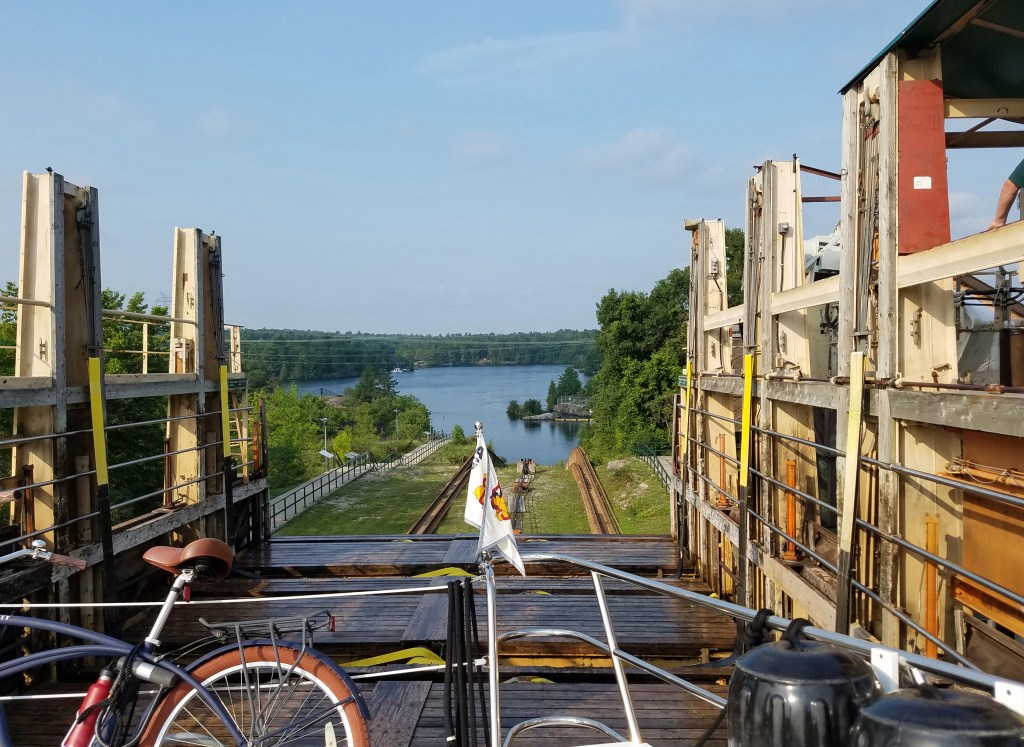
The Lift Lock was opened in 1904, and until recently was the highest hydraulic boat lift in the world, raising and lowering boats 65 feet in just about 60 seconds. The lift consists of two large chambers that are filled with water. Boats drive over a dropped gate into the chamber, the gate closes, an extra foot of water is let into the top chamber, and the weight of the water in the upper chamber counterbalances the lower, so one drops while the other ascends. It was quite exciting, although a very smooth and easy operation. It was a dull day, but I did take quite a few photos, plus Dick took pictures the day before when he walked up to the lock to see the operation.


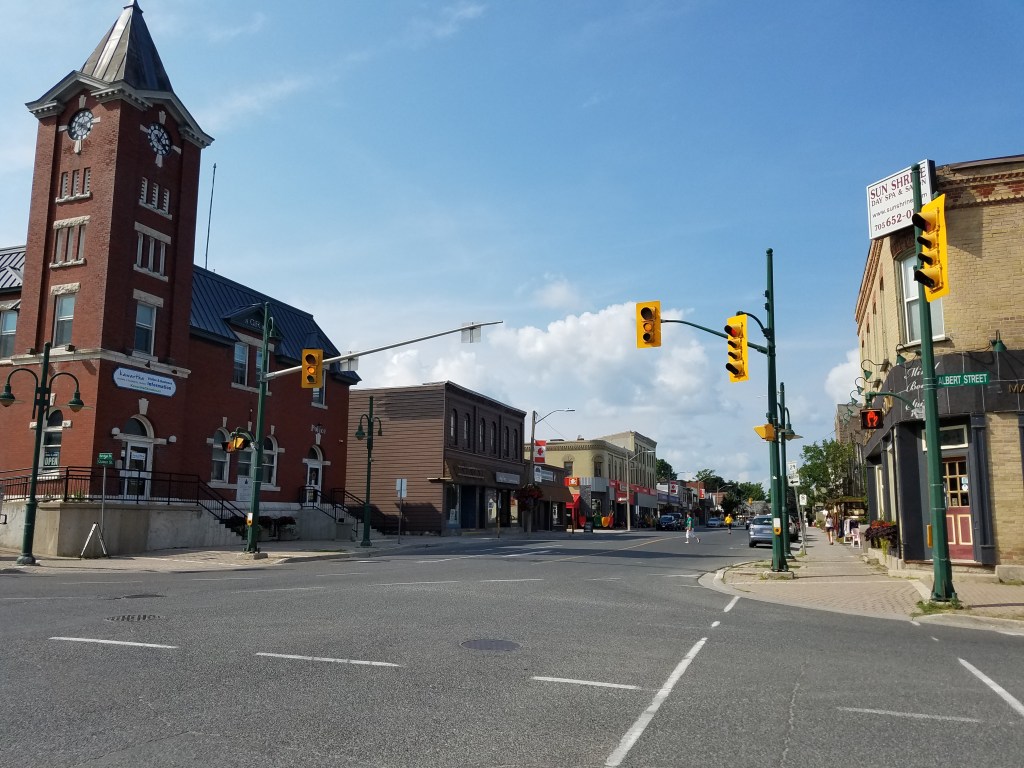
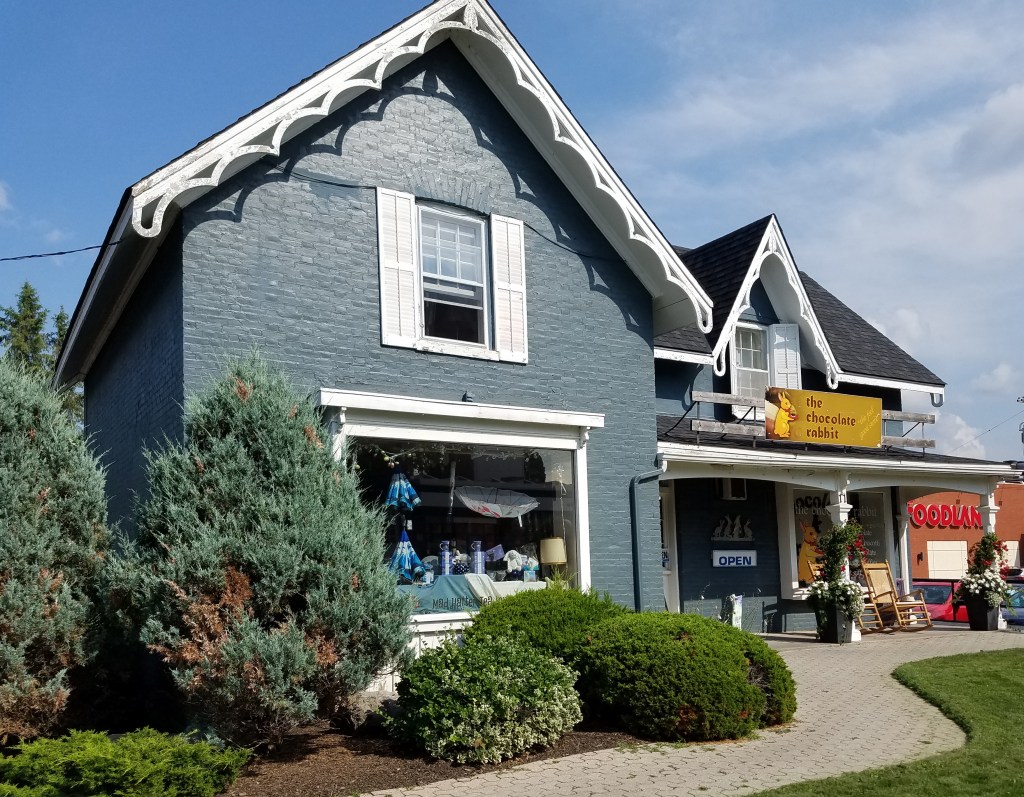
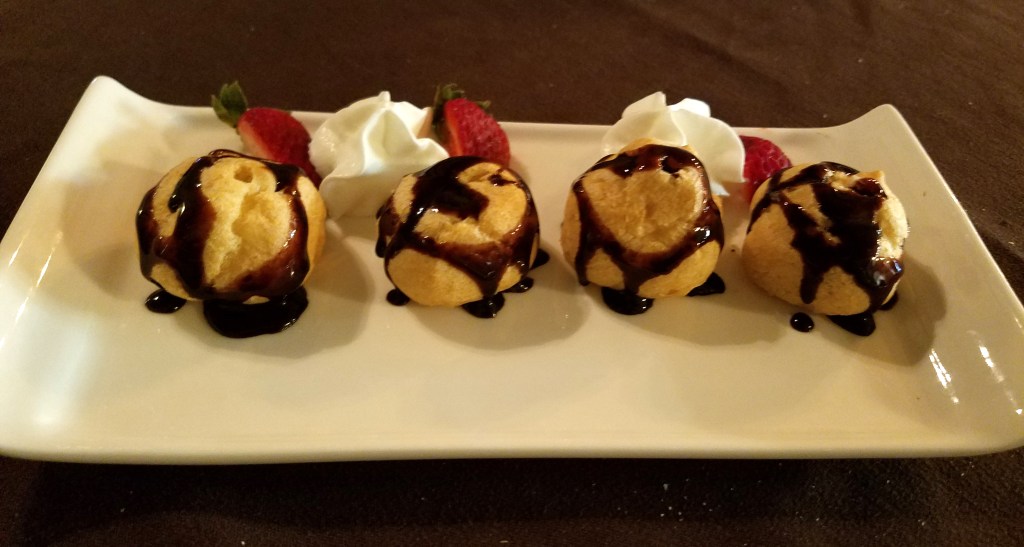
We stopped for the night at Lakefield on the wall just above the lock. Lakefield is a pretty town with a tidy main street with restored buildings, interesting shops, and an excellent restaurant. A highlight was a wonderful chocolate shop in a lovely old house at the edge of downtown. We made several selections and enjoyed them with tea for the next few afternoons. They were so good we wished we had bought a larger box! The next day was forecast to be rainy, so we wimped out and stayed another night on the lock wall. I had fun that evening cooking an Indian meal, papadums with dal, chick pea curry, chicken curry, naan bread, and basmati rice.
Kawartha Lakes is an area of lakes and small communities north and west of Peterborough. Since it is only 90 minutes from Toronto, the lakes and connecting rivers are dotted with cottages and there are usually lots of boaters out for the day travelling through the various locks of the Trent Severn Waterway. The village of Buckhorn was our next stop. The lock keepers manage the tie-ups above the lock, and we were shoehorned in between several houseboats. Houseboat rentals are apparently a thriving business in the Kawarthas, and we passed a lot of them as we travelled through the area. Four of the houseboats at Buckhorn were occupied by a large group of young teenage girls with older girls as leaders. They were not girl scouts, although most of them wore burgundy kerchiefs around their necks, and I heard the leaders speaking in what I recognized as a Slavic language. I found out the next day that these were Ukrainian girls, on a special outing. I think the leaders were in Canada for work experience, while the younger girls were from Canadian families of Ukrainian heritage. They were all well behaved, and very quiet. We were glad it was group of girls, suspecting that a similar gathering of boys would not have been such good neighbours! There are several restaurants in Buckhorn, including a Chinese restaurant that we were told too late was excellent. Instead we decided to go for pizza. A poor choice, as it turned out.
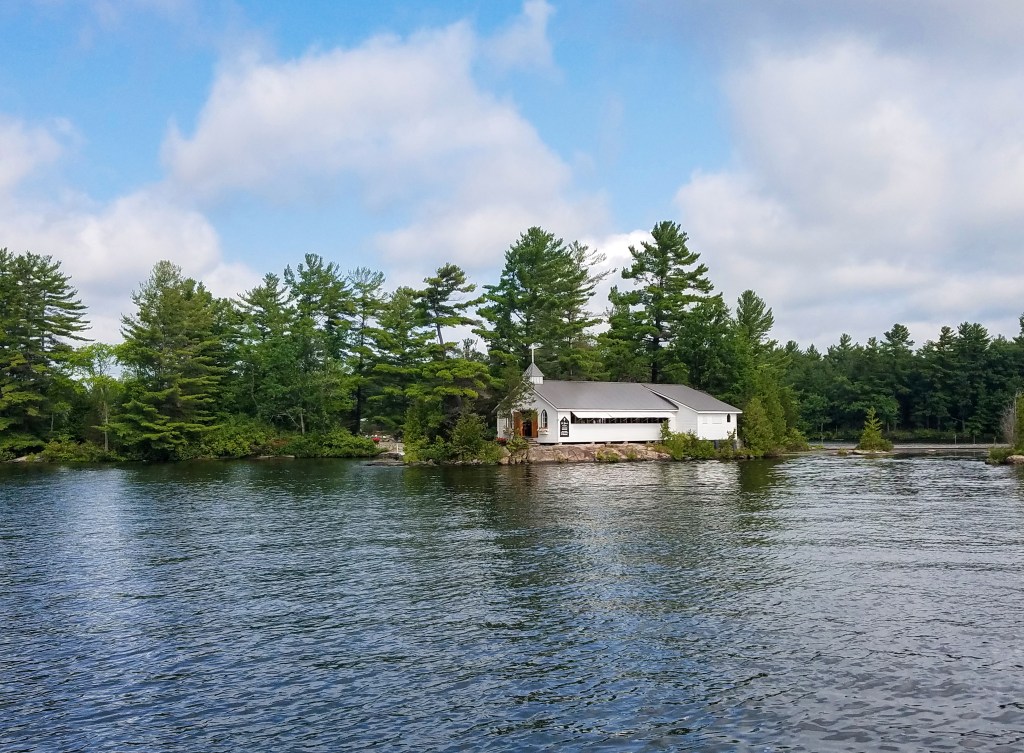
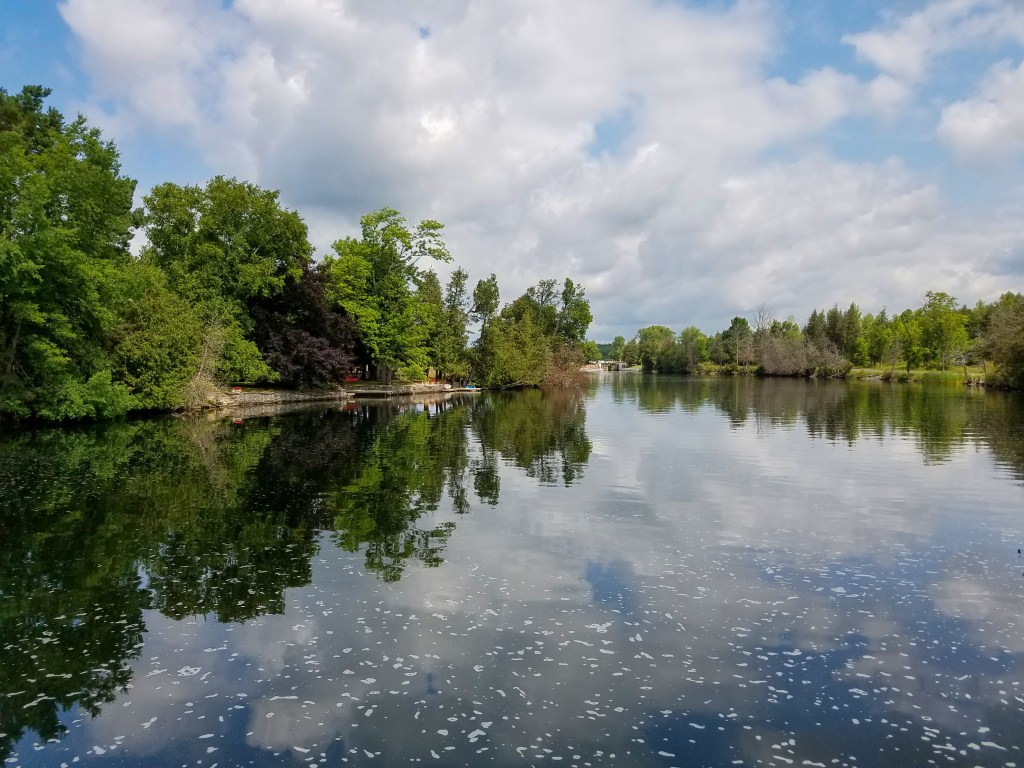
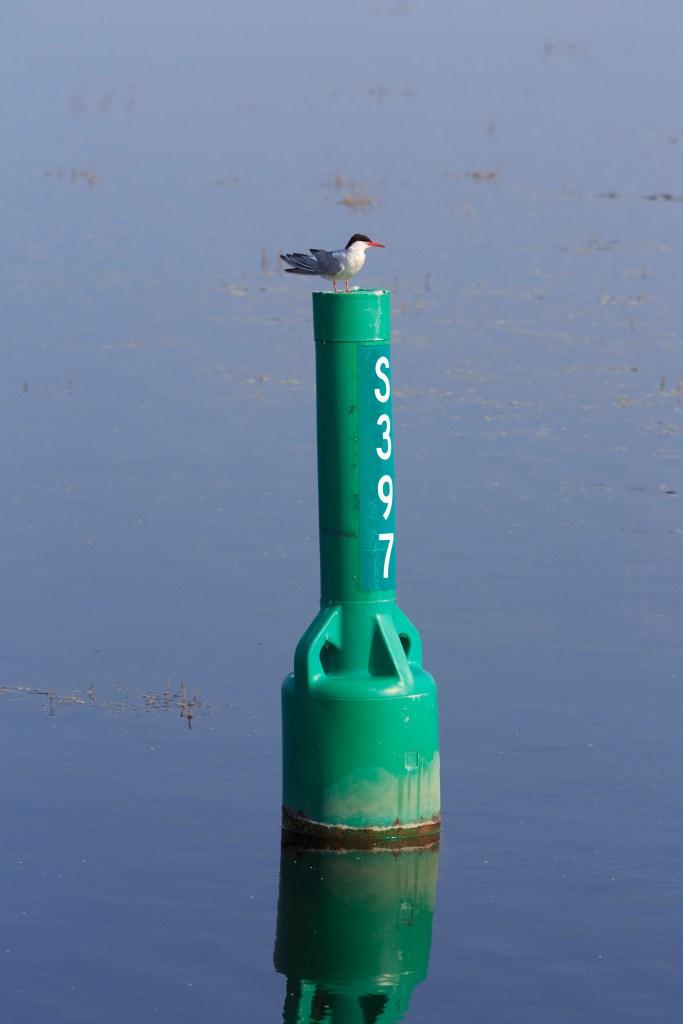
The next day we went on to Fenelon Falls. We arrived just in time to snag the last spot on the town wall above the lock. This meant that I had a front row seat while a great many boats of various sizes locked up and down throughout the afternoon. Nine Lives gathered a great deal of interest. There are very few catamarans of any size in this part of the country, and now that we are behind the main group of Loopers, people are surprised to see a boat that has come all the way from South Carolina. Tourists and dog walkers stop to chat and ask questions, and I can hear people talking about the boat even when they don’t pause for conversation.

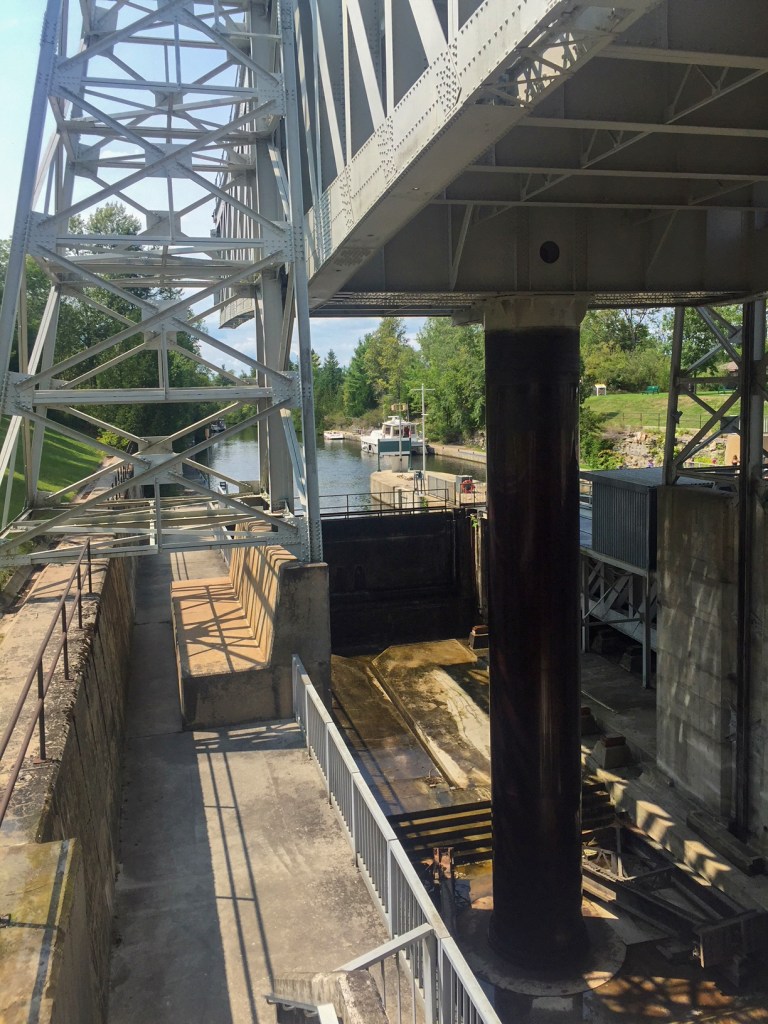
Kirkfield is the second lift lock on the Trent Severn. The lift was completed in 1907, and extensively modernized in the late 1960’s. The concrete piers were removed, so the lock construction is more easily seen. We stopped for the night just below the lock, so it was interesting to watch boats going up and down for the rest of the afternoon. A friendly boater stopped by to chat, and eventually told us that his two sons would love to be able to see inside the boat. We are always happy to show off Nine Lives, so the fellow and his sons came aboard. It was quite clear that the boys had zero interest, while the father asked many questions and enjoyed the visit! Beyond Kirkfield the Waterway became much quieter, with fewer boats out and about.

After a quick succession of 5 locks we were out into the open water of Lake Simcoe. Although not considered one of the Great Lakes, it is 19 miles long and 16 miles wide. It can become quite rough and is known for pop-up thunderstorms on hot summer afternoons. We gave Nine Lives a nice run and skipped across most of it after we noticed some building thunderheads. Lake Simcoe is connected to Lake Couchiching by a narrow channel with a fierce current. We needed to stop at a marina at the end of the channel to get a pump-out, and the current slammed the boat into a corner of the fuel dock, creating a nasty gouge in the side of the boat, fortunately above the waterline. The dockhands offered some waterproof tape to prevent any splashed water getting in, and later we were able to get more tape and complete the temporary repair. The tech at a local boatyard told us that as long as we keep the tape intact we will be fine with the temporary repair until the boat is hauled out of the water for winter storage. The tape is the same colour as the hull so it doesn’t show. Nobody wants other boaters to see the results of an “oops!”
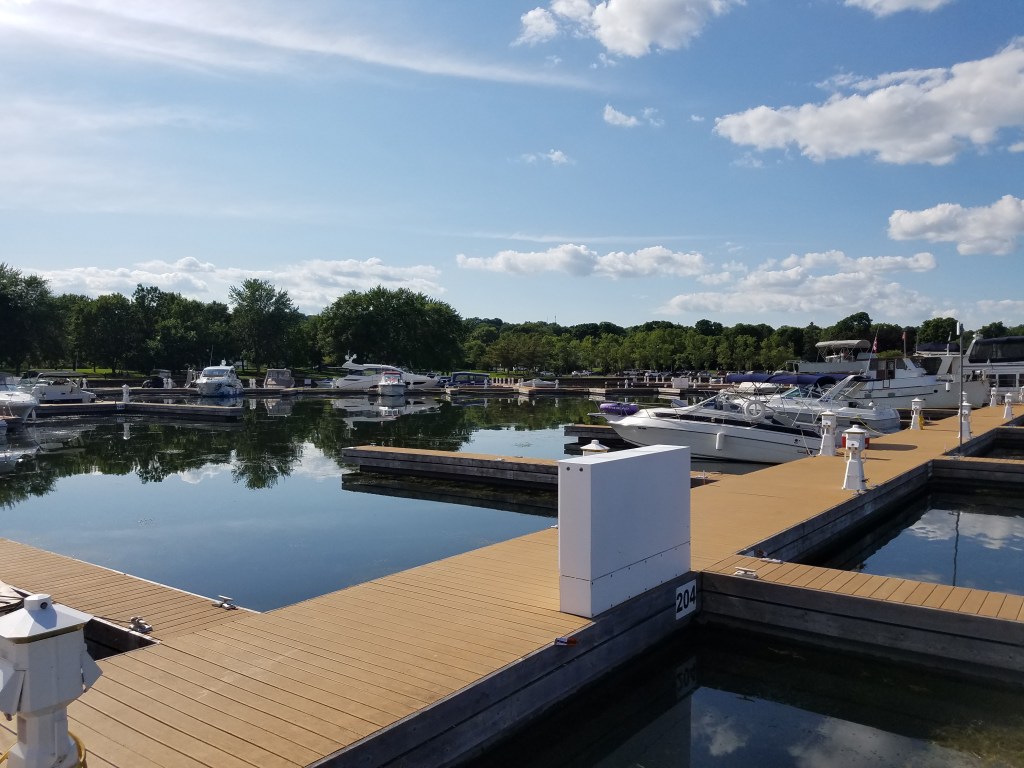
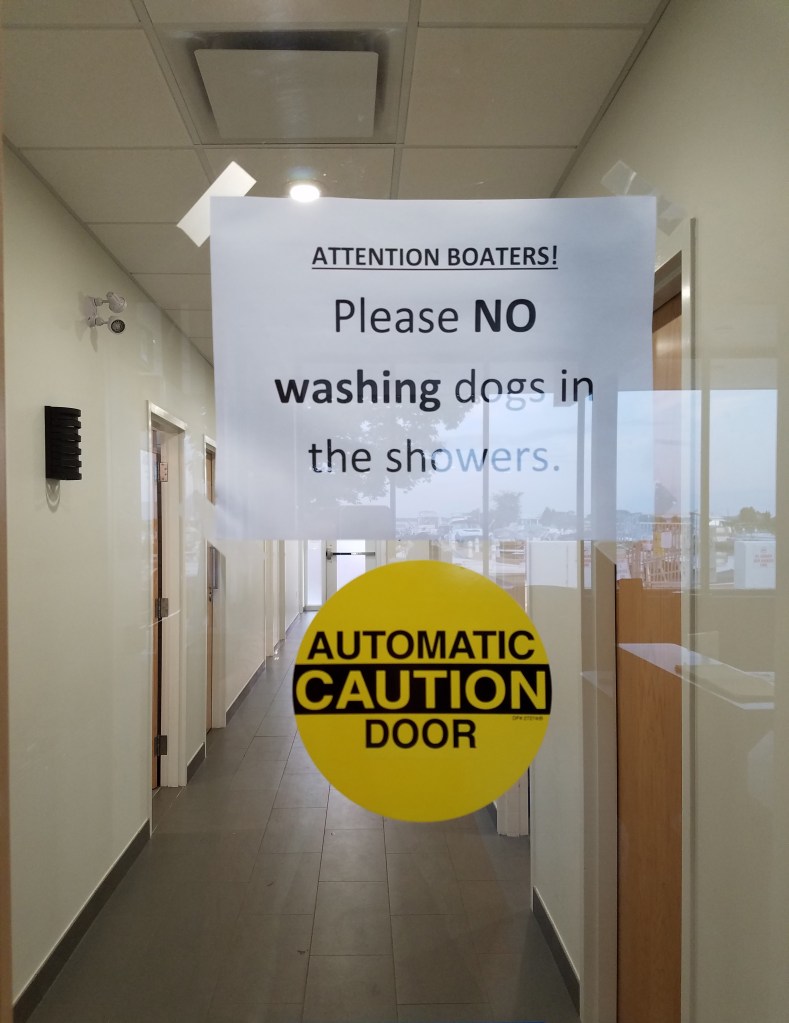
The site of the town of Orillia has been occupied for at least 4 thousand years. Evidence has been found of fishing weirs constructed in the narrows between Lakes Simcoe and Couchiching, and there were also trading, fishing, and hunting camps in the area. Samuel de Champlain visited in 1615, but the settlement of Orillia was not laid out until 1840. There is some manufacturing in the area as well as farming and of course tourism, but the largest local employer is a casino run on the nearby Ojibway Reserve. A beautiful marina has been built in the harbour, and there are bicycle paths running for several miles in each direction along the waterfront. Dick disappeared on a beer run that somehow incorporated all 5 miles of the bike path! There were several Looper boats in the marina, and we enjoyed docktails followed by Chinese food at a local restaurant with the couple on the boat next to us. They are also doing the Loop in small pieces like us, instead of the more common all at once over a single year, so it was nice to compare notes.
North of Orillia we travelled through some “interestingly” shallow and narrow stretches of the waterway. I say interesting, there were at least 2 cuts that were too narrow to allow large boats to pass each other, and one long stretch where we had to stop in place to allow big boats to inch past us. The channels are rock sides and bottom, and the sides slope, rather than being cut straight down. Unlike in some of the notoriously shallow areas of Georgia and New Jersey on the ICW, when you touch bottom here it is not soft sand but unyielding rock! We managed to traverse the whole section without incident, just those few nail-biting moments as we passed other boats. Our stop for the night was at the top of Big Chute Railway.

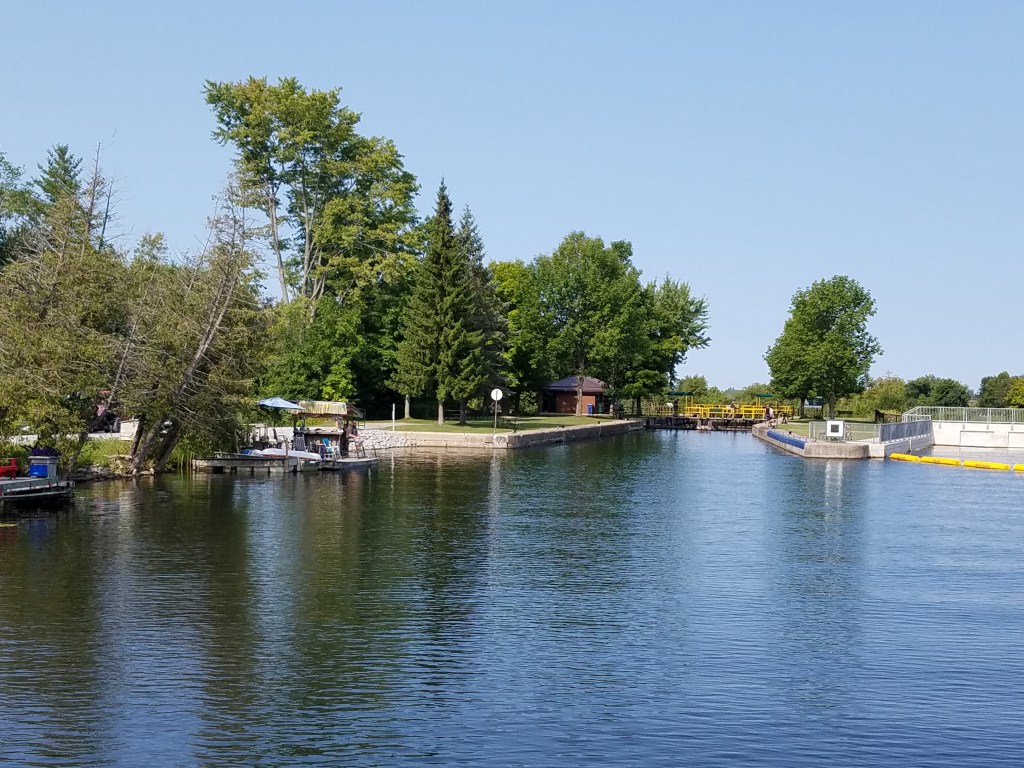
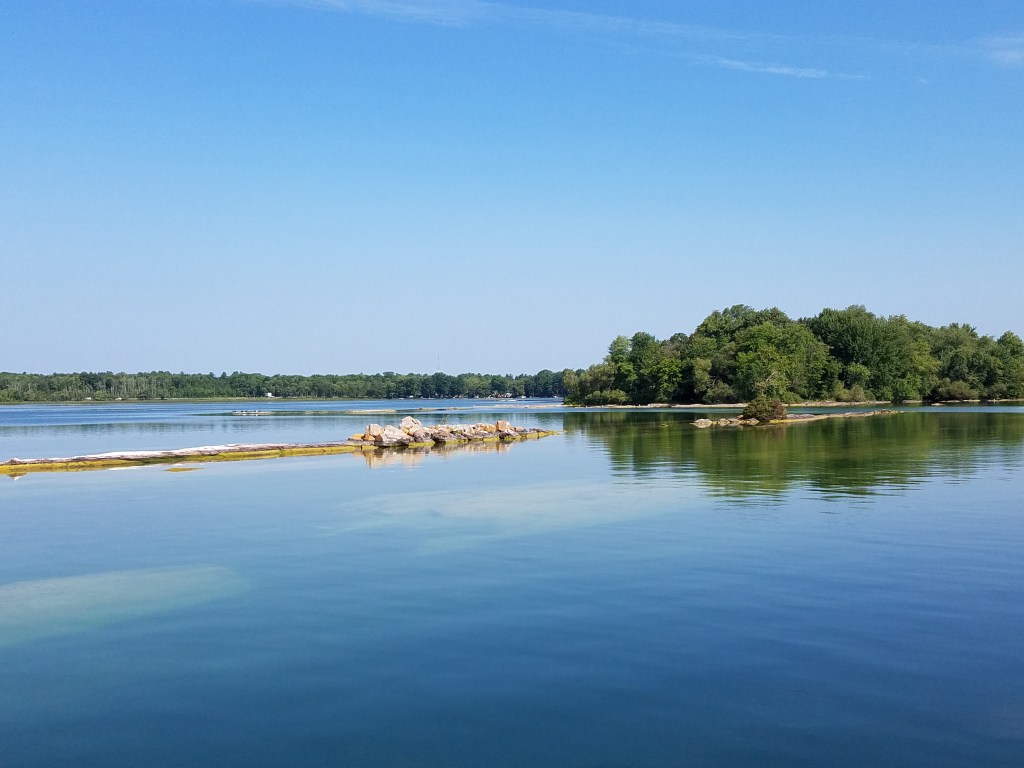
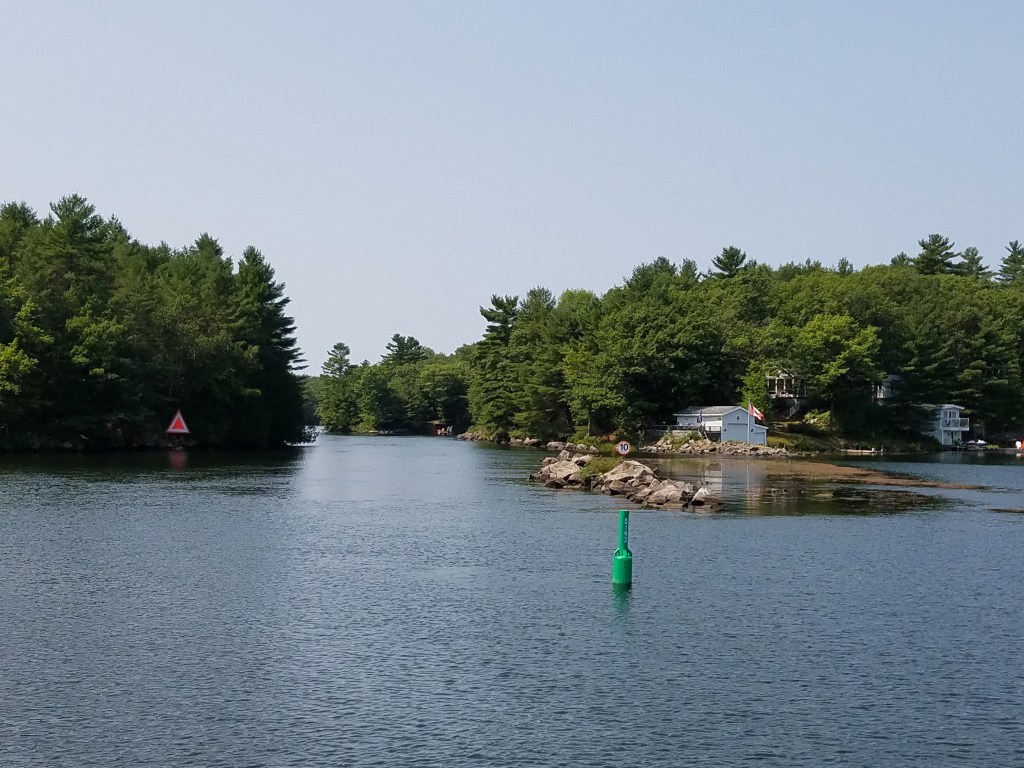
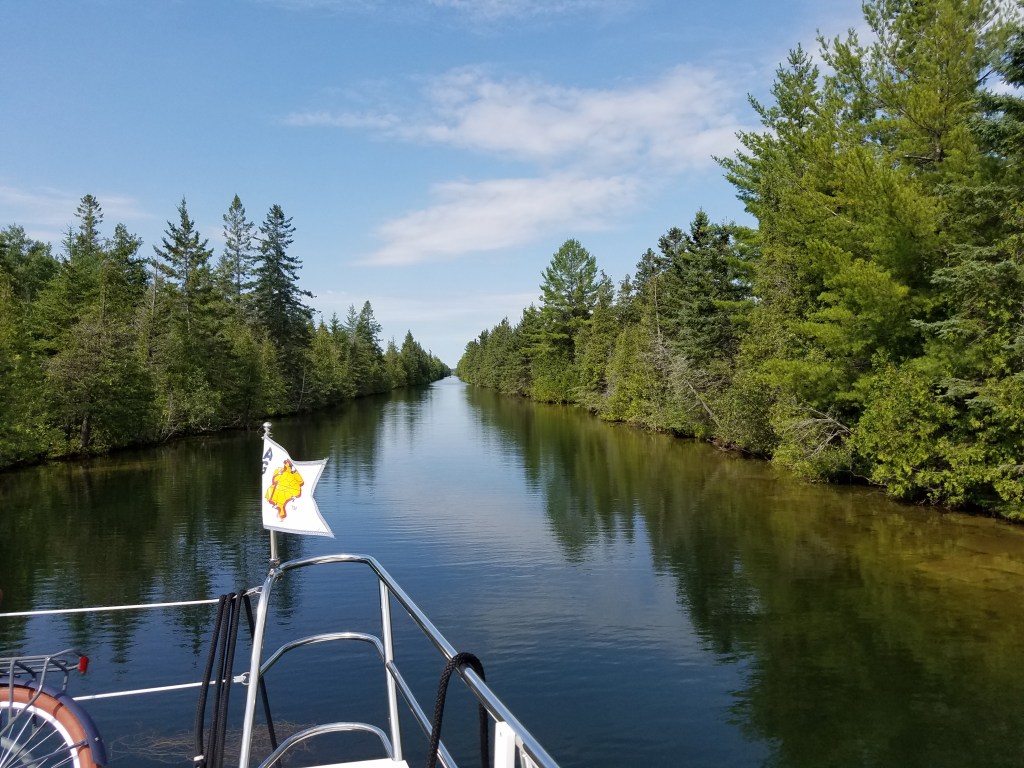

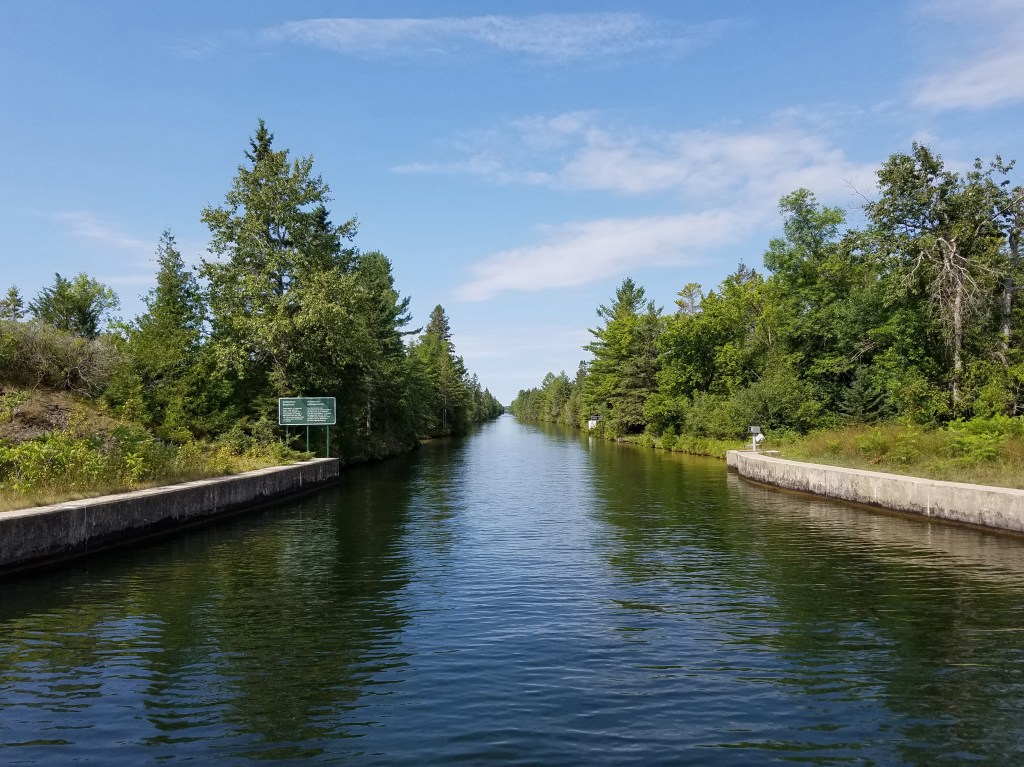
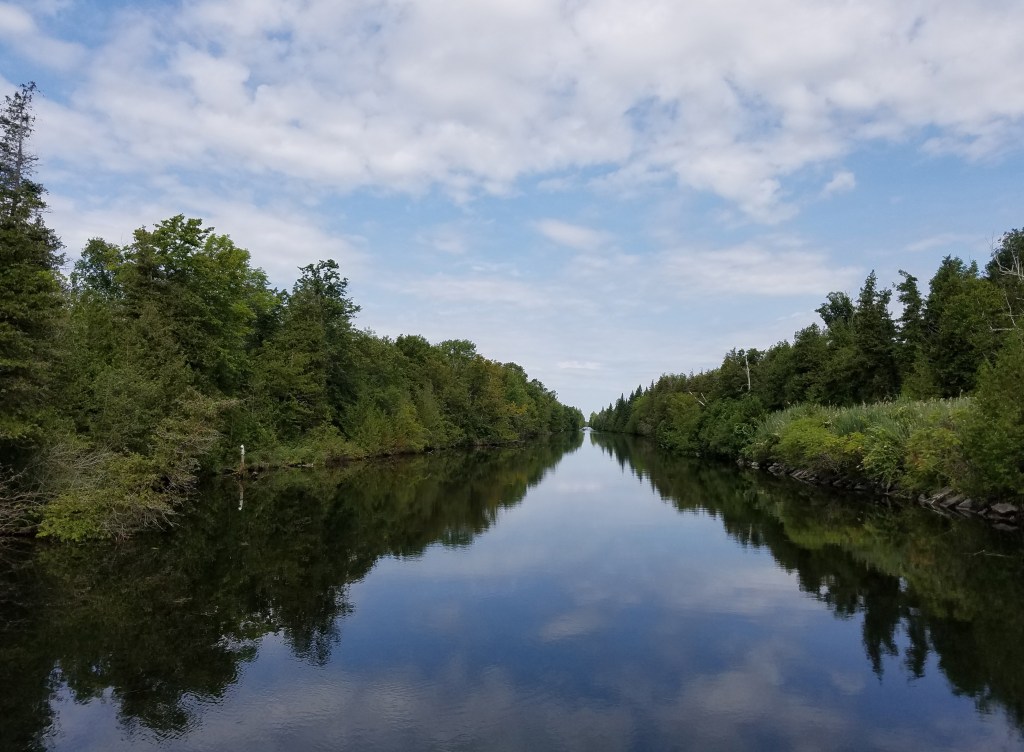

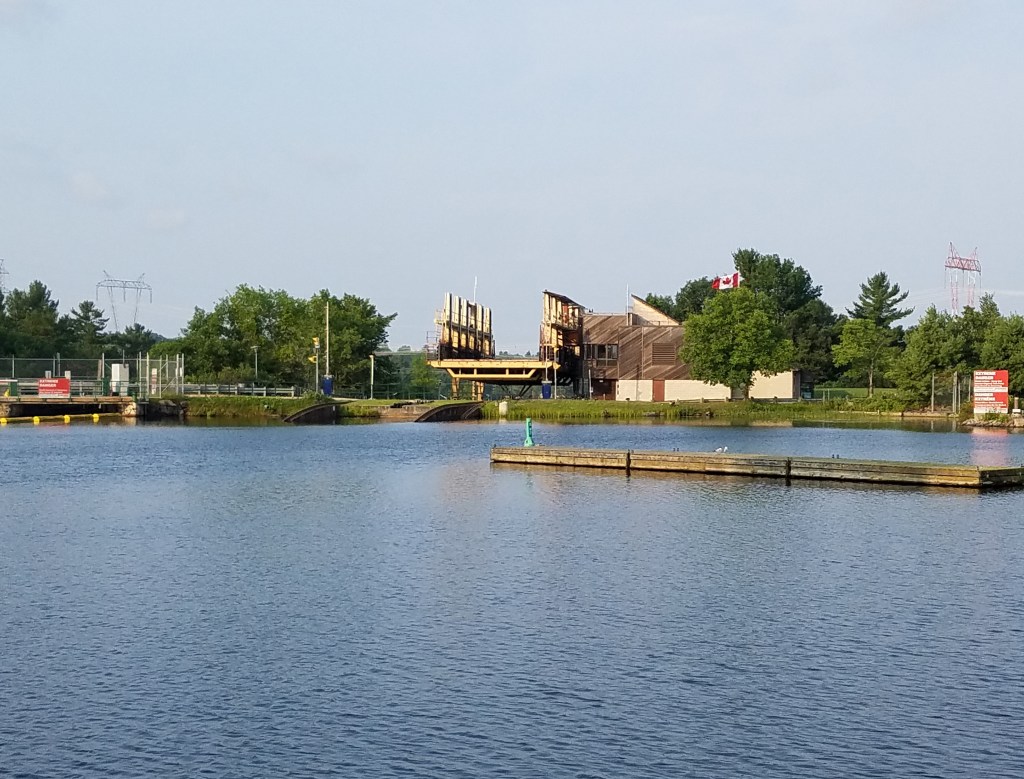
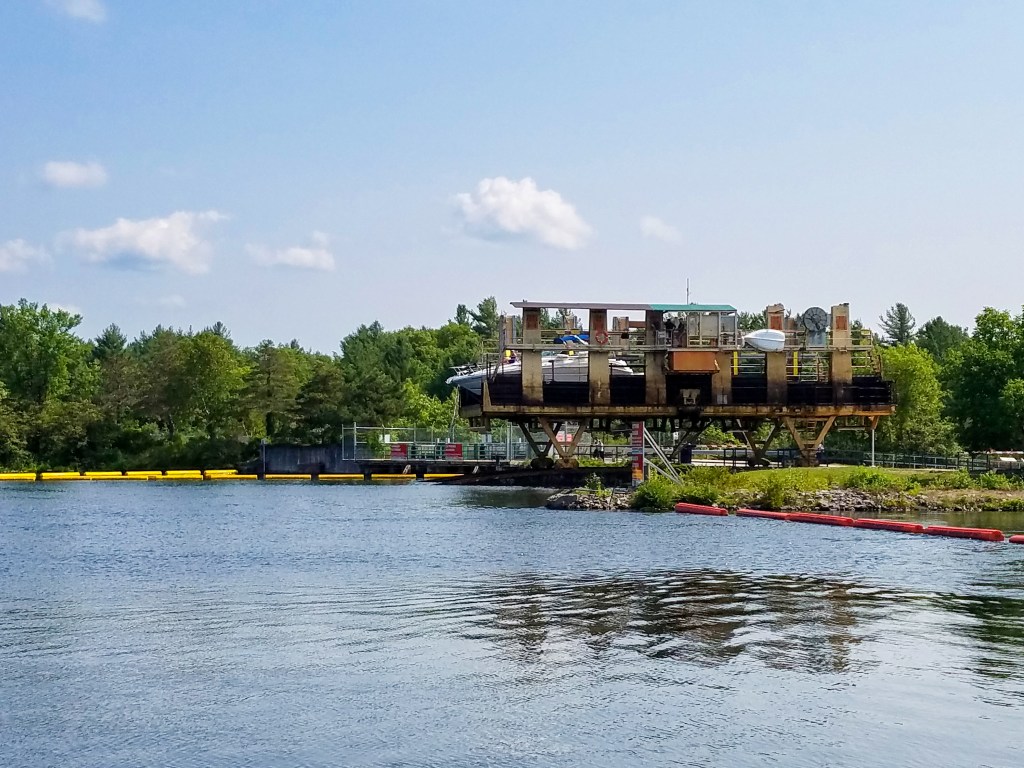
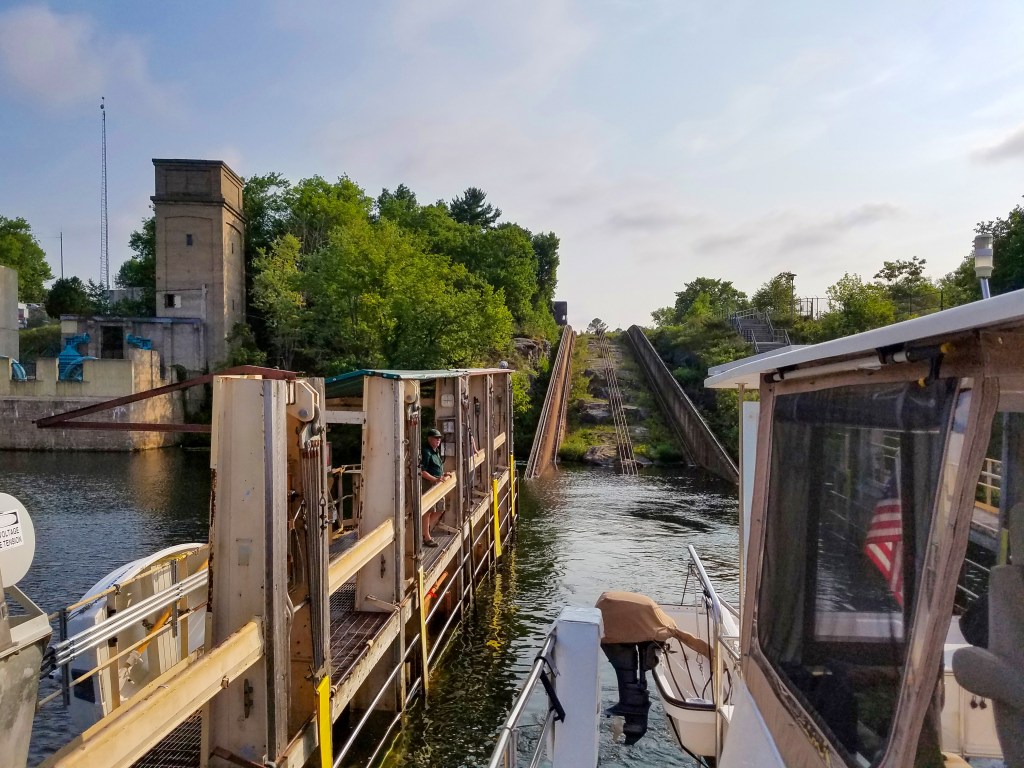
Big Chute was the second grand adventure on the Trent Severn. There were supposed to be 3 locks built to carry boats between Georgian Bay and the Severn River at Swift Rapids. One small, so-called temporary lock (it’s still in use) was built at Port Severn, and two marine railways were built between that and Swift Rapids. The Swift Rapids railway was eventually replaced by a lock, but Big Chute Marine Railway is still in use. The current carriage was opened in 1978, and can carry boats up to 100 feet long and 24 feet wide. The carriage rolls down into the water, and the boat drives in and is held at the side of the carriage while large slings are raised underneath to keep propellers and rudders off the bottom of the carriage and to steady the boat through the transit. The carriage then rolls out of the water and down (or up) the rails to the other end. It is cleverly designed to keep horizontal during the transit, even though the railway is very steep. This marvellous piece of engineering is getting rather long in the tooth, and breakdowns are not uncommon. In fact, a local boater had described it as “a white elephant that keeps breaking down”, not what we wanted to hear before our transit! Our keels completely enclose our props and rudders, so we were simply resting on the bottom of the carriage, not lifted in the slings. The carriage shakes and rattles alarmingly, and it was not exactly confidence building to listen to the operators chatting about all the reasons why the government is “going to have to work on this all winter!” Nine Lives survived the adventure without incident.


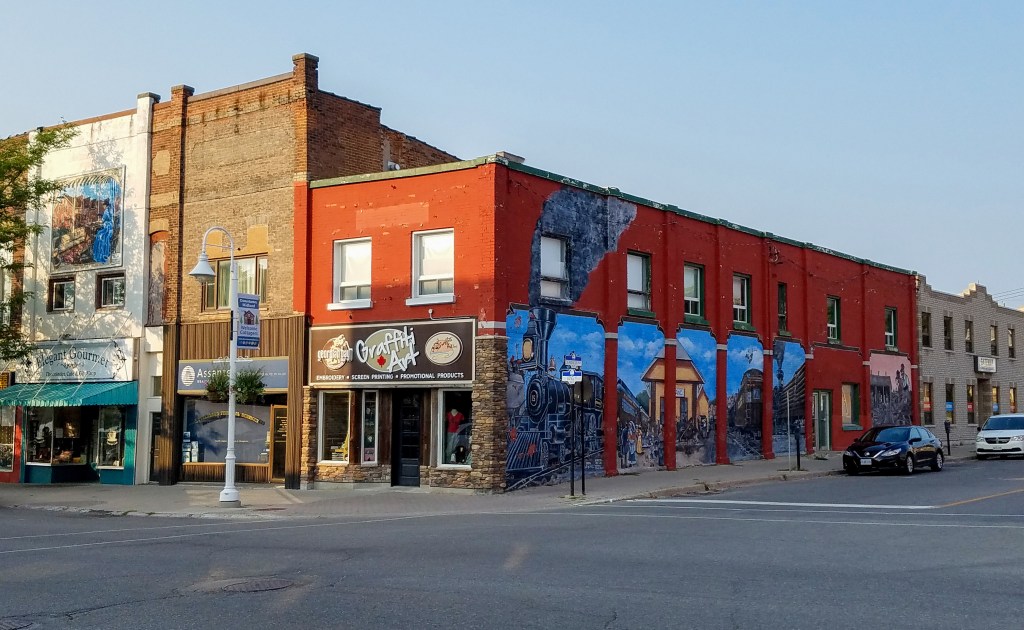
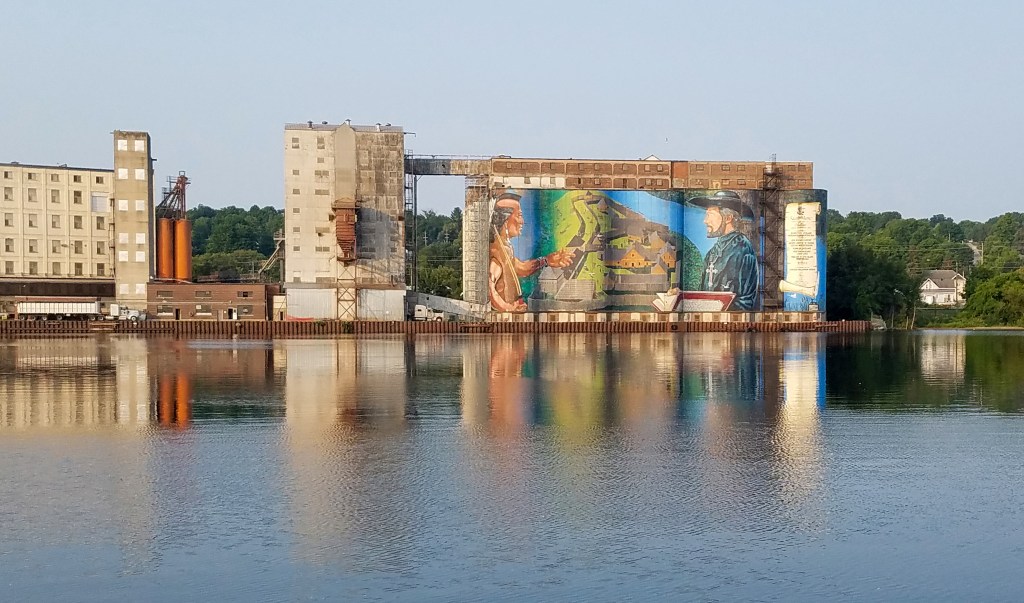
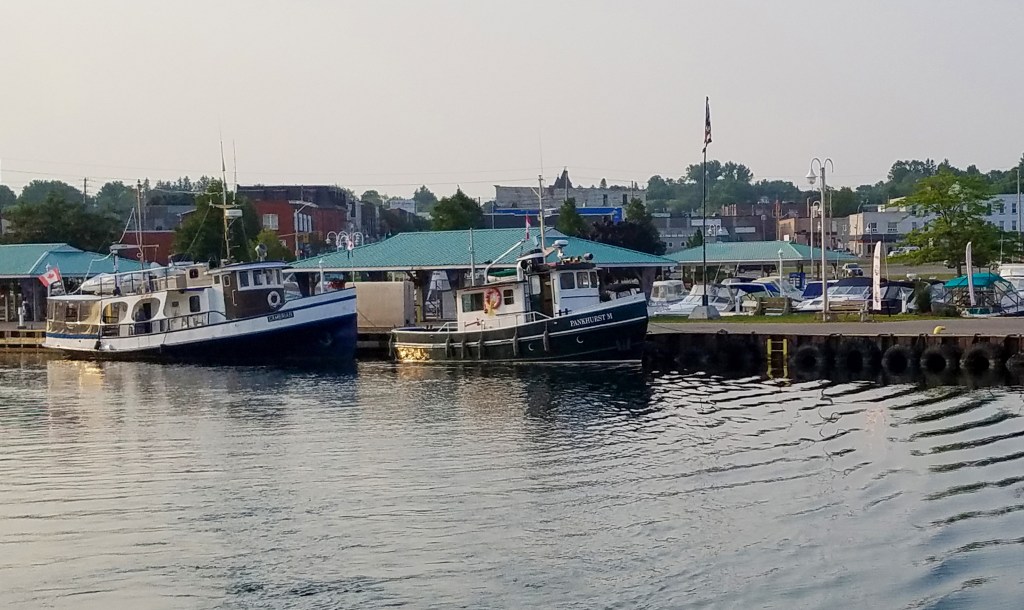
After the small lock at Port Severn we were into Georgian Bay. Our first stop was Midland, founded as a railway town in 1871. Of particular interest are a number of murals found around the town, painted by a local artist at the close of the 20th century. The largest covers what would otherwise be very unsightly grain elevators overlooking the harbour. The day after we were there was the start of a tugboat meet. They were expecting at least 20 tugboats to gather for tours and races over the weekend. The day we arrived there were already 5 at the docks. Just as there are people who enthusiastically restore old steam trains, there are those who buy and restore old tugboats. The ones we saw ranged from a very large 70 footer, to a small one painted bright red and named Maggie. We were sorry we couldn’t take time to stay and watch the meet.

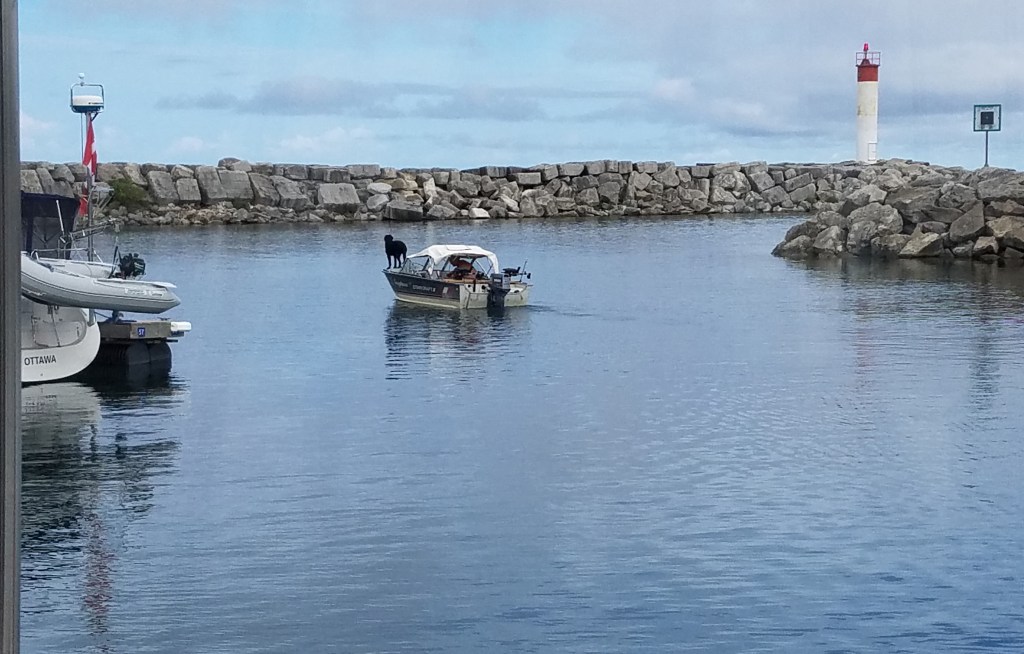
Skipping quickly across the southern end of Georgian Bay in advance of threatened thunderstorms, we arrived the next day at Meaford. We have now seen the last of our fellow Loopers, most of whom are heading north to the North Channel and Lake Michigan. Meaford is known for its apple orchards and an annual scarecrow festival. It also has an arts and cultural centre and some lovely old houses and civic buildings. As with most Ontario small towns, many of the downtown shop spaces are taken up by banks and various social services organizations and government offices. The nearest supermarket is 5 miles away, and while there are a few restaurants, there seems to be little to attract tourists to the town. The harbour is nice, and protected by a huge breakwater. We noticed that most of the slips are taken up by sailboats, and there is an active sailing school for children operating out of the harbour. We stayed three nights due to a poor weather forecast, and were very glad of the decision when we moved the boat the first morning to take on fuel. The waves in the short hop around the breakwater blew up while we refuelled, and the return trip to the harbour was very lumpy, knocking things over in the cabin. Now that we are back into “big water” we are experiencing the weather delays that have been mostly absent this summer.
Our next stop was Tobermory, a bustling town at the northern tip of the Bruce Peninsula. As we made our way north along the shoreline of the Peninsula I spent some time refreshing my memory of the geological feature known as the Niagara Escarpment. Dick and I both learned in school that the Niagara Escarpment is a high bluff that runs from the tip of the Bruce Peninsula south through Hamilton and Niagara Falls. Looking it up, I was surprised to learn that in fact, the formation rises from Waterton New York, through Ontario, Illinois, and Wisconsin, ending northwest of Chicago near the Wisconsin border. What a pompous and parochial attitude of a school system that suggests that the importance and magnitude of a geographical formation is limited to the piece that falls within political borders.

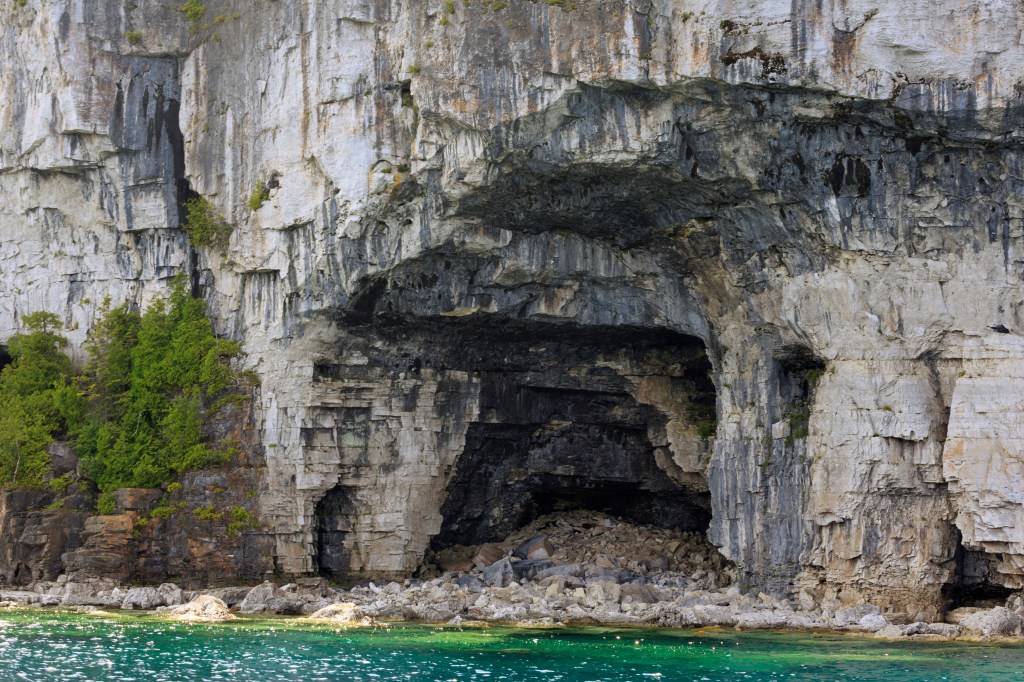
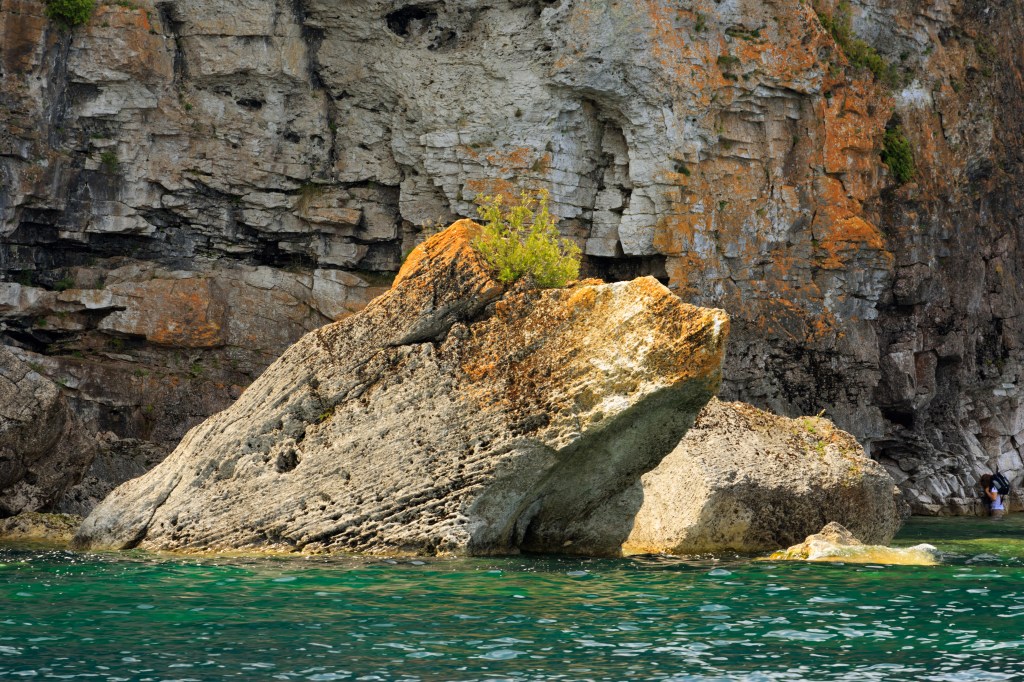
Tobermory is a popular tourist destination. Nearby is Fathom Five National Marine Park, which we saw from the water as we made our way around the point. Part of the National Park is Flowerpot Island, with a distinctive rock formation just offshore that attracts thousands of visitors on the many boat trips that ply the waters between Tobermory and the island. The area is also a magnet for diving, with many dive boats going out to explore the shipwrecks in the treacherous waters of north Georgian Bay. We arrived in town in early afternoon, and I enjoyed watching the harbour activity. In addition to at least 10 tourist cruise and diving boats every hour, there is a car ferry that goes to Manitoulin Island, and lots of large and small pleasure boats. All this activity is complicated by kayakers weaving around the harbour, seemingly unaware of the “law of gross tonnage” that suggests that even though kayakers may have the right of way, the bigger the vessel, the less easy it is to stop or turn and give way! I would have liked to spend another day or two in the busy little town with its interesting shops and lots of people watching, but the weather is getting chancy and we had to leave the next morning.
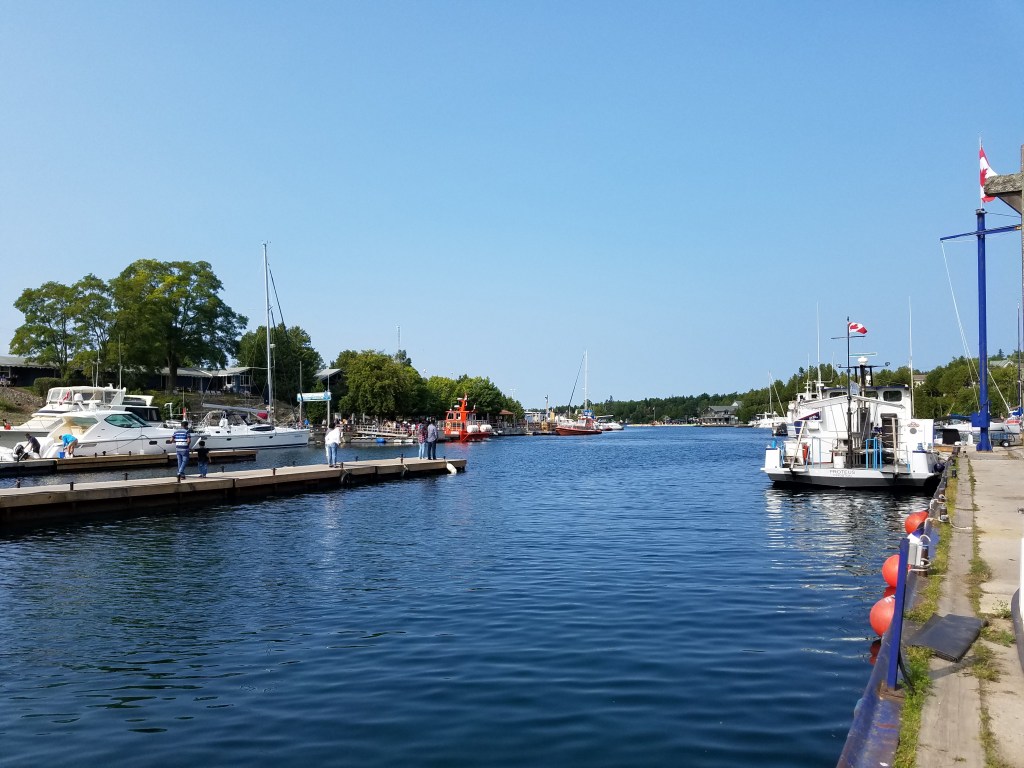
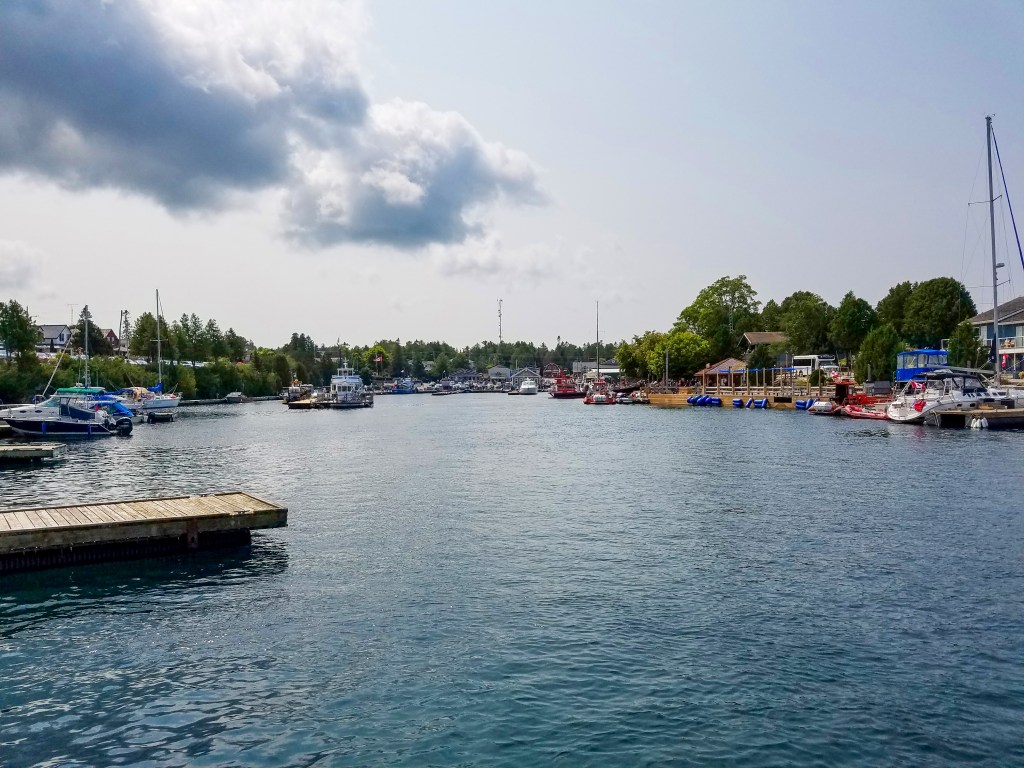
Turning south into Lake Huron we were surprised to find ourselves in much rougher water than the forecasts had suggested. Nine Lives doesn’t really cut through the water the way a sailboat or ocean-going trawler does, instead she dances on top of the waves. Our extra speed is helpful in smoothing things out so we are not wallowing or corkscrewing, but the ride is uncomfortable to say the least. The hulls and the centre section pound on the waves, and gradually the furniture in the salon begins to make its way aft, as each wave smacks the floor and makes everything bounce. At one point, Dick had to go below and rescue the small seat that happens to be our liquor cabinet, before it reached the galley stairs with potential disastrous results! Fortunately, the pounding only lasted about an hour before the promised smoother water showed up and we made our way into Port Elgin.
We were delighted to be able to entertain a friend from our university days on board for dinner that evening. Jan was in the same residence with us at Queen’s ..ahem.. some few years ago. We all agreed that none of us has changed a bit, even though we have not seen each other for a very long time. We spent an enjoyable evening catching up and exchanging stories. We would have liked to stay a little longer in Port Elgin, but once again with an eye on the weather we had to take advantage of a short window to make our way south. If we did not leave in the short hour between squalls that afternoon we would have been stuck there for at least 4 or 5 days.

 The Voyages of Nine Lives
I just LOVE your blog! It has me running to Google often to find a map or to read additional information on a topic. I hated that you missed your Indian meal. Glad you made one for yourself soon after. Safe travels. Lesley
LikeLike
Hi! I’m a new follower. We are aboard Pelican in Shelter Cove for a few months. I’m Mary Tracy’s daughter. Mom told me about y’all and Lesley sent me your link. We joined AGCLA at your recommendation (via Mom). We left Destin in March and only plan to go a little farther north of SC this year but we love living your journey with you. We have done the lower TennTom and the north Gulf has been our playground for years. I hope we will meet at Wexford soon. Follow us at saltyatsixty.com Lee McLaughlin
LikeLike