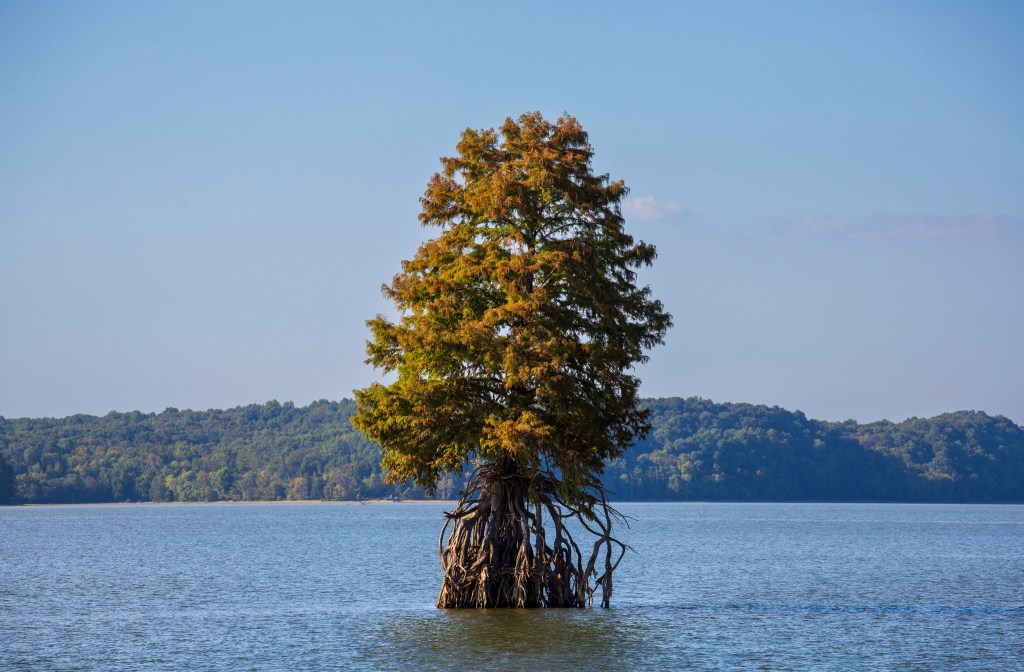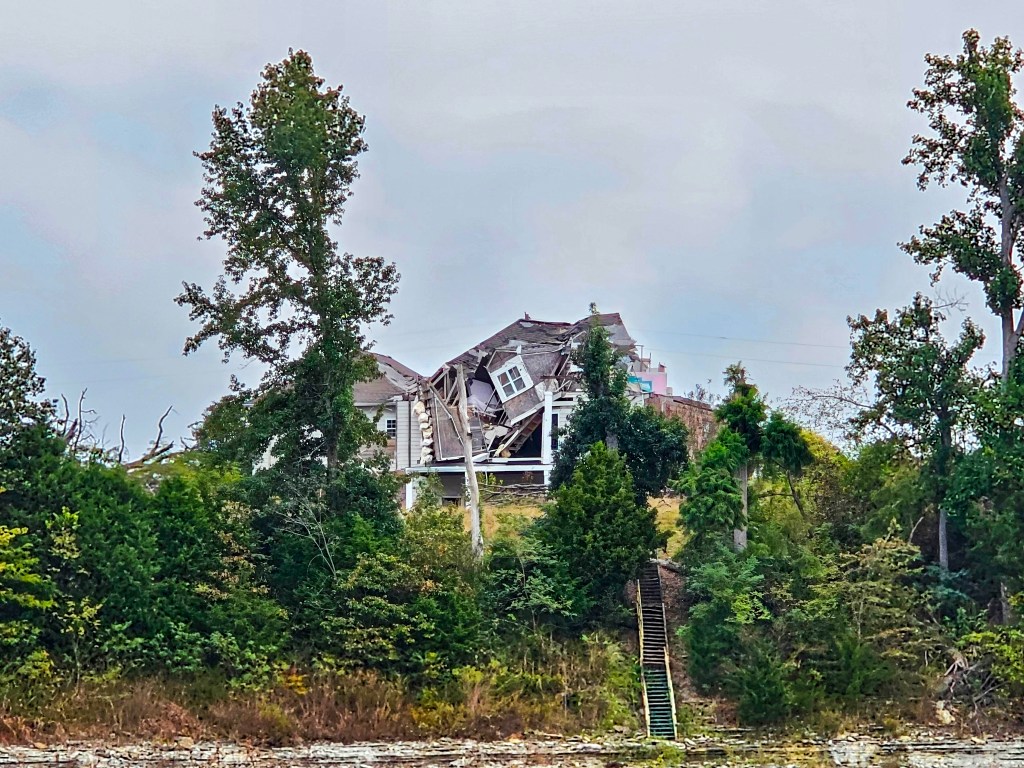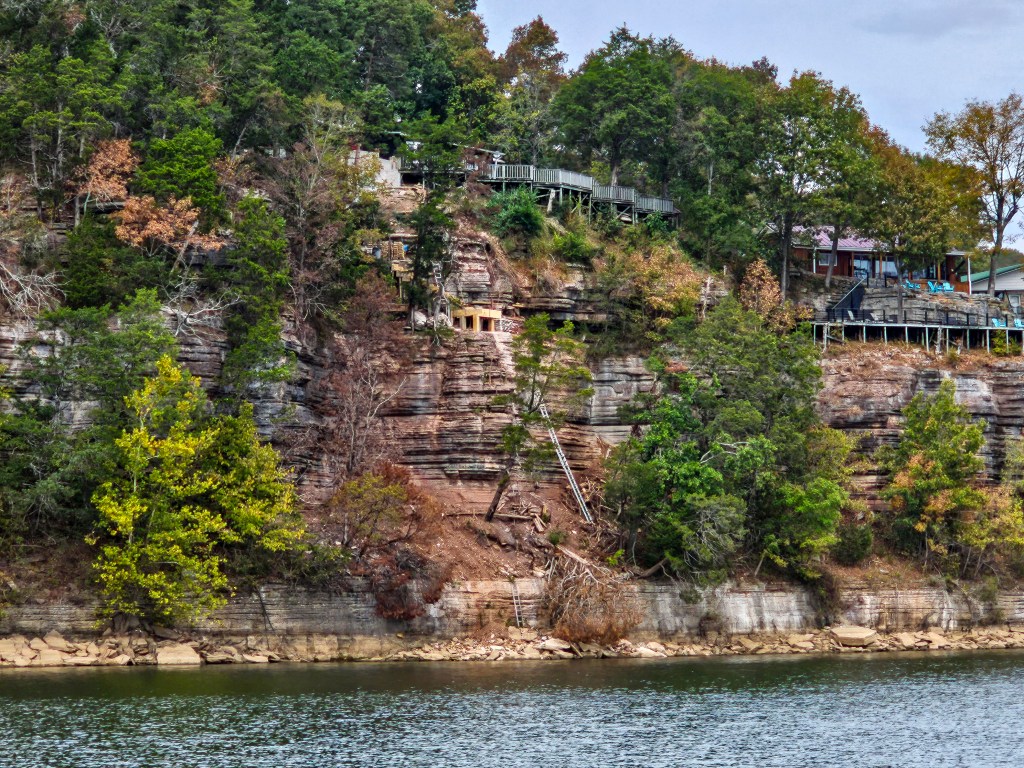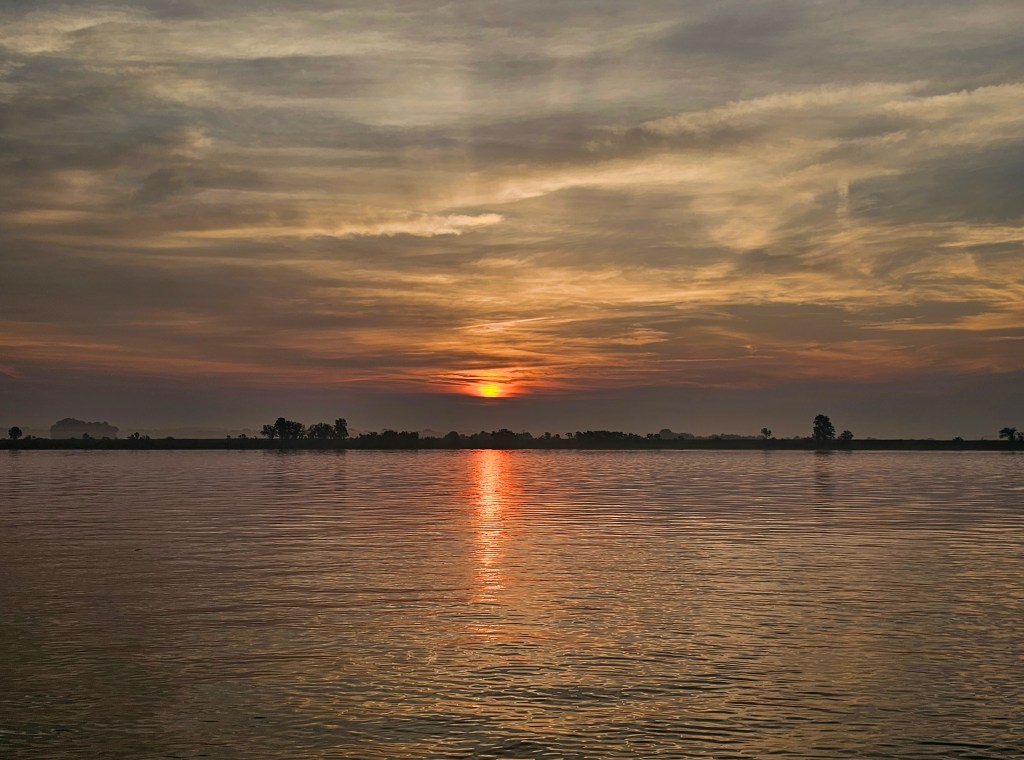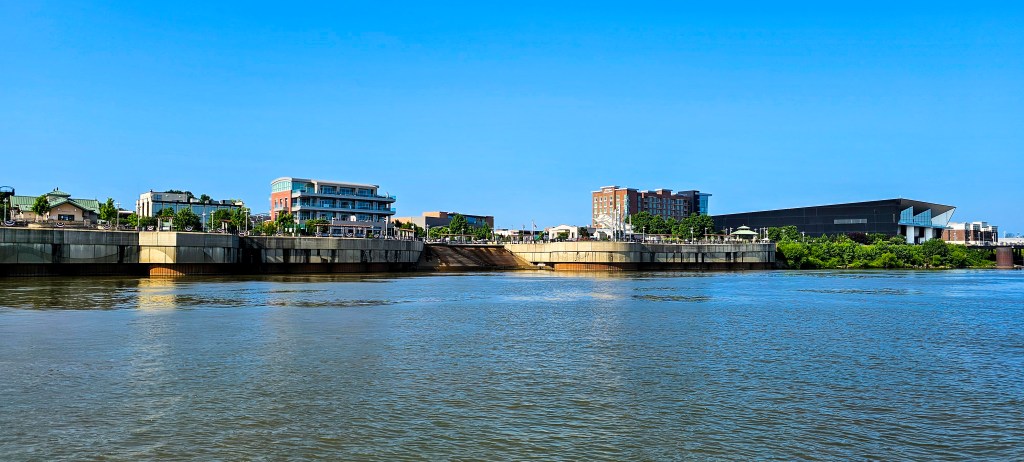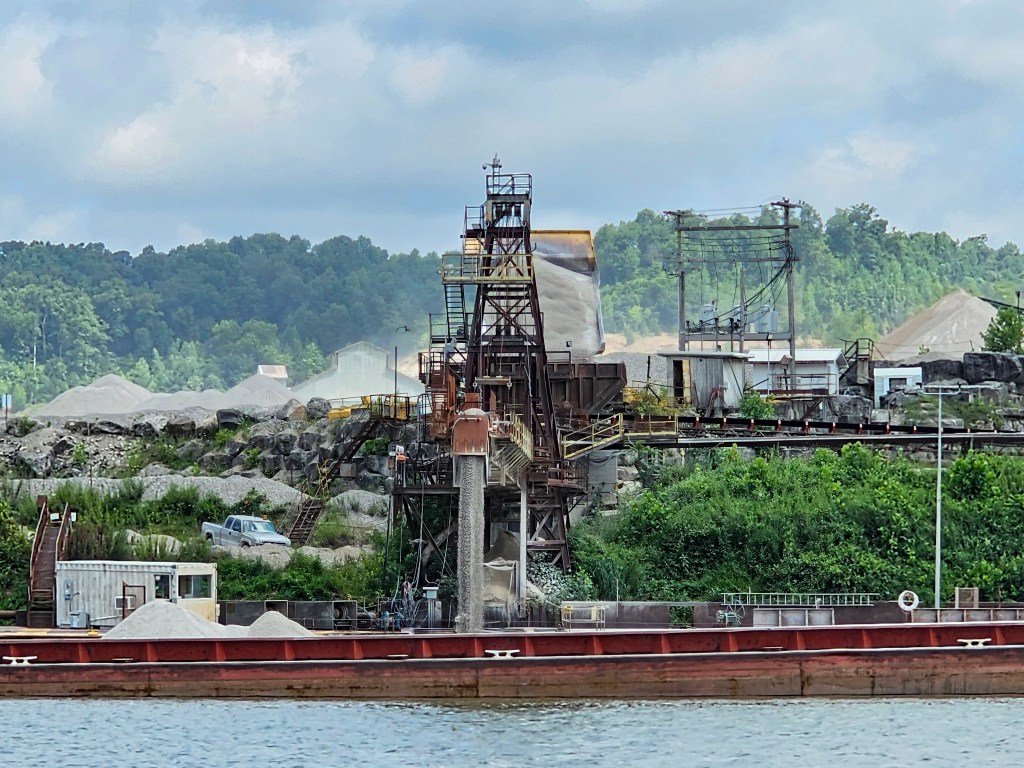
October 16th to November 2nd, 2024: Scottsboro to Columbus

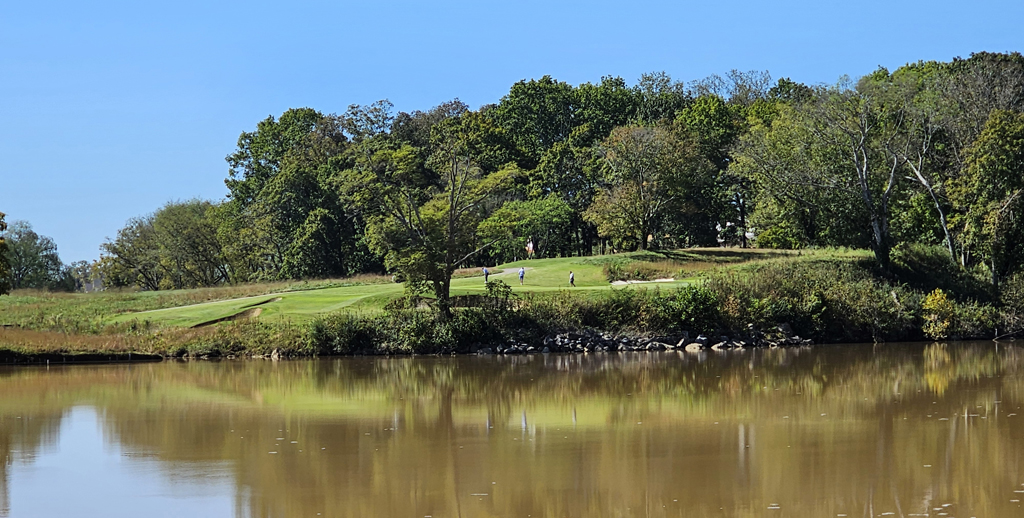
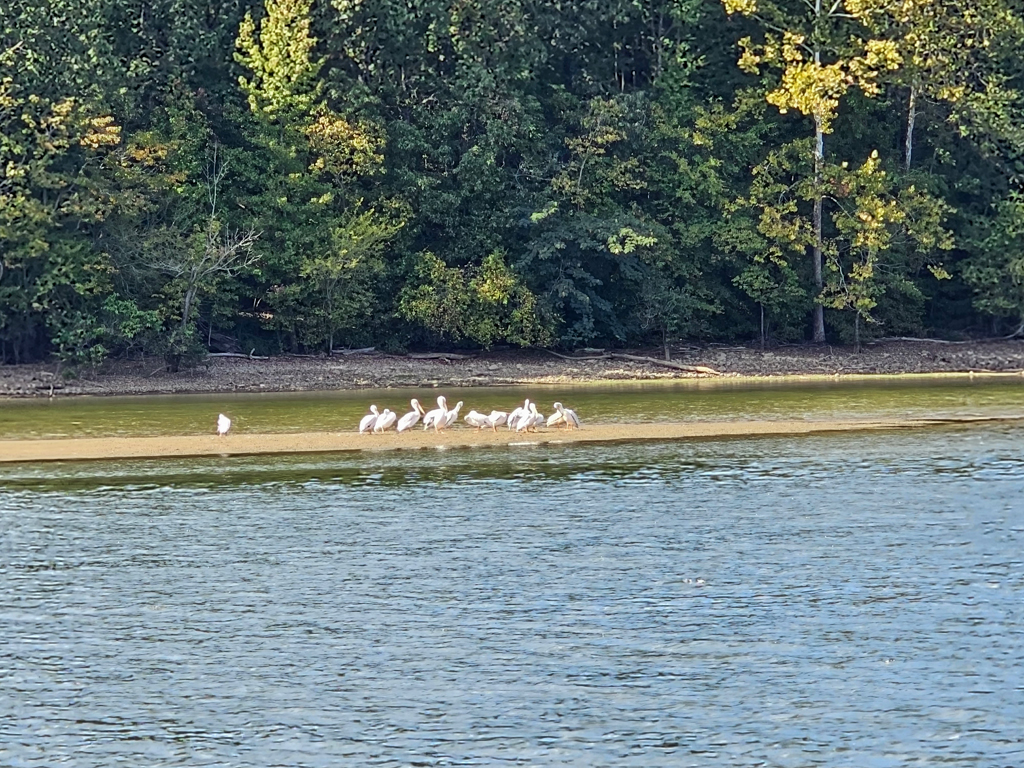
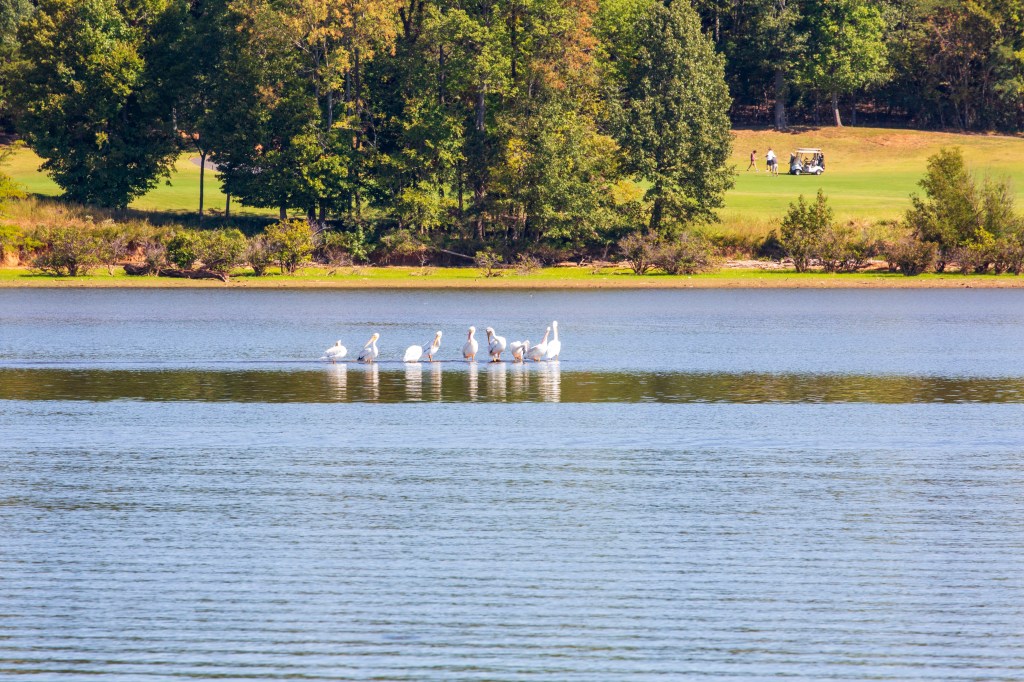
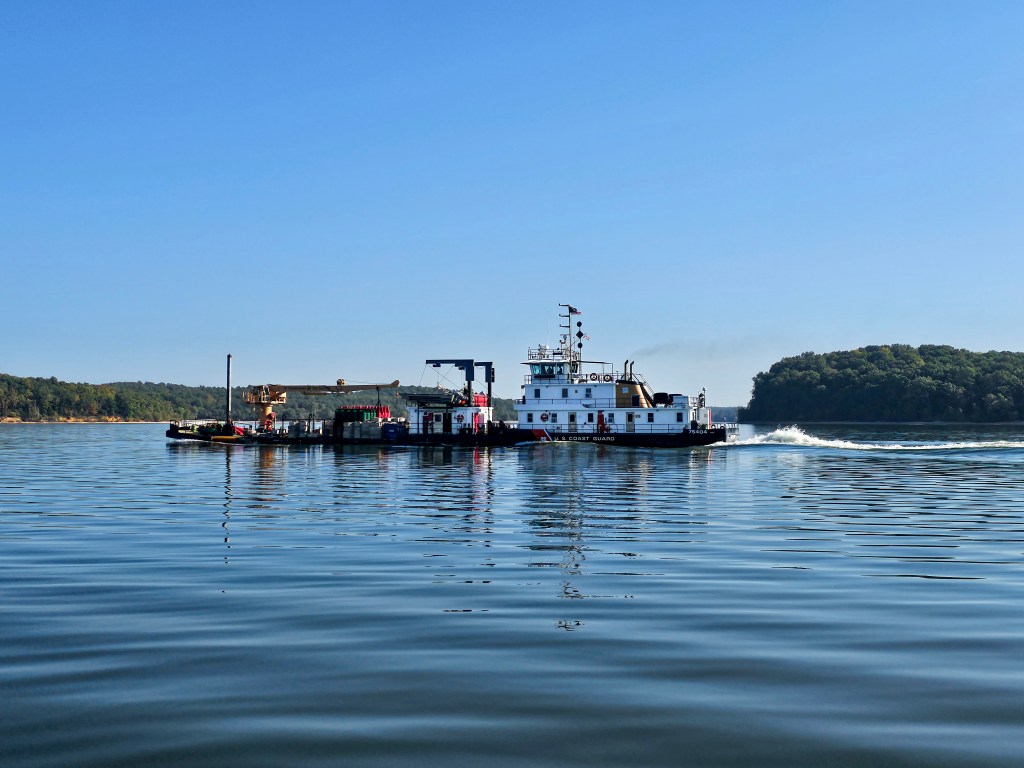
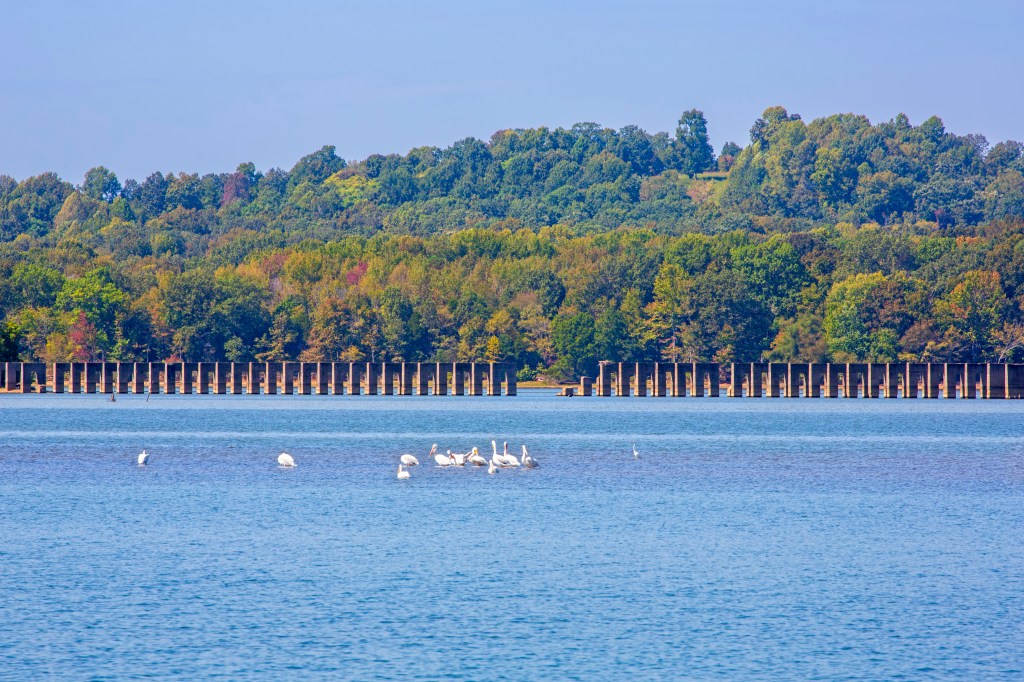
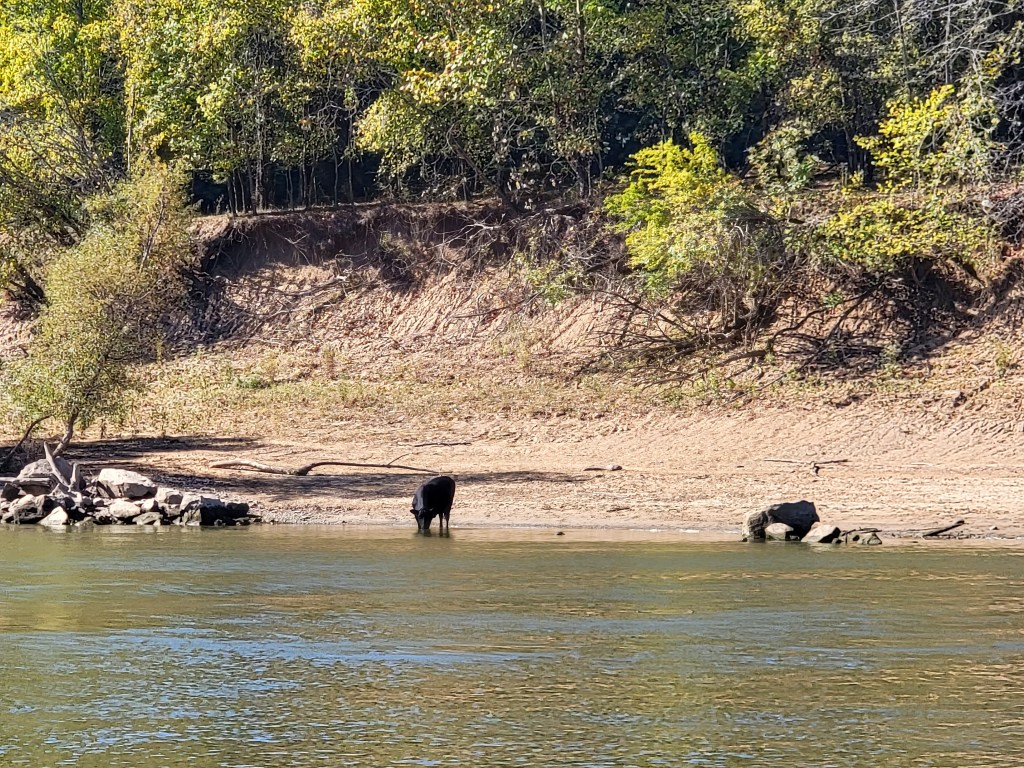
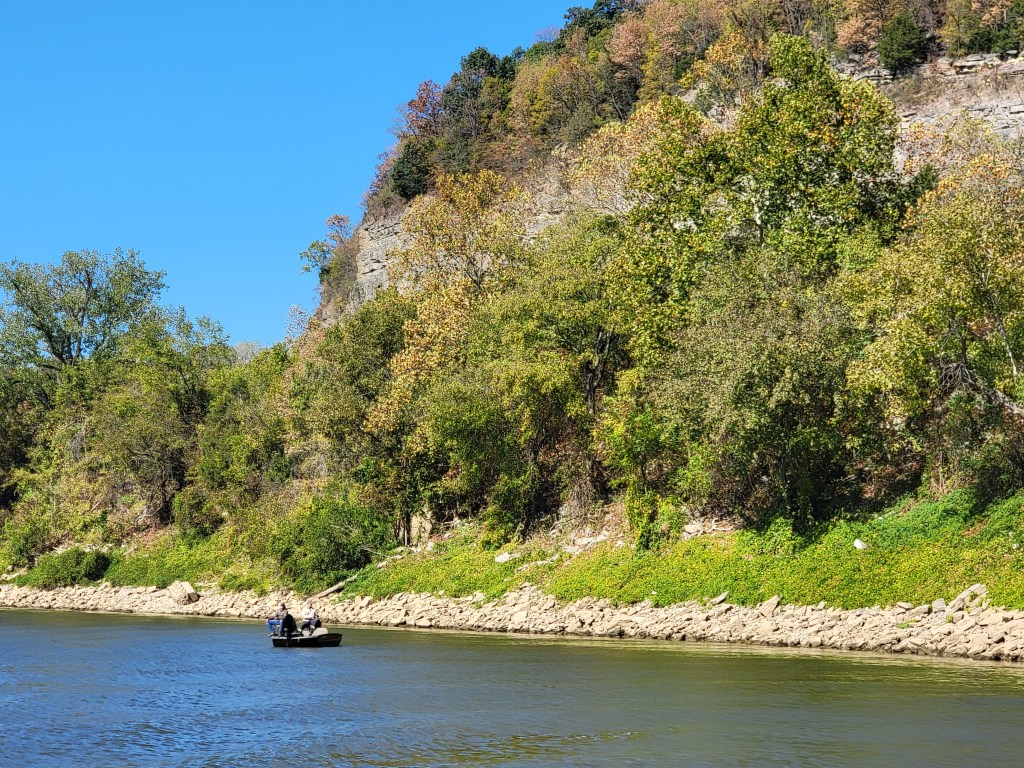
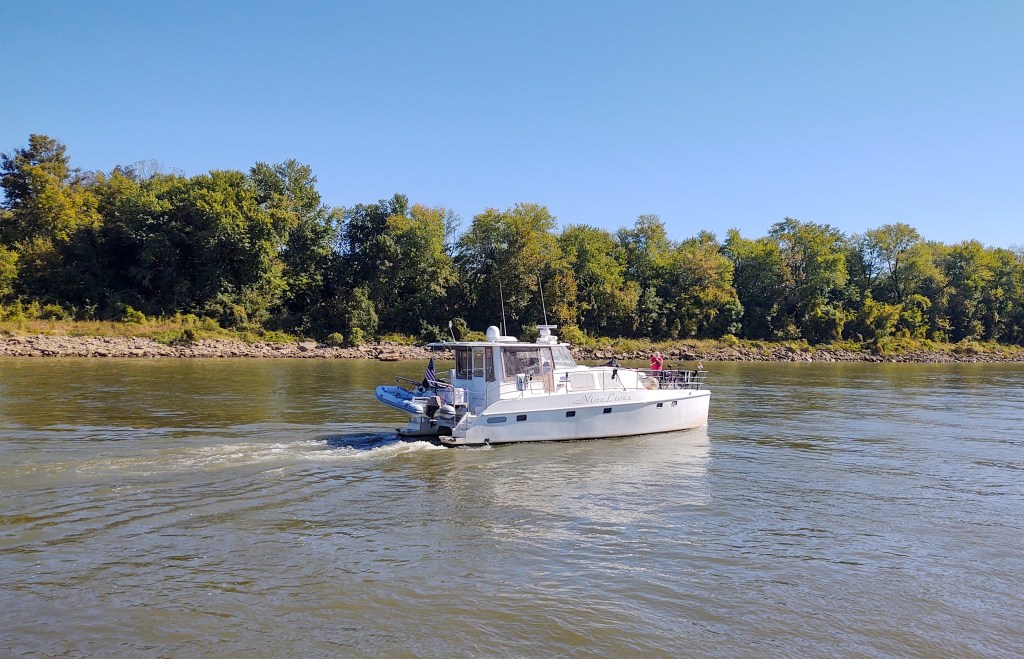
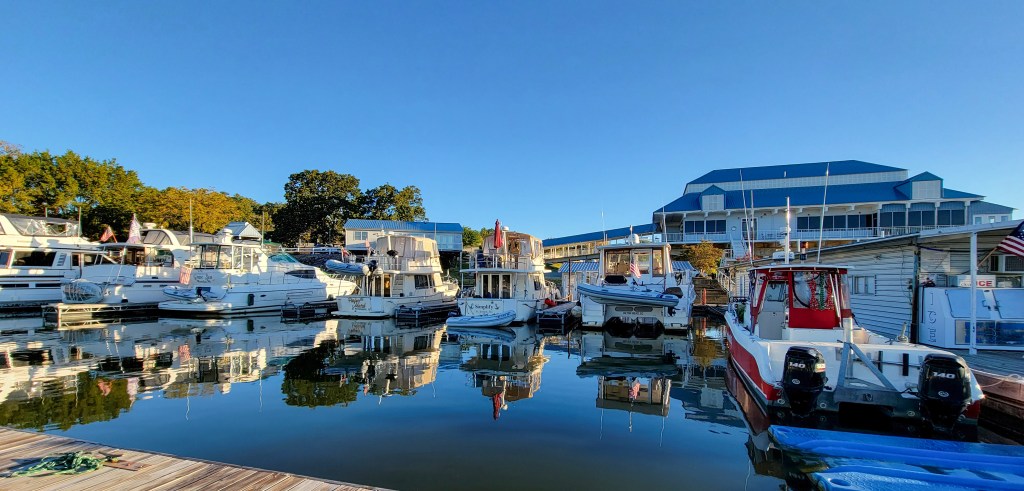
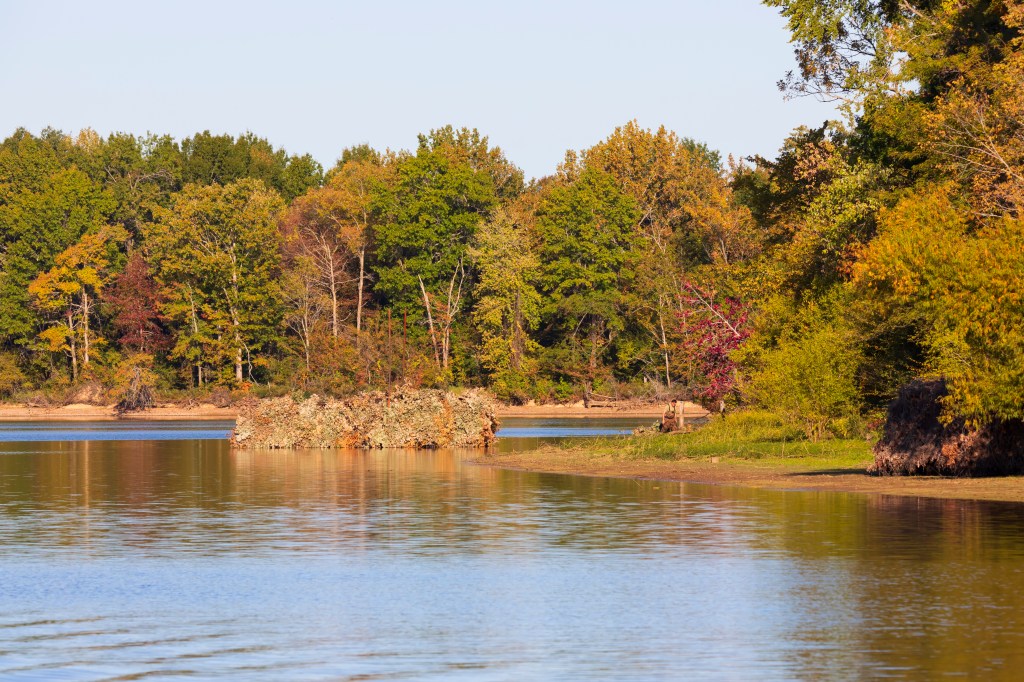
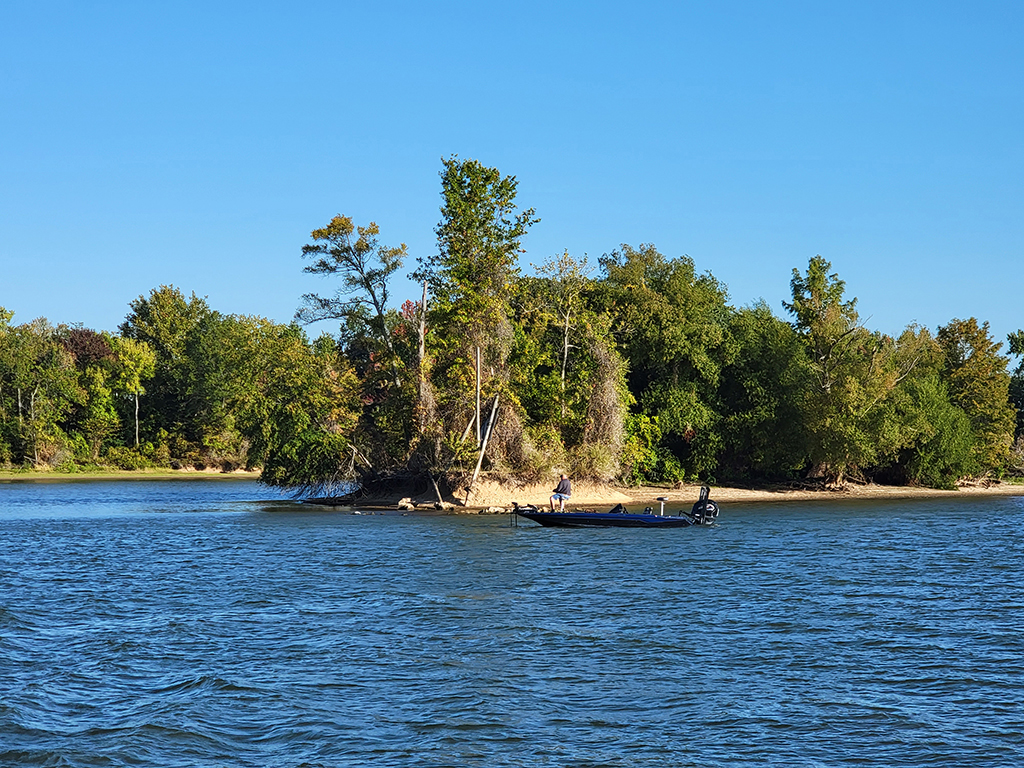
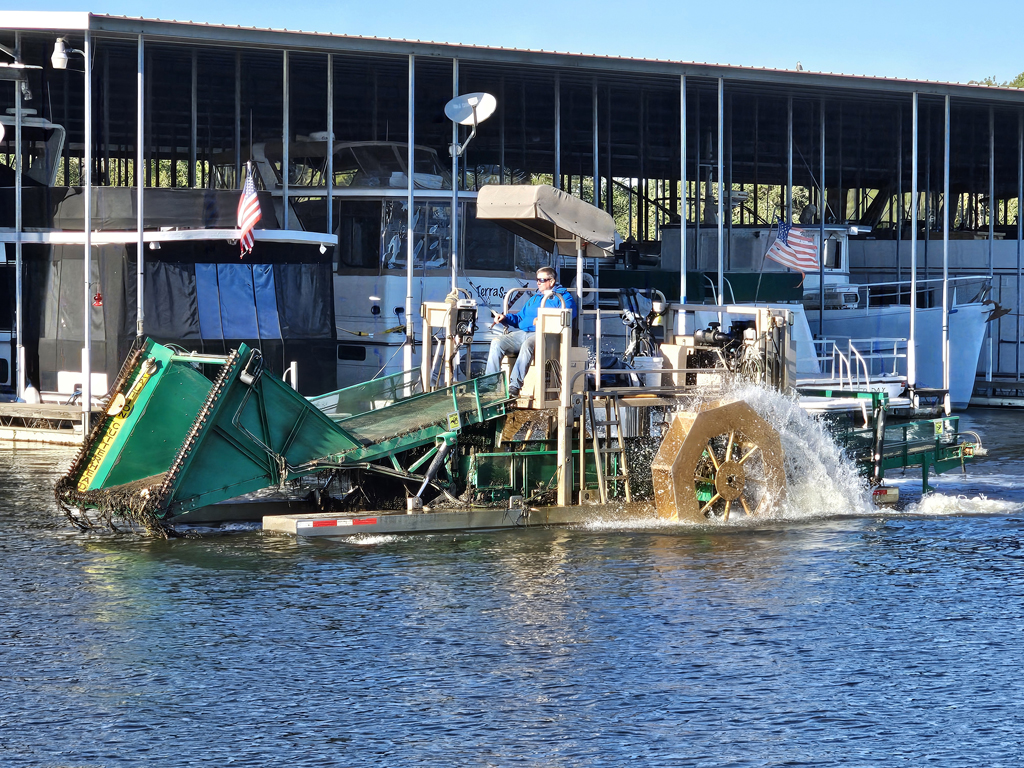
Our destination on October 16th was Goose Pond Colony Marina, near Scottsboro, Alabama. This marina is part of a large golf resort.  The entrance channel is narrow, but well-marked, and with lots of shallow areas there were interesting birds to be seen as we approached.  The grass is so prolific that the marina has a special machine to keep clearing the channel, and it goes out every day.  Our entrance was a matter of trust, because the grass fools the depth sounder and it suggests that we are about to run aground.  There were several other Loopers there, including some that we had already met.  Later that afternoon, Legacy, a smart Back Cove arrived on the other side of our slip.  We found out when they introduced themselves that they were just 8 hours into the Loop.  Unusually, the lady will be aboard one week in four, and for the rest of the time Don will travel solo.
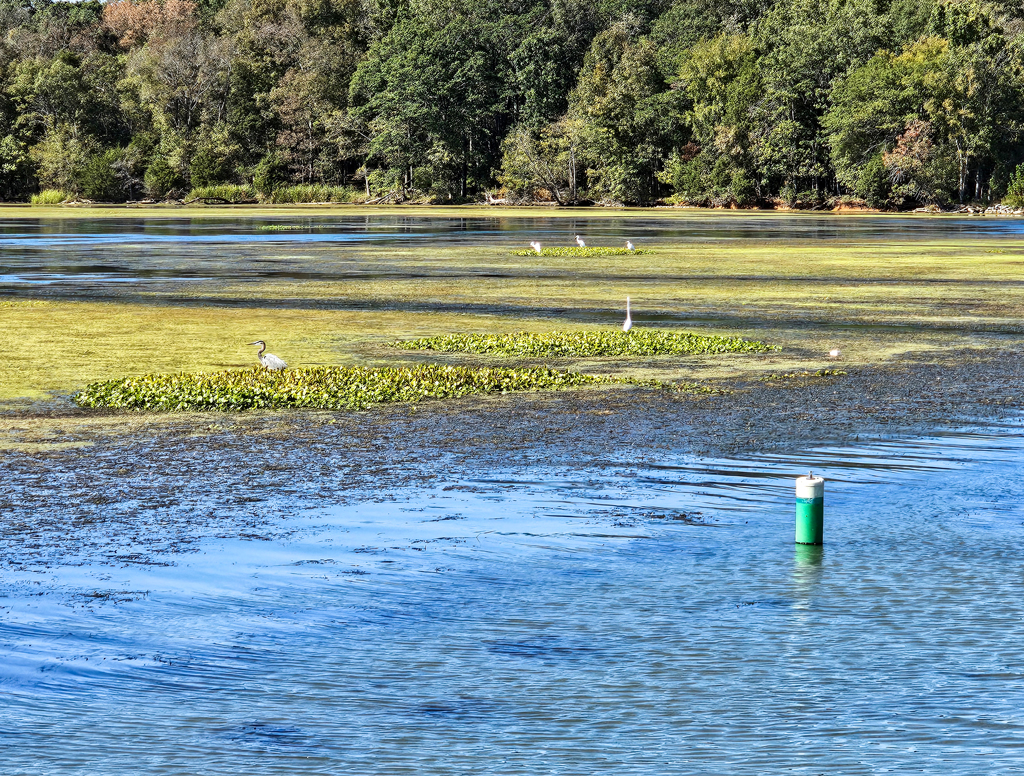
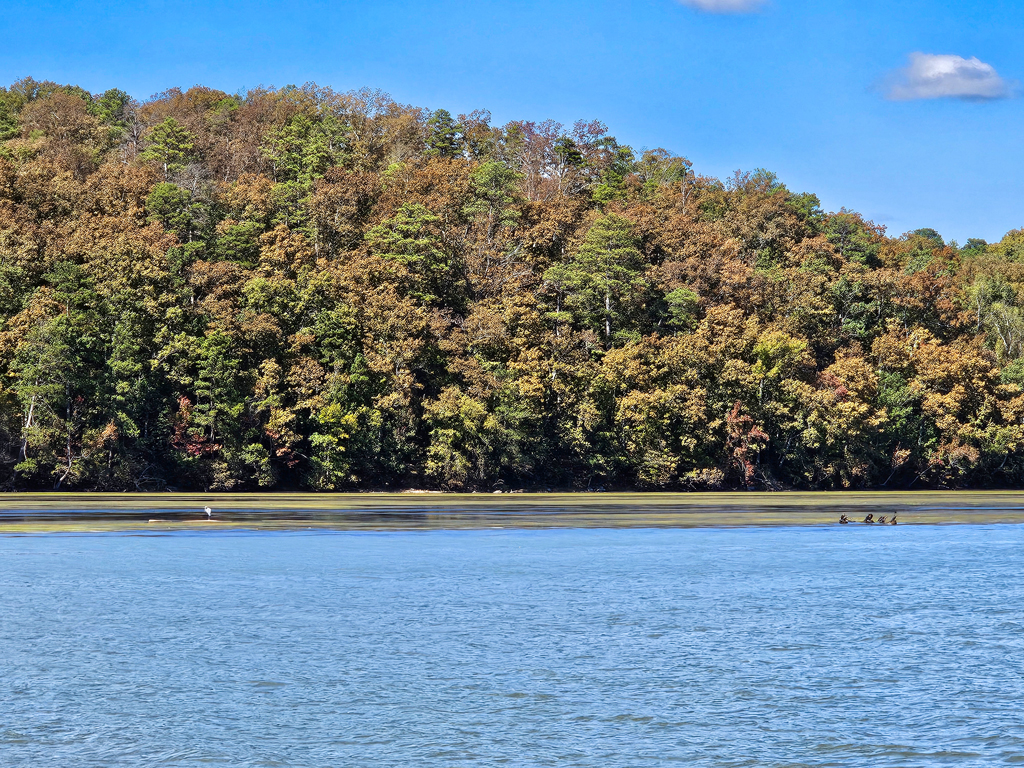
Wildlife in the shallows at the entrance to Goose Pond Marina
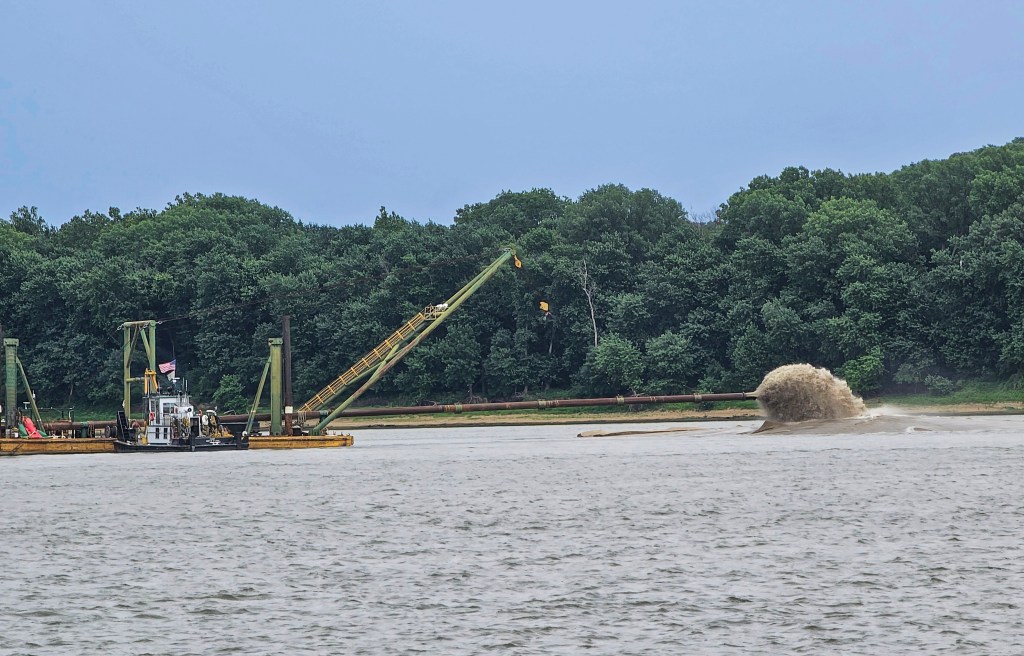
The grass cutter goes out every day to keep the channels clear at Goose Pond

We were invited to join two couples who we had met earlier in Chattanooga for dinner at the onsite restaurant.  It was nice to sit and chat and get to know them.  It did remind us though, that while it can be rewarding, the idea of “buddy boating”, that is, travelling with another boat all the time, does make for a less inclusive experience than enjoying meeting all the diverse boaters if you follow your own agenda.  By making your own plans, you find that you are leapfrogging some of the Loopers you have already met, and continue meeting new friends as you go along.  The food at the restaurant was acceptable, but no need to return.

We spent a quiet day at Goose Pond.  It was a good time to do some laundry and for me to finish and publish the second issue of the blog.
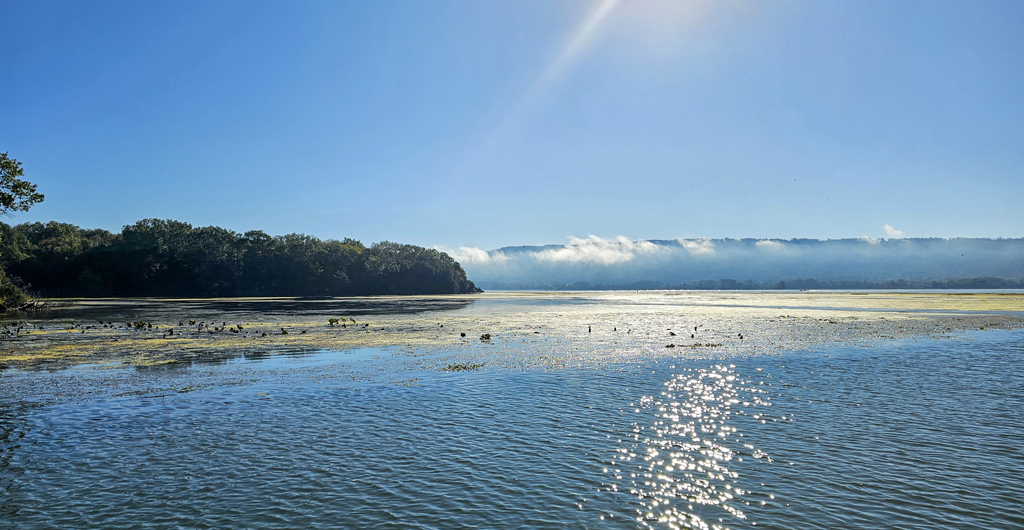
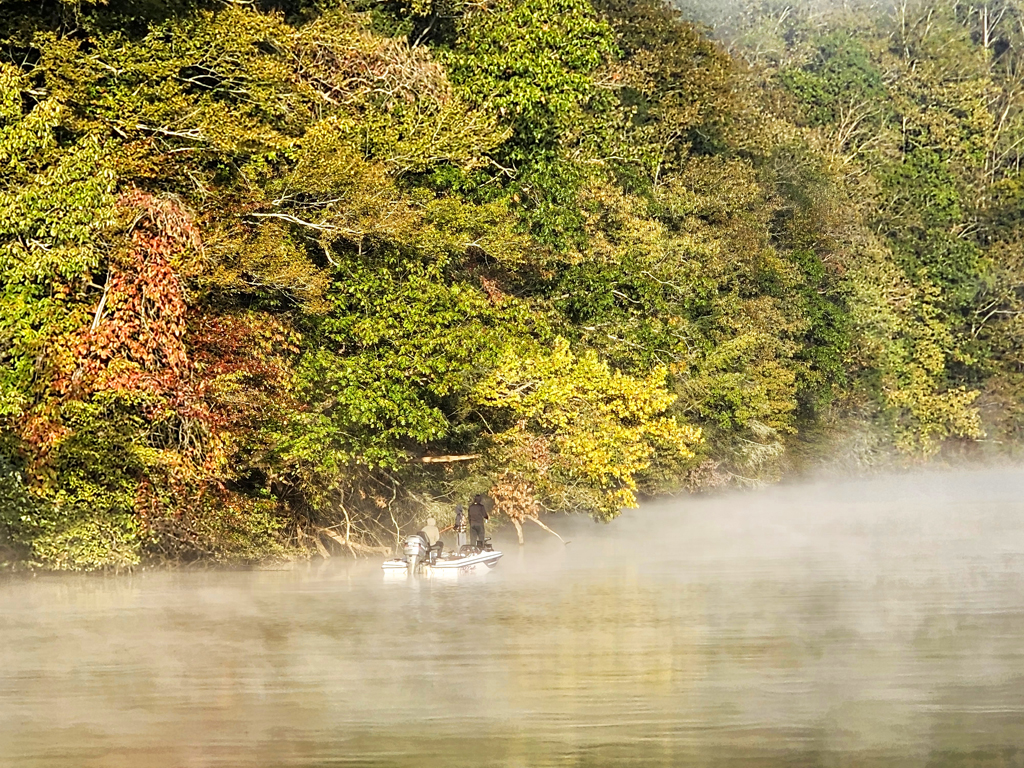
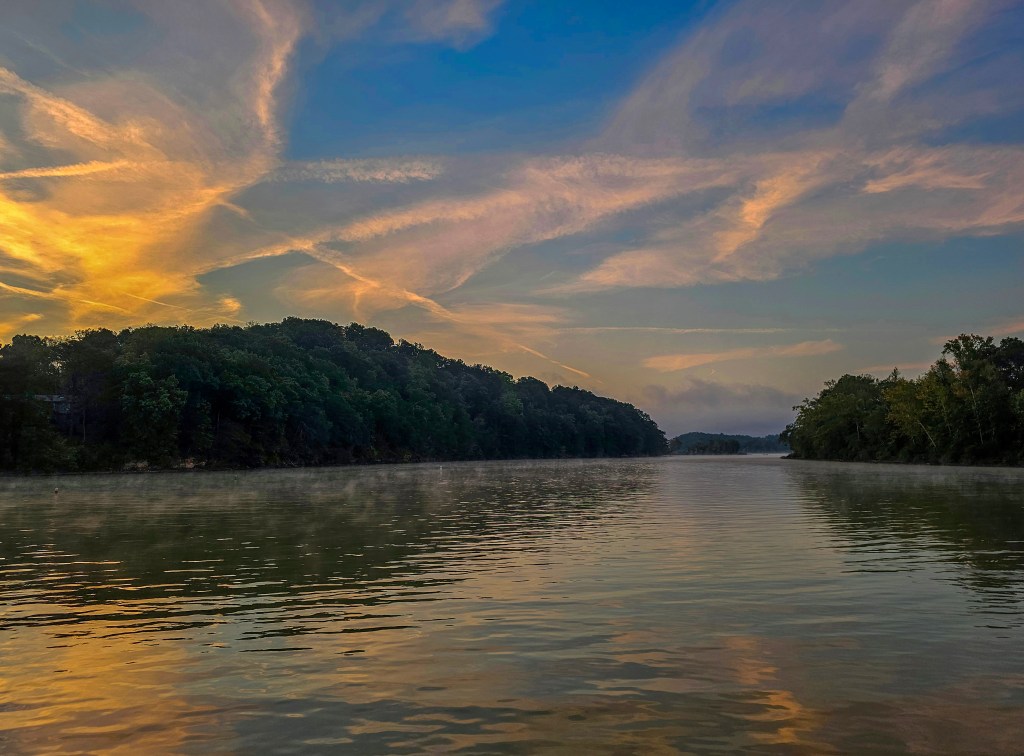
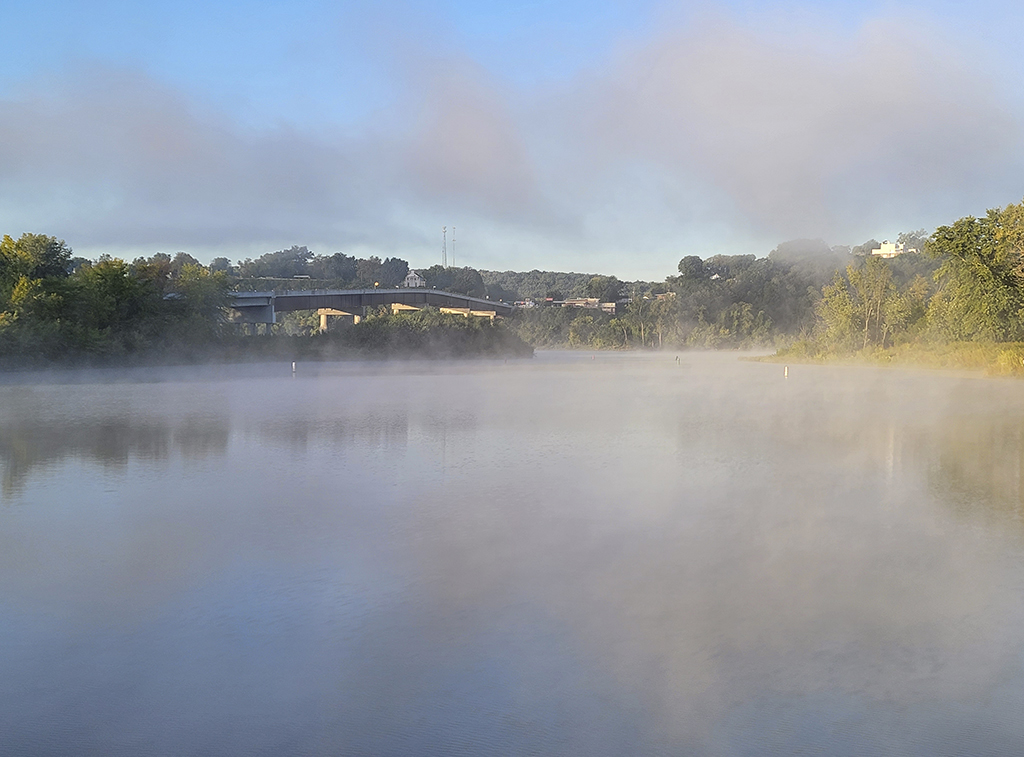
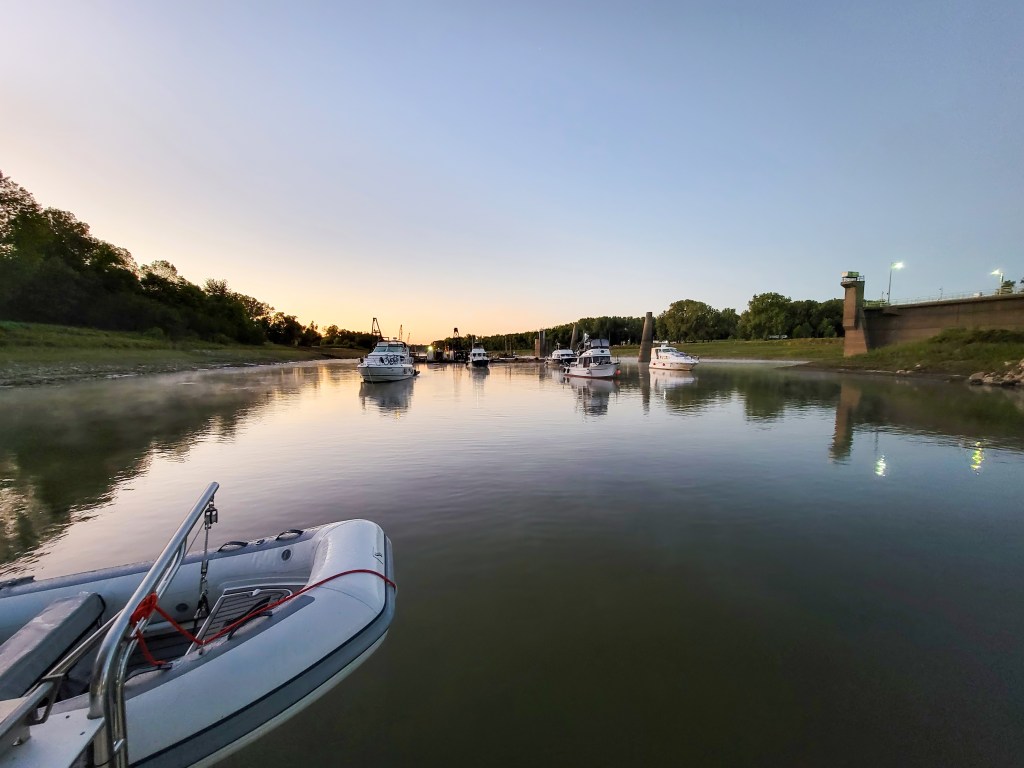
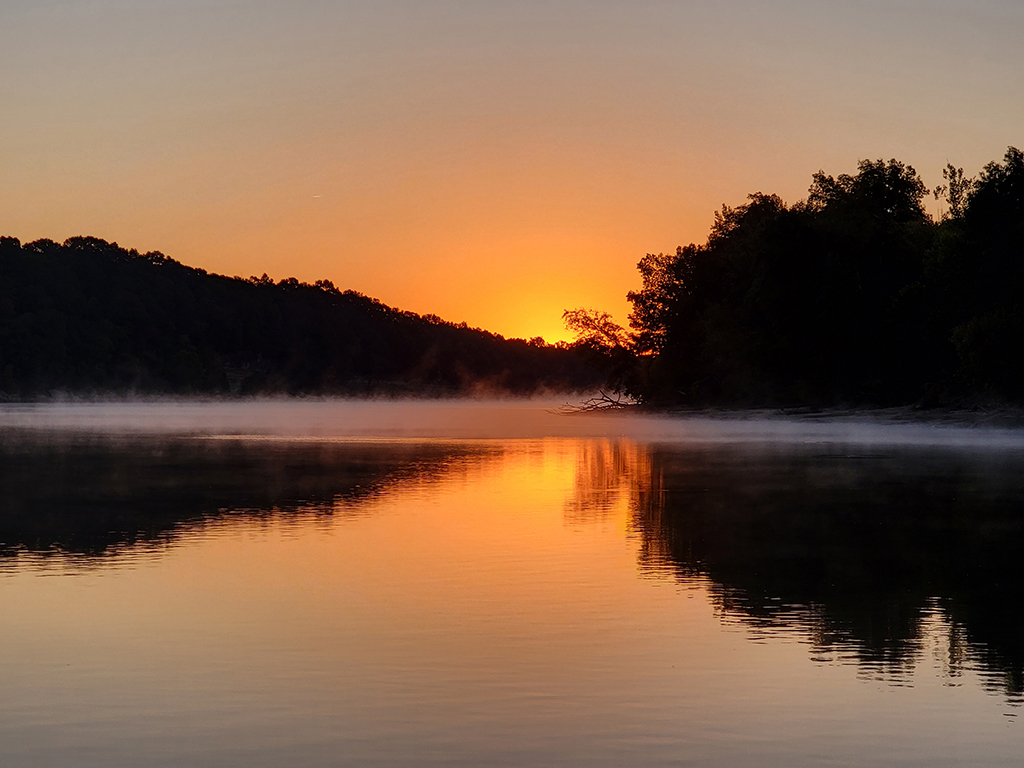
Morning mist at Goose Pond

I tried a new recipe for Chicken Tikka Masala.  It was tasty, but we think that in future the recipe might lend itself to using lamb and doing it in the slow cooker.  We enjoy Indian food, and if I can collect western cooking-style recipes we can put together an Indian meal without using the foil packets of sauces.  One is never entirely sure (and we probably don’t want to know) just how many interesting chemical concoctions are in those packages that keep them “fresh” for literally years.  Better to make the dishes from scratch.
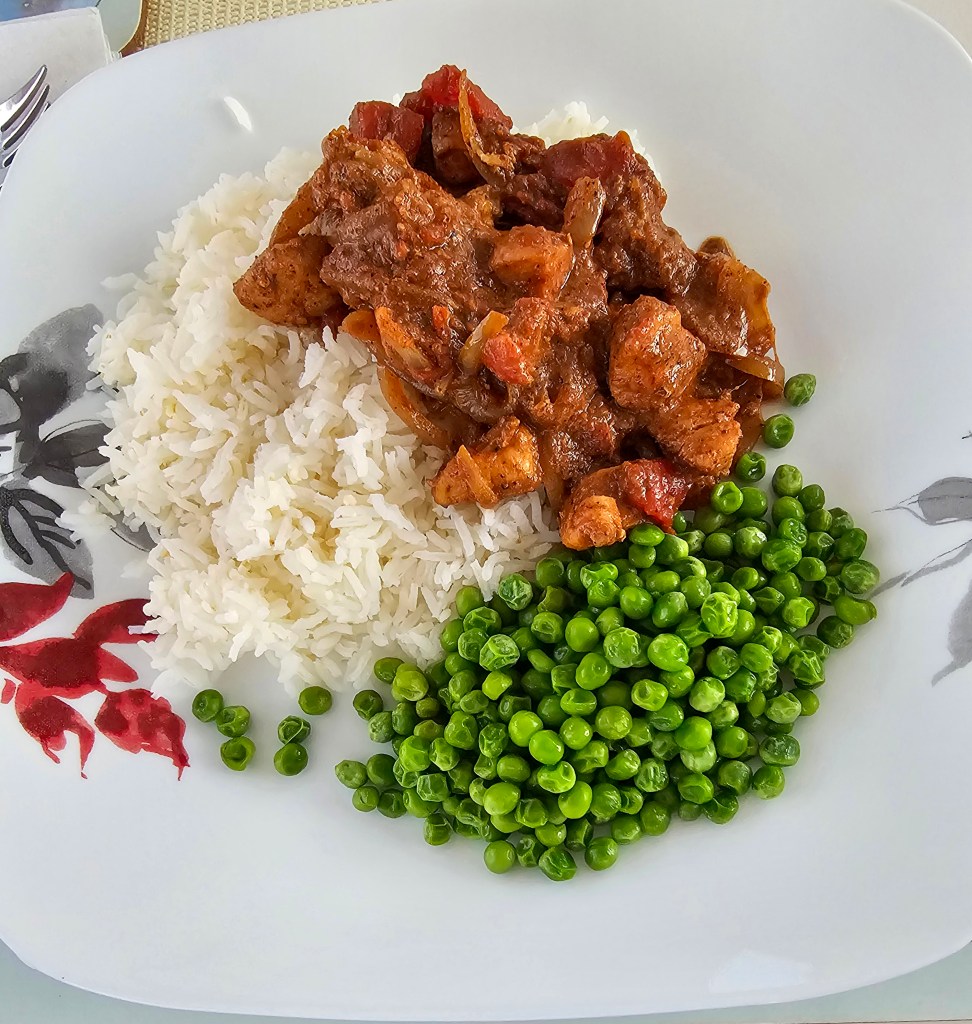
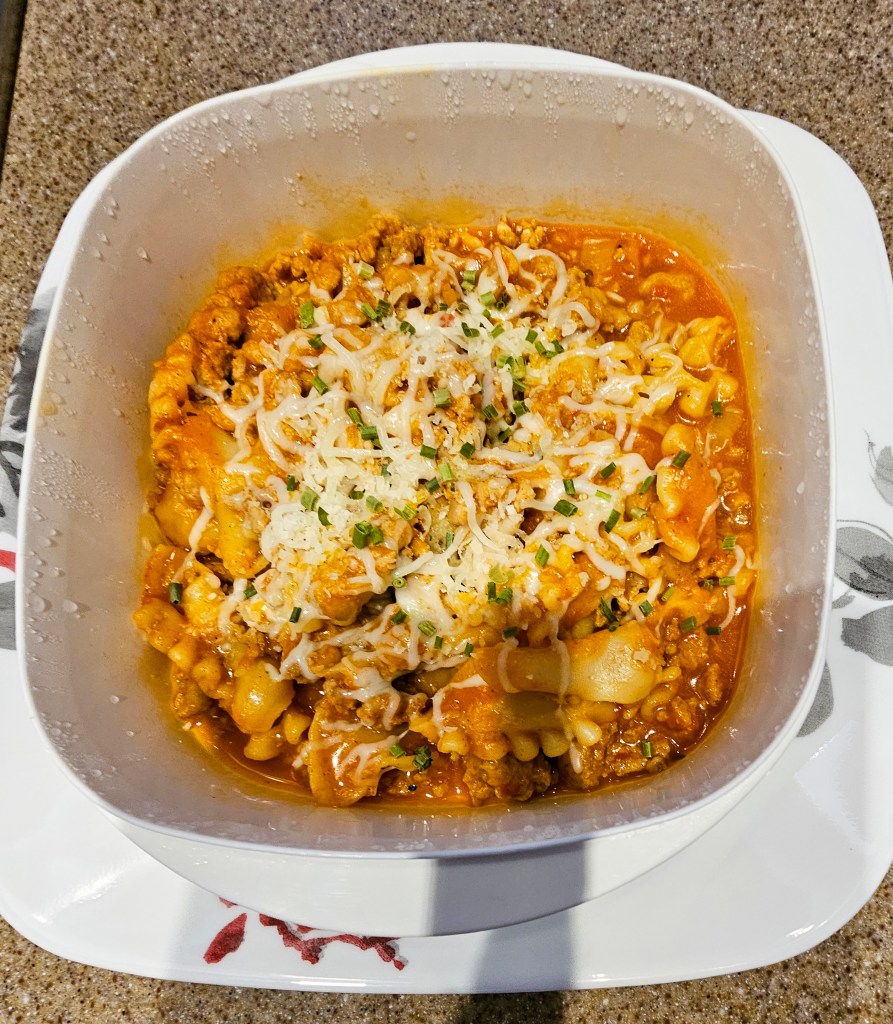
Chicken Tikka Masala

After our relaxing pause at Goose Pond, we headed downriver to Ditto Landing, arriving by early afternoon and happy to be greeted by our friends Cherie and Pete on Spring Fling.  They are segment Loopers like us.  Although Ditto Landing has no practical access on foot or by bike to nearby Huntsville, Cherie and Pete had a rental car and invited us to join them for dinner at a Japanese restaurant.  The food was excellent, and Dick even ordered, and enjoyed, some sushi.  My hibachi shrimp and chicken were also delicious.
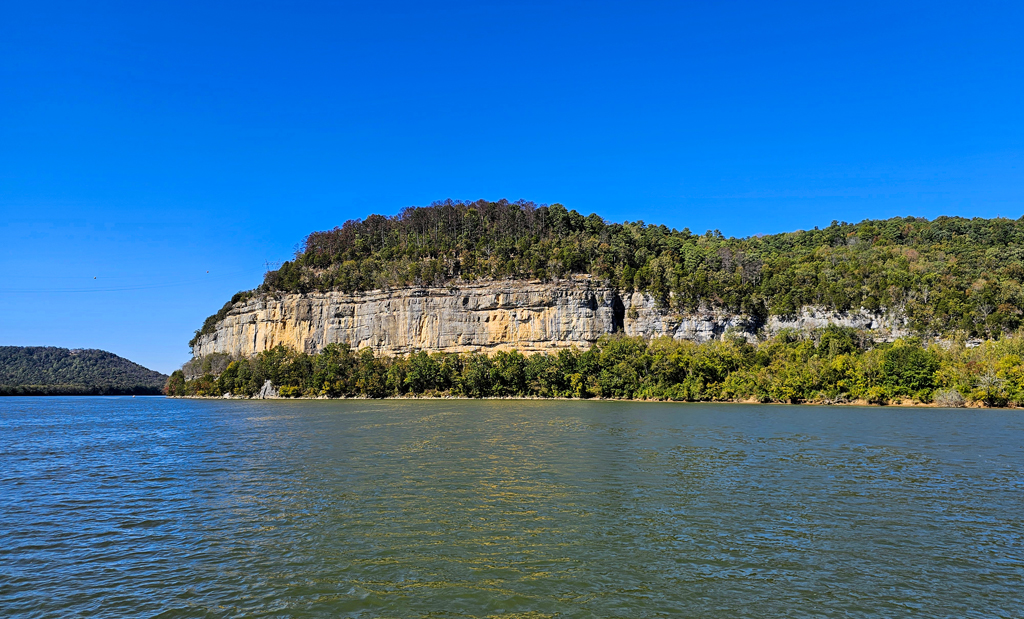
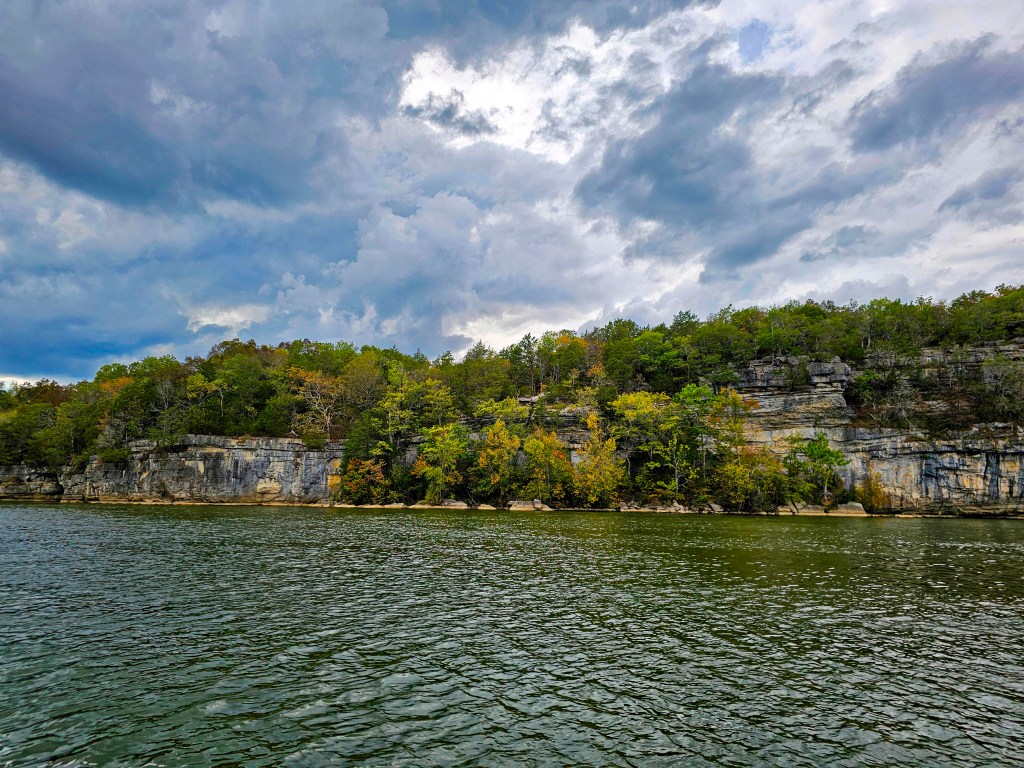
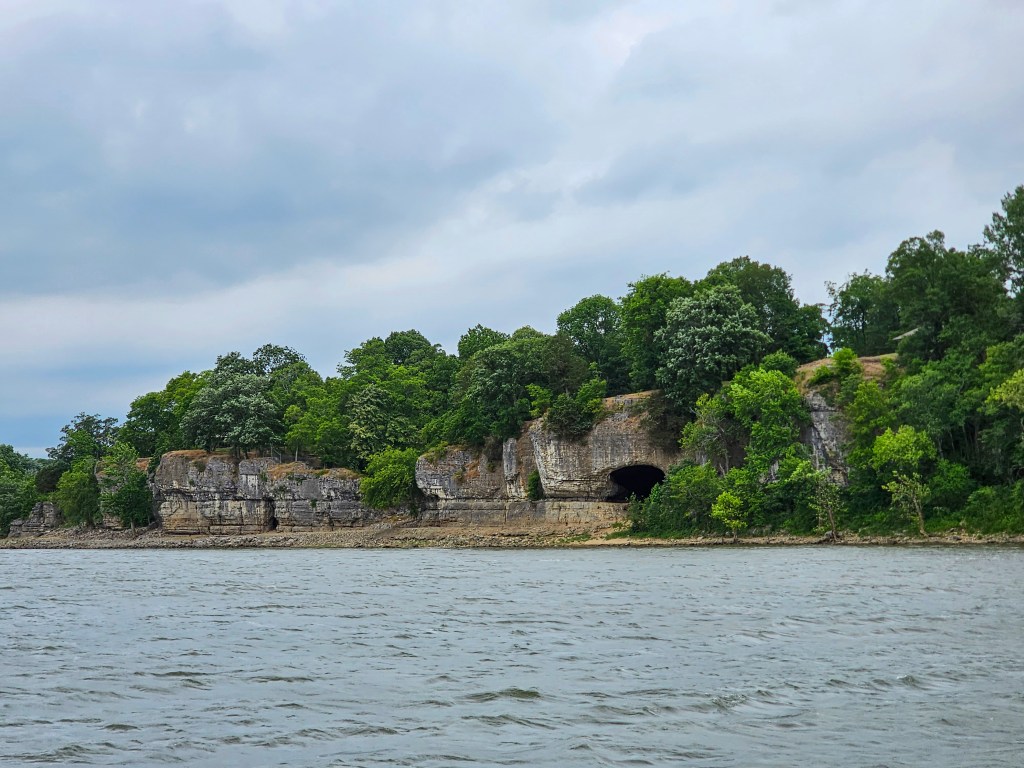
Painted Bluff
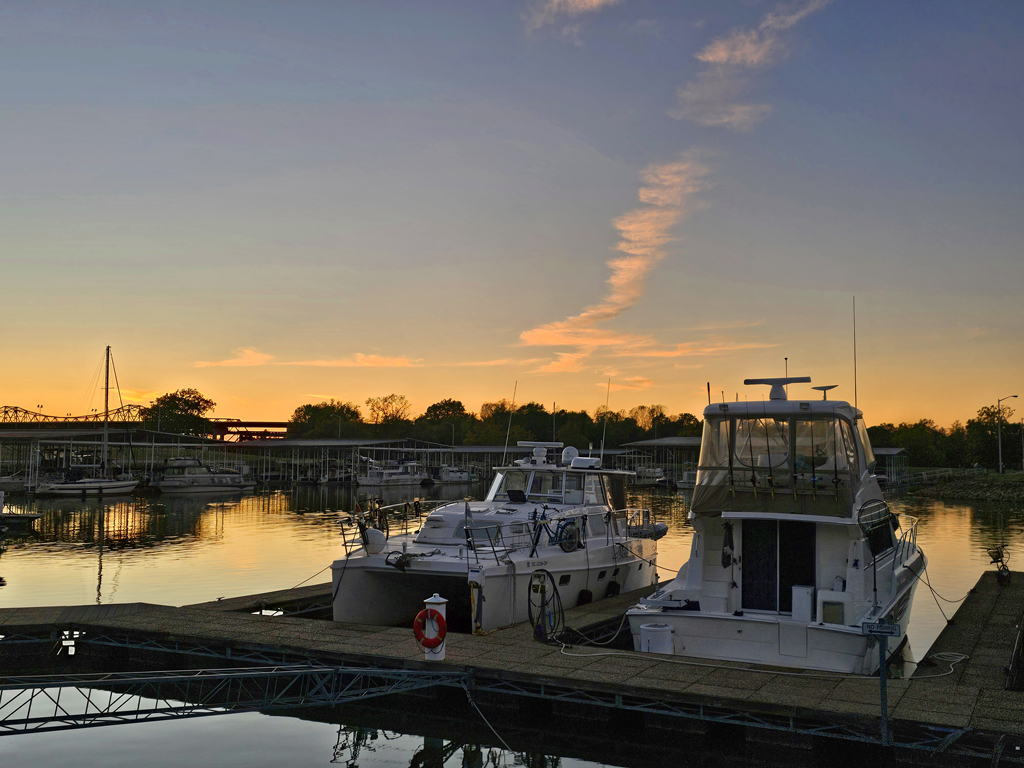
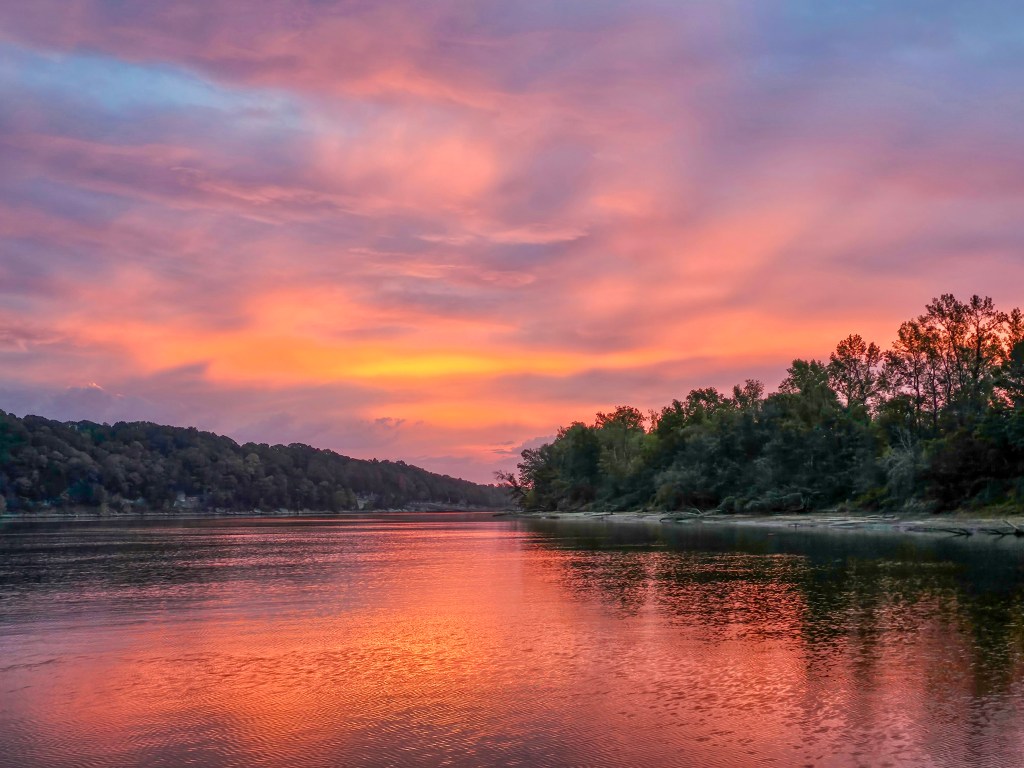
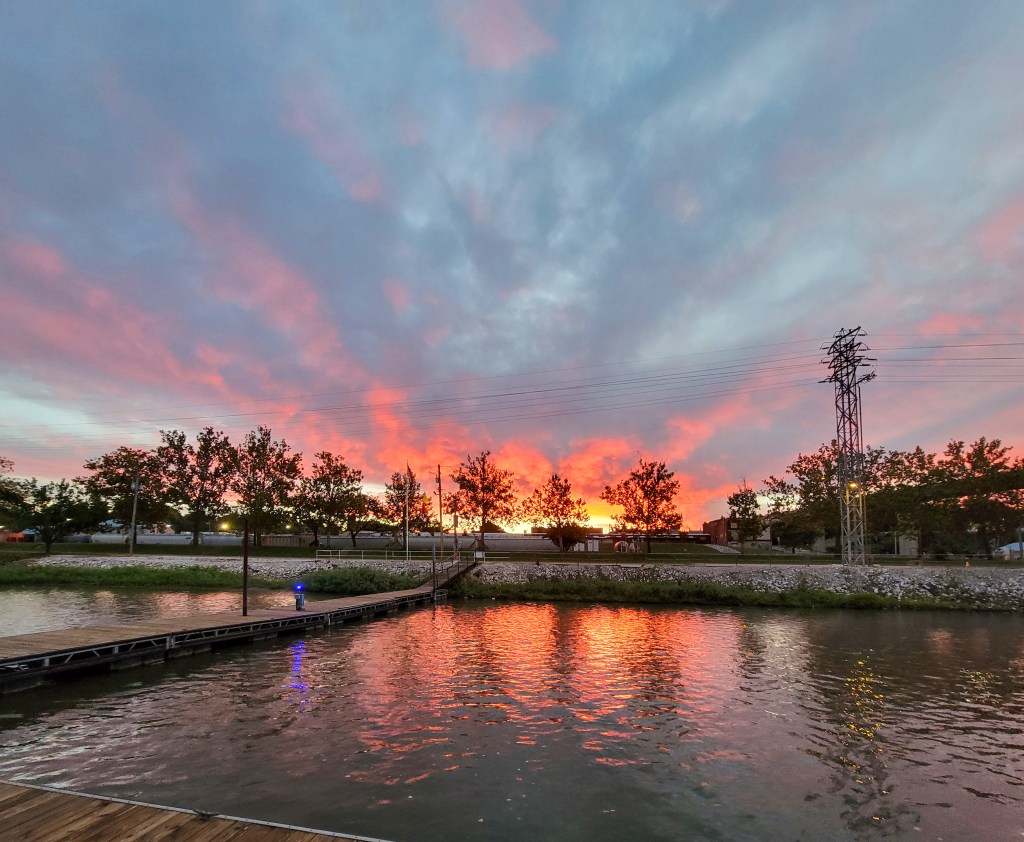
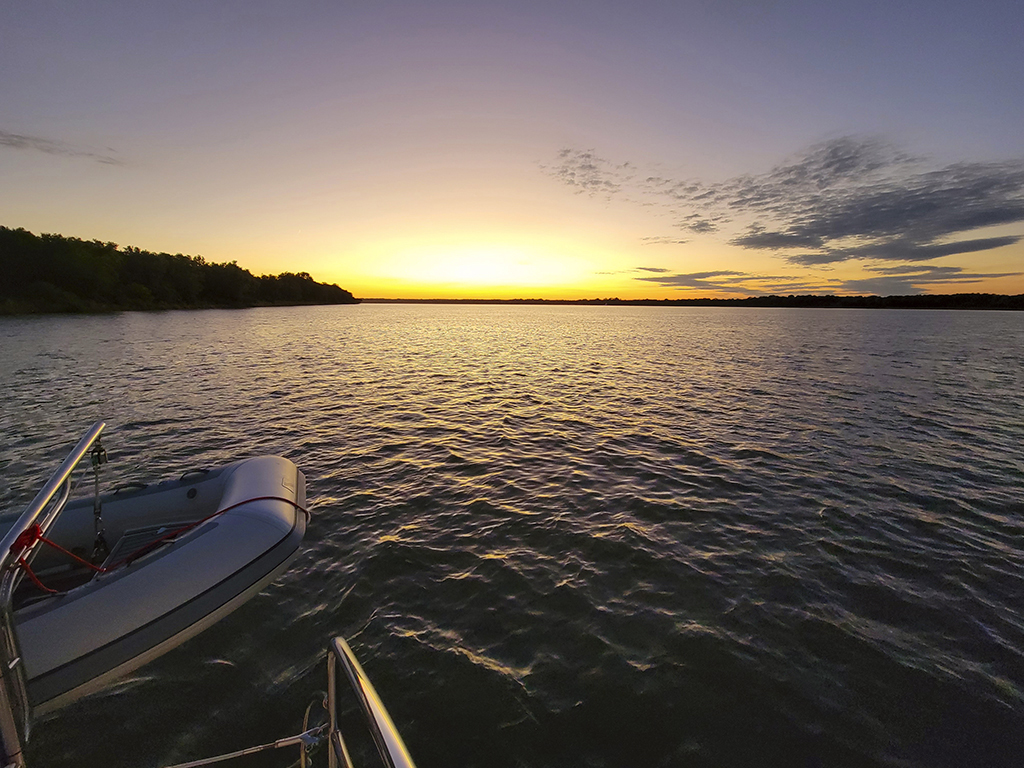
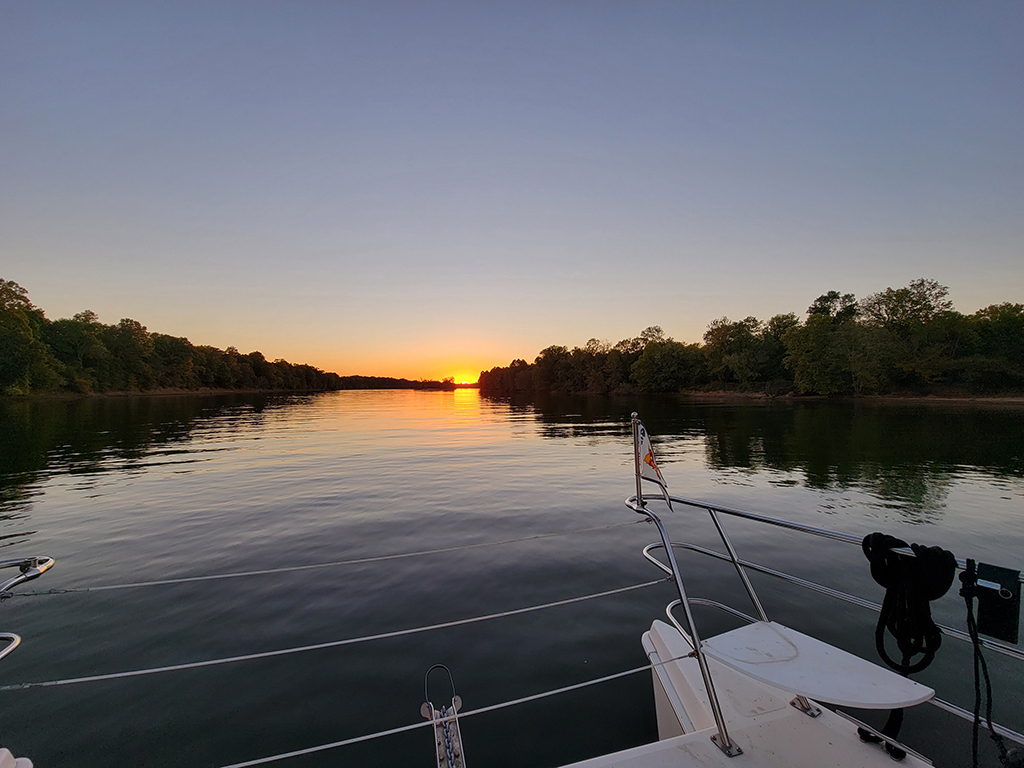
Sunset at Ditto Landing

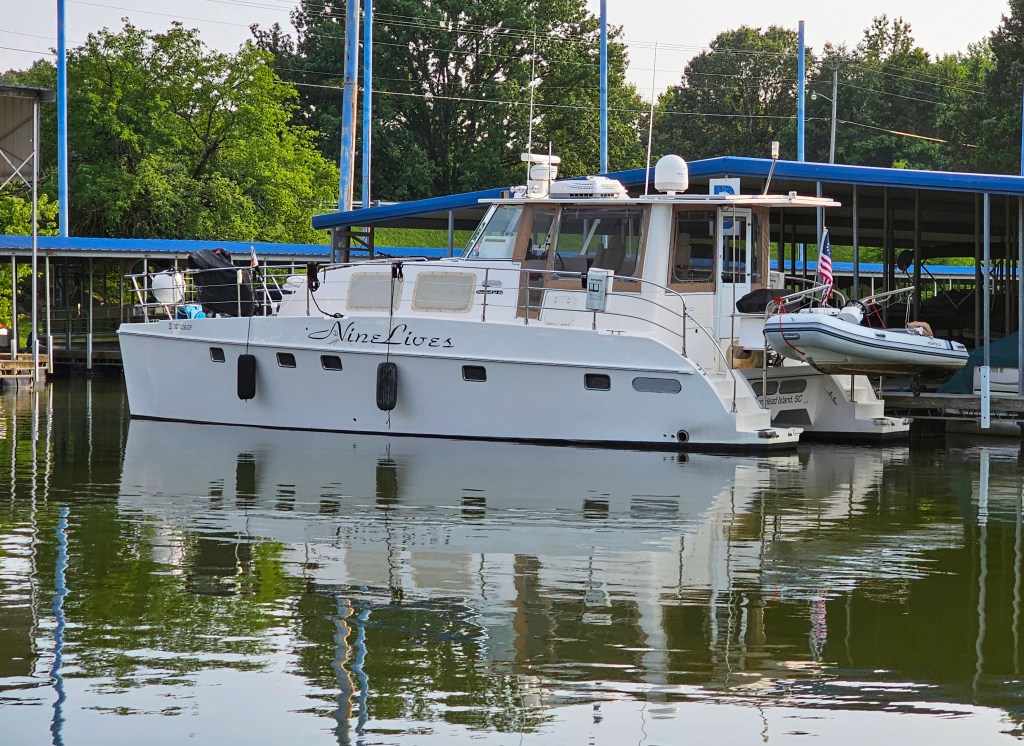
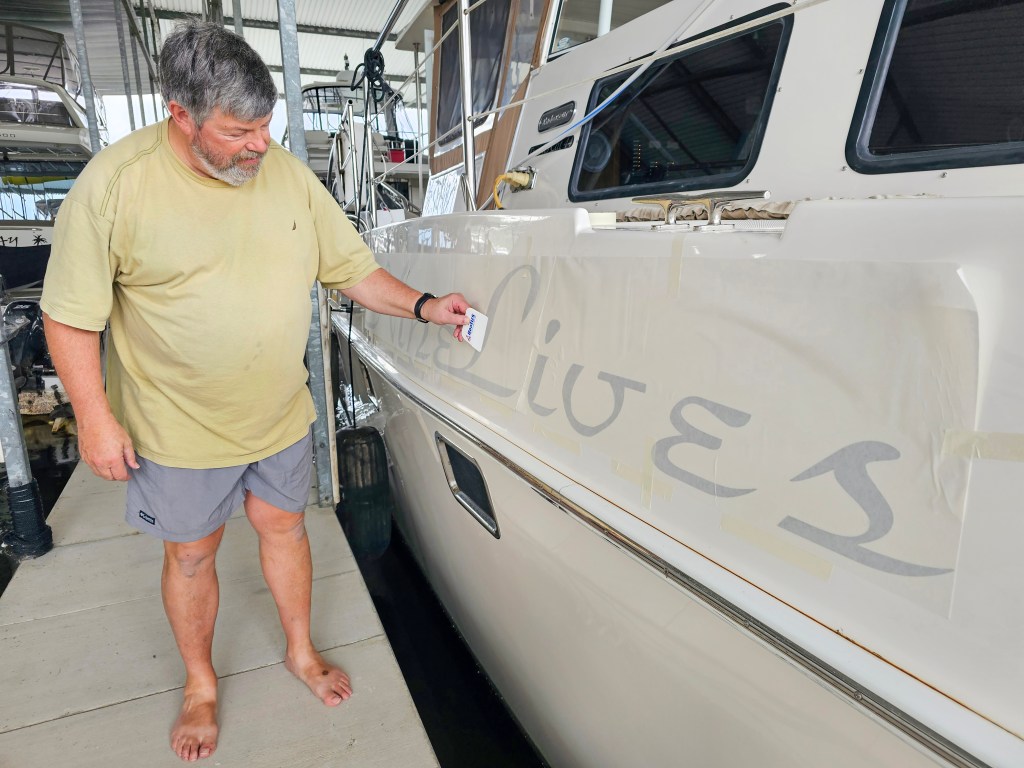
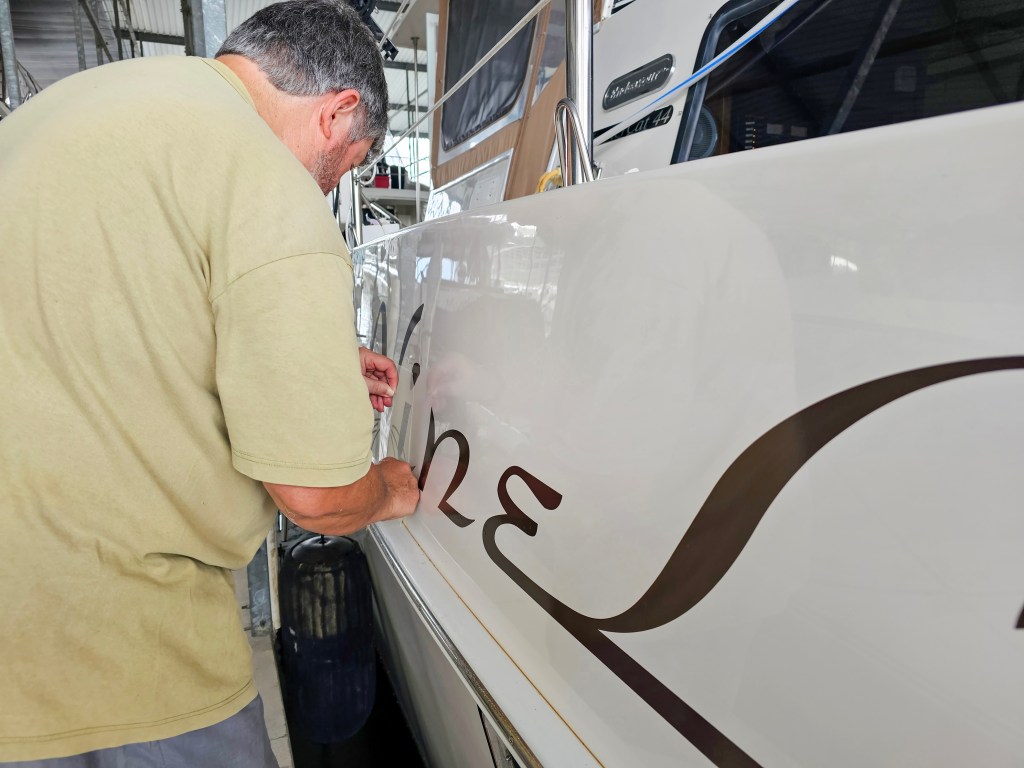
First thing next morning we began the big cleaning job, so Nine Lives would be spic and span for the boat crawl at Rendezvous.  As I scrubbed my bathroom, it was obvious that no cleaning had been done before we got on board at Aqua Yacht.  We haven’t been charged, so I suppose we were not cheated.  Dick took advantage of being in a slip, thus having access to both sides of the hull, to get some of the outside cleaning done.  It was nearly noon before we left, but already Nine Lives was starting to look spiffy.

Cleaning the hull at Ditto Landing

Behind Lehman’s Bluff is Redstone Arsenal.  The facility was established during WWII as a base for chemical manufacturing, and was then used as a research base for rockets and ballistic missiles.  Today it is still the centre for the Army’s missile programs for testing and development, and there are now over 75 tenant agencies, including NASA’s Marshall Space Flight Center.  The government and contractor workforce averages 35,000 to 40,000 personnel daily.

Lehman’s Bluff

We passed under the I-65 Bridge.  This Interstate connects Chicago, Indianapolis, Louisville, Nashville, Birmingham, Montgomery, and Mobile.  It is quite something to think that we have visited or will soon stop at almost all of those cities as we go through this western half of our Great Loop.
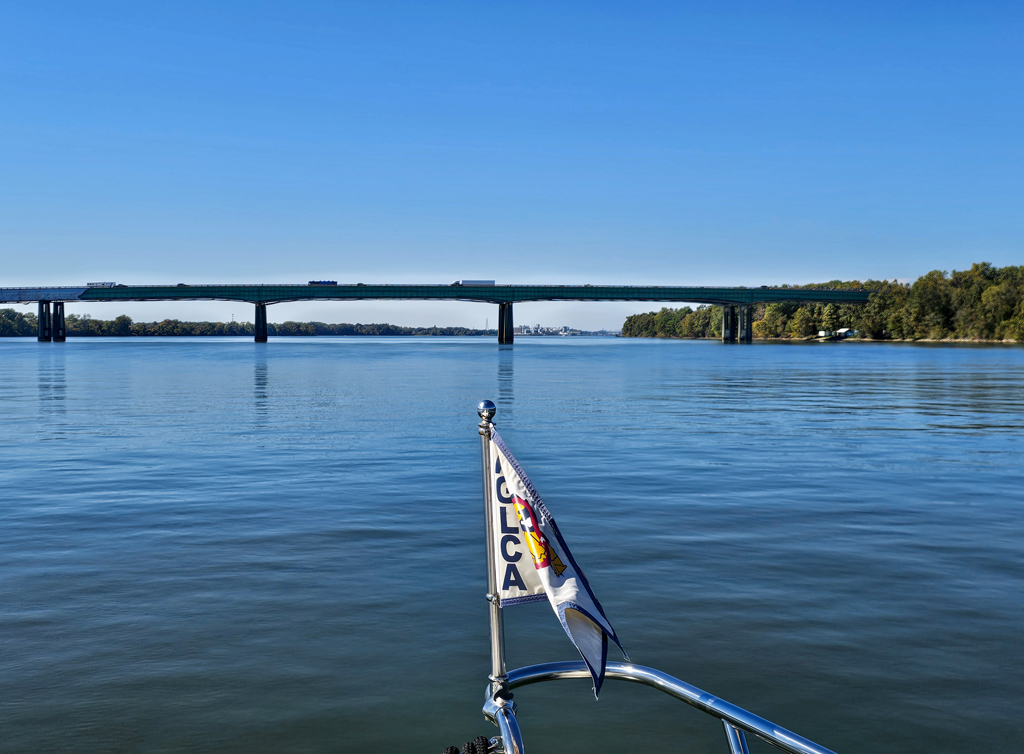
I-65 Bridge over the Tennessee River

Construction of the bridge was halted for a few months so that nesting birds in that part of the Wheeler National Wildlife Reserve would not be disturbed.  The NWR was created in 1938, after TWA (Tennessee Valley Authority) flooded the Tennessee River and created Wheeler Lake.  Backwaters were pumped dry in spring, thus eliminating mosquitoes.  When the water was returned in the fall, migratory birds were attracted to the abundant grasses and seed-bearing plants that had grown up.  Thousands of Sand Hill Cranes now overwinter in the refuge, and a few of the highly endangered Whooping Cranes have been seen in the last ten years.  We were too far from the grasslands to see cranes, but we were happy to see a Bald Eagle high in a tree.
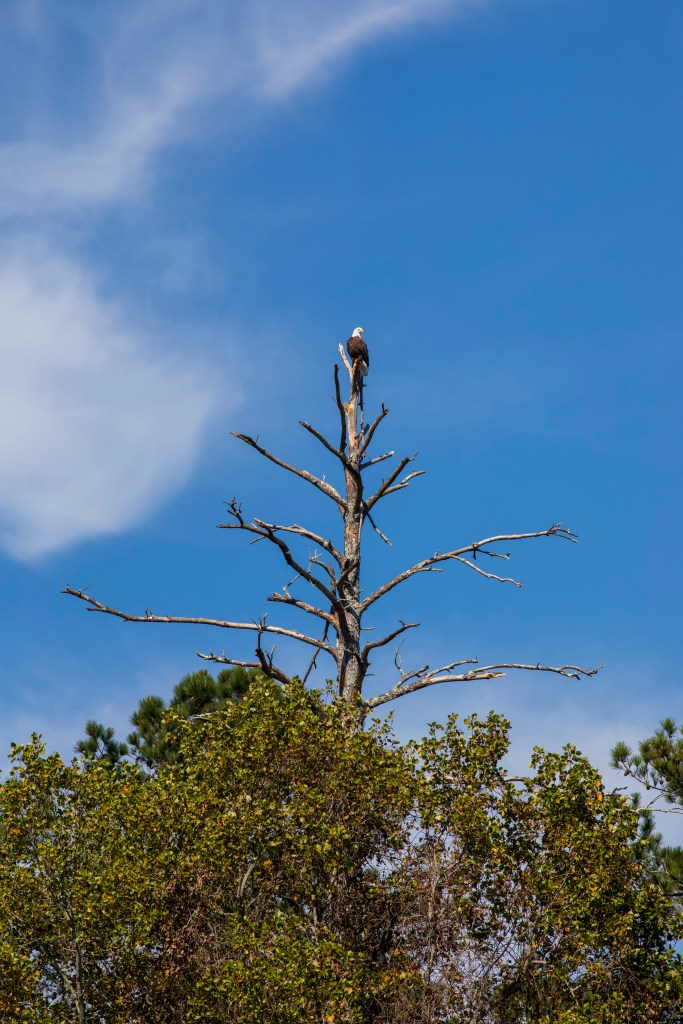
Bald Eagle in Wheeler National Wildlife Refuge
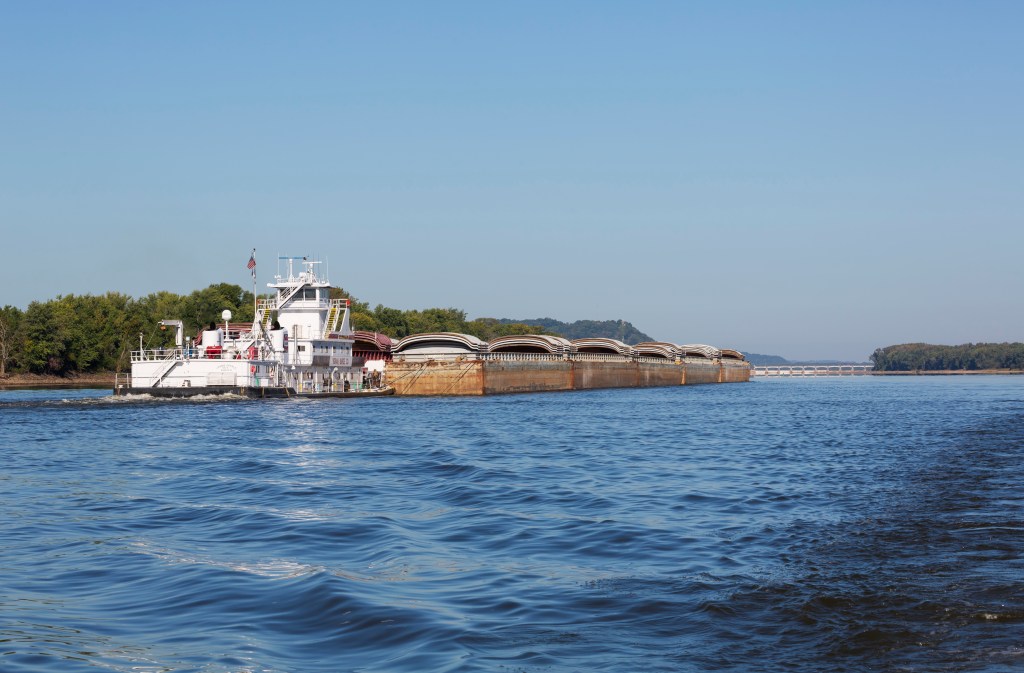
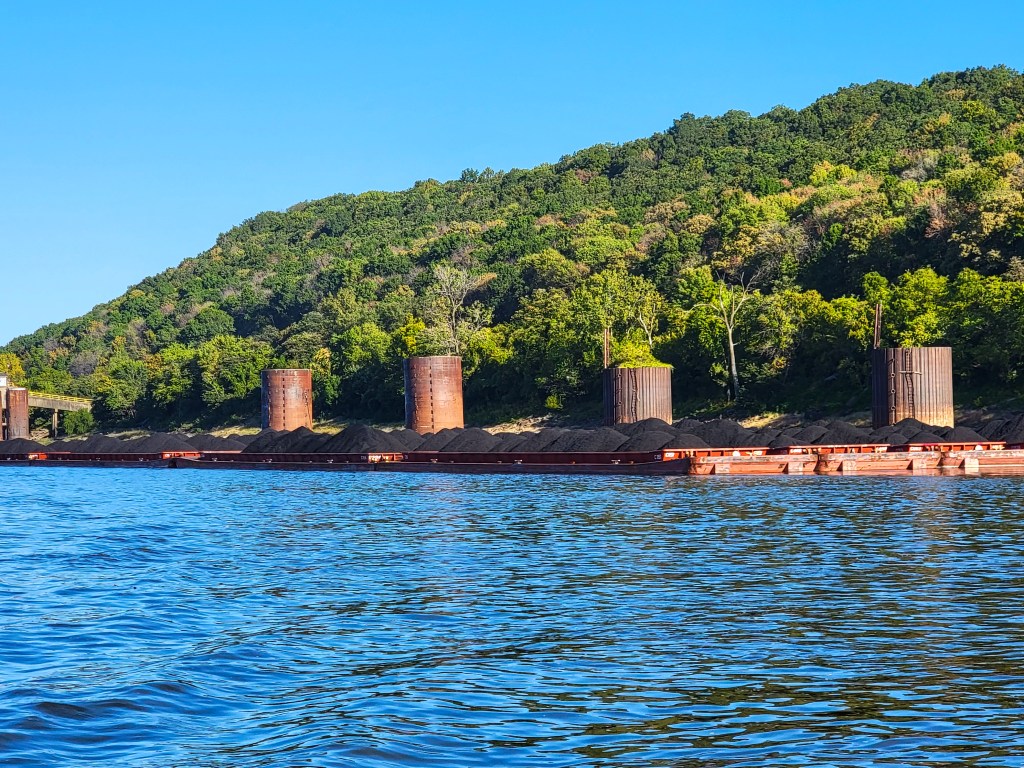
A tow with a portable ferry platform waiting at the bank for a large truck
Guntersville Lake

We were tied up in the marina at Decatur by 2:30. It is a strange marina, mainly boat storage.  Dick spoke to the owner in mid-October, and he made a reservation, but would not take a credit card number.  There is nobody in the office on weekends, and the on-site restaurant is currently closed for renovations, so there was no way to pay.  We had a free dock with power and water in a very calm location.

We got down to serious boat cleaning.  More than one adult beverage was required when we were finished for the day!  We both hate cleaning.  My frustration was that arrangements had been made for the major cleaning, inside and out, to have been done before we got on board.  If it had been done, our job would have been only a touch-up.  Instead, we were dealing with a year’s worth of accumulated grime from the storage period.

There was a pretty sunset over the industrial skyline of Decatur.  We watched a fellow on the dock catch a large fish for his dinner, underneath the “No Fishing from the Dock” sign.
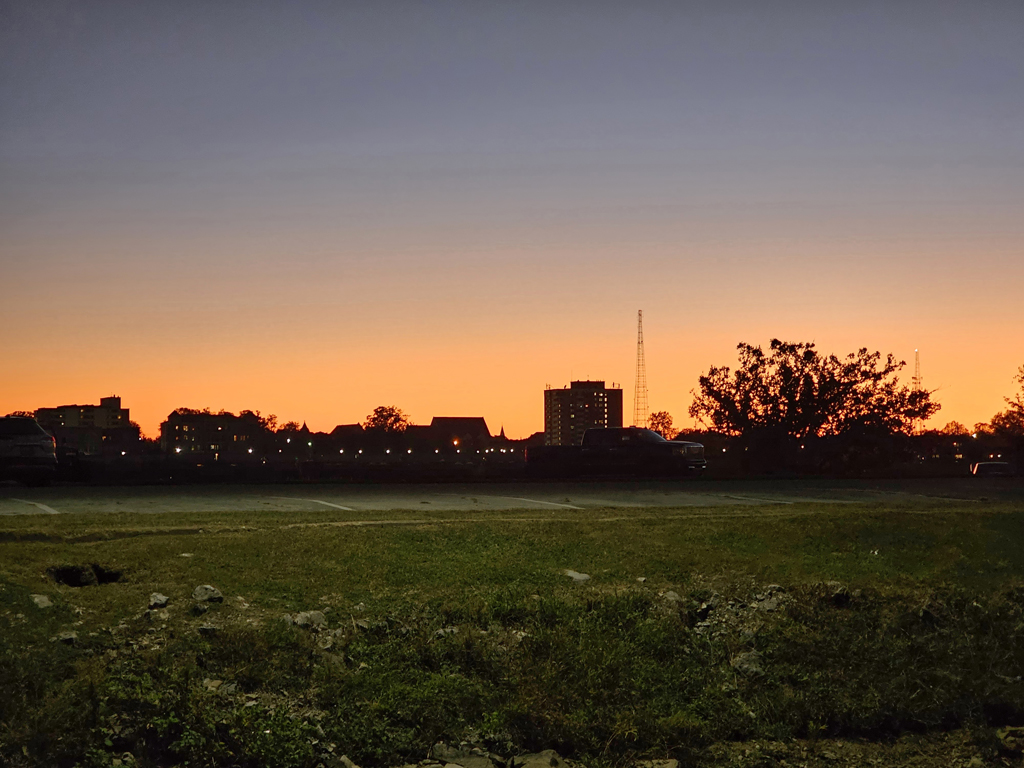
Decatur sunset

More cleaning in the morning before we set off. Nine Lives sparkled!

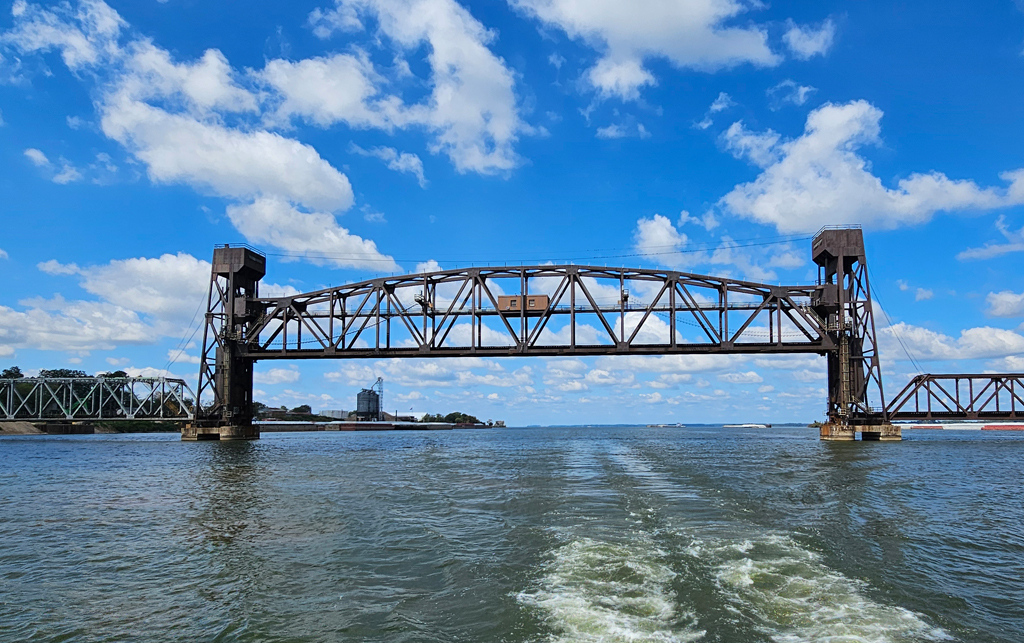
We waited 10 minutes for the Decatur Railway Bridge, as a long train of Amazon containers passed over.
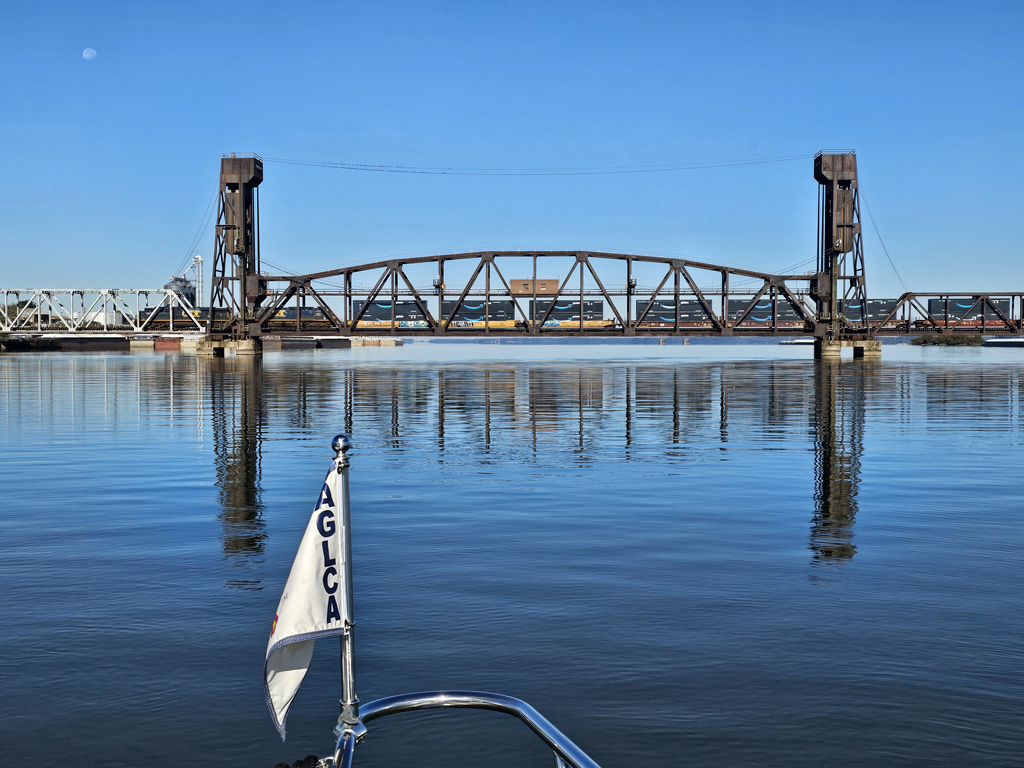
Decatur Railway Bridge with Amazon containers on a long freight train

We arrived at Joe Wheeler State Park by mid-afternoon.  After a pump out that we suspected (rightly) was inadequate, we went over to our assigned slip.  A fishing boat was diddling around exactly where we needed to be, so Dick sounded the horn.  Our horn is LOUD.  No effect.  Horn again, in fact twice more and me making “get out of the way” gestures before they finally figured it out.  As a result, we had a great deal of help with docking, having announced our imminent arrival so loudly.

After some final touches to the cleaning, I put together a spread for docktails.  We had invited up to 12, but between regrets, no-shows, and a couple we already knew were unlikely to be able to make it, we were glad that we also invited our dock neighbours, giving us 7 guests.  More would not have fitted into the cockpit, so just as well.

The first day of the Rendezvous was quite busy, mainly because in the afternoon, over the two-hour period of the boat crawl, we welcomed at least 50 people onto Nine Lives to look around.  Some visitors were still in the boat-shopping stage.  Some had their boat and were interested in storage, and what adaptations they might be able to make on their boats.  Many people were simply curious, having never been on a catamaran before, and they were amazed at how much usable space there is on board.
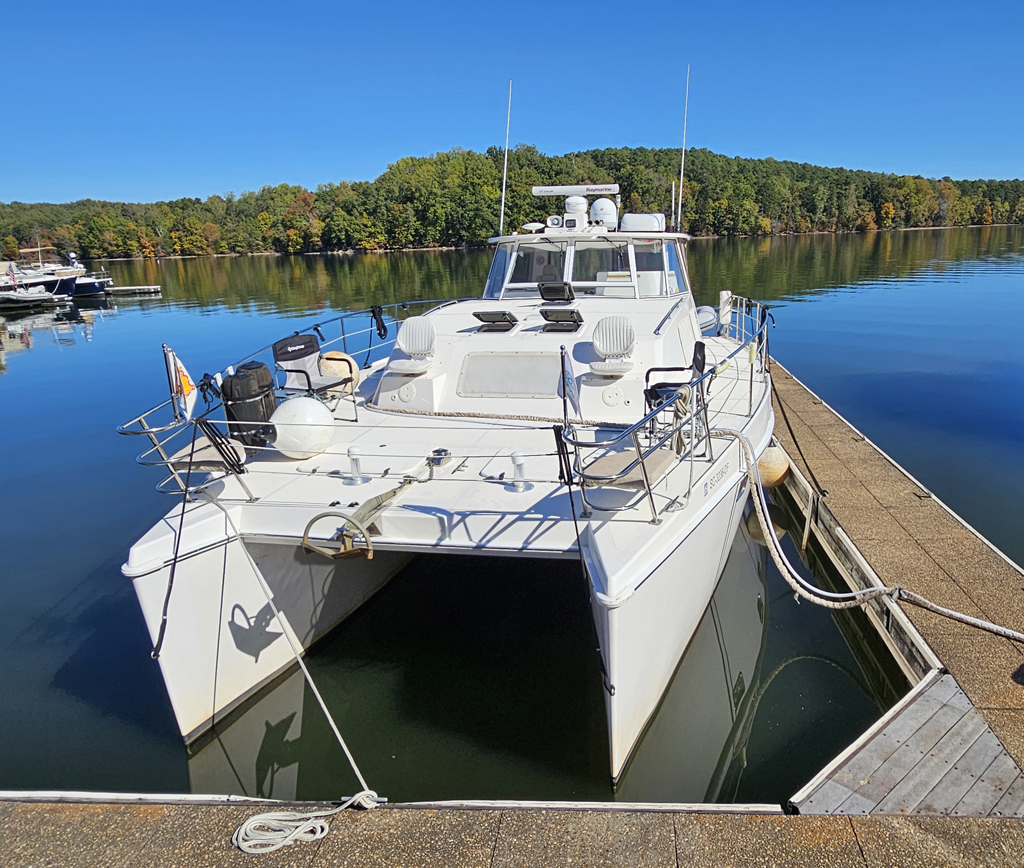
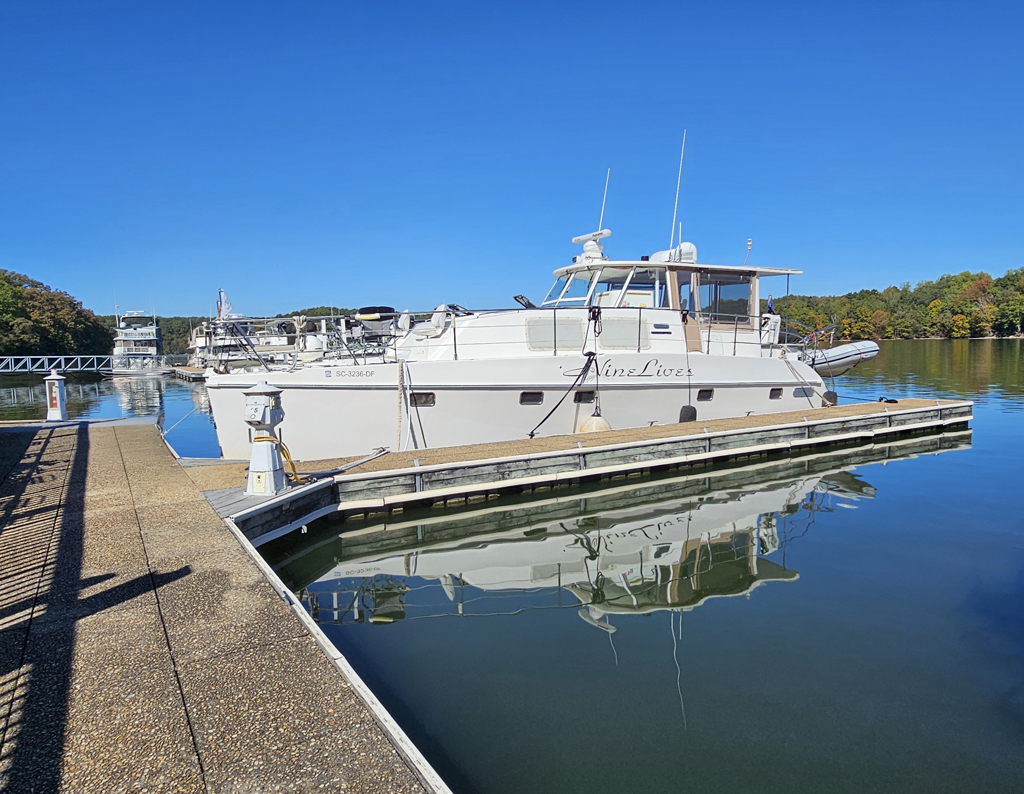
Nine Lives ready for visitors
Nine Lives at the dock at Joe Wheeler
Even the cockpit was sparkling clean

That evening, we enjoyed sitting with a table of planners and a couple who were just two weeks into their Loop for dinner.  After the meal, we, and a few others, were presented with nice engraved wooden cheeseboards as a thank you for stepping in at the last moment to make presentations during the Rendezvous.
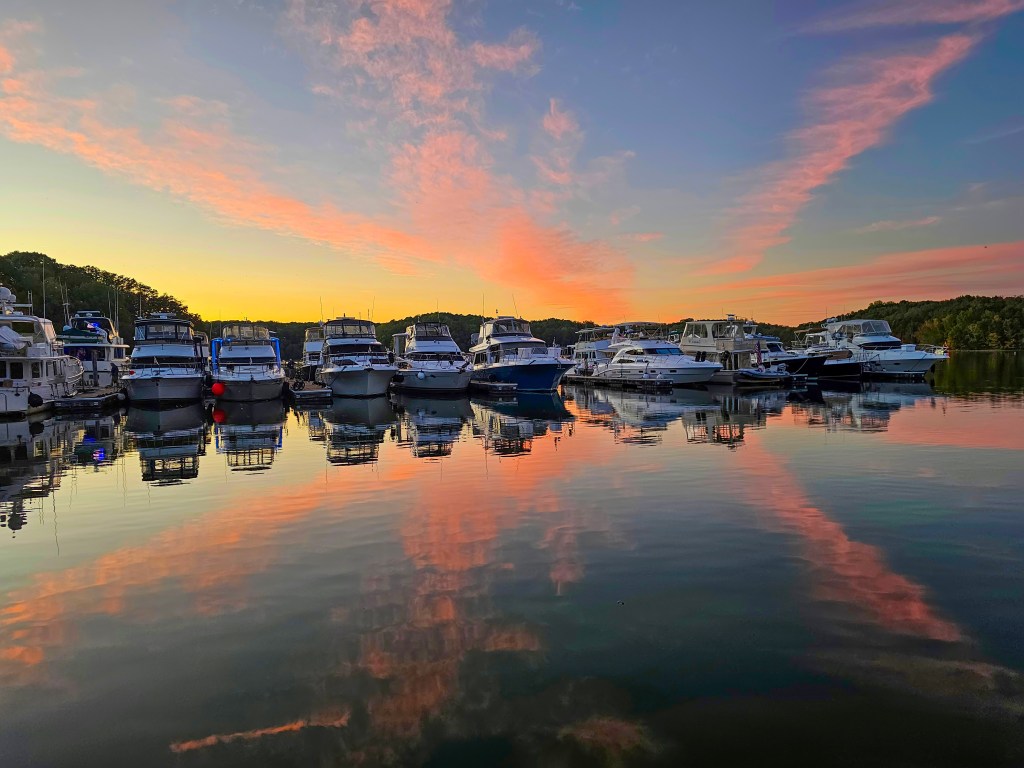
Looper boats at sunset at Joe Wheeler

The next day began the briefings part of the gathering.  We attended the presentations, advice and suggestions for our upcoming route from folks who have done the next part of the Loop multiple times.  This included preparation and advice for the Gulf Crossing, a 172-mile overnight crossing, well offshore. We will be doing this in February.

We had 3 busy days of briefings, socializing, and then the 3-hour boat crawl each afternoon.  This is an opportunity for Loopers, especially planners, to get onto all sorts of different boats, and see how they really look when Looping (as opposed to being all gussied up and decluttered at a boat show).  It was tiring.  Dick stayed up top and talked engines and boat handling, while I was below making sure the visitors saw everything, and demonstrating how we handle storage.

The final event of the gathering for us was our presentation on locking.  Dick ran over the time slot somewhat, but it was well received.  We had not expected that there would be so many people in the audience.  At the beginning, Dick asked how many had never been through a lock.  A surprising 100 out of about 150 in the audience raised their hands!  Dick did most of the presentation, while I took care of the humour with occasional interjections and comments.

The group photo at AGLCA Fall Rendezvous

Following the wrap-up lunch, there were various round-table discussions, and demonstrations, but we were both feeling quite tired and talked out, so we went back to Nine Lives and spent a relaxing afternoon and evening.
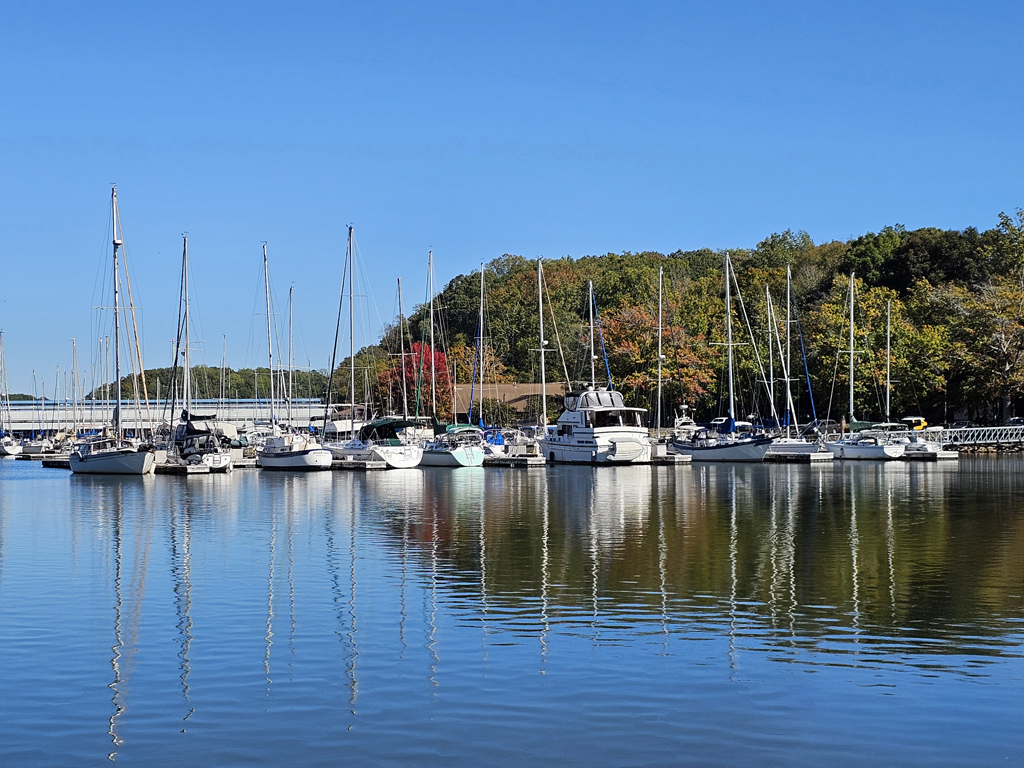
Docked sailboats at Joe Wheeler
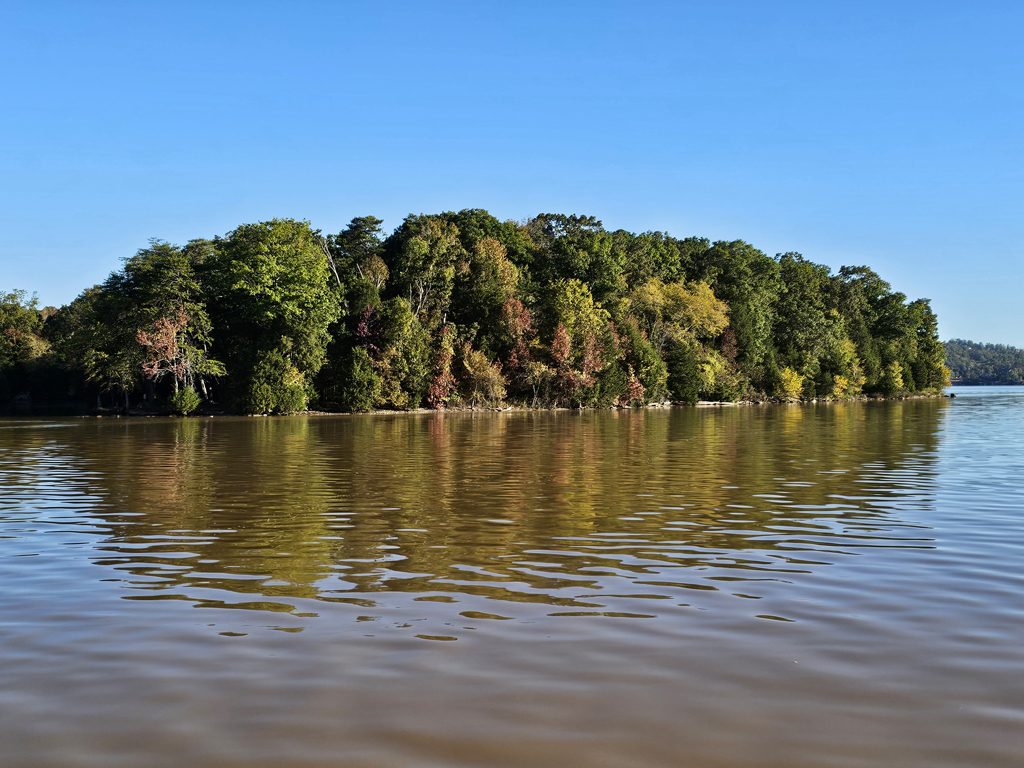
Autumn colors at Joe Wheeler State Park

Shortly after we came through a few weeks ago, The Wilson Lock had to shut down for at least the next 3 months while repairs are made to the doors.  There is a much older (built 1925) auxiliary lock, that is actually a 2-chamber stair.  A reminder for new readers and those who have forgotten, typical commercial traffic on the Inland Waterways is handled by tugboats, called tows, pushing barges that are lashed together.  The old lock only has space for a single barge, that must be pushed into the chamber, then pulled into the next chamber, and finally pulled out at the top (or bottom as the case may be) and eventually lashed back into the rest of the barge train. It now takes between 15 and 24 hours for a single tow with its typical 15 barges to pass through.  On the day we left Joe Wheeler, there were 21 tows with their barges in the queue.  This is because each barge requires an hour to transit the 2 chambers, plus additional time for maneuvering the barges, and uncoupling and re-coupling them after the transit.

The lock infrastructure here in USA is failing.  At least 80% of the locks are 50 years past their design life.  The locks are maintained by the Army Corps of Engineers, which is chronically underfunded.  To put the importance of the canal and waterway infrastructure into context, here are some facts and figures.  One 15-barge tow carries the equivalent of 214 rail cars + locomotives, or 1050 large semi-tractor-trailers (articulated lorries for our English friends).  With respect to the environment, barges have the smallest carbon footprint.  In terms of tons of CO2 per million ton-miles, a barge is 15.1, rail is 21.6, and trucks are a whopping 140.7.  Barges move cargo 675 ton-miles per gallon of fuel.  A rail car is 30% less efficient, and a truck is 78% less efficient.  Speaking just of the Wilson lock, it is the gateway to 531 miles of upstream navigable waterways.  12,000,000 tons of commodities valued at roughly $4 billion pass through annually.  Just in case you think that the areas of Tennessee and Alabama that are served by this waterway and specifically Wilson Lock are of little national importance, the barges serve 3 nuclear plants, United Launch Alliance, Marshall Space Flight Center, and Oakridge National Laboratory.  Commercial entities include a number of large quarries.  The stone that is produced in those quarries may be used for cement.  Cement is an important building material for houses, and just about everything else that humans apparently need to survive.  The Port cities served include Decatur, Huntsville, Guntersville, Chattanooga, and Knoxville, all of which are industrial centres.

Another way of looking at it, a single tow (with barges) costs about $500 per hour, and most of the tows have waited about 7 days since the breakdown, about 150 hours.  Then factor in the factories and industries that are not getting chemicals, materials or shipping their output, and you have a serious economic situation.  Some of these plants must shut down and their workers are not paid.  How many of our readers have any idea how much of the economy of the area (and the country) is affected by the temporary closure of even one lock?  I am guessing none (except for those who have just now waded through my facts and figures above!)

The boats that were part of the Rendezvous came up in flotillas of a maximum of 5 boats per day, helpfully staged and organized at Florence Harbor, just a few miles below Wilson Lock, by the harbormaster.  Of course, everyone wanted to leave immediately after the Rendezvous!  Some planned to go upstream to Knoxville, but many, including us, hoped to go downstream through Wilson.  As often happens, one of the Loopers stepped up and offered to organize flotillas, so that the appropriate sized group would all arrive at the right place, on time, and only one person would be the spokesperson for the group with the lockmaster.  We were able to sign up for the second group on the Friday, and the Wilson lockmaster promised to let 2 groups through each day, so we were hopeful.  Somebody must have spoken to the formerly cranky and unhelpful lockkeeper at Wheeler Lock (the one between Joe Wheeler State Park and Wilson Lock), because he agreed to let all 9 boats in the Friday flotillas through at once.

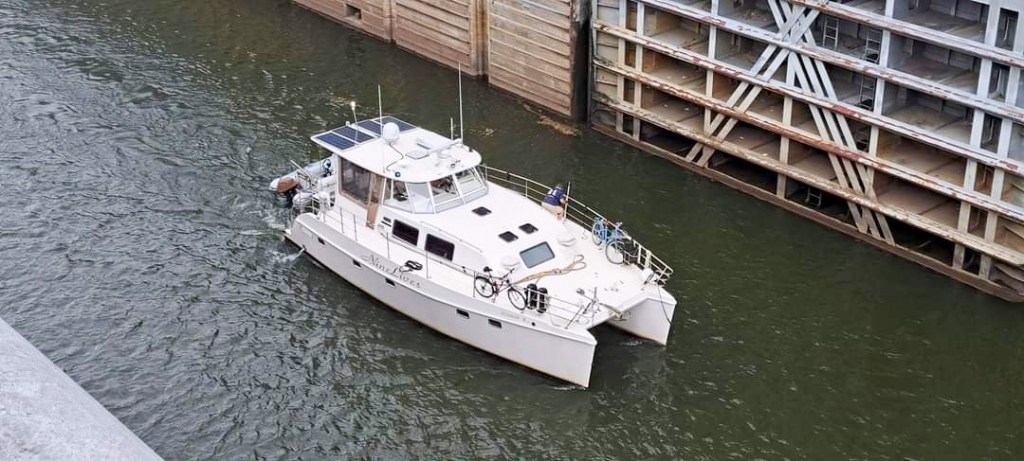
We were up at 5am, in order to be sure we could have coffee, more coffee, and breakfast, before leaving the dock at 6:20am. It was a lovely sight, the lights of the boats behind us against the rising sun.  It became clear that someone was going to have to raft up in Wheeler Lock.  We are always ready, and happy to be the anchor, but it was a bit surprising that it was the largest boat in the flotilla, the 62-foot Halcyon, that was our companion.  They commented that this was also a new experience for them, as they are usually the boat closest to the wall that others raft to.  Wheeler Lock gave us all a gentle drop and we headed out, line astern, towards the next part of the adventure.
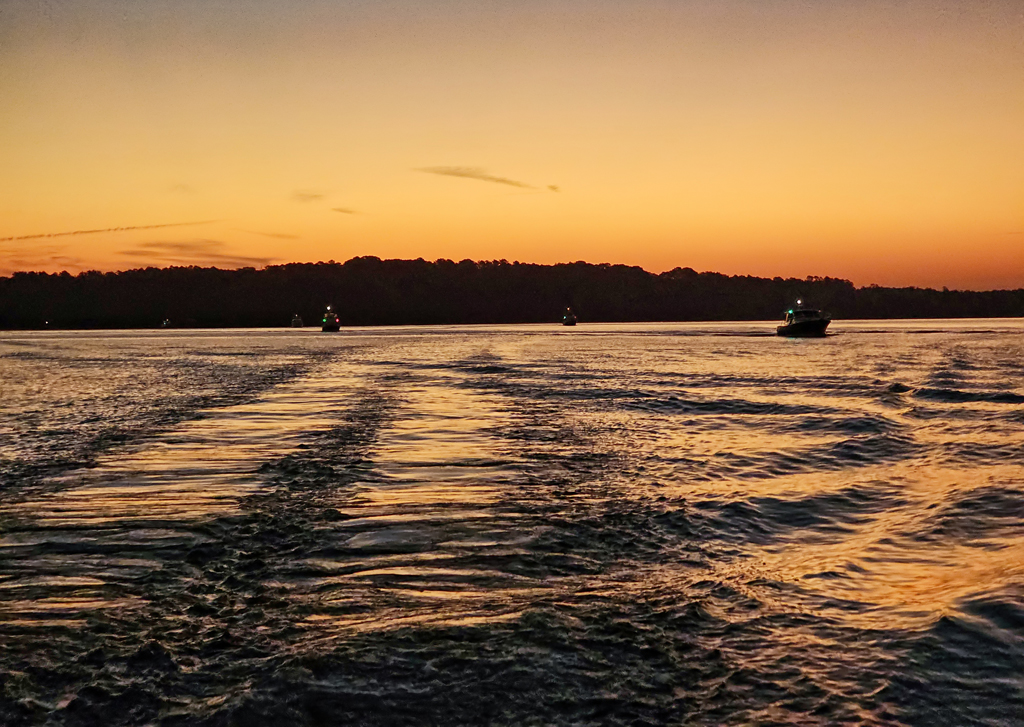
The flotilla leaves Joe Wheeler at sunrise
Tows and barges waiting above Wilson Lock

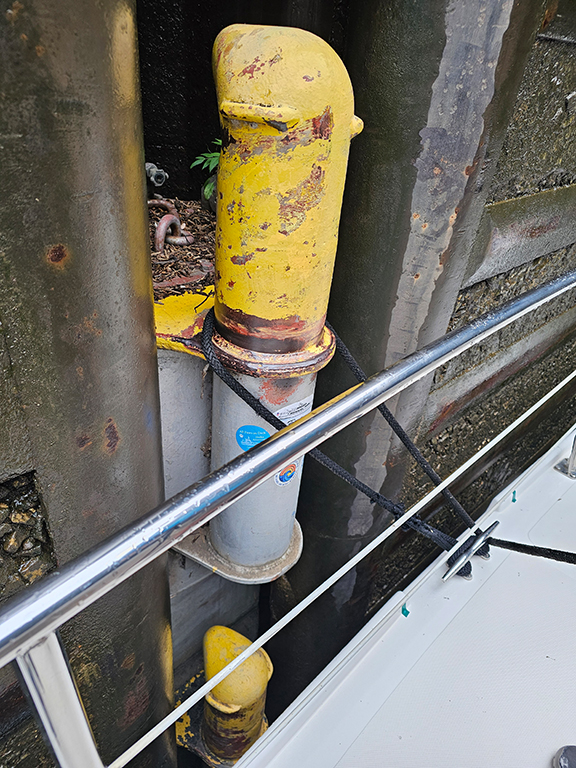
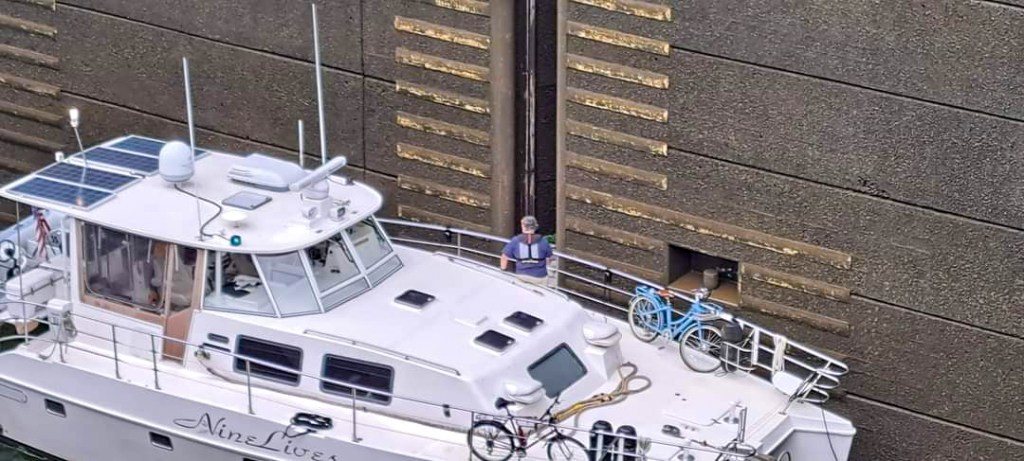
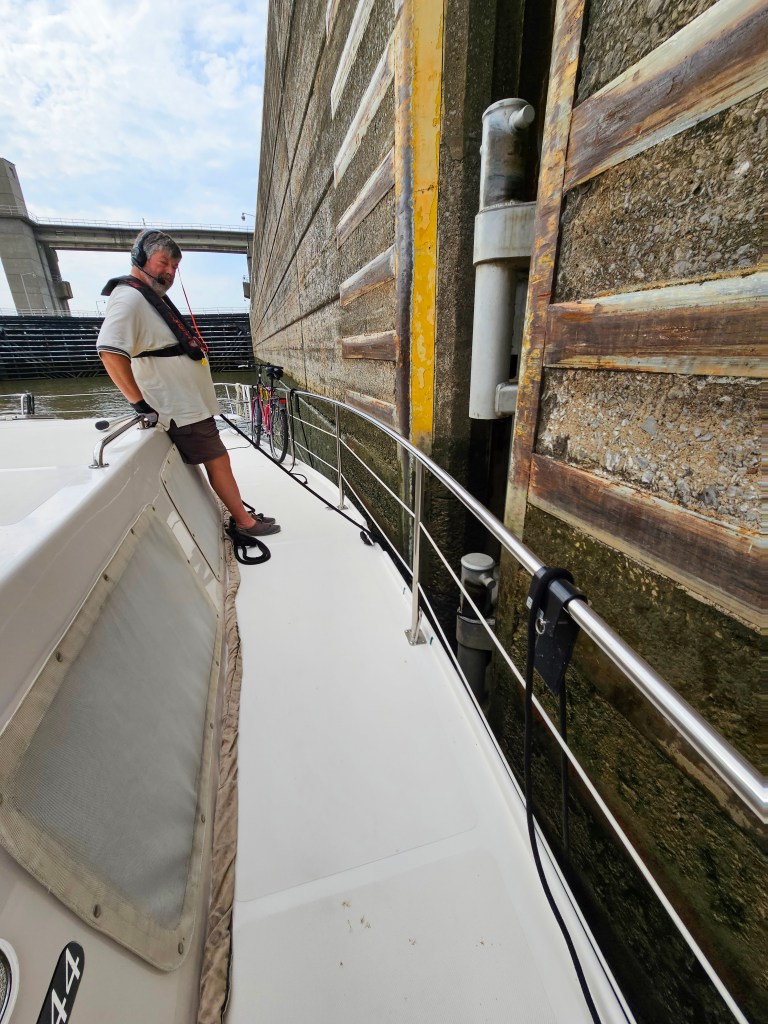
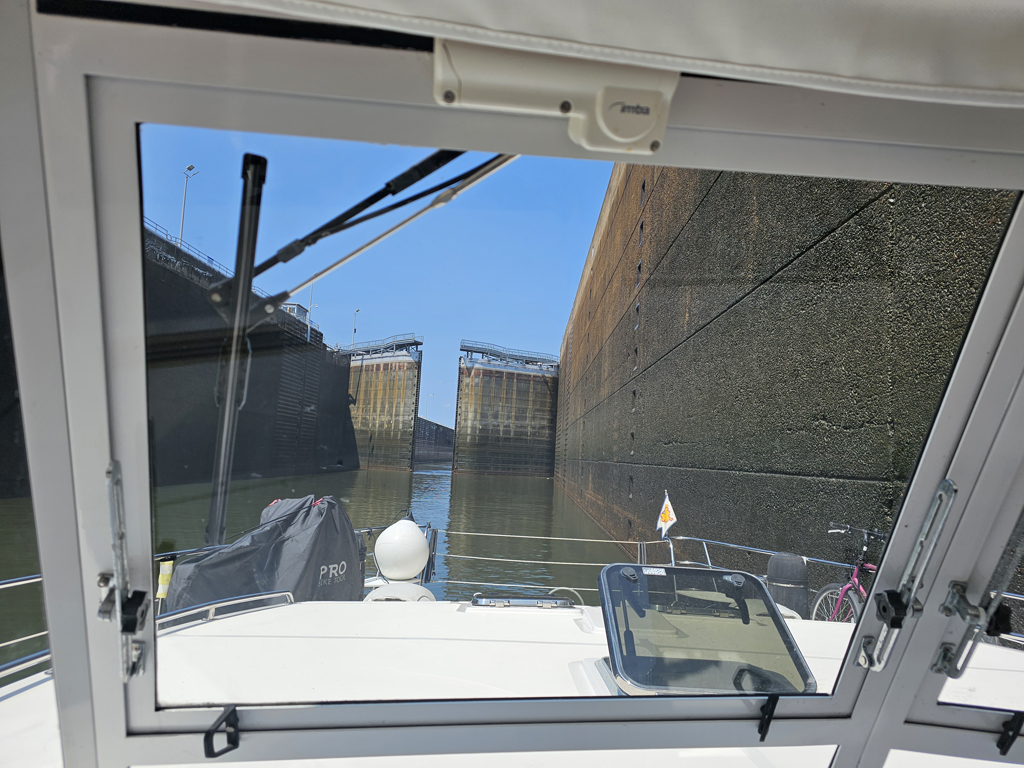
We arrived at Wilson Lock by 8:30 am and were advised to our great relief that the lock would take a break from commercial traffic, and the two parts of the 9-boat flotilla would be locked through, one after the other, starting at 10:30.  They began taking the first group exactly as promised.  Our group was right behind.  There are very few floating bollards on either side of the two chambers (and one is under a continuous heavy shower of water).  Unfortunately, the usable pins (bollards) are on opposite sides between the two chambers.  Nine Lives entered first, and took the pin at the front on the starboard (right) side.  Once secure, we called the next boat (Legacy) forward, and he rafted up to our port (left) side.  Then the other two boats arranged themselves in a similar fashion behind.  It was a day of firsts for our rafting partner.  His first solo lock-through at Wheeler, first time rafting up at Wilson.  After the gentle drop (thanks lockmaster!) in the first chamber, the doors opened.  We untied from Legacy, and I took Nine Lives slowly and gently across to the other, port side, while Dick quickly moved our big fenders across.  As soon as we were again secure, Legacy came up and tied up to our starboard side.  That was a little trickier, because Don does not have a door on that side of his boat, so Dick and I had to catch and hold Legacy until we could get lines tied.

Another gentle drop, and we could all head downstream, line astern, passing all the waiting tows and their barges.  We were tied up in Florence Harbor by 1pm, just ½ hour longer travel time than Dick’s original estimate that had not taken a broken lock into account!  I was glad that we did not have to do part of the exercise in the dark, as we had fully expected.  We were also glad that, having given a presentation at Rendezvous on how to go through a lock, with the expectation that after over 400 locks we are now experts, it all went well and we did not mess up, especially with an audience!

Looking down through the cockpit window at the tows and barges waiting below Wilson Lock
Tows and their barges waiting below Wilson Lock

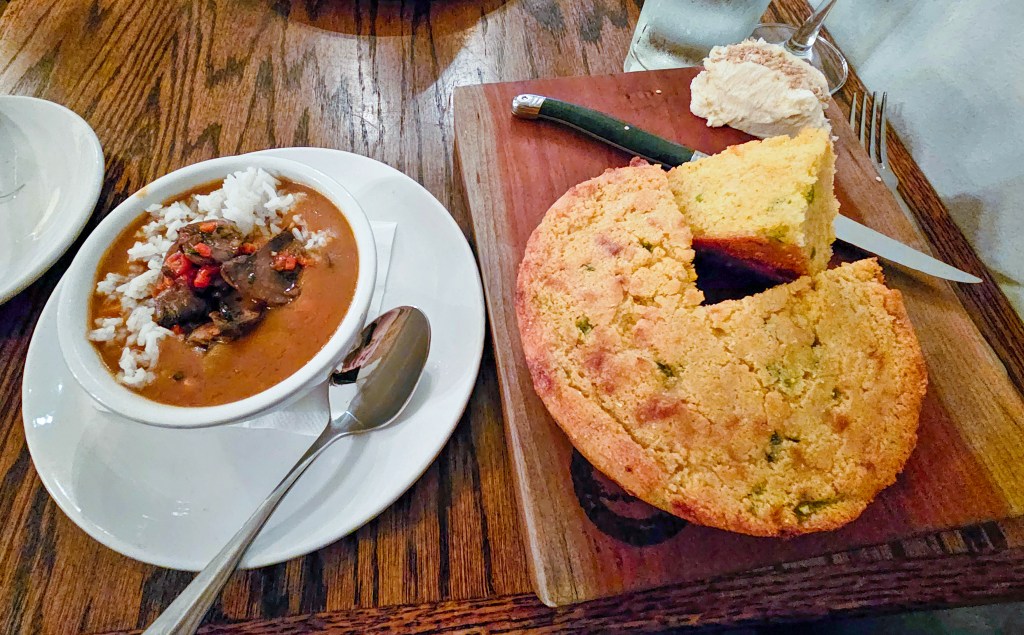
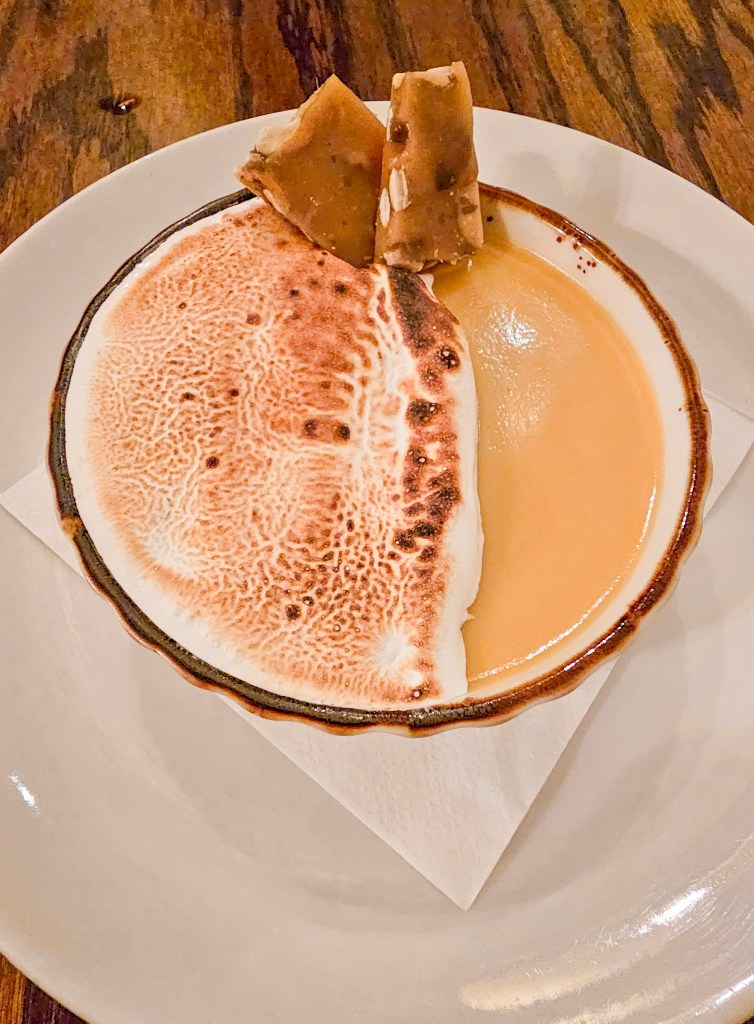
After a quiet afternoon we took an Uber to Odette’s, the restaurant we had cancelled on our last visit.  The menu is very modern and unusual, but within that context, the food was both delicious and beautifully presented.  Next to our table was another couple, and he asked about the cornbread that I had ordered.  I offered, and he asked to try a piece (it was delicious).  His Venezuelan wife of 16 years was both amazed and horrified that strangers would engage in this way.  They were a lovely couple.  We enjoyed chatting with them, and he gave us his number, hoping that we will call next time we visit Florence and go out to dinner with them.  These chance meetings and engaging chat are some of the best experiences on the Great Loop.

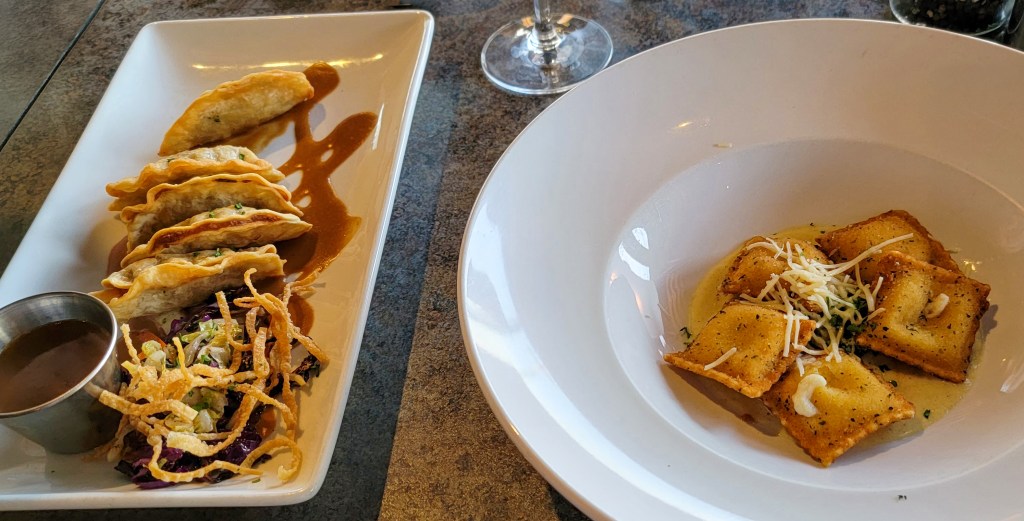
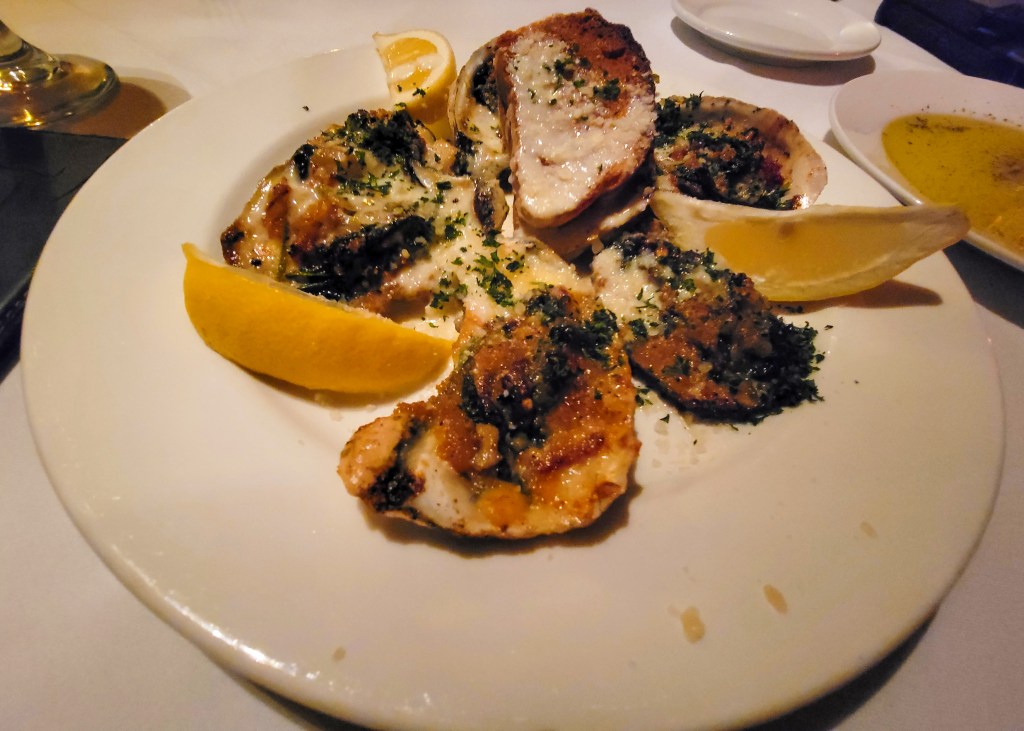
Odette’s starter sampler plate
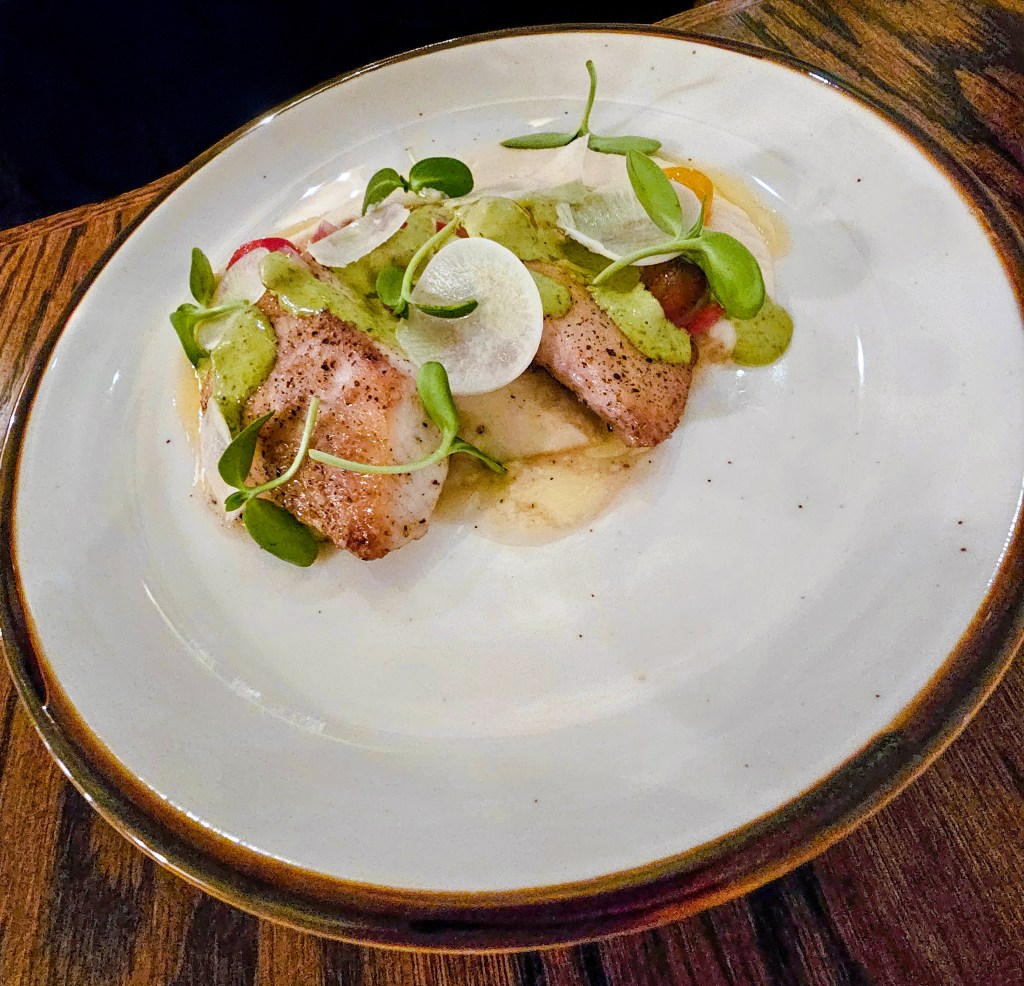
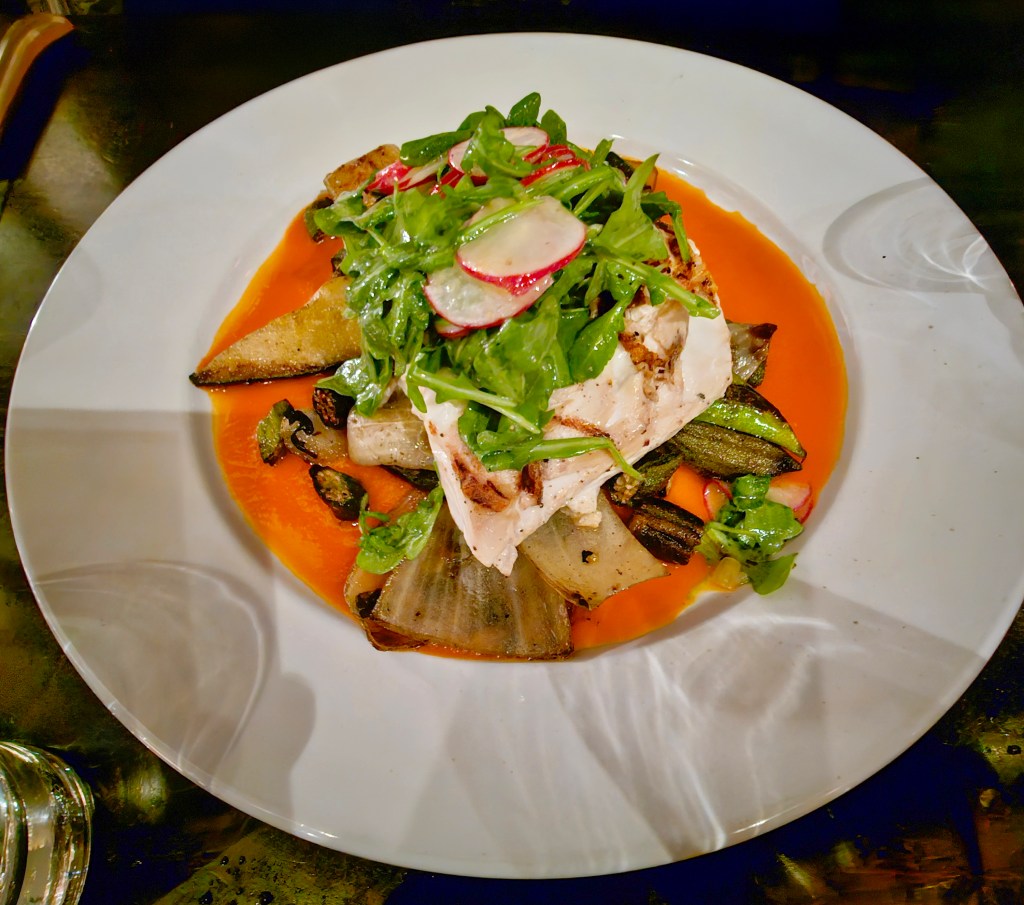
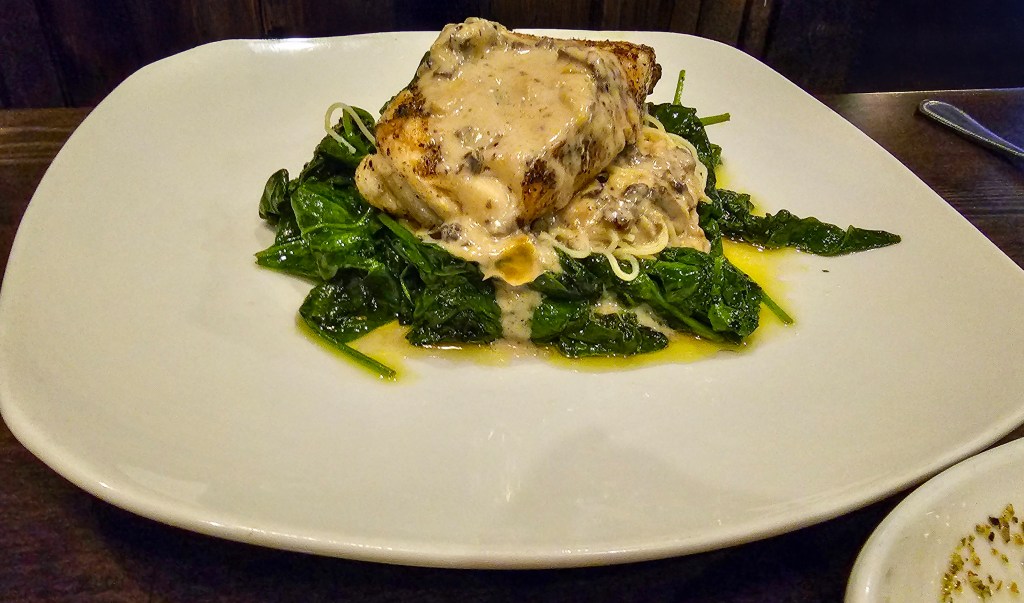
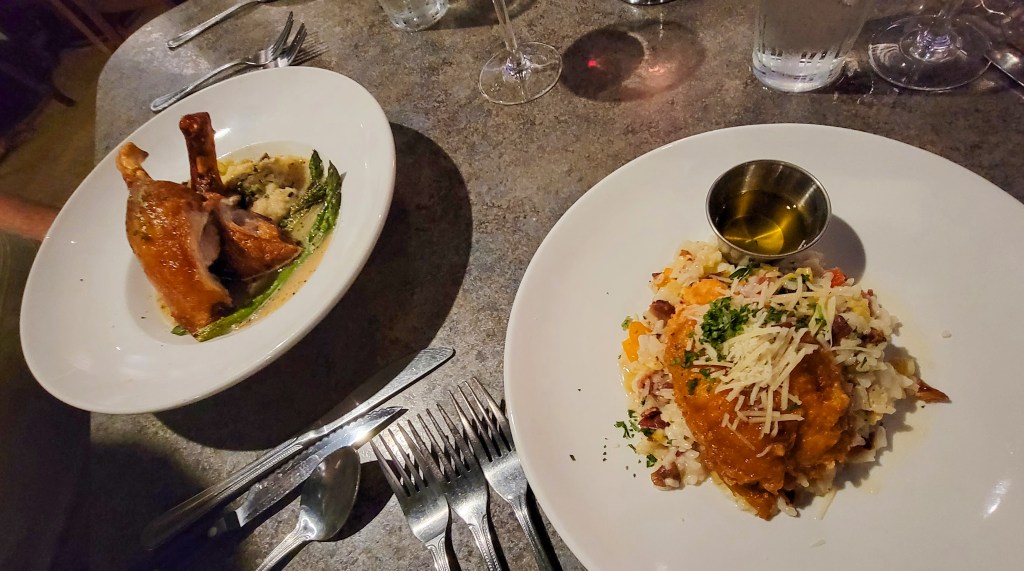
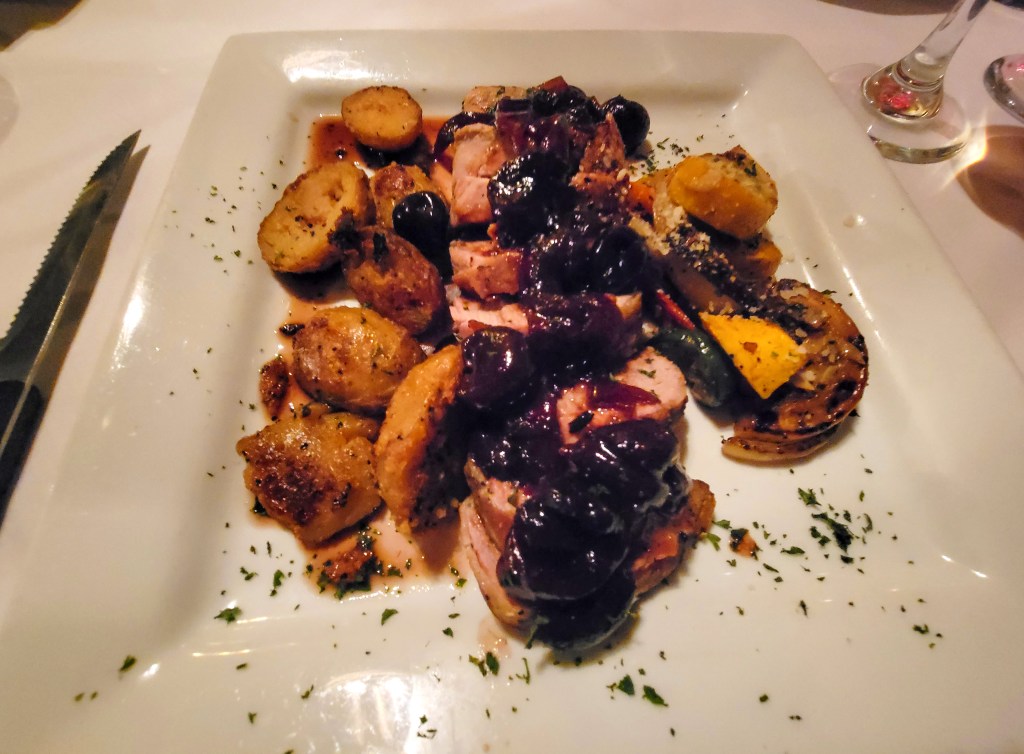
Grouper at Odette
Cornbread and a mushroom stew at Odette
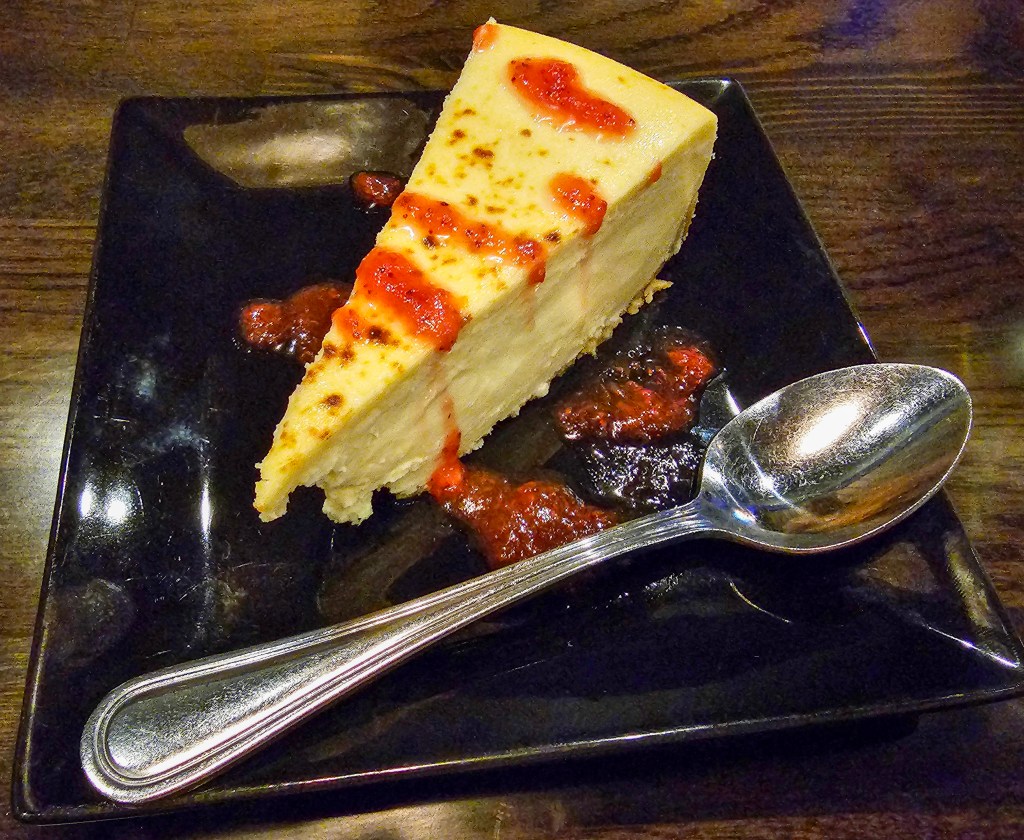
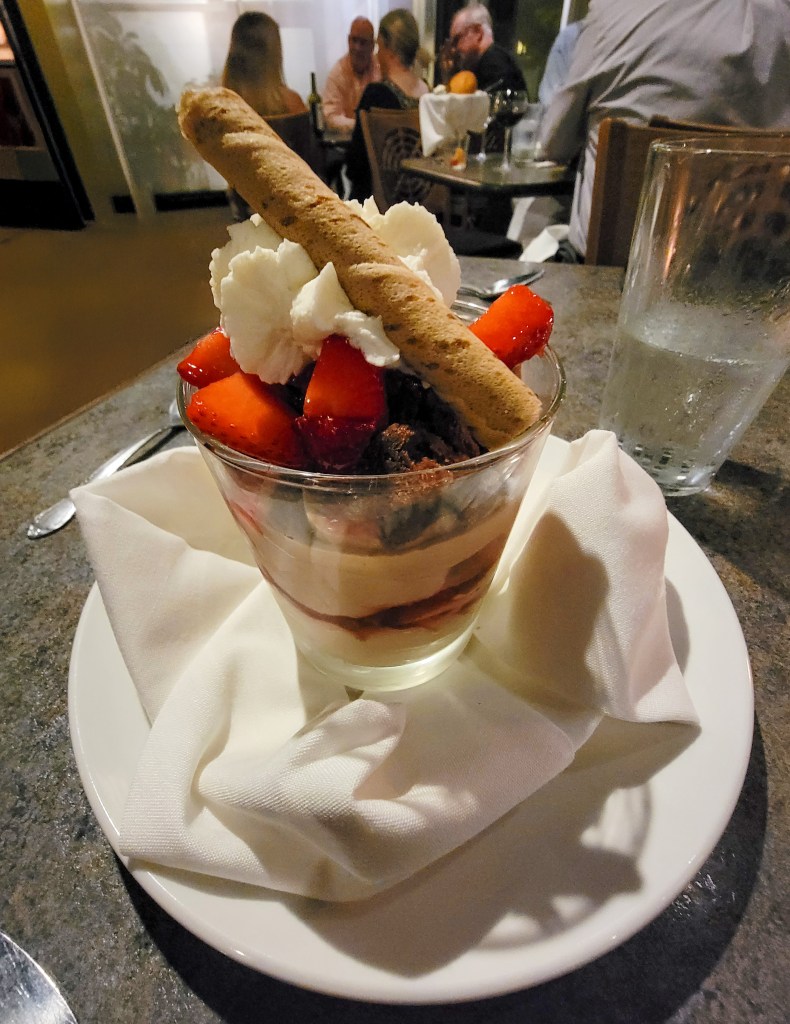
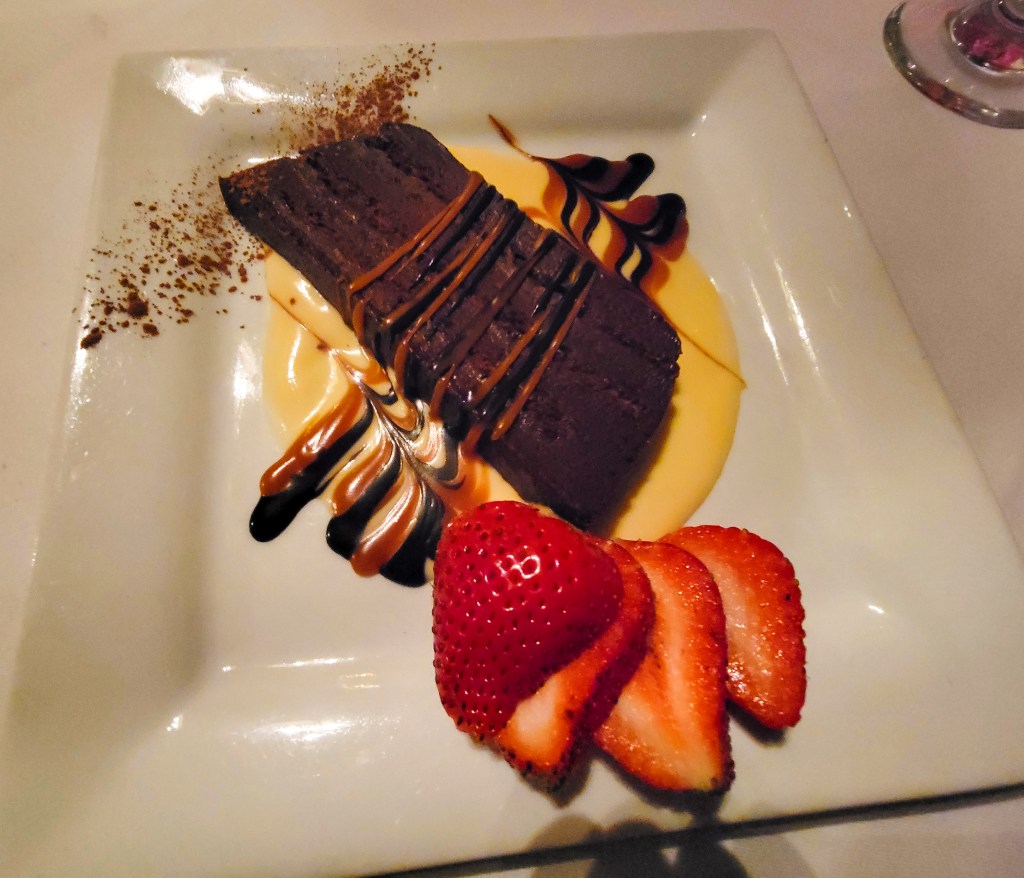
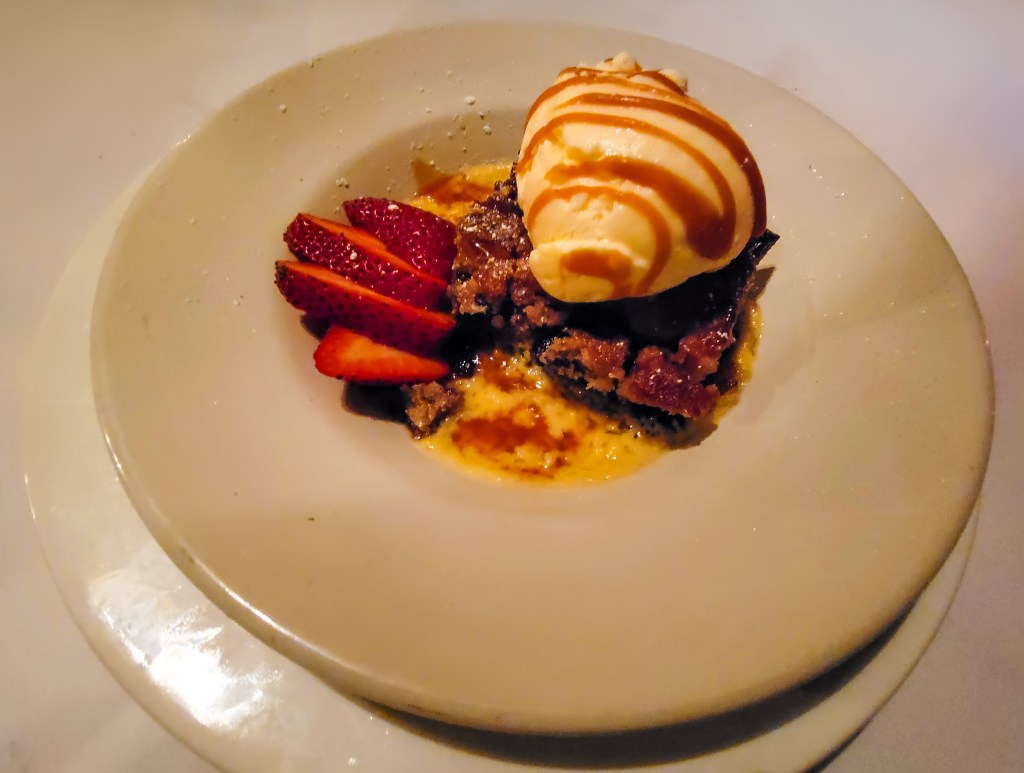
Odette’s interpretation of Pot de Creme

The next morning, shortly before sunrise (we were already up), we heard counting, and looked out to see what must have been 100 fishing boats heading down the River for a fishing tournament.  I was just not quick enough to get a picture.
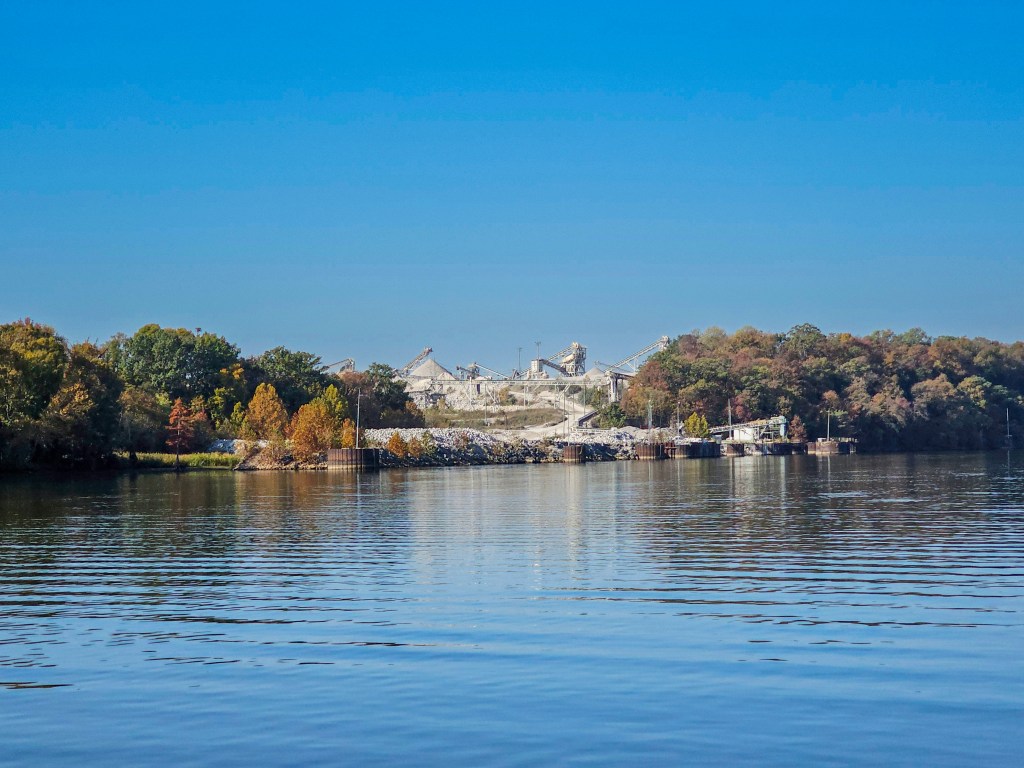
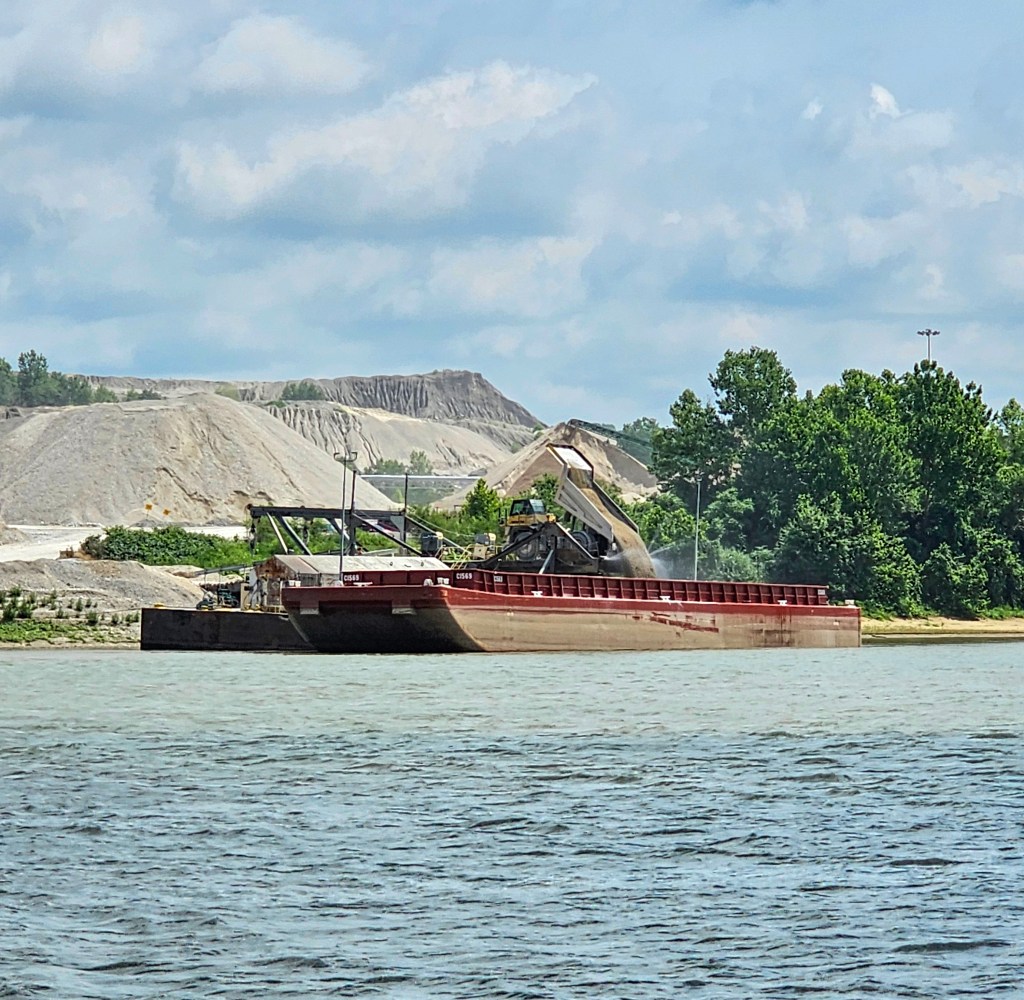
The quarry at Pride Landing

As we travelled downstream towards Aqua Yacht, we passed the now demolished Riverton Lock.  Riverton was the first major landing upstream of Paducah in the 19th century.  Shoals immediately upriver from Riverton prevented river traffic from getting to Florence for six months of the year when the water was low.  In 1891, George Washington Goethals developed a design for a single high lift lock.  He was able to convince the Army Corps of Engineers that his design was feasible and that the lock should be built to make travel possible and reliable all year round between Riverton and Florence.  The lock began operation in 1911, and at the time, was the highest lift lock in the world, with a lift of 26 feet.  In comparison, today, the lift in the main chamber of Wilson Lock to the south, is 100 feet, the highest single lift in any lock east of the Rockies, while Pickwick Lock to the north, has a lift of 63 feet.  Goethals’ success resulted in his transfer to Panama, where he was responsible for the design and construction of the Panama Canal.

All that remains of Riverton Lock, once the highest lift lock in the world.

We arrived at Aqua Yacht at the same time as 5 other boats.  We had hoped to be sociable, and to be either on the transient dock, or in a slip on D dock with many other Loopers.  Sadly, we were assigned E56.  After spending some time counting back to work out which slip we were supposed to be in, Dick turned Nine Lives into the correct slip, and it was very quickly obvious that someone’s measurement of 20 feet was faulty.  This was confirmed by a friendly boater on the dock, who could see that we were not going to fit, and that it was E56 as we had been directed to.  Dick called on the radio, and was given the new assignment of E47, just a few slips along, but definitely wider and longer.  After 3 years of practice getting into an identical slip on F-Dock, Dick had no problem easing Nine Lives in.  We already knew the best configuration for tying up to the posts.
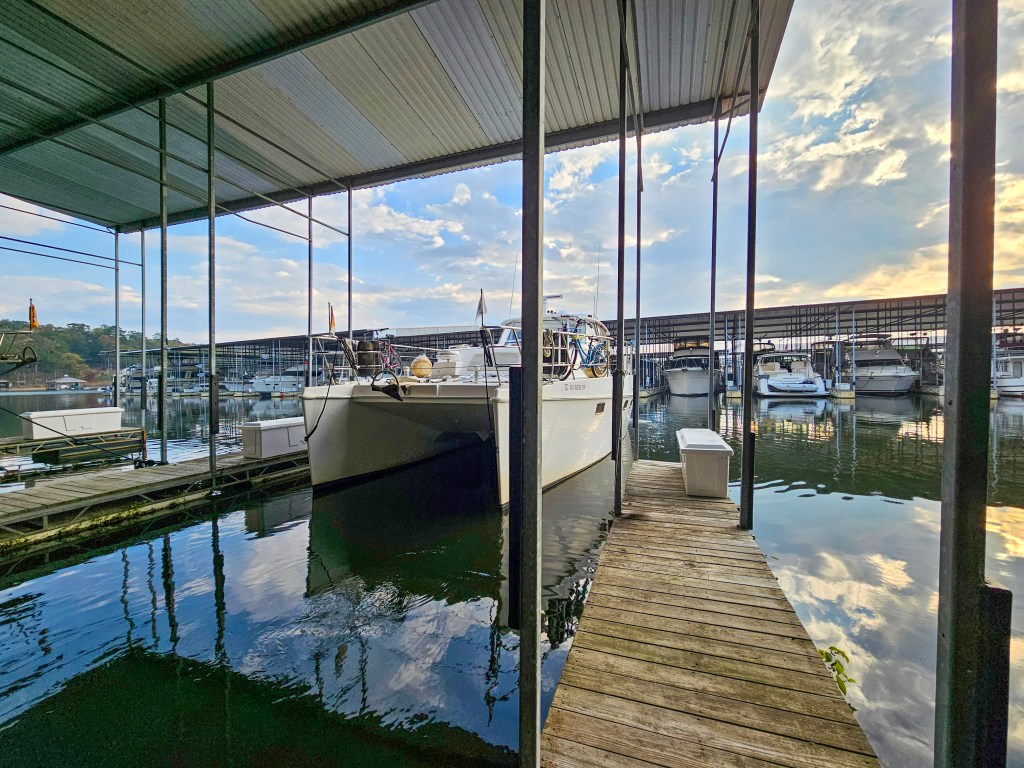
Aqua Yacht slip E-47

Once settled, Dick retrieved his car keys and hot-footed out to find a replacement for our leaking drinking water filter hose.  Once again, he had to go farther than expected, because, for reasons known only to them, the local hardware store is closed on Saturdays, the day that most working people are off and can work on home/boat/car projects.  New (stainless steel instead of unsuitable vinyl) hose duly acquired, Dick spent the next ½ hour lying on the floor in the galley doing the installation under the sink.

I was struck by how very lucky we were the previous day in our transit of Wilson Lock, as I watched the next groups.  We use an app called Nebo, that shows where everyone is.  It is very useful to keep track of other Loopers, and can also be used by friends and family to see where you are.  On this day there was one group heading in each direction.  The downbound group left Joe Wheeler at dawn, as we did, and arrived at Wilson shortly after 8:30am.  However, a tow plus barges was in progress, so they had to wait until about 2:30 before it was their turn.  That meant they arrived at Florence Harbor at about 4pm, and one of the boats in the group had chosen to travel all the way to Aqua Yacht, arriving well after dark.  The upbound group was even less fortunate.  Their transit began after 3:30pm, and by the time they were through and close to the next (Wheeler) lock, it was getting dark.  Three chose to anchor, but two carried on through Wheeler and arrived at Joe Wheeler State Park long after all staff had left.  One hopes that the few remaining Loopers on the docks were there to help them get situated.

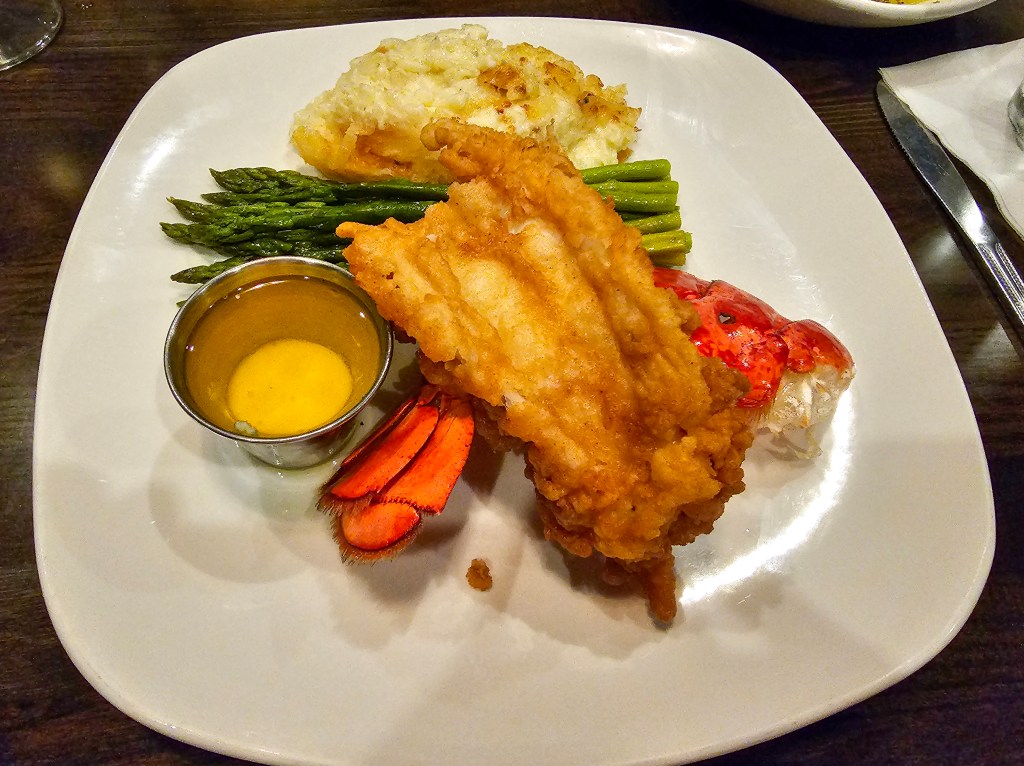
At last it was time to head to dinner.  Our final visit to our favorite restaurant.  Vicari’s was every bit as good as it was on our first visit 3 years ago.  Service was impeccable, and the food was outstanding.  We enjoyed our usual starters, then Dick had the prime rib and I treated myself to the fried lobster tail.

Our final dinner at Vicari’s, prime rib for Dick and fried lobster tail for me

Sunday was laundry day, blog writing, and Dick changed the oil and filters in both engines.  He also took apart the grill to see whether he could figure out what had been making the strange noise when he grilled the breakfast sausages and bacon that morning.
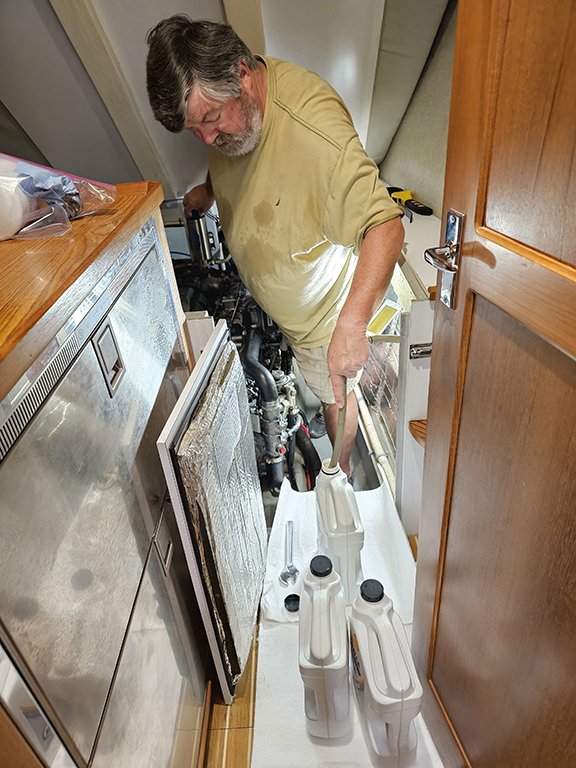
Dick changes the oil and filters. Two engines, the job has to be done twice!

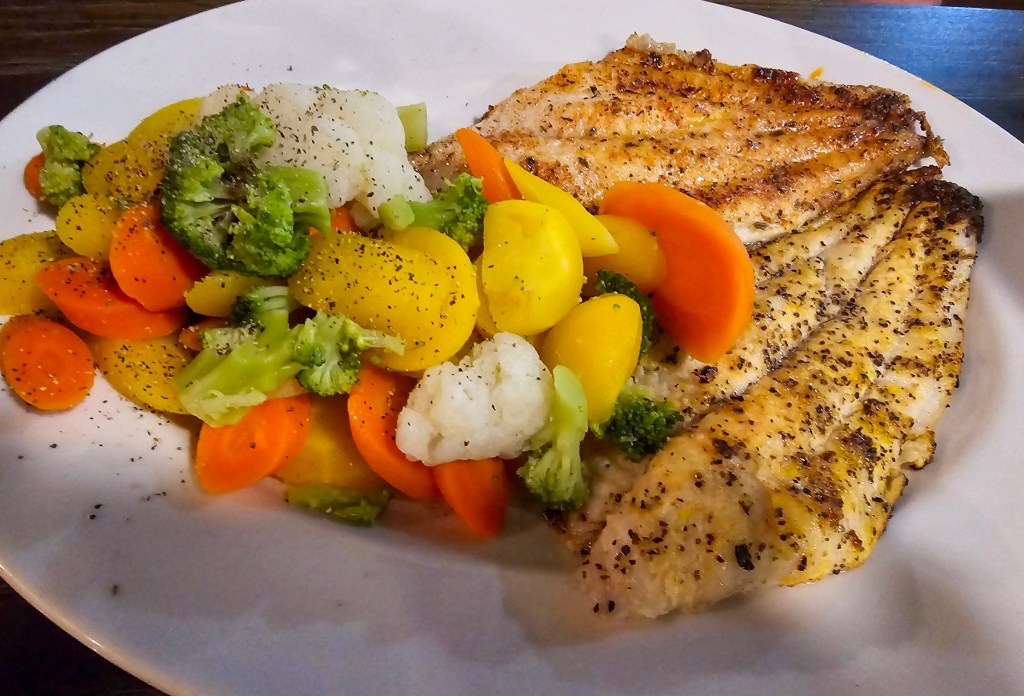
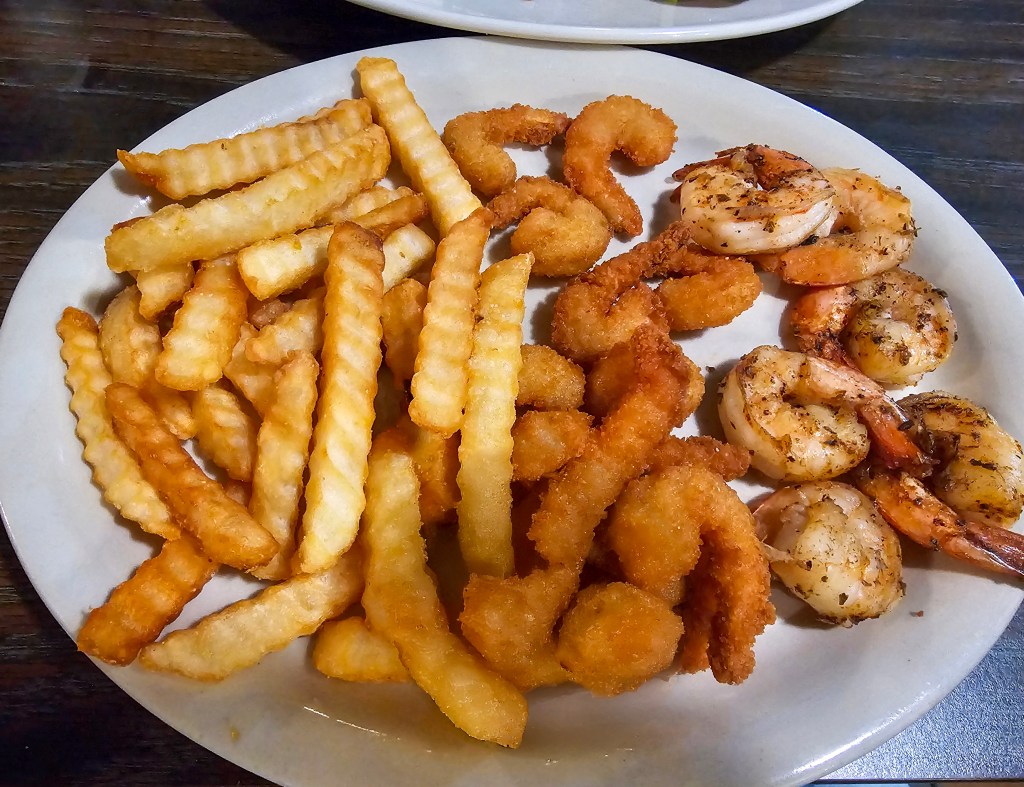
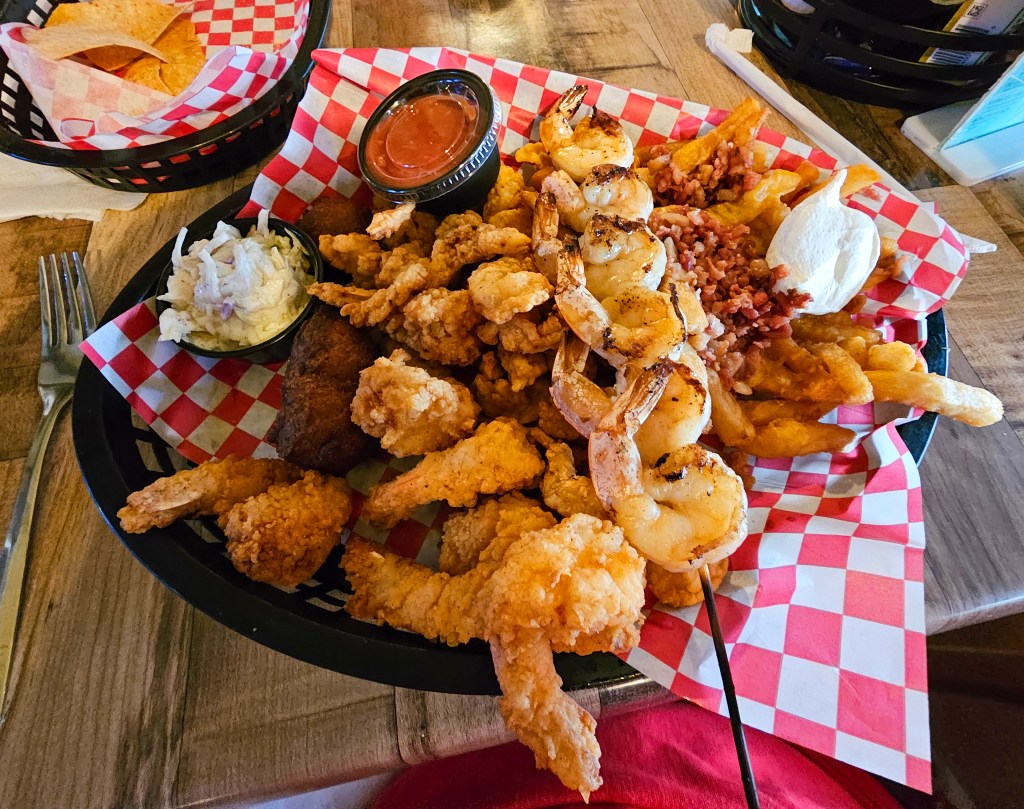
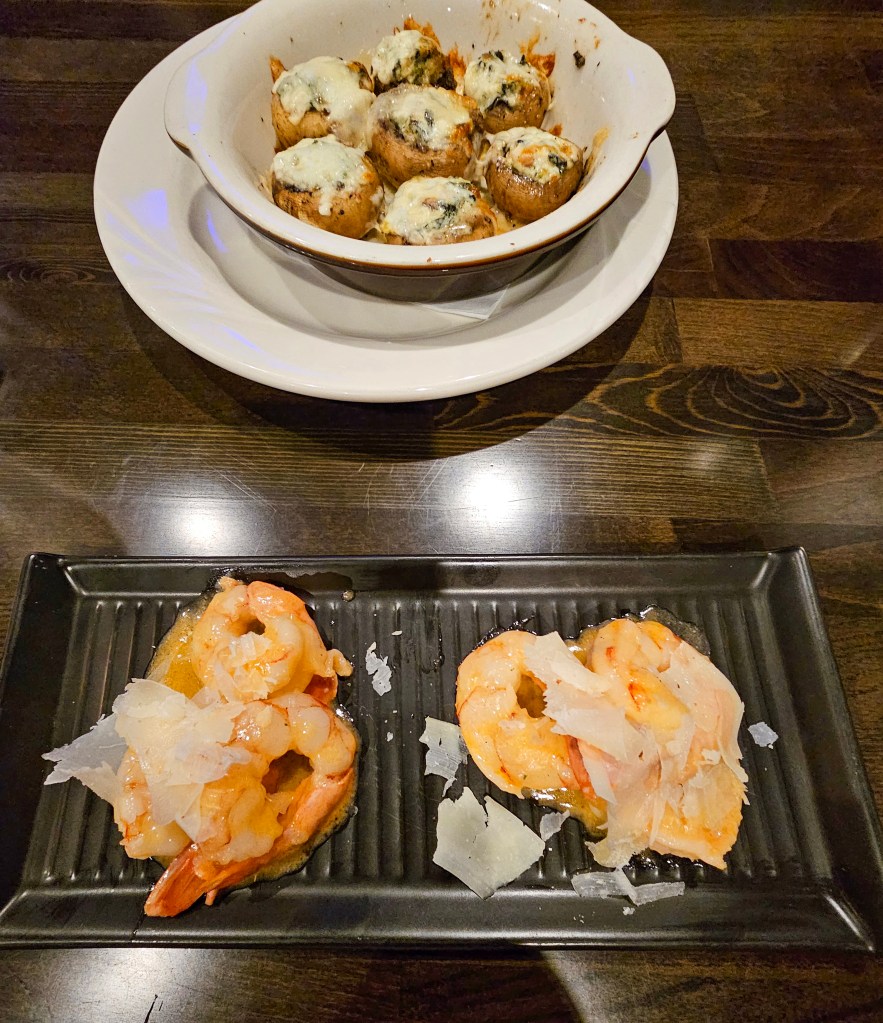
In the evening we set off for Hagy’s Catfish Hotel, a venerable, family run (for 80 years) restaurant about 20 miles away.  Dick loves catfish, and it is seldom offered on menus outside these Southern states.  We passed the Shiloh Battlefield.  I would have liked to have stopped for some pictures, but the catfish were calling.  The restaurant was full of character, and bustling.  Servers and young women dashed about, taking and delivering orders and bussing tables.  Meanwhile, an elegant woman made the rounds, stopping at each table to greet regulars or welcome strangers, while her equally elegant (presumed) daughter showed arriving guests to their tables.  The food was very good, and for the most part, piping hot.  Dick loved his two grilled catfish filets, one with lemon pepper seasoning, and the other with Cajun spice.  I opted for shrimp two ways, grilled with Cajun spice, and popcorn (breaded and fried) style.  Both were delicious.  The accompanying hush puppies were hot and crisp.  The only criticism we had was how rushed everything was.  The waitress kept asking to take our main course order, even though we explained that we were not in a hurry and did not want the starters, salad, and main courses piling up together.  As soon as we put our forks down, the bill was delivered – no dessert was offered.  With all the people tearing about it seemed very hectic.
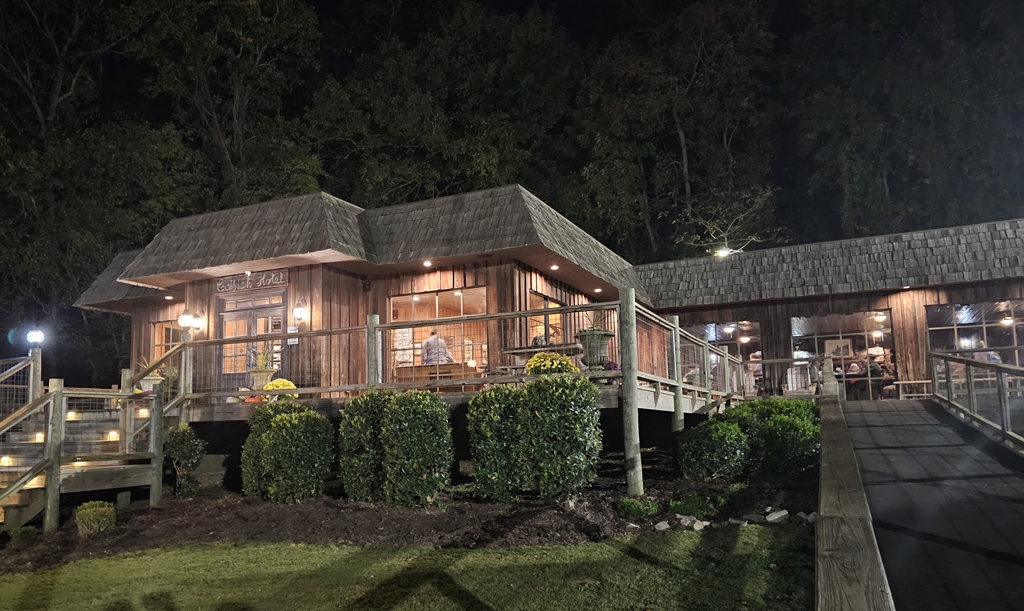
Hagy’s Catfish Hotel
Grilled catfish at Hagy’s
Shrimp two ways at Hagy’s
Don’t forget the hush puppies!

When we got outside, there were armadillos rooting in the flowerbeds.  Usually they are too shy and quick for photos, but there must have been something very interesting under the mulch because I was just able to get a snap.  Nine banded armadillos are native to South America, but they are gradually moving north, although they do not appear to be considered an invasive species as such.  I began to tell this to Dick as we drove back, but before I could get into my stride, he said, “I hear they are good eatin’”.  That certainly put an end to that conversation.  I did a little research, and here are some interesting things about the nine-banded armadillo that perhaps you did not know.  They can jump 3-4 feet in the air when frightened, which contributes to why so many are killed on the roads. They can inflate their intestines, and float across rivers, or alternately, they can sink to the bottom and walk across, being able to hold their breath for as much as 6 minutes.  They are nocturnal, and like to burrow, so they are not popular with gardeners.  In Texas, there is a small but well-established sport of armadillo racing, in which the animals scurry down a 40 foot track.  Most of the usual carnivorous predators like them, but their biggest predator is humans, who hunt them and harvest them for meat and shells.
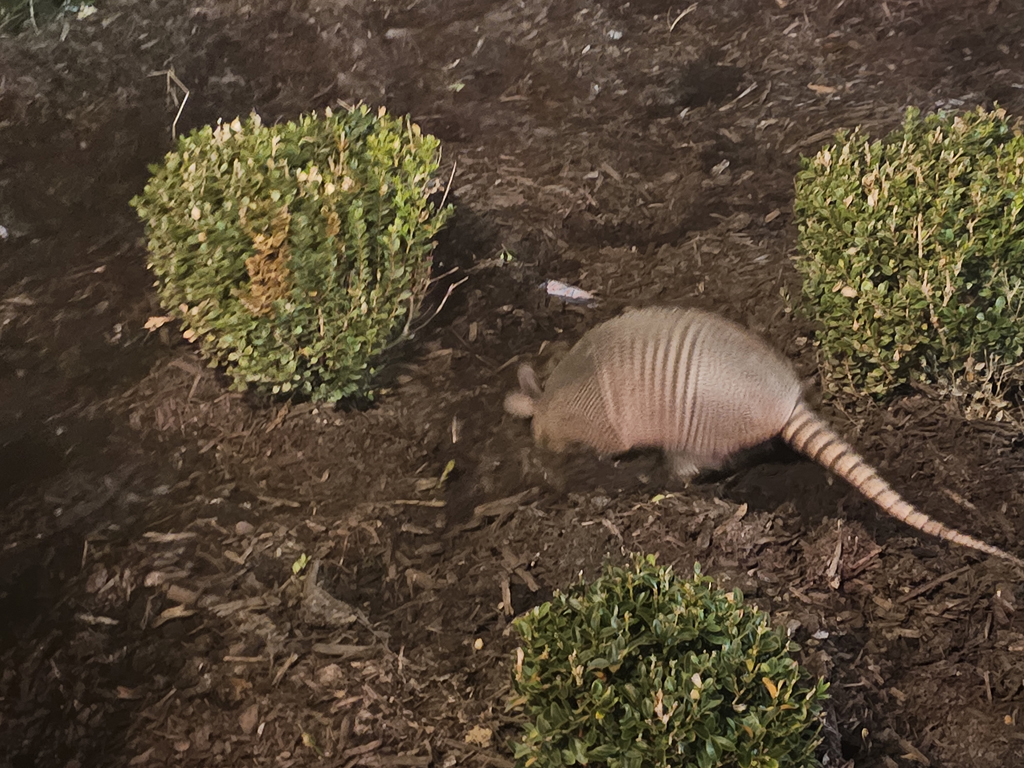
An armadillo roots in the flowerbed at Hagy’s Catfish Hotel

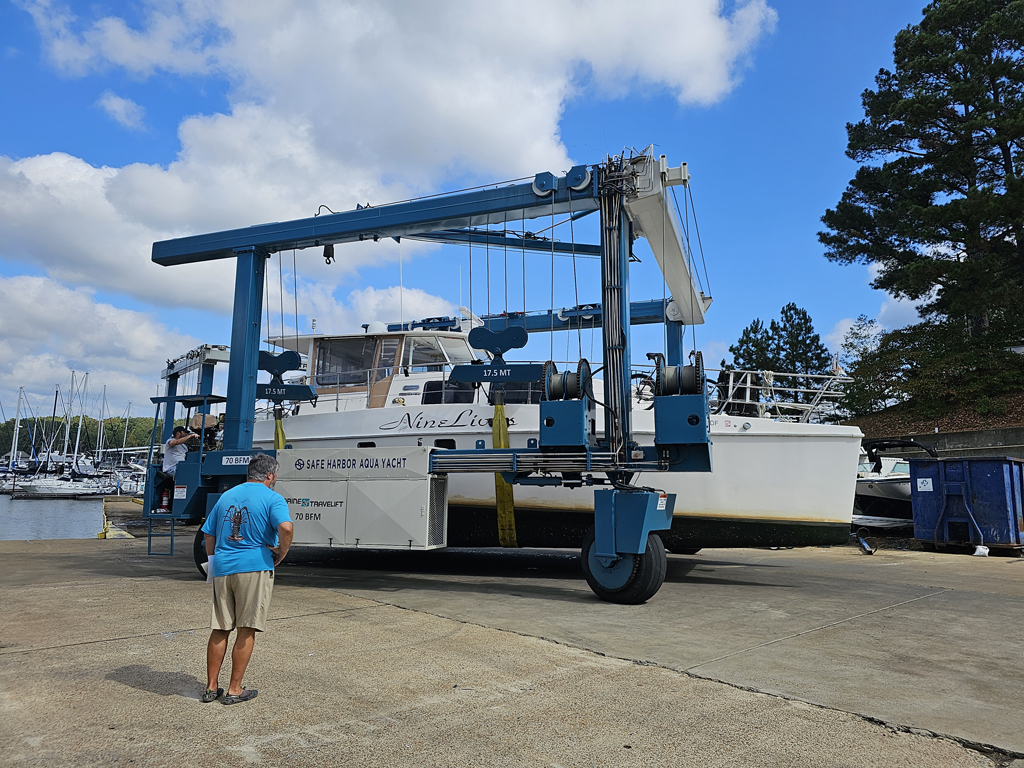
Our last day at Aqua Yacht started with a scheduled haul out.  When metal is continually in the water, it starts to corrode.  On a boat, there are a number of places that have metal fittings that are always in the water.  To prevent corrosion, pieces of metal called sacrificial anodes are attached.  These will corrode first, due to a metallurgical process that I have no need to understand!  Nine Lives left salt water back in 2018, and since then, her anodes have been made of magnesium.  Now that she is soon to return to salt water, we had her hauled out and new anodes made of zinc were installed.  The whole process took about 2 hours, including the haul out and pressure washing the bottom.  Everything worked fine, and we were ready to start south the next day.

Aqua Yacht haul out
Back in the water at Aqua Yacht

We took advantage of having our own vehicle to check out a new grocery store in Iuka, and also stock up our critically low stores of Jack Daniels and other adult beverages.

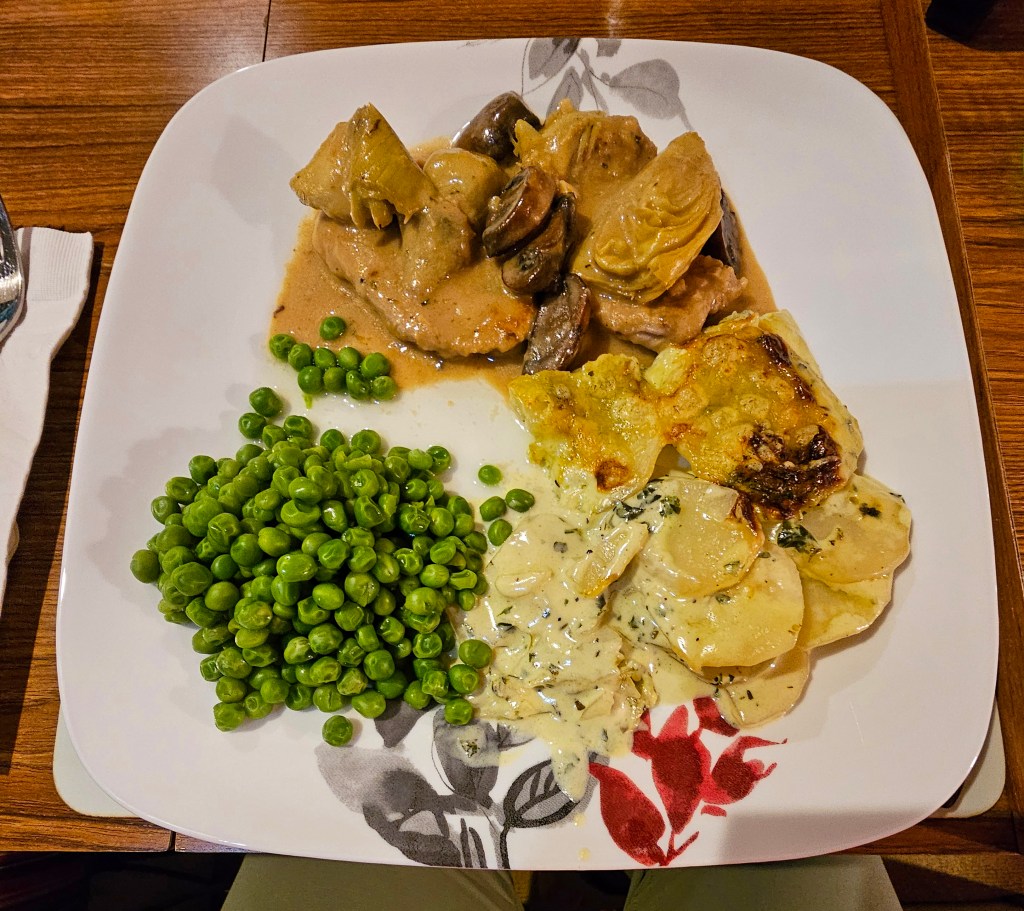
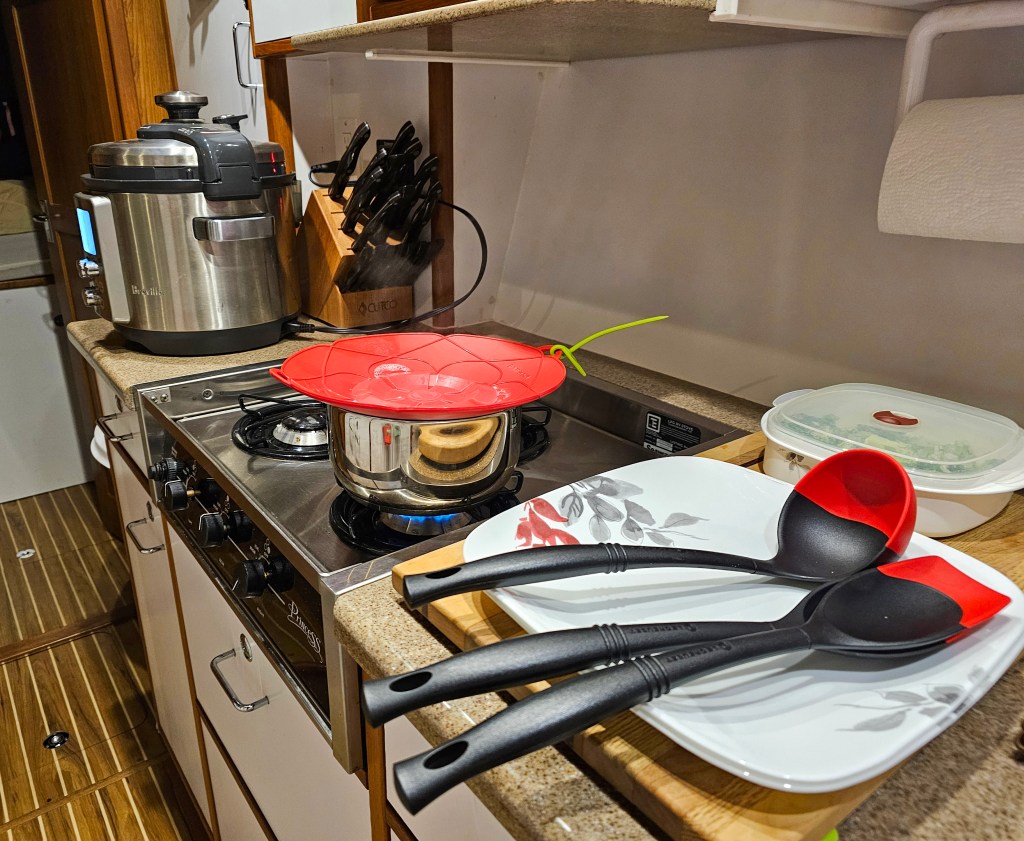
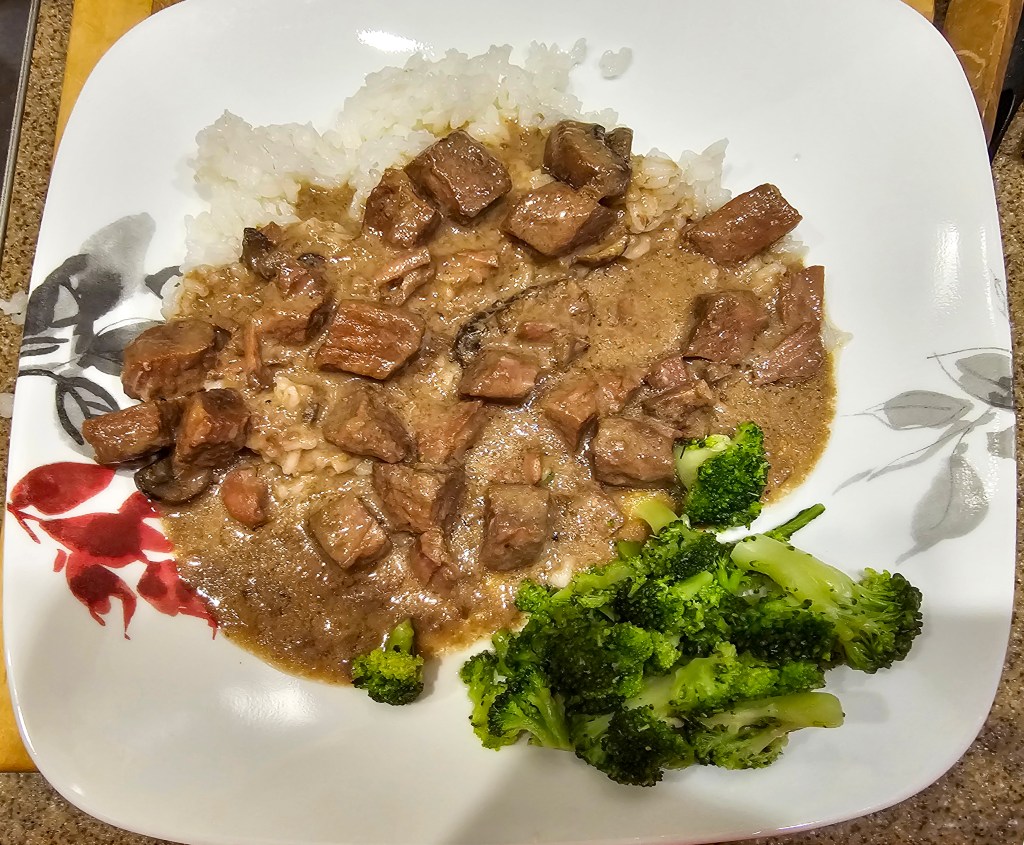
In the evening, I made shrimp fried rice from a new recipe.  It turned out very well, and I will certainly make it again.  In fact it would also have been relatively quick to prepare if I hadn’t needed to peel and devein the shrimp first.

Next morning we said goodbye to Aqua Yacht (except for a brief visit in a few weeks to pick up the car).  It has been a good base for the past 3 years.  The yard does good work, the only frustrations being the lack of communication and getting the work done on time, and very little cleaning done despite many promises.
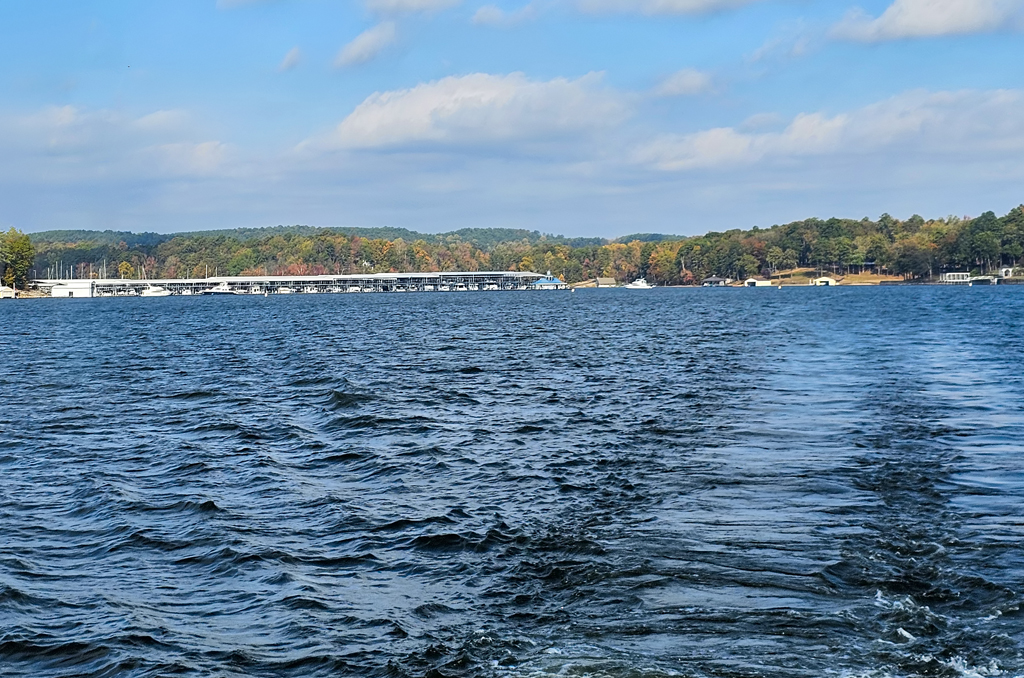
Goodbye Aqua Yacht

We set off south on the Tenn Tom Waterway.  This connects the Tennessee River at Pickwick Lake with the Tombigbee River at Demopolis, Alabama, and then joins the Black Warrior River to bring river traffic to Mobile and the Gulf of Mexico.  The first proposal for this waterway was made by a French explorer in about 1760.  In 1810, citizens of Knoxville, Tennessee, lobbied Congress to build the waterway, but the first engineering investigation took place many years later in 1875-76.  In 1913, another investigation took place.  Congress decided again that this would be too expensive and shelved the project.  More studies through the early 20th century, and eventually the project was approved in 1946.  There was strong opposition from key members of Congress from other regions, and again the project was shelved.  Money was budgeted in 1968 and in 1971 to build the waterway, and construction began in 1972.  There were more delays, due to lawsuits, but gradually the waterway was built, at a cost of nearly 2 billion dollars and it was dedicated in 1985.  Today, the waterway ships as much as 1.2 billion ton-miles of commerce each year.  We have been struck by the differences between these relatively new locks and those of the other waterways we have been travelling on for the past three years.
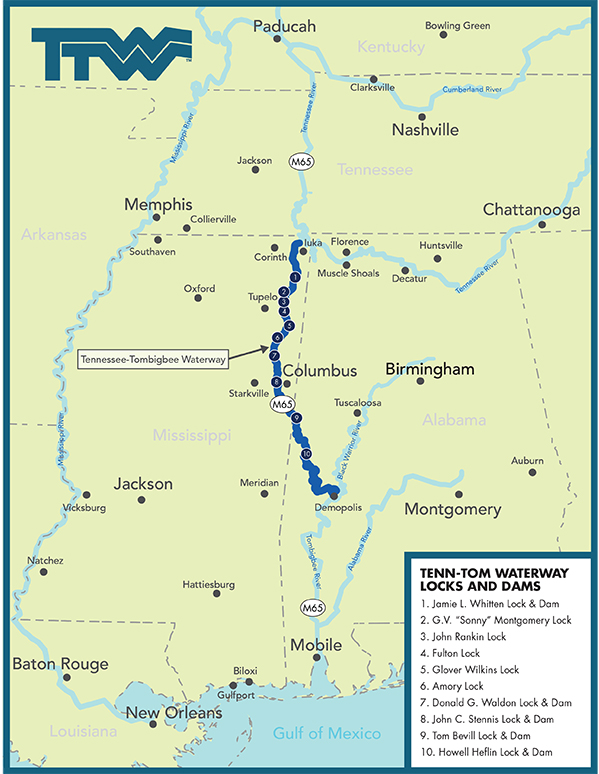
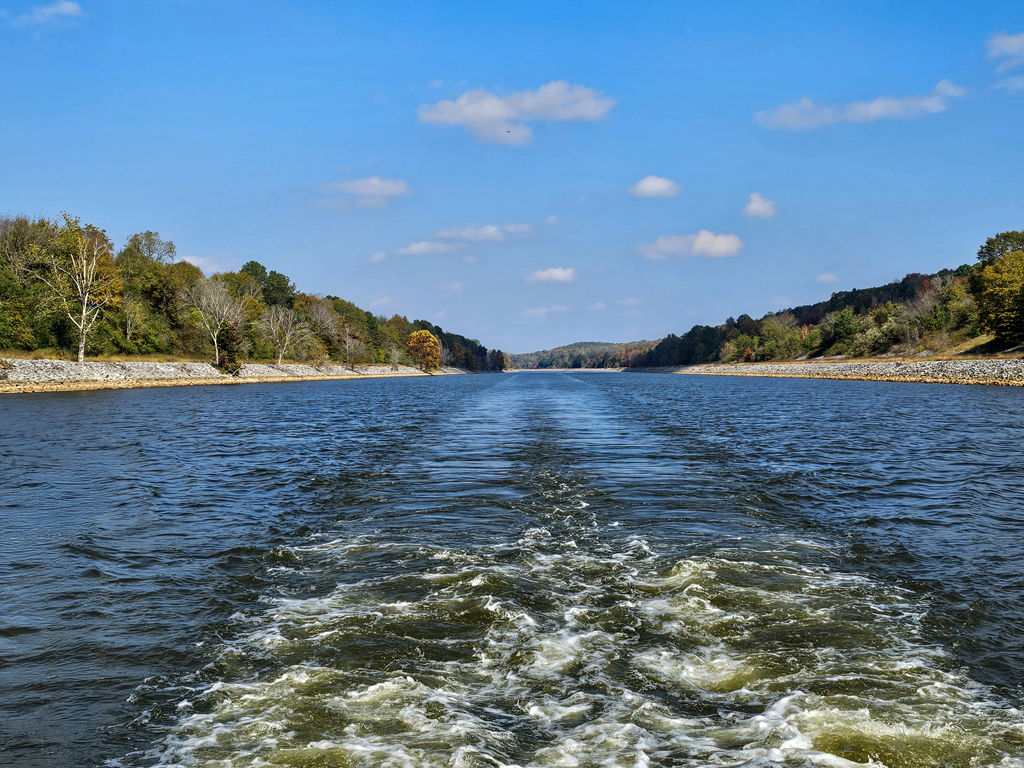
Map of the Tenn-Tom Waterway
The Tennessee Tombigbee Waterway
Meeting a tow on the narrow Tenn Tom

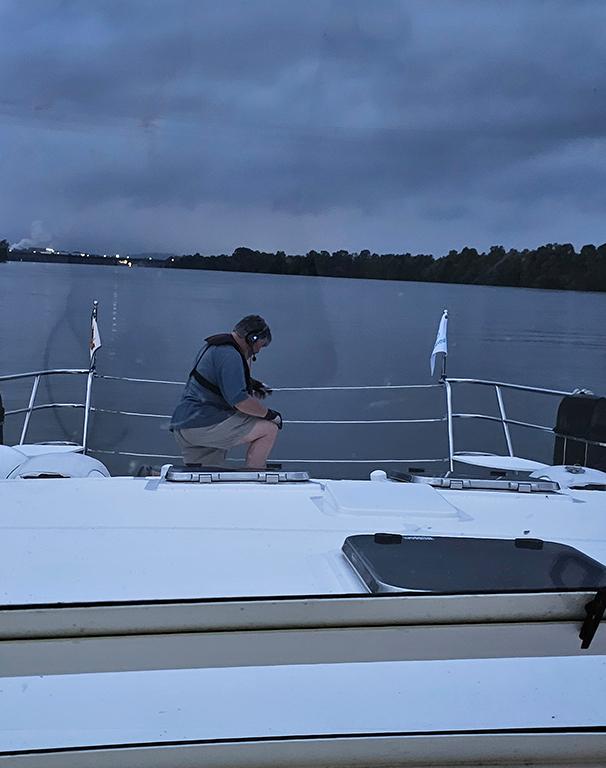
We anchored just above the first lock in a cove where there is a visitor centre.  There was already a boat in there – another Endeavourcat!  We set the anchor, and Nine Lives’ lady captain said, “I don’t think this is right, we are too close to the other boat, and we will not swing at the same rate and radius.”  The gentleman captain said, “It’s fine.”  Dick then spent a few hours replacing 3 cigarette lighter outlets (remember those?) with new USB ports.  I think there were some grownup words muttered during the tricky process.  After one and a half adult beverages on completion of the afternoon’s project, at dusk, the gentleman captain expressed the view that our location was not ideal, and now that the wind had dropped, we were at risk of bumping into the other boat.  Headsets on and engine started, and the whole pulling up and re-anchoring process to be gone through, as it got dark.  The lady captain was much happier in the new location, just wished it had not taken the gentleman captain quite so long to figure it out!

Another Endeavourcat anchored off Bay Springs Lake.

After a peaceful night we had arranged to coordinate with the other 2 boats in the area to go through the next locks together, and with one spokesman.  It all went well, and with no tows on this stretch of the waterway, we got through 3 locks and were tied up in the marina in 3.5 hours.

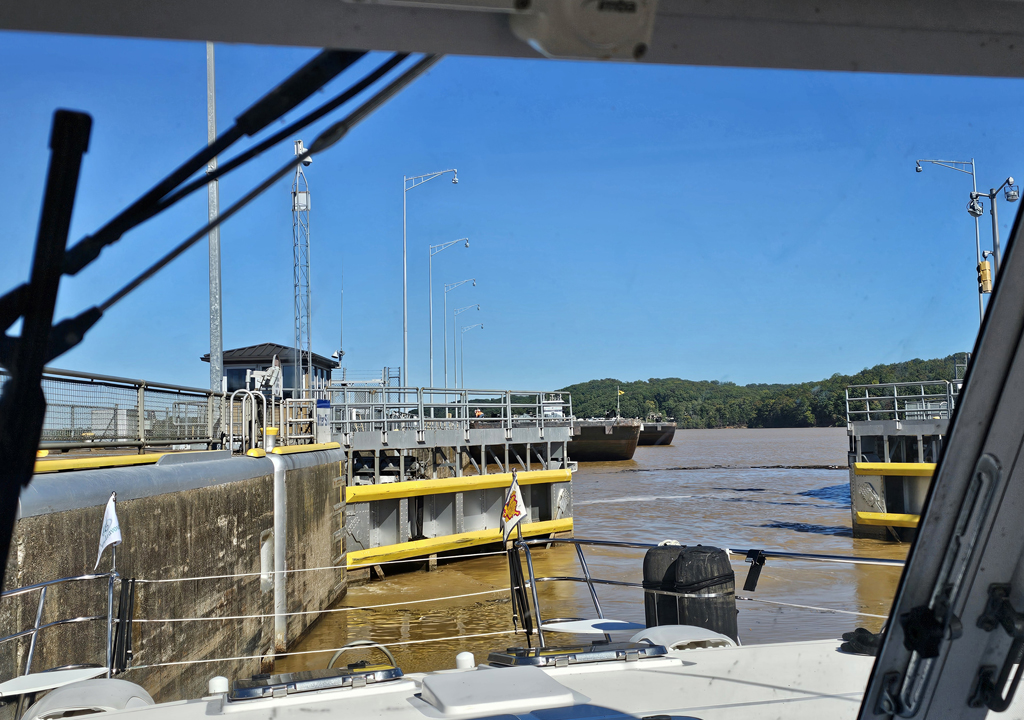
At the last lock of the day, there was a moment when we thought that all the extraordinary measures that we know about and have never had to use, might come into play.  The floating bollard that we were looped to didn’t float!  I was just about to hail the lockmaster when Dick gave the bollard a heavy push and it dropped down, protesting with metallic shrieks, and bouncing up and down a few times before it settled.  Definitely a good reason to have the strong man tending the pin, and what someone recently described as “the little lady” at the helm.  I would not have had either the strength or the reach to get that bollard moving.

Midway Marina is a strange place.  The marina itself is a mixture of very old docks with quite a bit of new wood going in to refurbish.  There are a number of near derelict boats in the slips.  However, there are some new and very attractive guest cabins, a huge, manicured park, and one of the best restaurants of its kind we have visited on the Loop.
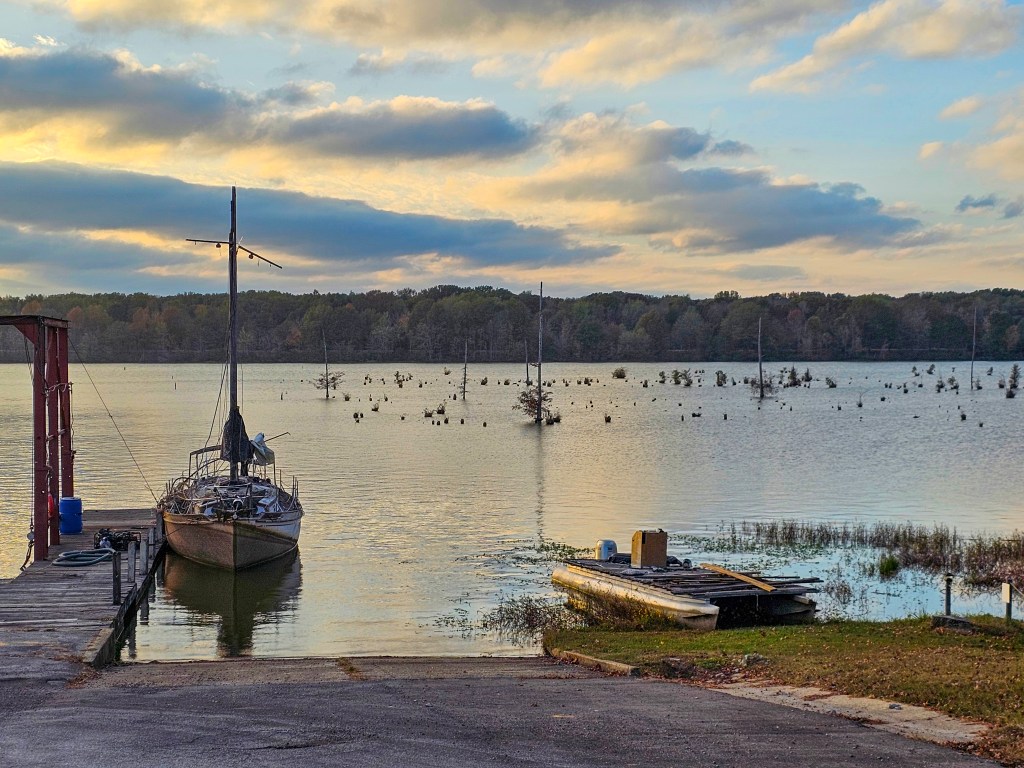
Midway Marina at dusk

We were delighted to find our favourite cheese curds on the menu, and while we were waiting for those delectable treats, we were brought a loaf of delicious bread.  We both ordered Po’ boys, Dick’s was with grilled catfish, while I had fried shrimp.  It was an exceptional meal.
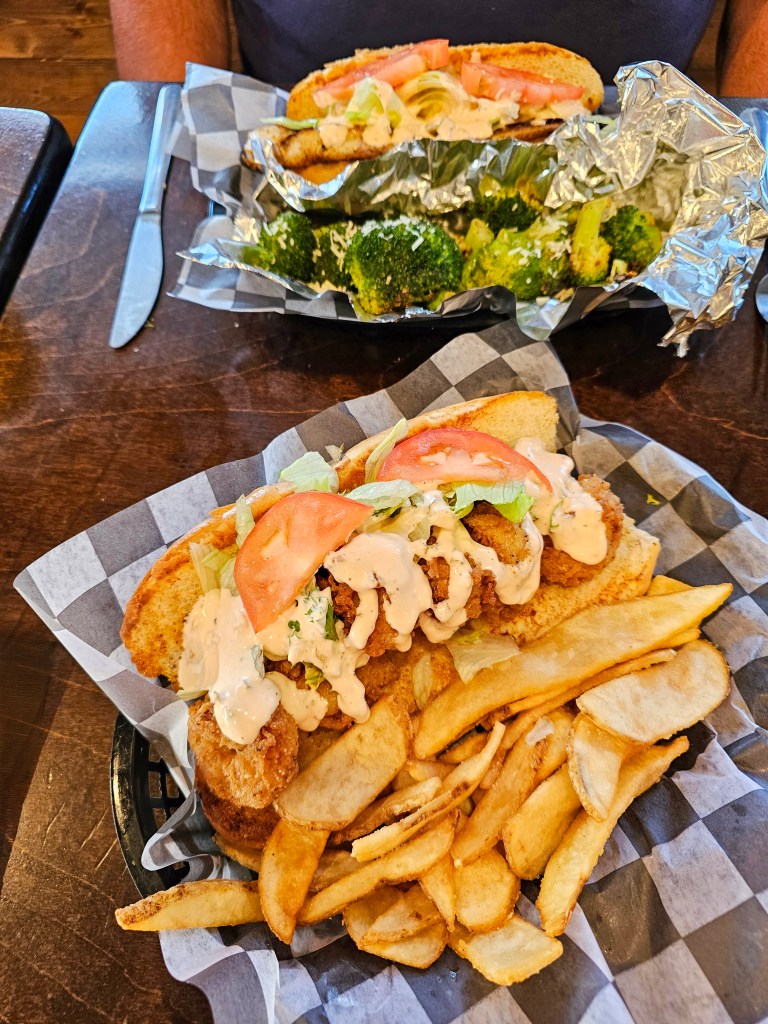
Po’ boys at Midway Marina

Next day was another 3-lock day.  Again, 3 boats were given the go-ahead to be at the lock by 9am.  We were very lucky with the tows (4 of them) as we met them either just before or just after the locks and were able to go through each lock right away.

We soon experienced our second “expect the unexpected” moment in 2 days.  I brought Nine Lives slowly into position at the pin we had chosen, and it suddenly became clear that the bollard had sunk and there was nothing there.  They are recessed in the lock wall, so you can’t tell until you are right beside it if there is a problem.  I had to back Nine Lives up to get to the pin 150 feet behind.  Since I don’t have eyes in the back of my head, it was a tricky maneuver, while Dick pushed off the lock wall and stopped the fenders from hanging up.
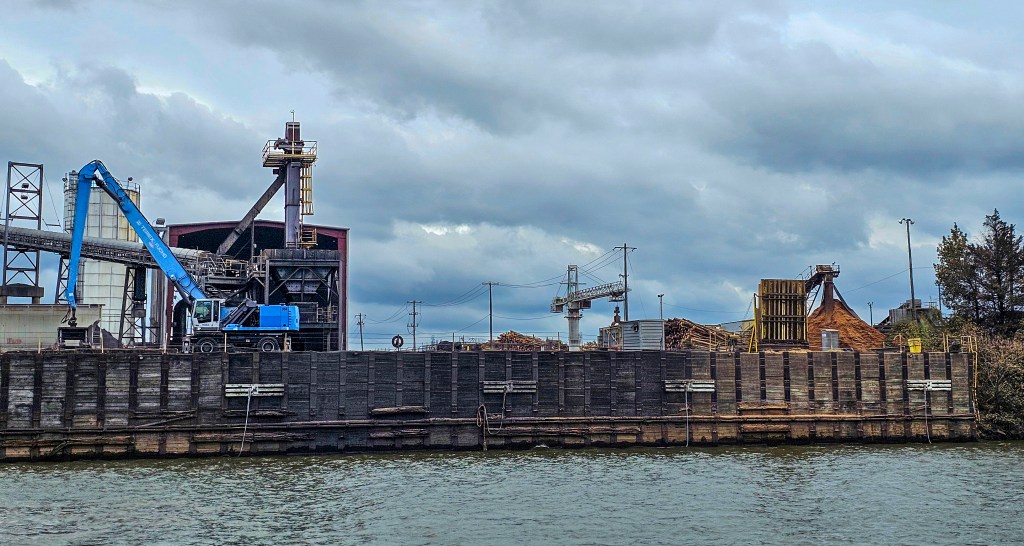
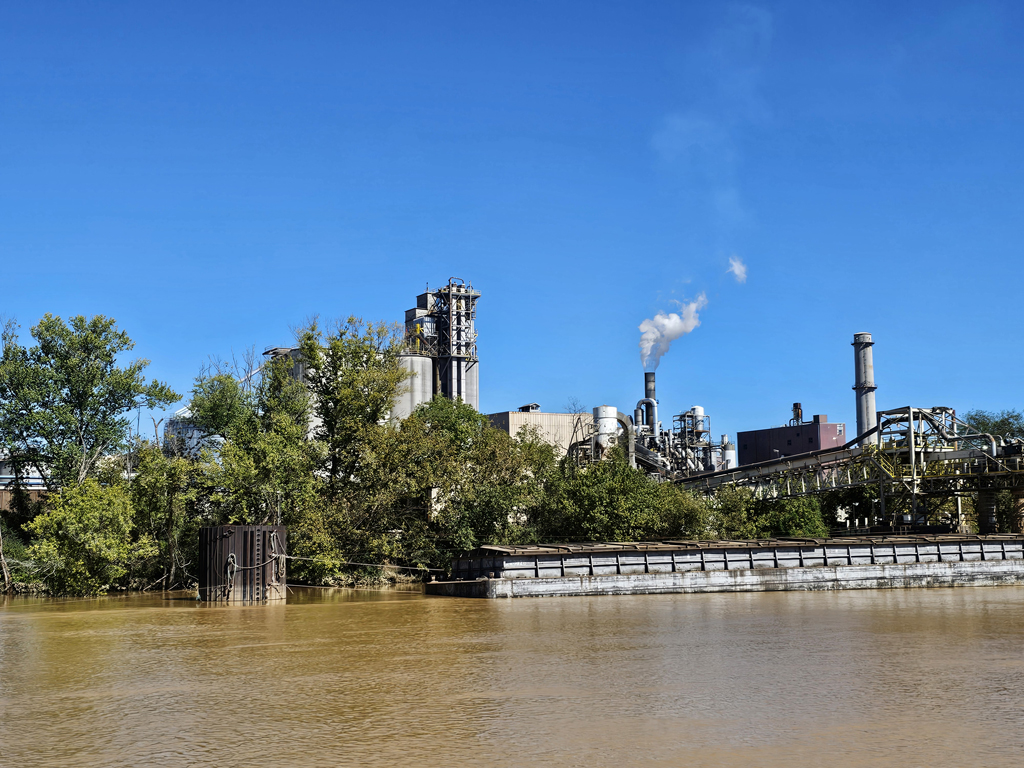
Domtar Chipping Mill at Amory

Our chosen anchorage for that night is popular, but reviews warn of a rocky bottom that means the anchor does not always set.  Usually I can feel it when the anchor grabs, but not this time.  I was not happy about the amount of swinging room either.  Reviews told us to expect 180 degree changes in direction.  I use two anchor alarms, and the one with the shorter radius went off several times.  Between a very slight current, and an opposing light breeze, Nine Lives swung all over the channel throughout the night.  We still don’t know whether the anchor ever dug in, or if just the weight of chain on the bottom held us in place.  Not an anchorage I would return to or recommend.

In East Lake, we passed large and small clumps of water hyacinth. This is a highly invasive species that is choking waterways all over the world.  In the United States it is a particular problem in the southern, Gulf states.  The plants reproduce by stolons, or runners, that create new plants.  The flowers produce thousands of seeds that are viable for up to 28 years.  Mats of water hyacinth can double in size in just one to two weeks.  Once established, the fish and native plants die, and the waterways become choked.  Harvesting the plants mechanically to try to get rid of them is a problem because they are extremely heavy, and then there is the problem of what to do with them once harvested.  Many different methods of eradication and control have been tried, including steam, hot water, acids, spraying with petroleum and setting fire to it, various chemicals, introduction of species of weevils that eat them, and harvesting.  In 1910 it was proposed to introduce hippopotamuses into Louisiana waters as a method of control.  The plan was for the hippos to eat the water hyacinth, and the animals could also be hunted for meat, which was in shortage at the time.  The proposal was lost by just a single vote, or we would have had a different problem in the southern states.  The pet hippos of drug lord Pablo Escobar escaped and are multiplying in the wild in Columbia, dangerous to both humans and the environment.  They are proving to be difficult to cull.  They can be extremely aggressive and will charge and attack small boats.  They also raid farm crops.  The solution to one problem can easily create another, as history tells us again and again.
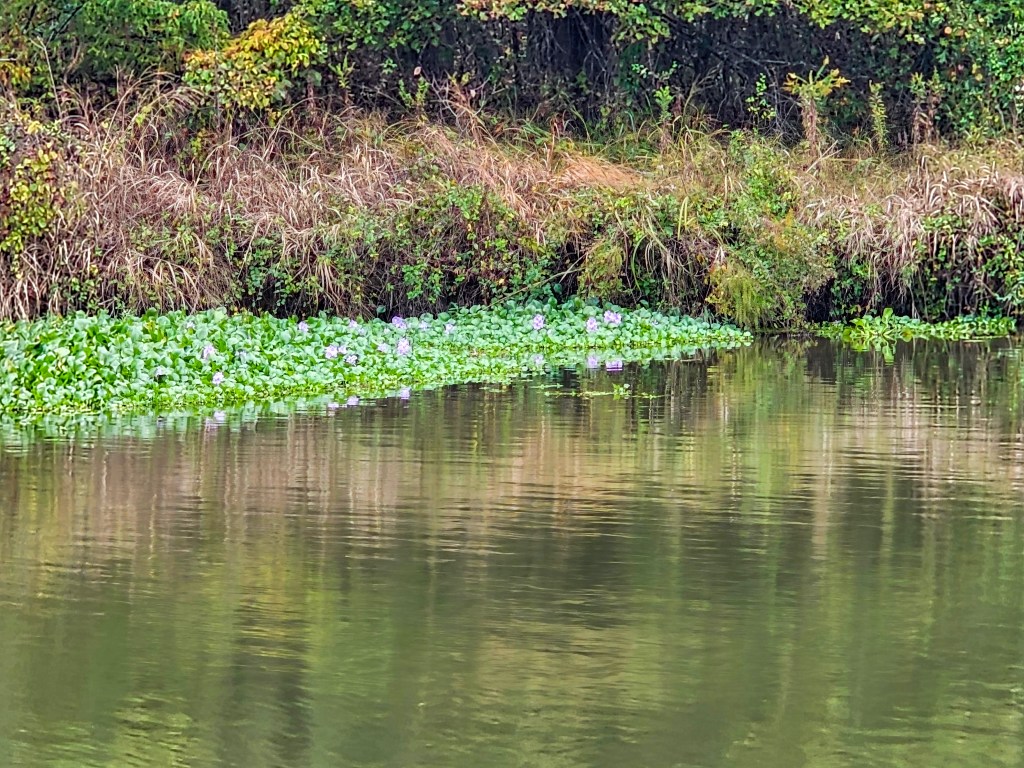
Water Hyacinth

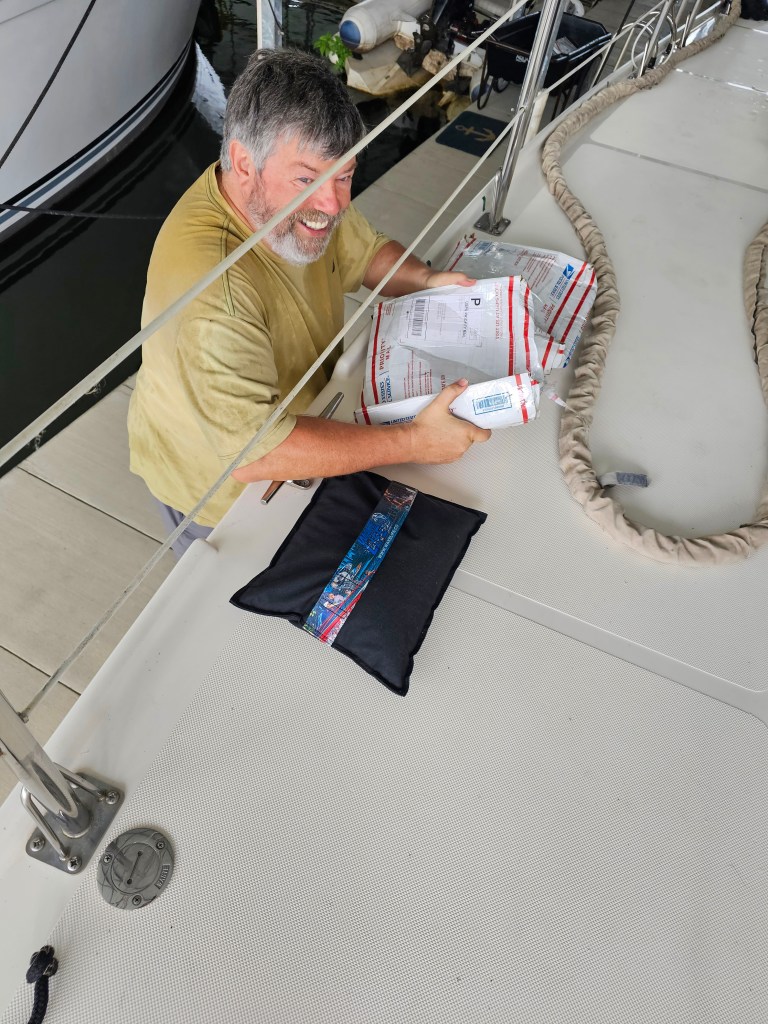
We arrived at Columbus Marina and were tied up by 1:10. It is a popular stop on this part of the Loop, so they have a 2-night maximum stay during this time.  We had hoped for several Amazon packages to be waiting for us, but USPS apparently found it too difficult to deliver on the due date, and did not schedule a second attempt for 3 days.  The next morning, we got the full explanation.  Apparently, USPS in Columbus has decided that any packages that do not fit through the mail slot will be held at the Post Office for pickup.  This information is not conveyed to Amazon (and thus the package recipient).  Then, when someone arrives to pick up their parcel, all the waiting parcels for the marina are handed to them at once.  Another boater had arranged for a Post Office run, and collected our two packages, so the issue was satisfactorily resolved for us.

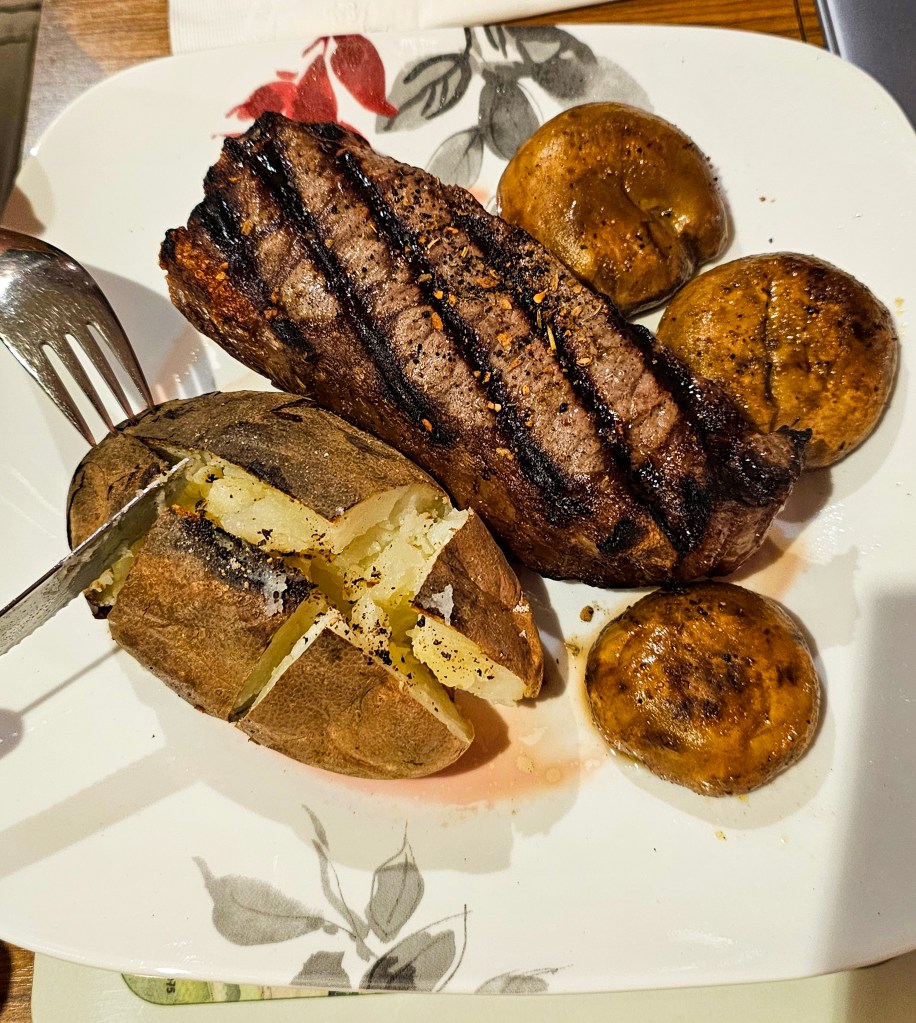
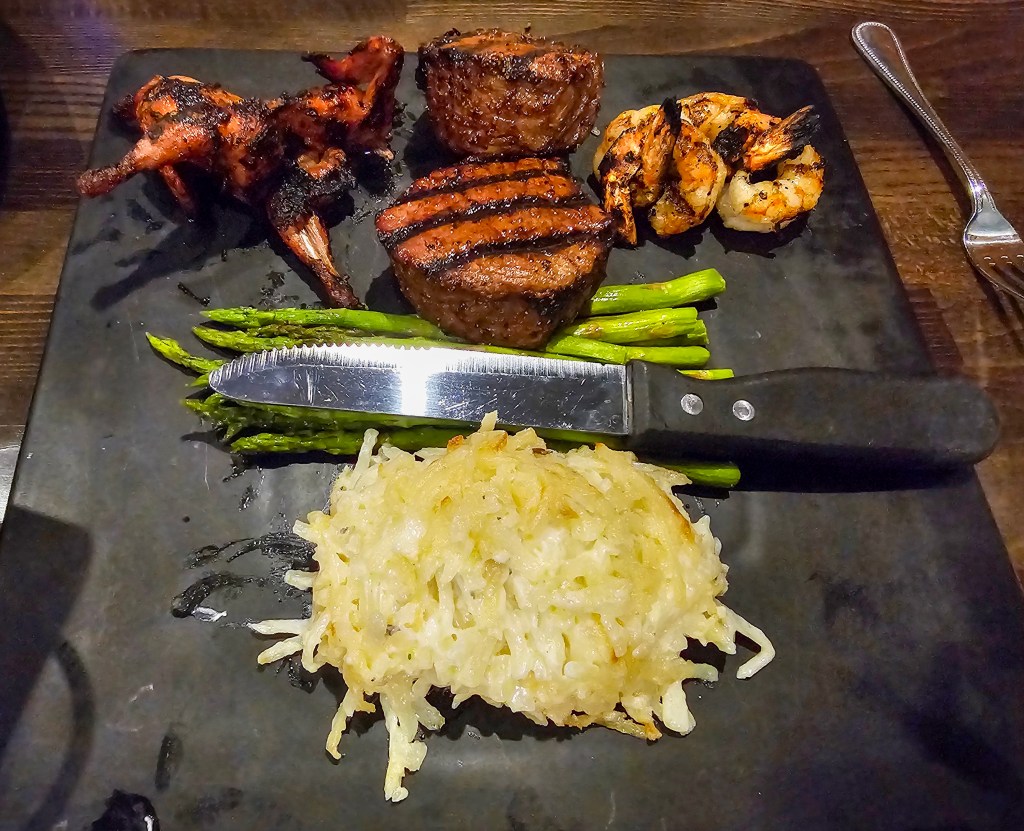
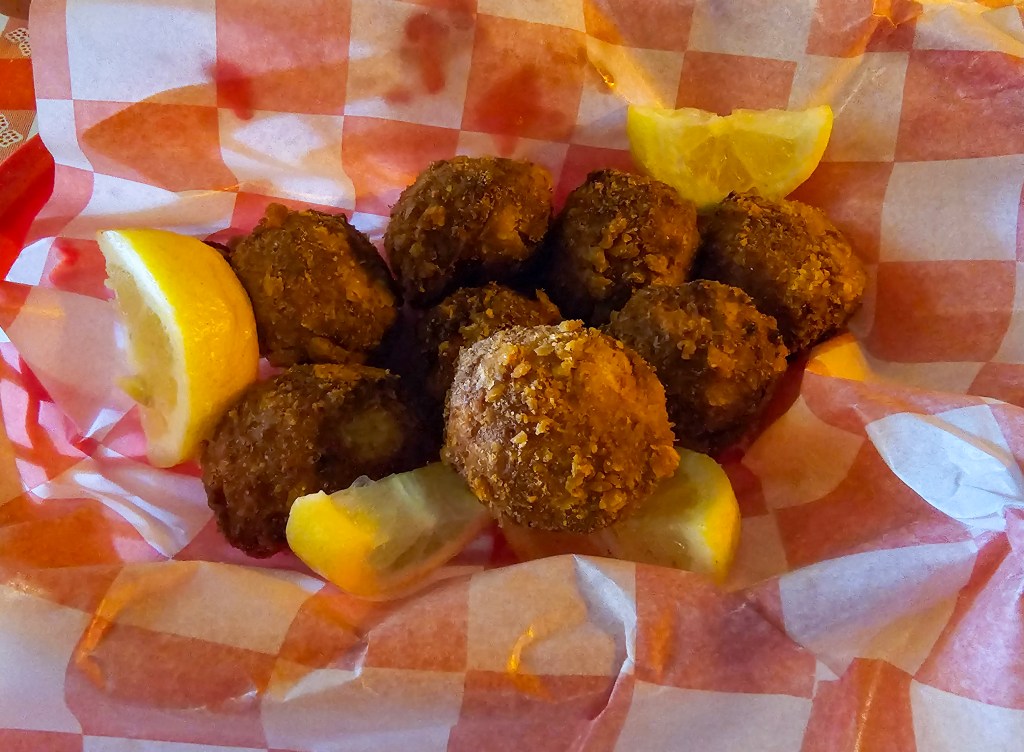
On our first evening, we arranged for the marina courtesy car to take us to a steak house, and made a reservation at the restaurant.  At the last minute, fellow boaters Sandy and Frank from Proost decided to join us.  The courtesy car is quite something.  It has over 270,000 miles on it.  As you drive, there are interesting squeaks and rattles, and after a while the engine begins to make a sort of groaning noise, as if it is about to quit from sheer exhaustion.  However it got us to the restaurant and back to the marina.  Our dinner was very enjoyable, but mainly for the company.  We have decided that food served cold in restaurants in this part of the country is SOP, and we should stop accepting excuses.  The appetizer of deep-fried balls with broccoli, bacon, and cheese were properly hot and tasted very good.  Dick’s prime rib was fine, but Frank’s was cold.  My steak was reasonably hot, but the accompanying shrimp skewer was room temperature at best.  The bowls of grits that Frank and I chose as sides were less than room temperature.  Frank’s beef and the grits were sent back.  By the time they returned, the rest of the food had been eaten.  Oh, and the grits were still just as cold as before.  Meanwhile, Sandy’s wine flight never arrived and had to be removed from the bill.  We really enjoyed talking with Sandy and Frank, and hope that we will have a chance to spend time with them again.  We first met in Florence, some weeks ago, and have been leapfrogging ever since.

Our day in the marina was a chance for me to finish this issue of the blog.  Dick pottered about doing various chores, including a pump out.  Unusually, this marina has in-slip pump out outlets, so you just have to go and find the hose and get the machine started, no need to move the boat to the fuel dock as is usual.  We want to have everything ready before we leave tomorrow, as we will be anchoring for three nights in a row, unusual for us.  Water will have to be used carefully, navy showers for the next three days!

Dick also re-installed the lower supports for the dinghy.  When we replaced the original fiberglass dinghy a few years ago, Dick assumed that lower supports were not required, the dinghy could just hang from the upper supports because it is so much lighter than the original.  Also, he had seen that most other boats with such a configuration have the dinghy hanging from the upper supports.  We have noticed that when it is rough, or we cross a large wake, the dinghy swings wildly from side to side, to the extent that it nearly came off when we went through the turbulence at Ft Louden Lock. After reading on the Endeavourcat forum that the lower supports actually serve two purposes, Dick decided to put them back.  In addition to helping with sway, the lower supports allow the dinghy to slide past the swim platforms when it is being launched, requiring a lot less manual intervention (that is, heaving it about). I do remember that those supports used to behave in odd ways, engendering a fair amount of cursing, but perhaps they will not be quite so annoying with the new dinghy.
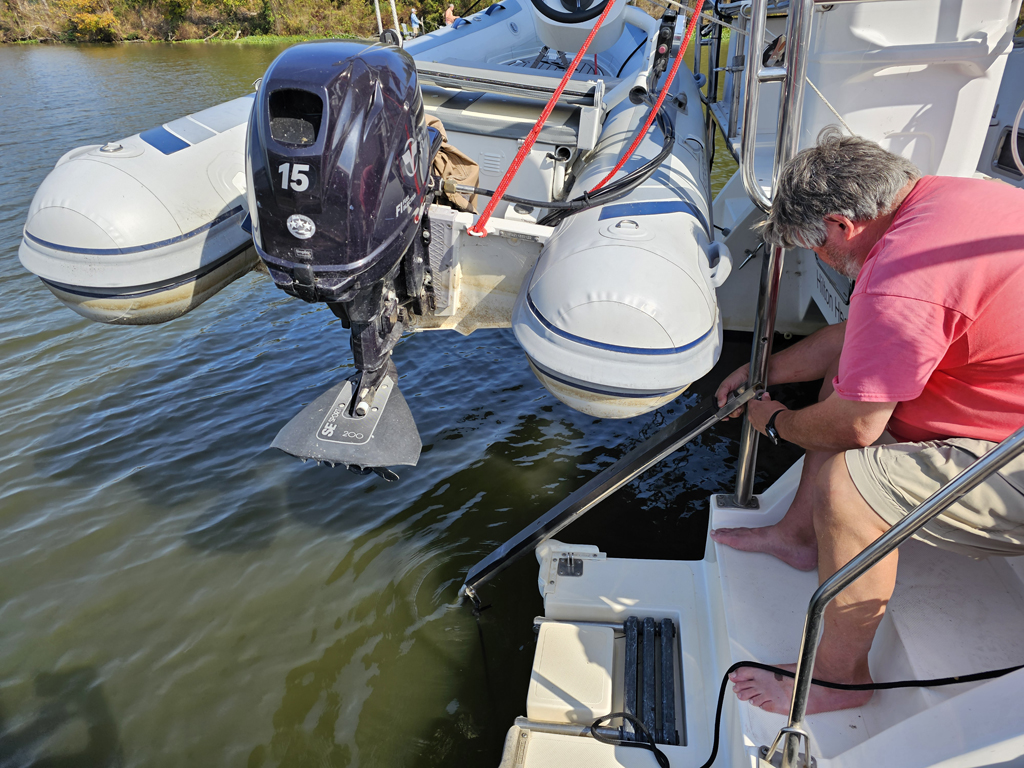
Restoring the dinghy supports
Nine Lives Voyage for October

October 2nd  to 16th, 2024: Chattanooga to Tellico Lake and back to Scottsboro

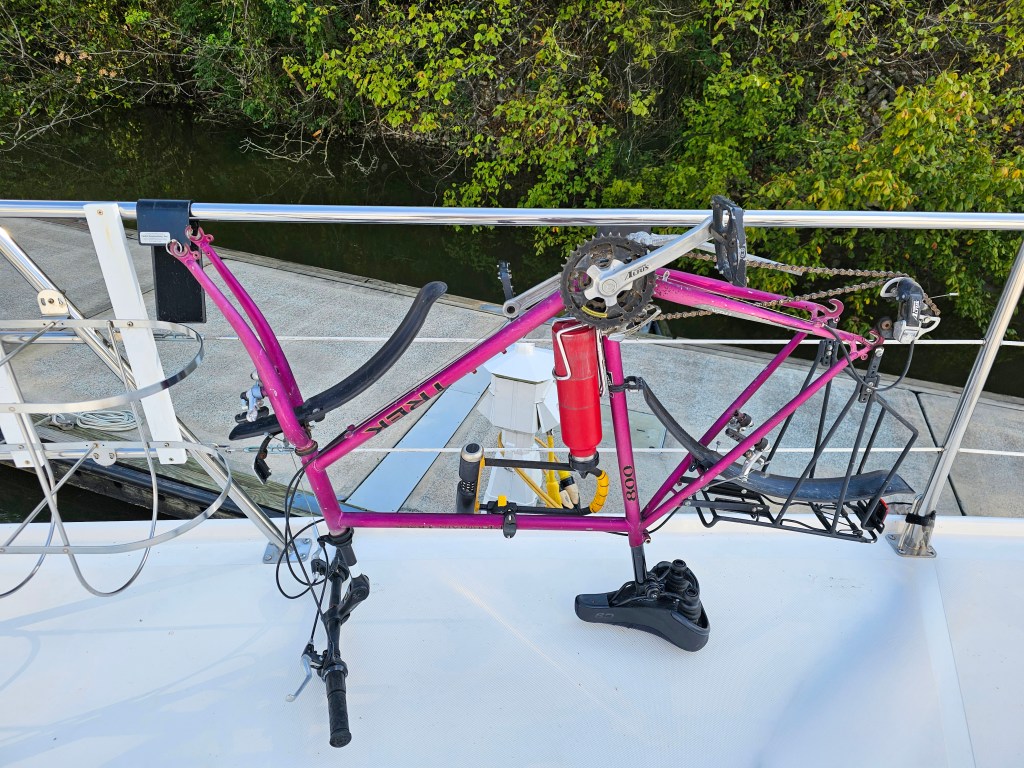
The last installment ended with something of a cliffhanger… would Dick’s bike disappear from the place he had locked it to the railings?  Well, no, the bike was still there the next day when Dick went to get it to go for a ride, however, important components were missing, namely wheels.  It had occurred to him at some point that perhaps he should lock said wheels, which have a quick release mechanism, to the rest of the bike, but he didn’t.  Fortunately, there is a Trek dealership within walking distance of the dock.  Yes, he could get the wheels, but they would have to be ordered.  We had already planned to stay much longer in Chattanooga, so arrangements were made to rent a car.  Of course, it is somewhat ironic that while the bike is about 30 years old, the wheels had been replaced just a few months earlier after an unfortunate encounter with a tourist’s vehicle in Hilton Head.

Oh dear!

After one of Dick’s special breakfasts, we set out to collect the rental car.  The depot was very close to the end of the electric bus line.  We went to the supermarket and stocked up on the heavy stuff that is less easy to transport by bike.  Parking in Chattanooga is inexpensive, just $11 per day.  There are lots of multi-storey car parks, including the one with the beautiful lighted façade that is nearest to our dock.

I am impressed by how clean the city is.  Unusual for an American city, especially one with such a large homeless population.  The electric buses are clean inside, no trash on the floors, and while I see people leaving rubbish on the ground under benches, it is always gone by the next day.  An army of cleaning fairies must be deployed around the city every evening.  Even the area under the bridge is kept relatively tidy.

A new improvement for Nine Lives. When we are staying in a marina for a few days we can now hook up to mains water and not have to keep filling the tanks.

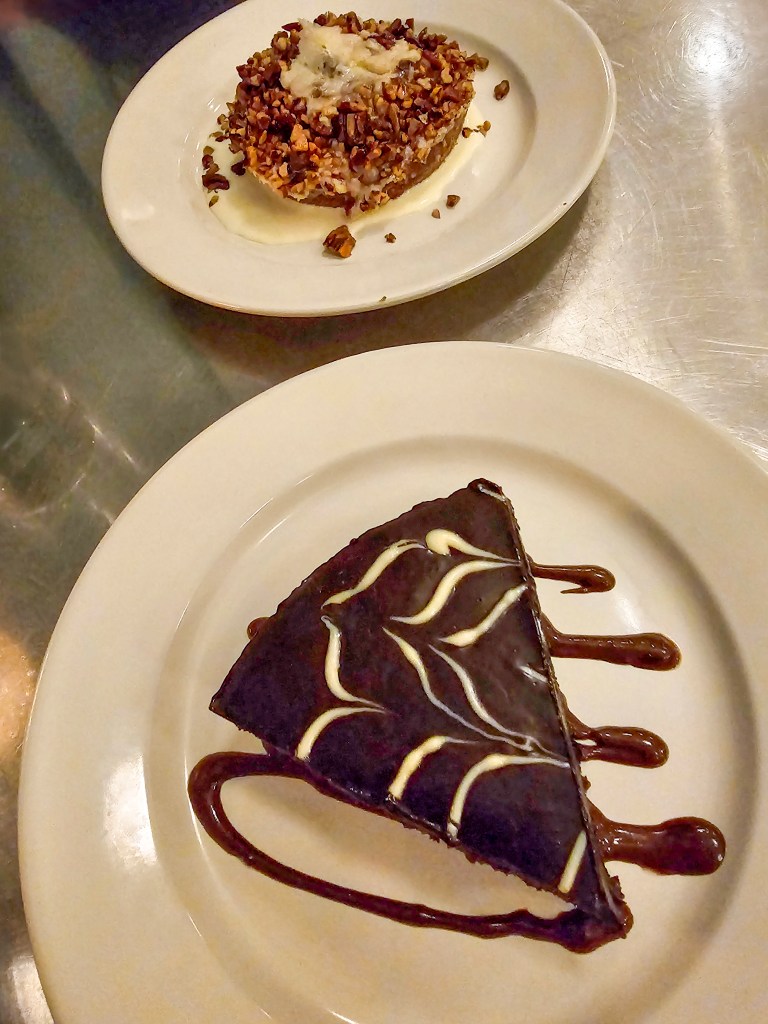
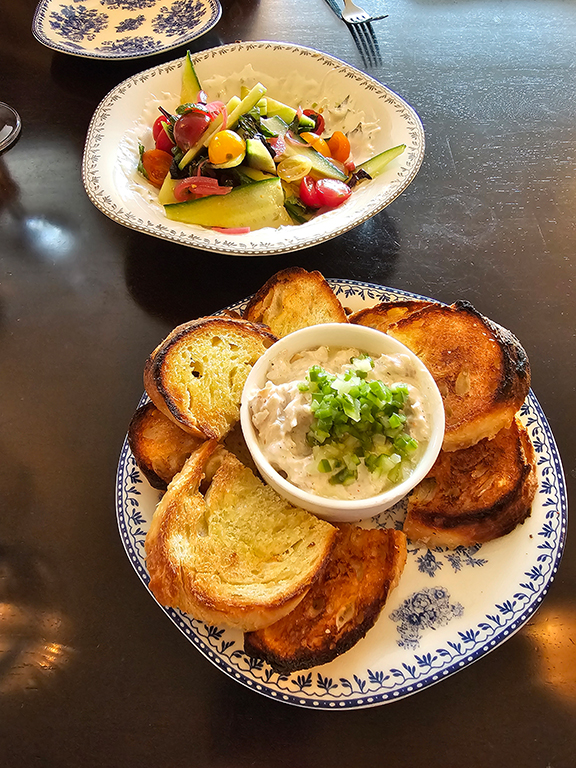
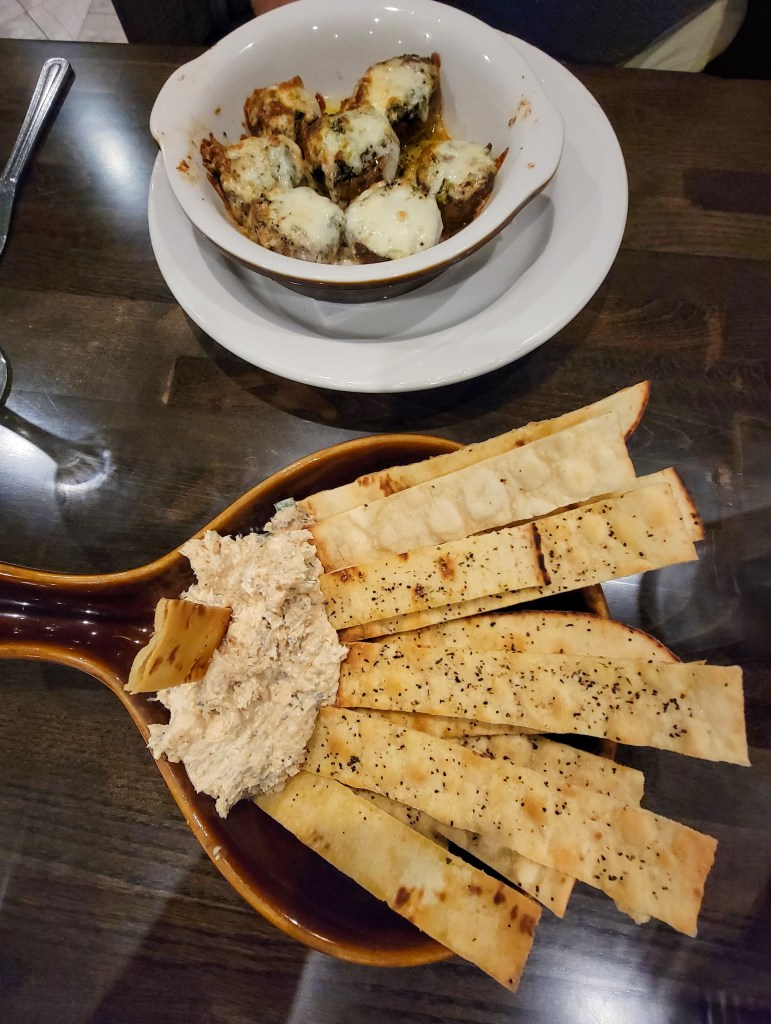
We ate at a restaurant called Public House.  The smoked trout dip was tasty, but it came with incredibly hard toasts and rather too many crudites for my preference.  It made a good lunch for Dick later!  The pot roast was excellent, and I had the best shrimp and grits I have ever tasted.  Desserts were very rich, but altogether it was a good meal.

Desserts at Public House, Chattanooga

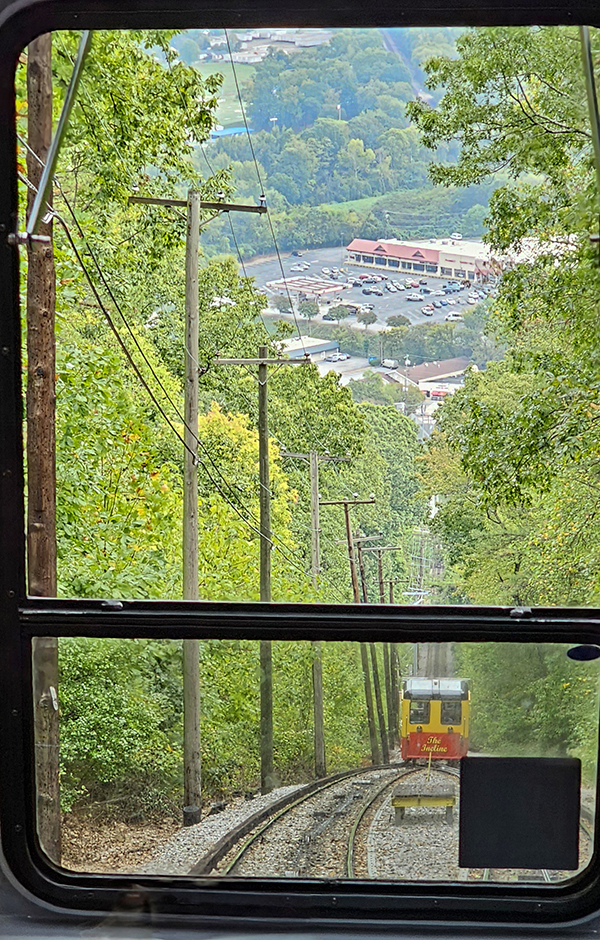
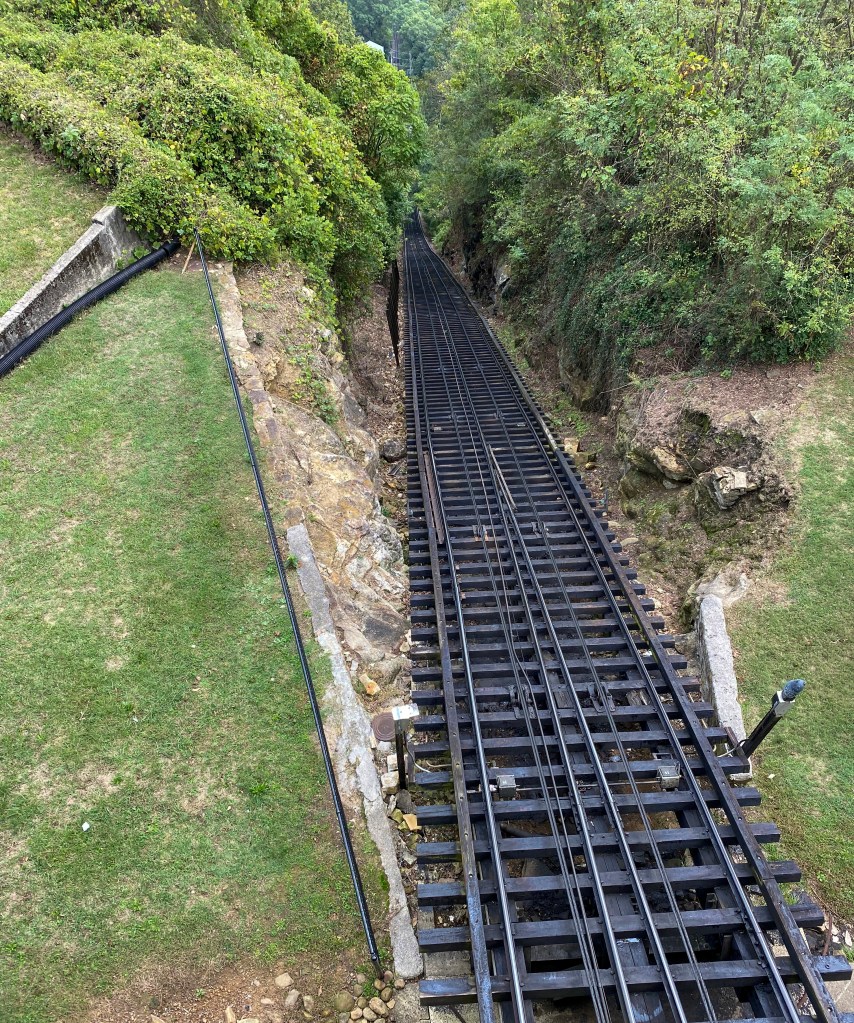
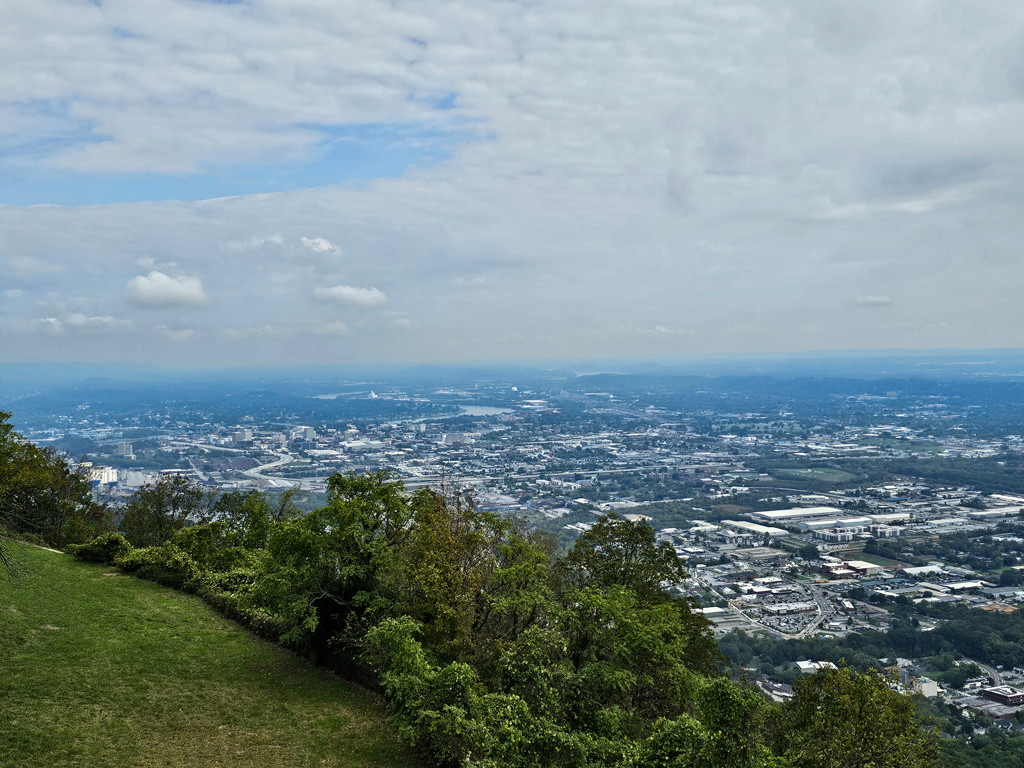
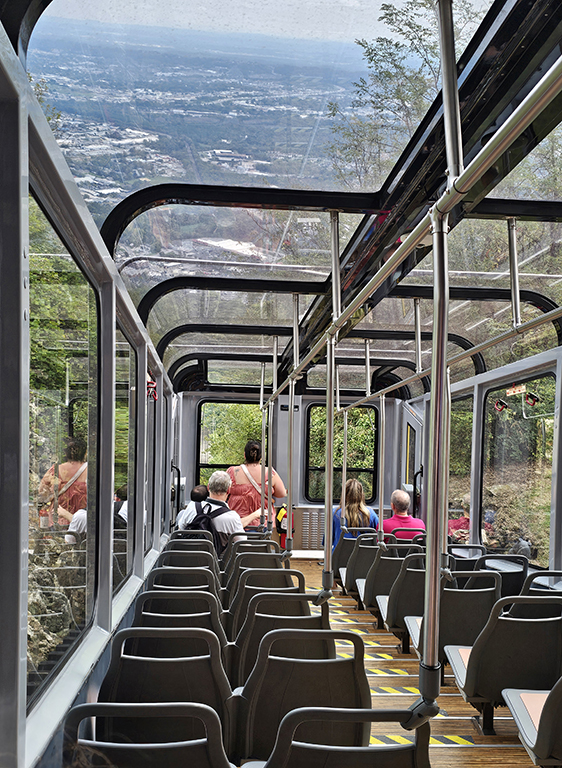
The next day we took a morning trip to the Incline Railway on Lookout Mountain.  It was cloudy, and too hazy for the really spectacular views, but it was an experience.  The railway is about a mile up the side of the mountain, with a maximum grade of 72.7%.  It is one of the steepest railways in the world.  I do not like heights. About 2/3 of the way up, I said to Dick, “The things I do for you!”  The lady in the seat ahead of us immediately said, “Oh I know what you mean!”  After we returned from the adventure, we stopped at Ben & Jerrys for ice cream.

Incline Railway on our way up
Incline Railway looking down the track from the top (Dick had to take this one!)
The machinery of the Incline Railway
The view from the top of the Incline Railway
Incline Railway return

Another Looper arrived in the late afternoon, so at last we were not the only boat on the dock.  They joined us for our planned visit to a rooftop bar called “Whisky Thief” in a nearby hotel.  The public areas of the hotel have beautiful, fascinating artworks on display, and Debbie and I would have liked to have had more time to study them.  The bar was quiet when we arrived, but grew increasingly noisy and crowded as the evening progressed.  The menu is limited to QR codes or, find the bar’s website online.  While they serve flights of various whiskeys, you have to keep going back to your phone to figure out what you are drinking.  Instead of a flight, I had a bourbon that we had enjoyed last year when we tried a (properly labelled) flight in a restaurant in Louisville.  We enjoyed the congenial company and will look forward to seeing them again at Rendezvous.

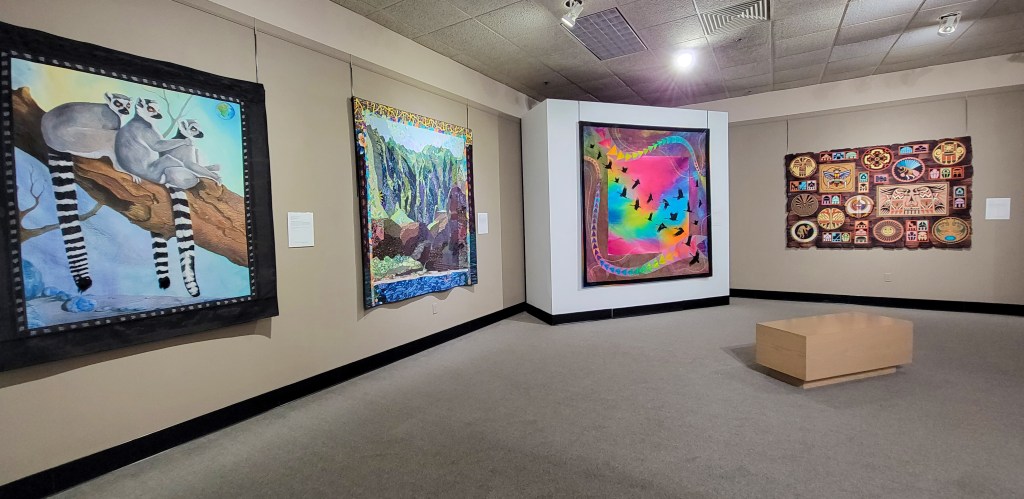
One of the beautiful artworks in the Edwin Hotel
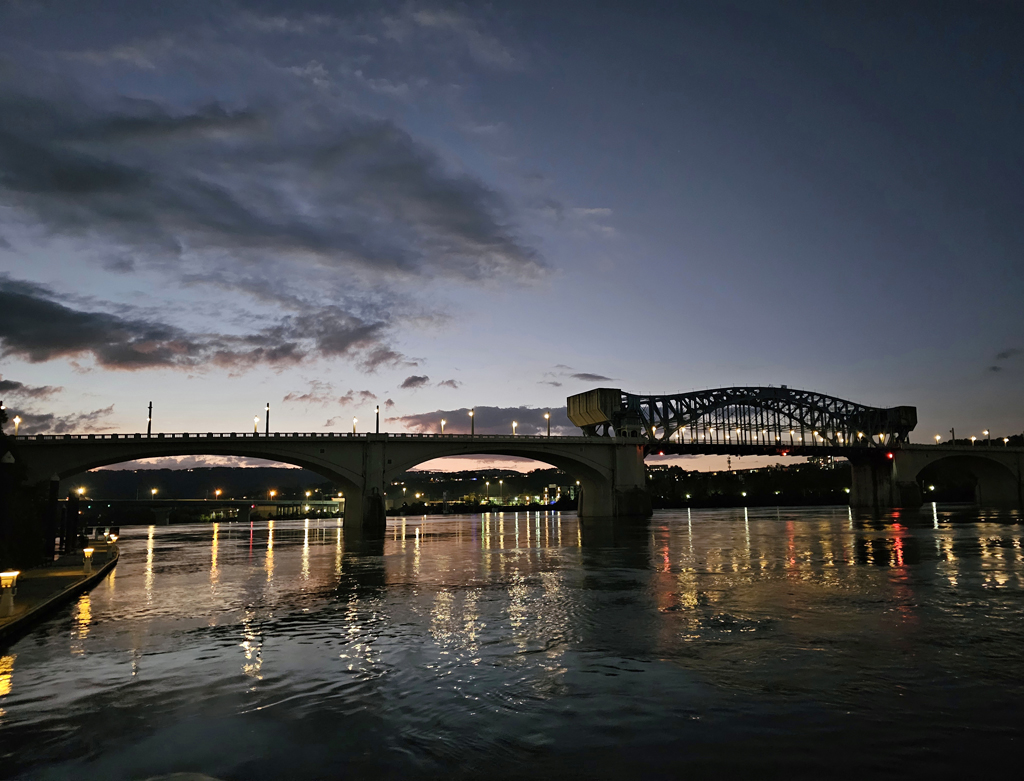
The Tennessee River at night, Chattanooga

The next day, after working on the Rendezvous presentation all day, we were glad to go out and walk to the second of the top steakhouses in Chattanooga.  There was a bluegrass festival in the waterfront park, but it was very hot and crowded, and the music was not really our taste, although we do enjoy some bluegrass.

Dinner was quite good, with excellent service, but the ambiance was more like a large cafeteria than an expensive steakhouse.  It was very noisy and crowded, and most of the patrons were dressed for the outdoor festival.  Although the water had receded and uncovered the downstream walkway to our dock earlier, when we returned it was up again, resulting in wet shoes and socks.

Hennen’s Steakhouse starters
Hennen’s Steakhouse steaks for both of us

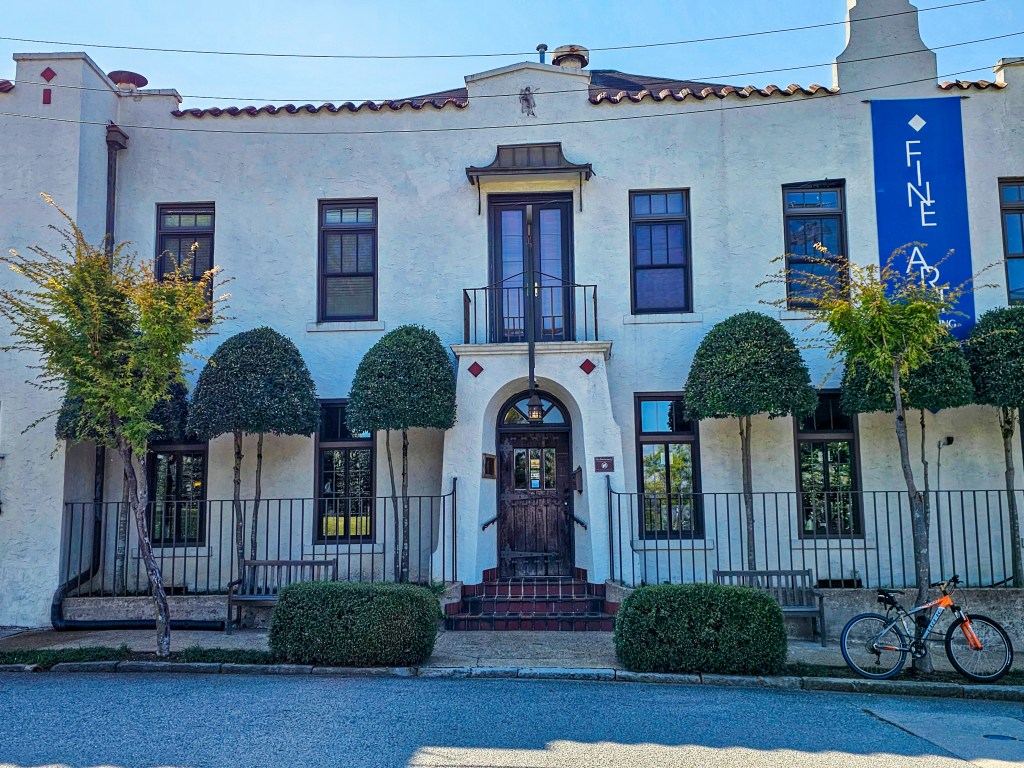
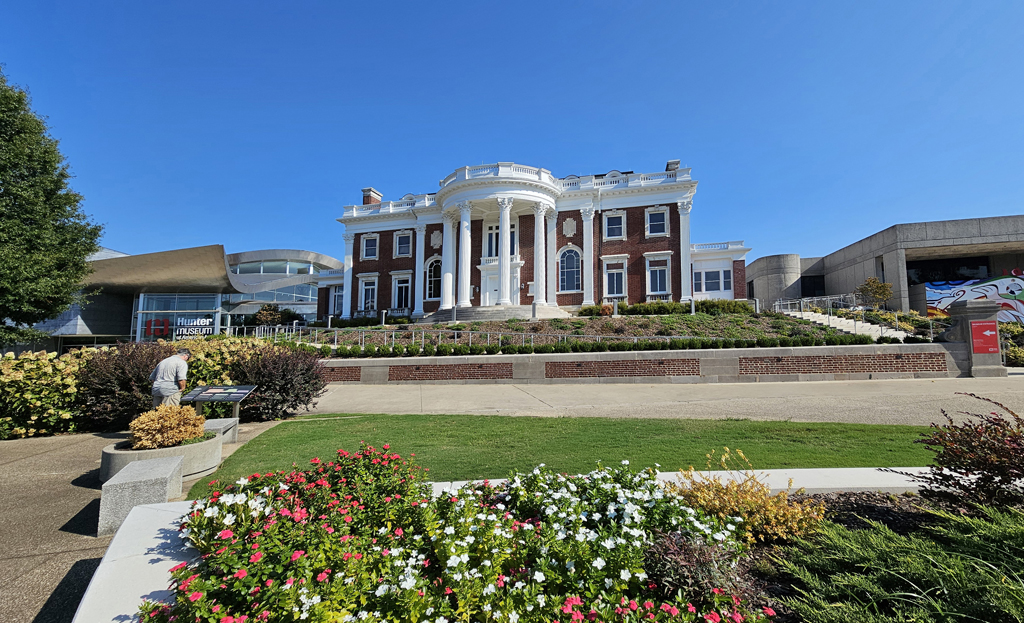
After another of Dick’s special breakfasts, we set off for some sightseeing.  I had found what was described in glowing terms as an art enclave with shops, galleries, an artisan bakery, and restaurants.  It was certainly an attractive area, but one of the galleries had limited days, and the other was not yet open on a Sunday.  No shops, and the artisan bakery was just pastries sold out of a coffee shop with a queue of at least 30 people.  Apart from the coffee shop, there was just one restaurant that we had been told was not very good.  So, we walked back to the Museum of American Art.  You could have knocked me over with a feather when Dick told me that was actually our destination for the morning.

Chattanooga Bluff View Art District

Of the temporary exhibitions, one that featured art glass had just finished, we would have loved that.  Instead, there was an exhibition of graffiti.  Yes, the stuff that vandalizes public and private buildings and street furniture.  Dick walked around it, I didn’t.  Afterwards, Dick’s comment was that while he recognizes people’s right to express themselves, and even the talent of the artists, he totally objects to the defacing of public and private buildings, spoiling someone else’s architectural, engineering, or design efforts.

The permanent exhibitions were more interesting, spanning American art from the 1700’s to contemporary.

The Museum of American Art, Chattanooga
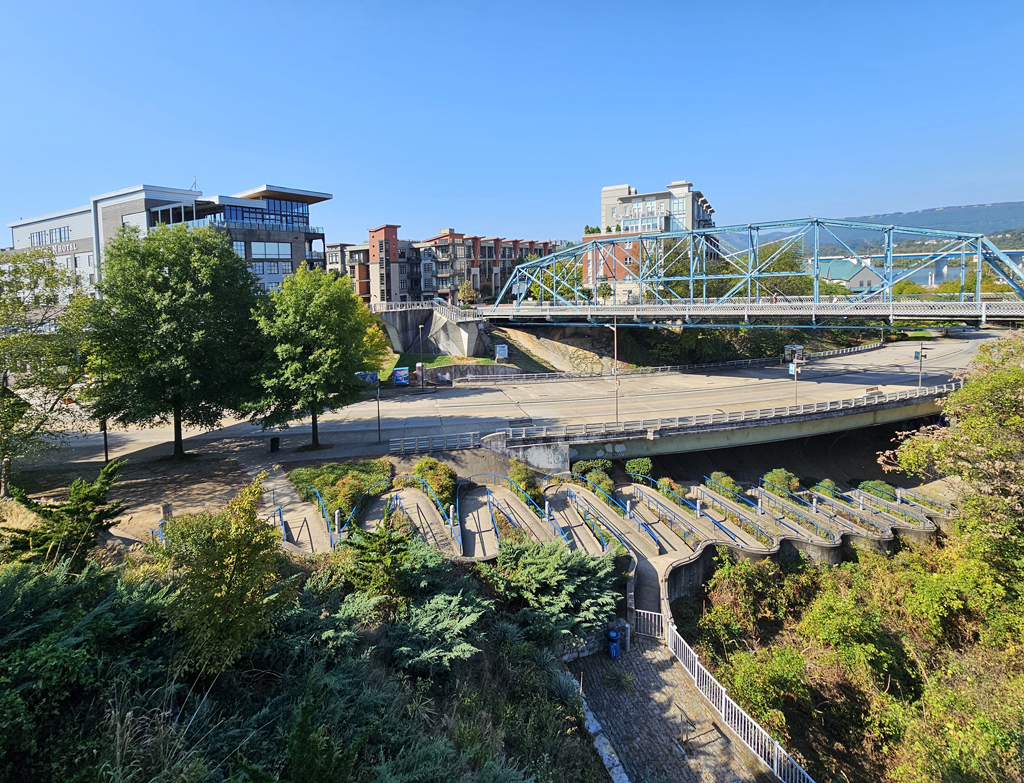
Chattanooga’s Walnut Street pedestrian bridge over the Tennessee River
The Zig Zag Walkway is an alternative to climbing one of the steep staircases up from the river

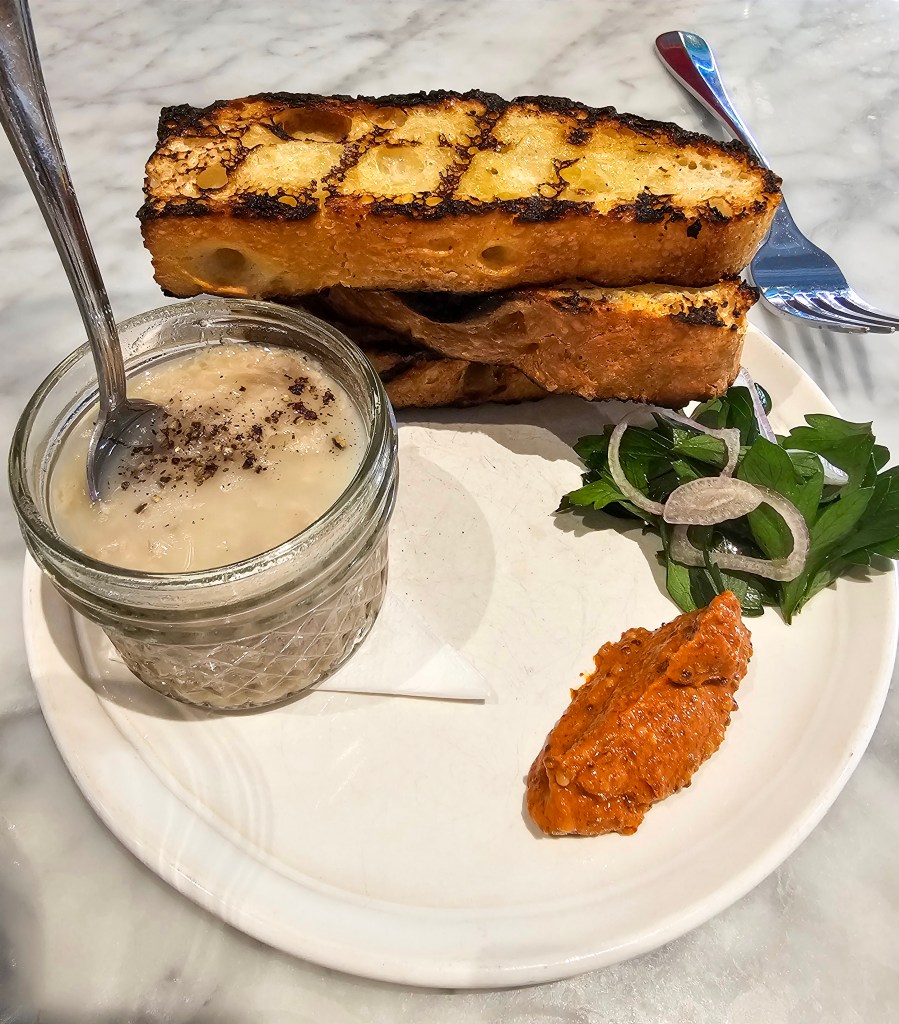
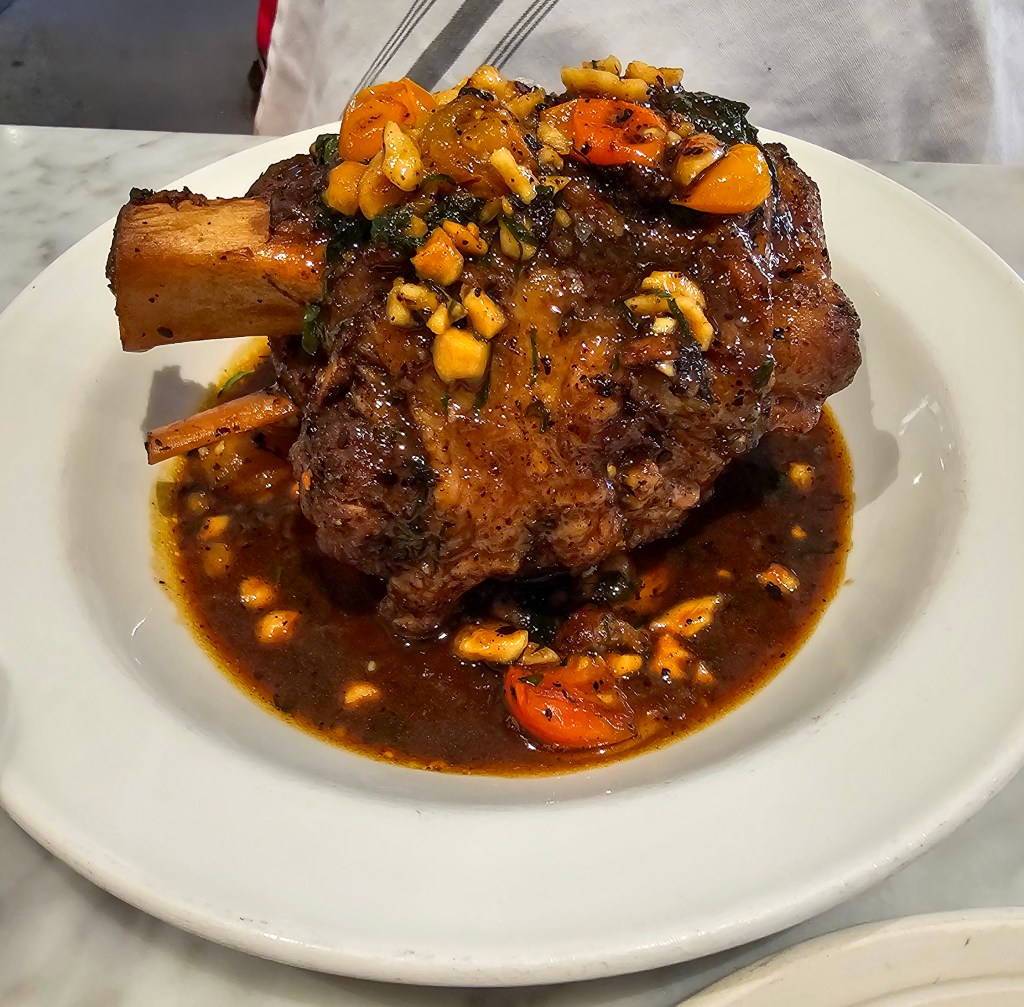
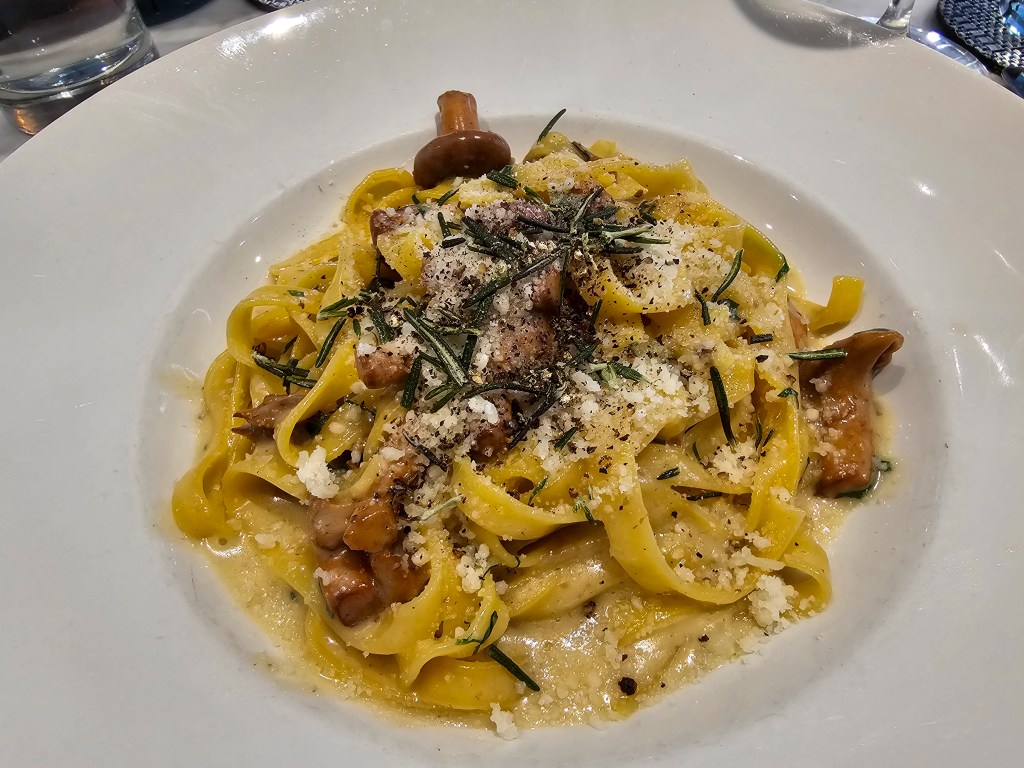
We went to Easy Bistro for an early dinner.  The venue was a surprisingly authentic French style.  I enjoyed the meal, quite unexpected, since there was so little on the menu for me to choose from that I ended up with a side dish as a starter.  Dick was in heaven, and had difficulty choosing from so many unusual options.  He settled on the rabbit rillettes, followed by pork hock, and profiteroles to finish.  My mushroom tagliatelle was very good, and worth taking home.  (and we remembered to take it, unlike the previous evening when we left the beautiful steak leftovers on the table by mistake).  The first glass of wine let me down.  I usually enjoy a Loire Valley white wine, but this one was awful.  It also happened to be the cheapest on the menu.  Dick’s comment, “The French hated it so much they sold it cheap to get it out of their country…”

Rabbit Rillettes with Garlic Toast at Easy Bistro
Pork Hock at Easy Bistro
Mushroom Tagliatelli at Easy Bistro
Profiteroles at Easy Bistro

We left early the next morning so we could go back to the fuel dock and take advantage of the excellent (and free) pump out machine.  We were properly underway before 9am, but there was a delay at the lock for a pleasure boat to lock down.  There are very few tows on this part of the river system, particularly given the delays at Wilson lock.

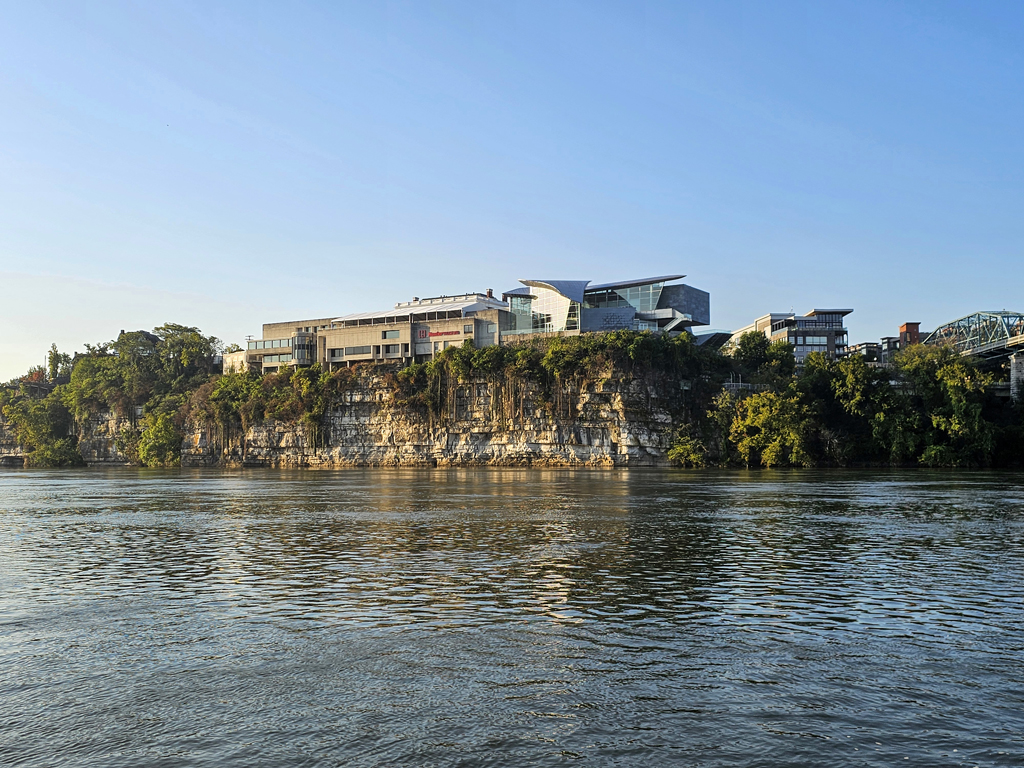
American Museum of Art from the river

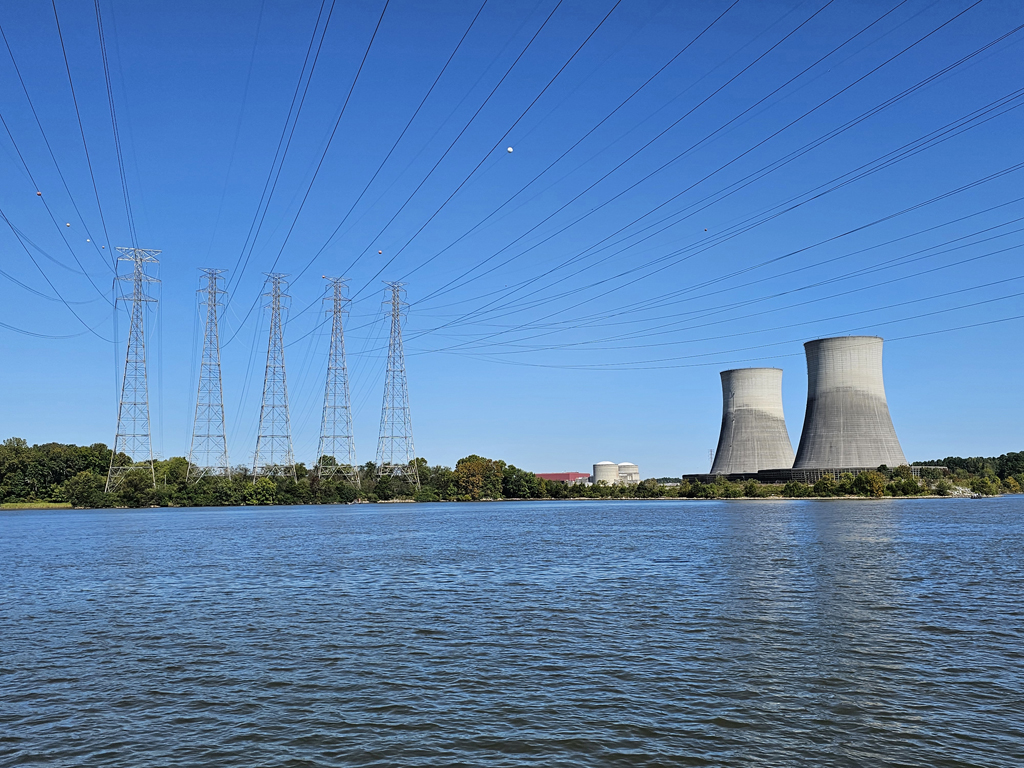
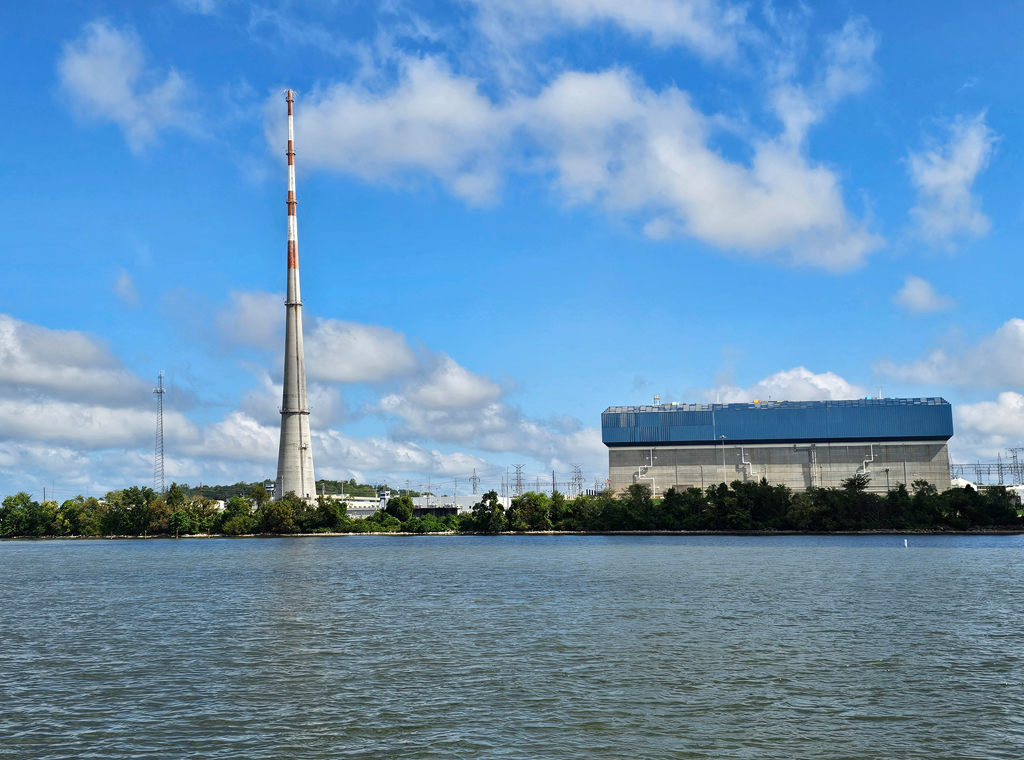
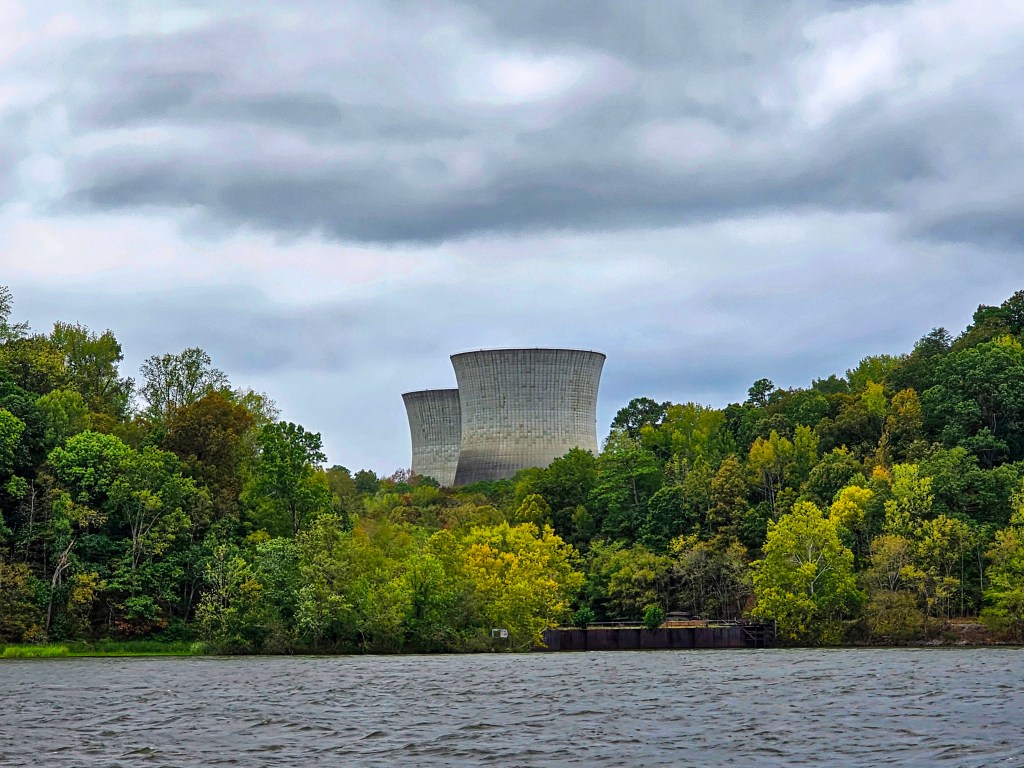
We passed the Sequoyah Nuclear Plant.  This plant, and its sister plant at Watts Bar, has a special system that uses borated ice to help condense the steam in the case of a loss of coolant accident.  The system allows for a smaller containment building.  The reactor cooling water at the Sequoyah plant is mostly pumped into the Tennessee River at a rate of a million gallons per minute.  A maximum rise of five degrees F is allowed in the river as a result of releasing the cooling water.  Once the maximum is reached, the big cooling towers are used to provide the required extra cooling.  On both occasions that we passed there was no steam coming from the towers.  We noticed that the area is popular with fishermen, so the fish must like the warmer water too.

Sequoyah Nuclear Plant, Lake Chickamauga

Sequoyah was a Cherokee polymath.  His most well-known achievement was the creation of a Cherokee syllabary, enabling the Cherokee language to be written as well as spoken.  Within 25 years of adoption of the syllabary, the Cherokee Nation had almost 100% literacy.  Many things have been named after Sequoyah, including the giant trees in California, a mountain in the Great Smoky Mountains, and a yacht that was formerly used by American Presidents.

That night we stayed at a fellow AGLCA member’s dock on Lake Chickamauga.  They have built a beautiful house above the lake with stunning views.  Their boat is elsewhere for repairs, so Nine Lives was made welcome.  We enjoyed refreshments and nibbles and the wonderful views from their balcony.  Later we returned the hospitality with docktails on Nine Lives.

We saw our first Bald Eagle this trip on Chickamauga Lake
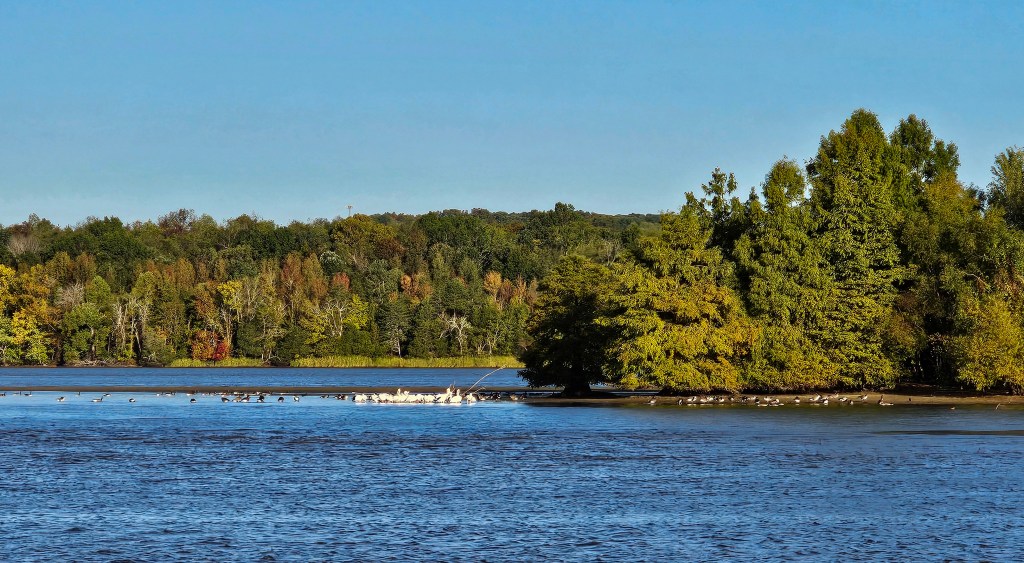
Autumn colours and pelicans

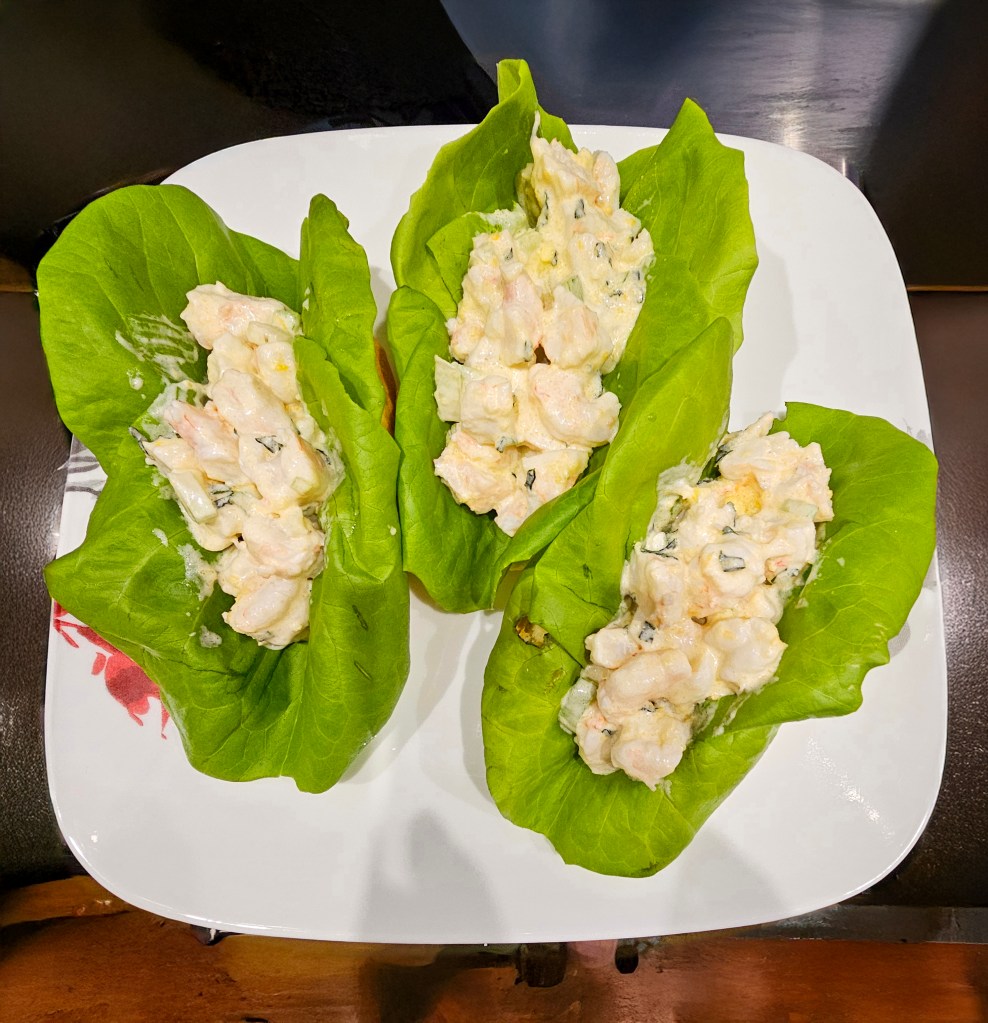
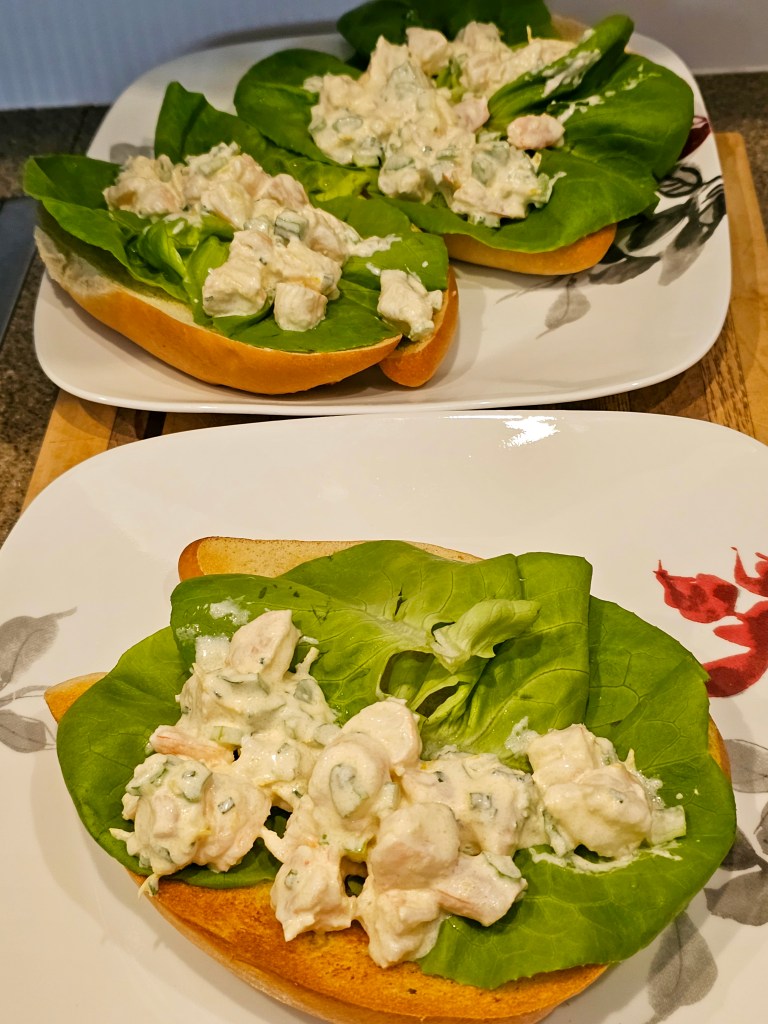
On October 8th we got an early start, expecting an 8-hour day, but the lock was ready for us when we got there, so we didn’t lose much time.  We were in the marina by 3:30pm in spite of a strong current against us.  The staff asked us to arrive before 5pm, so they could help us tie up, but after detailed instructions by phone for finding our slip, there was no help in sight.  Usually, this is just as well.  Not only does it save tipping a dockhand, but we do better ourselves.  This time it was a little more tricky than most because of very small cleats that are hard to keep a line around.  The onsite restaurant was closed for the season, so we had planned for shrimp sandwiches on board.  This year, instead of relying on frozen shrimp from the supermarket, some of which has been so awful it had to be thrown away, we bought several 1- and 2-lb packages of wild caught shrimp from Hudson’s in Hilton Head.  What a difference in flavour and texture!  Of course, it does mean that for shrimp sandwiches I have to cook them first, but the result was well worth the extra effort.

Shrimp sandwiches

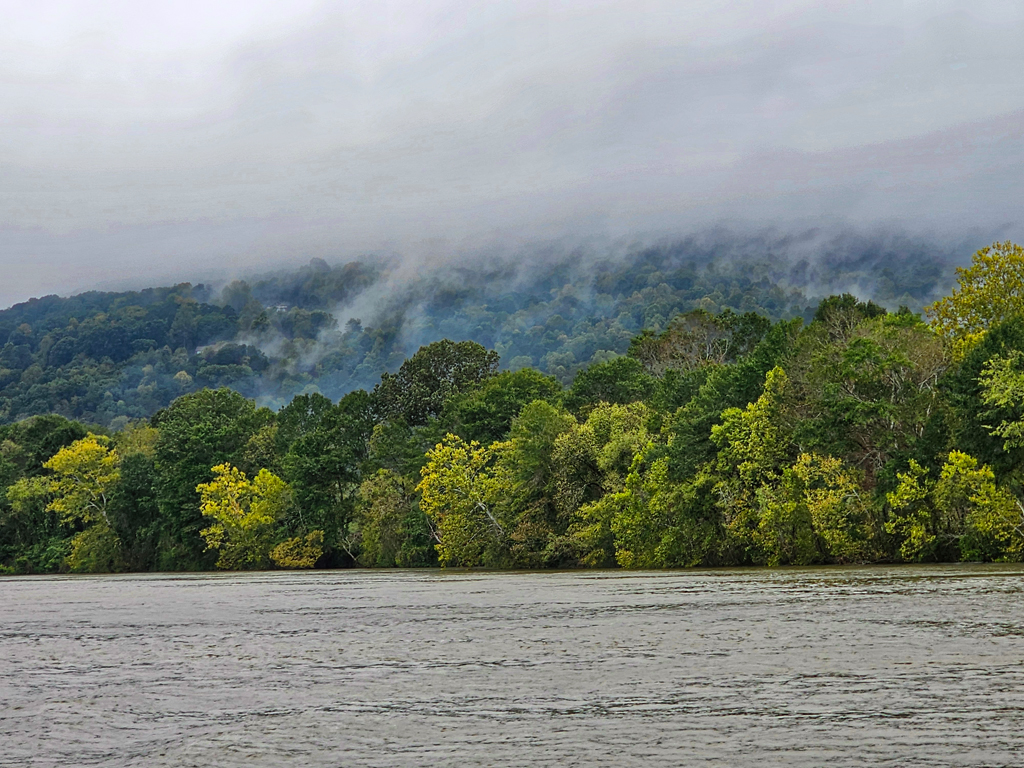
We now have wonderfully cool nights and chilly mornings.  Long sleeves are good to start, and I am starting to think about the gloves that I have packed away somewhere that have full fingers.  We are beginning to see pretty fall colours and mist on the water in the mornings.

We passed under Interstate 75.  This highway starts at the Canadian border in Sault Ste Marie, and links Detroit, Cincinnati, Lexington, Knoxville, Chattanooga, Atlanta, Tampa, and Miami.

Passing under Interstate 75

In Loudon, about a mile of the riverbank was taken up by the Primient factory.  This plant used to be the familiar Tate & Lyle, but it was rebranded following ownership change.  Most of the factory is screened by trees from the river.  The smell is strong, and not particularly pleasant.  We thought we would not like to live in any of the houses across the river that must have the smell with them all the time.  Corn is delivered and turned into a variety of products including high fructose corn syrup, and fuel ethanol.  Something about those products being produced in the same facility….

Primient Plant, formerly Tate & Lyle, at Loudon
Fall colours on Watts Bar Lake
A farmhouse on Watts Bar Lake with the Smoky Mountains in the distance

A day that was a mix of interesting shoreline and long boring stretches became far more exciting than either of us liked.  Ft Louden lock was our last upbound lock on the Great Loop, and it was a doozie.  When we were about 30 minutes away, Dick made his usual polite phone call to ask about the queue, and request a lock up.  The lockmaster explained that he was about to lock down a tow that would take 8 hours, but that if we could get there within 20 minutes, he would take us up first.  Dick put the hammers down, Nine Lives leapt forward, and we arrived at the lock in less than 15 minutes.  Then the excitement began.

Nine Lives speeds up to catch the lock

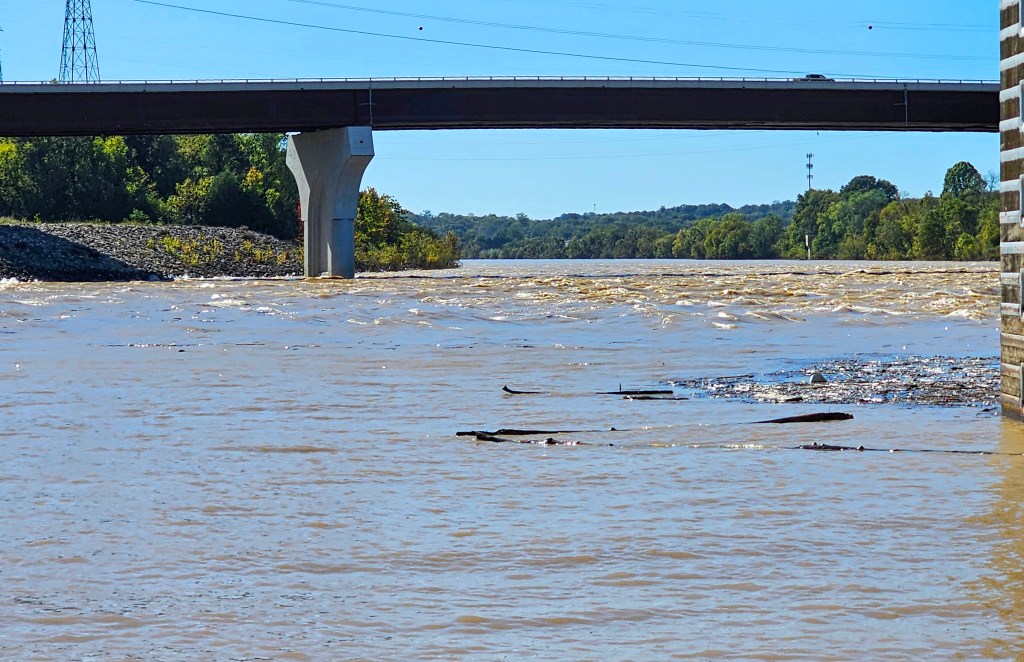
In addition to some huge logs and pieces of debris, the water coming off the dam had created an area of rolling waves with whitecaps, that were broadside to the boat.  Dick fought his way through the mess, as we were flung this way and that.  We were very glad that we observe “cupboard discipline” and latch all cupboards and drawers at all times.  If we didn’t, the contents would have been on the floor.

Looking back at the rough water below Ft Loudoun Lock

As we waited for the lock doors to open, we could see 2 huge tree trunks, each about 20 feet long, blocking the lock entrance from each side.  The only way was to push through them slowly.  Finally set, with Dick tending the line on the floating bollard as usual, he looked up to see a whole bunch of people looking down at us!  Once again, we were the show, or at least the opening act.  The lock was conducting tours of 30 to 35 local people, and our adventure coincided with one of the tours.  The excitement was not quite over.  The waiting tow had moved into position, in front of the lock gates.  Fortunately, after his front barges were tied off, he backed up a little, so there was enough space for us to get past.  Once again, we had to push through a debris field.  Certainly there was lots going on for the watching tour group. Dick posted on the Looper forum that evening, advising Loopers not to plan to come through that lock until the high water had subsided.  Nine Lives managed the turbulence, but some boats would have real trouble.

Exiting Ft Loudoun Lock past the waiting tow and through the debris field

We arrived at the marina, which is immediately above the lock, and had no answer when Dick tried to phone.  This meant tying up at the fuel dock in order to get a dock assignment and the gate key.  Always a pain.  Our slip was very short, although thankfully wide enough, with very small cleats that were impossible to get a line onto from above.  Once in the slip, I put the stern line around a post, and took station at the helm while Dick half climbed and half jumped off in the middle of the boat and secured all the lines.  I was not required to jump down 5 feet to go to dinner, as the ladder fit!  We planned to eat at the onsite restaurant.

We walked over and had about ½ an hour to wait.  However, there was room in the bar, and while Dick enjoyed a beer, I felt the need for something a little more robust after our earlier excitement, and ordered Woodford Reserve.  It was a double, but (sadly) not what one would describe as a generous pour!

The restaurant won a National Rib Cookoff, and regularly wins “best of” in Knoxville.  This is a barbecue restaurant, which means that I now have to explain to our non-Southern readers just exactly what is meant by the term barbecue.  In Canada, UK, Australia, and much of northern USA barbecue is a method of cooking over direct heat such as charcoal or gas, generally quite quickly.  Southern barbecue however, is done with indirect heat, such as smoking or roasting and over a long time.  Most Southern barbecue will feature a tomato and pepper-based sauce with brown sugar and often quite hot spices.  There are literally hundreds of bottled barbecue sauces available to buy in supermarkets, and restaurants often have their own recipe.  Dick and I have learned to use the term “grill” to describe either the equipment or cooking method, in order not to confuse any guests who might be expecting something quite different from what we are preparing!

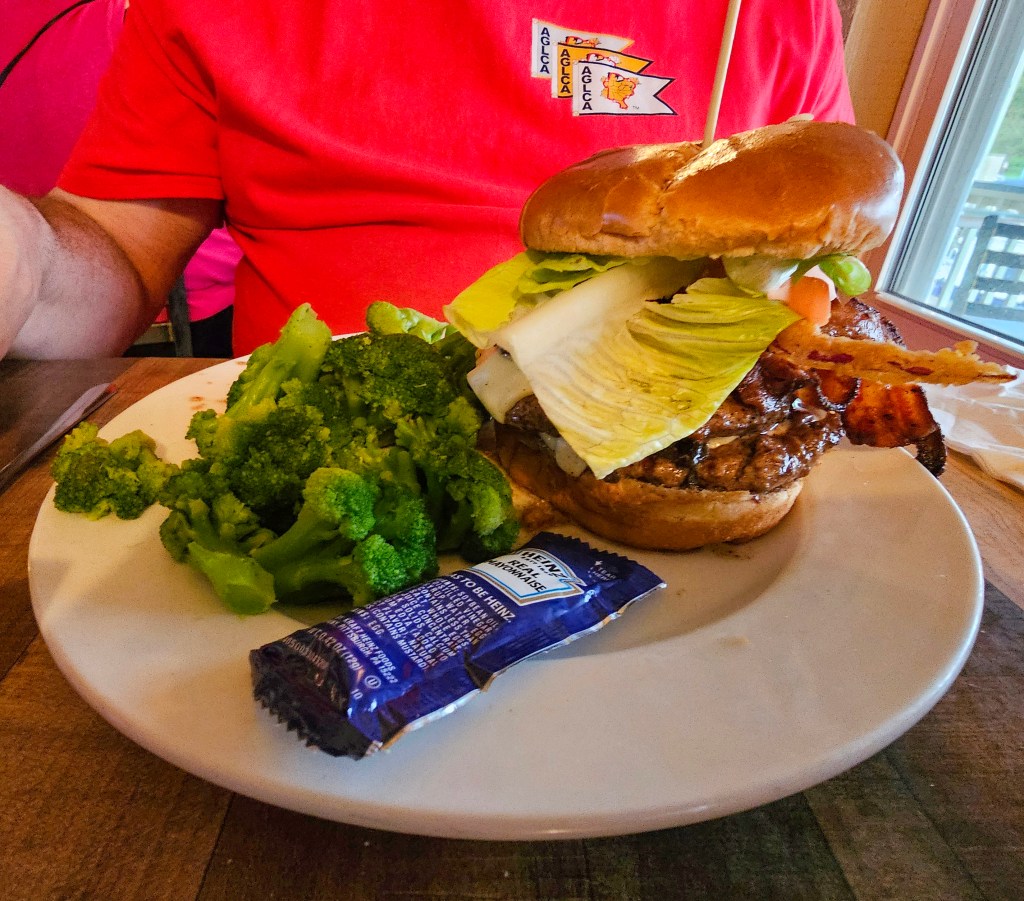
Dick ordered a trio of 3 dishes, BBQ ribs, fried chicken, and pulled pork.  I had a hamburger.  All were excellent, but I found that the seasoned fries had a sweet taste that I didn’t like at all.

The replica ships, Nina and Pinta, were visiting the Tennessee River when we were there

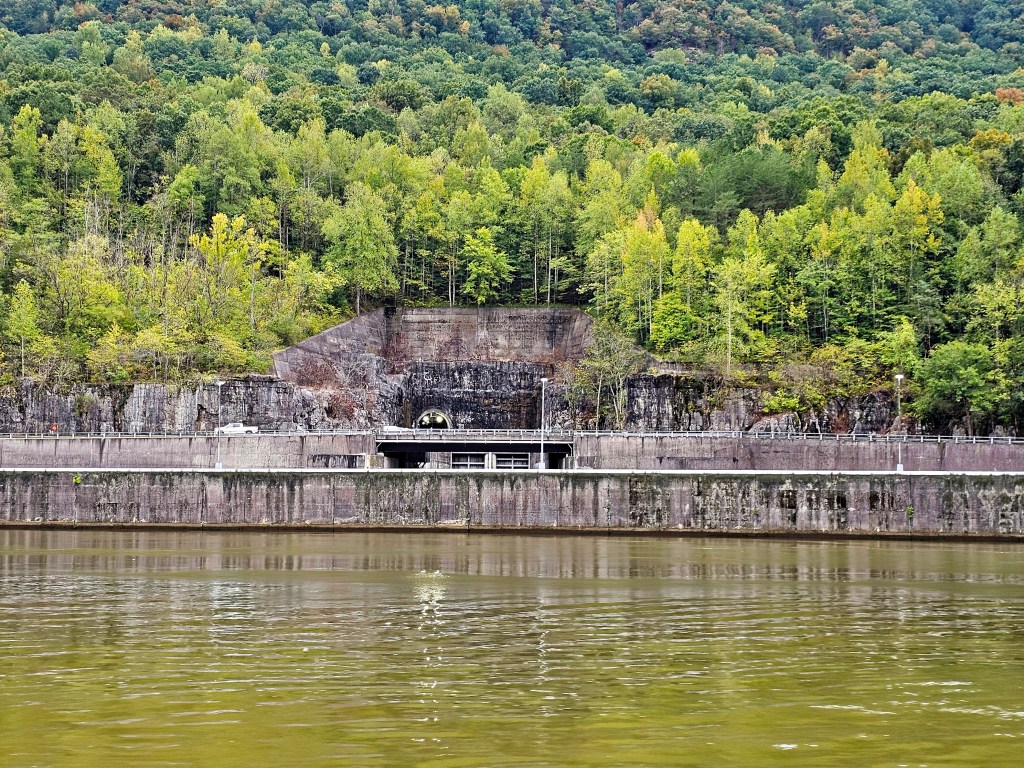
Next morning we set off up the Little Tennessee River.  We passed the earth dyke of the Tellico Dam, a highly controversial dam that created Tellico Lake.  TVA insisted that this dam was required to prevent flooding downstream, and also to improve the local economy.  Environmentalists, local landowners, fishermen, and Native Americans all objected for a variety of reasons, including the presence of the endangered snail darter (a fish).  Construction was halted just before completion.  Eventually it went forward by an Act of Congress.

Tellico Dam, essentially a long earthworks.

There are an enormous number of houses built around the Lake, all very large, over 5000 sq ft.  Certainly, the local economy was very much improved by the sheer amount of wealth that has migrated to the location.  What the snail darter thinks, we do not know, although the freshwater fish was relocated by TVA and is no longer considered endangered.  Later we saw the tops of drowned silos, a reminder that these lands had been farmed for generations and the landowners were forced out.

Some of the miles and miles of wealthy homes on Tellico Lake
Drowned silos are a reminder of what was lost and destroyed when the dam was built

We had thought to stop at Tellico Marina for the night, but repeated calls and emails had no response.  We went into the marina, and headed for the fuel dock, but it became increasingly shallow, so Dick turned around and we decided to anchor elsewhere overnight.  Shortly after leaving, the marina called to say they had space, but we told them sorry, too late, we already made other plans.

We explored about 26 miles up the river.  There were fine views of the distant Smoky Mountains, but surprisingly little fall colour in the trees.

View of the Smoky Mountains from Tellico Lake

Fort Loudoun was built by the British in 1756 to help keep the French out of the Appalachian region during the French and Indian War.  Just a few years after the war ended, there was a tragedy.  A breakdown in relations between the British and the Cherokee Nation resulted in 16 Cherokee chiefs who were being held hostage, being executed in South Carolina in 1759.  Fort Loudoun’s supply line was cut in the spring of 1760.  Once the food was nearly gone, the commander asked the Cherokee for terms of surrender.  Early in the morning on August 9th, the garrison of 180 men and 60 women and children left the fort by agreement and travelled as far as they could before making camp.  At sunrise the next morning, the camp was attacked, and 30 people were killed.  The rest were taken as slaves, although many of them were eventually ransomed.

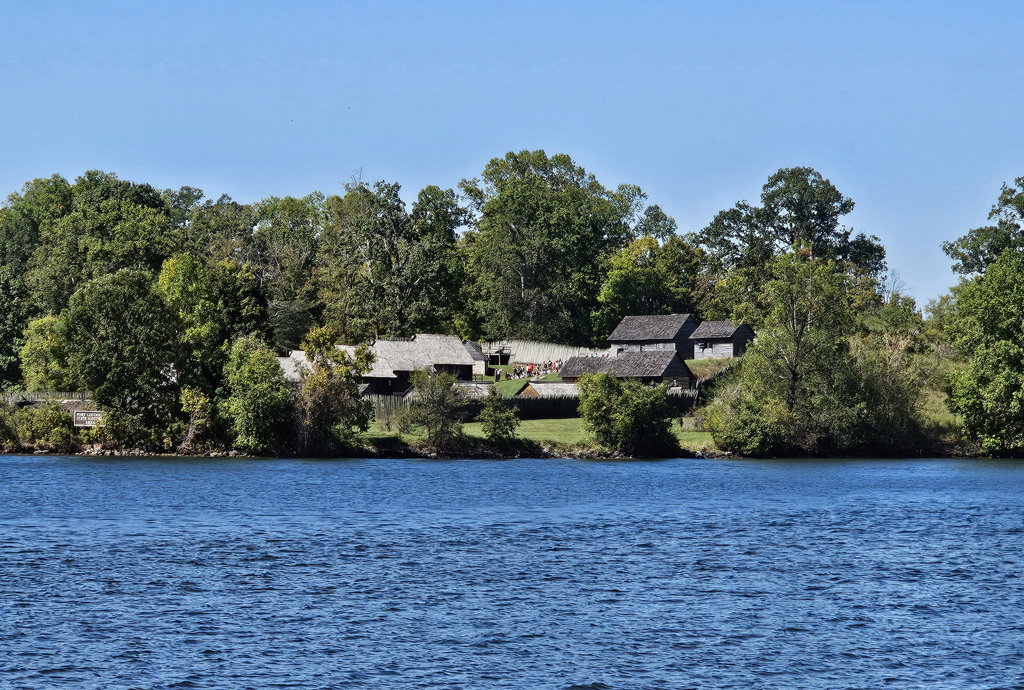
Fort Loudoun reconstruction

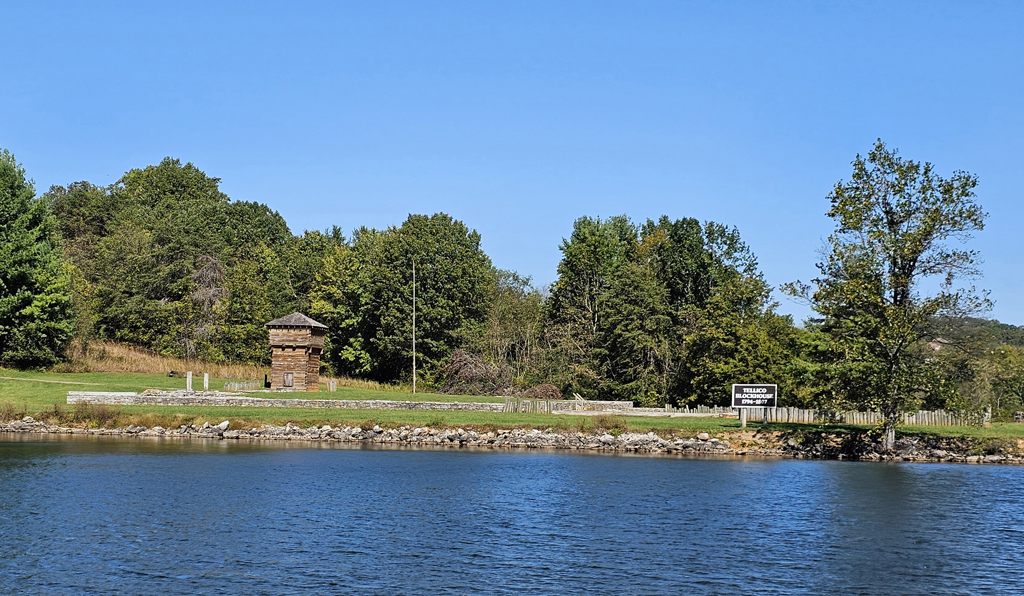
Across the river from the Fort, the Tellico Blockhouse was built in 1794, with the primary purpose of keeping the peace between white settlers who were moving into the valley and the Cherokee who lived there.  The blockhouse became a thriving trading post and was an important centre for negotiation of treaties for some years.  Gradually the local Cherokee moved away from the area, trying to get away from the encroaching settlers, and the blockhouse lost its strategic importance.

Tellico Blockhouse reconstruction

Among the huge tracts of expensive houses lining the lake we saw a number of boat building factories.  Yamaha, Sea Ray, and others were represented.  Clearly, this is a popular area for boat building.

The anchorage we thought would work was too small and unprotected, so we went back up the river a little way and found a good spot in a deep cove across from an RV park.  It was well protected.  The strong winds died down as soon as we got into the cove.  We had a very quiet night, and temperatures are now quite low, so the generator was not needed.  In the morning, the anchor came up easily, but covered in sticky red mud, so cleaning was required the next time we had dock water supply.

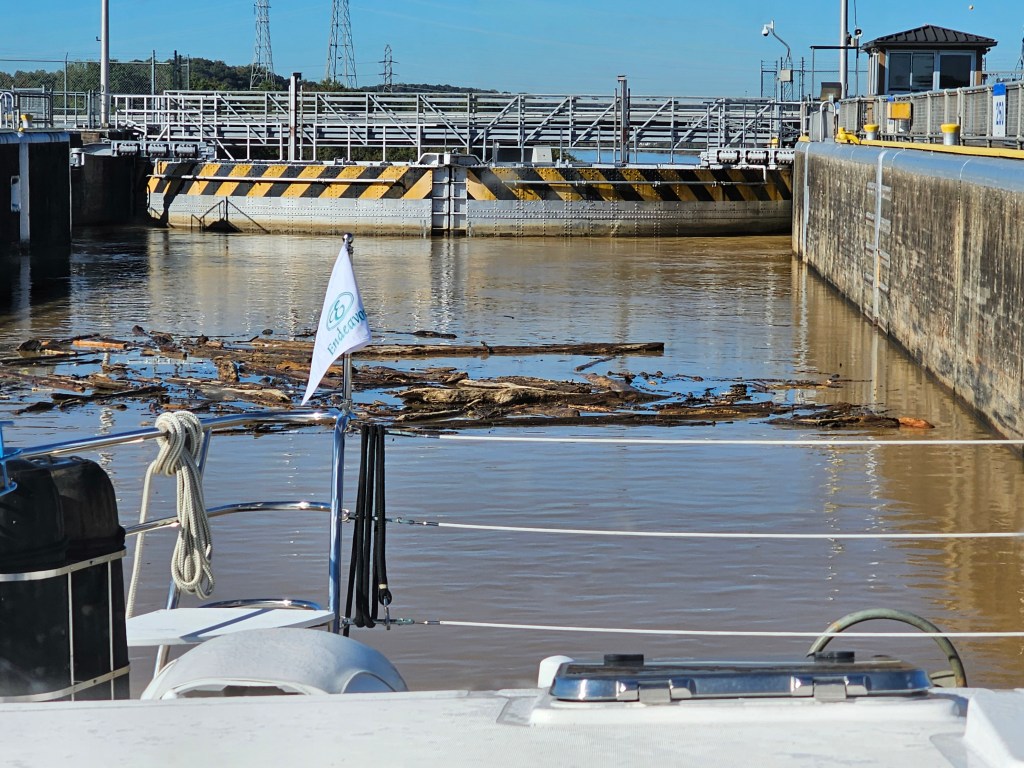
The return transit through Ft Loudoun lock was not something we were looking forward to.  There were some huge tree trunks we had to push through to get into the lock.  The ride down was smooth and easy compared to going up!  The debris field inside the lock raised our hopes briefly, as it appeared to obligingly move away to the side, but then the hopes were dashed as it spread itself back across our bows.  Dick did a masterful job of using bursts of the engines to move us forwards and then neutral to glide through.  Unfortunately, there was an even worse mess below the doors.  Eventually, I had to stand at the bow and direct, while Dick maneuvered forwards, backwards, and sideways, to shake the trees, and even planks of wood off the bows and avoid getting them caught in the props.  We only heard the distinct crack crackle of chewing lumber once.

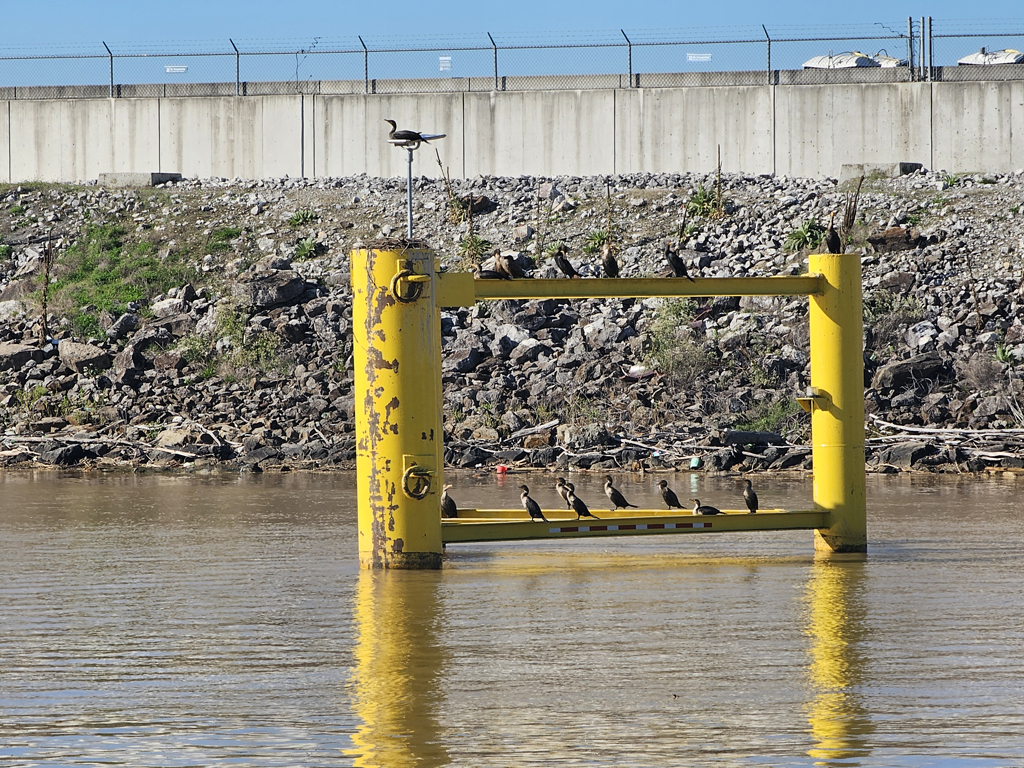
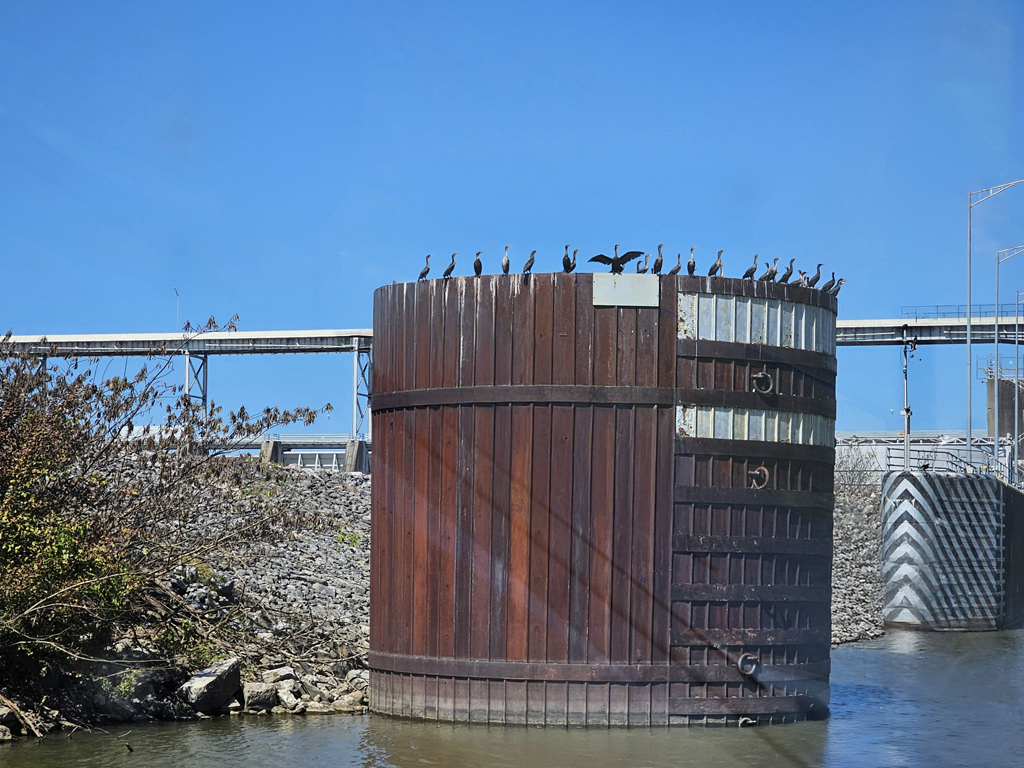
Cormorants at Ft Loudoun Lock

Debris navigated, there was the roiling water of the dam outflow to negotiate.  Although it was still more exciting than we would have liked, it was definitely easier with the current behind us even though the waves were still broadside.  Nice and friendly though the staff were, we are well glad to see the last of Ft Loudoun lock!  Later that day the lockmaster posted a video on their website of Nine Lives gliding up to the floating bollard with me at the helm and Dick waiting to lasso the pin.  We were quite chuffed, it all looked very professional!

Debris in the Ft Loudoun Lock

As we headed downriver, we had a helping current, and made 9 and even up to 11 knots at our normal engine revs, compared to 5 on the way up.

We could see the stacks of TVA Kingston Steam Plant, also known as Kingston Fossil Plant.  It was built between 1951 and 1955, and at the time, was the largest coal-fired power plant in the world.  In 2008 a dyke ruptured at a coal ash pond and 2.7 million cubic yards of fly ash spilled, burying 400 acres 6 feet deep and filling the Emory/Clinch Rivers, that flow into Watts Bar Lake, in sludge.  The dangers of using wet storage ponds for fly ash was known at the time, and TVA had found leaks in the levees and seepage into the soil at the sites of many of its storage ponds.  Instead of switching to dry storage ponds, small repairs were made to reduce costs. This was the largest industrial spill in US history.  The cleanup was declared complete in 2015, but many residents of the area still do not drink the water or swim in the river.

Distant stacks of TVA Kingston Steam Plant
Historic image of the wall of ash after the spill at Kingston Steam Plant (courtesy Wikipedia)

We went into a deep bay for our marina for the night. Caney Creek Marina does not appear to be well known to transient boaters, but we had a good stay.  Our neighbours on the dock had seen the Ft Loudoun lock facebook video that featured us entering the lock, and they came out to help us tie up as soon as they saw us arrive.  We were then invited to drop over for some beer and chat.  A most enjoyable encounter.

Fishing in the early morning mist
Tennessee National Golf Course
Whitestone Inn, an upscale B&B
An unusual rock formation and fall colour

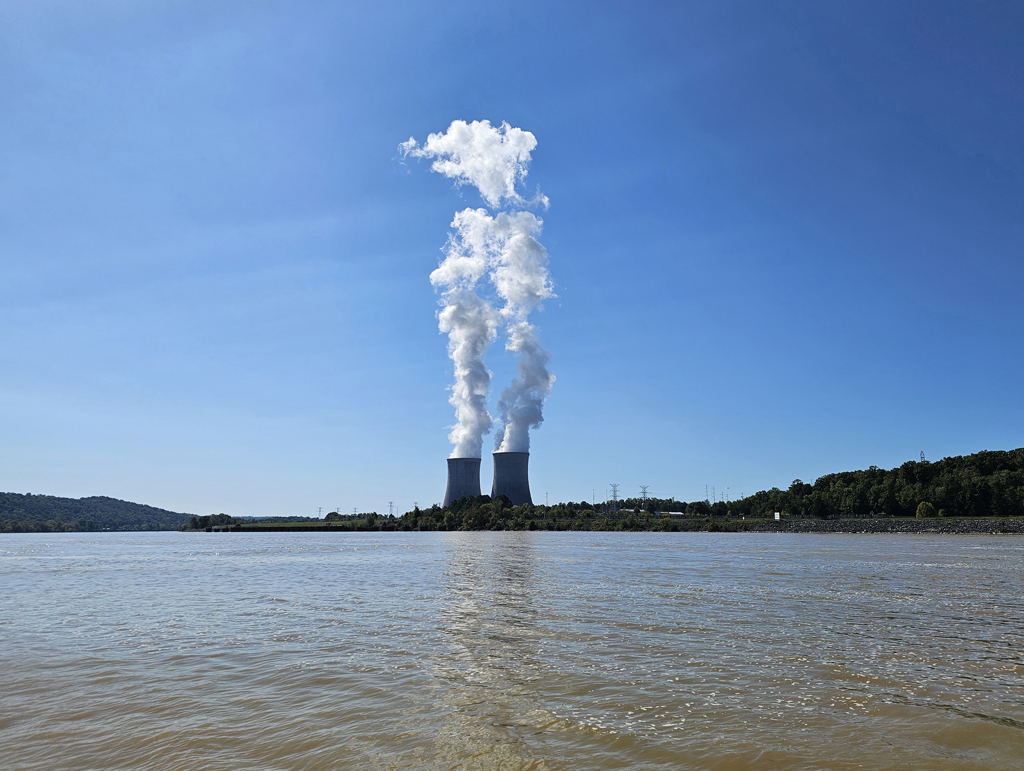
We were out by 9:30 the next morning, a little later than planned, but Dick took the time to wash the mud off the anchor from the previous day.  After transit through the lock, we passed the Watts Bar Nuclear Plant.  It is unusual to find a nuclear power plant and a hydroelectric generating station in the same location.

Approaching Watts Bar Dam
Cormorants at Watts Bar Dam
Watts Bar Nuclear Plant. That is just steam, not pollution, from the cooling towers.

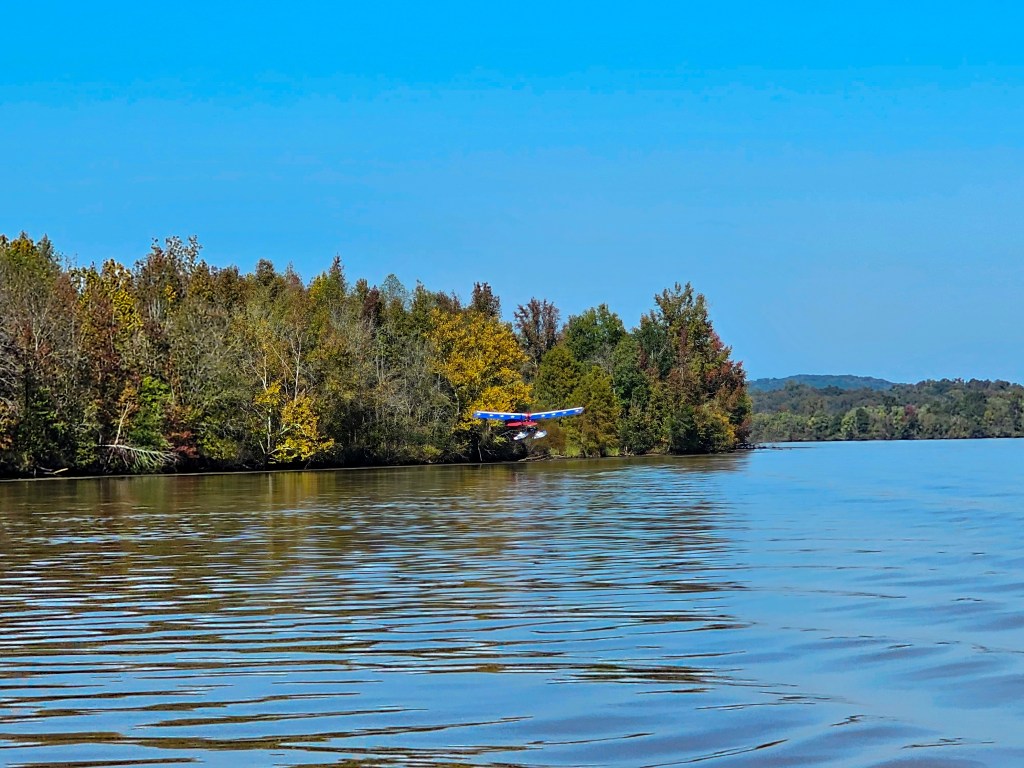
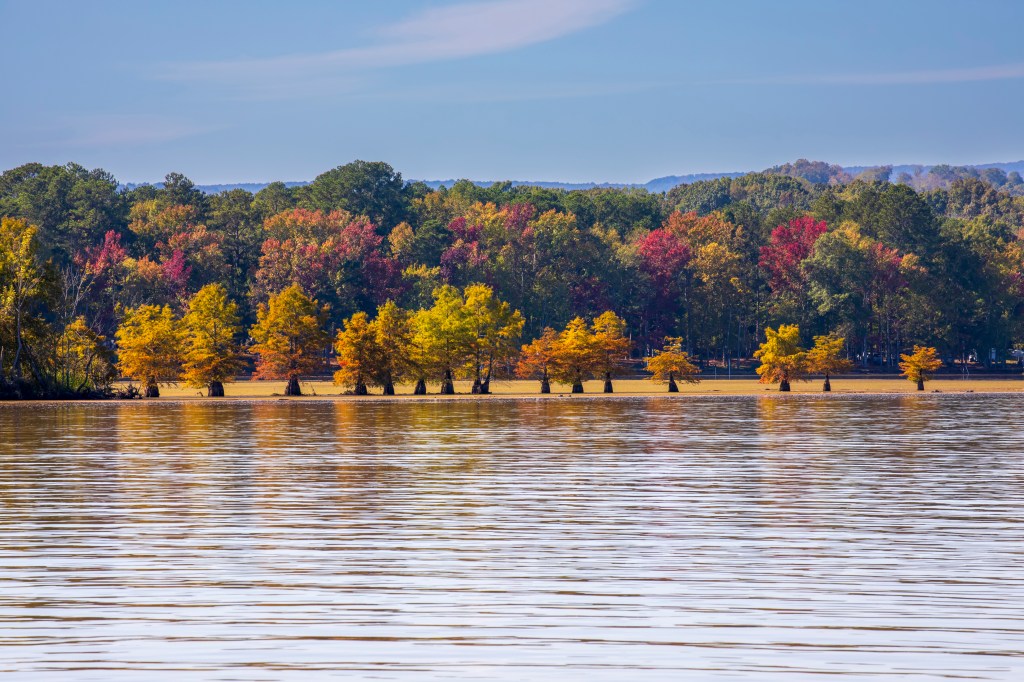
As on the way up, we had a day and a half of mostly boring travel.  Chickamauga is a large lake, so you don’t generally see much of the shore.  There was a brief excitement when an ultralight swept low over the river, and further south there were some lovely autumn colours in a row of bald cypress trees.

An ultralight flying low over Chickamauga Lake
Bald Cypress on Chickamauga Lake
Wisps of clouds made a nice sunrise at the marina near Dayton

Our transit through Chickamauga lock was interesting.  We were locked through with a small runabout.  Given that it was a Sunday, and close to Chattanooga, the lockmaster was asking all pleasure boats if they had been through a lock before.  This fellow said he had, and then proceeded to tie up to one of the fixed pins – that would have been completely useless and very dangerous once the water started going down in the lock.  An explanation was provided, and they moved forward to the floating pin.  The guy chatted with Dick, he was a very pleasant fellow, laughed at himself, and said how obvious it was once he was shown.  We told them to go out of the lock first, as they would be faster than us, and they were very considerate, no burst of speed, and no wake.  We could certainly wish there were more boaters like that.

Later, after tying up at the familiar Bluff Dock in Chattanooga, we helped with a large cruiser coming in.  They spent the entire approach tying fenders all along the vessel, and only when at the dock, went to get out coils of line (and untangle them) to tie up.  If they had seen as many fenders roll up on docks and catch in the cleats as I have, they would change their preparation priorities.

We walked up to Mellow Mushroom for a pizza fix.  Amusingly, it is rated the #1 restaurant in Chattanooga on TripAdvisor.  We assume this is due to the large numbers of people visiting the Aquarium and the Chattanooga waterfront.

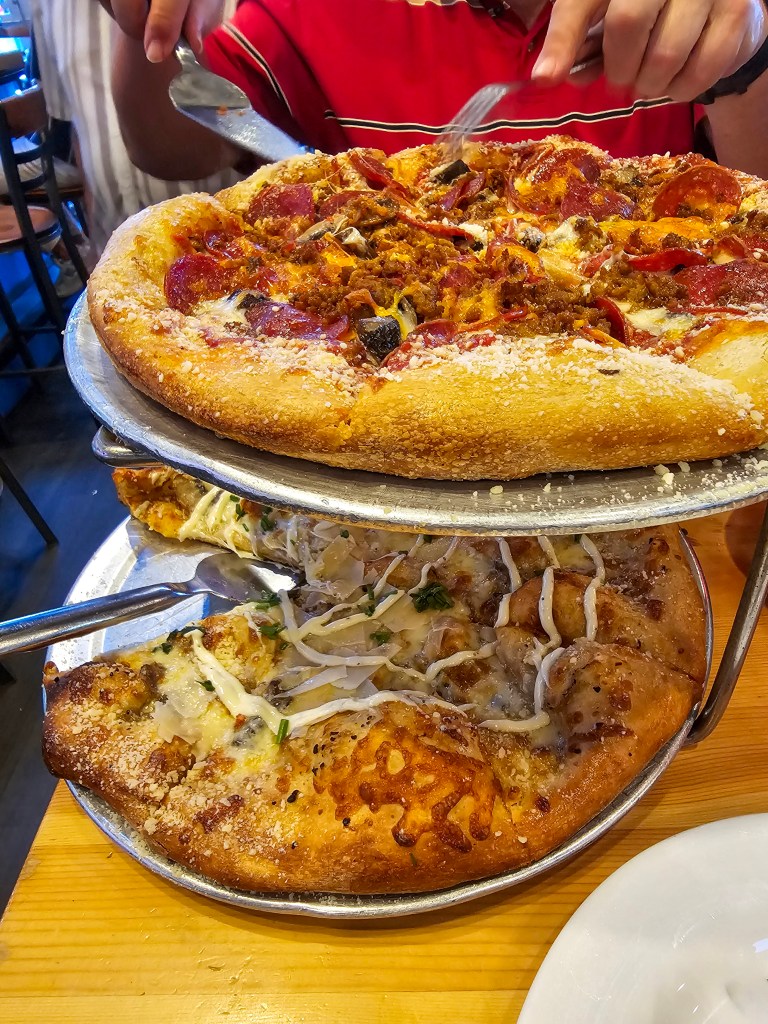
Pizzas at Mellow Mushroom

Our full day in Chattanooga was reserved for Dick to retrieve his bicycle, now sporting shiny new wheels, and he took advantage of being mobile again to use his trolley and pick up enough groceries to get us back to Aqua Yacht after Rendezvous.  I did several weeks’ worth of laundry.  Fortunately the clothes dried quickly on hangers in the very breezy cockpit.

Bicycles and groceries taken care of, Dick was able to get on with some forward planning for the next stage of the voyage.  He secured a 3-month booking at a newly rebuilt marina at the eastern end of Florida’s Panhandle.  With the whole of the Looper pack in panic mode after the devastation of 2 hurricanes, we feel it is prudent to nail down some of our options.

To our great disappointment, Dick had a phone call late in the afternoon to say that the restaurant we had been looking forward to for weeks had to close that evening due to maintenance issues.  It was purportedly the best fine dining restaurant in Chattanooga, but they had just moved to new premises and were clearly having teething problems.  We decided to give the steakhouse in the Read Hotel another chance.  The décor and ambiance was beautiful, and the meal was much more successful than our previous visit.

Sauteed shrimp at Bridgeman’s Chophouse
Rare steak for Dick at Bridgeman’s Chophouse
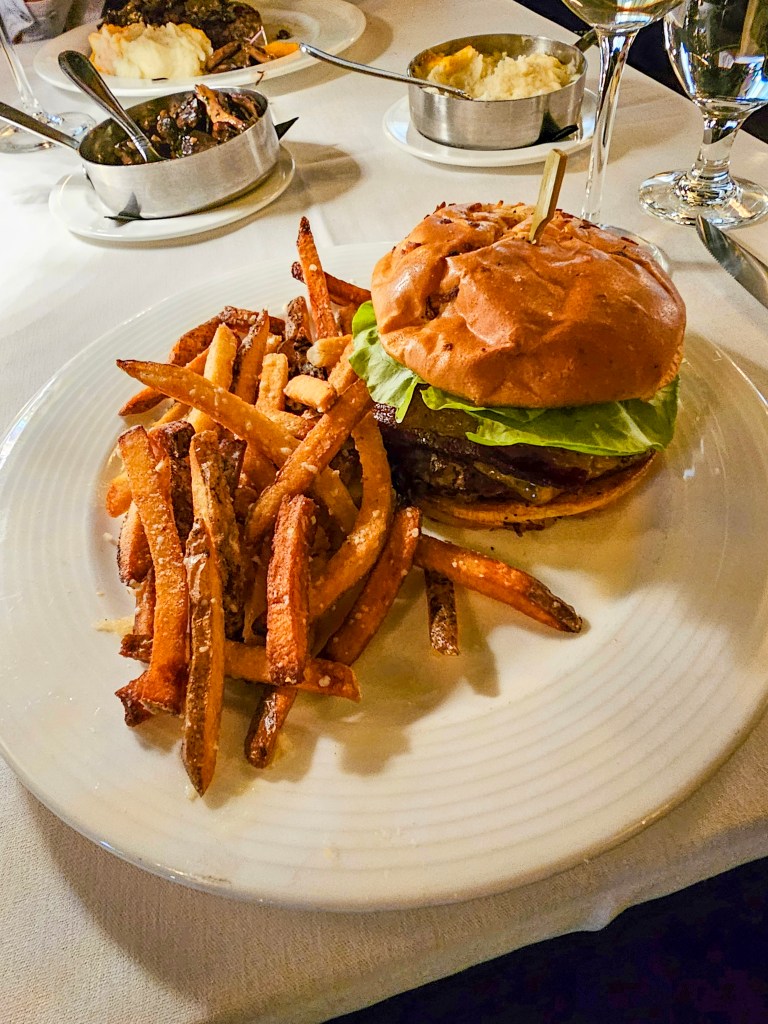
The hamburger at Bridgeman’s Chophouse was delicious in spite of the squishy bun
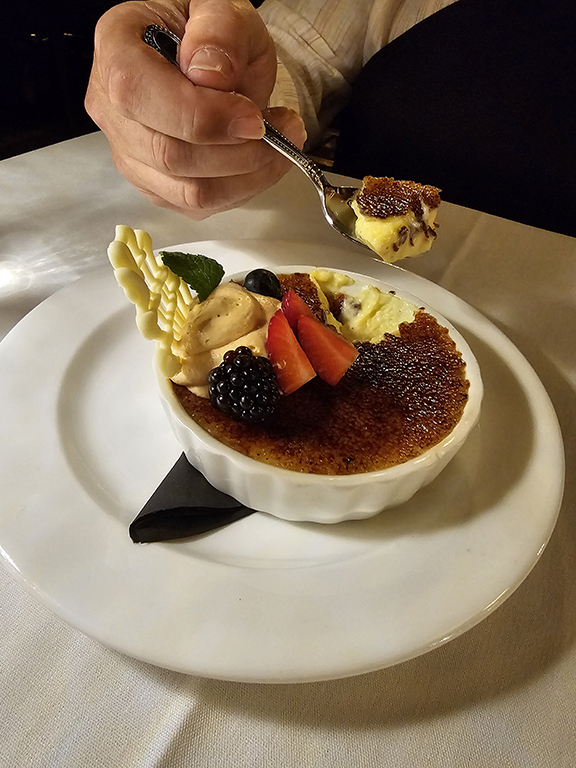
Creme Brulee at Bridgeman’s Chophouse

Tuesday was the day to travel through The Gorge, billed as Tennessee’s Grand Canyon.  We were hoping for more fall colour.  There were some pretty stretches, but an overcast sky meant very little photogenic scenery.  Naturally the clouds broke up and the sun came out after we were docked.

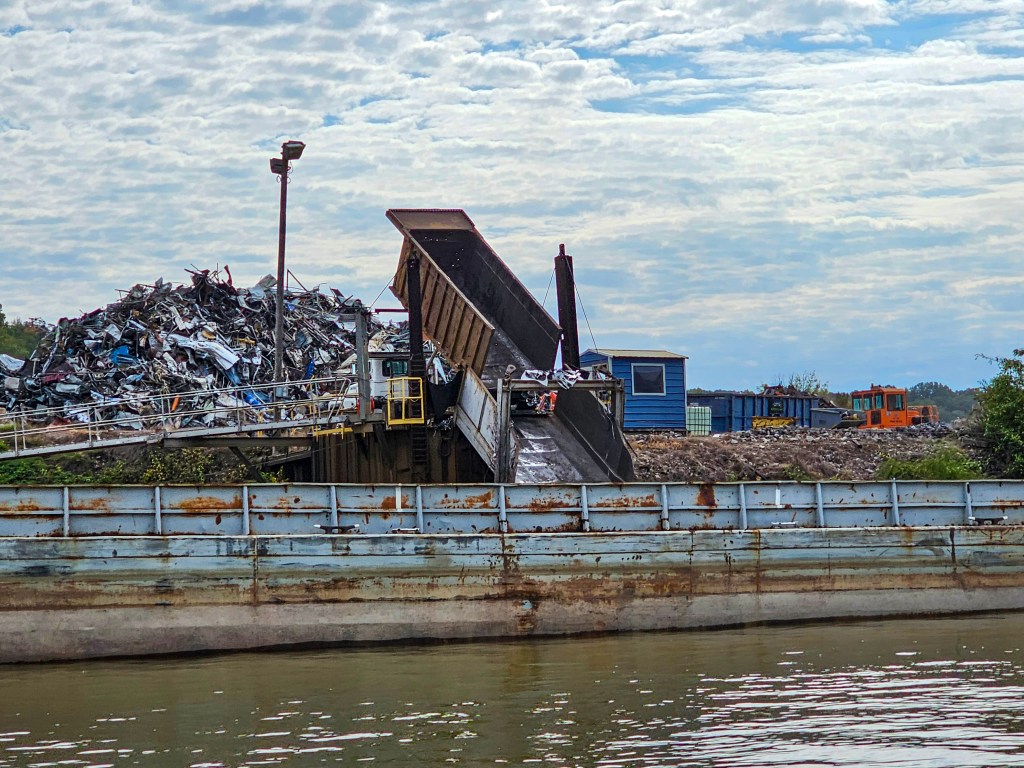
A barge is being loaded with scrap metal south of Chattanooga
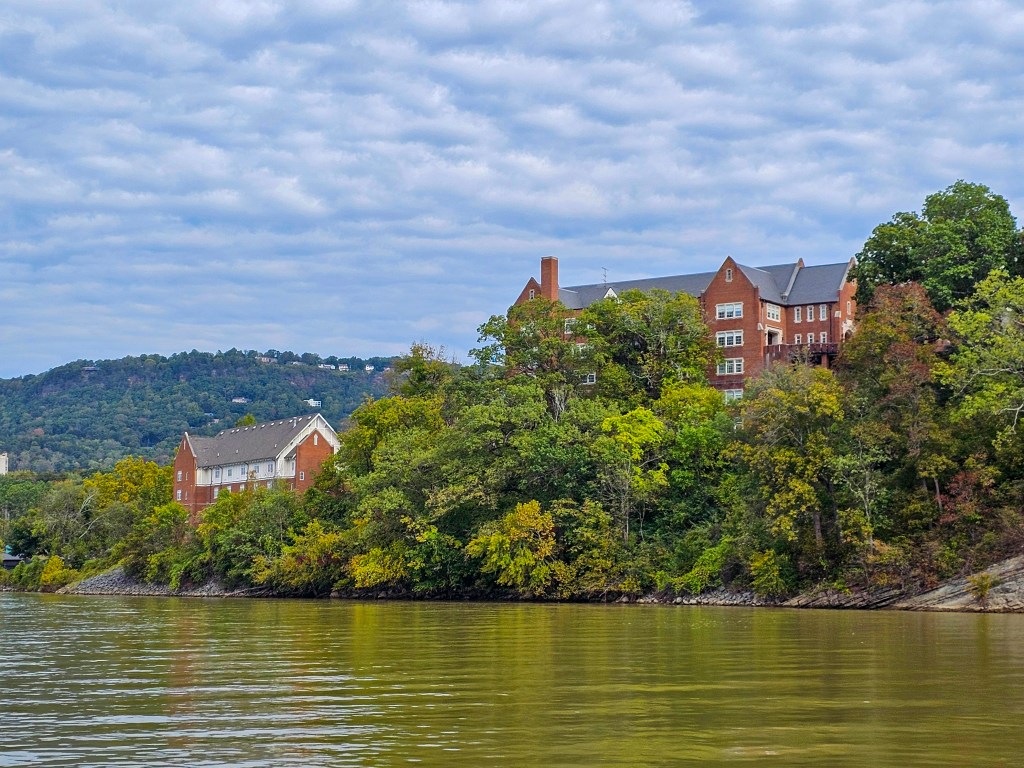
Baylor School south of Chattanooga
Lookout Mountain from the river. The Incline Railway goes up this mountain.
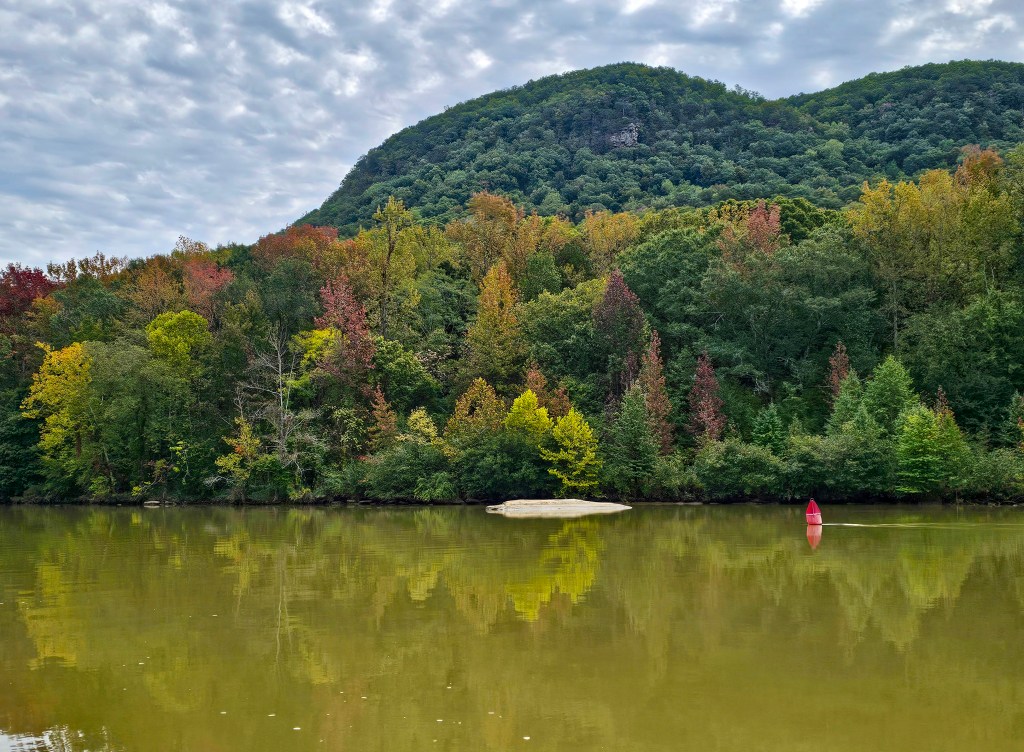
The Gorge

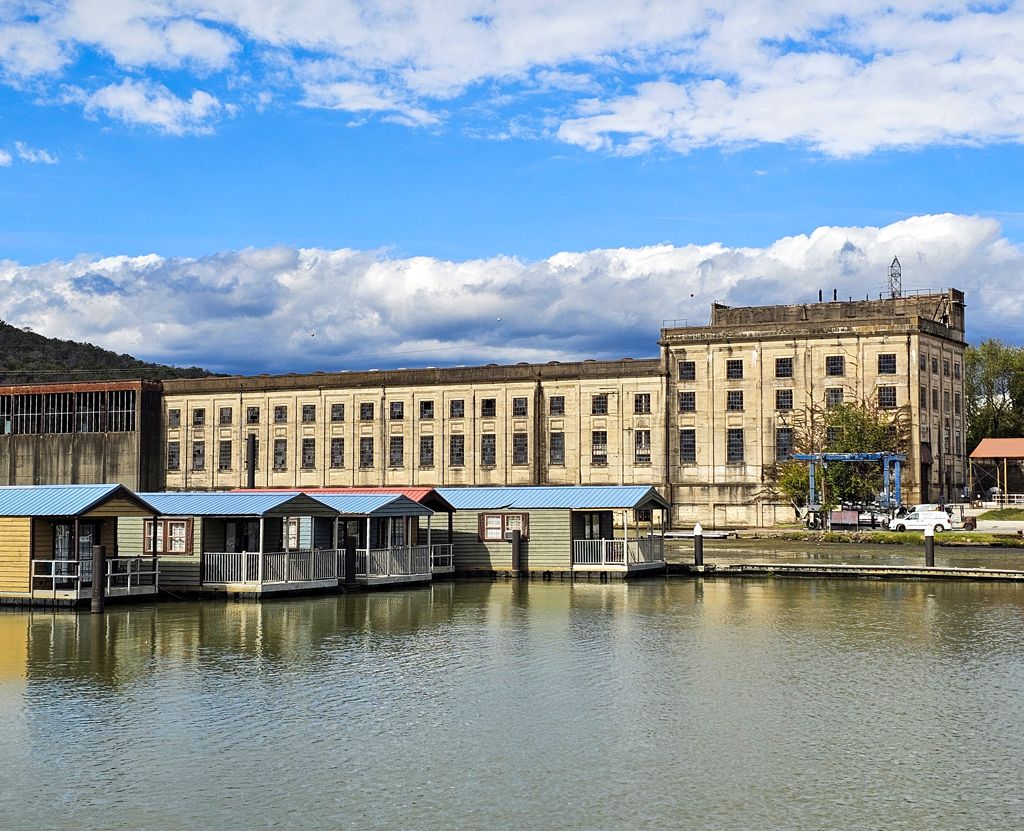
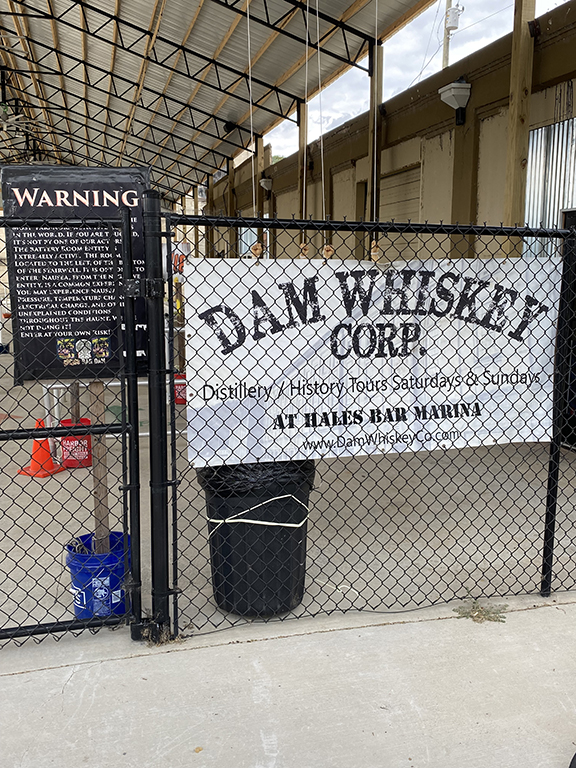
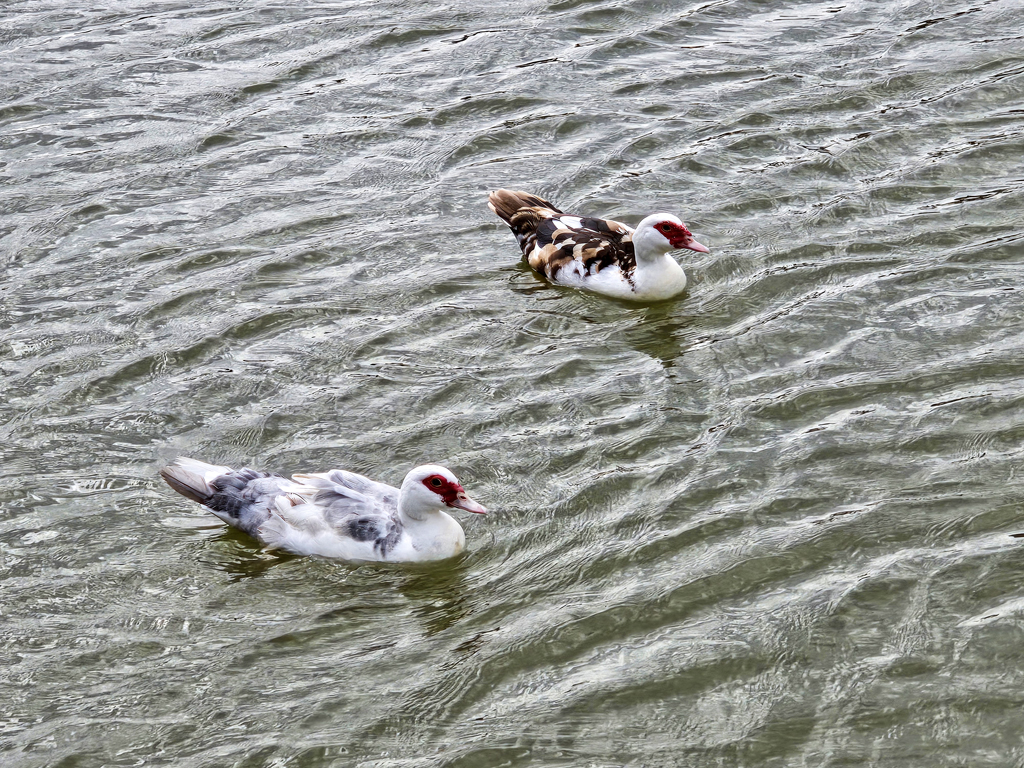
We tied up at Hales Bar Marina, with a view of the very unattractive but historically significant former hydroelectric facility.  There was only one useful cleat at our end of the assigned dock.  The whole place looks very run down, how anyone would consider coming and staying in one of the tiny floating cabins I do not know.  The distillery that occupies the former power house is only open weekends, so we did not get to tour or try their offerings.  There were some very colourful geese floating around the marina, but I can’t identify them.  I suspect domestic geese have encountered their wild relatives, with interesting results.  There are also goats wandering around.  Altogether a strange place.  We have no plans to return.

Floating cabins and the Power House at Hales Bar Marina
The distillery is located in the haunted Hales Bar Power House
Unusual geese at Hales Bar Marina

We had crossed into the Central time zone, so woke up an hour early the next morning and were underway shortly after 8am.  Dick had been told by the folks that tied up behind us that we could go out of the marina by another, shorter, but unmarked way.  We duly headed out, passing and waving to the occupant of one of the cabins on the way, but at a certain point the grass/weeds in the water fooled the depth sounder, so Dick could not tell where the channel was.  He backed around and we returned the long way, waving again to the bemused watcher.  Crossing over the submerged sandbar along the approved route was worrying, as the depth got shallower, but eventually we were through.

We had an easy transit through Nickajack lock, with no wait, but there were large mats of floating grass and weed to try to avoid.  Some boaters think it’s clever to proclaim “We were here!” by sticking stickers with their boat name on lock floating bollards. It is annoying to see, because those have to be cleaned off by lock maintenance staff in a time of tight budgets.  Defacing public utilities with stickers is just another form of graffiti.

Stickers deface the floating pins in many locks
Advice for new boaters, wear gloves for line handling! Imagine what Dick’s fingers would be like without them.

Our plans for the pre- and post-Christmas boating season have been revised in the wake of two devastating hurricanes affecting the Gulf Coast of Florida.  We originally expected to arrive in St Petersburg around mid-December, and then take about 4 weeks off to go home to Hilton Head for the Christmas/New Year season.  We are now booked to stop at a small place called Port St Joe, at the eastern end of the Florida Panhandle, on about November 22nd.  We have a reservation in the marina for 3 months.  After Christmas we will know how far along the various marinas and towns are with recovery and will be able to plan accordingly.  A big part of Florida’s economy is tourism based, so as soon as possible the towns will reopen and welcome tourists again.  It is likely that we will be anchoring more than originally planned, and we will spend less time in each place.  Our return to Hilton Head will probably be late April or early May.  It means that we will be boating in much warmer temperatures than Louise is happy with, but considering that so much of the Loop has already been too hot for my comfort, it is what it is.

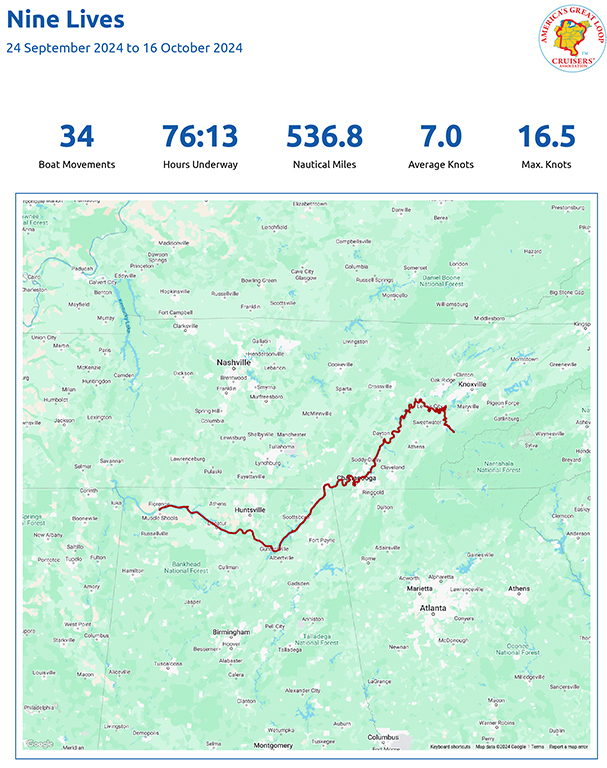
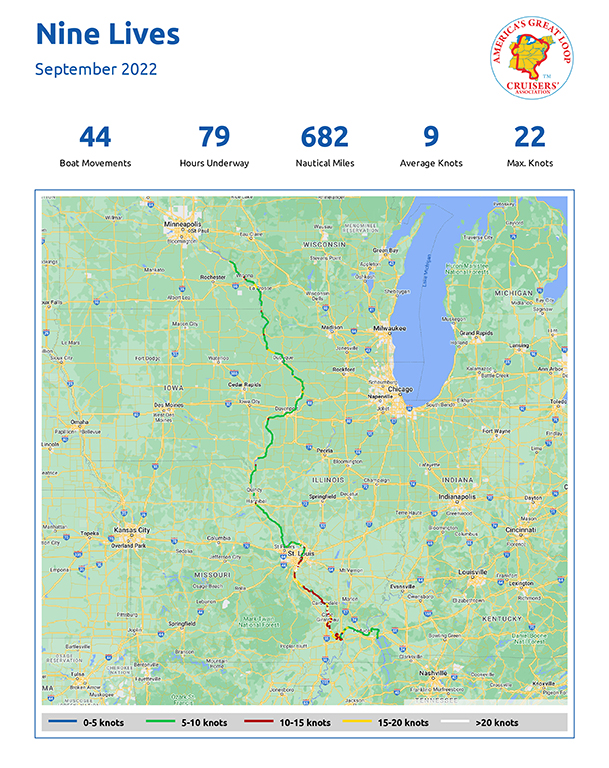
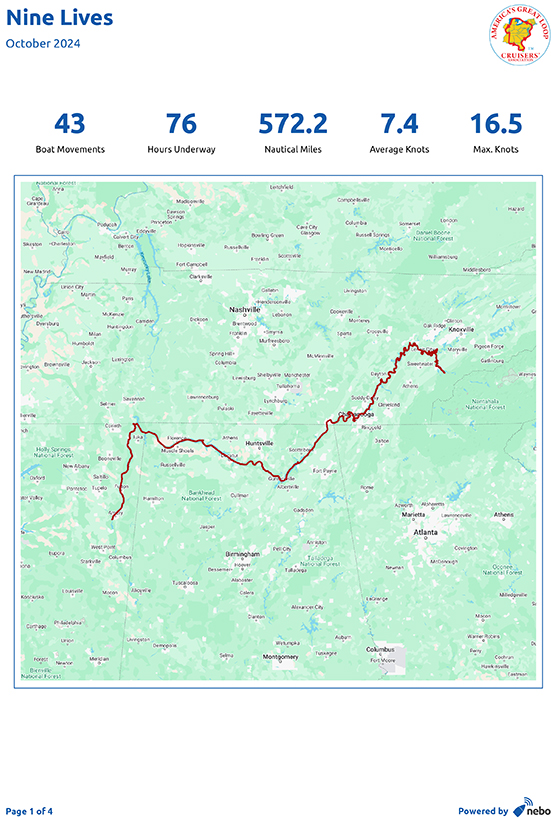
The track of our first 3 weeks of voyaging

September 20th to October 2nd, 2024 Pickwick Lake to Chattanooga

Nine Lives and her crew are cruising again!  From September until March, we will be visiting Tennessee, Alabama, Florida, and eventually Georgia and return to South Carolina.  During this final portion of the Great Loop, we will “cross our wake”, that is, cross over our original starting point in St Petersburg, Florida, and in spring we will finish in our home of Hilton Head.  We hope you enjoy the recounting of our voyages.

The first challenge, as always, is to get the crew back to Nine Lives.  From Hilton Head it is about 9.5 hours’ drive to Aqua Yacht on Pickwick Lake.  Unfortunately, the air conditioning on Dick’s vehicle broke down just a few days before our departure, and there was not enough time to get the replacement compressor shipped and installed before we left.  It was hot!  The maximum temperatures were 97F near Birmingham, AL, but it was not below 90F for most of the trip.  We arrived at 4:30pm local time.  We took the bikes and the new salon cushions to the boat, and set things up to shock the fresh water tanks so they could sit overnight with the bleach solution.  We also turned on the fridge and the freezers, so they would be ready for the next day.

Once again, we stayed in a cabin at Pickwick State Park for a couple of nights while we got the boat ready.  The cabins have a full-size fridge and freezer for all our food.  In spite of the long, hot journey, all the frozen food was still fully frozen.  We checked in and immediately had dinner at the lodge restaurant before going to the cabin.  We were so tired and hot that we knew we would not want to go out again once we got into the cabin!

The food was much better than Dick’s memory.  He was able to ask for his favorite catfish to be grilled, a great improvement over the usual deep fry.  I had fried shrimp, which were superb.  We shared cheese curds to start.  There won’t be many opportunities for that delectable treat after the next few weeks.  We have never seen them offered in Hilton Head or in UK.

The next morning at breakfast, while I waited for the pancakes I had ordered, I idly looked at the ingredients list on the packet of syrup in the basket on the table.  One of the first ingredients was ethylene glycol.  If you never knew, or had forgotten, that’s anti-freeze.  A cruise around our friend google suggests that we never, ever want to ingest this stuff.  Not even on pancakes.

After breakfast we were at the boat by 8:30, and began the process of trekking all the stuff 1/3 mile along the dock to the boat.  Well, Dick did the trekking, I sorted and put away as it arrived on board.  Division of labour…

Everything has to be put away

Dick finished the water process, changed the drinking water filter, put the chlorine tabs into the AC system, and stowed spare parts, and 2 dozen bottles of wine and other drinks.  He also put up the burgees on the bow.

Changing the drinking water filter requires some contortions

The boat was supposed to have been cleaned for our arrival, inside and out.  It is always a bad sign when cleaning equipment has been left on the dock, in this case a bucket of soapy water and a long-handled brush.  While the hull was sparkling, the deck had minimal attention, and the cockpit had not been touched since we left.  The smears from Dick’s enthusiastic destruction of marauding bugs last fall were still on the windshield. Inside was better (a different cleaner), but not as immaculate as the lady who did the job last year.

I prepared the clove bags that keep insects out of the galley drawers and cupboards, while Dick stowed 4 dozen beers and the fizzy water.

The big shopping excursion to the supermarket in Corinth took longer than Dick had expected, making us late for our much anticipated favourite restaurant, Vicari’s.  Dinner was every bit as good as always, a nice change.  So many of our favourite restaurants over the years seem to lose their mojo and the food ends up being pedestrian and bland.

We checked out of the cabin after breakfast, then Dick had to schlep all the food up the path to the vehicle, and then of course the whole lot had to be dragged to the boat, along with all the food and dry goods from the grocery shop.

One thing about having done this for so many years, we know where everything goes!  Mostly.

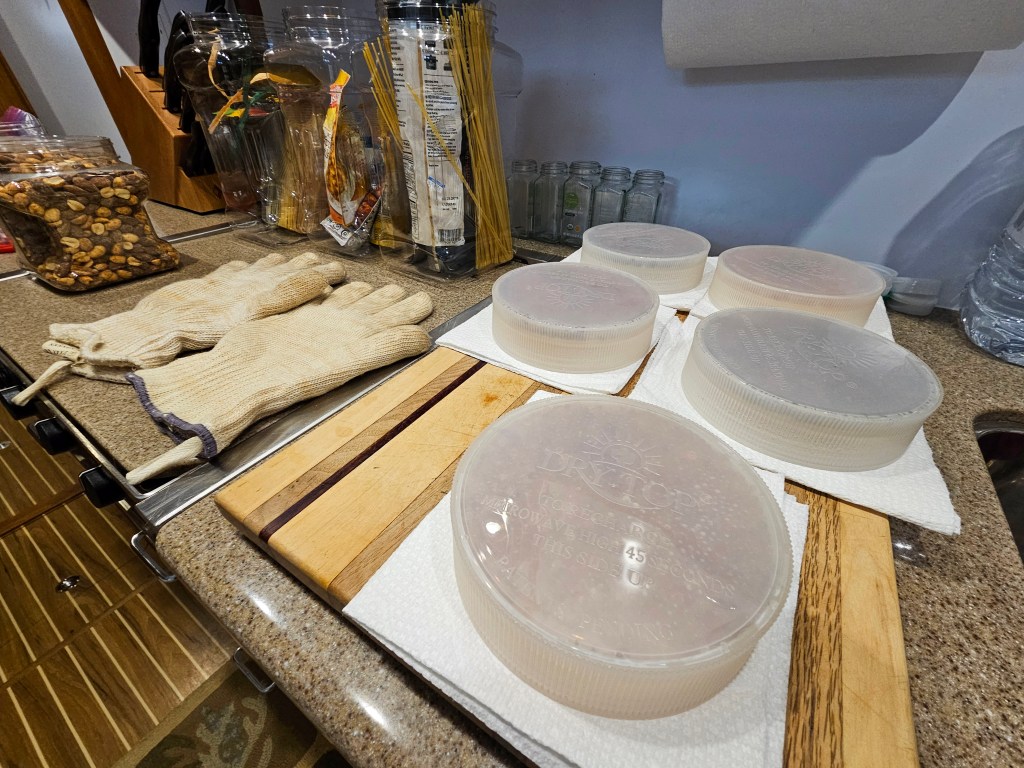
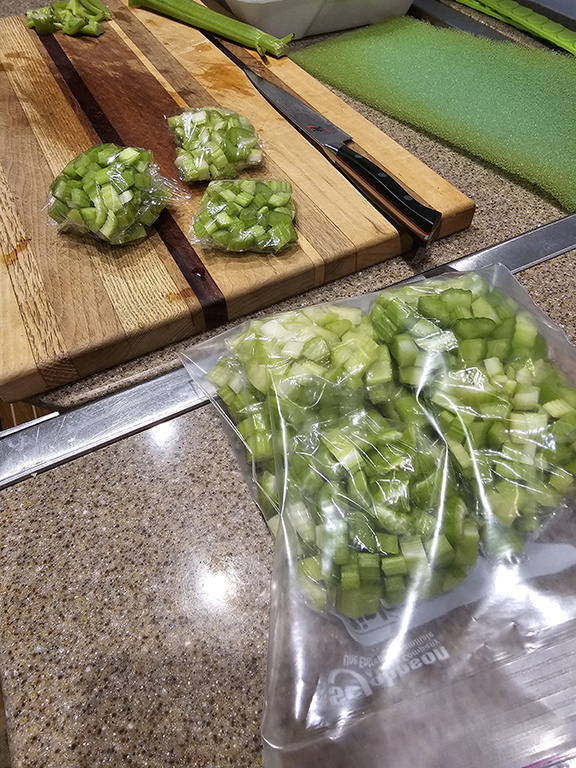
I sorted out the groceries, including chopping celery and bagging it into portions for the freezer.  I also recharged the “dry tops” from the storage jars in the microwave.  These are a Chinese product that was only available briefly, but they work fantastically well at keeping things like pasta, biscuits, nuts, and even brown sugar in perfect condition.

These are the tops of the plastic canisters. They are dehydrated in the microwave and are amazingly effective at keeping contents fresh.

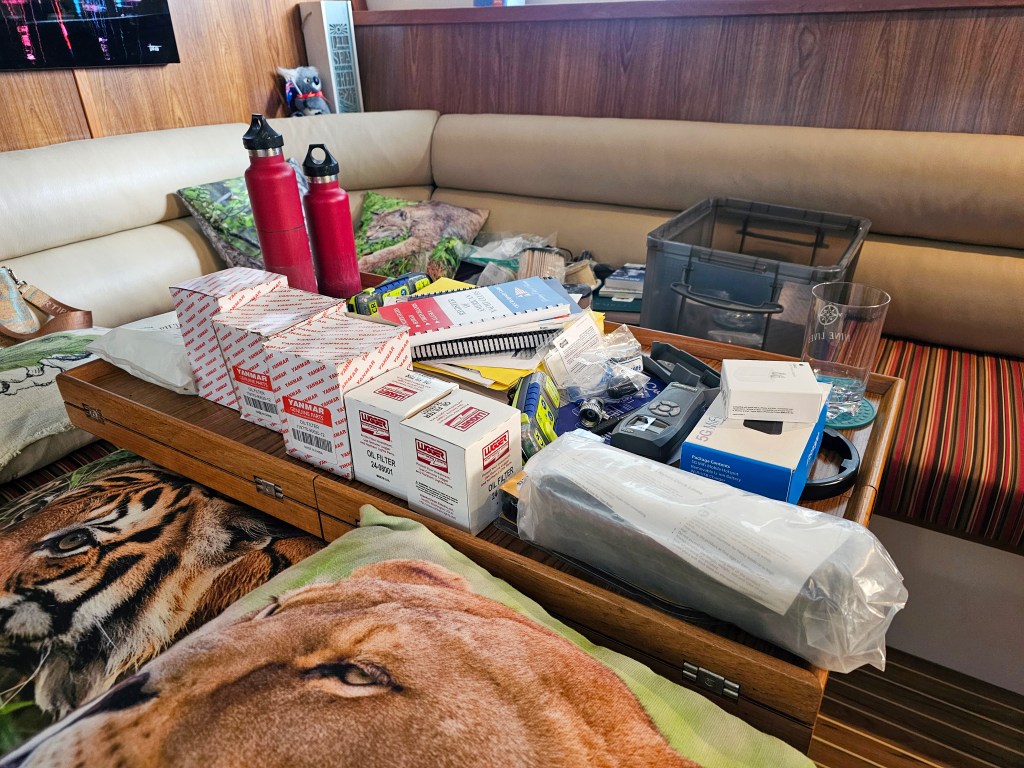
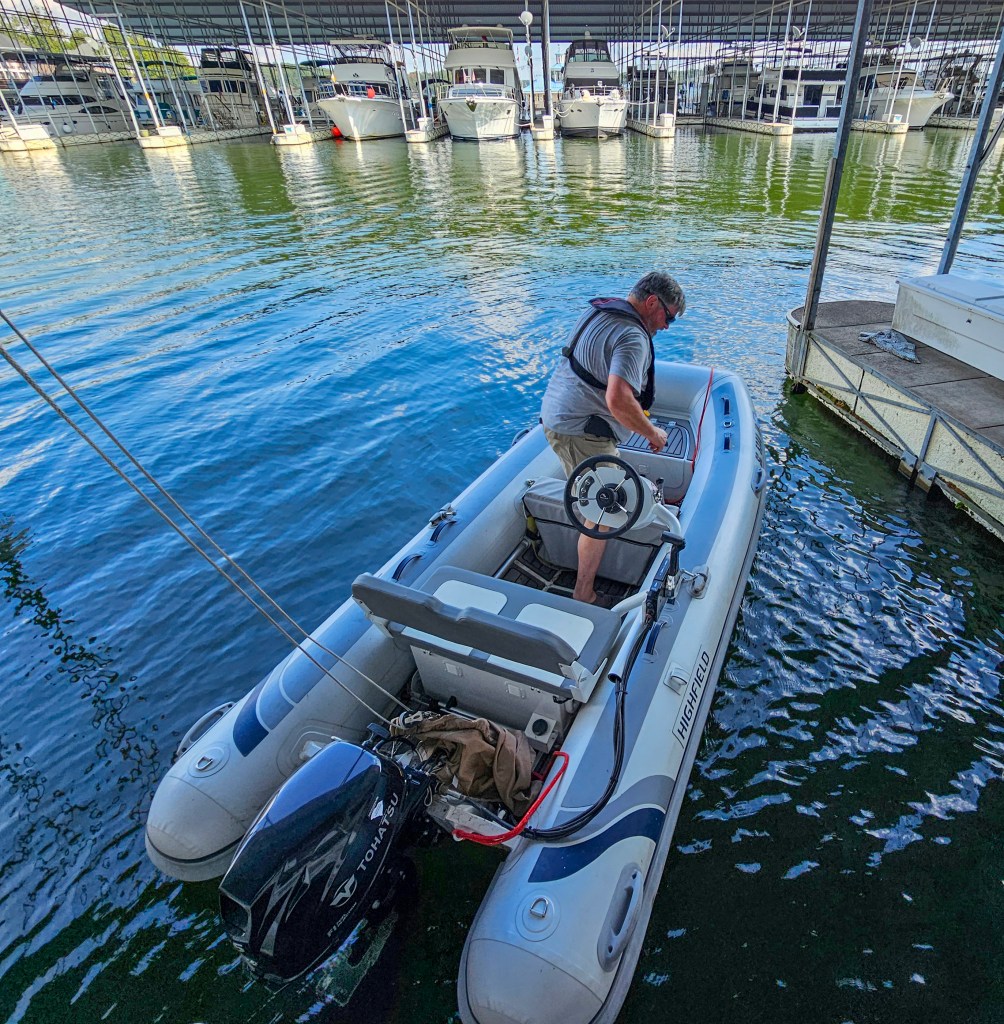
After a brief rest and recovery from all the to-ing and fro-ing with stuff, Dick started on his chores.  He changed the fuel filters from the main engines and the generator.  Vacuumed the cockpit and laid down the carpet. Put the new registration sticker on the dinghy.  Installed the sunscreens on the windows.  Checked the hydraulic steering reservoir for fluid level.  Prepare to launch the dinghy to check that everything was working correctly… and came to a grinding halt.

Launch the dinghy to make sure all is well.

The service department had put the dinghy up very high on the davits after they did the 50 hour service on the engine, and one of the two motors would not work to lower, only to raise that end of the dinghy.  After battling spider webs (my spray the day before had barely discouraged them), Dick had to get out the broom and have a really good sweep before even starting to try to diagnose the problem.  Naturally, more sophisticated troubleshooting was attempted before the simpler solution of wiggling the contacts for the plug.  Dinghy was duly launched (with the suitable precaution of keeping the rear hanger attached.  Dick evicted a staggering number and variety of 8-legged squatters, along with their webs, then followed the proper startup procedures, turned the key, and nothing happened.  The battery was absolutely flat.  The service men had not bothered to remove the drain plug when they returned the dinghy to the supports, and since there is an automatic bilge pump, every time it rained, the battery was drained a little more.  Dick set off to find a hardware store that would be open on Sunday and have a battery charger for sale.  He had to go all the way to Iuka, but he found one!
Battery set to charge, we walked out to the onsite restaurant for dinner.  Dick had checked that they were open on Sunday.  Sadly, not this Sunday.  A notice on the door said that they were closed indefinitely due to “unresolved plumbing issues”.  So we continued our Sunday stroll back to Nine Lives, and dug out the makings of sandwiches for dinner.

Next morning we were up early, and after taking time for coffee, Dick was pleased to find that the battery had charged and he could make sure the dinghy motor started and ran without issue.

We were finally away from our slip before 10am.  We had an uneventful day of cruising; a civilized 5.5 hours dock to dock.

The marina at Florence AL is supposedly open 7 days, but no radio response, and no phone was answered.  To be fair, Dick discovered later than he had the wrong number for the phone, so it was not surprising it wasn’t answered!  The 2 boats already in had spread themselves along the dock with gaps too small for us to easily fit into.  We docked at the back, but pulled up enough to leave room for the 50-footer that we knew was coming in behind us.  We spoke to them over the radio and were there to help with their lines.

They were a very nice couple, fellow Loopers, and we ended up going to dinner with them and then having drinks on Nine Lives after.

There was a hurricane brewing in the Gulf.  The forecasts were uncertain of its path, and there was a lot of concern for us and fellow boaters as to how much it might affect our plans.  We decided to look again in the morning and make some decisions.

Tuesday was a day that exemplifies the need not to have specific plans when boating.  We had volunteered, and our offer was accepted, to fill in for a veteran Looper for a presentation on locking at the upcoming Rendezvous of Loopers.  The various deadlines for submitting outline, bio, and introduction were already past, but we spent the morning starting work on the project.  We also untied and moved over to the fuel dock for fuel and a pump out.  Fortunately, one boat had left earlier, or getting back into our spot would have been quite tricky.

While Dick prepared bullet points for the presentation, I went through 7 years of photos to find those that are of locks and locking.  At this point, we discovered that our reliable workhorse, ten-year-old printer on board, while still operational, no longer speaks to our laptops, and could not be upgraded.

We kept a lookout for the marina courtesy car, and just managed to be first when it was returned.  Office Depot had a printer that would fit into the 12” space in the cupboard, and we also made a run to the supermarket for a few things that were missed earlier.  The rest of the afternoon was spent setting up the new printer.

We both felt that getting dressed up, then arranging for the courtesy car or uber to get to our planned restaurant, was just too much trouble, so we cancelled our reservation and walked along the dock to the onsite restaurant.  Basket food, but tasty.

A very tasty burger at Florence Harbor
My choice was the shrimp prepared 3 ways

Later, Dick chatted on the phone with the lockmaster at Wilson lock, 5 miles up the river, and arranged to call again at 5:15am to find out the status of the lock.  It is always better to speak to the person who is starting his 12-hour shift, rather than the one who is finishing, who may be wet as well as tired!

There was a split tow in progress in the morning, so we had time for showers and breakfast before our expected 7:30 departure.

So early, you say?  This particular lock had an approach wall collapse into the river a couple of years ago.  This means that the tows have to wait their turn from a long way up or down river, thus slowing down all operations.  Pleasure craft will be locked through only early in the morning, midday, or late, plus or minus, depending on existing tow traffic.  Not wishing to take a chance on the midday slot, we hoped for the early transit.  We were through Wilson lock at a very reasonable 9am.  Considering that this is the lock with issues, and a reputation for multi-hour holdups, we did well.  What was unexpected was the experience at the next lock.

A line goes around the bollard in the lock wall and is held, then the bollard floats up (or down) as the lock fills or empties. Being held secure means we won’t be thrown around by turbulent water.

The tow ahead of us (the same one that was going through Wilson at 5am), refused to allow the pleasure boats to go through ahead of him (there were two of us), even though he would, in fact, have lost no time by letting us through, as he had more than an hour required to approach the lock from where he was waiting.  So our two boats waited a full 8 hours instead of 4 (there was a downbound split tow that had to come through first).  Our fellow Looper boat anchored, but we held back with a combination of floating with the engine off and occasionally repositioning.  I did the early prep for our planned dinner on board later.

Our fellow Loopers on this part of the journey turned out to be a Dutch fellow, who emigrated to Canada in the 1990’s.  We will look forward to meeting again and spending some time in person!

We were in Joe Wheeler State Park by 5:15pm.  There were still concerns about the developing hurricane, although it was expected to be purely a rain event, with no significant wind at this location.  Some “conversation” between Nine Live’s two captains resulted in a compromise that would have us stop just 3 more nights before Chattanooga, but all in marinas rather than at anchorages or free town walls.  No locks the next day.  Even though there had been only two that day, a break was needed!

The first proper meal to be cooked onboard was a definite success.  The new recipe for scalloped potatoes complemented the pork and mushroom fricassee.

Preparing pork fricassee
A new recipe for scalloped potatoes
Our first dinner on board this cruising season

Thursday the 26th was the day for the hurricane (Helene) to make landfall, so we would know a lot more that evening, and even more the next day, as it was a fast-moving storm.  We planned to stay two nights at Ditto Landing to wait out the worst of the expected rain.  As I write this from my notes a week later, I know just how huge and devastating this storm was.  It was one of the largest ever to hit the United States, and loss of life and devastation to property extended from Florida to Georgia, Tennessee, and the Carolinas.  Our home in Hilton Head was fine, but our friends just a few miles away in Bluffton had trees down on their property and power outages.  Friends in Florida fared worse, and are still evaluating the damage, as are friends in Asheville, in the mountains of North Carolina.  We were lucky, more about our experiences later.

We left at 8:45 with an ETA of 3:30.  I spent an hour prepping a beef and mushroom stew for the slow cooker.  We passed TVA Browns Ferry Nuclear Plant.  This is the 3rd most powerful nuclear power plant in the USA.  It produces about 20% of TVA’s entire generating capacity.  There was no steam visible, so Dick wondered whether it is currently operating, although I can find no suggestion that it has been shut down. The stack is 660 feet high.  We were amazed at the number of additional low cooling towers on the site.  We delayed about ½ hour waiting for the Decatur Drawbridge, a railway bridge that is too low for Nine Lives to pass under.  The bridge tender was very pleasant, and kept us informed of the train movements.

Tennessee Valley Authority Browns Ferry Nuclear Plant
Some of the many cooling towers of TVA Browns Ferry Nuclear Plant
Pelicans and cormorants on a sand bar at Decatur
Decatur Drawbridge after opening for us.

It was a pretty boring stretch of river after Decatur.  We are too far from the banks to see any birds.  We passed Redstone Arsenal, a very interesting site, but the interesting bits are completely screened by trees.

We arrived at the marina, but our assigned slip proved difficult to get into with a slight breeze, and at only 20 feet wide there would not have been room for a fender between Nine Lives and the black rubber on the dock.  We were able to tie up next to our originally assigned slip below a launch ramp, which the dockmaster blocked off so trailers could not use it while we were there.  There were two more launch ramps available for day boaters to use.

Dinner was ready in the multi-cooker, and only the rice and vegetables needed to be prepared before we could sit down to enjoy our beef stew.

Preparing the side dishes for the beef stew
Beef stew with mushrooms

We were west and south of Hurricane Helene as it roared through Florida and Georgia and into Tennessee.  We didn’t even find out until later that it also had devastating effects in the Carolinas.  In northern Alabama we had heavy rains all night, but in fact, the noise of the fish eating the algae off the hull was louder than the rain.  It is an extraordinarily loud sound, as if someone is tapping hard on the hull!  Dick could not believe it was fish, and got up in the middle of the night just to check all around the boat.

The next day was quiet, as southern USA started cleanup and assessment of the damage.  Sadly, Tennessee and the Carolinas were just at the beginning of their problems, as water poured through areas that never expect hurricane impacts.  Our own plans would have ongoing impacts that only reveal themselves a few days at a time.

September 28th, we were out by 8:30am.  It was dull and cool in the aftermath of Helene, and the lines were soaking wet, but at least it wasn’t raining.

Nine Lives is happier now that she is flying 2 burgees again.  It was not appropriate to fly the Wexford green after we moved away, so last year we always felt a bit lopsided!  We now have an Endeavour burgee for the second flagpole.

It was a very long and boring day, and the weather was too dull to appreciate the emerging fall colours.  We passed Guntersville and through Guntersville Lake, seeing many large and expensive homes along the shoreline and up in the hills.  I cannot find any information as to why this area appears to be so much more prosperous than the rest of the Tennessee Valley.

Developing fall colours north of Guntersville

Painted Bluff is a famous landmark overlooking the river.  It features over 130 prehistoric Native American pictographs and petroglyphs.  The striations in the rock are certainly beautiful, especially with the developing autumn colours, but we were mystified that unsightly power lines were permitted to cross right over one of America’s beauty spots.

Painted Bluff

The Bellefonte Nuclear Plant began construction in 1975.  In the next 40 years over 4 billion was spent, and yet so far the plant is not operational and may never be.  It stopped construction in 1988, and moveable parts were sold off, then the site was auctioned in 2016.  Regulatory permissions were not obtained, by the new owners, and the whole thing is now tied up in the courts with lots of finger-pointing and accusations of malfeasance, including bribery and corruption.

A glimpse of the cooling towers of Bellefonte Nuclear Plant

We had planned to tie up for the night on an old, decommissioned lock wall.  After a very long day of cruising, we arrived at 6pm to find that it was just not suitable for Nine Lives.  The distance between bollards along the flat part of the wall was too great to tie up, and the two places we could have reached had metal protrusions and a cut out section of the wall.  We had to back out and carry on to an anchorage further up the river.  The location is in a wide chute behind an island.  We could see a Yamaha Plant on the shore, and it has what appeared to be a very respectable marina, complete with lit power pedestals, and not a single boat.  If the anchor had not set, we would have gone with the principle of “easier to ask forgiveness than permission” and availed ourselves of the facility.  In fact, I can’t even imagine how one would ask for permission!  We were anchored by 6:45, a very long day, finishing just as it was getting dark.  Most days are good on a boat.  This was not one of them.  Dick’s steak dinner prepared on the grill was a welcome treat after a hard day.

Setting the anchor at dusk
A well-earned steak dinner prepared on the grill

After a very peaceful night with just a few feet of movement from where I set the anchor alarms, we were ready to pull the anchor and get back onto the river for another long day.  I woke up very early (5am), because my phone was absolutely convinced that Bridgeport AL was in Tennessee and thus in the Eastern Time Zone.  We decided to head out early.

As the procedure began for pulling the anchor, Dick discovered that the bridle lines had caught an incredible amount of floating weed.  It was the highly invasive hydrilla, that infests waterways from Florida to California after escaping from aquariums in Florida in 1950’s and 60’s.  It costs millions every year to try to control it.  Dick had to shake it off with a boathook, then lift the lines a little bit and shake off the next clump.  The picture shows only one of the smallest clumps, there was enough of the stuff for several bales!  There was more weed on the anchor chain itself, but once that was cleared, the anchor came up smoothly and clean and we were away by 7:30am.

Hydrilla on the anchor chain

We passed the somewhat unprepossessing structure that is the historic Hales Bar hydroelectric plant.  Construction of the dam began in 1904, and took 8 years to build, with many accidents and several deaths.  On completion in 1913, it was the world’s second largest hydroelectric plant.  Only Niagara was larger.  The book tells me that there was a huge celebration, with bands playing, dances, banquets, speeches and fireworks.  From the beginning the dam leaked.  The area was cursed by a Cherokee warrior in 1775, and it has apparently been unlucky ever since.  The dam is considered to be one of the most haunted in the USA.  The dam was half a mile across and 60 feet high, and contained what was at the time the highest single lock lift in the world.  TVA acquired the dam in 1939, and continued the ongoing efforts to seal the leaks, but they were in vain.  By 1960, the dam was leaking at a rate of 2000 feet per second, and it became clear that the leaks were joining together inside the dam, with an increasing risk of complete (and sudden) failure.  A new dam and lock was build down the river, and as soon as the Nickajack Lock and Dam opened in 1967, the Hales Bar Dam was decommissioned.  Today the historic building is used as a private event space, and is also the home of Dam Whisky and Moonshine Distillery.  Although we plan to stop at the marina there on our return down the river, the distillery is only open on weekends, so we may not be able to tour and partake.

Hales Bar Hydroelectric Plant

The outflow for the Raccoon Mountain pumped storage facility can be seen from the river.  During times of low power demand, water is pumped from the river to a reservoir on the top of the mountain.  When demand is high, the water is released through a tunnel and drives generators in the underground power plant.  It takes 28 hours to fill the reservoir.

Raccoon Mountain Pumped Storage Facility
Autumn colours in the Gorge

Williams Island is passed just a few miles before Chattanooga.  In 1862, James J. Andrews, a Union spy, led 21 men through Confederate lines and managed to steal a railroad engine in Marietta, Georgia.  They headed north to Chattanooga, destroying telegraph communications as they went.  A Confederate force in another engine followed them, and caught up with them and imprisoned the spy in Chattanooga.  Andrews managed to escape, and got as far as Williams Island before he was caught.  This time he was taken to Atlanta and hanged.

Misty weather obscures most of the views in the Gorge

We arrived in Chattanooga by 4:30, and had help from a neighbour on the dock, who had stayed for 10 days waiting out the hurricane and the high water.

Nine Lives arrives in Chattanooga

We had dinner at one of the top steakhouses in Chattanooga.  We walked up many steps to get to the depot for the free downtown electric bus service.  It is very popular with the homeless.  The restaurant is in a gorgeous historic hotel.  The service was excellent, and the food was tasty, but unevenly heated.  Parts of the meal were piping hot, other parts (especially the potatoes) were barely warm.  After dinner we walked back to the boat because the bus does not run after 8pm on Sundays.  We were glad that it had stopped raining.

A beautiful building facade with lighting that changes colour. The building is a multi-storey car park!

In the morning, Dick went for a long walk to explore the downtown.  Unfortunately, while there are many interesting restaurants and the beautiful old buildings are being renovated to provide downtown living and shopping, it is still very much a work in progress.  In the afternoon, we enjoyed our first docktails on Nine Lives this season with Maggie and Bruce, the local Harbor Hosts.

Waterfront park on the north side of the river

We took the bus again to our dinner destination.  Alleia was an excellent choice for an Italian meal.  We shared a cheese and charcuterie platter.  Dick had the halibut, which was delicious with an excellent pomodoro sauce.  He was less enthused about the accompanying vegetables: summer squash, zucchini, and okra!  Dick loves most other vegetables, so this was quite a miss from his point of view.  I chose a mushroom and preserved truffle pizza, one of the best I have had in a long time.  Nothing on the dessert menu caught my eye, but Dick enjoyed his favourite panna cotta.  We returned by bus, as it runs late on weekdays.  Unfortunately, the usual ramp to the dock was under 5 feet of water, so we had to come down the steps at the other end.  They are in an unlit area much favoured by the large homeless population of this city, so not a comfortable way to have to go back and forth to the dock. 

Halibut at Alleia
Mushroom pizza at Alleia
Panna cotta at Alleia

The effects of Helene are still manifesting, and we were advised by the Knoxville Harbor Host not to venture that far up the river.  Apparently, TVA regulates the water being released by the dams on the system to limit flooding in Chattanooga, which explains why the walkway is periodically under water but the town is not flooded.  We extended our stay by 6 more days, and will reassess next weekend.  We hope to be able to travel up the river, but we will not go as far as Knoxville. As I write this, 4 of the locks on the Tennessee River are closed because of the very high volume of water flowing over the dams.

There is also great concern over the status of Wilson Lock, which the majority of Loopers must pass through to get to the site of the Rendezvous.  This gathering has been fully booked for months.  Since our passage, the main chamber of the lock has had to be closed for several months for repairs.  The auxiliary chamber is in fact 2 smaller steps, requiring a tow to lock through just one barge at a time.  With a typical tow on this river being made up of 15 barges, the transit takes 15 to 24 hours per tow.  Pleasure boats are not a priority, but it is hoped that it will be possible to arrange flotillas to fit between the commercial requirements.

We had concerns about the effectiveness of the pump out we had at Florence Marina.  The rather feeble pump had not seemed to have done the job properly, and a quiet afternoon seemed like a good time to untie and head over to the fuel dock.  Both the fuel pumps and the pump out machine are self-service, so there are no helpful dockhands to assist with operations or tying up.  In spite of the fierce current, Dick maneuvered Nine Lives into the quiet water in front of the dock, and I was justly proud of my skillful capture and double wrapping of the midships line around the dock cleat.  The pump out took just a few minutes with the robust pump, and we were back retying on our dock in less than half an hour.

Nine Lives on the dock

As we walked to the bus station we looked down at the waterfront.  You can see in the picture that the fixed docks are completely submerged.  Those light lines in the lower right are the handrails along the walkways, more than 5 feet under water.  At the base of the concrete lights in the top left are small white boxes.  These are the power outlets for the dock.  Theoretically the power has been cut off, but I did see the lights on the other night! The dock we are on is floating, so at least it moves up and down as the water rises and recedes.

The waterfront at Chattanooga is under more than 5 feet of water.

Chattanooga’s history began in 1815, when Cherokee descendant Chief John Ross established a ferry service across the river.  He also built a boat landing and a warehouse, and began trading with the local Cherokee Indians.  The settlement grew, and was incorporated in 1839.  It was in a strategic location, and metal industries ensured its continued growth.  It was fought over during the Civil War, and is still today an important manufacturing, wholesale, and retail centre.  It is also a popular tourist destination.  Ross’s Landing was located where the steps at the end of our dock are, our only access to the town when the ramp at the other end is flooded.

In 1854, the East Tennessee Iron Manufacturing Company built a blast furnace on a site overlooking Ross’s Landing.  A few years later the blast furnace was converted from charcoal to use coke, and was the first in the South to use coke in the primary reduction of iron ore.  Just a few years later, in 1863, Federal troops occupying Chattanooga demolished all the buildings, leaving only the stack, which was used as a lime kiln.

The Chattanooga Choo Choo building (yes, it’s a real place), was a Beaux Arts Classicism building built by the Southern Railway and completed in 1909.  It had the largest brick arch in the world. An 85-foot freestanding dome spanned the waiting room.  The last train arrived in 1970, and the beautiful building was boarded up and threatened with demolition.  It was rescued and refurbished and is now a hotel and restaurant complex.

Chattanooga Choo Choo
The station entrance
The dome and former waiting area

The song, yes, the song.  If it isn’t running around your head yet I am surprised.  See if I can remind you of this particular earworm!  The song tells the story of train journey from New York to Chattanooga, where the singer’s sweetheart will be waiting for him, and he will settle down and never leave. The passenger asks a shoeshine boy, “Pardon me, boy, Is that the Chattanooga Choo Choo?  Yes, yes, Track 29. Boy, you can give me a shine.”  The song was written in 1941, and first performed as a big band/swing number by Glenn Miller and His Orchestra.  It was a huge hit in a time of war, speaking to soldiers who wanted to look forward to the day that they could go home and be met by loved ones and parties.  It also referenced the heart of America, and the prosperity and industry that depended on the railways.

We went to dinner at Elsie’s Daughter, a somewhat unusual restaurant that is part of Hotel Chalet, that in turn is part of the Choo Choo complex.  The hotel features modern “chalets”, but the alternative, if you are willing to pay an additional $100 per night, are beautifully converted passenger cars, formerly part of the rolling stock of Southern Railway.

Converted railway cars of the Chalet Hotel

Dinner started well.  There is a very limited menu, and all plates are meant to be shared.  We began with a tomato and cucumber salad in a delicious dressing, and a plate of smoked trout spread accompanied by crisp pieces of toast.  Dick chose the crispy half chicken, which was also delicious.  I know this because my mushroom tartine was so tasteless that I gave up on it after a few bites (copious additions of salt and pepper did not help), and instead had some of the chicken.  The service that had been so bright and solicitous fell apart in the middle of the meal, as the single waitress tried to cope with a full restaurant.  We decided that the only dessert choice on offer was not of interest, so we paid and left.  We would consider returning, but not after 6pm.

Sharing plates at Elsie’s Daughter Restaurant

Earlier in the day, Dick had carried his bicycle up multiple flights of steps to go grocery shopping, because the walkway at the other end of the dock was under 5 feet of water.  He didn’t want to have to repeat that effort, so on his return, he locked the bike to the railings at the top of the steps. As we passed the bike, I commented that I thought there was about a 50% chance that it would be there when we returned from dinner.  The bike was there.  We passed a fellow standing on the pathway, with a suspiciously familiar water bottle at his feet.  I pointed it out to Dick, and he asked the guy, “did you take that water bottle from my bike over there?”  To my vast surprise, the guy laughed, apologized, and handed it back!  One hopes the bike will continue to be safe, but from now on the water bottle returns to the boat after each excursion.

A Chattanooga Choo Choo

September 29th to October 7th, 2023: Clarksville to Pickwick Lake

Our Clarksville docktails evening with Gina and Roger from Two Hull-Areas and Cathy and Mark from Dock Holiday was most enjoyable.  As always, we hope to meet them again some day on the water or in Hilton Head.

The next morning was very foggy, and all the spider webs were covered with dewdrops, making them easy to see and brush away!  We had a chance for a chat with both Gina and Roger before we left.  Roger helped us with a recalcitrant pump out machine, and with casting off.

Dewdrops on the spider webs in the early morning

The river was extremely muddy after the heavy rain of the previous day.  Also, there was a huge amount of debris, including whole trees.  We concluded that the Cheatham Dam had done another clearing of debris, there was far too much to be the result of one rainstorm, especially at winter pool.

As you move carefully through a debris field, and hear a loud CRACK, you think you have hit a tree.  Instead, in these waters, it is most likely to be a jumping silver carp.  They are extremely large, and are apparently easily frightened by the noise from boat engines, so they leap out of the water, often hitting the hull.  This added to the excitement of transiting through the debris, as we have not seen or heard many carp for the last couple of years.  Perhaps the muddy water makes them more nervous than usual.

Bluffs on the Cumberland River north of Clarksville

Just north of Dover, we saw beef cattle down by the water.  Dick tells me that some of them looked like a Hereford Angus cross.  He said they were definitely not purebreds, but for all that, he is sure they taste good!

Beef cattle by the water
Bald Cypress on the Cumberland River in Kentucky

We passed Baccalieu II making their way up the Cumberland to Nashville.  We were seeing a lot more Loopers in the general area, gradually gathering and waiting to join the main pack that was still stuck in Lake Michigan, waiting for 3 locks on the Illinois River to finish repairs.  This will be a tough autumn for most 2023 Loopers.  The lock closures meant that they could not get off the Great Lakes as early as many would prefer.  There are going to be about 300 Looper boats heading down the Illinois starting from October 6th.  The AGLCA has arranged flotillas, and negotiated with the Army Corps of Engineers who manage the locks, to pass through the Loopers in groups.  There will be many tows waiting, and if everybody tried to just show up, it would be chaotic, not to mention hours of waiting.  Once they are off the Illinois River, the next challenge will come from the very low water in the Mississippi and Ohio Rivers.  We experienced this last year, and this year is just as bad, in fact worse in some areas.  Dredging operations are requiring a 12-hour one way system on the Ohio River. Some of the popular anchorages are silted up and unavailable, and even in Paducah there will be a shutdown of electricity to the dock, while repairs are being made at a nearby substation.  Paducah is an important fuel stop for many Loopers, as it is a long distance for some boats to travel from the fuel stop on the Mississippi just south of St Louis, so the timing of the repairs is unfortunate.  It’s all part of the adventure, but I am happy that we don’t have to participate in this one!

Pelicans on the Cumberland

We arrived at Lake Barkley Marina just before 5pm.  We had to approach very slowly, first because the route from the Cumberland River is long and complicated, and it is extremely shallow outside the marked channel.  Then, there was so much debris in the marina itself, including large logs, that we had no choice but to run into them and push them aside.  Local boaters came over to help us get into the slip.  I had done most of the preparation during the day, so it was fairly quick to prepare our favourite shrimp sandwiches for supper.  The facilities were at least ¼ mile from our assigned slip, making them impractical to use.  Between that and the debris, we did not find the marina very enjoyable, and we would not return.

The next day, as we made our way towards Green Turtle Bay, we met another Looper heading south.  It was not the nicest experience.  The boat was a go-fast motor yacht with a planing hull, but the driver obviously has no concept of how to drive, both for the best fuel efficiency, and for the consideration of other boaters.  He had the prow up high, and, as Dick put it, his ass way down in the water, creating a huge wake that continued to bounce us up and down for over a mile due to the resonance set up in the calm water.  We could see that the people on board studied us through binoculars, but they neither slowed down nor hailed fellow Loopers.  We were too disgusted at the inconsiderate driving to hail them.  We later realized that we had in fact met them earlier, they made a point of introducing themselves and giving us their boat card.  Strange behaviour.

Pelicans and a golf course on the Cumberland River in Autumn

We were tied up in Green Turtle Bay by 12:30.  This was our 5th and last visit to a favourite marina.

In late afternoon we wandered down the dock to chat with other Loopers, and found ourselves sitting on one boat with a group of 6 others, sharing stories and snacks.  Later, Dick and I went up to the Yacht Club dining room, shortly joined by Cheri and Pete from Spring Fling, who we had met in Clarksville.  Service was chaotic, with long waits for bar service, and then all the food, starters, salads, and main courses, arrived together.  The food was good and the company convivial, so we did not mind.

It was an easy day’s run to Paris Landing State Park the next day.  We passed a Coast Guard vessel with red and green ATONs in the morning.  ATON stands for Aid TO Navigation, and are either green, with a flat top (called cans), or red, with a cone shaped top (called nuns).  While there are ATONs on most waterways, those on lakes created by flooded rivers are critically important for both commercial and pleasure traffic.  The original river bed will wind back and forth, and only that area is kept dredged to allow passage for tows and larger pleasure craft.  Tows occasionally run the ATONs over, and storms or large debris may also pull them off-station, so the Coast Guard must continually check and adjust positions or add new ones.

Coast Guard vessel with ATONS near Kentucky Dam

The lake is pretty enough, and the channel winds back and forth, but you are usually a long way away from shore, so it is quite a boring day.  We were passing the Land Between the Lakes National Recreation Area, a large reserve between the Tennessee and the Cumberland Rivers.  The Tennessee River was made into a lake by the Tennessee Valley Authority, to create hydroelectric power in the 1930’s.  Barkley Lake was created on the Cumberland River by the construction of a dam in the 1960’s.  It was quite interesting to see that the trees were turning colour on the Tennessee River side, but had been mostly still green on the Cumberland River side.  Although the Tennessee River is now a lake in its northern reaches, it is still called a river, and the channel follows the original winding river bed.  We were tied up by 2pm.  Later, two other Loopers, including Cheri and Pete also arrived.  We were greeted by the local Harbor Host, who happens to keep his Endeavourcat 36 in that marina.

Land Between the Lakes National Recreation Area
Fishing, Land Between the Lakes National Recreation Area

Dick grilled his special home-made burgers for supper.  I tried an experiment and used a large English muffin instead of a more conventional bun.  I will pronounce it a success, as most other buns get too soggy for my taste when they have been frozen.  The burgers were trimmed with sauteed mushrooms and sauteed tomatoes, along with Vermont cheddar slices.  It was a very quiet night, and we were out by 8:35 the next morning.

Dick’s delicious home made burger

We had another peaceful trip up the Tennessee River to Cuba Landing Marina.  Eventually the lake narrows and there is more to see, including pods of pelicans and changing colours of the trees, especially the bald cypress.  The Tennessee River is now at “winter pool”, which means that the water depth has been lowered by 5 feet.  This allows for winter rains and spring runoff, and helps prevent flooding.  Bald cypress are a deciduous conifer, meaning that they have needles, but the needles turn yellow and red in autumn and then drop, unlike most conifers. Once they mature, they are extremely hardy and long lived, and there are some specimens over 100 feet tall, and up to 40 feet or more across.  The oldest are thought to be over 2000 years old.  The bald cypress that we see on the Tennessee River seem to like to have their feet in the water, and once the depth is lowered, the fascinating root system is revealed.  Last year’s colours were a rich gold, while this year many of them are more reddish.

Bald cypress on the Tennessee River. The water has been lowered to winter pool, exposing the roots of the water loving trees.
Derelict railway viaduct near New Johnsonville. The Nashville Chattanooga and St Louis Railroad constructed the bridge in 1867. It was abandoned in 1945.

We arrived at Cuba Landing before 3pm, and had time to prepare a platter for docktails with Amy and Wes, who live on their boat in the marina.  Wes is a delivery captain, and has lots of stories to tell.  We enjoyed a very nice evening with a chilled bottle of local rose (and then some more wine), and all of us were surprised to discover it was well past Looper Midnight!

Ready for docktails at Cuba Landing

In the morning, the dreaded “tank full” red light came on, telling us two things.  First, it was obvious that our pump out in Clarksville had been incomplete, because the red light is a tank full warning for the blackwater tank, and it had only been 4 days.  Our normal capacity allows us 10 days.  The 2nd thing, happily, the red warning light is still working!  It failed several years ago, with unpleasant results, so it had been fixed.  Until it comes on, you can never be sure it hasn’t failed again, especially if you time your pump outs, as we do, to avoid being full!  After breakfast, Dick walked over to the marina office to pay, and was able to arrange for the pump out boat to come to our dock right away.  We were out of the marina by 10:10, only about ½ hour later than originally planned.

Sunrise at Cuba Landing, with mist on the water
Bluffs on the Tennessee River

As we made our way up the Tennessee River, we were continually reminded of the extremes of weather in this area.  All the houses along the riverbank are built high up on stilts, so they are protected from flooding.  The river would have to rise at least 20 feet before it even touched the base of the pillars, the anticipated volume of water must be incredible.  We also saw places where houses had been destroyed by tornadoes.  In one place only half of the house was damaged, in another the house was trashed, and yet the neighbours on either side appeared to be unaffected.  I am very glad that we did not see any violent weather events when we were underway in June and July.

Tornado damage on the Tennessee River
Some people build right on the edge of the cliffs in spite of all evidence that says this is unwise

We anchored behind Swallow Bluff Island by 4:30.  It seemed like a very long day, even though it was our normal travel hours.  It was a dull day, so although the fall colours were beautiful, the light was completely flat and there were fewer photography opportunities than I had hoped.

We had a very quiet night, once local boaters stopped racing through the channel past us, and there was a glorious sunrise for our last morning on the water this year.

Sunrise at Swallow Bluff Island
A beautiful historic house at Savannah, Tennessee

We passed Cherry Mansion, where General Ulysses S. Grant’s breakfast was interrupted by couriers with the news that the Battle of Shiloh had begun.  Later we passed Shiloh National Cemetery, seen through the trees above Pittsburgh Landing.  The Battle of Shiloh was fought from April 6th to 7th in 1862.  It was one of the bloodiest battles of the Civil War, with nearly 24,000 casualties.  Although they won the battle, the Union army had higher casualties.  Afterwards, there was much criticism of the generals on both sides.  The Confederate General, Albert Sidney Johnston, lost his life during the battle.  He chose to lead from the front, and sent his personal physician away to tend other casualties.  He was shot in the leg and bled to death, almost certainly a preventable death.  The loss of Johnston was considered by Jefferson Davis, the Confederate President, to be the main reason for the loss of the entire Western Theatre to Union forces.  The site of the battle was between Pittsburgh Landing, on the Tennessee River, and a small church named Shiloh, about 3 miles inland towards Corinth.  Perhaps it is ironic that Shiloh is a Hebrew word meaning “place of peace”.  Union troops were gathering in the area of Pittsburgh Landing with the eventual objective of taking the town of Corinth, where the Confederate army was waiting to defend the important intersection of two railroads.  The Union army outnumbered the Confederates, with more divisions on the way, so the Confederates decided to make a surprise attack, hoping to drive the Union troops off before they could consolidate their forces.  It never ceased to amaze me, when I read about battles, how often they are lost through bad judgement, incompetence, and even plain cowardice on the part of the leaders. 

Cherry Mansion
Pittsburgh Landing
You can just see the graves at Shiloh Cemetery through the trees above Pittsburgh Landing

Shortly after we passed the town of Satillo, Dick received an email with a picture of Nine Lives.  The gentleman told us he had seen us at anchor the previous evening when he was fishing, and had watched for us from his home in Satillo.  The friendliness of local people, especially in Tennessee, Kentucky, and West Virginia, was a highlight of this year’s trip.

Nine Lives passes Satillo

Earlier in the day we had been bounced around by a large yacht with Florida registration, called Rock O.  It had been docked behind us at Cuba Landing, and they were obviously in a big hurry to get to the lock at Pickwick.  Half an hour from the lock, Dick phoned the lockmaster, and was advised that they had another pleasure craft waiting, and if we could get there within half an hour, they would lock us through at the same time.  Dick speeded up.  We waited about 30 minutes for the earlier tow to finish and the lock to empty.  Rock O, after waking us in their hurry to arrive at the lock, will have waited about 3 hours.  We both found that very satisfying!  As we left the lock, the lockmaster told us to check their facebook page, as he had taken pictures.  Sure enough, there were several very nice images of Nine Lives.

Nine Lives enters Pickwick lock
Nine Lives on the wall as the lock fills
Dick tends the line in Pickwick lock

We were into our slip at Aqua Yacht on Pickwick Lake by 3:30.  There was just time to hastily prepare a platter for docktails, and we hosted a most enjoyable evening with platinum Loopers Robin and Charlie, harbor hosts at Aqua Yacht.  I had not met them in person, although Dick has corresponded with Charlie, and was previously introduced on the docks.  They have completed 2 loops, and are thinking about a 3rd.  It was great sharing stories with Robin, who has the same role when docking as I do.  She is quite familiar with teenage boys and older men who will not take directions for line handling from a woman!  We certainly hope to get together again in the future.

Dick had booked a haul out for first thing Friday morning.  On our arrival Thursday, he made a point of walking over to the workshop to confirm, and was promised they would come to our dock between 8 and 8:30am.  They did, but only to explain that the boat hauled the previous day had only a minor problem to fix, so they would do that and then after it was back in the water, it would be our turn.  This rather threw out all our careful plans, so we had to begin packing, laundry, and cabin preparation ahead of when we expected.

The tech arrived shortly after 11am.  We took the boat around, and I again had the dubious pleasure of being on board when it was lifted.  Then came the challenge of getting off.  This time I just couldn’t climb over the rail at the bow with any confidence that I was not going to fall into the (filthy) water.  Fortunately, the techs were very understanding, and lowered Nine Lives again and brought a workboat around so I could get off.

Nine Lives in the travel lift
Nine Lives ready to have the sponsons and the props checked

We were delighted to see that the sponsons were completely dry again this year.  All that care taken to protect them with fenders pays off!  The props need some work, as they are a bit dinged.  They were damaged when we were aground in Huntington.  On that morning, as we maneuvered to get off the wall, there were horrible grinding noises, now we know what they were.  Fortunately, one of the best workshops for propellers is right in the Pickwick area, and it has been some time since ours were tuned anyway.

The first day of preparation to leave the boat we packed all the clothes and the food, and set up the beds.  I put all the duvets on the big bed, along with all the pillows and throw cushions, and cover it all with the biggest duvet in a cover I don’t care about.  This prevents any accidental damage to the bedlinens when workmen are aboard.  On the second day the fridges and freezers are defrosted and cleaned, new clove bags prepared and distributed in the cupboards, wine and liquor packed, and the kitchen and small appliances are thoroughly cleaned, as well as the blades of all the fans.  Batteries are taken out of TV remotes and small electronics, the burgee and flag are taken down and stored.  We headed to the fuel dock for a last pump out to make sure the tank is completely empty against any possibility of freezing.  Once that is done, it is time to drain the fresh water tanks.  Dick takes off the shower heads so they don’t crack as they have in the past.  He sets up a dehumidifier, two engine room heaters, and a cockpit heater, so we are not relying on the boat heating system.  If there was a power failure, the boat system would drain and ruin the batteries, so it is better to have individual heaters and a dehumidifier running off mains power. One last go-round with the vacuum cleaner, roll up the carpets, and put the cockpit cushions into the salon, a final spray to discourage spiders, and we were ready to say goodbye for a year.

We were out by 4:30, both very tired, and needing a rest before the 45-minute drive to Corinth and our favourite local restaurant.  Vicari’s did not disappoint, and this time we both ordered things we had not tried before.  Dick had stuffed mushrooms to start, and I had red shrimp in butter and parmesan.  Dick ordered the mixed grill special, filet, red shrimp, and quail.  I tried the grilled pork tenderloin with 2 kinds of ravioli.  All was delicious.  For dessert, Dick had a limoncello cake, and I had bread pudding.  An excellent finish to a successful boating season.

Appetizers at Vicari’s
Vicari’s mixed grill with asparagus and hash browns
Vicari’s pork tenderloin with two kinds of ravioli
Vicari’s desserts

Here are some of our statistics for this season.

States: 8

Miles: 3141 (our longest trip ever)

Days: 106

Hours underway: 360

Engine Hours: 398.4 (also our most ever)

Average speed: 7.5 knots

Maximum speed: 19 knots

Locks: 66

Anchored: 13 nights

Also spent many nights at town walls without power, so ran the generator much more than prior seasons – over 400 hours

Quarts of whiskey consumed: 12 (ish)

This will be the last blog posting for a year.  Yes, a year.  We will come back to Nine Lives in October of 2024.  After attending the AGLCA Annual Fall Rendezvous, we will take time to visit Chattanooga and Knoxville before heading south to Mobile on the Gulf of Mexico.  We will “cross our wake” (that is complete our Loop), with a suitable party, in St Petersburg in December.  After a break for Christmas, we will resume our winter voyage, heading south to the Florida Keys, and then north up the east coast of Florida and Georgia to finish in Hilton Head.  Another party will be required, as we have always considered that we really began our Great Loop from our dock in Hilton Head!

The map of our voyage of 2023

June 19 to July 6, 2023, Pickwick Lake to Fort Knox, Kentucky

Nine Lives is on the move again.  She is looking particularly shiny and beautiful, with a new ceramic coating, and fresh lettering.  This year’s voyages will take her north on the Ohio River to Pittsburgh and beyond, and then south on the Cumberland River to Nashville.

Nine Lives at dock in Clifton

The crew left Hilton Head, with the vehicle packed tightly with all the items we take back for the winter, lots of frozen and fresh food, and bicycles on the rack at the back.  It had been our experience that grocery shopping in the Iuka area offered poor selection and quality, so as usual, we planned a number of meals ahead and shopped for them in Hilton Head.  It was an uneventful 9-hour drive to our destination, a cabin at Pickwick Lake State Park.  Again, past experience showed that it makes everything so much easier if we stay in a nearby cabin while making our preparations for the summer’s voyaging, rather than trying to work around piles of boxes and engine parts to sleep on board.  We stopped briefly on the way to check on Nine Lives and meet the cleaner, who was just finishing up.  We also confirmed that the existing lettering had been removed and Nine Lives was ready for her new script.

We ate at the lodge that evening, and after a good night’s sleep we were ready to begin.  In addition to the usual chores, the first priority was to install the new lettering, as the final ceramic coating is put on after the letters are installed. I was able to find a company that would use my design again for the name, and this time we chose to have the main script somewhat darker, while the cat’s eye and whiskers are gold.

After starting the process to shock (sanitize) the water tanks, we gathered the various tools and started with the letters for the hailing port that go at the back of the boat.  This process was made somewhat tricky by the need to stand in the dinghy to do it.  We learned a few things in the process, so it was a good plan to start with the smallest and least visible.  Next, the big job, 10 feet of the Nine Lives name (to be done twice, one for each side).  We decided to do it in 3 pieces, plus the separate eye and whiskers.  Doing it in smaller sections was definitely more successful.  The next day when we added the registration numbers we felt like old pros after all the practice.

The place where we put the hailing port, Hilton Head Island, is tricky to access
First steps in replacing the lettering
Carefully pull off the paper
It’s a tricky job!
She has her name again!

Flushed with our success, we set off to have dinner at The Outpost.  Dick had enjoyed a good burger there earlier in the year, so we were expecting a nice meal.  Sadly, this was one of the worst we have ever had.  Our cheese curd starter was well overdone, and the loaded waffle fries with pulled chicken was stone cold.  We sent it back and got a slightly warmer replacement that was still pretty much inedible.  Dick’s “Hungry Man” dinner was huge.  He ate the ribs and some of the pulled pork, and took the rest of it and the half chicken away in a box.  My dish was so awful that not even Dick was willing to eat it as leftovers.

The next day Dick drained and refilled the water tanks.  The tech was already there preparing Nine Lives for the final ceramic coat over the lettering.  After buffing she looks quite gorgeous!  I prepared the usual bags of cloves that discourage ants and other critters from visiting the kitchen cupboards and drawers.  Dick made multiple trips from the vehicle to unload and bring all the boxes and bags on board for putting away.  His next project was collecting the bags of steel shot that had been delivered to the marina office.  He ordered 10 bags, to be used as ballast at the front of the boat.  Interestingly, they were shipped in “flat rate” boxes by US Post Office.  Each bag weighs 50 pounds.  Only 9 actually arrived, and one was already out of the shipping box.  Dick had to make 3 trips, as 150 pounds is the absolute maximum that can be safely transported in the loading cart down the ramp to the docks.

50 lb bags of steel shot shipped in flat rate boxes

That evening we made a quick stop for last-minute groceries at the Kroger in Corinth.  It was a much better shop than any other we had found, so we may be able to consider provisioning there in future, instead of transporting everything from Hilton Head.  The highlight was, as usual, dinner at our favourite restaurant in the area, Vicari’s.  I could not resist my usual smoked trout pate to start, while Dick enjoyed his calamari.  Dick’s choice for main course was sea bass on a bed of spinach, and I had fried lobster tail with a quite delicious creamy blue cheese hash brown potato dish.  Desserts (always a must at Vicari’s) were crepes with strawberries Romanoff for Dick, and crème brulee cheesecake for me.

Calamari at Vicari’s
Vicari’s fried lobster tail with blue cheese potatoes
Vicari’s sea bass
Strawberries Romanoff crepes at Vicari’s
Creme brulee cheesecake at Vicari’s

We decided on an early night after all the hard work and a big meal, but Dick had just settled down when he had to get dressed again to meet the boat cleaner at the lodge and hand over cash to pay for the job.  She had been unable to find a bank that would cash the personal check.  This is the unfortunate situation here in USA.  The mechanism used by small businesses in UK, where one simply does a bank transfer to pay for goods and services, is not done here.  There are a few options, besides cheques or cash, but they are seldom used.  Making everything more difficult, personal checks are accepted in very few places, and rarely for cashing, just a deposit and funds held until the money clears.  Very difficult for a small individual business like our boat cleaner.  In future we will know to be prepared with cash.  We will certainly hire her again, as she did a great job.

Next morning, we packed up the food from the cabin and transported it to Nine Lives, where the fridges and freezers had been cooled ready.  While Dick played with bags of steel shot, I cut up the celery into single stick packets and put them into the freezer.  We use so little of the celery bundles that one buys in the supermarket, that this is a good alternative to buying fresh every time.

Chopped celery for the freezer

It is amazing what things you find that you haven’t seen for ages when you have to completely empty lockers.  There was a rotary laundry hanger, and even a toolbox with spare parts.  Getting the bags of shot into the forward pontoon on the port side was tricky.  There is a water line across the pontoon that the bags had to be lifted over, and there was no way that Dick could get in there past the watermaker to lift them over.  He had to settle for sort of tossing them from a prone position halfway into the pontoon.  I decided that a photo of Dick’s backside sticking out of the cupboard was not required for this account of our travels, but I did manage a picture of the small pile of heavy bags after he vacated the space.

Bags of ballast tossed past the water line in the forward port pontoon

The starboard side was much easier.  Just as well, as more bags were to be put in there to balance the boat.  All the extra refrigeration, the generator, and the propane tank are on the port side, and Dick is certain we added the better part of 1000 lbs of provisions, thus giving Nine Lives a distinct list to port!  I am not sure it’s really 1000 lbs, but the man who loaded and unloaded the car, then wheeled it all the better part of ¼ mile down the docks to the boat in multiple trips says that’s how much it was.  There is access to the starboard pontoon from above, through the locker where we keep chairs and extra canvas and fenders.  Dick cleverly used one of the fender boards (after first tying it off to avoid disaster) and slid the bags down into the pontoon.  He could then use the boat hook to reposition them.  The final two bags are just sitting in the locker, so can be removed if we are now front heavy.  I can say that the ballast certainly does make a difference.  We can see that the bottom paint at the waterline is now very close to equal at both bow and stern, and less water pools in the corners of the showers.

Sliding the ballast into the forward starboard pontoon

June 23rd.  Underway at last!  We added a small amount of diesel, but we already knew that fuel is cheaper further north by about $1/gallon, and we want absolutely full tanks before heading up the Ohio.  Diesel is reportedly scarce on that river.  We had a short wait at Pickwick lock.  The lockmaster initially said 2 hours, and we could tie up on the lock wall while a split tow finished, but he decided to put us through the auxiliary chamber early, so our wait was less than an hour.

Waiting for passage through Pickwick lock

Here is a good spot to review how we handle these big Army Corps of Engineers locks on the rivers.  I prepare the boat (fenders and a mid-ships line ready), and then we change places and I drive the boat into the lock and maneuver Nine Lives close to the wall where there are floating bollards.  Dick uses the boat hook to get the line around the bollard, which floats down (or up) as the lock empties (or fills).  I remain at the helm and may occasionally need to use the engines to realign us to the wall if turbulence starts us spinning out of position.  Keeping the engines running is somewhat controversial, but we only need to do this in the very big locks, and we have never been asked by a lockmaster to turn them off.  Locking complete and doors open, Dick retrieves the line and I drive off, and then we switch places again so I can put away the line and stow the fenders until the next lock.  We use headsets to communicate throughout the process.  These make a huge difference, no need for shouting or trying to make hand signals while wrestling with lines.

Dick tends the line beside the floating bollard
Pickwick lock, doors opening

As we made our way north on the Tennessee River, we passed several houses that had all but collapsed.  It appeared to be tornado damage, one house looked as though a huge fist had smacked down in the middle of the roof.  The houses are a write-off, and yet other buildings nearby were untouched.  One was completely reduced to rubble that had slid down the river bank.  It is confusing that we are travelling north, but going downstream.  The Tennessee climbs up from the Ohio River into the foothills of the Appalachians, navigable as far as Knoxville.

Tornado damage on the Tennessee River

We arrived at Clifton by 3:30.  Dick walked into town, but as the marina owner had told him, there was really nothing to see!  We had dinner at the marina restaurant (a major contrast to Vicari!)  Pretzels with beer cheese to start.  Dick was conservative and ordered bangers and mash, but I was adventurous and tried the bacon popper grilled cheese.  Bacon poppers are jalapeno peppers, filled with cream cheese and wrapped in bacon.  They were put inside a traditional grilled cheese sandwich.  It was very tasty!  That evening the entertainment was a highlight, we always enjoy live music.  This was LOUD, but very talented (older) guys.  They played rock and country rock, including Rolling Stones’ “Satisfaction”, Brooks and Dunn “Lost and Found in a Border Town”, and a fantastic blues version of Happy Birthday for a member of the audience.  Another audience member joined the group and sang “Green River”, one of Credence Clearwater Revival’s big hits.  At the break the group came over to our table and introduced themselves.  The lead singer had lived and worked in Bluffton, so he knew Hilton Head well.  He is now based in Nashville, and his day job is installing air conditioning units for hospitals and clean rooms.  For a change Dick was happy to stay nearly to the end of the evening without my having to nail him to the chair!

Beautiful ironwork on balconies on a historic former hotel in Clifton
Bacon popper grilled cheese sandwich
Live music in Clifton, great rock and roll
A rendition of Green River

We made an early start the next day and anchored in Birdsong Creek before 3pm.  There were a lot of little boats out on the water, but nobody else anchored in the place we enjoyed last autumn.  We had thought about visiting the pearl farm, but it was very hot, so we just stayed on board.  We enjoyed our traditional first night at anchor bottle of bubbly with a few snacks, followed by grilled steaks, baked potatoes, mushrooms, and corn.

First night at anchor in Birdsong Creek

It was a quiet night, although several times we were gently rocked by wakes.  Chef Dick cooked his signature full breakfast, eggs, bacon, sausage, potatoes, mushrooms and toast.  The anchor came up easily, the new motor and gear unit on the windlass working well.  The weather app said it was 94F, “feels like 104”.  It did.

It was a relatively short trip to Paris Island, and we were tied up by 1pm.  Dick scouted the area, and arranged for a ride to the conference center where we had dinner.  To our surprise, the waitress refused to serve alcohol to me because I did not have ID with me.  Research suggests this is a new problem in Tennessee, seniors being carded and refused drinks without proof of age.  The waitress was wrong, there is an exception for anyone who looks older than 50 (!), but there was nothing to be done, she was adamant.  It was also irritating that Dick had been served a beer in the bar earlier without any ID requested.  The food was indifferent.

We had an uneventful, if windy ride north on a somewhat lumpy Kentucky Lake to Green Turtle Bay.  We were fine, but some of the small boats that were out and about were bouncing a lot, and sailors were in their element!  We were tied up in Green Turtle Bay by 1:45.  Nine Lives enjoyed the compliments from the dockmaster, “beautiful boat”, and we also enjoyed hearing “you’ve done that before” as Dick maneuvered into the 22 foot wide slip without touching the sides, and I passed the lines to the waiting audience.

The next entertainment (for us) was watching TowBoatUS bring in a 45-foot Silverton aft cabin to the slip near us.  On a windy day it took several tries.  There were only women on board, a lot of boat for 3 of them.  Apparently, they made a mistake when topping up with fuel that morning, adding gasoline to the diesel tanks.  Very bad for the engines!

We were delighted to learn that GTB now rents golf carts that can be taken into town.  We had dinner at Patti’s, an easy bike ride, but having had problems with hip and back, I was happy to postpone the bike riding until another day.  It was a good dinner, but we were carded again for alcohol.  Here it was apparently a new town ordinance.  I believe it is an attempt to reduce teenage drinking (in US the drinking age is 21), but carding seniors would seem to be pointless.  This time I was prepared and had put my licence into my pocket.

Patti’s at Grand Rivers

Just as we left for dinner, we realized that there was no water, the tanks were empty but the gauge showed ¾ full.  We hoped it was just the gauge and not the pump.  On our return from dinner Dick added water to the tanks and we were happy to find that everything worked as it should.  It would seem that the gauge is now defective, so we will have to take extra care not to run out of water.

One of the tachometers was not working, and had not corrected itself after several days of cruising.  This has been an ongoing issue for some years, but only after the boat has been left for a while.  Two electrical techs came on board to see if they could diagnose the problem.  They wiggled some wires and then said that it wasn’t what Dick had thought, and could not easily be fixed in the time available.  To Dick’s great surprise, the tach started working the next time the engine was started, so whatever they wiggled must have fixed the issue.

We had an enjoyable day.  We went into town and were surprised and pleased by the selection of food at the small grocery store.  We could have bought frozen alligator tail meat, crawfish, oysters, or catfish, but we contented ourselves with some shrimp.  We visited the various boutiques that are part of Patti’s complex, surrounded by beautifully kept, shady gardens.  We found a throw pillow that will work in place of the short cockpit seat cushion that was inadvertently left at home.  In the afternoon we played bridge online with our English bridge club.  We enjoyed the game and finished in the top half, but it was embarrassing that after two years of rock-solid performance, the mi-fi (internet router) cut out 3 times.  We are noticing reduced performance, especially by afternoons, and have our suspicions.  It is just a couple of months since the 24-month purchase contract was complete and the gadget was paid for, and one thinks, hmmm, planned obsolescence.  If we have a lot of issues, we will give up on T-Mobile for internet service on board, and go with the newly available Starlink system, which is satellite based.  Later in the afternoon we went over to another boat and enjoyed docktails with new Loopers.

Frozen food choices in Grand Rivers
Bird houses in the gardens at Patti’s in Grand Rivers
An old truck on display at Patti’s… note the sign on the door, Please Don’t Climb On Me, I am old and tired.
Pink Tractor, a boutique in Grand Rivers

The next day we needed an early start, with 2 locks and 54 miles to go, plus getting fuel and a pump-out on the way out.  There was no wait at the first lock, other than for the lockmaster to turn it around.  We have seen lots of osprey nesting on the daymarks.  Other wildlife has included at least one bald eagle, golden eagles, turkey vultures, cormorants, and one pelican.  On the Cumberland River we saw what was probably a coyote, but might also have been a large fox.  Asian carp seem to be under better control.  An electronic barrier has been installed below Barclay Lock, and we saw few above it.  There were many dead carp below the dam and the barrier.  The Cumberland River was enjoyable as always, industry can be as interesting as scenery.  We were glad that we didn’t meet any tows on the narrow, winding river.

Turkey Vultures on the Cumberland River
Ospreys nesting on a daymark in Kentucky Lake

At Smithland lock our luck ran out and we lost 4 hours.  There were 2 upbound tows waiting.  The lockmaster said he would have sneaked us through, but one of the tows was carrying chemicals.  He said he would not put any tows down until after our passage, but eventually he came on the radio to say that the downbound tow had empty barges and he would be putting it through.  Once we were finally in the lock, we found out what had happened.  The lockmaster came and told us that a crewmember on the downbound tow had been threatening to kill the other crew (!) so the police came to the lock to arrest him and take him off.  I am glad we knew nothing about that until it was over!

Downbound tow leaves the lock after the arrest

Leaving the lock, we ran fast to make up some time and burn off the carbon that would have accumulated while we were idling.  We were anchored by 6:40, a long day.

So far the Ohio looks like the Mississippi, not very interesting.  We are hoping it improves, especially as we get nearer to the mountains.

We passed a quiet night, although I was most unhappy about our position in the anchorage, very close to the shore.  We were out by 9am, after one of Dick’s signature breakfasts.

Dredging on the Ohio River

We passed Cave-in-Rock, an unprepossessing place, with crumbling buildings and a huge LaFarge quarry just north of the town.  Now a state park, the cave in the rock is easily seen from the river, and was a notorious base for pirates and outlaws from 1790 thorough the 1870’s.  In the mid-1800’s, the cave was being used as a church, despite its history as a tavern, gambling den, brothel, and base for a range of criminal activities including piracy, murder, extortion, and counterfeiting. Several unfortunates were murdered by pushing them off the cliff above the cave, including one fellow who had been the only survivor of a pirate raid, but was subsequently tied to his horse and forced off the cliff.  While some of the victims survived the drop, neither the man, nor the horse were among the fortunate.  The church services clearly did not do much to engender human kindness and upright living, as the succession of outlaws and criminal behaviour continued until the last leader of the local gangs was assassinated in the 1880’s.

Cave-in-Rock
Rock formations on the Ohio south of the Saline River

We were anchored by 3pm, lots of swinging room and plenty shallow, but certainly not what you would call a pretty spot.  Dinner was a tasty new recipe, a one pot meal of ground pork, peppers and onions, marinara sauce, pasta, and thickened with mozarella cheese.  It was delicious, definitely a keeper!

Pasta on board
Threatening sky at the anchorage south of John T Meyers lock

The next morning, Dick consulted the lockmaster, and was advised that there were 4 big tows coming up.  We pulled anchor at 6:30am, to make sure we were ahead of them, and were through the lock by 8am.  This allowed us an early arrival at Evansville, tied up by 2pm.  Dick had seen how spread out the city is, so he arranged a rental car for our 3-day stay.  Enterprise will pick you up if they are not too busy, so our timing was good.

We had dinner at a German restaurant in a historic hardware building.  The beautiful interior has been sadly neglected.  Dick picked it because it was the top restaurant in the area as chosen by local residents.  This might have been an error in judgement.  I am not fond of German food generally, but they offered Wiener schnitzel (Austrian), so I thought it would be good.  Beer was served in a frosted fish bowl, a good start, but it went downhill from there.  We started with ham rolls, sort of croquettes, that were overdone and lacked any trace of ham.  Dick was in hog heaven with a dish of pig’s knuckles. Ugggh.  My Wiener schnitzel was the worst I have ever tasted.  Even the fries were awful.

Beer served in a fishbowl, a good start!
Ham rolls, sadly overcooked and no ham
Wiener schnitzel with soggy fries and Dick’s Pig’s knuckles

Although we rented a car, there is sadly little that we would want to do in the area.  A zoo with most of the animals missing, an arts and science museum firmly directed at children, and various wetland parks.  Walks in the heat and humidity with the opportunity to get eaten alive by mosquitoes do not appeal.

We found 3 interesting shops to visit.  Dick tried to visit the Tourist Information Bureau, but it is inexplicably closed on weekends.  The shops were a long way apart.  Evansville is a strange city, crisscrossed by highways and the interstate.  There is an odd mix of homes, manufacturing, and big box stores all mixed together.  One area of downtown is being revitalized with converted buildings turned into loft apartments, and lots of coffee shops and gathering places, but no shops.  The lovely old Post Office building has been beautifully renovated and turned into an events venue and office space.  I also liked the distinctive Greyhound Bus station building, now a burger bar in trendy downtown.  We took time to look at the other marina in the area, that Dick had planned to stay at, but they said they could not fit us in.  A fortunate escape, as it was every bit as dreadful as the online reviews suggested, so we were glad to be at the alternate location.  The cookery shop was a highlight, and we came away with several items that we could not possibly live without, even though we had previously been unaware of their existence.

The Old Post Office building in Evansville
Repurposed Greyhound Bus Terminal in Evansville, now a burger bar

An evening gathering with a cookout, live music, and fireworks was planned, and it carried on in spite of quite a lot of rain and thunderstorms drenching the proceedings.  The fireworks didn’t happen.  We didn’t join the gathering (although we were invited), as it seemed to be very local, with a lot of people in bathing suits, well lubricated before arriving!  Three sheets to the wind, if we want to use a nautical metaphor!

Sunday, we stayed on board, taking care of laundry, catching up with emails, and I began writing this first installment of the blog.  Thunderstorms came through with heavy rain, so it was a good day to stay in.  The rain cleared just in time to go out for dinner at an Italian restaurant, Biaggi’s, a small chain.  The food was excellent, nothing like the usual chain fare.  Dick had a beet and walnut salad to start, and I tried two different bruschettas.  One was mushroom, the other was shrimp and crab.  My white pizza with mushrooms was a taste sensation, and Dick said his rigatoni was also excellent.  For dessert we tried a tiramisu special, with fruit juice and berries instead of the usual coffee flavours.  This was less successful, as it was far too sweet for our taste.  We tried to figure out how we could eat there again on our return trip, Uber being the only possibility, as it is a long distance from the marina.  Evansville is very spread out.  There is a nice waterfront with a park, and boat launching facilities, but no dockage at all.  Also on the waterfront is the LST-325, a WWII landing ship tank that can be toured.

An unusual fruit tiramisu (and lots of delicious leftovers) at Biaggi’s
Evansville waterfront
LST-325 on the Evansville waterfront

Next morning, July 3rd,  we got an early start so Dick could return the rental car.  We filled the water tanks, and got a pump-out in anticipation of 3 nights anchoring after our next stop.  We were put through the lock with no wait, so we were tied up in Owensboro by 2:30pm.  Dick had told me this was a rusty, nearly derelict dock, so I was pleasantly surprised to find sturdy, wide wooden docks, albeit with no rubber.  There are no facilities, and it is quite a distance from town, but so far the town has not acted on an approved proposal and existing funding for a transient marina downtown.

Owensboro waterfront park
Sunrise, July 4th south of Owensboro

July 4th was a quiet day.  I watched the antics at the very busy boat launch, while Dick got some exercise.  He took a 20-mile bike ride to explore Owensboro, visit the Post Office, and get a few groceries.  Later, we were made an offer we simply could not refuse without giving great offense, prime rib and hanging out with some good old boys in the pavilion on the shore.  One of the fellows was beyond drunk, and engaged each of us in long conversations.  He was past the stage of slurring his words, having trouble even finding them!  Our host, the fellow who invited us to join them, was considerably less inebriated, and was very interesting to talk to.  He is a former tow captain, who used to take barges up and down the Lower Mississippi and the Ohio.  Now he is working on the marina, installing and repairing the docks, etc.  Later Dick enjoyed talking with a fellow from Michigan who now lives in Owensboro. The prime rib was very good, according to Dick, but I didn’t try any, far too rare for me!  As a guy the next morning put it when we chatted, “knock the horns off and serve”.  The fireworks looked very good, but we were not able to see more than glimpses, because of the tree covering.  After our evening of local culture, we turned in early, with a long day ahead of us.

Next morning, we passed Owensboro.  We could see pilings for a large dock just south of downtown, but no dock installed.  There is an extensive riverfront park and $9 million allocated for a marina, but the project was put on hold in 2021.  It is always hard for us to understand the lack of willingness to welcome transient boaters to a town.  Unlike local pontoon boaters and fishermen, bigger boats and crews bring a lot of money to the shops and restaurants of a town if they are able to visit.  Even a safe dinghy dock works, but we don’t even find those in this part of the country.

Owensboro waterfront from the River

We passed a number of interesting and historic towns, all with boat ramps, none with docks.  Visitors NOT welcome!  We had an early start in anticipation of a long day, but we ran fast for a few miles as we needed to pass several large tows going in both directions.  We arrived at our anchorage earlier than expected.  The planned spot was a river inlet, but it was quite narrow, and there was a lot of debris and no current to hold us in line and stop Nine Lives from swinging into the shore.  We backtracked down the Ohio for ½ mile and anchored in a wide area of the river, well off the sailing line.  We anchored in 30 feet of water, a lot deeper than usual, so Dick was glad he had increased the length of chain when he replaced the anchor rode.

The anchor rode is the stuff that goes between the anchor, and the boat, the line, if you like.  It can be rope or chain, usually a combination of the two.  I find it interesting to learn that the amount of chain vs rope is in fact cultural.  Here in North America, the most common is a few meters of chain and a lot of rope, and those who care about such things will defend their choice fiercely, in technical terms that include tension, elasticity, catenary, and other important aspects.  The story in Europe is the opposite, there, an all-chain rode is the most common.  Dick has always preferred the European model, but after reading all the discussions on the AGLCA forum, when he replaced our 180 foot all-chain rode with new, he opted for 200 feet of chain with a further 20 feet of rope.  This allowed us the safer option of 7:1 scope in 30 feet of water.  (Scope is how much anchor rode you play out.  7:1 is considered safest for overnight anchoring, 5:1 is acceptable, and as little as 3:1 is doable in a shallow area for a short stop, not overnight).  We were anchored, alarms set, and ready for adult beverages by 3:45.

Overnight, we moved less than 10 meters, in spite of a number of tows passing through the night.  We had left the radio on, so we knew what was happening, and in case a tow needed to hail us, although we were well off the channel and our anchor light was on.  Debris had collected around the anchor rode and bridle, but it slid away as Dick began the process to raise anchor.  We have noticed a lot of debris in the river, especially in the mornings.  There have been heavy thunderstorms in the area, that will always tend to wash down dead trees and branches, but the sheer amount of debris is unexpected.  I would not want to recommend a go-fast boat make this trip, unless they were prepared to wallow at trawler speed.

Debris on the Ohio River

Underway, we passed the replica of the Pinta.  She was built in Brazil, using the same methods and hand tools as the original used by Christopher Columbus 500 years ago.  She had been visiting Cincinnati and other stops on the Ohio.  We remembered seeing her sister ship, the Nina, in 2017 on the Hudson River.

The Pinta, a slightly oversized replica of Columbus’s ship

The scenery has improved, with more varied topography.  It is certainly pretty, but it is miles and miles of the same thing.  After a while it becomes very boring with no changes to look at, and unlike the Mississippi trip, we are seeing almost no wildlife.  We decided that one very long day of boredom was better than two shorter ones, so we cut one anchoring spot from our plans and arranged to arrive a day early in Louisville.  We also went for miles with no internet signal. Unprecedented these days.  It is definitely the land that time forgot.  There weren’t even any pleasure boaters or fishermen.
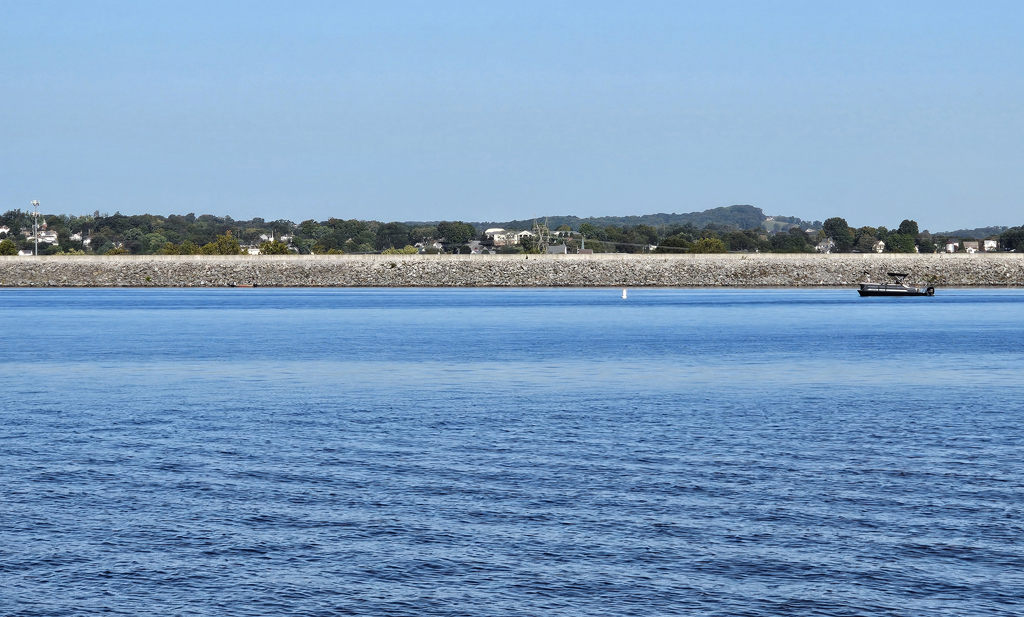
At one point we passed a huge quarry, Mulzer Crushed Stone, at Charleston, Indiana.  Crushed limestone, sand, and gravel is used in construction projects, including aggregate for highways and commercial and residential construction.  We were fascinated, watching enormous dump trucks filling waiting barges.  In one area the trucks backed up and tipped the load directly into the barge.  At another location, the stone was tipped into a hopper, and from then carried on a conveyor and poured into the barge.  As soon as each truck was empty and drove off, another full one took its place.  Looked at on google earth, the quarry is an enormous scar on the landscape, and there are an amazing number of quarries alongside most of the big rivers in this industrial heartland.  In addition to road construction, aggregate is also used for making cement, lime, and for agriculture.  Wikipedia tells us that concrete is the most widely used material in existence, and second only to water as the planet’s most consumed resource.  If the cement industry was a country, it would be the third largest carbon dioxide emitter on earth, behind China and USA.  Concrete and cement require huge amounts of power to manufacture.  In many cases on our travels, we see an entire power plant next door to a cement plant.  Perhaps those who wish to put a stop to the use of fossil fuels need to learn a few lessons about what other aspects of human endeavour require power, not just home heating and running our personal vehicles.

Mulzer Crushed Stone, Charleston Indiana
Loading a barge at Mulzer Crushed Stone
Dumping directly from the truck into a barge at Mulzer Crushed Stone

Social commentary over, and back to the voyage, we passed the town of New Amsterdam, which claims the distinction of being the smallest town in the United States, with a recorded population of 1 in the 2000 census.  It is possible that only one person responded to the survey, this being a part of the country that is not in favour of government oversight and interference.  Smallest town makes a good story, but the reality is that there are, in fact, a surprising number of towns in the USA that are smaller than New Amsterdam with its more accurate current recorded population count of 13.

New Amsterdam, Indiana

We planned to anchor in the Salt River at West Point, Kentucky, but again there was debris and no current in the river to keep us aligned.  It is possible to set out a second anchor, but that would be quite a bit of trouble, and it was much easier to backtrack a mile and again anchor in the river, on the Indiana side this time.  We were across from the Fort Knox Military Reserve, and yes, the Reserve is adjacent to the United States Bullion Depository, which houses a large portion of the United States’ gold reserves.  We were finally set by 6pm, but after starting at 7:30am, it had been a very long day.
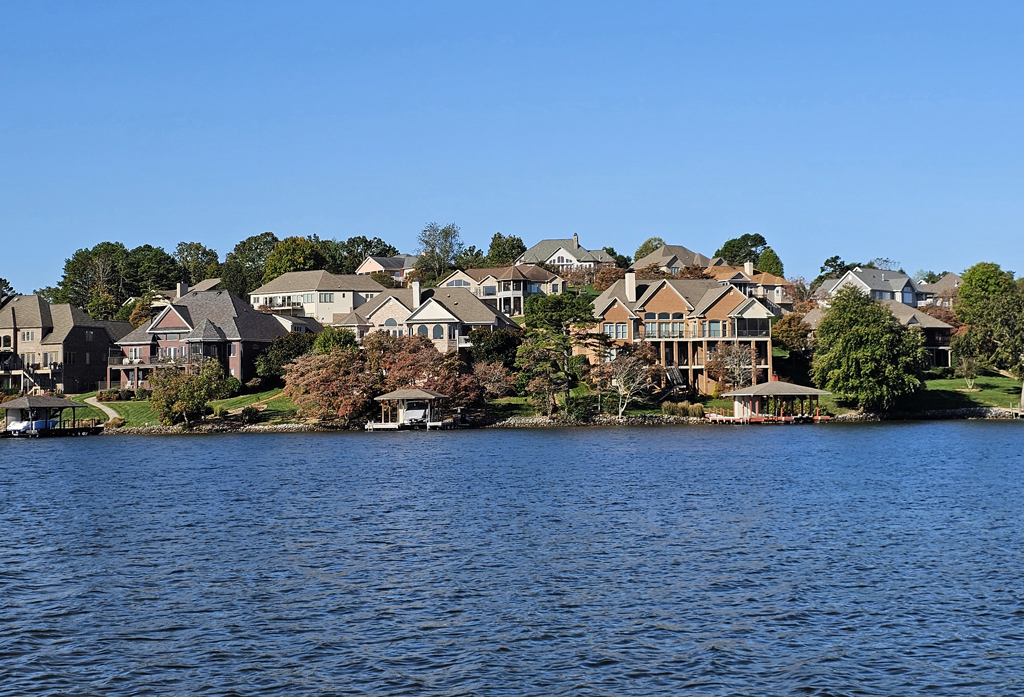
Apple Cinnamon Beer bread to enjoy with a cup of tea
Shrimp rolls for dinner on board

September 22 to October 4, 2022: Quincy to Pickwick Lake

Our second day in Quincy was a good day for chores.  I took care of laundry, Dick defrosted the fridge, and then made a run for grocery shopping.  Sid on Tranquility arrived mid-afternoon, and joined us for dinner at Boodalu in the evening.  Good steaks and enjoyable company.
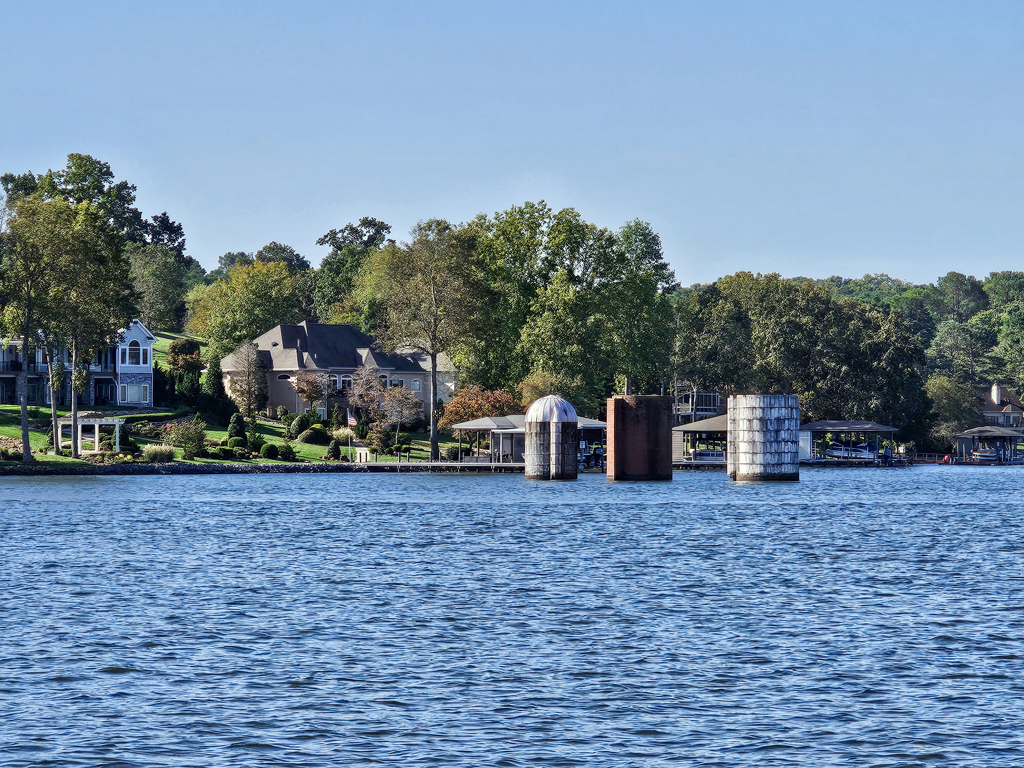
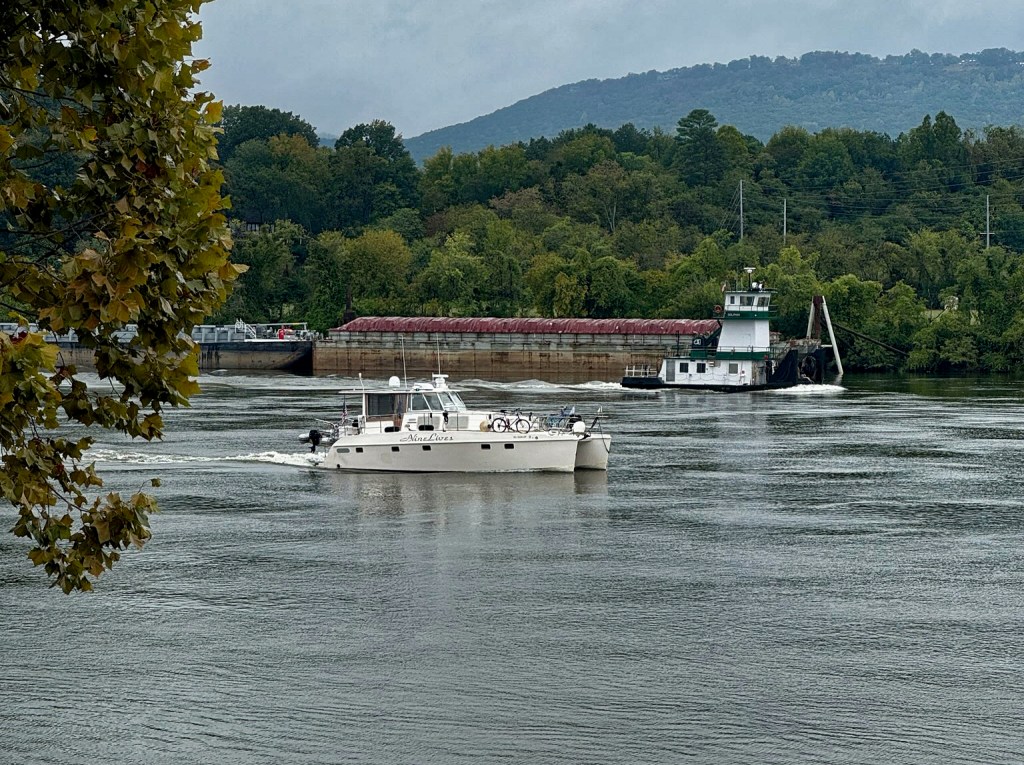
Nine Lives and Tranquility on the dock at Quincy
Quincy highway bridge at night
Quincy sunrise

The next morning, as we prepared to leave, the strap that I use to keep the power cords from sliding into the water jumped out of my hand as I undid it and landed in the water.  “Catch it!” I said to Dick, who instantly flopped full length onto the dock and retrieved it, just as it began to sink.  He learned the flopping technique in high school football.  You never know when lessons learned as a teenager will pay off in later life!  Sadly, Dick’s favourite white t-shirt is now relegated to painting and oil changes, as the Quincy dock had just that week been resealed and was still a bit tacky.  So a $30 shirt was sacrificed to save a $.99 strap…
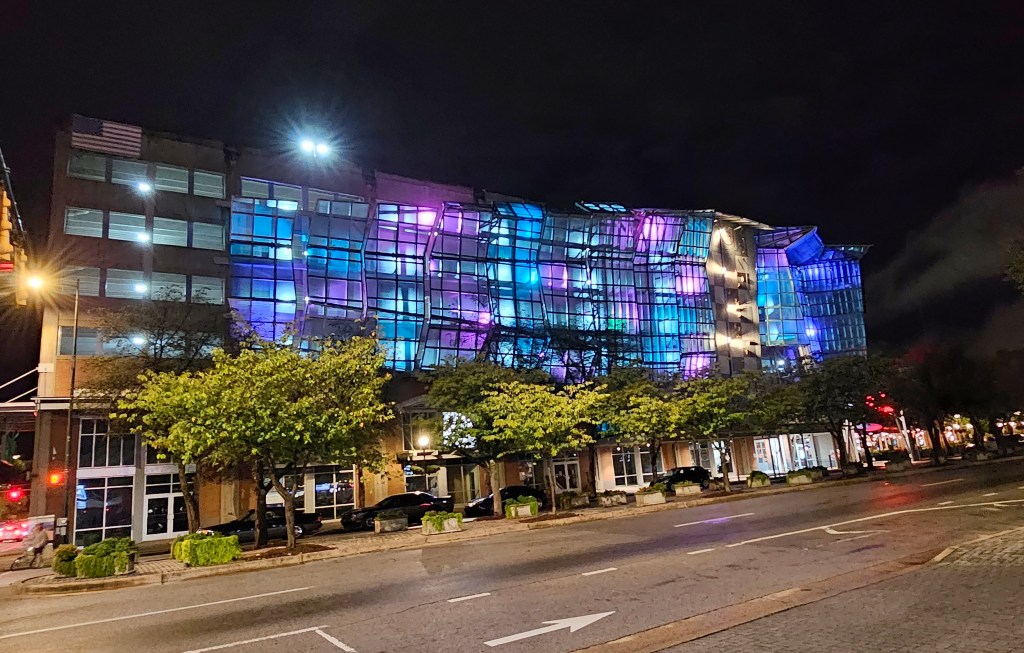
Our trip to Two Rivers was very cold.  I needed to get out warm socks, insulated vest (gilet), winter gloves, and rain jackets.  It was certainly a big change from our trip up-river, when the temperatures were well over 90.  Fortunately, the rain let up at both locks, and we had no waits.  It also slacked off for our arrival and tying up.

Dredging the Mississippi south of Quincy

We had a bit of an adventure as we entered the channel to the marina.  I was standing on the deck waiting with the lines, and I felt the port-side pontoon climb a hill!  We had run aground at the channel entrance, with just one pontoon.  It was a very strange sensation.  We were fast aground, and the dockmaster was preparing to contact a helper to pull us off.  Dick powered backwards, hard, for several minutes, and we sort of slewed sideways without actually coming free.  At last, with a surge of very black smoke from the engine, we floated back out into the channel.  The engine stopped smoking almost immediately, but a muddy brown stream shot out from the exhaust for quite a while before it ran clear.

Dick changed the approach to come from downstream and we got through the channel without further ado.  Later, when Dick checked, the starboard strainer was empty, but the one on the port engine was ¾ full of mud.  The rest of the uncaptured mud would have gone through the engine heat exchanger and into the water-cooled exhaust before washing out of the side of the boat as a muddy stream.  Not recommended for the health of the engine.

Strainer full of mud

That evening we had homemade pizza on board.  This last couple of weeks there are fewer opportunities for eating out, and more for eating up what we have on board.

Misty morning at Two Rivers Marina

The next day was a very pretty trip to Alton, with no locks to contend with.  We passed many tows with a full load of 15 barges, all empty.  These barges were being repositioned to be ready for harvest time further north.  Also, the Missouri River was very low, and tows were being advised by the Coast Guard to get off that river entirely.

Tow with empty barges on the Mississippi River. Many barges are repositioned in preparation for the harvest in the Mid-west.
Fishing on the Mississippi south of Rockport

We arrived in Alton with enough time to get fuel and a pump-out.  We discovered that we had been put at the end of the furthest pontoon in the marina, and as far from all the other Loopers as it would be possible to get.  We had hoped to resume friendly chats and possible docktails, but this was unlikely at such a distance. We did make an effort to visit one of the other docks, and Dick collected a few boat cards, but there really wasn’t the same easy interaction as happens when you share a dock.

Gentelin’s, on our third visit, started out wonderfully with delicious appetizers.  We shared potstickers, and toasted ravioli.  Dick ordered the duck for his main course, and it was good, although it was two legs instead of the half duck that was on the menu.  My tempura lobster was nothing like previous visits.  The wrong batter had been used, and the lobster was the mushy texture that you get when you overcook it from frozen.  Dessert did not salvage the evening, as it was too sweet.

Potstickers and toasted ravioli at Gentelin’s
Gentelin’s main courses
A pretty dessert, but far too sweet for our taste

A meeting was called for any Loopers who were planning to leave the next morning.  It is always more successful if only one boater contacts the lock, so coordinating the leaving times and appointing a spokesman is a good idea.  Unlike a similar meeting last year, nobody brought food or drink, and there was almost no socializing apart from polite introductions.  A very different group from our previous experiences.

We were up at 5am, and our group was in position in front of Mel Price lock at 6:45, 4th in line after 3 tows.  It took until 9:30 for our group of 9 boats to be locked through together.  The next lock south is Chain of Rocks, at St Louis.  Their second chamber was operating, and they were ready for the group to go straight in.  We had a lot of trouble holding Nine Lives in the lock, as we had misjudged the length of line needed to wrap around the floating bollard.  Dick didn’t want to use our normal long lines, but with the very short line and a strong wind, we were corkscrewing.  It took some jumping about to get a longer line in place plus a second stern line, and even then, I had both engines in gear to prevent corkscrewing for almost the whole lockdown.  Two boats had to raft up, as there were not enough floating bollards for everyone.  Normally we would enjoy that, but as soon as we realized we were having trouble we had let the group know we could not be available.  We were all through that lock by 11:30am, a pretty good time for the morning.

Looper group waiting at dawn for Mel Price lock
Loopers leaving Mel Price lock 3 hours later
St Louis
Parked tows on the Mississippi at St Louis

Once past St Louis we speeded up, and with help from the current we got up to 20.4 knots, our fastest speed to date.  We had two long days in the plan, and needed to run hard to be able to make the distances.

Normally we would tie up to the lock wall at Kaskaskia, but we happened to be there in the week that they were dredging the area, so boats had to anchor.  The lock keepers were very cooperative, allowing anchoring, even though they could have just closed all access.  Given the distances involved, that would have been very difficult for many Loopers.  We were the first of our group to arrive, but 5 other Looper boats were there first, and had taken up most of the available anchoring space.  We tried to go well forward of the others, but the lockmaster sent us back as being too close to the dam.  It was clear from our interaction and that with later boats, that the lockmaster really didn’t understand anchoring and how far back a boat needs to go from where the anchor is dropped.  We made 3 tries, complicated by a large stump in the area, wind that pushed us too close to the shore, and unhelpful advice from another boater that we were too close to his anchor.  All this was done with an audience, and at the end I didn’t know whether we should take a bow or hide our heads.

Once we were finally set, a boat that had locked through with us earlier arrived, and when asked by the lockmaster if he was the last, he said yes.  This was not true, as he could not help but know, as he had passed the other boat on the river.  The final boat had a very difficult spot to try to fit into.  On the following night, the lockmaster arranged for all the boats to lock up and anchor above the lock.  This made more sense, and ensured less interference with the dredge as well.  The dredge had to move their boom out of the way for every boat that came through, so it would have been much more considerate if everyone had left together in the morning. They didn’t.

Loopers anchored at Kaskaskia

Next morning the anchor came up much easier than it went down.  We avoided the stump and provided no entertainment for our watching neighbours.

On our second day of fast running and long distance to go we passed a loading terminal for coal with many full barges.  I was reminded of a country song on an album from Kathy Mattea, written in 2011, but still very much on point:

>>> 

You might think I’m outta date
But if I’m out of style and old
Why do men still dig me
All around the globe?

Hello, my name is coal
And around here I’m the queen
Some say I’m cheap and easy
Oh but they still bow to me
….
They curse me now for what I am
But not that long ago
They sang my praises everywhere
Hello, my name is coal

(excerpt from Coal, written by Jenee Fleenor and Larry Cordle, 2011)

Loaded coal barges

We passed through the Shawnee National Forest.  This whole area of the Mississippi is part of the Trail of Tears, when 60,000 members of the “Five Civilized Tribes” of Native Americans were displaced and sent west between 1830 and 1850.  American settlers, mainly from the South, had pressured the government to remove Indians from the southeast, in order to free up the land for settlement.  Population growth, the expansion of slavery, and the rapid development of cotton cultivation after the invention of the cotton gin created tensions and the subsequent land grabs. Although there was some opposition, the Indian Removal Act was passed in 1830 and allowed the government to extinguish any Indian land claims in the southeast.  Over the next 20 years this law was used to remove entire tribes from their ancestral lands and send them to newly acquired territories west of the Mississippi.  Up to 12,000 deaths during the journeys were caused by disease, malnutrition, and exposure during harsh winters.

Something was burning near the river, but we never found out what it was

We had decided not to stop at the usual anchorage at Boston Bar.  We found the two previous experiences quite unpleasant, with a very strong current, and high risk from riprap and bridge abutments if the anchor let go.  As we passed, we could see that the whole area where we had previously anchored was completely above water.  The next option also did not appeal to us, although many Loopers do choose to anchor there.  As we passed that anchorage, Angelo Towhead, we could hear chatter from tow operators that they were bumping the bottom in the area of the bridge, and to stay close to the red markers.  This put the tows with their large barge trains very close to the area where boats would anchor, so we certainly were not going to risk it.  We turned the corner into the Ohio River and headed towards a highly recommended anchorage at mile marker 974.

Boston Bar. When we anchored here in June there was over 8 feet of water under the boat, now it is high and dry

We heard from the Coast Guard that there had been a grounding at mile 974, and, sure enough, when we got there, we saw a tow with two barges full of coal, stuck fast beside the red markers.  We turned toward the shore, and fortunately Dick proceeded very slowly, as we suddenly had only 3 feet under the boat.  At that point we decide to back off and attempt to get to safer locations above the next lock.  The next day, Looper friends tried to anchor at mile 974, and they ran aground suddenly and did some damage to their props, so our decision was the right one.  By this time, it was getting quite late, and we knew that going through the lock plus 5 miles further upriver would take at least an hour.

Approaching Olmstead lock. Last year the wickets, the part of the dam on the right side of the picture, were well underwater and we were told to just drive over them instead of locking through.

The anchorage was straightforward to get to, and has plenty of depth.  It was not easy to tell whether the anchor had grabbed, so I set both alarms with a small radius.  It was peaceful, with little current.  Dick decided we would put on our underwater lights as well as the required white anchor light, just to be more visible.  So the blue lights went on, and we looked like party animals!  Later, Dick had second thoughts and turned the blue lights off to save battery power overnight.

The sun set as we anchored on the Ohio above Olmstead lock

After running hard so much, and forgetting to turn the icemaker off, a major defrosting project was required.  Nine Lives tends to sit a little low at the stern anyway, but when running hard, she digs in even more, and the bow is even higher, although she does tries hard to level out on plane!  If we forget to turn it off, as the icemaker adds water it slops over and runs down behind the ice bucket, creating a frozen block at the back of the machine.  Not the project Dick had hoped for at the end of a very long, stressful, and tiring day!

We had a short run to Paducah the next day, so a leisurely start with time for a bacon and egg breakfast.  We were there and tied up by mid-afternoon.

We had a good meal at Cynthia’s.  So far this seems to be the most consistent of the nice restaurants we have revisited.  We started with house smoked salmon for me, and oysters for Dick.  For main courses, I enjoyed bacon wrapped pork with cherry sauce, while Dick’s veal scallopine with mushroom sauce was delicious.  Dessert is never to be missed at Cynthias, and I could not resist returning to the chocolate slice as previous visits, while Dick loved his peach cobbler. 

Smoked salmon at Cynthia’s
Oysters at Cynthia’s
Pork with cherry sauce at Cynthia’s
Veal scallopini at Cynthia’s
Chocolate slice at Cynthia’s
Peach cobbler at Cynthia’s

In the middle of the night, we, and several other boats were boarded.  The masked intruder was almost certainly casing the joint, planning to steal.  He even peered down one open hatch at the Loopers sleeping below!  Oh, and did I mention that he had a stripey tail? Apparently, this raccoon likes to visit the boats, and was checking them out on several nights.

I went to the National Quilt Museum.  I had missed it on our previous two visits, and I found it quite surprising.  I particularly enjoyed the more traditional quilts, but it was interesting to see some of the other exhibits, including one room with fabric totems, and another Black Lives Matter project with quilted swing coats.  While I enjoyed the Quilt Museum, Dick visited the Railroad Museum.

National Quilt Museum, Paducah

Our Looper friends limped in with damaged props (after attempting to anchor at mile 974), but they were still ready to join us for docktails, followed by dinner at Grill 211.  They had booked a haul out and were hoping for a quick repair at Green Turtle Bay. (note, we think the repairs were completed quickly, as they are now on their way again)

Paducah has changed their procedures with their docks.  Previously, there was one Parks Department employee, plus a helper, who had dedicated cell phones so that boaters would get straight through to them.  They would come to the dock, and help tie up, and also arrange where each boat would be best, knowing what other boats were expected.  For some reason, the Parks Department has decided that they are now completely hands off, and boaters are expected to “sort it out”, with no assigned dockage.  This can result in small boats taking up the outside spaces, leaving the inside (with shallower water) for bigger boats.  It also means (as we saw) that nobody with authority is there to arrange for boaters to close up and leave enough space for the rest.  The day we arrived there were two rafted up on the inside, and the next day one boater refused to close up and left a very tight space for the next boat to try to get into between the dock and the rocks.  I will mention that while we have met some lovely people as always, overall we are not impressed with either the friendliness or consideration for others of many of the Loopers we have encountered this year.  Dick has received a request for his opinion on his Paducah experience, so he is hoping to suggest a return to the previous system, at least for the 6 weeks when they are fully booked each night by the Looper pack.

The next day, as we headed up the Cumberland River, we heard the Coast Guard reporting historic low water on the Ohio River between Cairo and Olmstead Lock, and also shoaling around mile markers 972 to 974.  It is quite a pretty trip up the Cumberland, in spite of some large quarry operations.  There must be good fishing in the river, as we saw many herons, and also eagles and egrets.

Cattle drinking on the Cumberland River
Fishing on the Cumberland River
Nine Lives on the Cumberland River

Dick phoned Green Turtle Bay to ask for our dock assignment and check that they were not putting us into a narrow slip.  He was very disappointed to be told we were to be on a t-head on the far side of the marina, once again, as far from other Loopers as possible.  When he told the lady that we were planning to walk to town for dinner, she told him that from that t-head, instead of a mile, the walk would be two and a half miles.  He must have sounded very sad, because the nice lady had a rethink, and changed us to Slip Number 1, right beside the bathhouse and the marina office.  She said it would be a bit tricky to get into, and she was right!  There is a rescue boat permanently docked at the end of that slip, and Nine Lives had to wiggle quite a bit to get in there.  I was glad to see our neighbour take his bikes off the finger pier, as I had visions of sweeping them into the water as we made the corner.  With lots of help ready from fellow Loopers and dockhands (and thus a large audience), Dick made it look easy and sashayed into the spot without any difficulty.

Green Turtle Bay Slip 1, a tight fit and a tricky maneuver for Nine Lives

We met fellow Endeavourcat 44 owners, and enjoyed looking through each other’s boats and comparing the similarities and differences.  They did the Loop in 2018, and sold their boat and planned other retirement activities.  Instead, they found that they did not enjoy RVing, so they looked for a new boat, specifically an Endeavourcat, that they could live on full time and repeat the Loop, taking a lot more time.

Deer at Grand Rivers

In the evening we walked over to Patti’s 1880 Settlement Restaurant.  It was a bit more than a mile, and undulating, with no sidewalks, but quite a nice walk and we saw deer in the gardens.  We had a great evening.  The restaurant was extravagantly decorated with lighted greenery with an autumnal theme.  The waitresses are dressed in flower print long dresses, and the waiters wear bib overalls.  There is a large shop with loads of junk that they hope you will buy while you wait for your table to be ready.  We started with an appetizer sampler platter.  It had fried pickles, something we have been seeing on menus everywhere this year.  I don’t eat pickles, Dick tried a few, but won’t be ordering them in future.  The loaded home-made potato chips were very good, as were the mozzarella sticks and the chicken tenders with accompanying sauces.  Dick ordered one of the signature pork chops for his main course, while I decided to be adventurous and try a Kentucky Hot Brown.  This was slices of ham, smoked turkey, and tomato, on toast, topped with cheese sauce and bacon, and completely buried under homemade potato chips.  It was delicious!  For dessert Dick went for their famous mile-high coconut cream pie, and I decided on a chocolate martini that was both pretty and tasty.  Given the distance and lack of sidewalks (or street lights), we asked for a ride back to the marina, and they took us straight away.  The restaurant will pick you up and return you to the marina if you call them, so we had been reasonably confident that we would get the ride back.  We will certainly return to Patti’s on our next visit to Green Turtle Bay.  It is a complete departure from our usual fine dining options, but very good food, and lots of character.

Autumn decorations at Patti’s
Appetizer sampler platter at Patti’s. We have no need to try fried pickles again.
The signature pork chop at Patti’s
Patti’s version of the Kentucky Hot Brown
Mile high coconut meringue pie at Patti’s
Patti’s chocolate martini

We were planning several more long days, so we set out shortly after 8am the next morning.  We had lots of help and good wishes from fellow Loopers.  Our exit was not quite as perfect as the entry, but still impressive.  One of the Loopers commented to Dick that he had been watching our progress on Nebo and could not believe how fast we were going.  We did set another new record at 22 knots.

Green Turtle Bay Marina in early morning

We were now into Kentucky Lake, a huge, long reservoir created from the Tennessee River by the Tennessee Valley Authority in 1944.  The TVA was created by Congress in 1933 as part of Roosevelt’s New Deal.  Over time it evolved primarily into an electric utility.   We passed a derelict building that we have wondered about previously, and this time I was able to identify it as the Old Danville Grain Elevator/Terminal.  It is an enormous concrete structure.  It was built on the banks of the Tennessee River in 1914 for the purpose of transferring barge loads of grain and other products to railcars above on the L&N Railroad.  It was 6 stories high, and used two huge elevators to move goods from the barges to waiting trains above.  Cargos included peanuts, grain, limestone, iron, and cotton.  When the TVA began clearing land for the creation of Kentucky Lake the terminal ceased operations.  Nobody knows for sure, but the suggestion is that because the structure was so big, and made entirely of concrete, it would have been prohibitively expensive to remove it.

Old Danville Grain Elevator/Terminal on Kentucky Lake. Only the top 3 of 6 storeys are above the water level.
Autumn colour on Kentucky Lake

That evening we anchored for the first time in Birdsong Creek.  Some of the reviews suggested a very complicated entrance and high risk of grounding, but Dick had good sonar detail on his chart, and seeing another Looper boat already in added to our confidence.  We stayed close to the green markers and always had plenty of water below us.  We anchored in 10 feet, beside the other Looper boat and well away from shore.  It was a very pretty, peaceful spot, in the middle of the Tennessee National Wildlife Refuge.  Further up the estuary is a freshwater pearl farm, that we might visit on a future occasion.

After a quiet night I enjoyed watching the sun come up and egrets fishing in the shallows.  As we pulled anchor, a hunter showed up with his dog to refurbish the duck blind across the creek.

Sunrise at Birdsong Creek
Egret in early morning at Birdsong Creek
Duck blind in Birdsong Creek, Tennessee National Wildlife Refuge. A hunter gathers brush to refurbish a duck blind.
Fishing at the mouth of Birdsong Creek

A check on our fuel situation suggested that we had used more than expected on the fast runs from Alton.  We decided it would be prudent to add some, rather than risk running dry before we got back to Pickwick Lake.  Dick made some phone calls, and found that the next marina south no longer sells diesel, and the further one was not answering their phone and has a reputation for being very expensive.  We decided to turn back north and get fuel at Pebble Isle.  It was an hour back, so the whole operation added nearly 3 hours to our day.  The dockmaster at Pebble Isle was very friendly and chatty, with a real Tennessee country accent.  We managed to figure out most of what he said, and guessed the rest!

Three men fish from a small boat on Kentucky Lake

The detour meant that we were very late into our planned anchorage at Swallow Bluff Island.  We set anchor just as the sun went down.  Fortunately, we had stopped there on the way north in June, so we were confident about the location.  It was a very quiet night, little wind, and no wakes, and the light current kept us perfectly in place.

Anchored as the sun sets at Swallow Bluff Island
Sunrise and mist on the river at Swallow Bluff Island

The shoreline was sandy, and it was easy to see the evidence of the recent lowering of the water to winter pool.  The pool refers to the depth the water is kept at on rivers and lakes when they are controlled by locks.  Kentucky Lake has a winter and a summer pool, with a difference of about 5 feet.  Winter pool allows room for winter and spring flooding from runoff and precipitation, while summer pool keeps the depth for greater numbers of tow traffic and allows for drought conditions.  The pool is measured as the number of feet above sea level.  On the Mississippi, the locks and dams are there to maintain navigable depth of the water for commercial traffic, they are not for flood control.  Kentucky Lake and the Tennessee River are controlled by dams that generate electricity for the TVA.

It is easy to see the difference between summer and winter pool a few days after the water has been lowered for the winter. The dark brown sand on the shore was covered at summer pool.
Bluffs on the Tennessee River
Turkey vultures gather on the shore on the Tennessee River

Our last lock for this season was Pickwick lock, a 50-foot lift.  It was a very ugly experience.  Nine Lives twisted and I couldn’t get her straightened with the engine.  I had to take over handling the line on the floating bollard while Dick pushed off at the bow with all his strength to keep the bow from scraping on the wall.  We won’t forget that experience in a hurry, and will put out another fender as close to the bow as possible for future locking.  We will also request a spot further back in the lock, where there may possibly be less turbulence.

Pickwick lock and dam

Once in Pickwick Lake it was an easy run to our winter marina at Aqua Yacht.  We decided not to stay on board for the last 3 nights, which makes everything easier for packing up, cleaning, and preparing for winter maintenance.  We booked into a cabin at Pickwick Lake State Park, where we stayed at the beginning of the season.  They have a decent restaurant on site, so no trying to cook either. 

On our second evening we treated ourselves to a return to Corinth and Vicari Restaurant, that we enjoyed in June.  In this instance our return meal exceeded our previous great experience!  I ordered the trout pate again, while Dick tried the stuffed mushrooms.  We went onto the chef’s menu (last fine dining experience of this season!) and shared the chateaubriand.  It was absolutely delicious.  To finish we had crepes with fresh strawberries.  Although it is a half hour drive, we will plan to return when we are back to the boat next year.

Appetizers at Vicari
We shared the chateaubriand at Vicari
Strawberry crepes at Vicari
In case anyone thought we actually eat all that food at the restaurants, here is the stack of take home leftovers!

Dick has spoken with the service manager at Aqua Yacht, and handed over his list of maintenance projects for this winter.  He is feeling a lot more positive that the work will in fact be completed as requested, as the staff seemed to be more engaged with the projects this time.  The 2000-hour engine service is already on the schedule for next week, and the refurbishing of the gelcoat will be done shortly afterwards.  Poor Nine Lives is looking like a stray cat these days, especially after a season on the muddy Mississippi.  The gelcoat was already dull when we started out in June, with far too many black rubber marks and other dings and scratches.  The previous name was showing through as well, most unfortunate.  After refurbishment, the plan is to refinish Nine Lives with a new ceramic coating.  There will also be fresh lettering.  The owner of the boat cleaning company has also assured Dick that she will be properly cleaned once a month.

This is the final blog issue for 2022.  We will resume in late June next year, with plans to go north on the Ohio River to Pittsburgh and then beyond on the Allegany and Monongahela Rivers to the end of navigation.  We will return again to Pickwick Lake for the following winter.

Nine Lives 2022 Statistics

States: 8, Mississippi, Kentucky, Tennessee, Missouri, Illinois, Wisconsin, Iowa, Minnesota

Locks:  58 (that’s 29 in each direction)

Miles:  2359

Bottles of Jack Daniels: 5 half gallon bottles

I will mention that unusually this summer, several of our guests shared our enjoyment of Manhattans as an adult beverage, so I am sure that contributed to the high number of bottles emptied.  That’s my story and I’m sticking to it.

Fastest speed at wide open throttle, 22 knots, fastest speed at normal throttle, 12.4 knots.

Rivers:  5, Tennessee, Cumberland, Ohio, Mississippi, St Croix

The map of our September travels. You can see the sections where we ran fast south of St Louis
I will leave you with a nice photo of Nine Lives passing the Arch at St Louis taken by a fellow Looper