
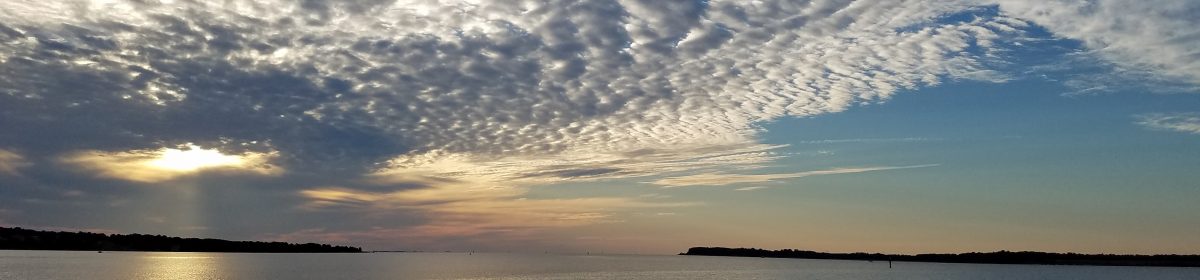
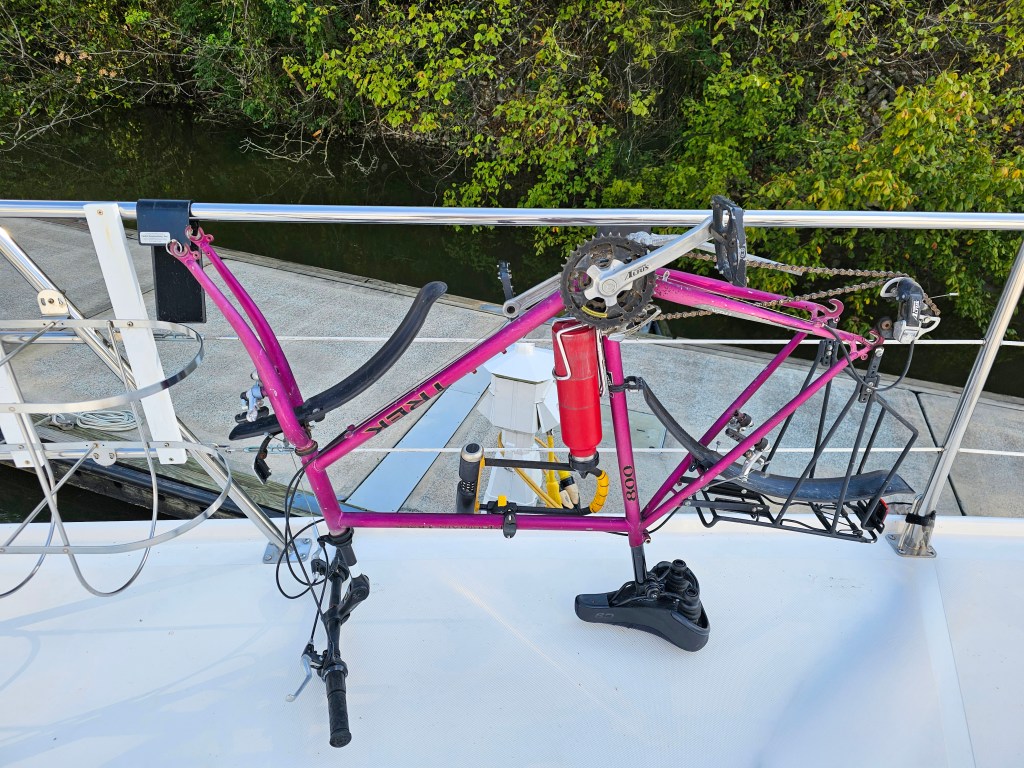
The last installment ended with something of a cliffhanger… would Dick’s bike disappear from the place he had locked it to the railings? Well, no, the bike was still there the next day when Dick went to get it to go for a ride, however, important components were missing, namely wheels. It had occurred to him at some point that perhaps he should lock said wheels, which have a quick release mechanism, to the rest of the bike, but he didn’t. Fortunately, there is a Trek dealership within walking distance of the dock. Yes, he could get the wheels, but they would have to be ordered. We had already planned to stay much longer in Chattanooga, so arrangements were made to rent a car. Of course, it is somewhat ironic that while the bike is about 30 years old, the wheels had been replaced just a few months earlier after an unfortunate encounter with a tourist’s vehicle in Hilton Head.
After one of Dick’s special breakfasts, we set out to collect the rental car. The depot was very close to the end of the electric bus line. We went to the supermarket and stocked up on the heavy stuff that is less easy to transport by bike. Parking in Chattanooga is inexpensive, just $11 per day. There are lots of multi-storey car parks, including the one with the beautiful lighted façade that is nearest to our dock.
I am impressed by how clean the city is. Unusual for an American city, especially one with such a large homeless population. The electric buses are clean inside, no trash on the floors, and while I see people leaving rubbish on the ground under benches, it is always gone by the next day. An army of cleaning fairies must be deployed around the city every evening. Even the area under the bridge is kept relatively tidy.

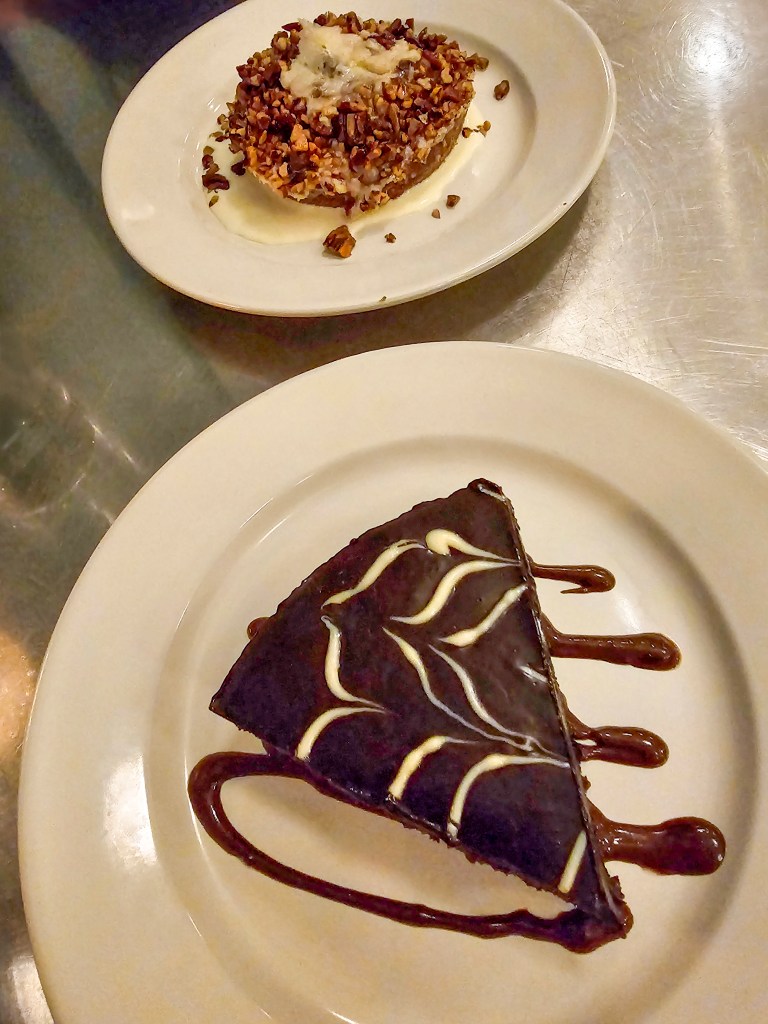
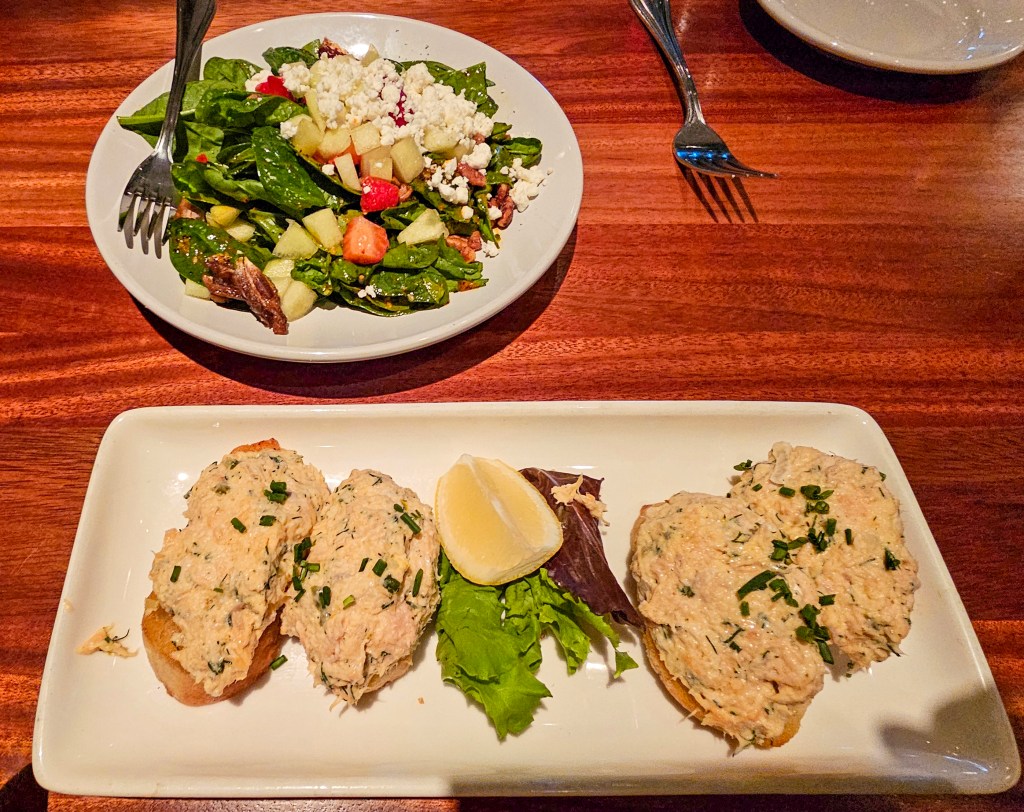
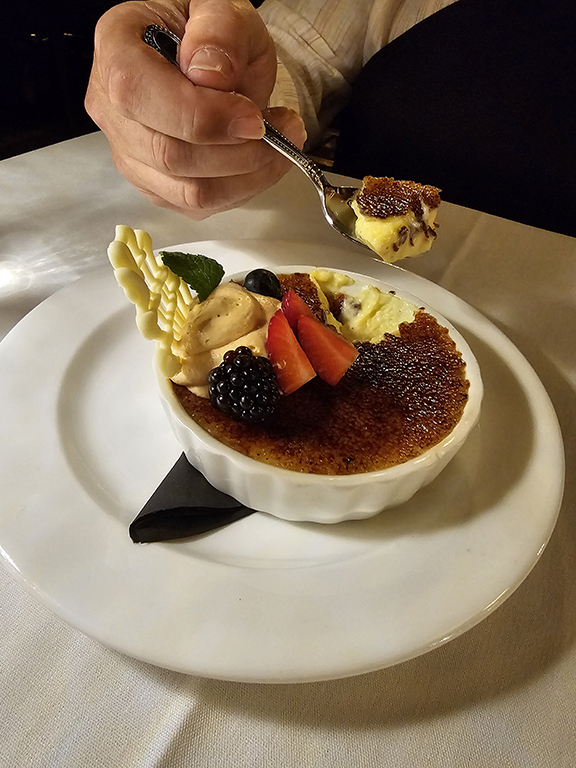
We ate at a restaurant called Public House. The smoked trout dip was tasty, but it came with incredibly hard toasts and rather too many crudites for my preference. It made a good lunch for Dick later! The pot roast was excellent, and I had the best shrimp and grits I have ever tasted. Desserts were very rich, but altogether it was a good meal.
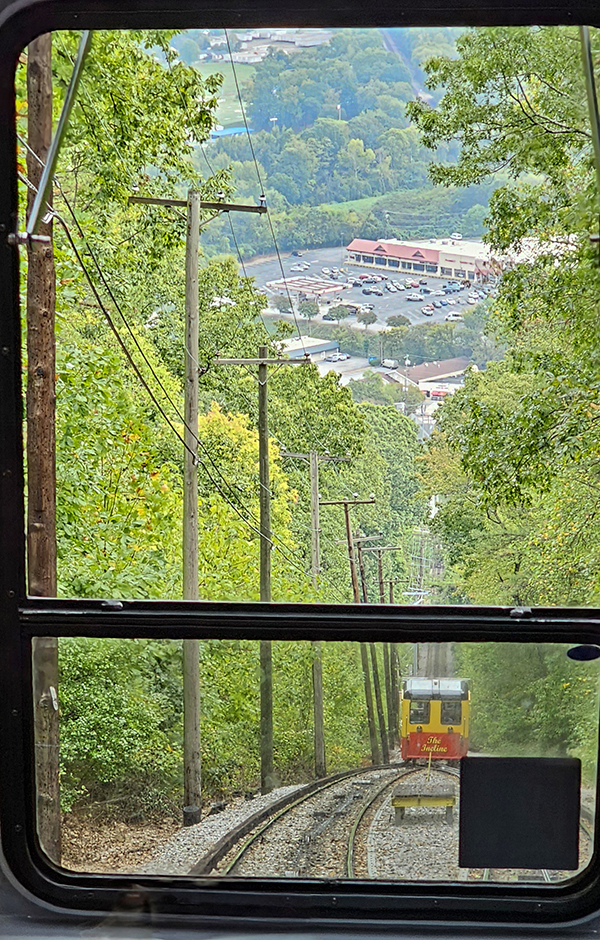
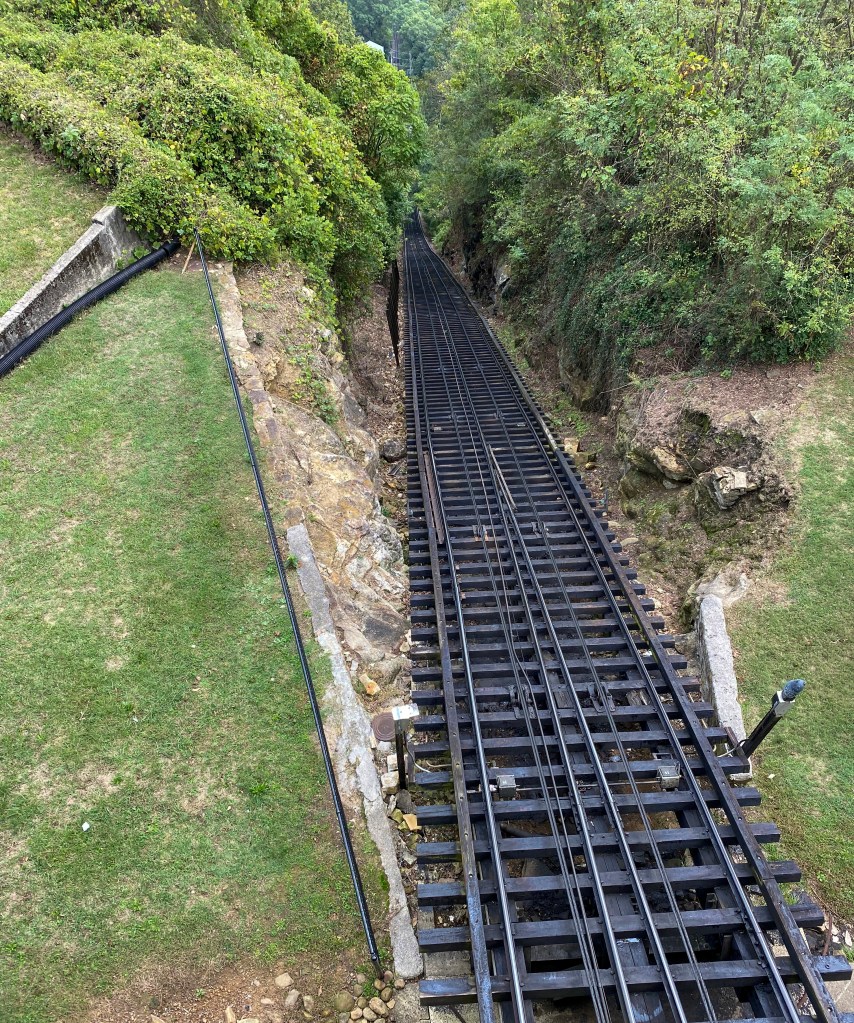
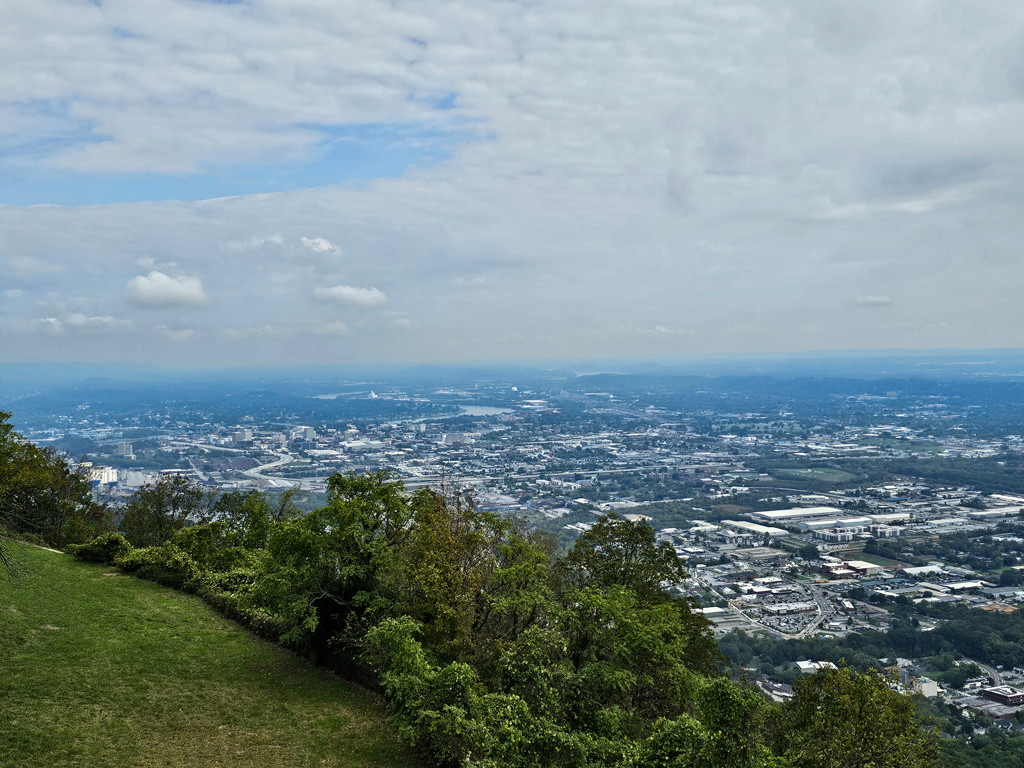
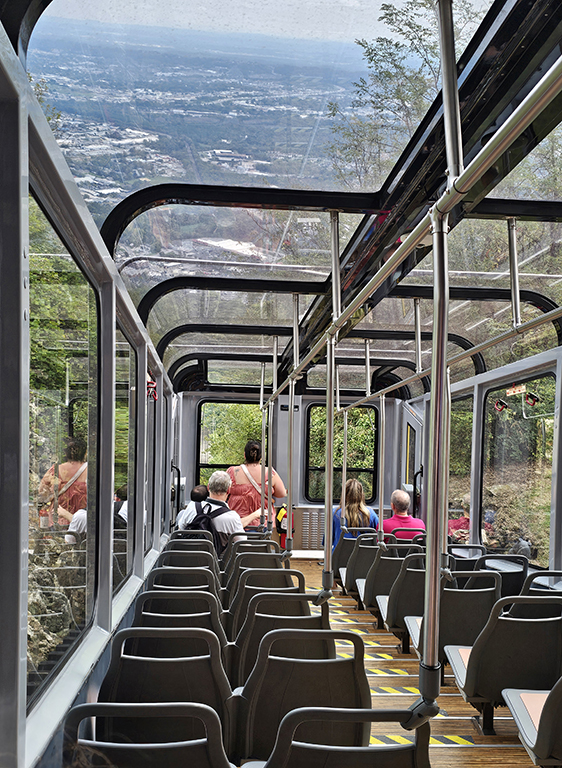
The next day we took a morning trip to the Incline Railway on Lookout Mountain. It was cloudy, and too hazy for the really spectacular views, but it was an experience. The railway is about a mile up the side of the mountain, with a maximum grade of 72.7%. It is one of the steepest railways in the world. I do not like heights. About 2/3 of the way up, I said to Dick, “The things I do for you!” The lady in the seat ahead of us immediately said, “Oh I know what you mean!” After we returned from the adventure, we stopped at Ben & Jerrys for ice cream.

Another Looper arrived in the late afternoon, so at last we were not the only boat on the dock. They joined us for our planned visit to a rooftop bar called “Whisky Thief” in a nearby hotel. The public areas of the hotel have beautiful, fascinating artworks on display, and Debbie and I would have liked to have had more time to study them. The bar was quiet when we arrived, but grew increasingly noisy and crowded as the evening progressed. The menu is limited to QR codes or, find the bar’s website online. While they serve flights of various whiskeys, you have to keep going back to your phone to figure out what you are drinking. Instead of a flight, I had a bourbon that we had enjoyed last year when we tried a (properly labelled) flight in a restaurant in Louisville. We enjoyed the congenial company and will look forward to seeing them again at Rendezvous.

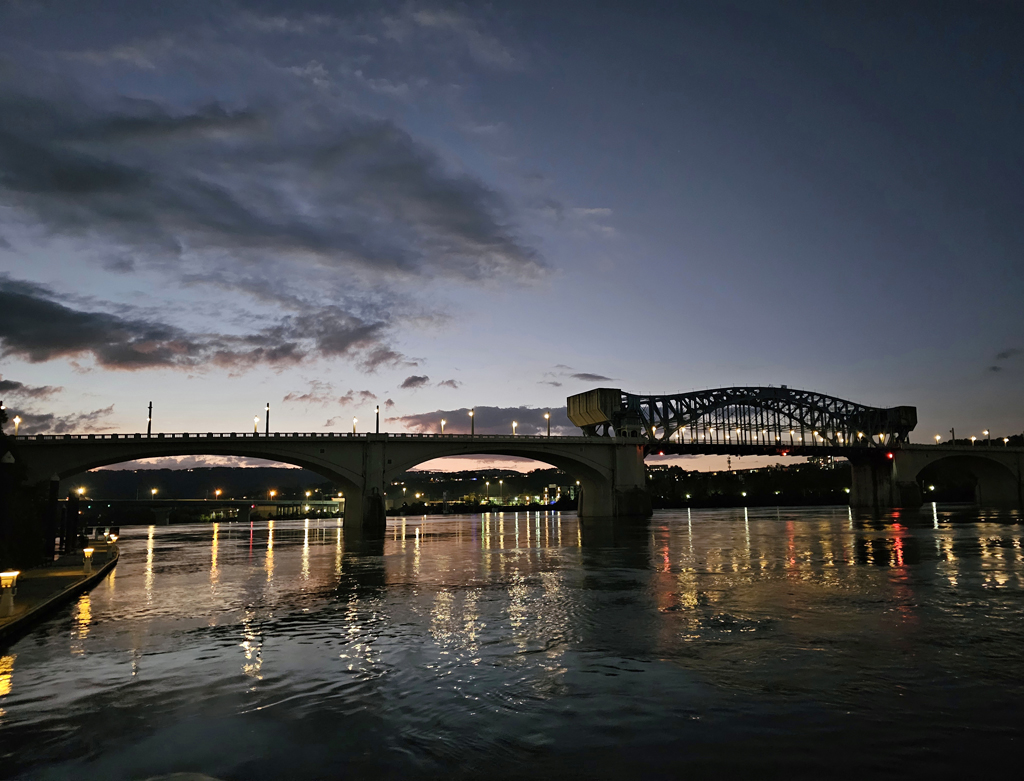
The next day, after working on the Rendezvous presentation all day, we were glad to go out and walk to the second of the top steakhouses in Chattanooga. There was a bluegrass festival in the waterfront park, but it was very hot and crowded, and the music was not really our taste, although we do enjoy some bluegrass.
Dinner was quite good, with excellent service, but the ambiance was more like a large cafeteria than an expensive steakhouse. It was very noisy and crowded, and most of the patrons were dressed for the outdoor festival. Although the water had receded and uncovered the downstream walkway to our dock earlier, when we returned it was up again, resulting in wet shoes and socks.

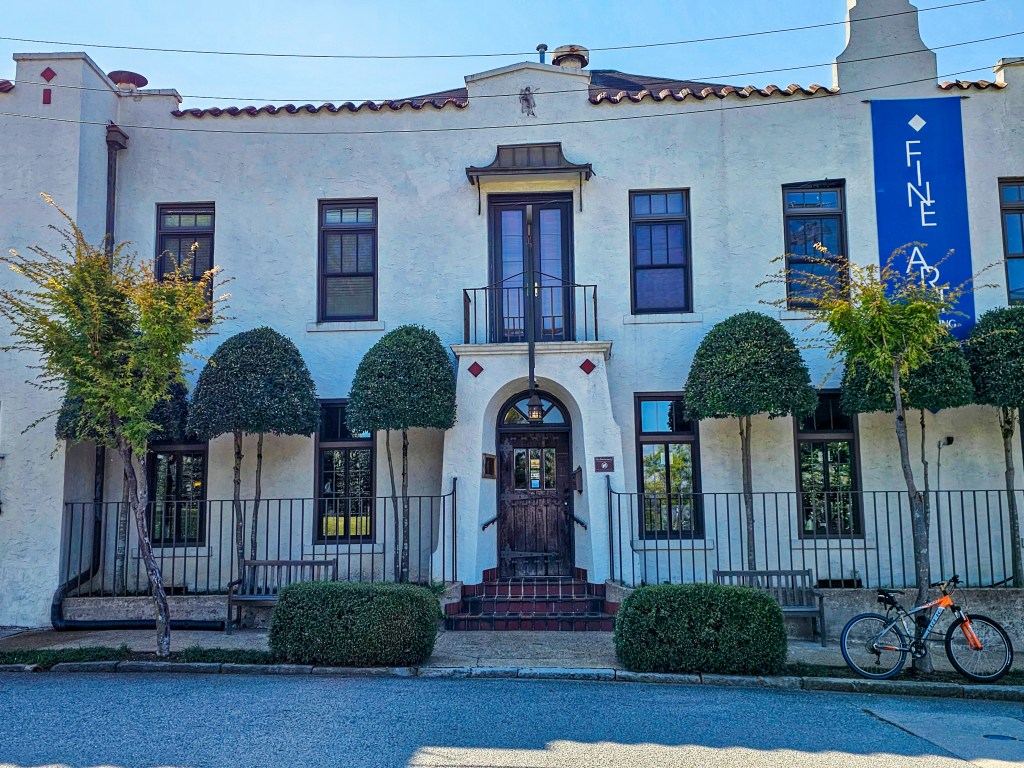
After another of Dick’s special breakfasts, we set off for some sightseeing. I had found what was described in glowing terms as an art enclave with shops, galleries, an artisan bakery, and restaurants. It was certainly an attractive area, but one of the galleries had limited days, and the other was not yet open on a Sunday. No shops, and the artisan bakery was just pastries sold out of a coffee shop with a queue of at least 30 people. Apart from the coffee shop, there was just one restaurant that we had been told was not very good. So, we walked back to the Museum of American Art. You could have knocked me over with a feather when Dick told me that was actually our destination for the morning.
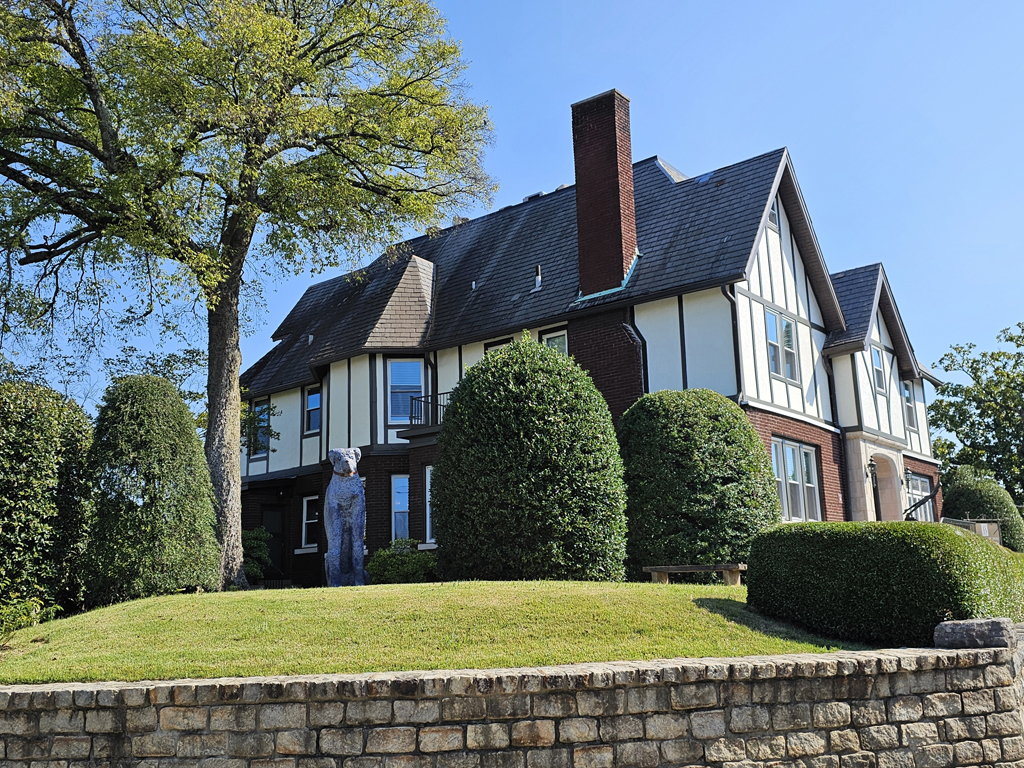
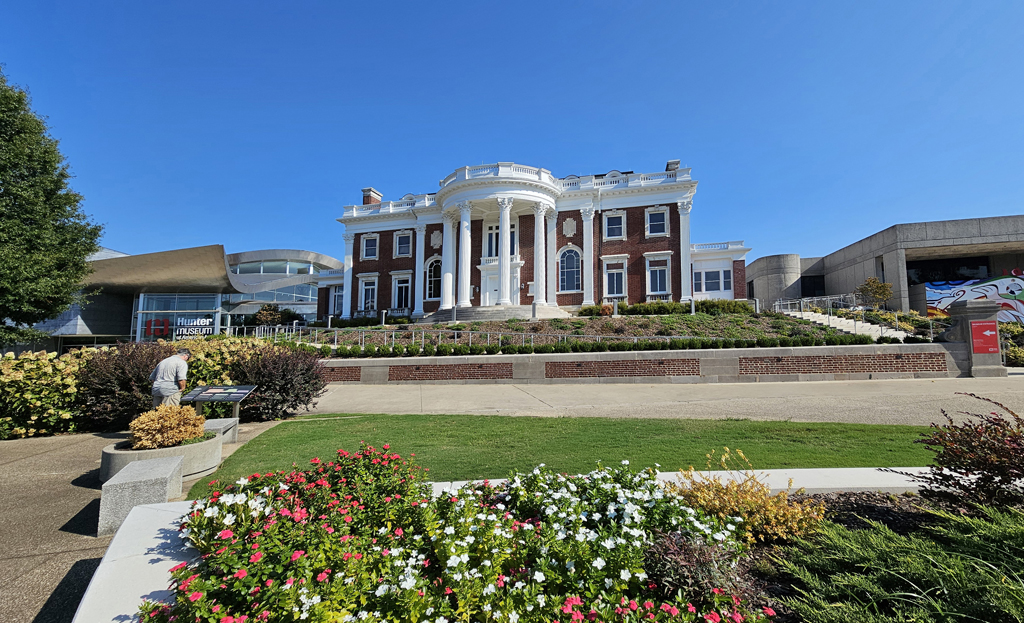
Of the temporary exhibitions, one that featured art glass had just finished, we would have loved that. Instead, there was an exhibition of graffiti. Yes, the stuff that vandalizes public and private buildings and street furniture. Dick walked around it, I didn’t. Afterwards, Dick’s comment was that while he recognizes people’s right to express themselves, and even the talent of the artists, he totally objects to the defacing of public and private buildings, spoiling someone else’s architectural, engineering, or design efforts.
The permanent exhibitions were more interesting, spanning American art from the 1700’s to contemporary.

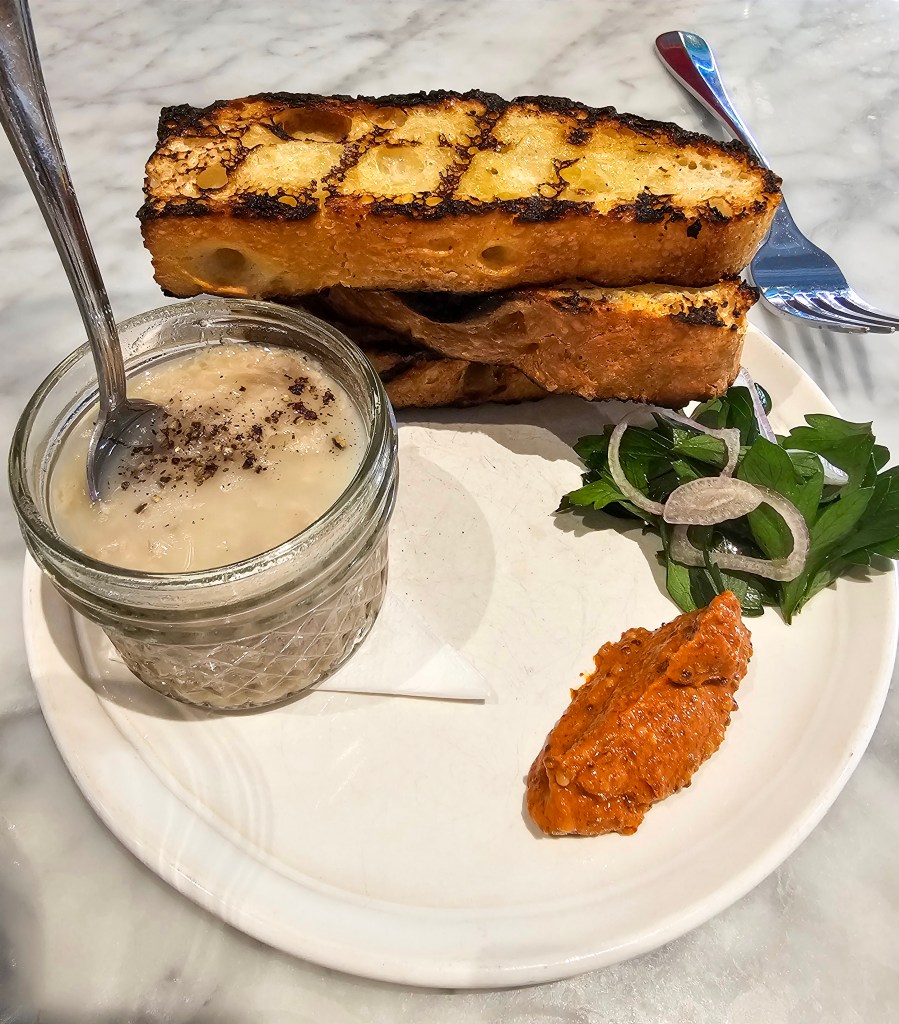
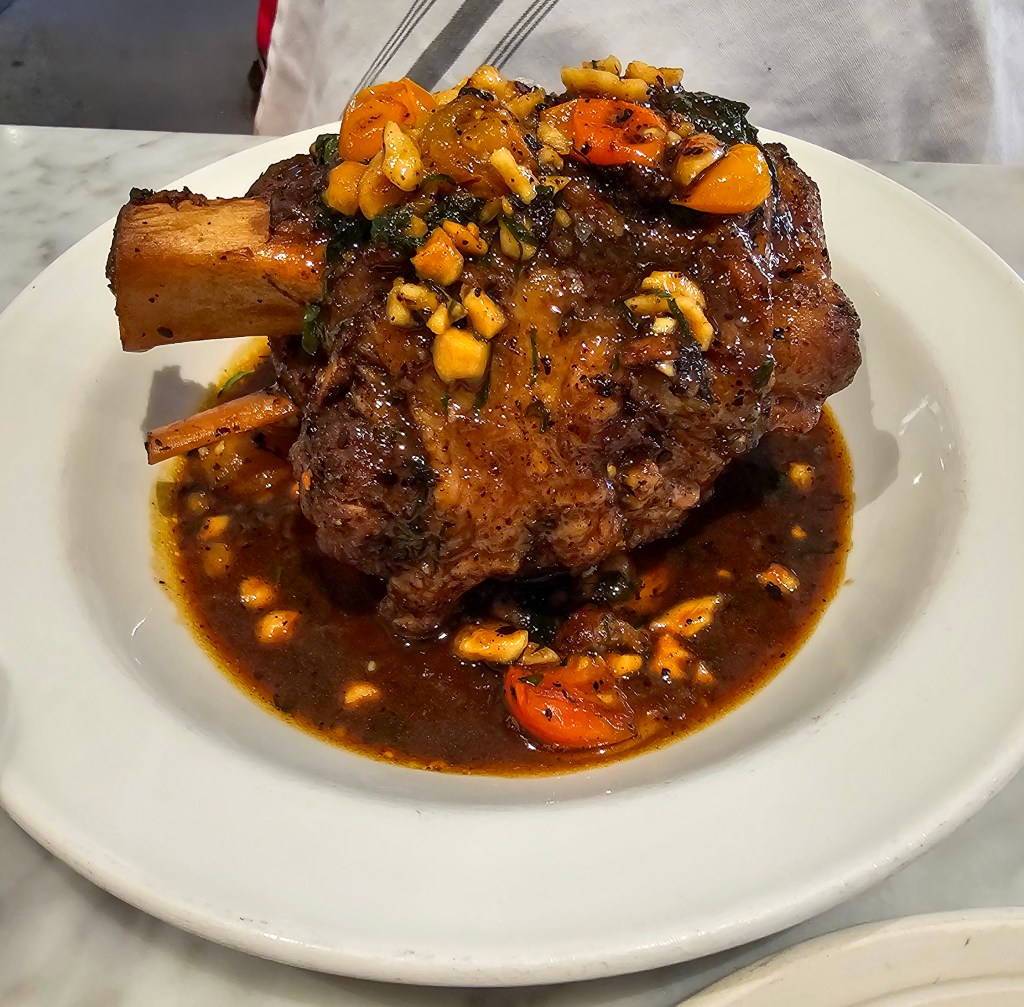
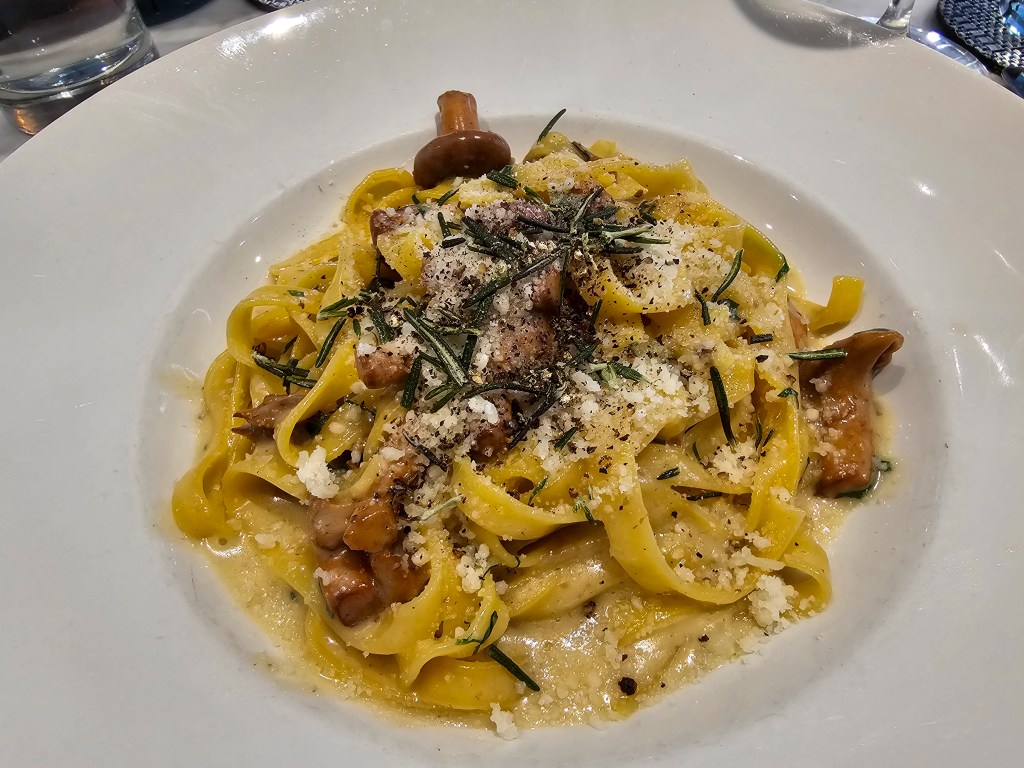
We went to Easy Bistro for an early dinner. The venue was a surprisingly authentic French style. I enjoyed the meal, quite unexpected, since there was so little on the menu for me to choose from that I ended up with a side dish as a starter. Dick was in heaven, and had difficulty choosing from so many unusual options. He settled on the rabbit rillettes, followed by pork hock, and profiteroles to finish. My mushroom tagliatelle was very good, and worth taking home. (and we remembered to take it, unlike the previous evening when we left the beautiful steak leftovers on the table by mistake). The first glass of wine let me down. I usually enjoy a Loire Valley white wine, but this one was awful. It also happened to be the cheapest on the menu. Dick’s comment, “The French hated it so much they sold it cheap to get it out of their country…”

We left early the next morning so we could go back to the fuel dock and take advantage of the excellent (and free) pump out machine. We were properly underway before 9am, but there was a delay at the lock for a pleasure boat to lock down. There are very few tows on this part of the river system, particularly given the delays at Wilson lock.
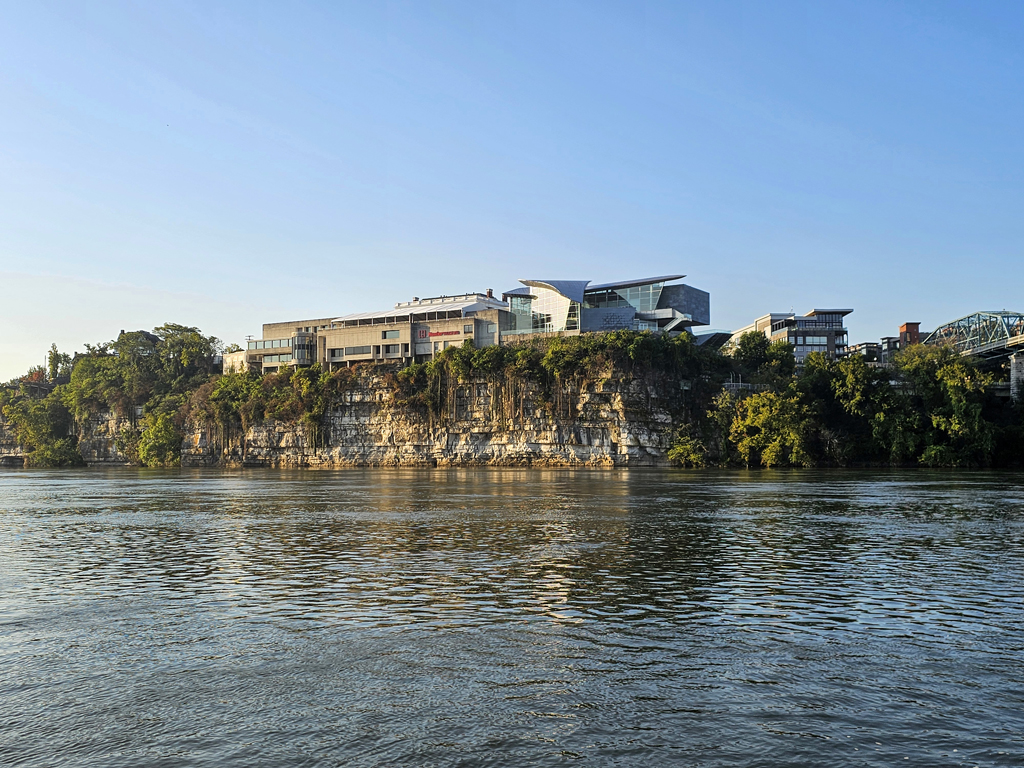
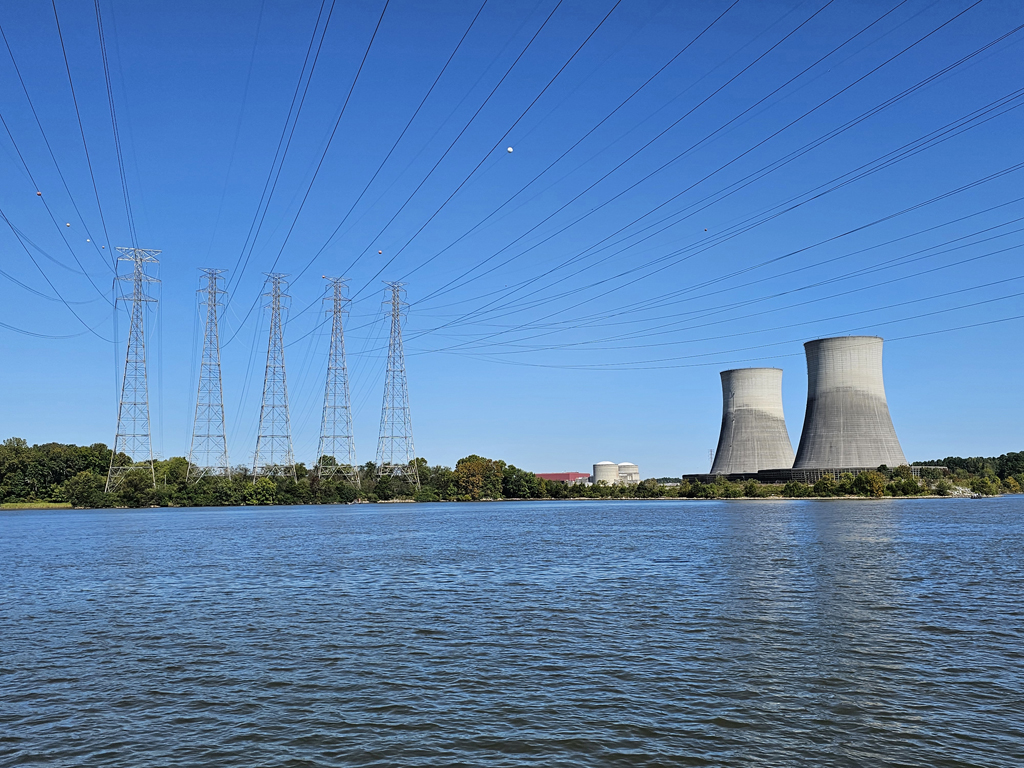
We passed the Sequoyah Nuclear Plant. This plant, and its sister plant at Watts Bar, has a special system that uses borated ice to help condense the steam in the case of a loss of coolant accident. The system allows for a smaller containment building. The reactor cooling water at the Sequoyah plant is mostly pumped into the Tennessee River at a rate of a million gallons per minute. A maximum rise of five degrees F is allowed in the river as a result of releasing the cooling water. Once the maximum is reached, the big cooling towers are used to provide the required extra cooling. On both occasions that we passed there was no steam coming from the towers. We noticed that the area is popular with fishermen, so the fish must like the warmer water too.
Sequoyah was a Cherokee polymath. His most well-known achievement was the creation of a Cherokee syllabary, enabling the Cherokee language to be written as well as spoken. Within 25 years of adoption of the syllabary, the Cherokee Nation had almost 100% literacy. Many things have been named after Sequoyah, including the giant trees in California, a mountain in the Great Smoky Mountains, and a yacht that was formerly used by American Presidents.
That night we stayed at a fellow AGLCA member’s dock on Lake Chickamauga. They have built a beautiful house above the lake with stunning views. Their boat is elsewhere for repairs, so Nine Lives was made welcome. We enjoyed refreshments and nibbles and the wonderful views from their balcony. Later we returned the hospitality with docktails on Nine Lives.

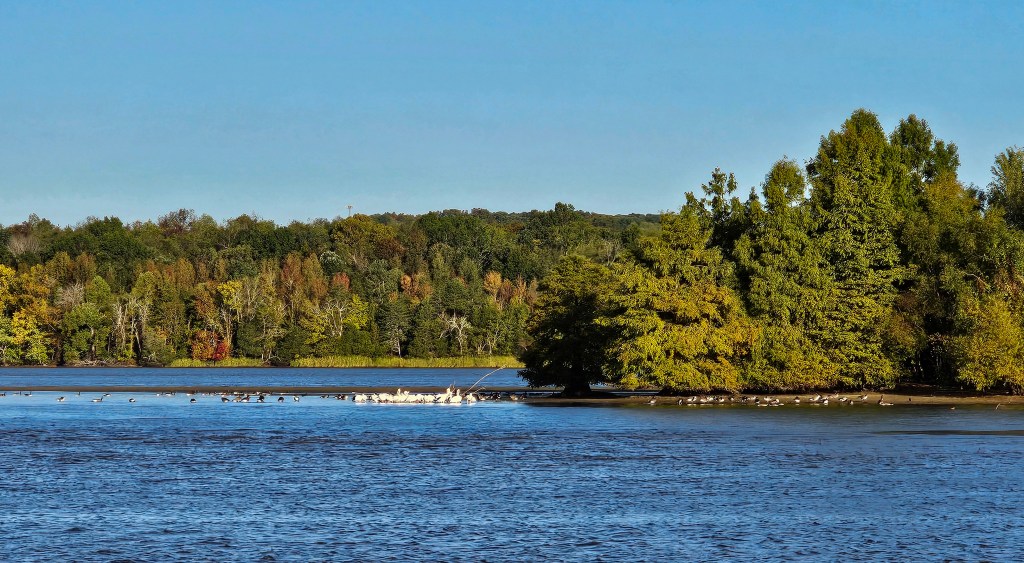
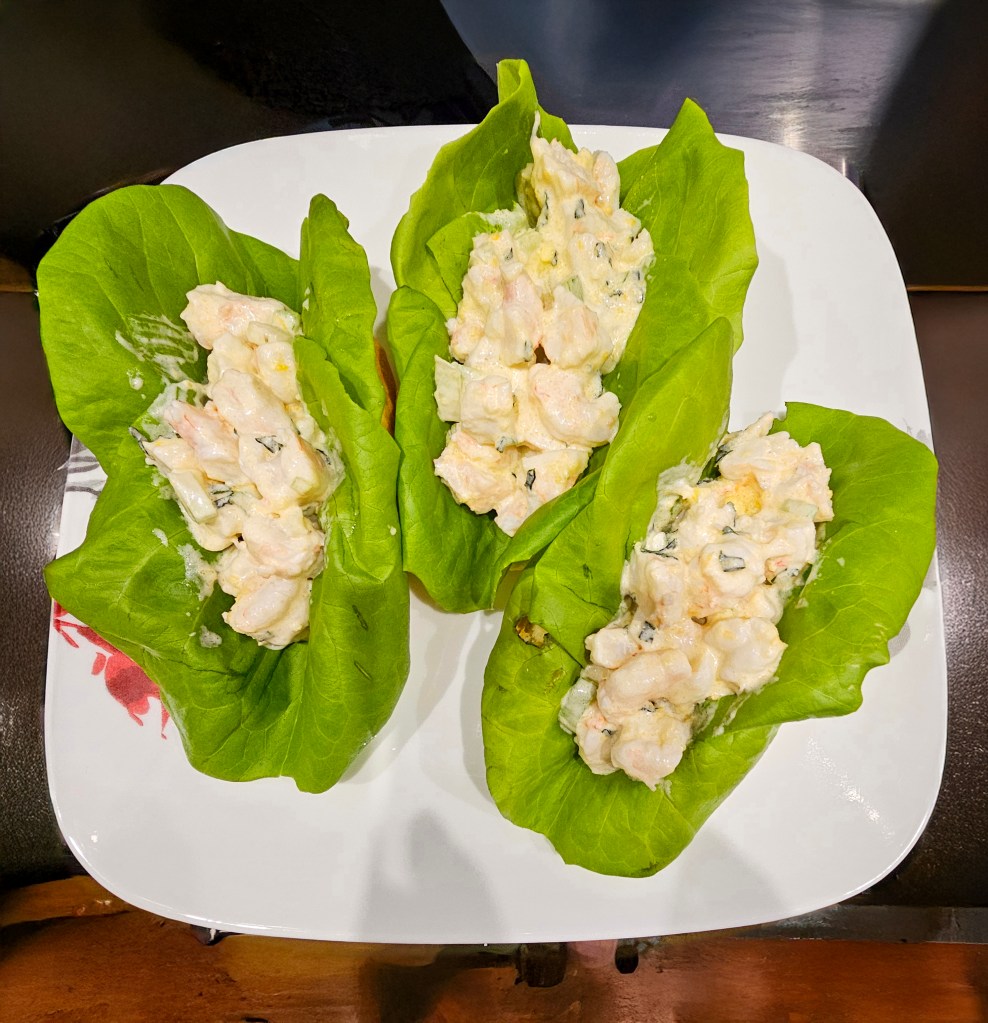
On October 8th we got an early start, expecting an 8-hour day, but the lock was ready for us when we got there, so we didn’t lose much time. We were in the marina by 3:30pm in spite of a strong current against us. The staff asked us to arrive before 5pm, so they could help us tie up, but after detailed instructions by phone for finding our slip, there was no help in sight. Usually, this is just as well. Not only does it save tipping a dockhand, but we do better ourselves. This time it was a little more tricky than most because of very small cleats that are hard to keep a line around. The onsite restaurant was closed for the season, so we had planned for shrimp sandwiches on board. This year, instead of relying on frozen shrimp from the supermarket, some of which has been so awful it had to be thrown away, we bought several 1- and 2-lb packages of wild caught shrimp from Hudson’s in Hilton Head. What a difference in flavour and texture! Of course, it does mean that for shrimp sandwiches I have to cook them first, but the result was well worth the extra effort.
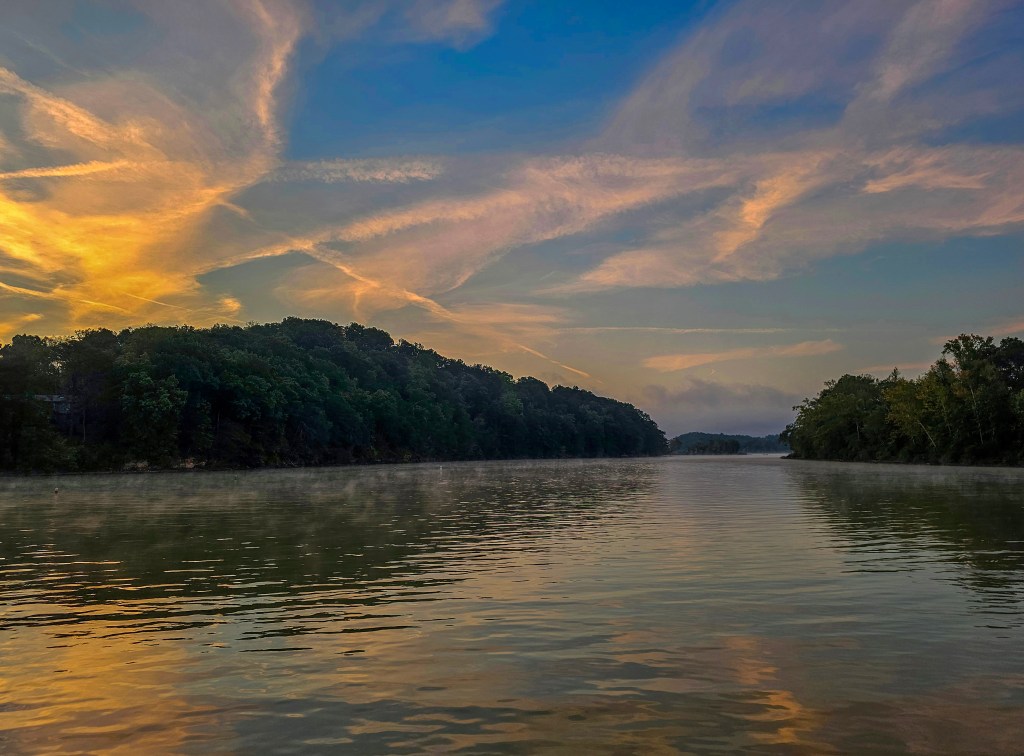
We now have wonderfully cool nights and chilly mornings. Long sleeves are good to start, and I am starting to think about the gloves that I have packed away somewhere that have full fingers. We are beginning to see pretty fall colours and mist on the water in the mornings.
We passed under Interstate 75. This highway starts at the Canadian border in Sault Ste Marie, and links Detroit, Cincinnati, Lexington, Knoxville, Chattanooga, Atlanta, Tampa, and Miami.

In Loudon, about a mile of the riverbank was taken up by the Primient factory. This plant used to be the familiar Tate & Lyle, but it was rebranded following ownership change. Most of the factory is screened by trees from the river. The smell is strong, and not particularly pleasant. We thought we would not like to live in any of the houses across the river that must have the smell with them all the time. Corn is delivered and turned into a variety of products including high fructose corn syrup, and fuel ethanol. Something about those products being produced in the same facility….
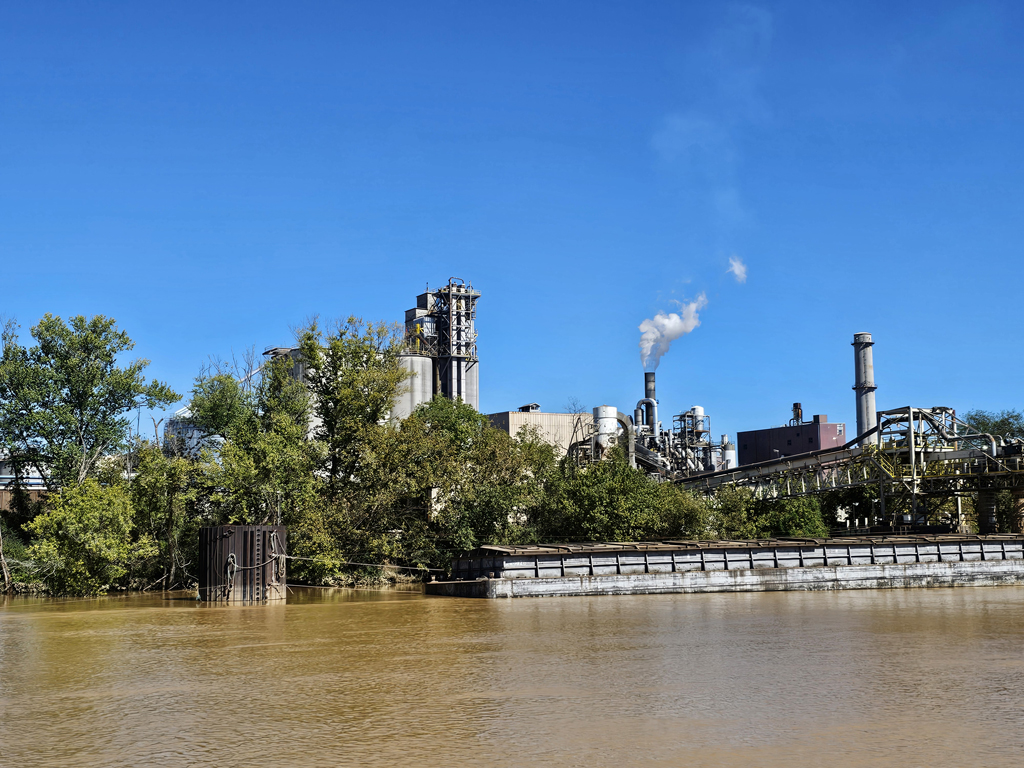
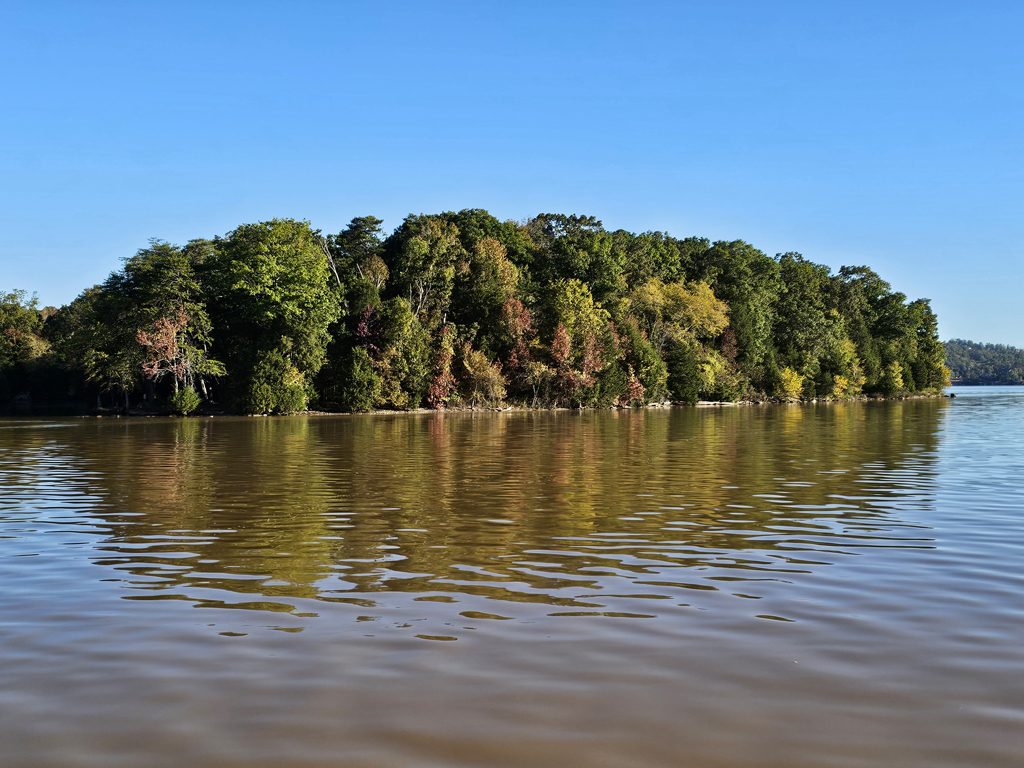

A day that was a mix of interesting shoreline and long boring stretches became far more exciting than either of us liked. Ft Louden lock was our last upbound lock on the Great Loop, and it was a doozie. When we were about 30 minutes away, Dick made his usual polite phone call to ask about the queue, and request a lock up. The lockmaster explained that he was about to lock down a tow that would take 8 hours, but that if we could get there within 20 minutes, he would take us up first. Dick put the hammers down, Nine Lives leapt forward, and we arrived at the lock in less than 15 minutes. Then the excitement began.
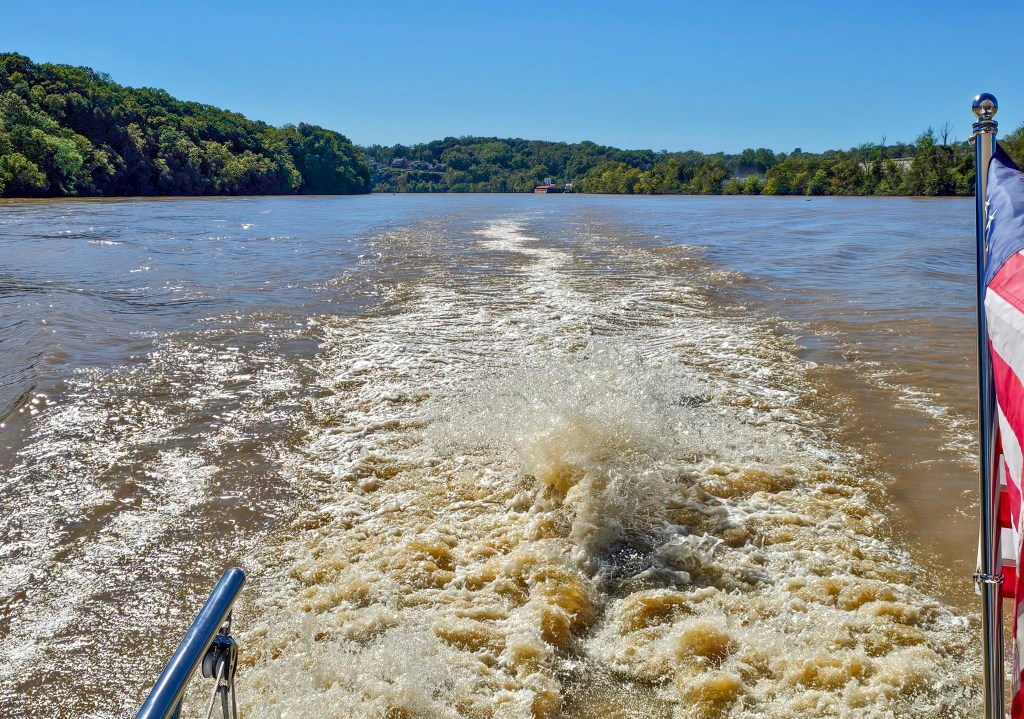
In addition to some huge logs and pieces of debris, the water coming off the dam had created an area of rolling waves with whitecaps, that were broadside to the boat. Dick fought his way through the mess, as we were flung this way and that. We were very glad that we observe “cupboard discipline” and latch all cupboards and drawers at all times. If we didn’t, the contents would have been on the floor.
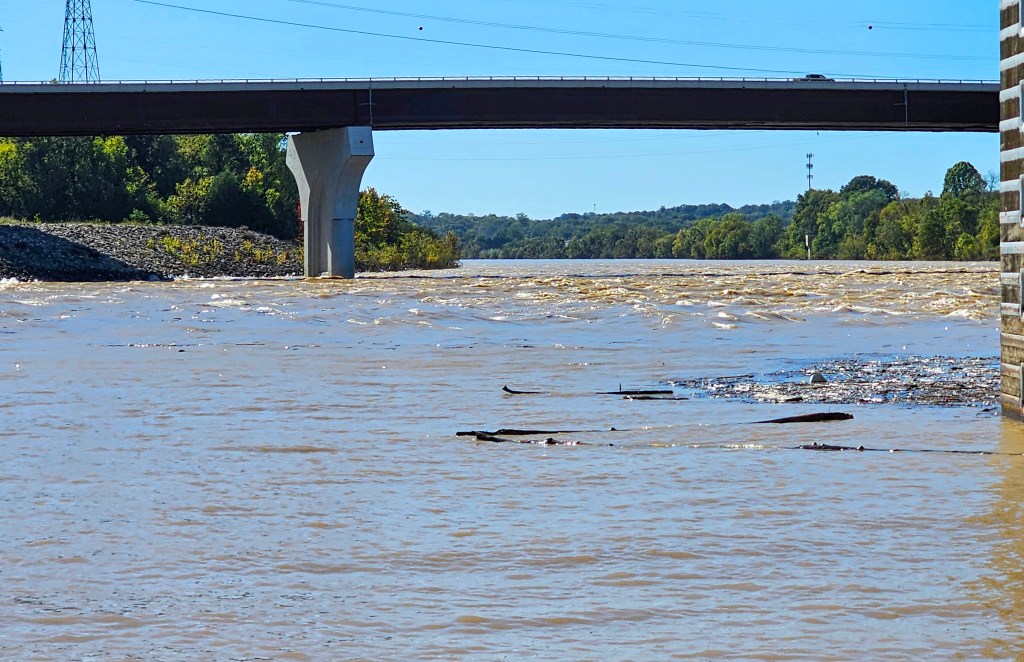
As we waited for the lock doors to open, we could see 2 huge tree trunks, each about 20 feet long, blocking the lock entrance from each side. The only way was to push through them slowly. Finally set, with Dick tending the line on the floating bollard as usual, he looked up to see a whole bunch of people looking down at us! Once again, we were the show, or at least the opening act. The lock was conducting tours of 30 to 35 local people, and our adventure coincided with one of the tours. The excitement was not quite over. The waiting tow had moved into position, in front of the lock gates. Fortunately, after his front barges were tied off, he backed up a little, so there was enough space for us to get past. Once again, we had to push through a debris field. Certainly there was lots going on for the watching tour group. Dick posted on the Looper forum that evening, advising Loopers not to plan to come through that lock until the high water had subsided. Nine Lives managed the turbulence, but some boats would have real trouble.
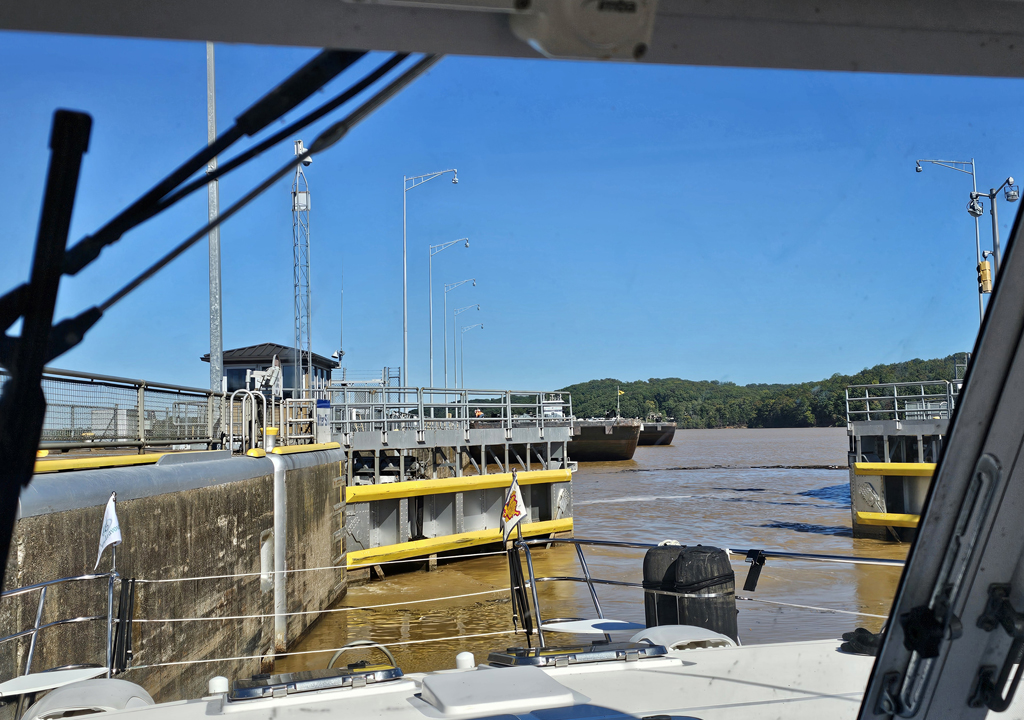
We arrived at the marina, which is immediately above the lock, and had no answer when Dick tried to phone. This meant tying up at the fuel dock in order to get a dock assignment and the gate key. Always a pain. Our slip was very short, although thankfully wide enough, with very small cleats that were impossible to get a line onto from above. Once in the slip, I put the stern line around a post, and took station at the helm while Dick half climbed and half jumped off in the middle of the boat and secured all the lines. I was not required to jump down 5 feet to go to dinner, as the ladder fit! We planned to eat at the onsite restaurant.
We walked over and had about ½ an hour to wait. However, there was room in the bar, and while Dick enjoyed a beer, I felt the need for something a little more robust after our earlier excitement, and ordered Woodford Reserve. It was a double, but (sadly) not what one would describe as a generous pour!
The restaurant won a National Rib Cookoff, and regularly wins “best of” in Knoxville. This is a barbecue restaurant, which means that I now have to explain to our non-Southern readers just exactly what is meant by the term barbecue. In Canada, UK, Australia, and much of northern USA barbecue is a method of cooking over direct heat such as charcoal or gas, generally quite quickly. Southern barbecue however, is done with indirect heat, such as smoking or roasting and over a long time. Most Southern barbecue will feature a tomato and pepper-based sauce with brown sugar and often quite hot spices. There are literally hundreds of bottled barbecue sauces available to buy in supermarkets, and restaurants often have their own recipe. Dick and I have learned to use the term “grill” to describe either the equipment or cooking method, in order not to confuse any guests who might be expecting something quite different from what we are preparing!
Dick ordered a trio of 3 dishes, BBQ ribs, fried chicken, and pulled pork. I had a hamburger. All were excellent, but I found that the seasoned fries had a sweet taste that I didn’t like at all.

Next morning we set off up the Little Tennessee River. We passed the earth dyke of the Tellico Dam, a highly controversial dam that created Tellico Lake. TVA insisted that this dam was required to prevent flooding downstream, and also to improve the local economy. Environmentalists, local landowners, fishermen, and Native Americans all objected for a variety of reasons, including the presence of the endangered snail darter (a fish). Construction was halted just before completion. Eventually it went forward by an Act of Congress.
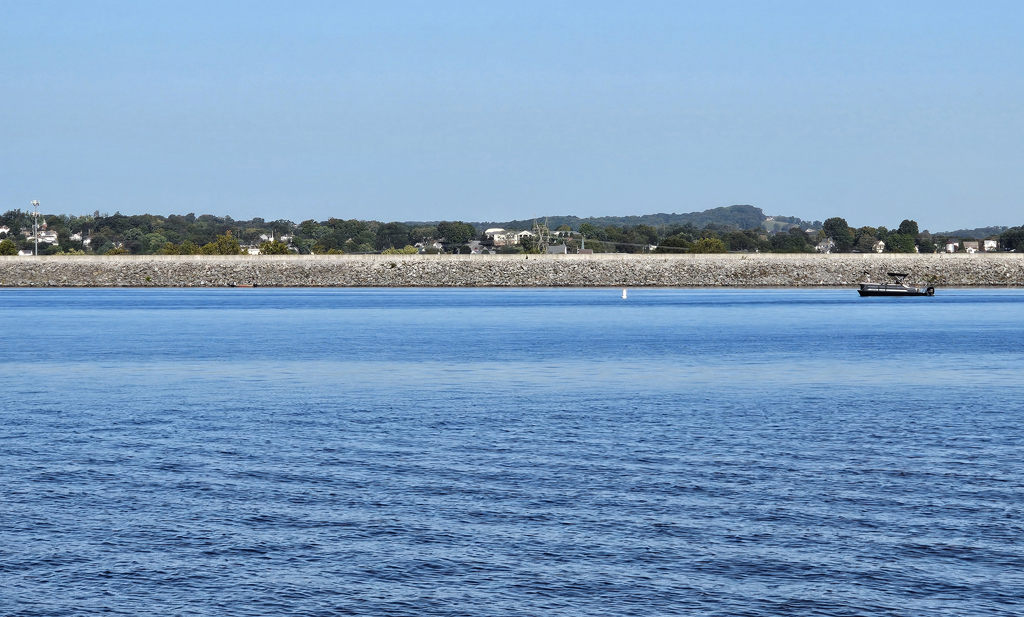
There are an enormous number of houses built around the Lake, all very large, over 5000 sq ft. Certainly, the local economy was very much improved by the sheer amount of wealth that has migrated to the location. What the snail darter thinks, we do not know, although the freshwater fish was relocated by TVA and is no longer considered endangered. Later we saw the tops of drowned silos, a reminder that these lands had been farmed for generations and the landowners were forced out.
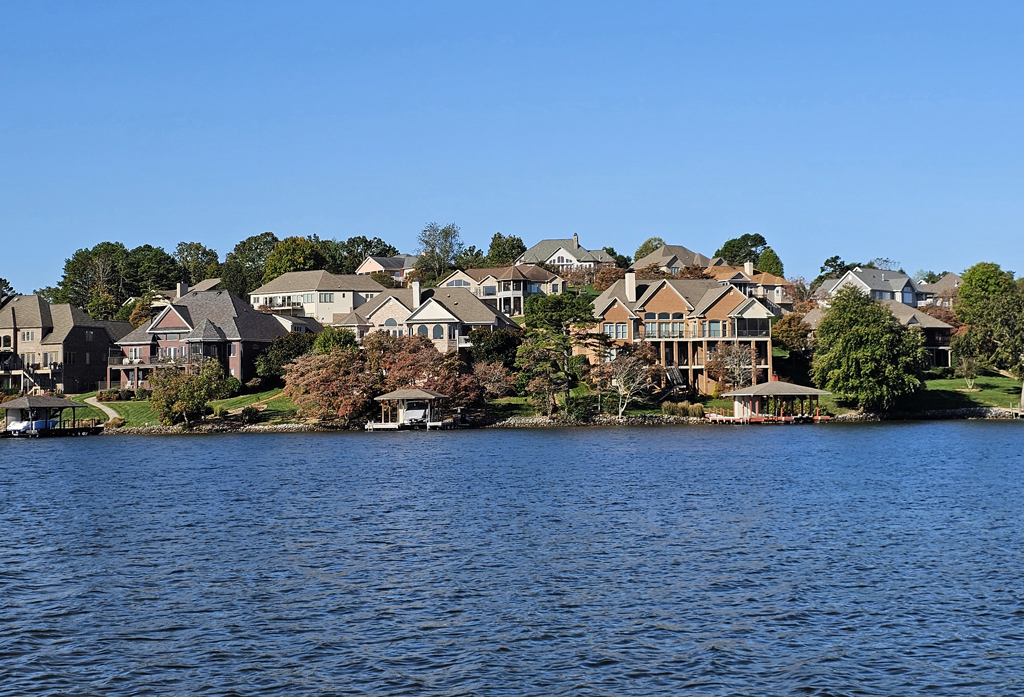
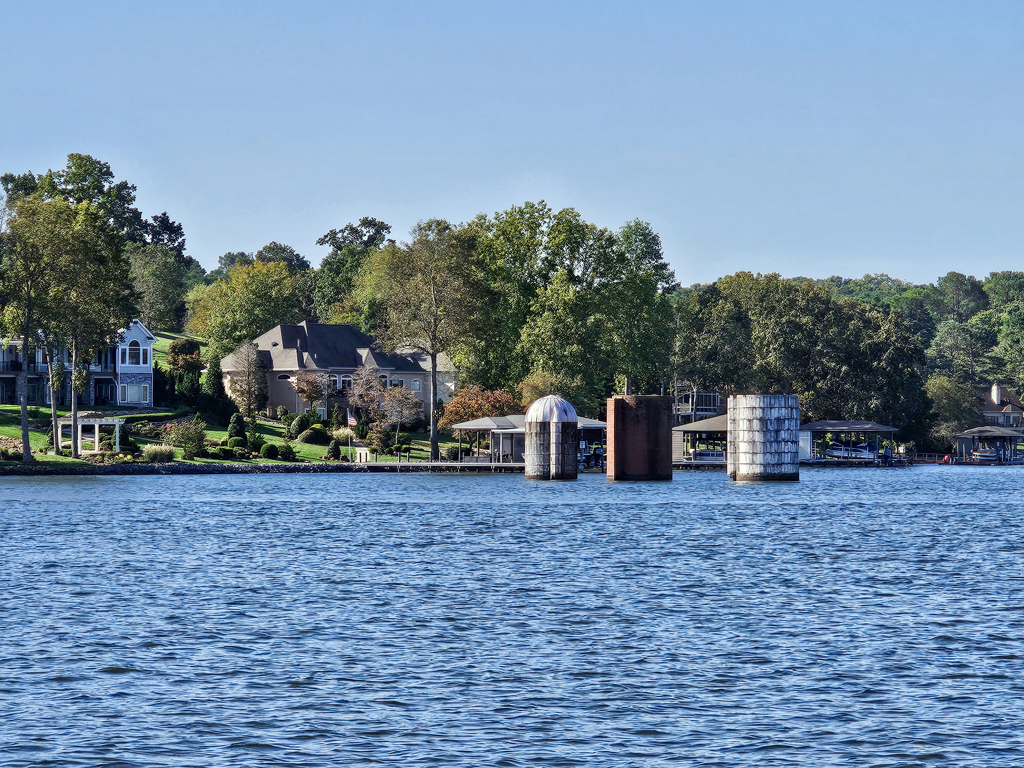
We had thought to stop at Tellico Marina for the night, but repeated calls and emails had no response. We went into the marina, and headed for the fuel dock, but it became increasingly shallow, so Dick turned around and we decided to anchor elsewhere overnight. Shortly after leaving, the marina called to say they had space, but we told them sorry, too late, we already made other plans.
We explored about 26 miles up the river. There were fine views of the distant Smoky Mountains, but surprisingly little fall colour in the trees.

Fort Loudoun was built by the British in 1756 to help keep the French out of the Appalachian region during the French and Indian War. Just a few years after the war ended, there was a tragedy. A breakdown in relations between the British and the Cherokee Nation resulted in 16 Cherokee chiefs who were being held hostage, being executed in South Carolina in 1759. Fort Loudoun’s supply line was cut in the spring of 1760. Once the food was nearly gone, the commander asked the Cherokee for terms of surrender. Early in the morning on August 9th, the garrison of 180 men and 60 women and children left the fort by agreement and travelled as far as they could before making camp. At sunrise the next morning, the camp was attacked, and 30 people were killed. The rest were taken as slaves, although many of them were eventually ransomed.
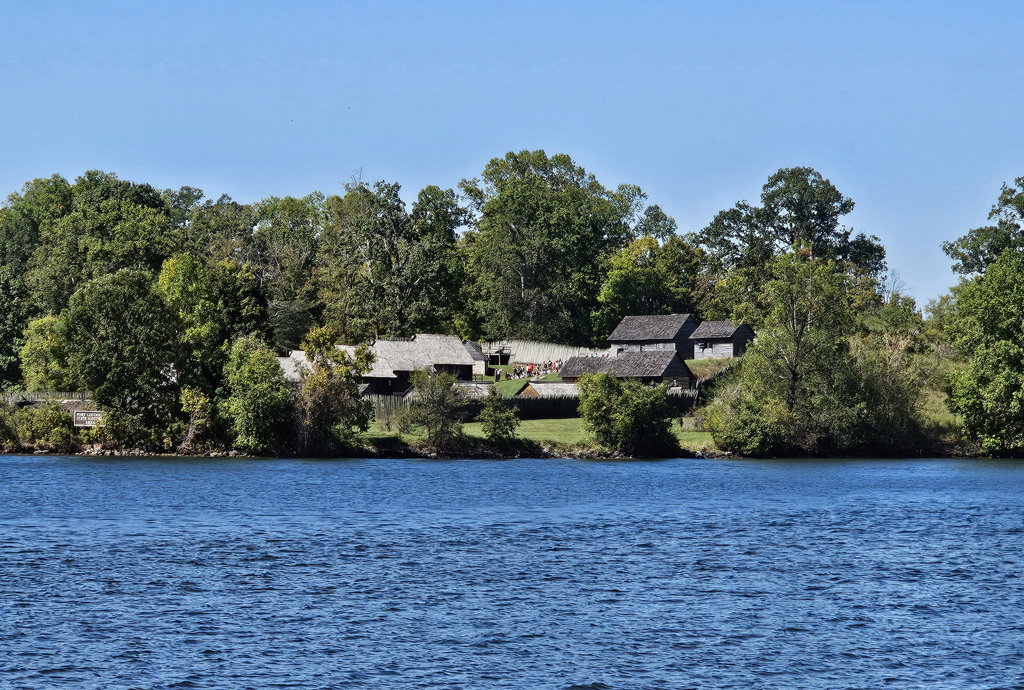
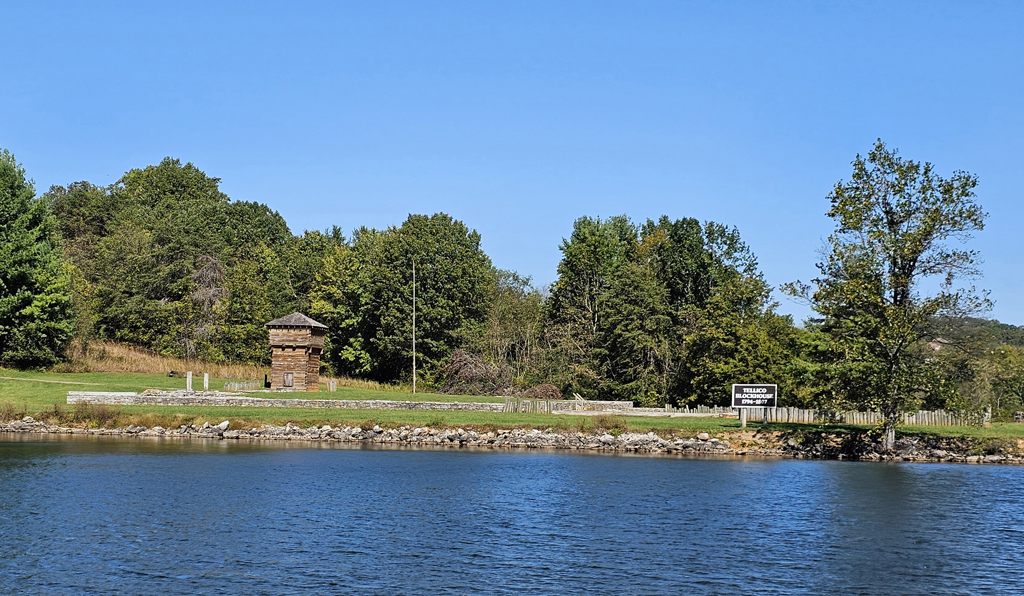
Across the river from the Fort, the Tellico Blockhouse was built in 1794, with the primary purpose of keeping the peace between white settlers who were moving into the valley and the Cherokee who lived there. The blockhouse became a thriving trading post and was an important centre for negotiation of treaties for some years. Gradually the local Cherokee moved away from the area, trying to get away from the encroaching settlers, and the blockhouse lost its strategic importance.
Among the huge tracts of expensive houses lining the lake we saw a number of boat building factories. Yamaha, Sea Ray, and others were represented. Clearly, this is a popular area for boat building.
The anchorage we thought would work was too small and unprotected, so we went back up the river a little way and found a good spot in a deep cove across from an RV park. It was well protected. The strong winds died down as soon as we got into the cove. We had a very quiet night, and temperatures are now quite low, so the generator was not needed. In the morning, the anchor came up easily, but covered in sticky red mud, so cleaning was required the next time we had dock water supply.
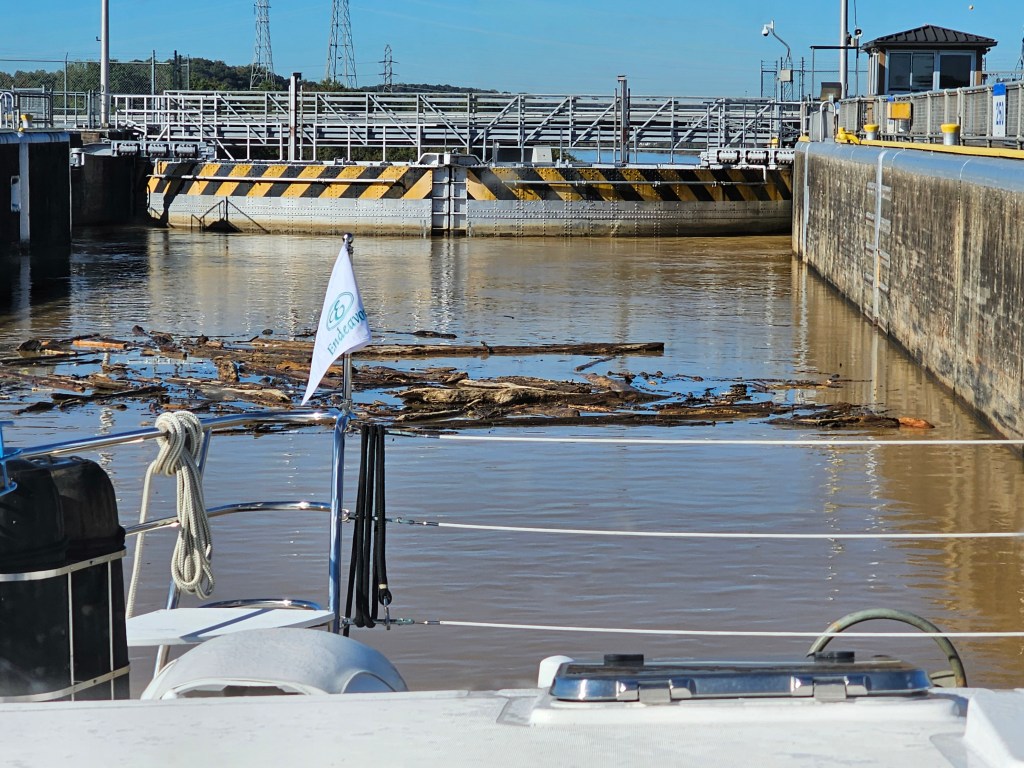
The return transit through Ft Loudoun lock was not something we were looking forward to. There were some huge tree trunks we had to push through to get into the lock. The ride down was smooth and easy compared to going up! The debris field inside the lock raised our hopes briefly, as it appeared to obligingly move away to the side, but then the hopes were dashed as it spread itself back across our bows. Dick did a masterful job of using bursts of the engines to move us forwards and then neutral to glide through. Unfortunately, there was an even worse mess below the doors. Eventually, I had to stand at the bow and direct, while Dick maneuvered forwards, backwards, and sideways, to shake the trees, and even planks of wood off the bows and avoid getting them caught in the props. We only heard the distinct crack crackle of chewing lumber once.
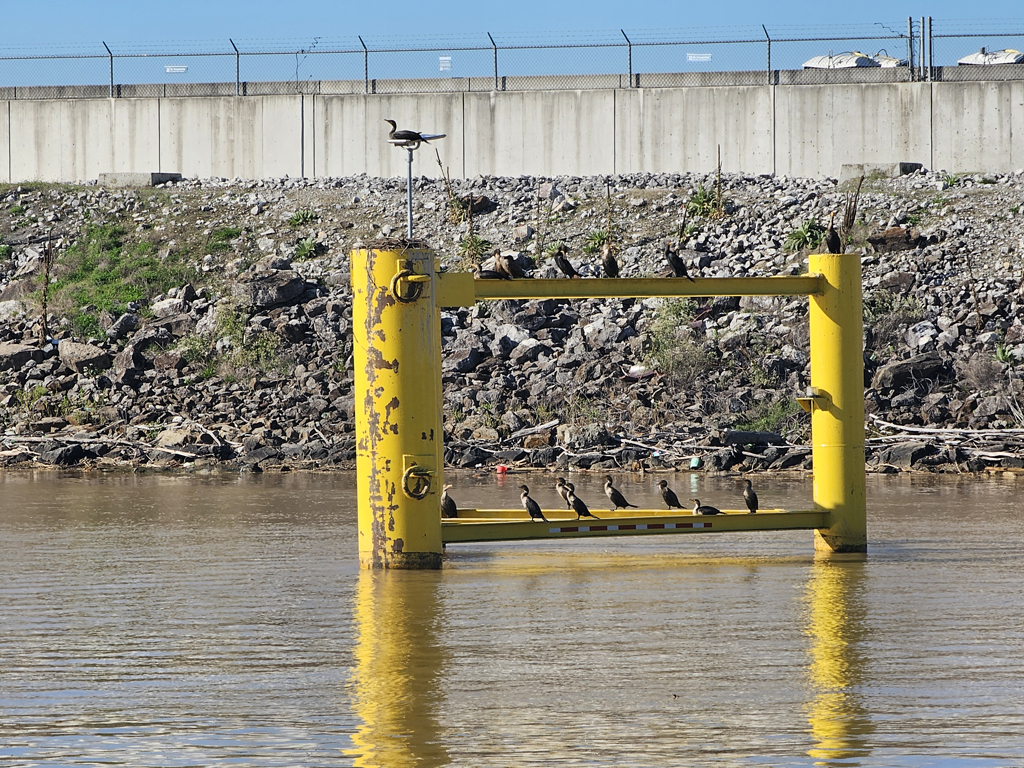
Debris navigated, there was the roiling water of the dam outflow to negotiate. Although it was still more exciting than we would have liked, it was definitely easier with the current behind us even though the waves were still broadside. Nice and friendly though the staff were, we are well glad to see the last of Ft Loudoun lock! Later that day the lockmaster posted a video on their website of Nine Lives gliding up to the floating bollard with me at the helm and Dick waiting to lasso the pin. We were quite chuffed, it all looked very professional!
As we headed downriver, we had a helping current, and made 9 and even up to 11 knots at our normal engine revs, compared to 5 on the way up.
We could see the stacks of TVA Kingston Steam Plant, also known as Kingston Fossil Plant. It was built between 1951 and 1955, and at the time, was the largest coal-fired power plant in the world. In 2008 a dyke ruptured at a coal ash pond and 2.7 million cubic yards of fly ash spilled, burying 400 acres 6 feet deep and filling the Emory/Clinch Rivers, that flow into Watts Bar Lake, in sludge. The dangers of using wet storage ponds for fly ash was known at the time, and TVA had found leaks in the levees and seepage into the soil at the sites of many of its storage ponds. Instead of switching to dry storage ponds, small repairs were made to reduce costs. This was the largest industrial spill in US history. The cleanup was declared complete in 2015, but many residents of the area still do not drink the water or swim in the river.


We went into a deep bay for our marina for the night. Caney Creek Marina does not appear to be well known to transient boaters, but we had a good stay. Our neighbours on the dock had seen the Ft Loudoun lock facebook video that featured us entering the lock, and they came out to help us tie up as soon as they saw us arrive. We were then invited to drop over for some beer and chat. A most enjoyable encounter.
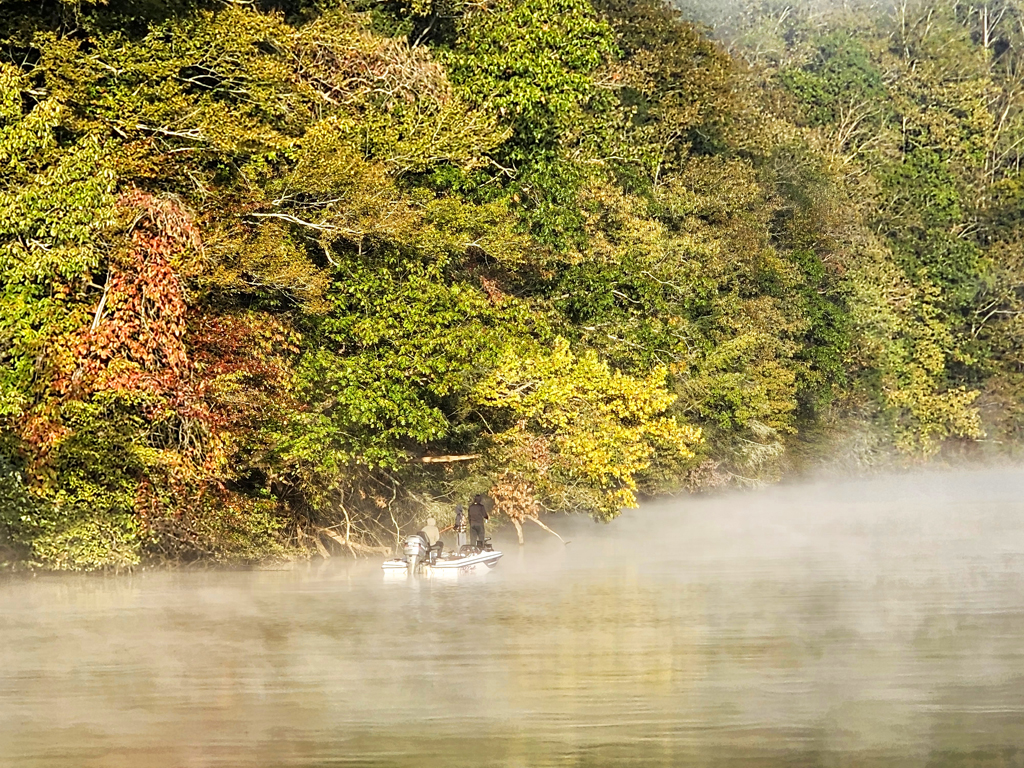
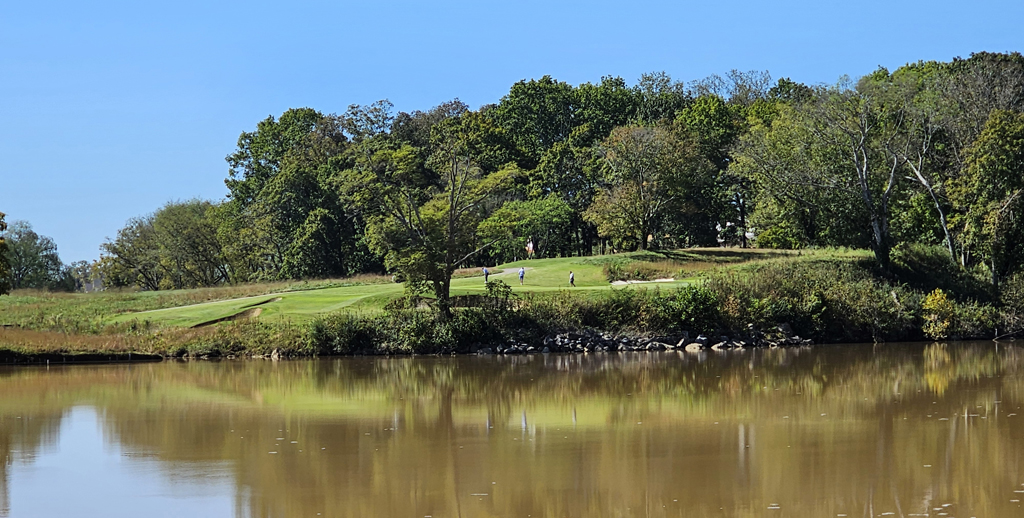
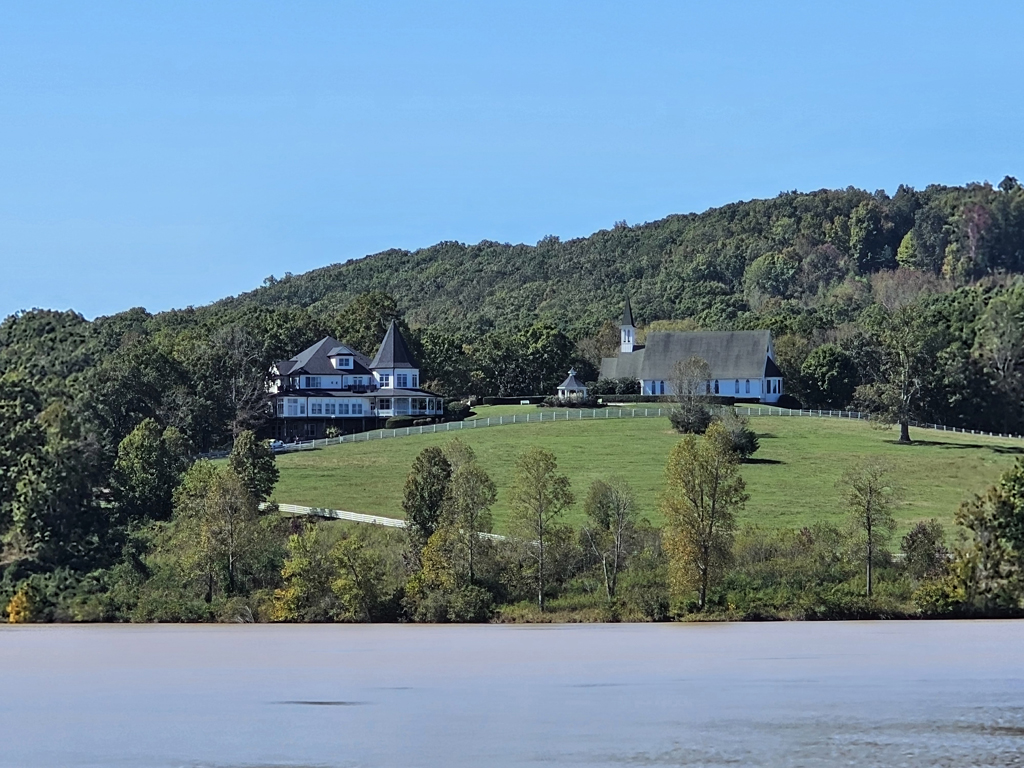

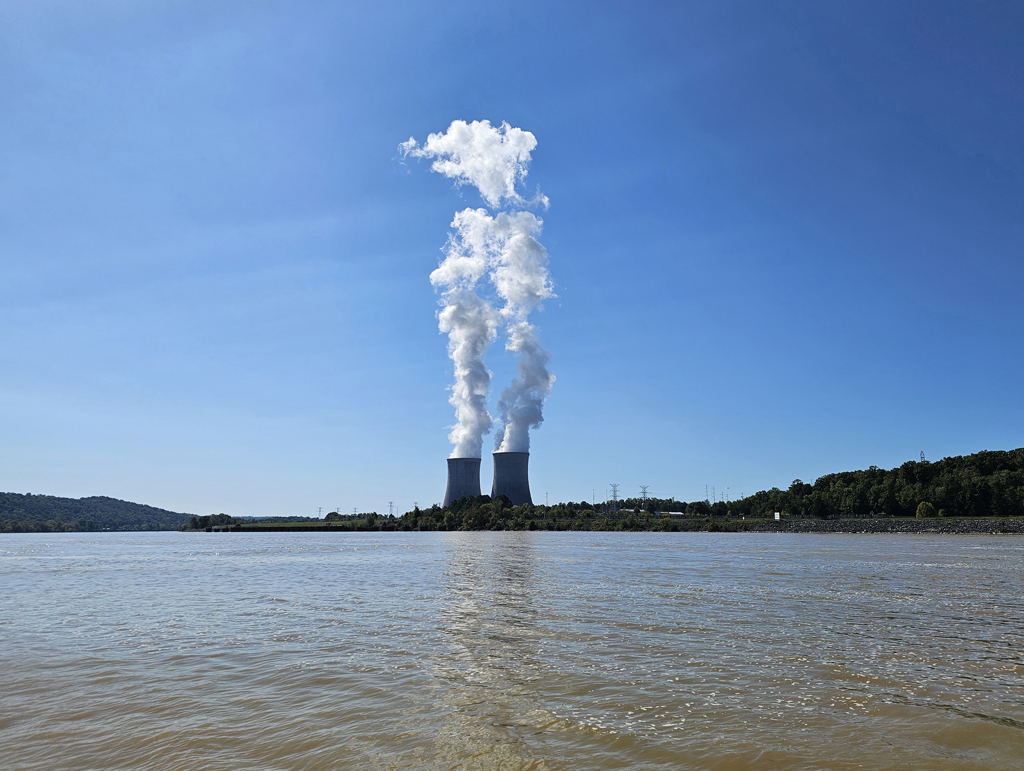
We were out by 9:30 the next morning, a little later than planned, but Dick took the time to wash the mud off the anchor from the previous day. After transit through the lock, we passed the Watts Bar Nuclear Plant. It is unusual to find a nuclear power plant and a hydroelectric generating station in the same location.
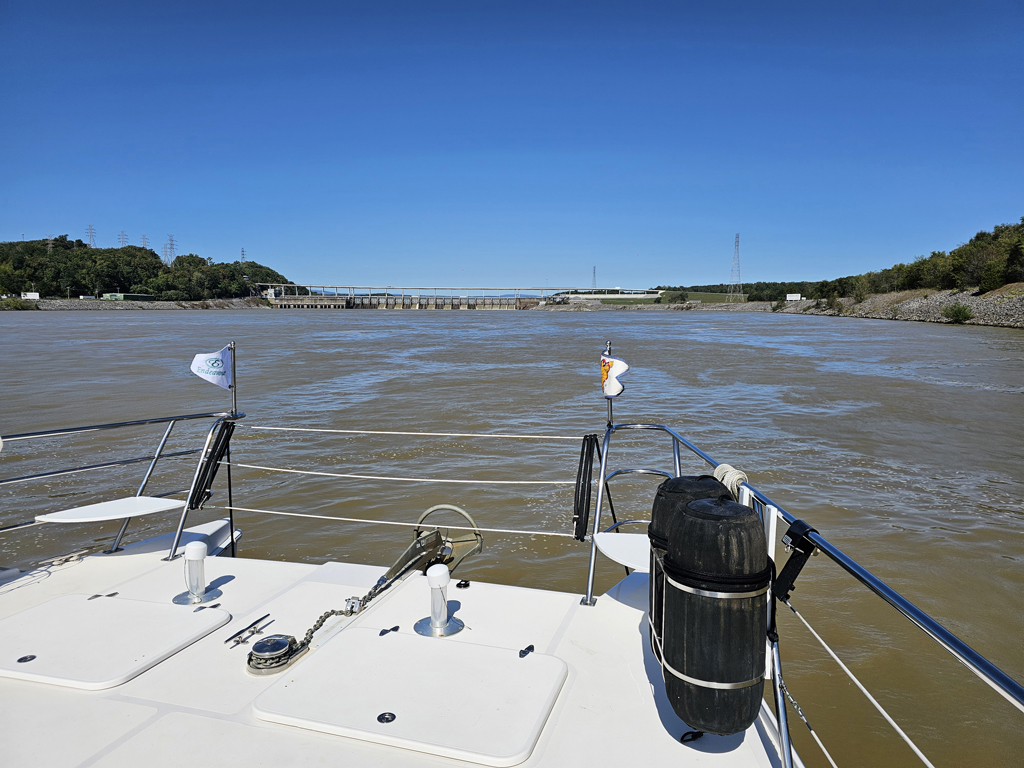
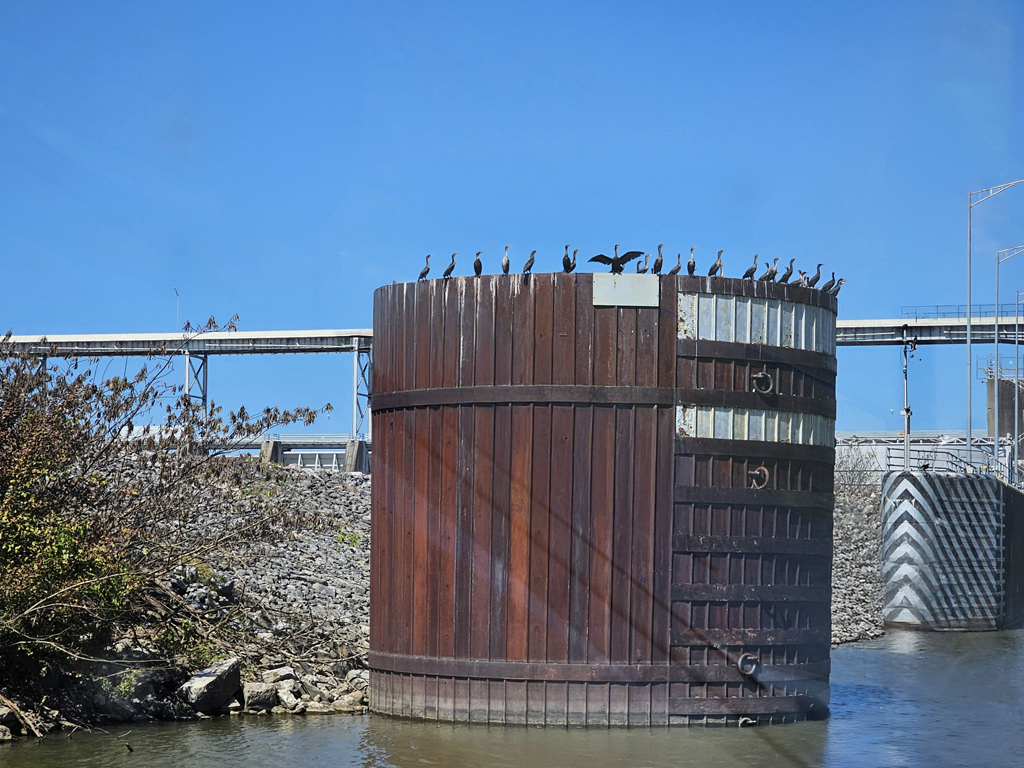
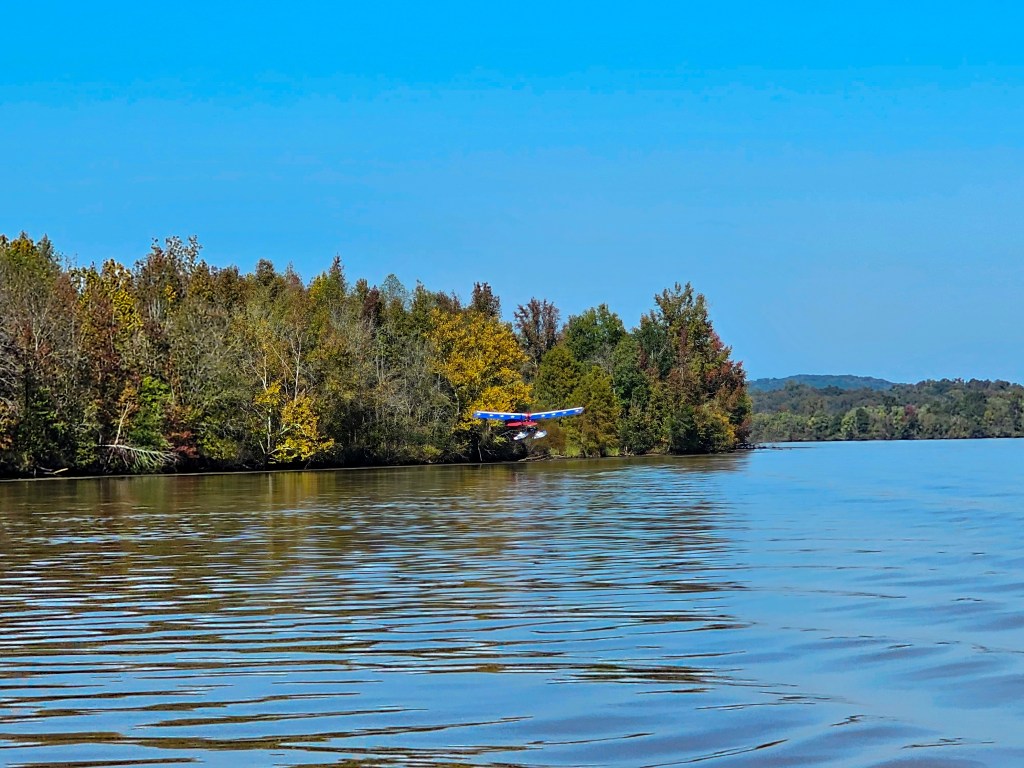
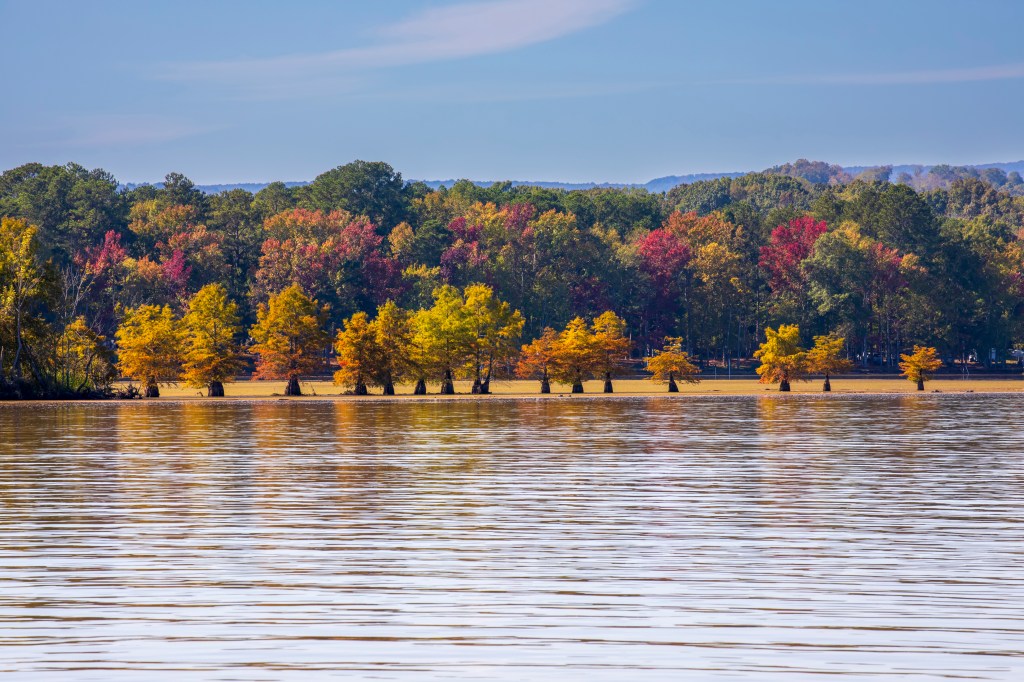
As on the way up, we had a day and a half of mostly boring travel. Chickamauga is a large lake, so you don’t generally see much of the shore. There was a brief excitement when an ultralight swept low over the river, and further south there were some lovely autumn colours in a row of bald cypress trees.
Our transit through Chickamauga lock was interesting. We were locked through with a small runabout. Given that it was a Sunday, and close to Chattanooga, the lockmaster was asking all pleasure boats if they had been through a lock before. This fellow said he had, and then proceeded to tie up to one of the fixed pins – that would have been completely useless and very dangerous once the water started going down in the lock. An explanation was provided, and they moved forward to the floating pin. The guy chatted with Dick, he was a very pleasant fellow, laughed at himself, and said how obvious it was once he was shown. We told them to go out of the lock first, as they would be faster than us, and they were very considerate, no burst of speed, and no wake. We could certainly wish there were more boaters like that.
Later, after tying up at the familiar Bluff Dock in Chattanooga, we helped with a large cruiser coming in. They spent the entire approach tying fenders all along the vessel, and only when at the dock, went to get out coils of line (and untangle them) to tie up. If they had seen as many fenders roll up on docks and catch in the cleats as I have, they would change their preparation priorities.
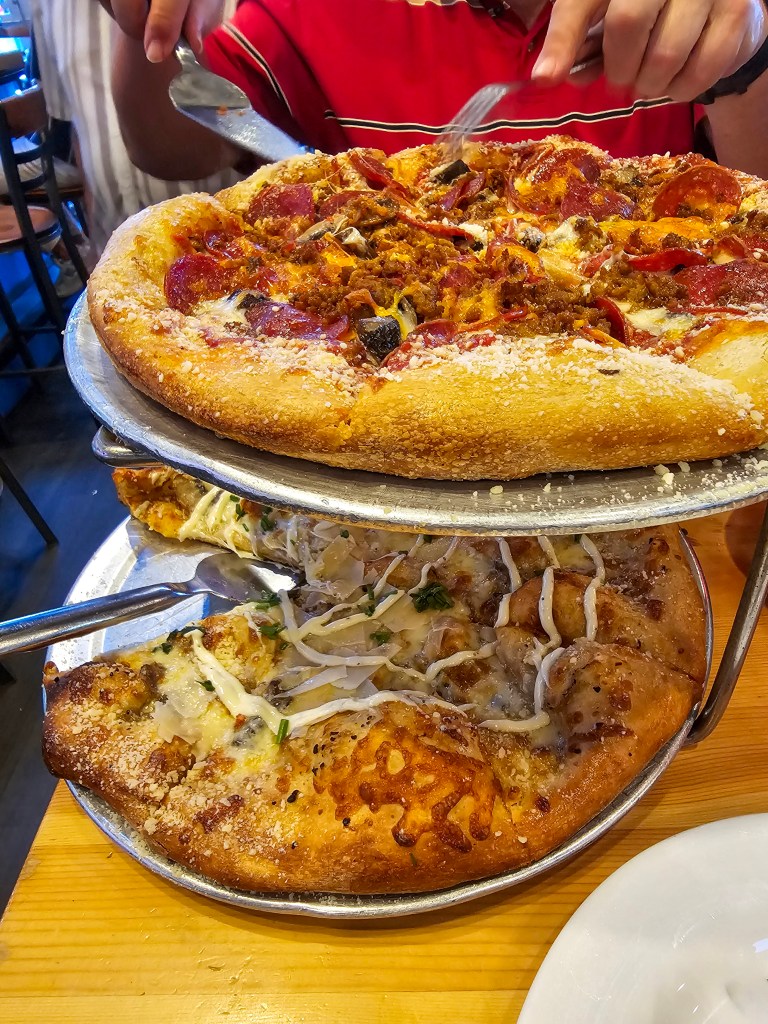
We walked up to Mellow Mushroom for a pizza fix. Amusingly, it is rated the #1 restaurant in Chattanooga on TripAdvisor. We assume this is due to the large numbers of people visiting the Aquarium and the Chattanooga waterfront.
Our full day in Chattanooga was reserved for Dick to retrieve his bicycle, now sporting shiny new wheels, and he took advantage of being mobile again to use his trolley and pick up enough groceries to get us back to Aqua Yacht after Rendezvous. I did several weeks’ worth of laundry. Fortunately the clothes dried quickly on hangers in the very breezy cockpit.
Bicycles and groceries taken care of, Dick was able to get on with some forward planning for the next stage of the voyage. He secured a 3-month booking at a newly rebuilt marina at the eastern end of Florida’s Panhandle. With the whole of the Looper pack in panic mode after the devastation of 2 hurricanes, we feel it is prudent to nail down some of our options.
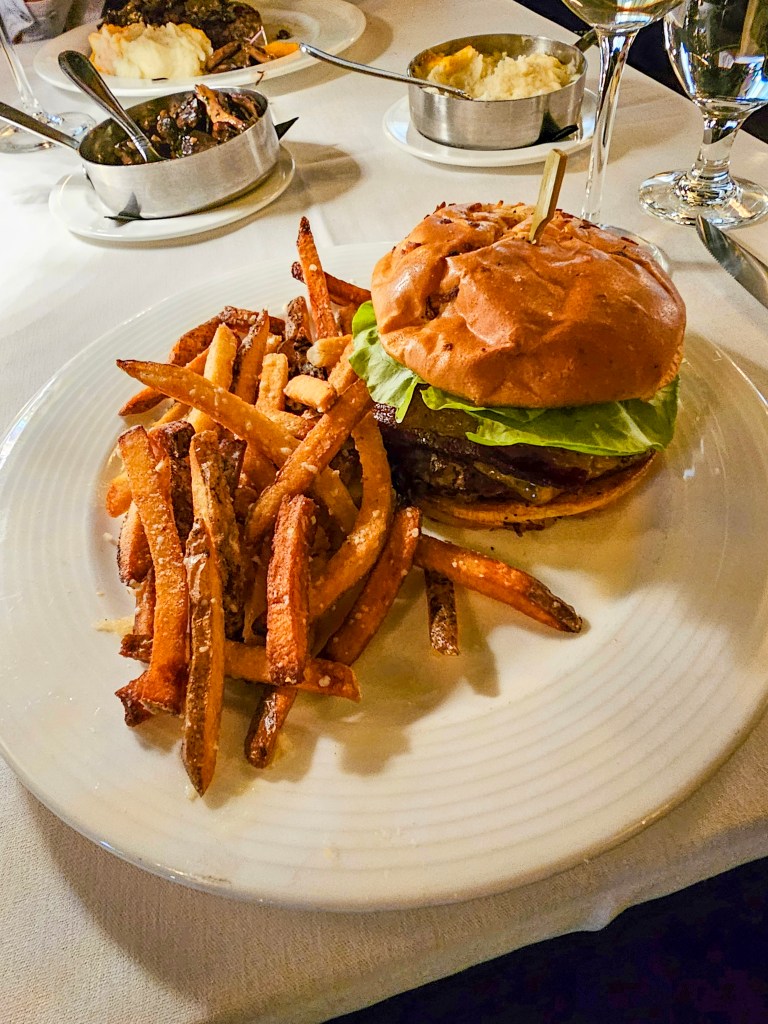
To our great disappointment, Dick had a phone call late in the afternoon to say that the restaurant we had been looking forward to for weeks had to close that evening due to maintenance issues. It was purportedly the best fine dining restaurant in Chattanooga, but they had just moved to new premises and were clearly having teething problems. We decided to give the steakhouse in the Read Hotel another chance. The décor and ambiance was beautiful, and the meal was much more successful than our previous visit.


Tuesday was the day to travel through The Gorge, billed as Tennessee’s Grand Canyon. We were hoping for more fall colour. There were some pretty stretches, but an overcast sky meant very little photogenic scenery. Naturally the clouds broke up and the sun came out after we were docked.
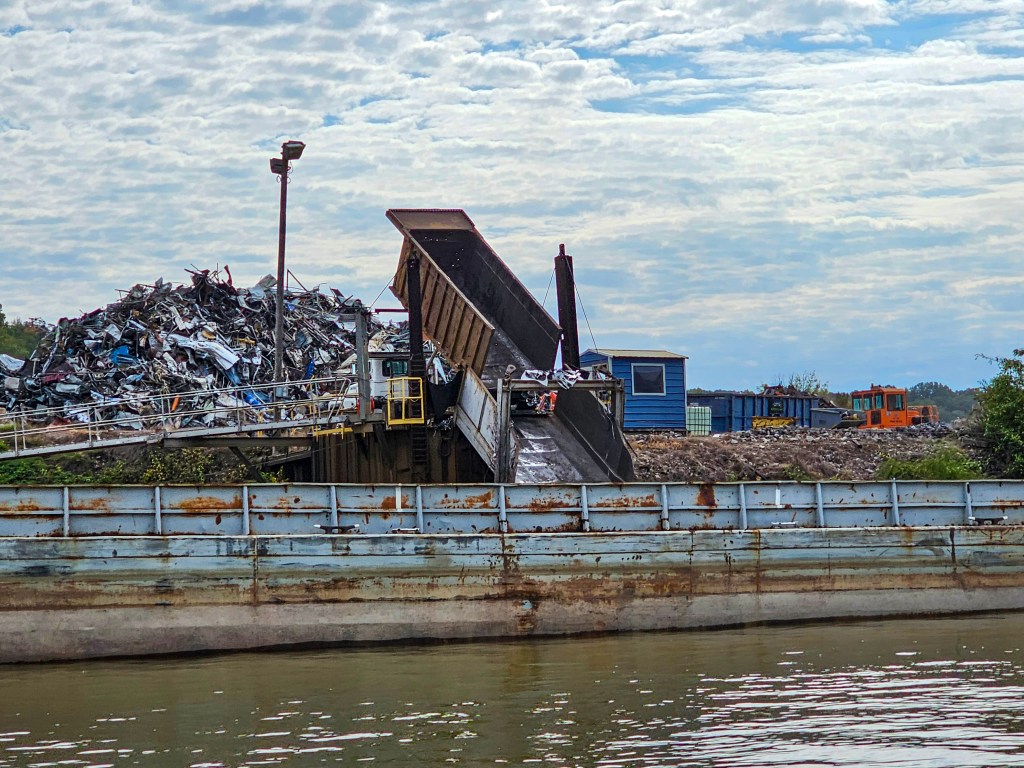
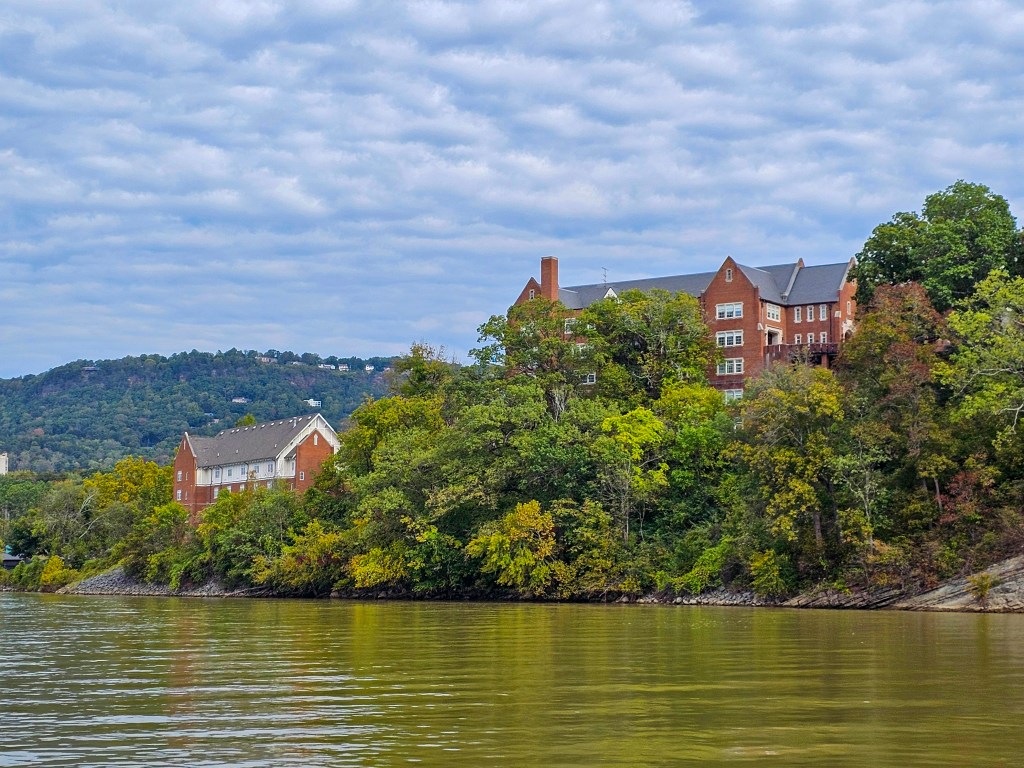

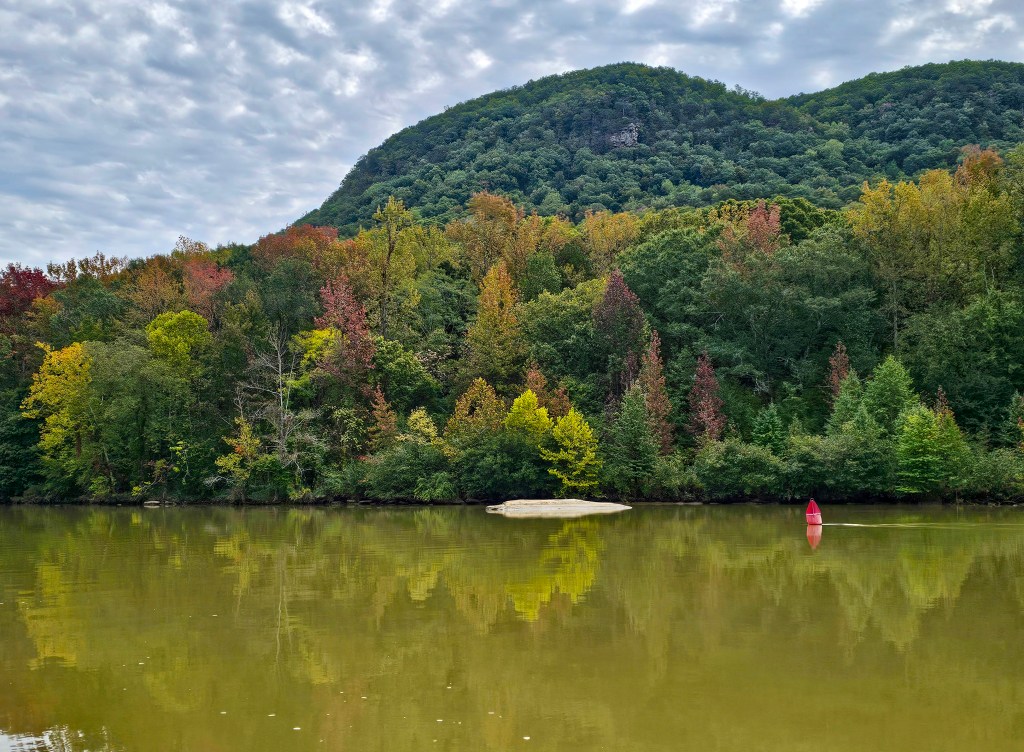
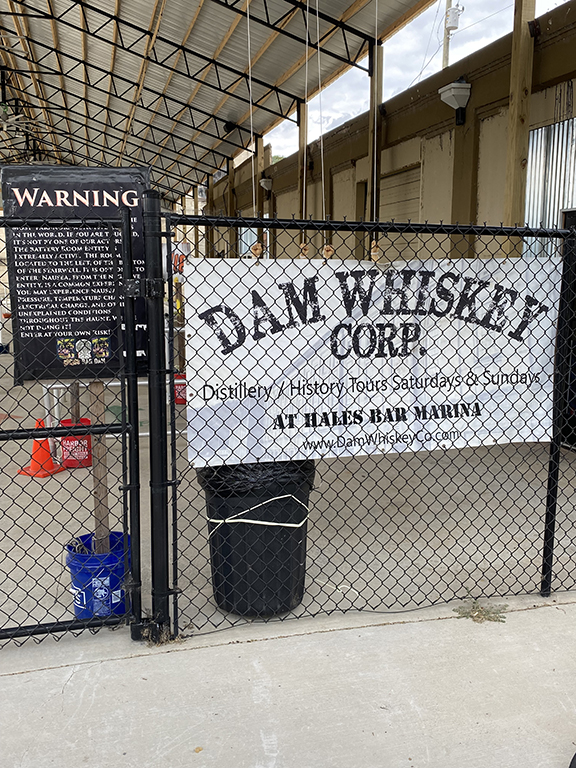
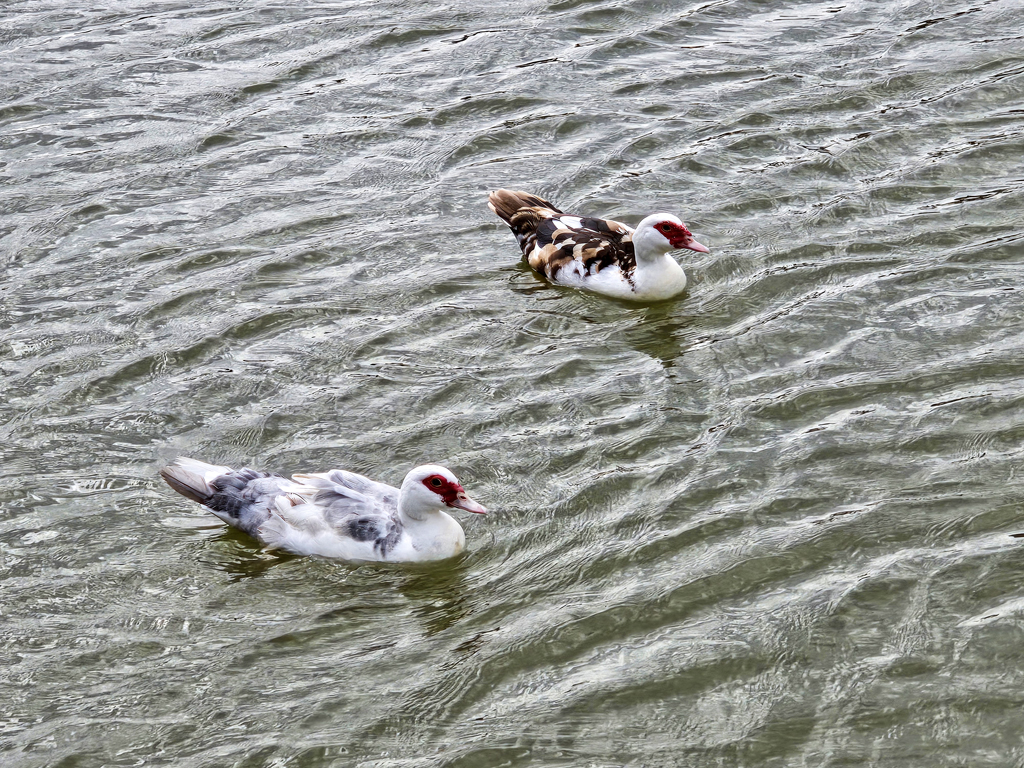
We tied up at Hales Bar Marina, with a view of the very unattractive but historically significant former hydroelectric facility. There was only one useful cleat at our end of the assigned dock. The whole place looks very run down, how anyone would consider coming and staying in one of the tiny floating cabins I do not know. The distillery that occupies the former power house is only open weekends, so we did not get to tour or try their offerings. There were some very colourful geese floating around the marina, but I can’t identify them. I suspect domestic geese have encountered their wild relatives, with interesting results. There are also goats wandering around. Altogether a strange place. We have no plans to return.
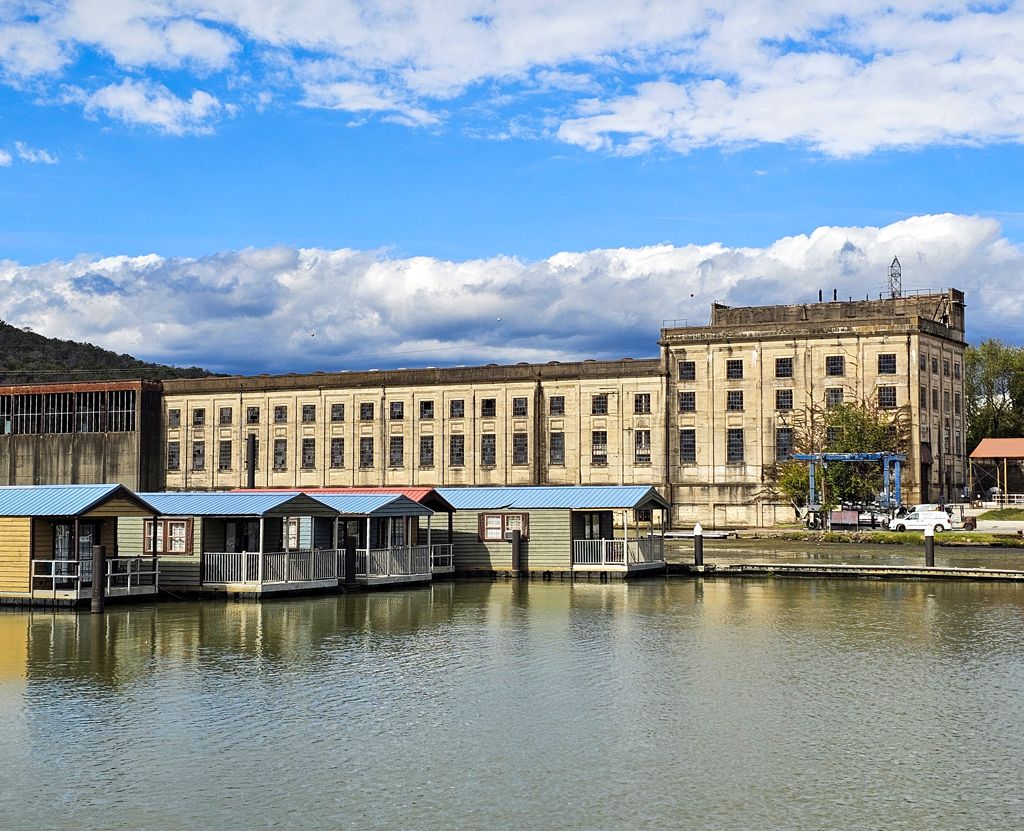
We had crossed into the Central time zone, so woke up an hour early the next morning and were underway shortly after 8am. Dick had been told by the folks that tied up behind us that we could go out of the marina by another, shorter, but unmarked way. We duly headed out, passing and waving to the occupant of one of the cabins on the way, but at a certain point the grass/weeds in the water fooled the depth sounder, so Dick could not tell where the channel was. He backed around and we returned the long way, waving again to the bemused watcher. Crossing over the submerged sandbar along the approved route was worrying, as the depth got shallower, but eventually we were through.
We had an easy transit through Nickajack lock, with no wait, but there were large mats of floating grass and weed to try to avoid. Some boaters think it’s clever to proclaim “We were here!” by sticking stickers with their boat name on lock floating bollards. It is annoying to see, because those have to be cleaned off by lock maintenance staff in a time of tight budgets. Defacing public utilities with stickers is just another form of graffiti.


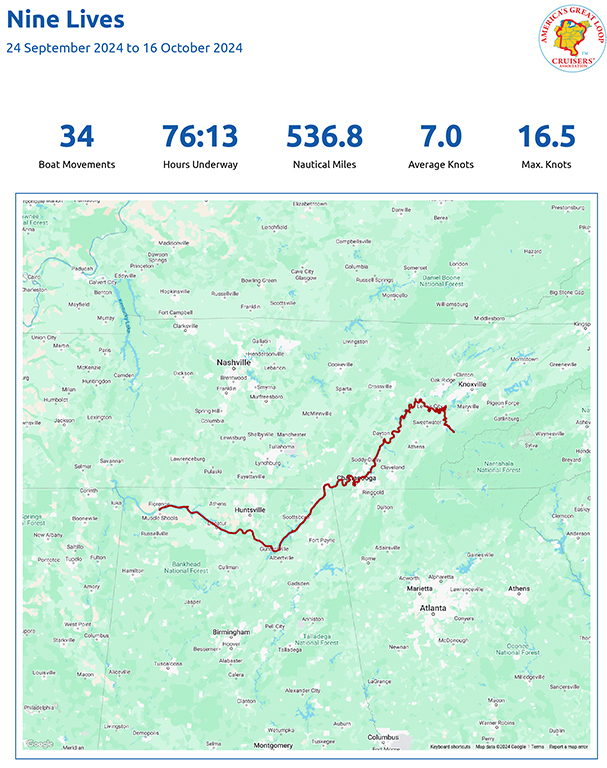
Our plans for the pre- and post-Christmas boating season have been revised in the wake of two devastating hurricanes affecting the Gulf Coast of Florida. We originally expected to arrive in St Petersburg around mid-December, and then take about 4 weeks off to go home to Hilton Head for the Christmas/New Year season. We are now booked to stop at a small place called Port St Joe, at the eastern end of the Florida Panhandle, on about November 22nd. We have a reservation in the marina for 3 months. After Christmas we will know how far along the various marinas and towns are with recovery and will be able to plan accordingly. A big part of Florida’s economy is tourism based, so as soon as possible the towns will reopen and welcome tourists again. It is likely that we will be anchoring more than originally planned, and we will spend less time in each place. Our return to Hilton Head will probably be late April or early May. It means that we will be boating in much warmer temperatures than Louise is happy with, but considering that so much of the Loop has already been too hot for my comfort, it is what it is.
 The Voyages of Nine Lives