
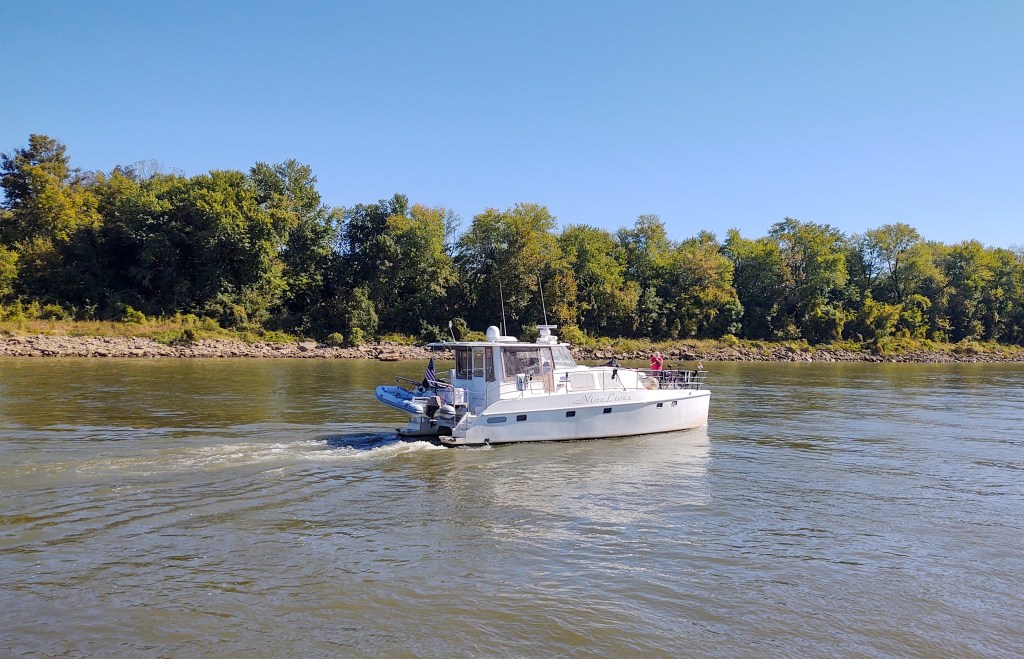
Nine Lives is on the move again. She is looking particularly shiny and beautiful, with a new ceramic coating, and fresh lettering. This year’s voyages will take her north on the Ohio River to Pittsburgh and beyond, and then south on the Cumberland River to Nashville.
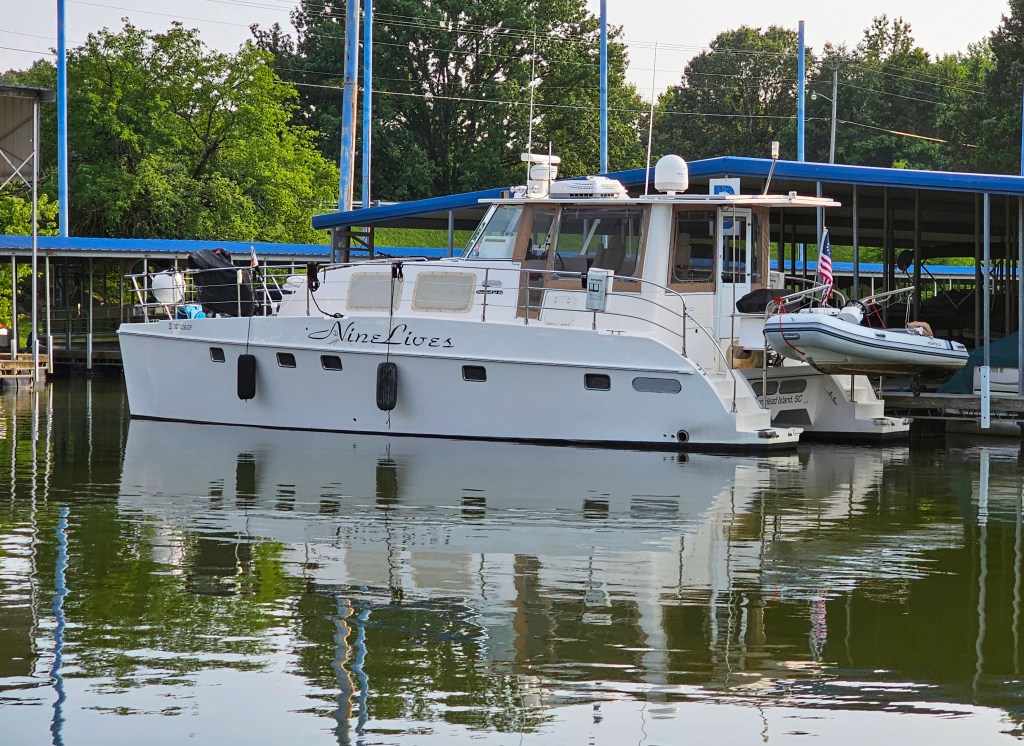
The crew left Hilton Head, with the vehicle packed tightly with all the items we take back for the winter, lots of frozen and fresh food, and bicycles on the rack at the back. It had been our experience that grocery shopping in the Iuka area offered poor selection and quality, so as usual, we planned a number of meals ahead and shopped for them in Hilton Head. It was an uneventful 9-hour drive to our destination, a cabin at Pickwick Lake State Park. Again, past experience showed that it makes everything so much easier if we stay in a nearby cabin while making our preparations for the summer’s voyaging, rather than trying to work around piles of boxes and engine parts to sleep on board. We stopped briefly on the way to check on Nine Lives and meet the cleaner, who was just finishing up. We also confirmed that the existing lettering had been removed and Nine Lives was ready for her new script.
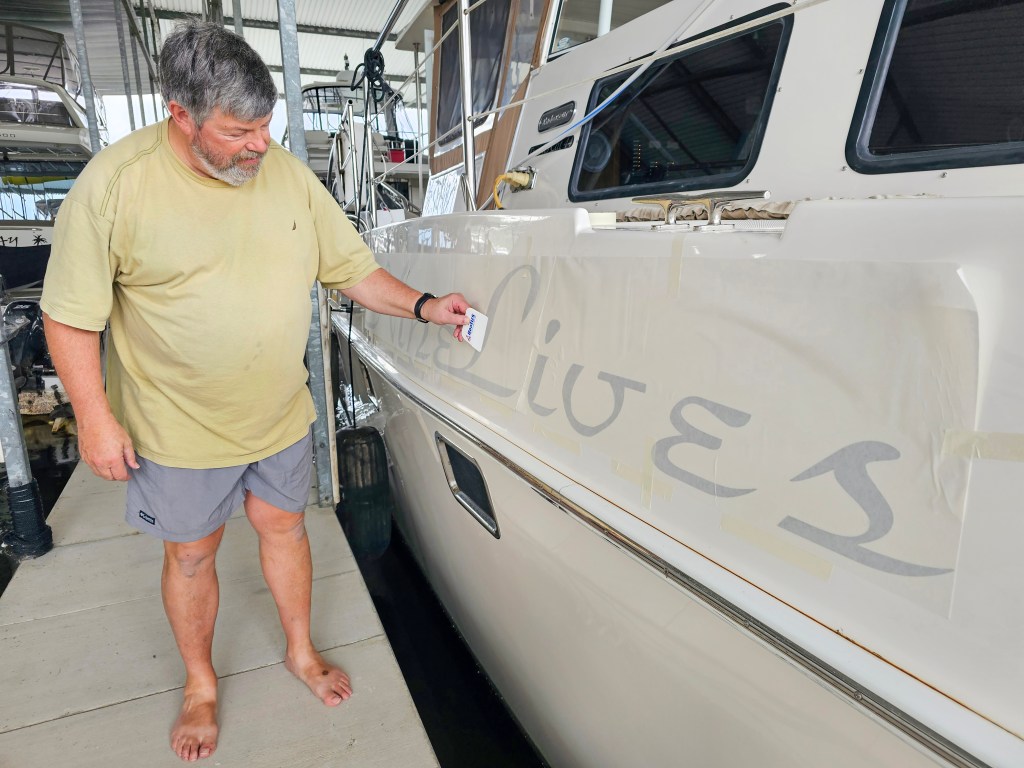
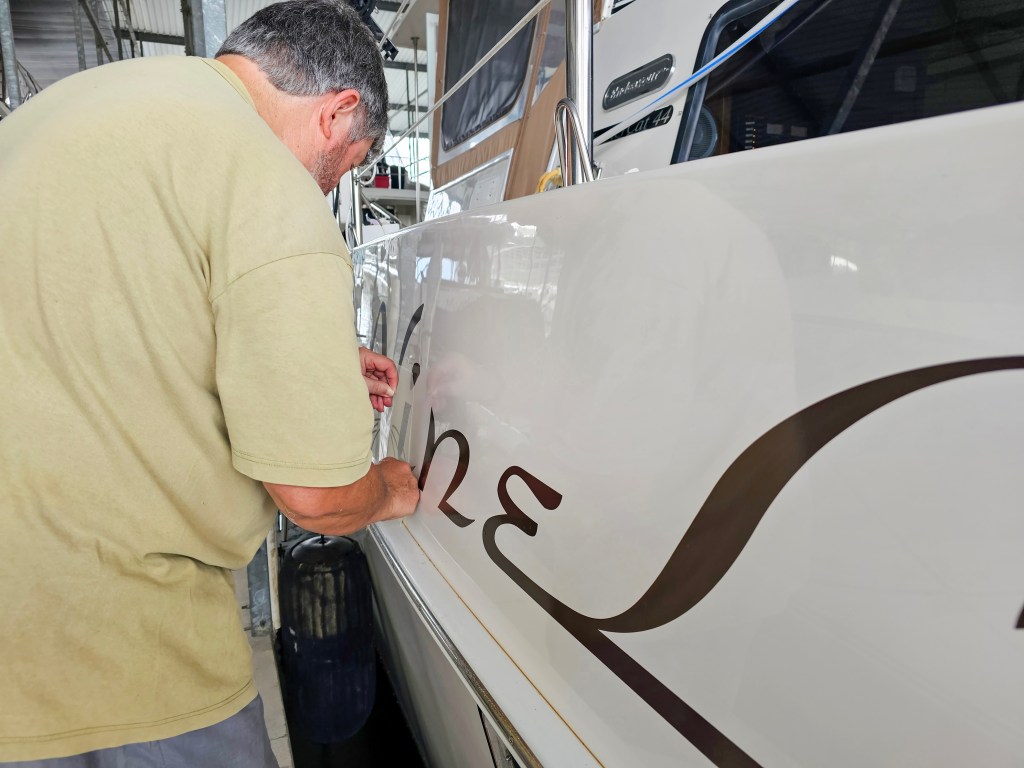
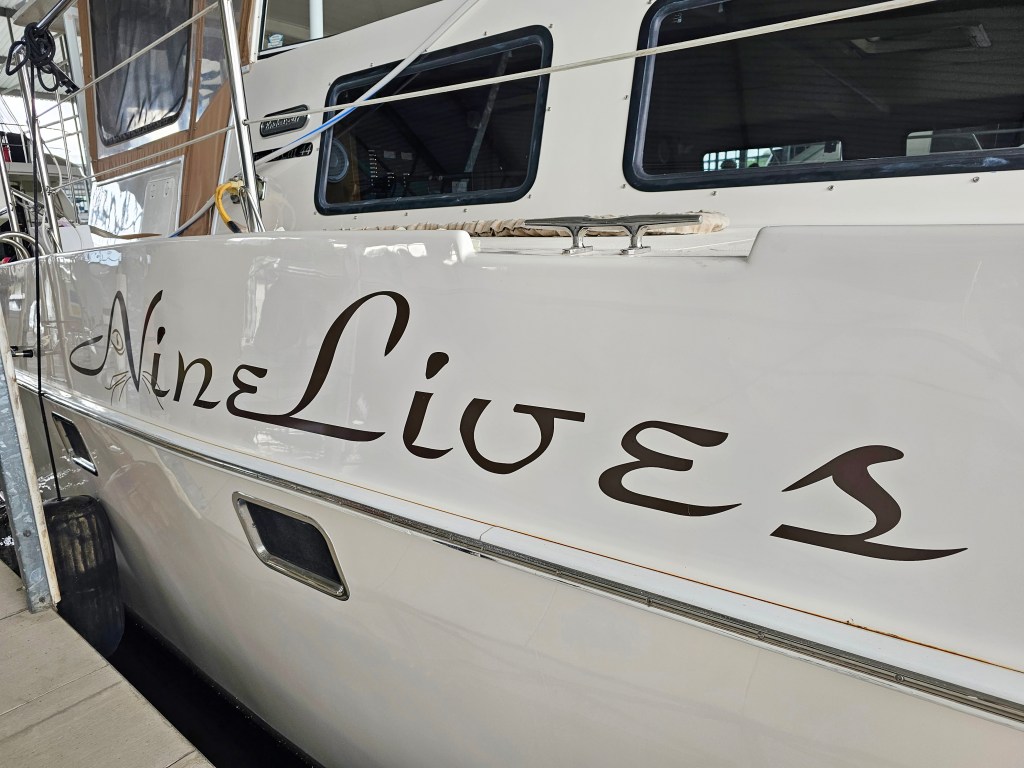
We ate at the lodge that evening, and after a good night’s sleep we were ready to begin. In addition to the usual chores, the first priority was to install the new lettering, as the final ceramic coating is put on after the letters are installed. I was able to find a company that would use my design again for the name, and this time we chose to have the main script somewhat darker, while the cat’s eye and whiskers are gold.
After starting the process to shock (sanitize) the water tanks, we gathered the various tools and started with the letters for the hailing port that go at the back of the boat. This process was made somewhat tricky by the need to stand in the dinghy to do it. We learned a few things in the process, so it was a good plan to start with the smallest and least visible. Next, the big job, 10 feet of the Nine Lives name (to be done twice, one for each side). We decided to do it in 3 pieces, plus the separate eye and whiskers. Doing it in smaller sections was definitely more successful. The next day when we added the registration numbers we felt like old pros after all the practice.


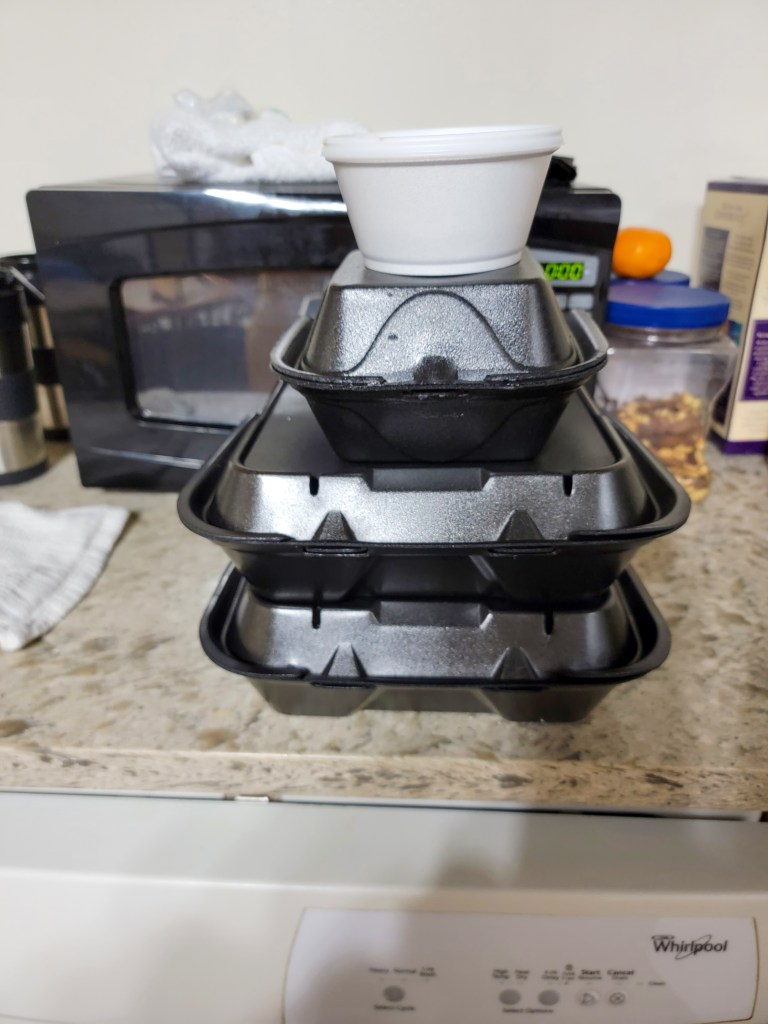
Flushed with our success, we set off to have dinner at The Outpost. Dick had enjoyed a good burger there earlier in the year, so we were expecting a nice meal. Sadly, this was one of the worst we have ever had. Our cheese curd starter was well overdone, and the loaded waffle fries with pulled chicken was stone cold. We sent it back and got a slightly warmer replacement that was still pretty much inedible. Dick’s “Hungry Man” dinner was huge. He ate the ribs and some of the pulled pork, and took the rest of it and the half chicken away in a box. My dish was so awful that not even Dick was willing to eat it as leftovers.
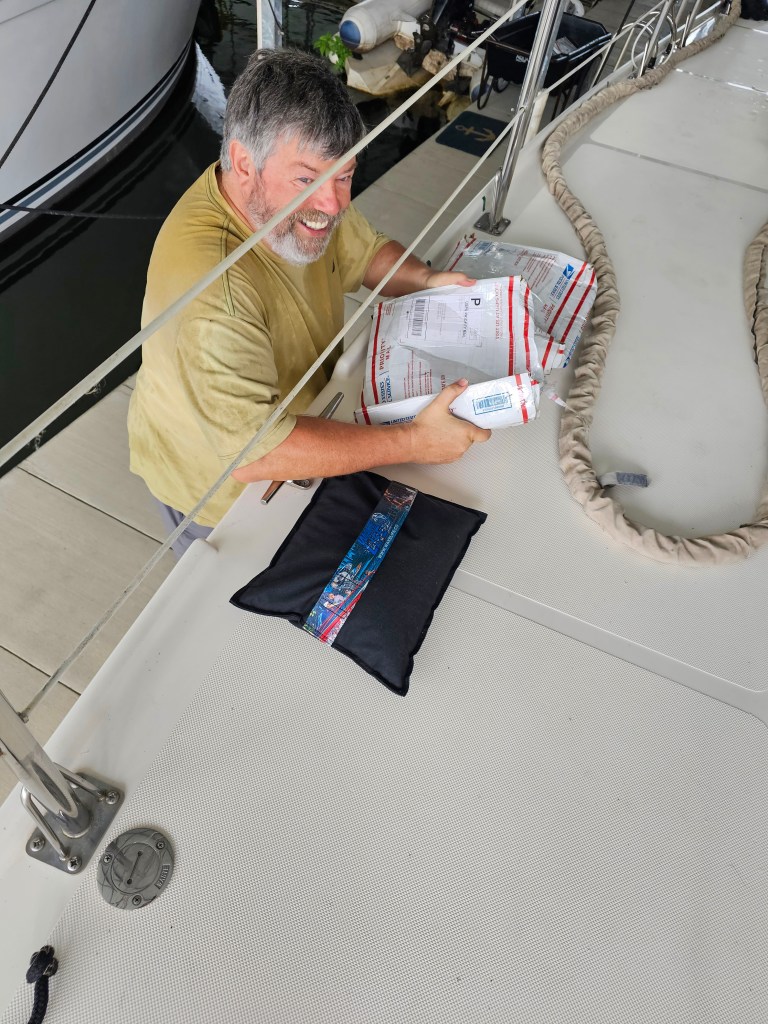
The next day Dick drained and refilled the water tanks. The tech was already there preparing Nine Lives for the final ceramic coat over the lettering. After buffing she looks quite gorgeous! I prepared the usual bags of cloves that discourage ants and other critters from visiting the kitchen cupboards and drawers. Dick made multiple trips from the vehicle to unload and bring all the boxes and bags on board for putting away. His next project was collecting the bags of steel shot that had been delivered to the marina office. He ordered 10 bags, to be used as ballast at the front of the boat. Interestingly, they were shipped in “flat rate” boxes by US Post Office. Each bag weighs 50 pounds. Only 9 actually arrived, and one was already out of the shipping box. Dick had to make 3 trips, as 150 pounds is the absolute maximum that can be safely transported in the loading cart down the ramp to the docks.
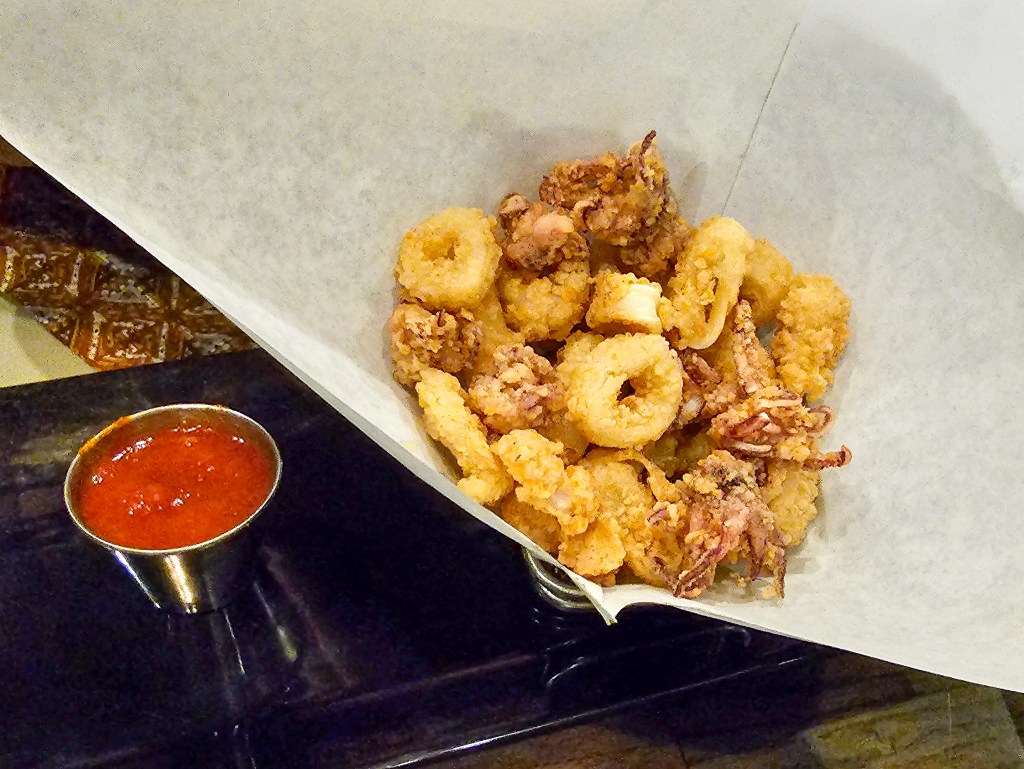
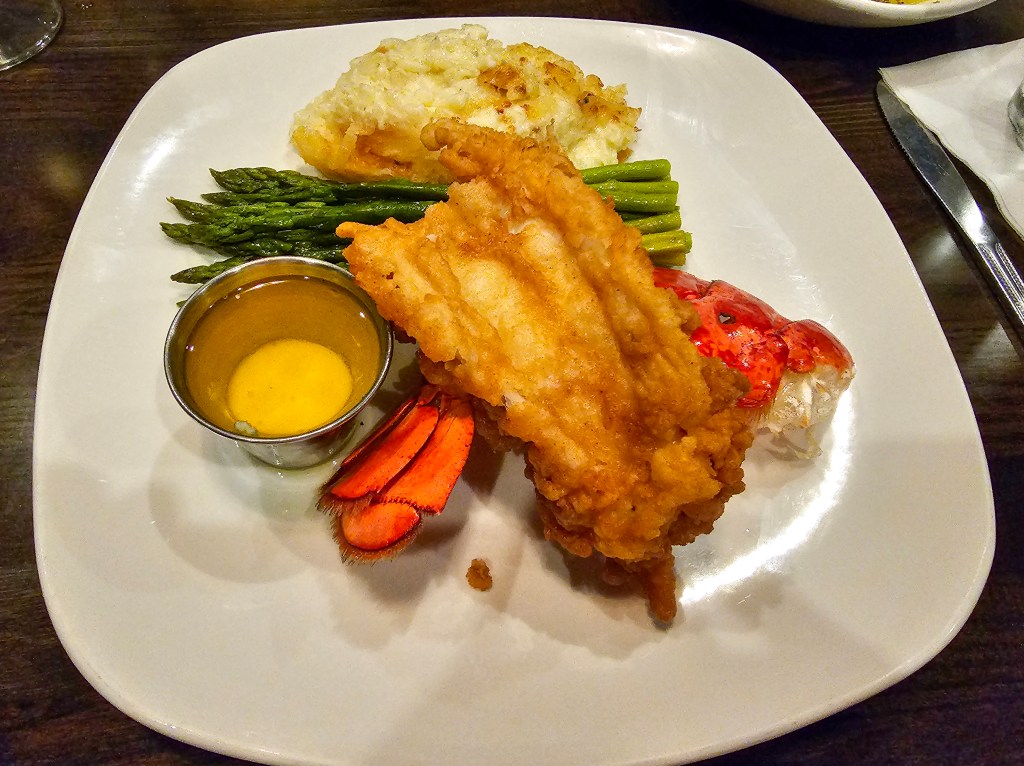
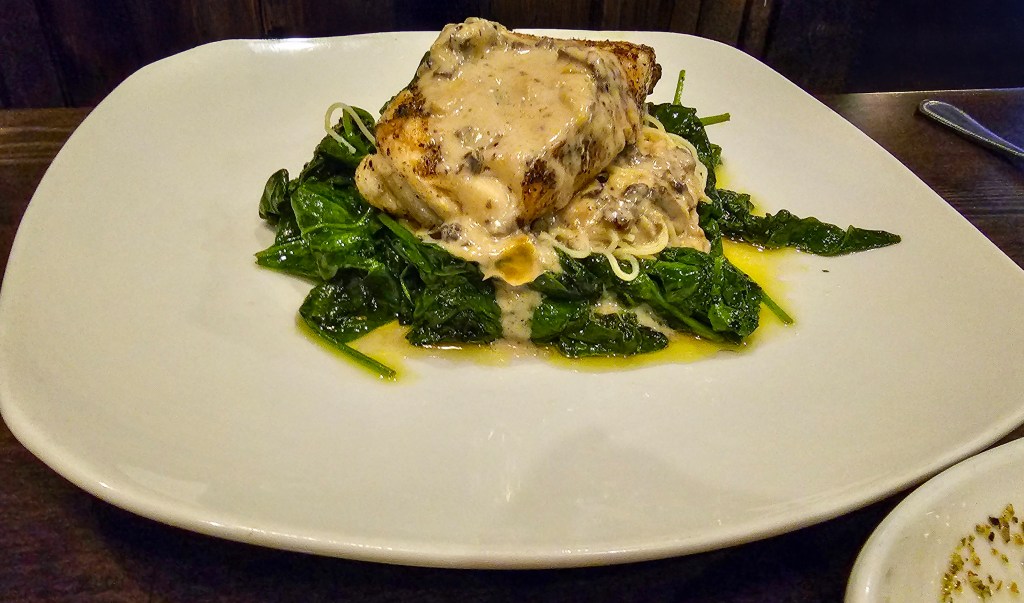
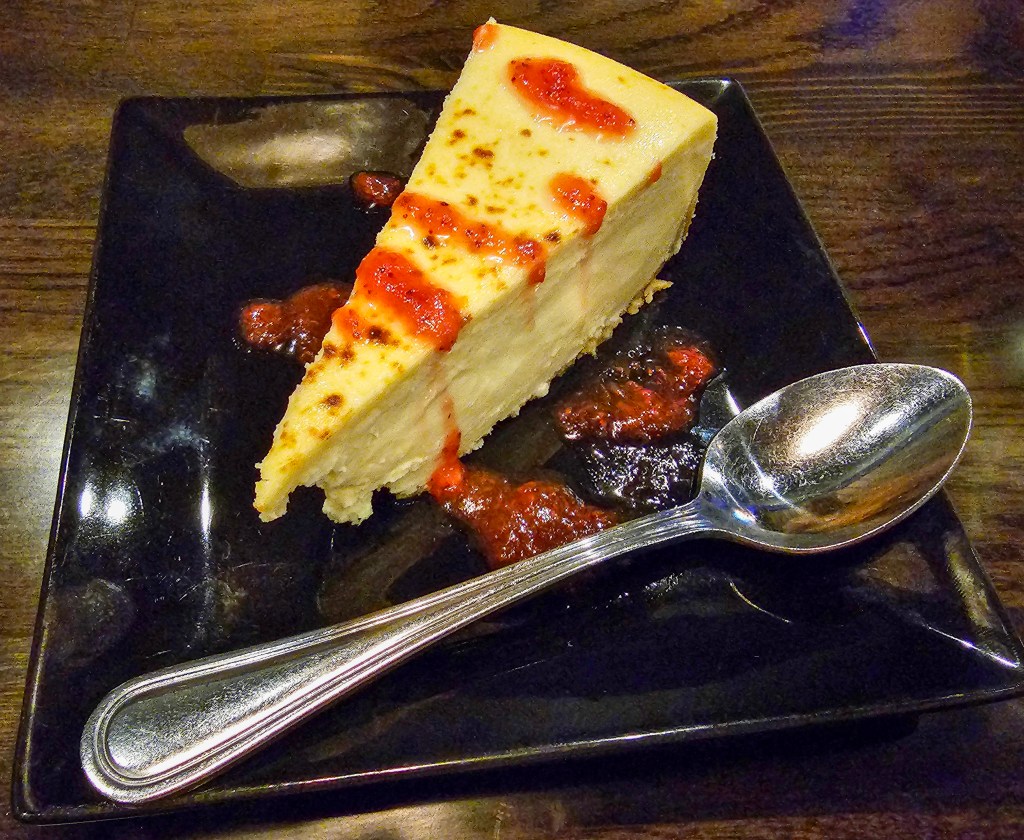
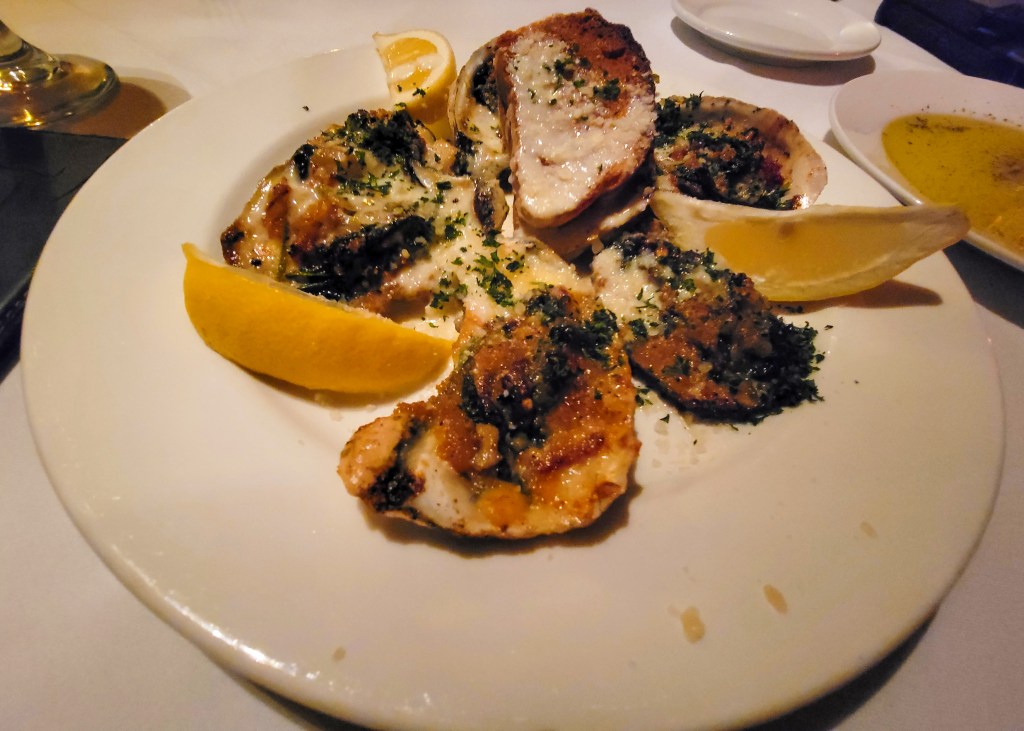
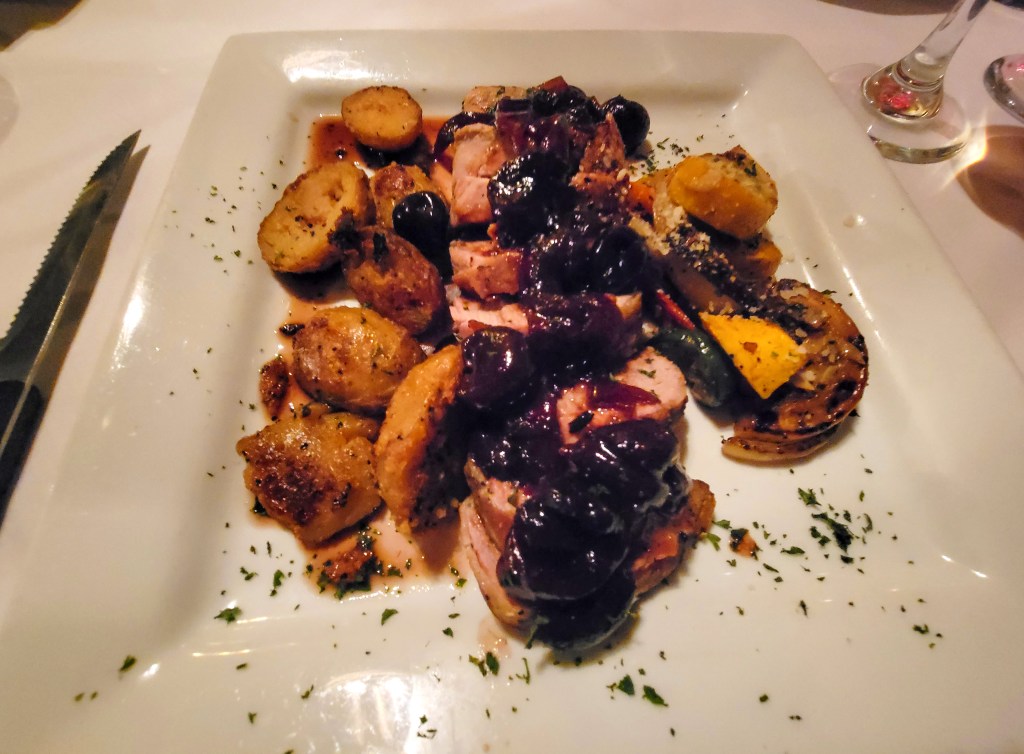
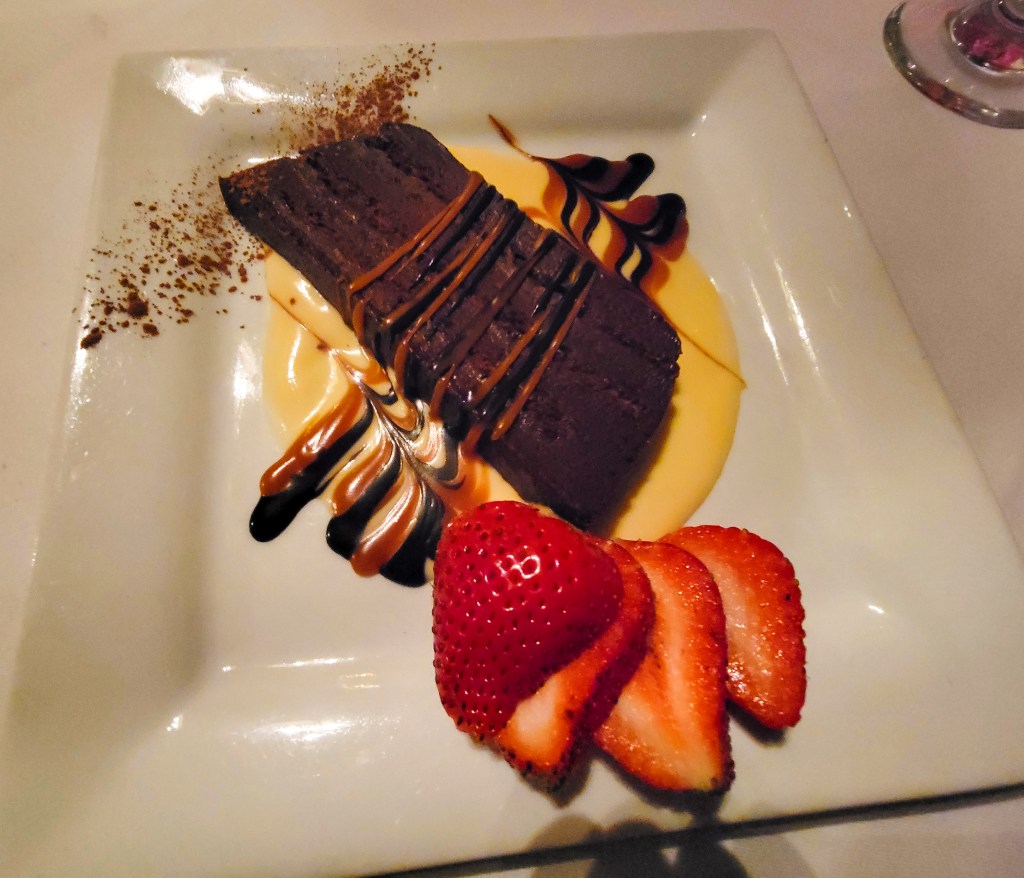
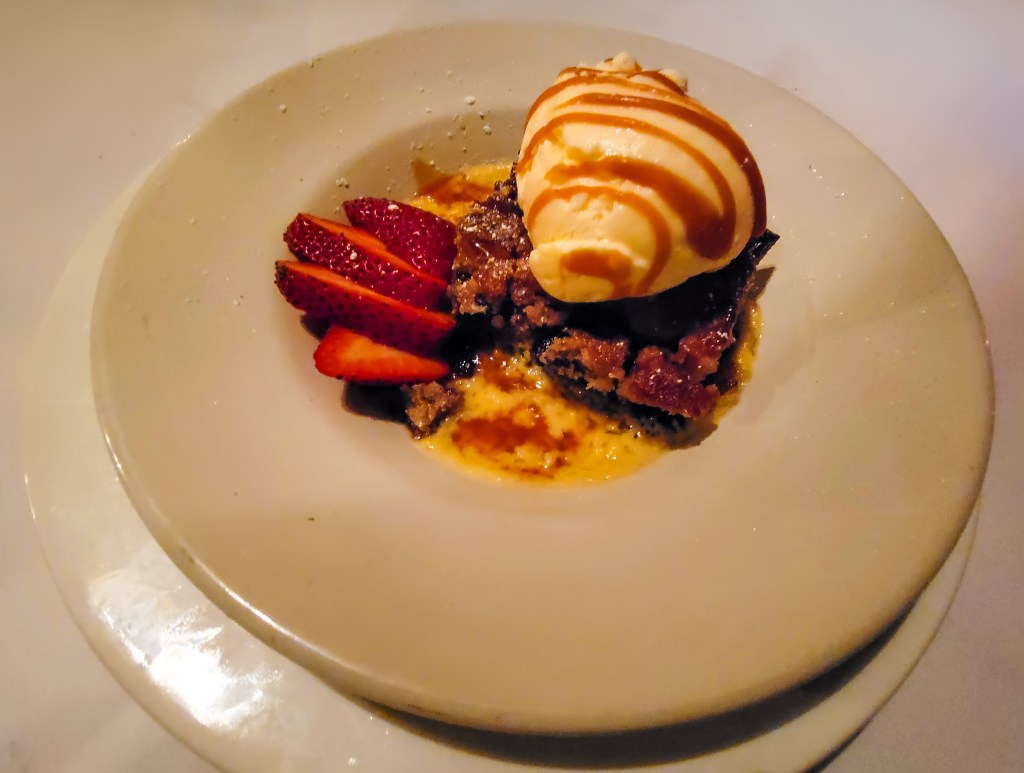
That evening we made a quick stop for last-minute groceries at the Kroger in Corinth. It was a much better shop than any other we had found, so we may be able to consider provisioning there in future, instead of transporting everything from Hilton Head. The highlight was, as usual, dinner at our favourite restaurant in the area, Vicari’s. I could not resist my usual smoked trout pate to start, while Dick enjoyed his calamari. Dick’s choice for main course was sea bass on a bed of spinach, and I had fried lobster tail with a quite delicious creamy blue cheese hash brown potato dish. Desserts (always a must at Vicari’s) were crepes with strawberries Romanoff for Dick, and crème brulee cheesecake for me.

We decided on an early night after all the hard work and a big meal, but Dick had just settled down when he had to get dressed again to meet the boat cleaner at the lodge and hand over cash to pay for the job. She had been unable to find a bank that would cash the personal check. This is the unfortunate situation here in USA. The mechanism used by small businesses in UK, where one simply does a bank transfer to pay for goods and services, is not done here. There are a few options, besides cheques or cash, but they are seldom used. Making everything more difficult, personal checks are accepted in very few places, and rarely for cashing, just a deposit and funds held until the money clears. Very difficult for a small individual business like our boat cleaner. In future we will know to be prepared with cash. We will certainly hire her again, as she did a great job.
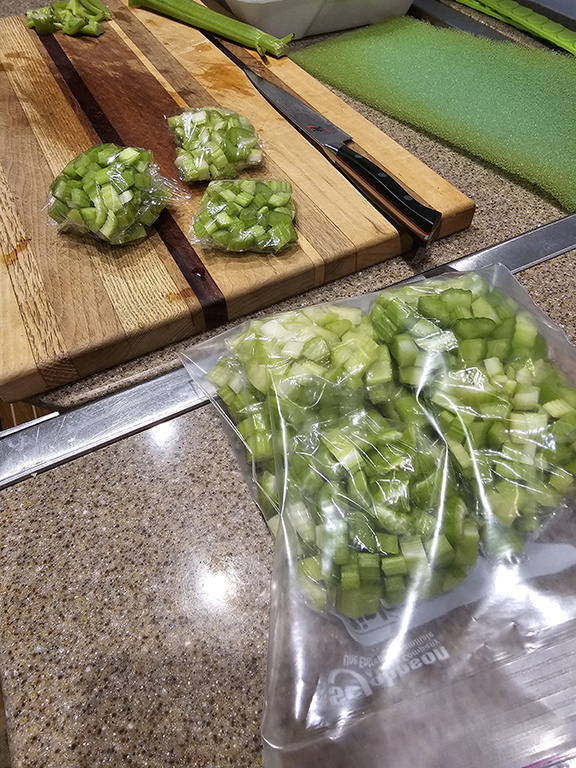
Next morning, we packed up the food from the cabin and transported it to Nine Lives, where the fridges and freezers had been cooled ready. While Dick played with bags of steel shot, I cut up the celery into single stick packets and put them into the freezer. We use so little of the celery bundles that one buys in the supermarket, that this is a good alternative to buying fresh every time.
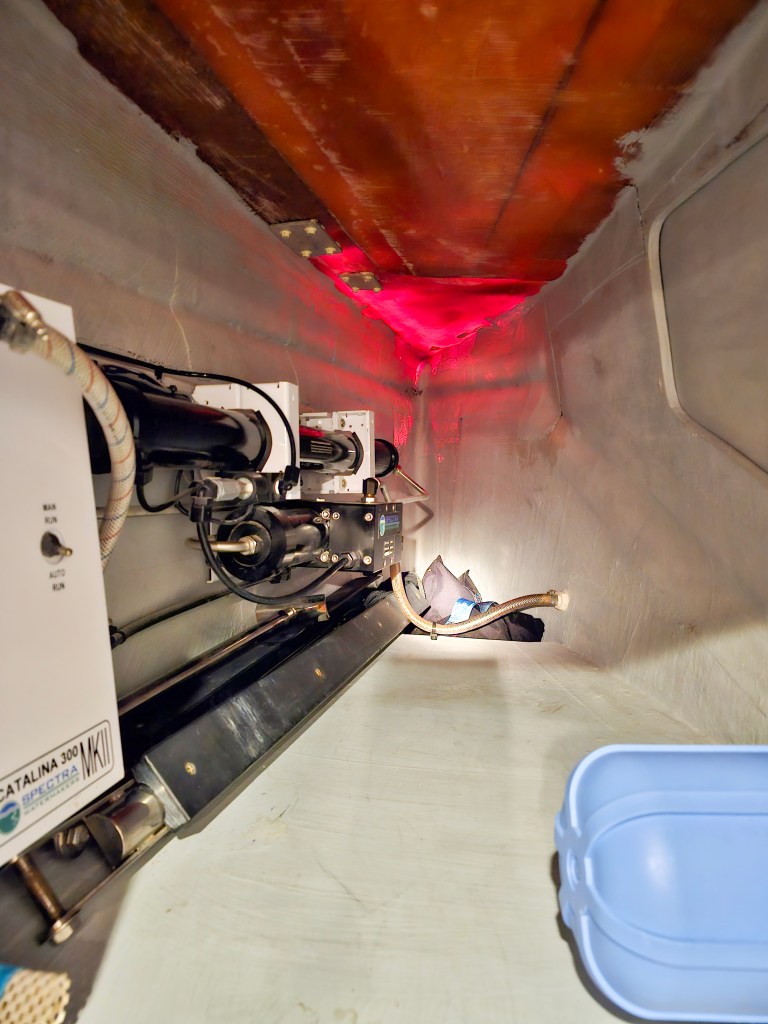
It is amazing what things you find that you haven’t seen for ages when you have to completely empty lockers. There was a rotary laundry hanger, and even a toolbox with spare parts. Getting the bags of shot into the forward pontoon on the port side was tricky. There is a water line across the pontoon that the bags had to be lifted over, and there was no way that Dick could get in there past the watermaker to lift them over. He had to settle for sort of tossing them from a prone position halfway into the pontoon. I decided that a photo of Dick’s backside sticking out of the cupboard was not required for this account of our travels, but I did manage a picture of the small pile of heavy bags after he vacated the space.
The starboard side was much easier. Just as well, as more bags were to be put in there to balance the boat. All the extra refrigeration, the generator, and the propane tank are on the port side, and Dick is certain we added the better part of 1000 lbs of provisions, thus giving Nine Lives a distinct list to port! I am not sure it’s really 1000 lbs, but the man who loaded and unloaded the car, then wheeled it all the better part of ¼ mile down the docks to the boat in multiple trips says that’s how much it was. There is access to the starboard pontoon from above, through the locker where we keep chairs and extra canvas and fenders. Dick cleverly used one of the fender boards (after first tying it off to avoid disaster) and slid the bags down into the pontoon. He could then use the boat hook to reposition them. The final two bags are just sitting in the locker, so can be removed if we are now front heavy. I can say that the ballast certainly does make a difference. We can see that the bottom paint at the waterline is now very close to equal at both bow and stern, and less water pools in the corners of the showers.

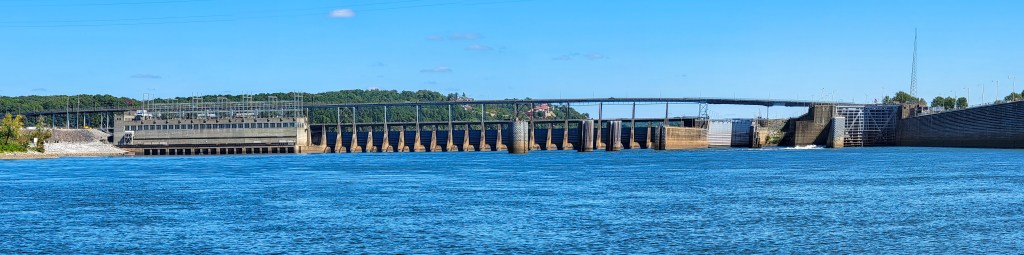
June 23rd. Underway at last! We added a small amount of diesel, but we already knew that fuel is cheaper further north by about $1/gallon, and we want absolutely full tanks before heading up the Ohio. Diesel is reportedly scarce on that river. We had a short wait at Pickwick lock. The lockmaster initially said 2 hours, and we could tie up on the lock wall while a split tow finished, but he decided to put us through the auxiliary chamber early, so our wait was less than an hour.

Here is a good spot to review how we handle these big Army Corps of Engineers locks on the rivers. I prepare the boat (fenders and a mid-ships line ready), and then we change places and I drive the boat into the lock and maneuver Nine Lives close to the wall where there are floating bollards. Dick uses the boat hook to get the line around the bollard, which floats down (or up) as the lock empties (or fills). I remain at the helm and may occasionally need to use the engines to realign us to the wall if turbulence starts us spinning out of position. Keeping the engines running is somewhat controversial, but we only need to do this in the very big locks, and we have never been asked by a lockmaster to turn them off. Locking complete and doors open, Dick retrieves the line and I drive off, and then we switch places again so I can put away the line and stow the fenders until the next lock. We use headsets to communicate throughout the process. These make a huge difference, no need for shouting or trying to make hand signals while wrestling with lines.
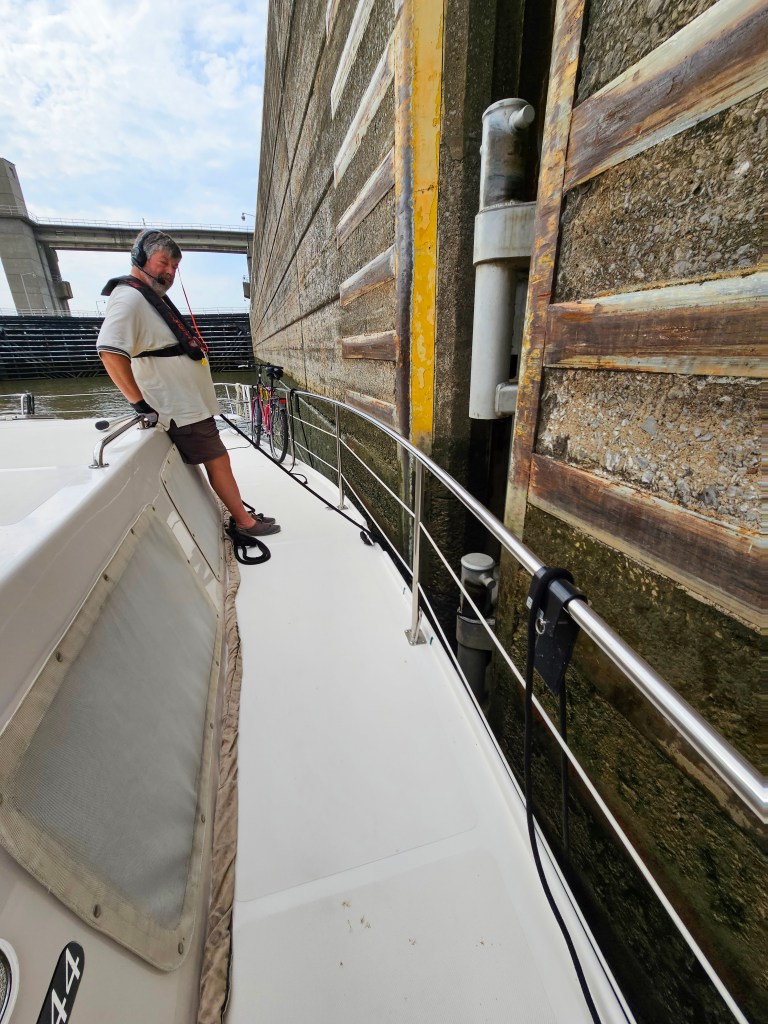
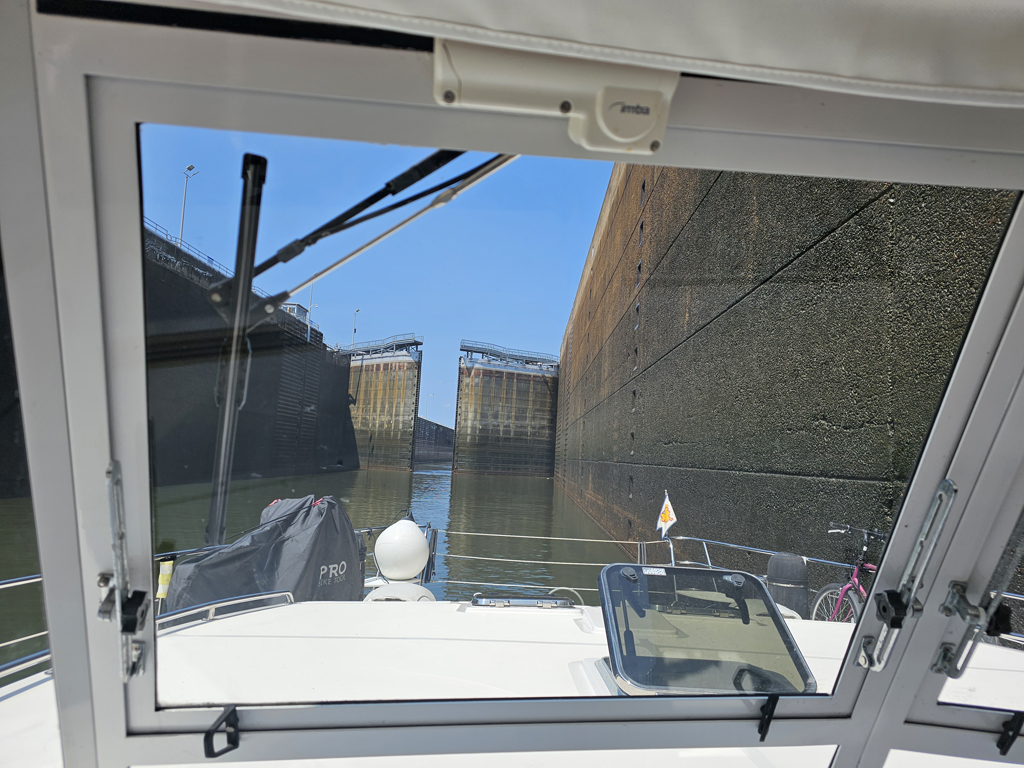
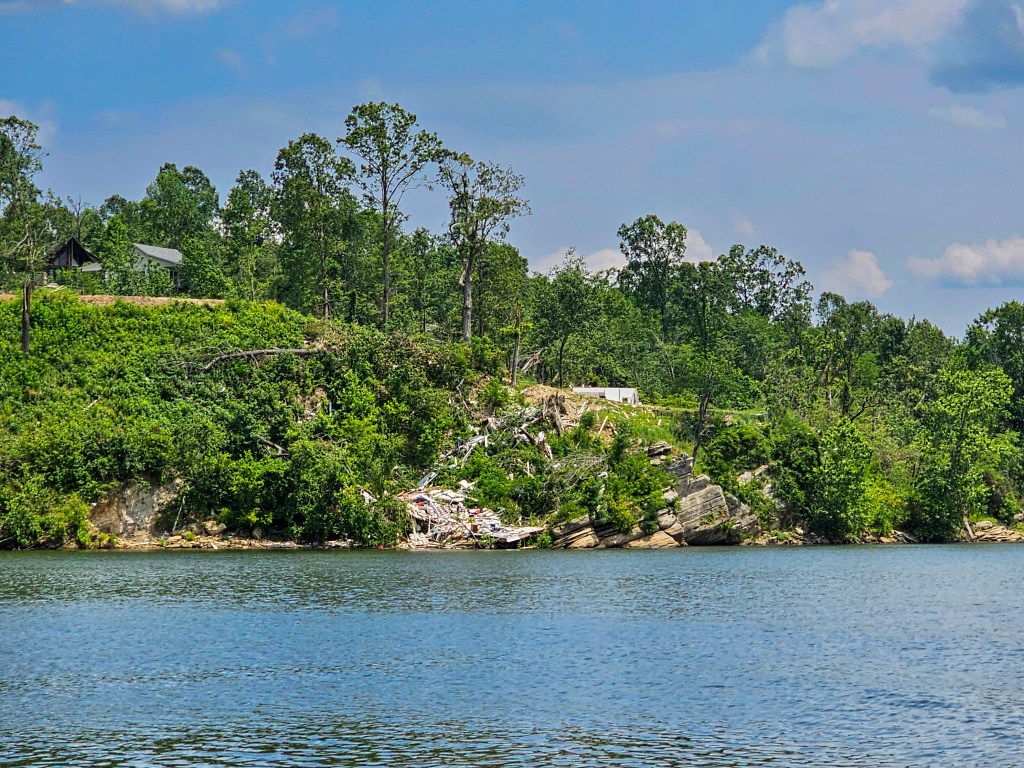
As we made our way north on the Tennessee River, we passed several houses that had all but collapsed. It appeared to be tornado damage, one house looked as though a huge fist had smacked down in the middle of the roof. The houses are a write-off, and yet other buildings nearby were untouched. One was completely reduced to rubble that had slid down the river bank. It is confusing that we are travelling north, but going downstream. The Tennessee climbs up from the Ohio River into the foothills of the Appalachians, navigable as far as Knoxville.
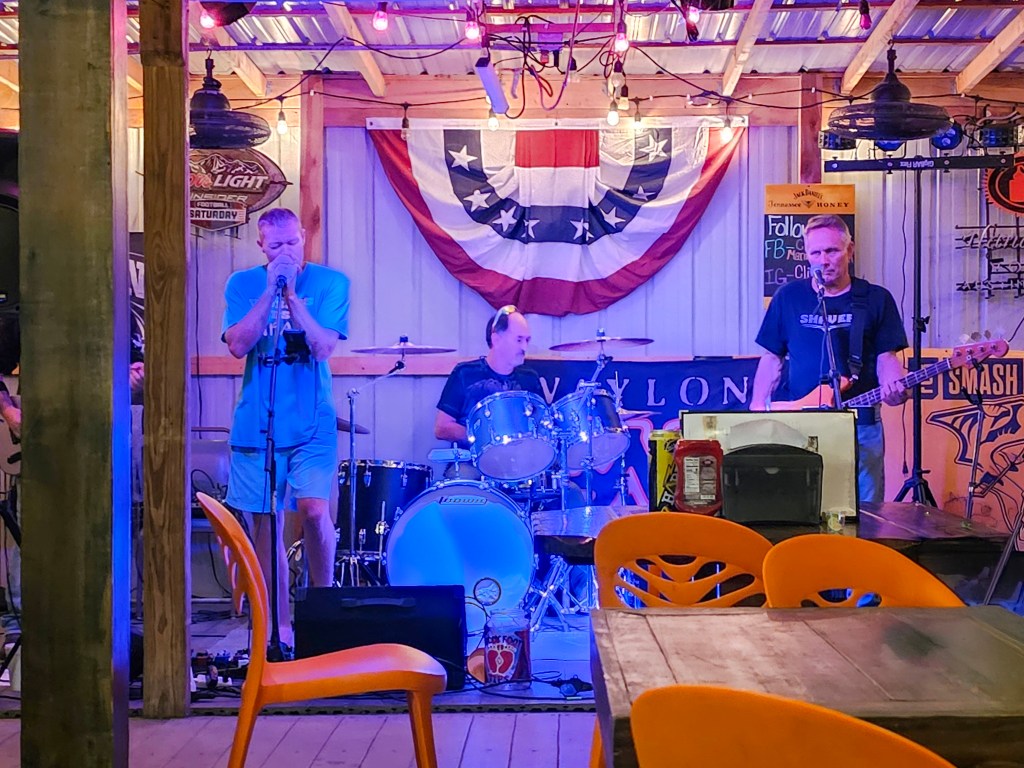
We arrived at Clifton by 3:30. Dick walked into town, but as the marina owner had told him, there was really nothing to see! We had dinner at the marina restaurant (a major contrast to Vicari!) Pretzels with beer cheese to start. Dick was conservative and ordered bangers and mash, but I was adventurous and tried the bacon popper grilled cheese. Bacon poppers are jalapeno peppers, filled with cream cheese and wrapped in bacon. They were put inside a traditional grilled cheese sandwich. It was very tasty! That evening the entertainment was a highlight, we always enjoy live music. This was LOUD, but very talented (older) guys. They played rock and country rock, including Rolling Stones’ “Satisfaction”, Brooks and Dunn “Lost and Found in a Border Town”, and a fantastic blues version of Happy Birthday for a member of the audience. Another audience member joined the group and sang “Green River”, one of Credence Clearwater Revival’s big hits. At the break the group came over to our table and introduced themselves. The lead singer had lived and worked in Bluffton, so he knew Hilton Head well. He is now based in Nashville, and his day job is installing air conditioning units for hospitals and clean rooms. For a change Dick was happy to stay nearly to the end of the evening without my having to nail him to the chair!


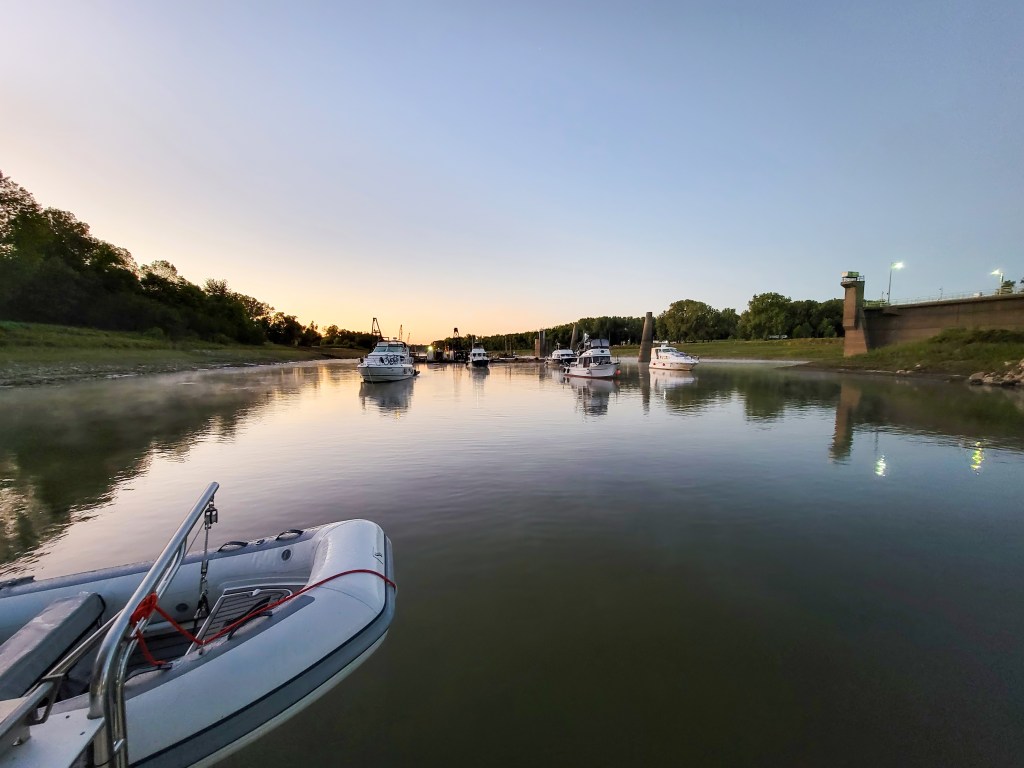
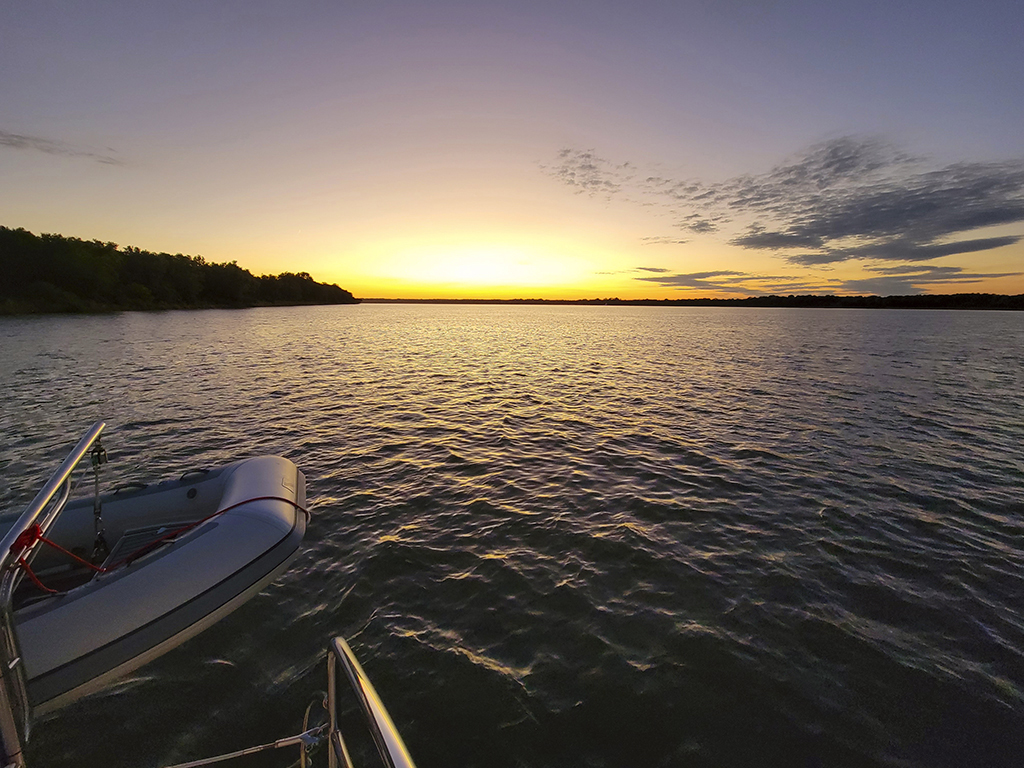
We made an early start the next day and anchored in Birdsong Creek before 3pm. There were a lot of little boats out on the water, but nobody else anchored in the place we enjoyed last autumn. We had thought about visiting the pearl farm, but it was very hot, so we just stayed on board. We enjoyed our traditional first night at anchor bottle of bubbly with a few snacks, followed by grilled steaks, baked potatoes, mushrooms, and corn.

It was a quiet night, although several times we were gently rocked by wakes. Chef Dick cooked his signature full breakfast, eggs, bacon, sausage, potatoes, mushrooms and toast. The anchor came up easily, the new motor and gear unit on the windlass working well. The weather app said it was 94F, “feels like 104”. It did.
It was a relatively short trip to Paris Island, and we were tied up by 1pm. Dick scouted the area, and arranged for a ride to the conference center where we had dinner. To our surprise, the waitress refused to serve alcohol to me because I did not have ID with me. Research suggests this is a new problem in Tennessee, seniors being carded and refused drinks without proof of age. The waitress was wrong, there is an exception for anyone who looks older than 50 (!), but there was nothing to be done, she was adamant. It was also irritating that Dick had been served a beer in the bar earlier without any ID requested. The food was indifferent.
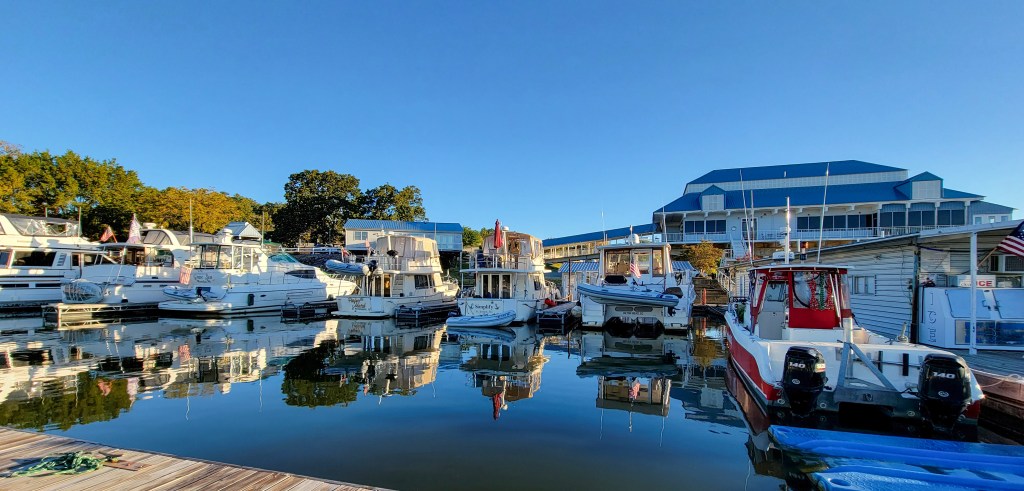
We had an uneventful, if windy ride north on a somewhat lumpy Kentucky Lake to Green Turtle Bay. We were fine, but some of the small boats that were out and about were bouncing a lot, and sailors were in their element! We were tied up in Green Turtle Bay by 1:45. Nine Lives enjoyed the compliments from the dockmaster, “beautiful boat”, and we also enjoyed hearing “you’ve done that before” as Dick maneuvered into the 22 foot wide slip without touching the sides, and I passed the lines to the waiting audience.
The next entertainment (for us) was watching TowBoatUS bring in a 45-foot Silverton aft cabin to the slip near us. On a windy day it took several tries. There were only women on board, a lot of boat for 3 of them. Apparently, they made a mistake when topping up with fuel that morning, adding gasoline to the diesel tanks. Very bad for the engines!
We were delighted to learn that GTB now rents golf carts that can be taken into town. We had dinner at Patti’s, an easy bike ride, but having had problems with hip and back, I was happy to postpone the bike riding until another day. It was a good dinner, but we were carded again for alcohol. Here it was apparently a new town ordinance. I believe it is an attempt to reduce teenage drinking (in US the drinking age is 21), but carding seniors would seem to be pointless. This time I was prepared and had put my licence into my pocket.

Just as we left for dinner, we realized that there was no water, the tanks were empty but the gauge showed ¾ full. We hoped it was just the gauge and not the pump. On our return from dinner Dick added water to the tanks and we were happy to find that everything worked as it should. It would seem that the gauge is now defective, so we will have to take extra care not to run out of water.
One of the tachometers was not working, and had not corrected itself after several days of cruising. This has been an ongoing issue for some years, but only after the boat has been left for a while. Two electrical techs came on board to see if they could diagnose the problem. They wiggled some wires and then said that it wasn’t what Dick had thought, and could not easily be fixed in the time available. To Dick’s great surprise, the tach started working the next time the engine was started, so whatever they wiggled must have fixed the issue.
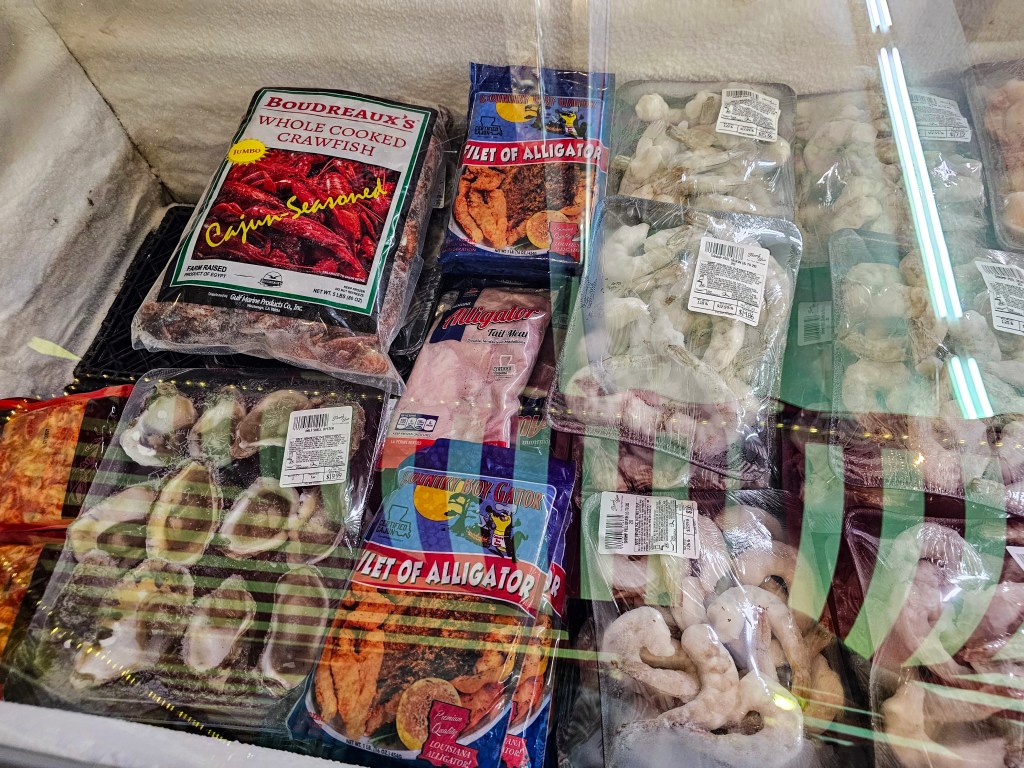
We had an enjoyable day. We went into town and were surprised and pleased by the selection of food at the small grocery store. We could have bought frozen alligator tail meat, crawfish, oysters, or catfish, but we contented ourselves with some shrimp. We visited the various boutiques that are part of Patti’s complex, surrounded by beautifully kept, shady gardens. We found a throw pillow that will work in place of the short cockpit seat cushion that was inadvertently left at home. In the afternoon we played bridge online with our English bridge club. We enjoyed the game and finished in the top half, but it was embarrassing that after two years of rock-solid performance, the mi-fi (internet router) cut out 3 times. We are noticing reduced performance, especially by afternoons, and have our suspicions. It is just a couple of months since the 24-month purchase contract was complete and the gadget was paid for, and one thinks, hmmm, planned obsolescence. If we have a lot of issues, we will give up on T-Mobile for internet service on board, and go with the newly available Starlink system, which is satellite based. Later in the afternoon we went over to another boat and enjoyed docktails with new Loopers.


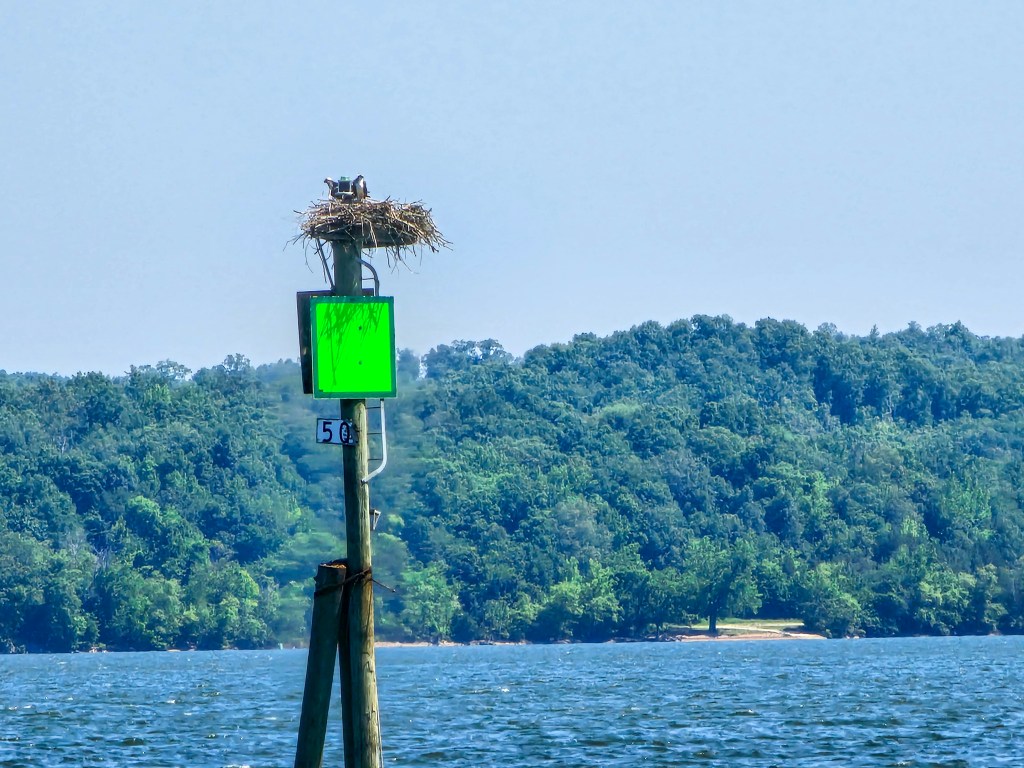
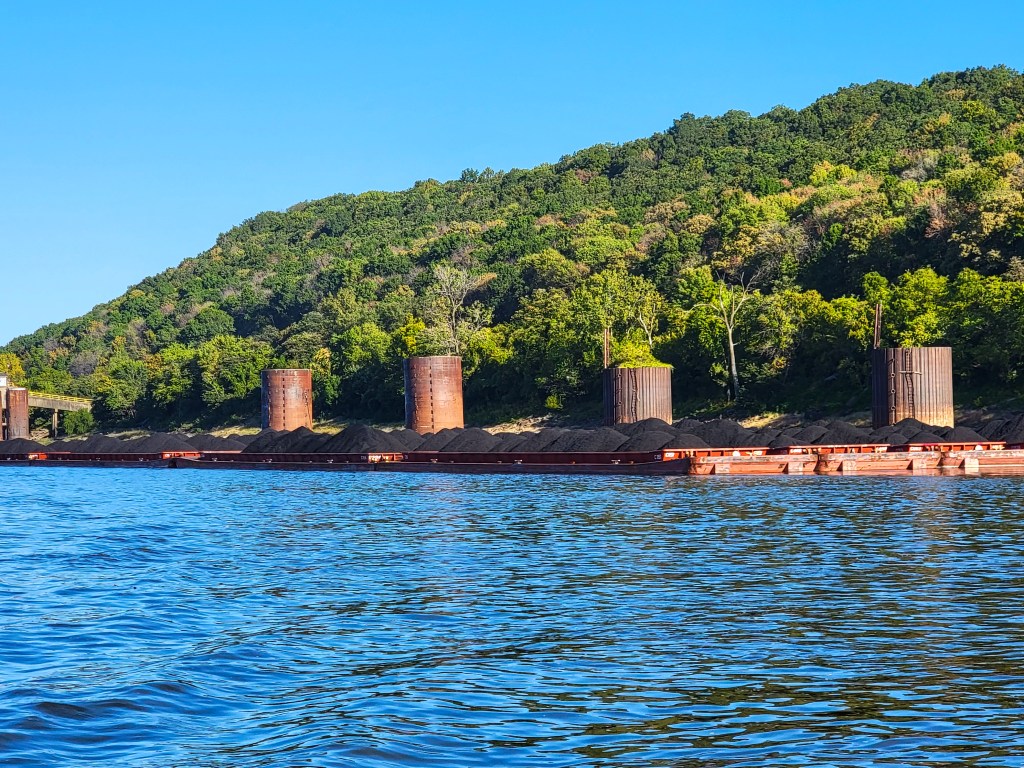
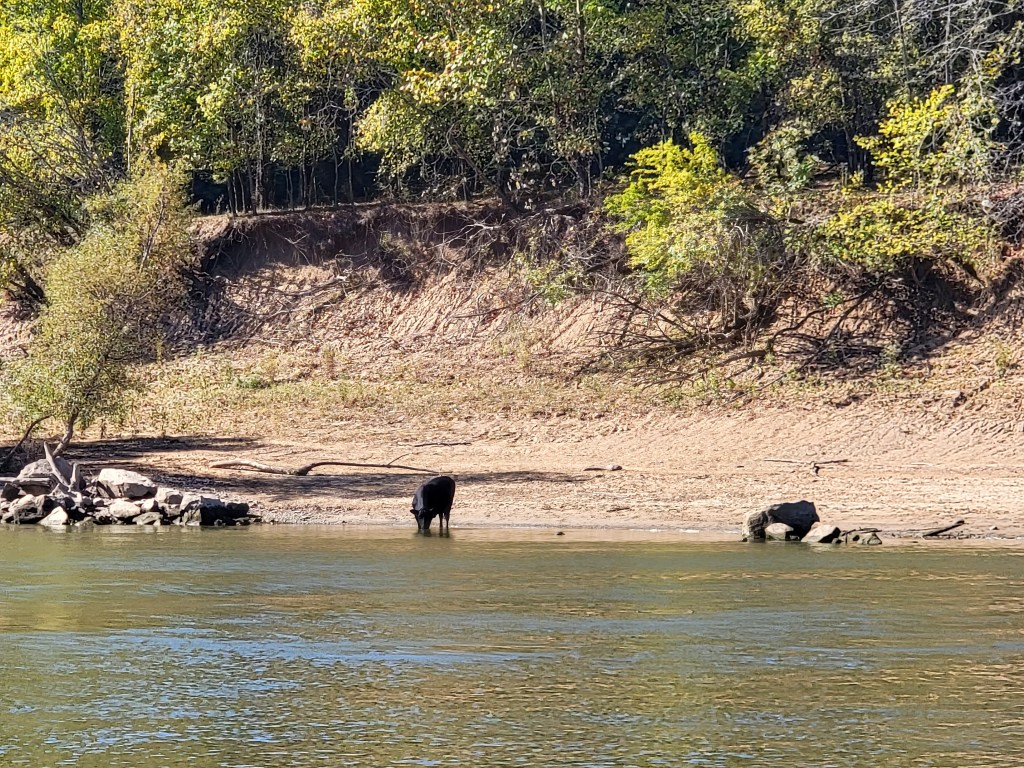
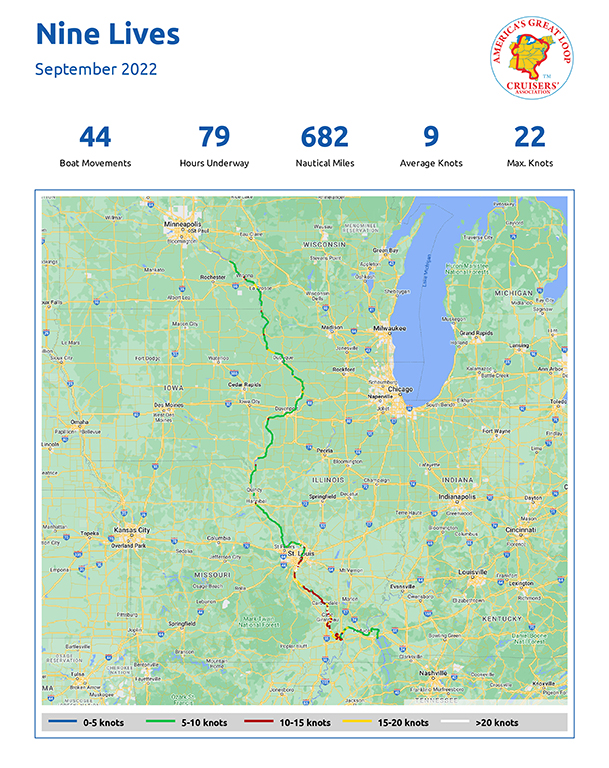
The next day we needed an early start, with 2 locks and 54 miles to go, plus getting fuel and a pump-out on the way out. There was no wait at the first lock, other than for the lockmaster to turn it around. We have seen lots of osprey nesting on the daymarks. Other wildlife has included at least one bald eagle, golden eagles, turkey vultures, cormorants, and one pelican. On the Cumberland River we saw what was probably a coyote, but might also have been a large fox. Asian carp seem to be under better control. An electronic barrier has been installed below Barclay Lock, and we saw few above it. There were many dead carp below the dam and the barrier. The Cumberland River was enjoyable as always, industry can be as interesting as scenery. We were glad that we didn’t meet any tows on the narrow, winding river.

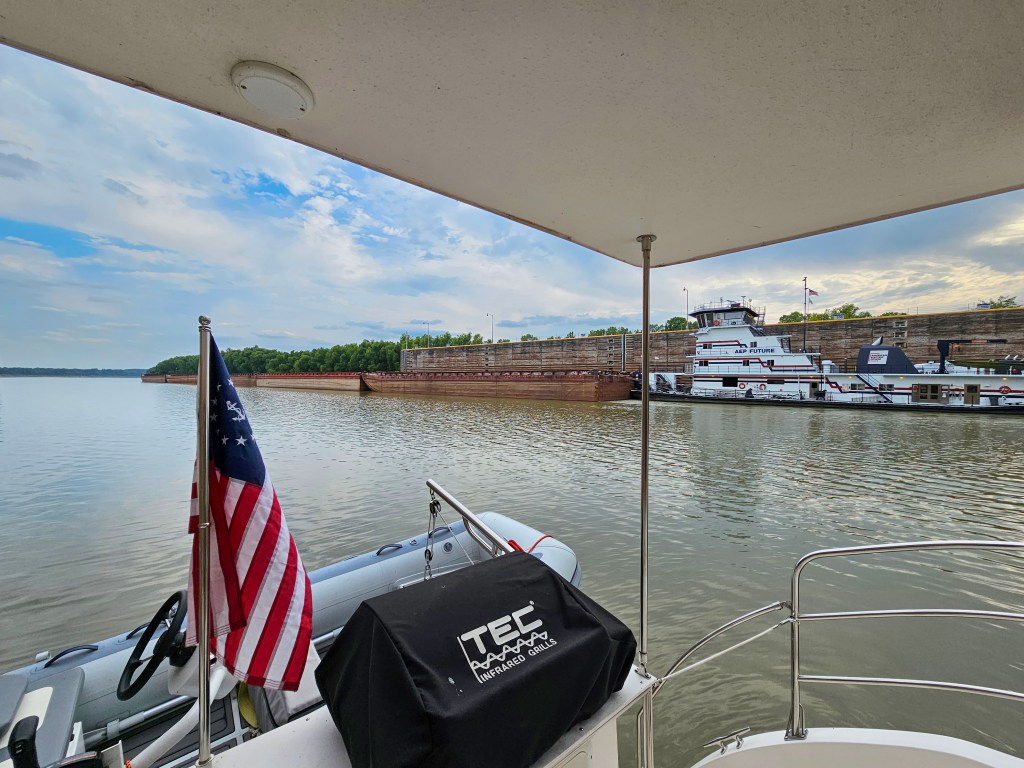
At Smithland lock our luck ran out and we lost 4 hours. There were 2 upbound tows waiting. The lockmaster said he would have sneaked us through, but one of the tows was carrying chemicals. He said he would not put any tows down until after our passage, but eventually he came on the radio to say that the downbound tow had empty barges and he would be putting it through. Once we were finally in the lock, we found out what had happened. The lockmaster came and told us that a crewmember on the downbound tow had been threatening to kill the other crew (!) so the police came to the lock to arrest him and take him off. I am glad we knew nothing about that until it was over!
Leaving the lock, we ran fast to make up some time and burn off the carbon that would have accumulated while we were idling. We were anchored by 6:40, a long day.
So far the Ohio looks like the Mississippi, not very interesting. We are hoping it improves, especially as we get nearer to the mountains.
We passed a quiet night, although I was most unhappy about our position in the anchorage, very close to the shore. We were out by 9am, after one of Dick’s signature breakfasts.
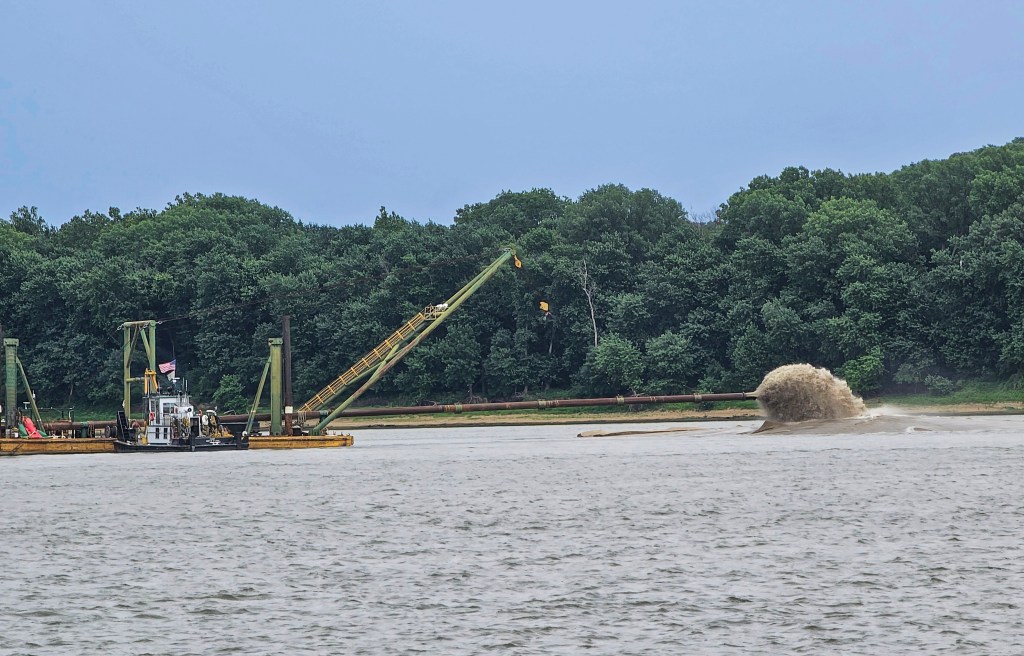
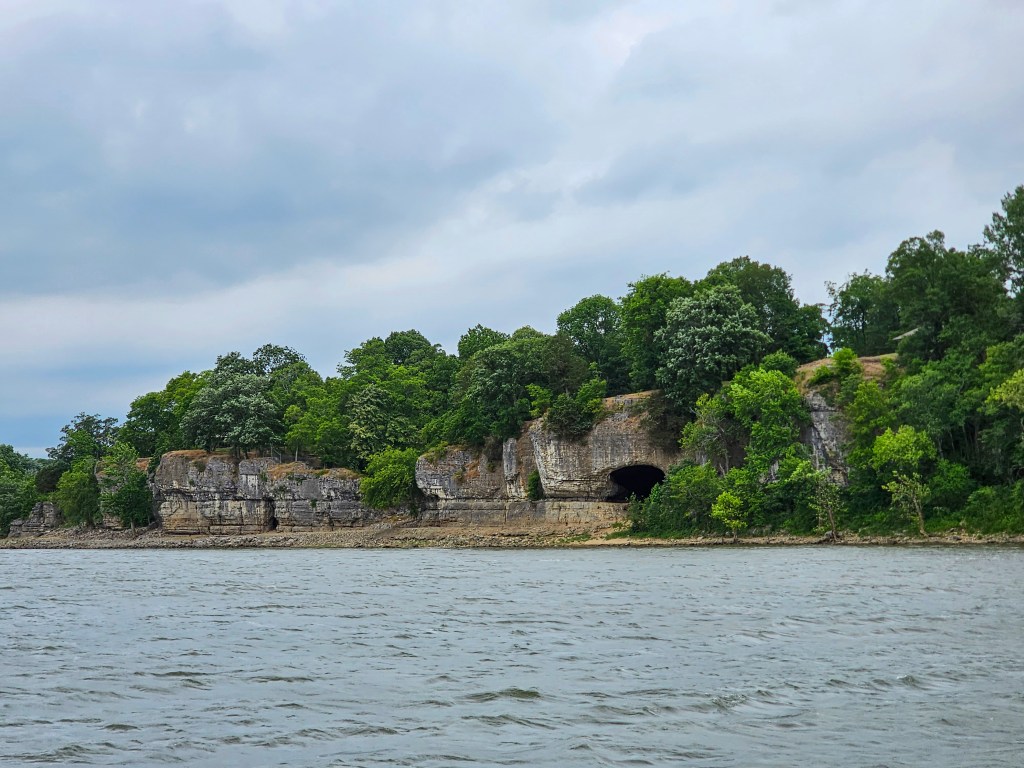
We passed Cave-in-Rock, an unprepossessing place, with crumbling buildings and a huge LaFarge quarry just north of the town. Now a state park, the cave in the rock is easily seen from the river, and was a notorious base for pirates and outlaws from 1790 thorough the 1870’s. In the mid-1800’s, the cave was being used as a church, despite its history as a tavern, gambling den, brothel, and base for a range of criminal activities including piracy, murder, extortion, and counterfeiting. Several unfortunates were murdered by pushing them off the cliff above the cave, including one fellow who had been the only survivor of a pirate raid, but was subsequently tied to his horse and forced off the cliff. While some of the victims survived the drop, neither the man, nor the horse were among the fortunate. The church services clearly did not do much to engender human kindness and upright living, as the succession of outlaws and criminal behaviour continued until the last leader of the local gangs was assassinated in the 1880’s.
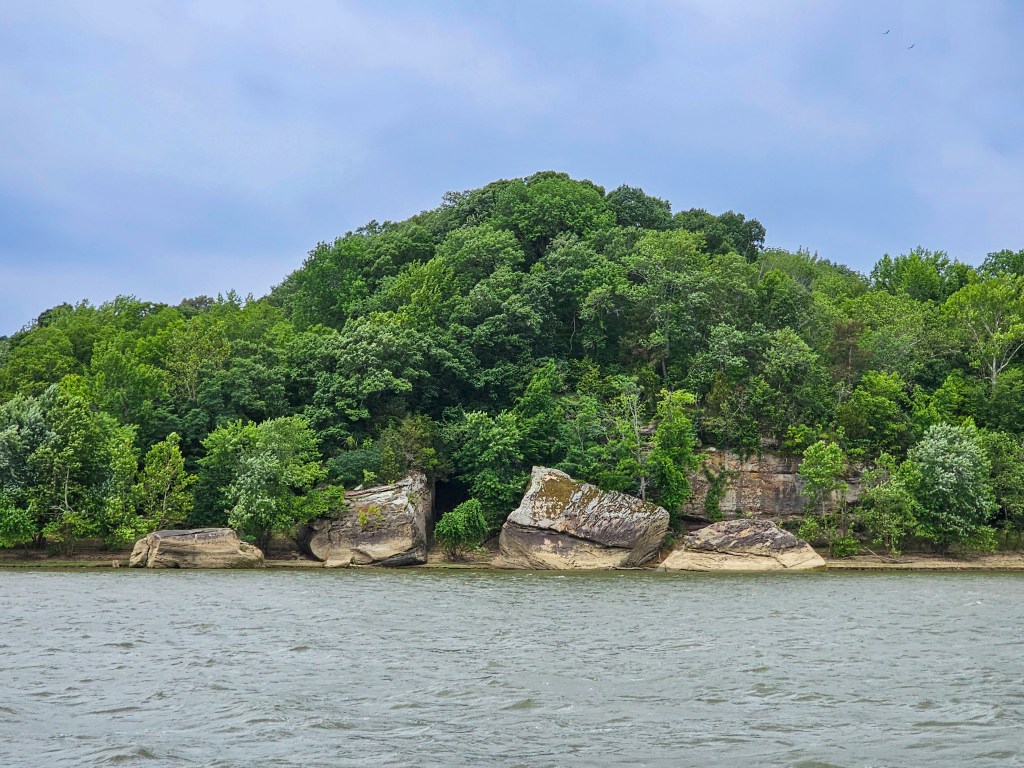
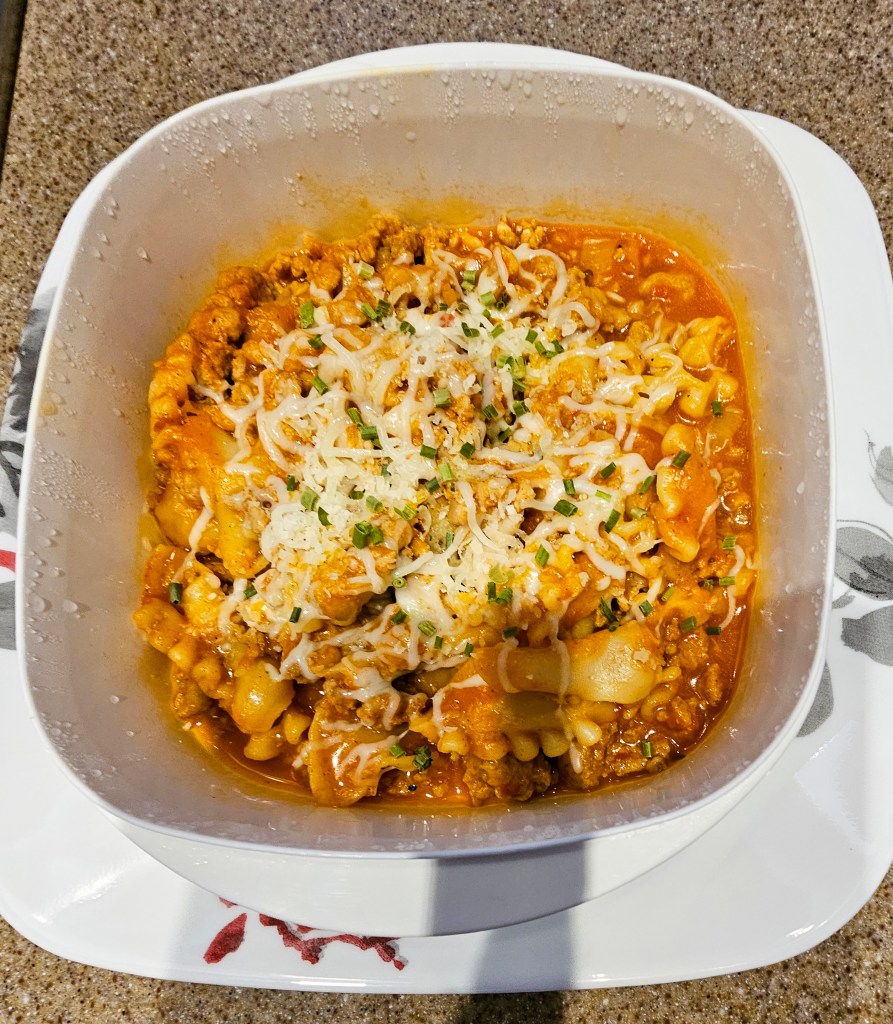
We were anchored by 3pm, lots of swinging room and plenty shallow, but certainly not what you would call a pretty spot. Dinner was a tasty new recipe, a one pot meal of ground pork, peppers and onions, marinara sauce, pasta, and thickened with mozarella cheese. It was delicious, definitely a keeper!
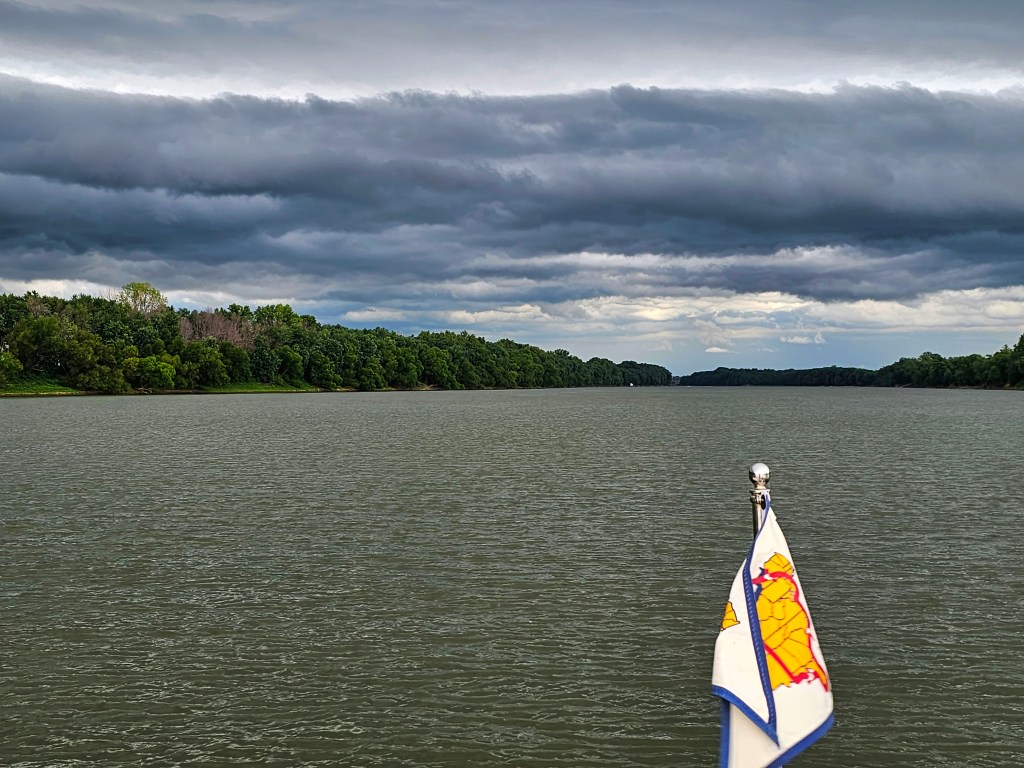
The next morning, Dick consulted the lockmaster, and was advised that there were 4 big tows coming up. We pulled anchor at 6:30am, to make sure we were ahead of them, and were through the lock by 8am. This allowed us an early arrival at Evansville, tied up by 2pm. Dick had seen how spread out the city is, so he arranged a rental car for our 3-day stay. Enterprise will pick you up if they are not too busy, so our timing was good.
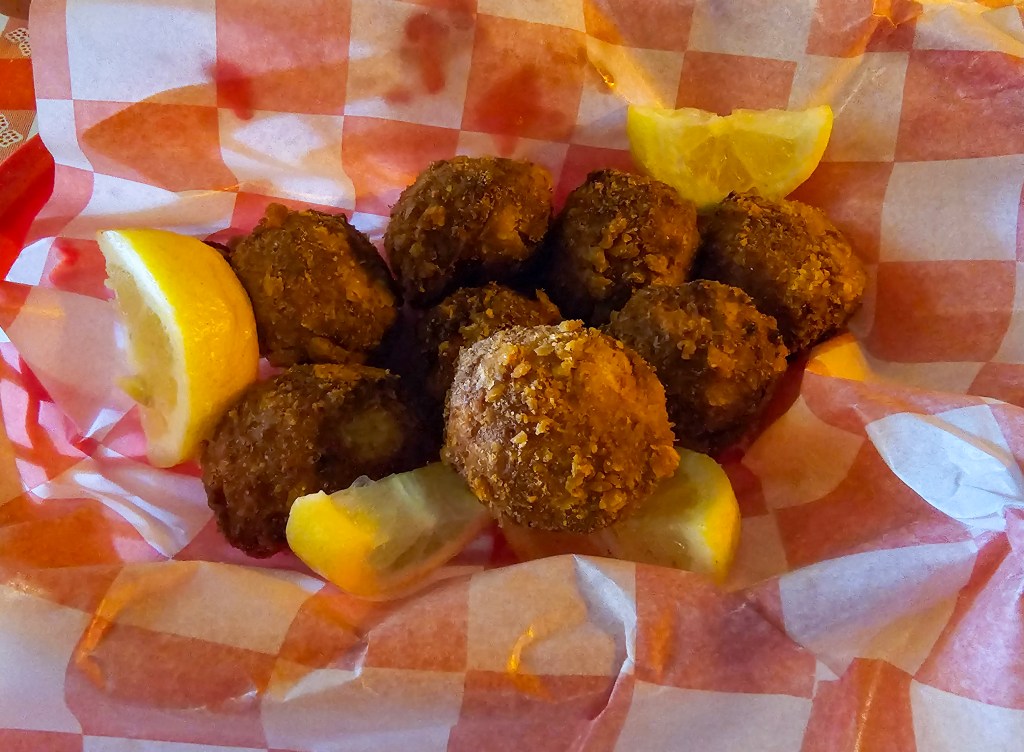
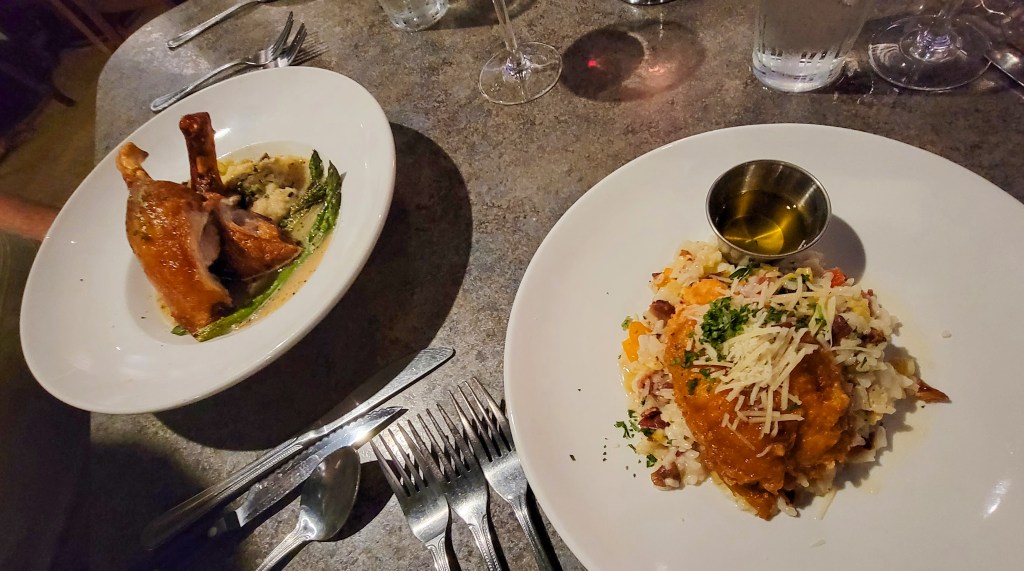
We had dinner at a German restaurant in a historic hardware building. The beautiful interior has been sadly neglected. Dick picked it because it was the top restaurant in the area as chosen by local residents. This might have been an error in judgement. I am not fond of German food generally, but they offered Wiener schnitzel (Austrian), so I thought it would be good. Beer was served in a frosted fish bowl, a good start, but it went downhill from there. We started with ham rolls, sort of croquettes, that were overdone and lacked any trace of ham. Dick was in hog heaven with a dish of pig’s knuckles. Ugggh. My Wiener schnitzel was the worst I have ever tasted. Even the fries were awful.


Although we rented a car, there is sadly little that we would want to do in the area. A zoo with most of the animals missing, an arts and science museum firmly directed at children, and various wetland parks. Walks in the heat and humidity with the opportunity to get eaten alive by mosquitoes do not appeal.
We found 3 interesting shops to visit. Dick tried to visit the Tourist Information Bureau, but it is inexplicably closed on weekends. The shops were a long way apart. Evansville is a strange city, crisscrossed by highways and the interstate. There is an odd mix of homes, manufacturing, and big box stores all mixed together. One area of downtown is being revitalized with converted buildings turned into loft apartments, and lots of coffee shops and gathering places, but no shops. The lovely old Post Office building has been beautifully renovated and turned into an events venue and office space. I also liked the distinctive Greyhound Bus station building, now a burger bar in trendy downtown. We took time to look at the other marina in the area, that Dick had planned to stay at, but they said they could not fit us in. A fortunate escape, as it was every bit as dreadful as the online reviews suggested, so we were glad to be at the alternate location. The cookery shop was a highlight, and we came away with several items that we could not possibly live without, even though we had previously been unaware of their existence.


An evening gathering with a cookout, live music, and fireworks was planned, and it carried on in spite of quite a lot of rain and thunderstorms drenching the proceedings. The fireworks didn’t happen. We didn’t join the gathering (although we were invited), as it seemed to be very local, with a lot of people in bathing suits, well lubricated before arriving! Three sheets to the wind, if we want to use a nautical metaphor!
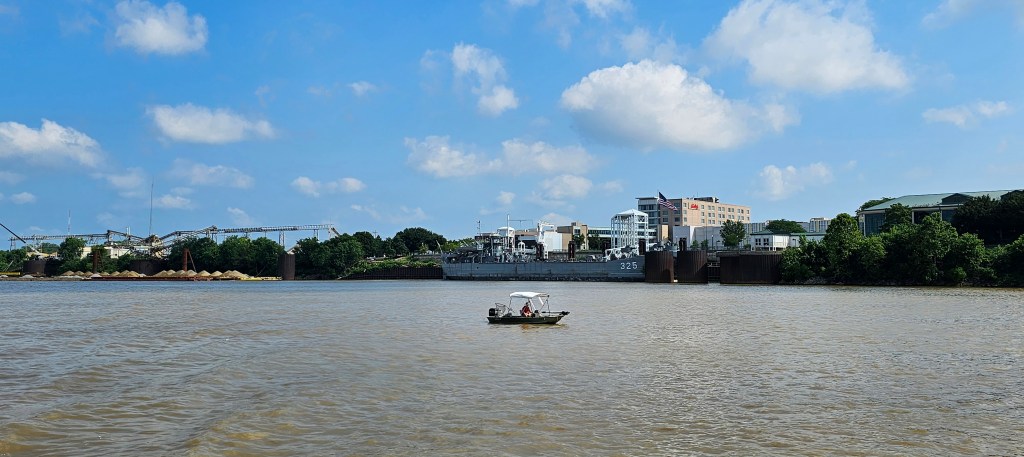
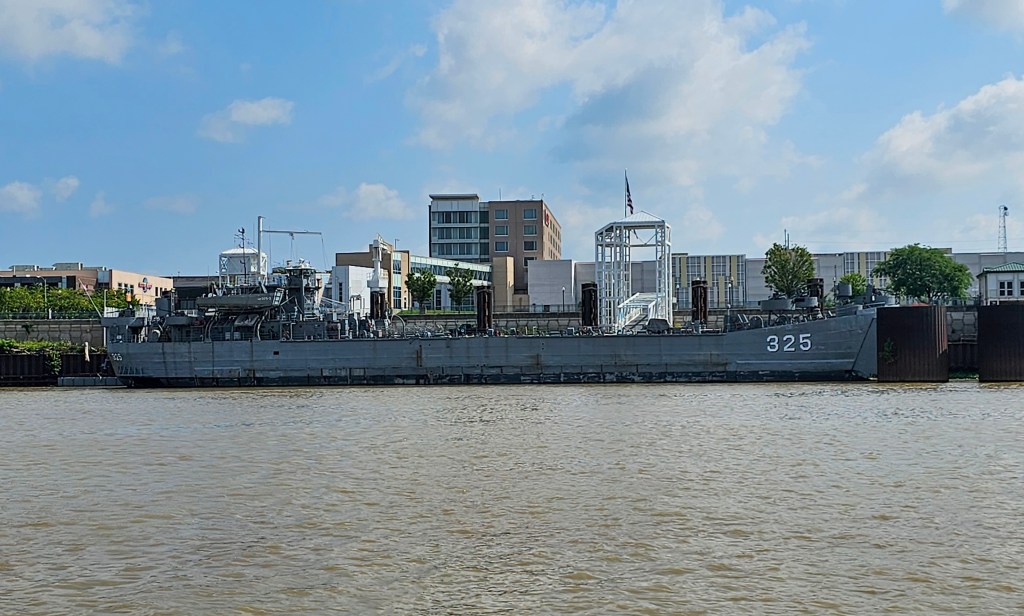
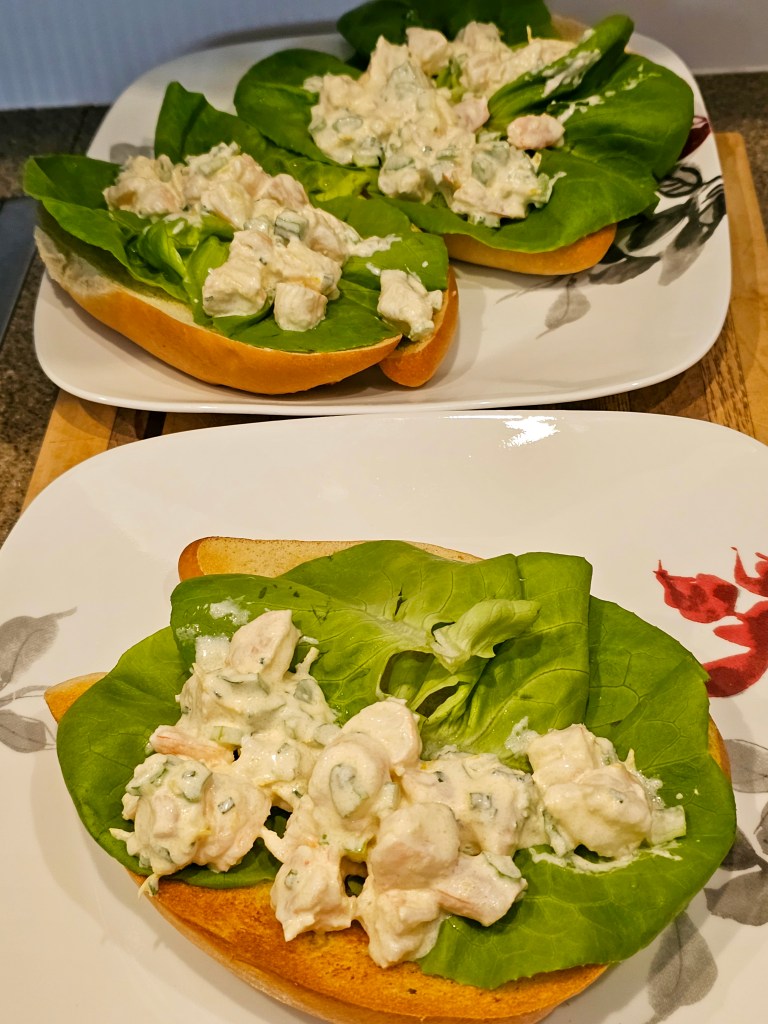
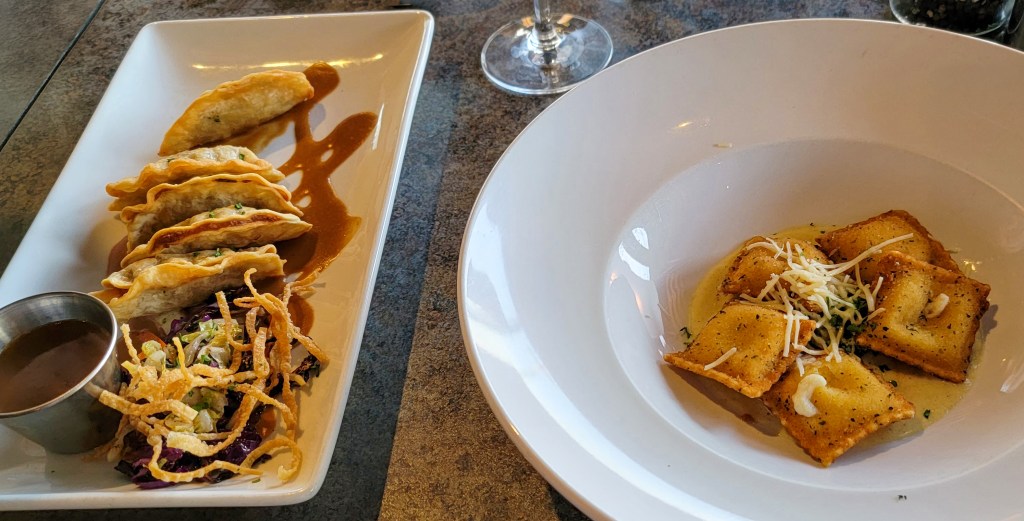
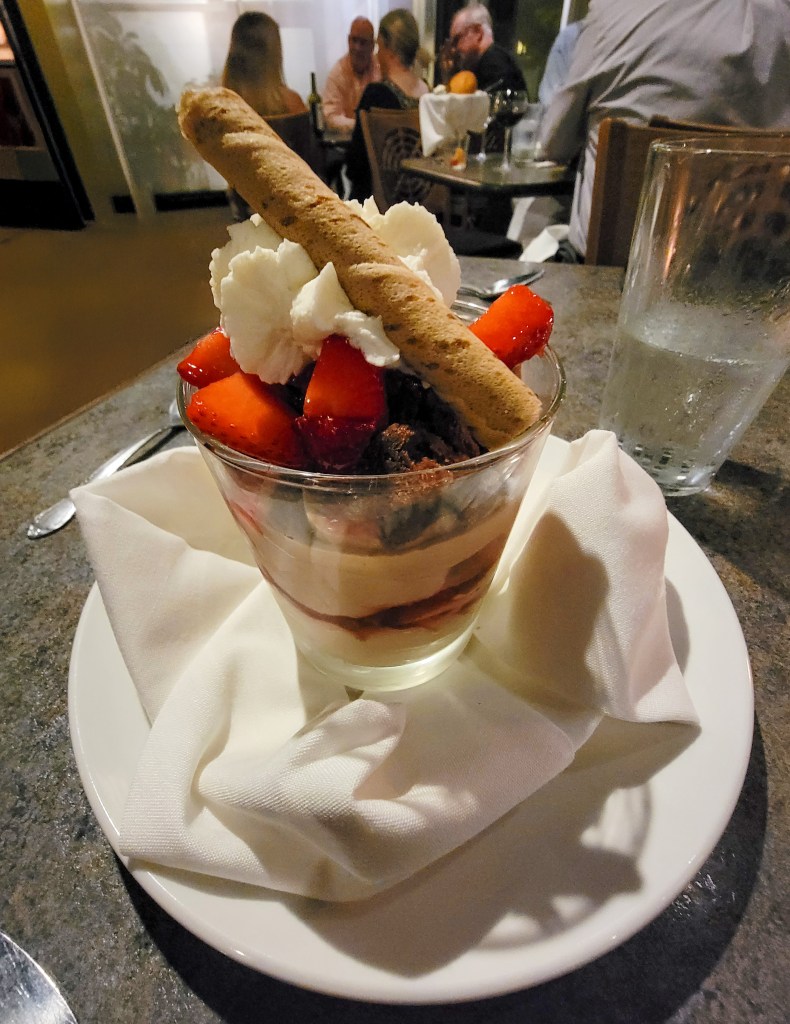
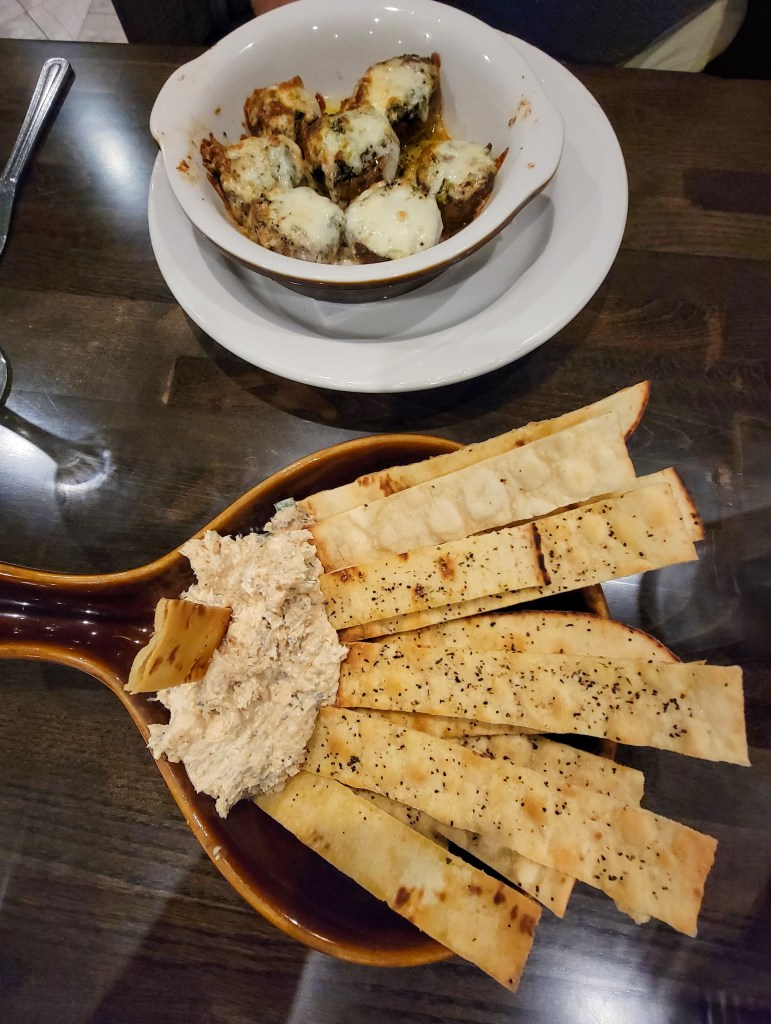
Sunday, we stayed on board, taking care of laundry, catching up with emails, and I began writing this first installment of the blog. Thunderstorms came through with heavy rain, so it was a good day to stay in. The rain cleared just in time to go out for dinner at an Italian restaurant, Biaggi’s, a small chain. The food was excellent, nothing like the usual chain fare. Dick had a beet and walnut salad to start, and I tried two different bruschettas. One was mushroom, the other was shrimp and crab. My white pizza with mushrooms was a taste sensation, and Dick said his rigatoni was also excellent. For dessert we tried a tiramisu special, with fruit juice and berries instead of the usual coffee flavours. This was less successful, as it was far too sweet for our taste. We tried to figure out how we could eat there again on our return trip, Uber being the only possibility, as it is a long distance from the marina. Evansville is very spread out. There is a nice waterfront with a park, and boat launching facilities, but no dockage at all. Also on the waterfront is the LST-325, a WWII landing ship tank that can be toured.

Next morning, July 3rd, we got an early start so Dick could return the rental car. We filled the water tanks, and got a pump-out in anticipation of 3 nights anchoring after our next stop. We were put through the lock with no wait, so we were tied up in Owensboro by 2:30pm. Dick had told me this was a rusty, nearly derelict dock, so I was pleasantly surprised to find sturdy, wide wooden docks, albeit with no rubber. There are no facilities, and it is quite a distance from town, but so far the town has not acted on an approved proposal and existing funding for a transient marina downtown.

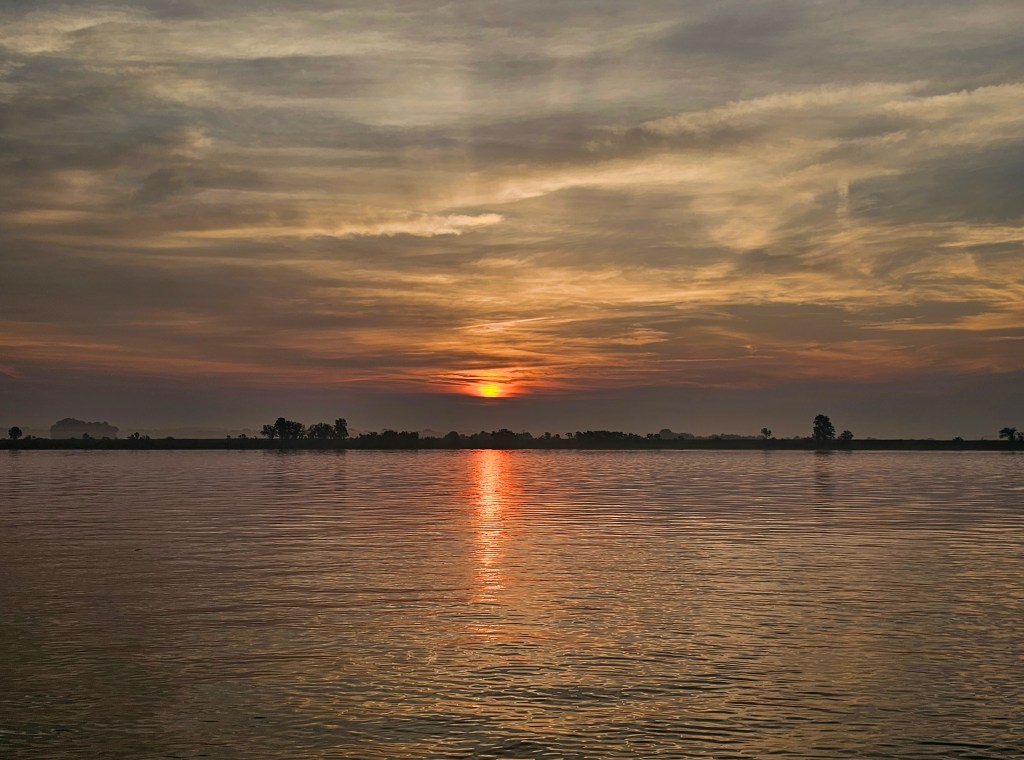
July 4th was a quiet day. I watched the antics at the very busy boat launch, while Dick got some exercise. He took a 20-mile bike ride to explore Owensboro, visit the Post Office, and get a few groceries. Later, we were made an offer we simply could not refuse without giving great offense, prime rib and hanging out with some good old boys in the pavilion on the shore. One of the fellows was beyond drunk, and engaged each of us in long conversations. He was past the stage of slurring his words, having trouble even finding them! Our host, the fellow who invited us to join them, was considerably less inebriated, and was very interesting to talk to. He is a former tow captain, who used to take barges up and down the Lower Mississippi and the Ohio. Now he is working on the marina, installing and repairing the docks, etc. Later Dick enjoyed talking with a fellow from Michigan who now lives in Owensboro. The prime rib was very good, according to Dick, but I didn’t try any, far too rare for me! As a guy the next morning put it when we chatted, “knock the horns off and serve”. The fireworks looked very good, but we were not able to see more than glimpses, because of the tree covering. After our evening of local culture, we turned in early, with a long day ahead of us.
Next morning, we passed Owensboro. We could see pilings for a large dock just south of downtown, but no dock installed. There is an extensive riverfront park and $9 million allocated for a marina, but the project was put on hold in 2021. It is always hard for us to understand the lack of willingness to welcome transient boaters to a town. Unlike local pontoon boaters and fishermen, bigger boats and crews bring a lot of money to the shops and restaurants of a town if they are able to visit. Even a safe dinghy dock works, but we don’t even find those in this part of the country.
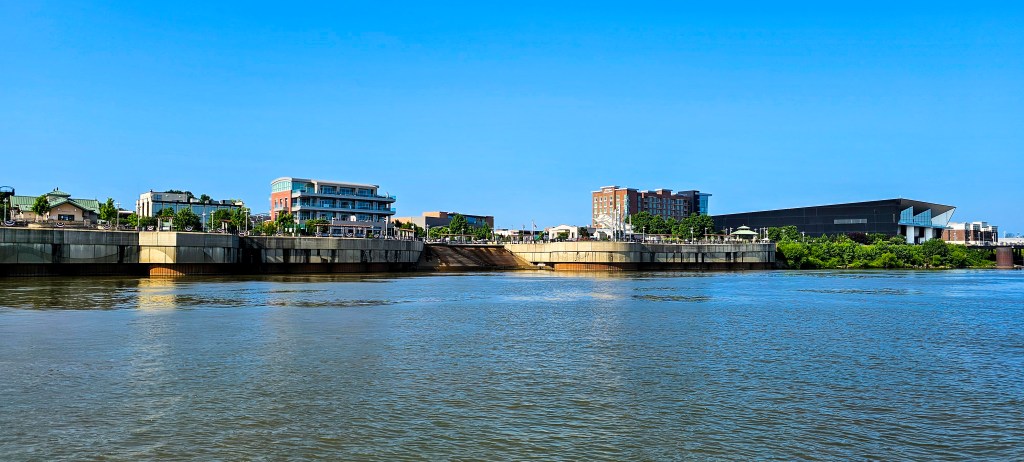
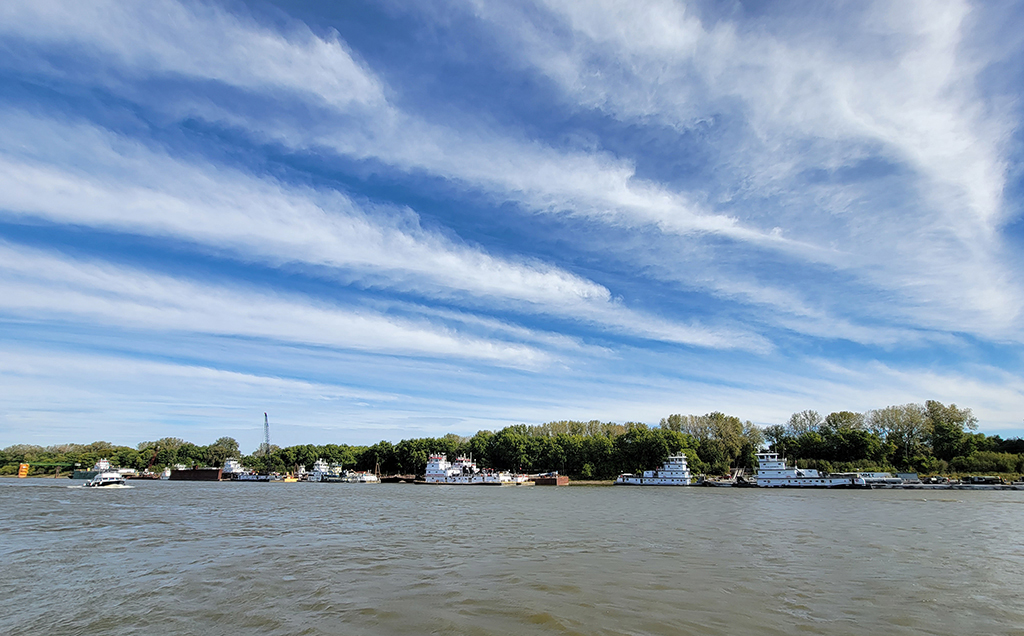
We passed a number of interesting and historic towns, all with boat ramps, none with docks. Visitors NOT welcome! We had an early start in anticipation of a long day, but we ran fast for a few miles as we needed to pass several large tows going in both directions. We arrived at our anchorage earlier than expected. The planned spot was a river inlet, but it was quite narrow, and there was a lot of debris and no current to hold us in line and stop Nine Lives from swinging into the shore. We backtracked down the Ohio for ½ mile and anchored in a wide area of the river, well off the sailing line. We anchored in 30 feet of water, a lot deeper than usual, so Dick was glad he had increased the length of chain when he replaced the anchor rode.
The anchor rode is the stuff that goes between the anchor, and the boat, the line, if you like. It can be rope or chain, usually a combination of the two. I find it interesting to learn that the amount of chain vs rope is in fact cultural. Here in North America, the most common is a few meters of chain and a lot of rope, and those who care about such things will defend their choice fiercely, in technical terms that include tension, elasticity, catenary, and other important aspects. The story in Europe is the opposite, there, an all-chain rode is the most common. Dick has always preferred the European model, but after reading all the discussions on the AGLCA forum, when he replaced our 180 foot all-chain rode with new, he opted for 200 feet of chain with a further 20 feet of rope. This allowed us the safer option of 7:1 scope in 30 feet of water. (Scope is how much anchor rode you play out. 7:1 is considered safest for overnight anchoring, 5:1 is acceptable, and as little as 3:1 is doable in a shallow area for a short stop, not overnight). We were anchored, alarms set, and ready for adult beverages by 3:45.
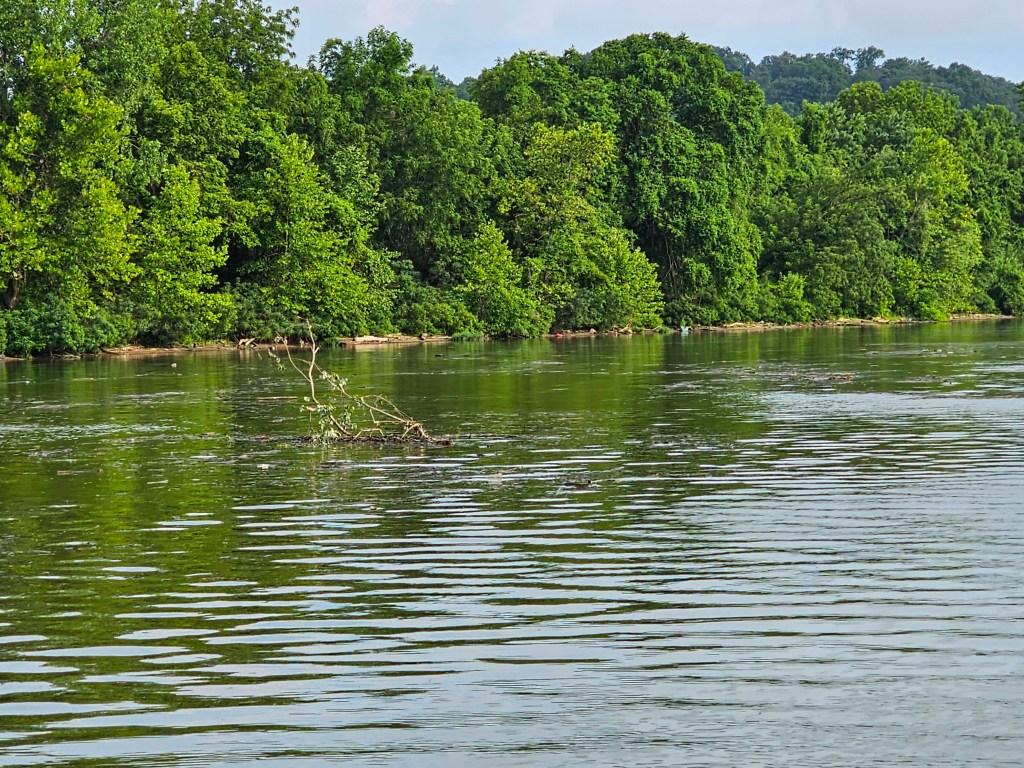
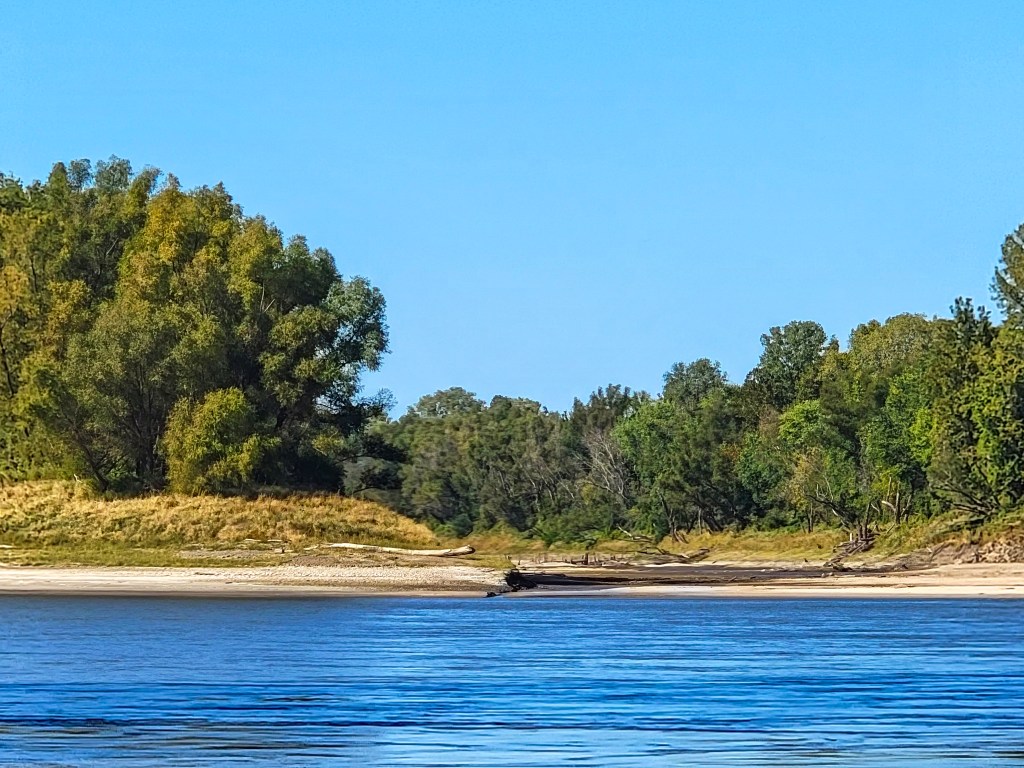
Overnight, we moved less than 10 meters, in spite of a number of tows passing through the night. We had left the radio on, so we knew what was happening, and in case a tow needed to hail us, although we were well off the channel and our anchor light was on. Debris had collected around the anchor rode and bridle, but it slid away as Dick began the process to raise anchor. We have noticed a lot of debris in the river, especially in the mornings. There have been heavy thunderstorms in the area, that will always tend to wash down dead trees and branches, but the sheer amount of debris is unexpected. I would not want to recommend a go-fast boat make this trip, unless they were prepared to wallow at trawler speed.
Underway, we passed the replica of the Pinta. She was built in Brazil, using the same methods and hand tools as the original used by Christopher Columbus 500 years ago. She had been visiting Cincinnati and other stops on the Ohio. We remembered seeing her sister ship, the Nina, in 2017 on the Hudson River.

The scenery has improved, with more varied topography. It is certainly pretty, but it is miles and miles of the same thing. After a while it becomes very boring with no changes to look at, and unlike the Mississippi trip, we are seeing almost no wildlife. We decided that one very long day of boredom was better than two shorter ones, so we cut one anchoring spot from our plans and arranged to arrive a day early in Louisville. We also went for miles with no internet signal. Unprecedented these days. It is definitely the land that time forgot. There weren’t even any pleasure boaters or fishermen.
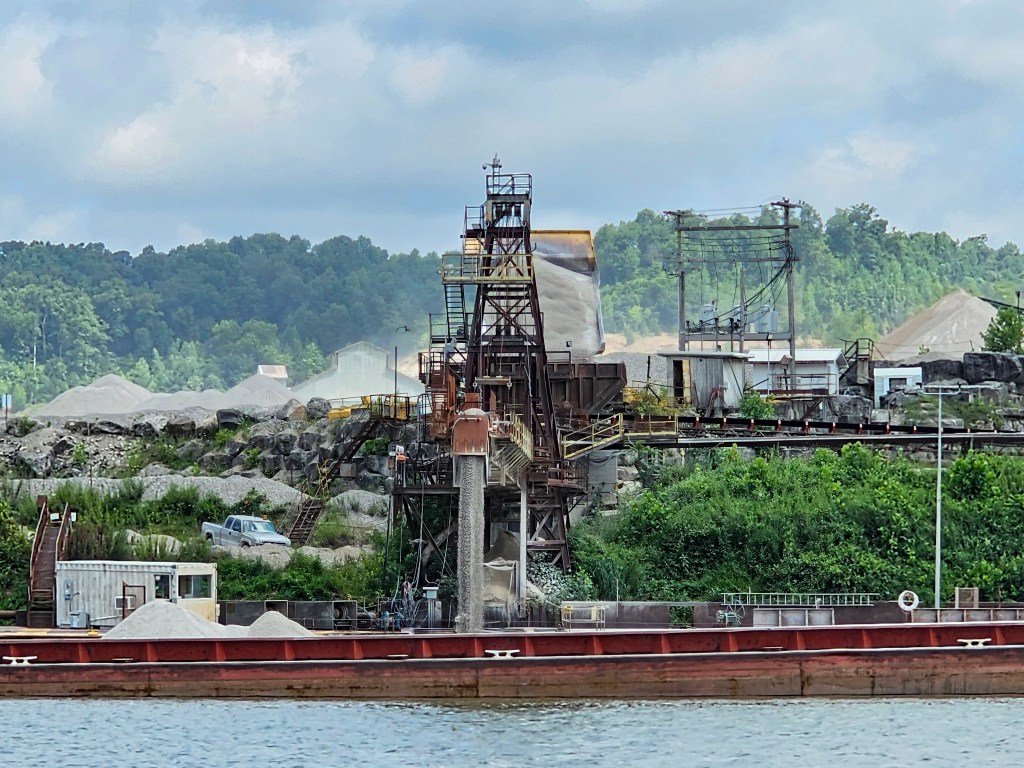
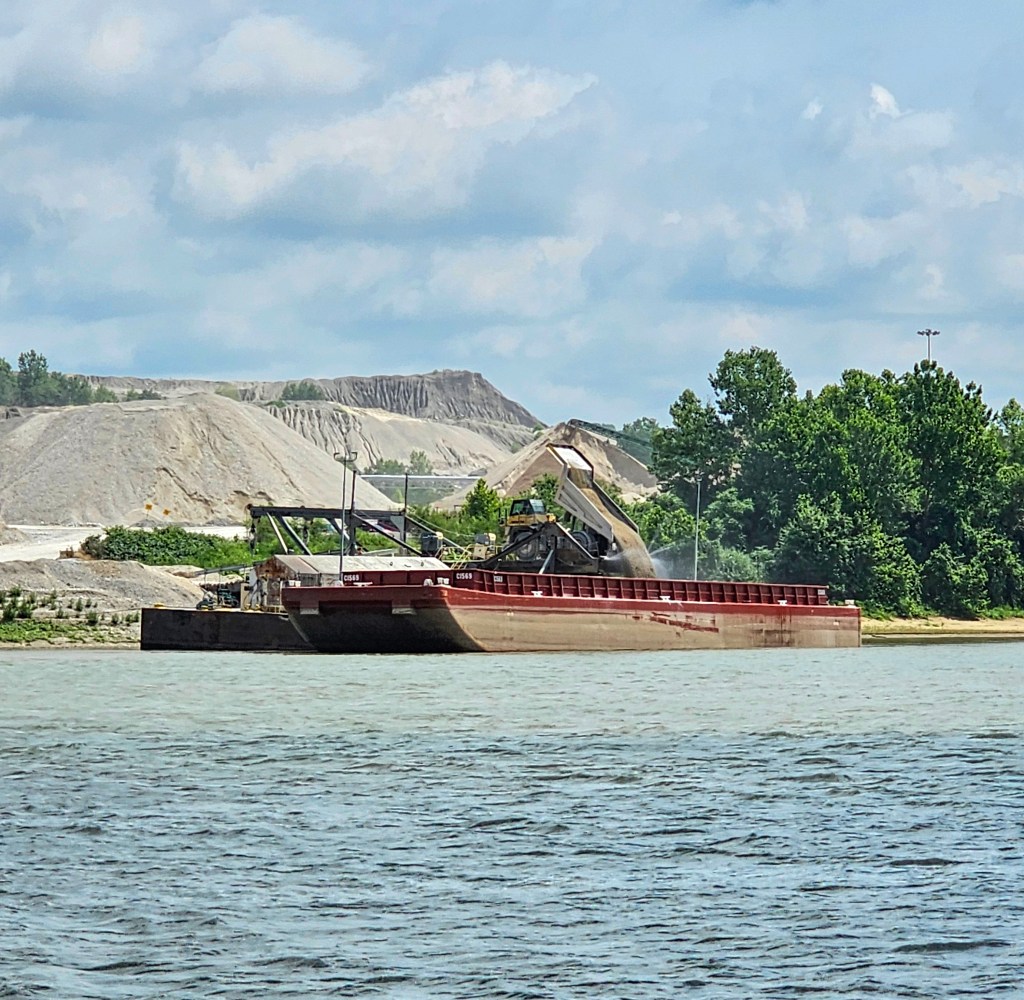
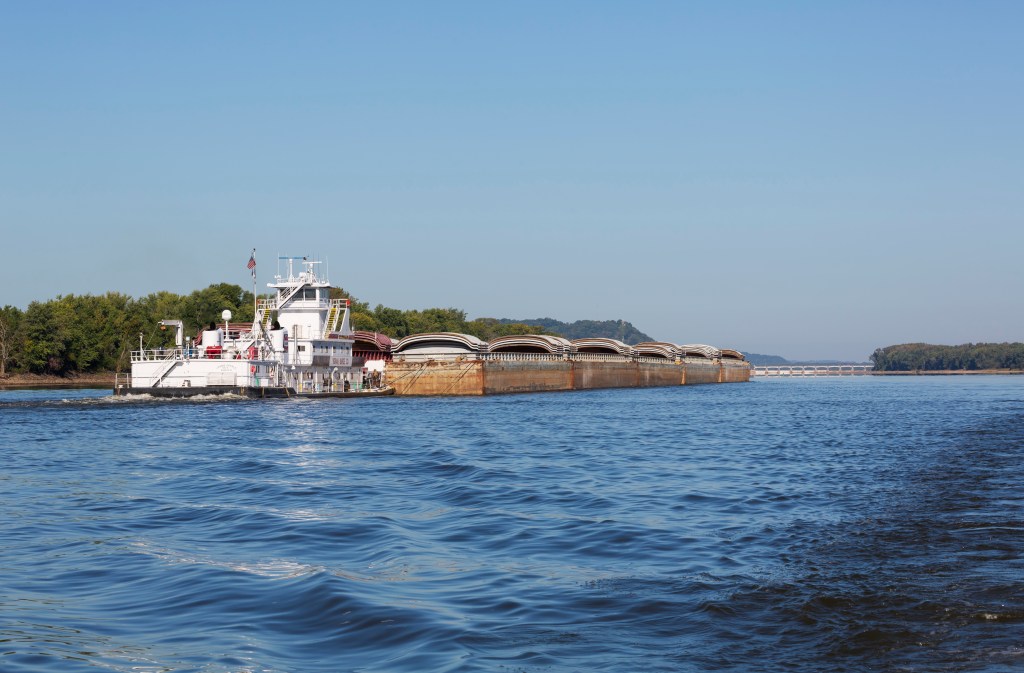
At one point we passed a huge quarry, Mulzer Crushed Stone, at Charleston, Indiana. Crushed limestone, sand, and gravel is used in construction projects, including aggregate for highways and commercial and residential construction. We were fascinated, watching enormous dump trucks filling waiting barges. In one area the trucks backed up and tipped the load directly into the barge. At another location, the stone was tipped into a hopper, and from then carried on a conveyor and poured into the barge. As soon as each truck was empty and drove off, another full one took its place. Looked at on google earth, the quarry is an enormous scar on the landscape, and there are an amazing number of quarries alongside most of the big rivers in this industrial heartland. In addition to road construction, aggregate is also used for making cement, lime, and for agriculture. Wikipedia tells us that concrete is the most widely used material in existence, and second only to water as the planet’s most consumed resource. If the cement industry was a country, it would be the third largest carbon dioxide emitter on earth, behind China and USA. Concrete and cement require huge amounts of power to manufacture. In many cases on our travels, we see an entire power plant next door to a cement plant. Perhaps those who wish to put a stop to the use of fossil fuels need to learn a few lessons about what other aspects of human endeavour require power, not just home heating and running our personal vehicles.

Social commentary over, and back to the voyage, we passed the town of New Amsterdam, which claims the distinction of being the smallest town in the United States, with a recorded population of 1 in the 2000 census. It is possible that only one person responded to the survey, this being a part of the country that is not in favour of government oversight and interference. Smallest town makes a good story, but the reality is that there are, in fact, a surprising number of towns in the USA that are smaller than New Amsterdam with its more accurate current recorded population count of 13.
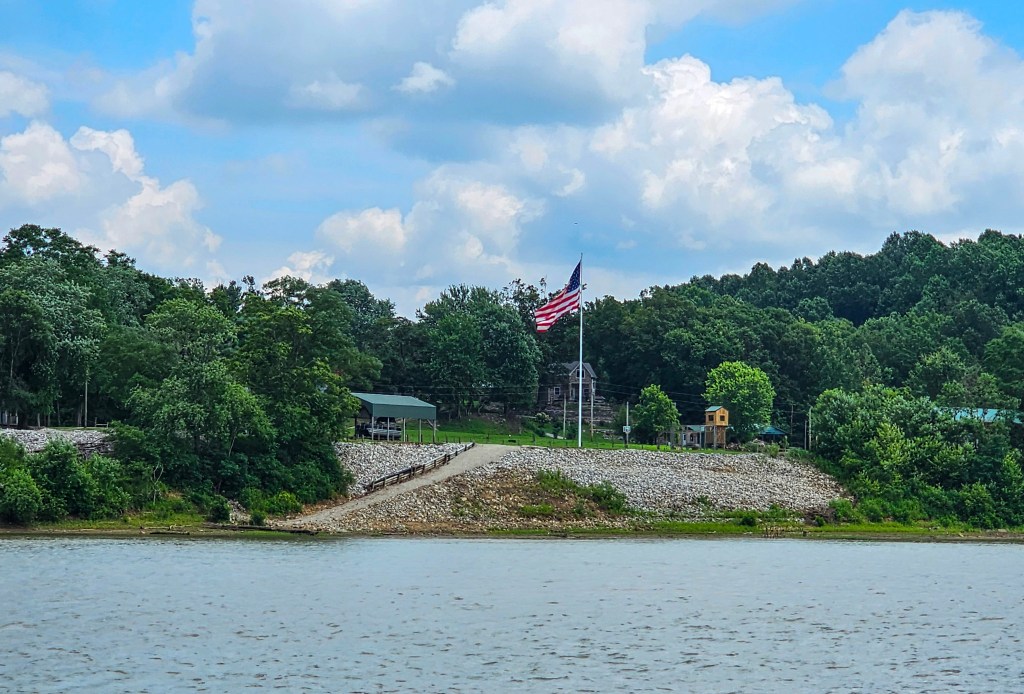
We planned to anchor in the Salt River at West Point, Kentucky, but again there was debris and no current in the river to keep us aligned. It is possible to set out a second anchor, but that would be quite a bit of trouble, and it was much easier to backtrack a mile and again anchor in the river, on the Indiana side this time. We were across from the Fort Knox Military Reserve, and yes, the Reserve is adjacent to the United States Bullion Depository, which houses a large portion of the United States’ gold reserves. We were finally set by 6pm, but after starting at 7:30am, it had been a very long day.

















 The Voyages of Nine Lives