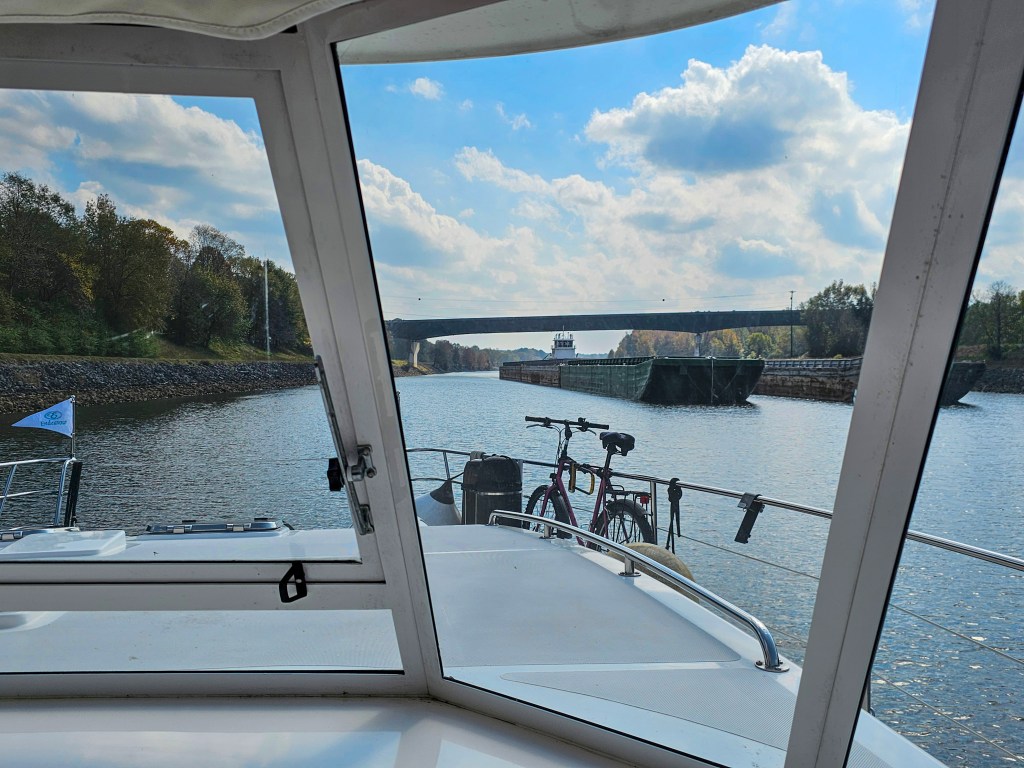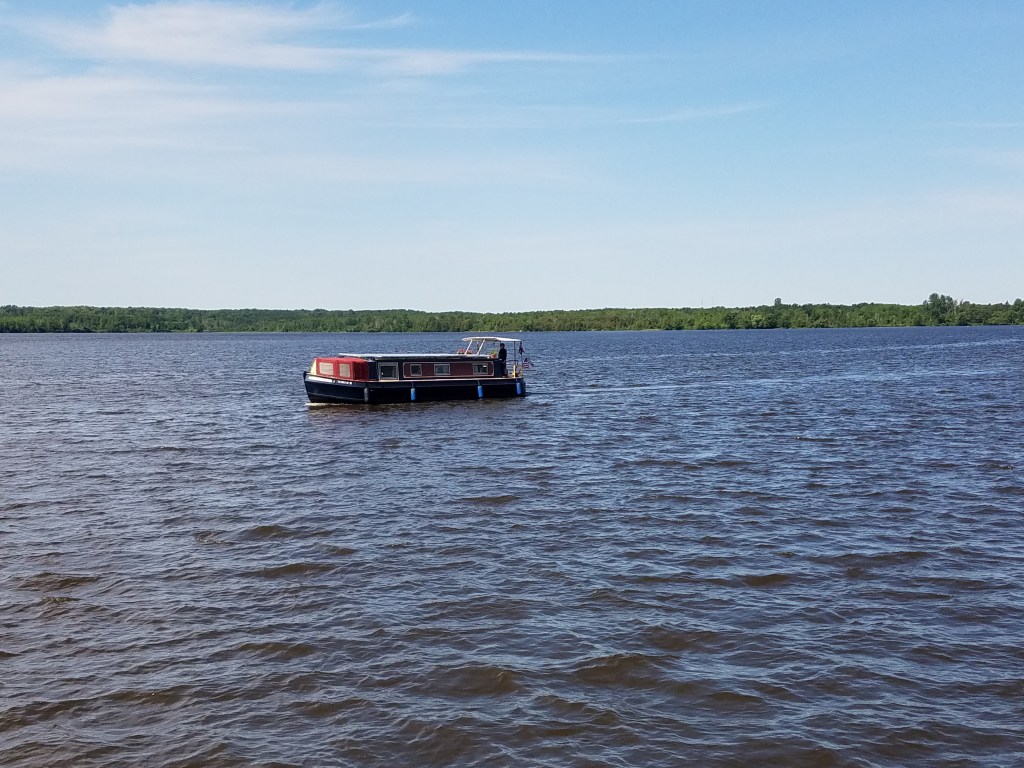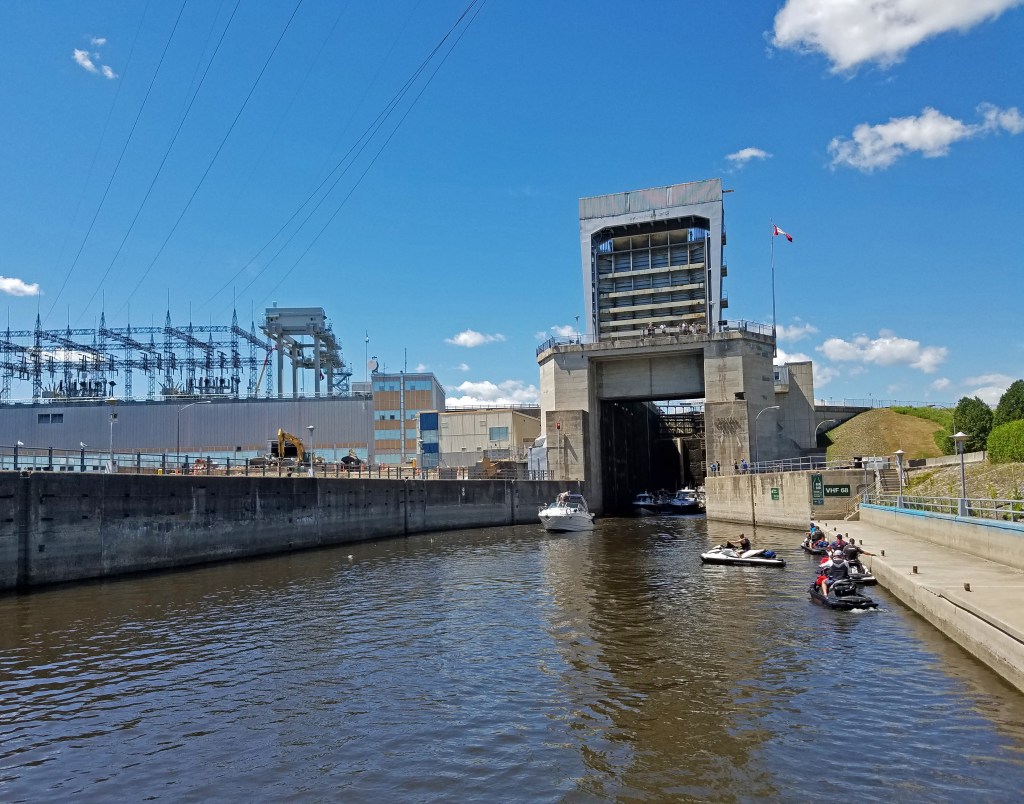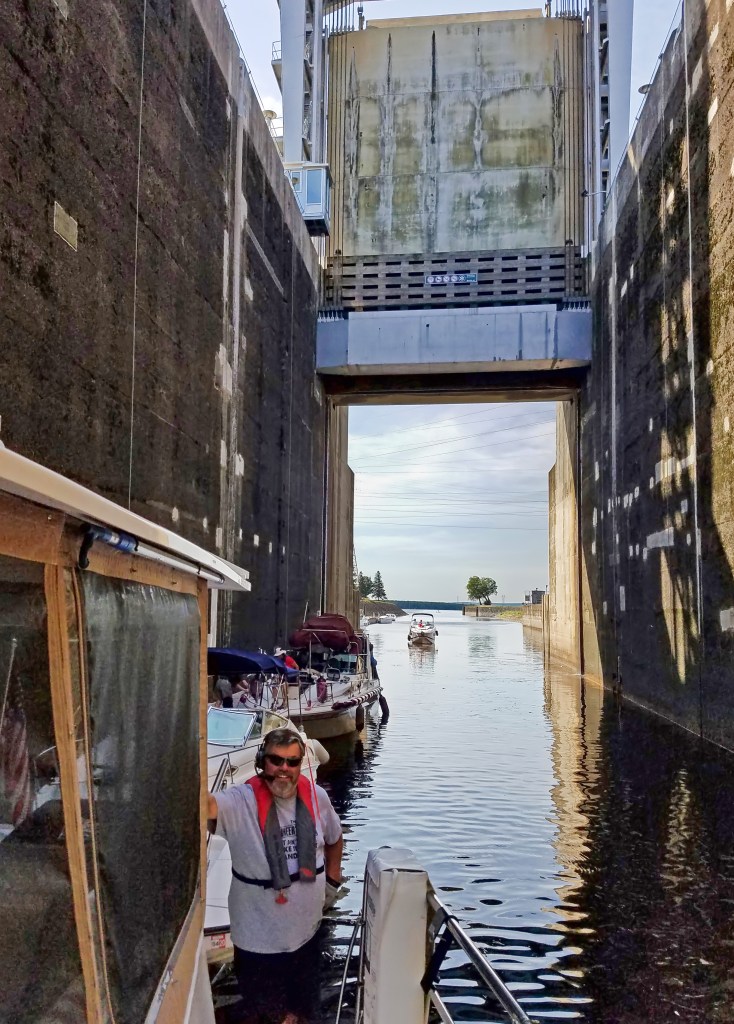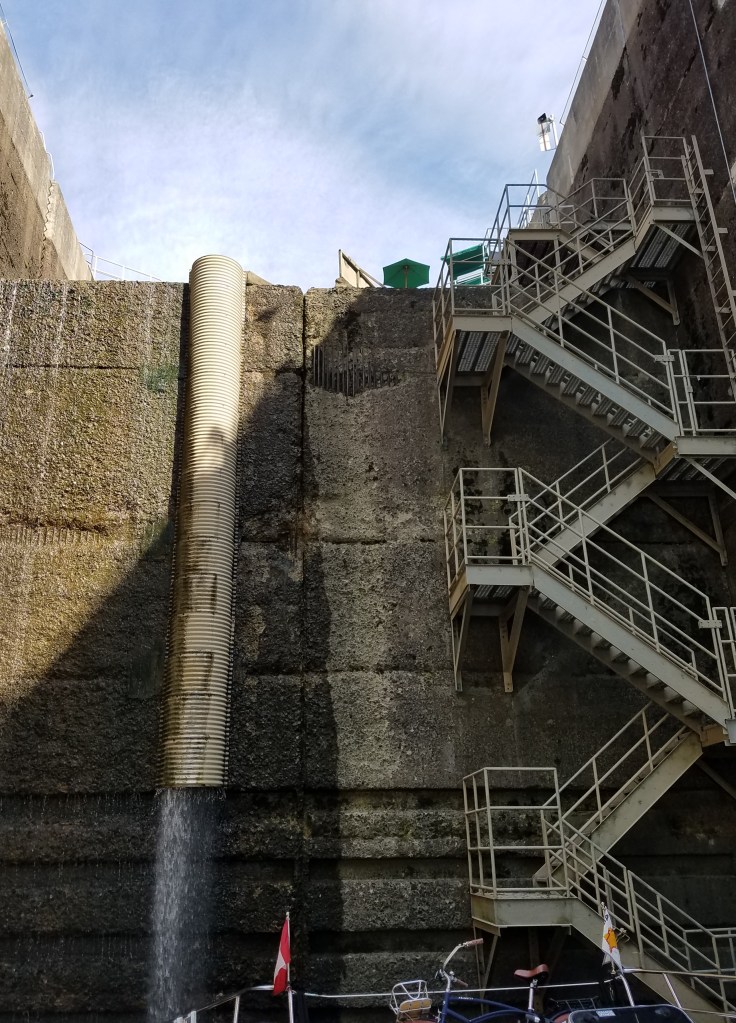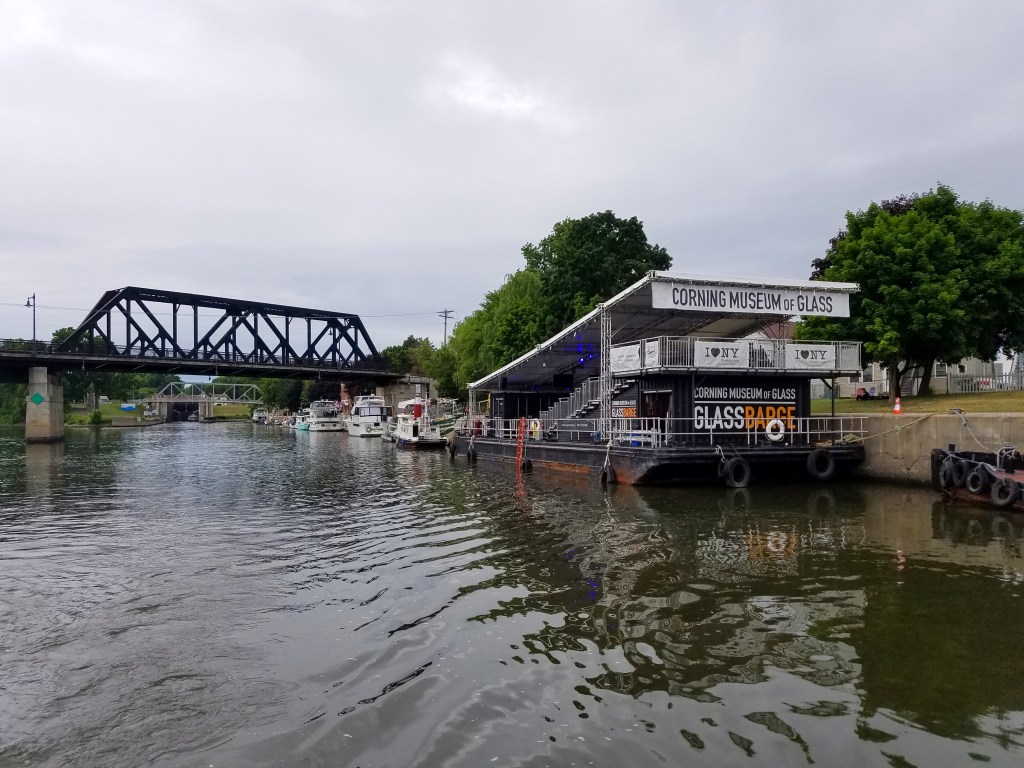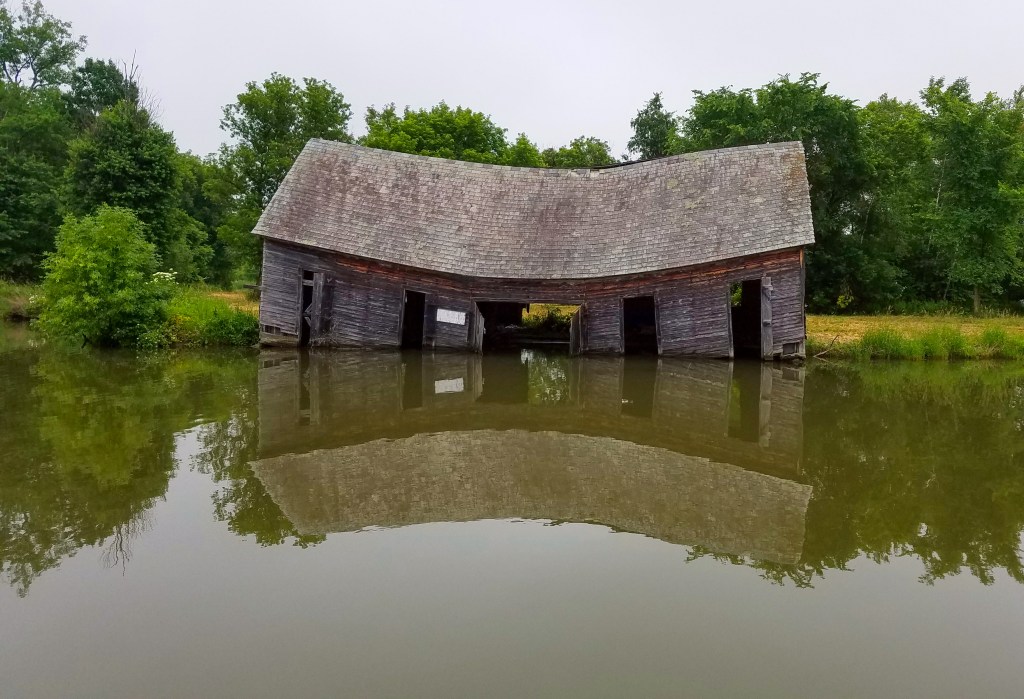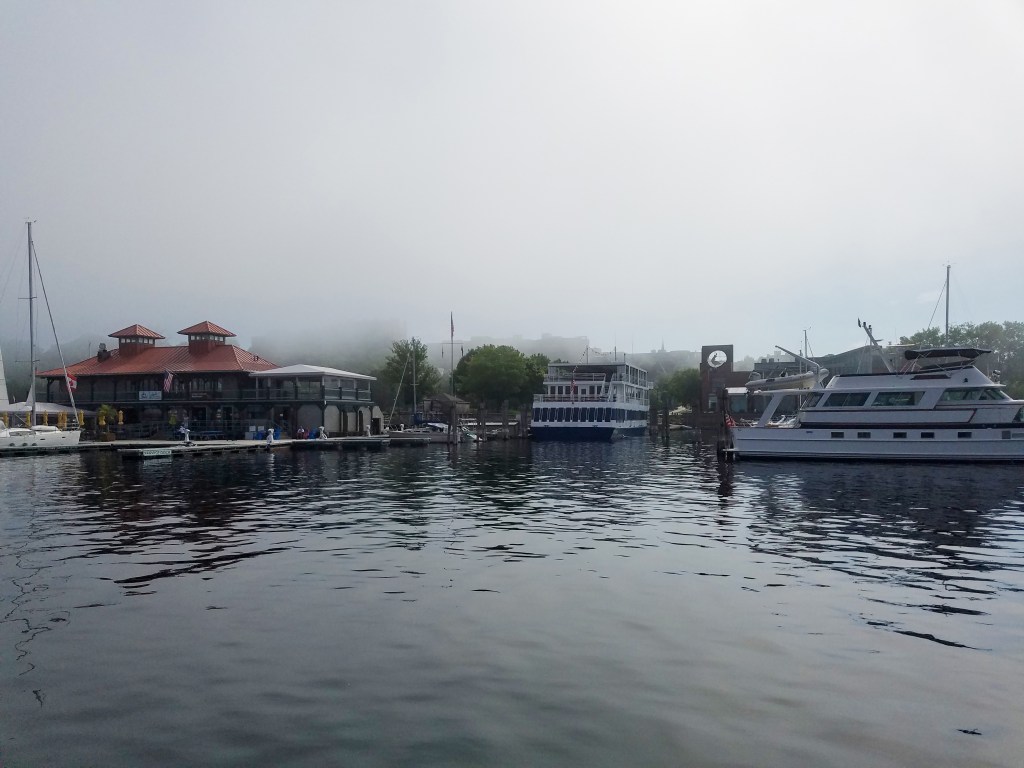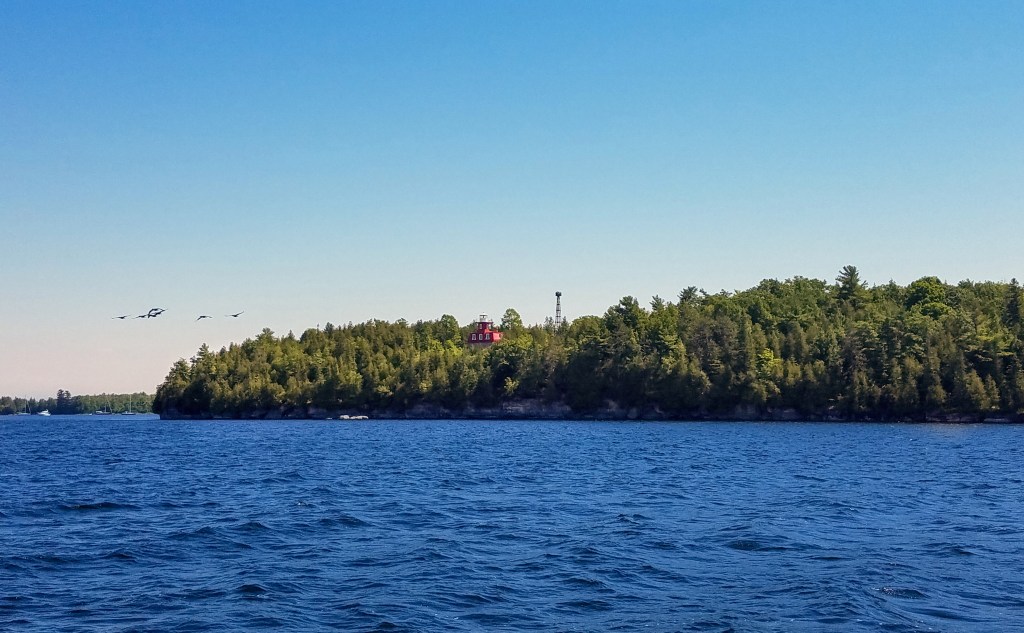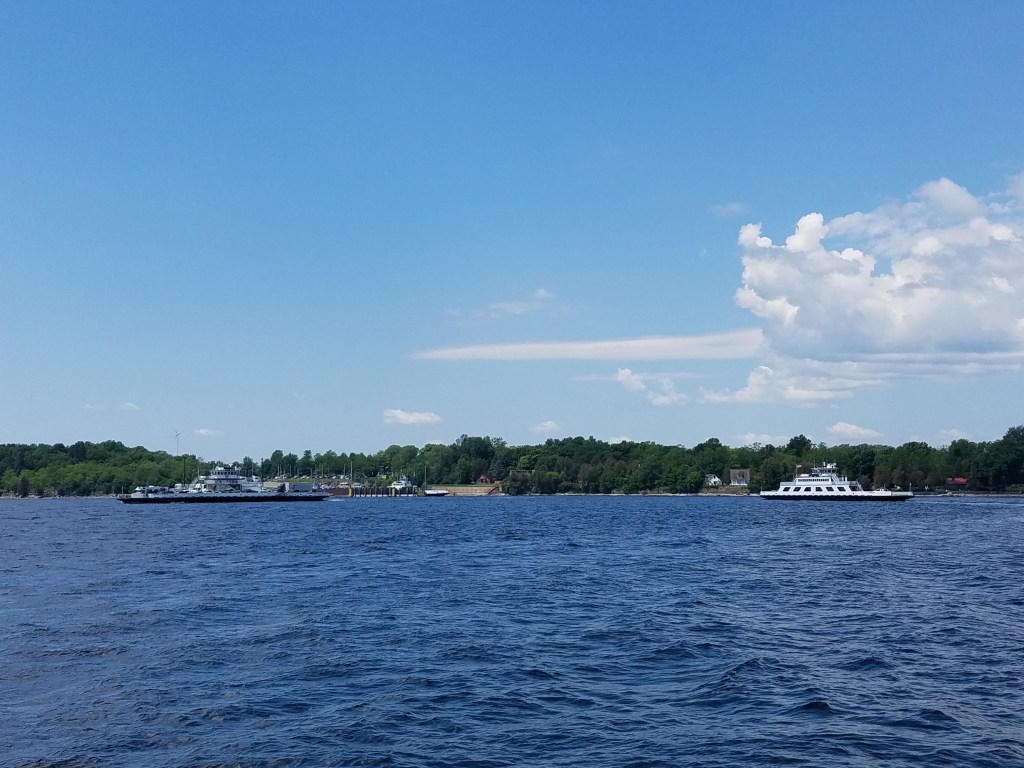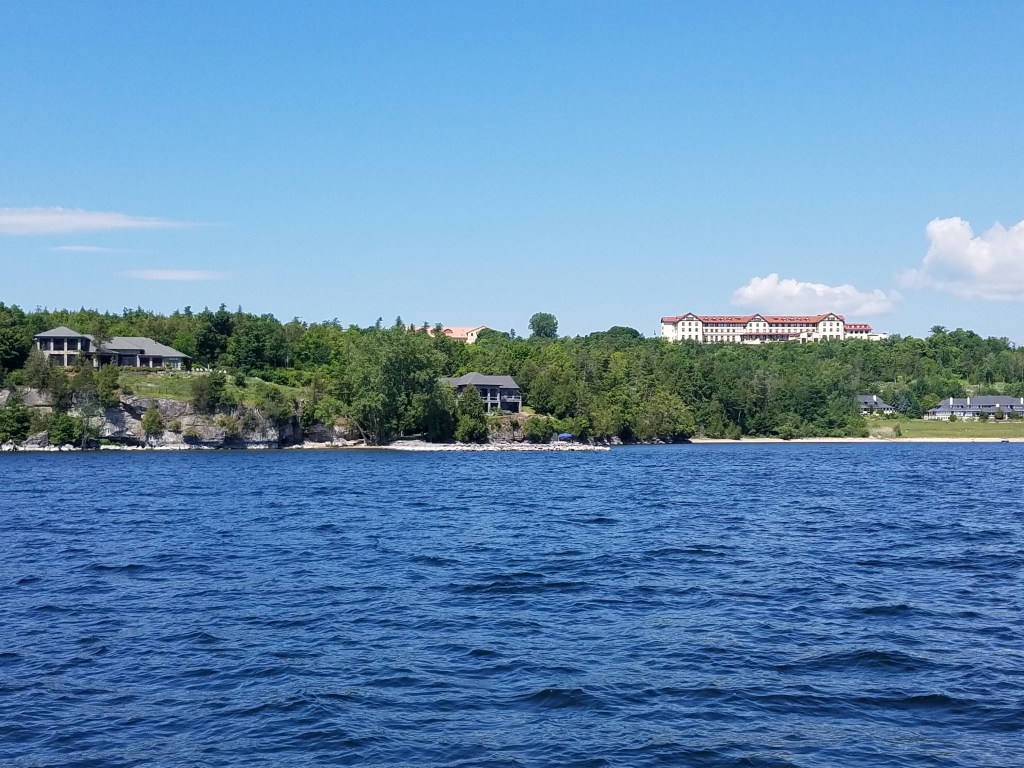
October 16th to November 2nd, 2024: Scottsboro to Columbus

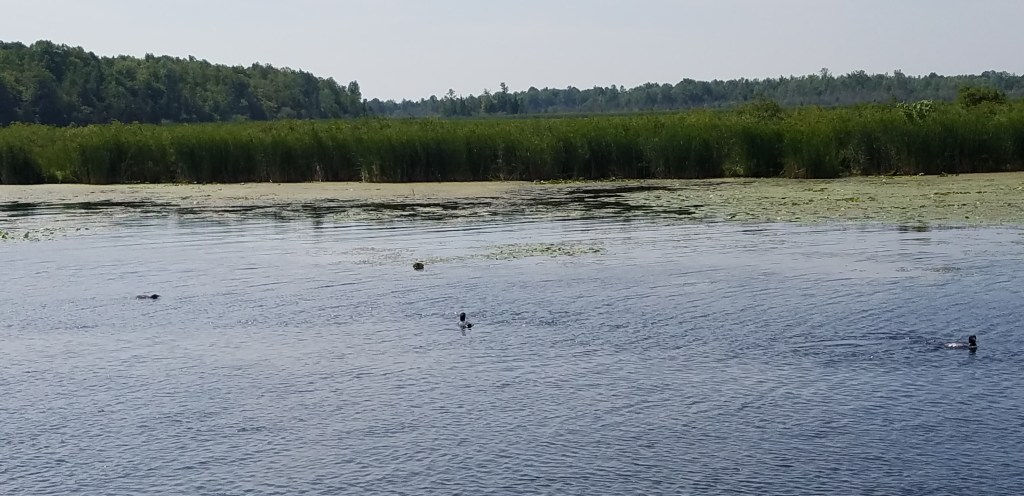
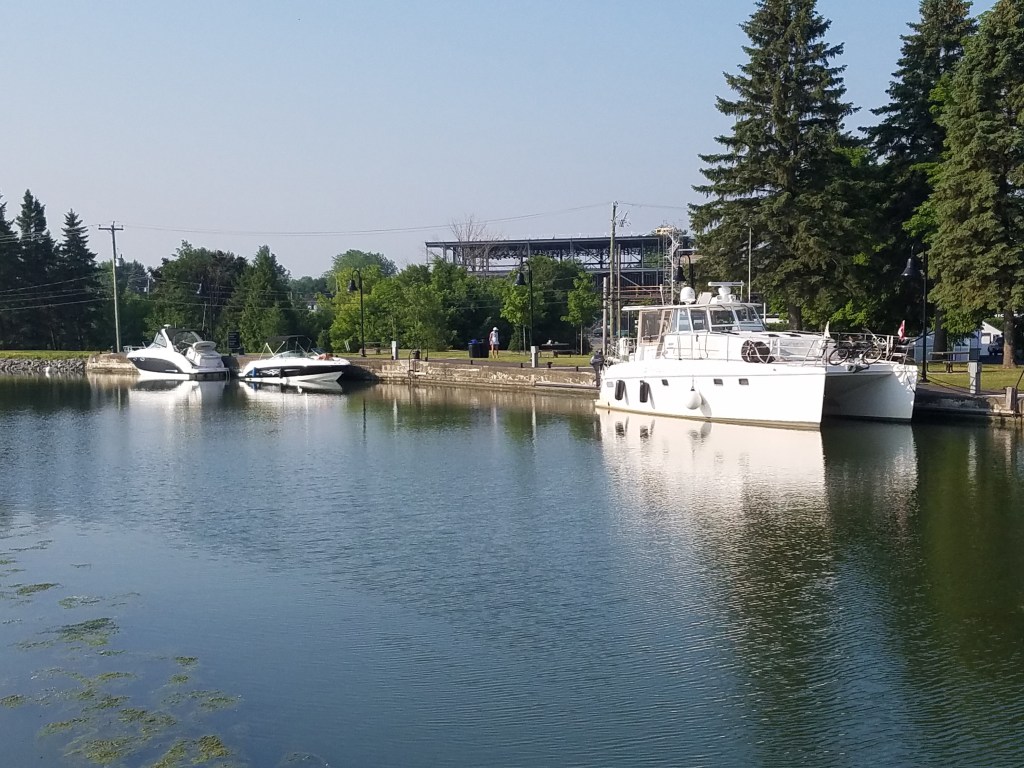
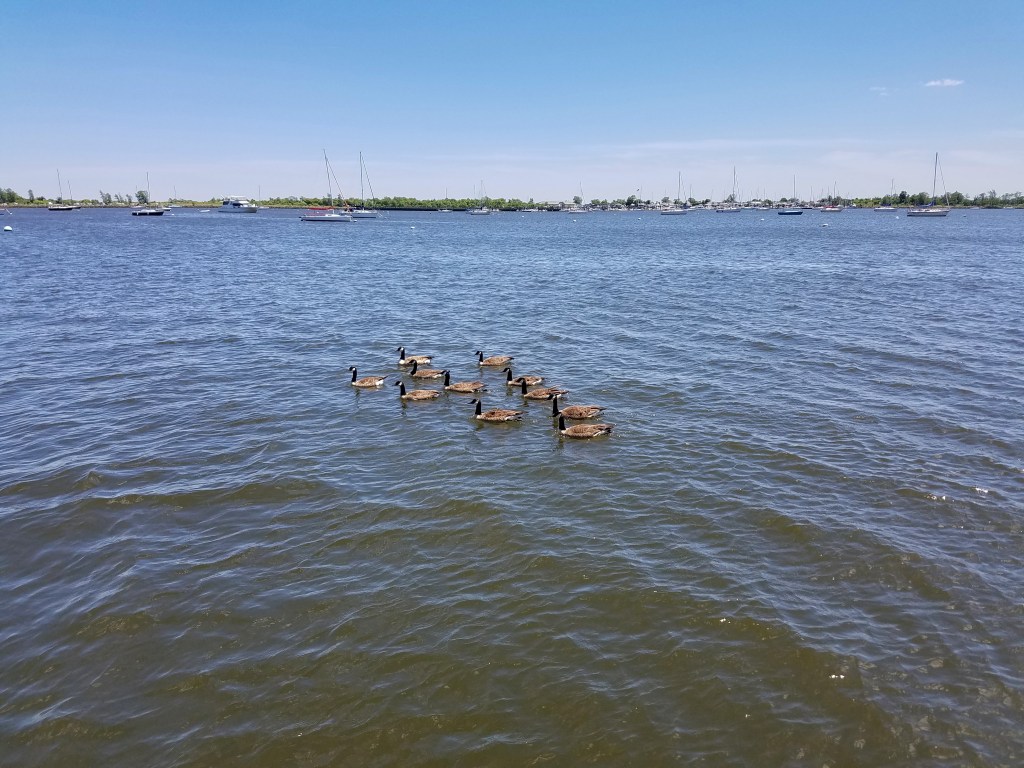
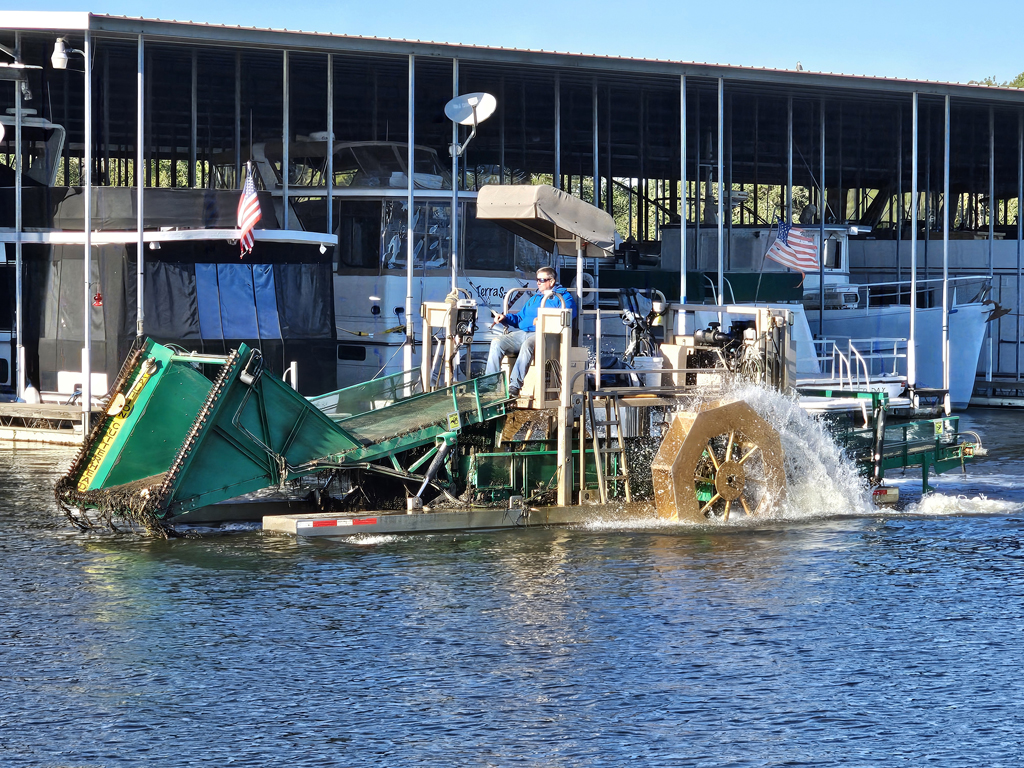
Our destination on October 16th was Goose Pond Colony Marina, near Scottsboro, Alabama. This marina is part of a large golf resort.  The entrance channel is narrow, but well-marked, and with lots of shallow areas there were interesting birds to be seen as we approached.  The grass is so prolific that the marina has a special machine to keep clearing the channel, and it goes out every day.  Our entrance was a matter of trust, because the grass fools the depth sounder and it suggests that we are about to run aground.  There were several other Loopers there, including some that we had already met.  Later that afternoon, Legacy, a smart Back Cove arrived on the other side of our slip.  We found out when they introduced themselves that they were just 8 hours into the Loop.  Unusually, the lady will be aboard one week in four, and for the rest of the time Don will travel solo.
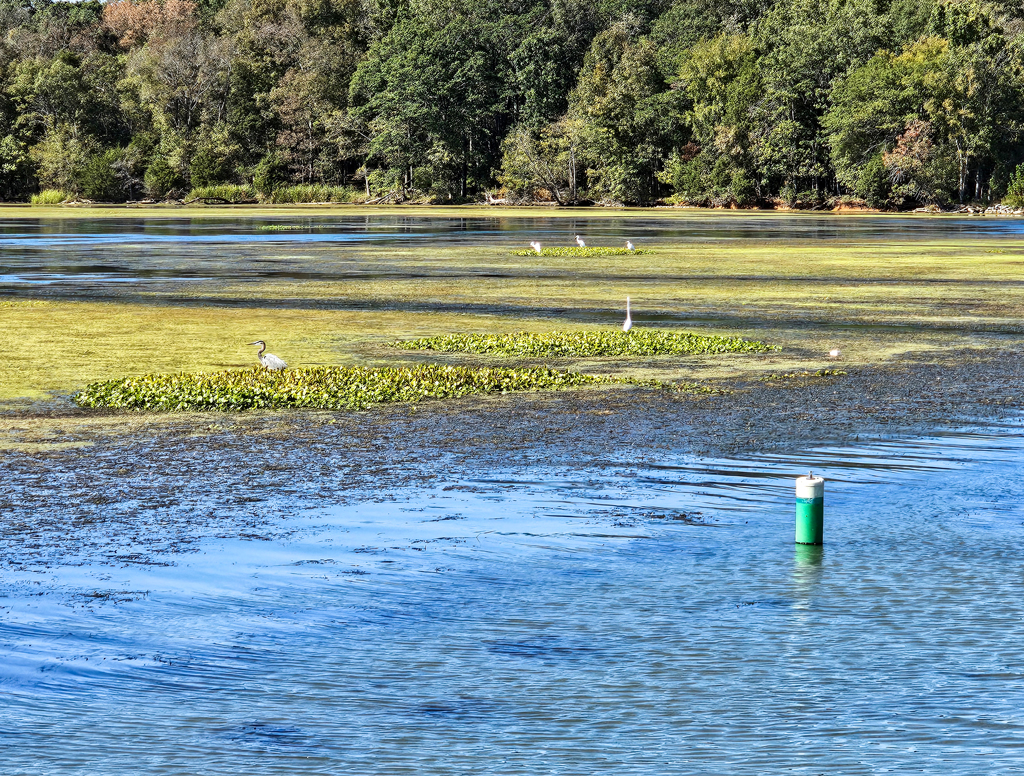
Wildlife in the shallows at the entrance to Goose Pond Marina
The grass cutter goes out every day to keep the channels clear at Goose Pond

We were invited to join two couples who we had met earlier in Chattanooga for dinner at the onsite restaurant.  It was nice to sit and chat and get to know them.  It did remind us though, that while it can be rewarding, the idea of “buddy boating”, that is, travelling with another boat all the time, does make for a less inclusive experience than enjoying meeting all the diverse boaters if you follow your own agenda.  By making your own plans, you find that you are leapfrogging some of the Loopers you have already met, and continue meeting new friends as you go along.  The food at the restaurant was acceptable, but no need to return.

We spent a quiet day at Goose Pond.  It was a good time to do some laundry and for me to finish and publish the second issue of the blog.
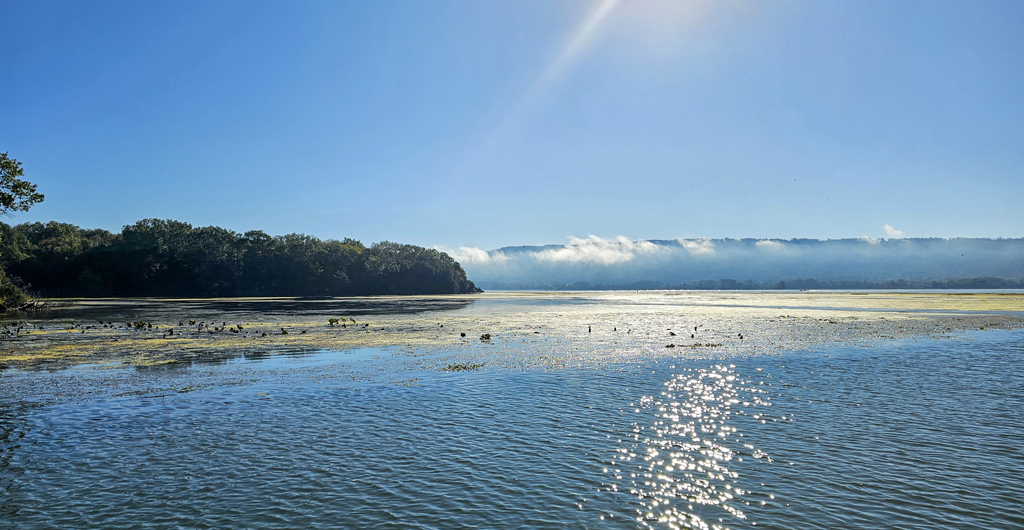
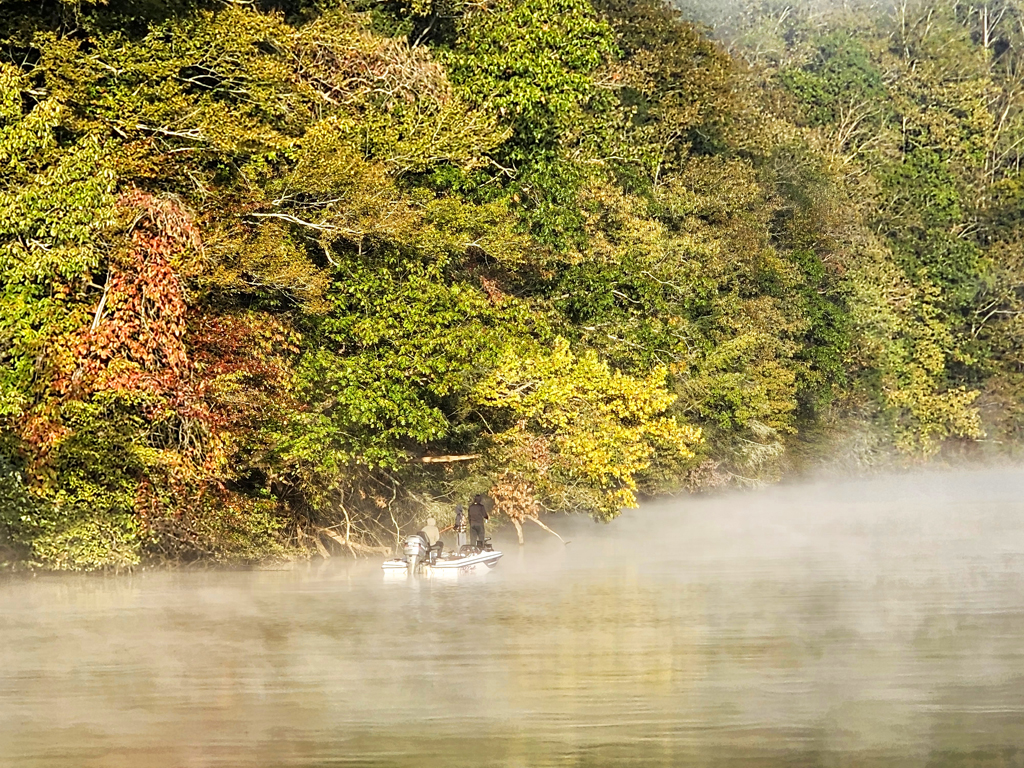
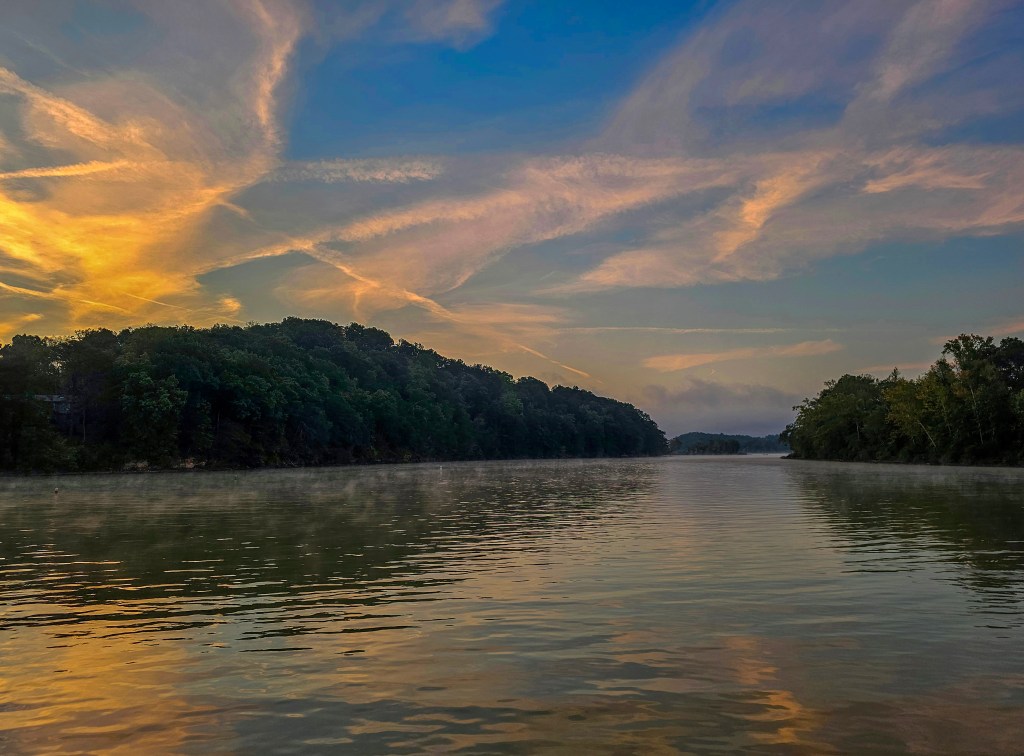
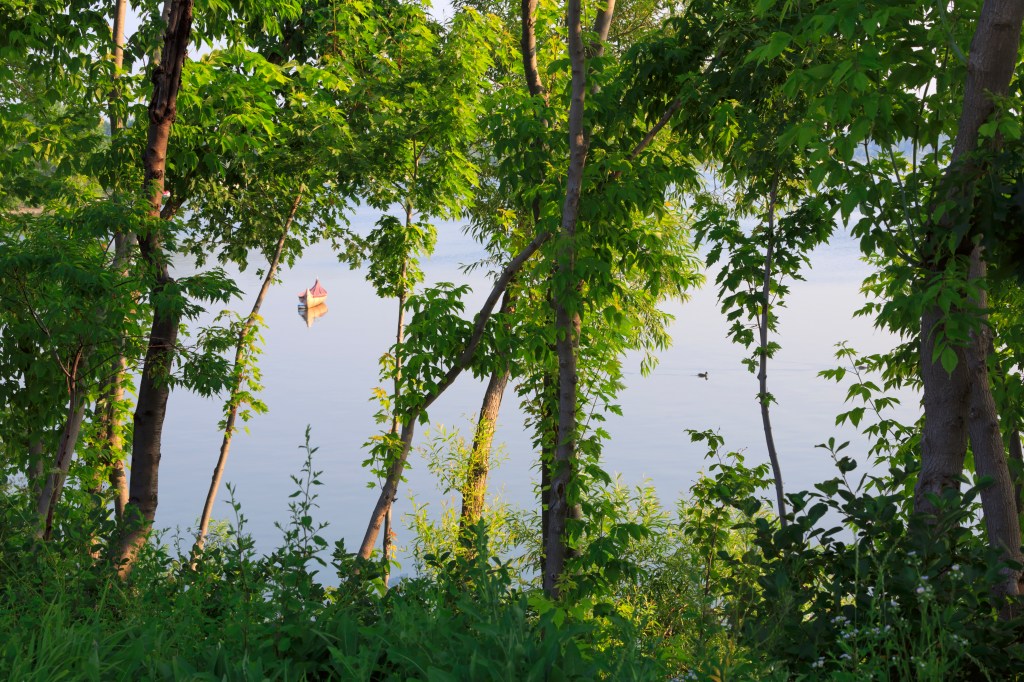
Morning mist at Goose Pond

I tried a new recipe for Chicken Tikka Masala.  It was tasty, but we think that in future the recipe might lend itself to using lamb and doing it in the slow cooker.  We enjoy Indian food, and if I can collect western cooking-style recipes we can put together an Indian meal without using the foil packets of sauces.  One is never entirely sure (and we probably don’t want to know) just how many interesting chemical concoctions are in those packages that keep them “fresh” for literally years.  Better to make the dishes from scratch.
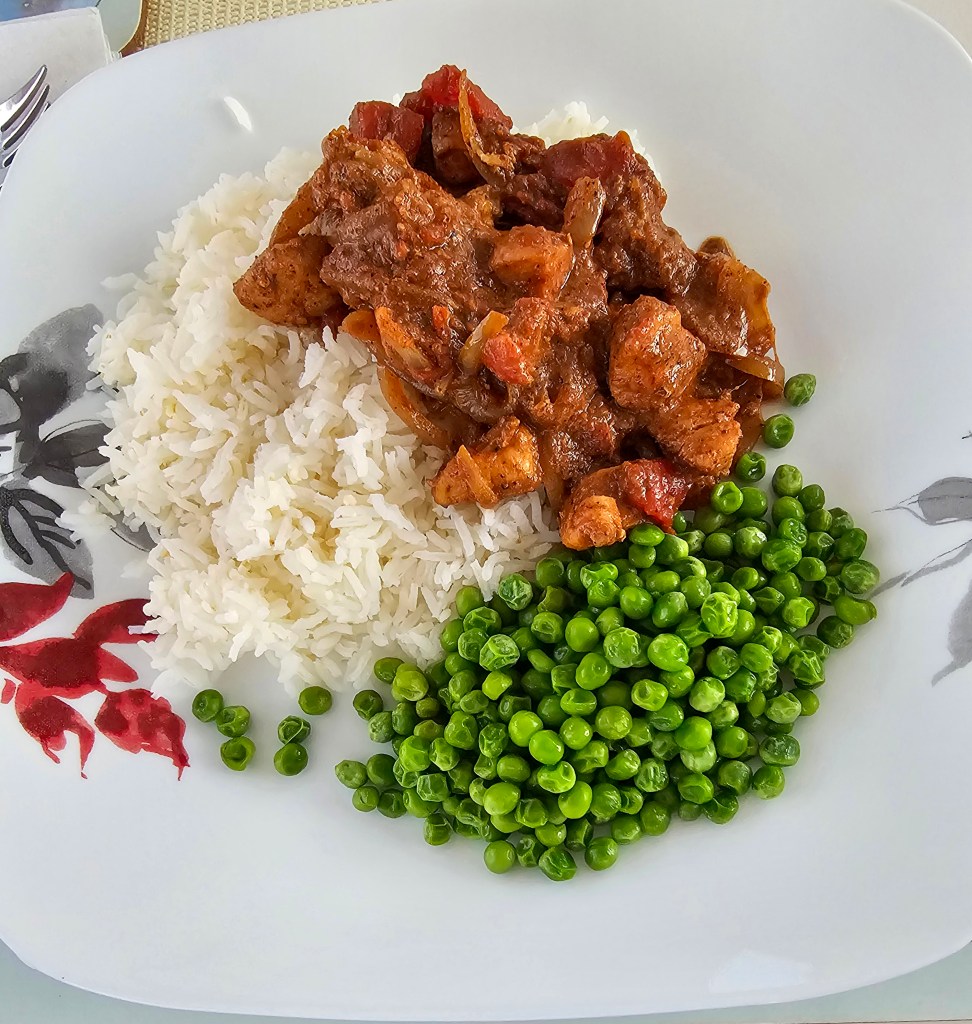
Chicken Tikka Masala

After our relaxing pause at Goose Pond, we headed downriver to Ditto Landing, arriving by early afternoon and happy to be greeted by our friends Cherie and Pete on Spring Fling.  They are segment Loopers like us.  Although Ditto Landing has no practical access on foot or by bike to nearby Huntsville, Cherie and Pete had a rental car and invited us to join them for dinner at a Japanese restaurant.  The food was excellent, and Dick even ordered, and enjoyed, some sushi.  My hibachi shrimp and chicken were also delicious.
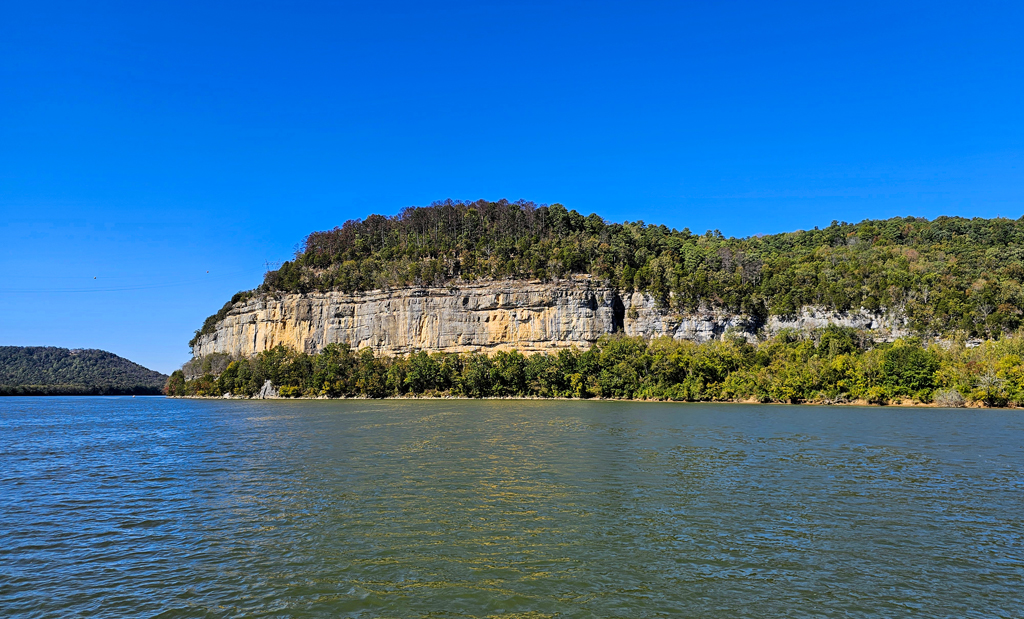
Painted Bluff
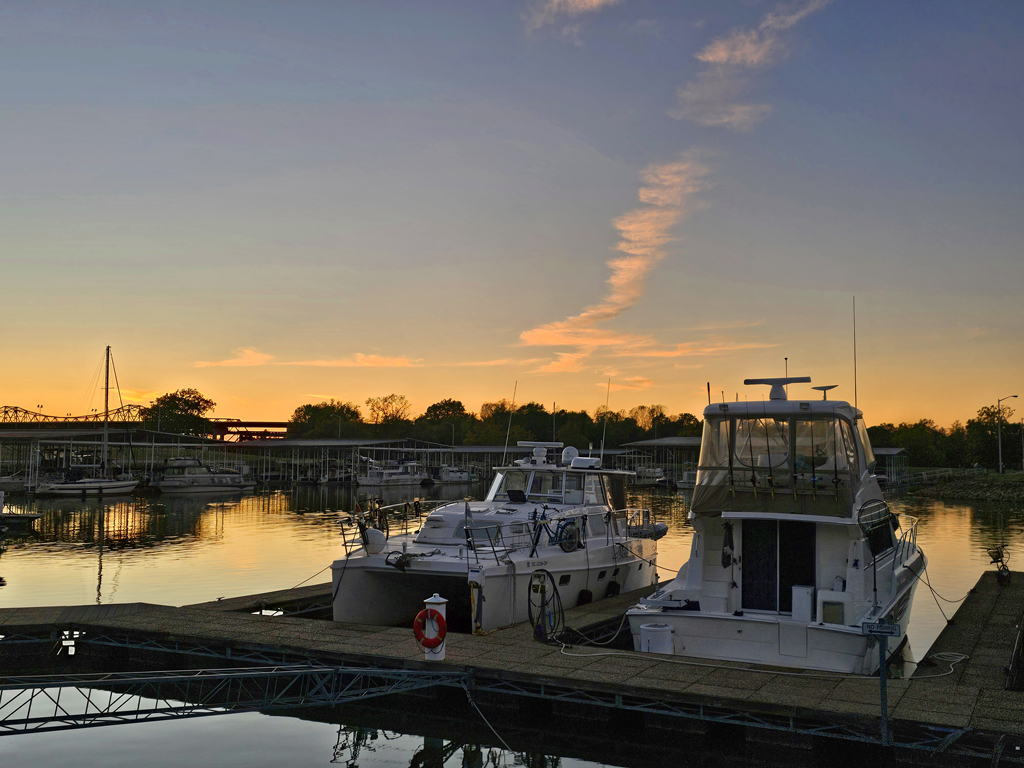
Sunset at Ditto Landing

First thing next morning we began the big cleaning job, so Nine Lives would be spic and span for the boat crawl at Rendezvous.  As I scrubbed my bathroom, it was obvious that no cleaning had been done before we got on board at Aqua Yacht.  We haven’t been charged, so I suppose we were not cheated.  Dick took advantage of being in a slip, thus having access to both sides of the hull, to get some of the outside cleaning done.  It was nearly noon before we left, but already Nine Lives was starting to look spiffy.

Cleaning the hull at Ditto Landing

Behind Lehman’s Bluff is Redstone Arsenal.  The facility was established during WWII as a base for chemical manufacturing, and was then used as a research base for rockets and ballistic missiles.  Today it is still the centre for the Army’s missile programs for testing and development, and there are now over 75 tenant agencies, including NASA’s Marshall Space Flight Center.  The government and contractor workforce averages 35,000 to 40,000 personnel daily.

Lehman’s Bluff

We passed under the I-65 Bridge.  This Interstate connects Chicago, Indianapolis, Louisville, Nashville, Birmingham, Montgomery, and Mobile.  It is quite something to think that we have visited or will soon stop at almost all of those cities as we go through this western half of our Great Loop.
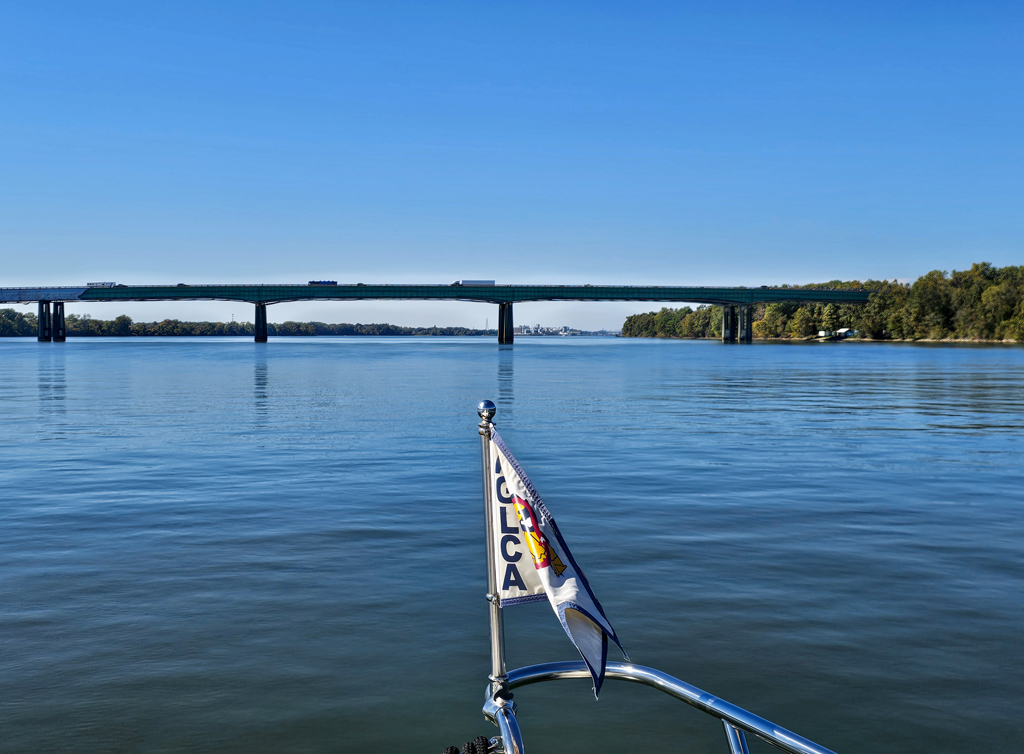
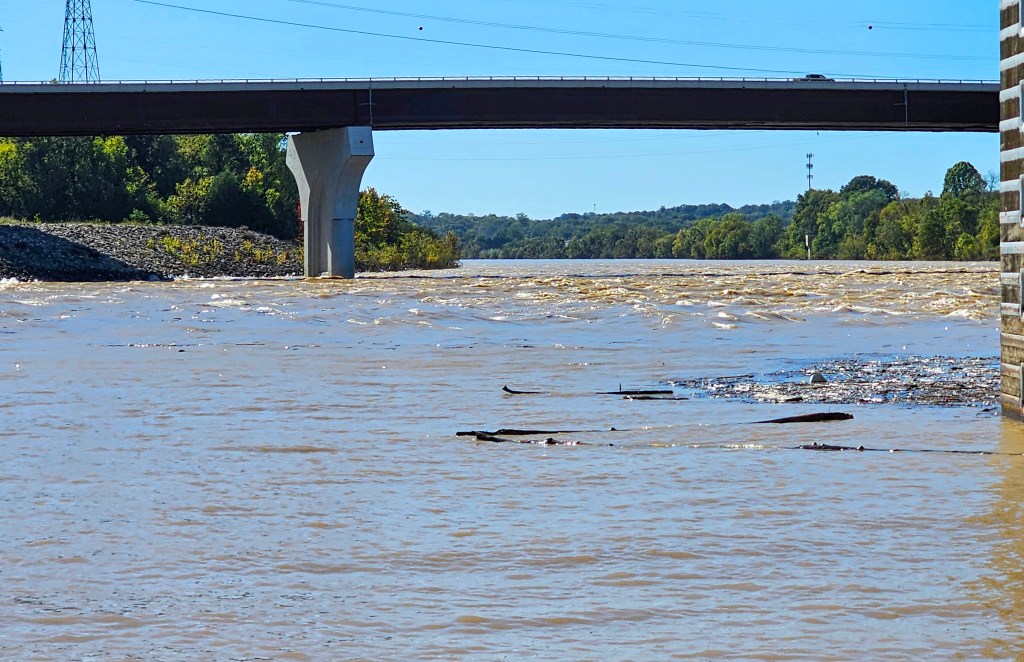
I-65 Bridge over the Tennessee River

Construction of the bridge was halted for a few months so that nesting birds in that part of the Wheeler National Wildlife Reserve would not be disturbed.  The NWR was created in 1938, after TWA (Tennessee Valley Authority) flooded the Tennessee River and created Wheeler Lake.  Backwaters were pumped dry in spring, thus eliminating mosquitoes.  When the water was returned in the fall, migratory birds were attracted to the abundant grasses and seed-bearing plants that had grown up.  Thousands of Sand Hill Cranes now overwinter in the refuge, and a few of the highly endangered Whooping Cranes have been seen in the last ten years.  We were too far from the grasslands to see cranes, but we were happy to see a Bald Eagle high in a tree.
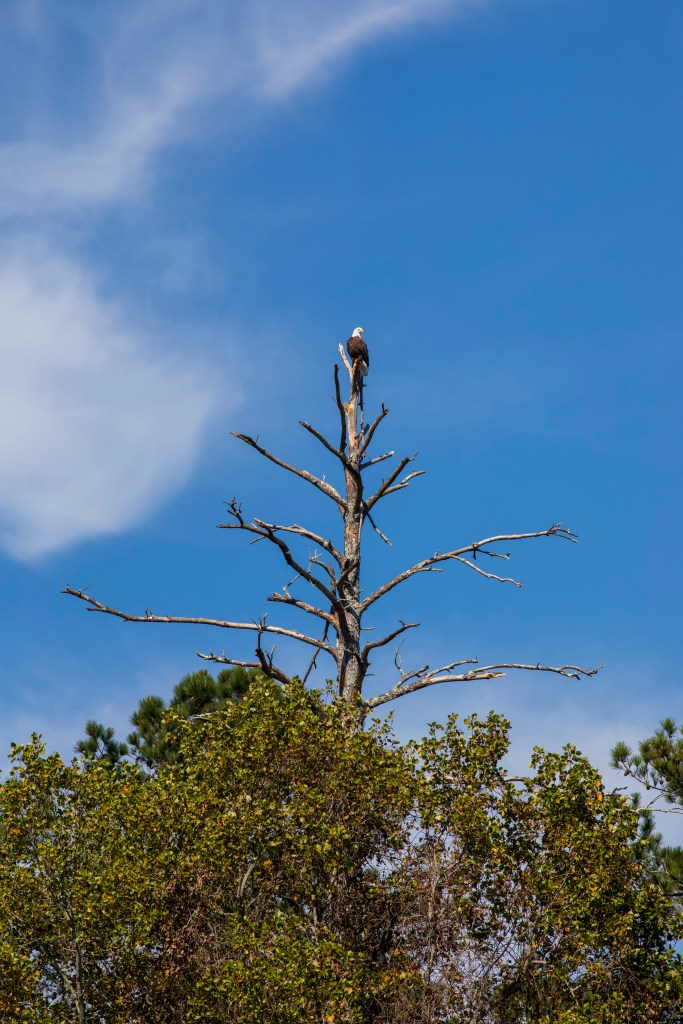
Bald Eagle in Wheeler National Wildlife Refuge
A tow with a portable ferry platform waiting at the bank for a large truck
Guntersville Lake

We were tied up in the marina at Decatur by 2:30. It is a strange marina, mainly boat storage.  Dick spoke to the owner in mid-October, and he made a reservation, but would not take a credit card number.  There is nobody in the office on weekends, and the on-site restaurant is currently closed for renovations, so there was no way to pay.  We had a free dock with power and water in a very calm location.

We got down to serious boat cleaning.  More than one adult beverage was required when we were finished for the day!  We both hate cleaning.  My frustration was that arrangements had been made for the major cleaning, inside and out, to have been done before we got on board.  If it had been done, our job would have been only a touch-up.  Instead, we were dealing with a year’s worth of accumulated grime from the storage period.

There was a pretty sunset over the industrial skyline of Decatur.  We watched a fellow on the dock catch a large fish for his dinner, underneath the “No Fishing from the Dock” sign.
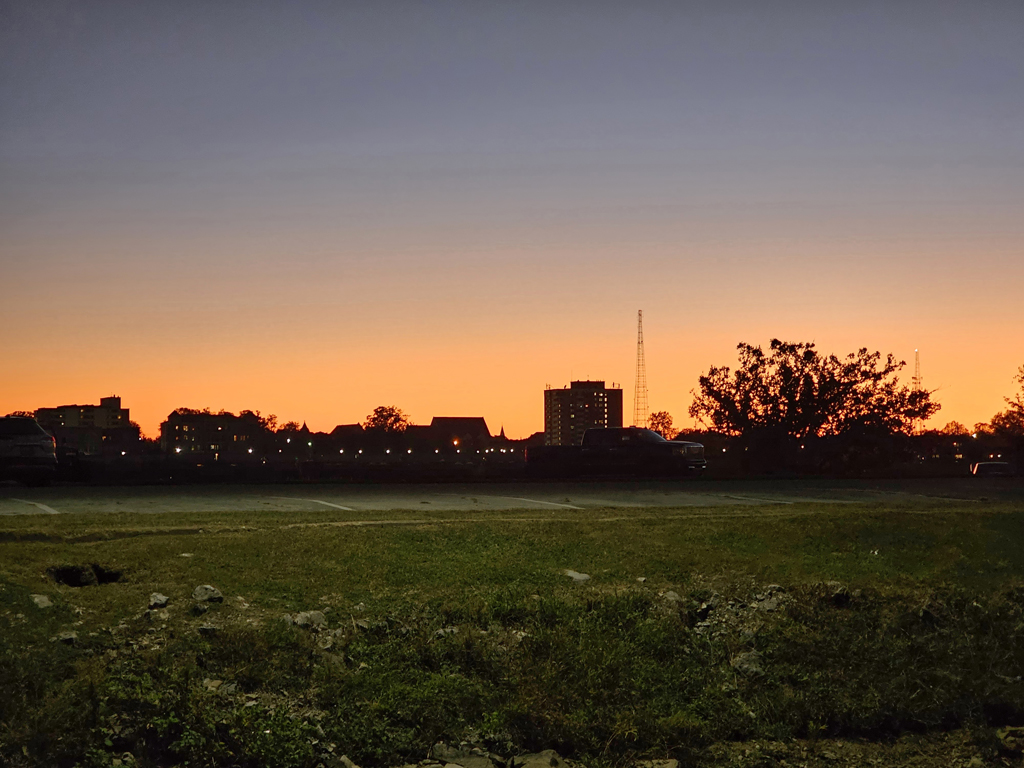
Decatur sunset

More cleaning in the morning before we set off. Nine Lives sparkled!

We waited 10 minutes for the Decatur Railway Bridge, as a long train of Amazon containers passed over.
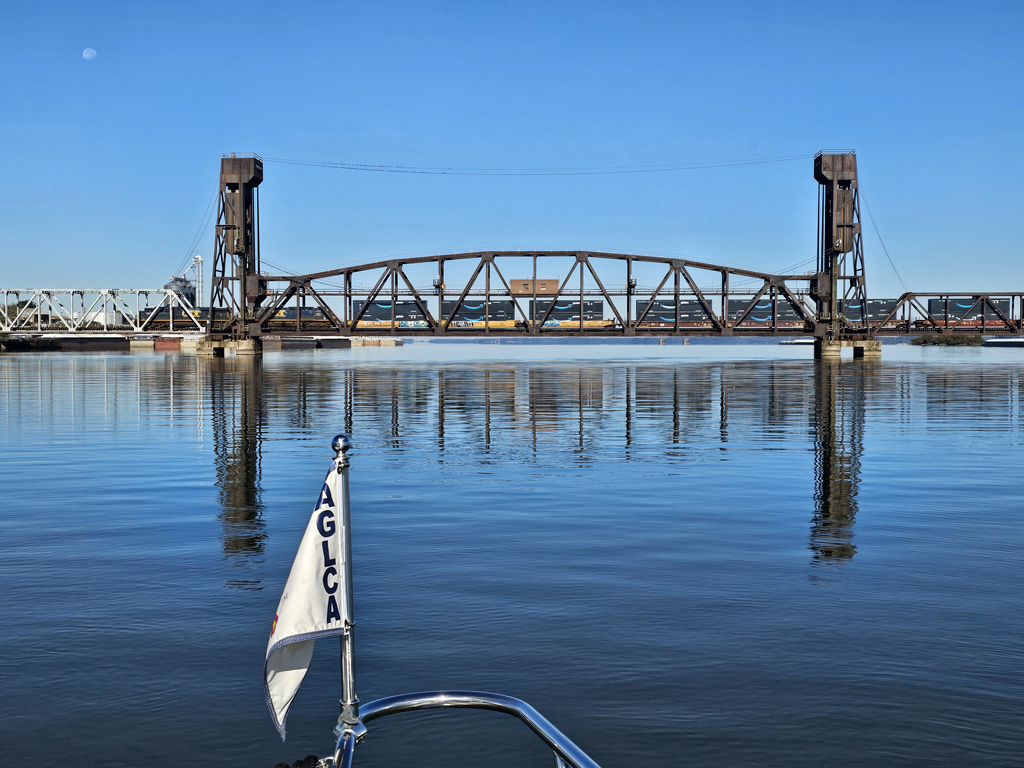
Decatur Railway Bridge with Amazon containers on a long freight train

We arrived at Joe Wheeler State Park by mid-afternoon.  After a pump out that we suspected (rightly) was inadequate, we went over to our assigned slip.  A fishing boat was diddling around exactly where we needed to be, so Dick sounded the horn.  Our horn is LOUD.  No effect.  Horn again, in fact twice more and me making “get out of the way” gestures before they finally figured it out.  As a result, we had a great deal of help with docking, having announced our imminent arrival so loudly.

After some final touches to the cleaning, I put together a spread for docktails.  We had invited up to 12, but between regrets, no-shows, and a couple we already knew were unlikely to be able to make it, we were glad that we also invited our dock neighbours, giving us 7 guests.  More would not have fitted into the cockpit, so just as well.

The first day of the Rendezvous was quite busy, mainly because in the afternoon, over the two-hour period of the boat crawl, we welcomed at least 50 people onto Nine Lives to look around.  Some visitors were still in the boat-shopping stage.  Some had their boat and were interested in storage, and what adaptations they might be able to make on their boats.  Many people were simply curious, having never been on a catamaran before, and they were amazed at how much usable space there is on board.
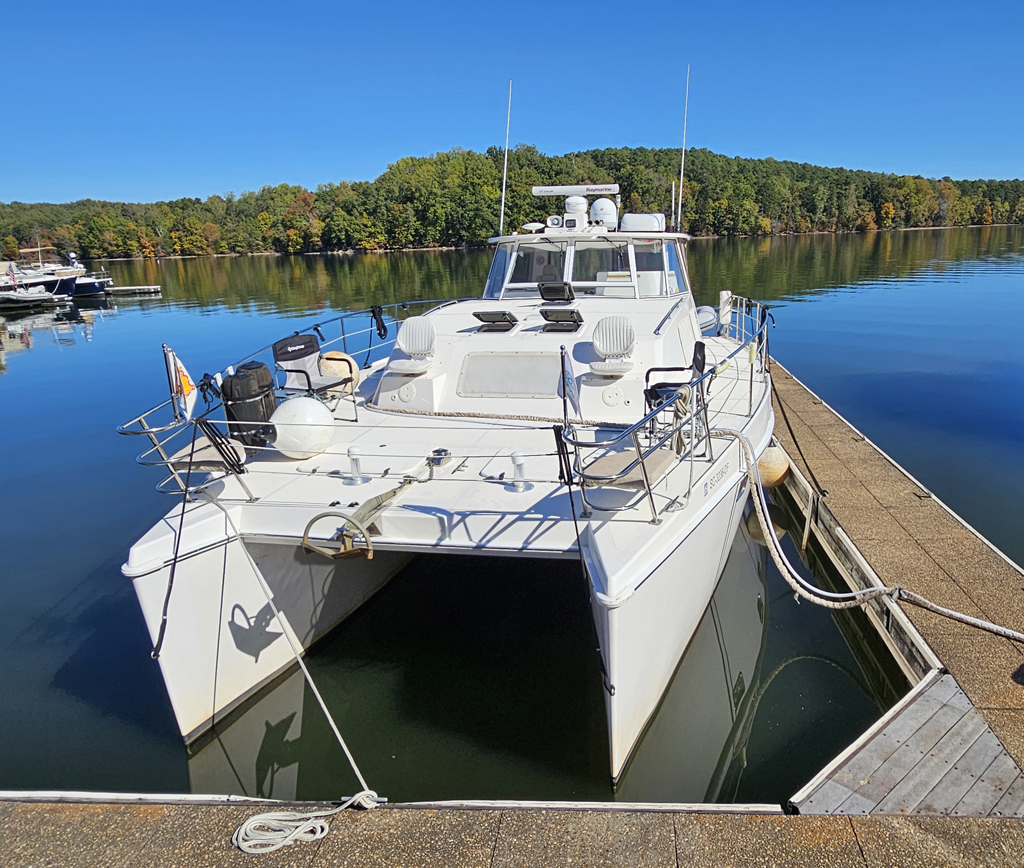
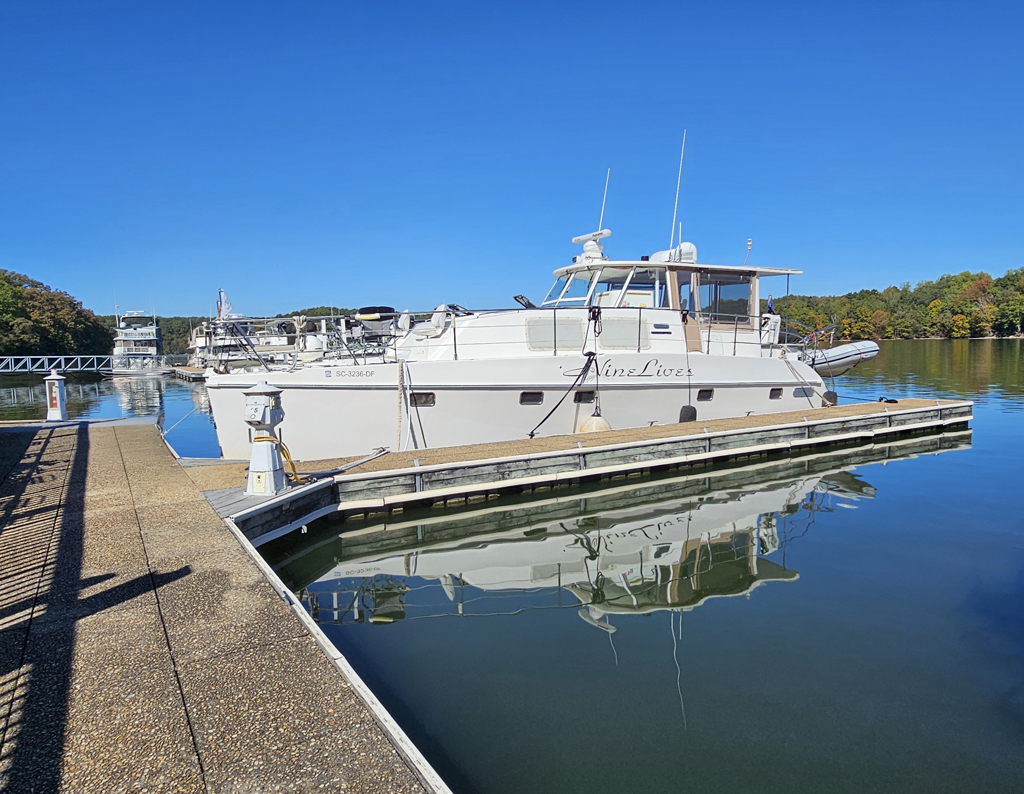
Nine Lives ready for visitors
Nine Lives at the dock at Joe Wheeler
Even the cockpit was sparkling clean

That evening, we enjoyed sitting with a table of planners and a couple who were just two weeks into their Loop for dinner.  After the meal, we, and a few others, were presented with nice engraved wooden cheeseboards as a thank you for stepping in at the last moment to make presentations during the Rendezvous.
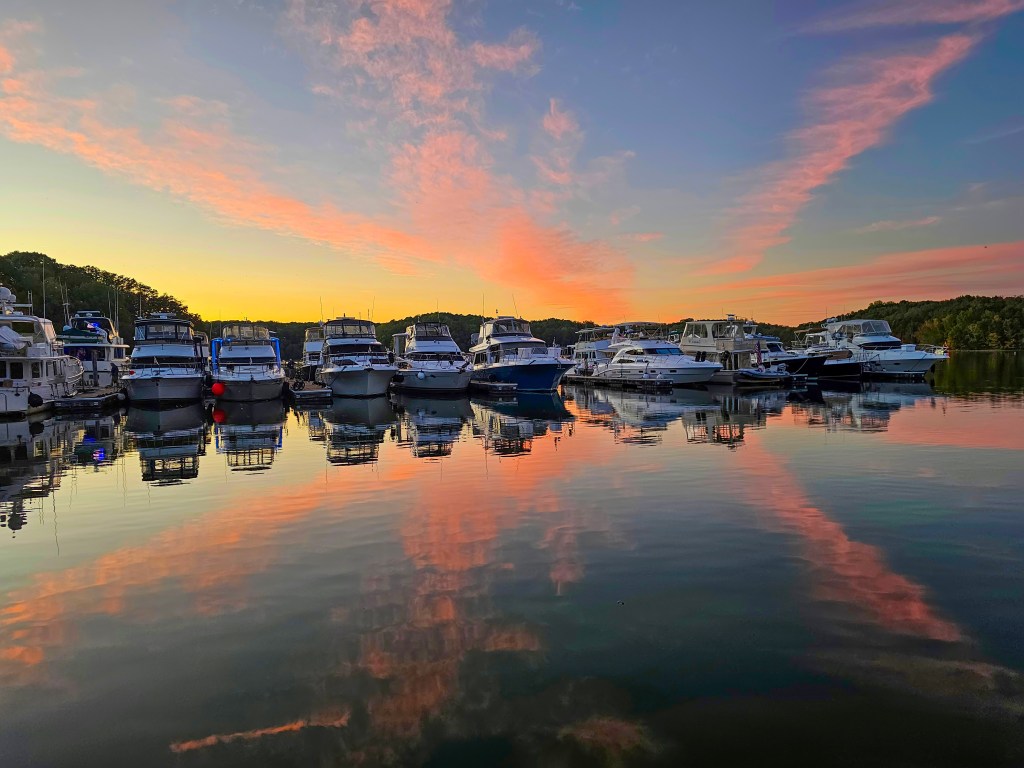
Looper boats at sunset at Joe Wheeler

The next day began the briefings part of the gathering.  We attended the presentations, advice and suggestions for our upcoming route from folks who have done the next part of the Loop multiple times.  This included preparation and advice for the Gulf Crossing, a 172-mile overnight crossing, well offshore. We will be doing this in February.

We had 3 busy days of briefings, socializing, and then the 3-hour boat crawl each afternoon.  This is an opportunity for Loopers, especially planners, to get onto all sorts of different boats, and see how they really look when Looping (as opposed to being all gussied up and decluttered at a boat show).  It was tiring.  Dick stayed up top and talked engines and boat handling, while I was below making sure the visitors saw everything, and demonstrating how we handle storage.

The final event of the gathering for us was our presentation on locking.  Dick ran over the time slot somewhat, but it was well received.  We had not expected that there would be so many people in the audience.  At the beginning, Dick asked how many had never been through a lock.  A surprising 100 out of about 150 in the audience raised their hands!  Dick did most of the presentation, while I took care of the humour with occasional interjections and comments.

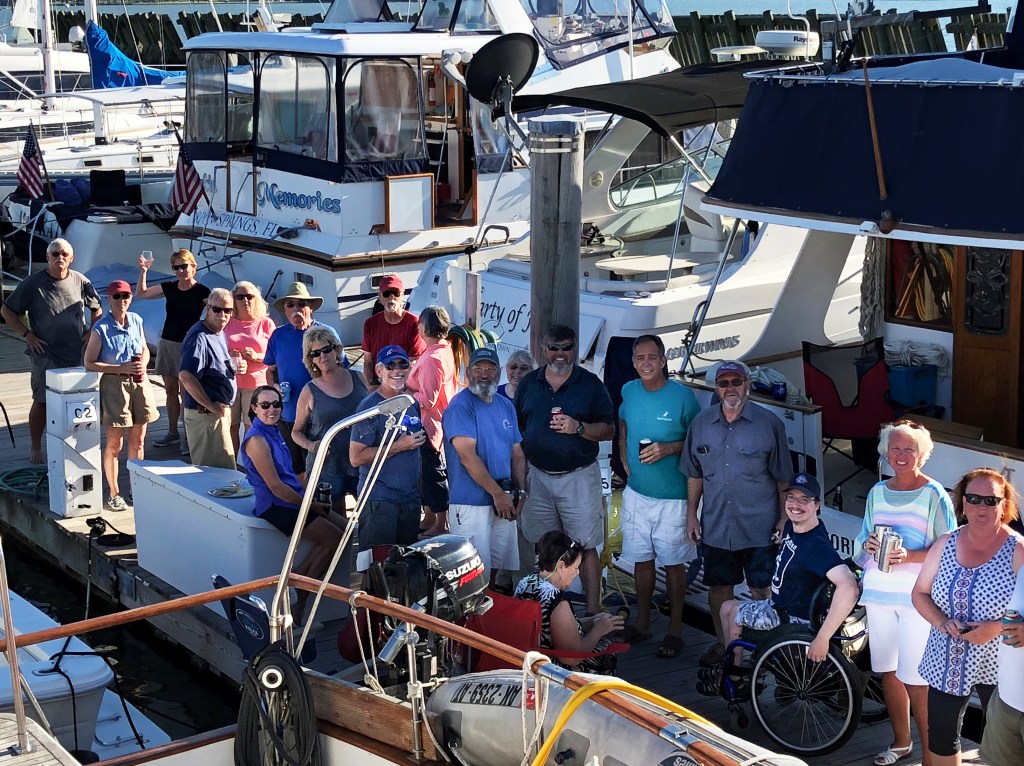
The group photo at AGLCA Fall Rendezvous

Following the wrap-up lunch, there were various round-table discussions, and demonstrations, but we were both feeling quite tired and talked out, so we went back to Nine Lives and spent a relaxing afternoon and evening.
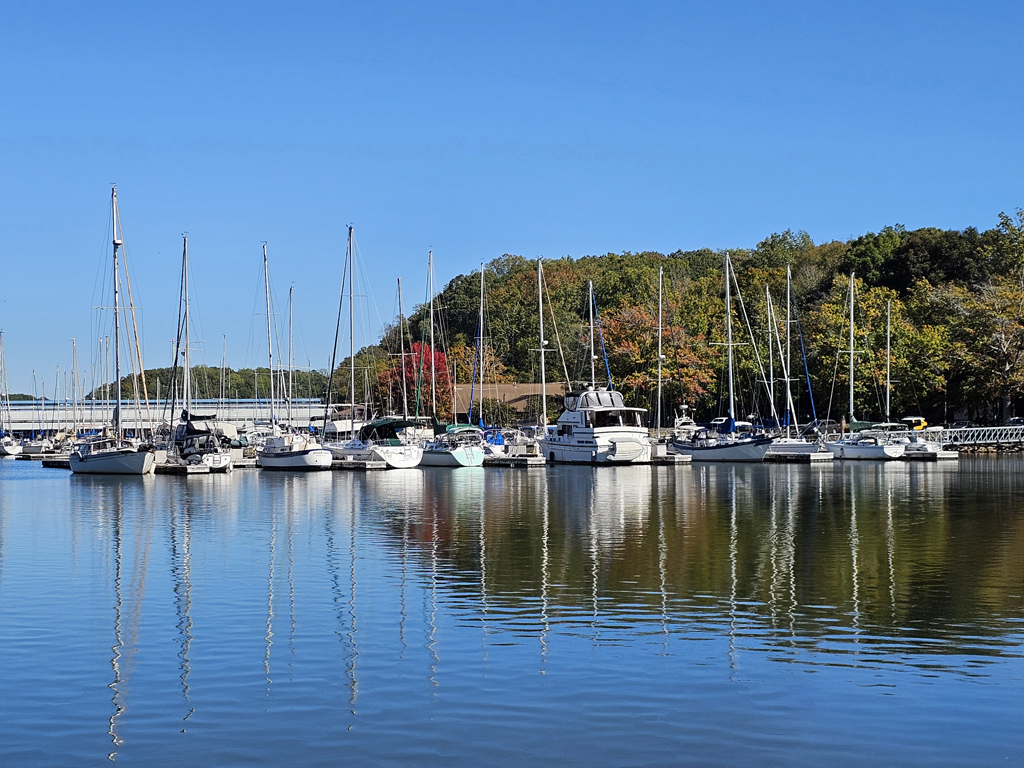
Docked sailboats at Joe Wheeler
Autumn colors at Joe Wheeler State Park

Shortly after we came through a few weeks ago, The Wilson Lock had to shut down for at least the next 3 months while repairs are made to the doors.  There is a much older (built 1925) auxiliary lock, that is actually a 2-chamber stair.  A reminder for new readers and those who have forgotten, typical commercial traffic on the Inland Waterways is handled by tugboats, called tows, pushing barges that are lashed together.  The old lock only has space for a single barge, that must be pushed into the chamber, then pulled into the next chamber, and finally pulled out at the top (or bottom as the case may be) and eventually lashed back into the rest of the barge train. It now takes between 15 and 24 hours for a single tow with its typical 15 barges to pass through.  On the day we left Joe Wheeler, there were 21 tows with their barges in the queue.  This is because each barge requires an hour to transit the 2 chambers, plus additional time for maneuvering the barges, and uncoupling and re-coupling them after the transit.

The lock infrastructure here in USA is failing.  At least 80% of the locks are 50 years past their design life.  The locks are maintained by the Army Corps of Engineers, which is chronically underfunded.  To put the importance of the canal and waterway infrastructure into context, here are some facts and figures.  One 15-barge tow carries the equivalent of 214 rail cars + locomotives, or 1050 large semi-tractor-trailers (articulated lorries for our English friends).  With respect to the environment, barges have the smallest carbon footprint.  In terms of tons of CO2 per million ton-miles, a barge is 15.1, rail is 21.6, and trucks are a whopping 140.7.  Barges move cargo 675 ton-miles per gallon of fuel.  A rail car is 30% less efficient, and a truck is 78% less efficient.  Speaking just of the Wilson lock, it is the gateway to 531 miles of upstream navigable waterways.  12,000,000 tons of commodities valued at roughly $4 billion pass through annually.  Just in case you think that the areas of Tennessee and Alabama that are served by this waterway and specifically Wilson Lock are of little national importance, the barges serve 3 nuclear plants, United Launch Alliance, Marshall Space Flight Center, and Oakridge National Laboratory.  Commercial entities include a number of large quarries.  The stone that is produced in those quarries may be used for cement.  Cement is an important building material for houses, and just about everything else that humans apparently need to survive.  The Port cities served include Decatur, Huntsville, Guntersville, Chattanooga, and Knoxville, all of which are industrial centres.

Another way of looking at it, a single tow (with barges) costs about $500 per hour, and most of the tows have waited about 7 days since the breakdown, about 150 hours.  Then factor in the factories and industries that are not getting chemicals, materials or shipping their output, and you have a serious economic situation.  Some of these plants must shut down and their workers are not paid.  How many of our readers have any idea how much of the economy of the area (and the country) is affected by the temporary closure of even one lock?  I am guessing none (except for those who have just now waded through my facts and figures above!)

The boats that were part of the Rendezvous came up in flotillas of a maximum of 5 boats per day, helpfully staged and organized at Florence Harbor, just a few miles below Wilson Lock, by the harbormaster.  Of course, everyone wanted to leave immediately after the Rendezvous!  Some planned to go upstream to Knoxville, but many, including us, hoped to go downstream through Wilson.  As often happens, one of the Loopers stepped up and offered to organize flotillas, so that the appropriate sized group would all arrive at the right place, on time, and only one person would be the spokesperson for the group with the lockmaster.  We were able to sign up for the second group on the Friday, and the Wilson lockmaster promised to let 2 groups through each day, so we were hopeful.  Somebody must have spoken to the formerly cranky and unhelpful lockkeeper at Wheeler Lock (the one between Joe Wheeler State Park and Wilson Lock), because he agreed to let all 9 boats in the Friday flotillas through at once.

We were up at 5am, in order to be sure we could have coffee, more coffee, and breakfast, before leaving the dock at 6:20am. It was a lovely sight, the lights of the boats behind us against the rising sun.  It became clear that someone was going to have to raft up in Wheeler Lock.  We are always ready, and happy to be the anchor, but it was a bit surprising that it was the largest boat in the flotilla, the 62-foot Halcyon, that was our companion.  They commented that this was also a new experience for them, as they are usually the boat closest to the wall that others raft to.  Wheeler Lock gave us all a gentle drop and we headed out, line astern, towards the next part of the adventure.
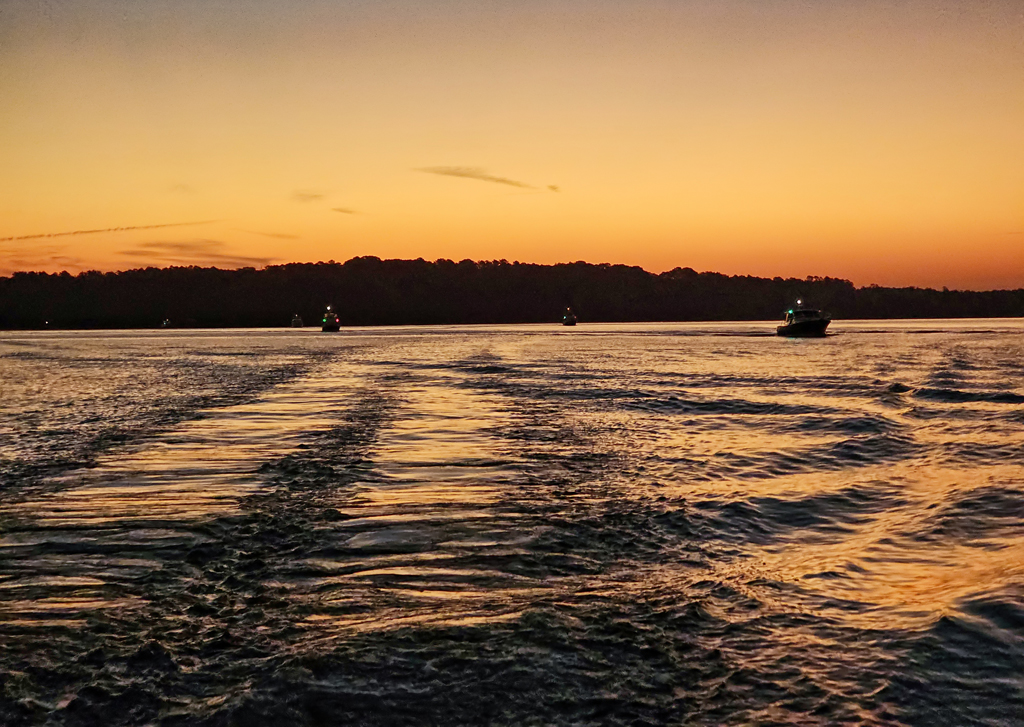
The flotilla leaves Joe Wheeler at sunrise
Tows and barges waiting above Wilson Lock

We arrived at Wilson Lock by 8:30 am and were advised to our great relief that the lock would take a break from commercial traffic, and the two parts of the 9-boat flotilla would be locked through, one after the other, starting at 10:30.  They began taking the first group exactly as promised.  Our group was right behind.  There are very few floating bollards on either side of the two chambers (and one is under a continuous heavy shower of water).  Unfortunately, the usable pins (bollards) are on opposite sides between the two chambers.  Nine Lives entered first, and took the pin at the front on the starboard (right) side.  Once secure, we called the next boat (Legacy) forward, and he rafted up to our port (left) side.  Then the other two boats arranged themselves in a similar fashion behind.  It was a day of firsts for our rafting partner.  His first solo lock-through at Wheeler, first time rafting up at Wilson.  After the gentle drop (thanks lockmaster!) in the first chamber, the doors opened.  We untied from Legacy, and I took Nine Lives slowly and gently across to the other, port side, while Dick quickly moved our big fenders across.  As soon as we were again secure, Legacy came up and tied up to our starboard side.  That was a little trickier, because Don does not have a door on that side of his boat, so Dick and I had to catch and hold Legacy until we could get lines tied.

Another gentle drop, and we could all head downstream, line astern, passing all the waiting tows and their barges.  We were tied up in Florence Harbor by 1pm, just ½ hour longer travel time than Dick’s original estimate that had not taken a broken lock into account!  I was glad that we did not have to do part of the exercise in the dark, as we had fully expected.  We were also glad that, having given a presentation at Rendezvous on how to go through a lock, with the expectation that after over 400 locks we are now experts, it all went well and we did not mess up, especially with an audience!

Looking down through the cockpit window at the tows and barges waiting below Wilson Lock
Tows and their barges waiting below Wilson Lock

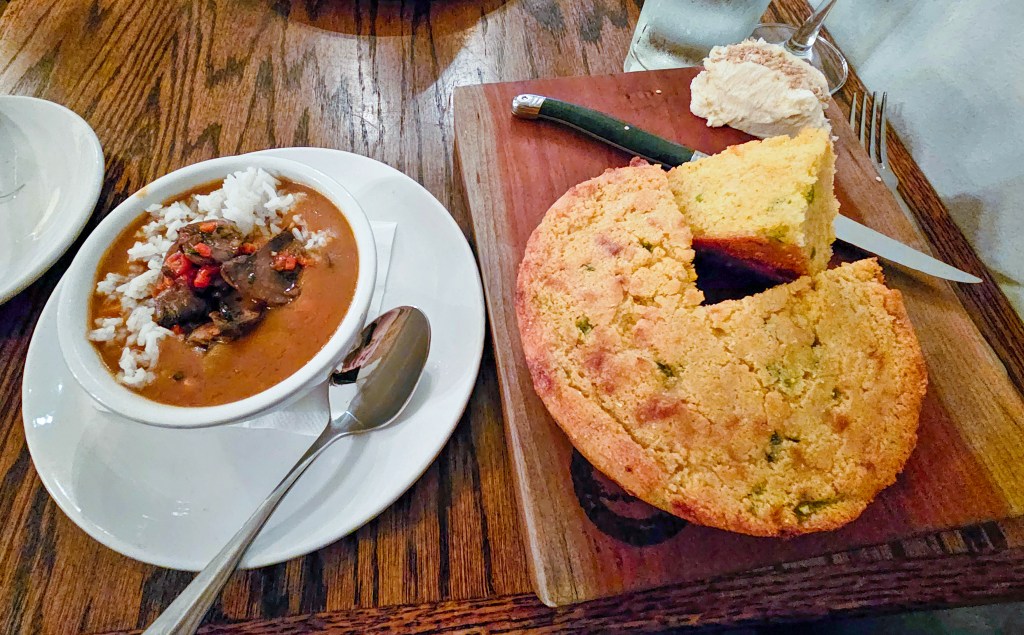
After a quiet afternoon we took an Uber to Odette’s, the restaurant we had cancelled on our last visit.  The menu is very modern and unusual, but within that context, the food was both delicious and beautifully presented.  Next to our table was another couple, and he asked about the cornbread that I had ordered.  I offered, and he asked to try a piece (it was delicious).  His Venezuelan wife of 16 years was both amazed and horrified that strangers would engage in this way.  They were a lovely couple.  We enjoyed chatting with them, and he gave us his number, hoping that we will call next time we visit Florence and go out to dinner with them.  These chance meetings and engaging chat are some of the best experiences on the Great Loop.

Odette’s starter sampler plate
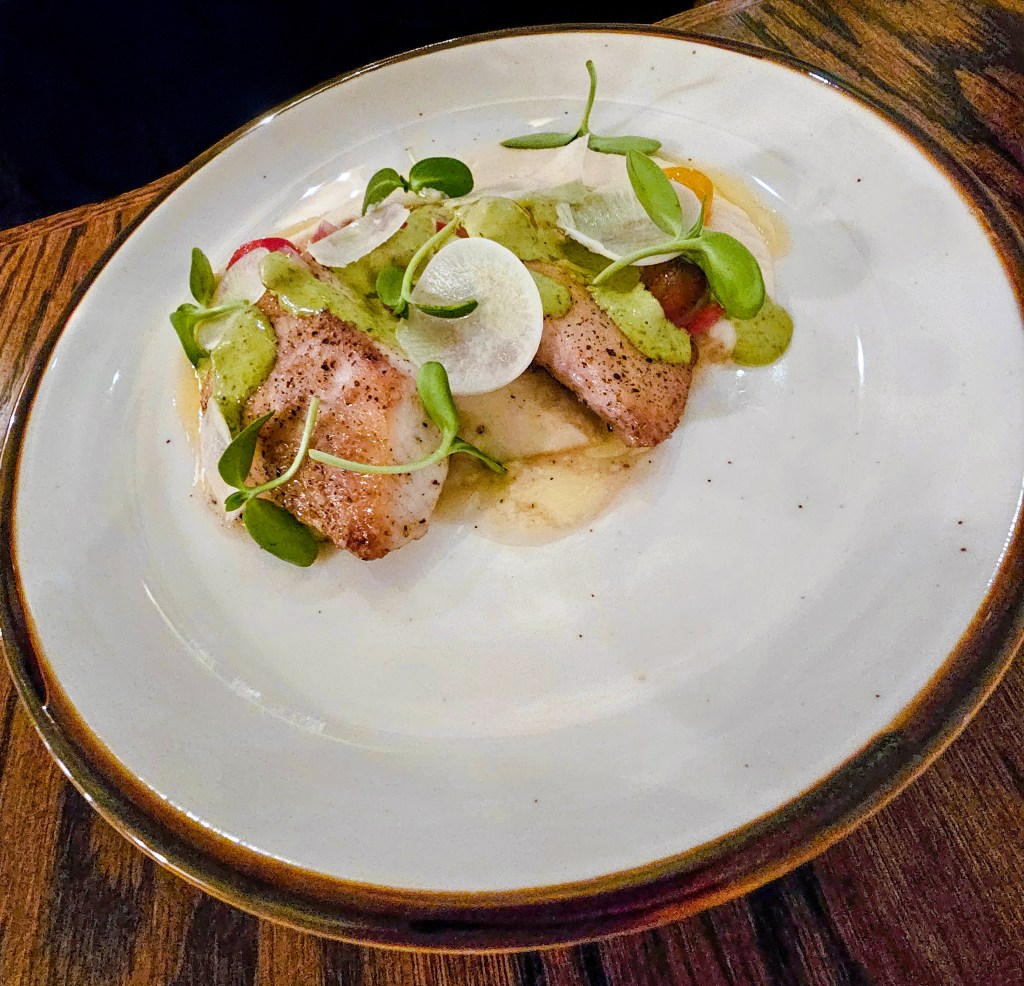
Grouper at Odette
Cornbread and a mushroom stew at Odette
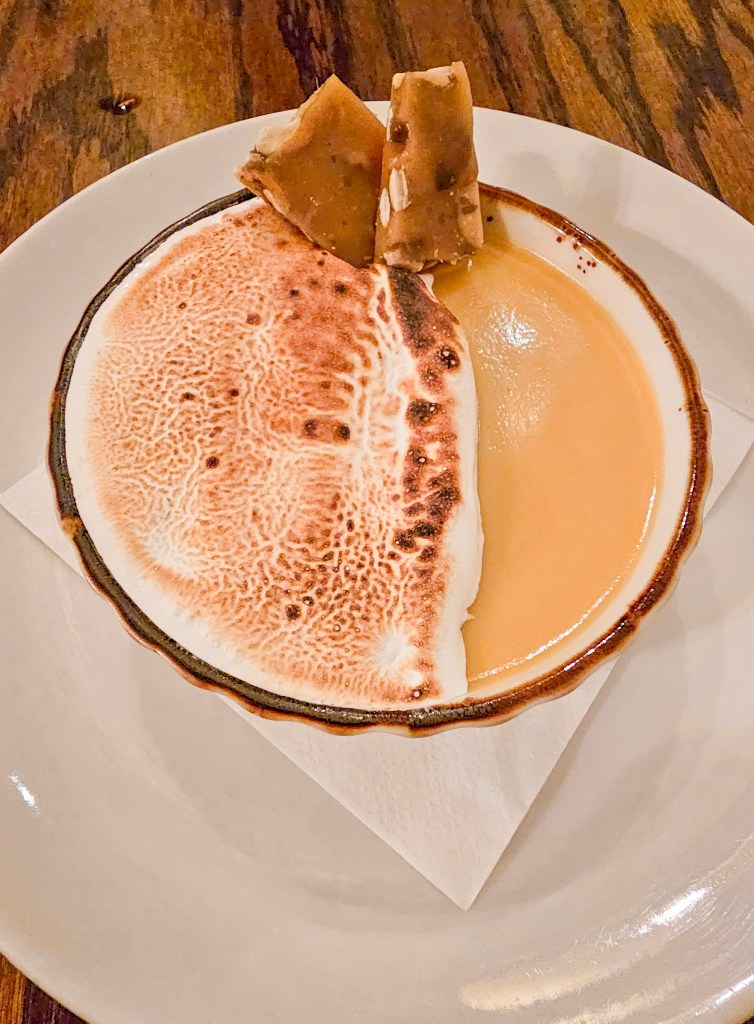
Odette’s interpretation of Pot de Creme

The next morning, shortly before sunrise (we were already up), we heard counting, and looked out to see what must have been 100 fishing boats heading down the River for a fishing tournament.  I was just not quick enough to get a picture.
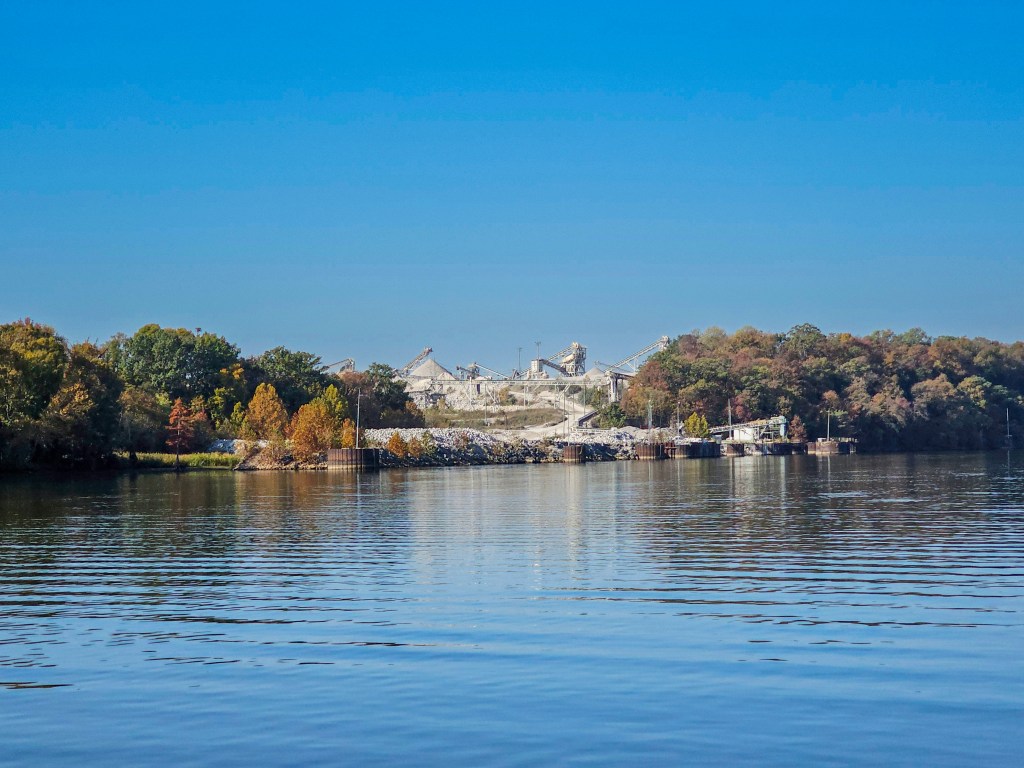
The quarry at Pride Landing

As we travelled downstream towards Aqua Yacht, we passed the now demolished Riverton Lock.  Riverton was the first major landing upstream of Paducah in the 19th century.  Shoals immediately upriver from Riverton prevented river traffic from getting to Florence for six months of the year when the water was low.  In 1891, George Washington Goethals developed a design for a single high lift lock.  He was able to convince the Army Corps of Engineers that his design was feasible and that the lock should be built to make travel possible and reliable all year round between Riverton and Florence.  The lock began operation in 1911, and at the time, was the highest lift lock in the world, with a lift of 26 feet.  In comparison, today, the lift in the main chamber of Wilson Lock to the south, is 100 feet, the highest single lift in any lock east of the Rockies, while Pickwick Lock to the north, has a lift of 63 feet.  Goethals’ success resulted in his transfer to Panama, where he was responsible for the design and construction of the Panama Canal.

All that remains of Riverton Lock, once the highest lift lock in the world.

We arrived at Aqua Yacht at the same time as 5 other boats.  We had hoped to be sociable, and to be either on the transient dock, or in a slip on D dock with many other Loopers.  Sadly, we were assigned E56.  After spending some time counting back to work out which slip we were supposed to be in, Dick turned Nine Lives into the correct slip, and it was very quickly obvious that someone’s measurement of 20 feet was faulty.  This was confirmed by a friendly boater on the dock, who could see that we were not going to fit, and that it was E56 as we had been directed to.  Dick called on the radio, and was given the new assignment of E47, just a few slips along, but definitely wider and longer.  After 3 years of practice getting into an identical slip on F-Dock, Dick had no problem easing Nine Lives in.  We already knew the best configuration for tying up to the posts.
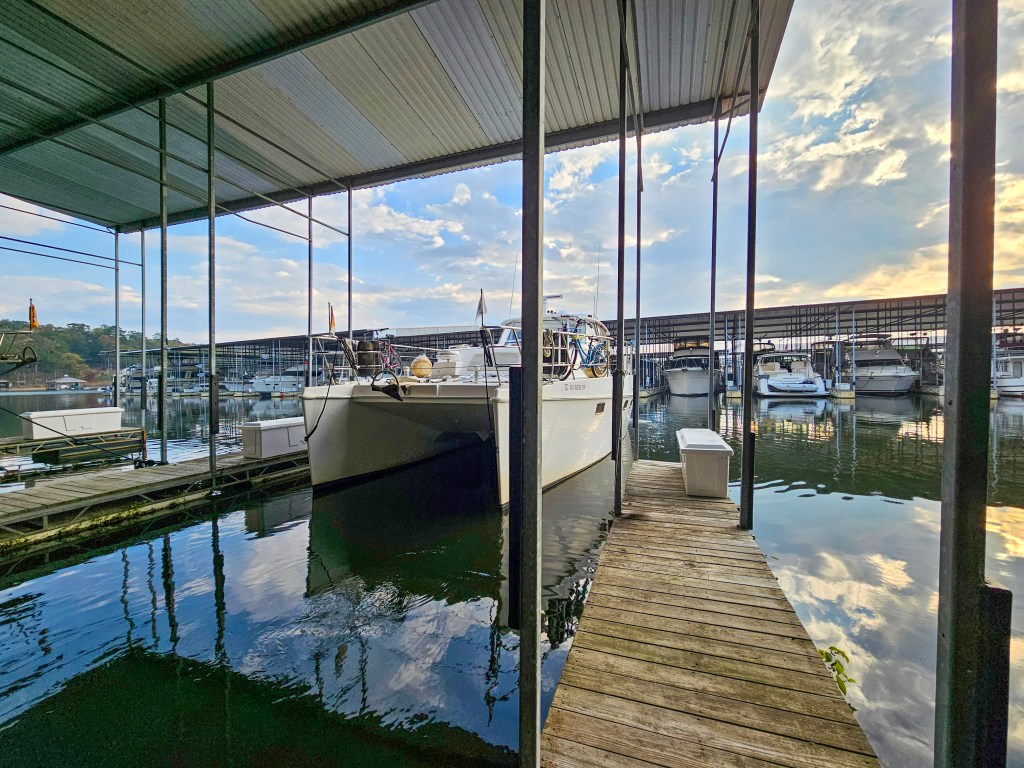
Aqua Yacht slip E-47

Once settled, Dick retrieved his car keys and hot-footed out to find a replacement for our leaking drinking water filter hose.  Once again, he had to go farther than expected, because, for reasons known only to them, the local hardware store is closed on Saturdays, the day that most working people are off and can work on home/boat/car projects.  New (stainless steel instead of unsuitable vinyl) hose duly acquired, Dick spent the next ½ hour lying on the floor in the galley doing the installation under the sink.

I was struck by how very lucky we were the previous day in our transit of Wilson Lock, as I watched the next groups.  We use an app called Nebo, that shows where everyone is.  It is very useful to keep track of other Loopers, and can also be used by friends and family to see where you are.  On this day there was one group heading in each direction.  The downbound group left Joe Wheeler at dawn, as we did, and arrived at Wilson shortly after 8:30am.  However, a tow plus barges was in progress, so they had to wait until about 2:30 before it was their turn.  That meant they arrived at Florence Harbor at about 4pm, and one of the boats in the group had chosen to travel all the way to Aqua Yacht, arriving well after dark.  The upbound group was even less fortunate.  Their transit began after 3:30pm, and by the time they were through and close to the next (Wheeler) lock, it was getting dark.  Three chose to anchor, but two carried on through Wheeler and arrived at Joe Wheeler State Park long after all staff had left.  One hopes that the few remaining Loopers on the docks were there to help them get situated.

At last it was time to head to dinner.  Our final visit to our favorite restaurant.  Vicari’s was every bit as good as it was on our first visit 3 years ago.  Service was impeccable, and the food was outstanding.  We enjoyed our usual starters, then Dick had the prime rib and I treated myself to the fried lobster tail.

Our final dinner at Vicari’s, prime rib for Dick and fried lobster tail for me

Sunday was laundry day, blog writing, and Dick changed the oil and filters in both engines.  He also took apart the grill to see whether he could figure out what had been making the strange noise when he grilled the breakfast sausages and bacon that morning.
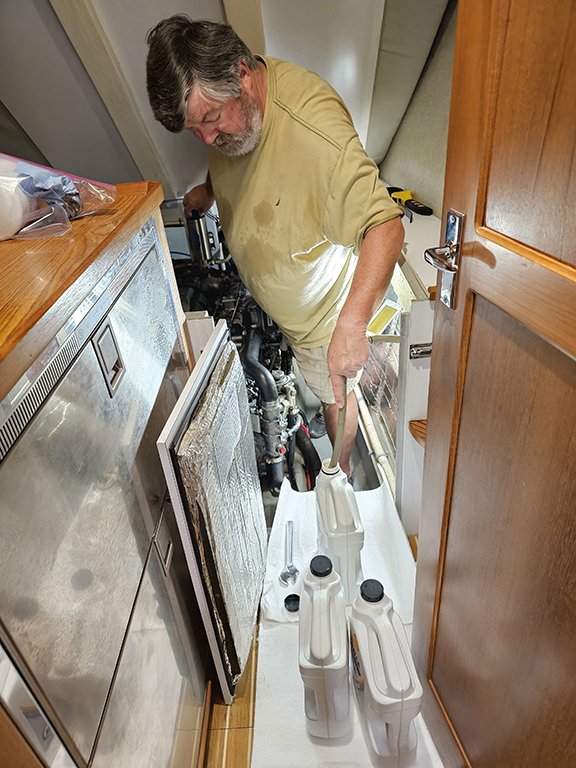
Dick changes the oil and filters. Two engines, the job has to be done twice!

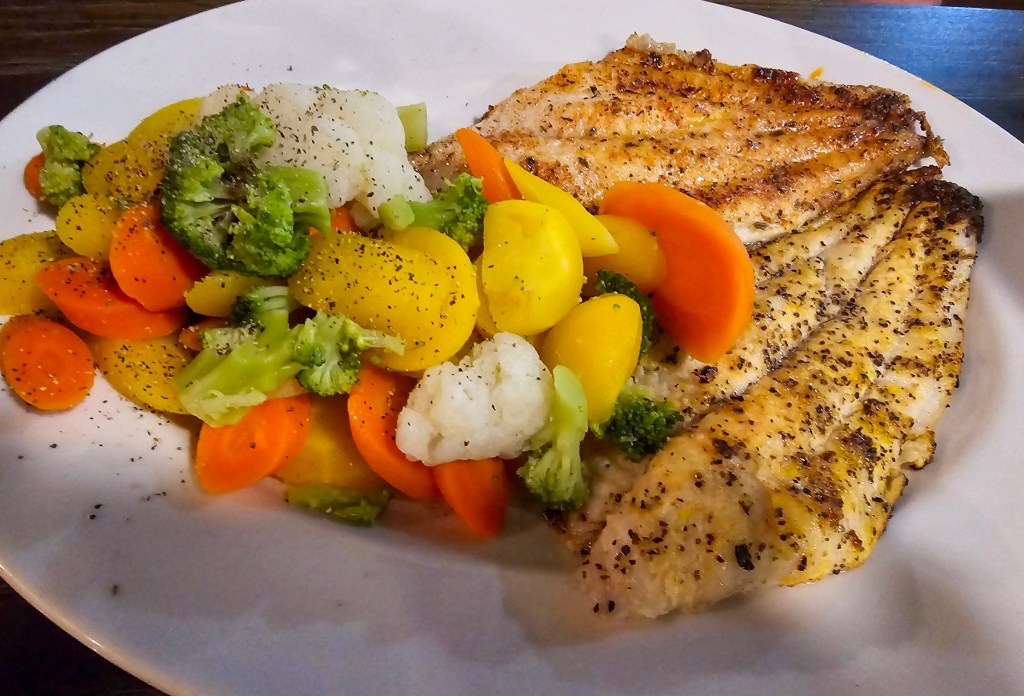
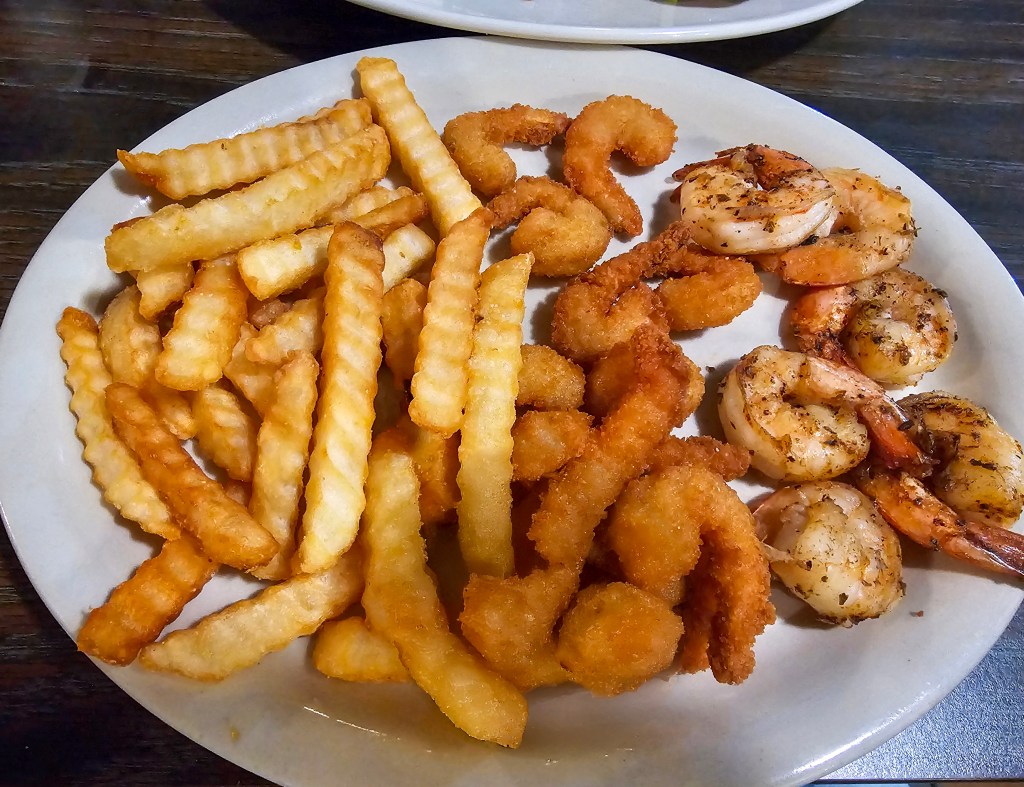
In the evening we set off for Hagy’s Catfish Hotel, a venerable, family run (for 80 years) restaurant about 20 miles away.  Dick loves catfish, and it is seldom offered on menus outside these Southern states.  We passed the Shiloh Battlefield.  I would have liked to have stopped for some pictures, but the catfish were calling.  The restaurant was full of character, and bustling.  Servers and young women dashed about, taking and delivering orders and bussing tables.  Meanwhile, an elegant woman made the rounds, stopping at each table to greet regulars or welcome strangers, while her equally elegant (presumed) daughter showed arriving guests to their tables.  The food was very good, and for the most part, piping hot.  Dick loved his two grilled catfish filets, one with lemon pepper seasoning, and the other with Cajun spice.  I opted for shrimp two ways, grilled with Cajun spice, and popcorn (breaded and fried) style.  Both were delicious.  The accompanying hush puppies were hot and crisp.  The only criticism we had was how rushed everything was.  The waitress kept asking to take our main course order, even though we explained that we were not in a hurry and did not want the starters, salad, and main courses piling up together.  As soon as we put our forks down, the bill was delivered – no dessert was offered.  With all the people tearing about it seemed very hectic.
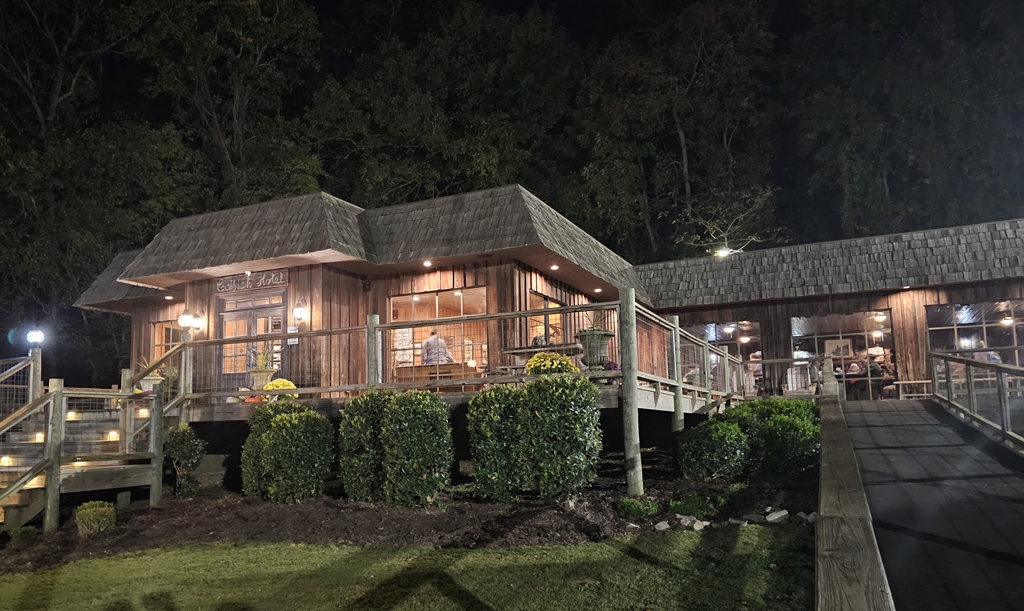
Hagy’s Catfish Hotel
Grilled catfish at Hagy’s
Shrimp two ways at Hagy’s
Don’t forget the hush puppies!

When we got outside, there were armadillos rooting in the flowerbeds.  Usually they are too shy and quick for photos, but there must have been something very interesting under the mulch because I was just able to get a snap.  Nine banded armadillos are native to South America, but they are gradually moving north, although they do not appear to be considered an invasive species as such.  I began to tell this to Dick as we drove back, but before I could get into my stride, he said, “I hear they are good eatin’”.  That certainly put an end to that conversation.  I did a little research, and here are some interesting things about the nine-banded armadillo that perhaps you did not know.  They can jump 3-4 feet in the air when frightened, which contributes to why so many are killed on the roads. They can inflate their intestines, and float across rivers, or alternately, they can sink to the bottom and walk across, being able to hold their breath for as much as 6 minutes.  They are nocturnal, and like to burrow, so they are not popular with gardeners.  In Texas, there is a small but well-established sport of armadillo racing, in which the animals scurry down a 40 foot track.  Most of the usual carnivorous predators like them, but their biggest predator is humans, who hunt them and harvest them for meat and shells.
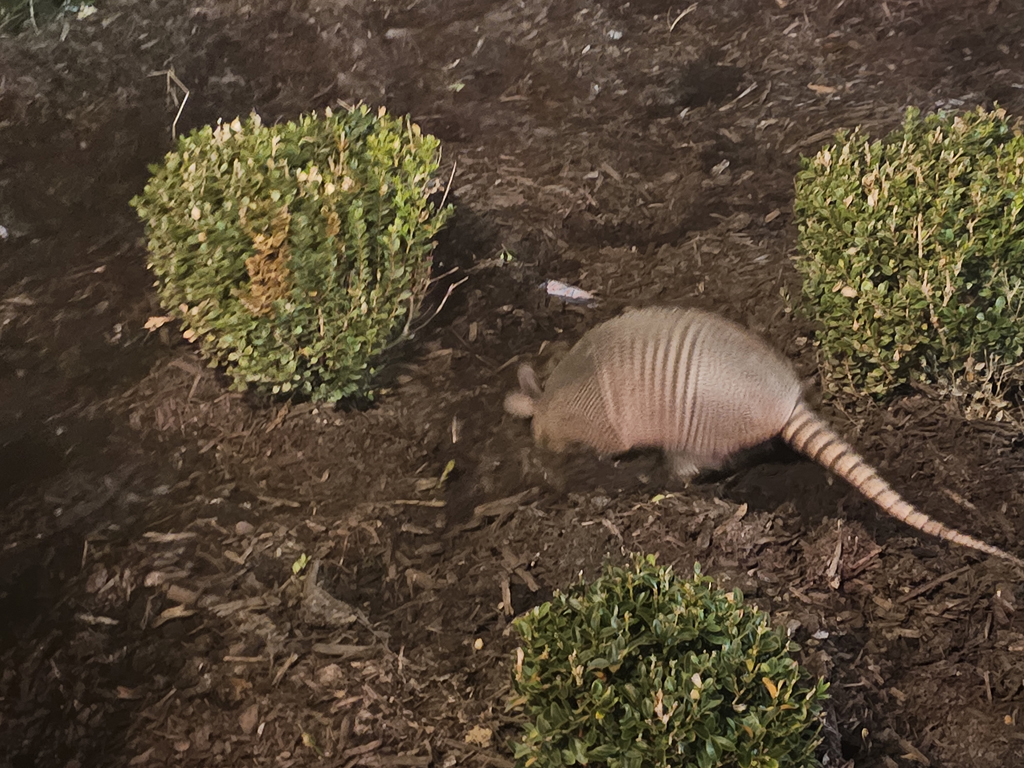
An armadillo roots in the flowerbed at Hagy’s Catfish Hotel

Our last day at Aqua Yacht started with a scheduled haul out.  When metal is continually in the water, it starts to corrode.  On a boat, there are a number of places that have metal fittings that are always in the water.  To prevent corrosion, pieces of metal called sacrificial anodes are attached.  These will corrode first, due to a metallurgical process that I have no need to understand!  Nine Lives left salt water back in 2018, and since then, her anodes have been made of magnesium.  Now that she is soon to return to salt water, we had her hauled out and new anodes made of zinc were installed.  The whole process took about 2 hours, including the haul out and pressure washing the bottom.  Everything worked fine, and we were ready to start south the next day.

Aqua Yacht haul out
Back in the water at Aqua Yacht

We took advantage of having our own vehicle to check out a new grocery store in Iuka, and also stock up our critically low stores of Jack Daniels and other adult beverages.

In the evening, I made shrimp fried rice from a new recipe.  It turned out very well, and I will certainly make it again.  In fact it would also have been relatively quick to prepare if I hadn’t needed to peel and devein the shrimp first.

Next morning we said goodbye to Aqua Yacht (except for a brief visit in a few weeks to pick up the car).  It has been a good base for the past 3 years.  The yard does good work, the only frustrations being the lack of communication and getting the work done on time, and very little cleaning done despite many promises.
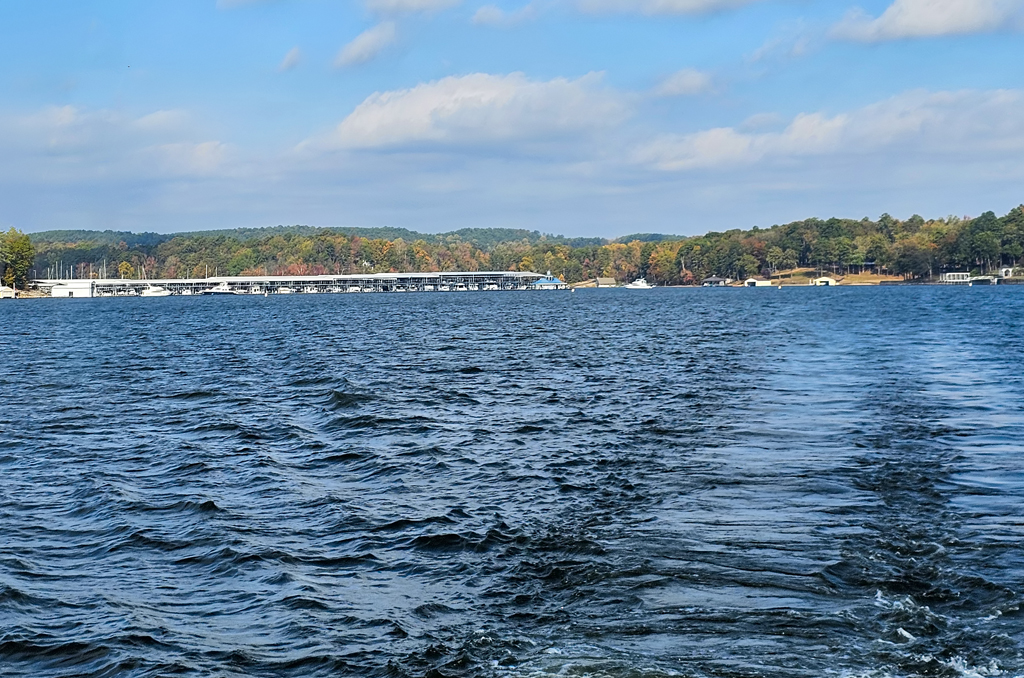
Goodbye Aqua Yacht

We set off south on the Tenn Tom Waterway.  This connects the Tennessee River at Pickwick Lake with the Tombigbee River at Demopolis, Alabama, and then joins the Black Warrior River to bring river traffic to Mobile and the Gulf of Mexico.  The first proposal for this waterway was made by a French explorer in about 1760.  In 1810, citizens of Knoxville, Tennessee, lobbied Congress to build the waterway, but the first engineering investigation took place many years later in 1875-76.  In 1913, another investigation took place.  Congress decided again that this would be too expensive and shelved the project.  More studies through the early 20th century, and eventually the project was approved in 1946.  There was strong opposition from key members of Congress from other regions, and again the project was shelved.  Money was budgeted in 1968 and in 1971 to build the waterway, and construction began in 1972.  There were more delays, due to lawsuits, but gradually the waterway was built, at a cost of nearly 2 billion dollars and it was dedicated in 1985.  Today, the waterway ships as much as 1.2 billion ton-miles of commerce each year.  We have been struck by the differences between these relatively new locks and those of the other waterways we have been travelling on for the past three years.
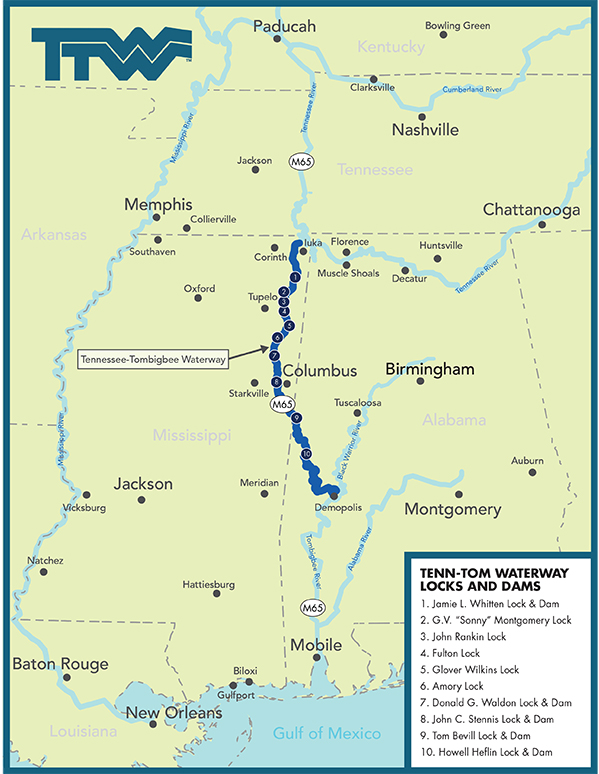
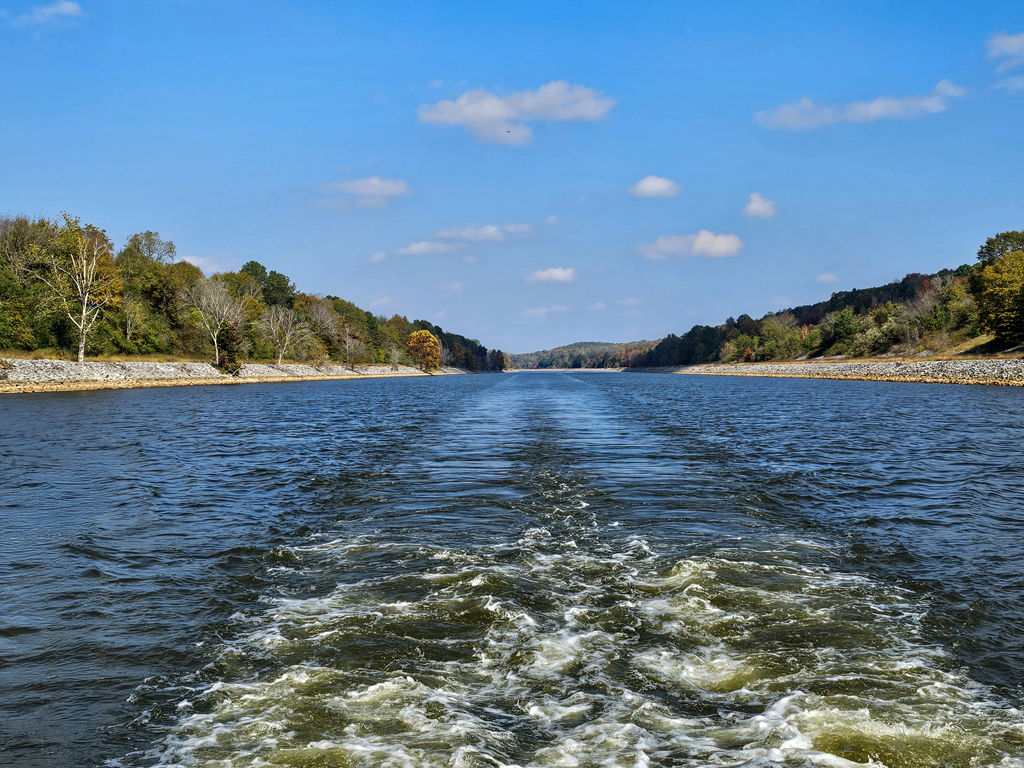
Map of the Tenn-Tom Waterway
The Tennessee Tombigbee Waterway
Meeting a tow on the narrow Tenn Tom

We anchored just above the first lock in a cove where there is a visitor centre.  There was already a boat in there – another Endeavourcat!  We set the anchor, and Nine Lives’ lady captain said, “I don’t think this is right, we are too close to the other boat, and we will not swing at the same rate and radius.”  The gentleman captain said, “It’s fine.”  Dick then spent a few hours replacing 3 cigarette lighter outlets (remember those?) with new USB ports.  I think there were some grownup words muttered during the tricky process.  After one and a half adult beverages on completion of the afternoon’s project, at dusk, the gentleman captain expressed the view that our location was not ideal, and now that the wind had dropped, we were at risk of bumping into the other boat.  Headsets on and engine started, and the whole pulling up and re-anchoring process to be gone through, as it got dark.  The lady captain was much happier in the new location, just wished it had not taken the gentleman captain quite so long to figure it out!

Another Endeavourcat anchored off Bay Springs Lake.

After a peaceful night we had arranged to coordinate with the other 2 boats in the area to go through the next locks together, and with one spokesman.  It all went well, and with no tows on this stretch of the waterway, we got through 3 locks and were tied up in the marina in 3.5 hours.

At the last lock of the day, there was a moment when we thought that all the extraordinary measures that we know about and have never had to use, might come into play.  The floating bollard that we were looped to didn’t float!  I was just about to hail the lockmaster when Dick gave the bollard a heavy push and it dropped down, protesting with metallic shrieks, and bouncing up and down a few times before it settled.  Definitely a good reason to have the strong man tending the pin, and what someone recently described as “the little lady” at the helm.  I would not have had either the strength or the reach to get that bollard moving.

Midway Marina is a strange place.  The marina itself is a mixture of very old docks with quite a bit of new wood going in to refurbish.  There are a number of near derelict boats in the slips.  However, there are some new and very attractive guest cabins, a huge, manicured park, and one of the best restaurants of its kind we have visited on the Loop.
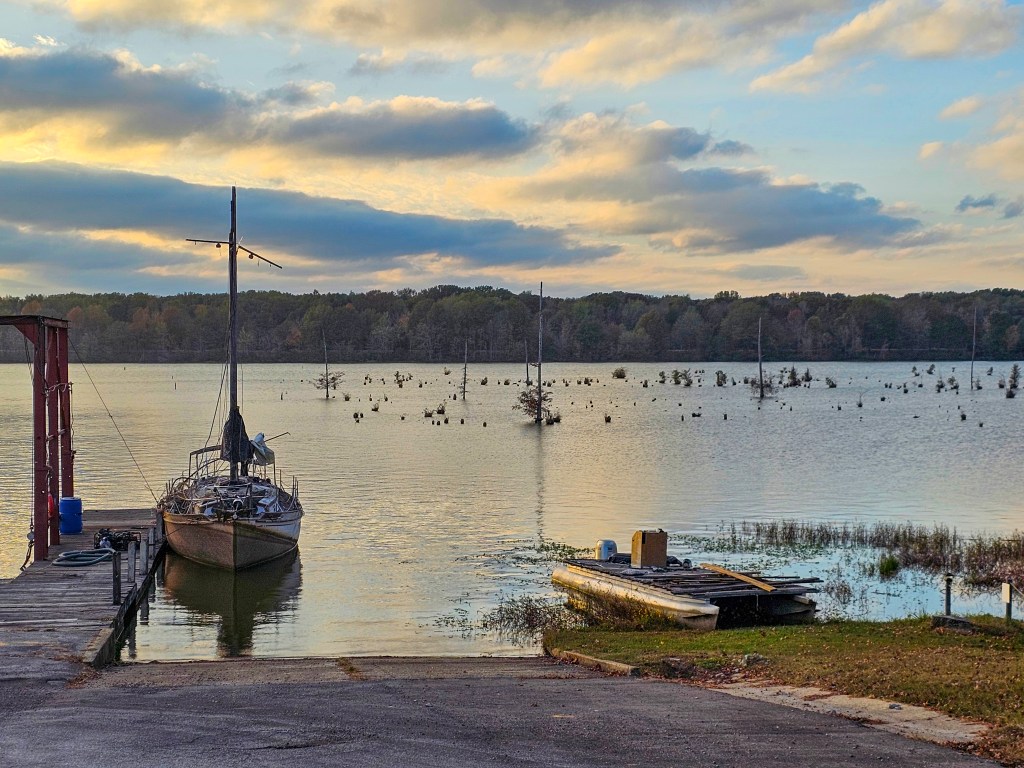
Midway Marina at dusk

We were delighted to find our favourite cheese curds on the menu, and while we were waiting for those delectable treats, we were brought a loaf of delicious bread.  We both ordered Po’ boys, Dick’s was with grilled catfish, while I had fried shrimp.  It was an exceptional meal.
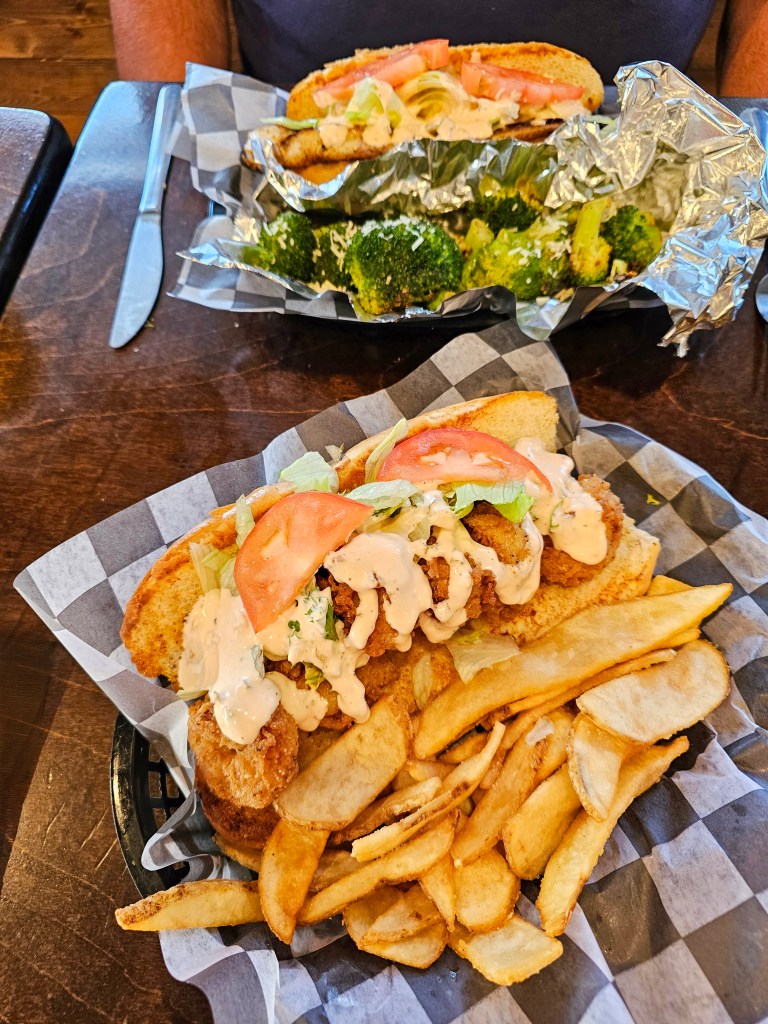
Po’ boys at Midway Marina

Next day was another 3-lock day.  Again, 3 boats were given the go-ahead to be at the lock by 9am.  We were very lucky with the tows (4 of them) as we met them either just before or just after the locks and were able to go through each lock right away.

We soon experienced our second “expect the unexpected” moment in 2 days.  I brought Nine Lives slowly into position at the pin we had chosen, and it suddenly became clear that the bollard had sunk and there was nothing there.  They are recessed in the lock wall, so you can’t tell until you are right beside it if there is a problem.  I had to back Nine Lives up to get to the pin 150 feet behind.  Since I don’t have eyes in the back of my head, it was a tricky maneuver, while Dick pushed off the lock wall and stopped the fenders from hanging up.
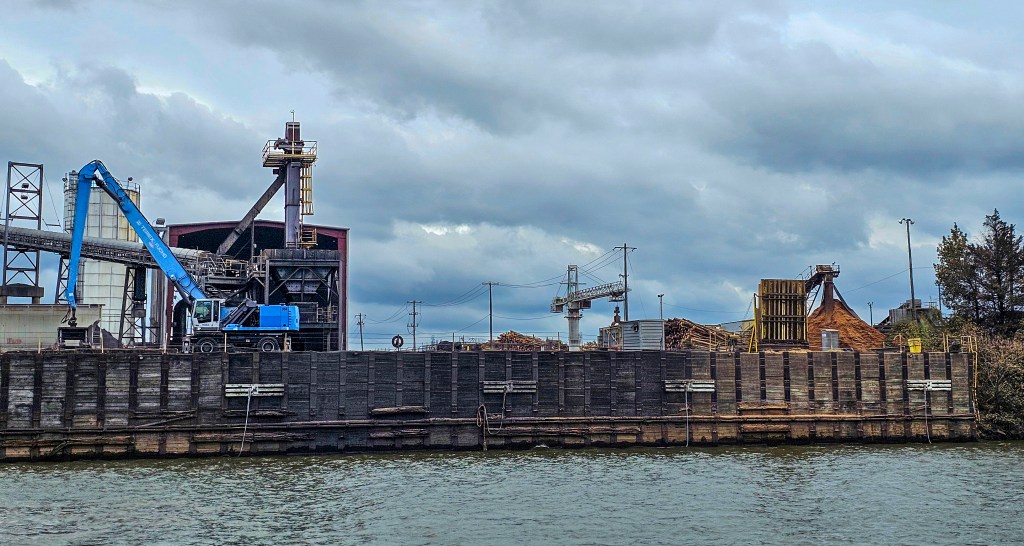
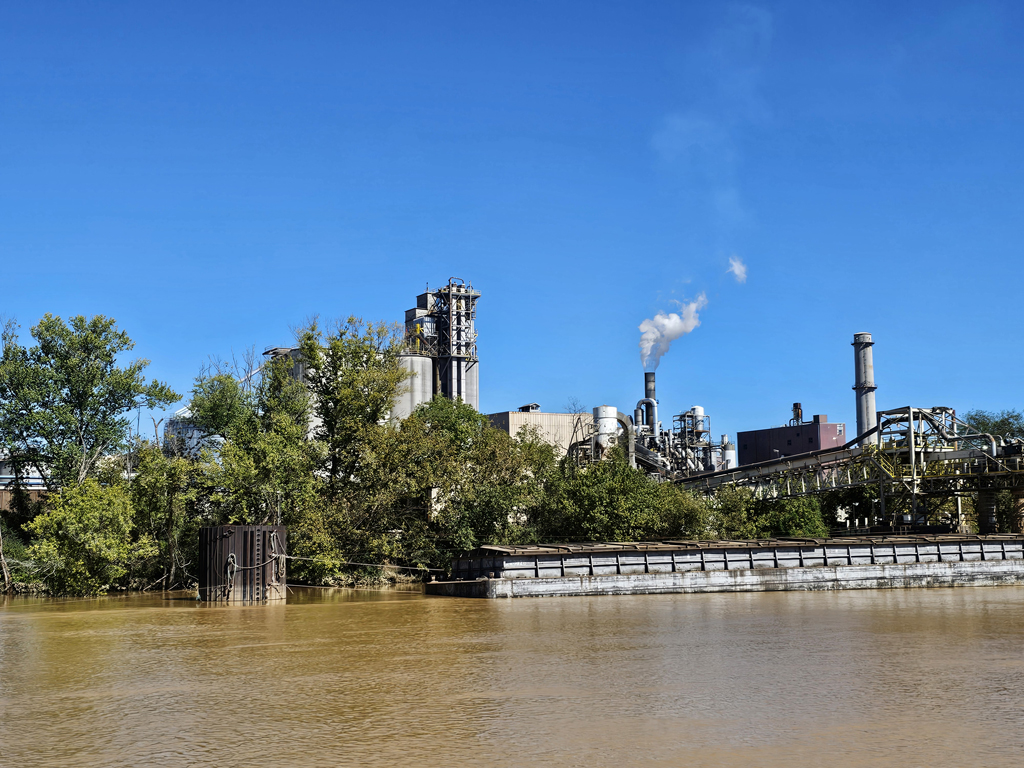
Domtar Chipping Mill at Amory

Our chosen anchorage for that night is popular, but reviews warn of a rocky bottom that means the anchor does not always set.  Usually I can feel it when the anchor grabs, but not this time.  I was not happy about the amount of swinging room either.  Reviews told us to expect 180 degree changes in direction.  I use two anchor alarms, and the one with the shorter radius went off several times.  Between a very slight current, and an opposing light breeze, Nine Lives swung all over the channel throughout the night.  We still don’t know whether the anchor ever dug in, or if just the weight of chain on the bottom held us in place.  Not an anchorage I would return to or recommend.

In East Lake, we passed large and small clumps of water hyacinth. This is a highly invasive species that is choking waterways all over the world.  In the United States it is a particular problem in the southern, Gulf states.  The plants reproduce by stolons, or runners, that create new plants.  The flowers produce thousands of seeds that are viable for up to 28 years.  Mats of water hyacinth can double in size in just one to two weeks.  Once established, the fish and native plants die, and the waterways become choked.  Harvesting the plants mechanically to try to get rid of them is a problem because they are extremely heavy, and then there is the problem of what to do with them once harvested.  Many different methods of eradication and control have been tried, including steam, hot water, acids, spraying with petroleum and setting fire to it, various chemicals, introduction of species of weevils that eat them, and harvesting.  In 1910 it was proposed to introduce hippopotamuses into Louisiana waters as a method of control.  The plan was for the hippos to eat the water hyacinth, and the animals could also be hunted for meat, which was in shortage at the time.  The proposal was lost by just a single vote, or we would have had a different problem in the southern states.  The pet hippos of drug lord Pablo Escobar escaped and are multiplying in the wild in Columbia, dangerous to both humans and the environment.  They are proving to be difficult to cull.  They can be extremely aggressive and will charge and attack small boats.  They also raid farm crops.  The solution to one problem can easily create another, as history tells us again and again.
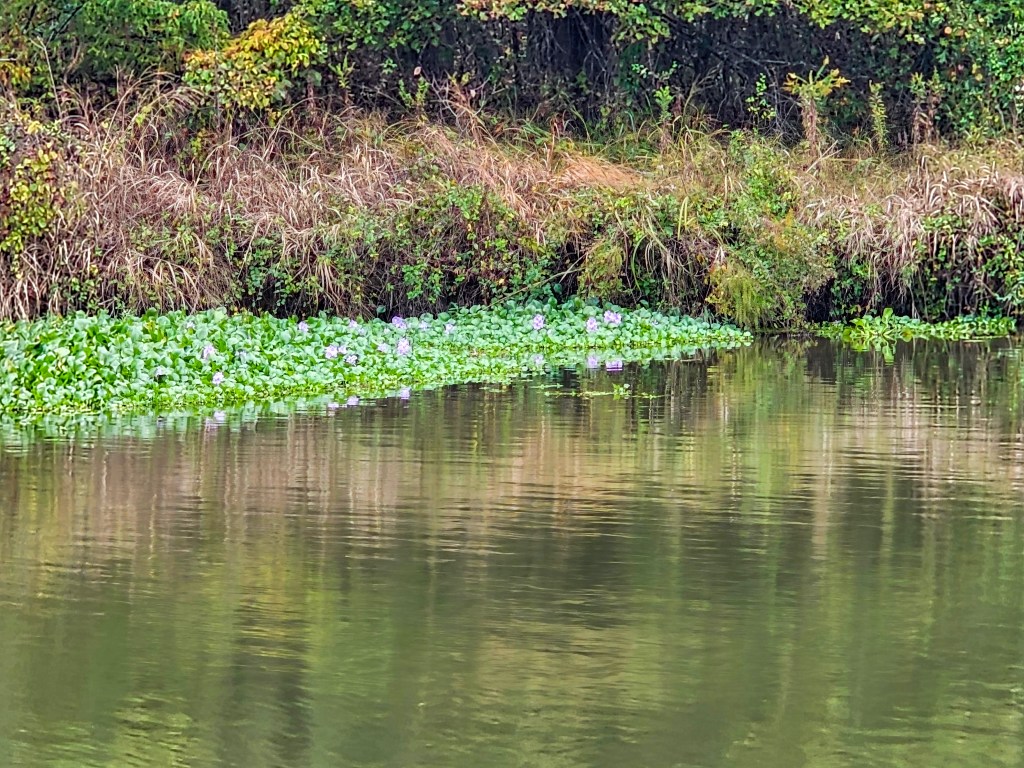
Water Hyacinth

We arrived at Columbus Marina and were tied up by 1:10. It is a popular stop on this part of the Loop, so they have a 2-night maximum stay during this time.  We had hoped for several Amazon packages to be waiting for us, but USPS apparently found it too difficult to deliver on the due date, and did not schedule a second attempt for 3 days.  The next morning, we got the full explanation.  Apparently, USPS in Columbus has decided that any packages that do not fit through the mail slot will be held at the Post Office for pickup.  This information is not conveyed to Amazon (and thus the package recipient).  Then, when someone arrives to pick up their parcel, all the waiting parcels for the marina are handed to them at once.  Another boater had arranged for a Post Office run, and collected our two packages, so the issue was satisfactorily resolved for us.

On our first evening, we arranged for the marina courtesy car to take us to a steak house, and made a reservation at the restaurant.  At the last minute, fellow boaters Sandy and Frank from Proost decided to join us.  The courtesy car is quite something.  It has over 270,000 miles on it.  As you drive, there are interesting squeaks and rattles, and after a while the engine begins to make a sort of groaning noise, as if it is about to quit from sheer exhaustion.  However it got us to the restaurant and back to the marina.  Our dinner was very enjoyable, but mainly for the company.  We have decided that food served cold in restaurants in this part of the country is SOP, and we should stop accepting excuses.  The appetizer of deep-fried balls with broccoli, bacon, and cheese were properly hot and tasted very good.  Dick’s prime rib was fine, but Frank’s was cold.  My steak was reasonably hot, but the accompanying shrimp skewer was room temperature at best.  The bowls of grits that Frank and I chose as sides were less than room temperature.  Frank’s beef and the grits were sent back.  By the time they returned, the rest of the food had been eaten.  Oh, and the grits were still just as cold as before.  Meanwhile, Sandy’s wine flight never arrived and had to be removed from the bill.  We really enjoyed talking with Sandy and Frank, and hope that we will have a chance to spend time with them again.  We first met in Florence, some weeks ago, and have been leapfrogging ever since.

Our day in the marina was a chance for me to finish this issue of the blog.  Dick pottered about doing various chores, including a pump out.  Unusually, this marina has in-slip pump out outlets, so you just have to go and find the hose and get the machine started, no need to move the boat to the fuel dock as is usual.  We want to have everything ready before we leave tomorrow, as we will be anchoring for three nights in a row, unusual for us.  Water will have to be used carefully, navy showers for the next three days!

Dick also re-installed the lower supports for the dinghy.  When we replaced the original fiberglass dinghy a few years ago, Dick assumed that lower supports were not required, the dinghy could just hang from the upper supports because it is so much lighter than the original.  Also, he had seen that most other boats with such a configuration have the dinghy hanging from the upper supports.  We have noticed that when it is rough, or we cross a large wake, the dinghy swings wildly from side to side, to the extent that it nearly came off when we went through the turbulence at Ft Louden Lock. After reading on the Endeavourcat forum that the lower supports actually serve two purposes, Dick decided to put them back.  In addition to helping with sway, the lower supports allow the dinghy to slide past the swim platforms when it is being launched, requiring a lot less manual intervention (that is, heaving it about). I do remember that those supports used to behave in odd ways, engendering a fair amount of cursing, but perhaps they will not be quite so annoying with the new dinghy.
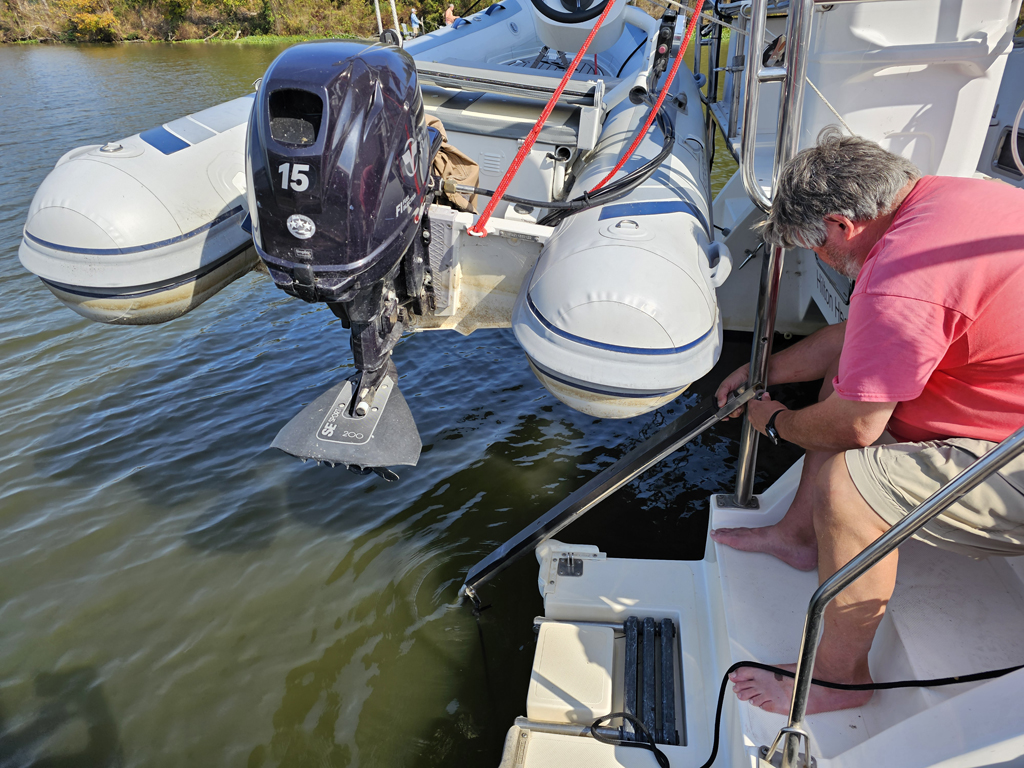
Restoring the dinghy supports
Nine Lives Voyage for October

October 2nd  to 16th, 2024: Chattanooga to Tellico Lake and back to Scottsboro

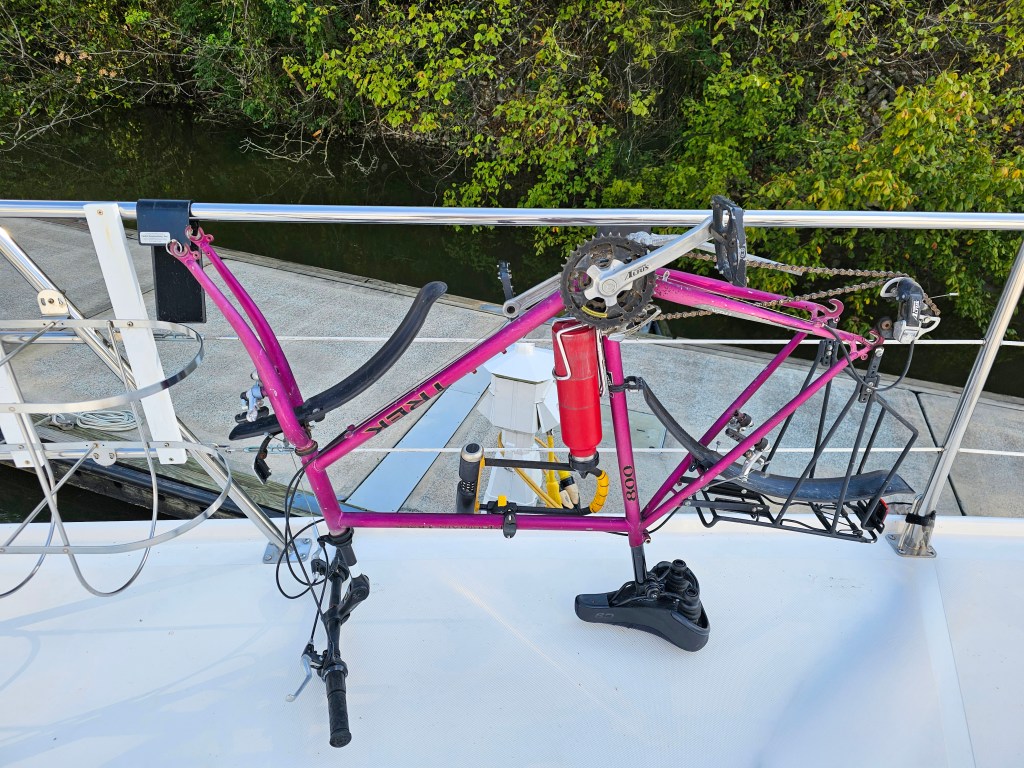
The last installment ended with something of a cliffhanger… would Dick’s bike disappear from the place he had locked it to the railings?  Well, no, the bike was still there the next day when Dick went to get it to go for a ride, however, important components were missing, namely wheels.  It had occurred to him at some point that perhaps he should lock said wheels, which have a quick release mechanism, to the rest of the bike, but he didn’t.  Fortunately, there is a Trek dealership within walking distance of the dock.  Yes, he could get the wheels, but they would have to be ordered.  We had already planned to stay much longer in Chattanooga, so arrangements were made to rent a car.  Of course, it is somewhat ironic that while the bike is about 30 years old, the wheels had been replaced just a few months earlier after an unfortunate encounter with a tourist’s vehicle in Hilton Head.

Oh dear!

After one of Dick’s special breakfasts, we set out to collect the rental car.  The depot was very close to the end of the electric bus line.  We went to the supermarket and stocked up on the heavy stuff that is less easy to transport by bike.  Parking in Chattanooga is inexpensive, just $11 per day.  There are lots of multi-storey car parks, including the one with the beautiful lighted façade that is nearest to our dock.

I am impressed by how clean the city is.  Unusual for an American city, especially one with such a large homeless population.  The electric buses are clean inside, no trash on the floors, and while I see people leaving rubbish on the ground under benches, it is always gone by the next day.  An army of cleaning fairies must be deployed around the city every evening.  Even the area under the bridge is kept relatively tidy.

A new improvement for Nine Lives. When we are staying in a marina for a few days we can now hook up to mains water and not have to keep filling the tanks.

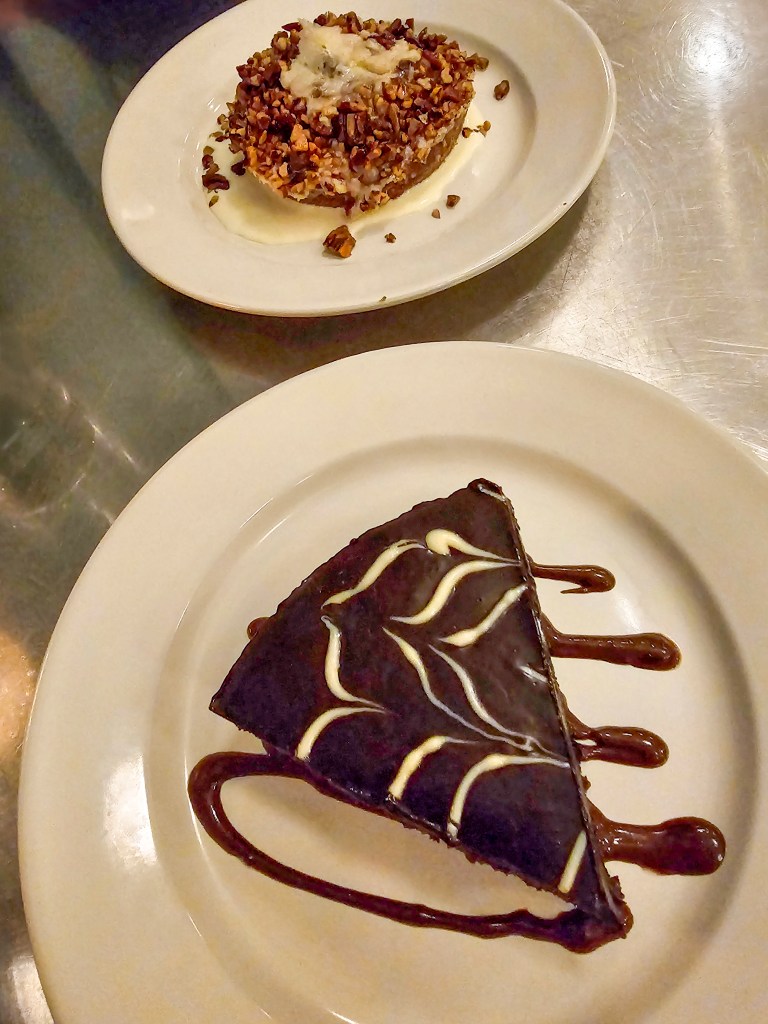
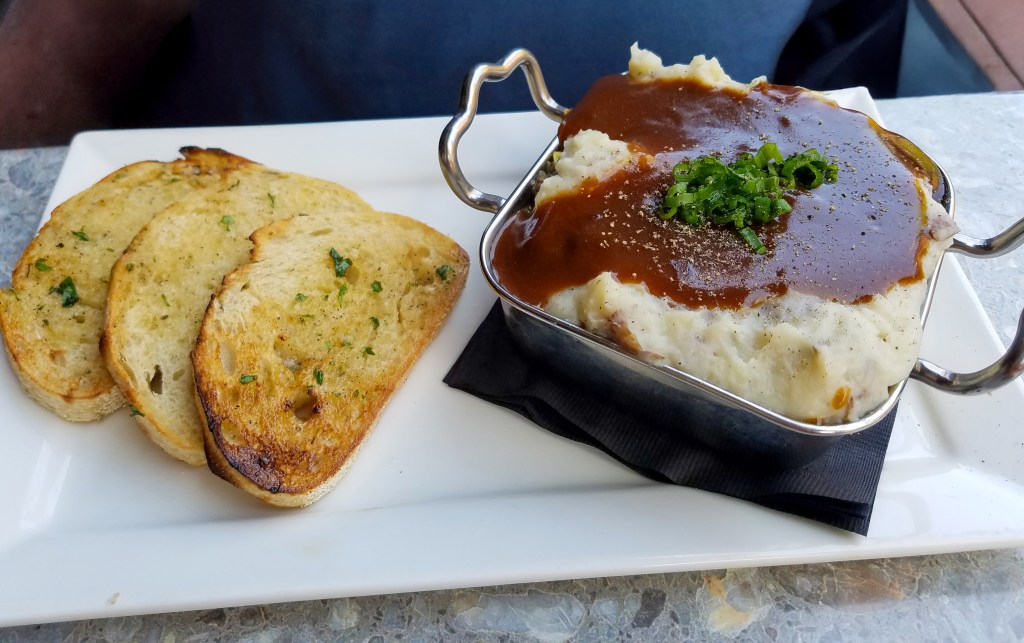
We ate at a restaurant called Public House.  The smoked trout dip was tasty, but it came with incredibly hard toasts and rather too many crudites for my preference.  It made a good lunch for Dick later!  The pot roast was excellent, and I had the best shrimp and grits I have ever tasted.  Desserts were very rich, but altogether it was a good meal.

Desserts at Public House, Chattanooga

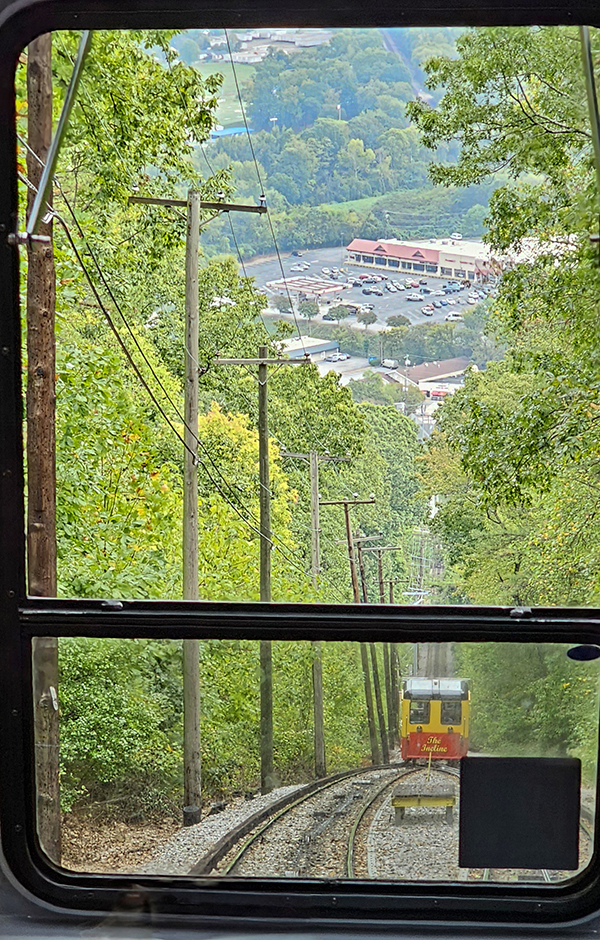
The next day we took a morning trip to the Incline Railway on Lookout Mountain.  It was cloudy, and too hazy for the really spectacular views, but it was an experience.  The railway is about a mile up the side of the mountain, with a maximum grade of 72.7%.  It is one of the steepest railways in the world.  I do not like heights. About 2/3 of the way up, I said to Dick, “The things I do for you!”  The lady in the seat ahead of us immediately said, “Oh I know what you mean!”  After we returned from the adventure, we stopped at Ben & Jerrys for ice cream.

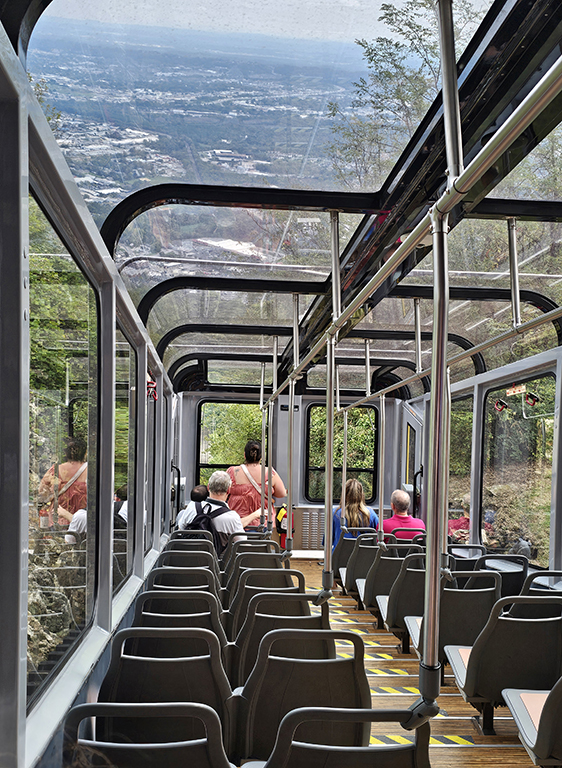
Incline Railway on our way up
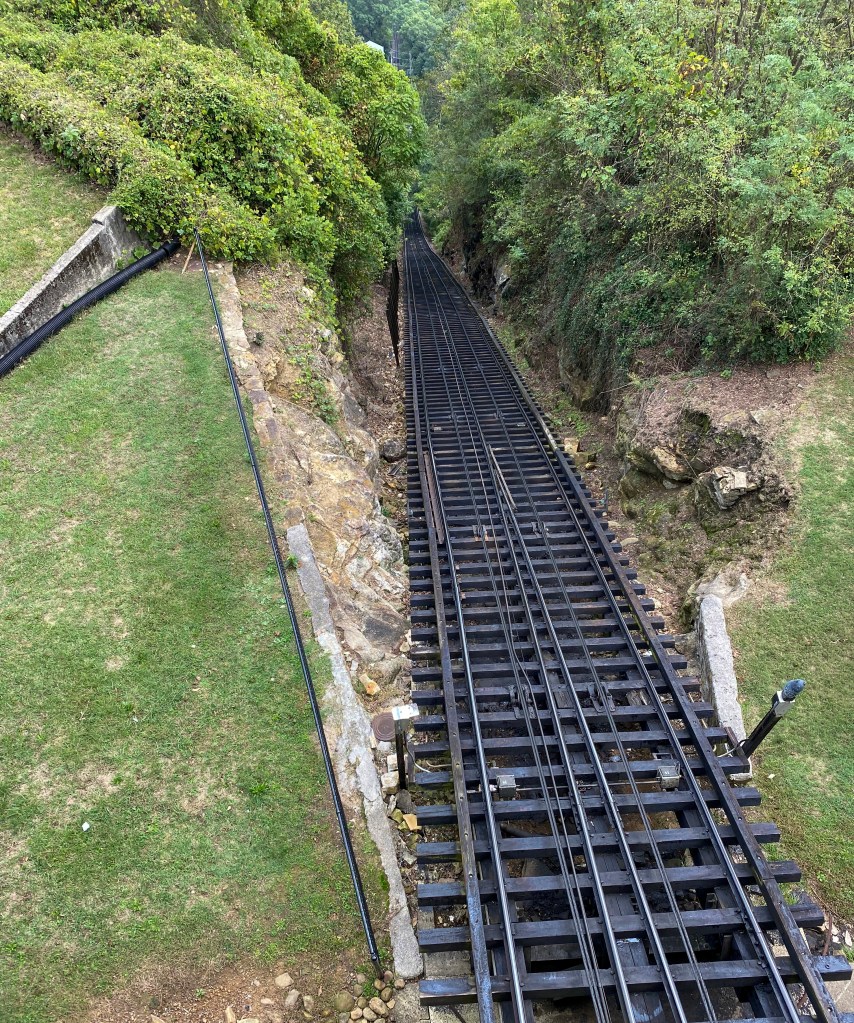
Incline Railway looking down the track from the top (Dick had to take this one!)
The machinery of the Incline Railway
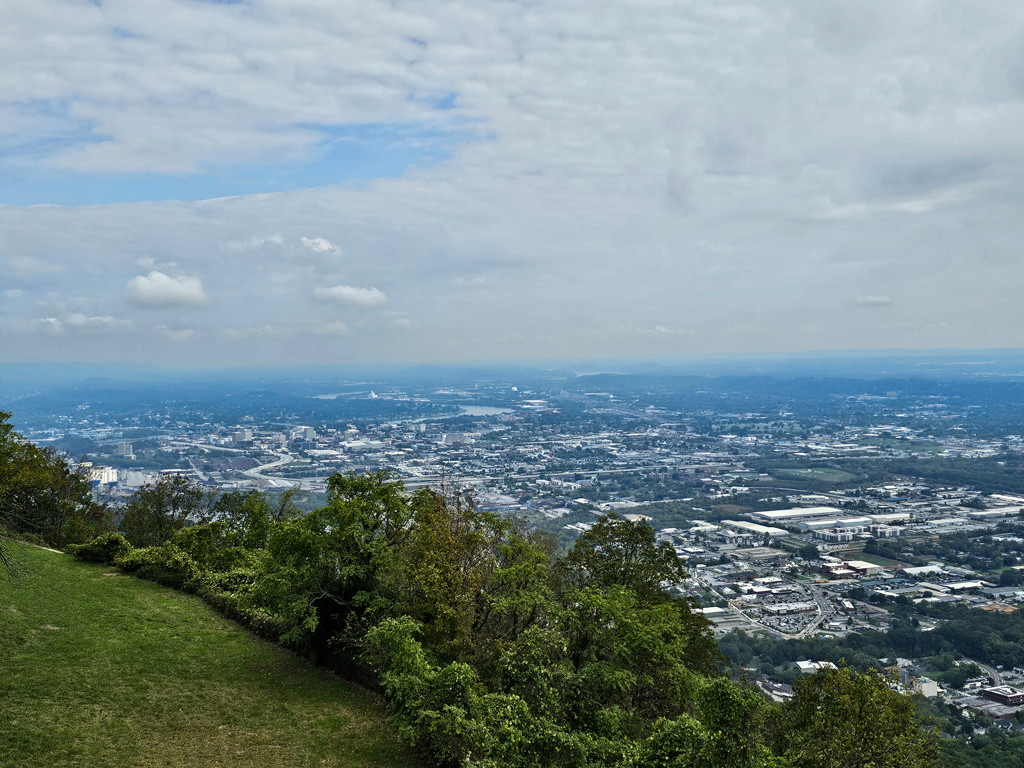
The view from the top of the Incline Railway
Incline Railway return

Another Looper arrived in the late afternoon, so at last we were not the only boat on the dock.  They joined us for our planned visit to a rooftop bar called “Whisky Thief” in a nearby hotel.  The public areas of the hotel have beautiful, fascinating artworks on display, and Debbie and I would have liked to have had more time to study them.  The bar was quiet when we arrived, but grew increasingly noisy and crowded as the evening progressed.  The menu is limited to QR codes or, find the bar’s website online.  While they serve flights of various whiskeys, you have to keep going back to your phone to figure out what you are drinking.  Instead of a flight, I had a bourbon that we had enjoyed last year when we tried a (properly labelled) flight in a restaurant in Louisville.  We enjoyed the congenial company and will look forward to seeing them again at Rendezvous.

One of the beautiful artworks in the Edwin Hotel
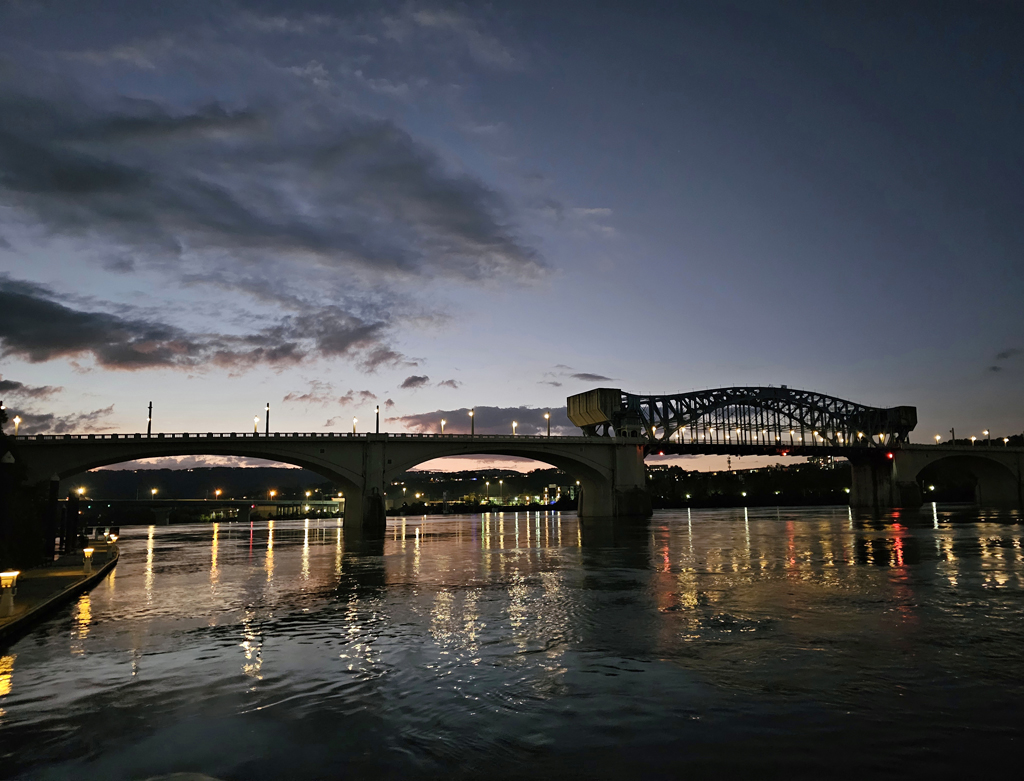
The Tennessee River at night, Chattanooga

The next day, after working on the Rendezvous presentation all day, we were glad to go out and walk to the second of the top steakhouses in Chattanooga.  There was a bluegrass festival in the waterfront park, but it was very hot and crowded, and the music was not really our taste, although we do enjoy some bluegrass.

Dinner was quite good, with excellent service, but the ambiance was more like a large cafeteria than an expensive steakhouse.  It was very noisy and crowded, and most of the patrons were dressed for the outdoor festival.  Although the water had receded and uncovered the downstream walkway to our dock earlier, when we returned it was up again, resulting in wet shoes and socks.

Hennen’s Steakhouse starters
Hennen’s Steakhouse steaks for both of us

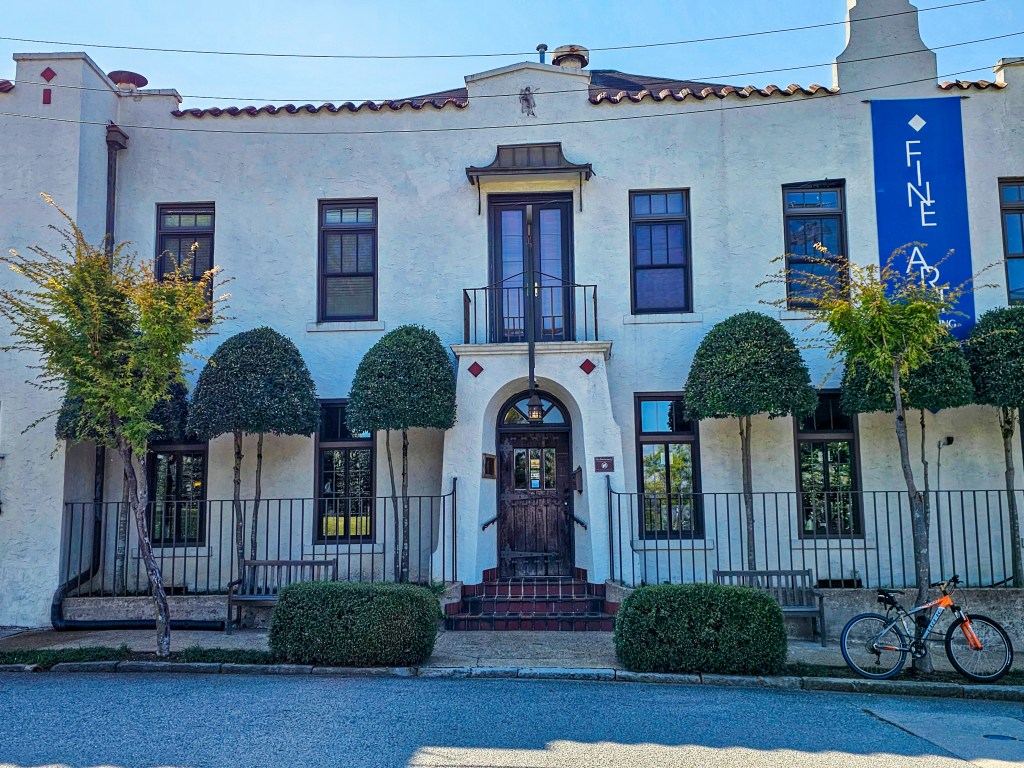
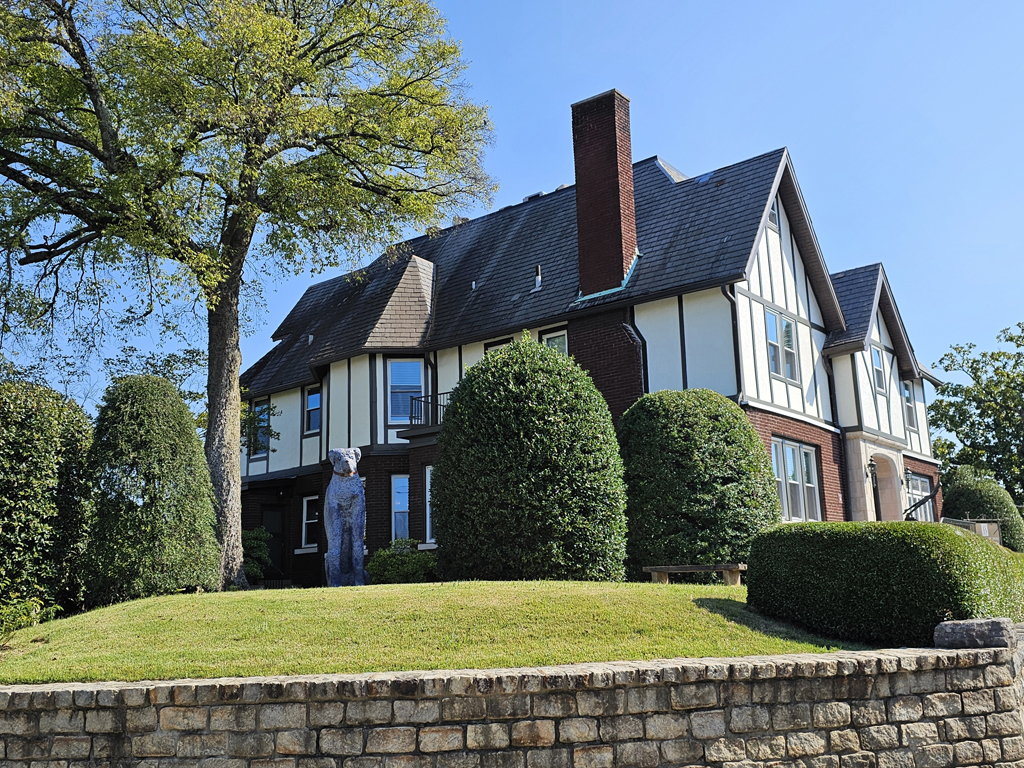
After another of Dick’s special breakfasts, we set off for some sightseeing.  I had found what was described in glowing terms as an art enclave with shops, galleries, an artisan bakery, and restaurants.  It was certainly an attractive area, but one of the galleries had limited days, and the other was not yet open on a Sunday.  No shops, and the artisan bakery was just pastries sold out of a coffee shop with a queue of at least 30 people.  Apart from the coffee shop, there was just one restaurant that we had been told was not very good.  So, we walked back to the Museum of American Art.  You could have knocked me over with a feather when Dick told me that was actually our destination for the morning.

Chattanooga Bluff View Art District

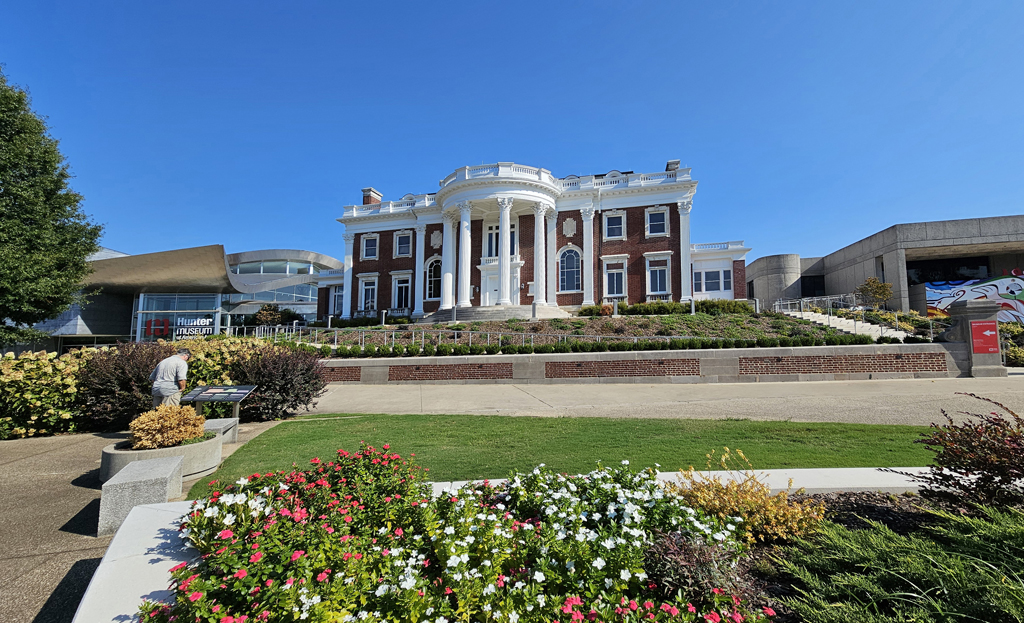
Of the temporary exhibitions, one that featured art glass had just finished, we would have loved that.  Instead, there was an exhibition of graffiti.  Yes, the stuff that vandalizes public and private buildings and street furniture.  Dick walked around it, I didn’t.  Afterwards, Dick’s comment was that while he recognizes people’s right to express themselves, and even the talent of the artists, he totally objects to the defacing of public and private buildings, spoiling someone else’s architectural, engineering, or design efforts.

The permanent exhibitions were more interesting, spanning American art from the 1700’s to contemporary.

The Museum of American Art, Chattanooga
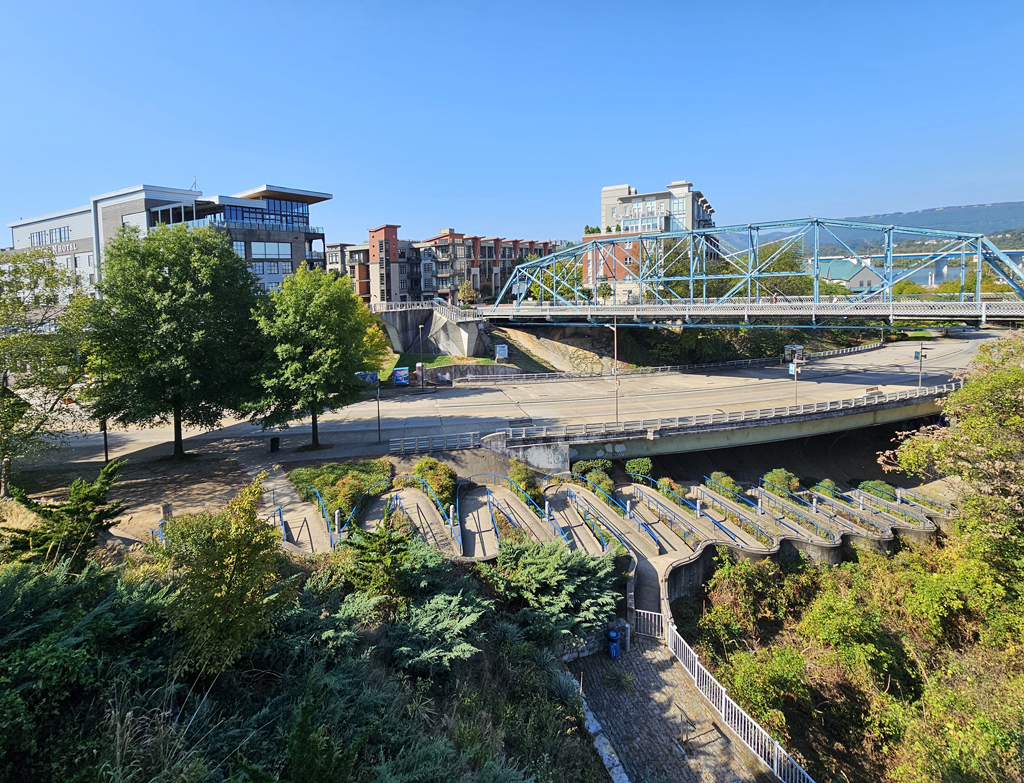
Chattanooga’s Walnut Street pedestrian bridge over the Tennessee River
The Zig Zag Walkway is an alternative to climbing one of the steep staircases up from the river

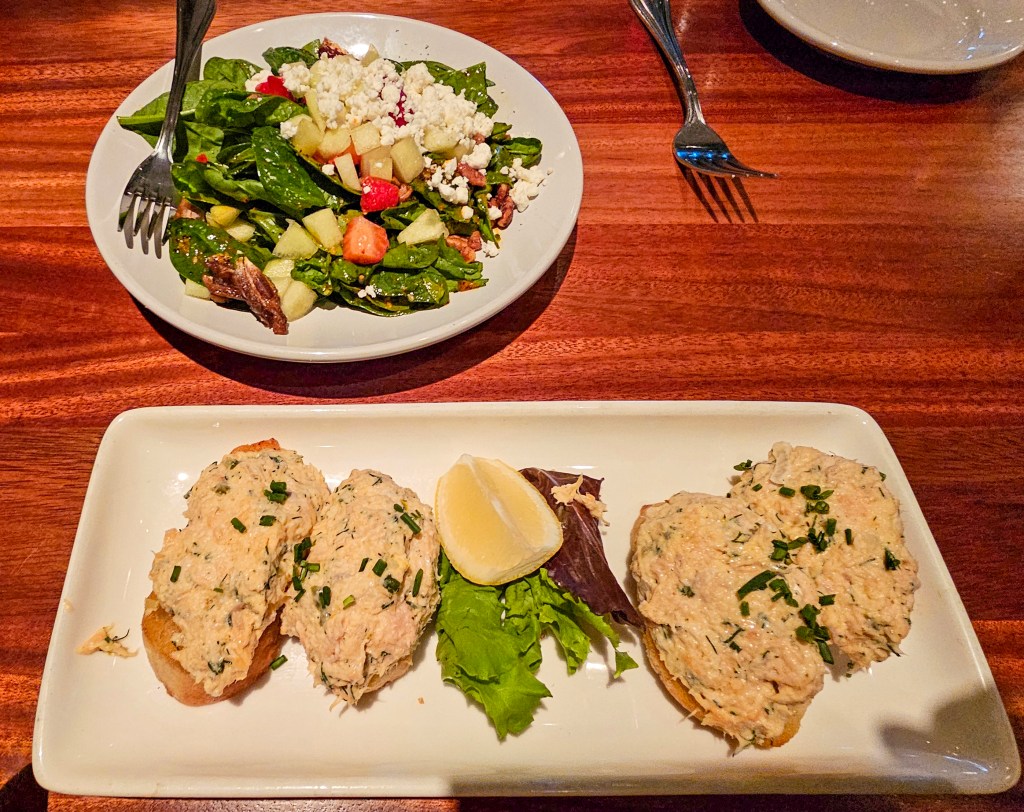
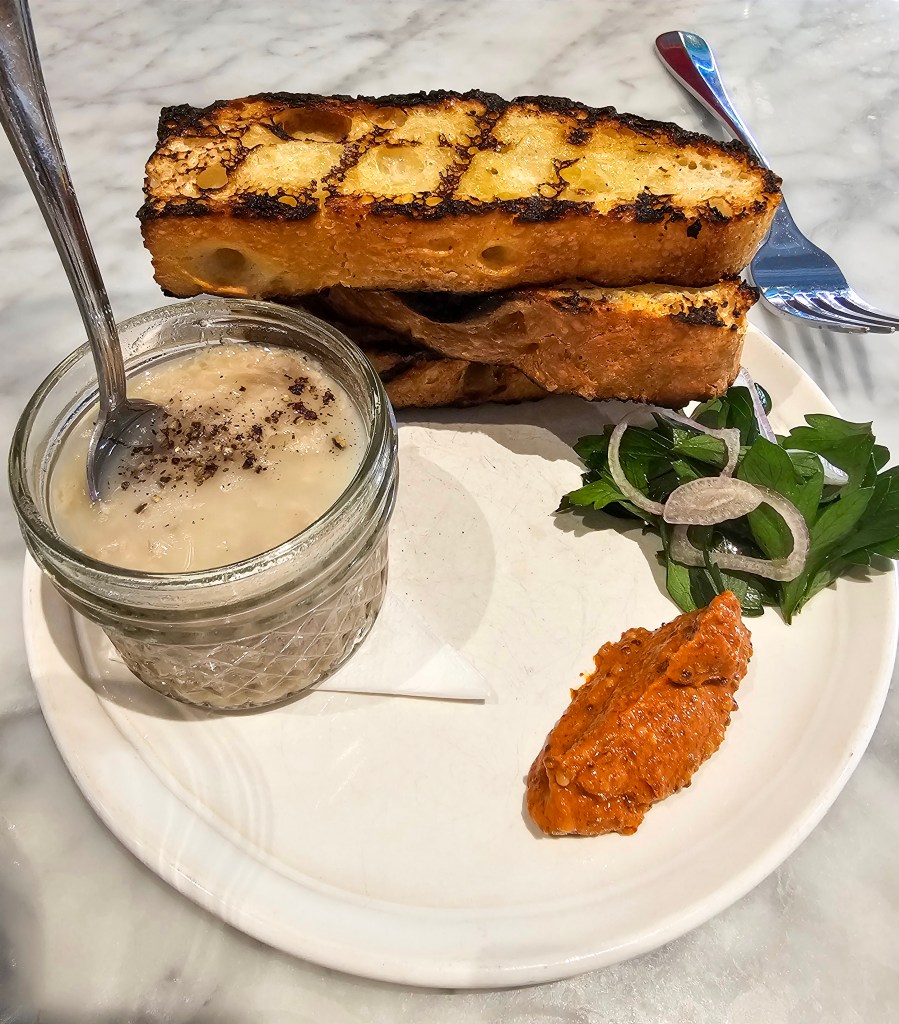
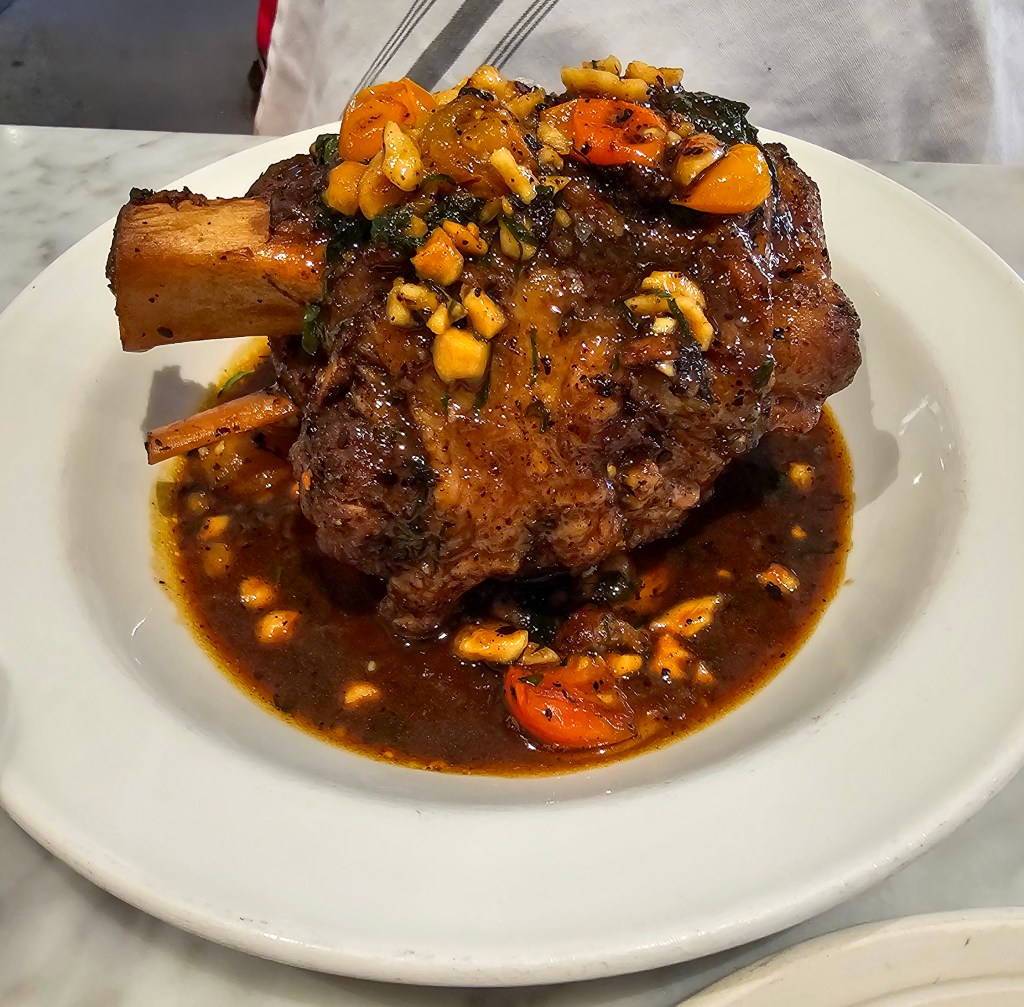
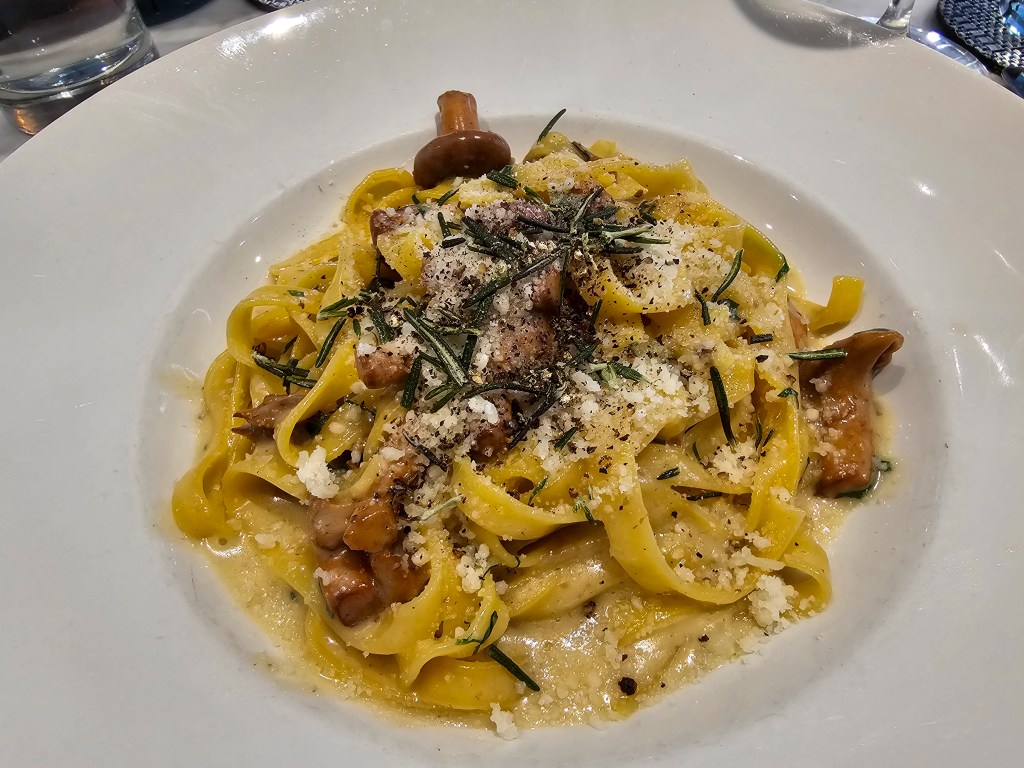
We went to Easy Bistro for an early dinner.  The venue was a surprisingly authentic French style.  I enjoyed the meal, quite unexpected, since there was so little on the menu for me to choose from that I ended up with a side dish as a starter.  Dick was in heaven, and had difficulty choosing from so many unusual options.  He settled on the rabbit rillettes, followed by pork hock, and profiteroles to finish.  My mushroom tagliatelle was very good, and worth taking home.  (and we remembered to take it, unlike the previous evening when we left the beautiful steak leftovers on the table by mistake).  The first glass of wine let me down.  I usually enjoy a Loire Valley white wine, but this one was awful.  It also happened to be the cheapest on the menu.  Dick’s comment, “The French hated it so much they sold it cheap to get it out of their country…”

Rabbit Rillettes with Garlic Toast at Easy Bistro
Pork Hock at Easy Bistro
Mushroom Tagliatelli at Easy Bistro
Profiteroles at Easy Bistro

We left early the next morning so we could go back to the fuel dock and take advantage of the excellent (and free) pump out machine.  We were properly underway before 9am, but there was a delay at the lock for a pleasure boat to lock down.  There are very few tows on this part of the river system, particularly given the delays at Wilson lock.

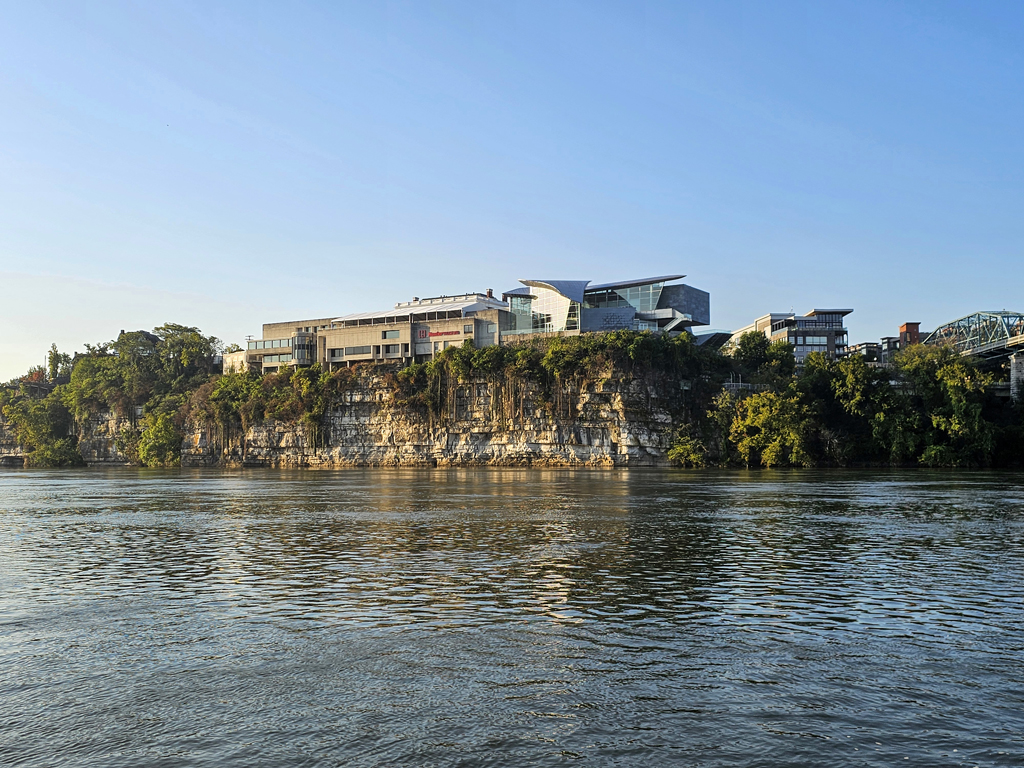
American Museum of Art from the river

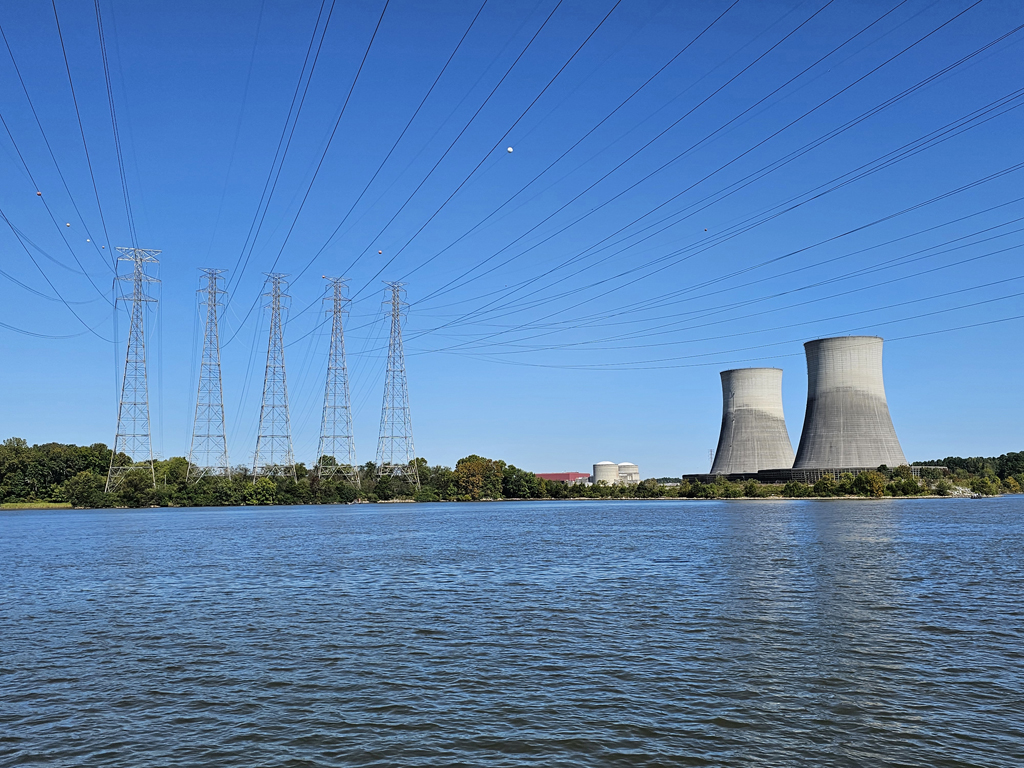
We passed the Sequoyah Nuclear Plant.  This plant, and its sister plant at Watts Bar, has a special system that uses borated ice to help condense the steam in the case of a loss of coolant accident.  The system allows for a smaller containment building.  The reactor cooling water at the Sequoyah plant is mostly pumped into the Tennessee River at a rate of a million gallons per minute.  A maximum rise of five degrees F is allowed in the river as a result of releasing the cooling water.  Once the maximum is reached, the big cooling towers are used to provide the required extra cooling.  On both occasions that we passed there was no steam coming from the towers.  We noticed that the area is popular with fishermen, so the fish must like the warmer water too.

Sequoyah Nuclear Plant, Lake Chickamauga

Sequoyah was a Cherokee polymath.  His most well-known achievement was the creation of a Cherokee syllabary, enabling the Cherokee language to be written as well as spoken.  Within 25 years of adoption of the syllabary, the Cherokee Nation had almost 100% literacy.  Many things have been named after Sequoyah, including the giant trees in California, a mountain in the Great Smoky Mountains, and a yacht that was formerly used by American Presidents.

That night we stayed at a fellow AGLCA member’s dock on Lake Chickamauga.  They have built a beautiful house above the lake with stunning views.  Their boat is elsewhere for repairs, so Nine Lives was made welcome.  We enjoyed refreshments and nibbles and the wonderful views from their balcony.  Later we returned the hospitality with docktails on Nine Lives.

We saw our first Bald Eagle this trip on Chickamauga Lake
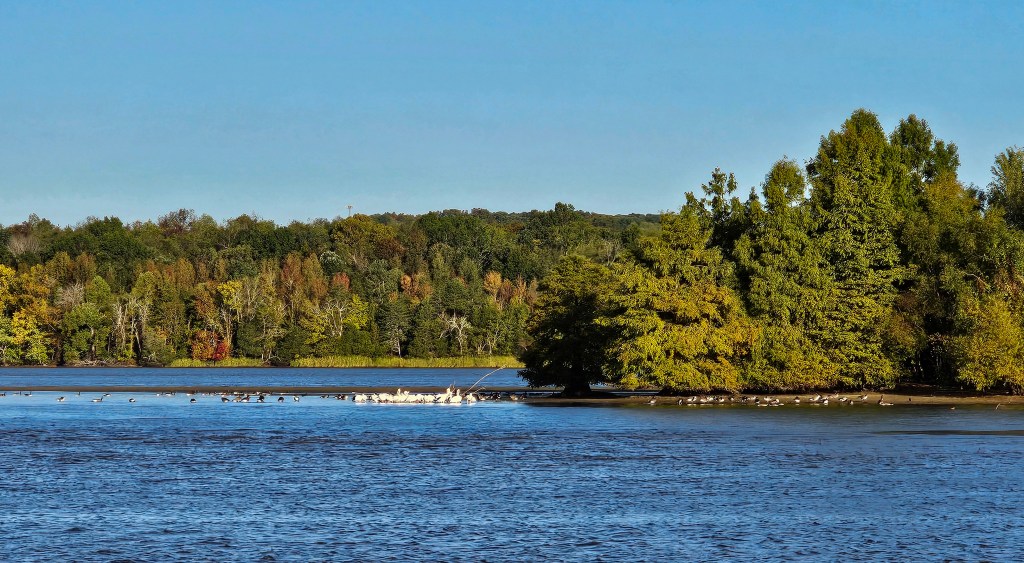
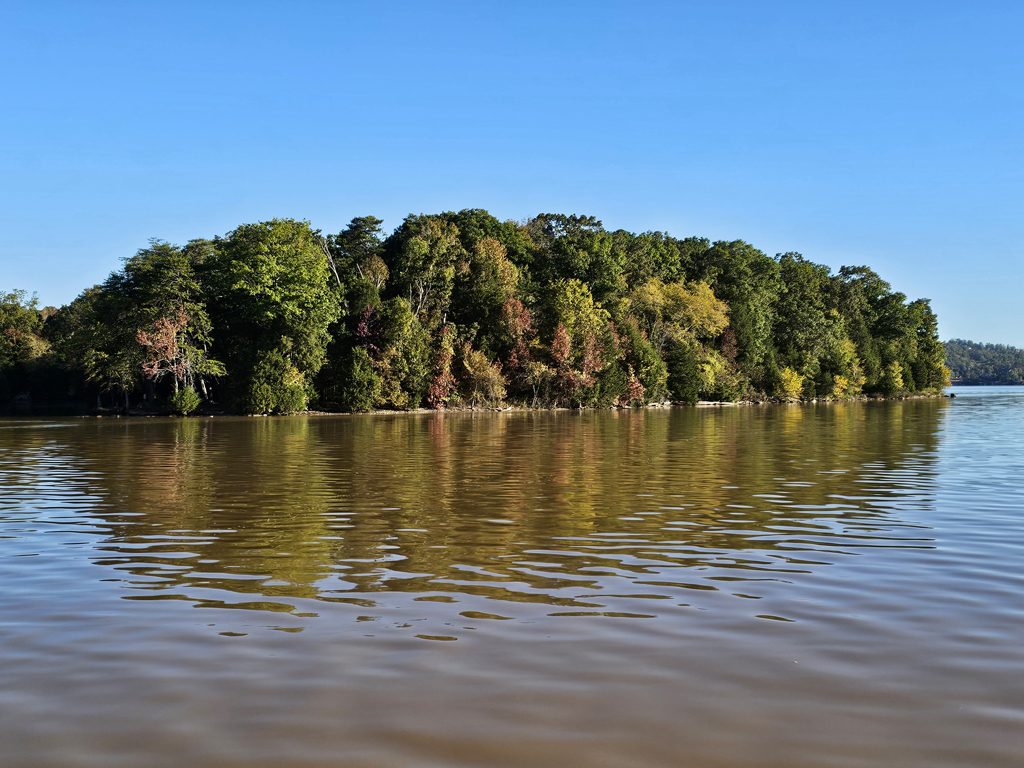
Autumn colours and pelicans

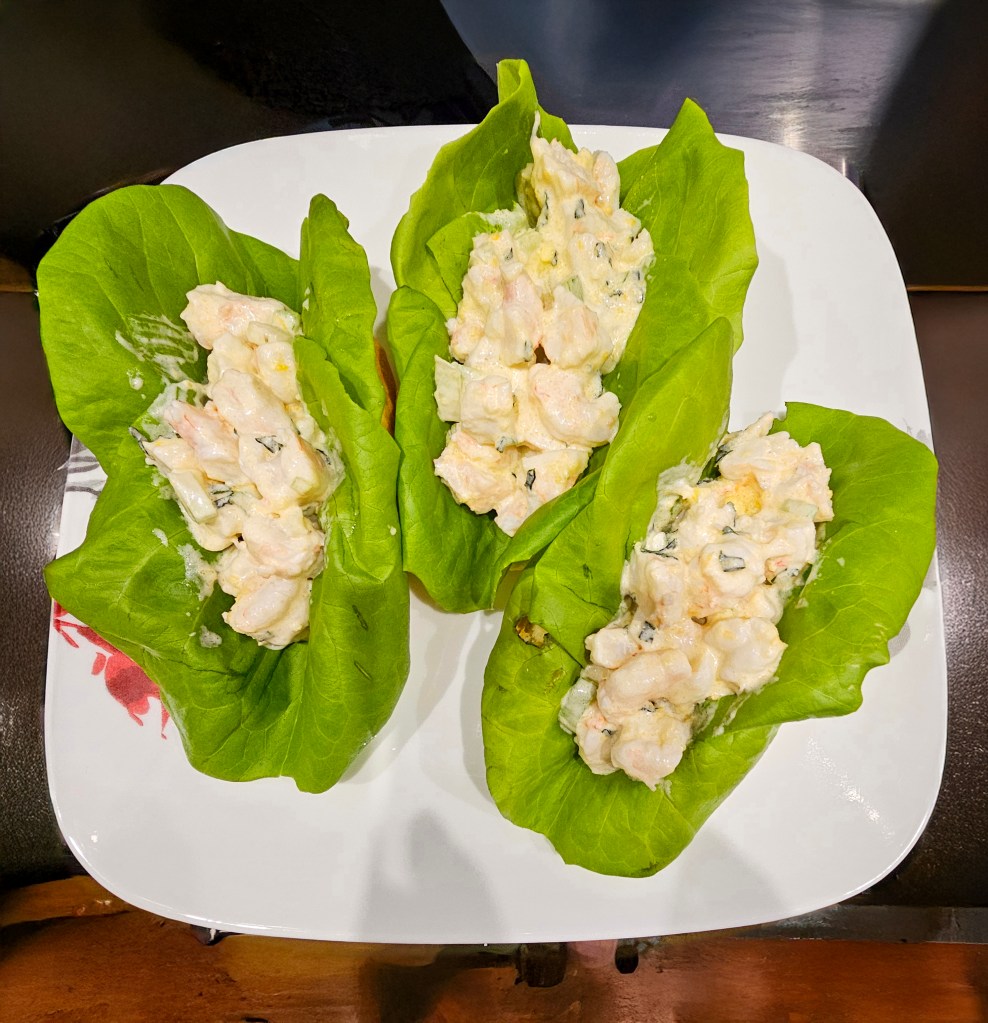
On October 8th we got an early start, expecting an 8-hour day, but the lock was ready for us when we got there, so we didn’t lose much time.  We were in the marina by 3:30pm in spite of a strong current against us.  The staff asked us to arrive before 5pm, so they could help us tie up, but after detailed instructions by phone for finding our slip, there was no help in sight.  Usually, this is just as well.  Not only does it save tipping a dockhand, but we do better ourselves.  This time it was a little more tricky than most because of very small cleats that are hard to keep a line around.  The onsite restaurant was closed for the season, so we had planned for shrimp sandwiches on board.  This year, instead of relying on frozen shrimp from the supermarket, some of which has been so awful it had to be thrown away, we bought several 1- and 2-lb packages of wild caught shrimp from Hudson’s in Hilton Head.  What a difference in flavour and texture!  Of course, it does mean that for shrimp sandwiches I have to cook them first, but the result was well worth the extra effort.

Shrimp sandwiches

We now have wonderfully cool nights and chilly mornings.  Long sleeves are good to start, and I am starting to think about the gloves that I have packed away somewhere that have full fingers.  We are beginning to see pretty fall colours and mist on the water in the mornings.

We passed under Interstate 75.  This highway starts at the Canadian border in Sault Ste Marie, and links Detroit, Cincinnati, Lexington, Knoxville, Chattanooga, Atlanta, Tampa, and Miami.

Passing under Interstate 75

In Loudon, about a mile of the riverbank was taken up by the Primient factory.  This plant used to be the familiar Tate & Lyle, but it was rebranded following ownership change.  Most of the factory is screened by trees from the river.  The smell is strong, and not particularly pleasant.  We thought we would not like to live in any of the houses across the river that must have the smell with them all the time.  Corn is delivered and turned into a variety of products including high fructose corn syrup, and fuel ethanol.  Something about those products being produced in the same facility….

Primient Plant, formerly Tate & Lyle, at Loudon
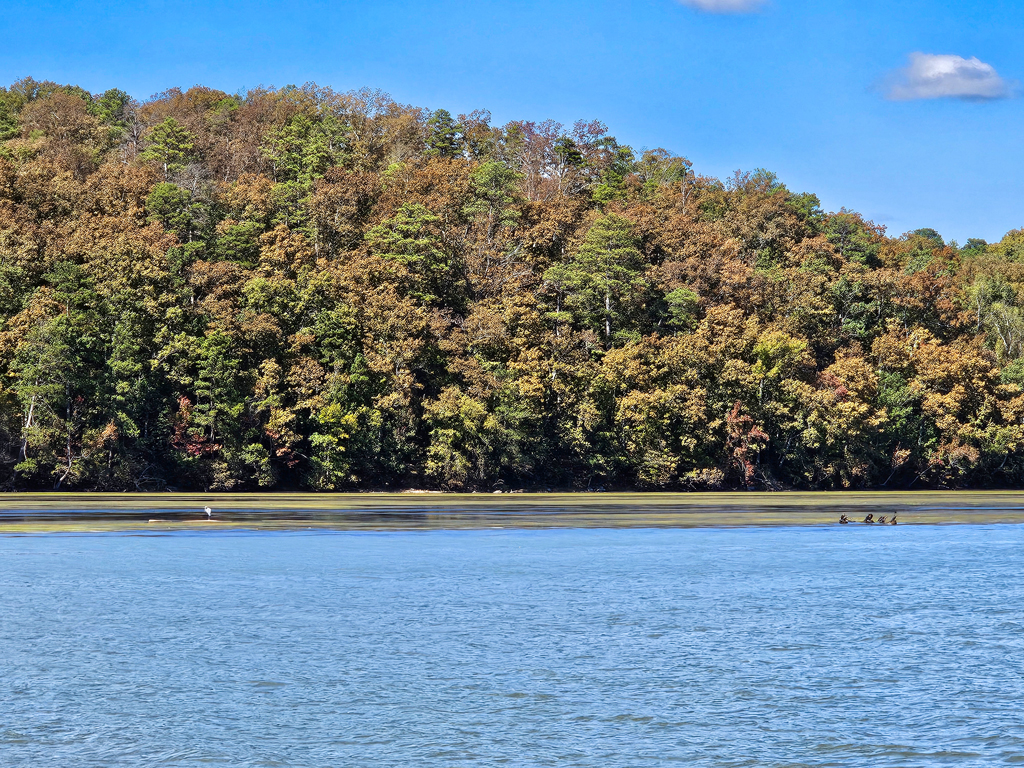
Fall colours on Watts Bar Lake
A farmhouse on Watts Bar Lake with the Smoky Mountains in the distance

A day that was a mix of interesting shoreline and long boring stretches became far more exciting than either of us liked.  Ft Louden lock was our last upbound lock on the Great Loop, and it was a doozie.  When we were about 30 minutes away, Dick made his usual polite phone call to ask about the queue, and request a lock up.  The lockmaster explained that he was about to lock down a tow that would take 8 hours, but that if we could get there within 20 minutes, he would take us up first.  Dick put the hammers down, Nine Lives leapt forward, and we arrived at the lock in less than 15 minutes.  Then the excitement began.

Nine Lives speeds up to catch the lock

In addition to some huge logs and pieces of debris, the water coming off the dam had created an area of rolling waves with whitecaps, that were broadside to the boat.  Dick fought his way through the mess, as we were flung this way and that.  We were very glad that we observe “cupboard discipline” and latch all cupboards and drawers at all times.  If we didn’t, the contents would have been on the floor.

Looking back at the rough water below Ft Loudoun Lock

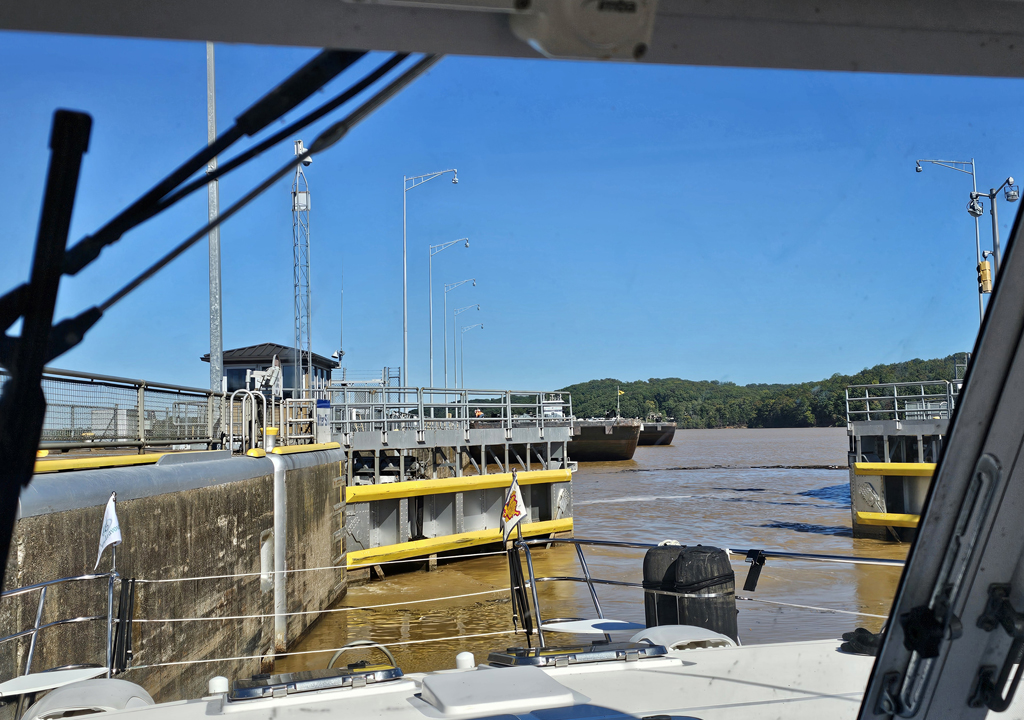
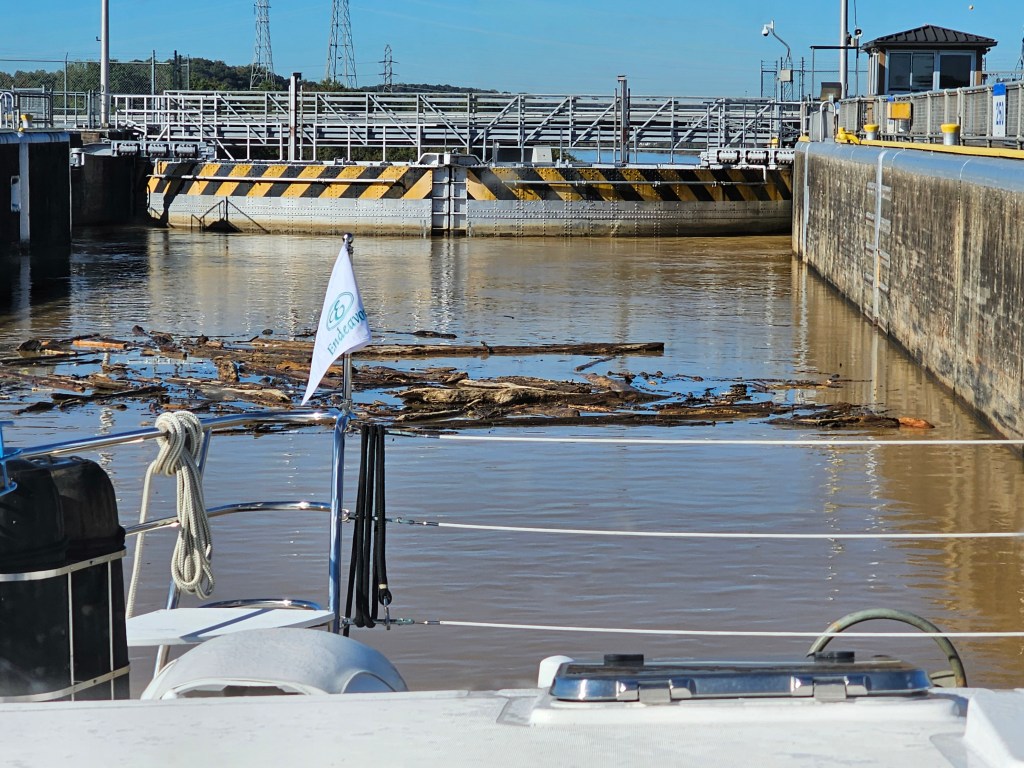
As we waited for the lock doors to open, we could see 2 huge tree trunks, each about 20 feet long, blocking the lock entrance from each side.  The only way was to push through them slowly.  Finally set, with Dick tending the line on the floating bollard as usual, he looked up to see a whole bunch of people looking down at us!  Once again, we were the show, or at least the opening act.  The lock was conducting tours of 30 to 35 local people, and our adventure coincided with one of the tours.  The excitement was not quite over.  The waiting tow had moved into position, in front of the lock gates.  Fortunately, after his front barges were tied off, he backed up a little, so there was enough space for us to get past.  Once again, we had to push through a debris field.  Certainly there was lots going on for the watching tour group. Dick posted on the Looper forum that evening, advising Loopers not to plan to come through that lock until the high water had subsided.  Nine Lives managed the turbulence, but some boats would have real trouble.

Exiting Ft Loudoun Lock past the waiting tow and through the debris field

We arrived at the marina, which is immediately above the lock, and had no answer when Dick tried to phone.  This meant tying up at the fuel dock in order to get a dock assignment and the gate key.  Always a pain.  Our slip was very short, although thankfully wide enough, with very small cleats that were impossible to get a line onto from above.  Once in the slip, I put the stern line around a post, and took station at the helm while Dick half climbed and half jumped off in the middle of the boat and secured all the lines.  I was not required to jump down 5 feet to go to dinner, as the ladder fit!  We planned to eat at the onsite restaurant.

We walked over and had about ½ an hour to wait.  However, there was room in the bar, and while Dick enjoyed a beer, I felt the need for something a little more robust after our earlier excitement, and ordered Woodford Reserve.  It was a double, but (sadly) not what one would describe as a generous pour!

The restaurant won a National Rib Cookoff, and regularly wins “best of” in Knoxville.  This is a barbecue restaurant, which means that I now have to explain to our non-Southern readers just exactly what is meant by the term barbecue.  In Canada, UK, Australia, and much of northern USA barbecue is a method of cooking over direct heat such as charcoal or gas, generally quite quickly.  Southern barbecue however, is done with indirect heat, such as smoking or roasting and over a long time.  Most Southern barbecue will feature a tomato and pepper-based sauce with brown sugar and often quite hot spices.  There are literally hundreds of bottled barbecue sauces available to buy in supermarkets, and restaurants often have their own recipe.  Dick and I have learned to use the term “grill” to describe either the equipment or cooking method, in order not to confuse any guests who might be expecting something quite different from what we are preparing!

Dick ordered a trio of 3 dishes, BBQ ribs, fried chicken, and pulled pork.  I had a hamburger.  All were excellent, but I found that the seasoned fries had a sweet taste that I didn’t like at all.

The replica ships, Nina and Pinta, were visiting the Tennessee River when we were there

Next morning we set off up the Little Tennessee River.  We passed the earth dyke of the Tellico Dam, a highly controversial dam that created Tellico Lake.  TVA insisted that this dam was required to prevent flooding downstream, and also to improve the local economy.  Environmentalists, local landowners, fishermen, and Native Americans all objected for a variety of reasons, including the presence of the endangered snail darter (a fish).  Construction was halted just before completion.  Eventually it went forward by an Act of Congress.

Tellico Dam, essentially a long earthworks.

There are an enormous number of houses built around the Lake, all very large, over 5000 sq ft.  Certainly, the local economy was very much improved by the sheer amount of wealth that has migrated to the location.  What the snail darter thinks, we do not know, although the freshwater fish was relocated by TVA and is no longer considered endangered.  Later we saw the tops of drowned silos, a reminder that these lands had been farmed for generations and the landowners were forced out.

Some of the miles and miles of wealthy homes on Tellico Lake
Drowned silos are a reminder of what was lost and destroyed when the dam was built

We had thought to stop at Tellico Marina for the night, but repeated calls and emails had no response.  We went into the marina, and headed for the fuel dock, but it became increasingly shallow, so Dick turned around and we decided to anchor elsewhere overnight.  Shortly after leaving, the marina called to say they had space, but we told them sorry, too late, we already made other plans.

We explored about 26 miles up the river.  There were fine views of the distant Smoky Mountains, but surprisingly little fall colour in the trees.

View of the Smoky Mountains from Tellico Lake

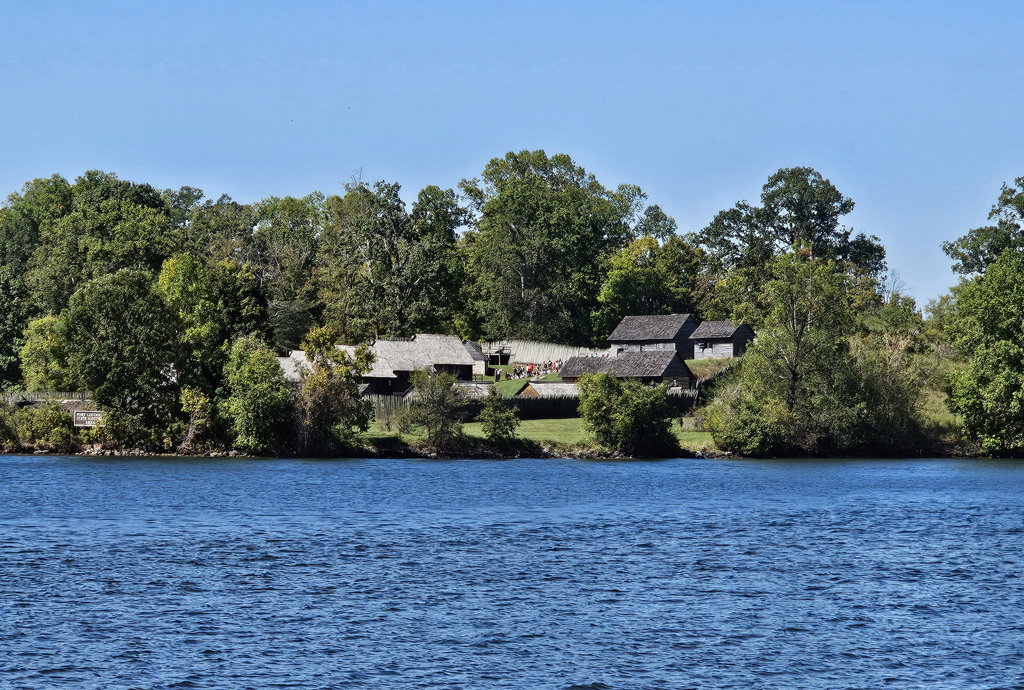
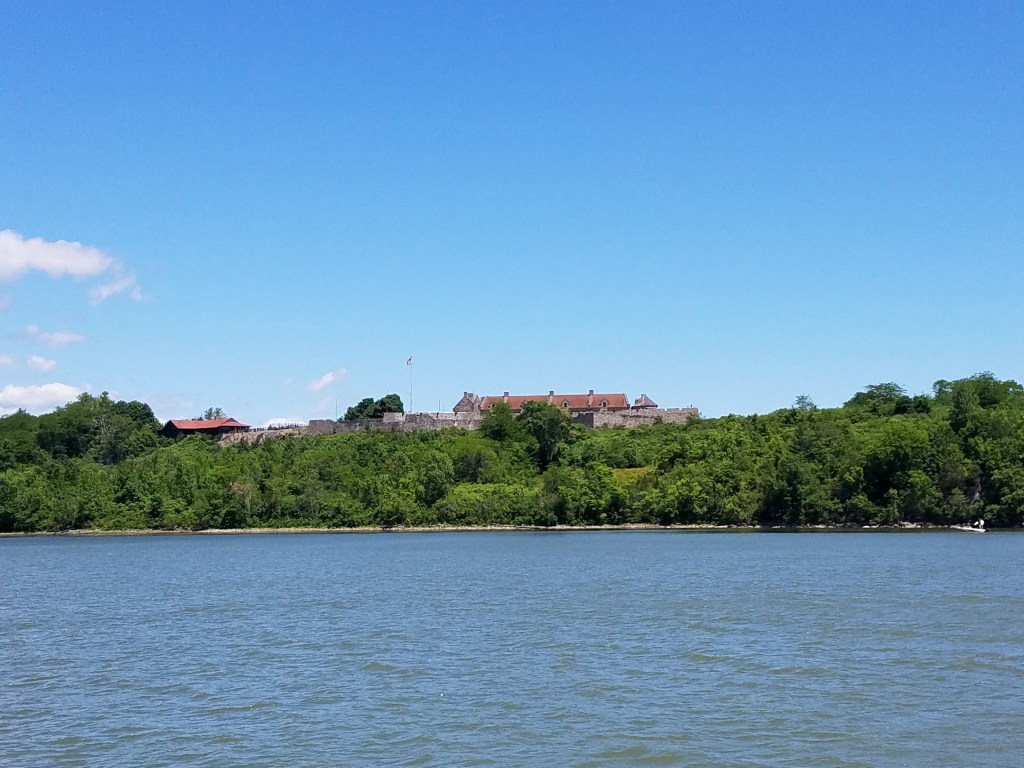
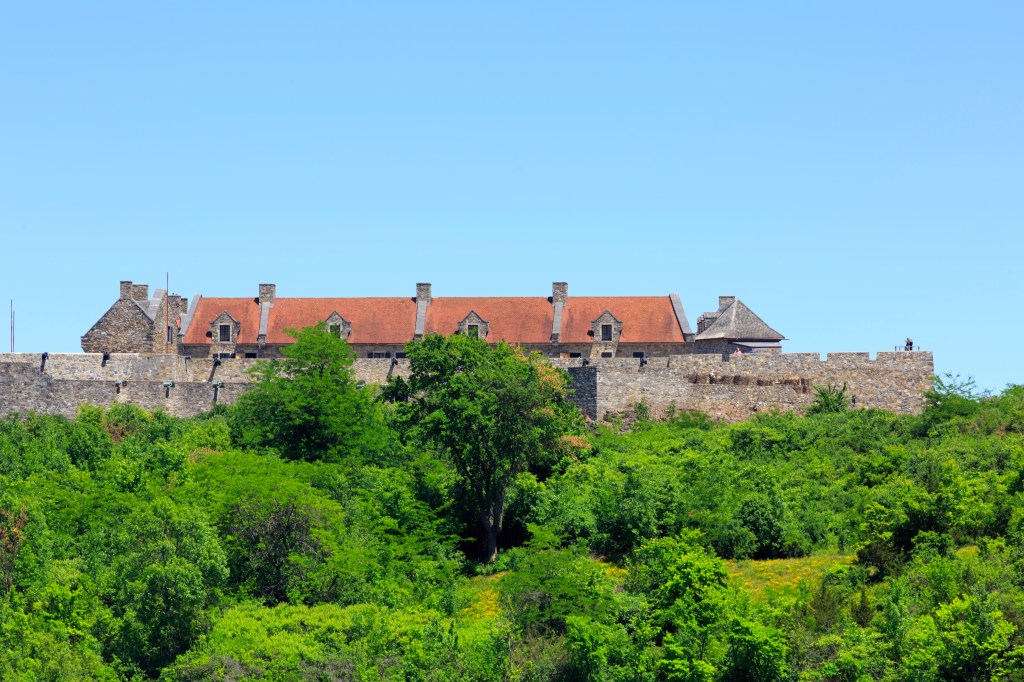
Fort Loudoun was built by the British in 1756 to help keep the French out of the Appalachian region during the French and Indian War.  Just a few years after the war ended, there was a tragedy.  A breakdown in relations between the British and the Cherokee Nation resulted in 16 Cherokee chiefs who were being held hostage, being executed in South Carolina in 1759.  Fort Loudoun’s supply line was cut in the spring of 1760.  Once the food was nearly gone, the commander asked the Cherokee for terms of surrender.  Early in the morning on August 9th, the garrison of 180 men and 60 women and children left the fort by agreement and travelled as far as they could before making camp.  At sunrise the next morning, the camp was attacked, and 30 people were killed.  The rest were taken as slaves, although many of them were eventually ransomed.

Fort Loudoun reconstruction

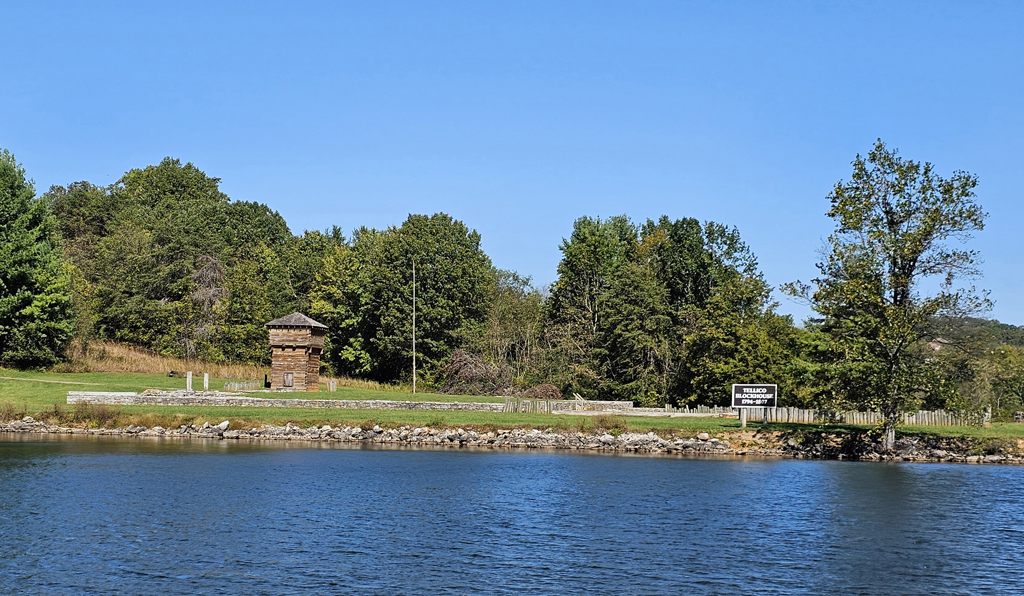
Across the river from the Fort, the Tellico Blockhouse was built in 1794, with the primary purpose of keeping the peace between white settlers who were moving into the valley and the Cherokee who lived there.  The blockhouse became a thriving trading post and was an important centre for negotiation of treaties for some years.  Gradually the local Cherokee moved away from the area, trying to get away from the encroaching settlers, and the blockhouse lost its strategic importance.

Tellico Blockhouse reconstruction

Among the huge tracts of expensive houses lining the lake we saw a number of boat building factories.  Yamaha, Sea Ray, and others were represented.  Clearly, this is a popular area for boat building.

The anchorage we thought would work was too small and unprotected, so we went back up the river a little way and found a good spot in a deep cove across from an RV park.  It was well protected.  The strong winds died down as soon as we got into the cove.  We had a very quiet night, and temperatures are now quite low, so the generator was not needed.  In the morning, the anchor came up easily, but covered in sticky red mud, so cleaning was required the next time we had dock water supply.

The return transit through Ft Loudoun lock was not something we were looking forward to.  There were some huge tree trunks we had to push through to get into the lock.  The ride down was smooth and easy compared to going up!  The debris field inside the lock raised our hopes briefly, as it appeared to obligingly move away to the side, but then the hopes were dashed as it spread itself back across our bows.  Dick did a masterful job of using bursts of the engines to move us forwards and then neutral to glide through.  Unfortunately, there was an even worse mess below the doors.  Eventually, I had to stand at the bow and direct, while Dick maneuvered forwards, backwards, and sideways, to shake the trees, and even planks of wood off the bows and avoid getting them caught in the props.  We only heard the distinct crack crackle of chewing lumber once.

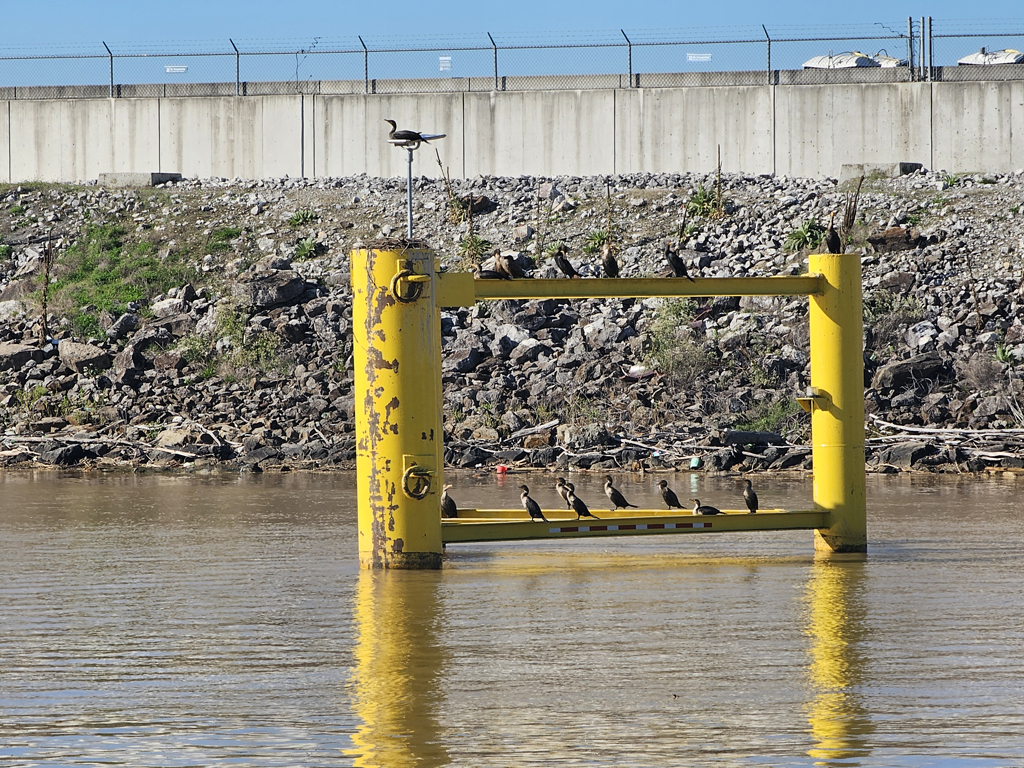
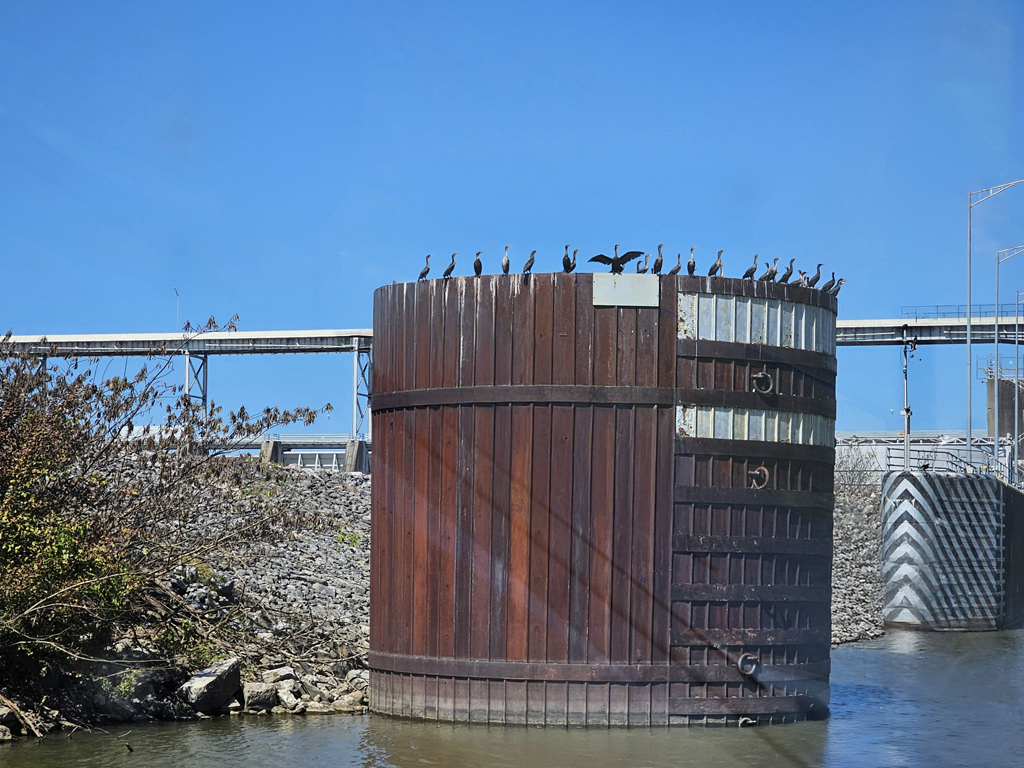
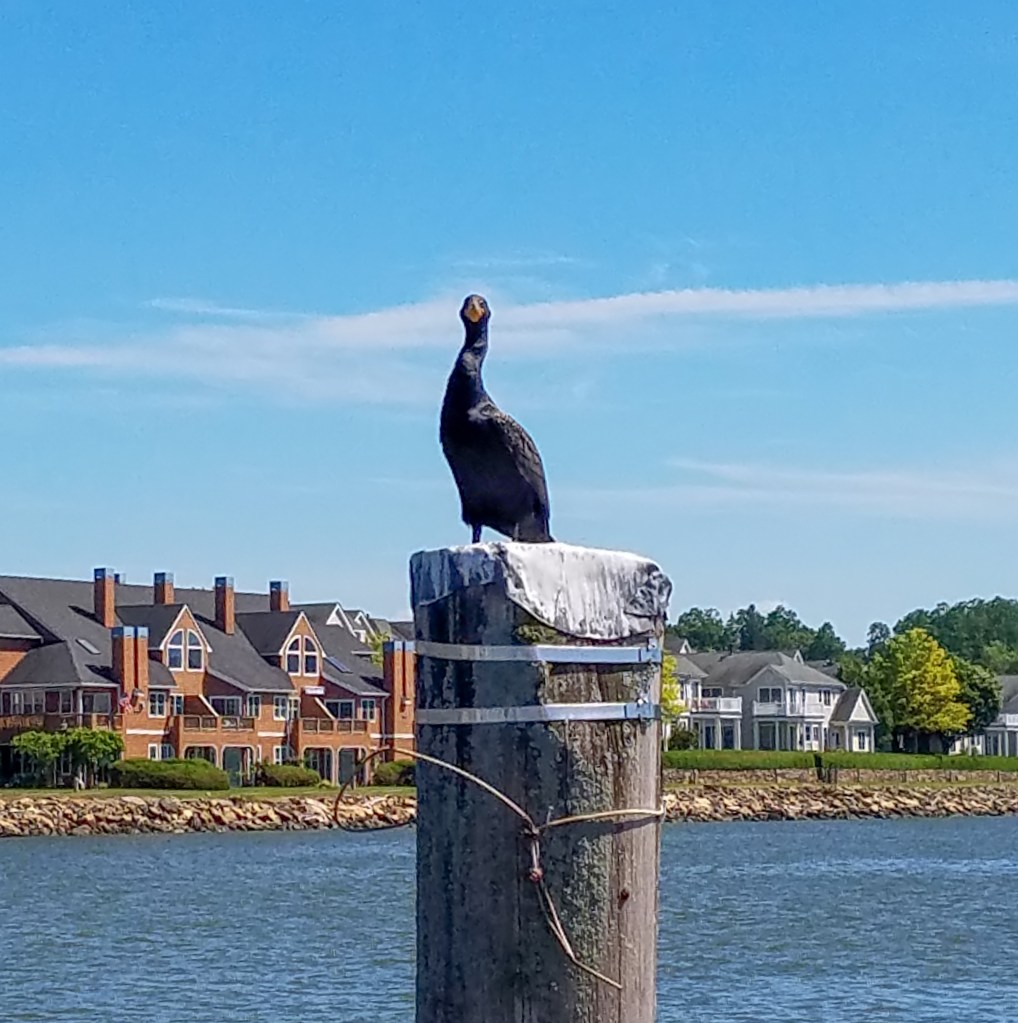
Cormorants at Ft Loudoun Lock

Debris navigated, there was the roiling water of the dam outflow to negotiate.  Although it was still more exciting than we would have liked, it was definitely easier with the current behind us even though the waves were still broadside.  Nice and friendly though the staff were, we are well glad to see the last of Ft Loudoun lock!  Later that day the lockmaster posted a video on their website of Nine Lives gliding up to the floating bollard with me at the helm and Dick waiting to lasso the pin.  We were quite chuffed, it all looked very professional!

Debris in the Ft Loudoun Lock

As we headed downriver, we had a helping current, and made 9 and even up to 11 knots at our normal engine revs, compared to 5 on the way up.

We could see the stacks of TVA Kingston Steam Plant, also known as Kingston Fossil Plant.  It was built between 1951 and 1955, and at the time, was the largest coal-fired power plant in the world.  In 2008 a dyke ruptured at a coal ash pond and 2.7 million cubic yards of fly ash spilled, burying 400 acres 6 feet deep and filling the Emory/Clinch Rivers, that flow into Watts Bar Lake, in sludge.  The dangers of using wet storage ponds for fly ash was known at the time, and TVA had found leaks in the levees and seepage into the soil at the sites of many of its storage ponds.  Instead of switching to dry storage ponds, small repairs were made to reduce costs. This was the largest industrial spill in US history.  The cleanup was declared complete in 2015, but many residents of the area still do not drink the water or swim in the river.

Distant stacks of TVA Kingston Steam Plant
Historic image of the wall of ash after the spill at Kingston Steam Plant (courtesy Wikipedia)

We went into a deep bay for our marina for the night. Caney Creek Marina does not appear to be well known to transient boaters, but we had a good stay.  Our neighbours on the dock had seen the Ft Loudoun lock facebook video that featured us entering the lock, and they came out to help us tie up as soon as they saw us arrive.  We were then invited to drop over for some beer and chat.  A most enjoyable encounter.

Fishing in the early morning mist
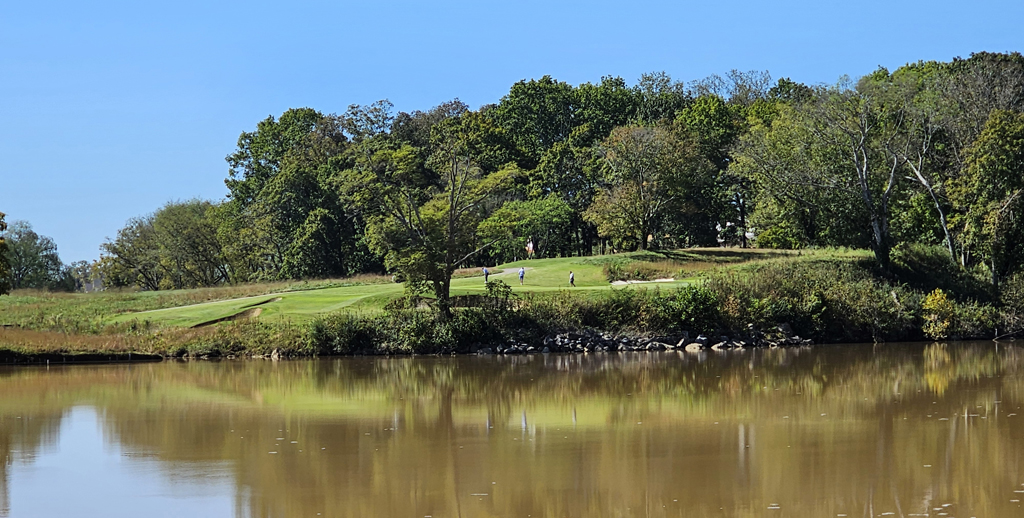
Tennessee National Golf Course
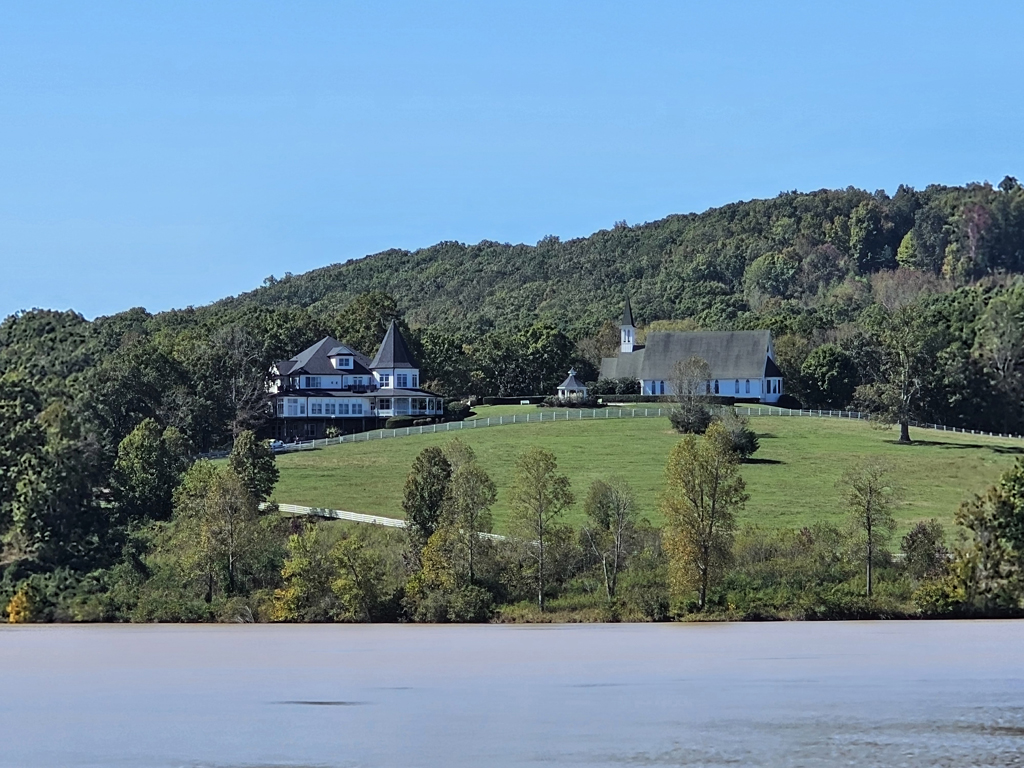
Whitestone Inn, an upscale B&B
An unusual rock formation and fall colour

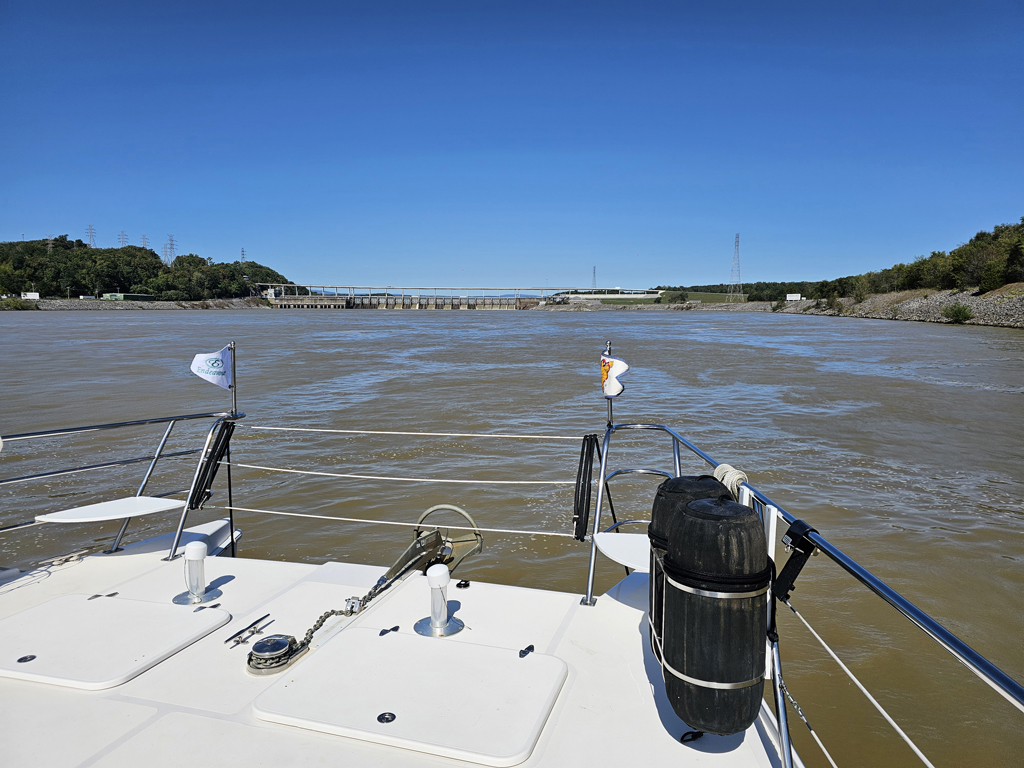
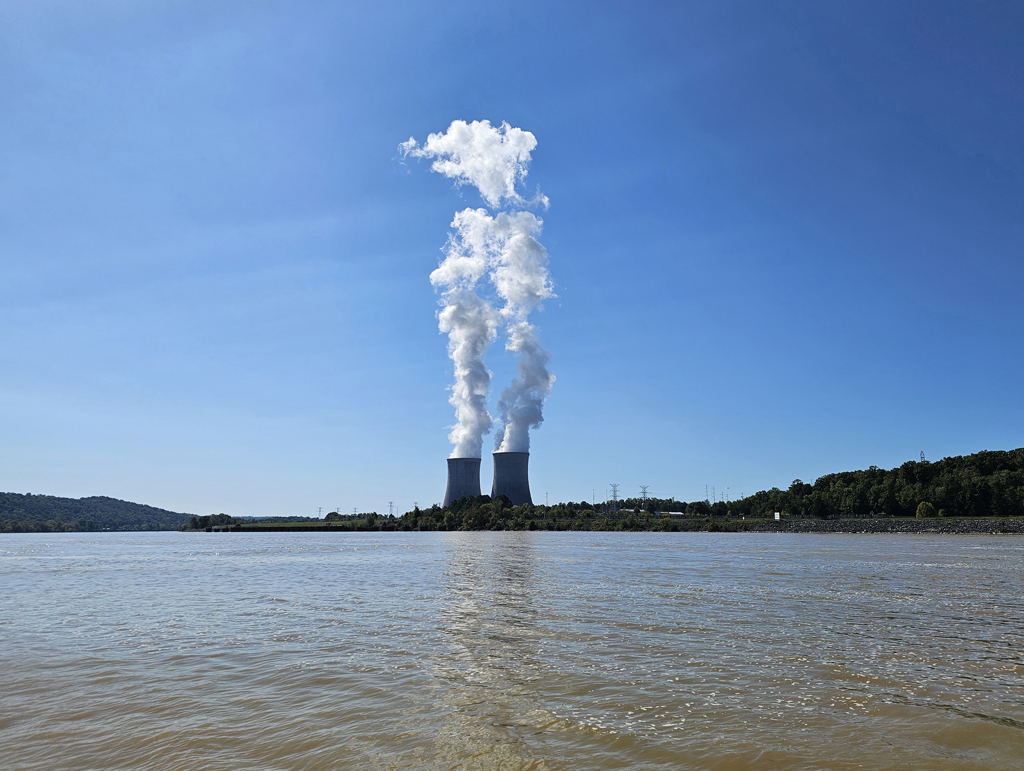
We were out by 9:30 the next morning, a little later than planned, but Dick took the time to wash the mud off the anchor from the previous day.  After transit through the lock, we passed the Watts Bar Nuclear Plant.  It is unusual to find a nuclear power plant and a hydroelectric generating station in the same location.

Approaching Watts Bar Dam
Cormorants at Watts Bar Dam
Watts Bar Nuclear Plant. That is just steam, not pollution, from the cooling towers.

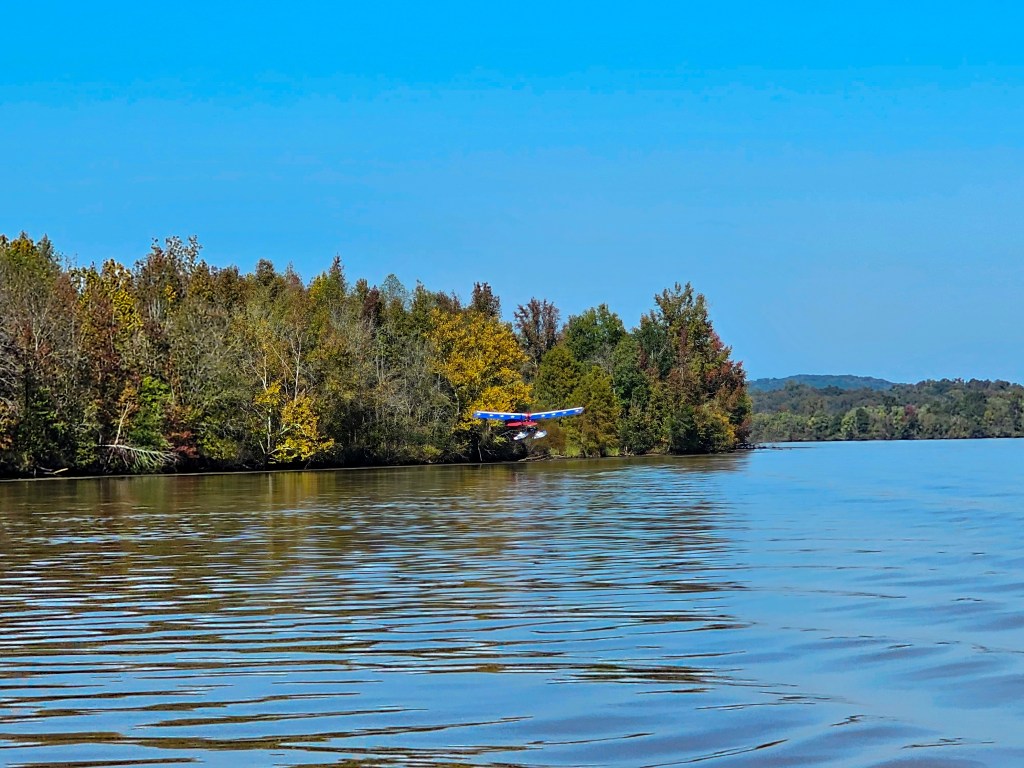
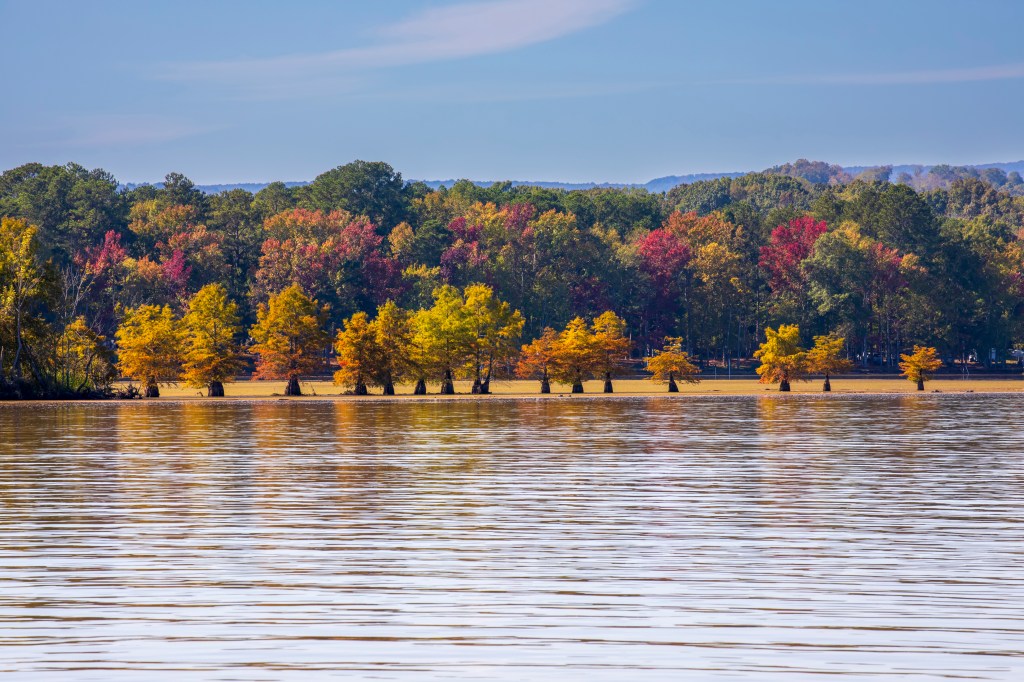
As on the way up, we had a day and a half of mostly boring travel.  Chickamauga is a large lake, so you don’t generally see much of the shore.  There was a brief excitement when an ultralight swept low over the river, and further south there were some lovely autumn colours in a row of bald cypress trees.

An ultralight flying low over Chickamauga Lake
Bald Cypress on Chickamauga Lake
Wisps of clouds made a nice sunrise at the marina near Dayton

Our transit through Chickamauga lock was interesting.  We were locked through with a small runabout.  Given that it was a Sunday, and close to Chattanooga, the lockmaster was asking all pleasure boats if they had been through a lock before.  This fellow said he had, and then proceeded to tie up to one of the fixed pins – that would have been completely useless and very dangerous once the water started going down in the lock.  An explanation was provided, and they moved forward to the floating pin.  The guy chatted with Dick, he was a very pleasant fellow, laughed at himself, and said how obvious it was once he was shown.  We told them to go out of the lock first, as they would be faster than us, and they were very considerate, no burst of speed, and no wake.  We could certainly wish there were more boaters like that.

Later, after tying up at the familiar Bluff Dock in Chattanooga, we helped with a large cruiser coming in.  They spent the entire approach tying fenders all along the vessel, and only when at the dock, went to get out coils of line (and untangle them) to tie up.  If they had seen as many fenders roll up on docks and catch in the cleats as I have, they would change their preparation priorities.

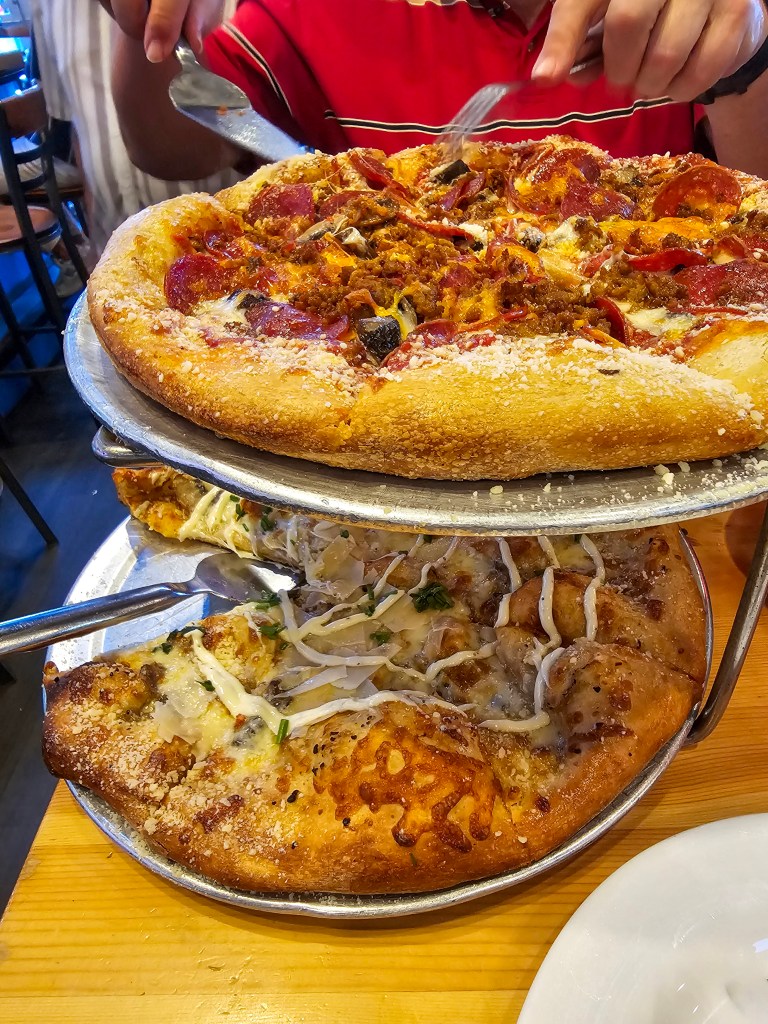
We walked up to Mellow Mushroom for a pizza fix.  Amusingly, it is rated the #1 restaurant in Chattanooga on TripAdvisor.  We assume this is due to the large numbers of people visiting the Aquarium and the Chattanooga waterfront.

Pizzas at Mellow Mushroom

Our full day in Chattanooga was reserved for Dick to retrieve his bicycle, now sporting shiny new wheels, and he took advantage of being mobile again to use his trolley and pick up enough groceries to get us back to Aqua Yacht after Rendezvous.  I did several weeks’ worth of laundry.  Fortunately the clothes dried quickly on hangers in the very breezy cockpit.

Bicycles and groceries taken care of, Dick was able to get on with some forward planning for the next stage of the voyage.  He secured a 3-month booking at a newly rebuilt marina at the eastern end of Florida’s Panhandle.  With the whole of the Looper pack in panic mode after the devastation of 2 hurricanes, we feel it is prudent to nail down some of our options.

To our great disappointment, Dick had a phone call late in the afternoon to say that the restaurant we had been looking forward to for weeks had to close that evening due to maintenance issues.  It was purportedly the best fine dining restaurant in Chattanooga, but they had just moved to new premises and were clearly having teething problems.  We decided to give the steakhouse in the Read Hotel another chance.  The décor and ambiance was beautiful, and the meal was much more successful than our previous visit.

Sauteed shrimp at Bridgeman’s Chophouse
Rare steak for Dick at Bridgeman’s Chophouse
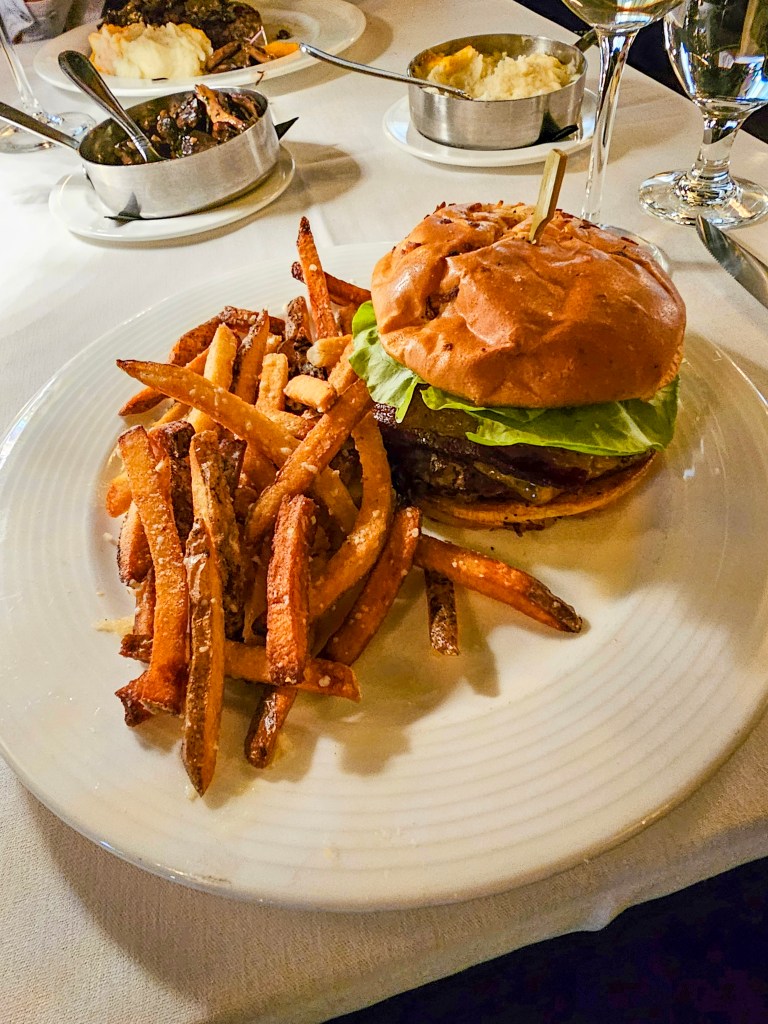
The hamburger at Bridgeman’s Chophouse was delicious in spite of the squishy bun
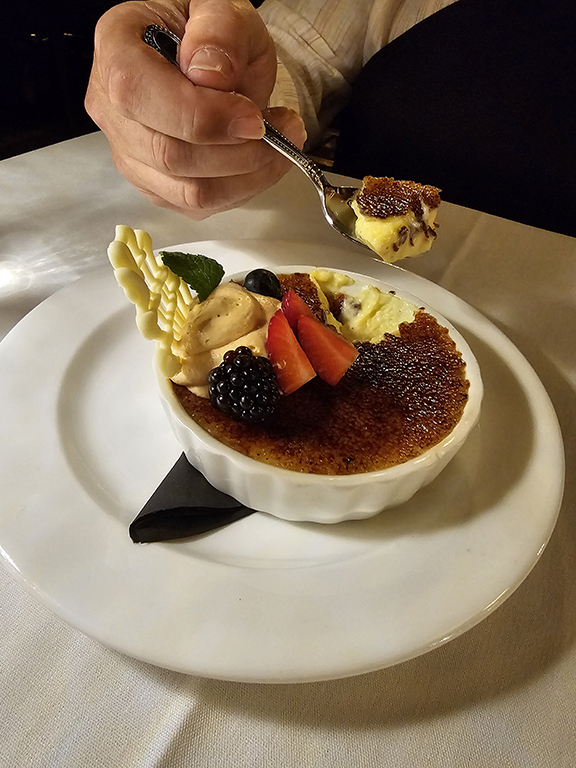
Creme Brulee at Bridgeman’s Chophouse

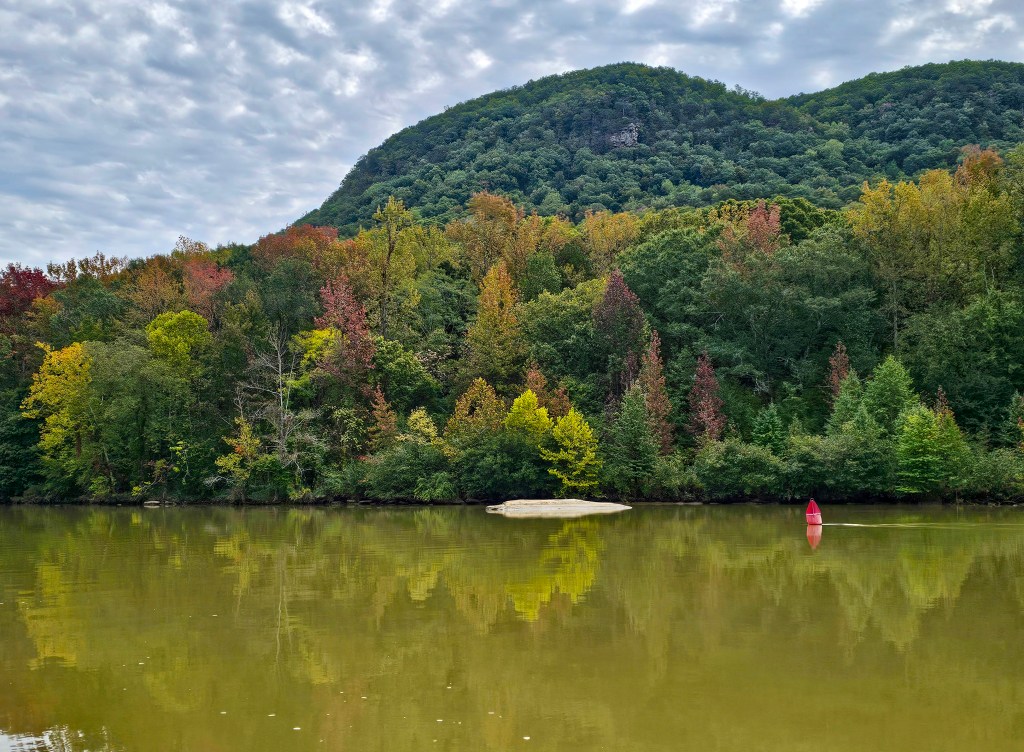
Tuesday was the day to travel through The Gorge, billed as Tennessee’s Grand Canyon.  We were hoping for more fall colour.  There were some pretty stretches, but an overcast sky meant very little photogenic scenery.  Naturally the clouds broke up and the sun came out after we were docked.

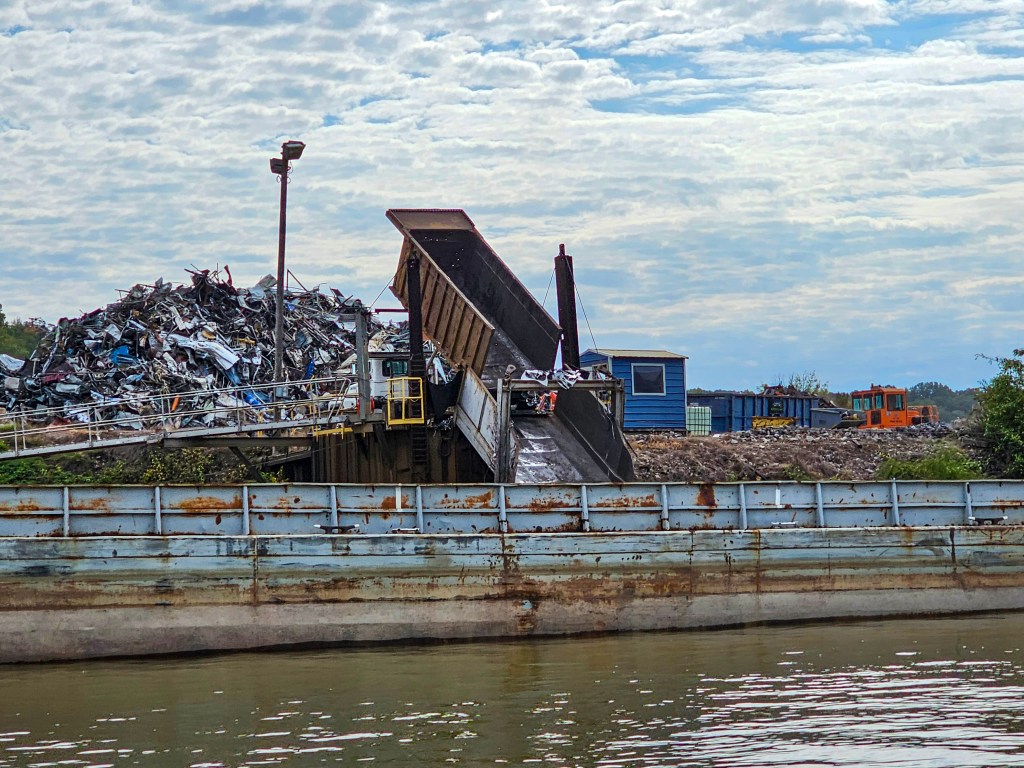
A barge is being loaded with scrap metal south of Chattanooga
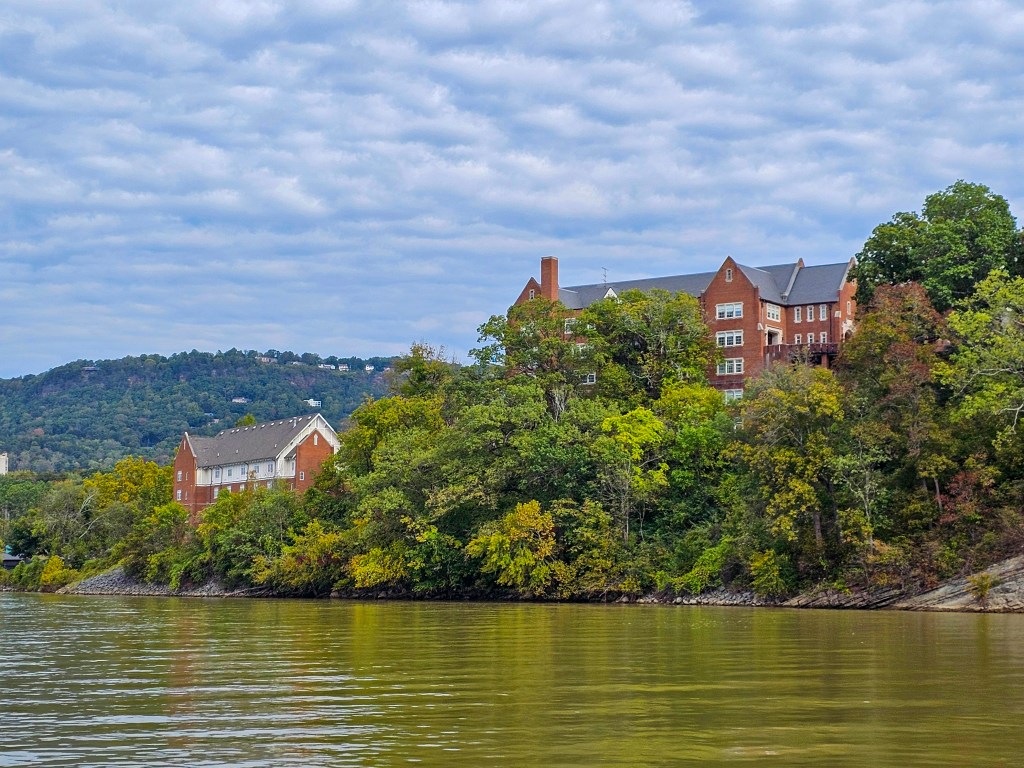
Baylor School south of Chattanooga
Lookout Mountain from the river. The Incline Railway goes up this mountain.
The Gorge

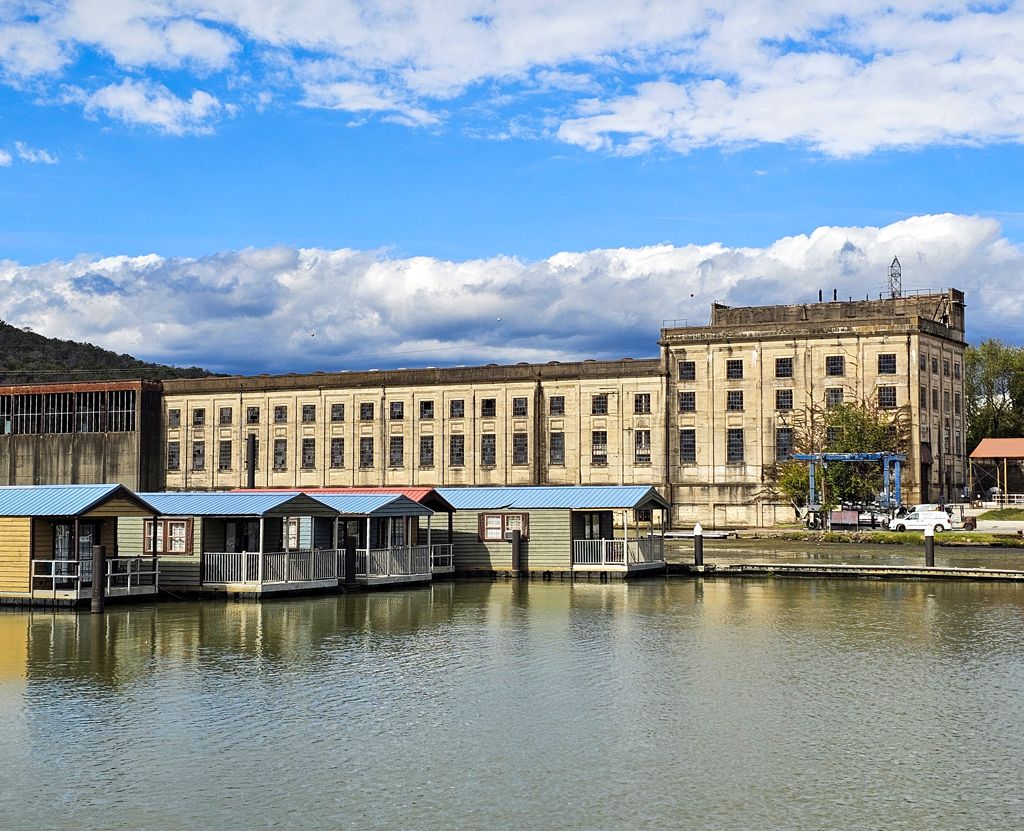
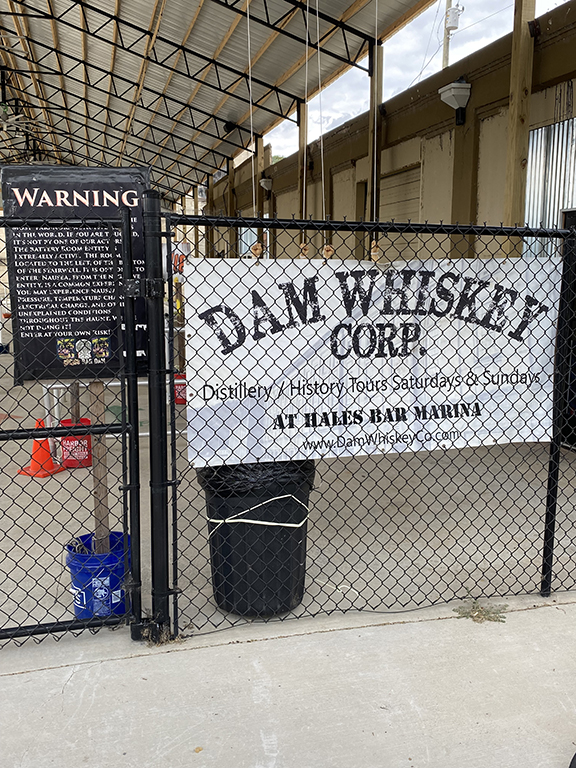
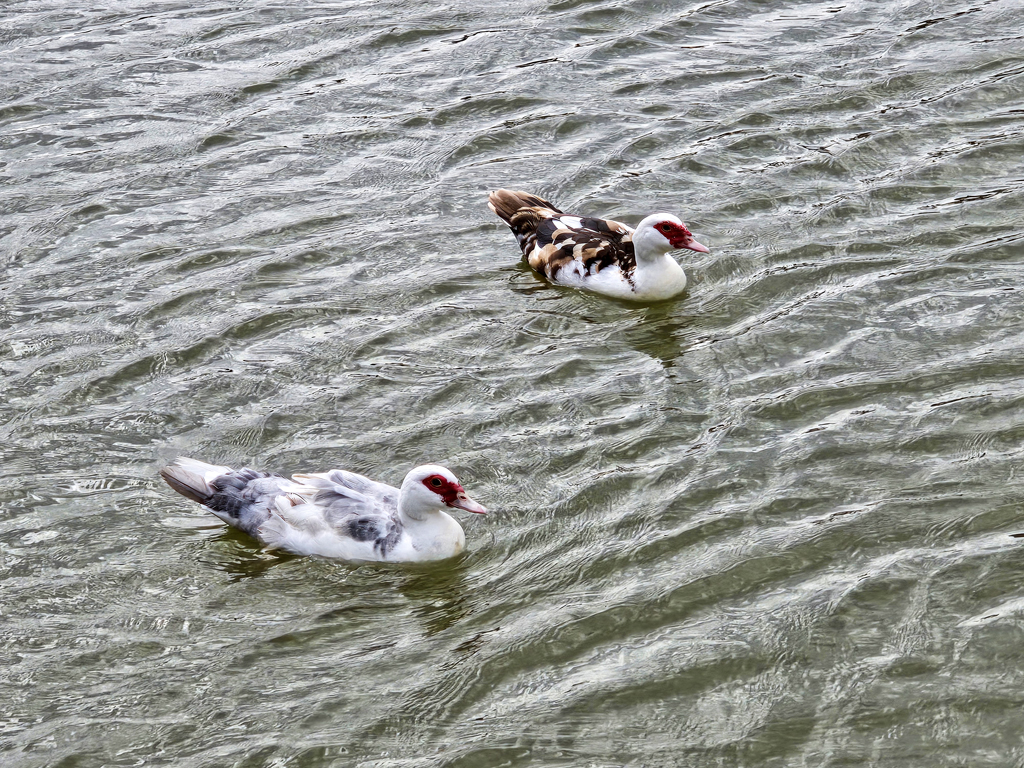
We tied up at Hales Bar Marina, with a view of the very unattractive but historically significant former hydroelectric facility.  There was only one useful cleat at our end of the assigned dock.  The whole place looks very run down, how anyone would consider coming and staying in one of the tiny floating cabins I do not know.  The distillery that occupies the former power house is only open weekends, so we did not get to tour or try their offerings.  There were some very colourful geese floating around the marina, but I can’t identify them.  I suspect domestic geese have encountered their wild relatives, with interesting results.  There are also goats wandering around.  Altogether a strange place.  We have no plans to return.

Floating cabins and the Power House at Hales Bar Marina
The distillery is located in the haunted Hales Bar Power House
Unusual geese at Hales Bar Marina

We had crossed into the Central time zone, so woke up an hour early the next morning and were underway shortly after 8am.  Dick had been told by the folks that tied up behind us that we could go out of the marina by another, shorter, but unmarked way.  We duly headed out, passing and waving to the occupant of one of the cabins on the way, but at a certain point the grass/weeds in the water fooled the depth sounder, so Dick could not tell where the channel was.  He backed around and we returned the long way, waving again to the bemused watcher.  Crossing over the submerged sandbar along the approved route was worrying, as the depth got shallower, but eventually we were through.

We had an easy transit through Nickajack lock, with no wait, but there were large mats of floating grass and weed to try to avoid.  Some boaters think it’s clever to proclaim “We were here!” by sticking stickers with their boat name on lock floating bollards. It is annoying to see, because those have to be cleaned off by lock maintenance staff in a time of tight budgets.  Defacing public utilities with stickers is just another form of graffiti.

Stickers deface the floating pins in many locks
Advice for new boaters, wear gloves for line handling! Imagine what Dick’s fingers would be like without them.

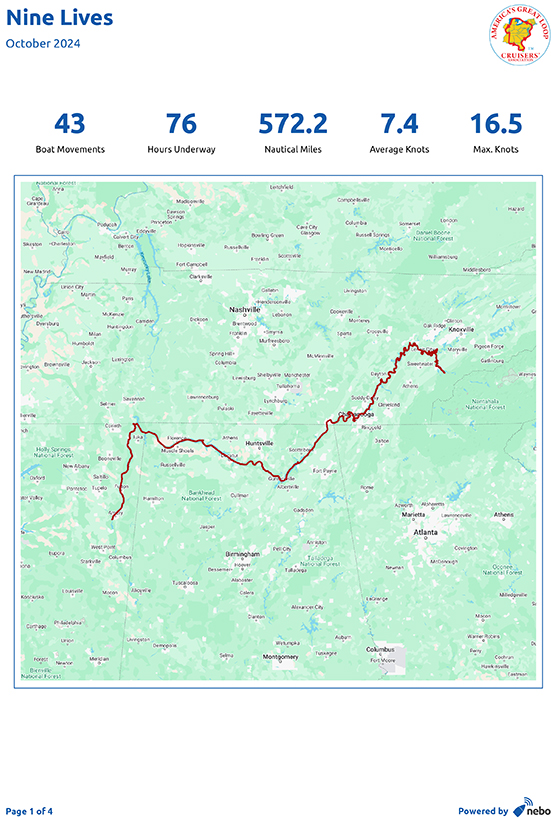
Our plans for the pre- and post-Christmas boating season have been revised in the wake of two devastating hurricanes affecting the Gulf Coast of Florida.  We originally expected to arrive in St Petersburg around mid-December, and then take about 4 weeks off to go home to Hilton Head for the Christmas/New Year season.  We are now booked to stop at a small place called Port St Joe, at the eastern end of the Florida Panhandle, on about November 22nd.  We have a reservation in the marina for 3 months.  After Christmas we will know how far along the various marinas and towns are with recovery and will be able to plan accordingly.  A big part of Florida’s economy is tourism based, so as soon as possible the towns will reopen and welcome tourists again.  It is likely that we will be anchoring more than originally planned, and we will spend less time in each place.  Our return to Hilton Head will probably be late April or early May.  It means that we will be boating in much warmer temperatures than Louise is happy with, but considering that so much of the Loop has already been too hot for my comfort, it is what it is.

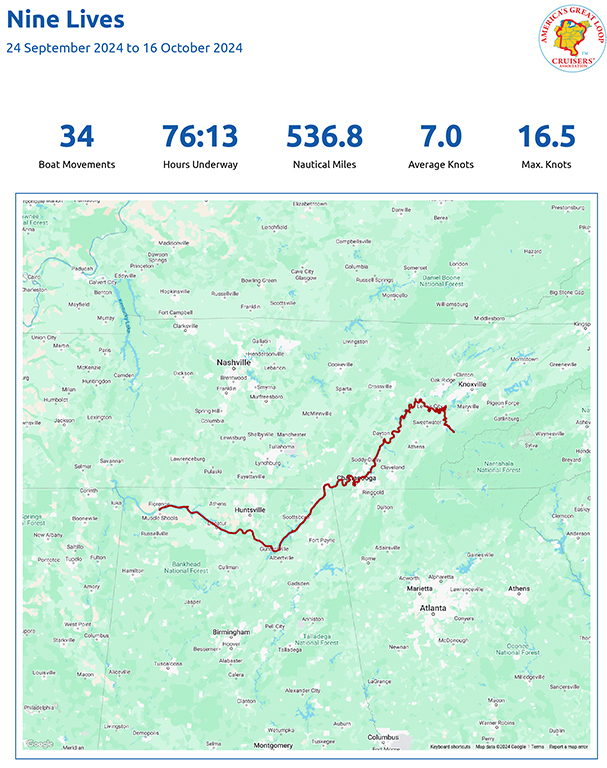
The track of our first 3 weeks of voyaging

July 19 to August 6, 2018: Jones Falls to Peterborough

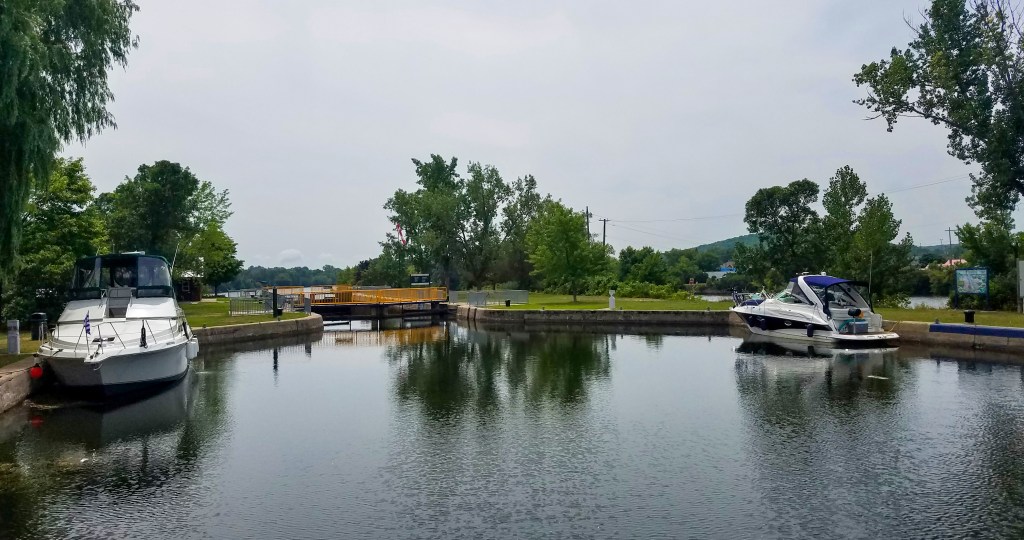
After transiting a flight of three locks to get to the lower basin at Jones Falls, we tied up along a wall at Hotel Kenny.  This is a historic hotel, opened in 1877.  For most of the 20th century it appears to have thrived as a fishing camp, with local guides taking guests out to catch big fish on nearby lakes.  Sadly, it has not moved with the times.  The motel style outbuildings are unlikely to offer the level of comfort expected at the prices charged, and all structures including the main hotel are clearly in need of major maintenance.  The dining room was nearly empty, apart from diners from the boats that had tied up for the night, suggesting that there are few hotel guests even at peak season.  It was all rather sad, especially as the location is beautiful and so much could be made of the site.

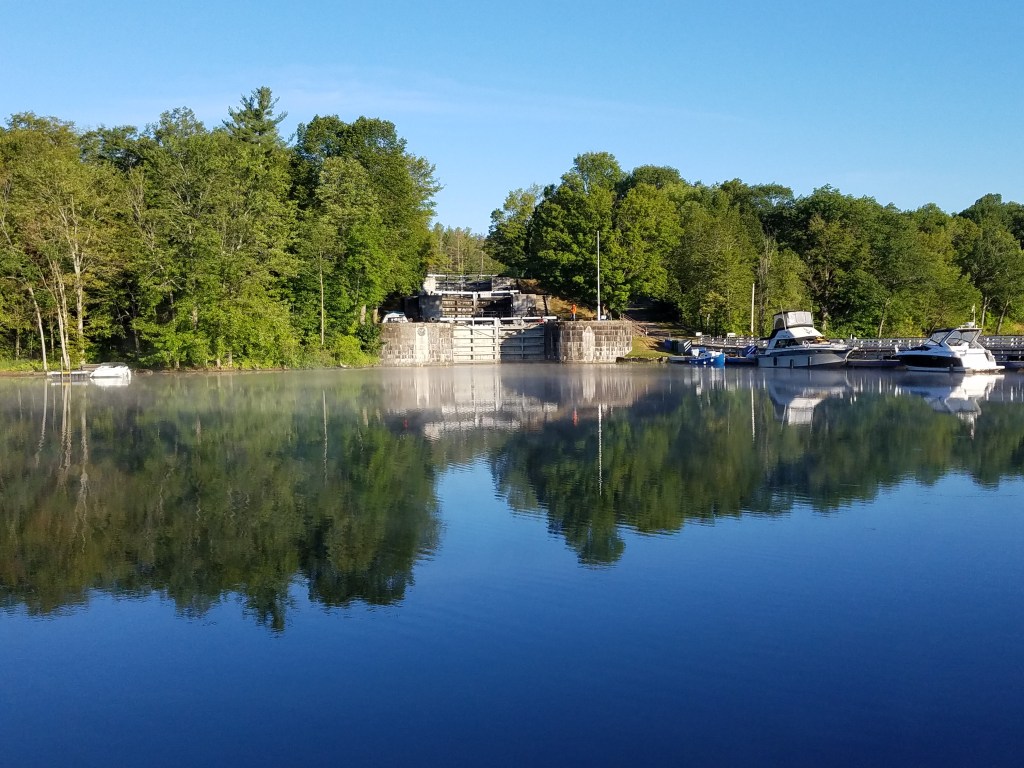
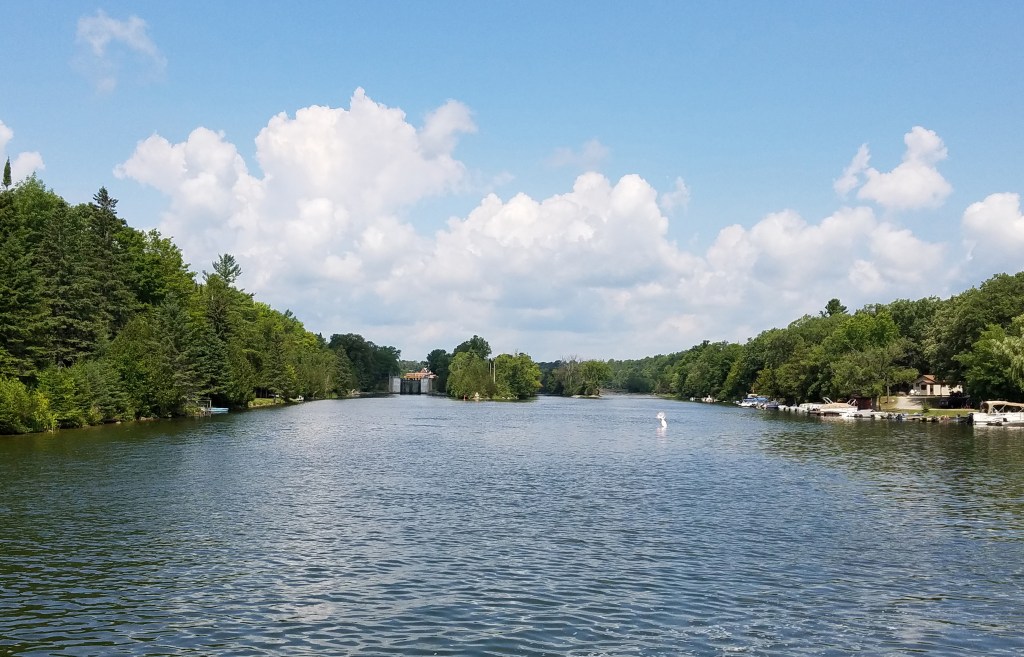
Jones Falls locks and lower basin

After 6 more locks we finished the Rideau Canal and arrived in Kingston.  Dick and I went to Queen’s University there, and he enjoyed a long walk to the campus to see how much has changed.  Kingston is a historic town occupying what was once a strategic location for defence of Upper Canada against those pesky Americans from the breakaway colonies!  Originally a French trading post called Cataraqui, it was taken over by the British and renamed King’s Town after George III. The former French Fort Frontenac was partially reconstructed in 1783, and a colony was set up for displaced British colonists, or “Loyalists” who were fleeing north from the War of Independence.  Fort Henry was built during the War of 1812 to protect the dockyards and the approach to the Rideau Canal. The dockyards are now the site of Royal Military College. Some of the cadets join the reinactment group of Fort Henry Guard, who staff Fort Henry during the summer months.

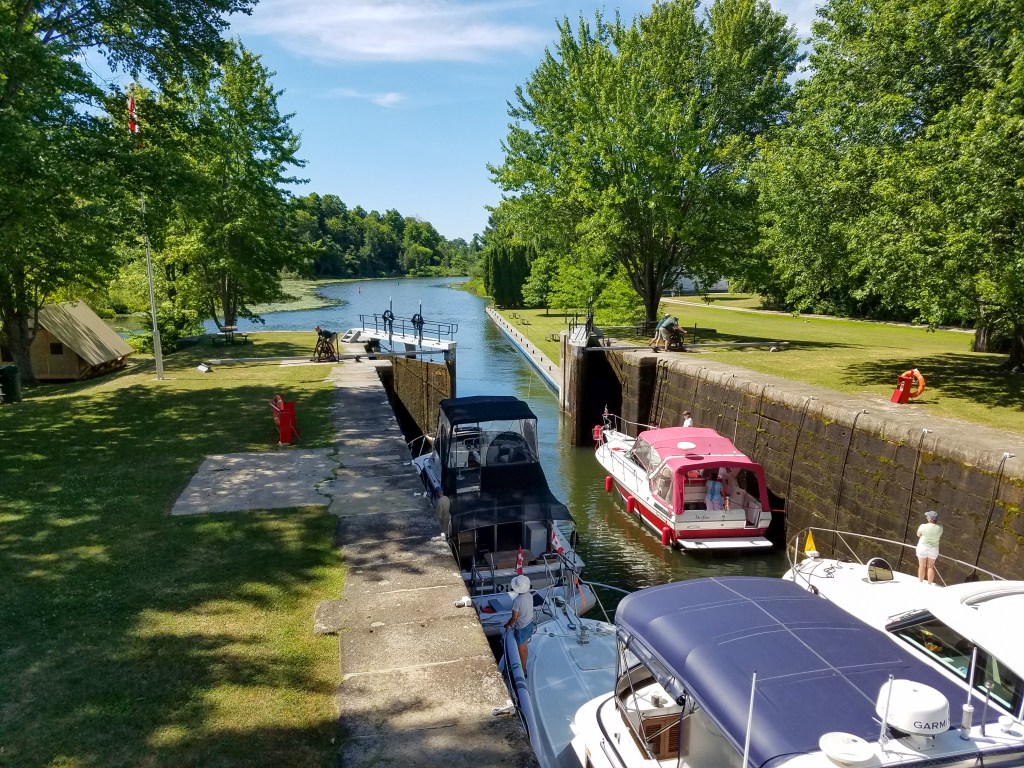
Upper Brewers lock – a boat moves from the upper into the lower of a pair of locks
Upper Brewers lock, boats about to leave the lower of the two locks
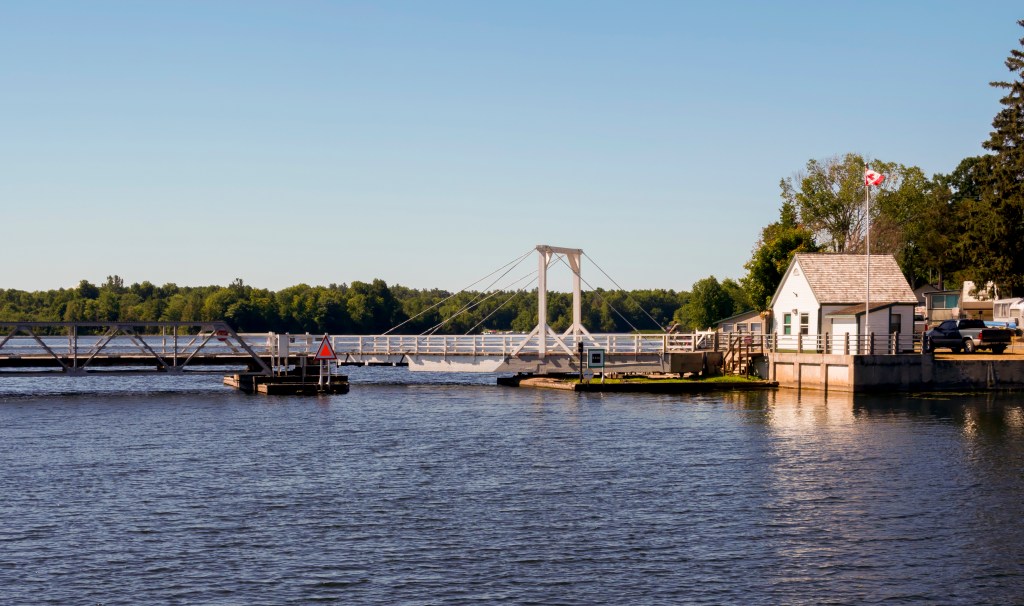
Brass Point Bridge, Rideau Canal, Ontario
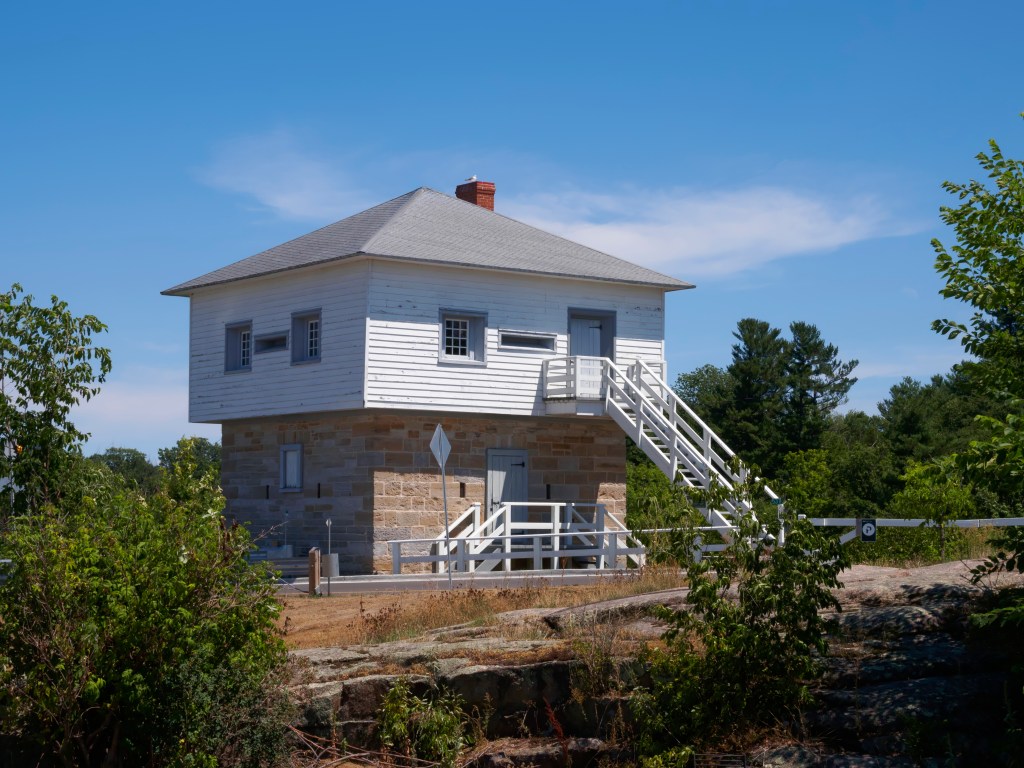
Blockhouse, Kingston Mills, Rideau Canal
Waiting for Kingston Mills lock

We enjoyed great pizza the first evening, and discovered when we were returning to the boat that there is a free country music concert for an hour each Wednesday evening.  Unfortunately, the hour was almost done, so we listened to just one song before the musicians packed up and left.  Pity, they sounded quite good!  The next day we walked up Princess Street (pretty much unrecognizable after ahem, 40-some years) and tried a German restaurant.  Dick enjoyed his meal, me, not so much.

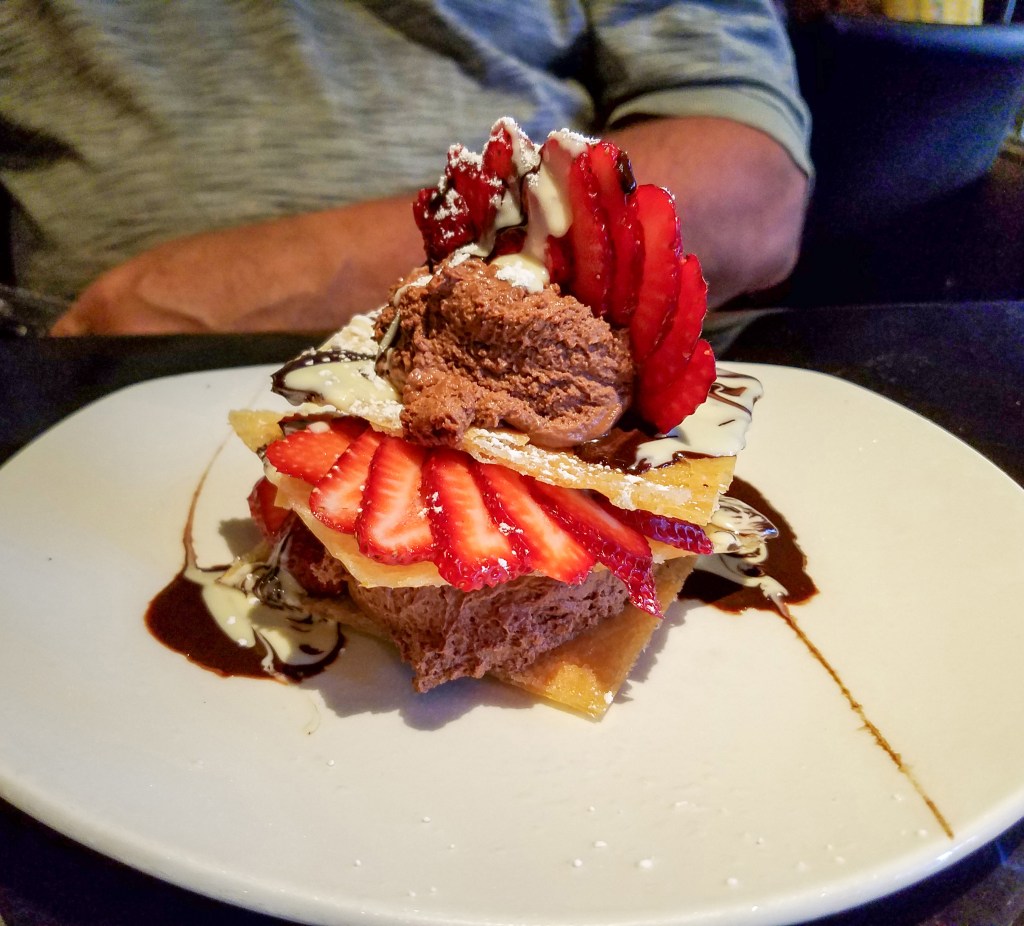
A very elegant dessert at Wooden Heads, unexpected in a pizza restaurant!
Outdoor concert in Kingston. In the background you can see two of the Martello towers that helped guard the important port from marauding Americans

From Kingston we set off towards Picton.  We knew that the forecast was for high winds, but Dick felt confident that we would be in waters protected by Wolfe and Amerst Islands for most of the trip.  The first stretch of open water was pretty lumpy, but the second part needed some major maneuvering to deal with much higher waves than expected.  As Dick wrestled with the wheel, we were surprised to be hailed on the radio.  I staggered over to the radio and responded.  It was a sailboat, who had just passed us.  Intrigued by the sight of a power catamaran, they wanted to know who was the manufacturer of Nine Lives and what year was she.  Compliments were paid, including “she handles the seas very well!”  As Dick fought the wheel…  A deteriorating weather forecast suggested that we should run all the way to Belleville instead of stopping at Picton as originally planned.

The next day we had to keep a close eye on the weather to find the one hour window we needed to get to Trenton.  By 1pm the wind had settled a bit and changed direction enough that we headed out.  Arrival in Trent Port Marina was made slightly more exciting by large numbers of small runabouts with fishermen, all of whom were maneuvering to get to the launch ramp across the river from the fuel/pumpout dock!  I keep saying Trenton, but the town that Dick was born in has become Quinte West after some geographical redistribution and combination with two other towns.  It seems to have been a worthwhile change for Trenton, in addition to a superb marina, there is a large City Hall and library building, and many areas of town that were derelict seem to have been cleaned up.  There is still a shortage of good shops in the downtown area, but we enjoyed shopping at the European deli, stocking up on various Dutch and English imported foods and treats.

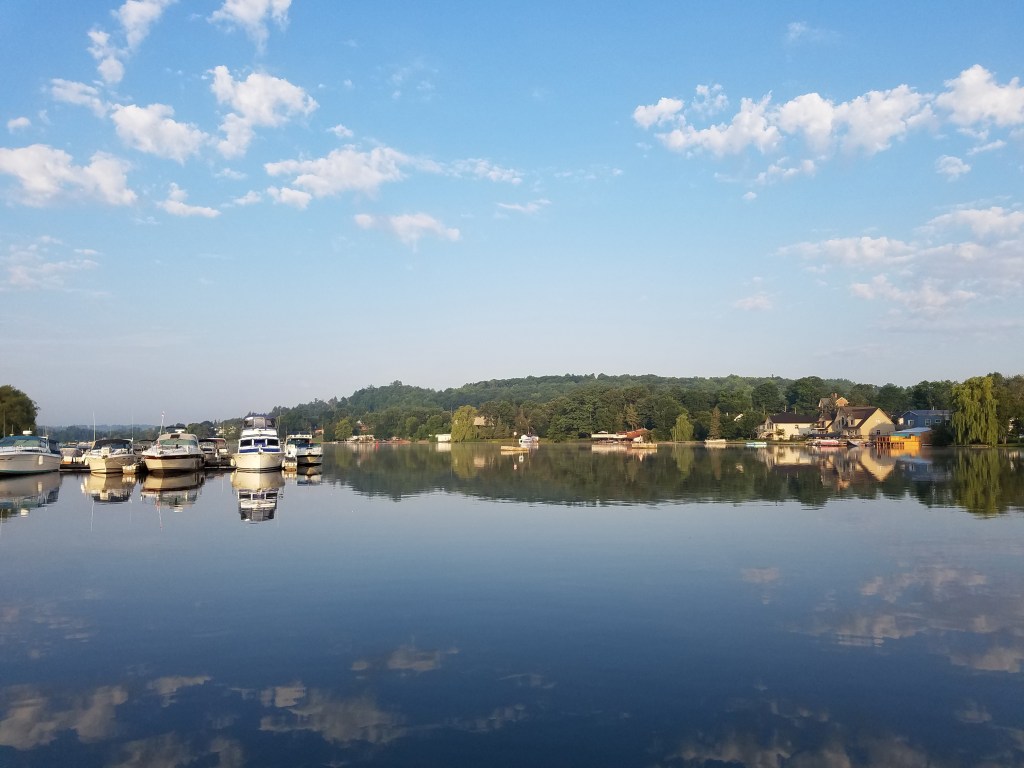
Trent Port Marina
Excellent facilities for boaters at Trent Port Marina

I hung up my galley slave apron, and tucked away the fender maid gloves to get on a flight home for a week.  I enjoyed the chance to just be by myself, as well as bridge, lunch and dinners with friends, and lots of time with my boy Tucker.  I also took care of some major issues caused by my website host, so my emails are “clean” again. Dick spent much of the week with his Mum, going on drives and scouting the various locations on the Trent Severn Waterway that are our next destinations.  He had a two page list of jobs to be done on the boat as well, and some of those were even crossed off!

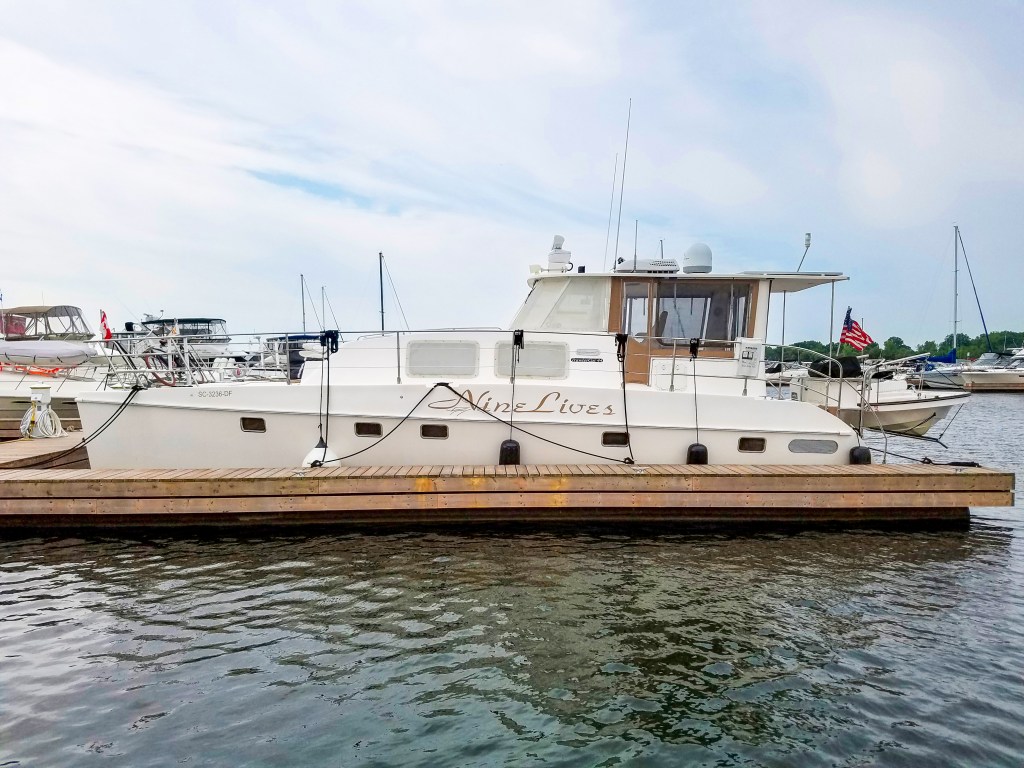
Nine Lives in Trent Port

Eventually the break was over and we set off up the Trent River towards Frankford.  First, we stopped for fuel and a pump-out.  This was our first time to fuel since the Hudson River, and we were expecting to take on about 400 gallons of diesel.  Unfortunately, the marina ran out after only 250!  We will be able to get to Georgian Bay easily on that, but we felt sorry for any boaters behind us who were planning to fill up.

The Trent Severn Waterway is a 240 mile long series of canals and connected rivers and lakes joining Lake Ontario with Georgian Bay.  The first lock was built in 1833, but it took years of broken promises and political infighting until 1915 before the entire route was completed.  There are two particularly noteworthy features along the route, but we will be passing them next week, so I will be telling you all about those in the next update!  There are 44 locks, 39 swing bridges, and 160 dams along the route that that manage the water levels for flood control and navigation on lakes and rivers in a large area of southern Ontario.  The Waterway passes through “cottage country”, the summer destination for a great many city dwellers. Dick learned to swim in the Trent River, and his grandparents farmed land adjacent to the river. Today many of the farms have been abandoned and the land is going back to woods.

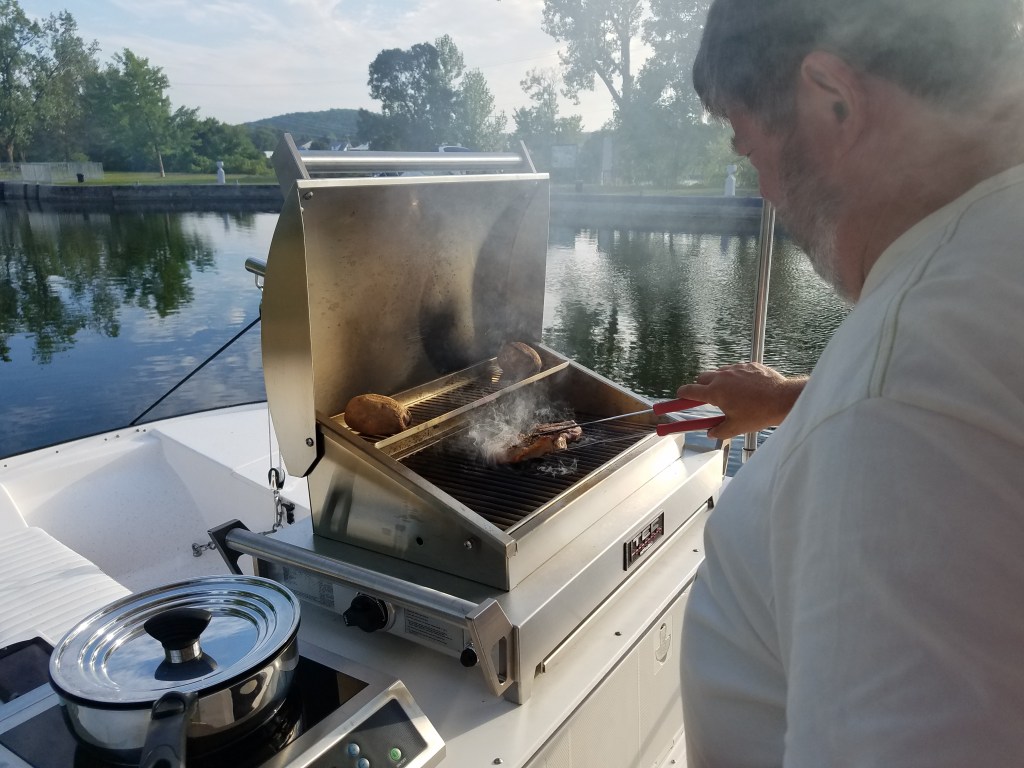
A feature of much of the waterway is free docking at lock walls and town walls for overnights.  We stopped first at Frankford, still technically part of Quinte West, and only 6 miles from Trenton, but 6 locks were enough on a hot day.  Dick grilled steaks and baked potatoes and we cooked fresh corn on the cob for one of our best meals on board.  The new grill is proving to be a great success, compared to the strange one that came with the boat.  We are also pleased with the purchase of an induction burner, that we can plug in beside the grill and keep the heat and steam from the cooking out of the galley.

Frankford and the Trent Severn Waterway
The new grill is great!

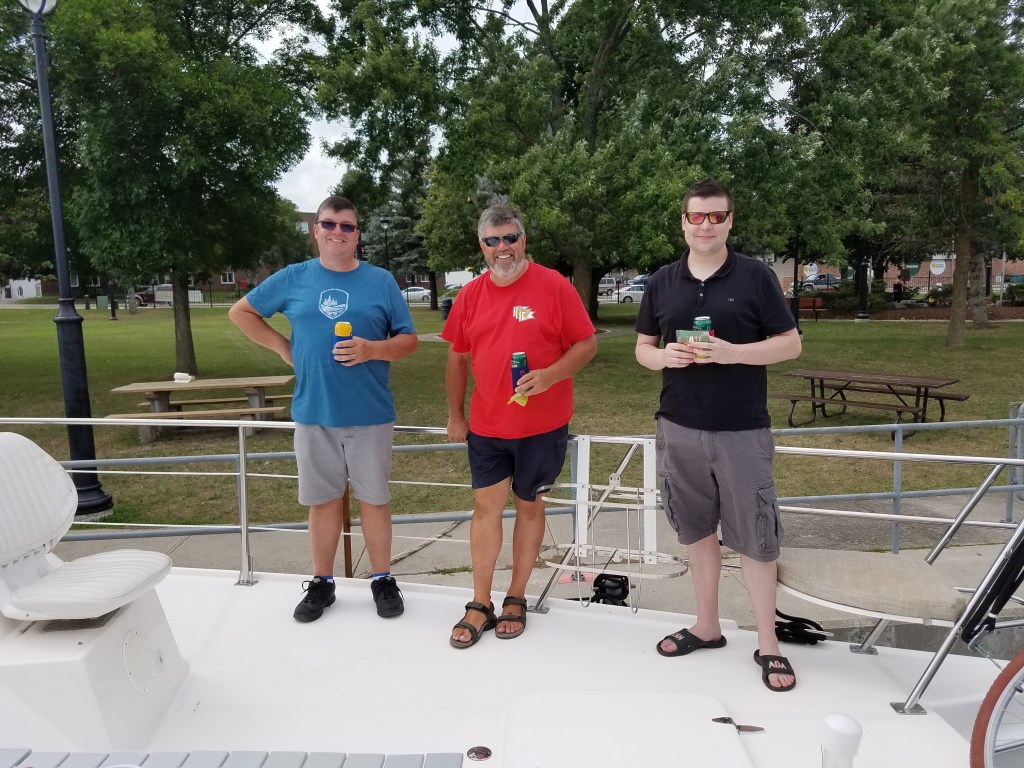
As we approached the first lock the next morning we were delighted to find Dick’s brother Ed waiting to join us for the day’s travel.  He was immediately directed to the stern line, to be his sole charge for the rest of the day as we went through the next 6 locks to Campbellford.  All that work required a suitable beverage after we tied up, and we were joined by Ed’s son Brent for libations and a few snacks.  The extra crew certainly made for an easy and relaxing day!

Frankford lock
Ed, Dick, Brent
Relaxing after a hard day on the water

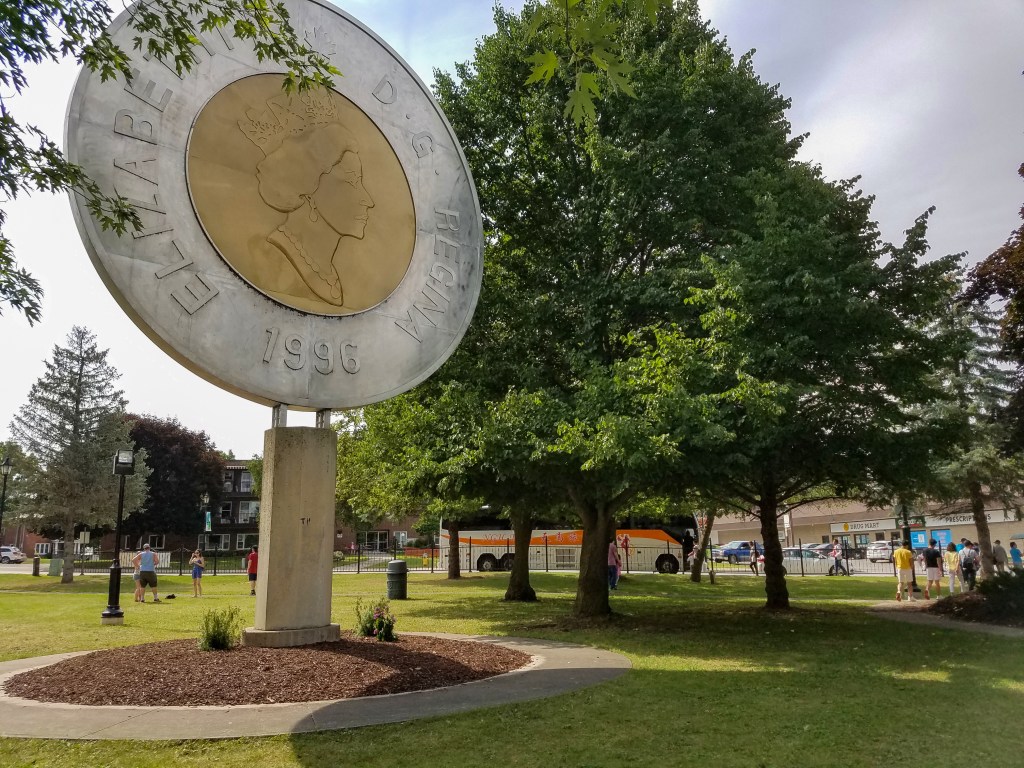
Campbellford is a small town in the middle of farming country, with excellent town wall docking for visiting boats.  We tied up on the west side, next to the park that features a 27 foot high statue of a toonie.  What’s a toonie you ask?  Well, Canada’s $1 coin began to be called a “loonie” after its introduction, because of the image of a loon on the coin.  When the time came to introduce a $2 coin, it seemed natural to call it a “toonie”.  The design of a polar bear on an ice floe was created by Brent Townsend, a Campbellford artist.  Imagine our surprise as we enjoyed our drinks and snacks to see a big tour bus draw up on the other side of the park and decant large numbers of Japanese tourists.  They proceeded to wander around the park in a bemused fashion, eventually posing for the usual selfies with the statue, and returning to their bus after about a 30 minute stop.  Who knew a 27 foot toonie was such a tourist draw that people would travel from the other side of the world to see it?

The giant toonie. The tour bus brought a large number of Japanese tourist to see the statue.

The town’s attractions did not end with good docking and a giant toonie.  In the evening we discovered a tiny European style bistro called Antonia’s.  It is owned and run by a chef from Sri Lanka and his Filipino wife, who retired from the restaurant business in Toronto.  Frustrated by the lack of local fine dining, they opened their bistro two years ago, and it has become a very successful business.  The menu is mostly European.  Dick loved his Osso Bucco, and I had delicious shrimp in Cajun cream sauce.  However, the chef told us they also offer a ‘curry night” about once a month, that is increasingly popular.

Cheesecake at Antonia’s

From Campbellford, we continued our leisurely trip to Hastings, transiting another 6 locks to arrive at a town wall that was completely full with small boats stopping for ice cream.  Fortunately, the town also operates a marina across the river, and they had room for us for the night.  The next day we enjoyed a relief from locks for most of the day, travelling across Rice Lake and then up the pretty Otonabee River to finish with one lock and arrival in Peterborough.

Trent Severn lock – approaching a lock north of Campbellford
Hastings

Peterborough is a medium sized city that is becoming a mecca for retirees.  Cultural activities and affordable living are listed as some of the advantages, in addition to easy access to the cities of Toronto, Ottawa, and Kingston. There is a nice marina at the edge of Little Lake, a relatively short walk to downtown and restaurants.  Yesterday evening we walked to a nearby Italian restaurant, and after an excellent meal we discovered that Dick’s Uncle Hans and his wife Cathy were docked just along the waterfront in their houseboat.  After some convivial conversation and drinks on board their boat we staggered home to Nine Lives.  In the centre of Little Lake is a huge waterspout fountain, and at night it is lit by changing colours.  We are looking forward to a local Indian restaurant for our dinner tonight.

The next couple of weeks will include the Peterborough Lift Lock and the Big Chute Marine Railway and arrival in Georgian Bay.  That will get us a break from locks for a while and some more weather dependent travel to look forward to.

July 5 to 18, 2018: Montreal to Jones Falls

Montreal was suffering a heat wave.  There were 33 deaths from the heat in the city during the few days we were visiting.  Dick managed to do some exploring, and even rode his bike as far as the Lachine Canal on the hottest day.  Me, I pretty much stayed on the boat, only venturing out in the evenings for dinner, and once to visit Bonsecours Market.  There were several other Looper boats in the marina, but nobody had energy for introductions or docktails.

Montreal’s history began with a fur trading station set up by Samuel de Champlain in 1605.  The local Iroquois were not best pleased and were successful in driving the French away.  In 1642 the town of Ville Marie was established and a fort was built the following year as a mission to convert the Iroquois to Christianity.  Settlers arrived, but the mission went into bankruptcy and the town came under direct control of the French King.  After 1763 New France became a British colony.  Over time Montreal became the premier city in Canada, a centre for finance, manufacturing, and commerce.  Today it is the largest city in the province of Quebec, and the second largest city in Canada.  Port operations moved away from the Old City, and today historic Old Montreal is a major tourist destination.

Montreal at night
Montreal at night
Montreal at night

Unfortunately, it is also very much a work in progress.  Many of the beautiful old buildings are empty and under reconstruction, and streets that had been paved are now being restored to cobblestones.  The main pedestrianized street is not particularly salubrious, too many t-shirt and souvenir shops interspersed with fast food chains.  Perhaps as the restoration works continue there will be more space for European style cafes and small shops.  I had high hopes for Bonsecours Market, described in fulsome terms in the tourist brochures as a historic indoor market full of boutiques and restaurants.  Sadly, the reality is only one of the 3 floors is occupied, there are yet more souvenir shops, and there is only one café slash ice cream stop.

We did find two nice restaurants in the Old Town, although the first one had an extremely limited and overly avant garde menu.  We had an outstanding meal at the second, the enjoyment slightly reduced by a somewhat snooty waiter, who clearly felt we were not quite the right sort of people to frequent his establishment.

It is more than 50 years since I last visited Montreal.  That was during the 1967 Worlds Fair, much of the city was under construction, and there was a heat wave.  I guess it just is not my city.

We enjoyed an unexpected visit from Dick’s Uncle Hans and his wife Cathy.  They volunteer at Ministry to Seafarers, a mission that provides a home away from home and assistance for seamen from all over the world when their ships are in port.  They happened to be there when we were, so it was great to welcome them onto the boat for coffee and chat.  We may get a chance to see them again later, as they have a boat on the Trent Severn.
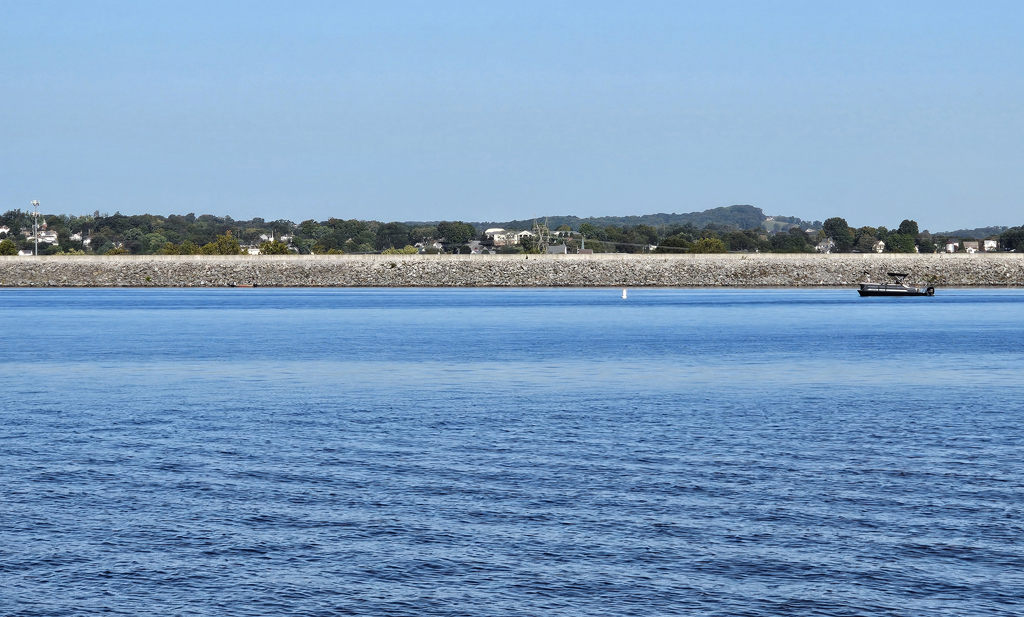
Hans and Cathy visit

We left Montreal before 9am, hoping for a swift passage through the two locks on the St Lawrence Seaway before our route took us north on the Ottawa River.  This was not to be.  On arrival at the first lock, we were told it would be 11am, as a large freighter was coming through and commercial traffic has priority.  As the freighter was being locked through, another Looper boat arrived, we had last met them at Half Moon Bay on the Hudson River.  They were told “after lunch”, as we would all have to wait for a “special” boat to come through.  After a certain amount of grumbling, Dick got out his laptop and was just settling in for some internet surfing when we were suddenly called to get ready and go into the lock with the just arrived Canada Coast Guard Vessel.  The Seaway locks are huge, and it is quite difficult to hold the boat in place with the thin nylon ropes that are dropped down the sides of the locks for pleasure boats.  The second lock was easier when we hit on the idea of Dick staying out holding one of the ropes, the second was tied off, and I took the helm and kept the engine running to maneuver the boat back and forth against the inrushing water (much as I do on narrowboats in locks in UK).
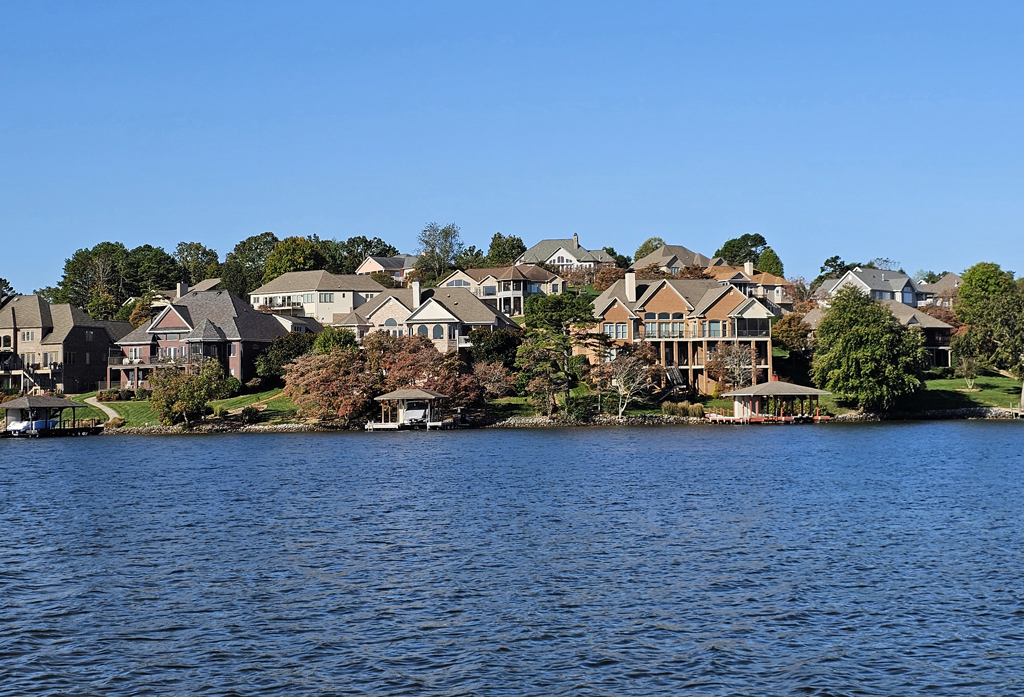
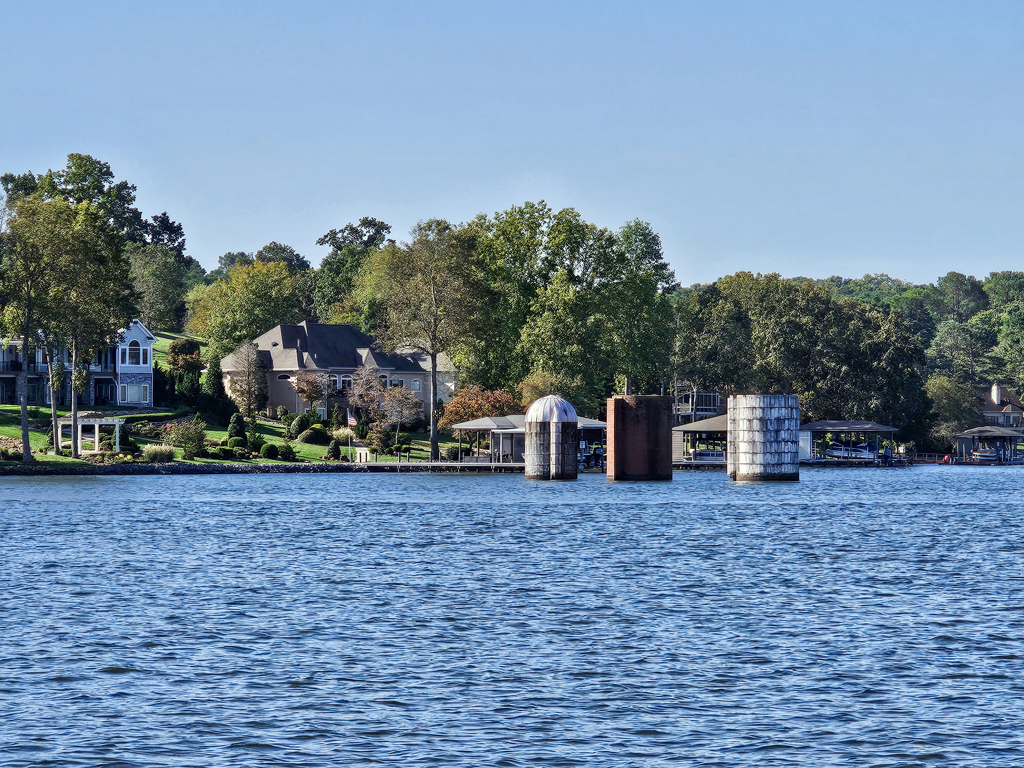
Waiting for the Seaway lock. The freighter has priority.
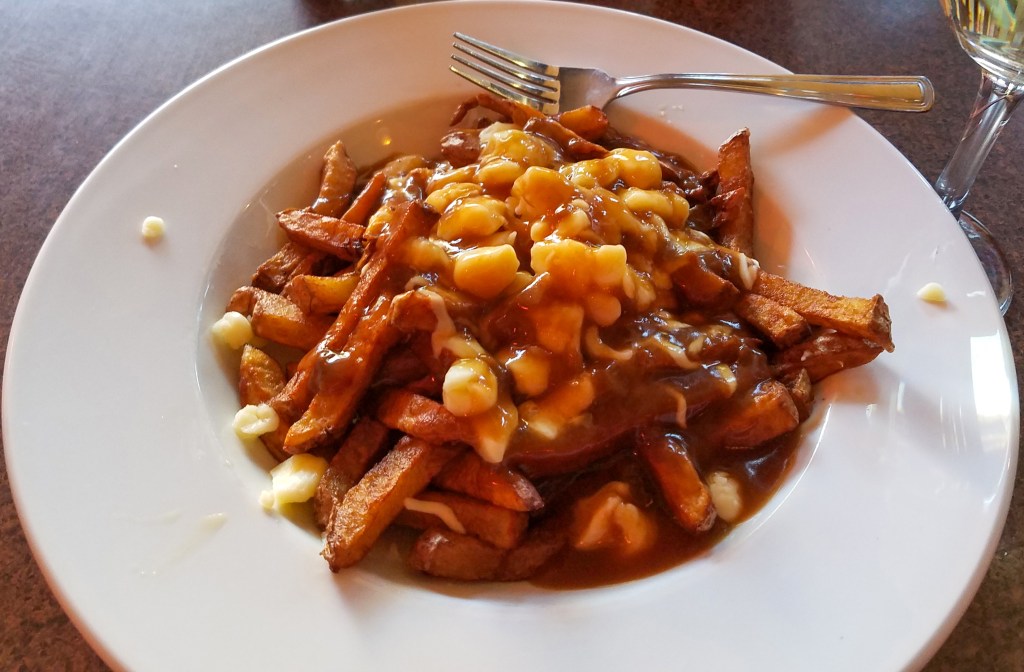
The next excitement was created by weather.  We were out in 20 knot winds and had to cross shallow Lac St Louis with the high wind and strong current. The course zigzags, and is surprisingly narrow, so at some points the swells were inevitably on our beam and we were rocking and rolling a lot more than is comfortable.  It was not a particularly long journey, fortunately, and we found space below the lock at the village of Sainte Anne de Bellevue.  This is a historic town, now a suburb of Montreal.  We did not see much of the village, only the street along the canal, lined with restaurants.  Consulting TripAdvisor, we selected one of the more highly rated establishments, which happened to be an Irish Pub.  Go figure.  Little of the menu resembled Irish pub fare, but Dick managed to find a lamb shank that he enjoyed very much.  I decided to be adventurous and try one of the signature Quebec dishes, poutine.  This is French fries, smothered in beef gravy, and topped with cheese curds.  I didn’t say it was good for you!  Anyway, clearly, I need to try it again, because while the dish was tasty enough, the French fries were seriously soggy, so it was not a success.

The lamb shank was a success
The poutine was very soggy, a not uncommon problem

After passing through the lock and officially entering the Ottawa River the next morning, we enjoyed a pleasantly calm day crossing Lac des Deux-Montagnes and on to Carillon Lock.  The Ottawa River is very wide at its lower end, in many cases more of a series of connected lakes than what one expects of a river.  The scenery is pretty, although the shore is often quite a distance away.

Ottawa River
We were surprised to see an English narrowboat making its way down the river

Carillon lock is the highest in Canada, with a 66 foot lift.  It is controlled by huge guillotine doors that lift and lower instead of the more usual swing gates. It is also the site of a large hydroelectric dam and tours are available, but Dick was disappointed to find that English tours must be booked a few days in advance.  He didn’t feel his command of French was quite up to a tour of a hydroelectric facility!

Carillon lock

We found a place on the wall below the lock, and enjoyed watching the boats entering and exiting.  It is an enormous lock, used almost exclusively by pleasure boats, with as many as 12 locking through at one time.  The largest boats go in first, and take the lines dropped down by the lock staff.  Then smaller boats are added, including a row down the middle.  Those middle boats tie to the boats they are beside.  It makes it a bit tricky for the boaters on the wall, because they are not only holding their own boat, but also the one that has tied to them!  There is also no restriction on who can use the lock, so lots of wave runners swarm in as well.  We were lucky when it was our turn the next morning, just three other smaller boats, and all on the wall with their own lines to hold.

Normally it is quiet and peaceful overnight at this location, but our stop coincided with a huge 3-day festival of electronic music, including 32 hours of non-stop sound.  As in all night, thumpa thumpa thumpa.

Entering and tying up in Carillon lock
The doors have closed and we are ready to be lifted
Lock operators have to climb those stairs every day for their shift

Our next stop was the beautiful Chateau Montebello. It is one of the Grand Old Ladies built by the Canadian Pacific Railroad Company.  (others include the Empress in Victoria, Chateau Laurier in Ottawa, Chateau Frontenac in Quebec City)  Now part of the Fairmont Hotel group, it is billed as the largest log structure in the world.  It was built in 1930 to be a Sportsmens Club for Canadian Pacific, and over the years it has hosted a fascinating list of political figures, royalty, and events.  We enjoyed looking at the old photographs on the wall!  In the 1970’s it was turned into a hotel, and still operates as a destination resort in beautiful surroundings.  We stayed one night in the marina and indulged ourselves with dinner in the hotel, as well as their breakfast buffet the next morning.

Historic Chateau Montebello, the largest log structure in the world.
The interior of Chateau Montebello
Upstairs gallery in Chateau Montebello
Pretty gardens of Chateau Montebello
Grounds and marina, Montebello
The Ottawa River from the grounds of Chateau Montebello

It was a relatively short run the next day to Ottawa, but on arrival we had the challenge of the staircase flight of 8 locks that connect the Ottawa River with the Rideau Canal.  The guides suggested that “thousands” would watch us locking up, and I had been practising my royal wave, but we started with an audience of just one or two!  As we moved up the flight, the audience grew, and included several tourists who took video of the entire process.  By the last lock we were watched by at least 30 people.  A fellow Looper who locked up with us said afterwards he was glad we were there and got all the attention, he felt he had enough stress trying to execute the locking maneuvers without the additional pressure of amateur critics!

Fixing the AC – peering into Nine Lives innards in hopes of fixing the air conditioning.  As it happened, the flashlight was not needed (nor was the screwdriver), and the fix required a study of the manual and a small adjustment to the fan settings.
Rideau Falls
Sometimes you’re the audience, sometimes you’re the show!
The lock flight in Ottawa
Another view of the lock flight

Ottawa is at the confluence of 3 major rivers, and was an important trading place for First Nations.  It was visited by Europeans as early as 1610, but it was not until 1800 that the first settlement in the area was established across the Ottawa River in Hull. In 1826, land speculators arrived on the south side of the river when the construction of the Rideau Canal was announced.  The town of Bytown was founded, and the canal was built to provide a secure route between Montreal and Kingston, bypassing the St Lawrence River and the threat of enemy fire on supply ships as happened during the War of 1812. Bytown was renamed Ottawa and incorporated as a city in 1855, after a turbulent early history that included labour unrest and political dissension that degenerated into rioting and violence on multiple occasions. In 1857 Ottawa was declared the capital of the Province of Canada by Queen Victoria, who was asked to make the choice after local politicians had failed to agree.

We docked on the canal wall in the centre of town.  It was an easy walk to ByWard Market, where we were delighted to find a wonderful choice of fresh produce at the stalls, as well as excellent small shops selling international cheeses and pates, a butcher, and a nice Italian food store.  Once again it was very hot, so we decided to have lunch in a restaurant and then relax on board for the evening.  We tried another Irish pub, and the next day we had a great meal in an Italian Trattoria.

Ottawa’s Market District
Produce in ByWard Market

On our second day we rode our bikes, stopping to watch the daily Changing of the Guard.  Dick had scouted the previous day, so I knew exactly where to stand to get the best pictures and not be at the back of the big crowd.  The ceremony was first performed in 1959, by a Ceremonial Guard that is made up of members from all branches of the Canadian military.  After the ceremony we rode to the Garden of the Provinces and Territories.  This was described in lyrical terms in the tourist brochure, and perhaps it was once beautiful, but it was a sad disappointment due to years of neglect and lack of renewal of the plantings.

Changing of the Guard, Ottawa
Garden of the Provinces and Territories
Chateau Frontenac and gardens
A pleasant courtyard
Shepherd’s Pie at an Irish Pub in Ottawa

The other takeaway from Ottawa was how much construction there was.  Roads were torn up everywhere, and the air was full of grit and dust.  A major boat cleaning was required both inside and out to get rid of it. We last visited Ottawa a few years ago, and the roads downtown were all torn up with construction then too. I guess nothing changes.

After Ottawa we went west and south on the Rideau Canal.  It is in a beautiful part of Southern Ontario, made up of a series of lakes connected by canal cuts and lots of locks.  This is “cottage country” and we are starting to get into the Canadian Shield.  You can google it for more detail, but basically it is the igneous rock with a thin cover of soil that covers half of Canada, from the Great Lakes to the Arctic Ocean.  Much of the scenery is rocks and pine trees, with deep lakes and lots of rivers.  At the same time, there are a few very shallow lakes that must be traversed in a zigzag pattern, paying careful attention to the red and green markers to avoid getting out of the channel.  Canadian Shield is very unforgiving if you touch bottom.

Brown and white cows rest in the shade beside the Rideau Canal, Ontario
Farms along the Rideau Canal
Slalom course – we must stay between the greens and the reds, you can see we go to the left and then after that we pass behind the boat on the right hand side of the picture.  Straying from the course risks running aground and severe prop damage!
Filling the water tanks. A time-consuming job that needs to be done every few days.
Rideau locks in a short staircase

We stopped for two nights in Smiths Falls.  The basin between the Smiths Falls locks was lined with boats of all sizes, and the marina/campground manager told us they had never had so many big boats in all at the same time.  The French boat rental company Le Boat has just started operations this year, with a base at Smiths Falls, so a lot of previously available slips are now taken up by their fleet of houseboats.  The boats do look very modern and attractive, comparing very favourably with the much older rentals available from long established companies.  There seemed to be a fair number of rentals going out, considering it is their first year of operation.  We were amused to see the large amount of rubber, in two rows, that completely surrounds each boat.  I am sure they are typically going to be referred to as “bumper boats”, given their size and the very minimal instruction (and no previous experience) requirements for renters!

We were not the only Loopers present, and enjoyed a very convivial evening of docktails with new friends from five different boats.  A highlight of the stop was a lunchtime visit from Mike and Sylvianne.  Mike worked at Ingersoll-Rand and was part of the hiring process when Dick joined the company more than 40 years ago.  They live just outside Montreal, but were out of town when we were there, so they decided to make an excursion so we could have a reunion.  We had a convivial lunch at a local restaurant, followed by a bottle of wine on the boat, accompanied by lots of reminiscing.

Loons

After a surprisingly long wait for the lock to open the next morning we were on our way across Rideau Lakes to the pretty village of Westport.  The dockmaster is very efficient, calling boats on the radio when they see them on the lake so they can give good approach and docking instructions.  Usually we have to make the call, and we have found that in Canada it is very hit and miss whether a marina even answers the hail! The village is clearly a destination for day-trippers arriving by boat and car, and is full of small boutiques selling everything from jewellery to clothing and souvenirs.  We also found a wonderful sandwich shop, that offered beautiful fresh bread and just the right amount of filling so you could eat it without it all falling apart.

Westport
Westport Harbour, Upper Rideau Lake

We stopped for two nights at Westport, and then headed towards Hotel Kenny at Jones Falls.  We expected a fairly short day with a 3 lock staircase to finish.  Today  was our day for a bit of excitement.  Shortly after we set off, I noticed a cloud of white smoke coming from the starboard engine.  Dick went below and decided that the ticky ticky noise meant that we had to shut that engine down immediately.  So, we now know that Nine Lives travels very nicely on just one engine!  We were able to stop at the next lock so Dick could take a look and see whether he could sort out the problem.  It turned out to be weed.  Lots and lots of weed!  The engines are cooled by water that comes from outside, and there are special baskets to catch any fish or plant life that gets sucked through the hose.  Dick took off the strainer and emptied a salad bowl full of weed that had packed into it.  Then he took off the hose that leads to the strainer, and pulled out a whole lot more weed!  On the assumption that the problem was likely to be the same for the other engine, he took a look, and sure enough, yet more plant life!  We were very fortunate that both of the engines did not overheat.  I suspect that trying to paddle Nine Lives would have been a pointless exercise.

Newboro lock – fortunately there was room for us to tie up and check the engine.
Checking the engine.
Weed!

The lock was very pretty, and while Dick sorted out the engines I watched a group of summer campers prepare and launch their canoes for an overnight outing.

A group of teenagers on a canoe trip

The last exercise of the day was a staircase of 3 locks, preceeded by a single lock, for a total of 4 in quick succession.  We gathered quite an audience, some of them very chatty, asking where we had come from and where we were going.  Tonight, a well deserved dinner at the hotel dining room, and then on to Kingston tomorrow.

In the lock.  If you look behind Dick you can see the summer students, who work very hard in the heat, manually operating the historic lock mechanisms.  Dick is wearing a headset.  We have those so we can swear at each other privately instead of yelling… I’m not kidding (much), boaters call them “marriage savers” because they allow clear and calm communication without shouting or gestures.
Signature sauce – Dick’s turn to cook.  He is making his signature spaghetti sauce on the new induction burner.  We thought it would be helpful at keeping heat and steam out of the cabin, and can report that it works wonderfully.  Naturally the cook requires an adult beverage while undertaking this delicate and demanding task.
the engine
The engine – for those of you who are interested in such things, here is a better picture of the engine. We have two of these. They are Yanmar 6 cylinder 315 HP engines.

June 17 to July 4, 2018: Hudson River to Montreal

Continuing our stay at Half Moon Bay on the Hudson River, after a day of sightseeing, we left the boat and went off in different directions.  Dick drove to Toronto to participate in the annual reunion lunch of former Ingersoll Rand colleagues from his first years with the company.  I rented another car and set off the next afternoon for Long Island and dinner with Harriet and Carol. I worked with Harriet many years ago at Brookhaven National Laboratory, and together with Carol and other friends we have travelled in Europe and enjoyed canal boating in UK.

However.  First it was apparently necessary for me to have a very stressful adventure.  Dick had not been gone for two hours when I discovered tell-tale signs that our holding tank was ready to overflow. (for the landlubbers, the holding tank is where we keep the poop and such, it has to be pumped out once a week). Having had an experience with the situation last summer I knew this was not to be ignored.  Unfortunately, the pump-out machine was located on a dock at the other end of the marina, outside the breakwater.  After my urgent requests for help from fellow Loopers, they jumped into action.  Two ladies got on board with me to catch and throw lines, and two gentlemen stood on the dock to cast off, and then hurried over to the pump-out dock and did the necessary business. The whole thing was immensely stressful on several levels.  First, although I do take Nine Lives into locks, mostly I don’t do the docking maneuvers (I lost my nerve in bad weather at St Mary’s last January).  I had to take her out of the tricky slip, around the marina, then turn and back her up to the pump-out dock.  Then of course it all had to be done again in reverse.  I can say definitively that I now have my nerve back!  The second level of stressful was because the tank was overfull, and I will leave my gentle readers to sleep sound and not draw graphic images for you all.  Anyway, it all got done, and what a great group these Loopers are.  One of the ladies had just arrived to spend time with her gentleman, and there she was participating in the most disagreeable job on the water to help a complete stranger! Credit to Dick, after a brief text exchange that evening to tell him what had happened, he phoned me and made soothing, congratulatory, and even slightly apologetic noises for not being present.

Instead of a picture of my awful adventure, here is one of a Half Moon Bay resident

My drive to Long Island was uneventful, but I am truly glad I no longer do that regularly.  It was only 48 miles, but it took 2.5 hours each way, and that was outside of rush hour traffic!  Port Jefferson, where I stayed and had dinner, is a pretty village on Long Island Sound.  There is a very nice marina there in the supposedly sheltered bay, but that afternoon I watched a trawler make 5 unsuccessful attempts to dock in the high winds and currents.  I am very glad we are not including the Sound on our Loop itinerary.  It was great to see my friends and catch up and reminisce. Dick had an equally uneventful trip to Toronto and enjoyed getting together with many old friends from his early days with Ingersoll Rand.  They included Gordon, who first hired Dick, and who I have known since childhood, when my Dad was an I-R customer.  Also Martin, who was at Queens a year behind us, and who was one of Dick’s first Application Engineers when he was moved up into Sales. Laurie was Dick’s second boss, and Dave succeeded Laurie as Dick’s boss. Garth headed up the Calgary operation when we lived there the first time in the 80’s.

After both safely returned to Half Moon Bay, we enjoyed a great evening of docktails with about 20 Loopers, and a chance to provision at the excellent local supermarket.  Dick was pleased to provision with a car, and not have to load 50 pounds of beer, water, fruit, canned goods, vegetables and various meat and cheese onto his bicycle as he usually does!  Reminding you all that he has a single speed bike, unassisted by electricity!

Docktails with Loopers at Half Moon Bay

Our first stop on the Hudson was our favourite Maritime Museum at Kingston.  We docked with two other Looper boats who we had met at docktails the evening before.  On our return from dinner we were fascinated by the local fire brigade practising their high pressure hose skills across the river, fortunately pointing up the Creek instead of across! The next morning we launched the dinghy and went for a ride all the way to the end of Rondout Creek.  Rondout was a major shipbuilding port in the 19th century, when it was the northern terminus of the Delaware and Hudson Canal.  Before that, it was a Dutch trading post in the early 17th century.  The Canal was the heyday of the city, bringing coal from northeastern Pennsylvania to the markets of New York City. As happened all over the world, the railroads spelled the end for the lucrative canal barge business, and it closed in the early 20th century.  Today Rondout Creek supplies a large part of New York City’s daily water draw via reservoirs and aqueducts in the Catskills. The Creek still has some small boatbuilding and repair facilities, as well as several large marinas.  It was an interesting dinghy run on a pretty morning.

One of my favourite pictures of Nine Lives, taken as we travelled north on the Hudson River
A cement plant on the Hudson River
Loopers docked in Rondout Creek
Rondout Creek Repair Yard
Fire Department practice in Rondout Creek
Maid of the Meadows

Our next stop was Donovan’s Shady Harbour, followed by a transit through Albany and Troy to Waterford.  At Troy we passed the Corning Glass Barge moored on the river wall.  This is a barge that travels around the Erie Canal and waterways of Upstate New York this year in celebration of the 150th anniversary of the move of the Brooklyn Flint Glass Company to Corning, New York. Some of the innovations credited to Corning Glass include the first electric light bulbs for Thomas Edison, the invention of optical fiber for telecommunications, and the glass used in modern flat screen displays, including cell phones. The barge offers glassblowing demonstrations each day plus museum exhibits sharing the story of glassmaking in Corning.  It is touring in celebration of the bicentennial of the New York Waterways and the Erie Canal.

Troy, New York
Troy, New York, the Corning Glass Barge docked on the waterfront
Approaching Albany
The Glass Barge, docked in Waterford

Waterford was busy, due to the anticipated arrival of the Glass Barge and the upcoming weekend, but we had timed our arrival carefully and were able to get a spot under the bridge on the free town wall.  Being under the bridge had the advantage of keeping the boat cool on a hot sunny day, but the ga-thump ga-thump of vehicles crossing the bridge carried on all night and in the morning the boat was covered in fallen dirt and dust.  Not to worry, our next stop was on the Champlain Canal, with a transit of five locks on a wet and miserable day!

I have decided that I am not so very fond of transiting locks in Nine Lives, especially big locks and lifting as opposed to lowering.  The lines we have to grab and hold are greasy and filthy, and all the muck from the lock-side transfers itself to the fenders and thus to the boat.  We are sailboat shaped, and we have a tendency to swing from bow and stern, so while other boats simply push off from the lock wall occasionally, we need constant vigilance and a lot of pushing, followed by inevitable pulling hard on wet lines to keep the boat in place at the lock wall.  Our usual method is for Dick to bring the boat near the lock, but then he goes outside where I have prepared lines and fenders, and he catches the critical first line while I bring the boat into the lock wall.  Then, once the boat is stopped, I rush outside and catch the second line at the stern and hang on for all I am worth.

The Champlain Canal is not the prettiest we have seen, although I am sure it would have looked better in sunshine.  We stopped for the night on a town wall in the village of Fort Edward. Once upon a time it was an important portage place used by Native Americans for thousands of years to get around Hudson Falls. The first fort was built here in 1755 during the French and Indian Wars.  The town was established in 1818.  As is so often the case, there are signs of former prosperity, but Fort Edward has fallen on hard times.  Several attempts have been made to improve the town, including an excellent park and walkways on the river, plus a good town dock for boaters.  However, nothing is done about upkeep, and it is all looking rather sad.

The Champlain Canal
A ruined barn on the Champlain Canal

Our next stop was Whitehall and another town dock and local park.  Originally it was called Skenesborough in 1759 when it was first settled.  The village was captured by the Americans during the Revolution, and a fleet of ships was built to face British forces on Lake Champlain.  Whitehall is considered to be the birthplace of the U.S. Navy.  More ships were built here during the War of 1812.  In the first part of the 19th century the Champlain Canal was built and the railroad also came to the town, and it became an important centre for the silk industry.  Today all this is a memory. Efforts to improve the waterfront and attract visitors are ongoing.

Loading a barge on the Champlain Canal

From Whitehall we transited the last lock on the Champlain Canal and entered Lake Champlain.  We passed Fort Ticonderoga, high above the western shore. Originally called Fort Carillon, it is a large 18th century star fort built by the French at the narrows near the southern end of Lake Champlain.  The fort played an important role in the region until after the Revolution. The U.S. government allowed it to fall into ruins and it was eventually bought by a private family in 1820.  It became a tourist attraction, and was restored in the early 20th century. It is now run by a foundation.  The most southerly of three Champlain ferries operates just north of the fort, crossing back and forth to Vermont using a cable.

Arriving in Lake Champlain
Fort Ticonderoga
Fort Ticonderoga, from Lake Champlain.
Southern Lake Champlain
Beaver lodge, Lake Champlain

Arriving south of the bridge at Crown Point, we anchored for the night in what we expected to be a bay sheltered from strong winds out of the north east.  Unfortunately, we chose a spot a little too near to the bridge and the narrows it crosses, and Dick was delighted to experience the phenomenon of vortex shedding first hand. He can give you the scientific explanation, I only know we bounced around a lot, swung on the anchor more that we prefer, and we could see waves crisscrossing near the boat when there had been no other craft passing to create a wake!

After an enjoyable, if a little windier than expected, trip north on Lake Champlain we arrived in Burlington.  Here we were greeted by Dick’s friend and former colleague Julian and Nikki, his partner.  We were treated to dinner at their summer home a few miles south of Burlington, and the next day they joined us for a Segway tour of the city.  This proved to be a fascinating morning out.  The tour operator is a former lawyer, who was one of the two influential citizens of the city who were able to prevent the waterfront and the closed railway right of way from being taken over by developers. Instead, after years of campaigning, a waterfront park was created, with a bike path that follows the shoreline for many miles, and two public marinas.  His efforts did not end there.  After a paragliding accident left him disabled, the activist applied several times for a permit to operate Segway tours on Burlington sidewalks and bike trails.  Turned down, on the assumption that Segways are dangerous, he then demonstrated lateral thinking, and came at the problem from the perspective of the Americans with Disabilities Act.  The tours are the number one attraction in Burlington, according to TripAdvisor, and many thousands have enjoyed one or two hour tours without accident or incident.  Burlington is a very nice small city, that seems to have done a great job of staying lively and successful while still being a centre for both the University of Vermont and Champlain College.  Somehow the large number of students add positively to the city rather than creating student ghettos.

A Segway Tour in Burlington, VT

We stayed 3 nights in Burlington, enjoying Julian and Nikki’s company and hosting them for dinner on board one evening.  Nikki and I had a very pleasant morning poking around the shops of the village of Shelburne and pausing for a nice lunch.  Dick took his bike along the waterfront trails in both directions. On our last evening we walked up the hill and had an interesting and authentic meal in a French restaurant.

We left Burlington on a cool and misty morning and headed north past Valcour Island.  This was the site of the naval battle with the ships that had been built in Whitehall during the American Revolution.  The armada hid behind the island and surprised the British as they sailed south.  The battle was lost, but it is credited as a turning point in the War of Independence because the losing American navy harried the British enough that they had to turn back north and wait for the next year, by which time the tide of the war had turned.

Leaving Burlington on a misty morning
Valcour Island

North of Plattsburgh the Port Kent ferries ply the narrows across to Grand Isle, Vermont.  I remember making that crossing many times with my parents on our way to Canada’s East Coast.  Three ferries were operating when we arrived, but we managed to find the right moment and keep out of their way.

Lake Champlain Ferries
Clinton College

Rouses Point marks the top end of Lake Champlain, and the border is just north of the bridge.  We tied up at the marina overnight, and watched many small cruisers come in for fuel after clearing U.S. Customs.  It was the beginning of a long weekend with Canada Day on Monday, and U.S Independence Day later in the week, so a busy time for the Lake and the Richelieu River and canals.  Just north of the bridge, still in American territory, is Fort Montgomery.  This is a Third System fort, built between 1844 and 1870.  It is one of only a few forts in the USA that has a full moat, and at the time of building it was considered state of the art with no expense spared in design and construction.  However, it was not the first structure to be built in that location.  In 1816 an octagonal structure with 30 foot high walls began construction to protect the United States from an attack from British Canada.  Unfortunately, it was discovered that a surveying error had resulted in this fort being built ¾ of a mile into British territory.  Sometimes named Fort Blunder, it was hastily abandoned and all the building materials were carried off by local settlers to use in their homes and barns.  After a treaty in 1842 ceded the location to the USA, the second Fort began construction.  It was garrisoned occasionally, and some of the many planned guns were installed, but eventually Fort Montgomery was made obsolete by new advances in warfare and it was abandoned.  It fell into private hands, and attempts were made to offer it to the State of New York as a historic landmark, but the State is not interested.  If any of you happen to have just short of $1 million kicking around, you can buy it.  It is zoned for commercial use, so you could build a marina or a resort hotel.

Fort Montgomery
Rouses Point. The little white building under the bridge is the Canada Customs stop.

The next morning it was our turn to take Nine Lives through Canadian Customs.  A very friendly officer asked the necessary questions (Are you carrying any weapons? Do you have any means of self-defense on board? Are you sure?  You live in South Carolina!) and scanned our passports.  He then decided he wanted to come on board Nine Lives, I think to see the boat rather than as an inspection tour!  He asked lots of the same questions that other boaters ask, such as what are the engines and how many bathrooms, and then bid us a cheery farewell without looking into any cupboards or storage lockers.

We continued north on the Richelieu River to St Jean sur Richelieu.  On the way we were waked numerous times by the many pocket cruisers that seem to be popular with Quebecois from Montreal.  I had to take the salon picture off the wall as Nine Lives bounced up and down and side to side from every passing boat. The river is lined with many beautiful properties, some with huge houses, others more modest.  It is only a few miles overland from Montreal, so many weekend cottages and even commuters enjoy the beautiful riverfront.  St Jean sur Richelieu is a fairly prosperous town, supporting 177 restaurants, according to TripAdvisor.  However, there are very few shops and boutiques, so I am guessing the wealthy shop in Montreal, while those of more modest means patronize big box stores outside of town. I had my best meal of the trip so far at one of the French restaurants, along with a bottle of my favourite Pouilly Fume, not often found on the menu. (No, I did not drink it all, Dick had his fair share!)

Saint Jean sur Richelieu

From Saint Jean sur Richelieu we were soon in the historic Chambly Canal.  This is a beautiful, but very narrow, waterway with 6 lift bridges and 9 locks that drop the canal a total of 80 feet.  The locks are all operated by hand by summer students employed by Parks Canada.  The canal has the same feel as the British canals we have spent so much time on in past years.  We made it a short day, stopping before the last three-lock staircase at the town wall in Chambly.  This was the hottest day we had experienced so far, with temperatures well into the 90s, and high humidity.  Even though I was careful to dress in sun protective clothing and a hat, I found that standing outside all morning in the heat and sun felt just like standing in a frying pan, and by the time we tied up I was starting to feel quite ill.  I remember feeling this hot when we lived in Malaysia, but then I was not also wearing a life jacket and a headset for communications!

The beautiful Chambly Canal
Approaching a lift bridge on the Chambly Canal
Nine Lives leaving a lock on the Chambly Canal
Nine Lives leaving the lock
We met fellow Loopers whose voyage was delayed by an unfortunate accident.

Chambly is a pretty town.  The final 3 locks on the canal drop to a wide basin at the end of the canal.  From there the Richelieu River continues its course north to Sorel and the St Lawrence River.  Chambly is considered a suburb of Montreal, being only 16 miles from city centre.  It was settled during the 17th century. A series of wooden forts were succeeded by a massive stone fort, one of a series built to protect French settlers in the area and the city of Montreal from hostile Iroquois and the English. Today it is a fairly quiet village with lots of parks and well kept homes and shops. We celebrated Canada Day (July 1st) with a bottle of champagne, cheese and crackers, and some very nice country pate Dick found at the local supermarket.

Chambly
Chambly, the park had an excellent outdoor photography exhibition.
Chambly
Traditional birch bark canoe on a mooring ball in Chambly Basin
Nine Lives on Chambly town wall
The final lock staircase on the Chambly Canal
The lock mechanism

Back in the Richelieu River we were again joined by numbers of cruising boats, all of whom are apparently incapable of slowing down when passing, and throw huge wakes regardless of kayaks, fishermen, pontoon boats, or Nine Lives being bounced around.  We reached the industrial town of Sorel by mid-afternoon, and tied up in a local marina just off the St Lawrence River.  We had been warned by the marina office to expect “many waves”, but in fact it was no worse than most of our marina stays.  So far Dick is managing to save his wad of $5 bills that he keeps ready for dockhands.  Either they are too late to help, or if they do show up they are more of a hindrance than a help, so he does not feel inclined to hand out tips!  An early morning walk along the Sorel waterfront park was very pleasant before the heat of the day.  Both the Chambly and Sorel parks have outdoor exhibitions of photographs taken by the local camera club members, most of them to a very high standard.

Sorel Marina
Sorel park
Outdoor photography exhibition at the Sorel park
Sorel and a freighter on the St Lawrence River

Our journey south on the St Lawrence to Montreal was uneventful until the last hour.  The river is wide, and there is a choice of taking the shipping channel or following a more meandering course on the small craft channel.  My marine traffic app showed only one or two freighters in the Seaway, so we chose the easier shipping channel.  Being so far from the shore it was perhaps the more boring choice.  As we approached Montreal, the passage got a little exciting.  We were passing a large freighter being loaded when suddenly we noticed a huge shadow over our shoulders, and discovered that a freighter we had passed earlier at the dock had come out and was now coming up behind us very fast.  Fortunately, there was plenty of room and time to get out of the way, but his speed created a wake that reflected back and forth from the shore and churned up the formerly smooth and easy waters.

Industry on the St Lawrence River

Next we arrived at the section of the river that is divided by St Helens Island. Here we turned west to enter the old Port of Montreal, the two kilometre stretch of the river that was used as early as 1611 by the fur trade until the 1970’s when it was replaced as a commercial port by larger and more modern facilities.  St Helens Island was enlarged and combined with other small islands to host the Worlds Fair in 1967.  The creation of this division in the river has resulted in an extreme current of more than 5 knots against you as you attempt to enter the Old Port.  We made our way under the Champlain Bridge at about 2 knots, all the time having to watch out for ferries and tour boats as well as unpredictable small pleasure boats.  We expected it to get easier when we entered the marina, but unfortunately one of the tour boats was coming out at that moment, so there were a few hairy moments while we tried to hold place in the strong current, avoiding being swept into the freighters moored on one side or running into the tour boat on the other.  The marina management apparently do not use their radios to talk to customers, only to each other, and the current, although not as bad as outside, is still surprisingly strong inside the marina.  Add the wind, and it was an overly exciting arrival.  Absent any instruction, we chose the first empty dock and tied up, at which point a slightly indignant dockhand appeared to give us our correct slip assignment and supposed assistance in tying up.  Another $5 saved…

We will be here in Old Montreal for 3 nights.  The heat wave is still with us, although we are hoping for more moderate temperatures on our last day for some sightseeing.  Fortunately this marina has good power and the air conditioning is working well.  A good time for laundry and finishing this installment of the blog!

June 1 to 17, 2018: Norfolk to the Hudson River

After an enjoyable break at home in Hilton Head for a few weeks, on June 1st we again collected a rental car and drove back to Great Bridge, a town south of Norfolk, Virginia. We had left the boat in a highly regarded repair facility, with a long list of small jobs that required a more specialist approach than Dick could expect to do himself.  Most of the work was completed, although one or two small items were forgotten.  Dick was pleased that the bill was considerably less than he had mentally braced for, and I am pleased that the forward air conditioning, while still not as effective as the unit aft, is definitely working better.  We spent the morning at the grocery store getting in the provisions we would need for the next few weeks, and Dick was able to get our propane bottle refilled.  We use propane for the galley stove, and also for the grill, and there is no gauge on the bottle, so we don’t really have a good sense of how much is left at any time!  I had done some baking at home for the freezer, so with that and the groceries safely stowed we were ready to depart.

The plan was immediately changed.  We had intended to travel north as far as Deltaville, just off the Chesapeake, and anchor for one night.  However, a look at the weather suggested it would probably be better to stop for the first night in Hampton, and then make a fast run on the only good weather day through the weekend and get to Solomons.  Hampton is at the north end of the huge Norfolk harbour.  Dick had in mind that we would stay at the city run town dock, but they were fully booked for a pirate weekend, so we stopped at another marina.  Looper gossip the other day suggests that this was no bad thing.  Someone who was staying at the town dock a few weeks ago had a bullet go through their cockpit and embed itself in their ceiling while they were sleeping!  Police were called, but what exactly had happened is a mystery.  The boaters slept through the incident, awakening in the morning to broken glass and said bullet in the ceiling!

Nine Lives at the dock

Our ride up Chesapeake Bay to Solomons was pleasant and uneventful, just the way we like it.  We were welcomed on arrival with a fly-past by the Blue Angels.  You may recall that they also welcomed us to Norfolk last month!  The town sits across the river from the Patuxent River Naval Air Station, and our arrival happened to coincide with their annual air show.  Solomons is a pretty little town, settled since colonial times and very boating oriented.  We walked around the harbour and enjoyed several nice meals at different restaurants.  We also launched the dinghy and did a harbour tour past all the marinas and up a couple of the channels to see interesting houses and nicely kept gardens.

The Blue Angels welcomed us to Solomons
Sunrise at Solomons
Interesting rocks on the shore
Sunset, Solomons

After waiting an extra day in Solomons to avoid some nasty winds on the bay, we set off for Annapolis.  Although we stopped there last year we didn’t really explore, this time we stayed long enough to see some sights.  We docked at one of the large marinas, and because we are 19 feet wide, they decided we would be best in a slip where they put the mega-yachts.  Talk about playing with the big kids!

LNG facility in Maryland. The tanker is enormous.
Playing with the big kids
Nine Lives is not small, but you can barely see her between the big yachts

We walked into town and took a boat tour up Spa Creek. Annapolis is a very old city, with buildings dating back to before the Declaration of Independence. It was briefly the capital city of the newly formed United States in 1783. It is also the home of the United States Naval Academy.  We would have liked to visit the naval base, but there wasn’t enough time.  We walked to the top of the main street, which is very lively with a nice mix of boutiques and interesting restaurants.  There had been a lot of rain, and we were surprised to see one of the parking lots full of water.  It didn’t seem to worry the visitors, they just drove right through the puddles and parked regardless!

Annapolis
Flooded parking lot in Annapolis

We enjoyed a visit with Marge and Fred, Dick’s former boss from his Prague days and his wife.  After docktails and a tour of the boat we went for dinner at one of the many excellent restaurants in town. Fred regaled us with stories of his days as a midshipman in the town.

We are very conscious of the weather this year, and far more careful about our planning.  After Annapolis we decided to miss Chesapeake City and go straight to Delaware City, as the long range forecast was deteriorating.  Delaware City is such an interesting little town.  The marina is situated along the original Chesapeake and Delaware Canal.  The 14 mile ship canal connects Delaware Bay with Chesapeake Bay, and gives cargo ships access to Baltimore, Philadelphia, and Washington without having to travel 500 miles around and all the way up the Chesapeake.  The original canal was dug by hand by 2600 men earning an average wage of $.75 a day.  In the 1920’s the canal was bought by the Federal Government.  The entrance was moved a few miles south, all the locks were removed, and the entire canal was deepened and widened.  The remaining piece of the original canal is now used by Delaware City Marina.  Tidal currents and a narrow fairway require careful maneuvering, and this is one of the few places that Dick does not make any adjustments to the way the dock hands have tied us! The evening briefing on expected winds and currents is well worth attending, and as a result, we decided again to cut our visit short and leave the next morning for Cape May, rather than be stuck there for several days.

Docked at Delaware City Marina

We had planned a 3 or 4 day stop in Cape May, but this time it wasn’t weather that frustrated our plans, it was a shark fishing tournament!  Every marina was fully booked through Saturday night.  We anchored in the river, not an entirely pleasant solution because although it is a clearly marked no-wake zone, local fishermen ignore the signs until they are much closer to town (and the Coast Guard Station).  Last year we took the New Jersey Intracoastal Waterway north from Cape May towards Atlantic City, and we had thought about repeating the adventure in spite of having run aground 4 times.  However, the tide times would have meant a 6am start, and the weather forecast for the Atlantic the next day was quite benign.  If we had any thoughts of changing our minds we discarded them, as a fellow Looper who had decided to take advantage of longer daylight and travel with the afternoon tide, turned around after running aground several times and returned to Cape May and the anchorage.

It was a very pleasant fast run to Atlantic City.  For most of it the water was like glass, with just small and gentle swells.  Nine Lives loves to run at her best speed (18 knots, just under 21 miles per hour for the landlubbers) in these conditions, and we arrived well before noon in Atlantic City.

Approaching Atlantic City

This visit we stayed at the huge marina in front of the Golden Nugget Casino.  It is one of the few casinos still operational in Atlantic City, and has a great choice of restaurants with no need to leave the complex.  We explored the Boardwalk and the town last year, so we just relaxed and caught up with reading and emails.

Golden Nugget, Atlantic City

Much of the trip so far has been a case of zip between destinations in carefully planned weather windows.  We were determined to try the northern part of the New Jersey ICW this year, and Dick was able to get excellent detailed advice from one of the experienced Loopers who lives in the area and travels the route regularly.  We got up at 5am (there simply has to be coffee before we start out!) and were underway by 6am.  This meant we were travelling on a rising tide for the first part of the trip, and it was happily uneventful.  Our depth sounder never showed less than 4 feet below our keels, and the trip was considerably less stressful than our previous experience!  The area is very pretty, with peaceful marshes, lots of osprey nesting, and clusters of beachy houses between the ICW and the Atlantic.  Travelling during the week means the yahoos in speedboats do not trouble us, and the keen fishermen in their big Viking trawlers are already out at sea.

Leaving Atlantic City
New Jersey ICW

The excitement for the day all happened at the end, just as we were breathing sighs of relief that the trip had been so uneventful.  There is a canal between Barnegat Bay and Manesquan River and Inlet. It is extremely narrow, and highly affected by the tide.  We entered the canal on an outgoing tide, and Dick had the engines at idle speed (the slowest speed that still turns the propellers and allows control for steering).  Our idle speed in calm water is about 4 knots (4.6 mph), and yet we shot through that canal at about 9.6 knots (11 mph).  It was like whitewater rafting without the fun. We had already been warned that locals seldom give right of way, so it was a nail biting 2 miles until we shot out the other side into the Manesquan River.  The excitement was not over.  There is a railway bridge just before Manesquan Inlet that we had to pass under to get to our marina.  The gap spanned by the bridge is only 31 feet wide.  We are 19.  The helpful Waterway Guide suggests, “Favor the north side of the channel.” Right.  Dick was hard put to keep us in the centre with the swift currents!  Arriving at the marina we were instructed to tie up at the fuel dock and await instructions.  This is never a favourite practice, but for once there was a very good reason, as maneuvering the boat into a slip in the currents requires highly experienced dock hands to give good instructions and catch lines.

The next day we again took advantage of a single day weather window and headed out into the Atlantic for the passage to Staten Island.  The conditions were at the upper limit of what an experienced Looper describes as “marginal”.  That is, winds 15 to 20 knots, and seas up to 3 feet.  On this occasion, the winds were going to be behind us, and the tides in our favour, so we decided to go.  It was quite an experience.  The instruments showed the boat travelling at 15 knots as she climbed up a swell, and then up to 18 knots as she slid down the other side.  I can’t say it was a pleasant run, but it was short, and we arrived at Great Kills Yacht Club on Staten Island well before noon.  The next two days would have been miserable to travel, as the winds switched to the north.  The main lesson we learned last year is that opposing winds and currents are always going to be unpleasant.

We enjoyed our visit to Great Kills last summer, and we glad to return to the friendly welcome and quiet harbour.  We took out our bikes and rode to the Italian grocery.  Last year I wasn’t allowed to buy much because we were in “eating up” mode, but this time I could browse and fill my cart!  We returned to Nine Lives with imported tins of tomatoes, pasta of every shape and size, useful tubes of concentrated garlic paste and onion paste, and some very nice frozen vegetables that are always good to have on a boat.

Great Kills, New Jersey
Local residents of Great Kills
Our bikes, ready to go exploring

The next morning was the first time on this trip that we did not quite get the forecast right.  We left Great Kills shortly after 8am to head towards New York Harbor.  The hope was to be there after rush hour, and so to avoid some of the water traffic that creates wakes from all directions.  We knew we would have the tide giving us a push up the river, unfortunately we did not expect the strong wind from the north.  Opposing currents and winds make for heavy chop, and it was a very uncomfortable trip.  Dick’s bike on the front of the boat kept jumping up and crashing down, and at one point he had to put on his life jacket and get out and retie the knot before the bike flipped over the lines.  He had to hang on with both hands, and it was scary for me to watch, let alone for him to do it! There were no water taxis and only a few ferries, but the heavy waves continued long past the city and only settled down a few miles from our destination at Croton-on-Hudson.

The first day here was a very enjoyable sightseeing break.  We collected a rental car, and drove first to the nearby Croton Dam.  This dam creates a reservoir that forms part of the New York City water supply.  It was built between 1892 and 1906.  It is unusual in that it is built of masonry rather than poured concrete.  It also incorporates a spillway that is partly man-made and partly a natural cliffside waterfall.  We walked around in the park at the base, and then were able to take a road up to the top and walk up and see the construction in more detail as well as the reservoir above.

Croton Dam
A look at the construction of Croton Dam
Croton Dam is also known as Cornell Dam

After the dam, we drove to the interesting town of Mt Kisco. Like much of Westchester County, it is a bedroom community for New York City, and is surrounded by lovely estates and many well kept acreage homes, some obviously built in the 19th century or earlier.  The town is full of tiny restaurants of all different ethnicities.  We chose a creperie, and enjoyed a very nice lunch.  A nearby Asian food market offered a few treasures for the pantry.

The highlight of the day was a visit to the Culinary Institute of America in the evening.  We had heard that to eat in one of their restaurants you must book months in advance, and being on a boat and subject to weather we couldn’t do that.  On Friday I decided to just see whether there might be an opening, and to our great surprise we were able to get a table for 8pm in the Italian restaurant, Ristorante Caterina de Medici. They are trying a new offering, after pressure from the public to be open on weekends.  After a glass of Prosecco we were brought a beautiful plate of antipasti and a Caesar salad to share, as well as a basket of bread.  Next, they brought five different pasta dishes, ranging from gnocci, shrimp bucatini, a risotto, and two others that escape me!  You could have as much or as little as you liked of each offering, and seconds if you happened to still be hungry. The evening finished with an interesting dessert.  Ours was a polenta cake with strawberry sauce and mascarpone.  We weren’t sure we liked the polenta cake, but the sauce was delicious! The wines were very nice choices and moderately priced.  It was a highlight of our trip, and any time we happen to find ourselves nearby we will make an effort to return.

Culinary Institute of America
The herb garden at the Culinary Institute
The Italian Restaurant at the Culinary Institute

We are booked in here at Half Moon Bay for 5 nights.  Dick has rented a car, and left this morning to  drive to Toronto for a reunion with his friends from his early years with Ingersoll Rand.  I will leave tomorrow (another rental car) and visit friends on Long Island.  We will reconvene on Tuesday evening and head north again on Wednesday.  Meanwhile this is a popular stop for Loopers, at least 7 boats in tonight and likely more expected in the next few days as the weather allows them to travel up from the Chesapeake.