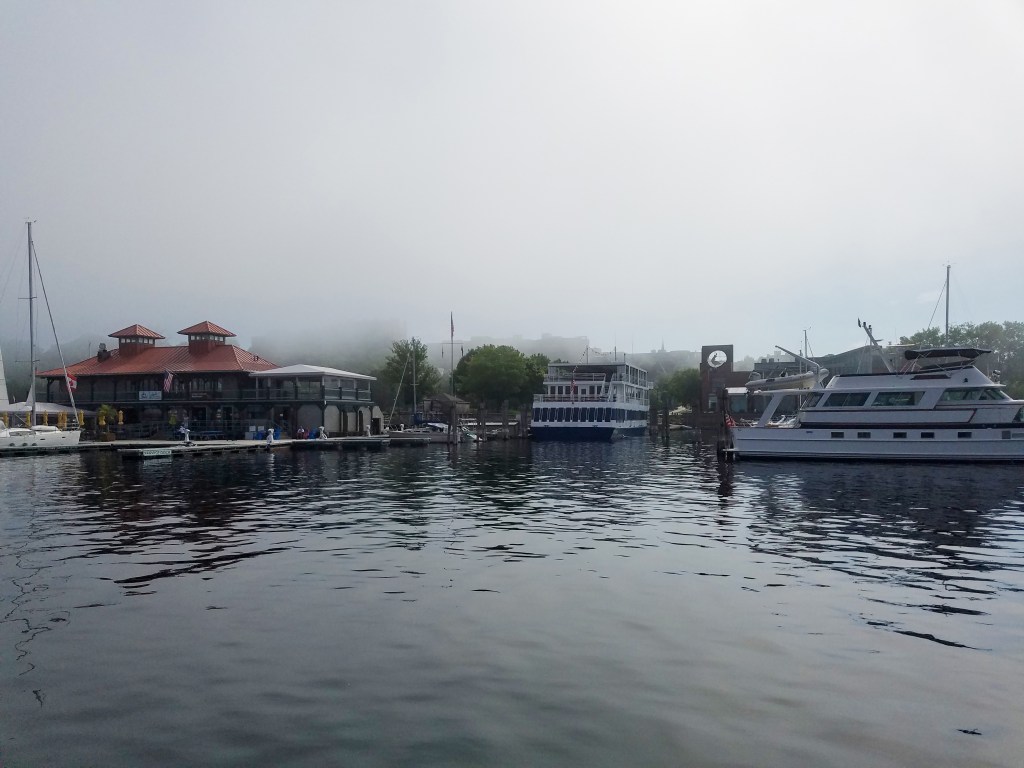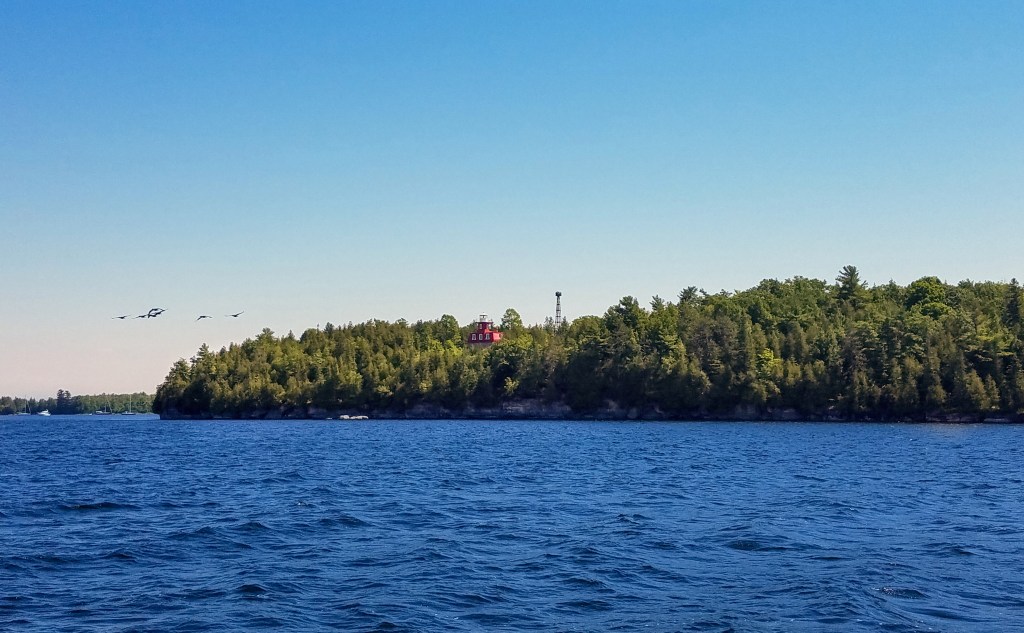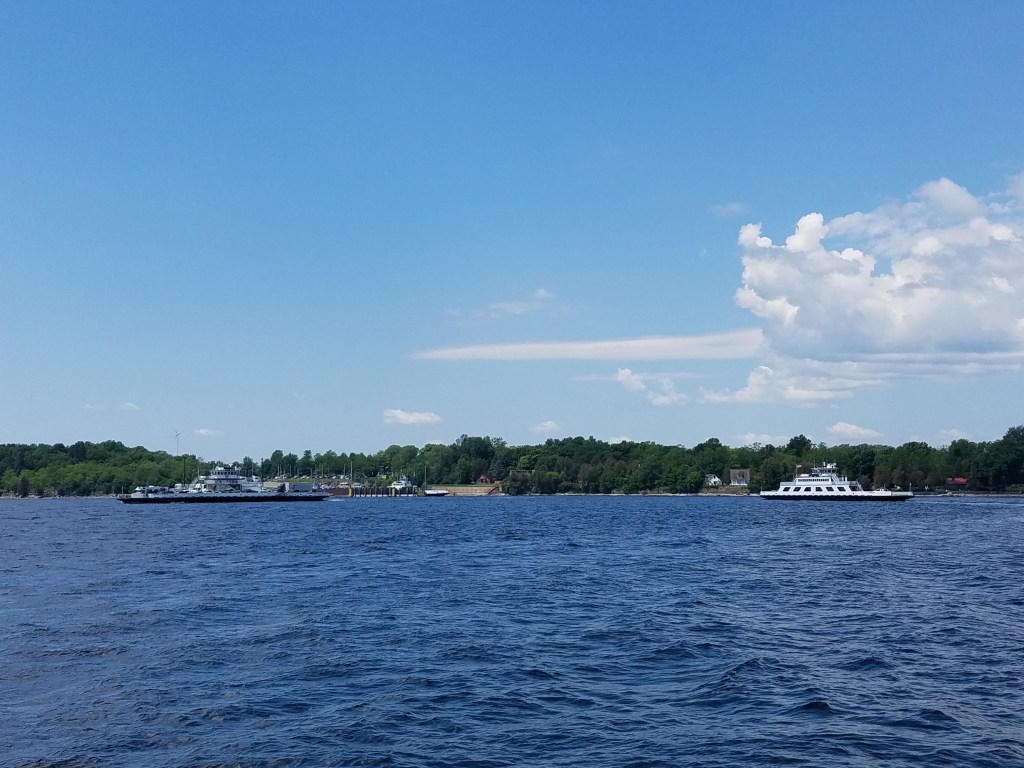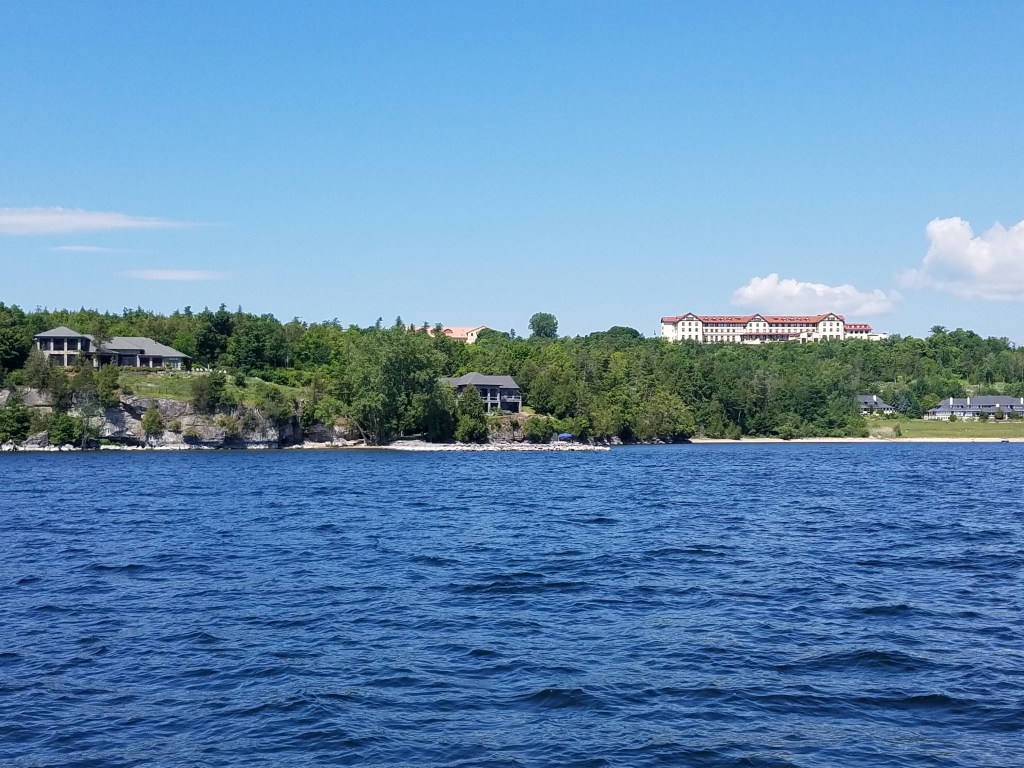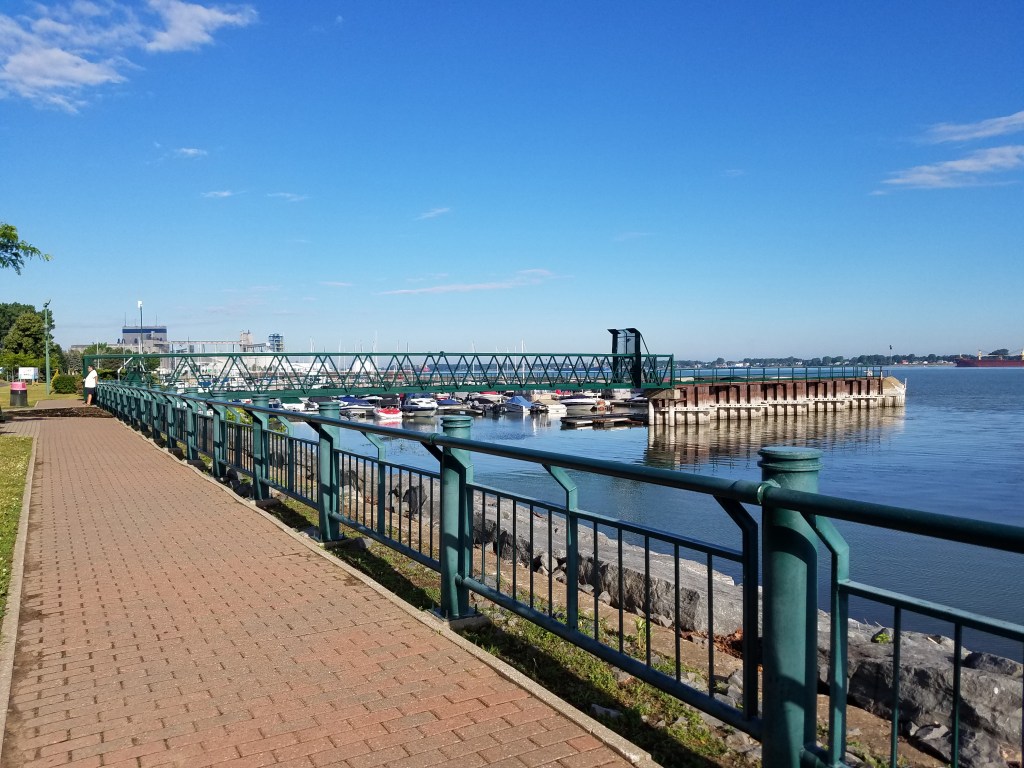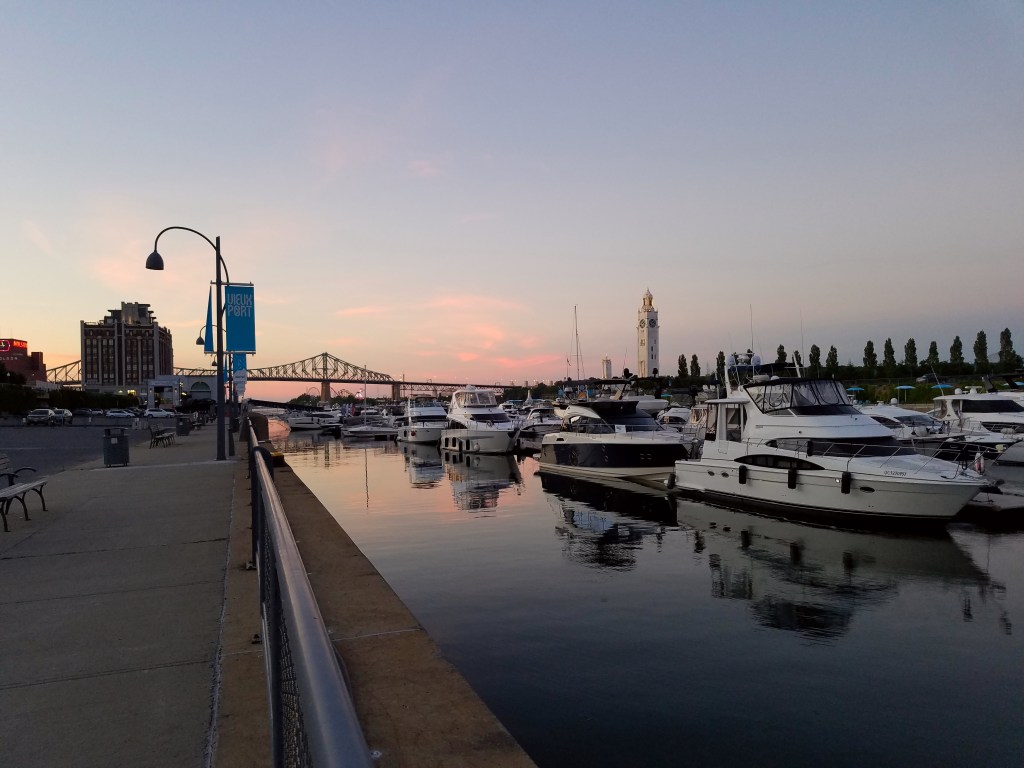
February 18th to March 5th, 2025: St Petersburg to Sanibel

Our trip across Tampa Bay to St Petersburg was uneventful and far more pleasant that the previous crossing.  We encountered a huge tow that took up the entire shipping channel, but there was plenty of water depth in the Bay, so we simply moved out of the way (the law of gross tonnage trumps all questions of right of way!)  As we neared St Petersburg, we saw several groups of dinghy sailboats, some racing, some obviously practicing their turns, but they were well off the channel.

Dinghy racing on Tampa Bay
Approaching St Petersburg

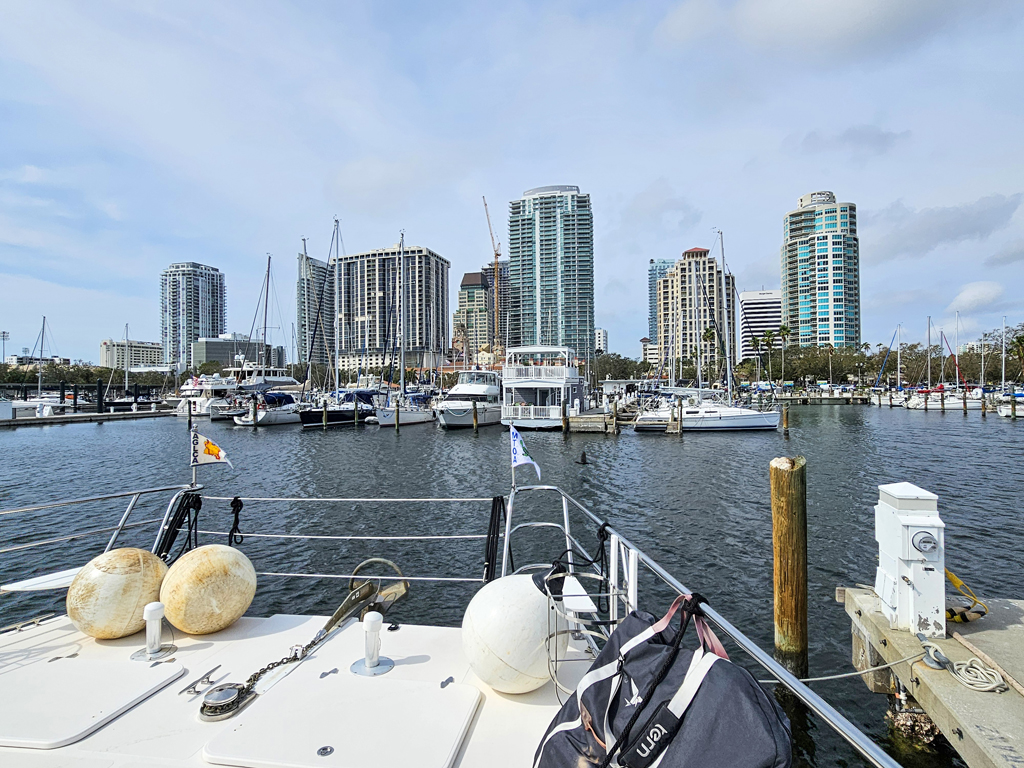
The marina is in the centre of downtown St Petersburg, a huge facility that occupies 3 large basins.  High rises line the waterfront, and there is a great choice of restaurants of all styles and price points within easy walking distance.

The marina is very well run.  The dockmaster called in the morning to confirm our arrival time, our slip assignment, and to make sure we had all the information we needed.  This is very unusual, Dick normally has to phone to confirm and ask the pertinent questions.  When we arrived at the pump out dock, they were ready to help tie up, and while we pumped out, the dockmaster went to our slip across the basin so he was waiting to catch our lines.

The facility is still recovering from the hurricanes, and their main building was destroyed, but they have adapted well and the dockmaster had all the paperwork and key cards ready to hand us, rather than making Dick walk the ¾ mile each way to the temporary office.  The docks are wide, sturdy concrete with good pilings, but as they are fixed rather than floating, it is necessary to take the tide into account when tying up.  The dockmaster warned us that there “is a pretty good tide here”, telling us that the change is about 2 feet.  We chuckled and told him that we deal with 9-foot tides in our home waters.  In fact, we always tie up with spring lines and lines across that can account for change in water levels, even on rivers.  Many Loopers whose boating experience does not include tidal waters have to learn some new skills and procedures when they arrive in the Gulf.

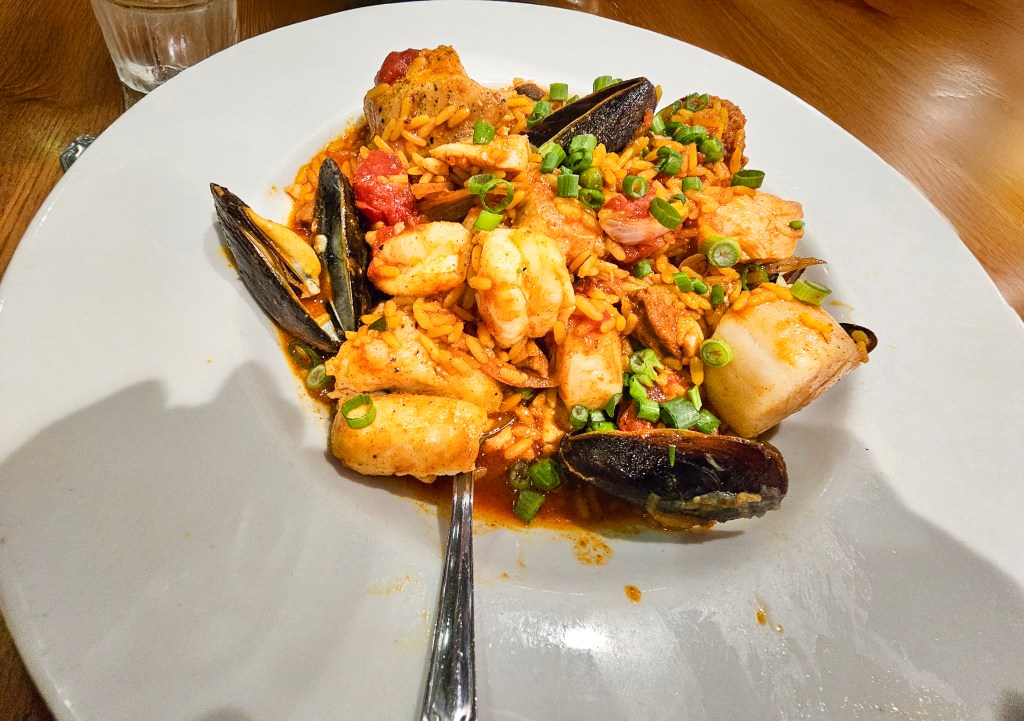
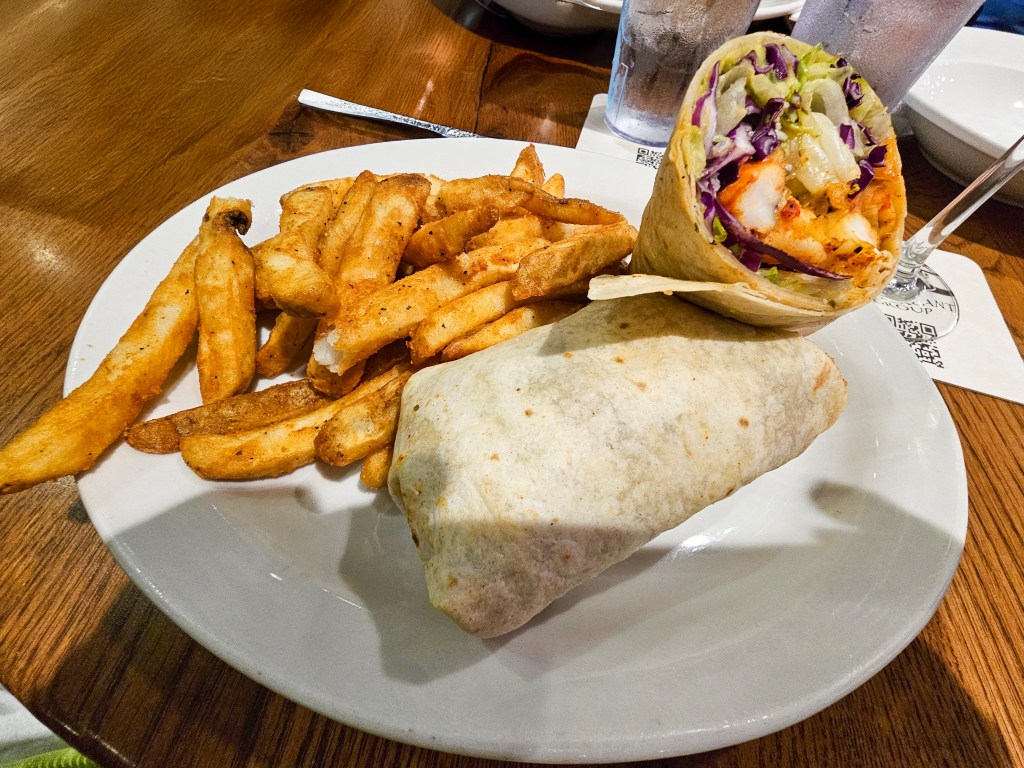
Our friend Kim was unable to meet us for dinner as planned, so we cancelled our reservation at a rather trendy eatery at the end of the pier, and opted for Doc Ford’s.  The story of the restaurant is interesting. It is owned by the writer of a popular series of books that feature the character Marion “Doc” Ford, a marine biologist and environmental consultant.  Dick always enjoys calamari, and my Tomlinson’s Taquitos were a delicious concoction of spicy shredded chicken in corn tortillas.  One was plenty, so the second made a great lunch for Dick, the leftover king.  For main courses, Dick’s paella was very good, and I loved my wrap with spicy grilled shrimp accompanied by some of the best fries we have eaten.  Even though the restaurant was incredibly crowded and so noisy you had to shout to be heard, all the food was piping hot and timely, and the waiter made a point of not neglecting his smaller tables while looking after the very large groups in his area.  We would certainly return.
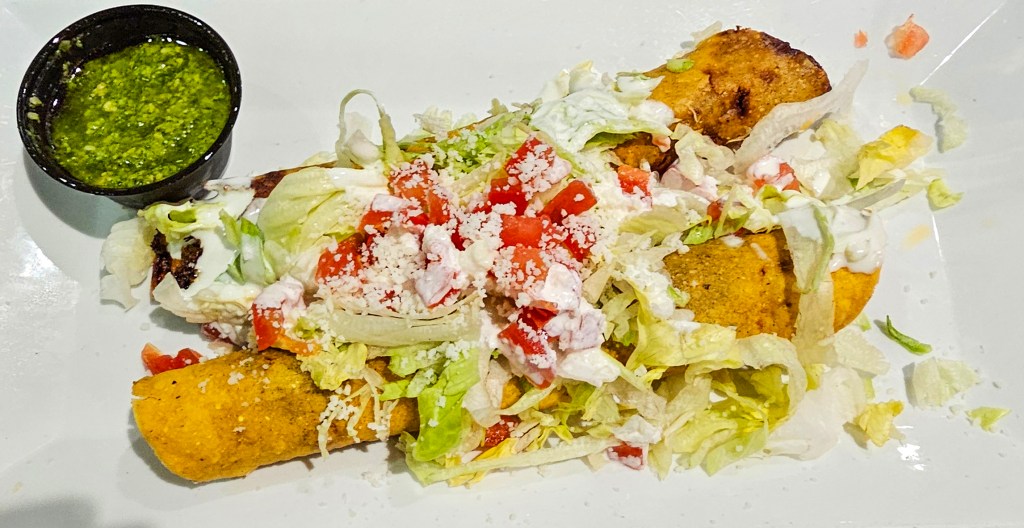
Doc Ford’s Tomlinson’s Taquitos
Doc Ford’s Paella
Doc Ford’s Spicy Shrimp Wrap with Fries

Beside the restaurant is an interesting sculpture to commemorate the world’s first commercial airline flight in 1914 on a Benoist Airboat.  The stainless steel sculpture is a full scale replica of the airboat.  St Petersburg considers itself the birthplace of commercial aviation, and the sculpture is on the site of the hangar used for the airline.  That first flight was to Tampa, taken by the then mayor of St Petersburg, at a cost of $400, equal to about $12,624 today.
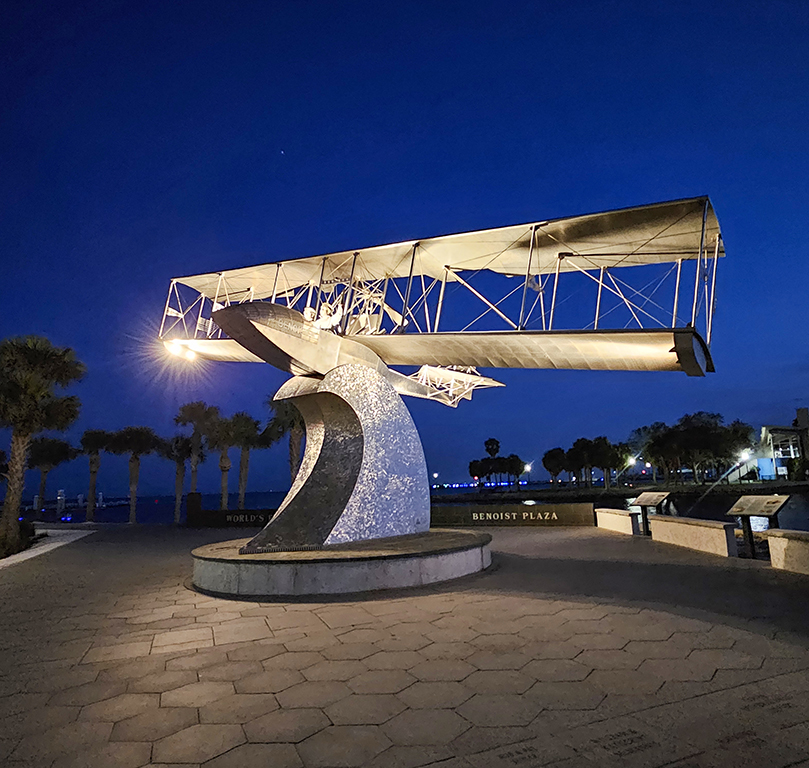
Benoist Airboat, sculpture to commemorate the first commercial airline flight
St Petersburg Municipal Marina and Skyline
Stormy sunrise in St Petersburg

The next day Dick shopped for party food and ingredients, and also some disposable champagne flutes.  I did part of the preparation, including making up a delicious dip, appropriately called “boat dip”.

In the evening, we donned our bright yellow, waterproof jackets and got ready to walk over to a very nice Italian restaurant to meet Kim.  Dick paused to make repairs when we discovered that one of the lines to the fender board had snapped, so I was first at the restaurant.  Shortly after I was seated, Dick arrived, and just said to the hostess, “I’m the other canary”.  She knew immediately who he was with!  Kim arrived after finding scarce parking, and we had a great evening catching up on each other’s news.

The next day I continued with party preparation, while Dick took the dinghy across to the fuel dock to fill the tank.  The plan was to anchor one night, and then we would be 4 nights on a mooring ball in Sarasota, so the dinghy was about to play an important role.  The battery was flat, but Dick has a charger on board, so that problem was soon solved.

Dick checks out the dinghy

Kim arrived mid-afternoon, and helped me set out the special nibbles on various platters.  The boat dip was spooned into tortilla scoops.  This was a new recipe, and is definitely a keeper.  Sour cream, a can of chopped tomatoes with peppers and onion (Rotel), an envelope each of ranch dressing mix and taco seasoning, and a bag of shredded cheddar jack cheese combine to make a spicy and very moreish dip.  I also mixed smoked salmon with onion chive cream cheese to fill tiny pastry cups.  We had brought frozen bite sized quiches and raspberry brie parcels, and I had made spiced palmiers.  Dick bought cooked shrimp, that were served in a large bowl with cocktail sauce for dipping.  I scattered Marconi almonds and tiny pepper drops around the platters, plus some chopped snacking buffalo sausage.  Having prepared and set out enough food to feed the entire marina, I was happy that the guests munched and enjoyed the food, along with beer, wine, fizzy drinks, and of course the champagne for toasting Nine Lives and our shiny new gold burgee.
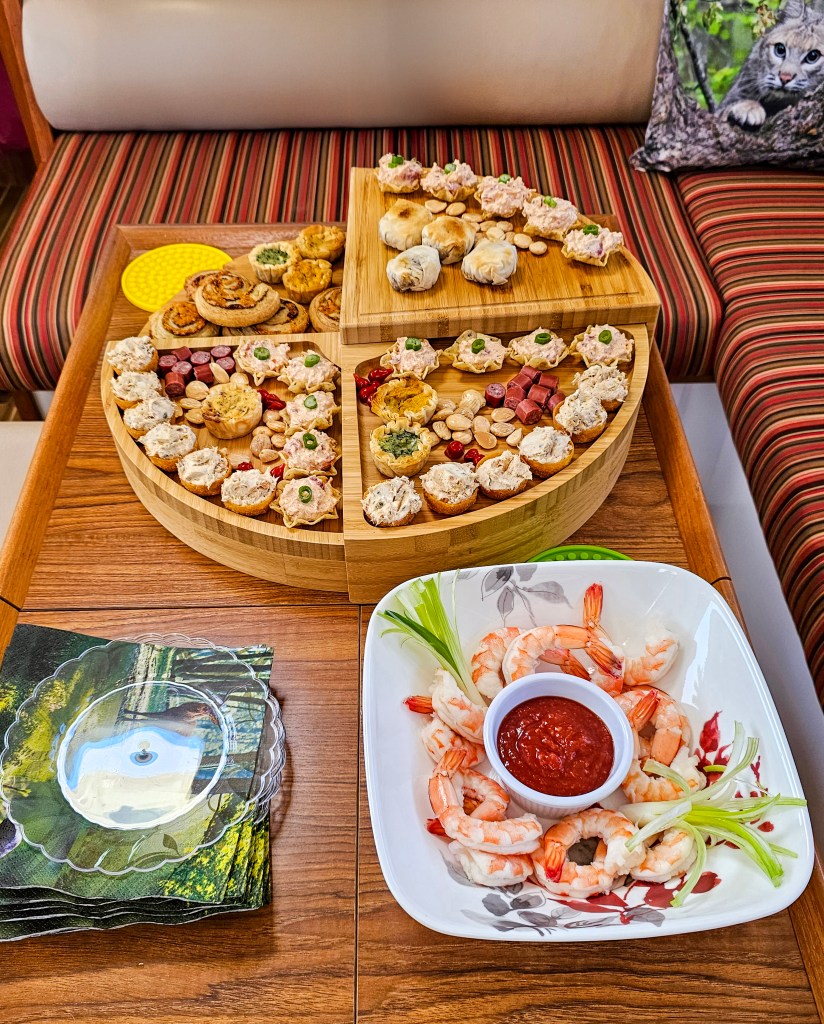
Party food for the wake crossing celebration

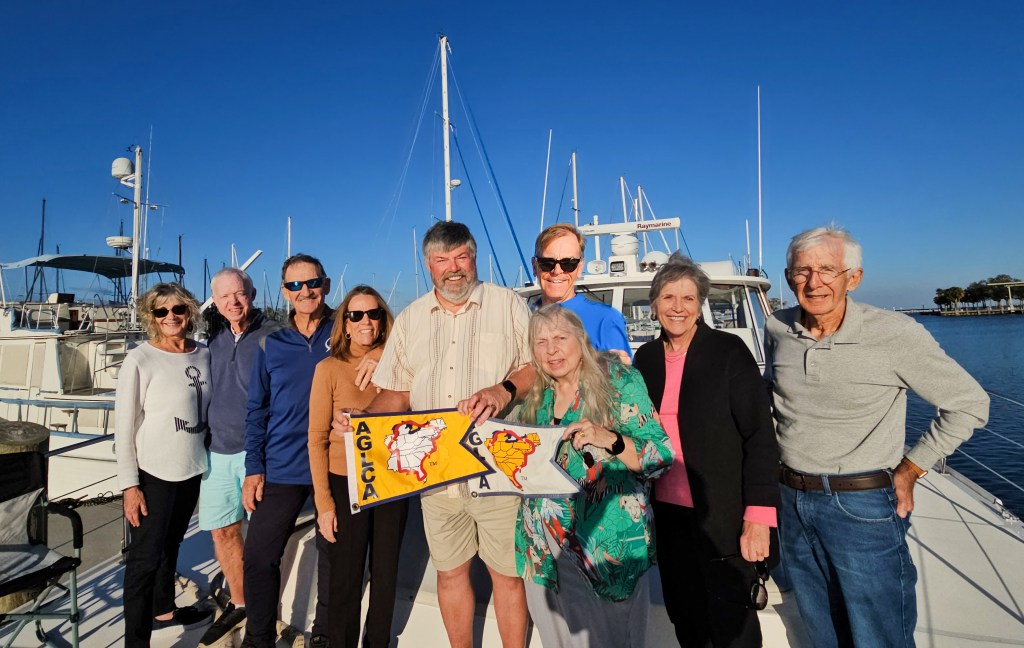
The guests were some of our oldest friends.  Three were at our renaming party in 2017 when we began the Loop.  The group included some of Dick’s former colleagues from Toronto and Calgary, a friend he played ice hockey with, and a slightly more recent colleague from the times after the joint venture.  Julian helped us out in a big way by receiving a bunch of Amazon orders, as well as the critically important gold burgee, and bringing it all to us for the party.  Marina offices will receive mail and parcels, but it can be somewhat hit and miss, so we were so glad to have a friend to accept important deliveries.
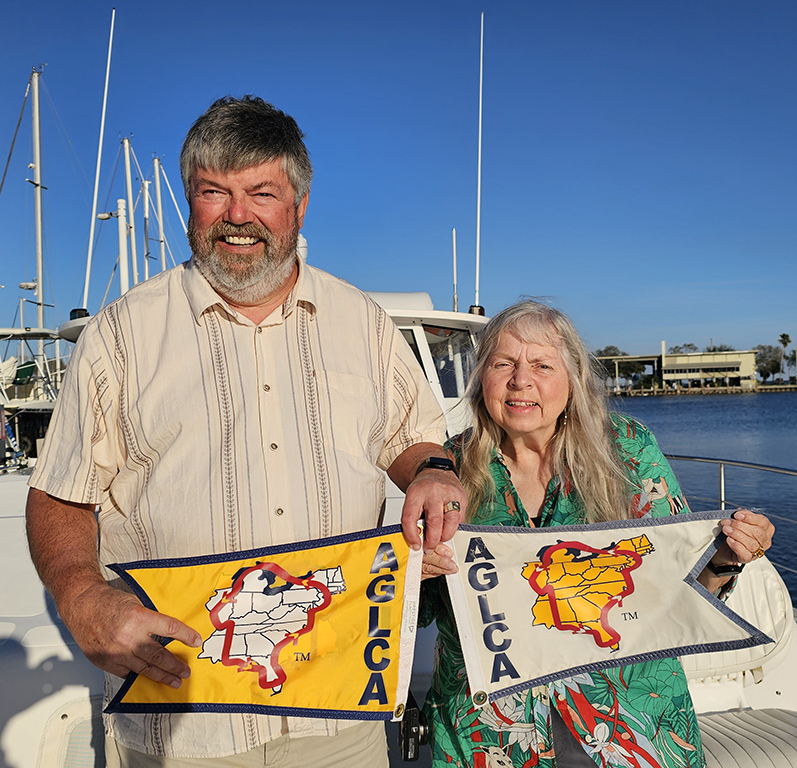
Our shiny new gold burgee
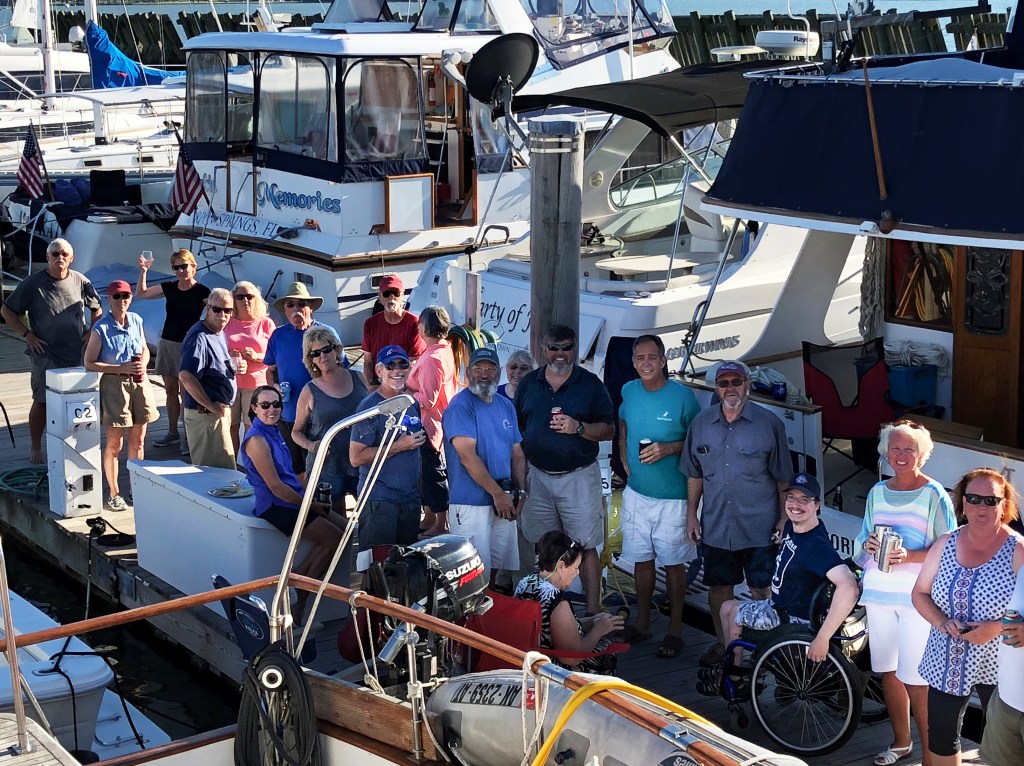
Friends came to celebrate

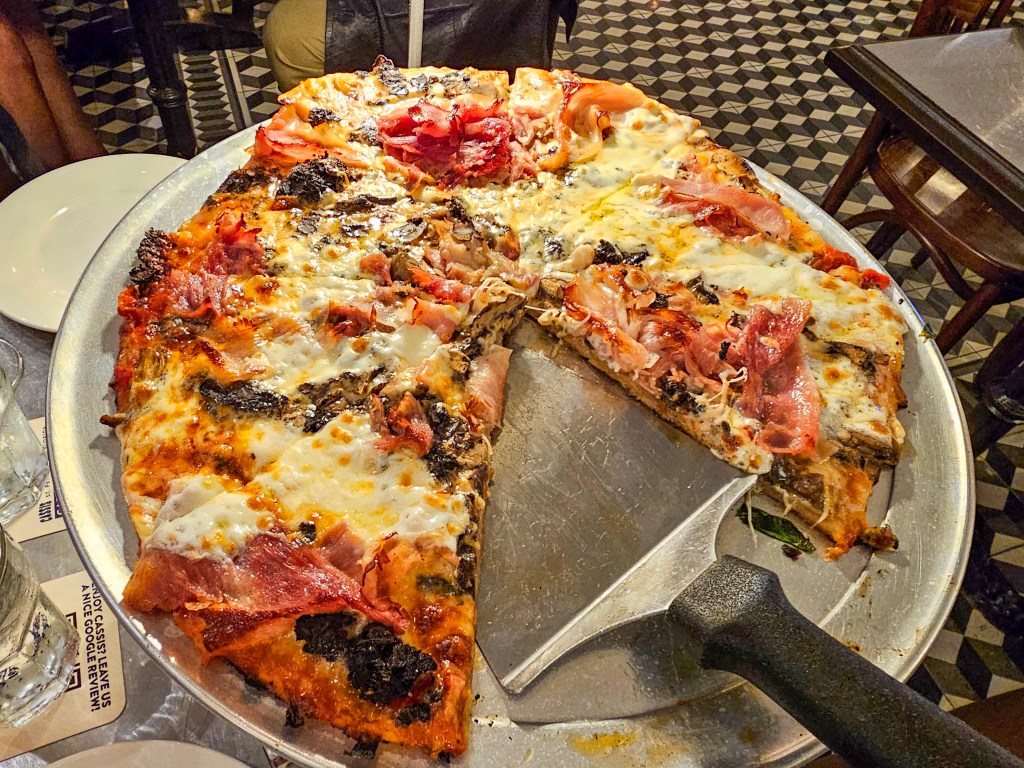
After a quiet day, (Dick rode his bike to Fresh Market to pick up a few groceries), we walked over to Cassis for a very nice dinner.  The only downside was that they were having their outside doors repainted, so the large double entrance doors needed to stay open.  It was quite chilly outside, so there was a tremendous cold draft that took all the heat off the food very quickly.
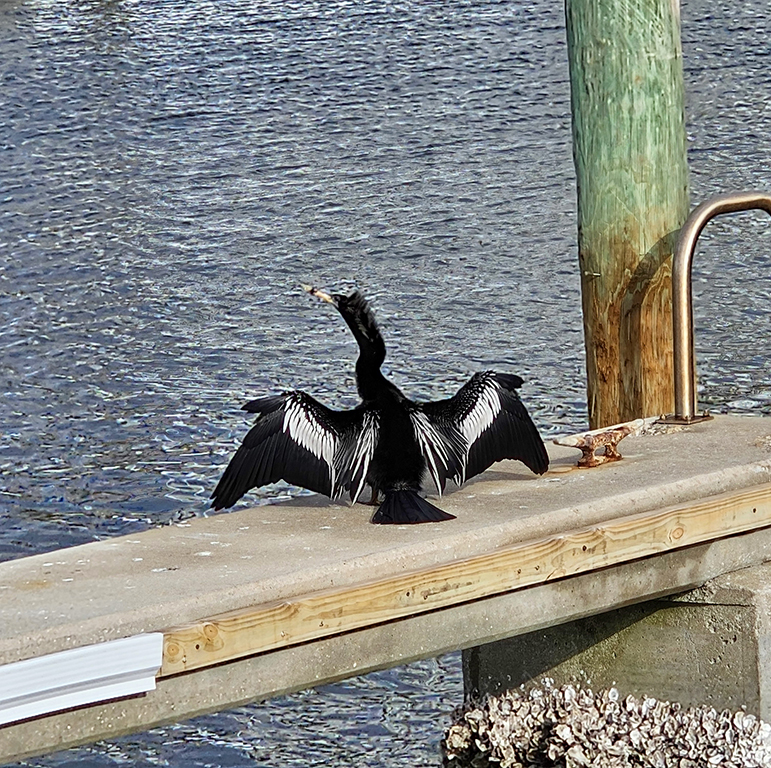
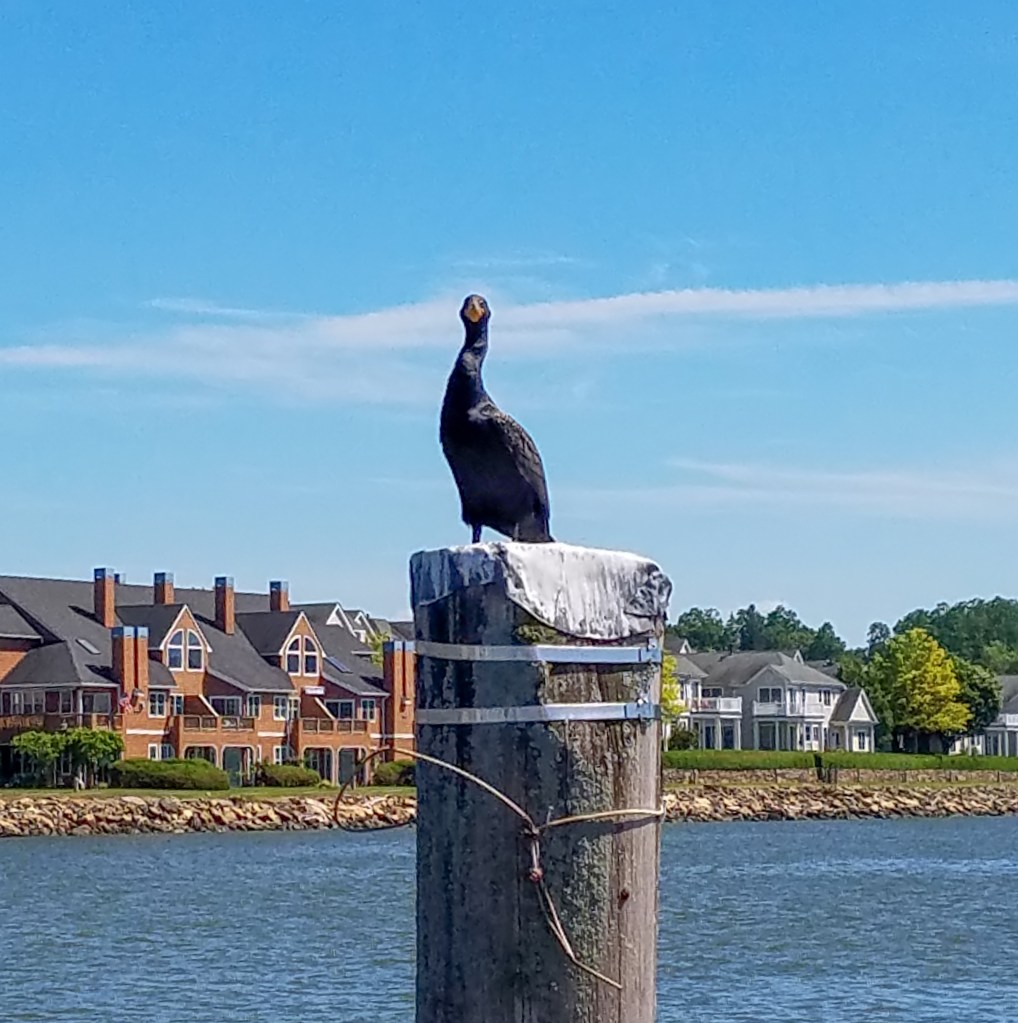
Anhinga drying his wings on a dock in the marina
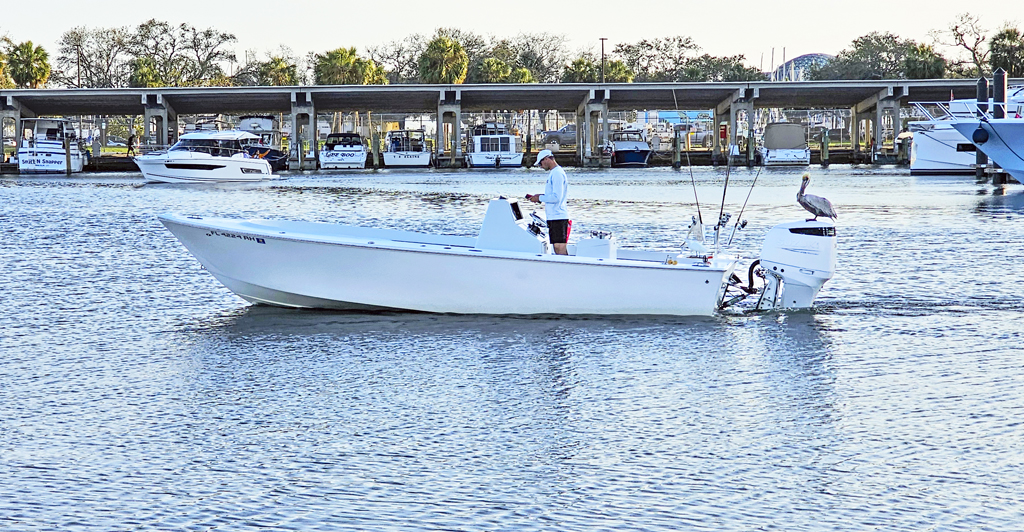
A boater heading out to go fishing. Note that he has two avian passengers!
Bouillabaisse at Cassis
Pizza at Cassis

We left St Petersburg at 11am.  It was lumpy again in Tampa Bay, but once we passed under the Sunshine Skyway Bridge it smoothed out.  From there until we anchored, we only had to deal with wakes from weekend pleasure boats.  The anchorage Dick had chosen had poor and out of date reviews.  I looked at every possibility south of that one, and we chose Whale Kay, off Longboat Key and across from Sarasota.  We crept into the anchorage very slowly, seeing less than 5 feet under the keel before it got a little deeper (8 feet) in the middle of the bay.  It felt as though we were out in the middle of Sarasota Bay, but in fact it was a very protected area.  Just one derelict boat, clearly dragged onto a sand bar from the hurricanes, and a few crab pots were present in the wide anchorage.  There was a glorious sunset to begin a very peaceful night.

We passed under the Sunshine Skyway Bridge in 2017 on our first voyage. It was too lumpy to take the picture from the deck this time.
Sunset at the Whale Key anchorage

We were only 5 miles north of Sarasota, our next stop, so there was time for Dick’s signature full English breakfast.  On arrival at Sarasota, we were reminded of the reason why it is best to stay put on weekends, as a guy in a large cruiser whipped past us very close and at high speed to beat us to the fuel dock, his wake throwing us from side to side.  After a long wait it was our turn on the dock, so we topped up with fresh water, then collected our key to the restroom and security gates, and our mooring ball assignment.  We were delighted to learn that we were number 1 (not that we ever doubted).  This meant that we were the closest ball to the marina, with the smallest wakes and an easy distance to watch the comings and goings of the busy harbour.
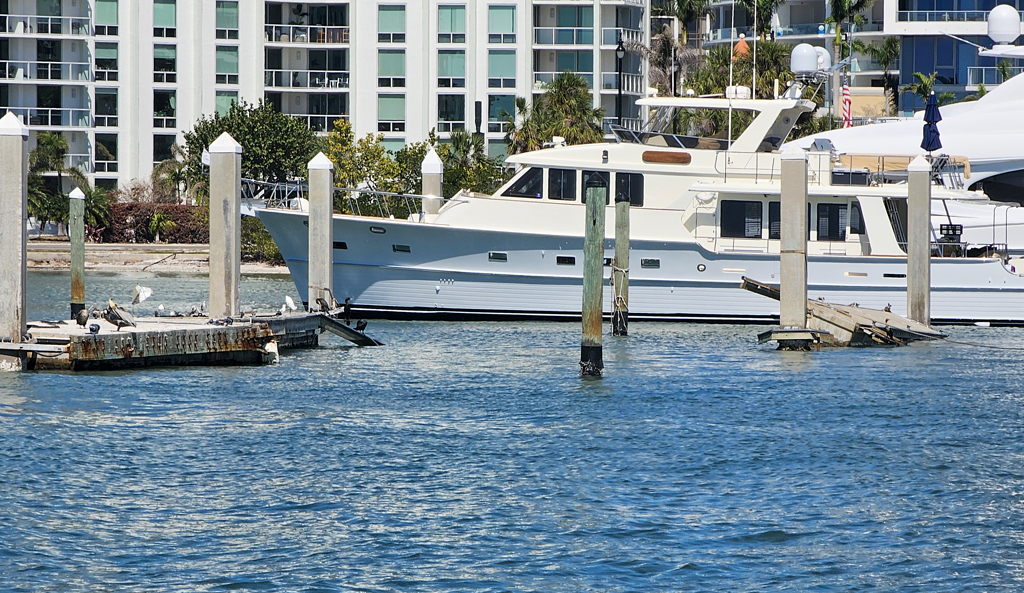
Damage to the marina in Sarasota. The only transient space until it is repaired is on mooring balls.

Although it is some years since we have used a mooring ball (not since our sailing days with my parents), we were very pleased to accomplish the maneuver without drama.  Dick caught the pendant with the boathook on the first pass, and he was ready with two lines to pull through the eye and back to Nine Lives.  Another day I watched people on a sailing cat fail to catch the pendant, requiring a big reposition and two tries to catch it.  One generally expects greater expertise from sailors.  Of course, stuff happens, and until we are done with mooring balls, I should touch wood and stop gloating!
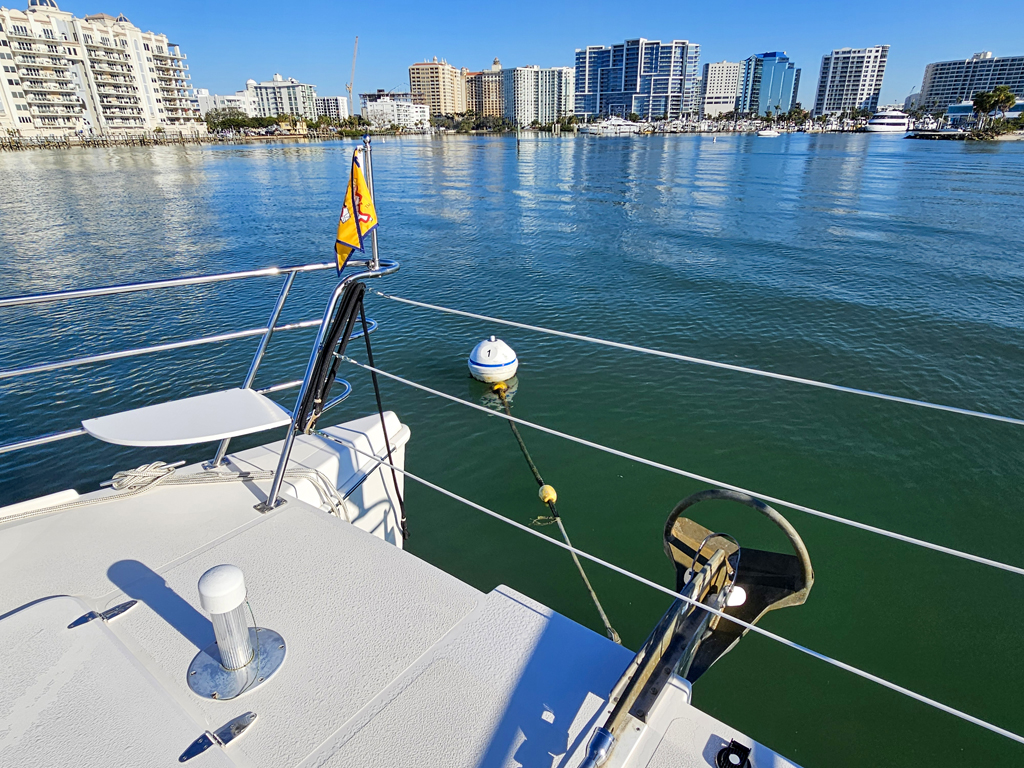
Sarasota, the mooring ball, our gold burgee, and the waterfront

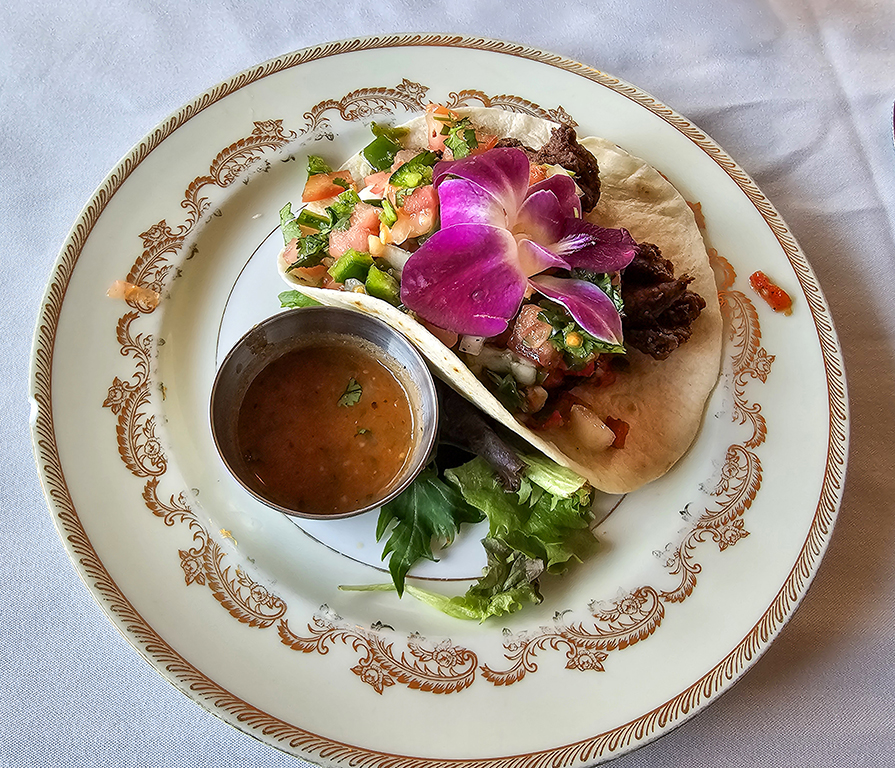
We had an early dinner reservation at a restaurant called Rosemary and Thyme.  It was a mile walk on a hot afternoon, but it was definitely worth it.  The restaurant is in a beautiful, sympathetically renovated old building, with a huge outdoor patio area.  By 5pm it was nearly full, testament to the excellent food and impeccable service.  I was charmed by the mismatched old china they use instead of new and matching (or, horrors, slates and bits of wood as were trendy a year or so ago).  Dick started with a fish chowder, and I enjoyed a delicious shrimp tostada.  Dick chose the halibut special for main course, while I opted for a second starter, sliced beef filet, breaded and fried, served with pico de gallo on a crisp tortilla.  Desserts were also excellent, and a reasonable individual portion-size for a change. The walk back to the marina was interesting, taking a different route through downtown.  I was surprised at the numbers of people in the many restaurants, on a Sunday night, almost every table in their outdoor areas was full.

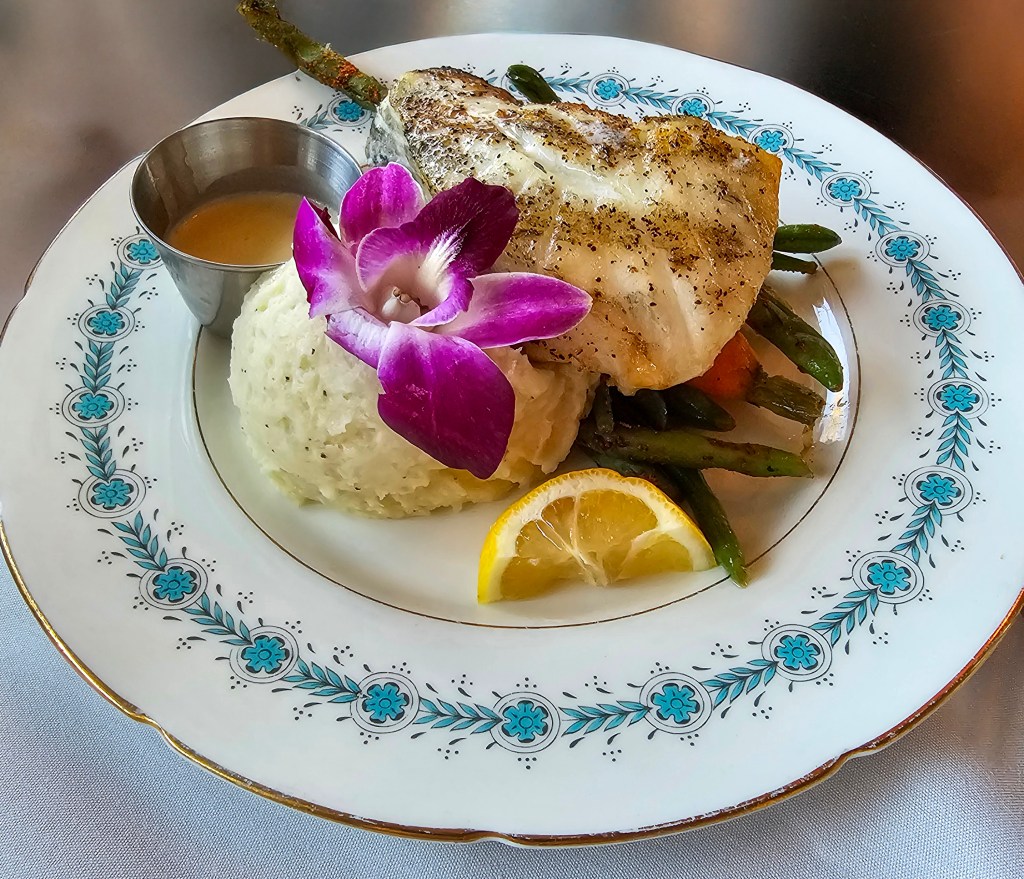
Shrimp Tostada at Rosemary and Thyme
Halibut at Rosemary and Thyme
Beef tortilla at Rosemary and Thyme

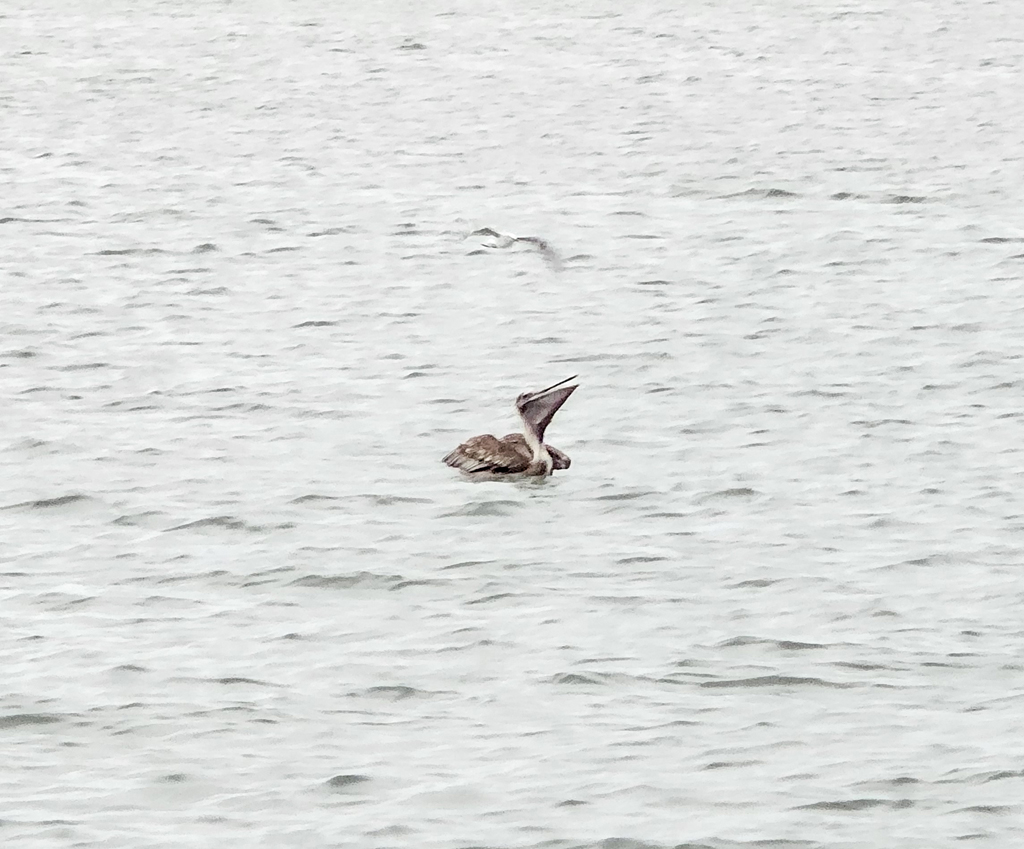
We spent the next, rainy, day on board.  I baked a batch of bran muffins, and Dick worked on reservations for the next couple of weeks for marinas and restaurants.  We also prepared responses to questions for a podcast on segment looping for AGLCA.  In the evening, as we sipped our pre-dinner cocktail, we found we were surrounded by pelicans fishing by diving.  It is amazing to watch.  They soar over the water, about 30 feet up, and suddenly, they dive straight down into the water, 80% of the time coming up with a fish.  They pause with their bill in the water.  I am guessing this is to orient the captured prey in the right direction, and then they lift their heads up and swallow the fish whole.  We watched this behaviour for the first time more than 20 years ago on a sailing trip in a remote bay in the Caribbean, but we have not seen it since.  After less than an hour, the fishing session was over, and the pelicans disappeared at dusk.

Splash! The pelican dives for his dinner.
Got one!

As the evening progressed, the rain became heavier.  Later, the wind came up, and Nine Lives transformed into a flamenco dancer, sliding back and forth through 180 degrees, and bouncing on the pendant of the mooring ball with loud noises, accompanied by rhythmic slapping of the waves and rocking from side to side.  Soon, the rotating became so fast that it was making me dizzy, so I retired early to bed and spent the night listening as the storm came up and retreated several times.  The rain was biblical, and with the strong wind, water leaked through some of the tiny gaps in the cockpit enclosure and there were small puddles here and there in the morning.  We were very glad we were on a secure mooring ball instead of at anchor.  Even our trusty Rocna  might have had difficulty holding as the wind blew us back and forth.

The next day was quieter and mostly sunny, but still a bit rough, making it exciting for getting into and out of the dinghy.  We met Betty and Cathie for lunch at the marina restaurant.  It was great to see them and be able to wish Betty a Happy Birthday in person, just a few days early.  After dropping me back on Nine Lives, Dick walked to Whole Foods with his Burleigh cart, so he could stock up on heavy items like sparkling water and potatoes.
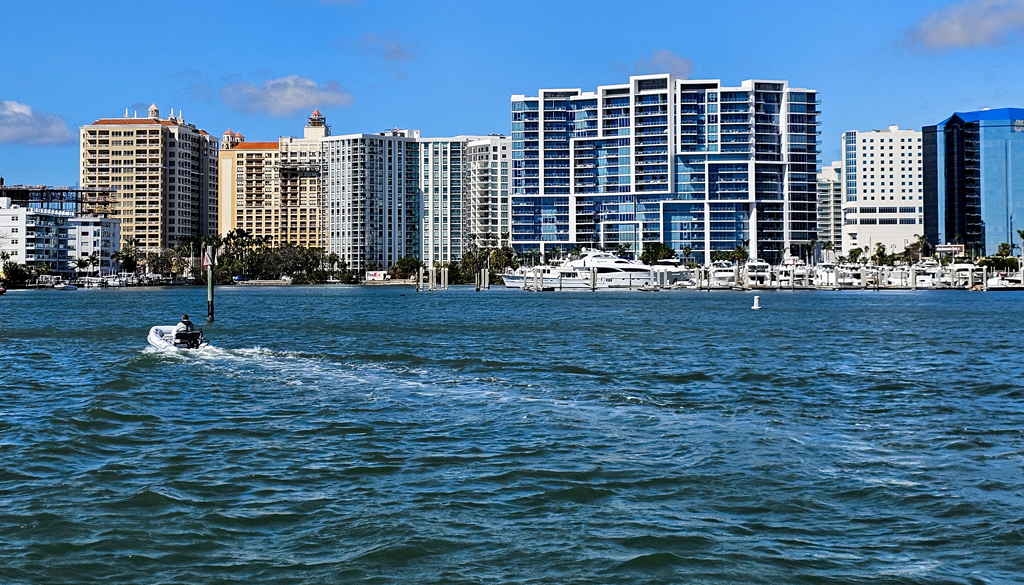
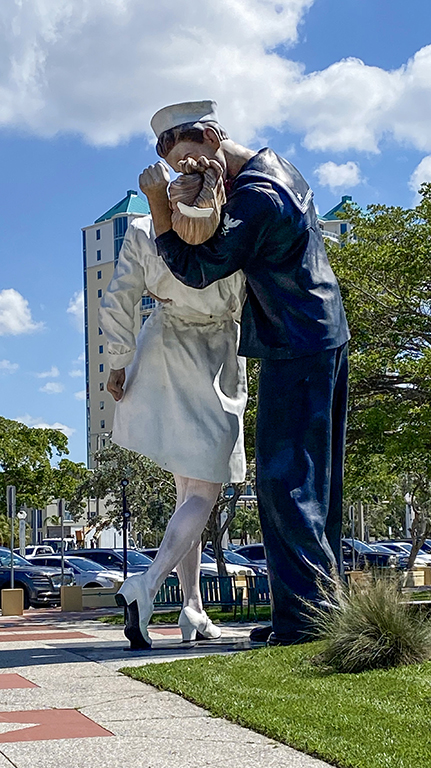
The hunter gatherer heads out
An interesting sculpture in Sarasota

The next morning, we launched the dinghy again and toured around the mooring field and the marina.  Some boats have clearly been there for some months, even since the hurricane, given the amount of marine growth on the hulls and the torn sails.  There are one or two boats stranded on the shore, but no wrecks in the harbour, so either they have been lifted, or none sank.  Dick walked to Publix while I watched the boat traffic.  I was fascinated by a couple who anchored beside us and then proceeded to race all around the harbour on e-foils.  These are like a small surfboard, with a long keel with wings at the bottom and a motor.  One stands on the board and the motor pushes the board (fast).  The board lifts right out of the water like a hydrofoil, using the wings on the bottom.  The rider holds a remote that controls the motor beneath.  When the pair returned to their boat after more than an hour of whizzing about, I was surprised at how large and obviously heavy these things are.  Clearly a lot of skill and good balance are required.
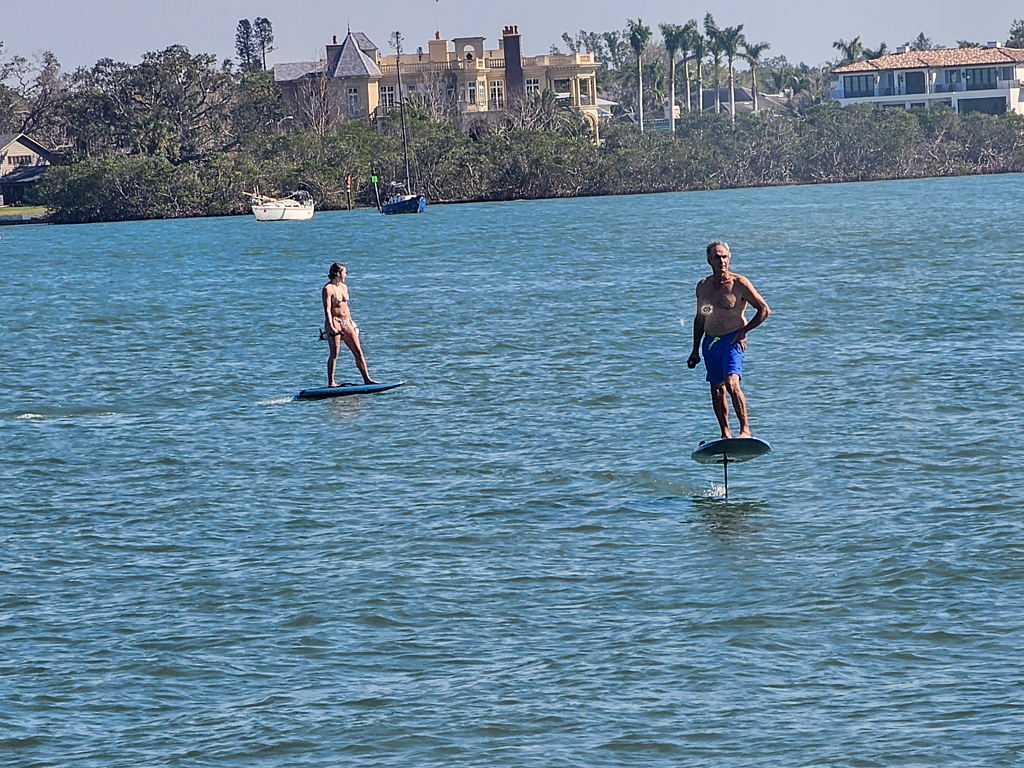
E-foils

Around 4pm we launched the dinghy and headed out to dinner.  I will be quite happy if we don’t need to do this again on the voyage. It is hard enough balancing in calm waters, but with the dinghy dancing around it is a recipe for an unplanned swim.  The first time we did this from the mooring ball, Dick stood in the dinghy to help me get in.  A wave lifted it, and he adjusted his balance suddenly, nearly throwing me overboard!  After that, the procedure was for him to sit down, and I kept one hand on a fixed part of Nine Lives until I was safely in the dinghy. (for those of you that wonder, we do both wear life jackets when using the dinghy)

Nine Lives on a mooring ball

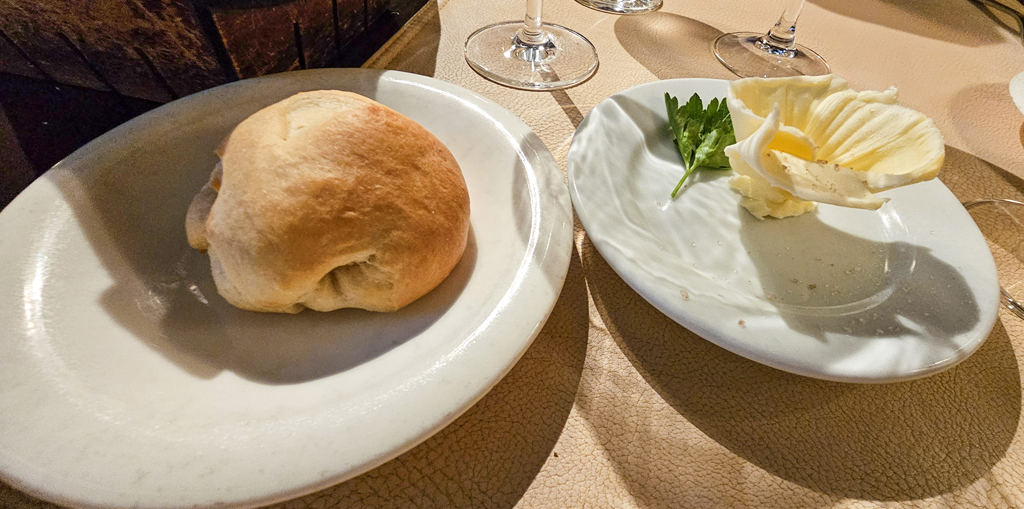
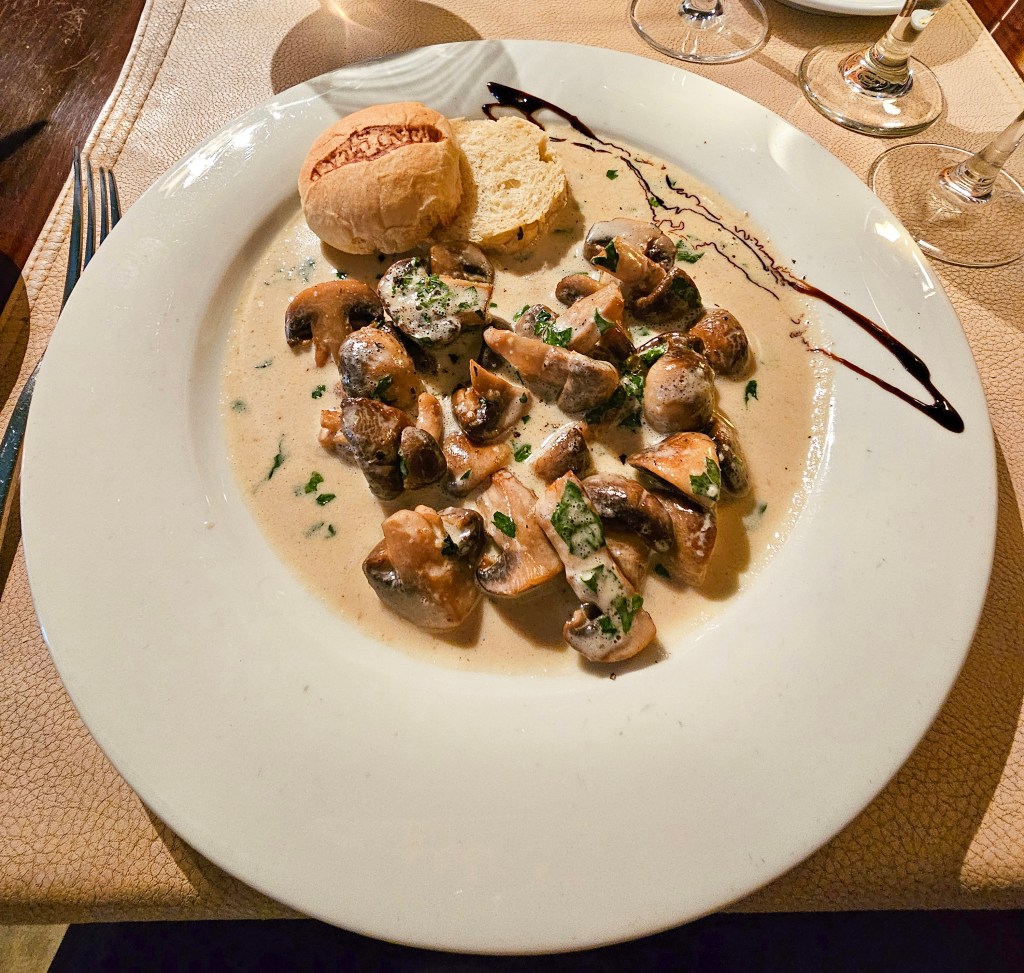
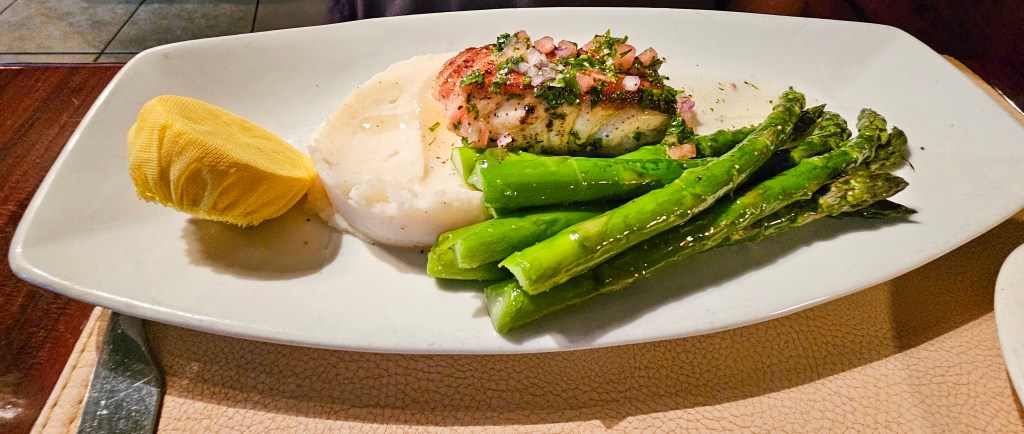
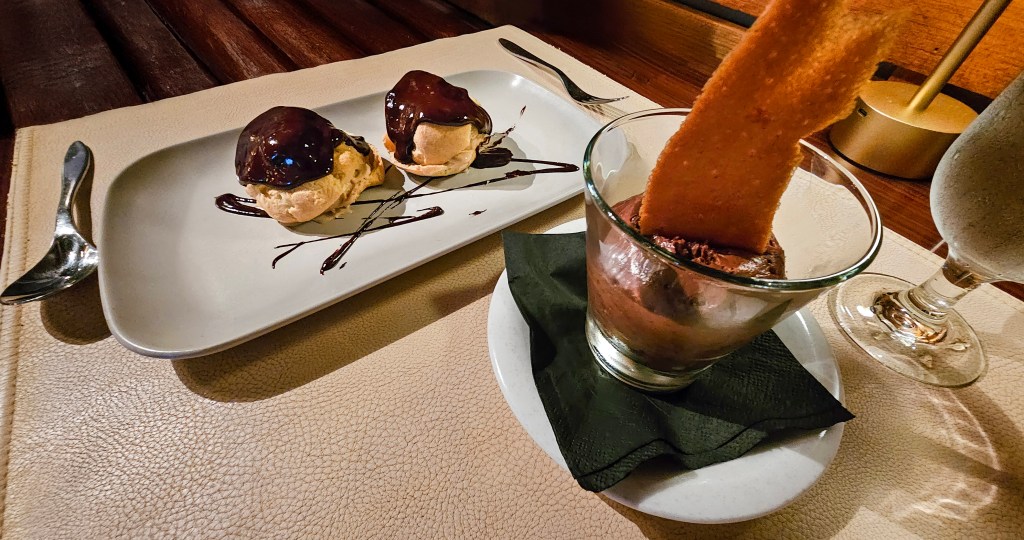
Dinner was incredible, unquestionably our best meal so far.  Antoines is a tiny French restaurant located in an unprepossessing strip mall, owned by a Belgian gentleman (a real character, with a Hercule Poirot mustache!) and his chef wife.  The food is amazing.  Before our appetizers arrived, we were brought tiny amuse bouche bowls of delicious pureed vegetable soup.  These were accompanied by fresh rolls and butter that was carved into an exquisite flower shape.  My garlic mushrooms were perfect, as were Dick’s authentically garlicky escargot.  I ordered the evening special lobster ravioli in lobster sauce, and Dick chose a delicious black grouper.  Desserts lived up to the rest of the meal, my chocolate mousse was excellent, as was Dick’s favourite profiteroles.  We accompanied the meal with a very good bottle of Sancerre.
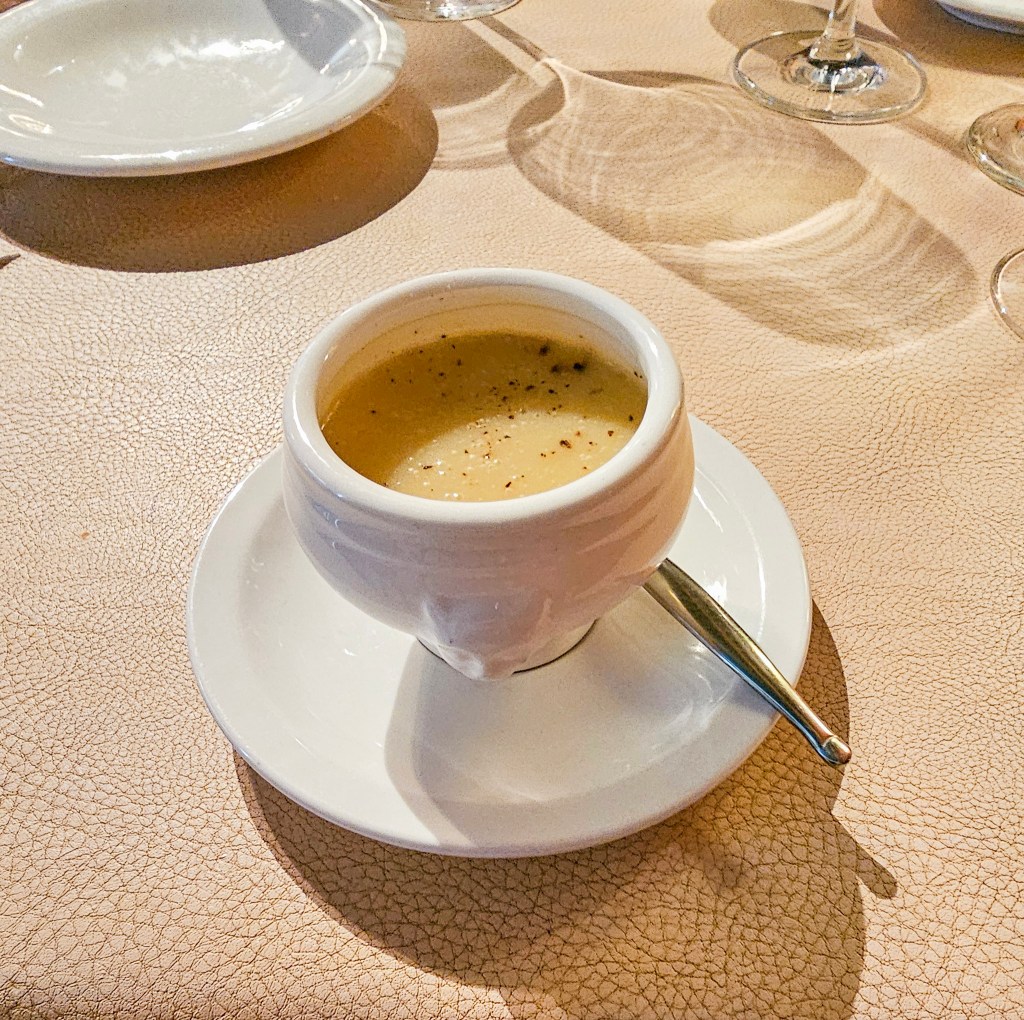
Amuse bouche at Antoines
Bread, and an exquisite butter sculpture at Antoines
Escargot at Antoines
Garlic mushrooms at Antoines
Grouper at Antoines
Lobster ravioli at Antoines
Desserts at Antoines

Our return to Nine Lives by dinghy was accomplished at dusk without incident, in spite of all that wine and good food!
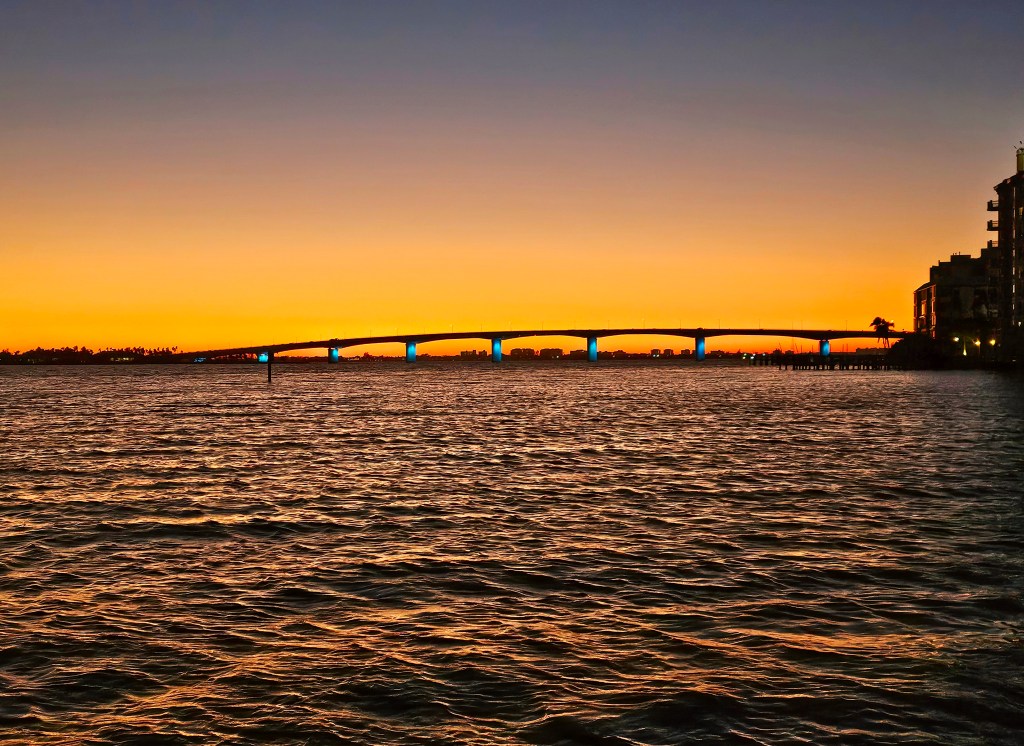
Sarasota’s John Ringling Causeway at sunset
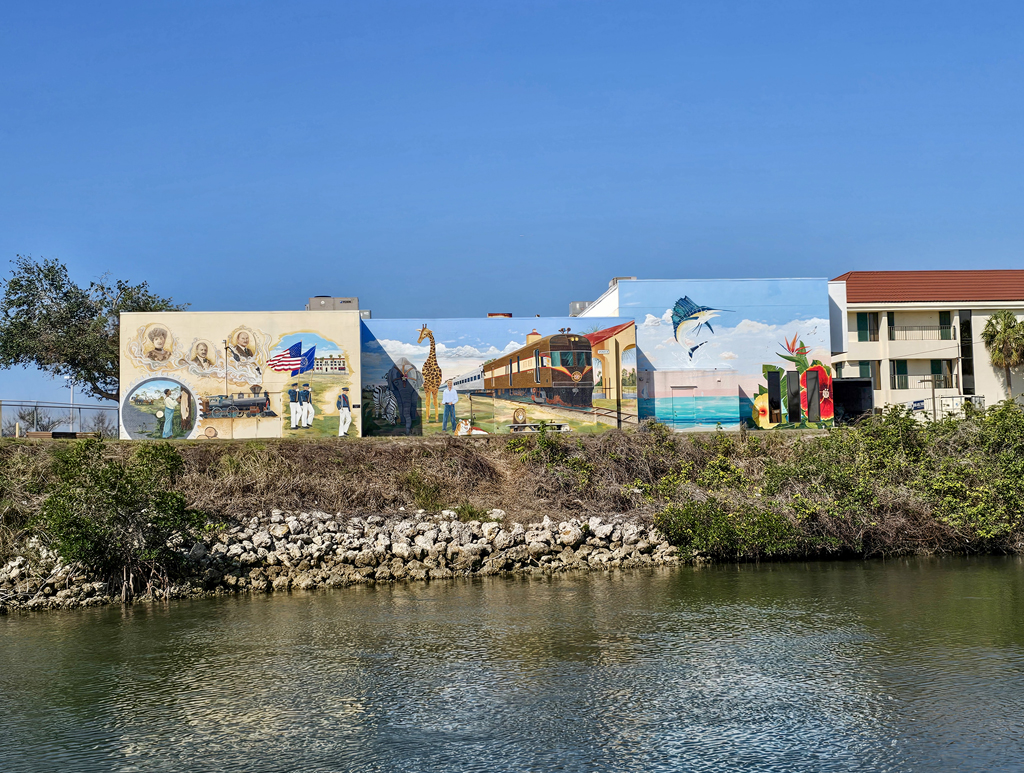
Murals on the canal in Venice

Crowsnest Restaurant in Venice operates a marina.  Only a few slips have been repaired from hurricane damage so far, and it is quite tricky to get in because the slips sit perpendicular to the strong current from the outlet to the Gulf.  Two dockhands help with tying up, in fact they came on board and handled the lines for us.  I was a bit insulted at first, thinking they were assuming that I was incapable, but as we watched other boats arrive it was clear that they do this for everyone.  In fact, getting into a slip is so tricky that one boat made several approaches and ultimately chose to tie up on the fuel dock overnight instead, in spite of the requirement that they would have to leave before 7:30am.

Soon after we arrived and were set, our friends from Pittsburgh and the Monongahela River arrived for docktails.  Valerie and Chip are staying in a condo nearby for the winter.  Valerie brought several interesting cheeses, a dip, and some strawberries, plus some flowers, so it was a reversal of our usual roles as hosts!  Nine Lives loved the flowers, artfully displayed in a special flat vase that expands when water is poured in, and fitting perfectly in one of the cockpit cup holders.  It was great to catch up with our friends, and dinner at the restaurant was most enjoyable.
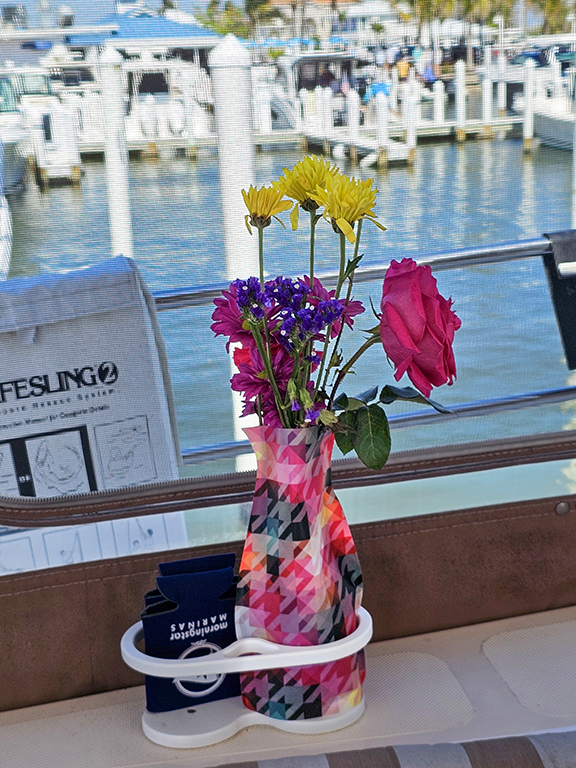
Flowers for Nine Lives
Dinner with Valerie and Chip at Crowsnest in Venice

Mangroves provide storm protection.  How many homes that were destroyed by flooding would have been saved if the mangroves had been left along the shorelines?  Our observation as we travelled south was that there were a lot more repairs required on the Gulf side of the GICW, but most of the mangroves are present on the land side, and there appears to be less hurricane damage.  Some wrecked docks and boat lifts, but the houses, even the single-story bungalows, look okay.
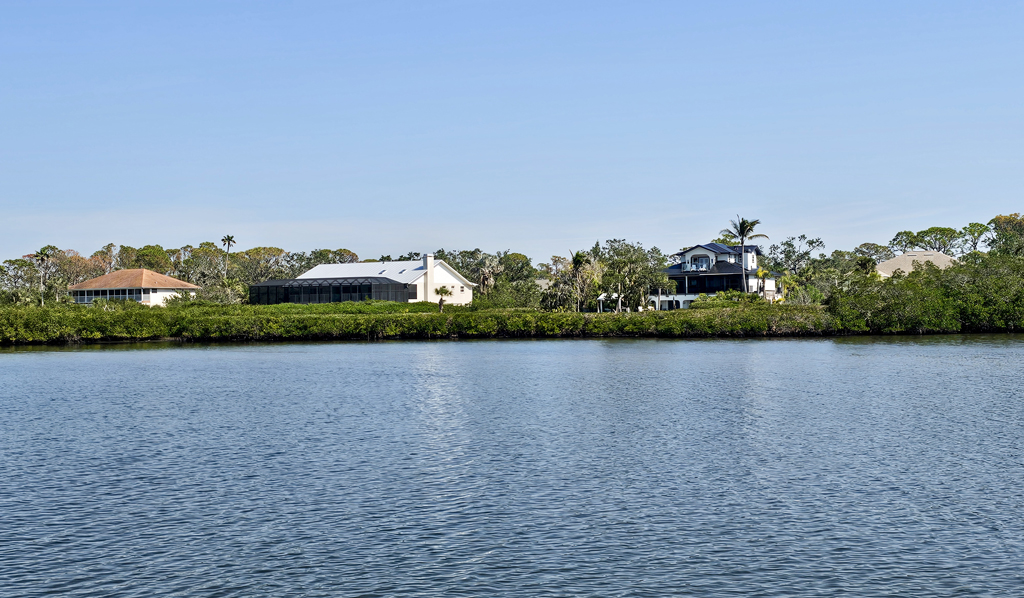
Mangroves help protect from storm surge along the shore.

For reasons that make sense to somebody, the posted no-wake zones are outside the fairly narrow dredged Intracoastal channel, meaning that all the shallow draft center consoles can wake us all the time.
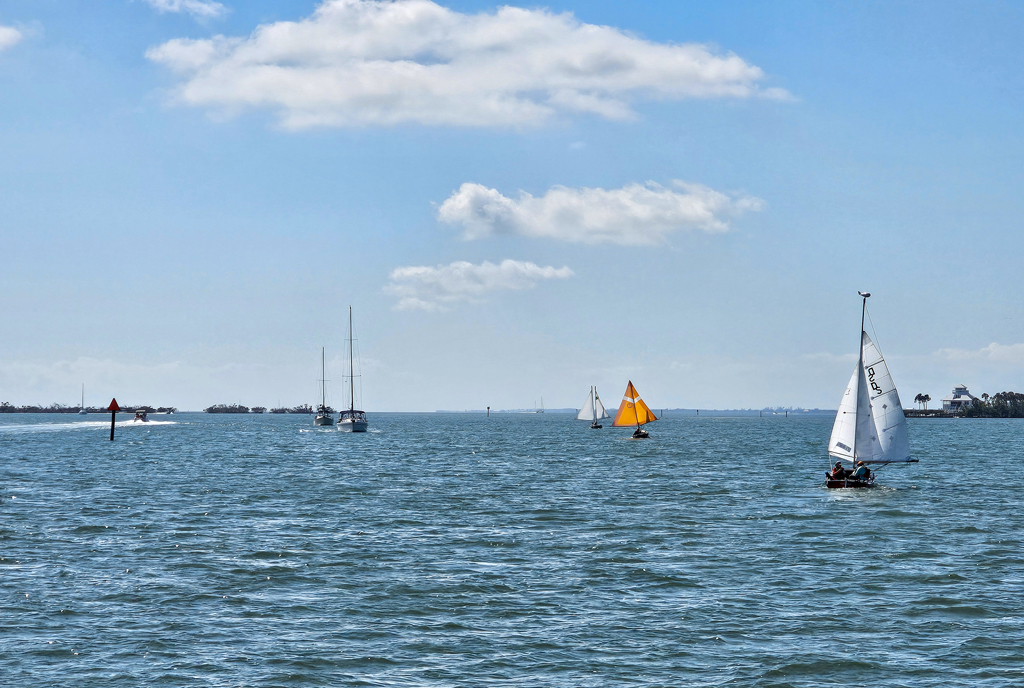
Busy day on the Gulf Intracoastal Waterway

Dolphins followed us a for a couple of miles, switching from one side of Nine Lives to the other.  We also heard them clicking and whistling, first time ever.  Dolphins are quite fast, they can travel at 18mph.  We were going at our usual cruising speed of 8mph, but apparently they like to ride in the slipstream of boats.  The reasons for this behaviour could include ease of travel, playfulness, or something else, nobody knows.  Dolphins use echolocation to orient themselves and to determine the size of objects they encounter.  I was surprised that they chose to dive beneath the boat as they moved from side to side, clearly, they were not concerned about being caught by our propellers.

Dolphins swimming beside Nine Lives

Our next destination was Boca Grande, on Gasparilla Island.  The area was originally inhabited by the Calusa people, arriving about 800 or 900 BC.  They predated the Seminoles, and had died out by the 18th century due to European diseases, slavery, and warfare.  Spanish and Cuban fishermen settled in the 19th century, operating fish ranches, catching mullet and other fish for salting and shipment to Havana and other markets.  Although the commercial fishery is gone, some of the current full-time inhabitants are descendants of these early settlers. In the 20th century, phosphate mining turned the south end of the island into a major deep-water port.  Phosphate was brought south from the mines near Punta Gorda by rail and was loaded onto schooners at the port and shipped worldwide.  In 1969, Port Boca Grande ranked as the 4th largest port in Florida.  By the 1970’s the phosphate industry started using alternative routes for shipping, and the railway and port were largely abandoned.  During this period, the island was discovered by wealthy American and British sportsmen, for hunting, and fishing, particularly tarpon. The Gasparilla Inn opened in 1911, serving the wealthy elite from Tampa, Fort Myers, and New England.

Check-in time at Boca Grande Marina is 2pm, we arrived a little early.  We were asked to stand off in protected deeper water in the harbour while the dockmaster wrangled boats.  Several had docked for lunch at the onsite restaurant, and 2 larger yachts were also expected.  It was organized chaos as the dockmaster and his two dockhands directed, tied, and untied boats in a well-practiced dance.  Normally, I would not choose to be on the fuel dock, but in this case, the location gave us a prime view of the golf course across the channel as well as the wildlife on the spit of land that protects the harbour.
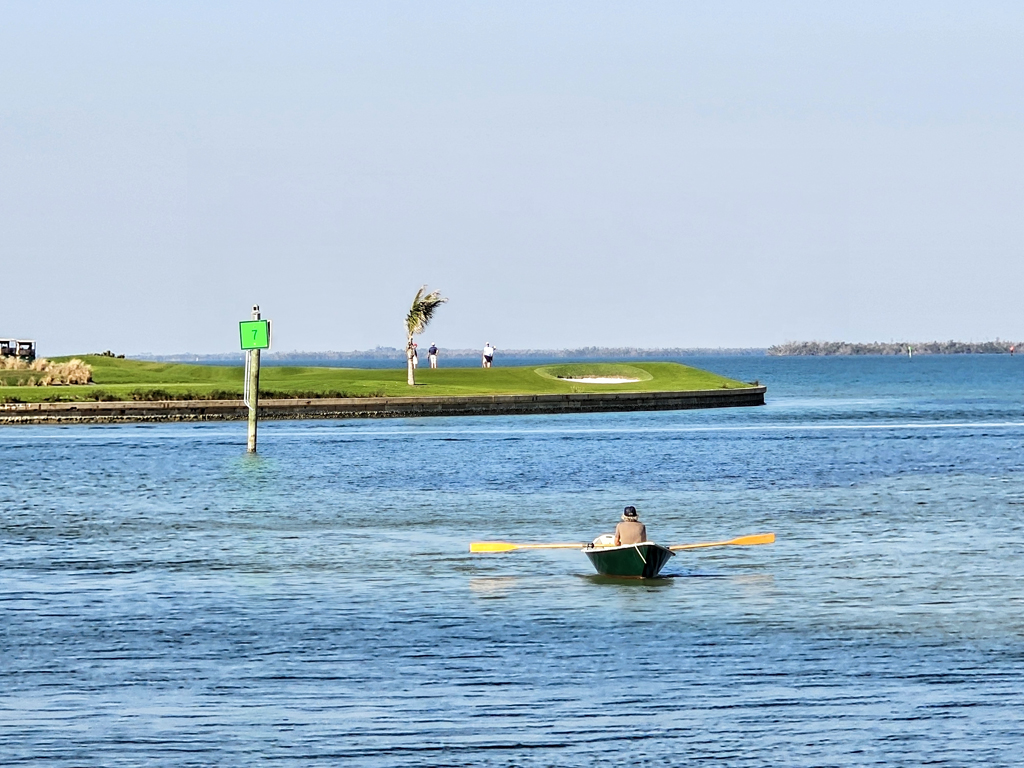
Boca Grande harbour entrance and golf course

There were a couple of very large yachts berthed in the marina.  One (120 feet) had its own center console tender tied up like a baby elephant beside its mother.  The one next to it, in a private slip, is Hilarium, a stunning blue-hulled yacht with classic lines, built in the Netherlands in 1986. It is 134 feet long, and accommodates 8 crew and up to 10 guests.
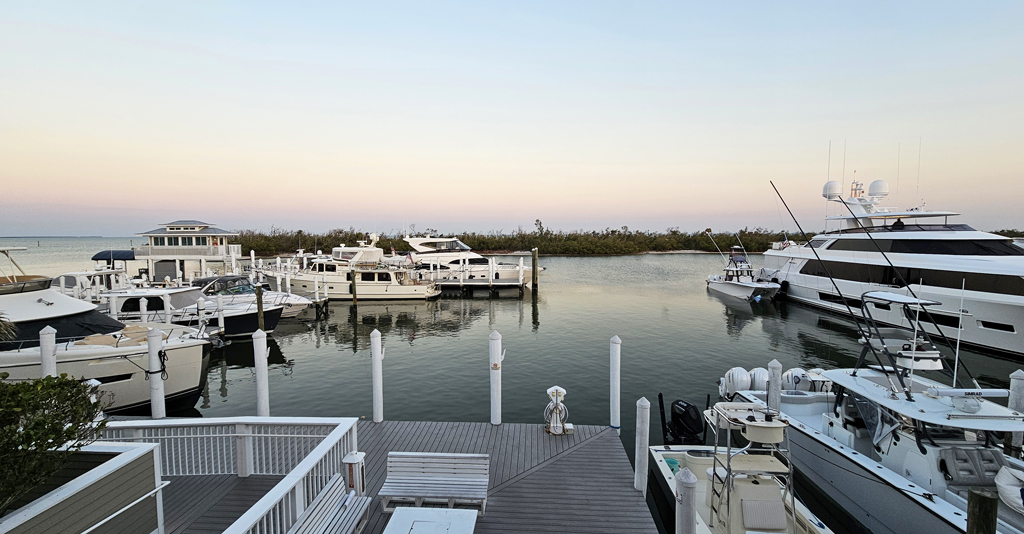
Boca Grande marina at dusk

Golf carts are available for rent, so we collected one and headed out for a brief reconnoiter around the town.  There are just 1001 full-time residents, with a median age of 68.7, but of course, the population is swelled by huge numbers of visitors.  The town prides itself on its old-fashioned, laid-back lifestyle, with no traffic lights, fast food outlets, or nightlife to be found apart from church functions (seriously).  That said, my impression is that it is a lot like Marie Antoinette playing shepherdess, given that a building lot in the area is priced at $2.5 million.

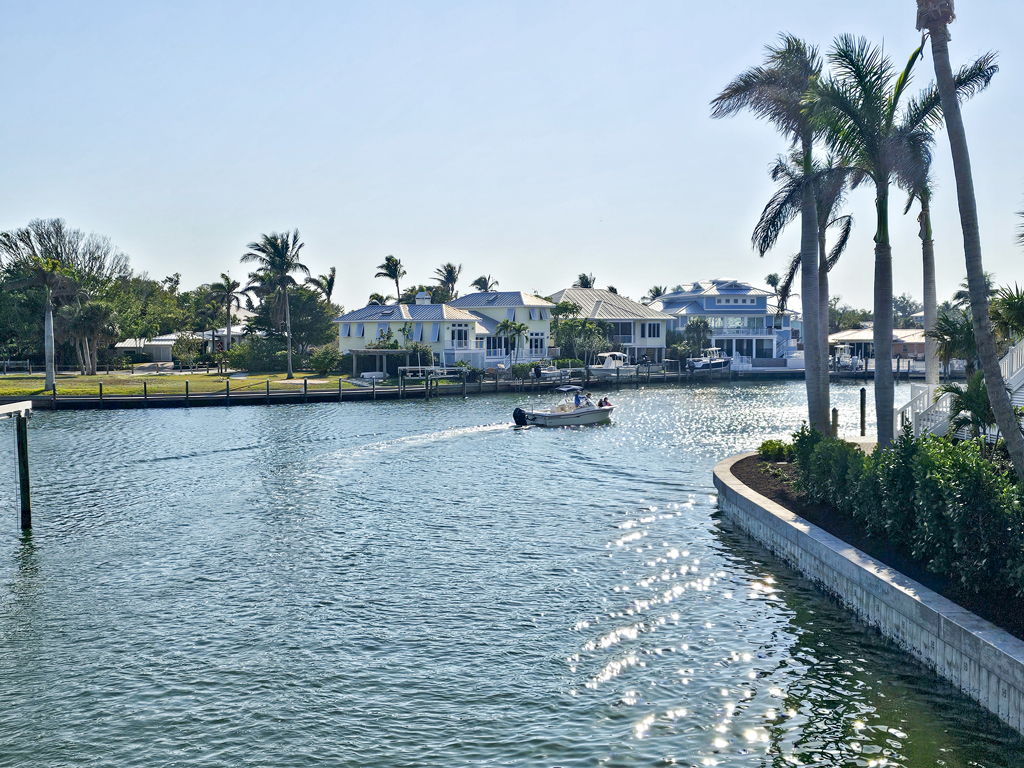
The beach at Boca Grande
Homes on Boca Grande

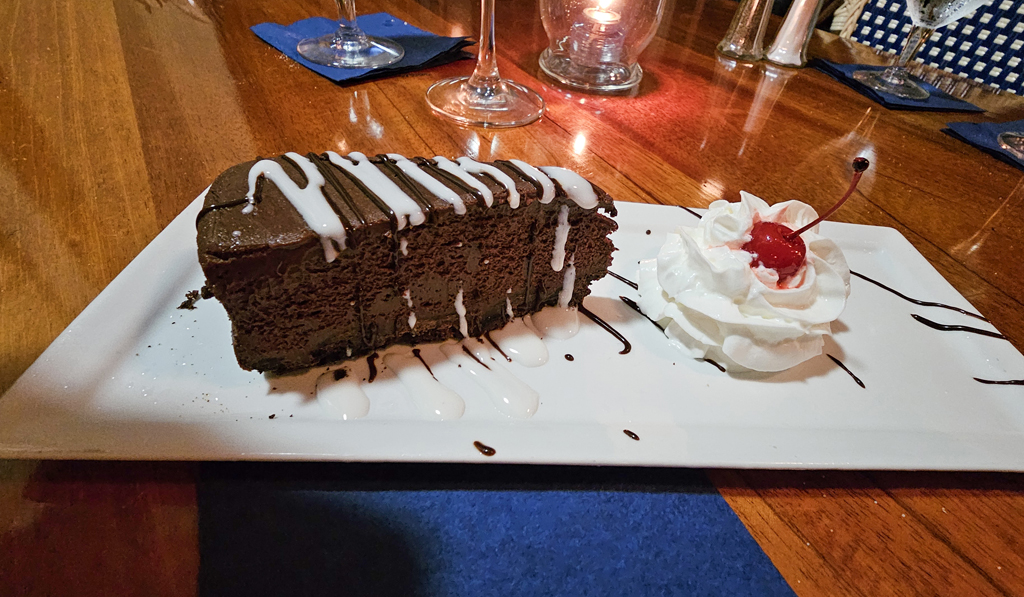
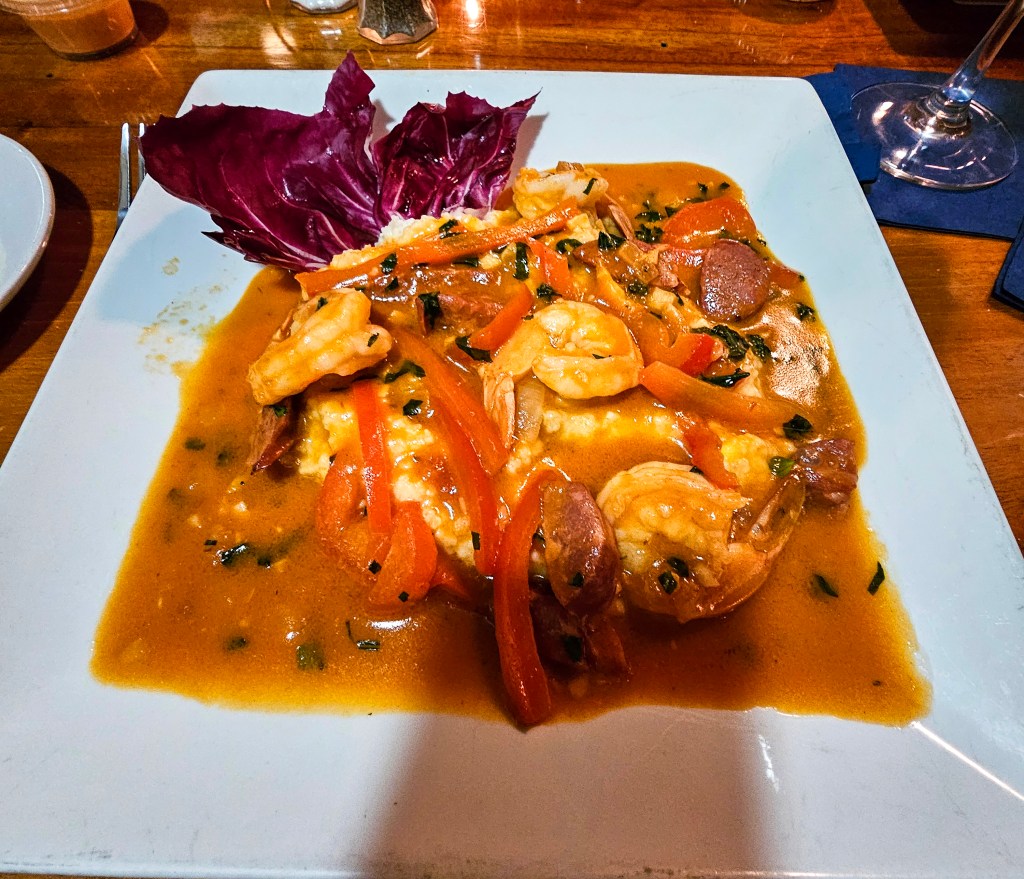
We had dinner at the onsite restaurant.  It was a mixed bag.  My truffle parmesan shoestring fries were so good that Dick suspended his objection to fried food and helped me eat them.  His oysters Rockefeller were not very good at all.  I ordered shrimp and grits, that came with just 4, tasty, but slightly overcooked shrimp and a few small chunks of andouille sausage on a mass of red peppers and grits.  On the other hand, Dick’s seafood medley was excellent, as was the chocolate mousse cake that we shared for dessert.
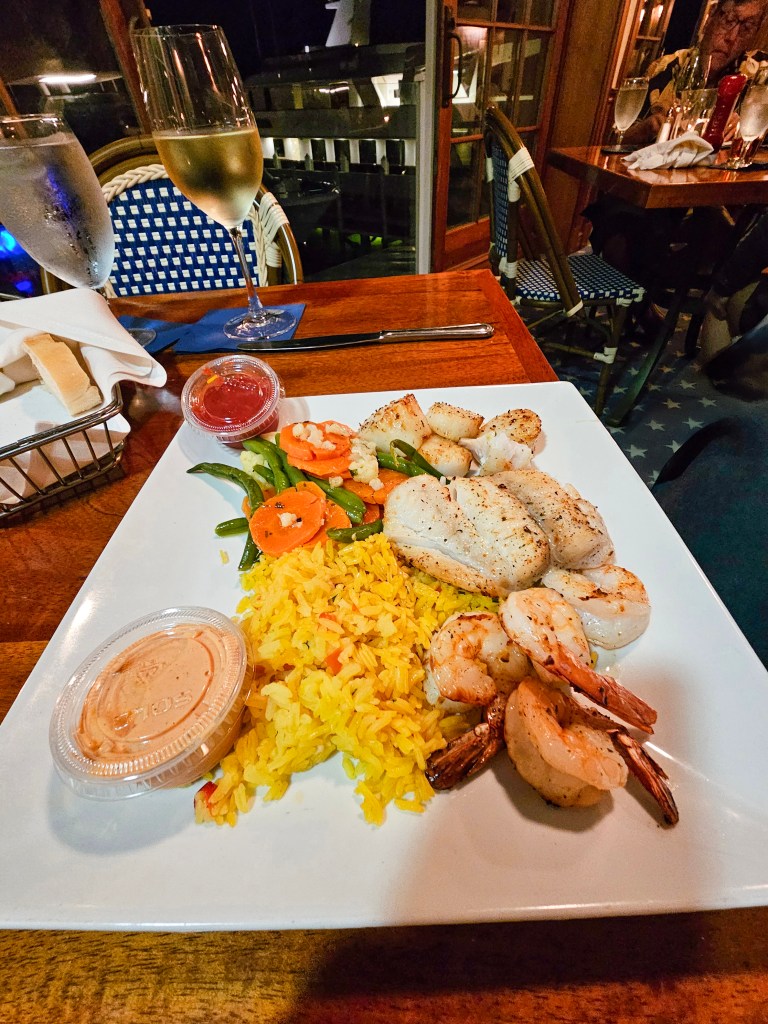
Seafood medley at Eagle Grill
Shrimp and grits at Eagle Grill
Chocolate mousse cake at Eagle Grill

The golf course looks stunning, but the only way for non-members to play is to stay at the Gasparilla Inn.  Dick proposes a birthday weekend there for me so that he can play the course…hmmmm…

We enjoyed an interesting day exploring Boca Grande.  We went to the Strawberry Festival, but it was quite disappointing, essentially a church social that took up part of the town.  There were offerings on silent auction, some used toys and children’s clothes, a tent selling brats in buns, strawberries and strawberry shortcake, and a quite respectable garage band made up of locals of retirement age.  There was apparently more to see inside the church, but we didn’t bother.  In every shop in town, the ladies asked excitedly, “Did you get your strawberry shortcake?”  So, a big deal in the town, but of little interest for us as visitors.  We looked around most of the shops, but didn’t buy until we found one with interesting specialty foods, homewares, and upscale takeaway.  Dick decided that we would have a large container of lobster salad for our supper the next day.  He choked when the bill was rung up.  Let’s just say that we could eat lunch out with wine for the same money (including ordering lobster rolls).  That said, the salad was delicious served on French bread with crisp butter lettuce.

Boca Grande Strawberry Festival
The lobster salad (we ate it the next day)

After dropping our purchases off at the boat, we took the golf cart to the southern end of the island.  Like highway 98 on the Panhandle, it is miles and miles of new-build housing.  It does seem to be built to “hurricane proof” standards, that is, constructed of concrete and elevated so that a storm surge can flow through below.  It was possible to climb the lighthouse, but Dick decided this time that it would be very hard on the knees coming down, so he passed on the opportunity.
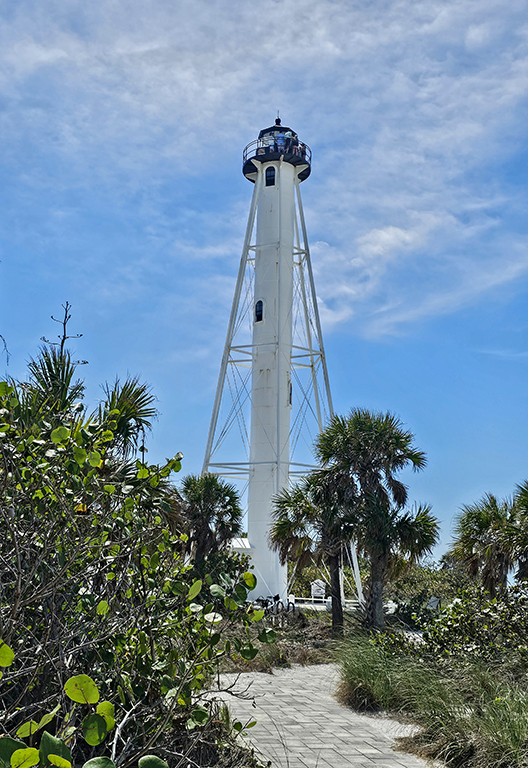
Boca Grande Lighthouse
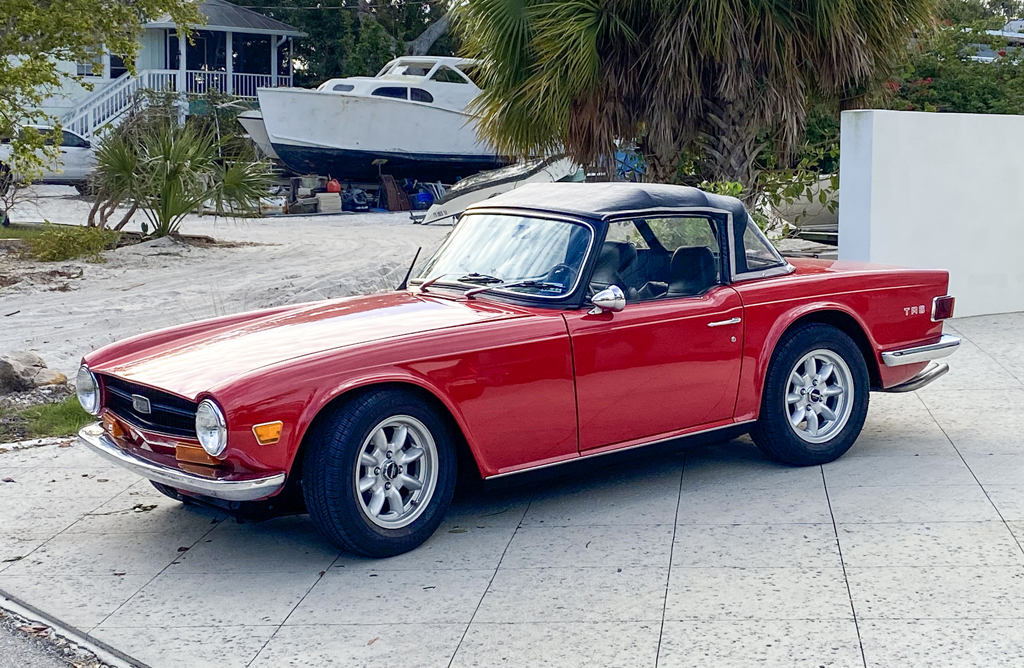
A shiny red TR6. Dick has always wanted one of these.

In the early evening, we dressed up and went over to the Gasparilla Inn, a wonderful old Florida hotel, for drinks in their bar.  This was touted as a see-and-be-seen opportunity to hobnob with the great and the good of the town.  It was a lovely lounge with superb snacks and perfectly prepared Manhattans, but there was nobody hobnobbing at that time, just a fierce game of backgammon going on, played between some guests.  We enjoyed the experience anyway.

The lounge at Gasparilla Inn
The bar at Gasparilla Inn
They make excellent Manhattans at Gasparilla Inn

After our drinks, we went to dinner at Scarpa’s Coastal, a blend of modern Italian and local cuisine.  It was a good meal, but the food was not as hot as it should have been.

Stuffed mushroom and burrata salad at Scarpa’s Coastal
Rack of lamb and grilled shrimp at Scarpa’s Coastal
Desserts at Scarpa’s Coastal

We made a leisurely start with an easy passage to Sanibel Island.  Here we finally left the route we travelled in 2017 when we collected Nine Lives, and everything is new again.  The marina at Sanibel is unusual in that it is not on the bay, instead, a narrow channel gives access to the marina as well as a network of canals with homes.  There was some damage from the hurricane, but it is mostly repaired, and we are on a newer, floating dock.  There is a restaurant on site that we will try later in the week.

We ate on board the first evening.  Next morning, Dick arranged to rent a golf cart for a few days.  He decided to upgrade to a Moke.  It is sort of what one might expect the offspring of a golf cart and a jeep to be like.  Ours is bright red, easier for cars to see us on the roads.  Mokes are electric, so quieter than a gas driven golf cart, and fully fitted for roads, with seatbelts, lights, proper signals, speedometer, etc.  The seats are also a lot more comfortable than a golf cart would have been.  You can even snap on a canvas cover if it rains or for sun protection.
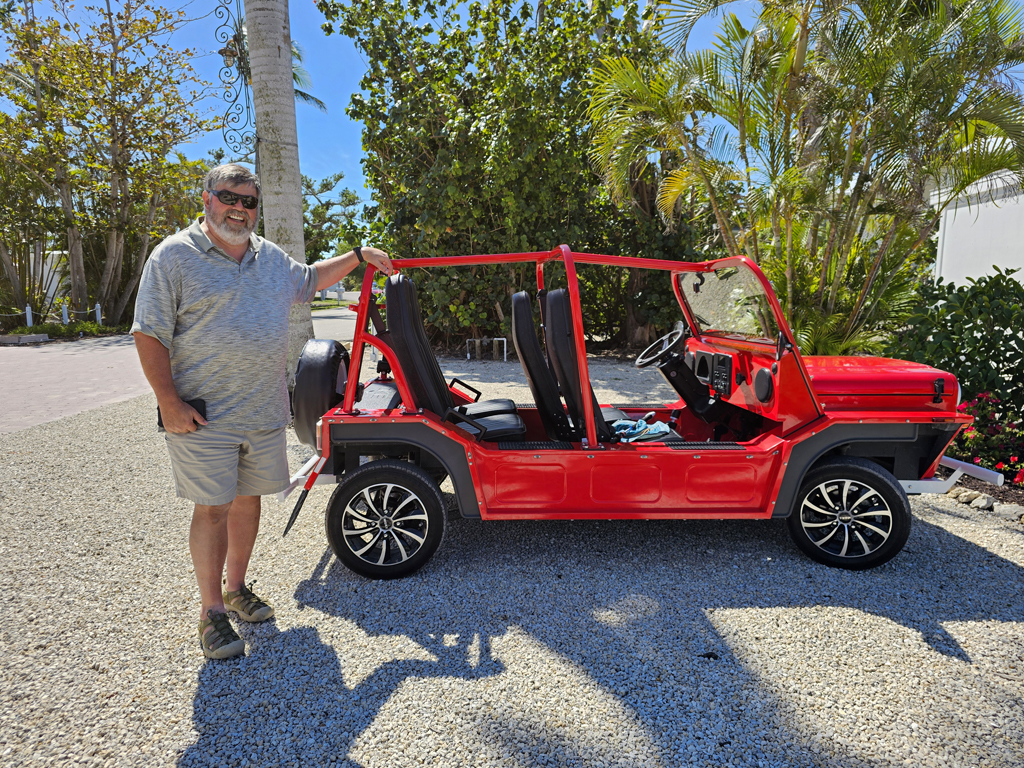
It’s a Moke!

We went for a drive around the island.  We were able to find the old, converted motel that we stayed at on a timeshare exchange more than 25 years ago.  It is undergoing major renovation, but it is not being torn down.  We also visited a couple of interesting galleries, finding a nice piece of art pottery to take home as a reminder of our visit.
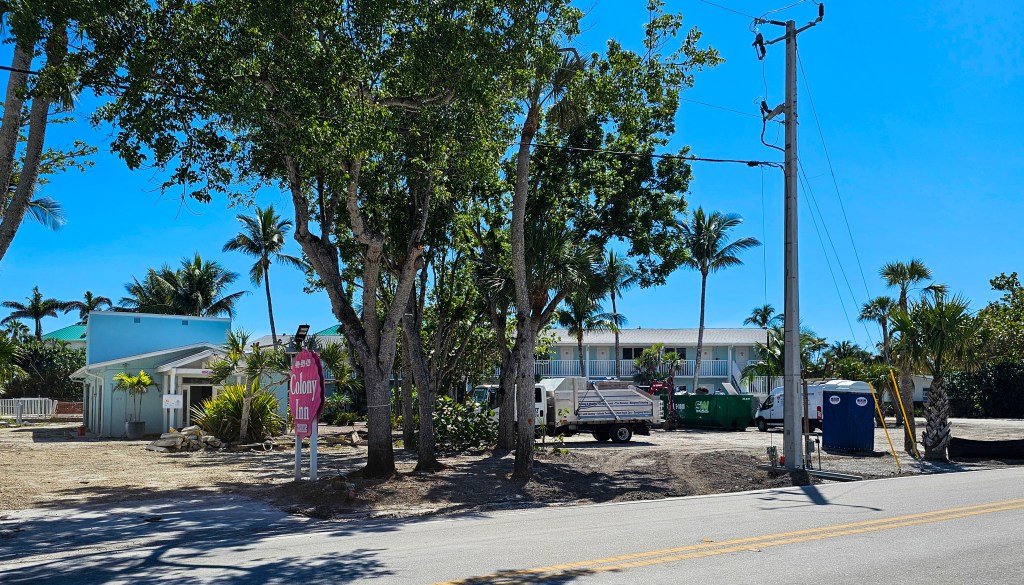
Colony Inn, under renovation

Sanibel has clearly had a large influx of new residents since our last visit.  There are a great many condos, and a few areas with some very large houses, but mostly it seems to be more down to earth than Boca Grande, with real people instead of the very wealthy playing at being ordinary.  We also noticed that while there is almost no evidence remaining of the hurricane on Boca Grande (we could see a lot of obviously new landscaping there) here on Sanibel there is still a lot of dead vegetation and trees, and many homes are still waiting for repair.  Less money to effect repairs, and probably further down the priorities list for government help, not to mention further down the priorities list for contractors doing the work.

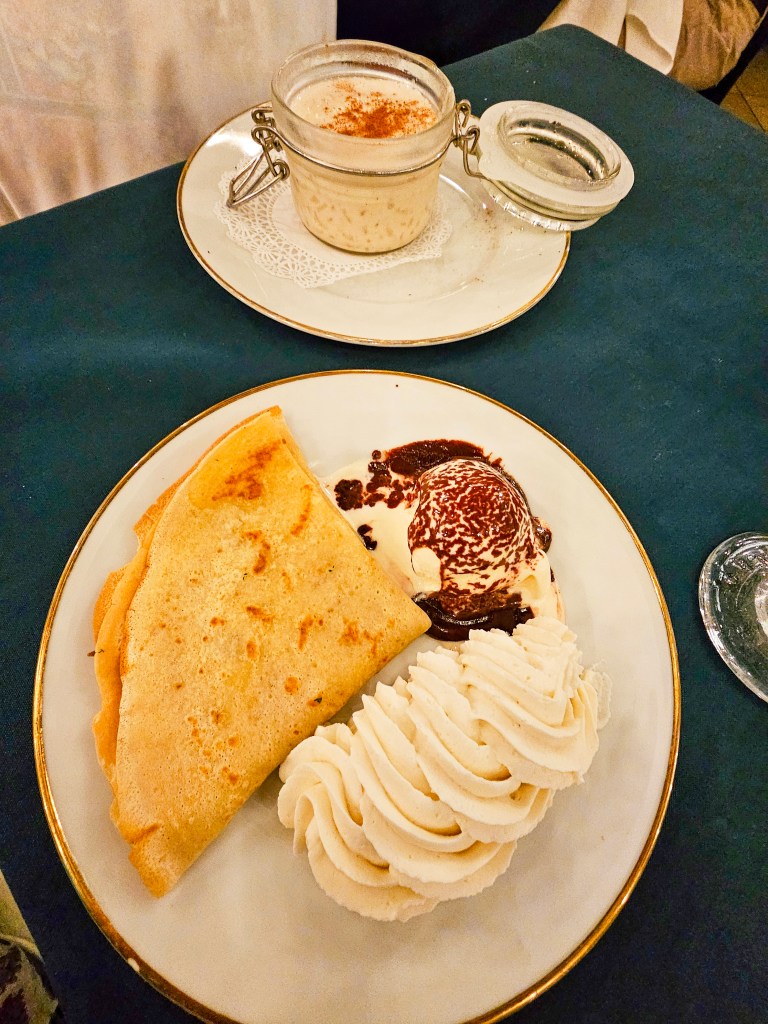
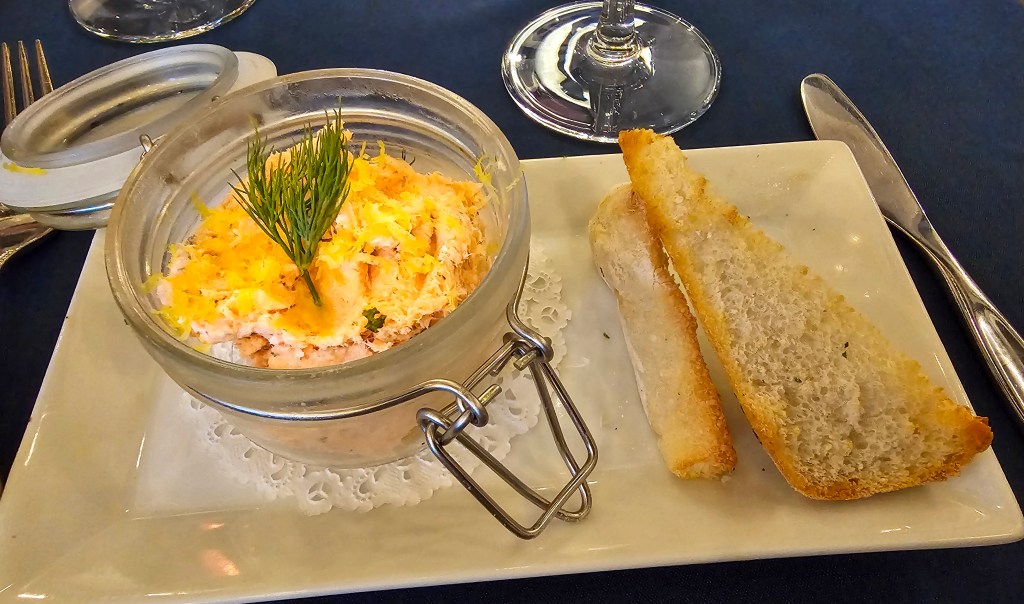
Our dinner was at Bleu Rendezvous, a very authentic French bistro.  It was so authentic that our table for 2 was exactly 2 feet by 2 feet.  Very typical in Paris, not usual (or comfortable!) here in America.  The din was incredible, everyone had to shout to be heard.  Excellent food, with the exception of the crepe I ordered for dessert.  Hard to say whether we would return.  The restaurant is very popular, there were a large number of people sitting waiting outside for their tables to be free when we left.
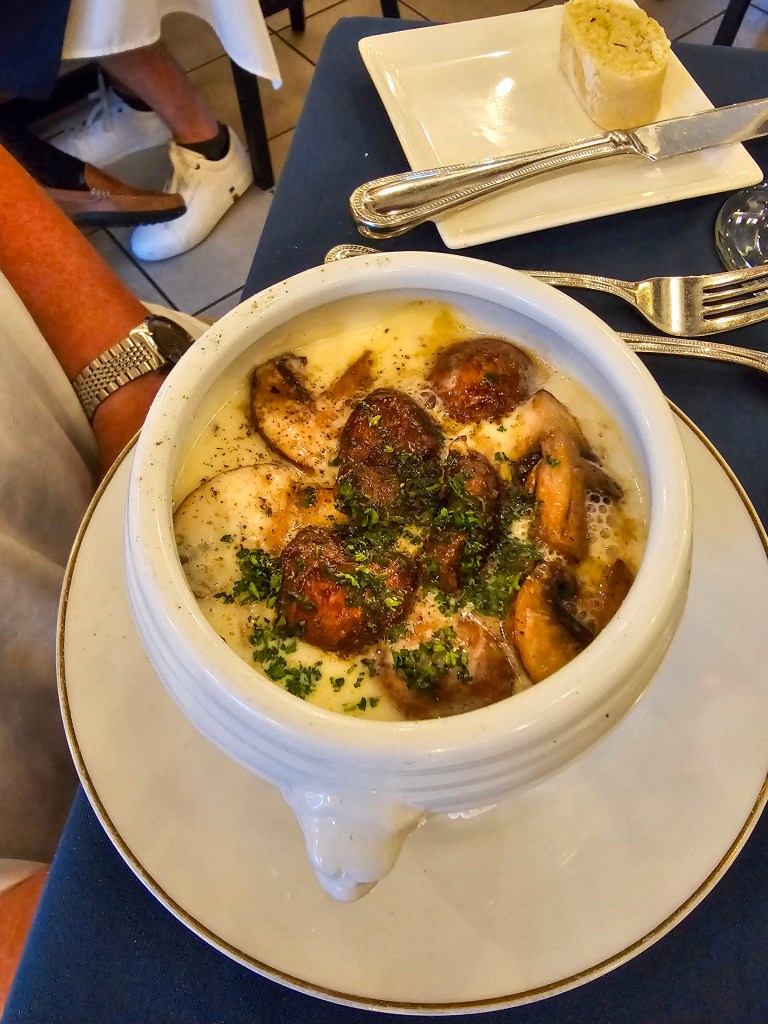
Bleu Rendezvous mushrooms. Note how close together and small the tables are, look at the upper left corner of the picture!
Bleu Rendezvous salmon rillettes
Bleu Rendezvous veal marengo and trout almondine
Bleu Rendezvous desserts

We are certainly here in the high season.  Not only are restaurants full, even on Monday or Tuesday evenings, Dick is finding it quite difficult to get dockage as we move south.  We are behind the Looper pack, so are not having to compete with them, but there are few or no slips available for us.  We had hoped to stop in Naples for a few days, and then Marco Island, but we can only book one night in Naples, and we are going to have to move from place to place, and anchor part of the time, for the week we plan to be on Marco Island.  Plans are also weather dependent, as we have to travel outside in the Gulf between the next two stops, and then a crossing (daylight, but expected to take 10 hours unless we go fast for part of it) to Key West.

A piece of advice for everyone who is charmed by the youthful excitement of a Moke.  If you are female, don’t wear a dress or a skirt!  Leaving aside the large amount of leg that goes on show as you climb over the sill to get into or out of the vehicle, once you are on the road, it is exceedingly cold and drafty!  Trying to hold onto a hat and keep your skirt from blowing up and revealing the lace on your undies, is a feat requiring at least 3 arms.  It is a lot of fun to try the Moke out, but there is no temptation to regress to carefree youth and put one into our garage.
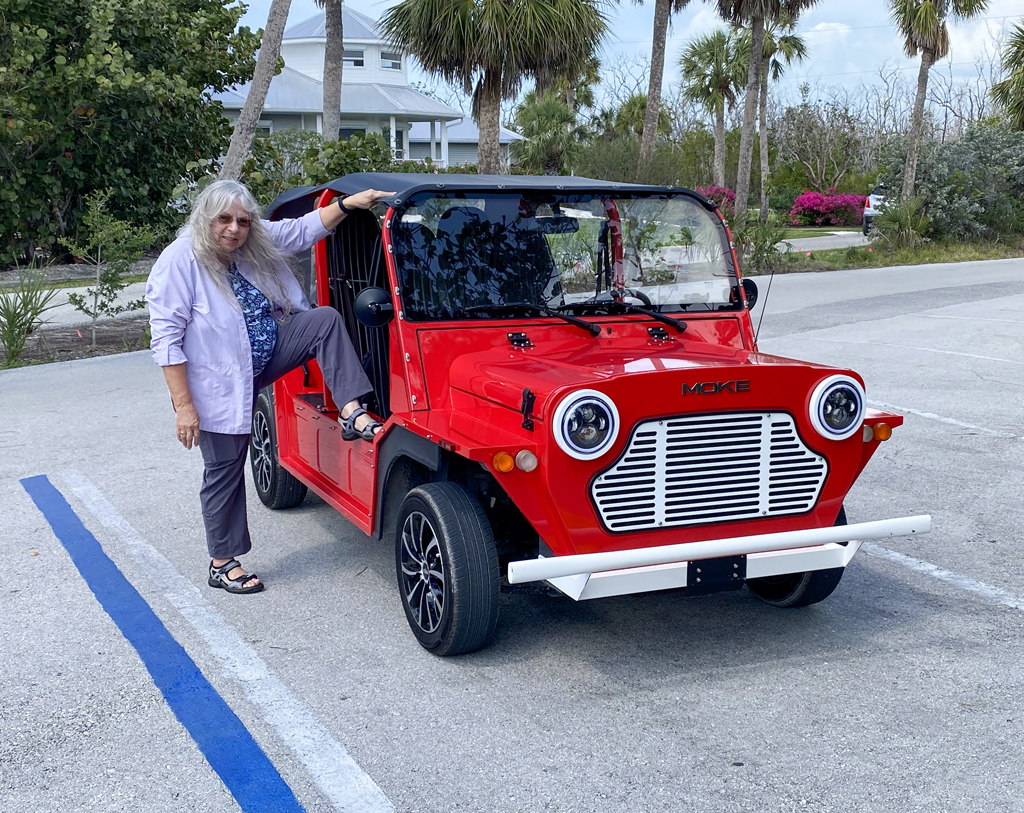
Louise getting into Moke. I thought the front of the vehicle looked like a happy smile, but now I think it is more like a smirk as we fold ourselves up getting in and out.

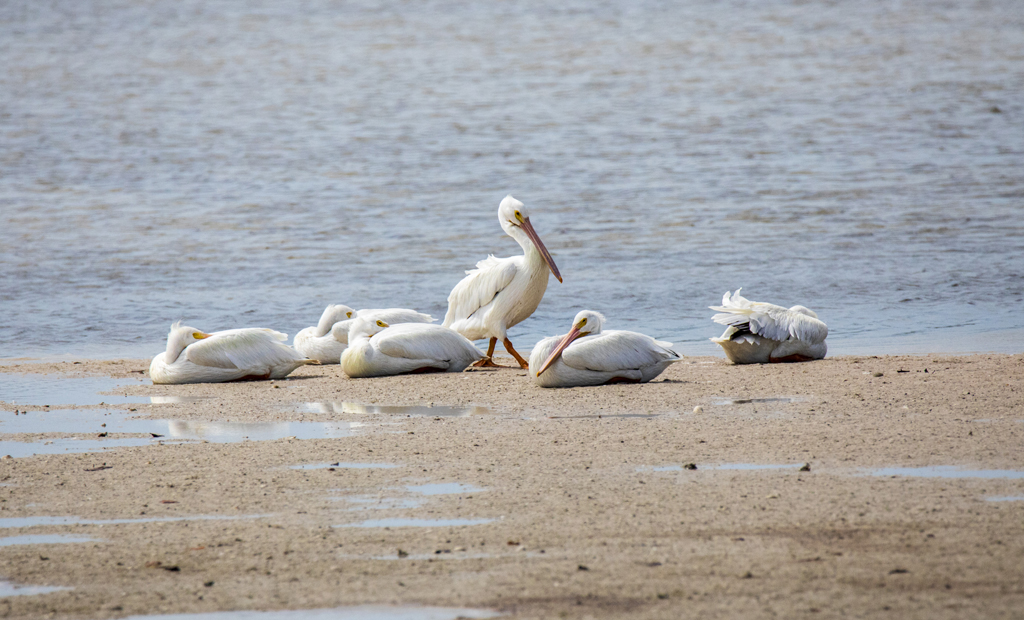
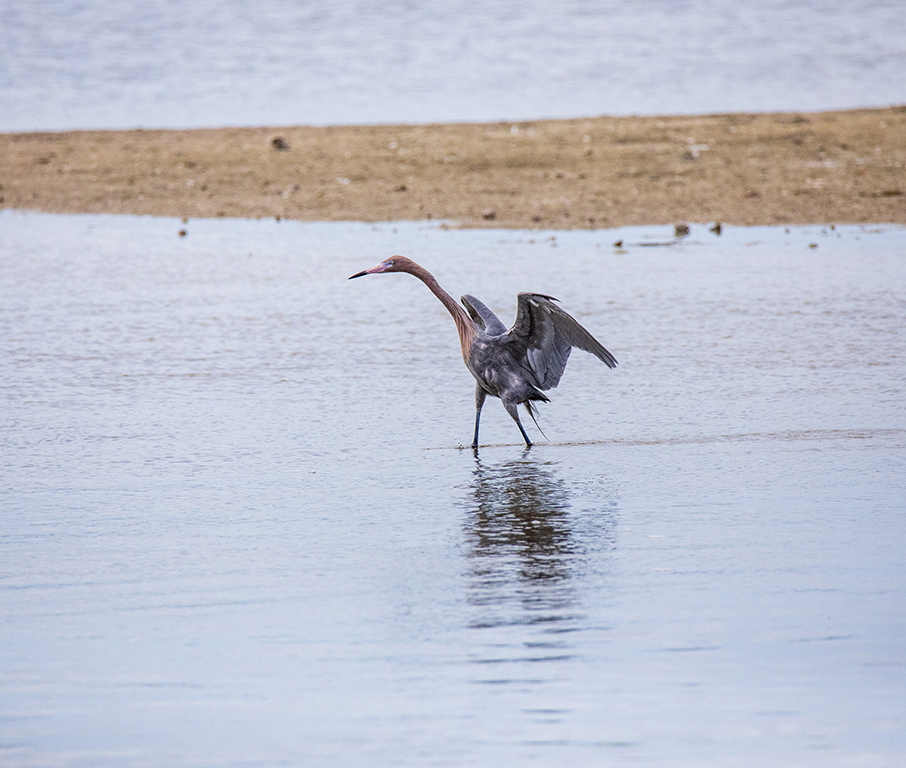
I have been looking forward to visiting the J.N. “Ding” Darling National Wildlife Refuge.  Years ago, we rode bicycles through the refuge, and my memory is of an amazing place, teeming with wildlife.  Well, history did not repeat, and I am sorry to say that this visit was a great disappointment.  Whether it was the time of day, or residual effects from the hurricanes, there were few birds and certainly no alligators to be seen.  A couple of iguanas zipped into the brush as we passed.  Resting in the shallows we saw pelicans, both brown and white, gulls, and a cormorant, all of which we have seen many times in other locations.  Further along we did see a Reddish Egret displaying their typical fishing dance.  They jump around, scratching in the sand to stir up the fish, and occasionally spreading their wings, creating a shadow on the water that lets them see the fish below. A godwit stood nearby, perhaps waiting for leftovers.

J.N. Darling was a pioneer of conservation in the United States.  His editorial cartoons drew attention to the plight of wildlife, and helped to educate the public that natural resources are not unlimited, and that unhindered use of these resources is not a God-given right.  He was the founder of the National Wildlife Federation, and the chief of the U.S. Biological Survey, now called the U.S. Fish and Wildlife Service.  He helped conceive the Federal Duck Stamp Program, drawing the first stamp, and since 1934, hunters have been required to purchase a Federal Duck Stamp in order to be allowed to hunt waterfowl.  These purchases have supported the acquisition of millions of acres of wetlands for feeding, breeding, and migration of waterfowl.

There was an interesting plaque about the salt marsh mosquito.  When the natural flow of water is impeded, the mangroves die, and mosquitoes breed in the still water.  Ding Darling brings in engineers to dig culverts to restore the flow of water and reduce the need for pesticides.  While mosquitoes have an ecological niche, being incidental pollinators, and also providing food for numerous predators, the sign also mentioned that too many mosquitoes can be a major stressor to both humans and wildlife, through biting and the spread of disease.  This is not news to me… small biting insects are my least favourite aspect of any warm climate!

Shorebirds at the Wildlife Refuge
White Pelicans. They are migratory, so we saw them on the Tennessee River, and now here they are enjoying the winter sun in Florida, just like Loopers!
Reddish Egret performing his fishing dance

After our visit to the Wildlife Refuge, we stopped at one of the small shopping malls and looked at a few shops before joining the incredible queues on the main road to return to the marina.  We think traffic is bad in Hilton Head!  The tailbacks on any of the main roads that lead to the causeway on Sanibel are unbelievable.  Traffic wardens are in place all day, and it really doesn’t seem to matter whether it is morning or evening.  I looked up data for vehicles crossing the causeway. The latest I could find was November of 2021, when 3.2 million vehicles crossed during that single month.  The current traffic issues will continue until 2027, as the causeway is repaired after being damaged in the hurricanes.  Eventually we were able to turn off and go around the other side of the island to avoid the queues.

Dinner was at the number 2 rated restaurant on the island.  The food was not particularly good, the service slapdash, and overall the restaurant has little to recommend it.  We would not return.

We are looking forward to continuing our exploration of Florida’s Gulf Coast, followed by a visit to Key West and Marathon before eventually heading north on the Intracoastal Waterway up the east coast of Florida.
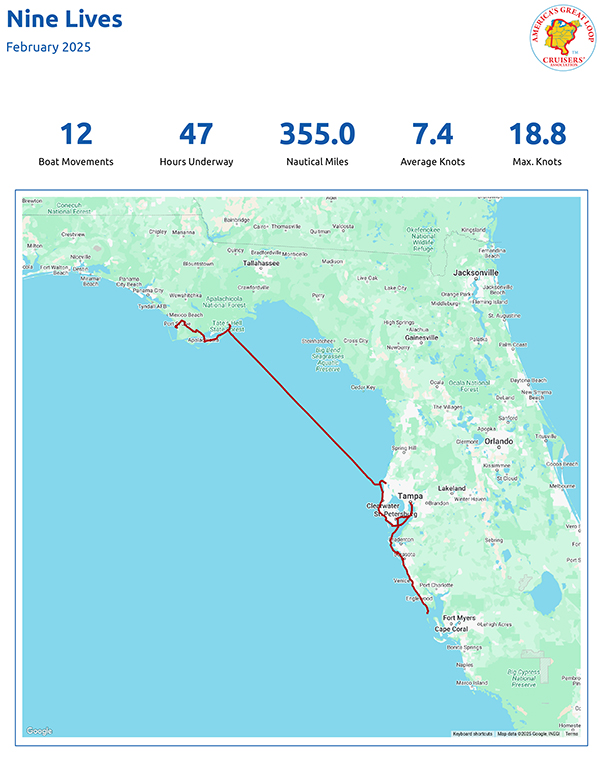
Nine Lives voyages for February 2025

September 29th to October 7th, 2023: Clarksville to Pickwick Lake

Our Clarksville docktails evening with Gina and Roger from Two Hull-Areas and Cathy and Mark from Dock Holiday was most enjoyable.  As always, we hope to meet them again some day on the water or in Hilton Head.

The next morning was very foggy, and all the spider webs were covered with dewdrops, making them easy to see and brush away!  We had a chance for a chat with both Gina and Roger before we left.  Roger helped us with a recalcitrant pump out machine, and with casting off.

Dewdrops on the spider webs in the early morning

The river was extremely muddy after the heavy rain of the previous day.  Also, there was a huge amount of debris, including whole trees.  We concluded that the Cheatham Dam had done another clearing of debris, there was far too much to be the result of one rainstorm, especially at winter pool.

As you move carefully through a debris field, and hear a loud CRACK, you think you have hit a tree.  Instead, in these waters, it is most likely to be a jumping silver carp.  They are extremely large, and are apparently easily frightened by the noise from boat engines, so they leap out of the water, often hitting the hull.  This added to the excitement of transiting through the debris, as we have not seen or heard many carp for the last couple of years.  Perhaps the muddy water makes them more nervous than usual.

Bluffs on the Cumberland River north of Clarksville

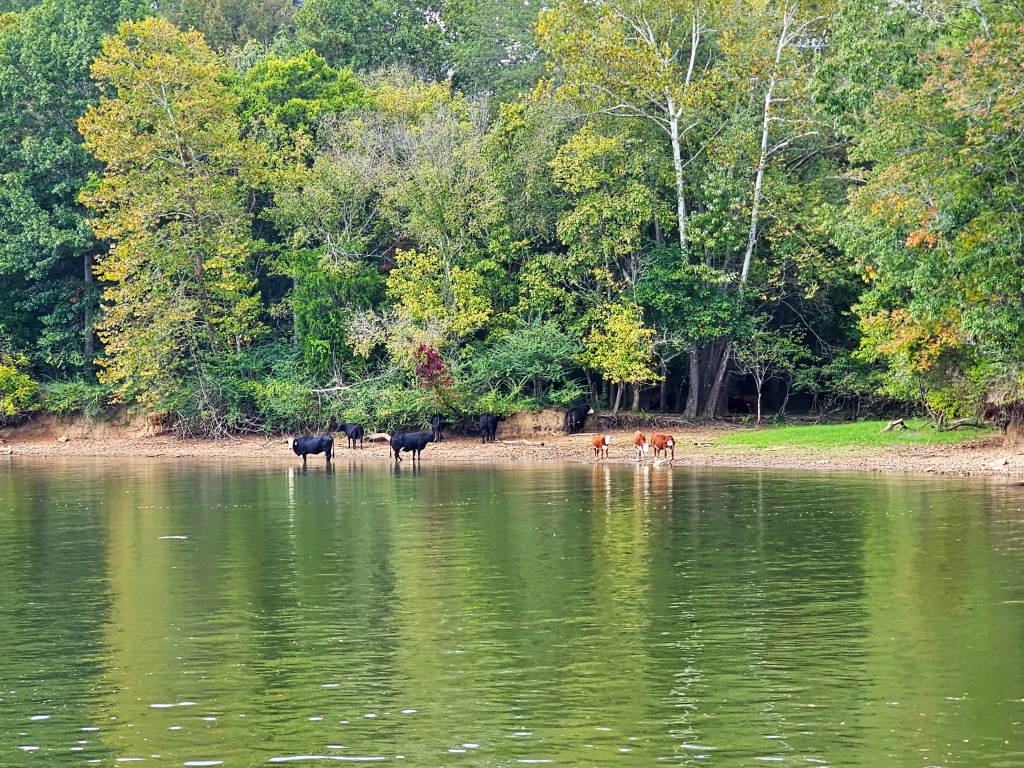
Just north of Dover, we saw beef cattle down by the water.  Dick tells me that some of them looked like a Hereford Angus cross.  He said they were definitely not purebreds, but for all that, he is sure they taste good!

Beef cattle by the water
Bald Cypress on the Cumberland River in Kentucky

We passed Baccalieu II making their way up the Cumberland to Nashville.  We were seeing a lot more Loopers in the general area, gradually gathering and waiting to join the main pack that was still stuck in Lake Michigan, waiting for 3 locks on the Illinois River to finish repairs.  This will be a tough autumn for most 2023 Loopers.  The lock closures meant that they could not get off the Great Lakes as early as many would prefer.  There are going to be about 300 Looper boats heading down the Illinois starting from October 6th.  The AGLCA has arranged flotillas, and negotiated with the Army Corps of Engineers who manage the locks, to pass through the Loopers in groups.  There will be many tows waiting, and if everybody tried to just show up, it would be chaotic, not to mention hours of waiting.  Once they are off the Illinois River, the next challenge will come from the very low water in the Mississippi and Ohio Rivers.  We experienced this last year, and this year is just as bad, in fact worse in some areas.  Dredging operations are requiring a 12-hour one way system on the Ohio River. Some of the popular anchorages are silted up and unavailable, and even in Paducah there will be a shutdown of electricity to the dock, while repairs are being made at a nearby substation.  Paducah is an important fuel stop for many Loopers, as it is a long distance for some boats to travel from the fuel stop on the Mississippi just south of St Louis, so the timing of the repairs is unfortunate.  It’s all part of the adventure, but I am happy that we don’t have to participate in this one!

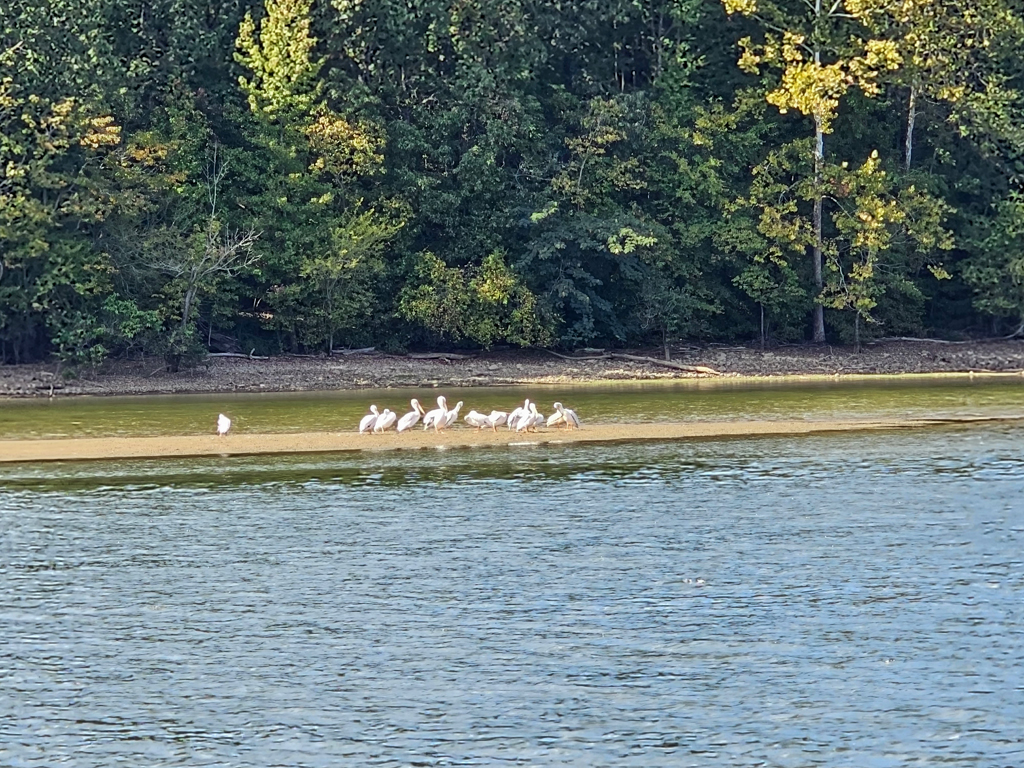
Pelicans on the Cumberland

We arrived at Lake Barkley Marina just before 5pm.  We had to approach very slowly, first because the route from the Cumberland River is long and complicated, and it is extremely shallow outside the marked channel.  Then, there was so much debris in the marina itself, including large logs, that we had no choice but to run into them and push them aside.  Local boaters came over to help us get into the slip.  I had done most of the preparation during the day, so it was fairly quick to prepare our favourite shrimp sandwiches for supper.  The facilities were at least ¼ mile from our assigned slip, making them impractical to use.  Between that and the debris, we did not find the marina very enjoyable, and we would not return.

The next day, as we made our way towards Green Turtle Bay, we met another Looper heading south.  It was not the nicest experience.  The boat was a go-fast motor yacht with a planing hull, but the driver obviously has no concept of how to drive, both for the best fuel efficiency, and for the consideration of other boaters.  He had the prow up high, and, as Dick put it, his ass way down in the water, creating a huge wake that continued to bounce us up and down for over a mile due to the resonance set up in the calm water.  We could see that the people on board studied us through binoculars, but they neither slowed down nor hailed fellow Loopers.  We were too disgusted at the inconsiderate driving to hail them.  We later realized that we had in fact met them earlier, they made a point of introducing themselves and giving us their boat card.  Strange behaviour.

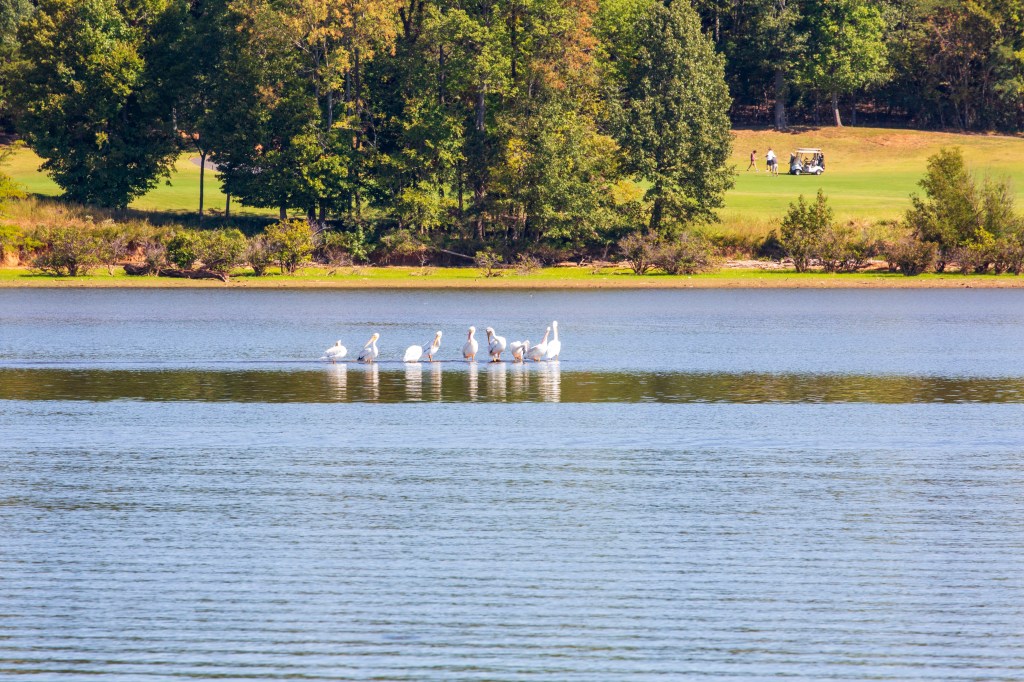
Pelicans and a golf course on the Cumberland River in Autumn

We were tied up in Green Turtle Bay by 12:30.  This was our 5th and last visit to a favourite marina.

In late afternoon we wandered down the dock to chat with other Loopers, and found ourselves sitting on one boat with a group of 6 others, sharing stories and snacks.  Later, Dick and I went up to the Yacht Club dining room, shortly joined by Cheri and Pete from Spring Fling, who we had met in Clarksville.  Service was chaotic, with long waits for bar service, and then all the food, starters, salads, and main courses, arrived together.  The food was good and the company convivial, so we did not mind.

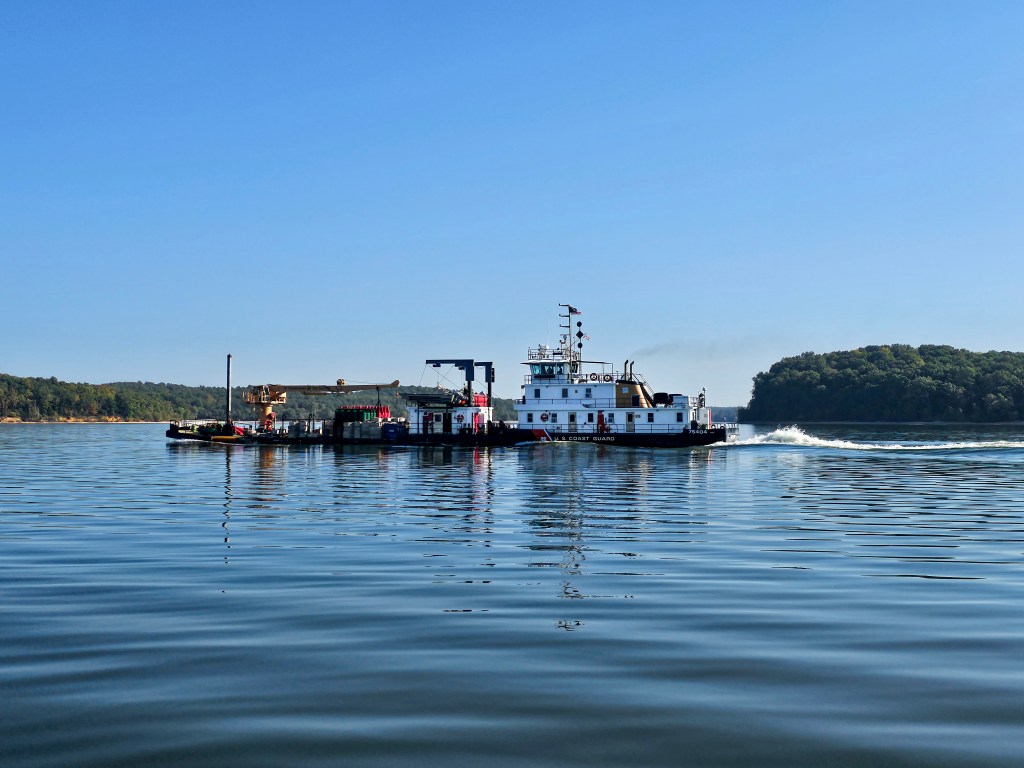
It was an easy day’s run to Paris Landing State Park the next day.  We passed a Coast Guard vessel with red and green ATONs in the morning.  ATON stands for Aid TO Navigation, and are either green, with a flat top (called cans), or red, with a cone shaped top (called nuns).  While there are ATONs on most waterways, those on lakes created by flooded rivers are critically important for both commercial and pleasure traffic.  The original river bed will wind back and forth, and only that area is kept dredged to allow passage for tows and larger pleasure craft.  Tows occasionally run the ATONs over, and storms or large debris may also pull them off-station, so the Coast Guard must continually check and adjust positions or add new ones.

Coast Guard vessel with ATONS near Kentucky Dam

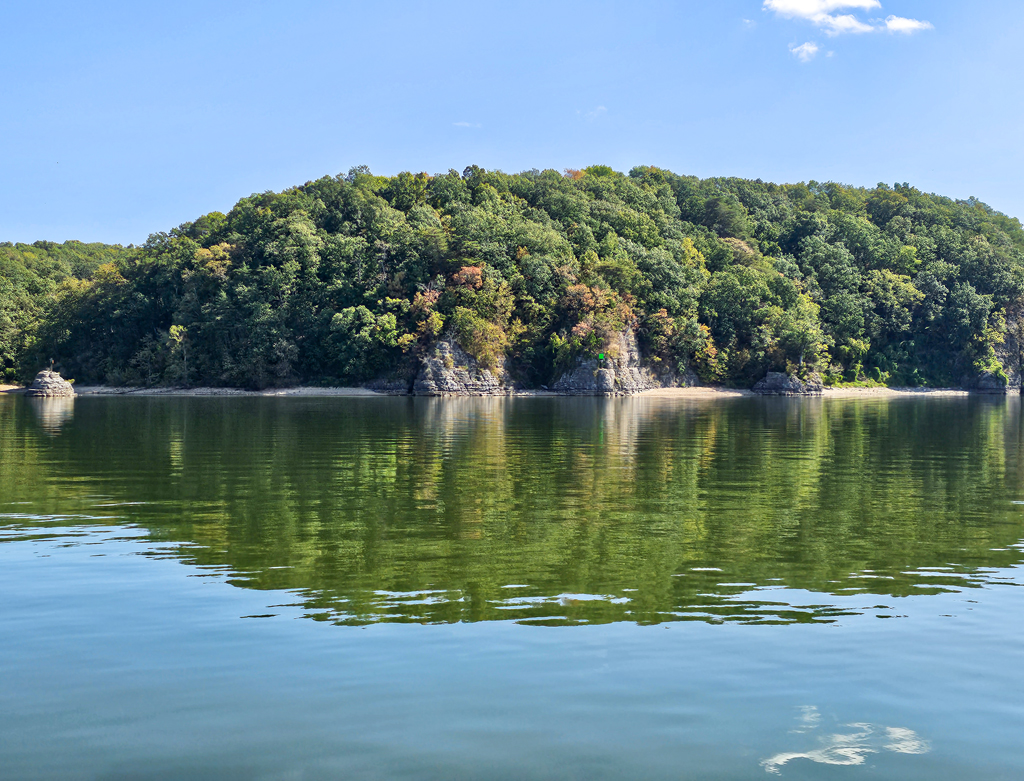
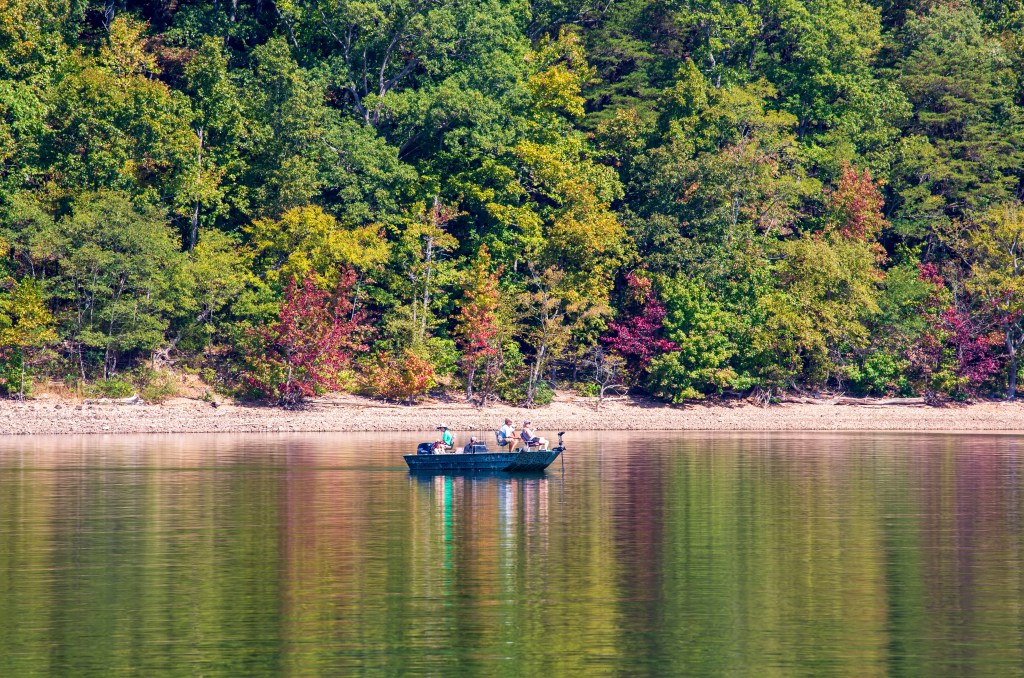
The lake is pretty enough, and the channel winds back and forth, but you are usually a long way away from shore, so it is quite a boring day.  We were passing the Land Between the Lakes National Recreation Area, a large reserve between the Tennessee and the Cumberland Rivers.  The Tennessee River was made into a lake by the Tennessee Valley Authority, to create hydroelectric power in the 1930’s.  Barkley Lake was created on the Cumberland River by the construction of a dam in the 1960’s.  It was quite interesting to see that the trees were turning colour on the Tennessee River side, but had been mostly still green on the Cumberland River side.  Although the Tennessee River is now a lake in its northern reaches, it is still called a river, and the channel follows the original winding river bed.  We were tied up by 2pm.  Later, two other Loopers, including Cheri and Pete also arrived.  We were greeted by the local Harbor Host, who happens to keep his Endeavourcat 36 in that marina.

Land Between the Lakes National Recreation Area
Fishing, Land Between the Lakes National Recreation Area

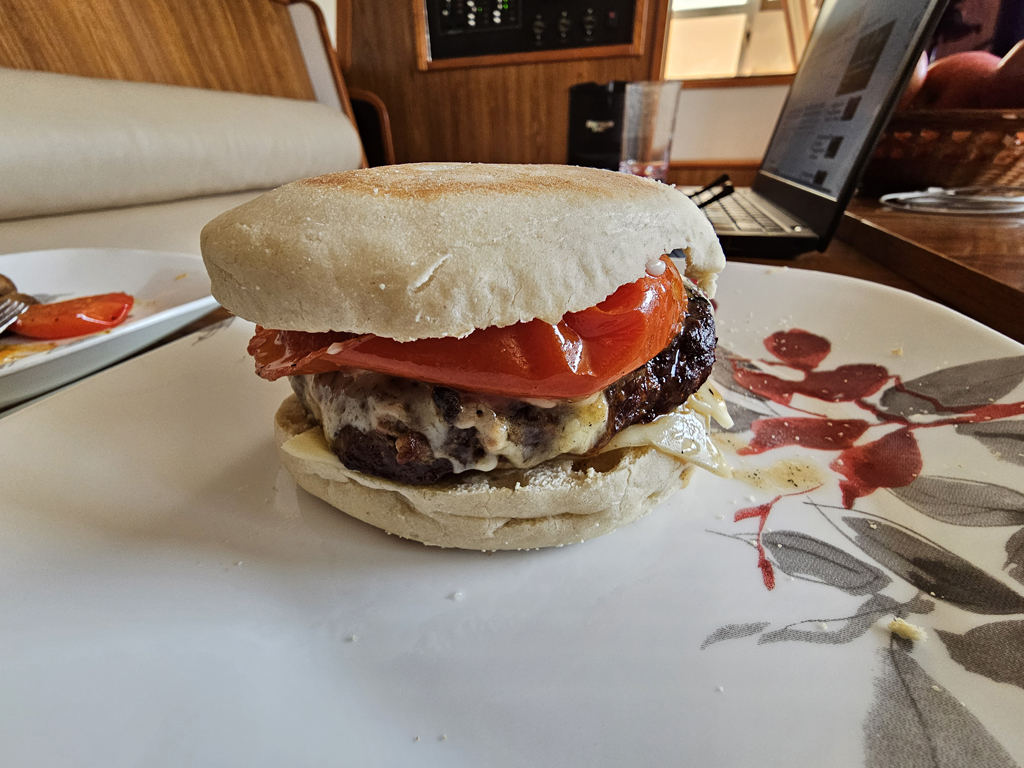
Dick grilled his special home-made burgers for supper.  I tried an experiment and used a large English muffin instead of a more conventional bun.  I will pronounce it a success, as most other buns get too soggy for my taste when they have been frozen.  The burgers were trimmed with sauteed mushrooms and sauteed tomatoes, along with Vermont cheddar slices.  It was a very quiet night, and we were out by 8:35 the next morning.

Dick’s delicious home made burger

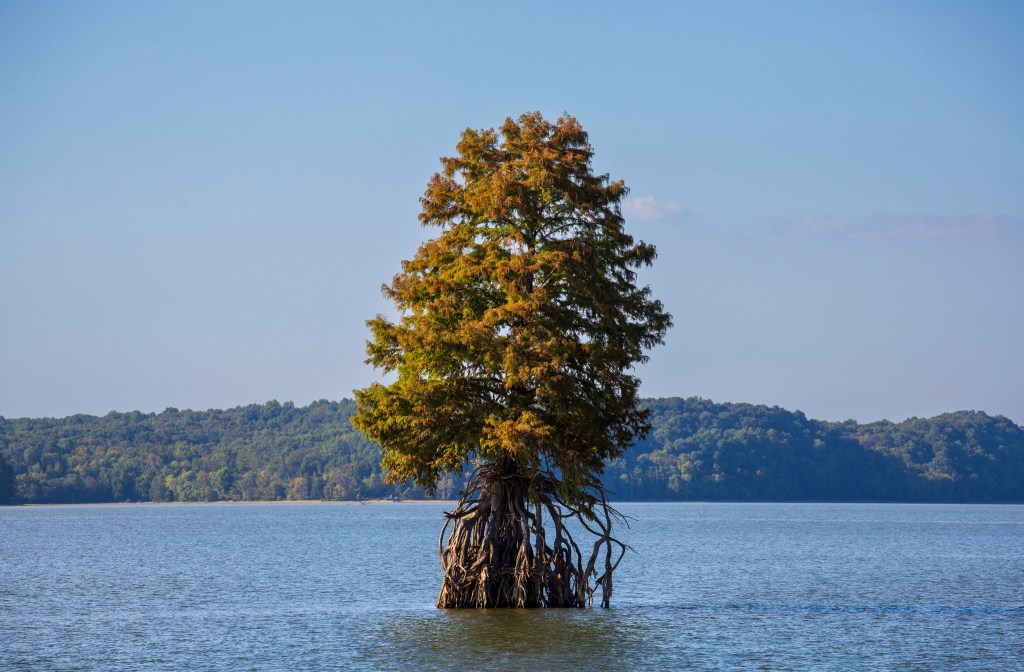
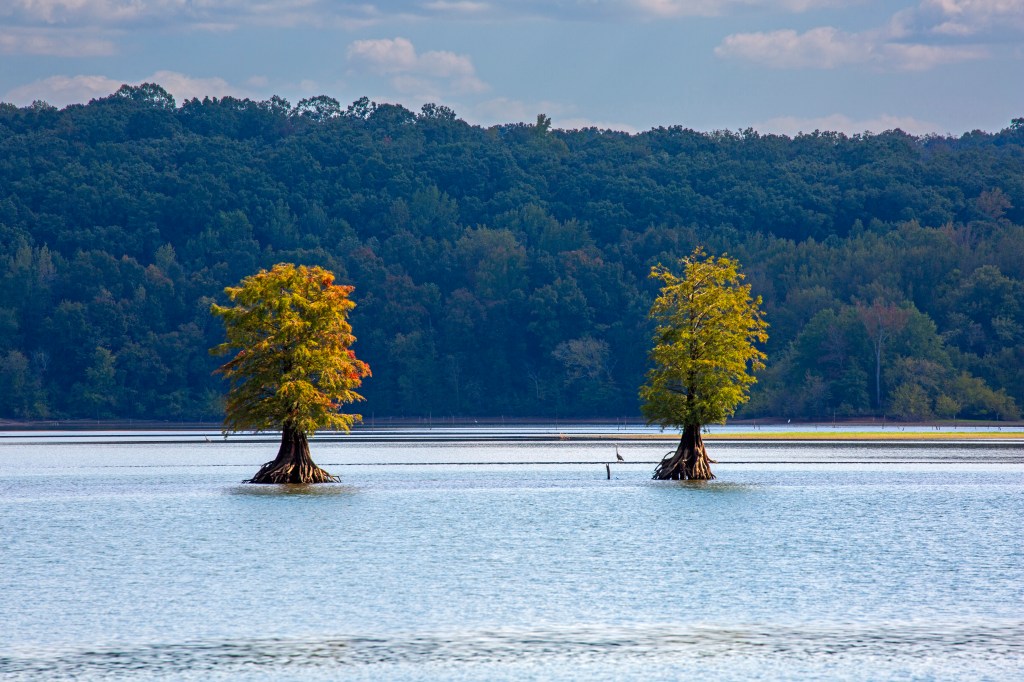
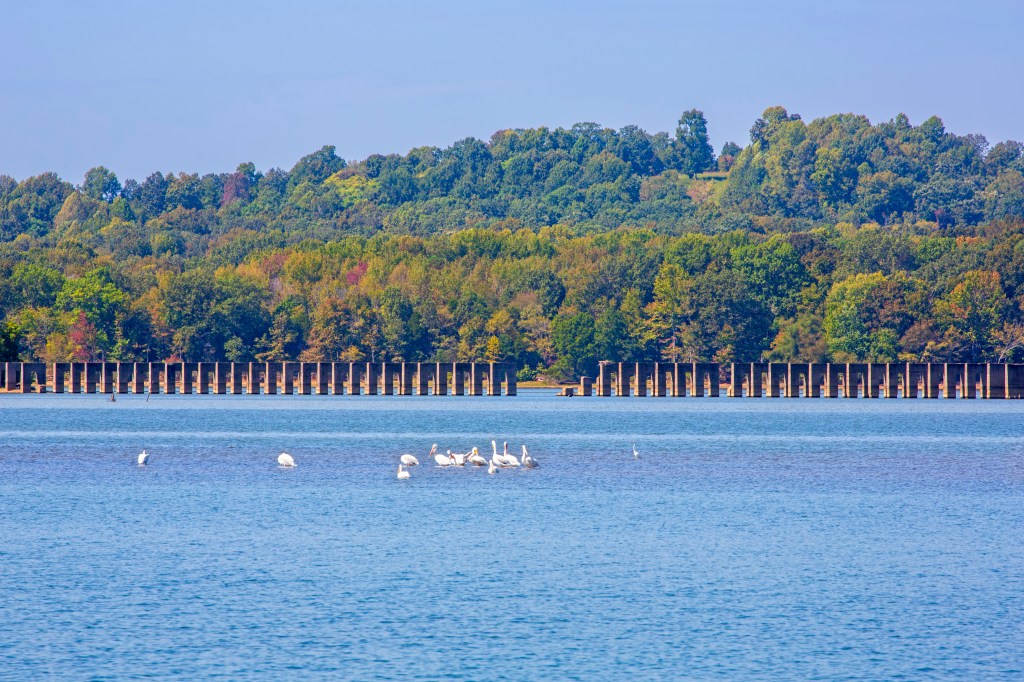
We had another peaceful trip up the Tennessee River to Cuba Landing Marina.  Eventually the lake narrows and there is more to see, including pods of pelicans and changing colours of the trees, especially the bald cypress.  The Tennessee River is now at “winter pool”, which means that the water depth has been lowered by 5 feet.  This allows for winter rains and spring runoff, and helps prevent flooding.  Bald cypress are a deciduous conifer, meaning that they have needles, but the needles turn yellow and red in autumn and then drop, unlike most conifers. Once they mature, they are extremely hardy and long lived, and there are some specimens over 100 feet tall, and up to 40 feet or more across.  The oldest are thought to be over 2000 years old.  The bald cypress that we see on the Tennessee River seem to like to have their feet in the water, and once the depth is lowered, the fascinating root system is revealed.  Last year’s colours were a rich gold, while this year many of them are more reddish.

Bald cypress on the Tennessee River. The water has been lowered to winter pool, exposing the roots of the water loving trees.
Derelict railway viaduct near New Johnsonville. The Nashville Chattanooga and St Louis Railroad constructed the bridge in 1867. It was abandoned in 1945.

We arrived at Cuba Landing before 3pm, and had time to prepare a platter for docktails with Amy and Wes, who live on their boat in the marina.  Wes is a delivery captain, and has lots of stories to tell.  We enjoyed a very nice evening with a chilled bottle of local rose (and then some more wine), and all of us were surprised to discover it was well past Looper Midnight!

Ready for docktails at Cuba Landing

In the morning, the dreaded “tank full” red light came on, telling us two things.  First, it was obvious that our pump out in Clarksville had been incomplete, because the red light is a tank full warning for the blackwater tank, and it had only been 4 days.  Our normal capacity allows us 10 days.  The 2nd thing, happily, the red warning light is still working!  It failed several years ago, with unpleasant results, so it had been fixed.  Until it comes on, you can never be sure it hasn’t failed again, especially if you time your pump outs, as we do, to avoid being full!  After breakfast, Dick walked over to the marina office to pay, and was able to arrange for the pump out boat to come to our dock right away.  We were out of the marina by 10:10, only about ½ hour later than originally planned.

Sunrise at Cuba Landing, with mist on the water
Bluffs on the Tennessee River

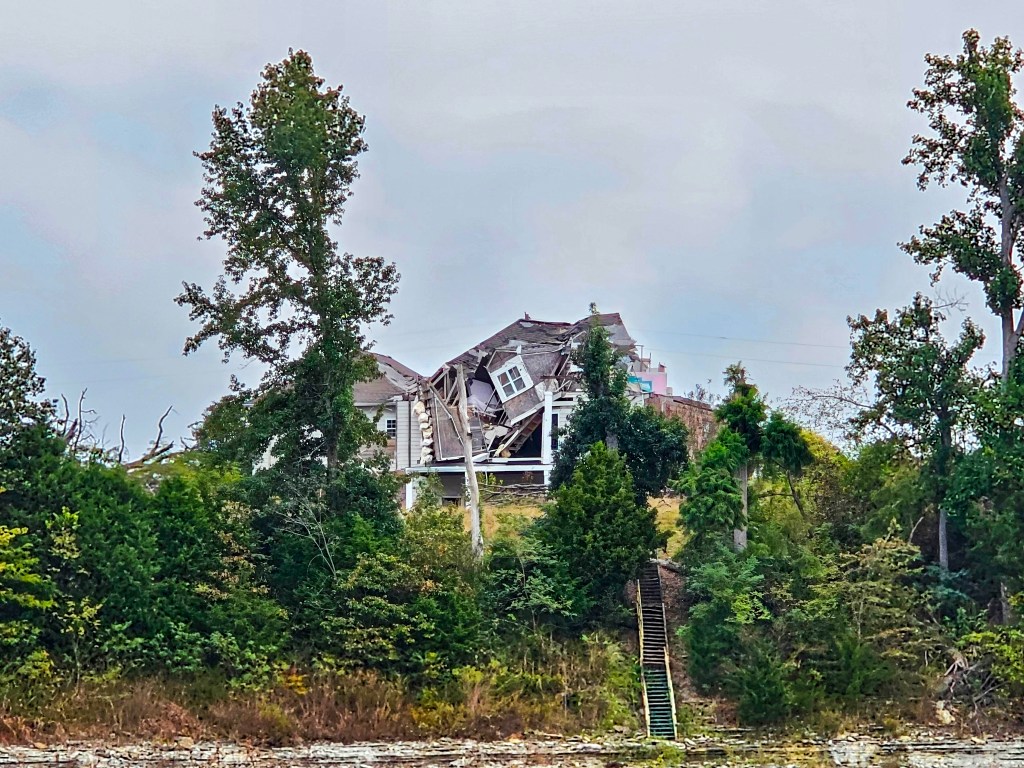
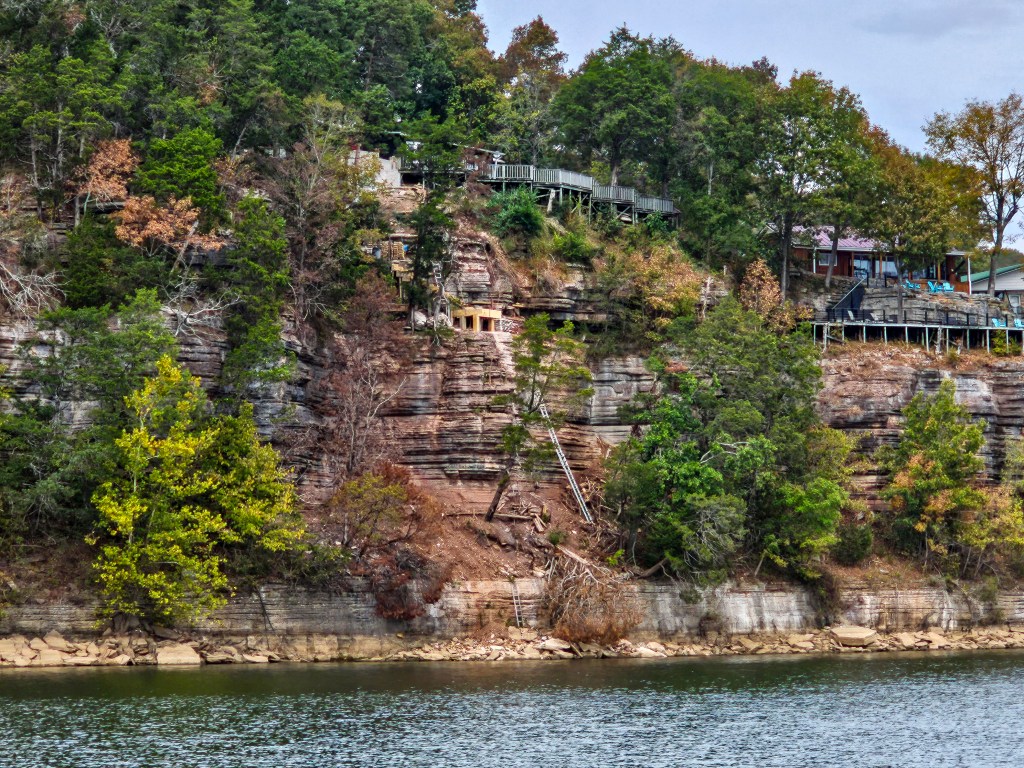
As we made our way up the Tennessee River, we were continually reminded of the extremes of weather in this area.  All the houses along the riverbank are built high up on stilts, so they are protected from flooding.  The river would have to rise at least 20 feet before it even touched the base of the pillars, the anticipated volume of water must be incredible.  We also saw places where houses had been destroyed by tornadoes.  In one place only half of the house was damaged, in another the house was trashed, and yet the neighbours on either side appeared to be unaffected.  I am very glad that we did not see any violent weather events when we were underway in June and July.

Tornado damage on the Tennessee River
Some people build right on the edge of the cliffs in spite of all evidence that says this is unwise

We anchored behind Swallow Bluff Island by 4:30.  It seemed like a very long day, even though it was our normal travel hours.  It was a dull day, so although the fall colours were beautiful, the light was completely flat and there were fewer photography opportunities than I had hoped.

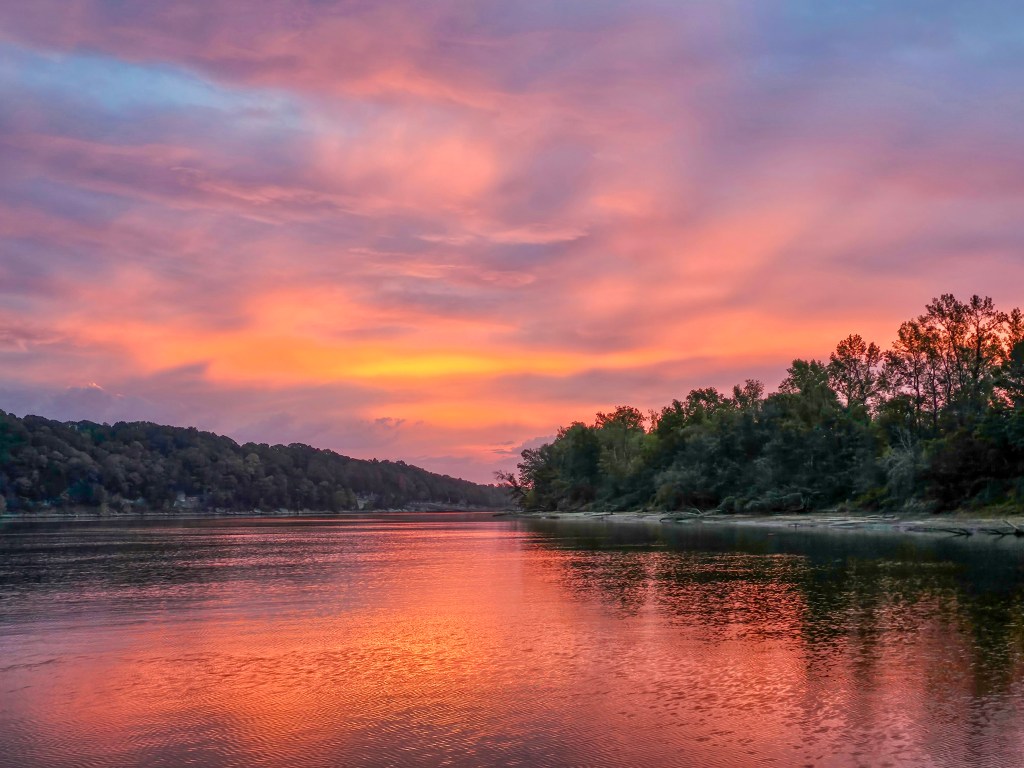
We had a very quiet night, once local boaters stopped racing through the channel past us, and there was a glorious sunrise for our last morning on the water this year.

Sunrise at Swallow Bluff Island
A beautiful historic house at Savannah, Tennessee

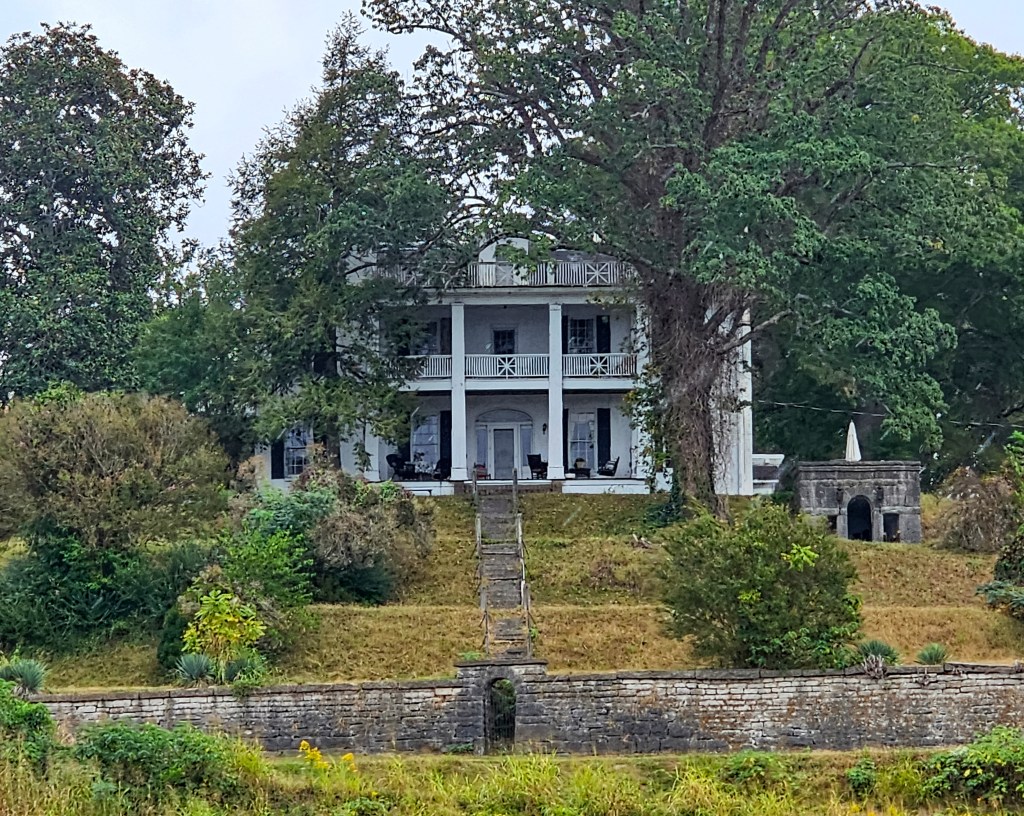
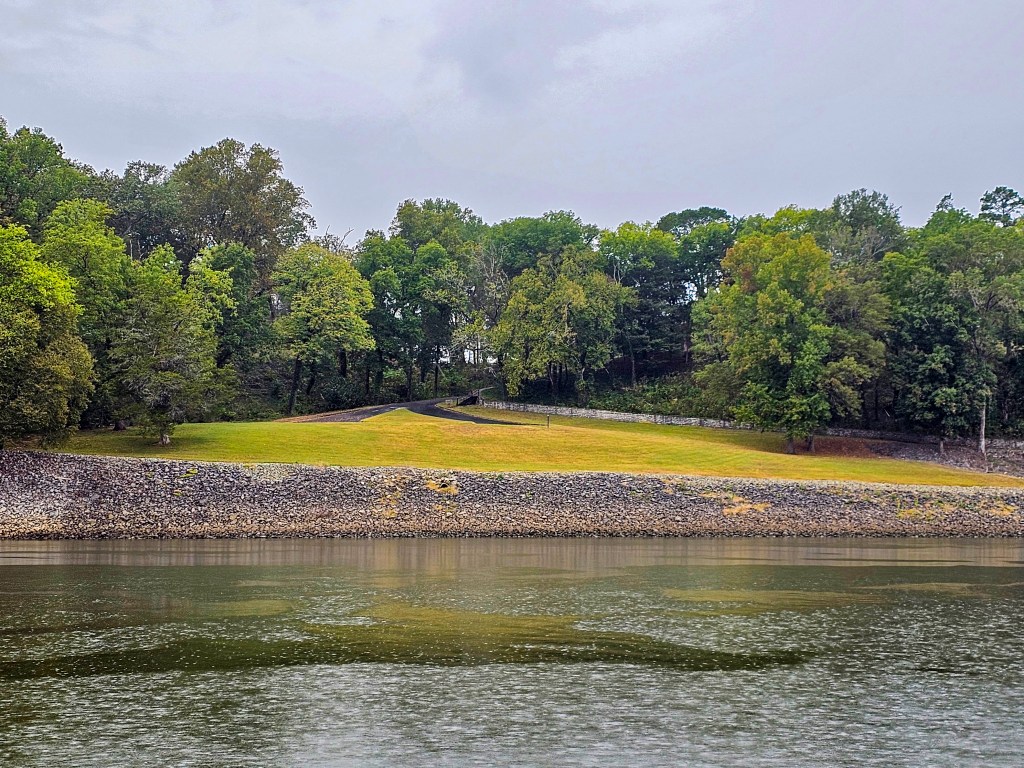
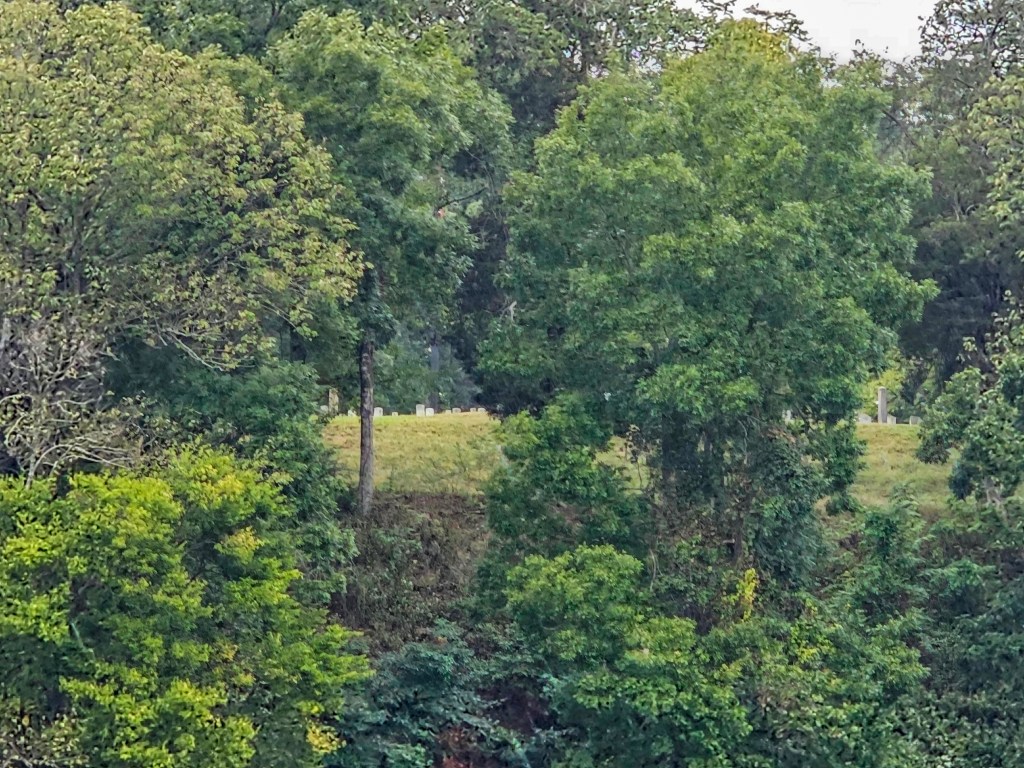
We passed Cherry Mansion, where General Ulysses S. Grant’s breakfast was interrupted by couriers with the news that the Battle of Shiloh had begun.  Later we passed Shiloh National Cemetery, seen through the trees above Pittsburgh Landing.  The Battle of Shiloh was fought from April 6th to 7th in 1862.  It was one of the bloodiest battles of the Civil War, with nearly 24,000 casualties.  Although they won the battle, the Union army had higher casualties.  Afterwards, there was much criticism of the generals on both sides.  The Confederate General, Albert Sidney Johnston, lost his life during the battle.  He chose to lead from the front, and sent his personal physician away to tend other casualties.  He was shot in the leg and bled to death, almost certainly a preventable death.  The loss of Johnston was considered by Jefferson Davis, the Confederate President, to be the main reason for the loss of the entire Western Theatre to Union forces.  The site of the battle was between Pittsburgh Landing, on the Tennessee River, and a small church named Shiloh, about 3 miles inland towards Corinth.  Perhaps it is ironic that Shiloh is a Hebrew word meaning “place of peace”.  Union troops were gathering in the area of Pittsburgh Landing with the eventual objective of taking the town of Corinth, where the Confederate army was waiting to defend the important intersection of two railroads.  The Union army outnumbered the Confederates, with more divisions on the way, so the Confederates decided to make a surprise attack, hoping to drive the Union troops off before they could consolidate their forces.  It never ceased to amaze me, when I read about battles, how often they are lost through bad judgement, incompetence, and even plain cowardice on the part of the leaders. 

Cherry Mansion
Pittsburgh Landing
You can just see the graves at Shiloh Cemetery through the trees above Pittsburgh Landing

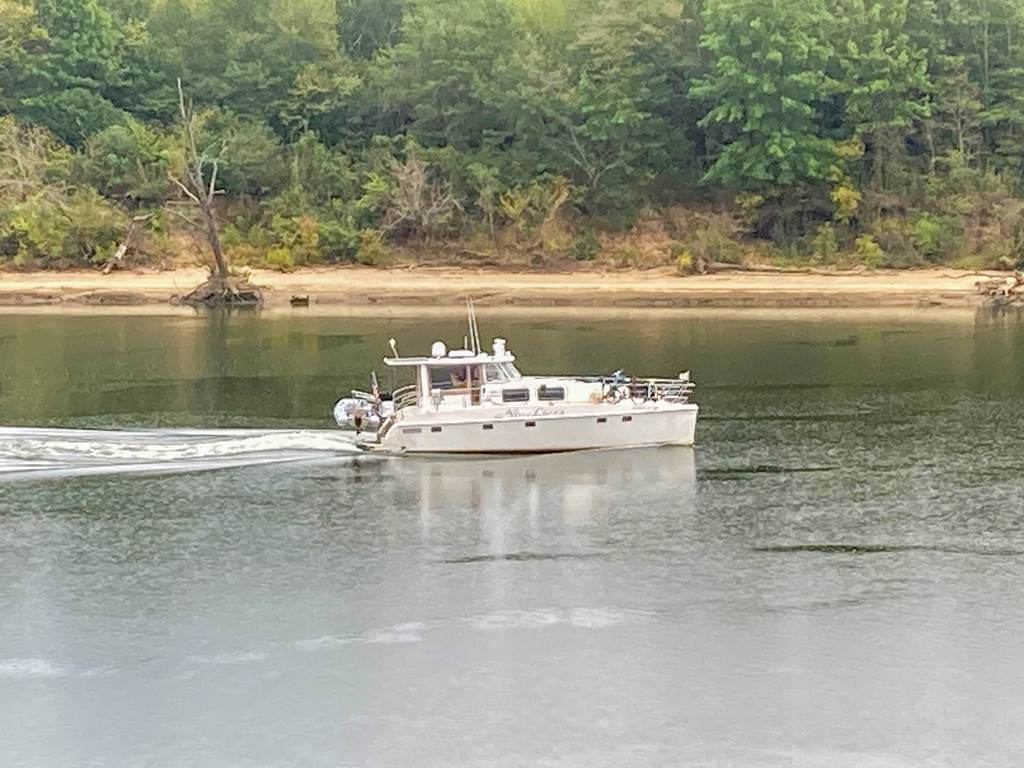
Shortly after we passed the town of Satillo, Dick received an email with a picture of Nine Lives.  The gentleman told us he had seen us at anchor the previous evening when he was fishing, and had watched for us from his home in Satillo.  The friendliness of local people, especially in Tennessee, Kentucky, and West Virginia, was a highlight of this year’s trip.

Nine Lives passes Satillo

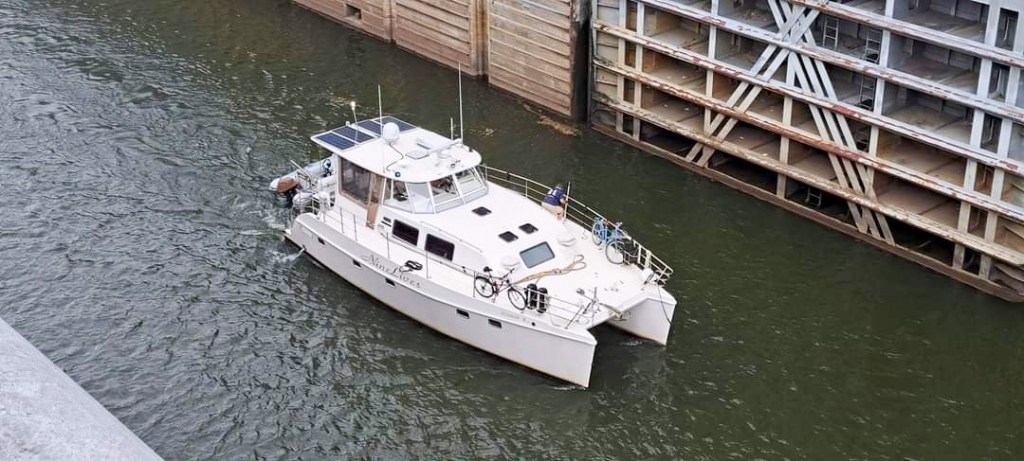
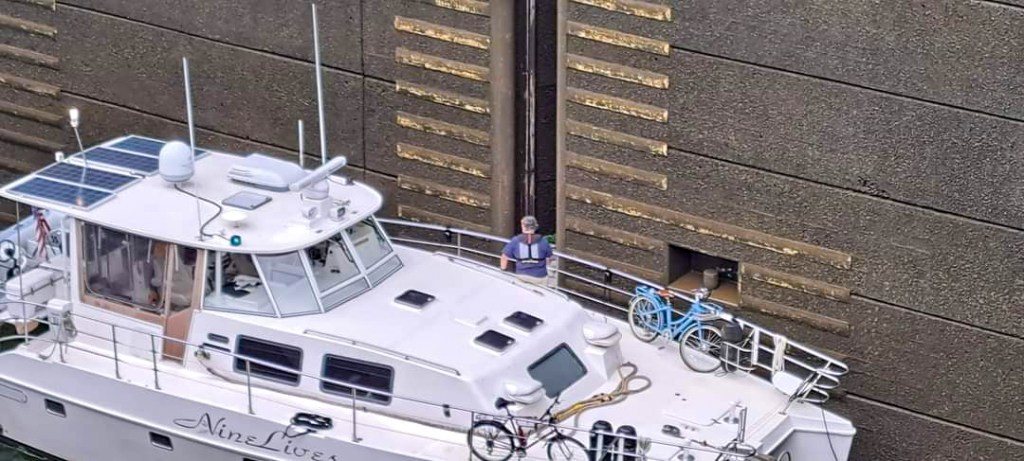
Earlier in the day we had been bounced around by a large yacht with Florida registration, called Rock O.  It had been docked behind us at Cuba Landing, and they were obviously in a big hurry to get to the lock at Pickwick.  Half an hour from the lock, Dick phoned the lockmaster, and was advised that they had another pleasure craft waiting, and if we could get there within half an hour, they would lock us through at the same time.  Dick speeded up.  We waited about 30 minutes for the earlier tow to finish and the lock to empty.  Rock O, after waking us in their hurry to arrive at the lock, will have waited about 3 hours.  We both found that very satisfying!  As we left the lock, the lockmaster told us to check their facebook page, as he had taken pictures.  Sure enough, there were several very nice images of Nine Lives.

Nine Lives enters Pickwick lock
Nine Lives on the wall as the lock fills
Dick tends the line in Pickwick lock

We were into our slip at Aqua Yacht on Pickwick Lake by 3:30.  There was just time to hastily prepare a platter for docktails, and we hosted a most enjoyable evening with platinum Loopers Robin and Charlie, harbor hosts at Aqua Yacht.  I had not met them in person, although Dick has corresponded with Charlie, and was previously introduced on the docks.  They have completed 2 loops, and are thinking about a 3rd.  It was great sharing stories with Robin, who has the same role when docking as I do.  She is quite familiar with teenage boys and older men who will not take directions for line handling from a woman!  We certainly hope to get together again in the future.

Dick had booked a haul out for first thing Friday morning.  On our arrival Thursday, he made a point of walking over to the workshop to confirm, and was promised they would come to our dock between 8 and 8:30am.  They did, but only to explain that the boat hauled the previous day had only a minor problem to fix, so they would do that and then after it was back in the water, it would be our turn.  This rather threw out all our careful plans, so we had to begin packing, laundry, and cabin preparation ahead of when we expected.

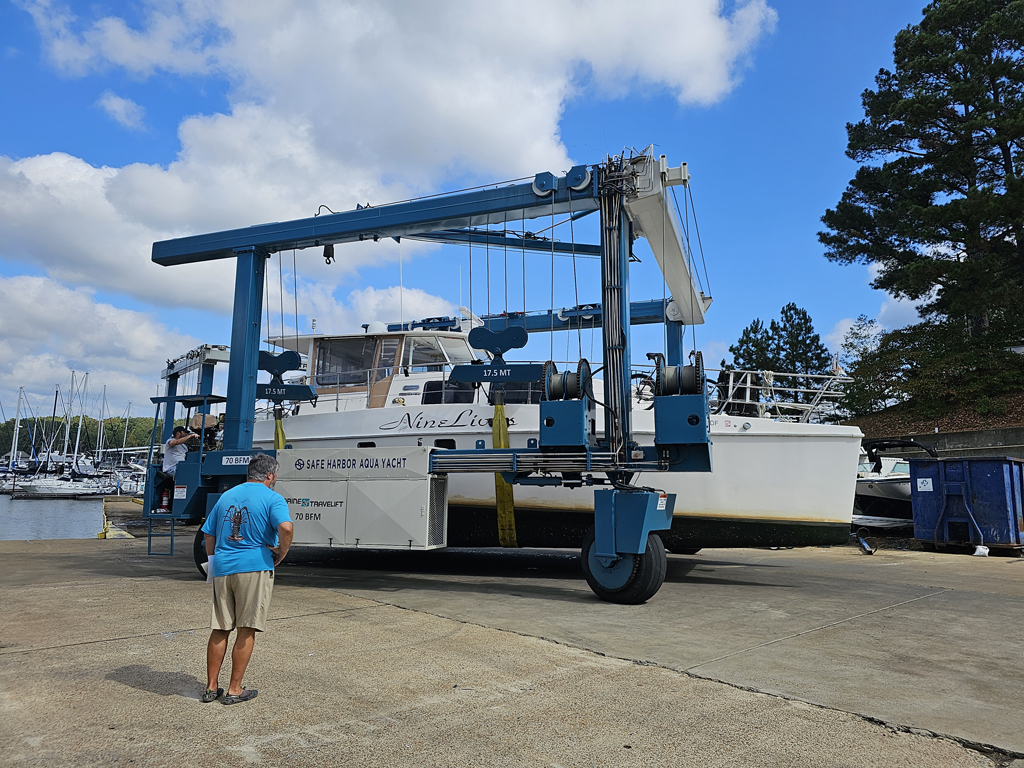
The tech arrived shortly after 11am.  We took the boat around, and I again had the dubious pleasure of being on board when it was lifted.  Then came the challenge of getting off.  This time I just couldn’t climb over the rail at the bow with any confidence that I was not going to fall into the (filthy) water.  Fortunately, the techs were very understanding, and lowered Nine Lives again and brought a workboat around so I could get off.

Nine Lives in the travel lift
Nine Lives ready to have the sponsons and the props checked

We were delighted to see that the sponsons were completely dry again this year.  All that care taken to protect them with fenders pays off!  The props need some work, as they are a bit dinged.  They were damaged when we were aground in Huntington.  On that morning, as we maneuvered to get off the wall, there were horrible grinding noises, now we know what they were.  Fortunately, one of the best workshops for propellers is right in the Pickwick area, and it has been some time since ours were tuned anyway.

The first day of preparation to leave the boat we packed all the clothes and the food, and set up the beds.  I put all the duvets on the big bed, along with all the pillows and throw cushions, and cover it all with the biggest duvet in a cover I don’t care about.  This prevents any accidental damage to the bedlinens when workmen are aboard.  On the second day the fridges and freezers are defrosted and cleaned, new clove bags prepared and distributed in the cupboards, wine and liquor packed, and the kitchen and small appliances are thoroughly cleaned, as well as the blades of all the fans.  Batteries are taken out of TV remotes and small electronics, the burgee and flag are taken down and stored.  We headed to the fuel dock for a last pump out to make sure the tank is completely empty against any possibility of freezing.  Once that is done, it is time to drain the fresh water tanks.  Dick takes off the shower heads so they don’t crack as they have in the past.  He sets up a dehumidifier, two engine room heaters, and a cockpit heater, so we are not relying on the boat heating system.  If there was a power failure, the boat system would drain and ruin the batteries, so it is better to have individual heaters and a dehumidifier running off mains power. One last go-round with the vacuum cleaner, roll up the carpets, and put the cockpit cushions into the salon, a final spray to discourage spiders, and we were ready to say goodbye for a year.

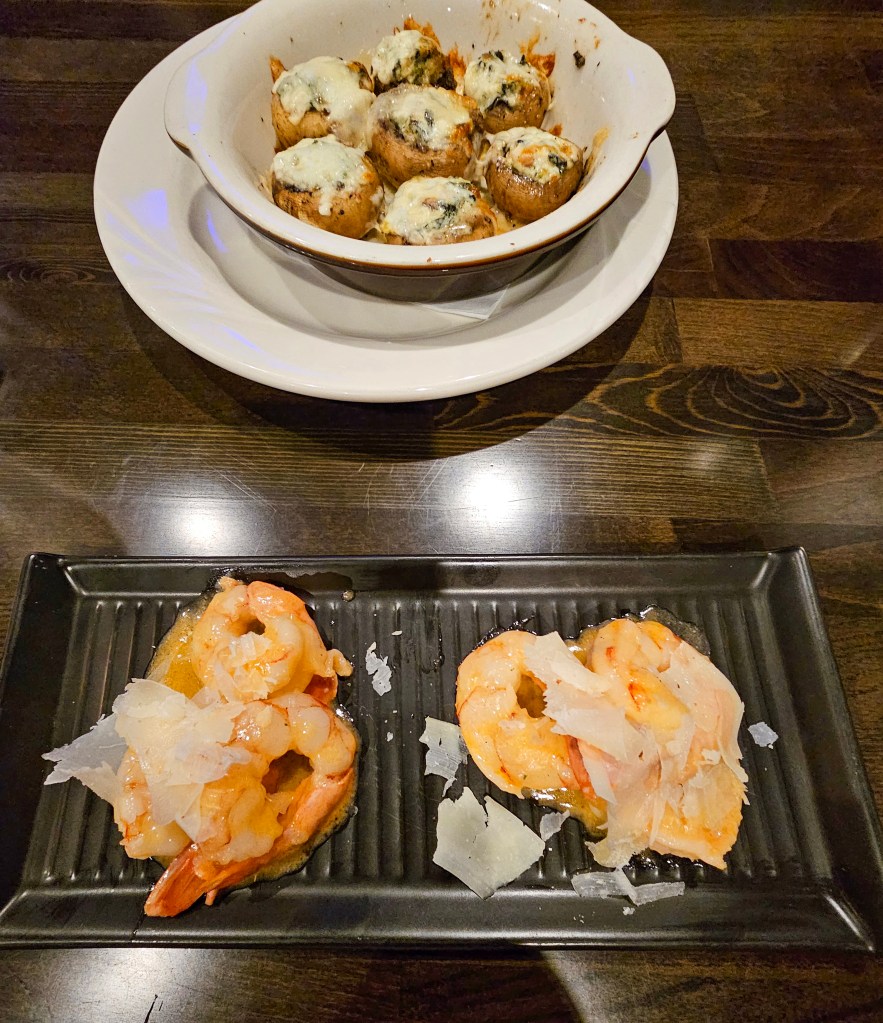
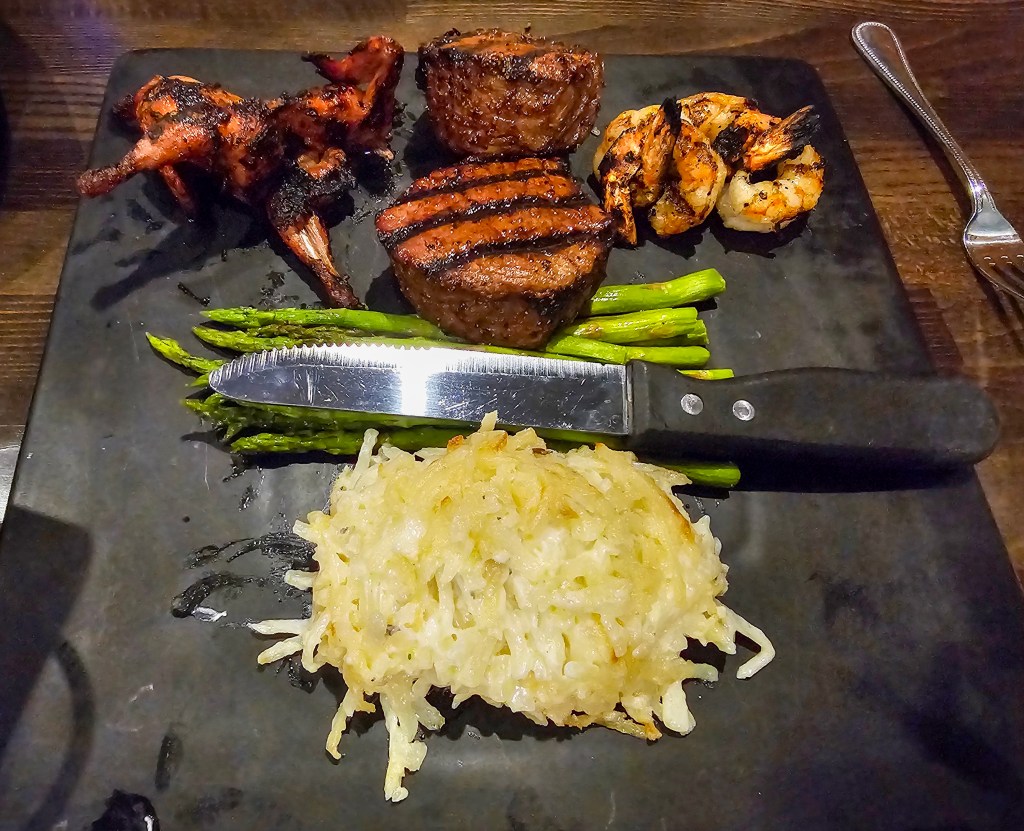
We were out by 4:30, both very tired, and needing a rest before the 45-minute drive to Corinth and our favourite local restaurant.  Vicari’s did not disappoint, and this time we both ordered things we had not tried before.  Dick had stuffed mushrooms to start, and I had red shrimp in butter and parmesan.  Dick ordered the mixed grill special, filet, red shrimp, and quail.  I tried the grilled pork tenderloin with 2 kinds of ravioli.  All was delicious.  For dessert, Dick had a limoncello cake, and I had bread pudding.  An excellent finish to a successful boating season.

Appetizers at Vicari’s
Vicari’s mixed grill with asparagus and hash browns
Vicari’s pork tenderloin with two kinds of ravioli
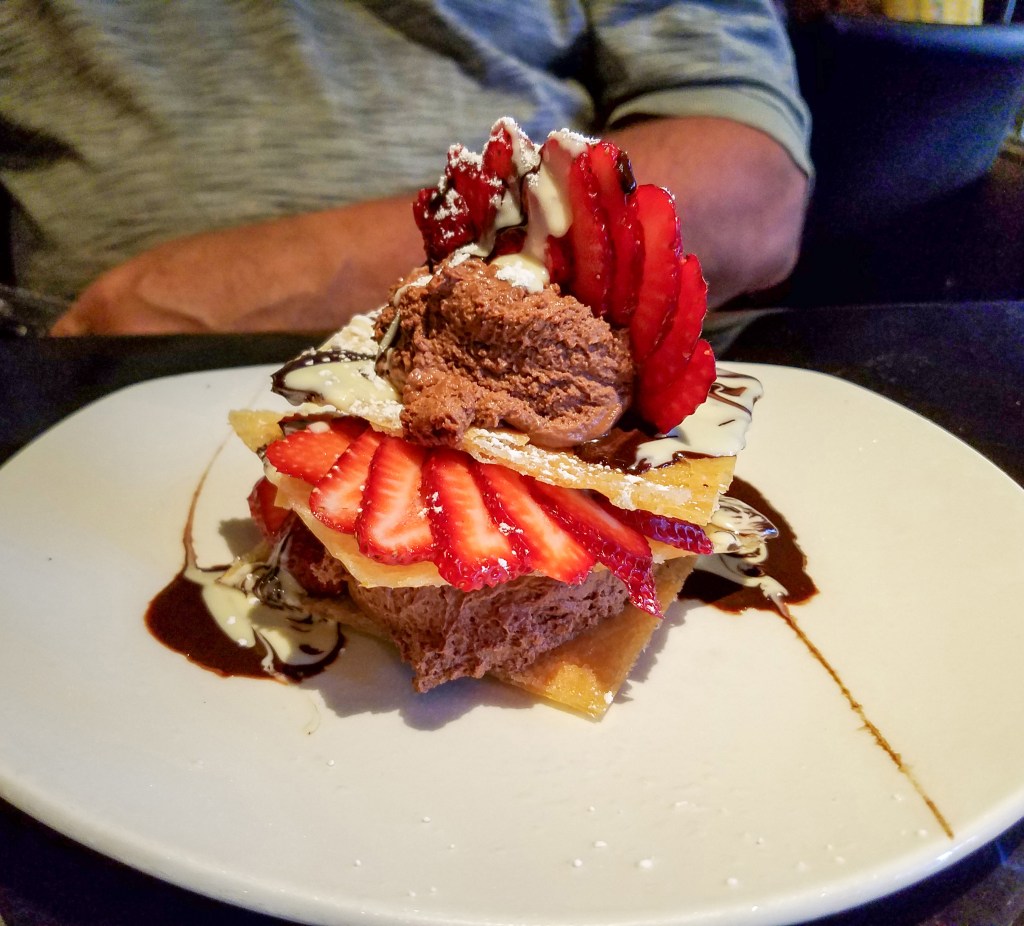
Vicari’s desserts

Here are some of our statistics for this season.

States: 8

Miles: 3141 (our longest trip ever)

Days: 106

Hours underway: 360

Engine Hours: 398.4 (also our most ever)

Average speed: 7.5 knots

Maximum speed: 19 knots

Locks: 66

Anchored: 13 nights

Also spent many nights at town walls without power, so ran the generator much more than prior seasons – over 400 hours

Quarts of whiskey consumed: 12 (ish)

This will be the last blog posting for a year.  Yes, a year.  We will come back to Nine Lives in October of 2024.  After attending the AGLCA Annual Fall Rendezvous, we will take time to visit Chattanooga and Knoxville before heading south to Mobile on the Gulf of Mexico.  We will “cross our wake” (that is complete our Loop), with a suitable party, in St Petersburg in December.  After a break for Christmas, we will resume our winter voyage, heading south to the Florida Keys, and then north up the east coast of Florida and Georgia to finish in Hilton Head.  Another party will be required, as we have always considered that we really began our Great Loop from our dock in Hilton Head!

The map of our voyage of 2023

July 19 to August 6, 2018: Jones Falls to Peterborough

After transiting a flight of three locks to get to the lower basin at Jones Falls, we tied up along a wall at Hotel Kenny.  This is a historic hotel, opened in 1877.  For most of the 20th century it appears to have thrived as a fishing camp, with local guides taking guests out to catch big fish on nearby lakes.  Sadly, it has not moved with the times.  The motel style outbuildings are unlikely to offer the level of comfort expected at the prices charged, and all structures including the main hotel are clearly in need of major maintenance.  The dining room was nearly empty, apart from diners from the boats that had tied up for the night, suggesting that there are few hotel guests even at peak season.  It was all rather sad, especially as the location is beautiful and so much could be made of the site.

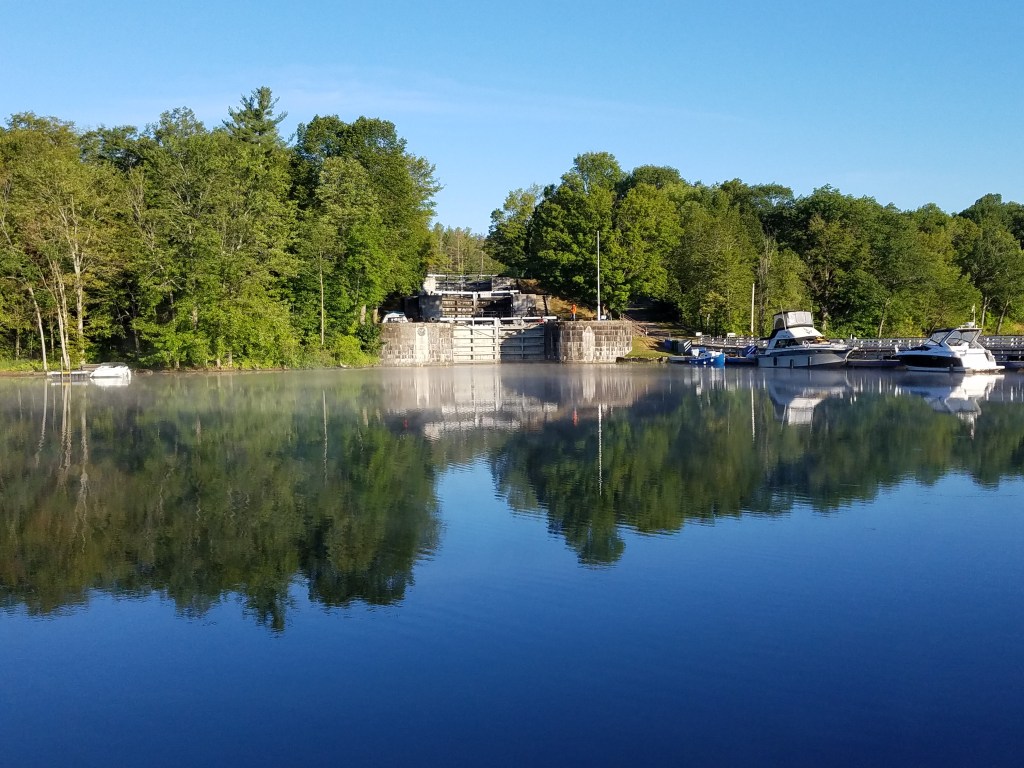
Jones Falls locks and lower basin

After 6 more locks we finished the Rideau Canal and arrived in Kingston.  Dick and I went to Queen’s University there, and he enjoyed a long walk to the campus to see how much has changed.  Kingston is a historic town occupying what was once a strategic location for defence of Upper Canada against those pesky Americans from the breakaway colonies!  Originally a French trading post called Cataraqui, it was taken over by the British and renamed King’s Town after George III. The former French Fort Frontenac was partially reconstructed in 1783, and a colony was set up for displaced British colonists, or “Loyalists” who were fleeing north from the War of Independence.  Fort Henry was built during the War of 1812 to protect the dockyards and the approach to the Rideau Canal. The dockyards are now the site of Royal Military College. Some of the cadets join the reinactment group of Fort Henry Guard, who staff Fort Henry during the summer months.

Upper Brewers lock – a boat moves from the upper into the lower of a pair of locks
Upper Brewers lock, boats about to leave the lower of the two locks
Brass Point Bridge, Rideau Canal, Ontario
Blockhouse, Kingston Mills, Rideau Canal
Waiting for Kingston Mills lock

We enjoyed great pizza the first evening, and discovered when we were returning to the boat that there is a free country music concert for an hour each Wednesday evening.  Unfortunately, the hour was almost done, so we listened to just one song before the musicians packed up and left.  Pity, they sounded quite good!  The next day we walked up Princess Street (pretty much unrecognizable after ahem, 40-some years) and tried a German restaurant.  Dick enjoyed his meal, me, not so much.

A very elegant dessert at Wooden Heads, unexpected in a pizza restaurant!
Outdoor concert in Kingston. In the background you can see two of the Martello towers that helped guard the important port from marauding Americans

From Kingston we set off towards Picton.  We knew that the forecast was for high winds, but Dick felt confident that we would be in waters protected by Wolfe and Amerst Islands for most of the trip.  The first stretch of open water was pretty lumpy, but the second part needed some major maneuvering to deal with much higher waves than expected.  As Dick wrestled with the wheel, we were surprised to be hailed on the radio.  I staggered over to the radio and responded.  It was a sailboat, who had just passed us.  Intrigued by the sight of a power catamaran, they wanted to know who was the manufacturer of Nine Lives and what year was she.  Compliments were paid, including “she handles the seas very well!”  As Dick fought the wheel…  A deteriorating weather forecast suggested that we should run all the way to Belleville instead of stopping at Picton as originally planned.

The next day we had to keep a close eye on the weather to find the one hour window we needed to get to Trenton.  By 1pm the wind had settled a bit and changed direction enough that we headed out.  Arrival in Trent Port Marina was made slightly more exciting by large numbers of small runabouts with fishermen, all of whom were maneuvering to get to the launch ramp across the river from the fuel/pumpout dock!  I keep saying Trenton, but the town that Dick was born in has become Quinte West after some geographical redistribution and combination with two other towns.  It seems to have been a worthwhile change for Trenton, in addition to a superb marina, there is a large City Hall and library building, and many areas of town that were derelict seem to have been cleaned up.  There is still a shortage of good shops in the downtown area, but we enjoyed shopping at the European deli, stocking up on various Dutch and English imported foods and treats.

Trent Port Marina
Excellent facilities for boaters at Trent Port Marina

I hung up my galley slave apron, and tucked away the fender maid gloves to get on a flight home for a week.  I enjoyed the chance to just be by myself, as well as bridge, lunch and dinners with friends, and lots of time with my boy Tucker.  I also took care of some major issues caused by my website host, so my emails are “clean” again. Dick spent much of the week with his Mum, going on drives and scouting the various locations on the Trent Severn Waterway that are our next destinations.  He had a two page list of jobs to be done on the boat as well, and some of those were even crossed off!

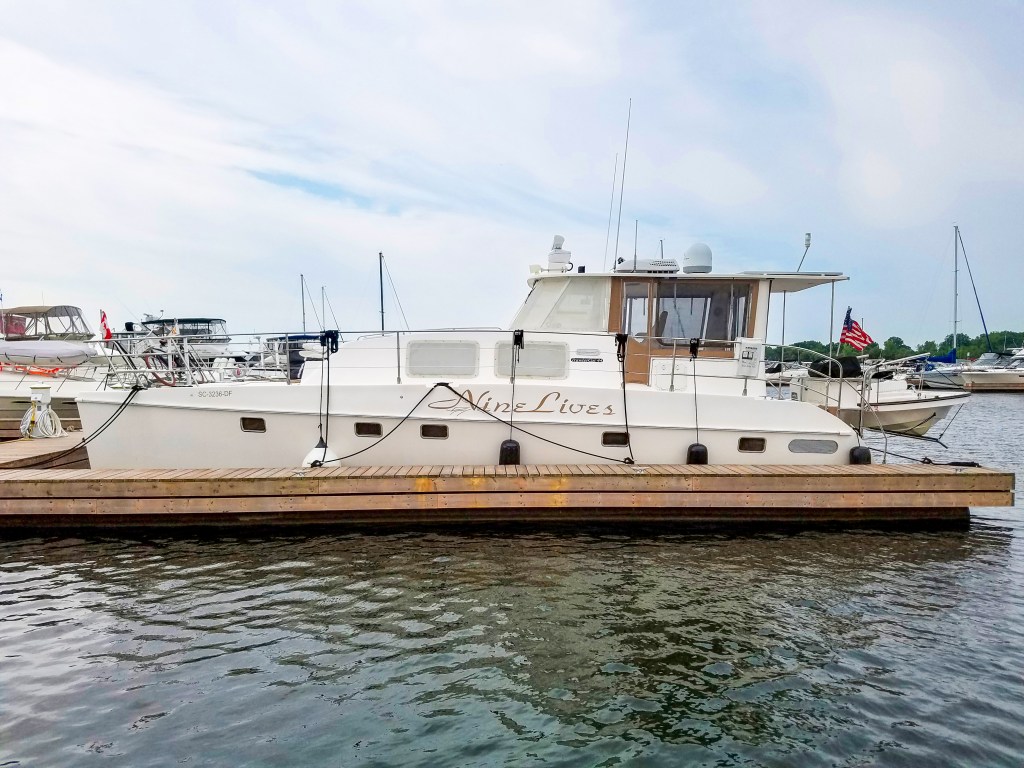
Nine Lives in Trent Port

Eventually the break was over and we set off up the Trent River towards Frankford.  First, we stopped for fuel and a pump-out.  This was our first time to fuel since the Hudson River, and we were expecting to take on about 400 gallons of diesel.  Unfortunately, the marina ran out after only 250!  We will be able to get to Georgian Bay easily on that, but we felt sorry for any boaters behind us who were planning to fill up.

The Trent Severn Waterway is a 240 mile long series of canals and connected rivers and lakes joining Lake Ontario with Georgian Bay.  The first lock was built in 1833, but it took years of broken promises and political infighting until 1915 before the entire route was completed.  There are two particularly noteworthy features along the route, but we will be passing them next week, so I will be telling you all about those in the next update!  There are 44 locks, 39 swing bridges, and 160 dams along the route that that manage the water levels for flood control and navigation on lakes and rivers in a large area of southern Ontario.  The Waterway passes through “cottage country”, the summer destination for a great many city dwellers. Dick learned to swim in the Trent River, and his grandparents farmed land adjacent to the river. Today many of the farms have been abandoned and the land is going back to woods.

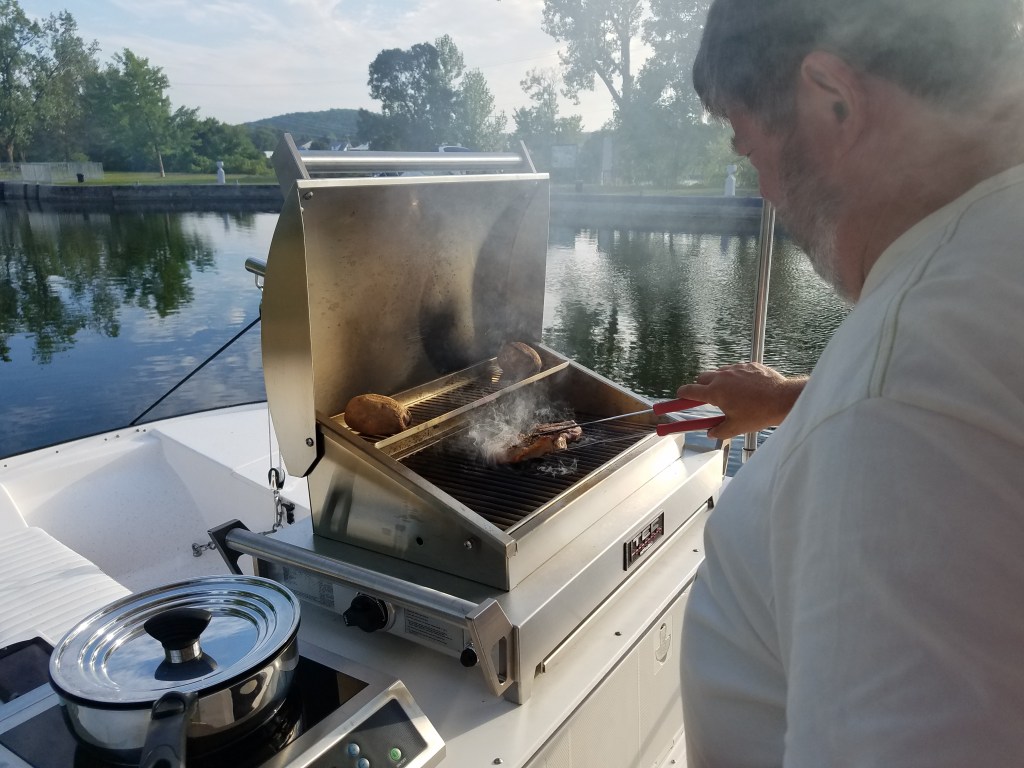
A feature of much of the waterway is free docking at lock walls and town walls for overnights.  We stopped first at Frankford, still technically part of Quinte West, and only 6 miles from Trenton, but 6 locks were enough on a hot day.  Dick grilled steaks and baked potatoes and we cooked fresh corn on the cob for one of our best meals on board.  The new grill is proving to be a great success, compared to the strange one that came with the boat.  We are also pleased with the purchase of an induction burner, that we can plug in beside the grill and keep the heat and steam from the cooking out of the galley.

Frankford and the Trent Severn Waterway
The new grill is great!

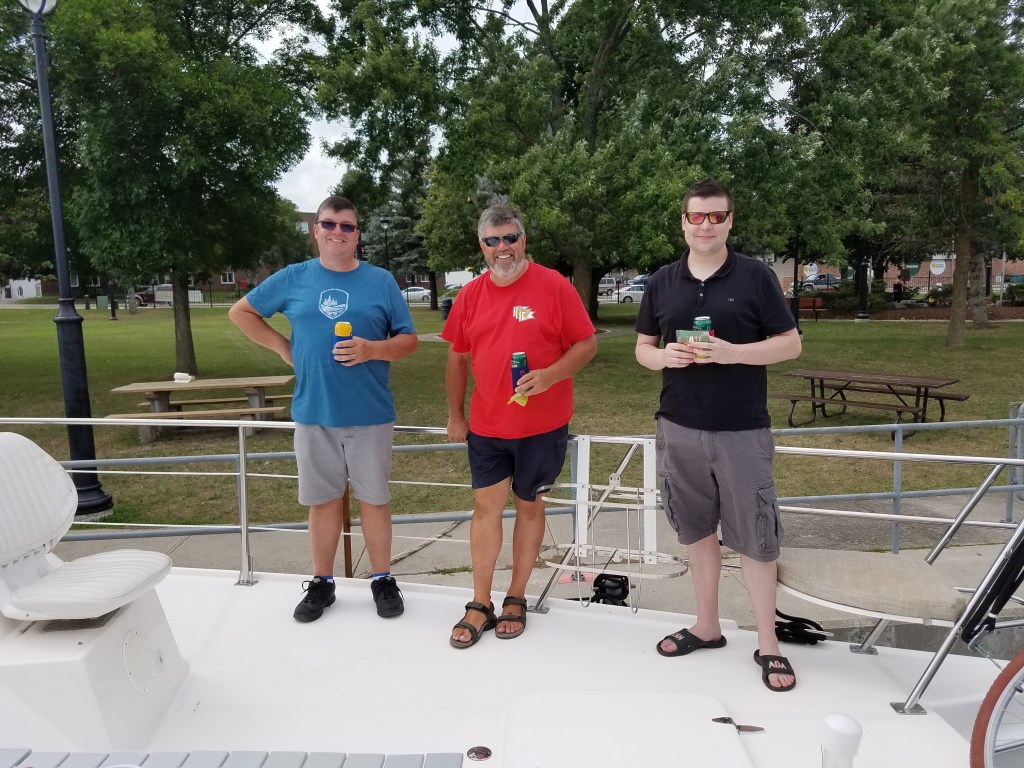
As we approached the first lock the next morning we were delighted to find Dick’s brother Ed waiting to join us for the day’s travel.  He was immediately directed to the stern line, to be his sole charge for the rest of the day as we went through the next 6 locks to Campbellford.  All that work required a suitable beverage after we tied up, and we were joined by Ed’s son Brent for libations and a few snacks.  The extra crew certainly made for an easy and relaxing day!

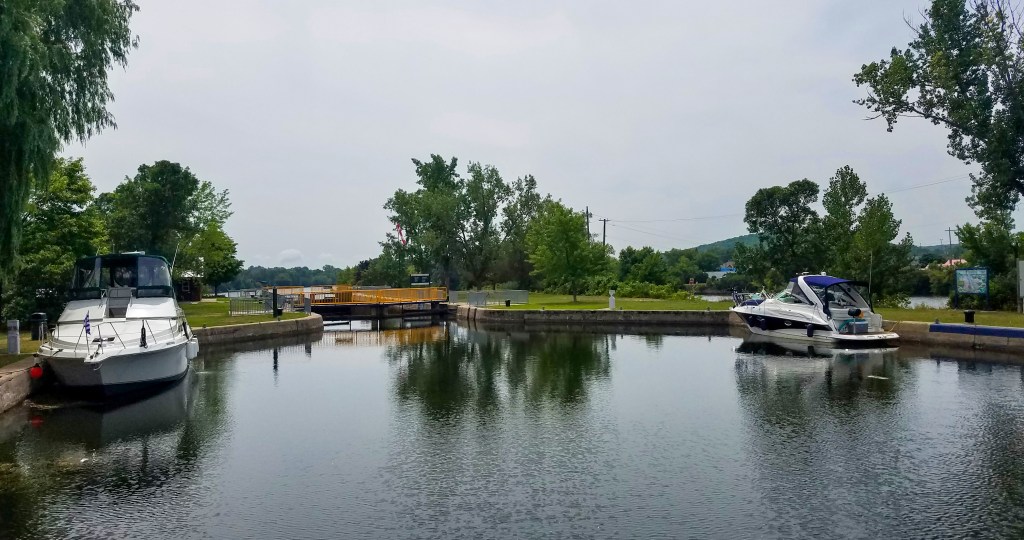
Frankford lock
Ed, Dick, Brent
Relaxing after a hard day on the water

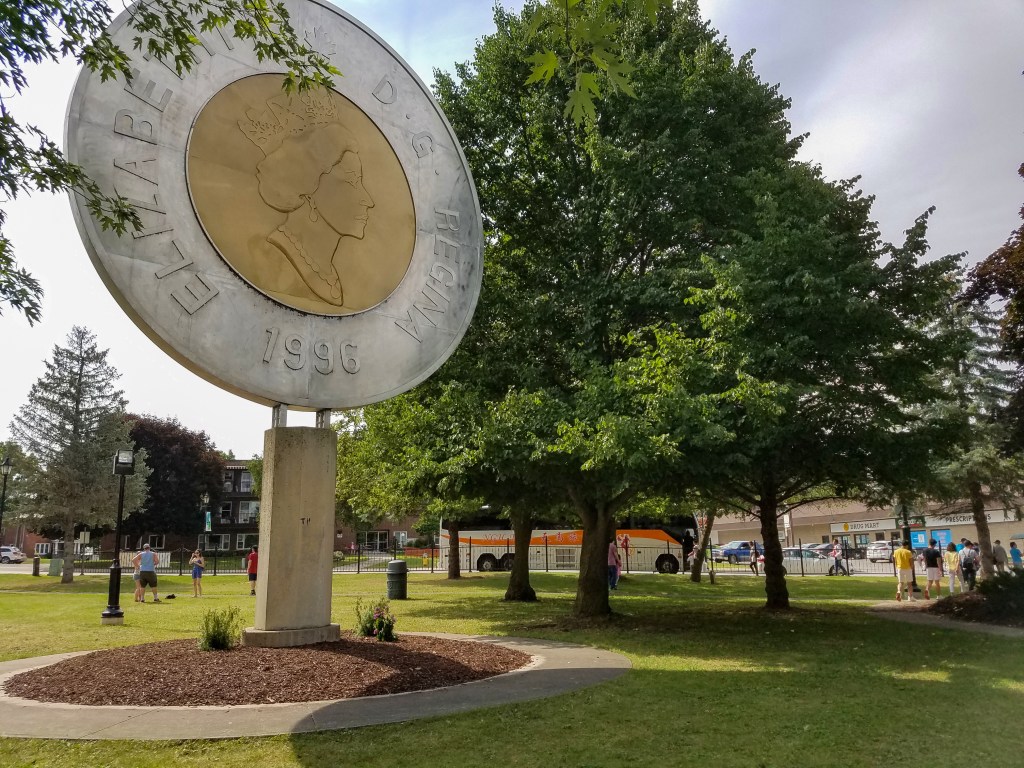
Campbellford is a small town in the middle of farming country, with excellent town wall docking for visiting boats.  We tied up on the west side, next to the park that features a 27 foot high statue of a toonie.  What’s a toonie you ask?  Well, Canada’s $1 coin began to be called a “loonie” after its introduction, because of the image of a loon on the coin.  When the time came to introduce a $2 coin, it seemed natural to call it a “toonie”.  The design of a polar bear on an ice floe was created by Brent Townsend, a Campbellford artist.  Imagine our surprise as we enjoyed our drinks and snacks to see a big tour bus draw up on the other side of the park and decant large numbers of Japanese tourists.  They proceeded to wander around the park in a bemused fashion, eventually posing for the usual selfies with the statue, and returning to their bus after about a 30 minute stop.  Who knew a 27 foot toonie was such a tourist draw that people would travel from the other side of the world to see it?

The giant toonie. The tour bus brought a large number of Japanese tourist to see the statue.

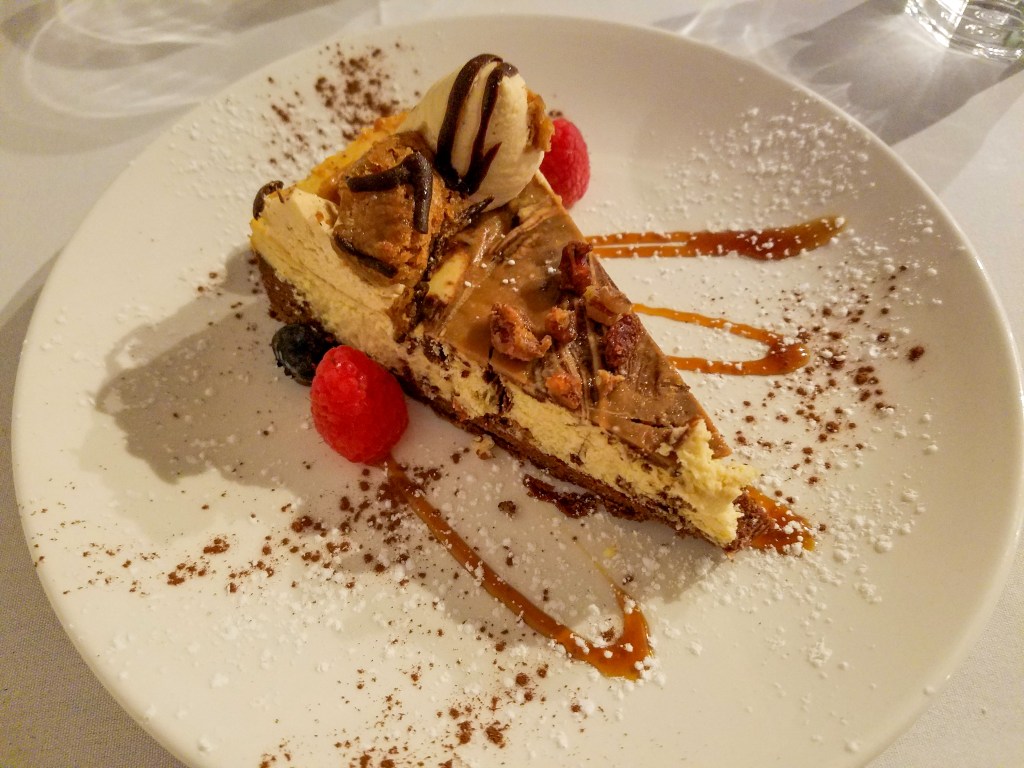
The town’s attractions did not end with good docking and a giant toonie.  In the evening we discovered a tiny European style bistro called Antonia’s.  It is owned and run by a chef from Sri Lanka and his Filipino wife, who retired from the restaurant business in Toronto.  Frustrated by the lack of local fine dining, they opened their bistro two years ago, and it has become a very successful business.  The menu is mostly European.  Dick loved his Osso Bucco, and I had delicious shrimp in Cajun cream sauce.  However, the chef told us they also offer a ‘curry night” about once a month, that is increasingly popular.

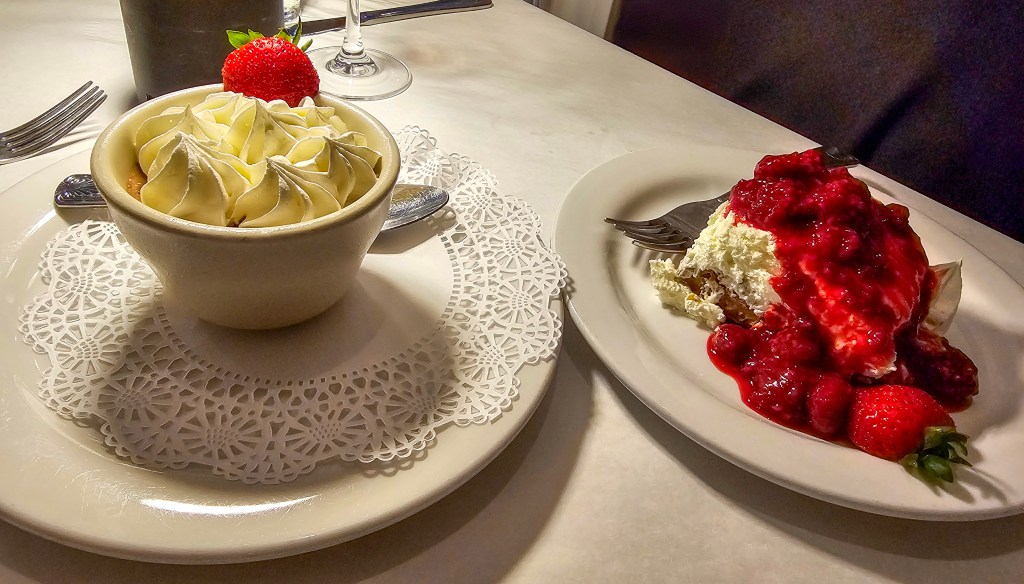
Cheesecake at Antonia’s

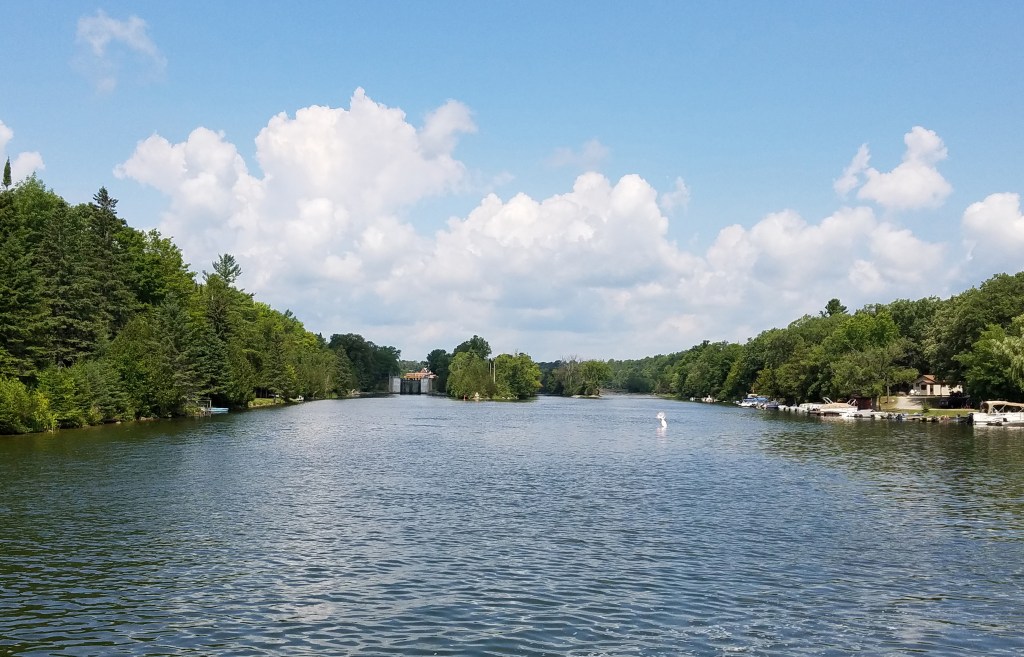
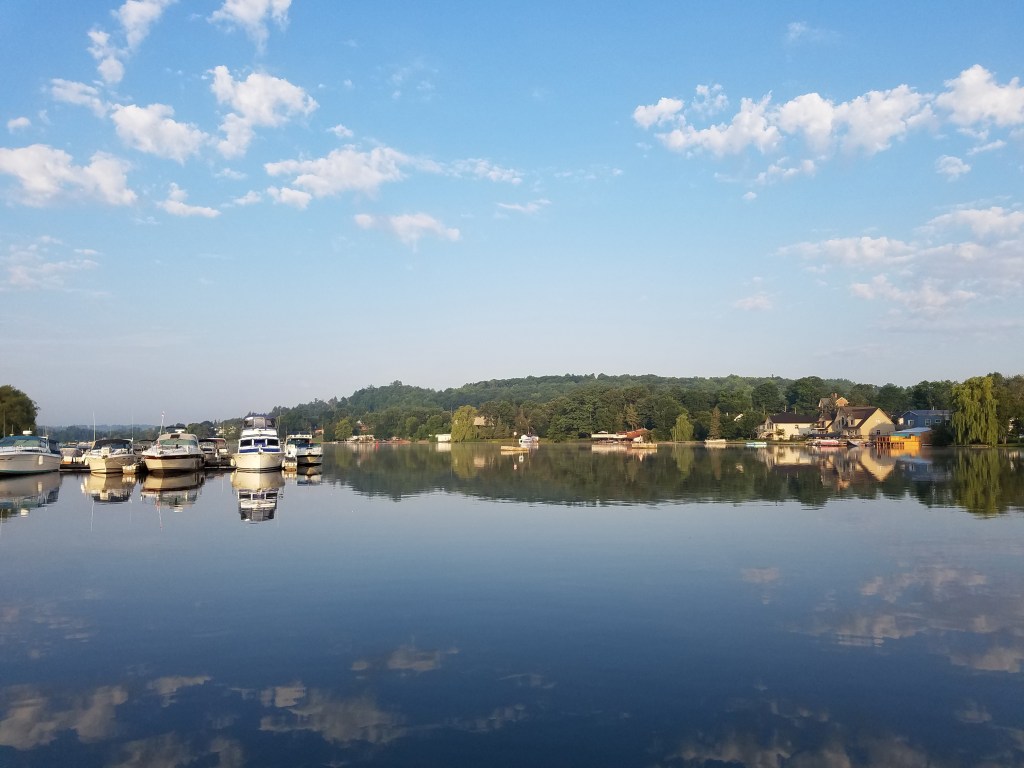
From Campbellford, we continued our leisurely trip to Hastings, transiting another 6 locks to arrive at a town wall that was completely full with small boats stopping for ice cream.  Fortunately, the town also operates a marina across the river, and they had room for us for the night.  The next day we enjoyed a relief from locks for most of the day, travelling across Rice Lake and then up the pretty Otonabee River to finish with one lock and arrival in Peterborough.

Trent Severn lock – approaching a lock north of Campbellford
Hastings

Peterborough is a medium sized city that is becoming a mecca for retirees.  Cultural activities and affordable living are listed as some of the advantages, in addition to easy access to the cities of Toronto, Ottawa, and Kingston. There is a nice marina at the edge of Little Lake, a relatively short walk to downtown and restaurants.  Yesterday evening we walked to a nearby Italian restaurant, and after an excellent meal we discovered that Dick’s Uncle Hans and his wife Cathy were docked just along the waterfront in their houseboat.  After some convivial conversation and drinks on board their boat we staggered home to Nine Lives.  In the centre of Little Lake is a huge waterspout fountain, and at night it is lit by changing colours.  We are looking forward to a local Indian restaurant for our dinner tonight.

The next couple of weeks will include the Peterborough Lift Lock and the Big Chute Marine Railway and arrival in Georgian Bay.  That will get us a break from locks for a while and some more weather dependent travel to look forward to.

June 17 to July 4, 2018: Hudson River to Montreal

Continuing our stay at Half Moon Bay on the Hudson River, after a day of sightseeing, we left the boat and went off in different directions.  Dick drove to Toronto to participate in the annual reunion lunch of former Ingersoll Rand colleagues from his first years with the company.  I rented another car and set off the next afternoon for Long Island and dinner with Harriet and Carol. I worked with Harriet many years ago at Brookhaven National Laboratory, and together with Carol and other friends we have travelled in Europe and enjoyed canal boating in UK.

However.  First it was apparently necessary for me to have a very stressful adventure.  Dick had not been gone for two hours when I discovered tell-tale signs that our holding tank was ready to overflow. (for the landlubbers, the holding tank is where we keep the poop and such, it has to be pumped out once a week). Having had an experience with the situation last summer I knew this was not to be ignored.  Unfortunately, the pump-out machine was located on a dock at the other end of the marina, outside the breakwater.  After my urgent requests for help from fellow Loopers, they jumped into action.  Two ladies got on board with me to catch and throw lines, and two gentlemen stood on the dock to cast off, and then hurried over to the pump-out dock and did the necessary business. The whole thing was immensely stressful on several levels.  First, although I do take Nine Lives into locks, mostly I don’t do the docking maneuvers (I lost my nerve in bad weather at St Mary’s last January).  I had to take her out of the tricky slip, around the marina, then turn and back her up to the pump-out dock.  Then of course it all had to be done again in reverse.  I can say definitively that I now have my nerve back!  The second level of stressful was because the tank was overfull, and I will leave my gentle readers to sleep sound and not draw graphic images for you all.  Anyway, it all got done, and what a great group these Loopers are.  One of the ladies had just arrived to spend time with her gentleman, and there she was participating in the most disagreeable job on the water to help a complete stranger! Credit to Dick, after a brief text exchange that evening to tell him what had happened, he phoned me and made soothing, congratulatory, and even slightly apologetic noises for not being present.

Instead of a picture of my awful adventure, here is one of a Half Moon Bay resident

My drive to Long Island was uneventful, but I am truly glad I no longer do that regularly.  It was only 48 miles, but it took 2.5 hours each way, and that was outside of rush hour traffic!  Port Jefferson, where I stayed and had dinner, is a pretty village on Long Island Sound.  There is a very nice marina there in the supposedly sheltered bay, but that afternoon I watched a trawler make 5 unsuccessful attempts to dock in the high winds and currents.  I am very glad we are not including the Sound on our Loop itinerary.  It was great to see my friends and catch up and reminisce. Dick had an equally uneventful trip to Toronto and enjoyed getting together with many old friends from his early days with Ingersoll Rand.  They included Gordon, who first hired Dick, and who I have known since childhood, when my Dad was an I-R customer.  Also Martin, who was at Queens a year behind us, and who was one of Dick’s first Application Engineers when he was moved up into Sales. Laurie was Dick’s second boss, and Dave succeeded Laurie as Dick’s boss. Garth headed up the Calgary operation when we lived there the first time in the 80’s.

After both safely returned to Half Moon Bay, we enjoyed a great evening of docktails with about 20 Loopers, and a chance to provision at the excellent local supermarket.  Dick was pleased to provision with a car, and not have to load 50 pounds of beer, water, fruit, canned goods, vegetables and various meat and cheese onto his bicycle as he usually does!  Reminding you all that he has a single speed bike, unassisted by electricity!

Docktails with Loopers at Half Moon Bay

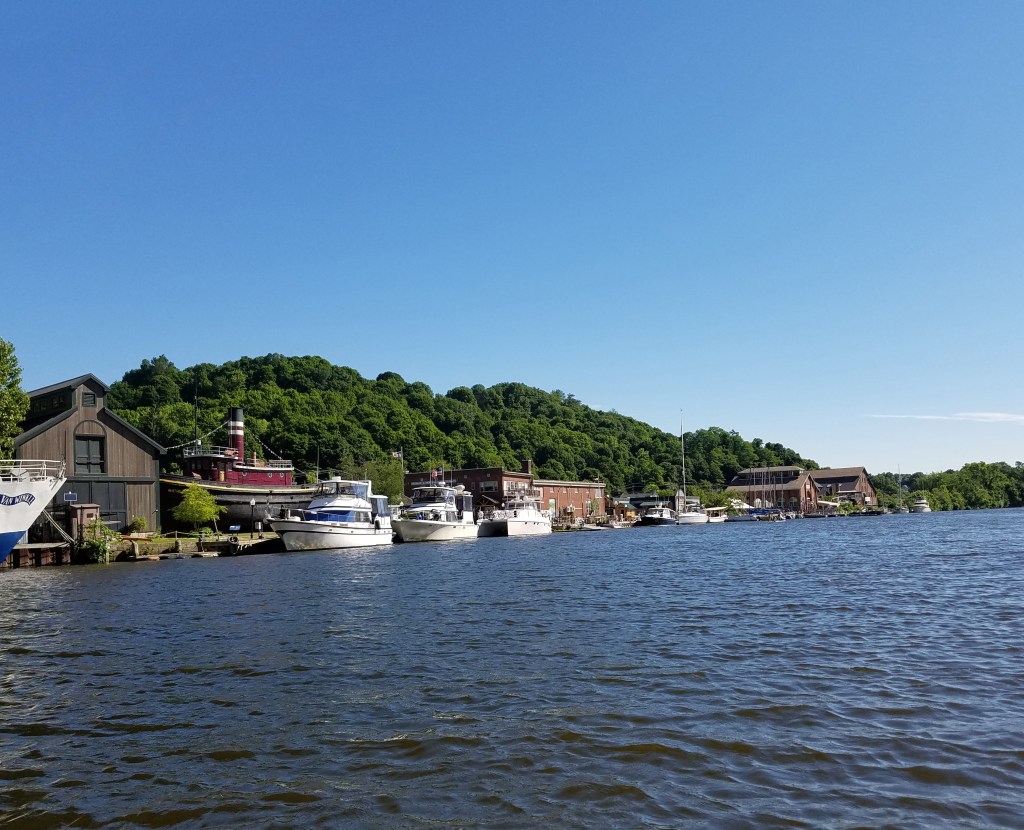
Our first stop on the Hudson was our favourite Maritime Museum at Kingston.  We docked with two other Looper boats who we had met at docktails the evening before.  On our return from dinner we were fascinated by the local fire brigade practising their high pressure hose skills across the river, fortunately pointing up the Creek instead of across! The next morning we launched the dinghy and went for a ride all the way to the end of Rondout Creek.  Rondout was a major shipbuilding port in the 19th century, when it was the northern terminus of the Delaware and Hudson Canal.  Before that, it was a Dutch trading post in the early 17th century.  The Canal was the heyday of the city, bringing coal from northeastern Pennsylvania to the markets of New York City. As happened all over the world, the railroads spelled the end for the lucrative canal barge business, and it closed in the early 20th century.  Today Rondout Creek supplies a large part of New York City’s daily water draw via reservoirs and aqueducts in the Catskills. The Creek still has some small boatbuilding and repair facilities, as well as several large marinas.  It was an interesting dinghy run on a pretty morning.

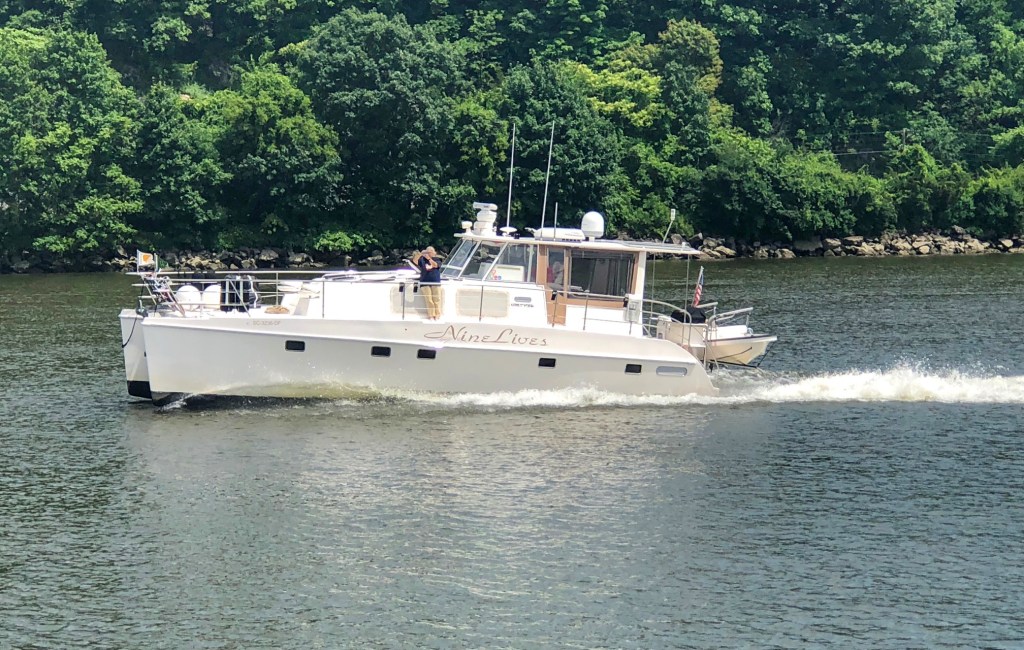
One of my favourite pictures of Nine Lives, taken as we travelled north on the Hudson River
A cement plant on the Hudson River
Loopers docked in Rondout Creek
Rondout Creek Repair Yard
Fire Department practice in Rondout Creek
Maid of the Meadows

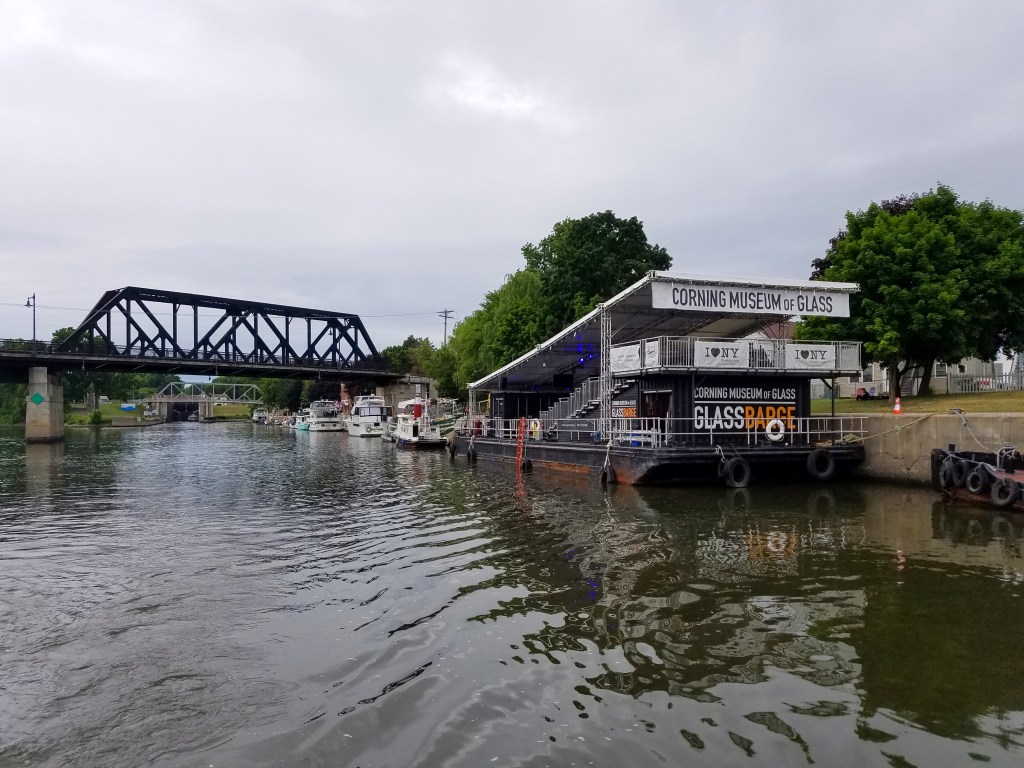
Our next stop was Donovan’s Shady Harbour, followed by a transit through Albany and Troy to Waterford.  At Troy we passed the Corning Glass Barge moored on the river wall.  This is a barge that travels around the Erie Canal and waterways of Upstate New York this year in celebration of the 150th anniversary of the move of the Brooklyn Flint Glass Company to Corning, New York. Some of the innovations credited to Corning Glass include the first electric light bulbs for Thomas Edison, the invention of optical fiber for telecommunications, and the glass used in modern flat screen displays, including cell phones. The barge offers glassblowing demonstrations each day plus museum exhibits sharing the story of glassmaking in Corning.  It is touring in celebration of the bicentennial of the New York Waterways and the Erie Canal.

Troy, New York
Troy, New York, the Corning Glass Barge docked on the waterfront
Approaching Albany
The Glass Barge, docked in Waterford

Waterford was busy, due to the anticipated arrival of the Glass Barge and the upcoming weekend, but we had timed our arrival carefully and were able to get a spot under the bridge on the free town wall.  Being under the bridge had the advantage of keeping the boat cool on a hot sunny day, but the ga-thump ga-thump of vehicles crossing the bridge carried on all night and in the morning the boat was covered in fallen dirt and dust.  Not to worry, our next stop was on the Champlain Canal, with a transit of five locks on a wet and miserable day!

I have decided that I am not so very fond of transiting locks in Nine Lives, especially big locks and lifting as opposed to lowering.  The lines we have to grab and hold are greasy and filthy, and all the muck from the lock-side transfers itself to the fenders and thus to the boat.  We are sailboat shaped, and we have a tendency to swing from bow and stern, so while other boats simply push off from the lock wall occasionally, we need constant vigilance and a lot of pushing, followed by inevitable pulling hard on wet lines to keep the boat in place at the lock wall.  Our usual method is for Dick to bring the boat near the lock, but then he goes outside where I have prepared lines and fenders, and he catches the critical first line while I bring the boat into the lock wall.  Then, once the boat is stopped, I rush outside and catch the second line at the stern and hang on for all I am worth.

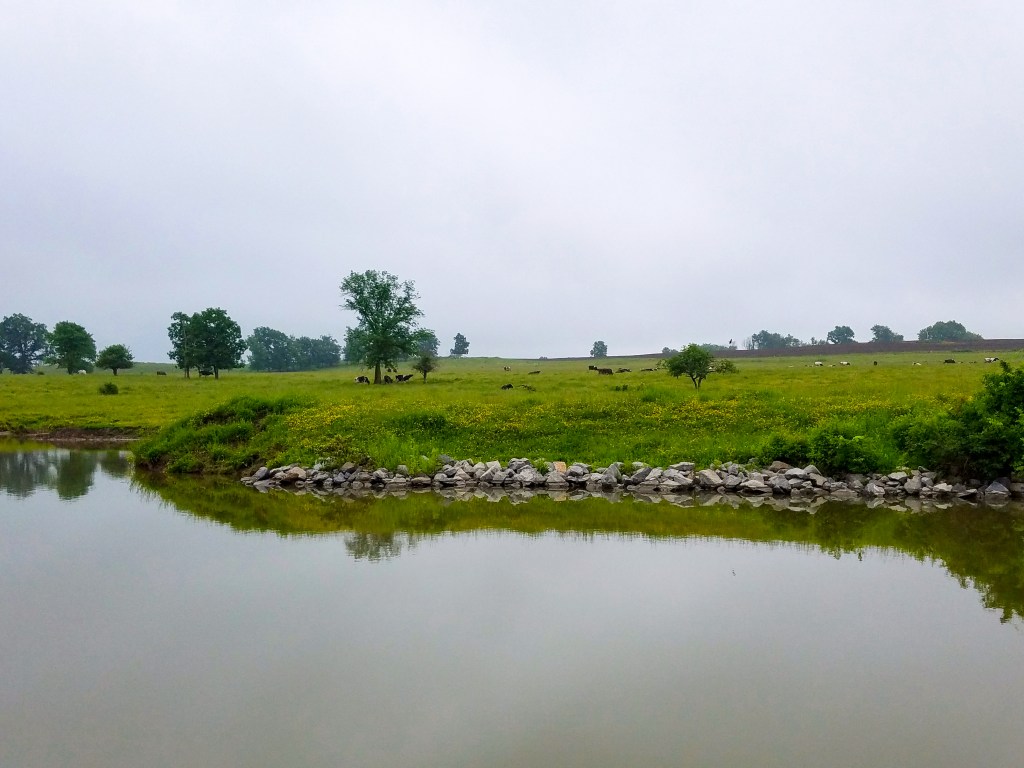
The Champlain Canal is not the prettiest we have seen, although I am sure it would have looked better in sunshine.  We stopped for the night on a town wall in the village of Fort Edward. Once upon a time it was an important portage place used by Native Americans for thousands of years to get around Hudson Falls. The first fort was built here in 1755 during the French and Indian Wars.  The town was established in 1818.  As is so often the case, there are signs of former prosperity, but Fort Edward has fallen on hard times.  Several attempts have been made to improve the town, including an excellent park and walkways on the river, plus a good town dock for boaters.  However, nothing is done about upkeep, and it is all looking rather sad.

The Champlain Canal
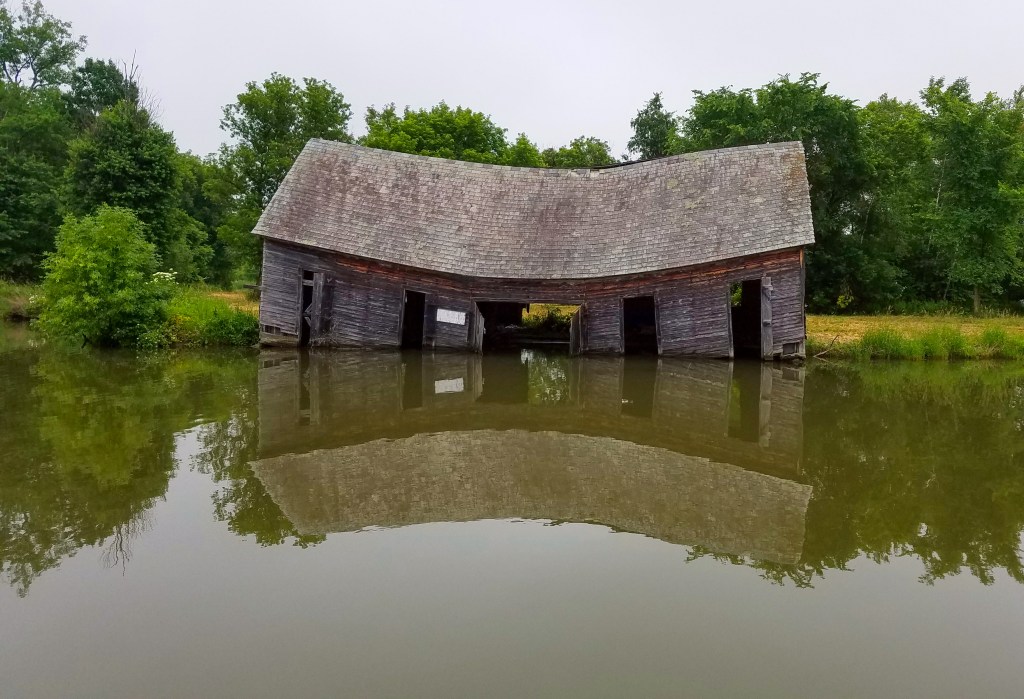
A ruined barn on the Champlain Canal

Our next stop was Whitehall and another town dock and local park.  Originally it was called Skenesborough in 1759 when it was first settled.  The village was captured by the Americans during the Revolution, and a fleet of ships was built to face British forces on Lake Champlain.  Whitehall is considered to be the birthplace of the U.S. Navy.  More ships were built here during the War of 1812.  In the first part of the 19th century the Champlain Canal was built and the railroad also came to the town, and it became an important centre for the silk industry.  Today all this is a memory. Efforts to improve the waterfront and attract visitors are ongoing.

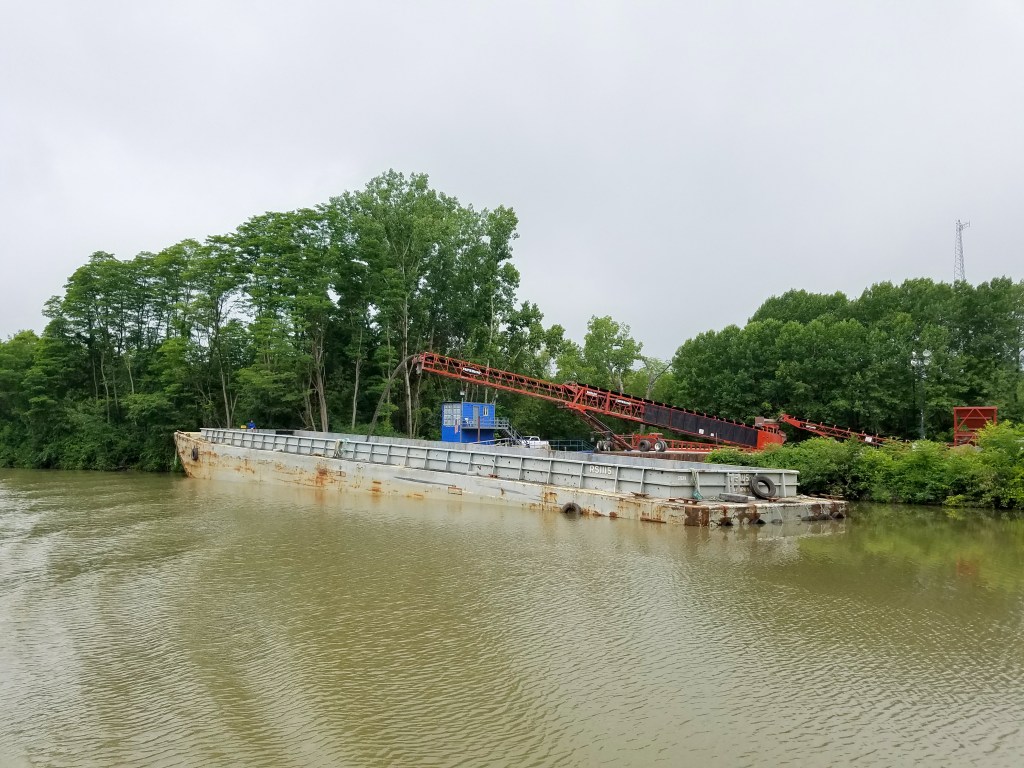
Loading a barge on the Champlain Canal

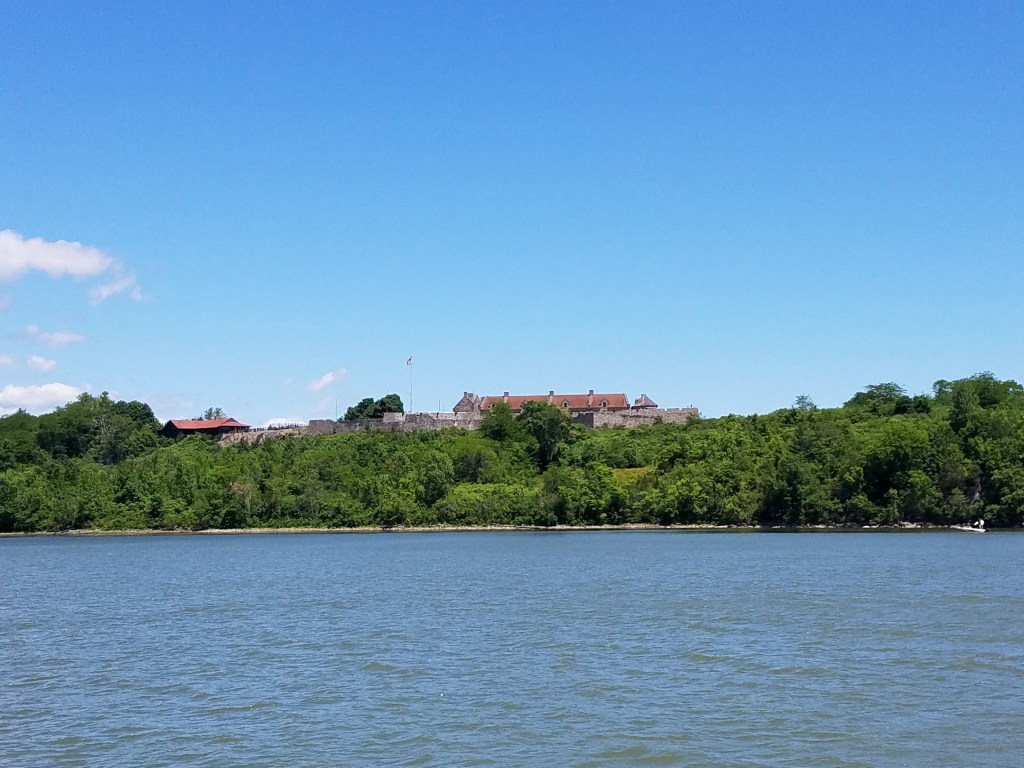
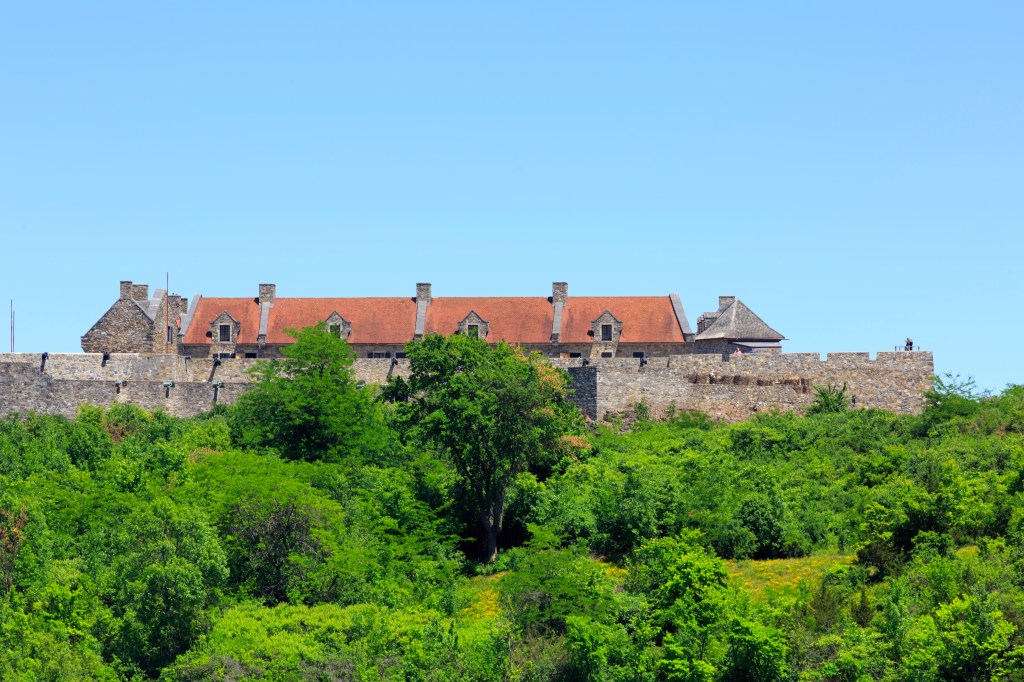
From Whitehall we transited the last lock on the Champlain Canal and entered Lake Champlain.  We passed Fort Ticonderoga, high above the western shore. Originally called Fort Carillon, it is a large 18th century star fort built by the French at the narrows near the southern end of Lake Champlain.  The fort played an important role in the region until after the Revolution. The U.S. government allowed it to fall into ruins and it was eventually bought by a private family in 1820.  It became a tourist attraction, and was restored in the early 20th century. It is now run by a foundation.  The most southerly of three Champlain ferries operates just north of the fort, crossing back and forth to Vermont using a cable.

Arriving in Lake Champlain
Fort Ticonderoga
Fort Ticonderoga, from Lake Champlain.
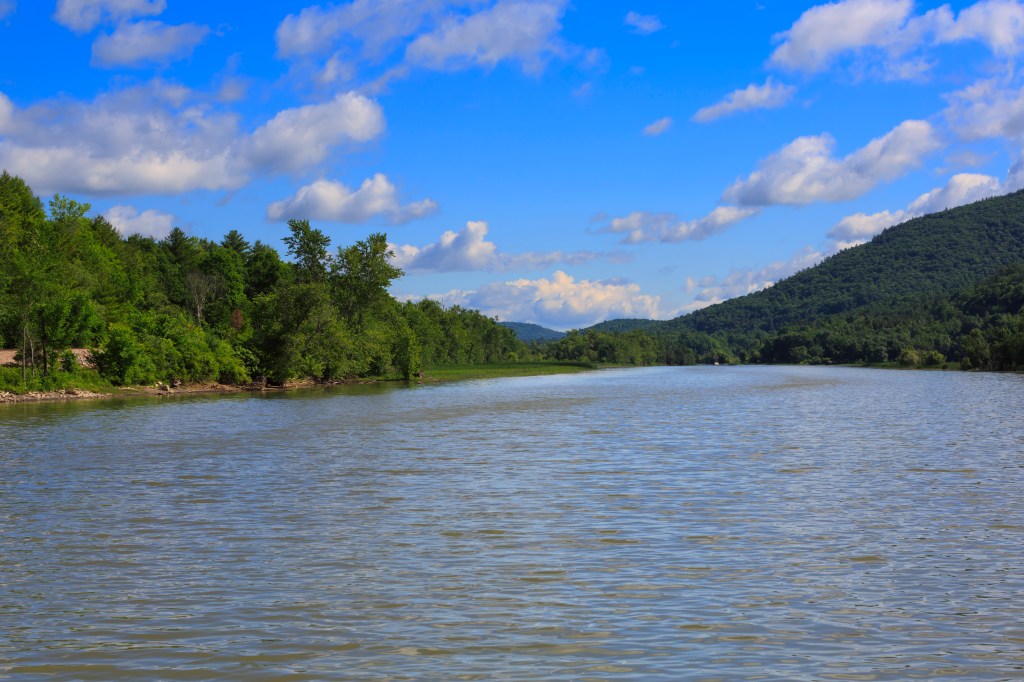
Southern Lake Champlain
Beaver lodge, Lake Champlain

Arriving south of the bridge at Crown Point, we anchored for the night in what we expected to be a bay sheltered from strong winds out of the north east.  Unfortunately, we chose a spot a little too near to the bridge and the narrows it crosses, and Dick was delighted to experience the phenomenon of vortex shedding first hand. He can give you the scientific explanation, I only know we bounced around a lot, swung on the anchor more that we prefer, and we could see waves crisscrossing near the boat when there had been no other craft passing to create a wake!

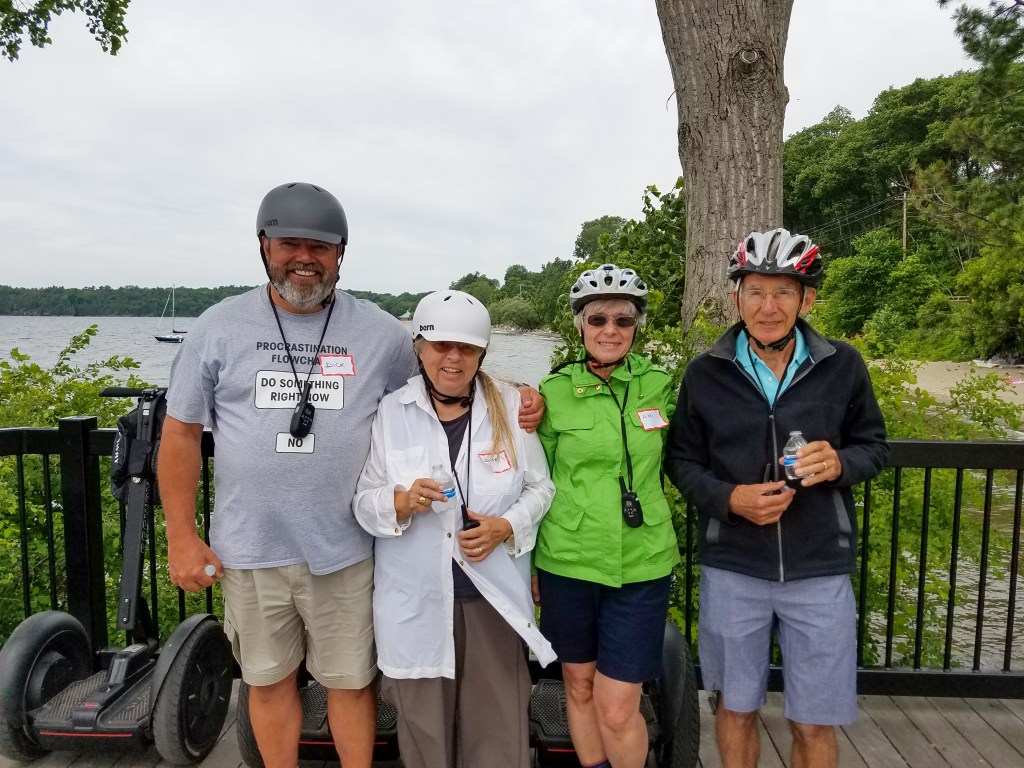
After an enjoyable, if a little windier than expected, trip north on Lake Champlain we arrived in Burlington.  Here we were greeted by Dick’s friend and former colleague Julian and Nikki, his partner.  We were treated to dinner at their summer home a few miles south of Burlington, and the next day they joined us for a Segway tour of the city.  This proved to be a fascinating morning out.  The tour operator is a former lawyer, who was one of the two influential citizens of the city who were able to prevent the waterfront and the closed railway right of way from being taken over by developers. Instead, after years of campaigning, a waterfront park was created, with a bike path that follows the shoreline for many miles, and two public marinas.  His efforts did not end there.  After a paragliding accident left him disabled, the activist applied several times for a permit to operate Segway tours on Burlington sidewalks and bike trails.  Turned down, on the assumption that Segways are dangerous, he then demonstrated lateral thinking, and came at the problem from the perspective of the Americans with Disabilities Act.  The tours are the number one attraction in Burlington, according to TripAdvisor, and many thousands have enjoyed one or two hour tours without accident or incident.  Burlington is a very nice small city, that seems to have done a great job of staying lively and successful while still being a centre for both the University of Vermont and Champlain College.  Somehow the large number of students add positively to the city rather than creating student ghettos.

A Segway Tour in Burlington, VT

We stayed 3 nights in Burlington, enjoying Julian and Nikki’s company and hosting them for dinner on board one evening.  Nikki and I had a very pleasant morning poking around the shops of the village of Shelburne and pausing for a nice lunch.  Dick took his bike along the waterfront trails in both directions. On our last evening we walked up the hill and had an interesting and authentic meal in a French restaurant.

We left Burlington on a cool and misty morning and headed north past Valcour Island.  This was the site of the naval battle with the ships that had been built in Whitehall during the American Revolution.  The armada hid behind the island and surprised the British as they sailed south.  The battle was lost, but it is credited as a turning point in the War of Independence because the losing American navy harried the British enough that they had to turn back north and wait for the next year, by which time the tide of the war had turned.

Leaving Burlington on a misty morning
Valcour Island

North of Plattsburgh the Port Kent ferries ply the narrows across to Grand Isle, Vermont.  I remember making that crossing many times with my parents on our way to Canada’s East Coast.  Three ferries were operating when we arrived, but we managed to find the right moment and keep out of their way.

Lake Champlain Ferries
Clinton College

Rouses Point marks the top end of Lake Champlain, and the border is just north of the bridge.  We tied up at the marina overnight, and watched many small cruisers come in for fuel after clearing U.S. Customs.  It was the beginning of a long weekend with Canada Day on Monday, and U.S Independence Day later in the week, so a busy time for the Lake and the Richelieu River and canals.  Just north of the bridge, still in American territory, is Fort Montgomery.  This is a Third System fort, built between 1844 and 1870.  It is one of only a few forts in the USA that has a full moat, and at the time of building it was considered state of the art with no expense spared in design and construction.  However, it was not the first structure to be built in that location.  In 1816 an octagonal structure with 30 foot high walls began construction to protect the United States from an attack from British Canada.  Unfortunately, it was discovered that a surveying error had resulted in this fort being built ¾ of a mile into British territory.  Sometimes named Fort Blunder, it was hastily abandoned and all the building materials were carried off by local settlers to use in their homes and barns.  After a treaty in 1842 ceded the location to the USA, the second Fort began construction.  It was garrisoned occasionally, and some of the many planned guns were installed, but eventually Fort Montgomery was made obsolete by new advances in warfare and it was abandoned.  It fell into private hands, and attempts were made to offer it to the State of New York as a historic landmark, but the State is not interested.  If any of you happen to have just short of $1 million kicking around, you can buy it.  It is zoned for commercial use, so you could build a marina or a resort hotel.
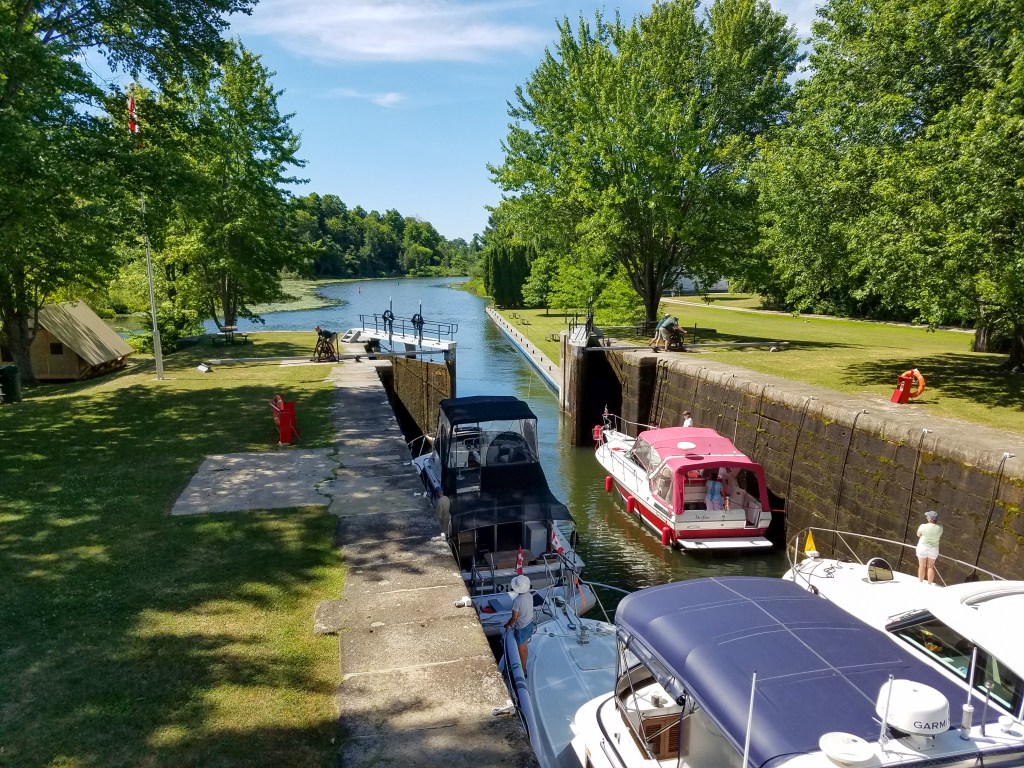
Fort Montgomery
Rouses Point. The little white building under the bridge is the Canada Customs stop.

The next morning it was our turn to take Nine Lives through Canadian Customs.  A very friendly officer asked the necessary questions (Are you carrying any weapons? Do you have any means of self-defense on board? Are you sure?  You live in South Carolina!) and scanned our passports.  He then decided he wanted to come on board Nine Lives, I think to see the boat rather than as an inspection tour!  He asked lots of the same questions that other boaters ask, such as what are the engines and how many bathrooms, and then bid us a cheery farewell without looking into any cupboards or storage lockers.

We continued north on the Richelieu River to St Jean sur Richelieu.  On the way we were waked numerous times by the many pocket cruisers that seem to be popular with Quebecois from Montreal.  I had to take the salon picture off the wall as Nine Lives bounced up and down and side to side from every passing boat. The river is lined with many beautiful properties, some with huge houses, others more modest.  It is only a few miles overland from Montreal, so many weekend cottages and even commuters enjoy the beautiful riverfront.  St Jean sur Richelieu is a fairly prosperous town, supporting 177 restaurants, according to TripAdvisor.  However, there are very few shops and boutiques, so I am guessing the wealthy shop in Montreal, while those of more modest means patronize big box stores outside of town. I had my best meal of the trip so far at one of the French restaurants, along with a bottle of my favourite Pouilly Fume, not often found on the menu. (No, I did not drink it all, Dick had his fair share!)

Saint Jean sur Richelieu

From Saint Jean sur Richelieu we were soon in the historic Chambly Canal.  This is a beautiful, but very narrow, waterway with 6 lift bridges and 9 locks that drop the canal a total of 80 feet.  The locks are all operated by hand by summer students employed by Parks Canada.  The canal has the same feel as the British canals we have spent so much time on in past years.  We made it a short day, stopping before the last three-lock staircase at the town wall in Chambly.  This was the hottest day we had experienced so far, with temperatures well into the 90s, and high humidity.  Even though I was careful to dress in sun protective clothing and a hat, I found that standing outside all morning in the heat and sun felt just like standing in a frying pan, and by the time we tied up I was starting to feel quite ill.  I remember feeling this hot when we lived in Malaysia, but then I was not also wearing a life jacket and a headset for communications!
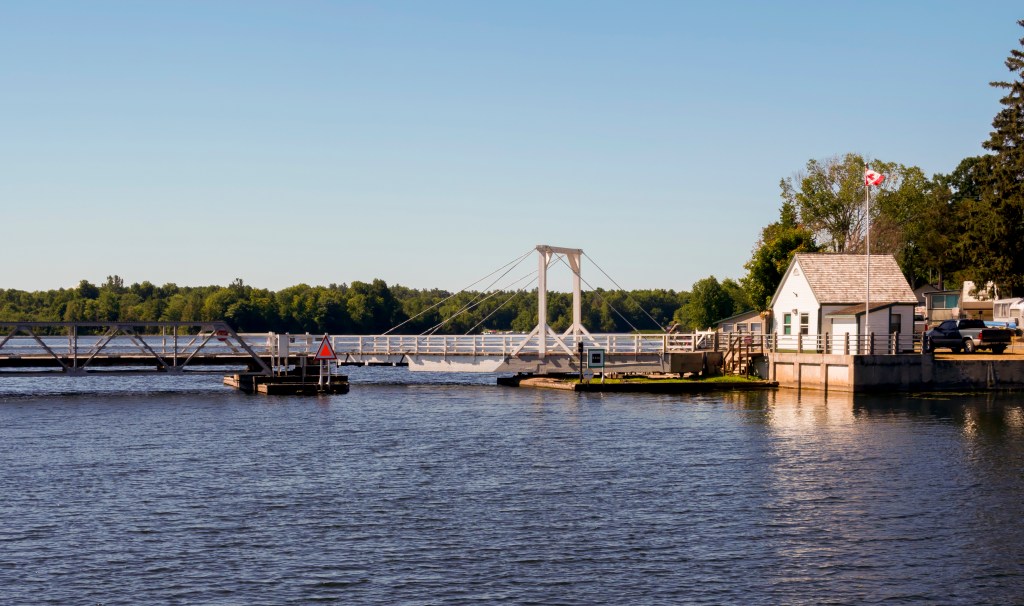
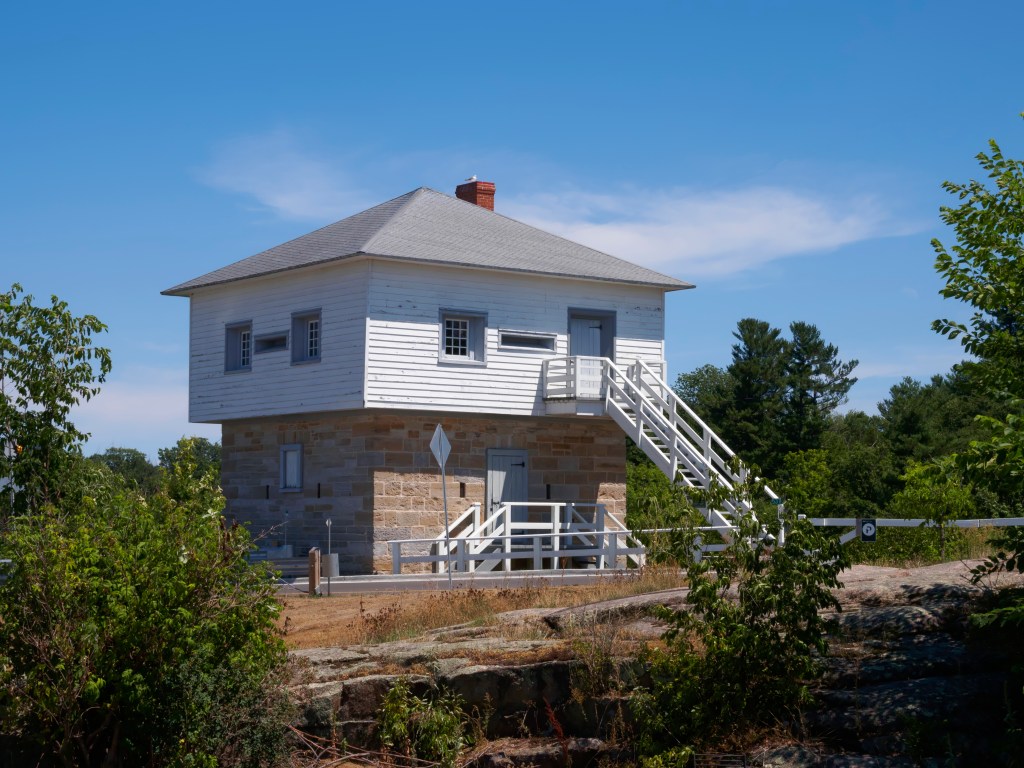
The beautiful Chambly Canal
Approaching a lift bridge on the Chambly Canal
Nine Lives leaving a lock on the Chambly Canal
Nine Lives leaving the lock
We met fellow Loopers whose voyage was delayed by an unfortunate accident.

Chambly is a pretty town.  The final 3 locks on the canal drop to a wide basin at the end of the canal.  From there the Richelieu River continues its course north to Sorel and the St Lawrence River.  Chambly is considered a suburb of Montreal, being only 16 miles from city centre.  It was settled during the 17th century. A series of wooden forts were succeeded by a massive stone fort, one of a series built to protect French settlers in the area and the city of Montreal from hostile Iroquois and the English. Today it is a fairly quiet village with lots of parks and well kept homes and shops. We celebrated Canada Day (July 1st) with a bottle of champagne, cheese and crackers, and some very nice country pate Dick found at the local supermarket.

Chambly
Chambly, the park had an excellent outdoor photography exhibition.
Chambly
Traditional birch bark canoe on a mooring ball in Chambly Basin
Nine Lives on Chambly town wall
The final lock staircase on the Chambly Canal
The lock mechanism

Back in the Richelieu River we were again joined by numbers of cruising boats, all of whom are apparently incapable of slowing down when passing, and throw huge wakes regardless of kayaks, fishermen, pontoon boats, or Nine Lives being bounced around.  We reached the industrial town of Sorel by mid-afternoon, and tied up in a local marina just off the St Lawrence River.  We had been warned by the marina office to expect “many waves”, but in fact it was no worse than most of our marina stays.  So far Dick is managing to save his wad of $5 bills that he keeps ready for dockhands.  Either they are too late to help, or if they do show up they are more of a hindrance than a help, so he does not feel inclined to hand out tips!  An early morning walk along the Sorel waterfront park was very pleasant before the heat of the day.  Both the Chambly and Sorel parks have outdoor exhibitions of photographs taken by the local camera club members, most of them to a very high standard.

Sorel Marina
Sorel park
Outdoor photography exhibition at the Sorel park
Sorel and a freighter on the St Lawrence River

Our journey south on the St Lawrence to Montreal was uneventful until the last hour.  The river is wide, and there is a choice of taking the shipping channel or following a more meandering course on the small craft channel.  My marine traffic app showed only one or two freighters in the Seaway, so we chose the easier shipping channel.  Being so far from the shore it was perhaps the more boring choice.  As we approached Montreal, the passage got a little exciting.  We were passing a large freighter being loaded when suddenly we noticed a huge shadow over our shoulders, and discovered that a freighter we had passed earlier at the dock had come out and was now coming up behind us very fast.  Fortunately, there was plenty of room and time to get out of the way, but his speed created a wake that reflected back and forth from the shore and churned up the formerly smooth and easy waters.

Industry on the St Lawrence River

Next we arrived at the section of the river that is divided by St Helens Island. Here we turned west to enter the old Port of Montreal, the two kilometre stretch of the river that was used as early as 1611 by the fur trade until the 1970’s when it was replaced as a commercial port by larger and more modern facilities.  St Helens Island was enlarged and combined with other small islands to host the Worlds Fair in 1967.  The creation of this division in the river has resulted in an extreme current of more than 5 knots against you as you attempt to enter the Old Port.  We made our way under the Champlain Bridge at about 2 knots, all the time having to watch out for ferries and tour boats as well as unpredictable small pleasure boats.  We expected it to get easier when we entered the marina, but unfortunately one of the tour boats was coming out at that moment, so there were a few hairy moments while we tried to hold place in the strong current, avoiding being swept into the freighters moored on one side or running into the tour boat on the other.  The marina management apparently do not use their radios to talk to customers, only to each other, and the current, although not as bad as outside, is still surprisingly strong inside the marina.  Add the wind, and it was an overly exciting arrival.  Absent any instruction, we chose the first empty dock and tied up, at which point a slightly indignant dockhand appeared to give us our correct slip assignment and supposed assistance in tying up.  Another $5 saved…
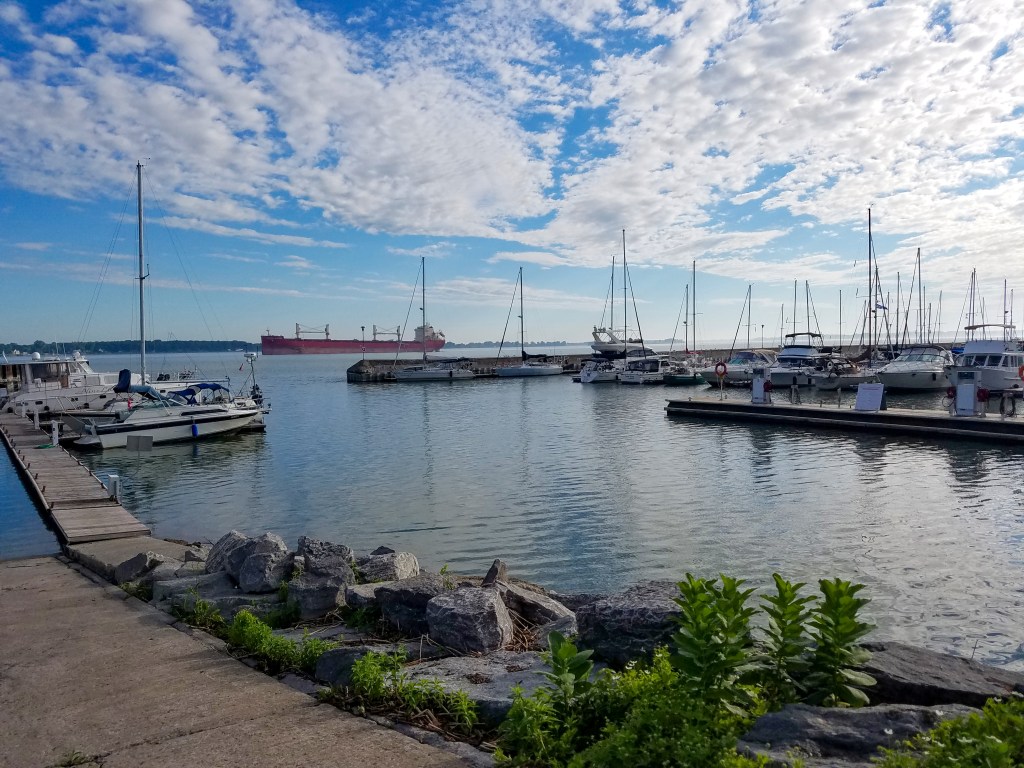
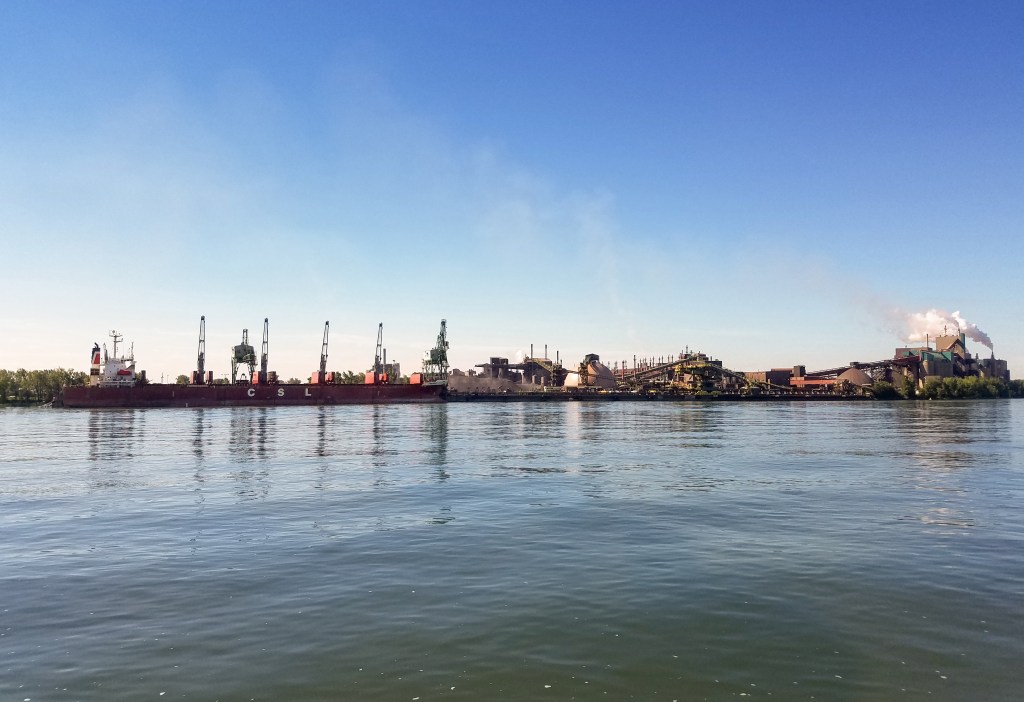
We will be here in Old Montreal for 3 nights.  The heat wave is still with us, although we are hoping for more moderate temperatures on our last day for some sightseeing.  Fortunately this marina has good power and the air conditioning is working well.  A good time for laundry and finishing this installment of the blog!