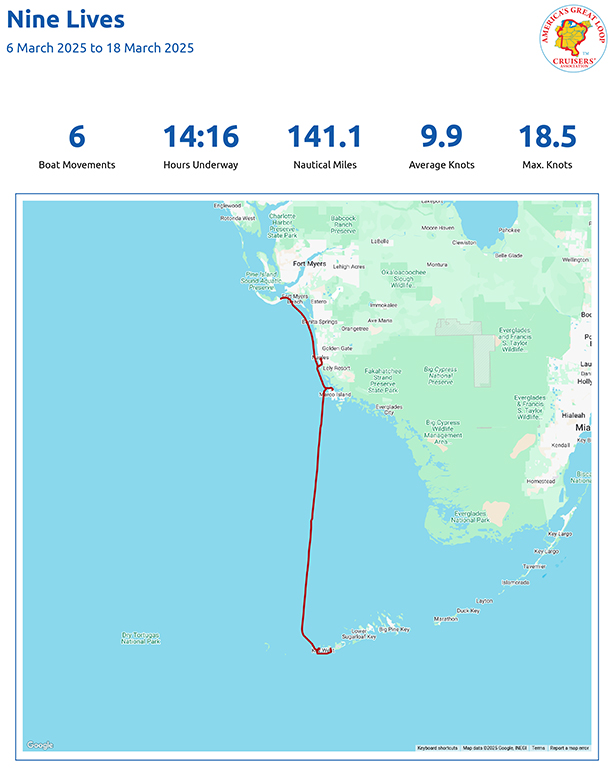
March 6th to 18th, 2025: Sanibel Island to Stock Island

Wednesday the 6th was a busy, social day.  Early in the morning, I met our slip neighbour just as the harbourmaster delivered fresh, hot, blueberry muffins to our boat.  Our neighbour had just taken possession of a 15-year-old Back Cove, and was preparing to take it across Florida and then north to his home in Cape Cod, after some much needed work in a couple of boatyards along the way.  Dick took MOKE for a final run to stock up on heavy grocery items, while I worked on getting the next issue of the blog completed and published.
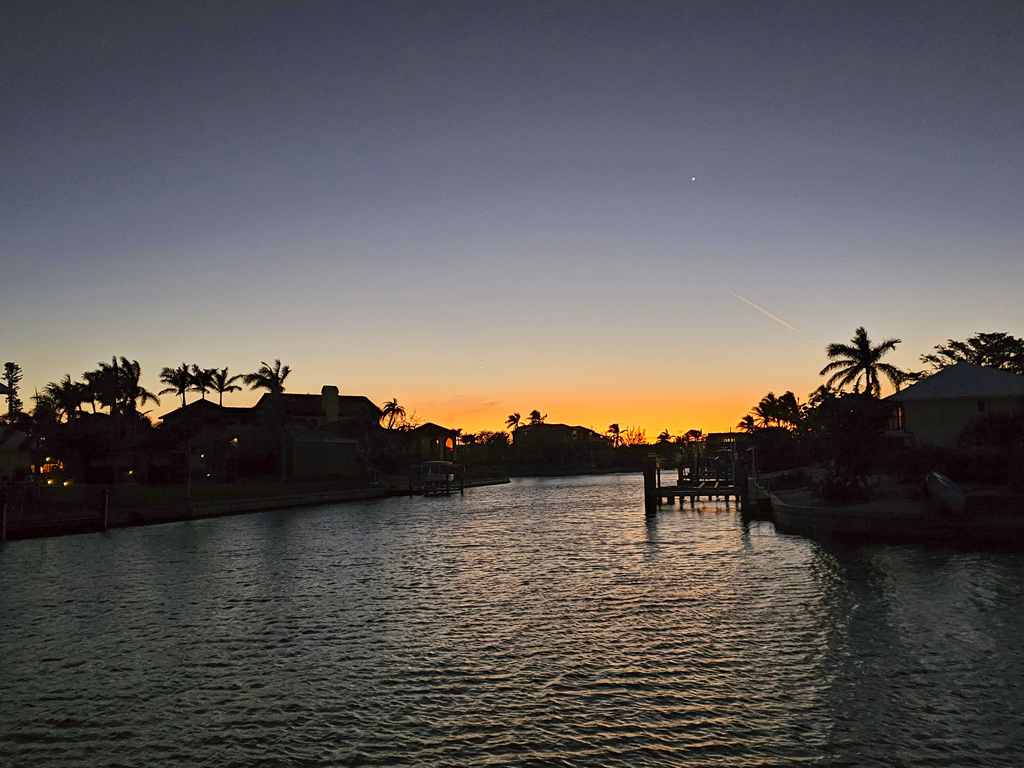
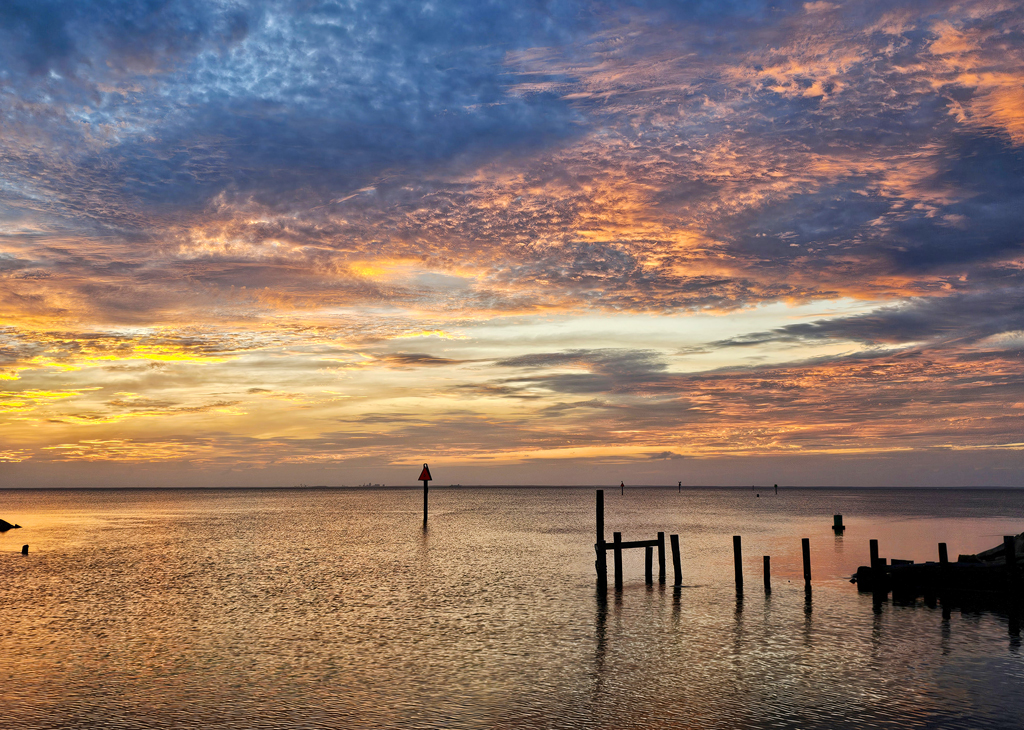
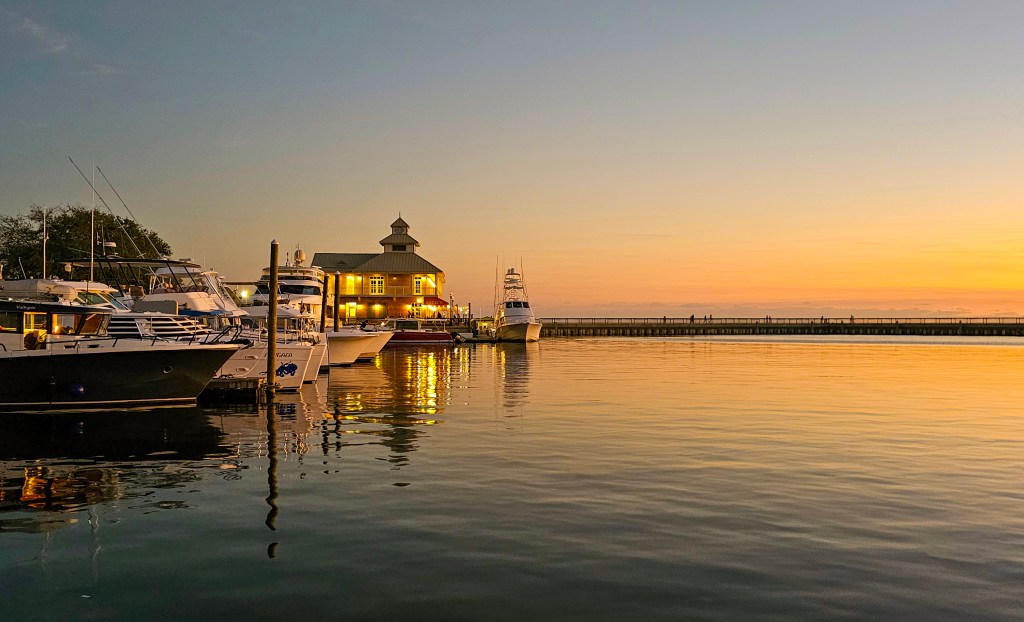
Sanibel, the canal at sunset

Local Harbor Hosts Mike and Deb came over from Fort Meyers and we had a pleasant lunch at the onsite restaurant.  Later in the afternoon, we enjoyed a great reunion with Jim and Marilyn, who we met in 2021 on Lake Michigan.  We all tucked into cheese and sausage and exchanged stories of our various boating experiences, as well as interesting international business travel stories.
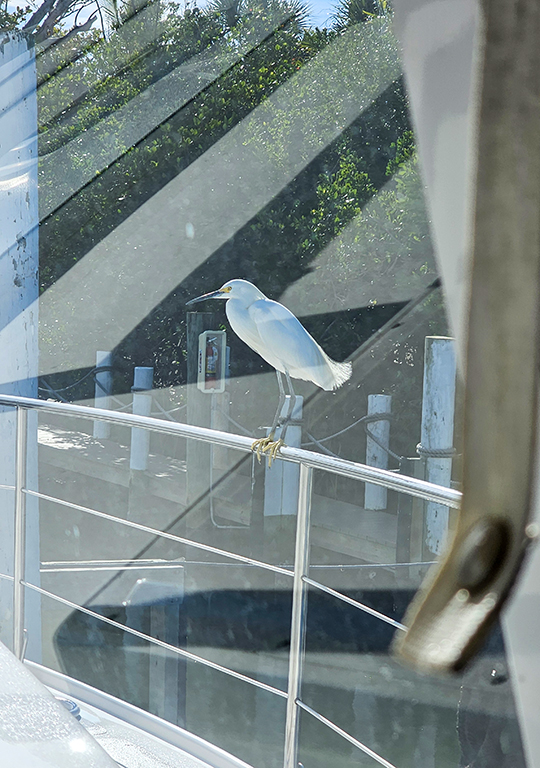
A Snowy Egret visits Nine Lives

Very high winds and waves were forecast for the next day, so we stayed put.  It was a good day for boat chores.  In the afternoon, we took a walk to have a look at the beach – we were very glad we weren’t out in that weather!
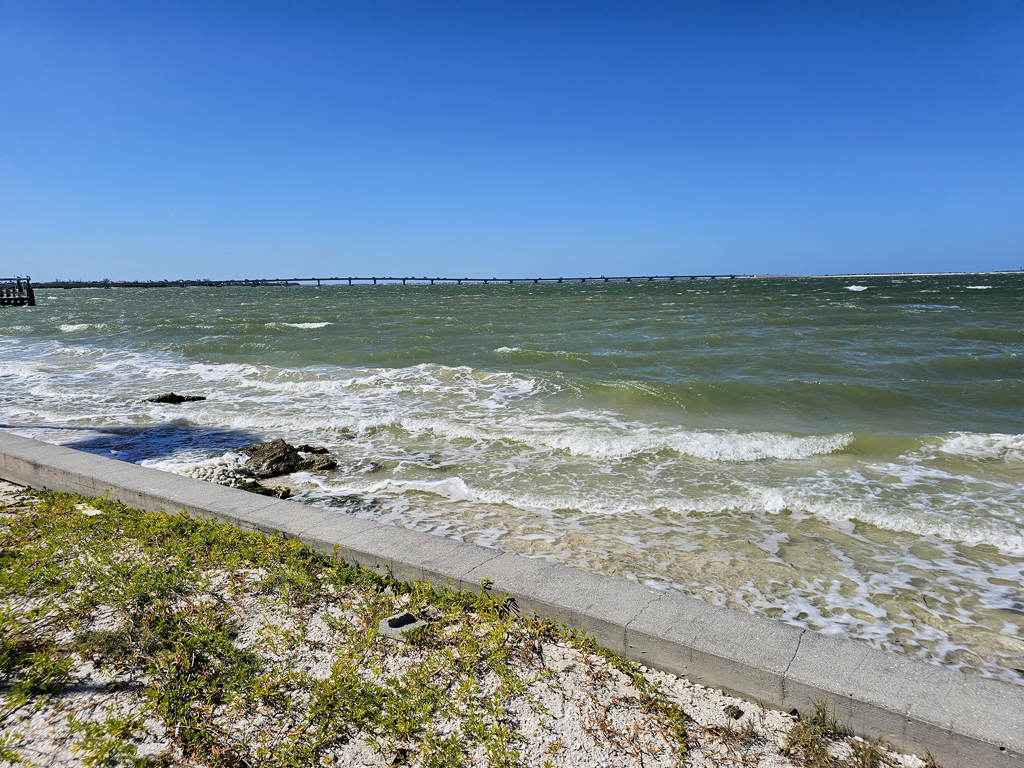
The seas were rough, so we stayed put!
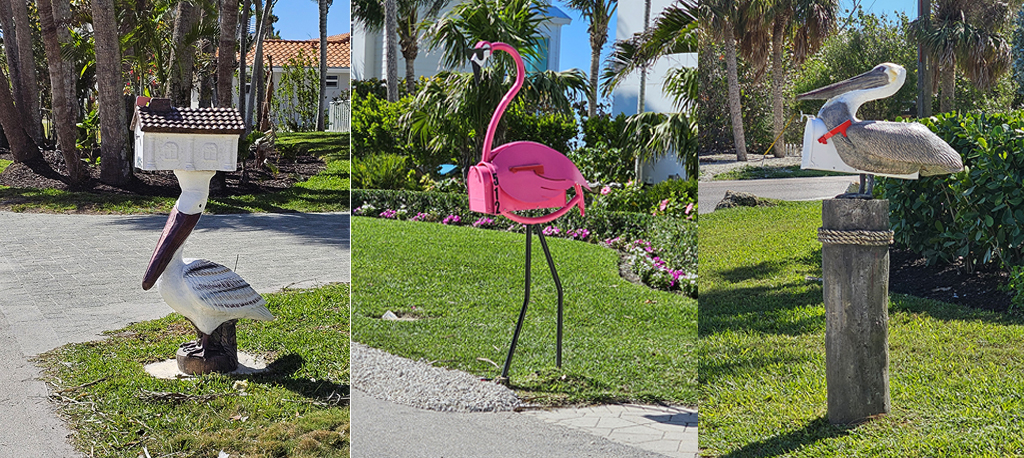
A few of the fun mailboxes in front of Sanibel homes

Our voyage to Naples was straightforward, with relatively smooth seas, although unfortunately in a direction that gave us a certain amount of corkscrew motion.  Not enough to require medication or wrist bands, but I certainly was not going down into the cabin in those conditions.

Naples is reached by turning into a very narrow and shallow channel with a lot of shoaling.  We could see breakers on one side of us, and an optimistic surfer waiting his chance.  I can’t imagine a more dangerous place to surf, one miscalculation could put you right into the path of an oncoming boat.  Once you are through the cut, the waterway opens up and winds north for several miles.  The shores are lined with beautiful homes.  Here again, the speed limit in the channel is 30mph, and outside is a no wake zone.  This is to protect the manatees, but it makes things difficult for slower boaters, as they are subject to wakes they can’t avoid or turn into.
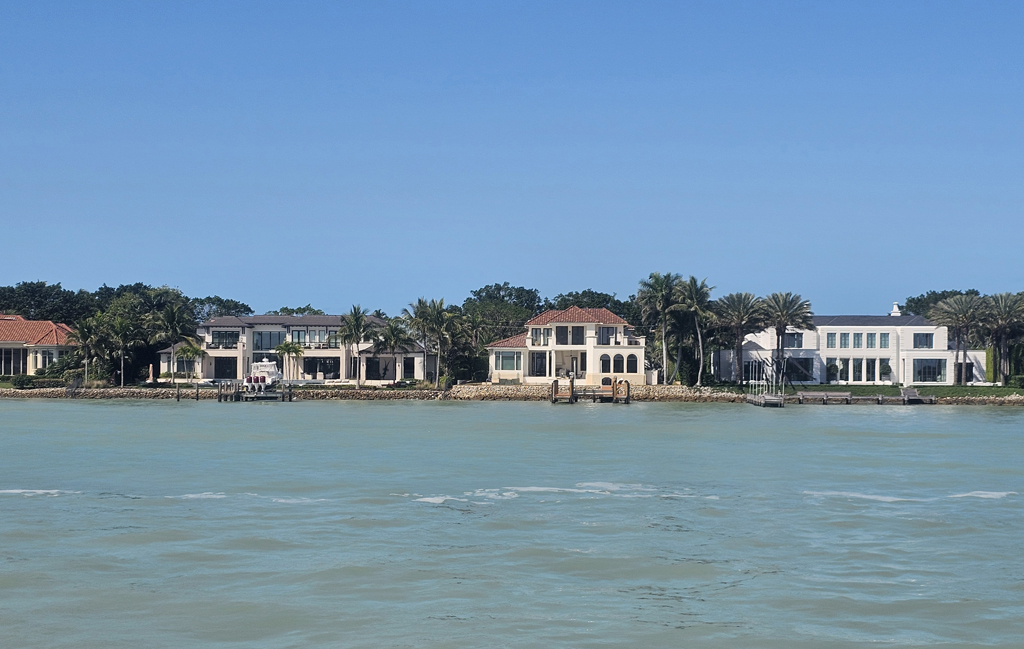
Beautiful waterfront homes in Naples

On arrival at the city marina, we went straight to the fuel dock for a pump out.  Staff were efficient, answering the radio when we called, and helping to tie up.  I would not call them friendly, as some reviewers have experienced, and as often happens, the man who took the midships line refused to cleat it tight, making it difficult for Dick to bring the stern in. Our overnight dockage was just along the dock, but it required slotting between two large sportfish boats, so Dick had to go out, turn around, and then maneuver back in.  This time the dock hand was more understanding of how Nine Lives ties up, having seen what is needed.

Our spot on the outside dock meant some motion from passing boats, but it was worth it to be able to watch the traffic.  There is no security in the marina, and it seems to be a “thing” to walk around the docks and look at the boats.  One man was explaining, quite loudly, to his family that we obviously bring Nine Lives from Hilton Head and stay for the winter.  When he saw me looking, he asked how long it had taken us to get to Naples.  I was amused at the look on his face when I told him, 8 years!  Explanations were then offered, but it’s always fun to be able to correct mansplaining.  There must have been at least 50 people wandering around and commenting on the various craft.  I have never seen so many tourist boats, all doing a roaring trade.  There were lots of tiny floating tiki bars with just 4 or 5 people sitting on bar stools while the vessel puttered around the harbour.  There were the usual dolphin watch pontoon boats, also at least 2 very large sailing cats as well as monohull sailing boats heading out for cruises in the Gulf.  There were also the expected sport fishing boats, and a large dinner cruising yacht.
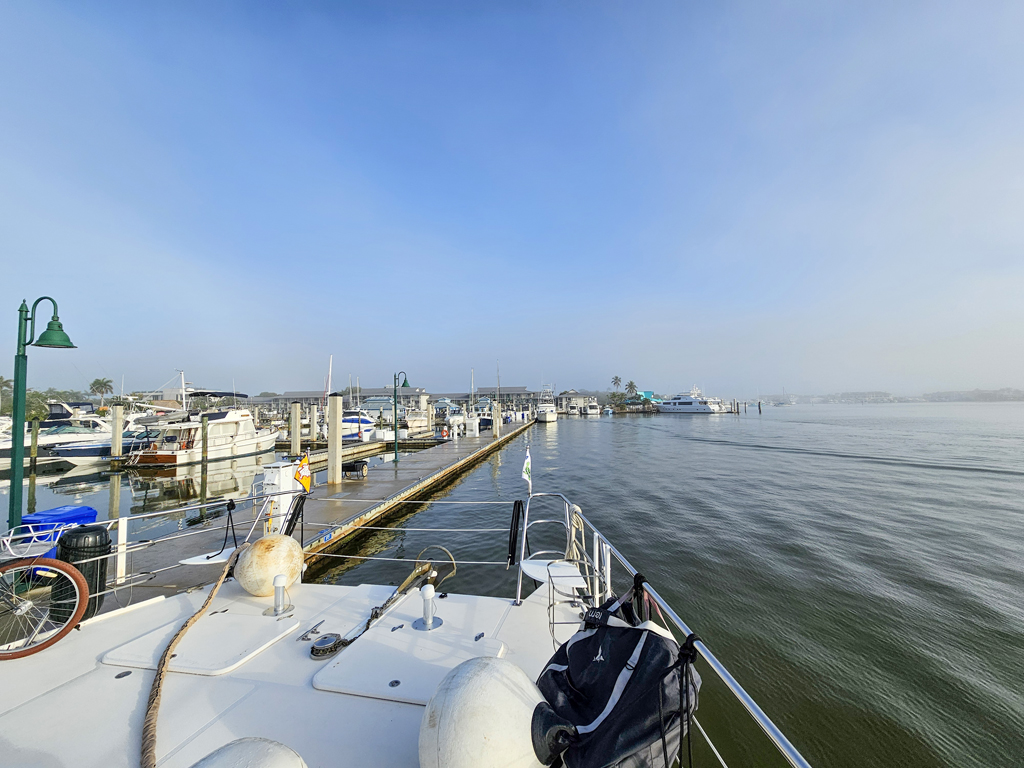
Naples City Dock on a misty morning before the traffic starts

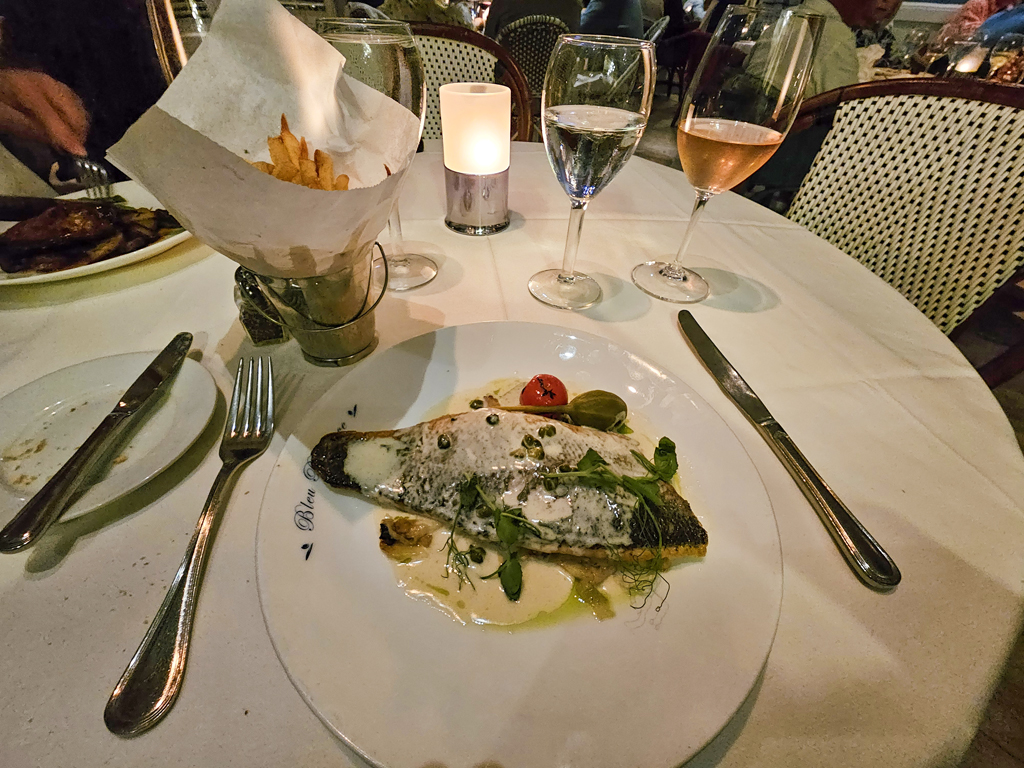
Dick took time to explore the town, finding a couple of very interesting shopping precincts that we would plan to return to later with a rental car.  In the evening, we walked to the nearby Bleu Provence, another outstanding French restaurant.  Service was excellent, and the food was delicious.  Once again, the noise was incredible, it seems to be the main downside of dining in Florida.  Dick commented that it has been our luck lately to be seated at a table next to one with a particularly loud man who holds forth at length on topics that are of zero interest to nearby diners.

Bleu Provence pork shank
Bleu Provence seabass
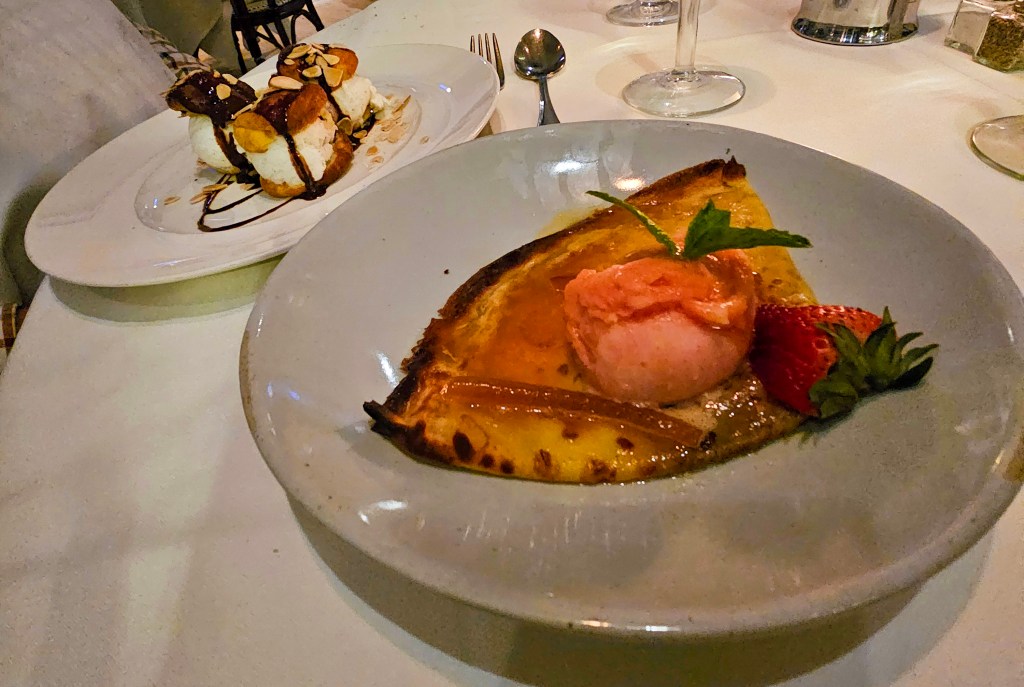
Bleu Provence desserts, profiteroles and a crepe

We didn’t have far to go to Marco Island, so we left at 11am.  It should have been an enjoyable trip through the Naples channel, looking at all the beautiful houses.  Sadly, because of the 30mph speed limit and the huge number of Saturday boaters, it was just an unpleasant half hour of being thrown around by wakes.  Not the fault of the boaters, they are doing the speed limit that they are allowed, and looking forward to getting out onto the Gulf.  Once we got out there, it was unpleasant in a whole different way.  Long, rolling waves on the bow meant that wristbands were required, and I was very unhappy.  The official trip planner, when questioned, indicated that the sea state was not at all as predicted.  Fortunately, it wasn’t a long trip, and once we were into the channel for Marco Island everything calmed down.  All the waterways around the Island are strictly minimum wake or no wake, so travel is much more enjoyable.
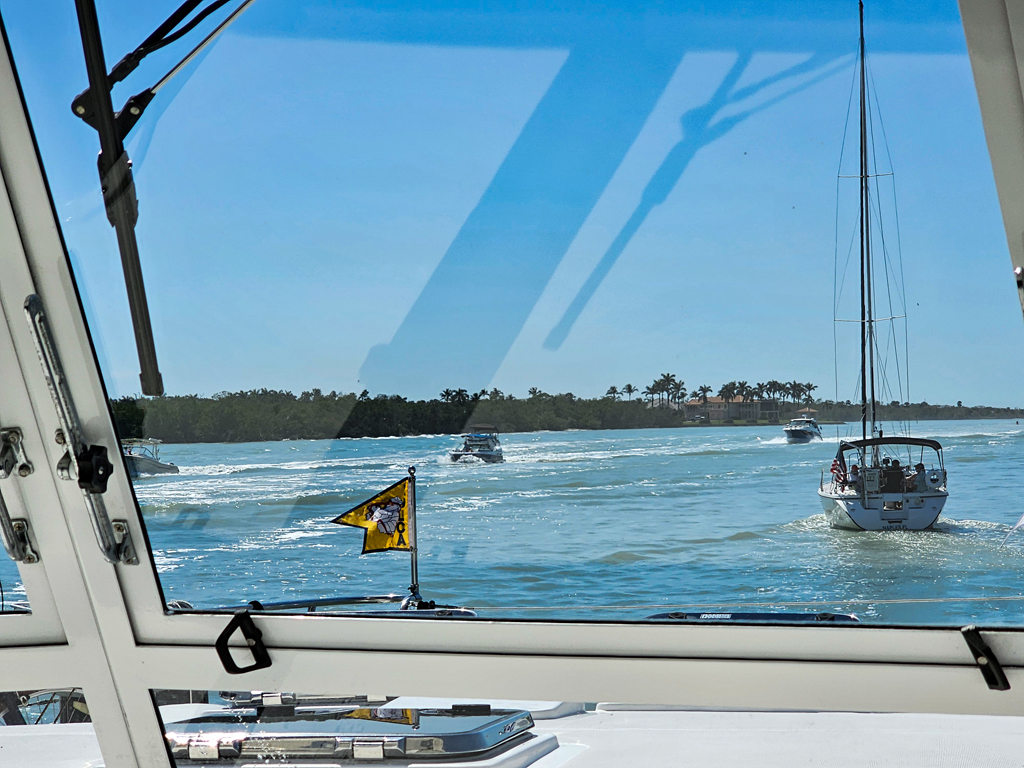
Naples, busy channel

We arrived at our marina, and our slip neighbour offered to catch our lines.  For a change, when asked to cleat the midship line tight, he did!  Docking was very quick and easy with such great help.  Dick checked in with the dockmaster, and then walked over to the other marina on the bay, hoping that one of the two would have had a cancellation and we would be able to avoid some or all of the expected nights at anchor.  No luck.

In the evening, we walked to a nearby steakhouse.  They have very good reviews, but sadly, our experience did not live up to expectations.  My steak was charred on the outside, and the asparagus was yellow and bitter, should never have left the kitchen.  The dessert we shared looked gorgeous, but it did not taste very good and neither of us wanted to finish it.  It was a very pricey meal for what it was.

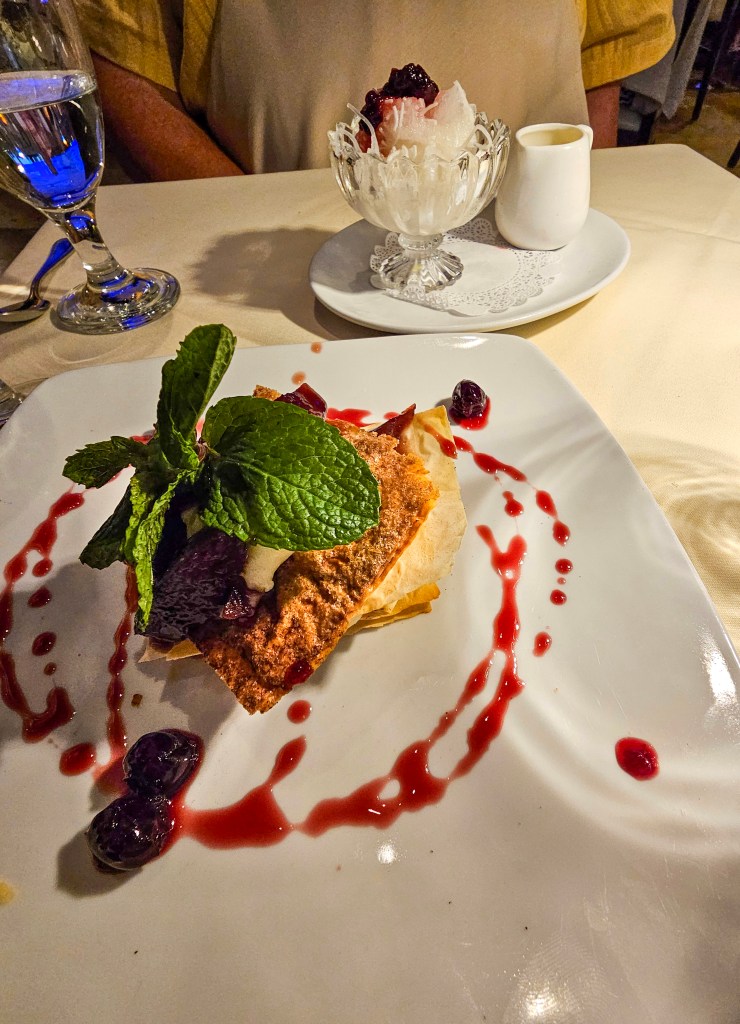
Steakhouse dessert, attractive, but only the strawberry tasted good!

Next morning, Dick checked again to see if we could remain in the marina.  He was offered an 18-foot-wide slip, and thought we might just squeeze into it (one thinks about a large lady and a corset). At the waterline, we are less than our 18’8” width at the widest point, our rub rail.  We untied and made the attempt, but sadly, we couldn’t fit as the dock was just that bit higher than we had hoped.  Instead, we anchored just outside the marina, between 2 sailboats as planned.  We spent an interesting afternoon watching boats to-ing and fro-ing.  There was a small cruise ship in port (100 passengers).  Some of the passengers were taken on a dolphin cruise, and their boat got into trouble and had to be rescued and towed back by Sea Tow.  An interesting experience for the passengers, if not quite what they were expecting.
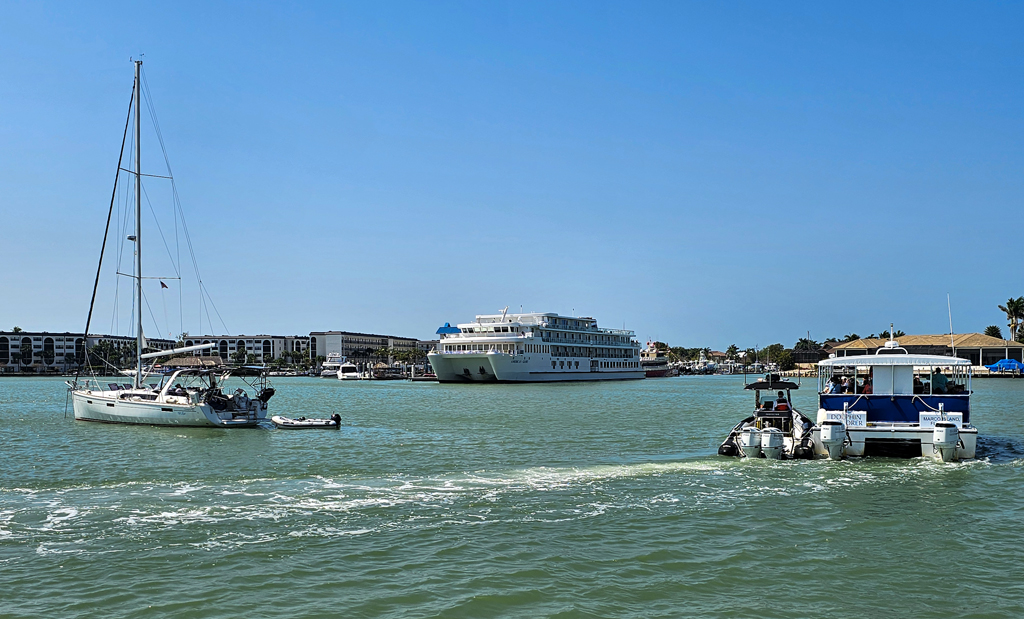
Sea Tow rescues the dolphin watching tour boat
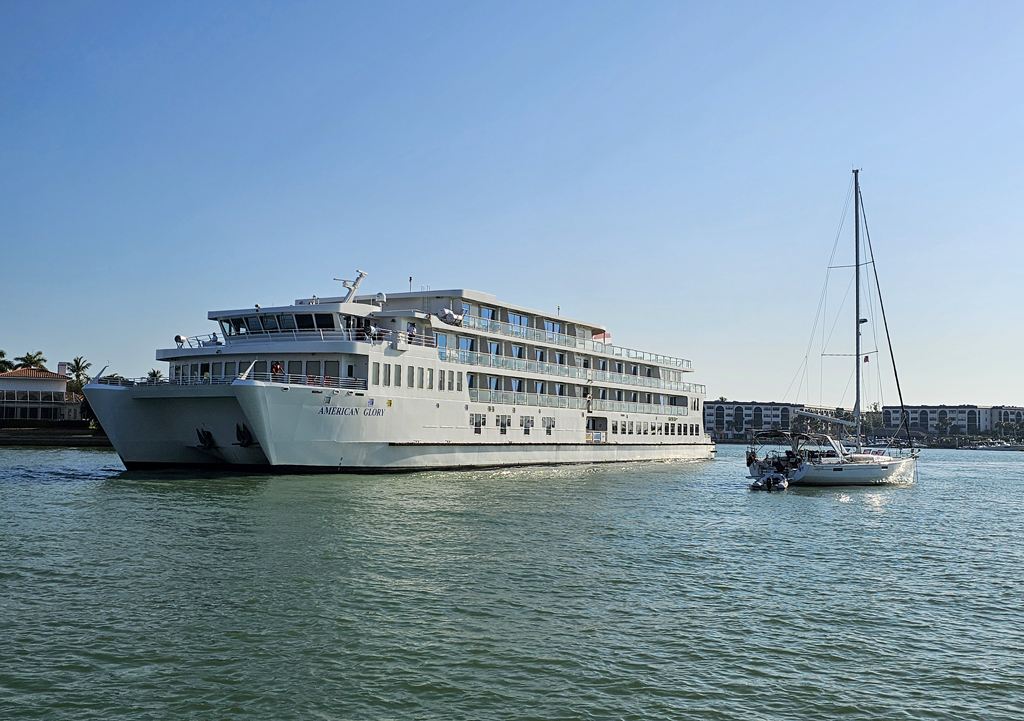
American Glory leaves port in the evening

After a quiet night, we re-recorded the podcast we had done earlier for AGLCA.  The topic is “Segment Looping”, that is, doing the great Loop in segments rather than all at once as is more usual.  We were asked about how we chose our boat, how we decided on the length of the segments, where we put the boat when we were not aboard, and of course, the advantages and disadvantages of segment looping. 

We dropped the dinghy, and Dick set off to collect the rental car he had arranged.  The weather in the afternoon went from interesting to exciting.  We started with heavy rain and some rumbling thunder.  After the rain stopped, the wind really came up and we began to swing from side to side.  There was a small craft warning for the entire west coast of Florida.  The wind howled, and we swung faster through 180 degrees.  Earlier, Dick had chatted with the couple on the sailboat anchored next to us.  They were having a bad week.  They had gone out in rough weather, and were lifted by a big wave and slammed down on something, debris, sand bar, possibly the broken marker off the Marco Island Channel?  The impact was enough to bend their floorboards, so they had concerns that there was serious damage to their hull.  A haul-out was scheduled for later in the week, and meanwhile, they were anchoring while they waited for their appointment.  Next piece of bad luck, their dinghy motor died.  Dick gave Bill his card, and offered a ride if needed to shore the next day, to save them having to row.

A couple of hours later, the phone rang, it was Bill to say that their dinghy had broken free and was floating away.  Fortunately, it was floating into one of the canals rather than out into the bay.  Dick quickly donned life vest and shoes, and headed out.  He managed to capture the runaway, not without some challenge, as it had slid under the only open dock on the canal.  He returned it to the sailboat, and in due course it was pulled up onto its davits, instead of just being tied.  Everyone then settled back to what they were doing, and listened to the wind howl.
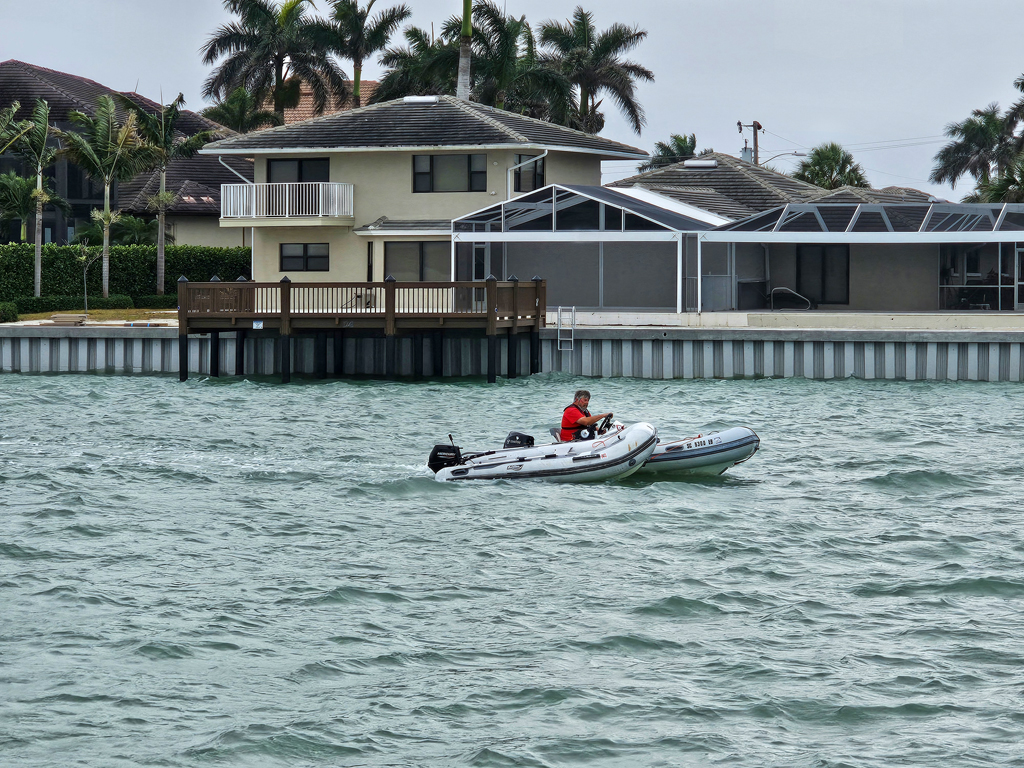
Dick rescues the neighbour’s dinghy
Dick’s dinghy delivery service!

The afternoon excitement was not over by any means.  I looked over at our sailboat friends, and realized they were dragging their anchor.  As I tried to work out the best way to get their attention, they noticed the situation, and started their engines.  They began the process of resetting their anchor.  Dick decided to check ours, and saw that one of the lines of the bridle had come off.  Life vest, headsets, start engines, and we began a little resetting of our own.  It didn’t take long, and once we were set again, we poured well-deserved adult beverages and sat watching.

A small trawler that had come into the bay, and anchored behind us, decided to relocate for the second time that day.  Meanwhile, our sailboat friends seemed to be set, and put on their snubber (this is a line that functions as our bridle does, taking the weight of the anchor chain off the anchor roller).  Within a few minutes they were in motion again, and trying to get the anchor to set.  We suspect a couple of issues.  The type of anchor they have does not appear to swivel like ours, so as the boat swings back and forth it is less likely to remain set.  We also suspect that they are backing down too hard and too soon, and then not putting out enough rode (that’s the chain, rope, or combination of the two that goes between the anchor and the boat).  Dick and I always put out at least 7:1, that is, 7 times the depth from the bridle attachment points.  We have seen advice for 5:1, or even 3:1, but 7:1 was what we were taught for an overnight stop.  Ultimately, they were unable to get their anchor to hold, but meanwhile, Dick left a message to tell them about the vacant slip we couldn’t fit into, or the alternative of tying up at the fuel dock, since it was now after hours.  They chose to head for the fuel dock.

Just to finish their rather sad story, Bill let us know later that after the haulout and inspection by the insurance adjuster, it is certain that their beautiful Oceanis 45 will be written off, as it cannot be repaired.  They are selling everything portable and fortunately had an “agreed value” insurance policy, so they will get back what they paid for the boat.  An object lesson, reminding all of us not to go out in conditions that are worse than we should be in.

Eventually, the chop subsided, but the wind was still high, so Dick had to cook the burgers on the frying pan in the galley.  The wind would have blown out the flame under the grill!  As it happens, the burgers were delicious, and perfectly cooked, and in my opinion, we should always do them in the frying pan in future.

Tuesday turned out to be a busy and interesting day.  After a leisurely start, we got into the dinghy and motored over to the fuel dock, which doubles as a dinghy dock.  There is a $10 plus tax charge, which is pretty unusual, although it does allow in/out privileges.  The biggest issue is that after 6pm, you are supposed to have left, because the dock is behind the security gates and they do not provide the code to dinghy owners.  Fortunately for our plans, we already knew the code, although we kept that quiet and told the cashier that we had friends in the marina who would let us in.

Our first stop was a high-end shopping center at another marina.  Dick’s sources for marina selection had suggested that it was not suitable for boats of our size, and that the access was too shallow, so he had not tried to get a reservation there.  Having seen 2 Looper boats in there this week, we could have fit.

The shops were disappointing, with the exception of a jewellery shop that offered unique pieces of shells and marine glass, set in silver.  We would have bought something there, but the saleslady was unable to help us while a couple dithered over their purchase.  After a very long wait, we gave up.

Next, we drove to the end of the island, marvelling at the sheer number of high-rise condo buildings.  Assuming that each unit has one vehicle, the traffic jams must be horrendous, and we now know why the restaurants at that end of the island are fully booked.

We parked in another shopping centre that happened to have a branch of my favourite ladies’ shop, as well as being the location of our (early) dinner reservation.  Having bought two nice things at Chico’s, I was delighted to discover that there were more shops with very unusual, and flattering, clothes that just had to be added to my wardrobe.  Dick can occasionally be a good shopping buddy, and this was one of those rare times.  He selected several garments that subsequently found their way into shopping bags.  Exhausted by our efforts, we fortified ourselves with ice cream before heading out for some grocery shopping.  It was late enough by the time we finished that we decided not to return to the boat, instead we went directly to the restaurant.

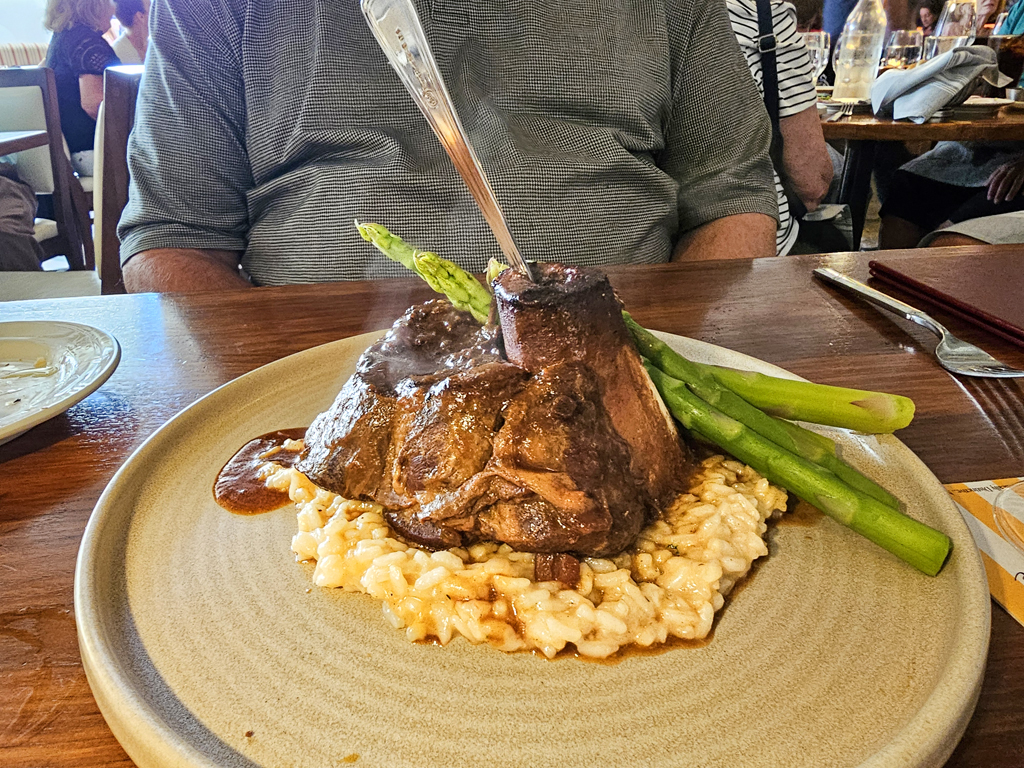
Da Vinci’s is a huge venue, that was completely filled by shortly after 5pm.  Many of the diners appeared to be family groups, grandma and grandpa, parents, and grandchildren on vacation.  Dinner was excellent, and service was also very good.  It just shows that having enough staff makes a big difference to success, especially in restaurants that cater to families and vacationers.
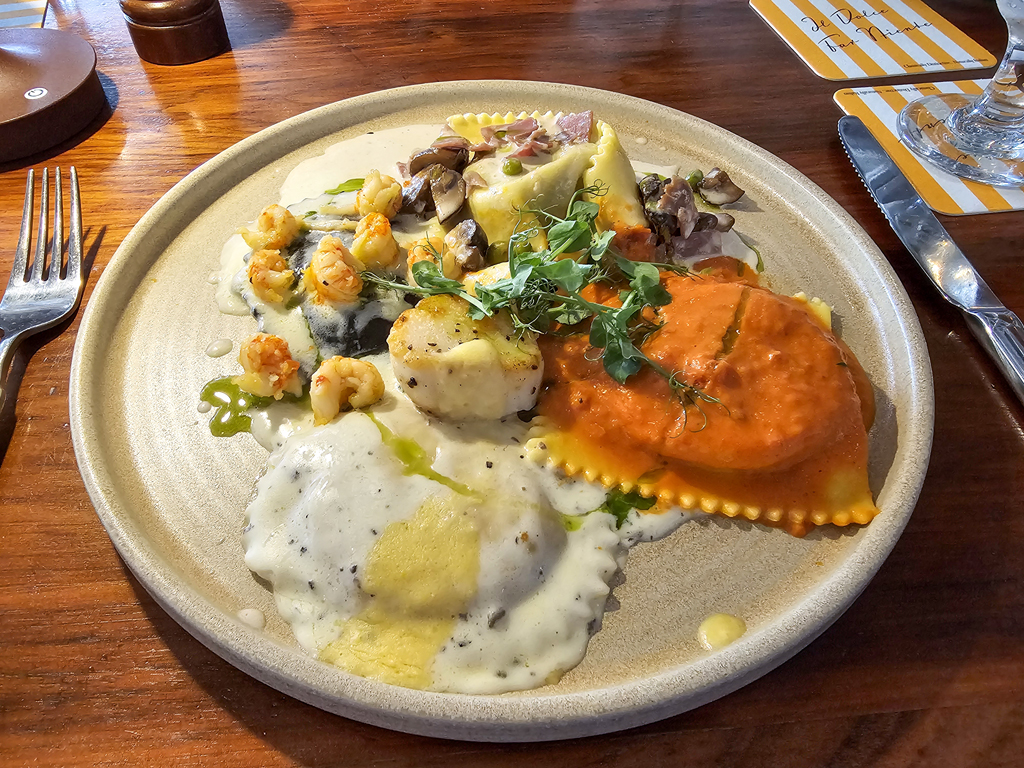
Da Vinci’s ravioli trio
Da Vinci’s osso bucco
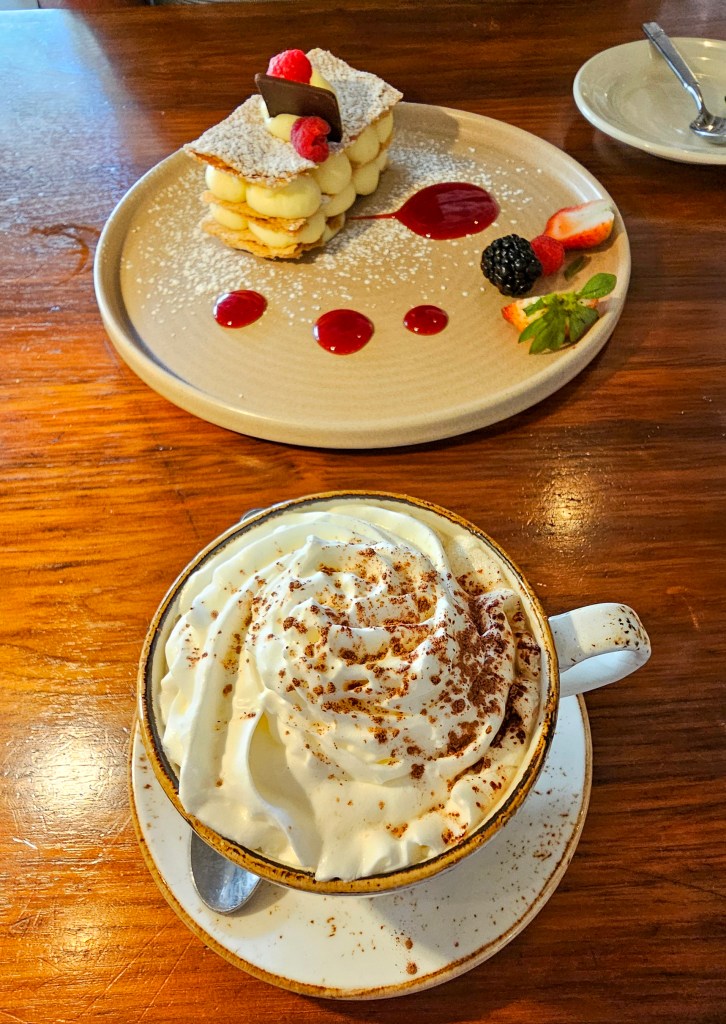
Da Vinci’s desserts, Napoleon and a Spanish coffee

Returning to Nine Lives was accomplished without drama, and we had a very peaceful night.  We suspect the anchor had dragged a small amount with tide changes, but it always dug in again and we remained within the circle I set for the anchor alarms.
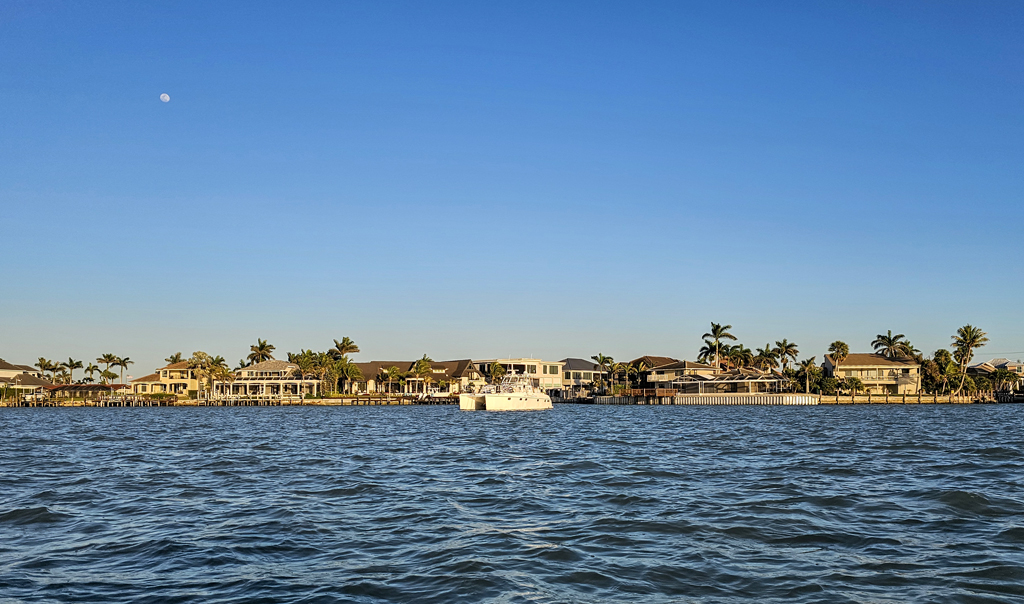
Nine Lives at anchor in Factory Bay

The next morning we were fascinated watching TowBoatUS retrieve the derelict sailboat that had been anchored beside us.  Derelict boats left at anchor are a huge problem in southern US, especially in Florida.  Wealthy homeowners don’t want to have to look at deteriorating vessels outside their expensive properties.  We find this completely understandable.  The problem comes when communities and counties try a shotgun approach and put forward legislative bills to forbid anchoring entirely.  There are already laws and procedures in place to deal with the situation, but instead of following them, a draconian approach is proposed again and again in the form of new and ever more restrictive laws.  Concerned boating organizations do their best to counter the proposals but are not always successful.  We were happy to see the derelict retrieval, as it shows that measures can be taken to handle the problem.  It took less than an hour from the time the towing company came out to dropping the derelict at the dock and heading out on another job.
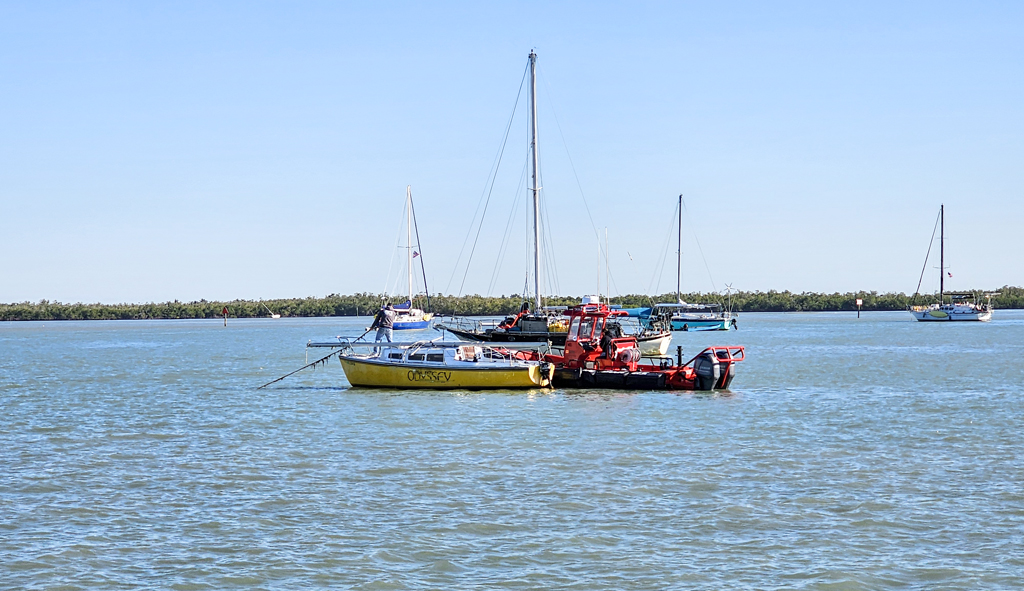
TowBoatUS retrieves a derelict sailboat

We were able to get into our slip across the bay a little early.  The anchor took a while to come loose from the mud – three days of wind and fetch with almost continual swinging back and forth meant it was well dug in.

Two Endeavourcats at Factory Bay Marina. Nine Lives is the further of the two.

As soon as Dick had retrieved the rented vehicle, we set off for Naples.  Another successful shopping day!  I said to Dick, we have made up in just 2 days for 3 years of scarce shopping on the inland rivers.  This extravaganza was a little more even, 2 shirts for Dick, a necklace and an outfit for me, and a very nice silk flower arrangement for the condo.

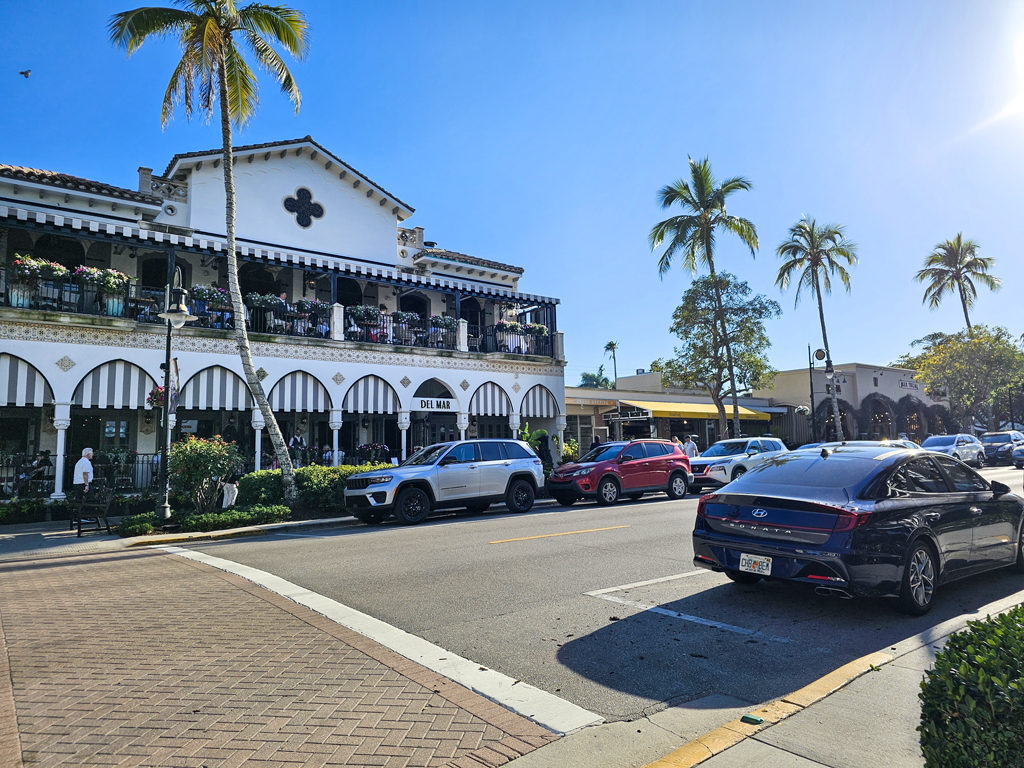
Naples
Naples

Next stop was Bha! Bha!, a Persian restaurant.  The food was beautifully presented and absolutely delicious.  I started with gravlax, while Dick had lamb meatballs.  His main course was the Persian chef’s interpretation of paella, which he loved.  I had a wonderful dish of beef tenderloin pieces with tomatoes, eggplant, and red peppers in a spicy sauce.  The desserts were also beautifully presented, but sadly they were too sweet for our taste.

Bha! Bha! Persian Restaurant gravlax and lamb meatballs to start
Bha! Bha! paella
Bha! Bha! beef tenderloin
Bha! Bha! beautiful, but very sweet desserts

On our travels to and from Naples, there was a road sign warning about panthers crossing.  I would have loved to have seen a panther.  Instead, I saw two wild pigs foraging along the verges. I suppose they would make a good lunch for a panther…

Naples

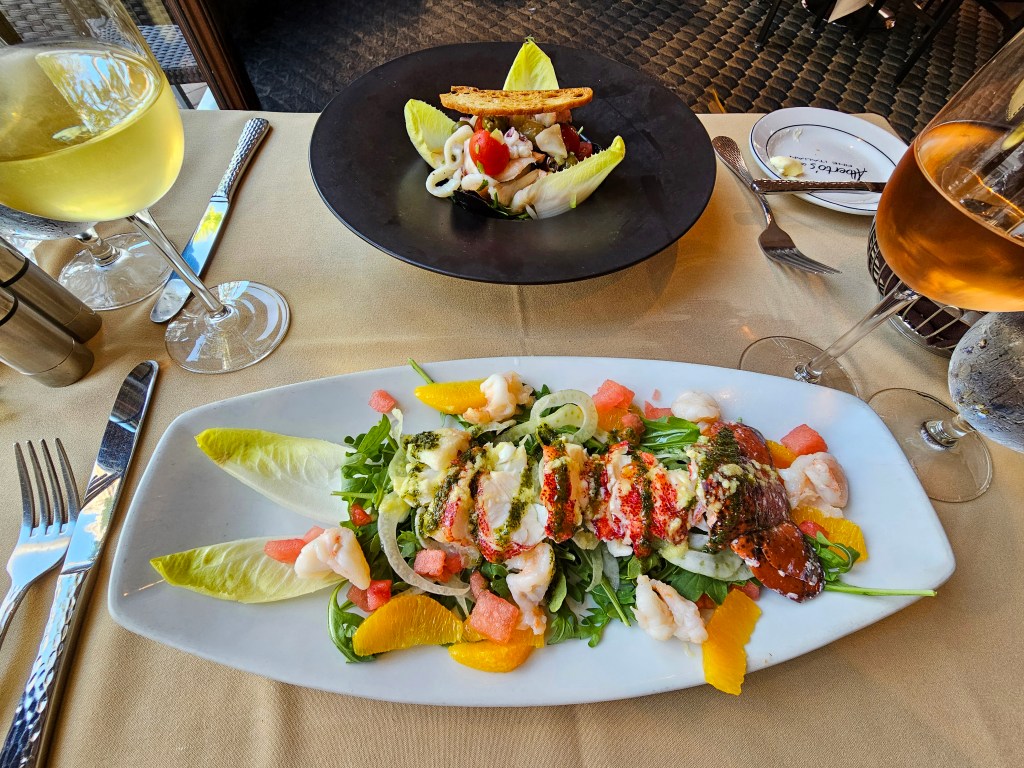
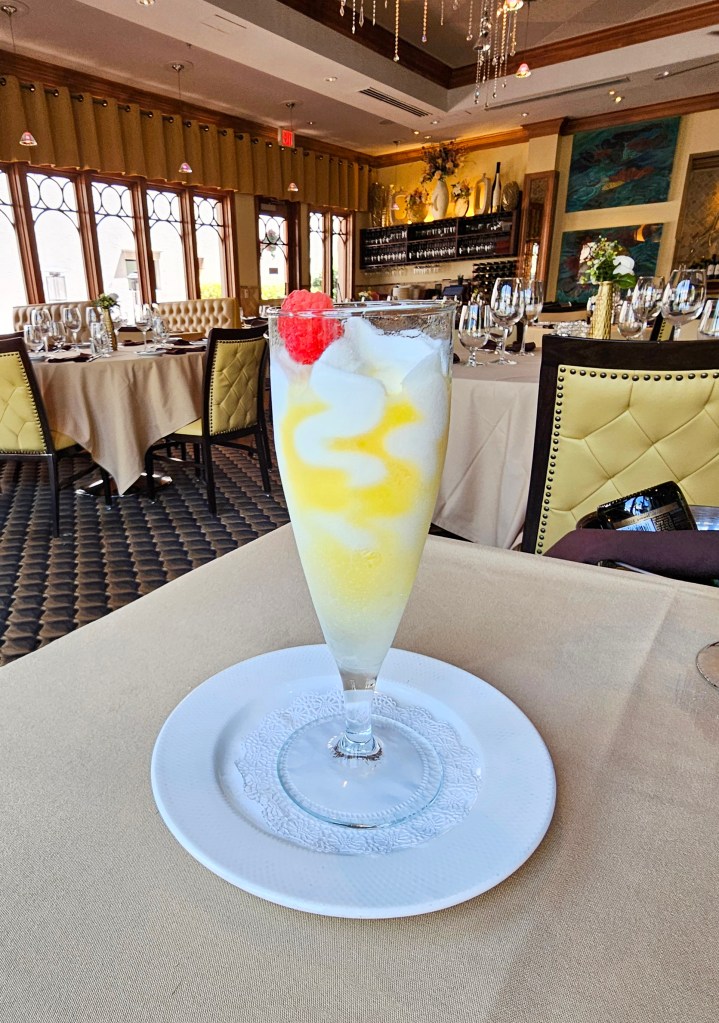
The next day was another full day.  We returned to Naples, to the second upscale shopping precinct that Dick had scouted earlier in the week.  We found a couple of very interesting, eclectic boutiques with things for the home.  The clothing shops were less interesting, probably just as well!  Lunch was at Alberto’s, an Italian restaurant.  We chose the cauliflower soup to start, which was delicious.  We both ordered salads, Dick’s with mixed seafood, and mine with lobster and shrimp.  They were excellent.  Desserts were interesting.  Dick enjoyed a parfait made with limoncello, and I ordered Grand Marnier crème brulee.  It was a bit startling, as it arrived with 5” of flames creating the sugar crust.  I can’t remember a dish being delivered on fire before.

Pizzas on display in a window
Seafood salads at Alberto’s
Limoncello dessert at Alberto’s

We returned to Marco Island, and after Dick returned the rental car, we spent a quiet evening.  We hoped to have an evening drink with our slip neighbours, fellow Loopers, but it didn’t work out, so we made plans to get together in Key West.

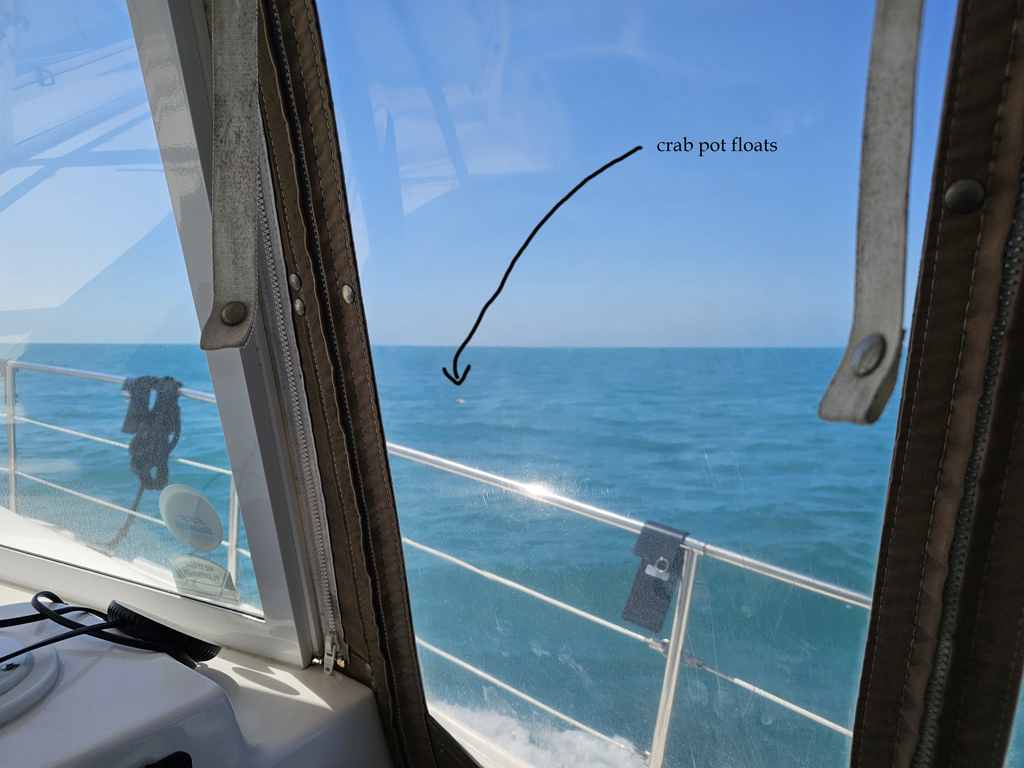
It was an early start for our second Gulf crossing.  This one would be daylight only, with plans to shorten the duration by running fast.  We ran the whole way at about 85% of WOT (wide open throttle, that is, the fastest the engines can go), giving us between 13 and 15 knots.  This was partly for comfort, but also to make sure that a prolonged journey at this speed was fine for the engines.  One unexpected challenge was the crab pots.  We did not expect them so far off shore and in water depths of 50 feet.  The pots are marked by floats, each about 6” to 8” in diameter.  Here they were mostly in groups of 3, but they were still very difficult to see.  They bob up and down in the waves, and between the sun glinting on the water and the small whitecaps, they were practically invisible.  Dick’s chair is further forward than mine, and of course he is taller, and with the bow slightly elevated at the speed we were travelling, I had no hope of seeing them except through the side window.  By then they are pretty close for Dick to find the next in the line and maneuver around it.  These crab pot floats are not something you want to just run over.  If you cut the line or damage the float, you are hurting the fisherman’s livelihood.  Also, you risk damage to your hull and running gear.  Get the line wrapped around the prop and you are instantly dead in the water.
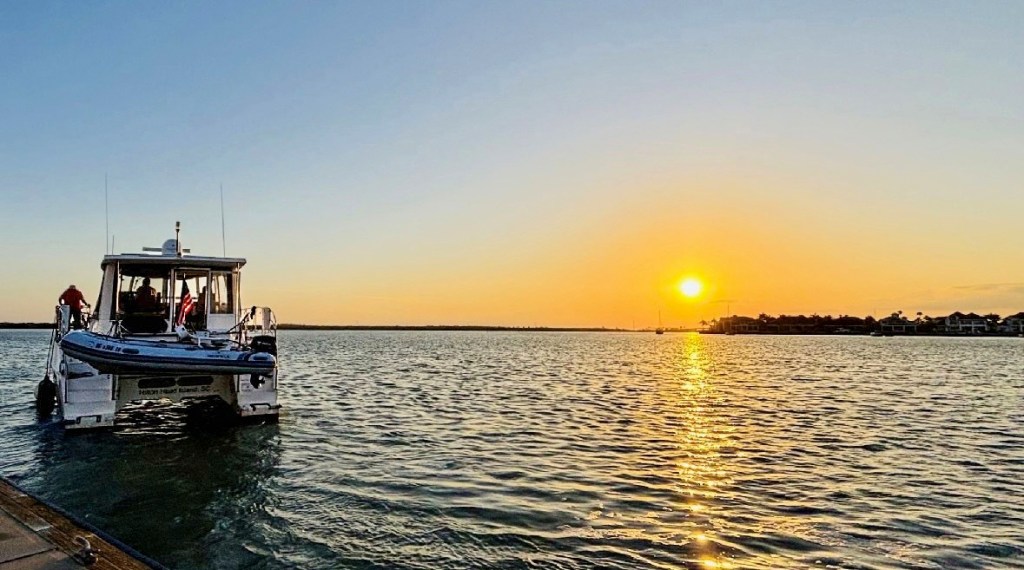
Nine Lives leaves Factory Bay at dawn
Nine Lives speeds up and makes a rooster tail!
Crab pots are hard to see!

We arrived at the marina in Key West by 3pm.  The basin is huge, but there are 4 separate marinas, and it is both crowded and higgledy piggledy.  Nine Lives was salt encrusted after her fast run, so Dick’s first order of business was a washdown of all the decks, railings, and windows.

In the evening, we joined fellow Loopers Beth and Calvin for dinner at a local steakhouse.  The food was very good, as was the service, and they were great company.  Their boat was behind us in Marco Island, and they made the same crossing a couple of hours after us.

We set out to explore Key West the next morning.  Dick booked 2 days for the hop-on-hop-off trolley tour, so we began by taking the full 90-minute round-trip tour of the island.
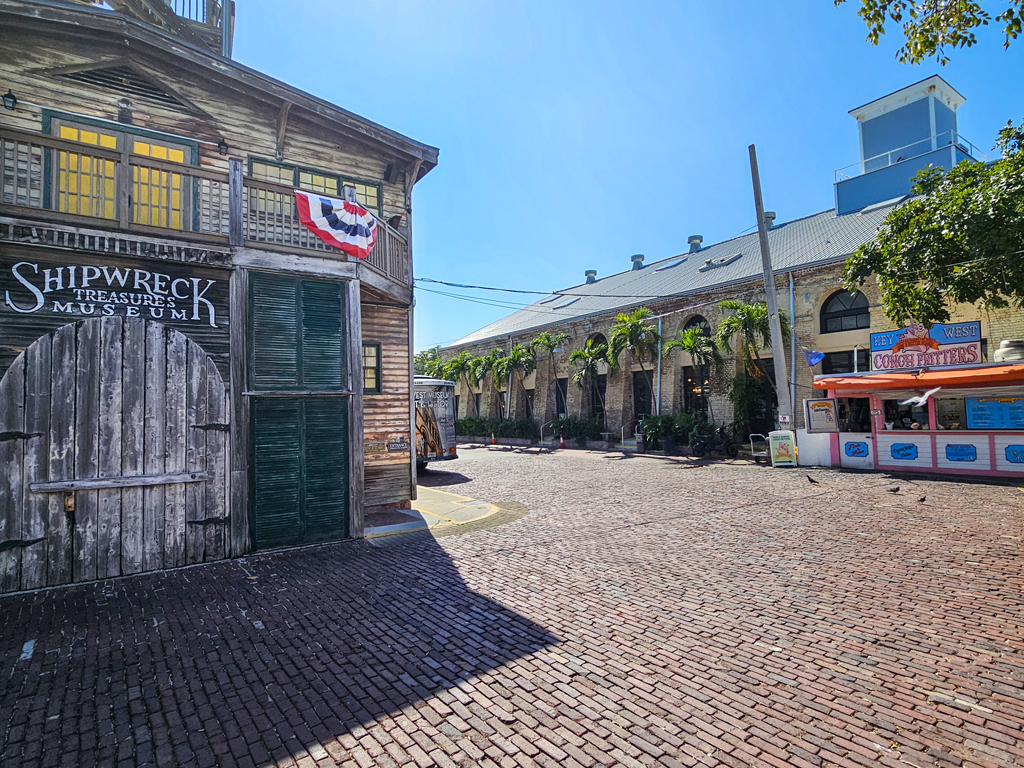
Key West Mallory Square
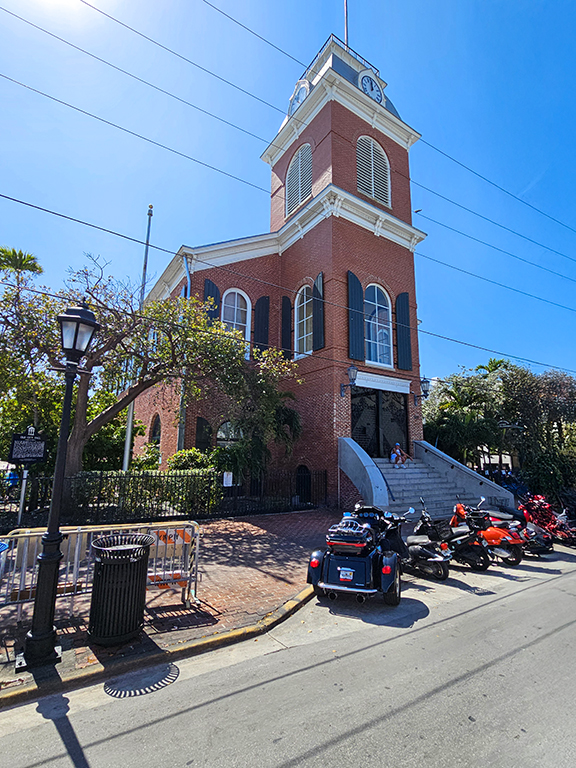
Key West Old City Hall
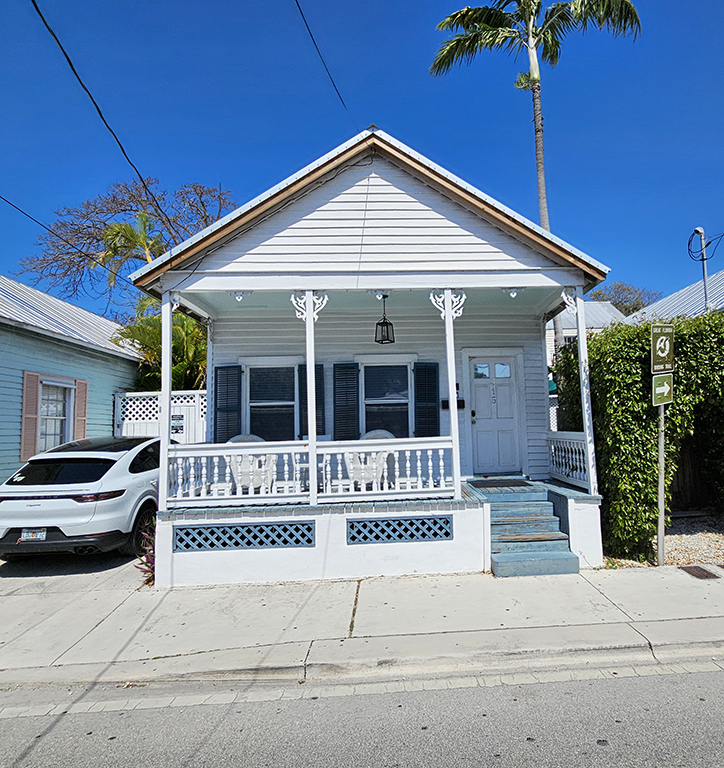
Shotgun House in Key West. The front and back doors are in line, for ventilation.

The Saturday before St Patrick’s Day is a big celebration in Key West, so students on spring break, cruise ship passengers, and hundreds of other tourists wandered the streets, in and out of the many bars, and generally enjoyed a raucous good time.  Crowds and drunks are never my thing, so I was reminded of being told by friends that you either love it or hate it when speaking of Key West.  I was well on the way to the latter until after dinner, as we walked back to the boat along quiet, leafy streets of gracious old houses with lovely tropical gardens. 
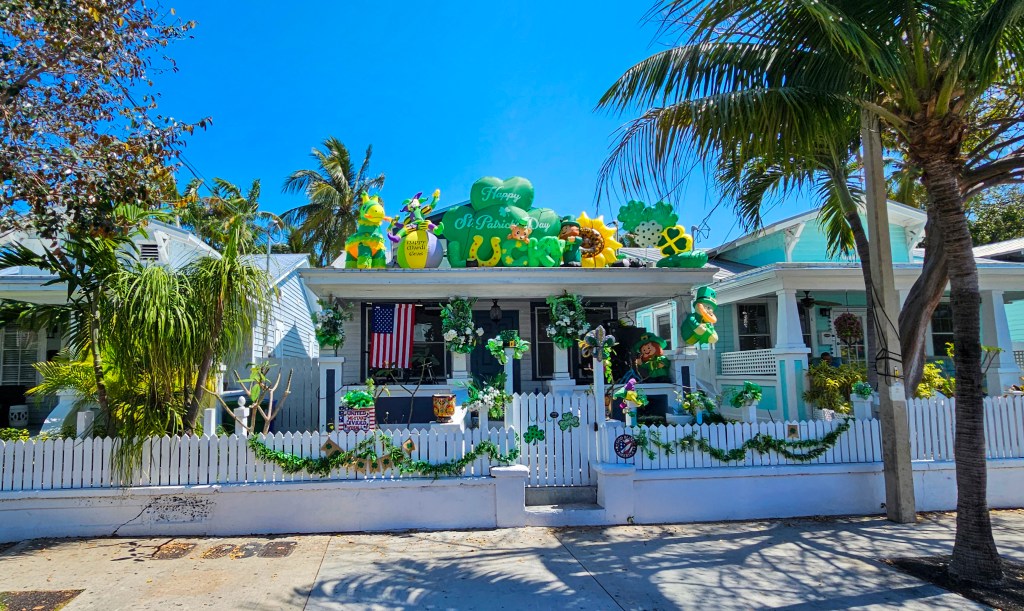
Key West celebrates St Patrick’s Day with enthusiasm
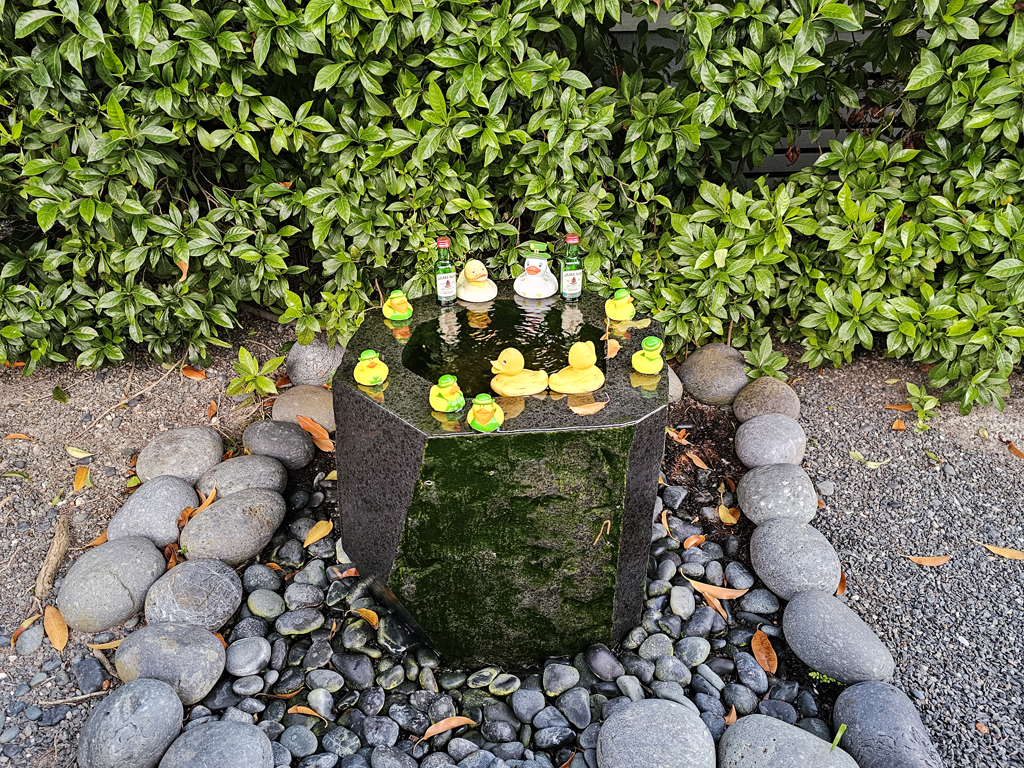
A St Patrick’s Day display of rubber duckies
Taking a break from celebrating

There were some interesting stories on the trolley tour.  One must always assume part fantasy, I have heard the most outrageous lies told by tour guides!

One story goes that in the mid 20th century, the island was populated by the navy and the shrimp fishermen.  These groups hated each other, but there was only one bar on the island at the time, so they found themselves drinking together after hard days at sea.  The bar, The Red Doors Saloon, was also known as “The Bucket of Blood”.  Fights broke out regularly, and brawling was a way of life.  Apparently, when you arrived at the bar, you were searched for weapons before being allowed to enter the premises.  If you didn’t have one, they gave you one – just to ensure that everyone had an equal chance. One can look up the true story.  Research shows that the building dates from 1868, and was at various times, a cigar factory, a ship’s chandlery, a grocery and hardware store, and a bar.  It was always a shrimper’s bar, and its reputation as a place of beatings, stabbings, assaults, and even quiet murders was well earned.  By 1972, the regulars had moved on and the bar was no longer viable and closed its doors.  Today it is an upscale lady’s boutique. There is another story about this building’s colourful history.  At one time, the upstairs was used as a bordello.  When the building was renovated, inside one of the upstairs walls were found a great many mens’ wallets.  Apparently, the ladies of the evening would rob their patrons and toss the empty wallets into a cavity in the wall.  The tour guide commented that given the clothing sold today in this shop, men are still leaving without the contents of their wallets.
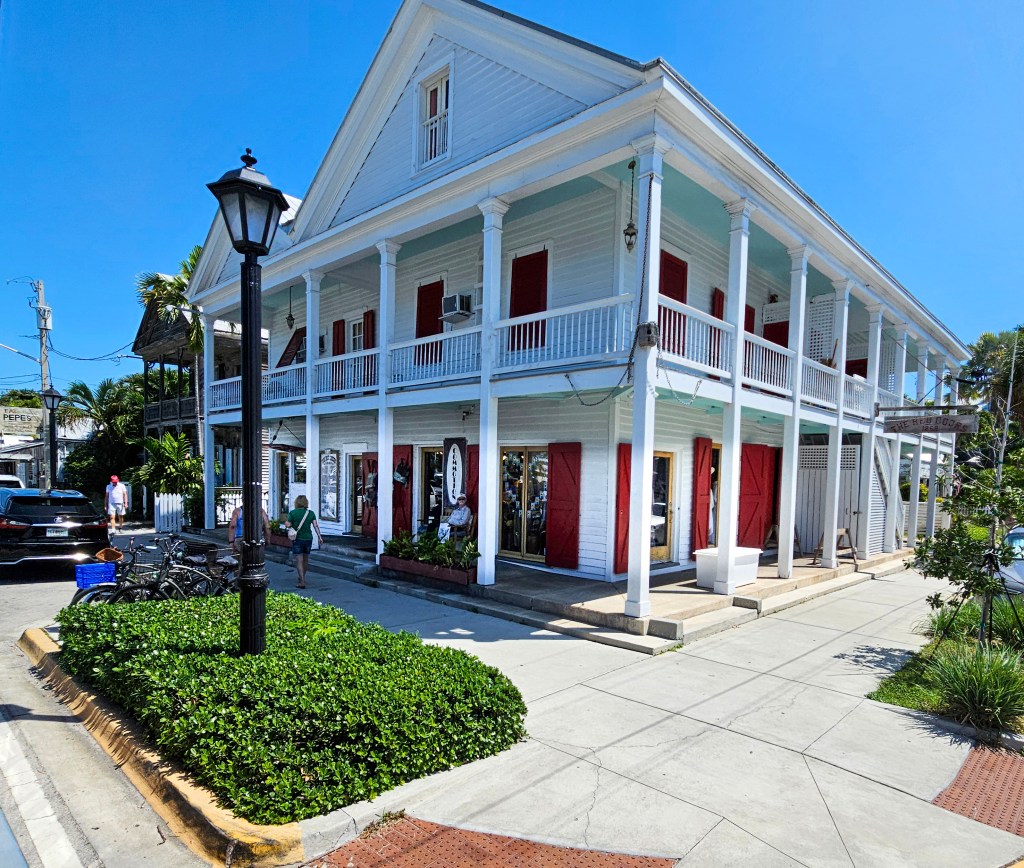
Red Doors Saloon, or The Bucket of Blood, today a more genteel ladies shop.

In the 19th century, many Cubans came to the island to avoid troubles in their own country.  They brought with them their culture and cuisine, and also their chickens.  These ran loose, and inevitably multiplied.  Early in the morning, while I sat in the cockpit enjoying coffee, I could hear roosters crowing all over town.  I imagine that would not help much with the inevitable morning-after hangovers suffered by the St Patrick’s Day revelers. The chickens are feral, and are considered a nuisance by residents, but they are an important part of the island’s history and are now protected.
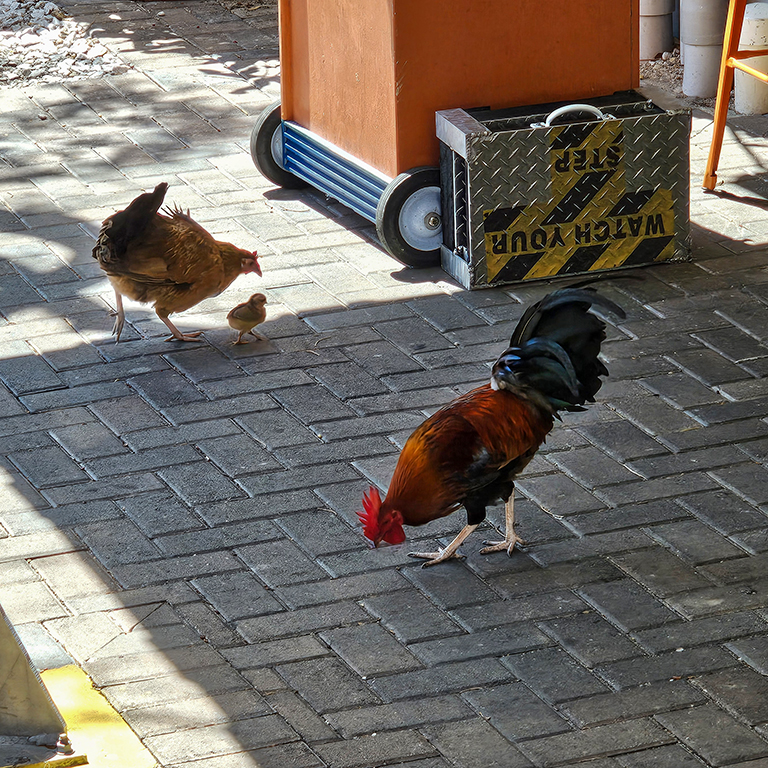
Chicken family

The southernmost part of USA is supposedly on the south side of the island.  There is a marker to designate the spot, and it is considered obligatory for visitors to have their picture taken in front of the large painted concrete buoy.  The queue was a block long.  We decided to pass on that particular experience.  In fact, the marker is not at the southernmost point of the US, it’s not even the southernmost point of Key West.  It is also not the remains of the Key West lighthouse that was wrecked in a hurricane.  It was set up as a tourist attraction in 1983 by the city.

Southernmost marker (picture snapped between tourists, the queue was a block long).
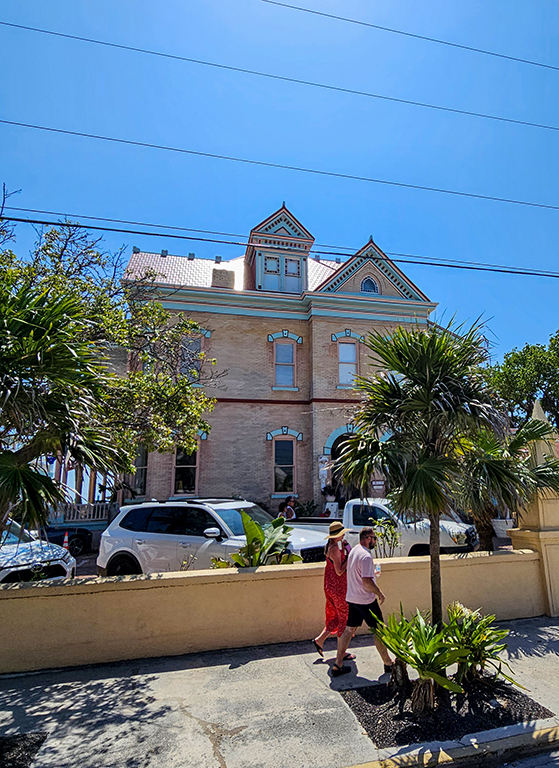
Southernmost House. It has only one bedroom. The owners loved to entertain, and much of the house is a ballroom, but guests slept in one of three other houses nearby, because the owners did not want their company overnight.

When the navy first arrived, with the mission to clear out the pirates in the Caribbean, Key West was a one mile square island.  The navy needed more space, so they started dredging, using the coral they dug to fill in the wetlands and increase the size of the island.  By the time it had grown to 4 miles square, it became clear that they were dredging faster than the coral could renew, and doing irreparable damage to the only coral reef in United States waters.  The expansion stopped, and that end of the island is called “New Town”, as distinguished from “Old Town”, the site of the original settlement.

Sloppy Joe’s Bar officially opened in 1933, the day that Prohibition was repealed.  In fact, the island was full of speakeasies, the Island being a bastion of free-thinkers who considered that Prohibition was an amusing exercise dreamed up by the government.  It was Ernest Hemmingway’s favourite bar, and while it originally had several other names, Sloppy Joe’s was the one that stuck.
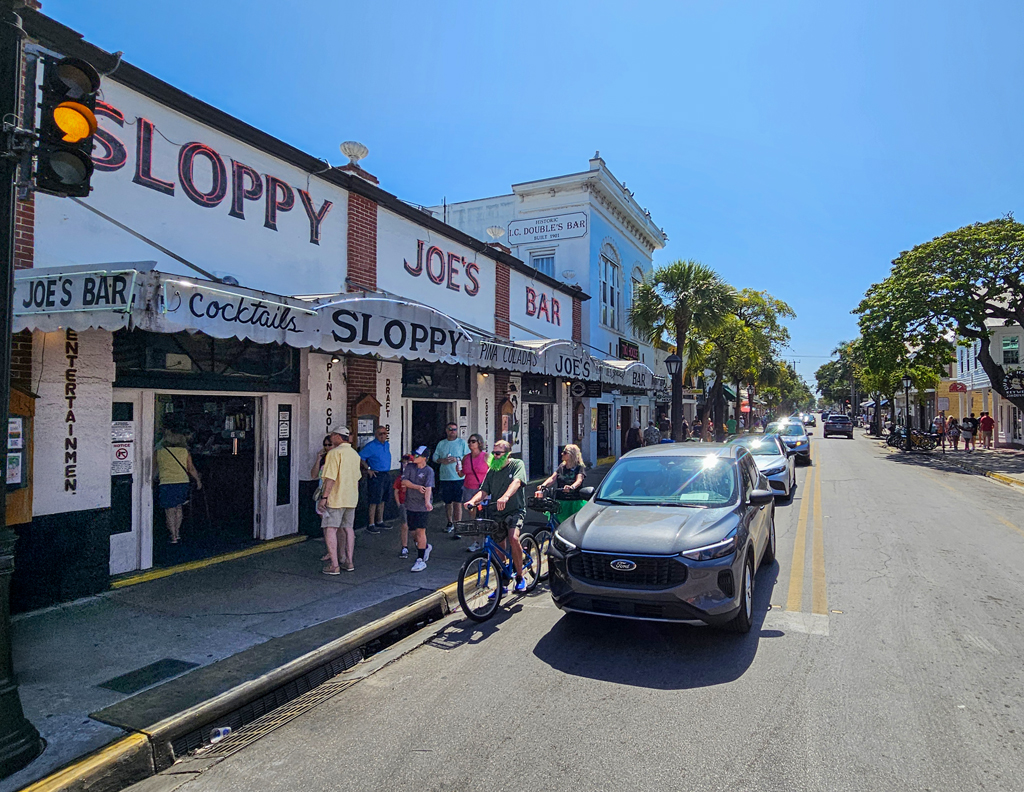
Sloppy Joe’s, Hemmingway’s favourite bar. Note the guy on a bicycle wearing a green beard for St Patrick’s Day.

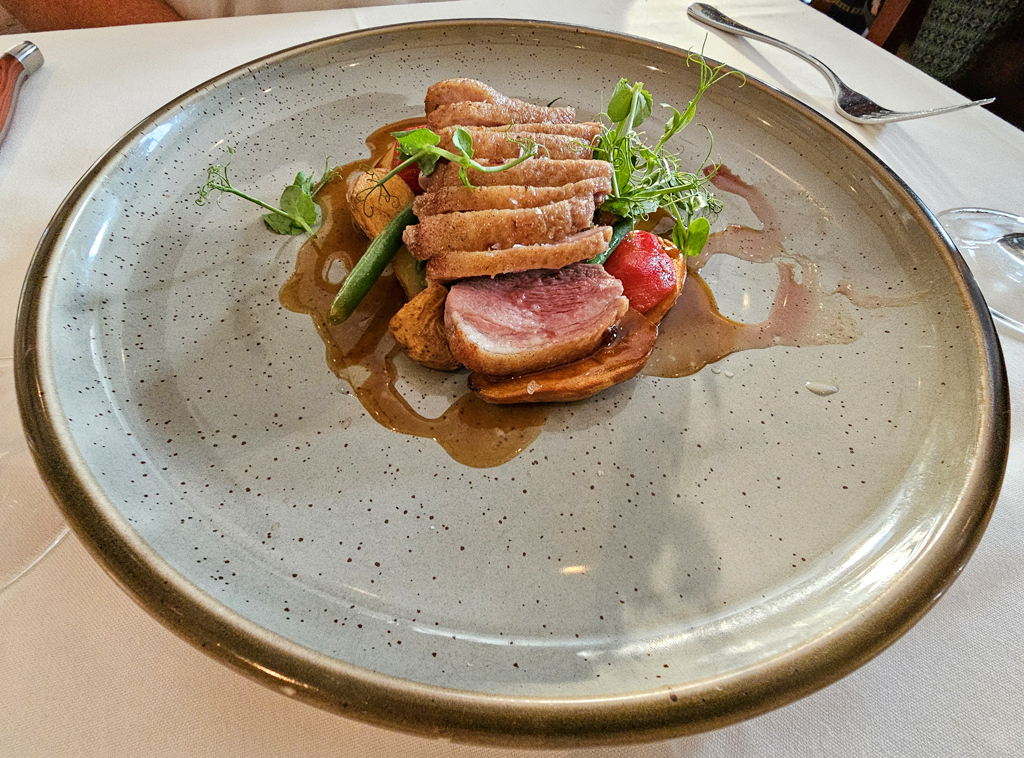
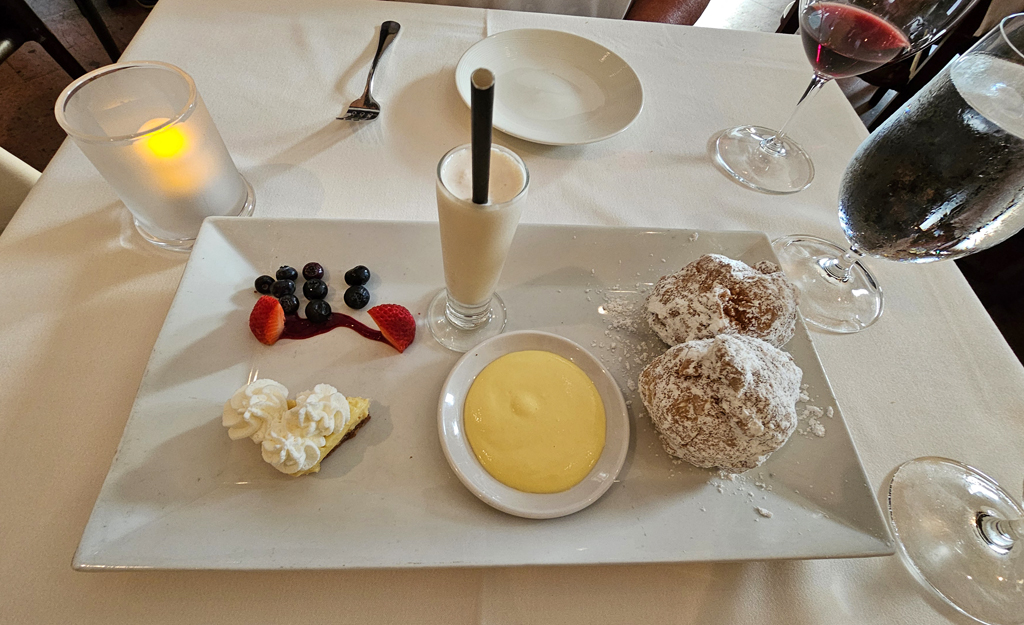
Dinner was at Café Marquesa, a beautiful, elegant restaurant that is part of a very upscale hotel, spread over several historic homes.  The owner (manager?) met every guest as they entered, and checked back with them during the meal to make sure everything was as expected.  The restaurant offers what is described as “gourmet coastal cuisine.”  The meal was excellent, starting with an interesting amuse bouche, a small beignet, filled with cotija cheese, resting on a lightly spicy chili sauce.  The courses and portions were designed to put together a 4-course meal, so Dick enjoyed what was very similar to a tasting menu.  I decided to try the salad to begin, and Dick had she crab soup.  After a small pasta dish with crawfish tails, Dick’s main course was duck breast, while I had filet mignon Oscar, topped with a small crab cake and served on a perfectly executed roesti potato cake.  We shared a dessert trio.
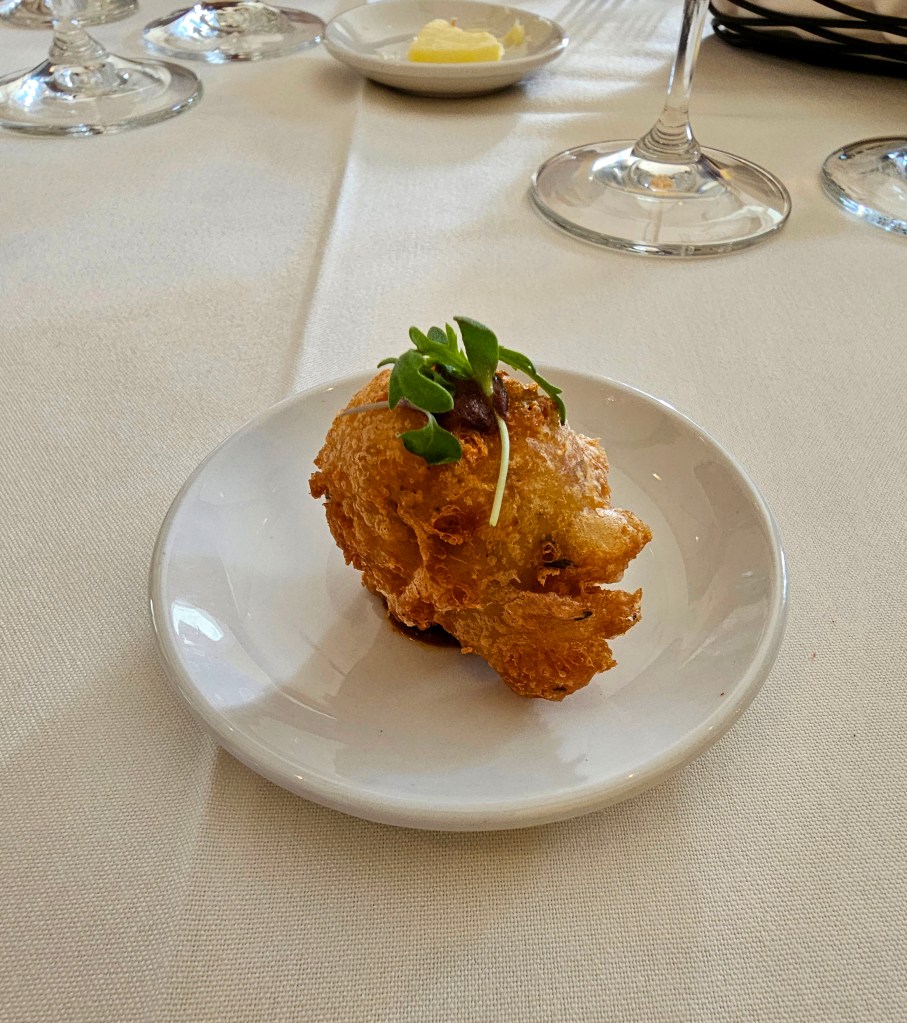
Cafe Marquesa amuse bouche
Cafe Marquesa she crab soup
Cafe Marquesa duck breast
Cafe Marquesa filet mignon Oscar
Dessert trio at Cafe Marquesa

As we walked back along the beautiful streets of the residential part of the old town, we saw a hen shepherding her chicks across the road, watched by an interested golden retriever, fortunately well secured on his leash.

Why did the chicken cross the road?

We sat in the cockpit and enjoyed a nightcap.  Clearly, the Key West spirit is contagious, because we decided a second glass was called for, and we stayed up long past Looper midnight!

We set off the next day to repeat the trolley tour – different guide, different stories, and sitting on the opposite side to get different pictures.

Green Iguana
Tarpon
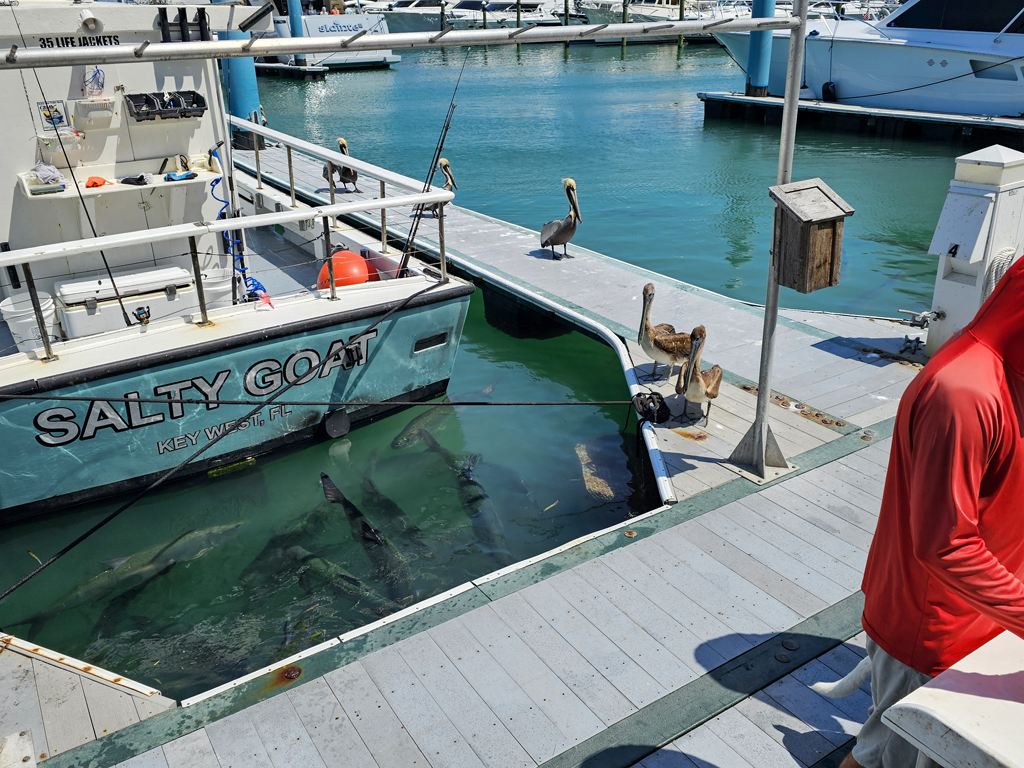
The tarpon and the pelicans are waiting for the guy in the red shirt to toss them the scraps as he cleans the fish caught that day.

From my perspective, we probably couldn’t have chosen a worse week to be there.  It was hot – between temperatures over 80F and high humidity, it felt like 90F, and the sun beat down on the concrete sidewalks.  The St Patrick’s celebration and spring break combined to create my most disliked scenario, crowds and drunks.  The next week might have been a perfect time, cooler, quieter, but we are not there then.

The tour driver had a great sense of humour, but he was clearly hungover and did not have as many interesting stories as the previous day.  Afterwards, we did the Key West thing, and repaired to a bar for tropical beverages.

Better Than Sex, a dessert only restaurant
Mile Zero on US Highway 1
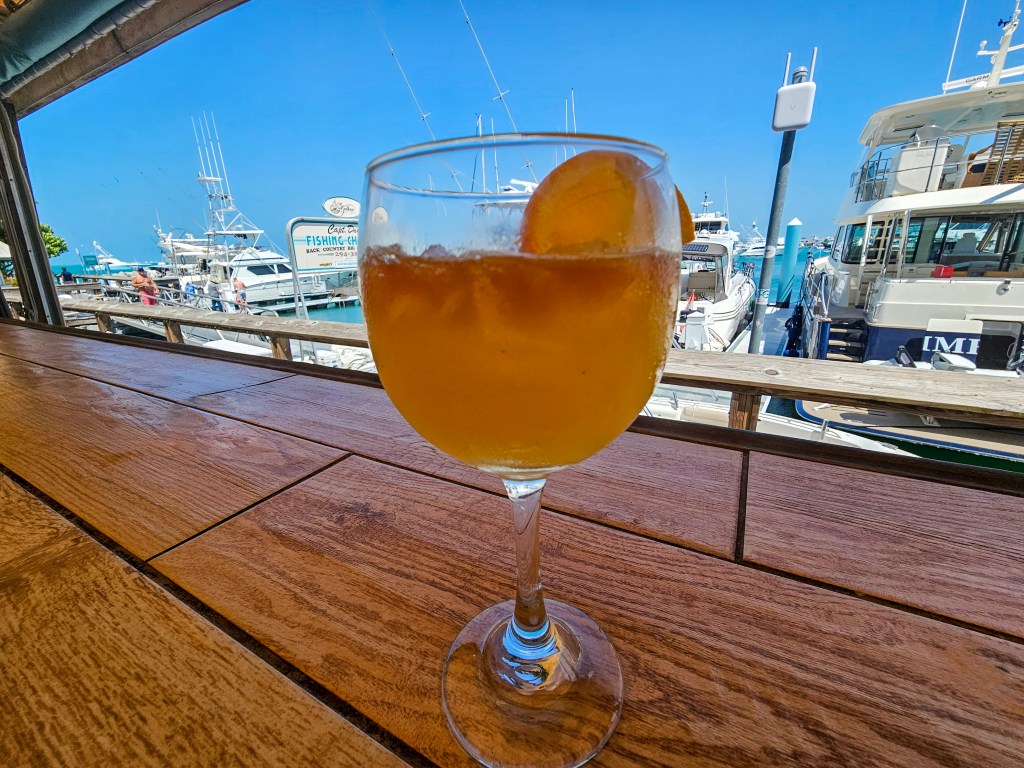
Pause for a tropical beverage
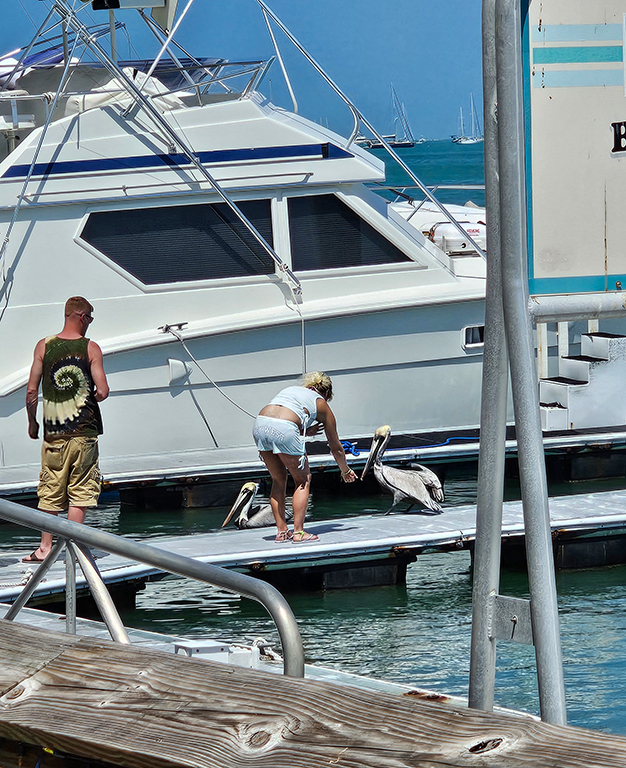
A foolish tourist tries to feed a pelican

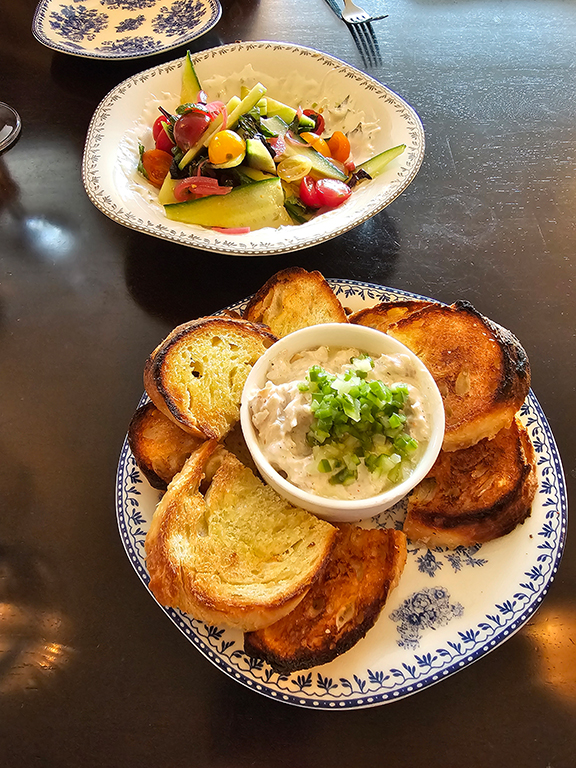
Our dinner plans were for a late meal at Hot Tin Roof, having reserved one of the coveted outside tables.  It was still hot and muggy, and on arrival we realized that the outside tables are on a balcony overlooking a popular bar with live music, all very loud!  We were able to get a table inside instead.  The meal started with delicious and unusual garlic toasts with Manchego butter.  Dick’s choices for the meal were good, but I found that my food was overwhelmed by the sauces.  The key lime pie for dessert made up for everything.  It was delicious and nothing like what we have had before.

Key Lime Pie at Hot Tin Roof

We were not able to stay longer in the marina in Key West because they had a previous booking, and we don’t fit into the slips that were vacant.  Dick booked 3 nights at Perry Hotel Marina on Stock Island, which is across the bridge from Key West.  It would take just an hour, especially if we ran fast, to get there from Key West.  We knew that conditions would be bad.  The wind was howling.  Calvin helped us untie, if he hadn’t been there, we would have had trouble.  Dick had spoken with a couple of fishing boat captains, who confirmed his expectation that the worst would be just outside the harbour, with the wind coming from the north and the waves directly on the beam.  Once in the lee of Fleming Key, it would be better, and then as soon as we rounded the point and were on the south side of Key West we would have greater protection from the wind.

The “adventure” unfolded pretty much as predicted.  Dick was pleased with the way Nine Lives handled the conditions, although he commented that we have never had the waves splash the roof of the cockpit before.  Later, after we were safely tied up, the Coast Guard issued a small craft warning for the Florida Keys (by definition, Nine Lives is a small craft).  The winds were predicted to get worse through the day, hence our 8:30am departure in 25 knot winds.  On arrival, I felt that a large whiskey was required, but given that it was not even 10am, I settled for coffee.

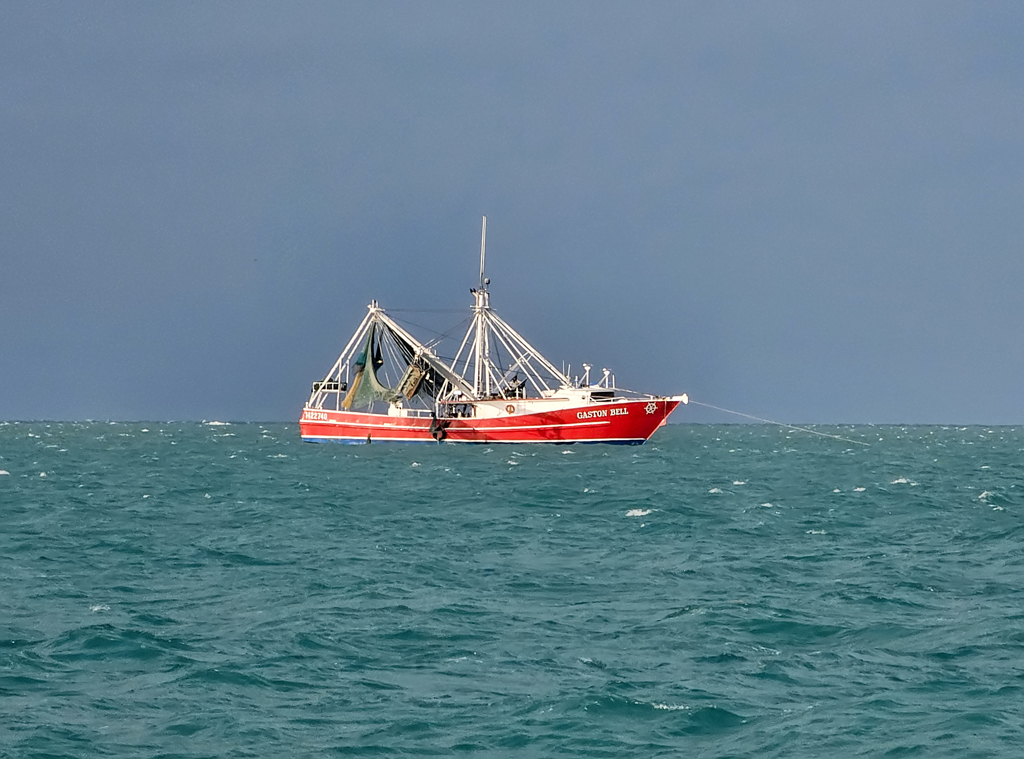
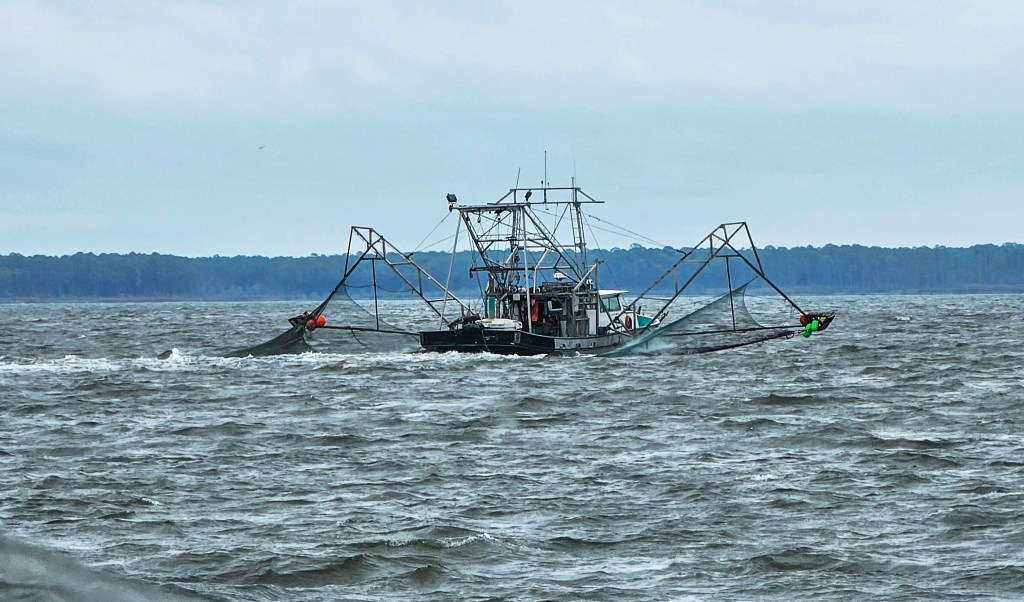
We travelled through part of Hawk Channel, the passage that connects the Atlantic Ocean with the Gulf.  The Florida Reef Tract, the only living coral barrier reef in the continental USA, lies along the channel and helps to protect the Keys (and us) from heavy surf.  Pink shrimp are caught by shrimpers anchoring between the reef and the shore.  These shrimp are nocturnal, that is, they move around at night, and bury themselves in the sand and mud on the bottom during the day.  The story goes that they were discovered by accident, when a shrimp boat captain left his nets down in the water overnight, and when they were lifted in the morning, they were full of a new species of shrimp.  A nice story.  As we made our way along the south shore of Key West, we could see the fishing boats anchored, with their nets out but not down in the water.  One presumes that they had already lifted the nets and were processing the catch.
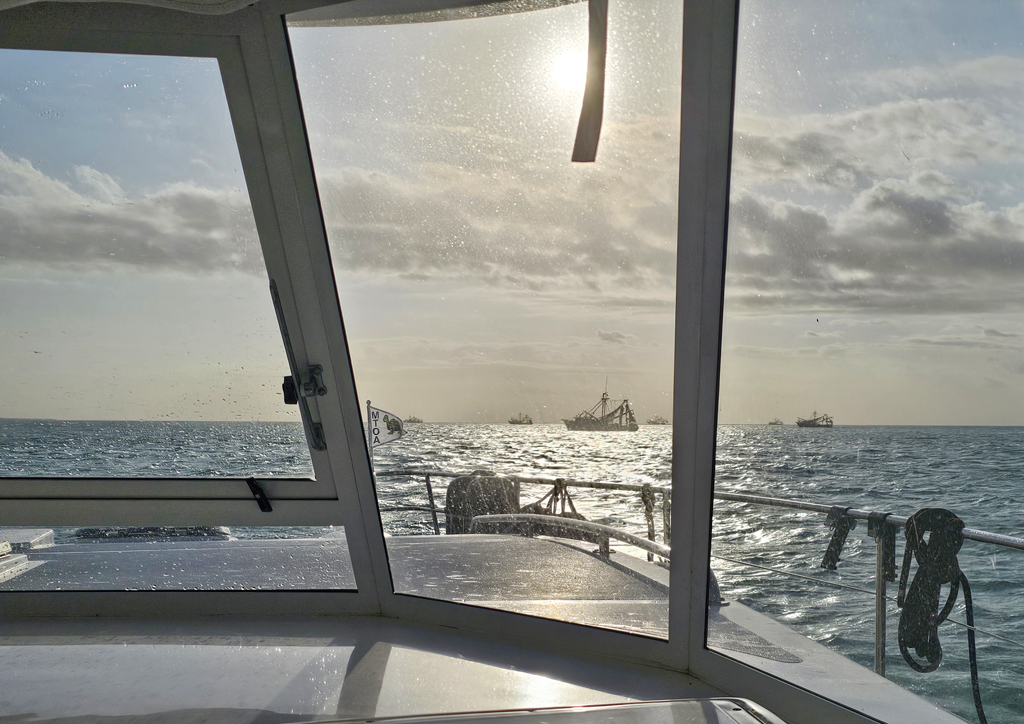
Shrimp boats on the horizon as we make our way to Stock Island
Shrimp boat, anchored. Note the nets are out of the water.

In the harbour we saw a saildrone, a very interesting unmanned vessel that Dick had read is being used by the Navy and by NOAA.  The Saildrone website is very interesting, these vessels can be used for infrastructure on oceans (think undersea cables), offshore energy surveys and development, ocean monitoring and climate science, and of course national security and defence.

A Saildrone

We arrived at the Perry Hotel and Marina, quite relieved that we were there as planned and without extra drama.  It is a nice facility, with many features including swimming pool, fitness center, onsite restaurant and a bar with live music nightly, laundry, bath house, captains lounge, etc etc.  They even have an hourly shuttle to Key West Old Town, that runs until 10pm, so all of the restaurants of Key West are easily accessible.  We saw as we came in that there was an Endeavour Trawlercat Skylounge called Remember When.  The name was familiar, Dick thought we had met them on the Alligator River in North Carolina in 2017.  When we looked at our filed boat cards, there was their card, and Dick was quite right.  He chatted with them later, and they remembered us too.

Hosing off the salt after a rough passage

We are planning a quiet few days here before leaving for Marathon.  A good time for laundry and boat chores, and a rest from the hustle and bustle of Key West.
November 3rd to 17th, 2024: Columbus to Pensacola

The night before we were due to leave Columbus, the clocks went back an hour, so everyone was awake early.  A couple of boats left before 7am, but 7 of us arranged to leave together, shortly after 8am.  We had to wait a bit while a tow locked down ahead of us.

Loopers waiting for John C Stennis Lock
Boats in the lock

We passed the Drax Aliceville Pellet Plant.  They turn wood into pellets and ship it all over the world to be used as biomass fuel.  Plants fueled by biomass make a claim of green energy because of the assumption that forests will regrow.  The claim is controversial, but several countries give subsidies to energy companies that use biomass instead of fossil fuels.  One such plant in UK has been found to use wood harvested from old growth forests in Western Canada, according to reports by investigative reporters.  I presume (but do not know this for certain) that there are no old growth forests left in this part of USA.  On the rivers we passed many tracts of pines that were being grown as a crop. In a pelletisation plant, wood that is unsuitable for other products is chipped, heated to reduce its moisture content, and then reduced to a fine powder.  This is then pressed at high pressure to form a small, dense pellet.  Biomass pellets produce 80% less CO2 emissions than coal, and there are lower levels of other pollutants.  Coal fired generating plants can be converted to burn biomass pellets.  Using wood pellets is considered to be carbon neutral when the wood is taken from sustainably managed forests.

Drax Aliceville Pellet Plant

We were anchored by 4pm in a quiet oxbow off the waterway.  I was much happier than I was at the last anchorage!  Firstly, although we were still in 20 feet of water, the area was wide enough to have full confidence that there was more than enough space to swing 360 degrees.  Secondly, we both felt a distinct pull when the anchor set, so no concerns on that score either.  The wind came up during the night and we swung back and forth about 60 degrees, always being stopped by the well-set anchor.  My anchor alarm shows a track, so we can see where Nine Lives meanders while we sleep.  At 7:15 we lifted the anchor in quite a stiff breeze, but all was well, and we set off down the river.

Peaceful anchorage south of Columbus

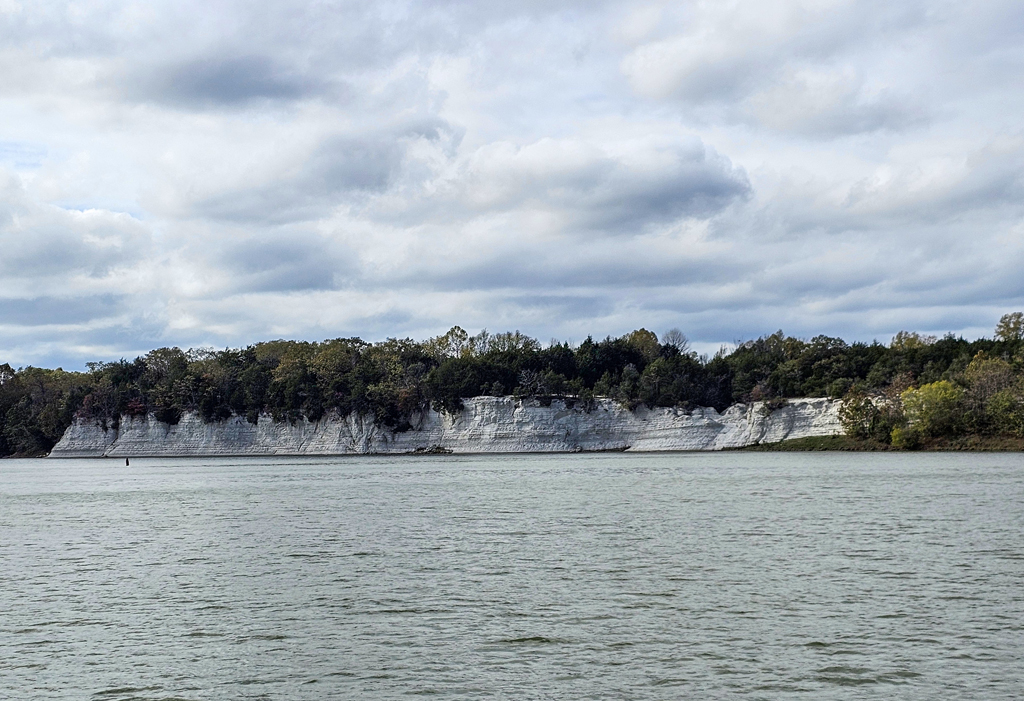
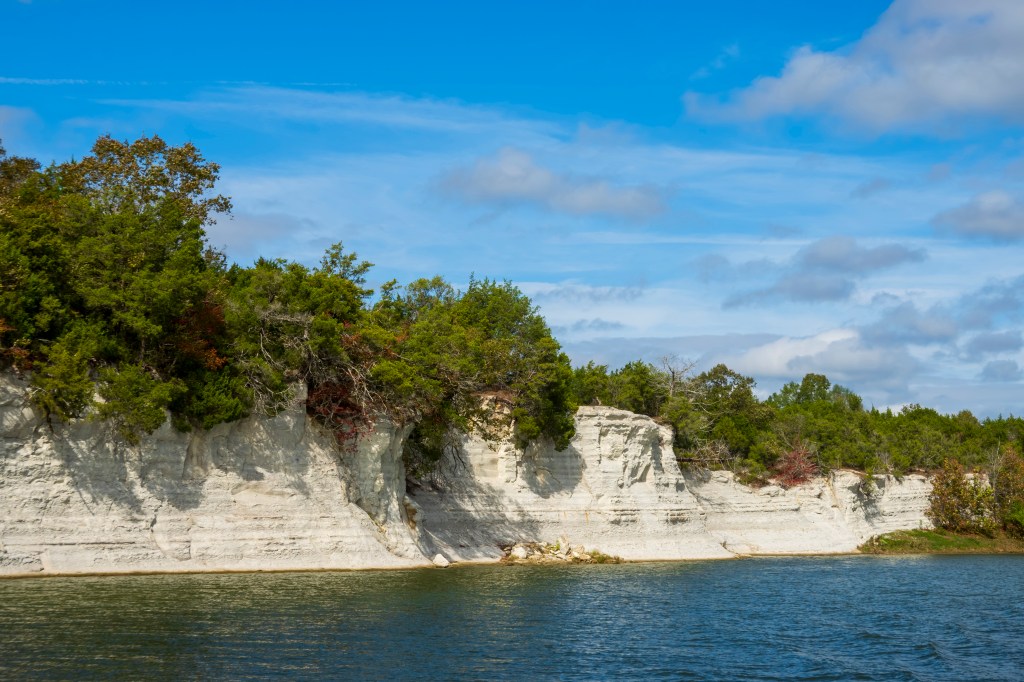
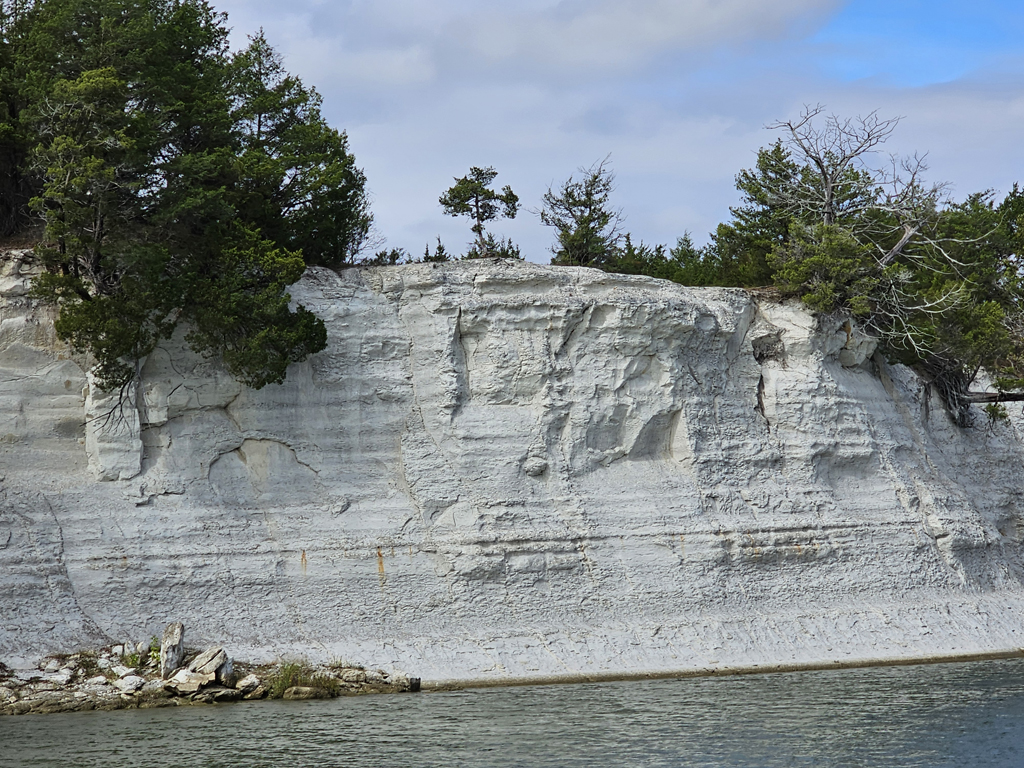
We passed a stretch that was an interesting lesson in geology and canal construction.  Later, we came to the White Cliffs of Epes, also known as White Bluff, or Ecor Blanc. These spectacular cliffs are formed of chalk that was laid down at the same time as the White Cliffs of Dover, about 145 million years ago.  The cliffs are 80 feet high, but they are in a difficult spot for most travellers to admire them, as they are best seen from the river.  Chalk was formed by layers of marine organisms, and these 80-foot cliffs would have taken about 1.4 million years to be laid down.  This chalk underlies the fertile Black Belt that cuts in a crescent through Alabama. Apparently, an underlying chalk base is impermeable and leads to very rich soil above, making the Black Belt area a perfect place for growing cotton.

Geology and construction of the waterway
White Cliffs of Epes

Now that most of the cotton is gone, the chalk underlying the land means that it is particularly suitable for landfills.  15,000 tons of trash per day, originating from 33 states, arrives at just one of these landfills.  The same landfill was used to bury more than 4 million tons of coal ash slurry from the TVA Kingston Spill in Tennessee that I wrote about earlier this trip.  Further down the river there were more white cliffs, not quite as extensive and bright, and so not as famous.

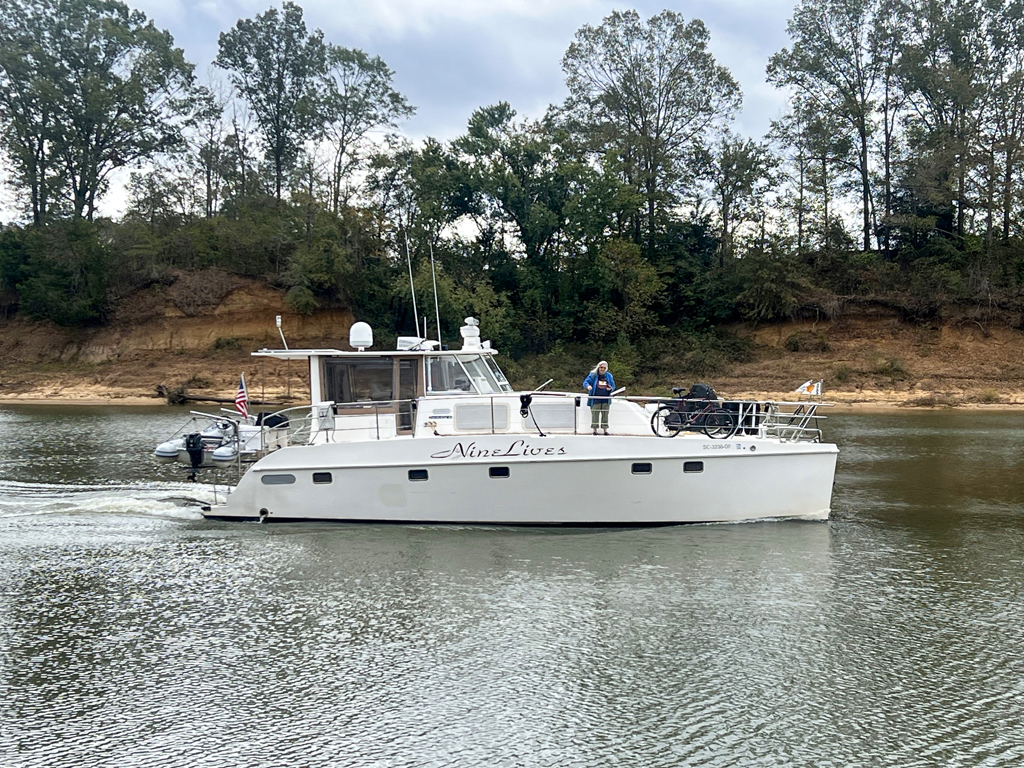
Nine Lives

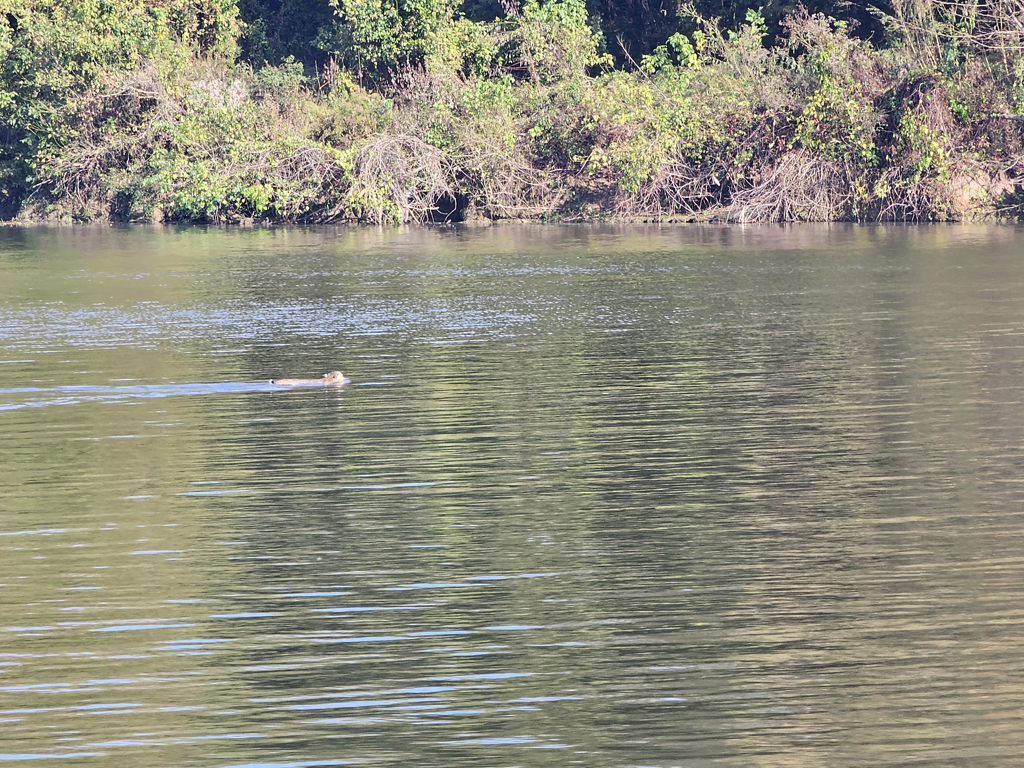
That day was one of the prettiest and most interesting days on the Inland Rivers.  The copper colours of the bald cypress and their twisted roots above the water, the geology, egrets and herons, and the sun shining through the trees in their fall colours all combined to make an exceptional day on the water.  Seeing a large cat swimming across the river was a highlight, although I could not get a very clear picture.  We believe it had to be a bobcat, as there are no cougars in this part of Alabama.  Male bobcats can be up to 40 pounds, so we are pretty sure that is what we saw

A bobcat swims across the river

We crossed 3000 hours on Nine Lives’ engines.  We also moved into the Black Warrior River, the lower part of the Tenn Tom Waterway.  The river is named after Tuscaloosa, a Maubilian chief.  The river rises in the Appalachians, and flows for 169 miles into the Tombigbee River, draining 6228 square miles of the watershed.  Its dams and reservoirs allow use for hydroelectric power, drinking water, and transportation.  The basin that it flows through is still important for mining coal and methane, although we saw fewer coal-carrying barges here than we did last year on the Ohio River.  Mobile is still the largest coal port in the southern United States.  There are 50 active coal mines on the river.  The Black Warrior has also been an important waterway for shipping iron and steel.

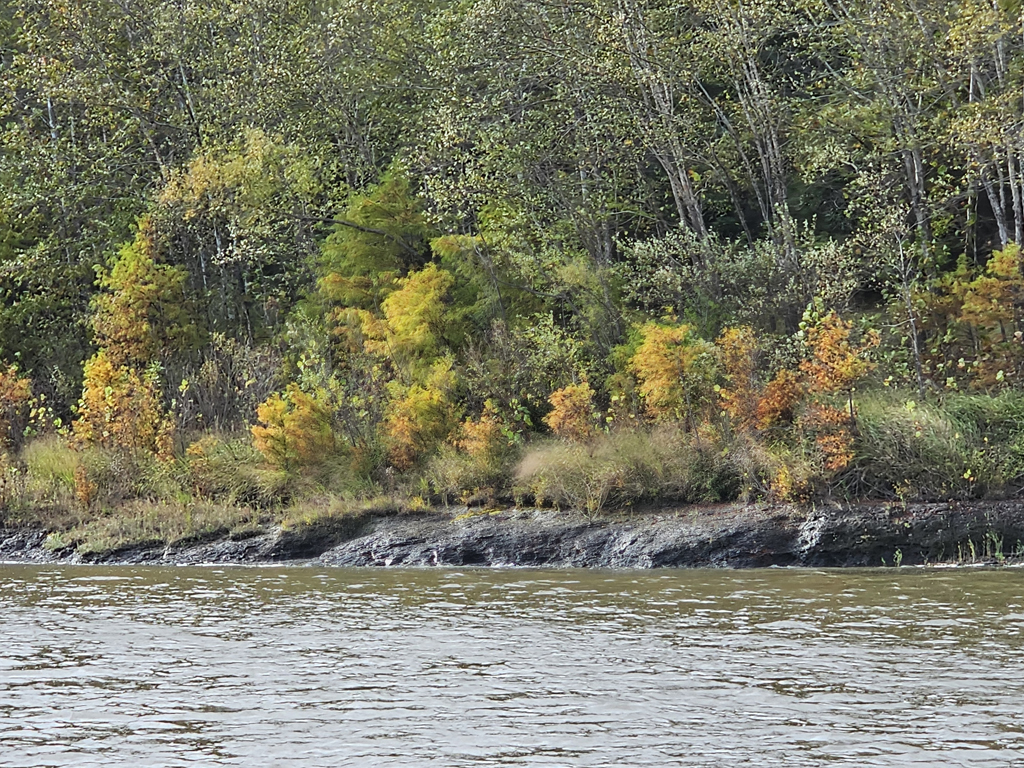
Fall colour above Demopolis

Reading about the Black Warrior River and its early history, we find yet another ugly chapter in the region’s history.  The Muskogee Indians, including the Creek tribes, lived in this area, with the Maubilians occupying the farthest south areas with the Tensaw tribes.  An estimated 2,500 to 5,000 Maubilians, under the leadership of Tuscaloosa, the legendary Black Warrior, were slaughtered by Hernando de Soto in 1540.  The Spaniards effectively wiped out the Maubilian culture, but their name lives on in the city of Mobile.  Mobile comes from a French variant of Maubilian.

We arrived at Demopolis and were tied up by 2:15. They put us on the fuel dock because there was a 97-foot Marlow coming in that would take up the whole of the long T-dock where we would normally have been assigned.

Kingfisher Bay Marina at Demopolis

In the evening, we were happy to welcome Sandy and Frank from Proost on board for dinner.  It was Nasi Goreng.  Frank is originally from the Netherlands, and the dish is a favourite for all of us.  We enjoyed a very congenial evening, swapping stories and comparing how Nasi Goreng should be prepared, and which condiments should accompany the dish.

The group of boats that planned to leave in the morning included the big Marlow, but their appointment at the lock was 6am, which would have meant leaving before sunrise.  Dick decided we were not going to do that.   Unfortunately, the lock had later scheduled maintenance (we suspect that the early group knew this and failed to share that information).  We were able to go to the lock shortly after 10am, but then we had to wait an extra 15 minutes while a towing boat with a disabled sailboat maneuvered out of the lock.  We were finally on our way downriver by 11am.

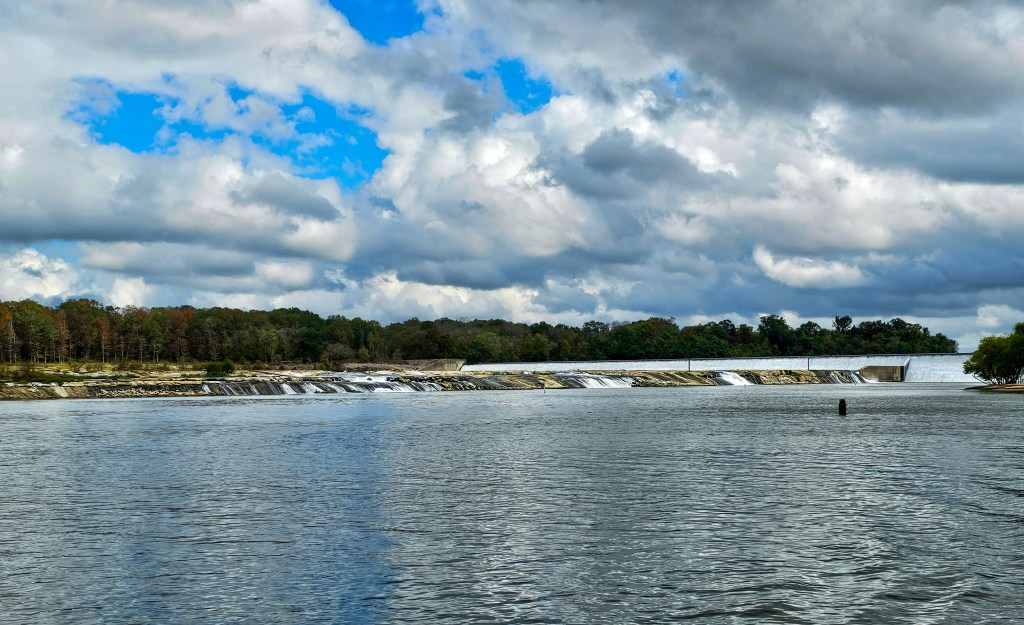
The spillway below Demopolis Lock
A chemical plant
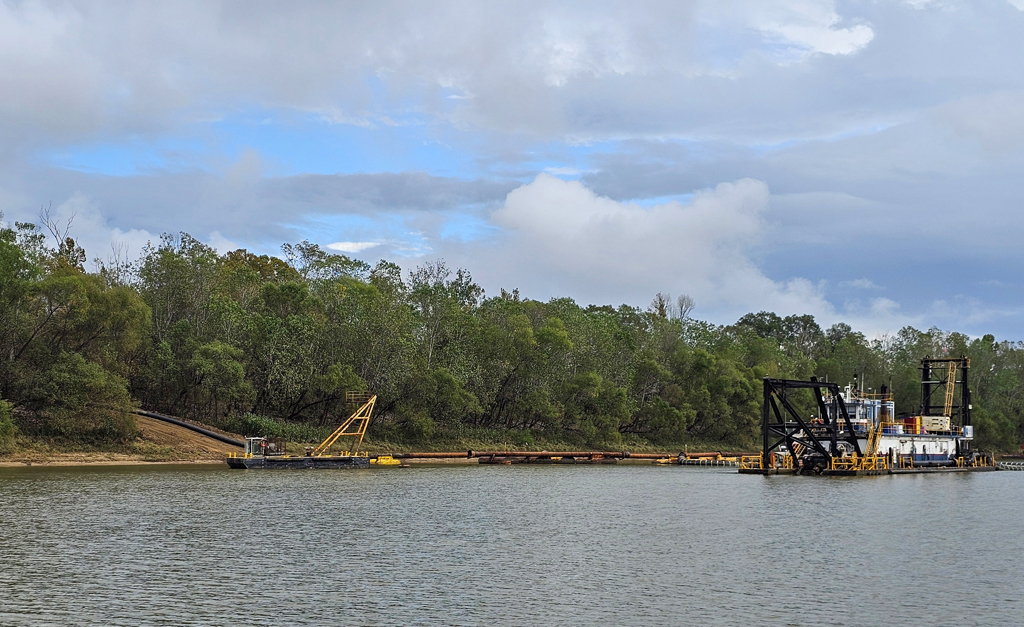
Dredging the Black Warrior River
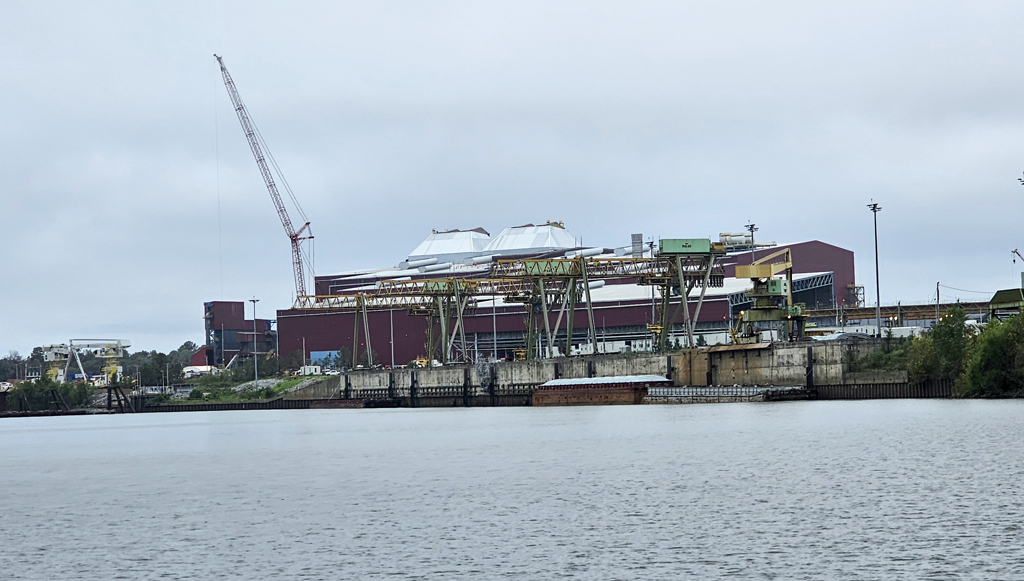
A steel rolling mill on the Black Warrior River

I was surprised and disappointed that after a day of lots of wildlife and very pretty scenery, our first look at the Black Warrior River was not nearly as nice.  In fact, it was long hours of boredom, with mostly scrub growing along the banks, no houses, and only the occasional wood products plant to look at.  There are very few anchorages along this stretch, and even those are simply in a shallow area in a wider part of the river.  I was not happy, looking at any of the choices.  We had departed Demopolis with 4th Dimension, another Endeavourcat, that we have been leapfrogging on this journey.  Kip and his wife have been around the Great Loop 4 times, and we knew that they planned to stop at the same anchorage as Dick had chosen.

There were two places to anchor on the bend, and Dick eased into the upstream area, trying to leave space for 4th Dimension.  He soon discovered that the river shelved rapidly, and with just 4 feet of water under the boat there would be no room to swing.  We absolutely don’t want to be putting out a second anchor to hold us in place, although many boaters do choose that solution.  At this point, it was clear that Kip was heading towards the downstream section of the bend, so we followed.  Dick got on the radio and asked if we could set our own anchor alongside, and then raft up.  That way we would swing together.  Kip was dubious.  His concern was that if we swung 180 degrees, our anchor chains would twist together and be a heck of a mess to untangle.  The forecast was for the wind to stay in the same direction, but drop overnight, so it was decided there was little risk.  It was a great advantage for us, because Kip has broadcast-AIS.

Automatic Identification System, AIS, is a feature that all commercial vessels must have by law, and that is available for pleasure craft.  Pleasure craft can have broadcast-and-receive-AIS as part of their radio setup, or receive-AIS only.  Way back in 2016, when we had to replace our secondary radio due to a lightning strike, we would have preferred to have the full AIS transponder, that is, both broadcast and receive.  At the time we were told that a new radio with broadcast-AIS would be several months before it could be delivered, but receive-only was available immediately.  Dick felt that it was more important for us to be able to see the commercial traffic, than for them to be able to see us.  Interestingly, so it has proved.  What’s more, in 8 years of voyages we have never once heard a tow call a pleasure craft because of the pleasure craft’s transponder, and the one time we were called by a tow it was because he saw us on radar.  So, Nine Lives cannot broadcast AIS.  Our position in that anchorage put us out in the river, disturbingly (for me) close to the sailing line.  With Kip broadcasting AIS, we felt that we were far more visible to tow traffic than our anchor light alone would have allowed.

The tow that passed us shortly after dark threw us around with its prop wash as it powered through the bend, but our anchors held us in place.

We were able to reciprocate a little, because our location had poor cell service and Kip was unable to watch the election night results come in using his phone as a hotspot.  Our mi-fi was doing a sterling job as always, even with just 1-2 bars of reception, it gave enough bandwidth for up to 5 devices, and we were able to share it with 4th Dimension.  We all passed a peaceful night, especially as there was no more tow traffic.

Autumn colour below Demopolis

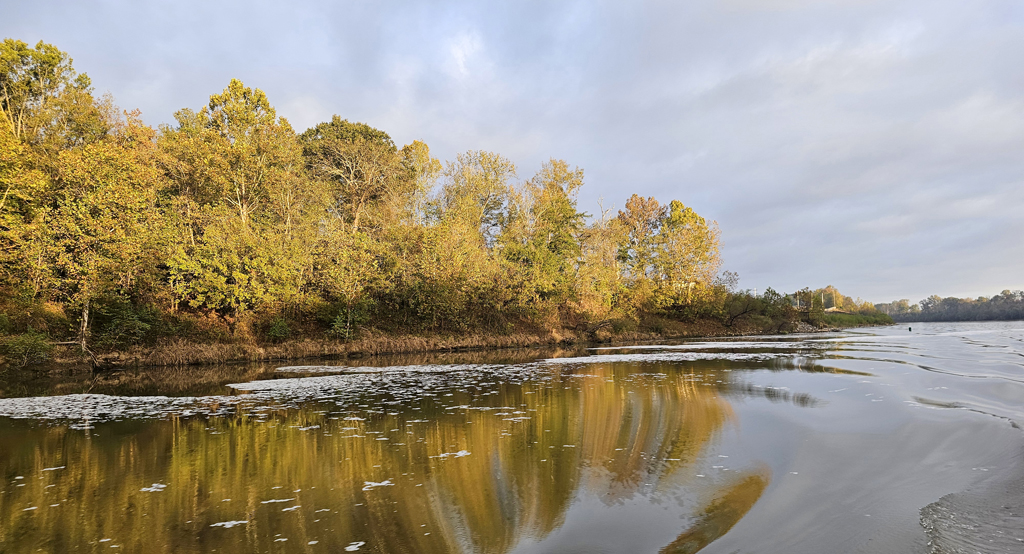
We needed an early start, hoping to get well below the next lock that day, a 100-mile step.  We were untied and up anchor and on our way by 6:10am.  The water was incredibly still, with mirror reflections.  Even though it was the same relatively ugly scrub, in the morning sunshine and clear water it was very pretty.  Except for the stretch below a water treatment plant. We could see the outflow bubbling up and about 2 miles of foam sitting on the water.

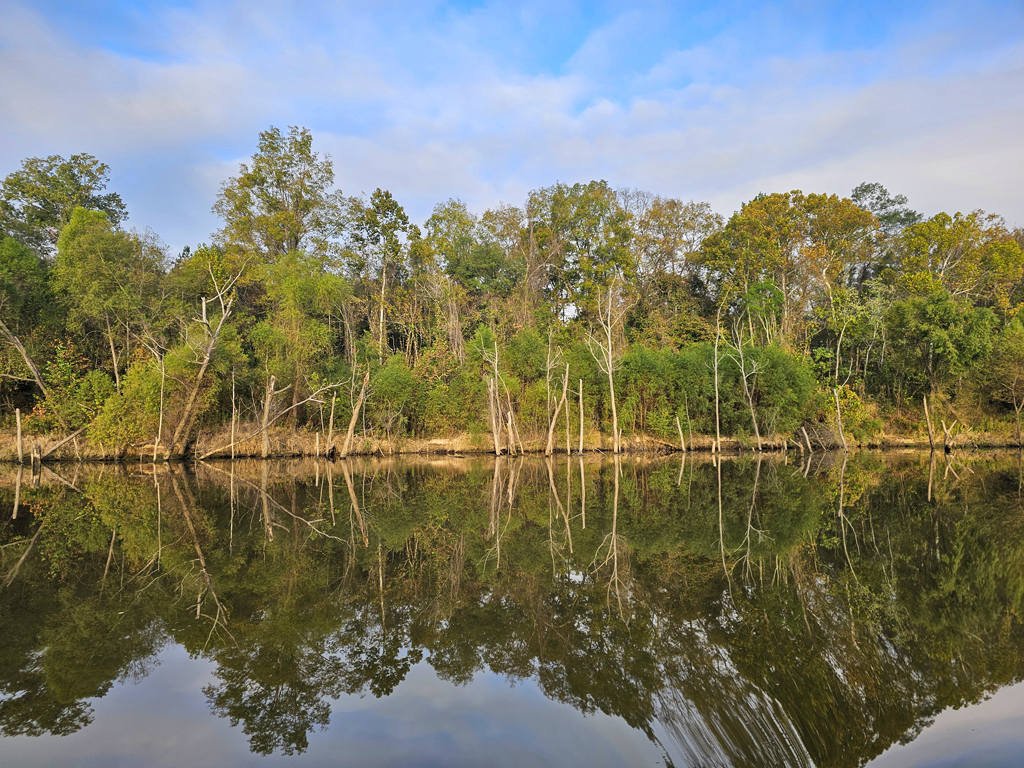
Still water and reflections
A pretty stretch of the river
Foam on the river from a water treatment plant outflow

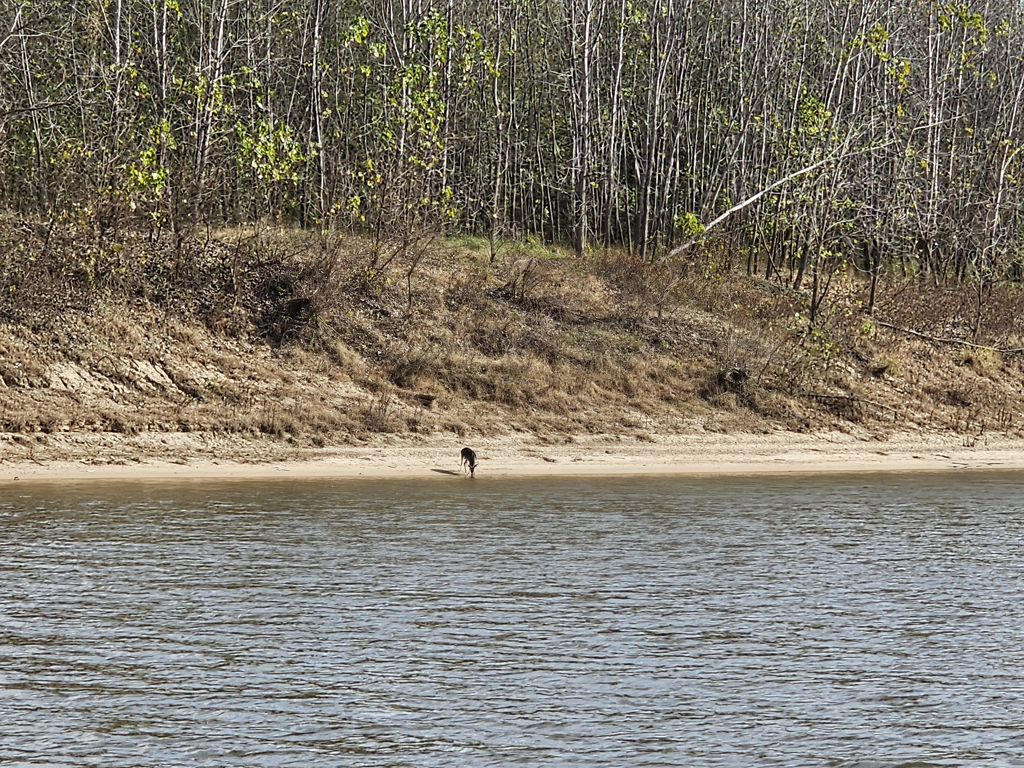
Although not too obvious, there was some wildlife other than birds.  In addition to the cat we saw swimming a few days before, and the deer on the beach, Dick saw a bear in some bushes, and we saw our first gator swimming near the shore.  As I read about the area, I discovered that alligators once were found as far north as Missouri, and that a few still live in Wheeler Lake in Tennessee.  They were on the list of Endangered Species in 1973, but have come back and are now in the category of Least Concern.  Today they are gradually expanding their range back towards northern states where they were previously extinct.  Alligator farming is now a big business, producing both meat and hides.  Dick will order alligator in a restaurant, but I do not.

Deer on the shore

We passed the famous, or rather infamous, Bobby’s Fish Camp.  It is a character place, the only possible stop for Loopers who must have fuel and/or water on this stretch of the Loop.  Only the first 3 boats to arrive fit on the dock, the rest must raft up, and do not get power.  Regardless, all pay the same $2.75 per foot (compared to $1.25 at Columbus and Midway, both of which are proper marinas).  Bobby used to be a real character, but he died, and the subsequent owners apparently lack his charm.  I say no more.  We did not plan to stop there, as we did not need fuel or water, and feel it is better to leave spaces for those who really need them.

Bobby’s Fish Camp with a single long dock that has space for just 3 boats

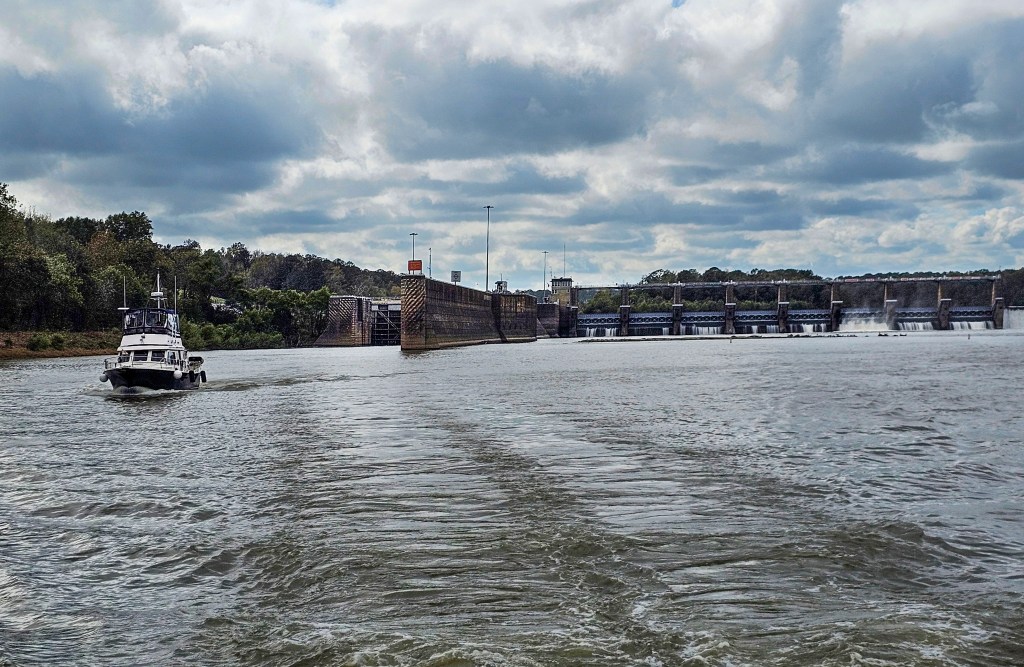
We were able to catch up to a group of 4 Loopers who had already contacted the Coffeeville lock, so we were through with no delay.  Just as well, with a further 3 hours to our planned anchorage.  That was our last lock until we travel all the way around Florida and arrive back at Wexford!  We have done 421 lock transits in total on the Loop.

Leaving Coffeeville Lock, our last lock on the Great Loop!

We anchored in a bend in the river with about 7 feet under the boat.  There was no wind, and a bit of current, but plenty of room to swing, since we only had about 80 feet of chain out.  Later, after dark, a tow passed us.  It was interesting to see their searchlight sweeping back and forth, and it was very comforting to see how far to the other side of the river they passed by.  We also felt no wake or propwash, since they were so far away and had to go very slowly around the series of bends in the river.  Overnight there were other tows passing, but Nine Lives did not even rock as they passed by.  The river is tidal at this point, and overnight we did swing 180 degrees, but we were still in deep enough water and well off the sailing line.

As we raised the anchor, there was a disturbing moment when the clutch (part of the electric windlass that pulls the anchor chain) began to slip.  “Shit!” said Dick.  However, he did not immediately expand on his remark.  When prompted (remember that we are wearing headsets for communication), he said that the clutch was slipping.  Further muttering, followed by the comment that the anchor must be snagged.  I moved the boat forward to see if we could move past the snag, and Dick then took hold of the anchor chain and was able to lift the anchor off the bottom with no difficulty.  That is, no difficulty apart from manually lifting a 55-pound anchor and accompanying 3/8-inch chain.  Once the anchor was well off the bottom, I eased Nine Lives away from the anchorage and into the river while Dick figured out what had happened.  It turned out that the clutch slipping had been doing its job of protecting the windlass, because the chain had piled up and jammed in the locker.  Once freed, everything worked smoothly, and we were underway by 6:35.

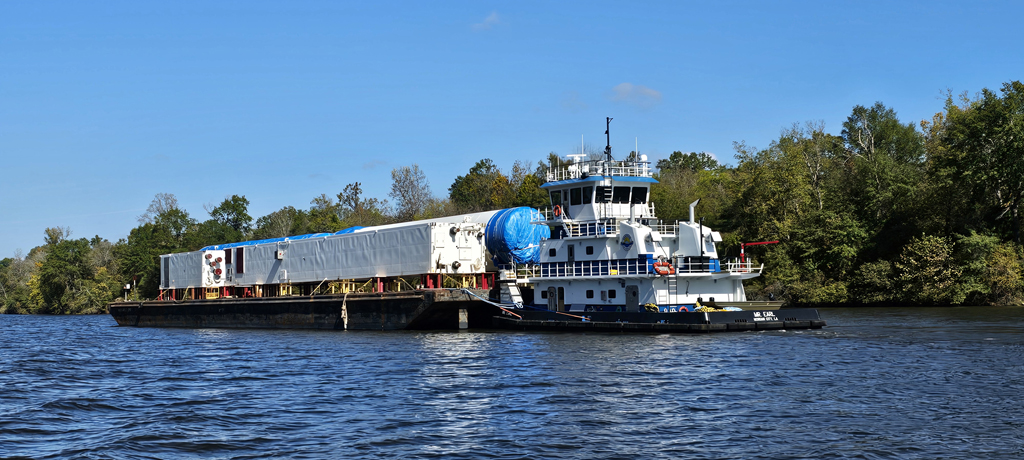
A passing tow with an unusual load

This was again quite a long and mostly boring stretch of river.  We did see 4 brown pelicans fly past us, quite a while since we have seen those.  They are a strictly coastal breed, and feed by diving from above and scoping up the fish.  The larger white pelicans that we have seen for the past few years are migratory on the Inland Rivers, and feed by scooping up fish from a floating position.

Brown pelicans on a bridge abutment

There is quite a change in vegetation in a fairly short stretch of river.  Palmettos, Spanish moss, cypress and loblolly pines begin to dominate.  In addition to the herons and egrets, we also saw kingfishers and osprey as well as seagulls.  We were now definitely in the bayou.

Celebrate our last lock of the Loop and our arrival in salt water

We anchored in a creek off the Tensaw River that feeds into the Mobile River.  It is 12 miles north of Mobile, and 25 miles from our next day’s destination at Fairhope, on the east side of Mobile Bay.  Notwithstanding previous reviews of the anchorage, the current in the creek was not enough to hold us in place against the change of the tide so we woke up to find ourselves facing the opposite direction from when we went to bed.  After more than 6 years since we anchored in tidal waters, I had forgotten to set the alarm to allow for the swing.  We were up in the night checking to see that the anchor was holding and that we were where we should be.  There was debris that had to be cleared from the bridle and the pontoons before lifting the anchor, and it came up with quite a lot of black mud.

The track showing where Nine Lives meandered overnight
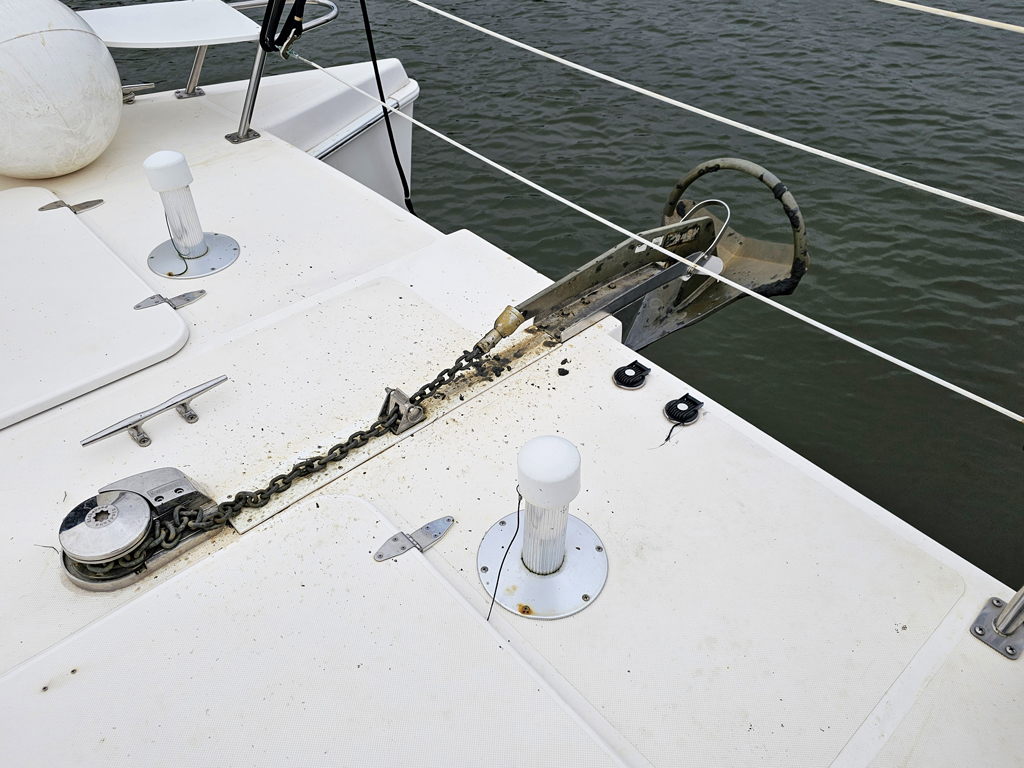
Muddy anchor
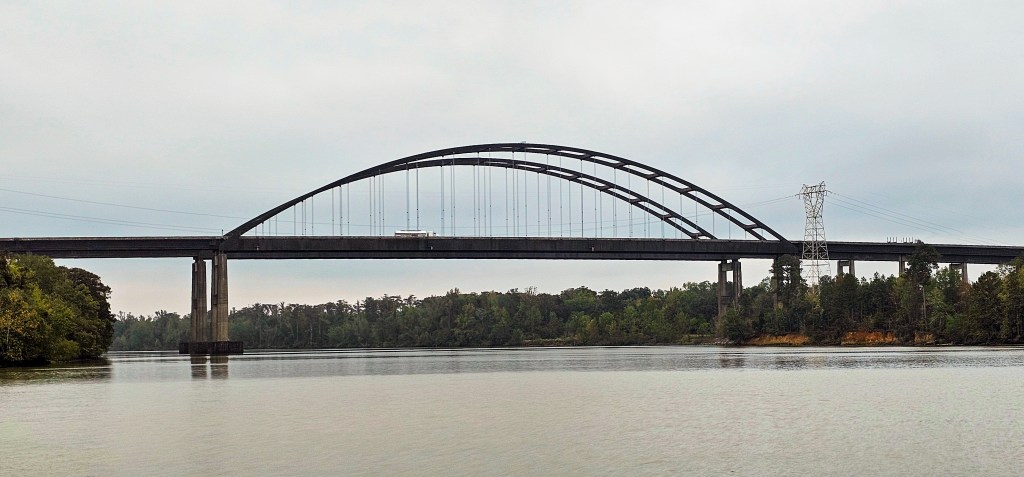
Interstate 65, we passed under it, and then later we drove across it.

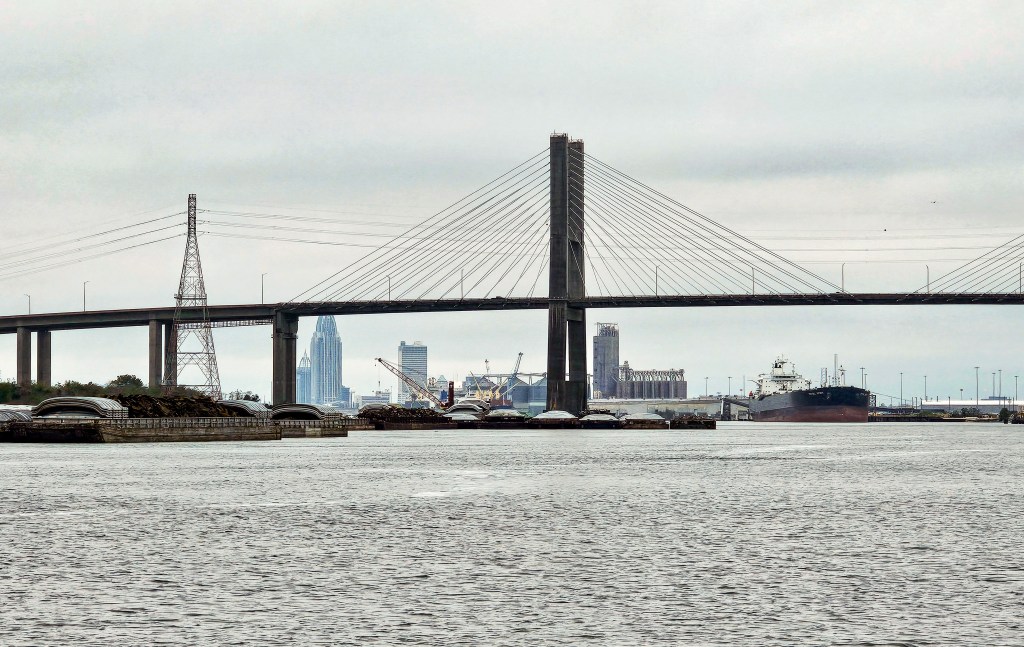
We arrived in Mobile Port.  We haven’t seen that many barges since Cairo (at the junction of the Ohio and the Mississippi Rivers).  There was an oil tanker docked, we haven’t seen those big boys since the Great Lakes.  We felt very small as we made our way through the port traffic towards Mobile Bay.

Arriving in Mobile Harbor

Mobile is the second-largest city in Alabama.  Its position on a protected saltwater bay has been the key to the success of the city from its founding by the French in 1702, when it was the first capital of Louisiana.

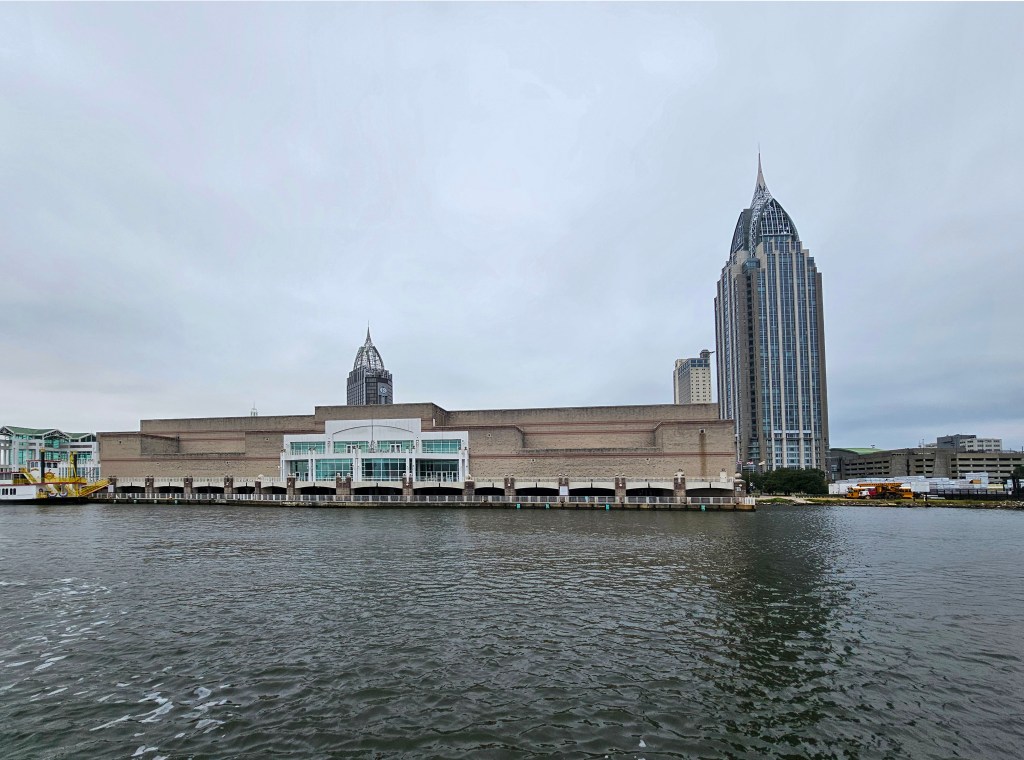
We passed the Convention Center, where you can dock, for a fee, with no power or water.  Some Loopers stop there, but it is reported as not particularly safe to leave your boat there, so it seems somewhat pointless.  We were very lucky with the big ship traffic.  The only ship that was underway had already slowed down for the harbor entrance, so we did not have to deal with the kind of wake the big fellas create.  A passing boater in a 44 ft trawler told us that cargo ship had passed him in the bay and had thrown him around “like a rubber duckie”.

Mobile Convention Center
Following a tug through Mobile Harbor
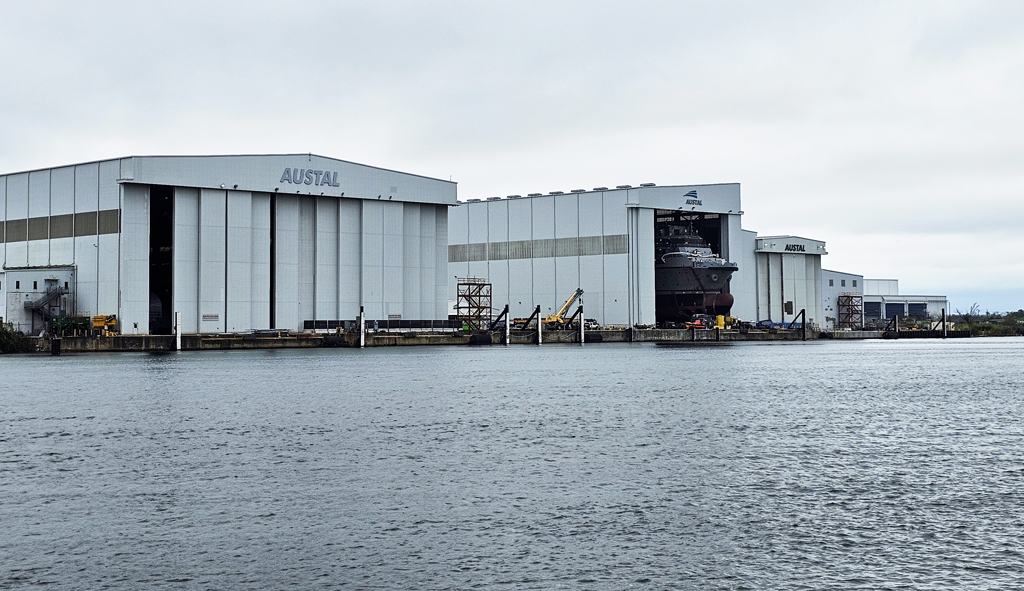
Drydocks for shipbuilding in Mobile
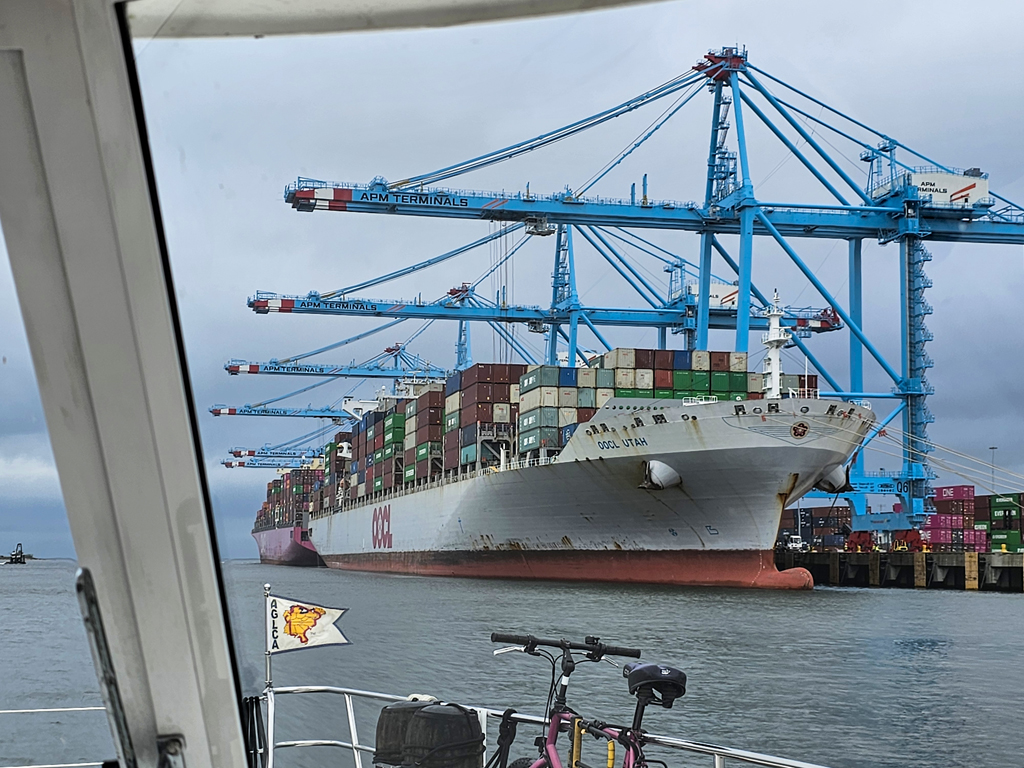
A container ship loading in Mobile Port
Container ships and Mobile downtown in the distance
A cargo ship arriving in Mobile Port

Although the wind was stronger than expected, thanks to a hurricane passing across the Gulf, it was still not too bad, and it was an easier crossing once we were out of the ship channel and no longer heading due south with the wind on the beam.

We arrived in Fairhope Marina by 11am.  Our side tie was at the end of the last dock, nearest the bay.  At the entrance to the channel, we lost the 5G T-Mobile signal, so our mi-fi router did not work, and neither did my phone, although Dick’s was working.  It turned out that his phone receives only 4G.  After a long conversation with T-Mobile and a change of setting on my phone, my access was restored, and we had instructions for changing the mi-fi.

Pelicans at the Fairhope Marina entrance

Dick took Uber to collect the rental car.  Enterprise advertises that they pick you up, and about half the time they do, but not in Fairhope.  Although the town claims to be “bike friendly”, that applies only when you are in the downtown.  To get there you have to ride for several miles on a narrow road with no shoulder.

Sunset on our first evening in Fairhope

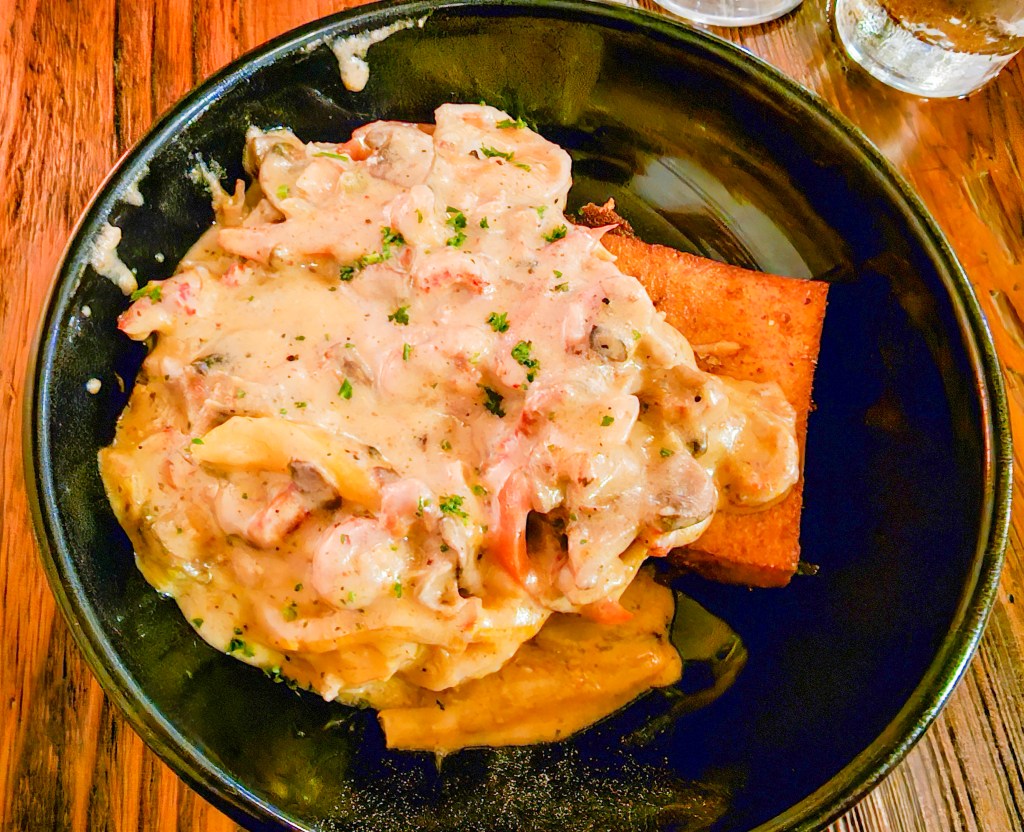
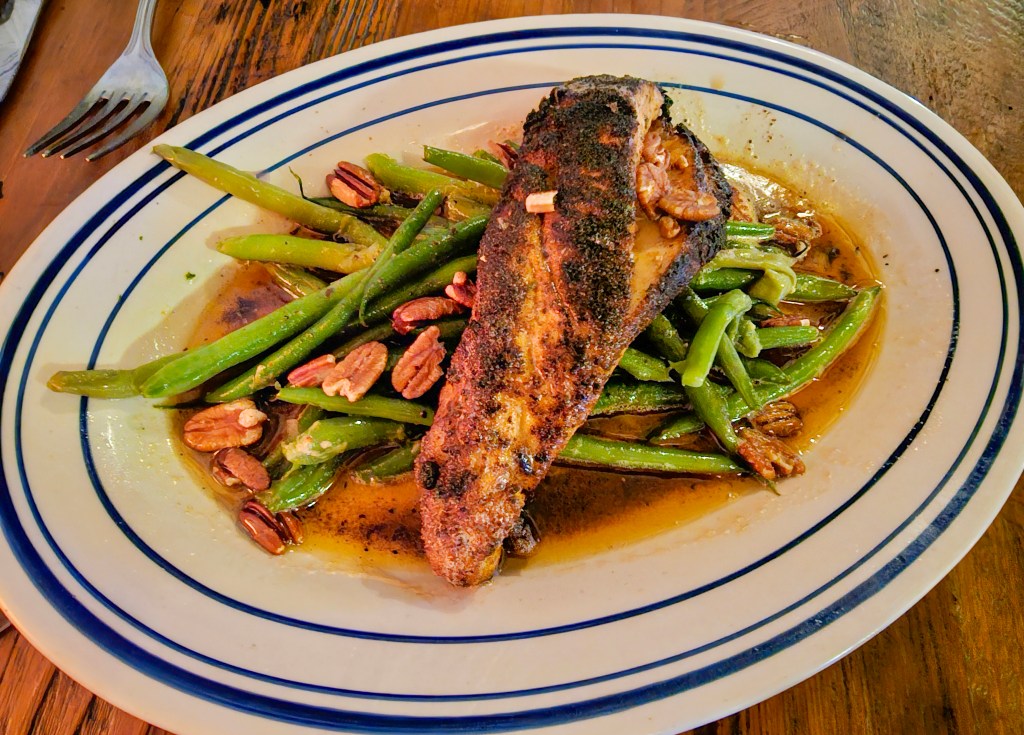
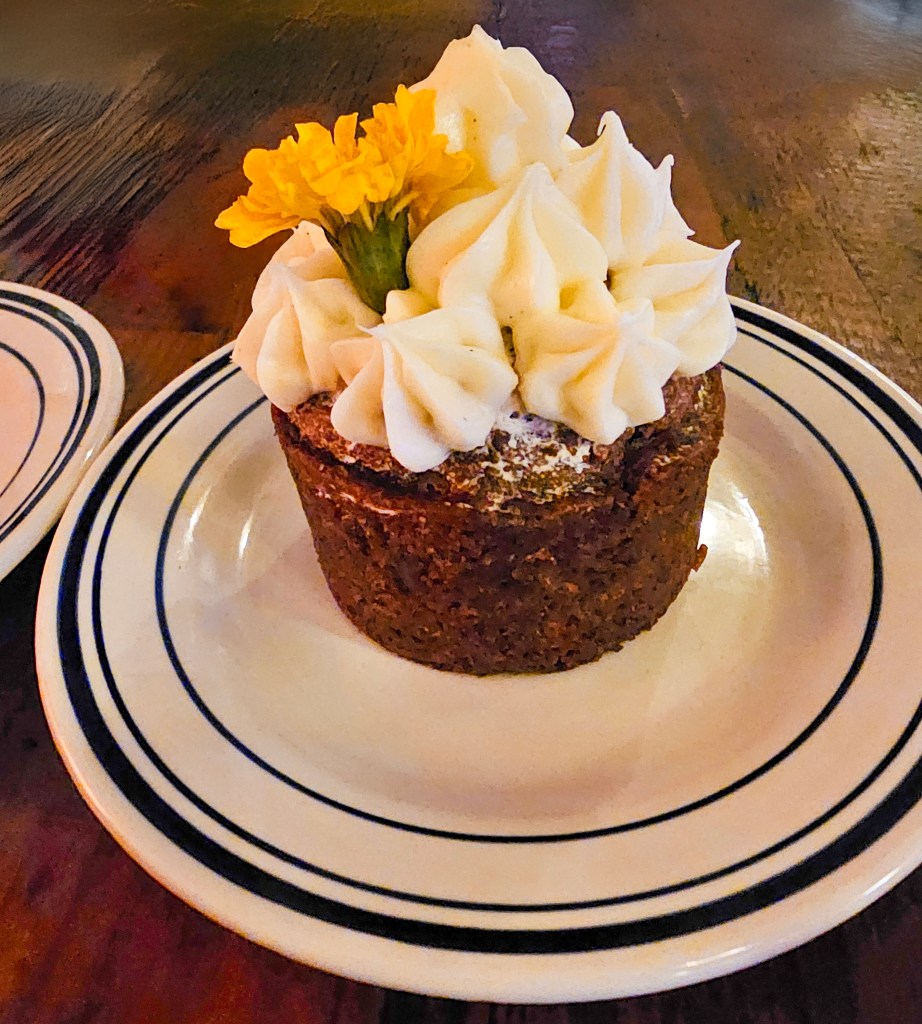
We drove to an interesting French/Southern cuisine restaurant, R Bistro.  It was very crowded, with several large groups, including a birthday group of 8 women who were right next to us.  The noise in the restaurant was unbelievable.  The food was delicious though, and we would certainly return if we lived in the area.  Dick started with gumbo, and I tried their crawfish beignets.  My shrimp and grits were served on a grits cake, an unusual presentation, and Dick had blackened grouper.  None of the desserts appealed to me, but Dick loved his carrot cake (I had a tiny taste and thought it was awful!)

R Bistro
Shrimp and Grits at R Bistro
Blackened Grouper at R Bistro
Carrot Cake at R Bistro

The next day we went first to a local Publix, quite simply the best supermarket we have been to in years.  After returning to the boat and putting away the food, we set out to explore the town.

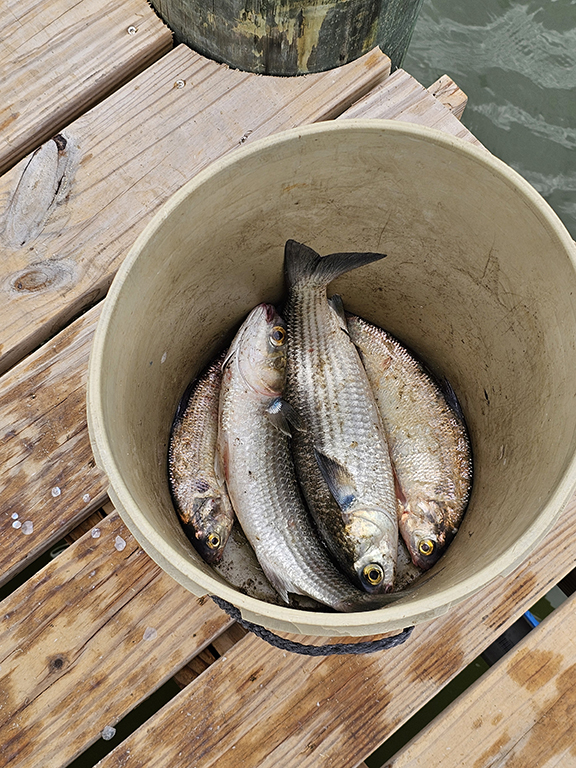
People enjoy fishing on the docks at Fairhope, here is a catch of mullet

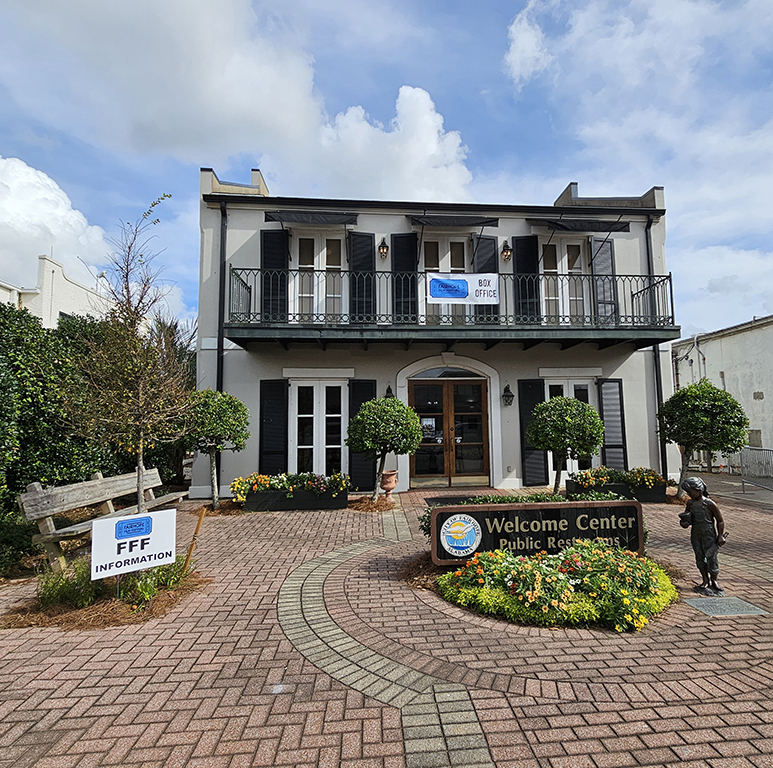
The city of Fairhope was founded in 1894 by a group of colonists who supported the economic theories of Henry George, who believed that there should be no taxes other than a single tax on land.  The idea was popular, and colonists and financial backers flocked to the area.  From its beginning as an optimistic utopia (and before you get all excited and think about relocating, today they do pay all the usual taxes), Fairhope grew as a resort area, with people coming across Mobile Bay to enjoy the quiet and the scenery.  It became a popular place for artists and intellectuals to spend the winter.  Today it is a resort area and a bedroom community for wealthier commuters from Mobile.

Fairhope Welcome Center
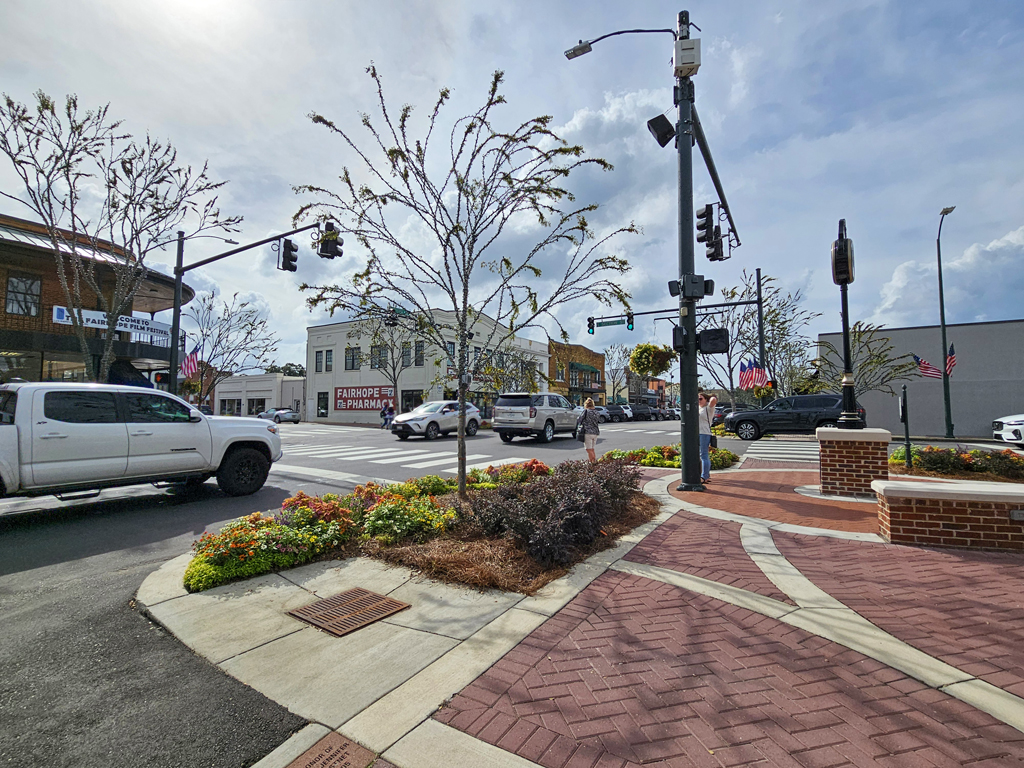
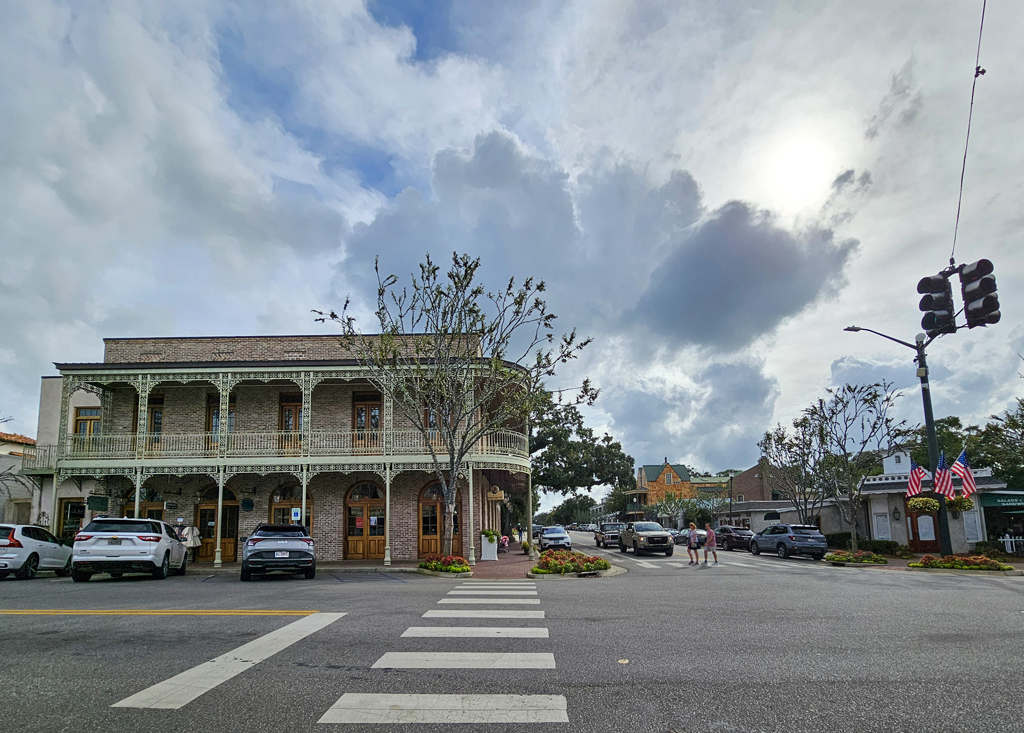
Downtown Fairhope
Downtown Fairhope

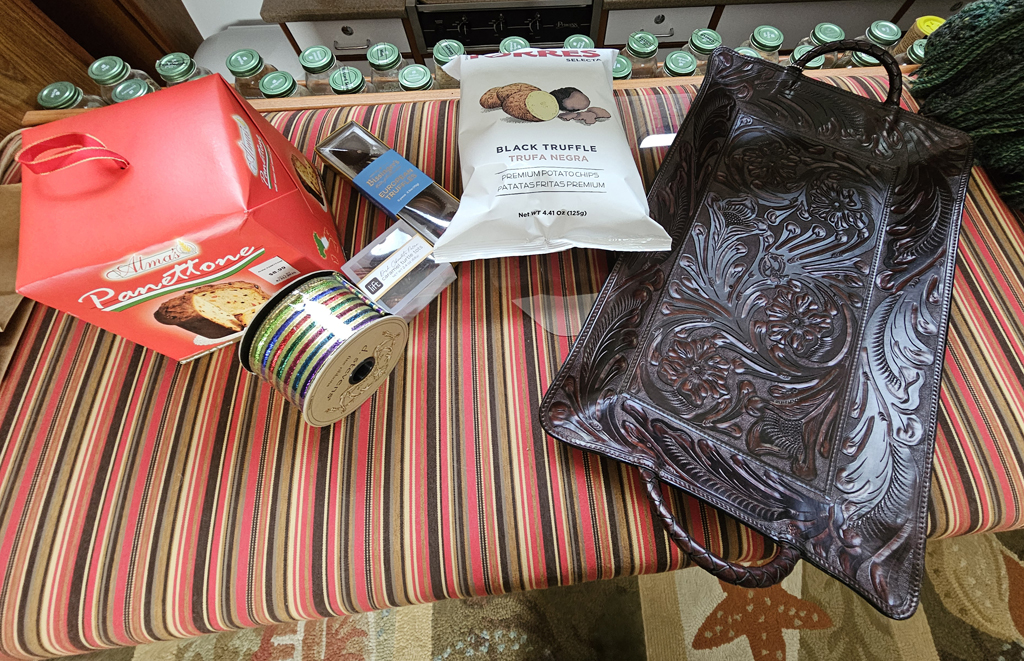
In Fairhope we found some of the best main street shops we have enjoyed looking around for a long time.  We bought a hand made leather tray in an antique shop, and at the other end of the spectrum, some exotic potato chips and a few chocolates in a specialty food shop.  Afterwards, I had been hoping for a cappuccino at one of the many coffee shops, but Dick had a different idea.

Our souvenirs of Fairhope

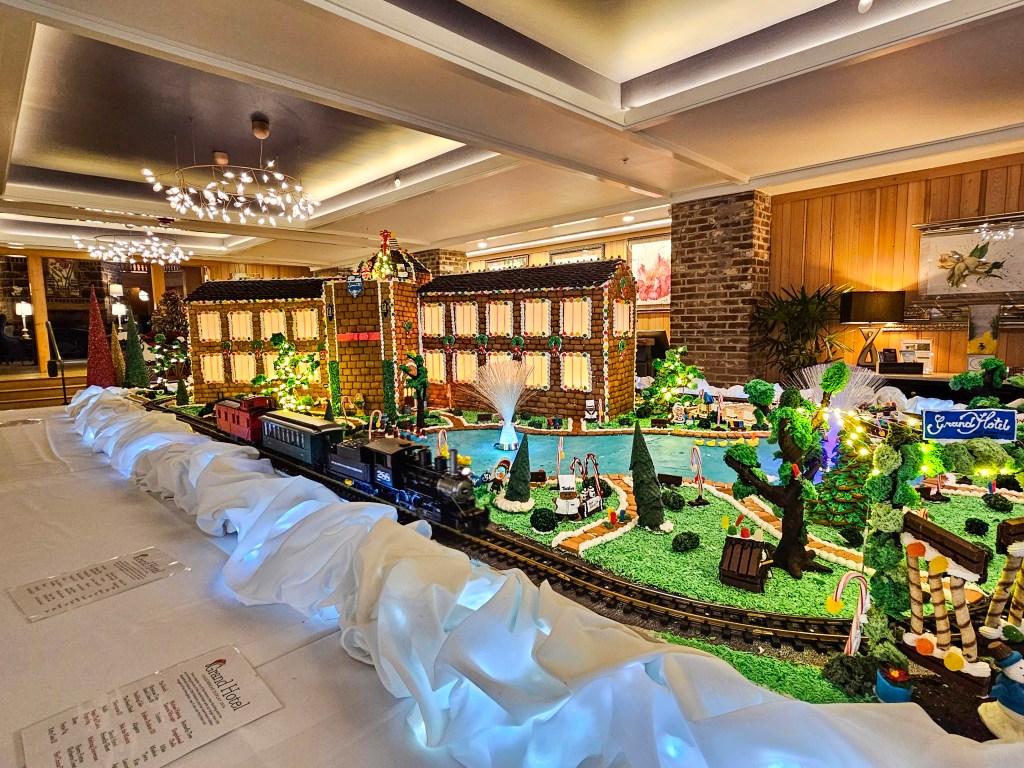
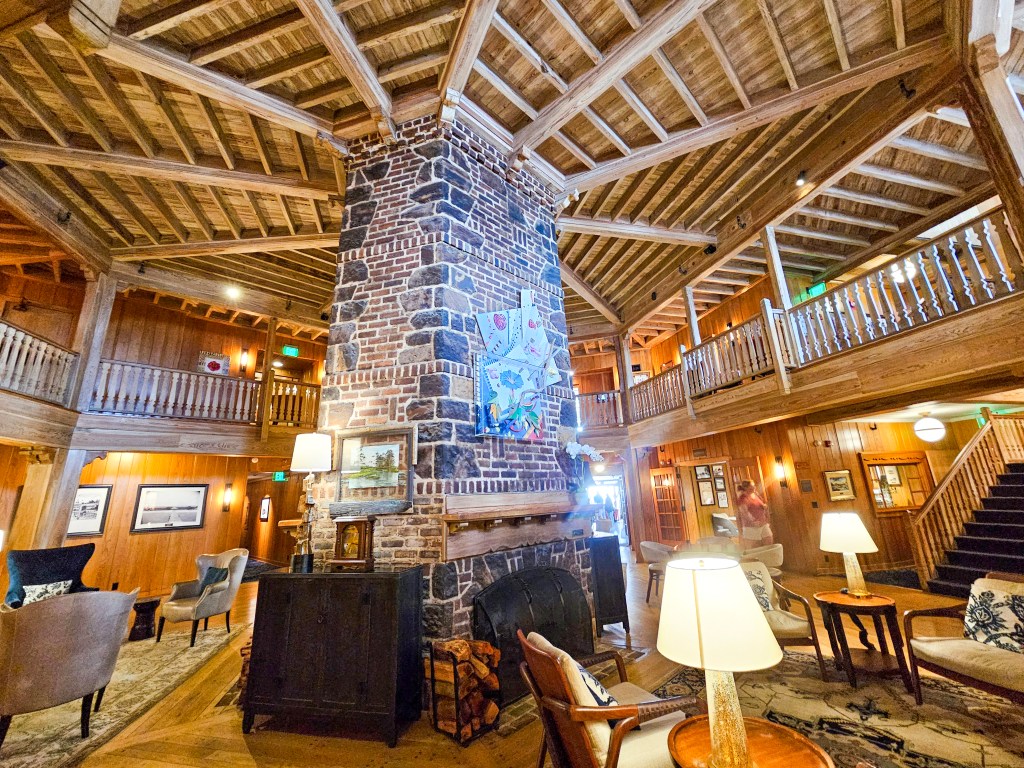
We drove a few miles out of town to the Grand Hotel, a historic hotel that is now part of the Marriott Autograph Collection.  There has been a hotel on the site since 1820, and by 1847 a large establishment had been built.  During the Civil War, the hotel was used as a Confederate hospital, and over 300 soldiers are buried in the Confederate Cemetery on the grounds.  The present hotel was built in 1941, and during World War Two it was used as a training base for US Army Air Force amphibious landings.  In the lobby was an amazing gingerbread and candy display depicting the hotel and the grounds, with a train running around it.  Children and adults alike loved it.  We enjoyed an excellent cappuccino and a cherry Danish in the lobby and made note that we will hope to come and stay there one of these days.

The Grand Hotel in gingerbread
The atrium at the Grand Hotel
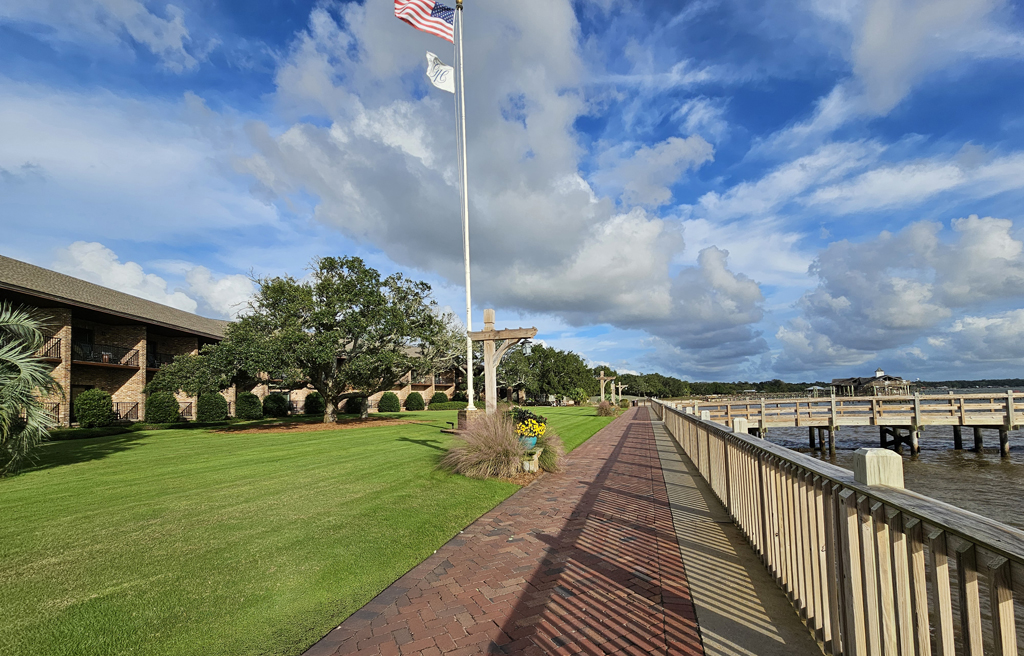
The grounds of the Grand Hotel

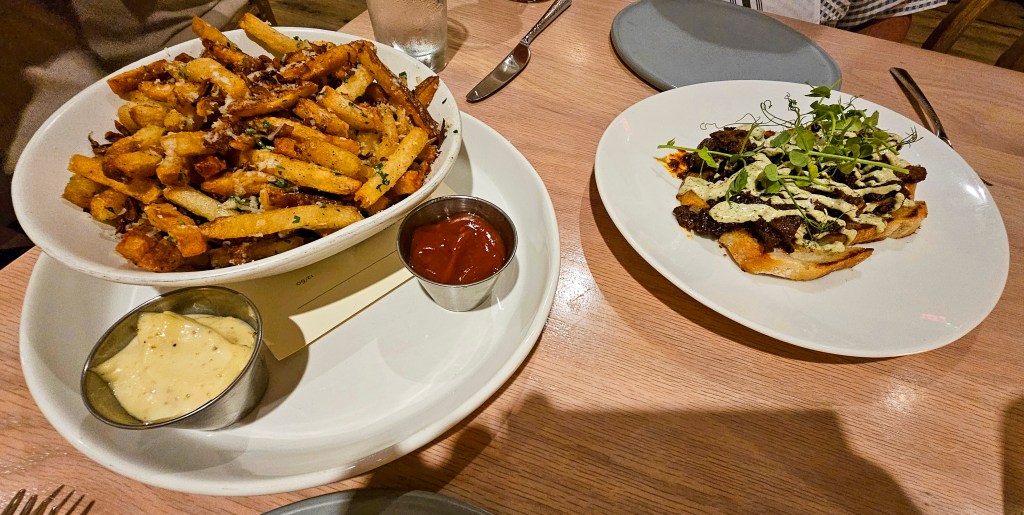
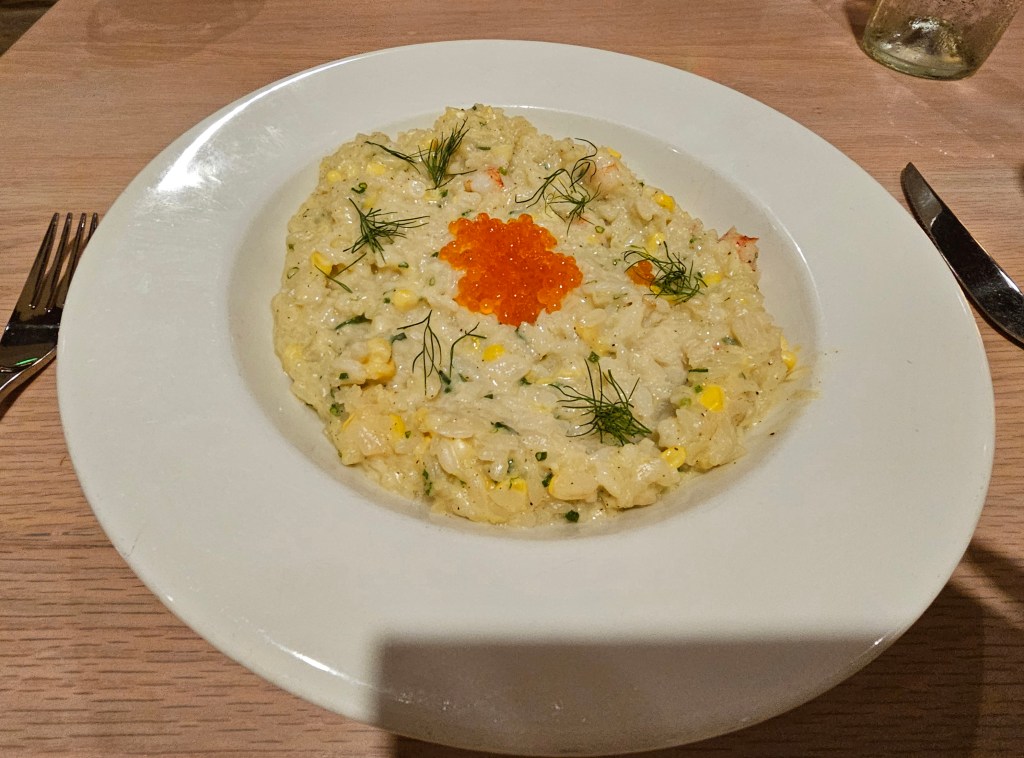
Sadly, the dinner in the evening did not live up to the delights of the day.  Hope Farm is all about the trendy farm-to-table concept, and they boast about their own produce, but since they appear to grow mainly brassicas and mushrooms, it makes for some odd combinations in the dishes on offer.  Dick enjoyed his highly recommended mushrooms on toast for starter, but my fries with parmesan and truffle garlic aioli missed excellence because they were not hot.  I had the shrimp risotto, properly prepared rice, but if there were 5 tiny shrimp in there I would be surprised.  Dick’s tomahawk pork chop was delicious.  Dick was then persuaded to try some home-made ice cream that involved bacon.  He said it was good ice cream, but the flavour was just too strange.  I was tempted by the “duck fat caramels with sea salt”.  It was explained that the cream was replaced with duck fat, and our waiter considered them an amazing treat.  Amazing might be the operative word, but not in a good way.  It is a long time since I have consumed anything as awful that was not intended as a cure for illness.  They were too gooey to bite in half, so I ended up with this large, sweet, incredibly greasy lump of goo that had to be consumed (and no hint of the promised sea salt).  As I worked through getting the disgusting mass so I could swallow, Dick unhelpfully kept offering his weird tasting ice cream “to wash it down”.  Uggh.  I can still taste that greasy mess when I think about it.  I told the waiter they should give it all back to the ducks.  He was delighted to receive the remaining 5 of these so-called treats, and he also took them off the bill, which was a kind gesture.

Hope Farm starters
Hope Farm shrimp risotto. I couldn’t find more than a couple of tiny shrimp.
Hope Farm pork chop

The next day was entirely taken up with repositioning the car.  This involved driving the rental car 6.5 hours north to Aqua Yacht, and then turning around and driving back to Fairhope in convoy.  The northbound journey was not so bad, on roads that had little traffic and no trucks (it was Sunday).  Unfortunately, we did not want to return by the same route because half of the journey would be in the dark, and there would be a high risk of hitting a deer.  Instead, we took the Interstates, which are always busy.  The journey was made longer because of intermittent rain, sometimes heavy.  Dick was good, and drove more slowly than he normally would, partly because of the conditions, but also to make it easier for me to follow.  We left Nine Lives at 6:30am, and were back on board at 8:30pm.  Dick, of course, drove the full 14 hours, my part was just 7.5 hours and I was in our own, more comfortable vehicle.  Even so, this was not a journey I want to ever repeat.  We did another reposition a few days later, but that one was all done in daylight.

Another beautiful sunset in Fairhope

Monday was a day for regrouping and taking care of a few domestic chores.  Dick also traced persistent water leaks that we have noticed these past few weeks.  All three turn out to have slightly different causes, but all essentially are caused by aging plastic connections.  These are made of a particular type of plastic that has been banned in plumbing for some years.  Water is seeping, not a flood, but it does have to be taken care of.  Dick hopes to arrange for all the connections to be replaced when we are way from the boat in December/January.

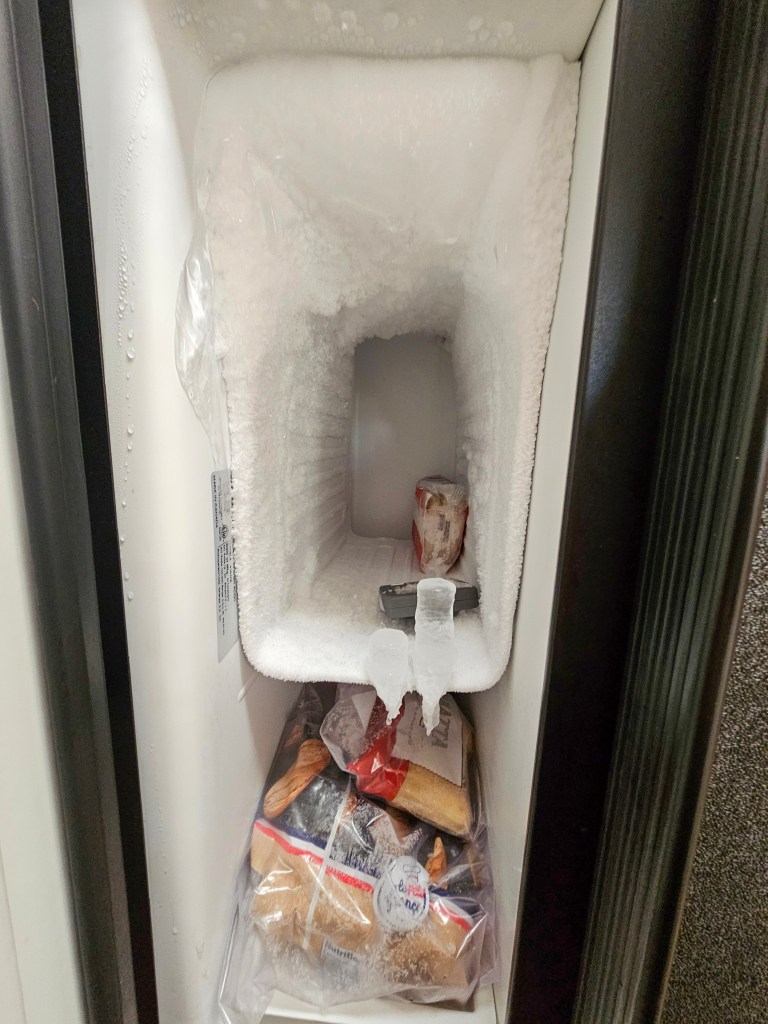
Frosted up freezer waiting for Dick’s attention

In the evening, we had an early dinner at Gambino’s, a venerable Italian restaurant that gets top billing on TripAdvisor.  We enjoyed the meal.  Dick and I both started with the gumbo.  I had a delicious shrimp dish, while Dick tried the fish special.  The fish was tri-tail, a game fish that is also by-catch from commercial tuna fishing in tropical and semi-tropical waters.  We have never heard of it, but Dick said it tasted delicious. 

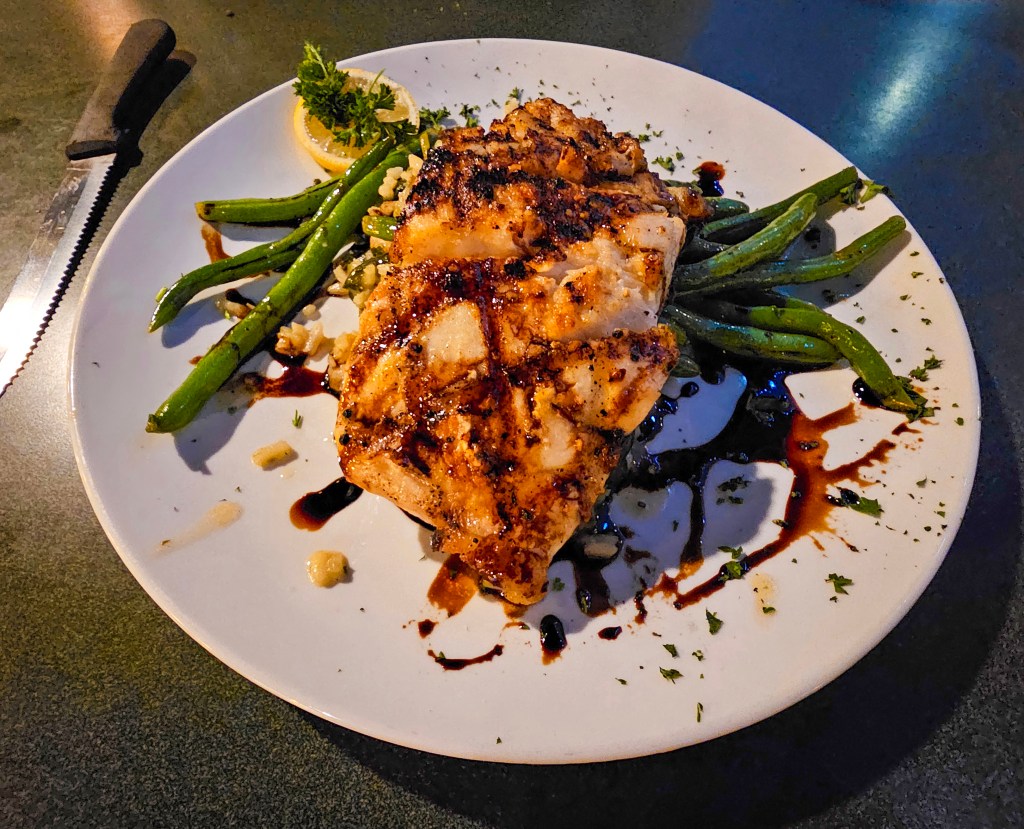
Gambino’s tri-tail
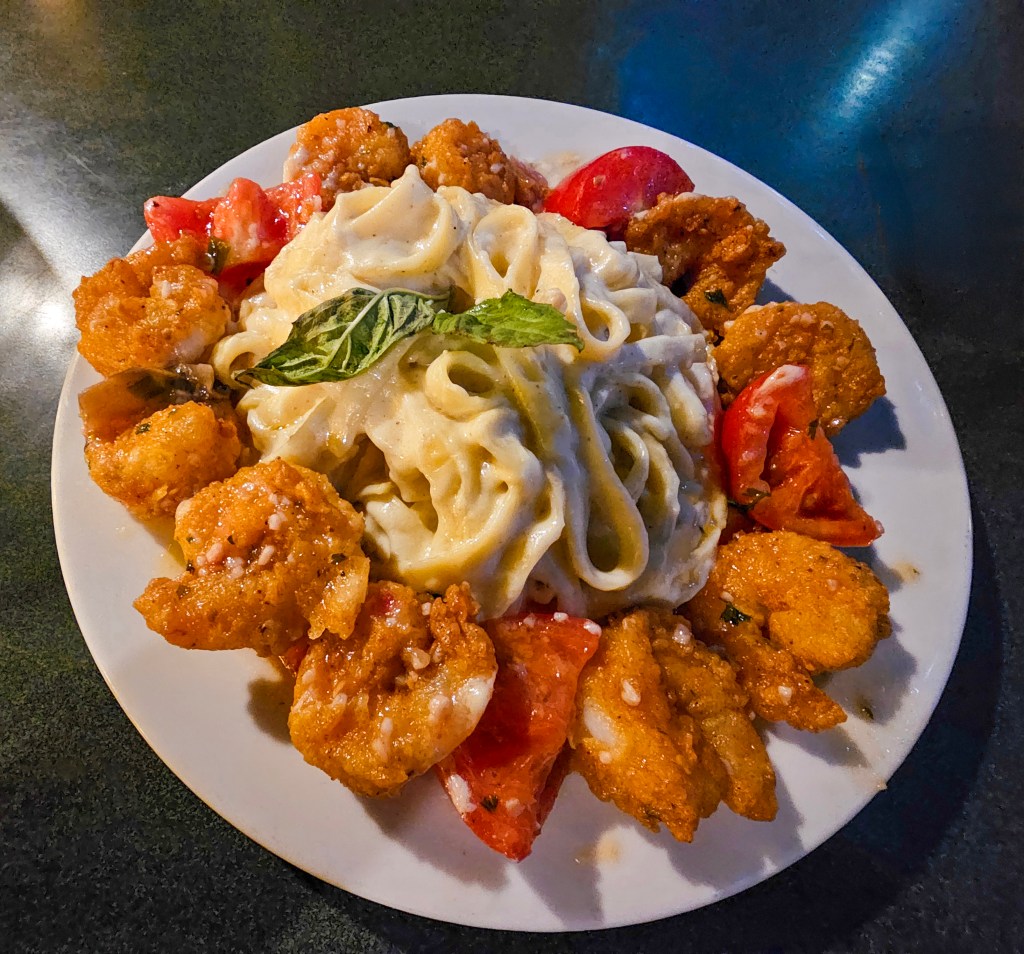
Shrimp at Gambino’s

Looking around the restaurant, we noticed a strange thing. A large group of adults arrived and were seated near us.  There were about 20 people, all couples.  As each couple arrived, they greeted the earlier arrivals, and then the men separated, and sat at one end of the table while all the women sat at the other.  We were amazed.  Later, I read a possible explanation from some notes on the culture of pre-Civil War Alabama.  According to the research, life in the Deep South was by no means all Gone with the Wind and Tara.  Before the Civil War, the vast majority of the population were independent landowners, working farms with typically less than 100 acres.  Assisted by a few slaves, they grew a variety of staple crops, and usually 10 to 15 acres of a money crop, such as rice, indigo, or tobacco and later, cotton, for export.    There were few slaves on these farms, it was too expensive.  Instead, most of the labour was supplied by family members.  In the evening, farmers returned to their houses, made up of two identical halves with a long corridor (known as a dog trot) down the middle.  When visitors came, they were segregated by gender, men and women sat on opposite sides.  Only the visiting dogs mingled in the middle.  We can’t help but think that the segregation of genders that we saw in the restaurant is a cultural norm that traces back to those early years.

Just to round out the story, above the yeoman farmers, were a small group of Southerners, the planters.  Legally defined as landowners with more than 20 slaves, most were yeoman farmers who had worked their way to the top through sheer force of will and practical farming techniques.   The average plantation had more than a thousand acres, and a slave population of 50 to 100.  The land owned was not necessarily all together, tracts could be widely separated. The work was supervised by overseers, who may have lacked the knowledge or the will to maximize and sustain a crop yield, while the planter applied himself to finding markets and transportation for the crops and balancing debts.  Most of the larger plantations operated heavily in debt.    According to this source, by the Civil War, the economy of the South was already crumbling, due to poor farming practice and soil depletion.  Fields and houses were abandoned and left to the weeds as the planters moved west.  As we travelled down the rivers, we saw trees grown as a crop for wood products, and we rarely saw fields of cotton.  In many ways the land has returned to the early years of the pioneers, with cattle and grassland alongside the tree plantations.

We left at 8:30am for the trip south through Mobile Bay and into the Gulf Intracoastal Waterway for our Orange Beach destination.  The morning began poorly.  The promised rain failed to hold off, and what began as a light mist, immediately became a downpour as we set about the untying process.  I had my jacket on, but Dick decided too late that wearing his would have been a good idea.  I had to kneel on the deck to undo the strap holding the power cord, so I was wet from the knees down.  Naturally, the rain stopped almost immediately after we were underway.  We saw our first dolphins in 6 years!  A pod of 3 swam alongside for a few hundred feet.  After that, it was just an ugly 3 hours until we were able to turn into the waves on the Gulf Intracoastal Waterway (GICW) channel.  Mobile Bay is very shallow, and with a wind off our beam for most of the way, causing an ugly chop reminiscent of the Great Lakes, it was an unpleasant ride.  Dick adjusted our heading several times to try to improve the comfort level, but there was only so much he could do.  We saw shrimp boats out in the bay fishing.   We could see a number of other Looper boats on Nebo, making their way south.  Interestingly, several chose a route very close to the eastern shore, that Dick had rejected as too shallow.

Shrimp boat fishing on Mobile Bay

The marina we had chosen is unfortunately a long way off the main route and has quite a complicated entry.  On arrival we were told to tie up on the end of L-dock.  It took a lot of maneuvering, especially with the wind blowing us off the dock.  There were no dock hands to help until we were just about set and ready to connect the power cords.  Then the dockmaster arrived to tell us that we were in the wrong place.  We had to untie everything, go back along the narrow channel, turn around, and finally tie to the side of L-dock.  This time we had 3 dockhands to help.  After all the messing about, Dick did not, on this occasion, dispense the usual $5 bills for the help.

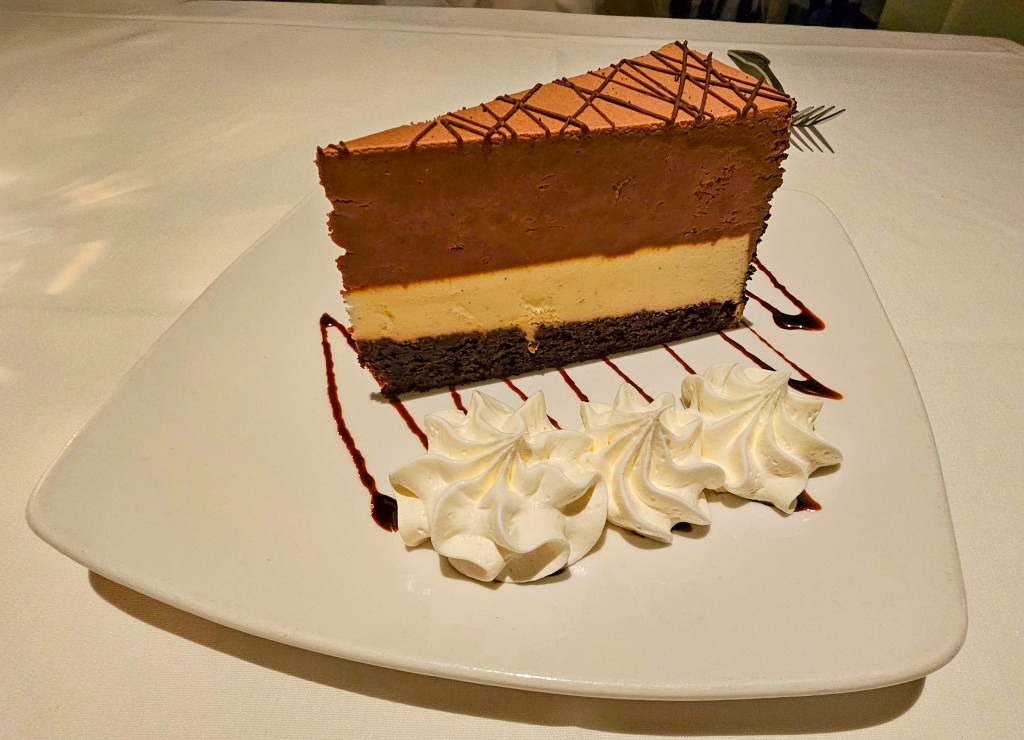
The marina is too far from town to walk, and we would not ride bikes after dark, so Uber it was for our dinner plans.  After a slight issue with the driver being sent to the wrong side of the channel to pick us up, we were soon at Louisiana Lagniappe for one of the best meals we have had on this trip.  It is a classic restaurant, with fresh white tablecloths for every dining party, professional wait staff and old-fashioned extras including a plate of hush puppies delivered as soon as you sit down.  Each entrée includes a salad and a twice-baked potato.  We started with lobster wontons, which were as tasty as they were pretty.  Grouper is the specialty, with many different options for preparation.  Dick enjoyed the one he chose, and I had the New Orleans style barbecue shrimp.  We shared a delicious multi-layer chocolate cheesecake for dessert.  There was one interesting moment. As usual, we ordered a glass of something bubbly when we arrived.  I had not finished mine before the waitress brought the glass of wine I had ordered to go with the main course.  She began to take away my unfinished glass of bubbly, and when I stopped her, she told me that Alabama law does not allow anyone to have more than one alcoholic drink in front of them at a time.  Clearly, this particular law is not always enforced, because I nearly always have a few sips left when the next glass of wine arrives!

Louisiana Lagniappe lobster wontons
Tuxedo cake at Louisiana Lagniappe

Our Uber driver on our return was again directed to the wrong location, and he thought we were just making conversation when we said we had passed the turning, as he drove us farther away from our destination.  He finally turned around with profuse apologies after I told him, quite loudly, “We really are going the wrong way!”

The next day was time to review our plans in light of two days of high winds in the area.  We decided to stay an extra day, and head for Pensacola a day later than planned.  Dick had to rejig the rest of the schedule, and we will not be back in Hilton Head as early as we had thought.  On the other hand, this will give us a chance to take a bit more time on the Panhandle, an interesting and enjoyable part of the Loop that we had been looking forward to.

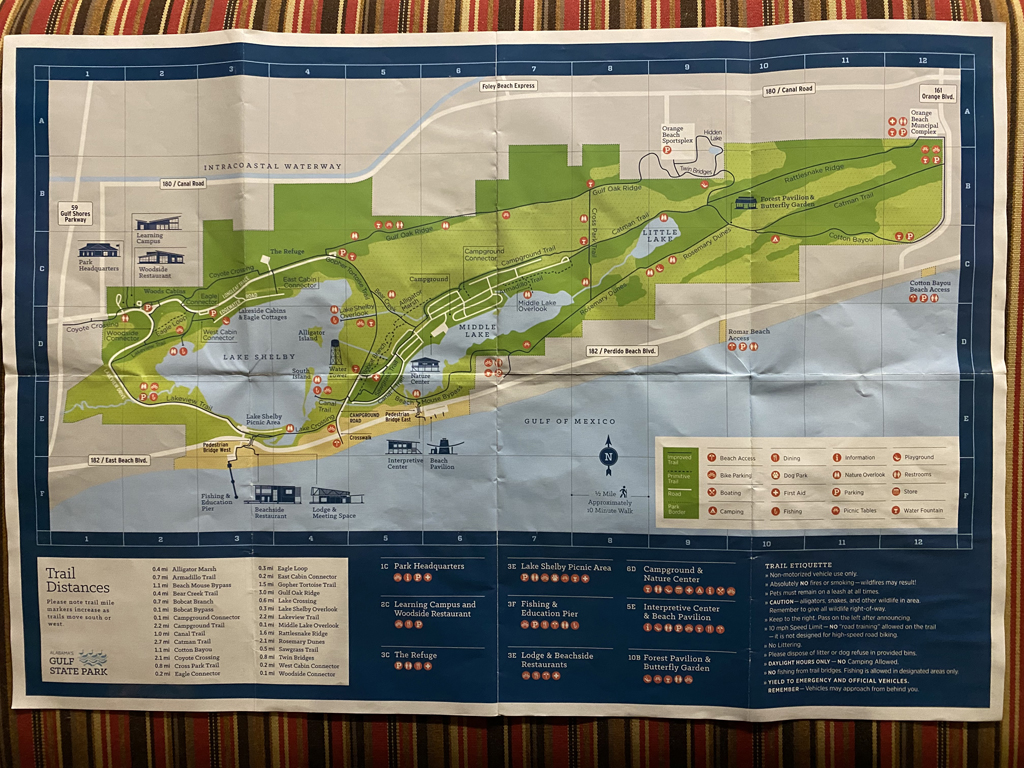
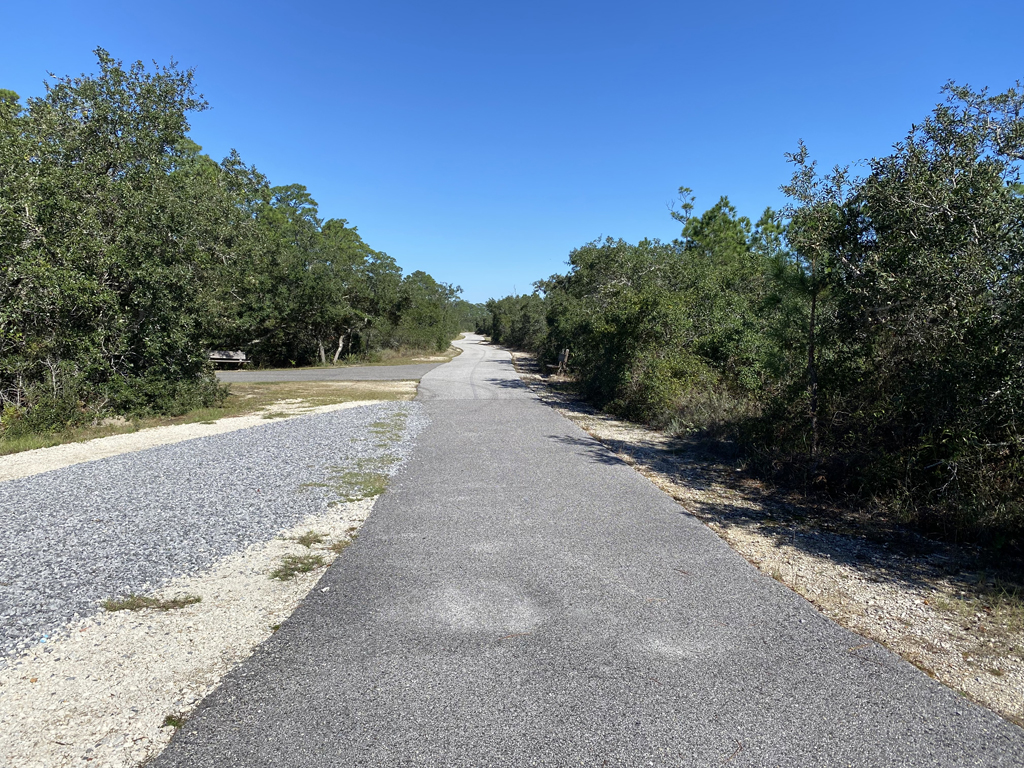
After making adjustments to the plan for the next week or so, Dick set off on his bike for a 17-mile ride through Gulf State Park.  He reported that it was a wonderful park, and regretted that there was not going to be an opportunity to get my bike out and show me the excellent scenery and wildlife.

Map of Gulf State Park
Paved trails through Gulf State Park
Dick enjoyed his bike ride through Gulf State Park
Views of Orange Beach from Gulf State Park

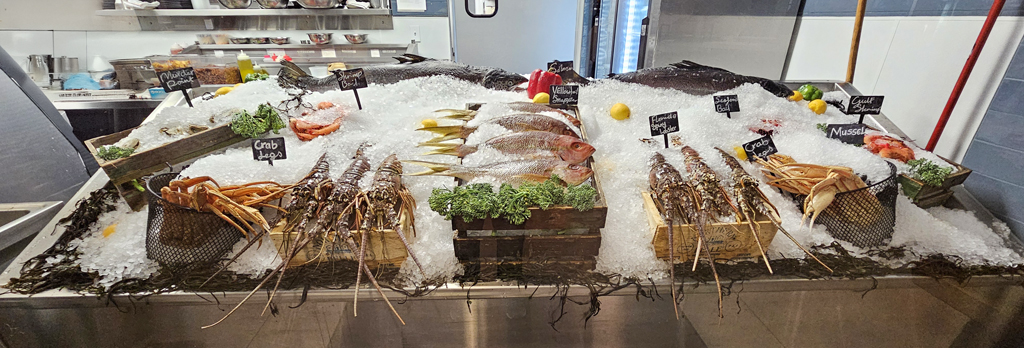
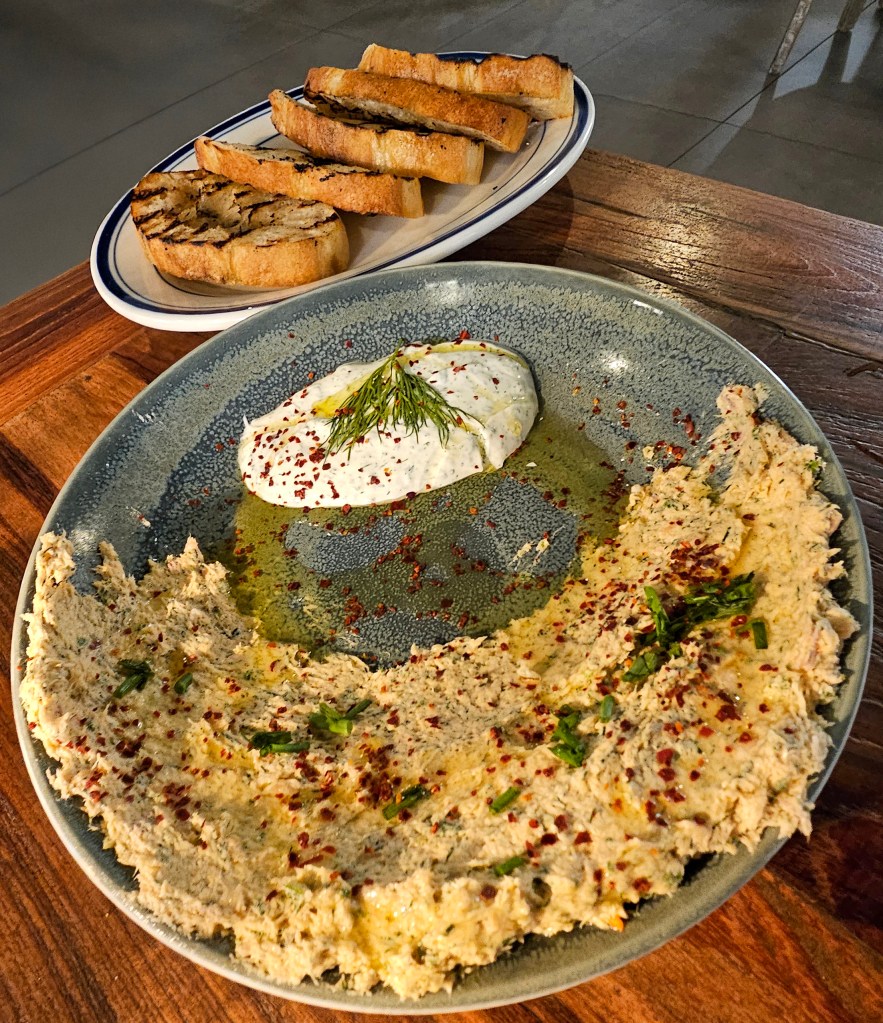
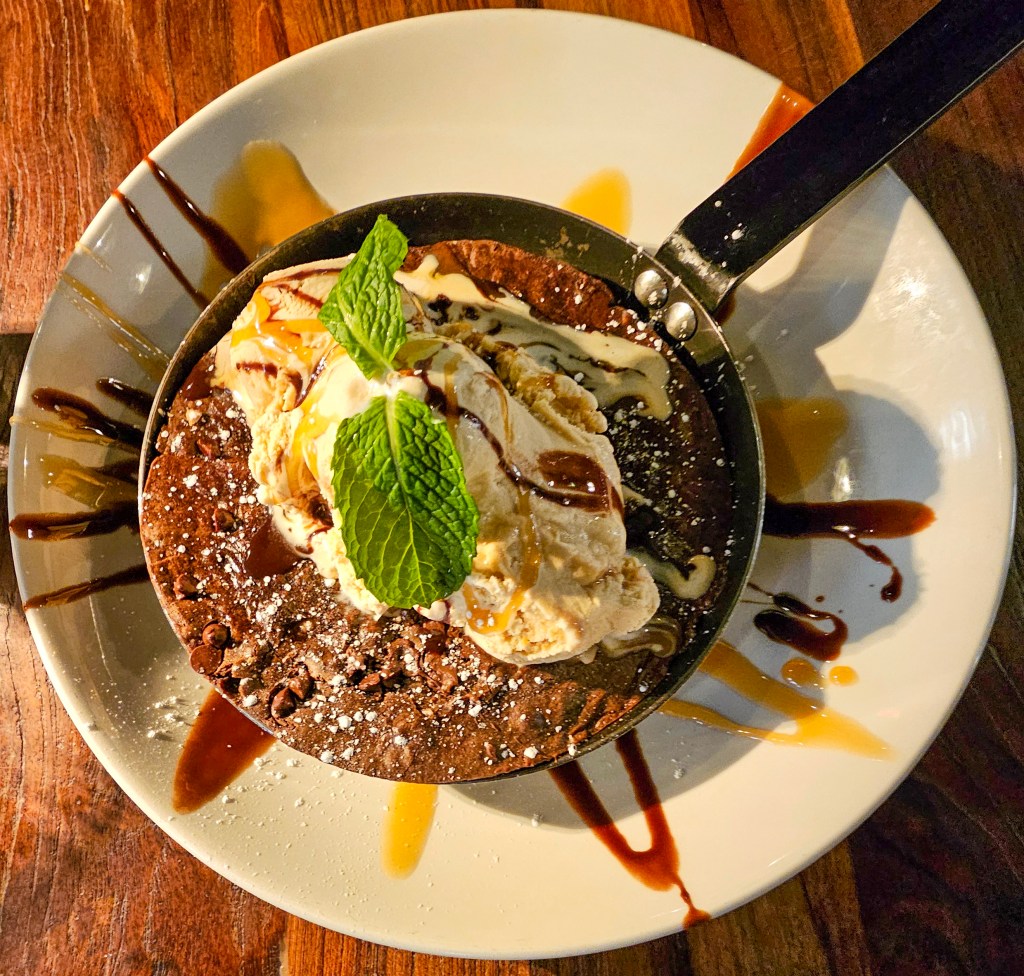
In the evening we took an Uber to Zeke’s, a seafood restaurant, marina, and fishing port.  It was far more casual in style than the other night, but we enjoyed a good meal.  The incredibly decadent skillet brownie with salted caramel ice cream was a fantastic finish.

Zeke’s Restaurant
A display of fish and seafood at Zeke’s
A tasty salmon spread at Zeke’s
Delicious and decadent chocolate brownie at Zeke’s

We made a later than usual 10am start the next morning, to allow the waves in Pensacola Bay to settle down.  It was still pretty bouncy, but the waves were in the right direction, so it was not uncomfortable.  We arrived at the marina just after the attendant had left for lunch, so we had no help tying up at the fuel dock for fuel and a pump out.  Timing was good though, as soon as Dick had everything ready, the attendant returned and started fueling.  Dick then negotiated to stay a full week, rather than the four days that had been reserved.  The attendant was quite reluctant, but eventually agreed.  There is another hurricane brewing in the Gulf, and while it is expected to dissipate without making landfall, the wind and waves will be roiled up for several days, and we do not want to cross Pensacola Bay in adverse conditions.

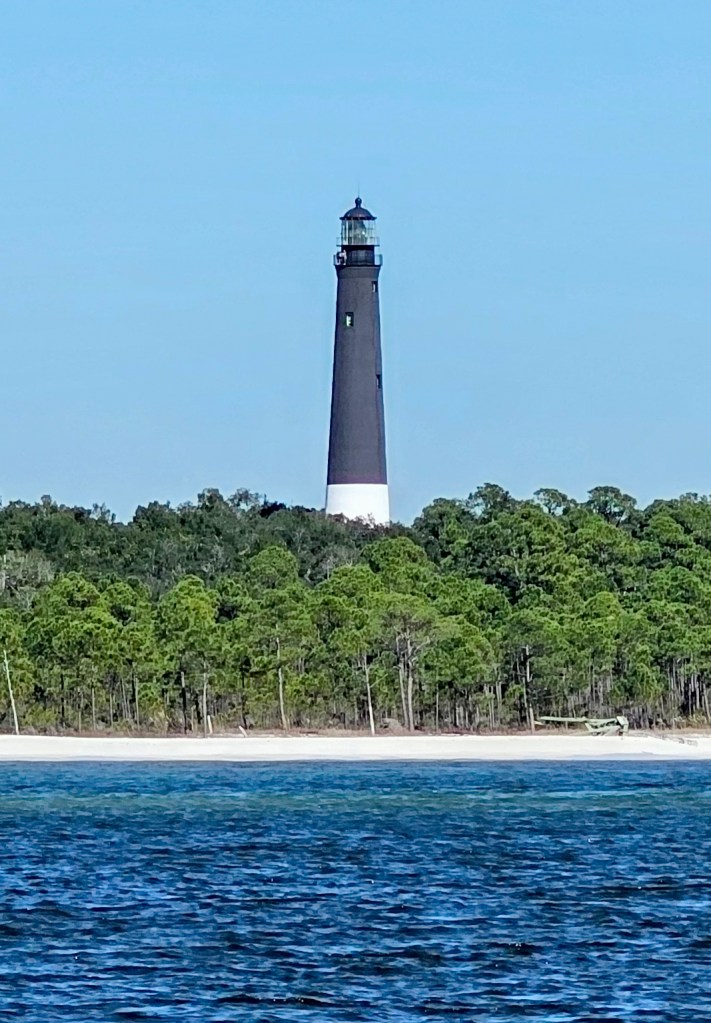
Pensacola Lighthouse

In the evening we walked through the historic downtown to our first restaurant, an Italian eatery with a Southern twist.  We started with a cheese and charcuterie platter, which was authentic and delicious.  I chose the New Orleans Barbecue shrimp, and Dick loved his lasagna.  Both arrived piping hot!  We are sincerely hoping that now that we are out of the mid-west, hot food will be the norm rather than the exception.

The next morning, Dick collected another rental car, and we drove back to Fairhope, where we picked up our vehicle that was waiting for us at the marina.  On the way I was delighted when Dick agreed to stop briefly in downtown Fairhope, so I could have a look around a very interesting ladies’ shop that I had missed the previous week.  Very interesting clothing, bright colours, and a lot of embroidery.  It took some time to choose, but I was happy to leave with a new white blouse with very colourful embroidery.  Our car was safe and sound, and it was a fairly easy drive back to Pensacola.  The next day would be the final reposition, and a much longer journey, as we take both cars to Port St Joe and then return to Pensacola in the rental car.

Palafox Pier Marina

That evening we took advantage of having a car to drive to a restaurant several miles away.  It was an odd place, called O’Brien’s, but it is not Irish, instead I would call it French/Southern.  The décor was dated and very tired, and the menus were a bit grubby, but both the food and the service were excellent.  Their version of NOLA barbecue shrimp was served in a delicious cream sauce, and Dick’s seafood gratin bake was perfect.  Dick had rack of lamb for main course, mine was a Southwest Chicken Salad.  Dick was astonished, as I almost never order salad, or chicken!  The cheesecake for dessert was a perfect finish.  The owner came around to all the tables, to ask if everything was to their liking, always a great touch.
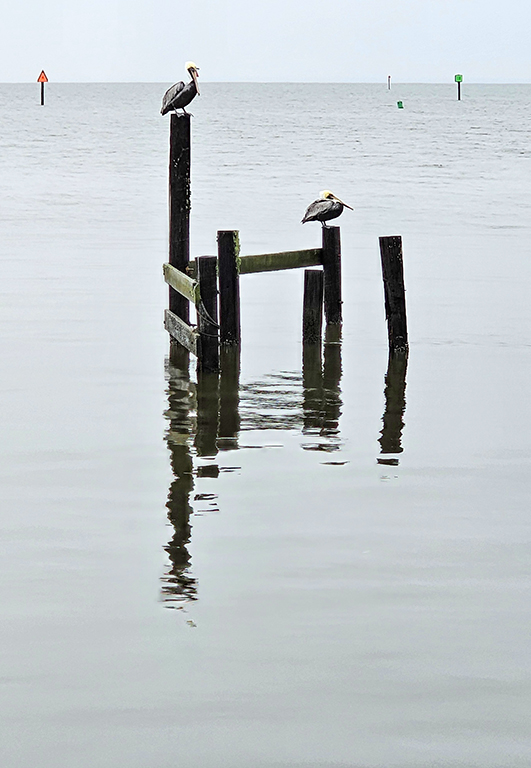
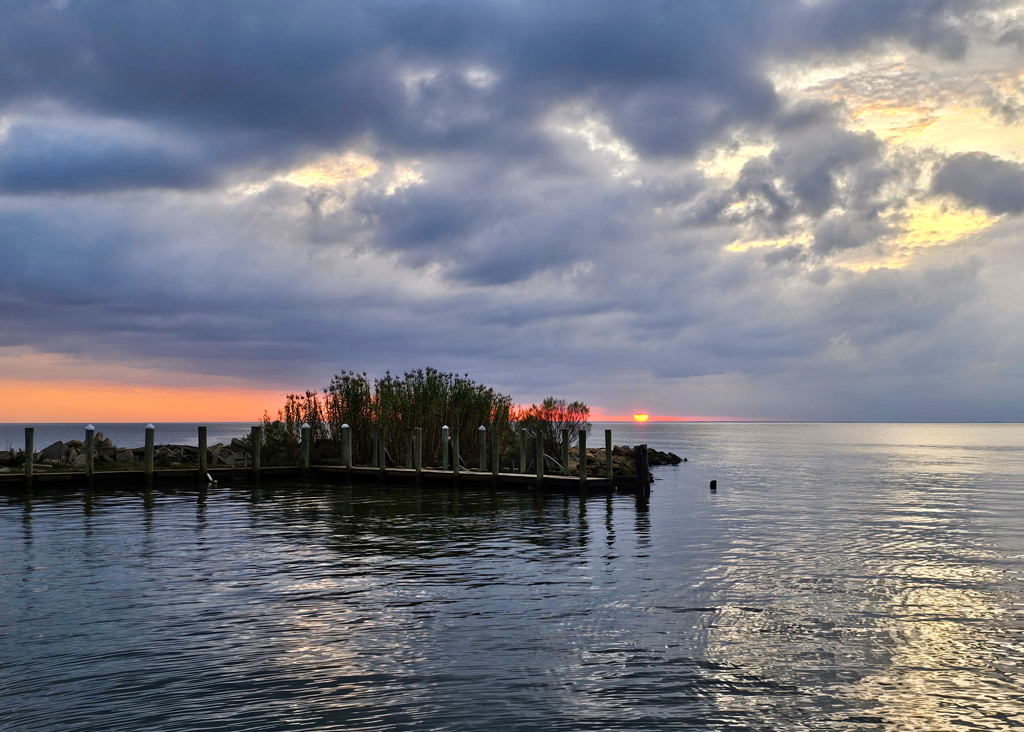
The next day required a fairly early start for the final repositioning of our car so that it is waiting for us at Port St Joe when we arrive there in about 10 days.

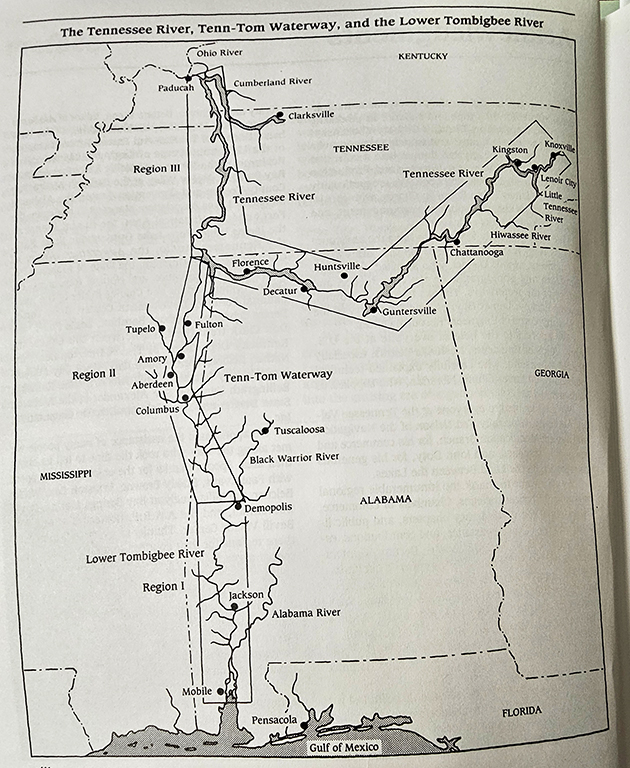
A map of the Tenn Tom Waterway. Nine Lives has travelled all of the waterway except for the last little bit of the Tennessee to Knoxville. Last year we went up the Cumberland to Nashville, and this year we have done the Tennessee River and the Tenn Tom Waterway.

September 20th to October 2nd, 2024 Pickwick Lake to Chattanooga

Nine Lives and her crew are cruising again!  From September until March, we will be visiting Tennessee, Alabama, Florida, and eventually Georgia and return to South Carolina.  During this final portion of the Great Loop, we will “cross our wake”, that is, cross over our original starting point in St Petersburg, Florida, and in spring we will finish in our home of Hilton Head.  We hope you enjoy the recounting of our voyages.

The first challenge, as always, is to get the crew back to Nine Lives.  From Hilton Head it is about 9.5 hours’ drive to Aqua Yacht on Pickwick Lake.  Unfortunately, the air conditioning on Dick’s vehicle broke down just a few days before our departure, and there was not enough time to get the replacement compressor shipped and installed before we left.  It was hot!  The maximum temperatures were 97F near Birmingham, AL, but it was not below 90F for most of the trip.  We arrived at 4:30pm local time.  We took the bikes and the new salon cushions to the boat, and set things up to shock the fresh water tanks so they could sit overnight with the bleach solution.  We also turned on the fridge and the freezers, so they would be ready for the next day.

Once again, we stayed in a cabin at Pickwick State Park for a couple of nights while we got the boat ready.  The cabins have a full-size fridge and freezer for all our food.  In spite of the long, hot journey, all the frozen food was still fully frozen.  We checked in and immediately had dinner at the lodge restaurant before going to the cabin.  We were so tired and hot that we knew we would not want to go out again once we got into the cabin!

The food was much better than Dick’s memory.  He was able to ask for his favorite catfish to be grilled, a great improvement over the usual deep fry.  I had fried shrimp, which were superb.  We shared cheese curds to start.  There won’t be many opportunities for that delectable treat after the next few weeks.  We have never seen them offered in Hilton Head or in UK.

The next morning at breakfast, while I waited for the pancakes I had ordered, I idly looked at the ingredients list on the packet of syrup in the basket on the table.  One of the first ingredients was ethylene glycol.  If you never knew, or had forgotten, that’s anti-freeze.  A cruise around our friend google suggests that we never, ever want to ingest this stuff.  Not even on pancakes.

After breakfast we were at the boat by 8:30, and began the process of trekking all the stuff 1/3 mile along the dock to the boat.  Well, Dick did the trekking, I sorted and put away as it arrived on board.  Division of labour…

Everything has to be put away

Dick finished the water process, changed the drinking water filter, put the chlorine tabs into the AC system, and stowed spare parts, and 2 dozen bottles of wine and other drinks.  He also put up the burgees on the bow.

Changing the drinking water filter requires some contortions

The boat was supposed to have been cleaned for our arrival, inside and out.  It is always a bad sign when cleaning equipment has been left on the dock, in this case a bucket of soapy water and a long-handled brush.  While the hull was sparkling, the deck had minimal attention, and the cockpit had not been touched since we left.  The smears from Dick’s enthusiastic destruction of marauding bugs last fall were still on the windshield. Inside was better (a different cleaner), but not as immaculate as the lady who did the job last year.

I prepared the clove bags that keep insects out of the galley drawers and cupboards, while Dick stowed 4 dozen beers and the fizzy water.

The big shopping excursion to the supermarket in Corinth took longer than Dick had expected, making us late for our much anticipated favourite restaurant, Vicari’s.  Dinner was every bit as good as always, a nice change.  So many of our favourite restaurants over the years seem to lose their mojo and the food ends up being pedestrian and bland.

We checked out of the cabin after breakfast, then Dick had to schlep all the food up the path to the vehicle, and then of course the whole lot had to be dragged to the boat, along with all the food and dry goods from the grocery shop.

One thing about having done this for so many years, we know where everything goes!  Mostly.

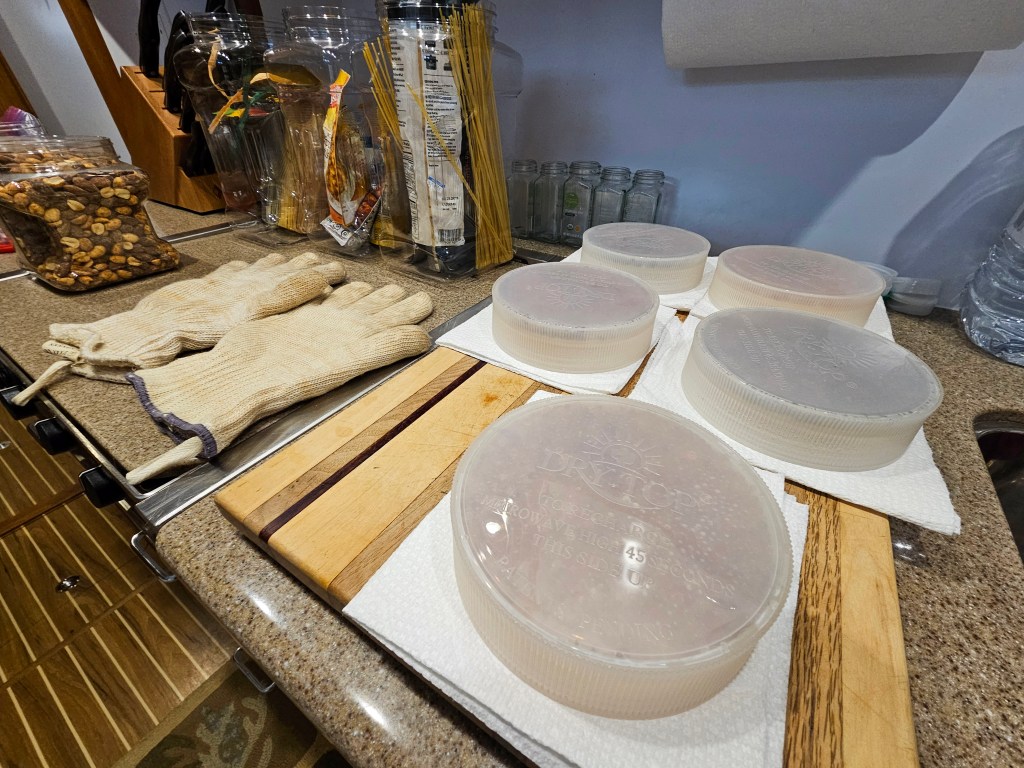
I sorted out the groceries, including chopping celery and bagging it into portions for the freezer.  I also recharged the “dry tops” from the storage jars in the microwave.  These are a Chinese product that was only available briefly, but they work fantastically well at keeping things like pasta, biscuits, nuts, and even brown sugar in perfect condition.

These are the tops of the plastic canisters. They are dehydrated in the microwave and are amazingly effective at keeping contents fresh.

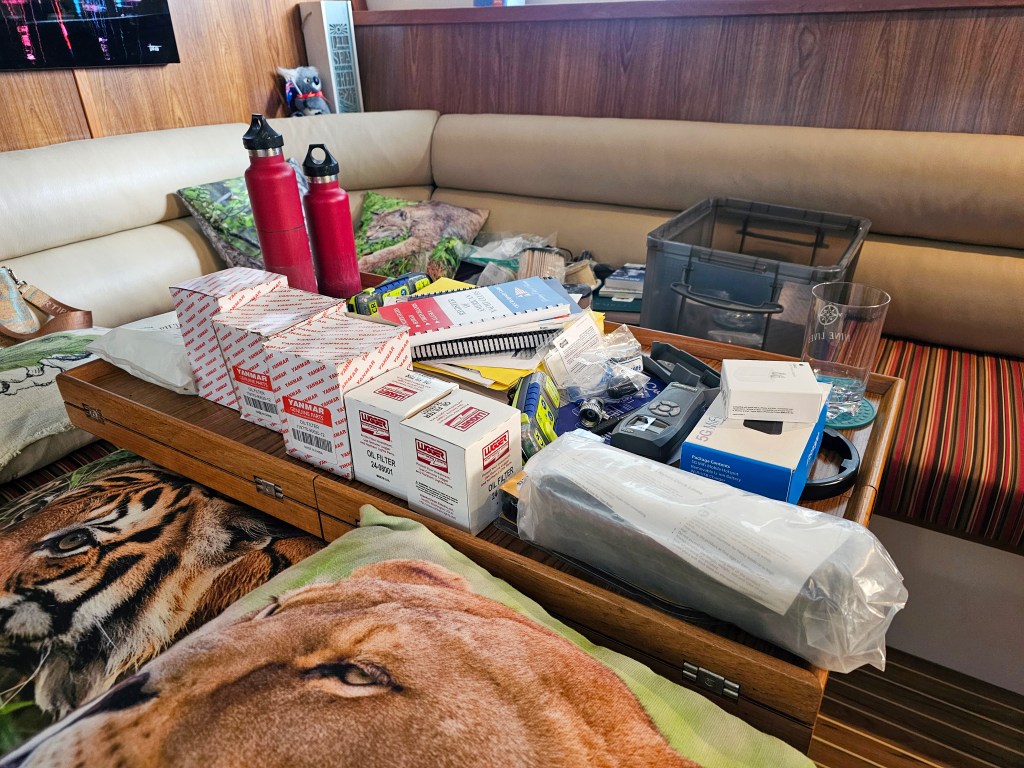
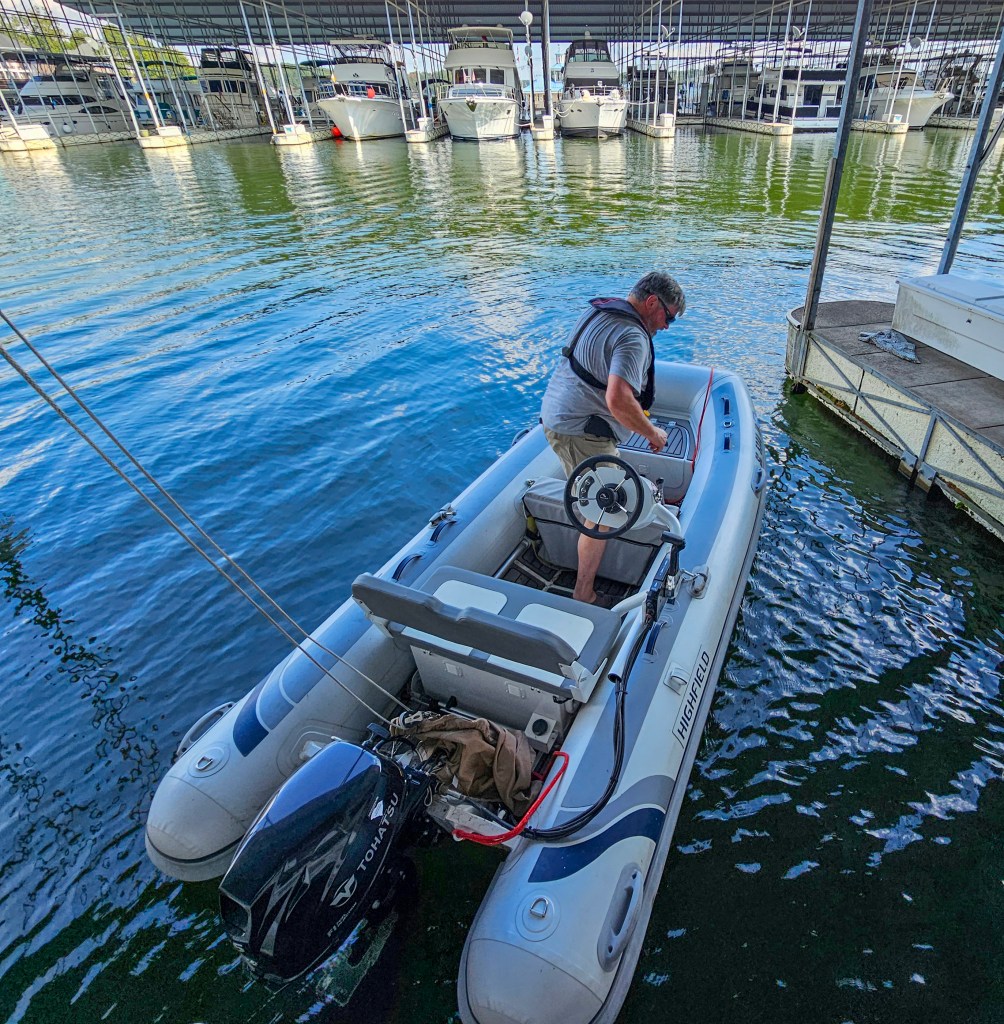
After a brief rest and recovery from all the to-ing and fro-ing with stuff, Dick started on his chores.  He changed the fuel filters from the main engines and the generator.  Vacuumed the cockpit and laid down the carpet. Put the new registration sticker on the dinghy.  Installed the sunscreens on the windows.  Checked the hydraulic steering reservoir for fluid level.  Prepare to launch the dinghy to check that everything was working correctly… and came to a grinding halt.

Launch the dinghy to make sure all is well.

The service department had put the dinghy up very high on the davits after they did the 50 hour service on the engine, and one of the two motors would not work to lower, only to raise that end of the dinghy.  After battling spider webs (my spray the day before had barely discouraged them), Dick had to get out the broom and have a really good sweep before even starting to try to diagnose the problem.  Naturally, more sophisticated troubleshooting was attempted before the simpler solution of wiggling the contacts for the plug.  Dinghy was duly launched (with the suitable precaution of keeping the rear hanger attached.  Dick evicted a staggering number and variety of 8-legged squatters, along with their webs, then followed the proper startup procedures, turned the key, and nothing happened.  The battery was absolutely flat.  The service men had not bothered to remove the drain plug when they returned the dinghy to the supports, and since there is an automatic bilge pump, every time it rained, the battery was drained a little more.  Dick set off to find a hardware store that would be open on Sunday and have a battery charger for sale.  He had to go all the way to Iuka, but he found one!

Battery set to charge, we walked out to the onsite restaurant for dinner.  Dick had checked that they were open on Sunday.  Sadly, not this Sunday.  A notice on the door said that they were closed indefinitely due to “unresolved plumbing issues”.  So we continued our Sunday stroll back to Nine Lives, and dug out the makings of sandwiches for dinner.

Next morning we were up early, and after taking time for coffee, Dick was pleased to find that the battery had charged and he could make sure the dinghy motor started and ran without issue.

We were finally away from our slip before 10am.  We had an uneventful day of cruising; a civilized 5.5 hours dock to dock.

The marina at Florence AL is supposedly open 7 days, but no radio response, and no phone was answered.  To be fair, Dick discovered later than he had the wrong number for the phone, so it was not surprising it wasn’t answered!  The 2 boats already in had spread themselves along the dock with gaps too small for us to easily fit into.  We docked at the back, but pulled up enough to leave room for the 50-footer that we knew was coming in behind us.  We spoke to them over the radio and were there to help with their lines.

They were a very nice couple, fellow Loopers, and we ended up going to dinner with them and then having drinks on Nine Lives after.

There was a hurricane brewing in the Gulf.  The forecasts were uncertain of its path, and there was a lot of concern for us and fellow boaters as to how much it might affect our plans.  We decided to look again in the morning and make some decisions.

Tuesday was a day that exemplifies the need not to have specific plans when boating.  We had volunteered, and our offer was accepted, to fill in for a veteran Looper for a presentation on locking at the upcoming Rendezvous of Loopers.  The various deadlines for submitting outline, bio, and introduction were already past, but we spent the morning starting work on the project.  We also untied and moved over to the fuel dock for fuel and a pump out.  Fortunately, one boat had left earlier, or getting back into our spot would have been quite tricky.

While Dick prepared bullet points for the presentation, I went through 7 years of photos to find those that are of locks and locking.  At this point, we discovered that our reliable workhorse, ten-year-old printer on board, while still operational, no longer speaks to our laptops, and could not be upgraded.

We kept a lookout for the marina courtesy car, and just managed to be first when it was returned.  Office Depot had a printer that would fit into the 12” space in the cupboard, and we also made a run to the supermarket for a few things that were missed earlier.  The rest of the afternoon was spent setting up the new printer.

We both felt that getting dressed up, then arranging for the courtesy car or uber to get to our planned restaurant, was just too much trouble, so we cancelled our reservation and walked along the dock to the onsite restaurant.  Basket food, but tasty.

A very tasty burger at Florence Harbor
My choice was the shrimp prepared 3 ways

Later, Dick chatted on the phone with the lockmaster at Wilson lock, 5 miles up the river, and arranged to call again at 5:15am to find out the status of the lock.  It is always better to speak to the person who is starting his 12-hour shift, rather than the one who is finishing, who may be wet as well as tired!

There was a split tow in progress in the morning, so we had time for showers and breakfast before our expected 7:30 departure.

So early, you say?  This particular lock had an approach wall collapse into the river a couple of years ago.  This means that the tows have to wait their turn from a long way up or down river, thus slowing down all operations.  Pleasure craft will be locked through only early in the morning, midday, or late, plus or minus, depending on existing tow traffic.  Not wishing to take a chance on the midday slot, we hoped for the early transit.  We were through Wilson lock at a very reasonable 9am.  Considering that this is the lock with issues, and a reputation for multi-hour holdups, we did well.  What was unexpected was the experience at the next lock.

A line goes around the bollard in the lock wall and is held, then the bollard floats up (or down) as the lock fills or empties. Being held secure means we won’t be thrown around by turbulent water.

The tow ahead of us (the same one that was going through Wilson at 5am), refused to allow the pleasure boats to go through ahead of him (there were two of us), even though he would, in fact, have lost no time by letting us through, as he had more than an hour required to approach the lock from where he was waiting.  So our two boats waited a full 8 hours instead of 4 (there was a downbound split tow that had to come through first).  Our fellow Looper boat anchored, but we held back with a combination of floating with the engine off and occasionally repositioning.  I did the early prep for our planned dinner on board later.

Our fellow Loopers on this part of the journey turned out to be a Dutch fellow, who emigrated to Canada in the 1990’s.  We will look forward to meeting again and spending some time in person!

We were in Joe Wheeler State Park by 5:15pm.  There were still concerns about the developing hurricane, although it was expected to be purely a rain event, with no significant wind at this location.  Some “conversation” between Nine Live’s two captains resulted in a compromise that would have us stop just 3 more nights before Chattanooga, but all in marinas rather than at anchorages or free town walls.  No locks the next day.  Even though there had been only two that day, a break was needed!

The first proper meal to be cooked onboard was a definite success.  The new recipe for scalloped potatoes complemented the pork and mushroom fricassee.

Preparing pork fricassee
A new recipe for scalloped potatoes
Our first dinner on board this cruising season

Thursday the 26th was the day for the hurricane (Helene) to make landfall, so we would know a lot more that evening, and even more the next day, as it was a fast-moving storm.  We planned to stay two nights at Ditto Landing to wait out the worst of the expected rain.  As I write this from my notes a week later, I know just how huge and devastating this storm was.  It was one of the largest ever to hit the United States, and loss of life and devastation to property extended from Florida to Georgia, Tennessee, and the Carolinas.  Our home in Hilton Head was fine, but our friends just a few miles away in Bluffton had trees down on their property and power outages.  Friends in Florida fared worse, and are still evaluating the damage, as are friends in Asheville, in the mountains of North Carolina.  We were lucky, more about our experiences later.

We left at 8:45 with an ETA of 3:30.  I spent an hour prepping a beef and mushroom stew for the slow cooker.  We passed TVA Browns Ferry Nuclear Plant.  This is the 3rd most powerful nuclear power plant in the USA.  It produces about 20% of TVA’s entire generating capacity.  There was no steam visible, so Dick wondered whether it is currently operating, although I can find no suggestion that it has been shut down. The stack is 660 feet high.  We were amazed at the number of additional low cooling towers on the site.  We delayed about ½ hour waiting for the Decatur Drawbridge, a railway bridge that is too low for Nine Lives to pass under.  The bridge tender was very pleasant, and kept us informed of the train movements.

Tennessee Valley Authority Browns Ferry Nuclear Plant
Some of the many cooling towers of TVA Browns Ferry Nuclear Plant
Pelicans and cormorants on a sand bar at Decatur
Decatur Drawbridge after opening for us.

It was a pretty boring stretch of river after Decatur.  We are too far from the banks to see any birds.  We passed Redstone Arsenal, a very interesting site, but the interesting bits are completely screened by trees.

We arrived at the marina, but our assigned slip proved difficult to get into with a slight breeze, and at only 20 feet wide there would not have been room for a fender between Nine Lives and the black rubber on the dock.  We were able to tie up next to our originally assigned slip below a launch ramp, which the dockmaster blocked off so trailers could not use it while we were there.  There were two more launch ramps available for day boaters to use.

Dinner was ready in the multi-cooker, and only the rice and vegetables needed to be prepared before we could sit down to enjoy our beef stew.

Preparing the side dishes for the beef stew
Beef stew with mushrooms

We were west and south of Hurricane Helene as it roared through Florida and Georgia and into Tennessee.  We didn’t even find out until later that it also had devastating effects in the Carolinas.  In northern Alabama we had heavy rains all night, but in fact, the noise of the fish eating the algae off the hull was louder than the rain.  It is an extraordinarily loud sound, as if someone is tapping hard on the hull!  Dick could not believe it was fish, and got up in the middle of the night just to check all around the boat.

The next day was quiet, as southern USA started cleanup and assessment of the damage.  Sadly, Tennessee and the Carolinas were just at the beginning of their problems, as water poured through areas that never expect hurricane impacts.  Our own plans would have ongoing impacts that only reveal themselves a few days at a time.

September 28th, we were out by 8:30am.  It was dull and cool in the aftermath of Helene, and the lines were soaking wet, but at least it wasn’t raining.

Nine Lives is happier now that she is flying 2 burgees again.  It was not appropriate to fly the Wexford green after we moved away, so last year we always felt a bit lopsided!  We now have an Endeavour burgee for the second flagpole.

It was a very long and boring day, and the weather was too dull to appreciate the emerging fall colours.  We passed Guntersville and through Guntersville Lake, seeing many large and expensive homes along the shoreline and up in the hills.  I cannot find any information as to why this area appears to be so much more prosperous than the rest of the Tennessee Valley.

Developing fall colours north of Guntersville

Painted Bluff is a famous landmark overlooking the river.  It features over 130 prehistoric Native American pictographs and petroglyphs.  The striations in the rock are certainly beautiful, especially with the developing autumn colours, but we were mystified that unsightly power lines were permitted to cross right over one of America’s beauty spots.

Painted Bluff

The Bellefonte Nuclear Plant began construction in 1975.  In the next 40 years over 4 billion was spent, and yet so far the plant is not operational and may never be.  It stopped construction in 1988, and moveable parts were sold off, then the site was auctioned in 2016.  Regulatory permissions were not obtained, by the new owners, and the whole thing is now tied up in the courts with lots of finger-pointing and accusations of malfeasance, including bribery and corruption.

A glimpse of the cooling towers of Bellefonte Nuclear Plant

We had planned to tie up for the night on an old, decommissioned lock wall.  After a very long day of cruising, we arrived at 6pm to find that it was just not suitable for Nine Lives.  The distance between bollards along the flat part of the wall was too great to tie up, and the two places we could have reached had metal protrusions and a cut out section of the wall.  We had to back out and carry on to an anchorage further up the river.  The location is in a wide chute behind an island.  We could see a Yamaha Plant on the shore, and it has what appeared to be a very respectable marina, complete with lit power pedestals, and not a single boat.  If the anchor had not set, we would have gone with the principle of “easier to ask forgiveness than permission” and availed ourselves of the facility.  In fact, I can’t even imagine how one would ask for permission!  We were anchored by 6:45, a very long day, finishing just as it was getting dark.  Most days are good on a boat.  This was not one of them.  Dick’s steak dinner prepared on the grill was a welcome treat after a hard day.

Setting the anchor at dusk
A well-earned steak dinner prepared on the grill

After a very peaceful night with just a few feet of movement from where I set the anchor alarms, we were ready to pull the anchor and get back onto the river for another long day.  I woke up very early (5am), because my phone was absolutely convinced that Bridgeport AL was in Tennessee and thus in the Eastern Time Zone.  We decided to head out early.

As the procedure began for pulling the anchor, Dick discovered that the bridle lines had caught an incredible amount of floating weed.  It was the highly invasive hydrilla, that infests waterways from Florida to California after escaping from aquariums in Florida in 1950’s and 60’s.  It costs millions every year to try to control it.  Dick had to shake it off with a boathook, then lift the lines a little bit and shake off the next clump.  The picture shows only one of the smallest clumps, there was enough of the stuff for several bales!  There was more weed on the anchor chain itself, but once that was cleared, the anchor came up smoothly and clean and we were away by 7:30am.

Hydrilla on the anchor chain

We passed the somewhat unprepossessing structure that is the historic Hales Bar hydroelectric plant.  Construction of the dam began in 1904, and took 8 years to build, with many accidents and several deaths.  On completion in 1913, it was the world’s second largest hydroelectric plant.  Only Niagara was larger.  The book tells me that there was a huge celebration, with bands playing, dances, banquets, speeches and fireworks.  From the beginning the dam leaked.  The area was cursed by a Cherokee warrior in 1775, and it has apparently been unlucky ever since.  The dam is considered to be one of the most haunted in the USA.  The dam was half a mile across and 60 feet high, and contained what was at the time the highest single lock lift in the world.  TVA acquired the dam in 1939, and continued the ongoing efforts to seal the leaks, but they were in vain.  By 1960, the dam was leaking at a rate of 2000 feet per second, and it became clear that the leaks were joining together inside the dam, with an increasing risk of complete (and sudden) failure.  A new dam and lock was build down the river, and as soon as the Nickajack Lock and Dam opened in 1967, the Hales Bar Dam was decommissioned.  Today the historic building is used as a private event space, and is also the home of Dam Whisky and Moonshine Distillery.  Although we plan to stop at the marina there on our return down the river, the distillery is only open on weekends, so we may not be able to tour and partake.

Hales Bar Hydroelectric Plant

The outflow for the Raccoon Mountain pumped storage facility can be seen from the river.  During times of low power demand, water is pumped from the river to a reservoir on the top of the mountain.  When demand is high, the water is released through a tunnel and drives generators in the underground power plant.  It takes 28 hours to fill the reservoir.

Raccoon Mountain Pumped Storage Facility
Autumn colours in the Gorge

Williams Island is passed just a few miles before Chattanooga.  In 1862, James J. Andrews, a Union spy, led 21 men through Confederate lines and managed to steal a railroad engine in Marietta, Georgia.  They headed north to Chattanooga, destroying telegraph communications as they went.  A Confederate force in another engine followed them, and caught up with them and imprisoned the spy in Chattanooga.  Andrews managed to escape, and got as far as Williams Island before he was caught.  This time he was taken to Atlanta and hanged.

Misty weather obscures most of the views in the Gorge

We arrived in Chattanooga by 4:30, and had help from a neighbour on the dock, who had stayed for 10 days waiting out the hurricane and the high water.

Nine Lives arrives in Chattanooga

We had dinner at one of the top steakhouses in Chattanooga.  We walked up many steps to get to the depot for the free downtown electric bus service.  It is very popular with the homeless.  The restaurant is in a gorgeous historic hotel.  The service was excellent, and the food was tasty, but unevenly heated.  Parts of the meal were piping hot, other parts (especially the potatoes) were barely warm.  After dinner we walked back to the boat because the bus does not run after 8pm on Sundays.  We were glad that it had stopped raining.

A beautiful building facade with lighting that changes colour. The building is a multi-storey car park!

In the morning, Dick went for a long walk to explore the downtown.  Unfortunately, while there are many interesting restaurants and the beautiful old buildings are being renovated to provide downtown living and shopping, it is still very much a work in progress.  In the afternoon, we enjoyed our first docktails on Nine Lives this season with Maggie and Bruce, the local Harbor Hosts.

Waterfront park on the north side of the river

We took the bus again to our dinner destination.  Alleia was an excellent choice for an Italian meal.  We shared a cheese and charcuterie platter.  Dick had the halibut, which was delicious with an excellent pomodoro sauce.  He was less enthused about the accompanying vegetables: summer squash, zucchini, and okra!  Dick loves most other vegetables, so this was quite a miss from his point of view.  I chose a mushroom and preserved truffle pizza, one of the best I have had in a long time.  Nothing on the dessert menu caught my eye, but Dick enjoyed his favourite panna cotta.  We returned by bus, as it runs late on weekdays.  Unfortunately, the usual ramp to the dock was under 5 feet of water, so we had to come down the steps at the other end.  They are in an unlit area much favoured by the large homeless population of this city, so not a comfortable way to have to go back and forth to the dock. 

Halibut at Alleia
Mushroom pizza at Alleia
Panna cotta at Alleia

The effects of Helene are still manifesting, and we were advised by the Knoxville Harbor Host not to venture that far up the river.  Apparently, TVA regulates the water being released by the dams on the system to limit flooding in Chattanooga, which explains why the walkway is periodically under water but the town is not flooded.  We extended our stay by 6 more days, and will reassess next weekend.  We hope to be able to travel up the river, but we will not go as far as Knoxville. As I write this, 4 of the locks on the Tennessee River are closed because of the very high volume of water flowing over the dams.

There is also great concern over the status of Wilson Lock, which the majority of Loopers must pass through to get to the site of the Rendezvous.  This gathering has been fully booked for months.  Since our passage, the main chamber of the lock has had to be closed for several months for repairs.  The auxiliary chamber is in fact 2 smaller steps, requiring a tow to lock through just one barge at a time.  With a typical tow on this river being made up of 15 barges, the transit takes 15 to 24 hours per tow.  Pleasure boats are not a priority, but it is hoped that it will be possible to arrange flotillas to fit between the commercial requirements.

We had concerns about the effectiveness of the pump out we had at Florence Marina.  The rather feeble pump had not seemed to have done the job properly, and a quiet afternoon seemed like a good time to untie and head over to the fuel dock.  Both the fuel pumps and the pump out machine are self-service, so there are no helpful dockhands to assist with operations or tying up.  In spite of the fierce current, Dick maneuvered Nine Lives into the quiet water in front of the dock, and I was justly proud of my skillful capture and double wrapping of the midships line around the dock cleat.  The pump out took just a few minutes with the robust pump, and we were back retying on our dock in less than half an hour.

Nine Lives on the dock

As we walked to the bus station we looked down at the waterfront.  You can see in the picture that the fixed docks are completely submerged.  Those light lines in the lower right are the handrails along the walkways, more than 5 feet under water.  At the base of the concrete lights in the top left are small white boxes.  These are the power outlets for the dock.  Theoretically the power has been cut off, but I did see the lights on the other night! The dock we are on is floating, so at least it moves up and down as the water rises and recedes.

The waterfront at Chattanooga is under more than 5 feet of water.

Chattanooga’s history began in 1815, when Cherokee descendant Chief John Ross established a ferry service across the river.  He also built a boat landing and a warehouse, and began trading with the local Cherokee Indians.  The settlement grew, and was incorporated in 1839.  It was in a strategic location, and metal industries ensured its continued growth.  It was fought over during the Civil War, and is still today an important manufacturing, wholesale, and retail centre.  It is also a popular tourist destination.  Ross’s Landing was located where the steps at the end of our dock are, our only access to the town when the ramp at the other end is flooded.

In 1854, the East Tennessee Iron Manufacturing Company built a blast furnace on a site overlooking Ross’s Landing.  A few years later the blast furnace was converted from charcoal to use coke, and was the first in the South to use coke in the primary reduction of iron ore.  Just a few years later, in 1863, Federal troops occupying Chattanooga demolished all the buildings, leaving only the stack, which was used as a lime kiln.

The Chattanooga Choo Choo building (yes, it’s a real place), was a Beaux Arts Classicism building built by the Southern Railway and completed in 1909.  It had the largest brick arch in the world. An 85-foot freestanding dome spanned the waiting room.  The last train arrived in 1970, and the beautiful building was boarded up and threatened with demolition.  It was rescued and refurbished and is now a hotel and restaurant complex.

Chattanooga Choo Choo
The station entrance
The dome and former waiting area

The song, yes, the song.  If it isn’t running around your head yet I am surprised.  See if I can remind you of this particular earworm!  The song tells the story of train journey from New York to Chattanooga, where the singer’s sweetheart will be waiting for him, and he will settle down and never leave. The passenger asks a shoeshine boy, “Pardon me, boy, Is that the Chattanooga Choo Choo?  Yes, yes, Track 29. Boy, you can give me a shine.”  The song was written in 1941, and first performed as a big band/swing number by Glenn Miller and His Orchestra.  It was a huge hit in a time of war, speaking to soldiers who wanted to look forward to the day that they could go home and be met by loved ones and parties.  It also referenced the heart of America, and the prosperity and industry that depended on the railways.

We went to dinner at Elsie’s Daughter, a somewhat unusual restaurant that is part of Hotel Chalet, that in turn is part of the Choo Choo complex.  The hotel features modern “chalets”, but the alternative, if you are willing to pay an additional $100 per night, are beautifully converted passenger cars, formerly part of the rolling stock of Southern Railway.

Converted railway cars of the Chalet Hotel

Dinner started well.  There is a very limited menu, and all plates are meant to be shared.  We began with a tomato and cucumber salad in a delicious dressing, and a plate of smoked trout spread accompanied by crisp pieces of toast.  Dick chose the crispy half chicken, which was also delicious.  I know this because my mushroom tartine was so tasteless that I gave up on it after a few bites (copious additions of salt and pepper did not help), and instead had some of the chicken.  The service that had been so bright and solicitous fell apart in the middle of the meal, as the single waitress tried to cope with a full restaurant.  We decided that the only dessert choice on offer was not of interest, so we paid and left.  We would consider returning, but not after 6pm.
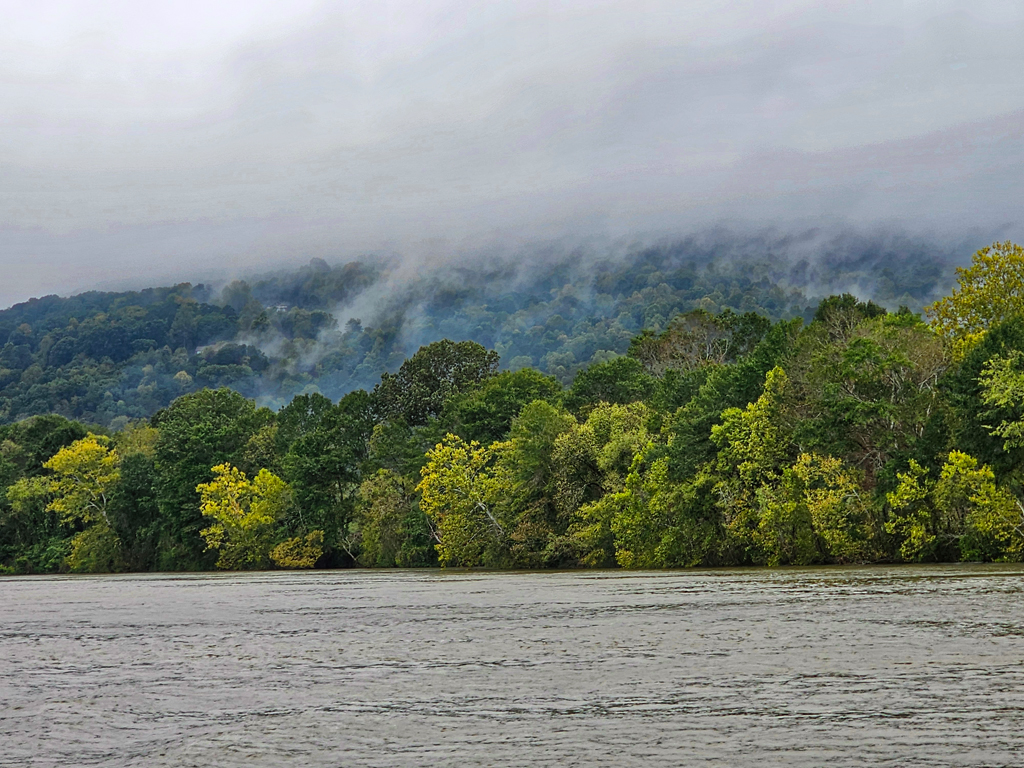
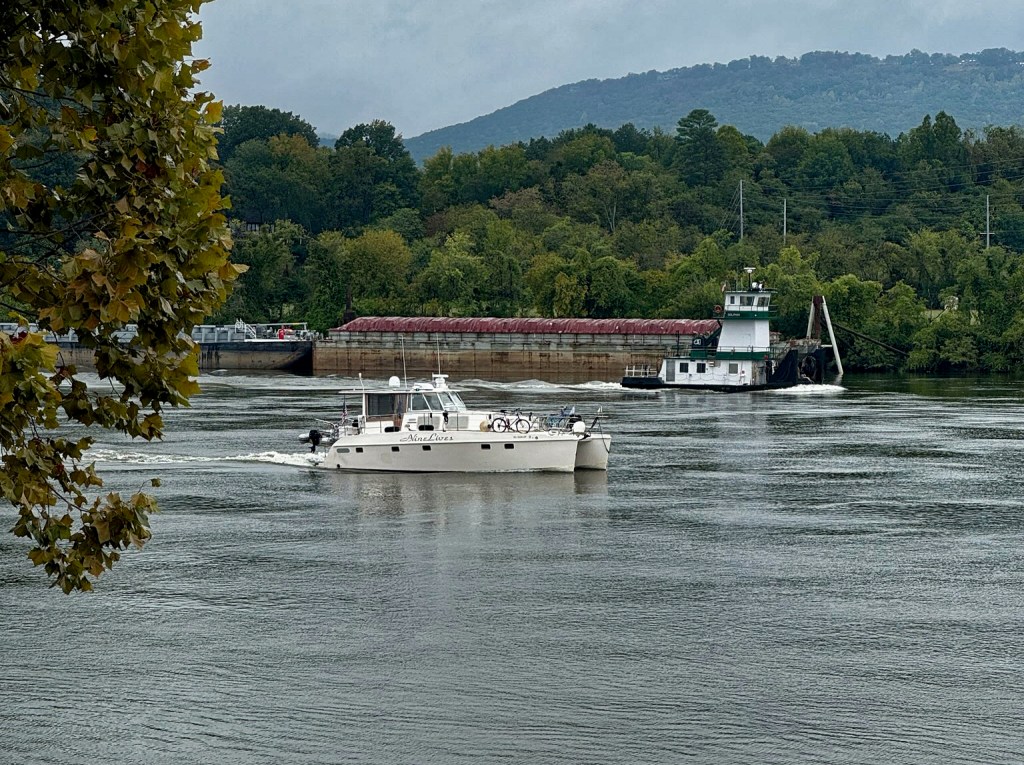
Sharing plates at Elsie’s Daughter Restaurant

Earlier in the day, Dick had carried his bicycle up multiple flights of steps to go grocery shopping, because the walkway at the other end of the dock was under 5 feet of water.  He didn’t want to have to repeat that effort, so on his return, he locked the bike to the railings at the top of the steps. As we passed the bike, I commented that I thought there was about a 50% chance that it would be there when we returned from dinner.  The bike was there.  We passed a fellow standing on the pathway, with a suspiciously familiar water bottle at his feet.  I pointed it out to Dick, and he asked the guy, “did you take that water bottle from my bike over there?”  To my vast surprise, the guy laughed, apologized, and handed it back!  One hopes the bike will continue to be safe, but from now on the water bottle returns to the boat after each excursion.

A Chattanooga Choo Choo