July 25 to August 13, 2017: New Jersey to Beaufort NC

Retracing our steps

Our stay at Great Kills Yacht Club in New Jersey was very enjoyable.  Without question it was the friendliest yacht club we have visited.  Each day there were people working on their boats or, in the evening, spending time in the bar.  Most made a point of chatting to us, and several came along the dock to look at Nine Lives and ask questions.  She likes that kind of attention!  We rode our bikes into town and found a very nice Italian grocery.  Although we didn’t really need any provisions we couldn’t resist a few things on the shelves.  We also rode over to the park on the Atlantic side of the basin.  We were amused to see many people relaxing and sunbathing on lounge chairs set up in front of their cars in the parking lot.  Wide sand beaches and acres of grass were completely ignored in favour of being within spitting distance of the car!
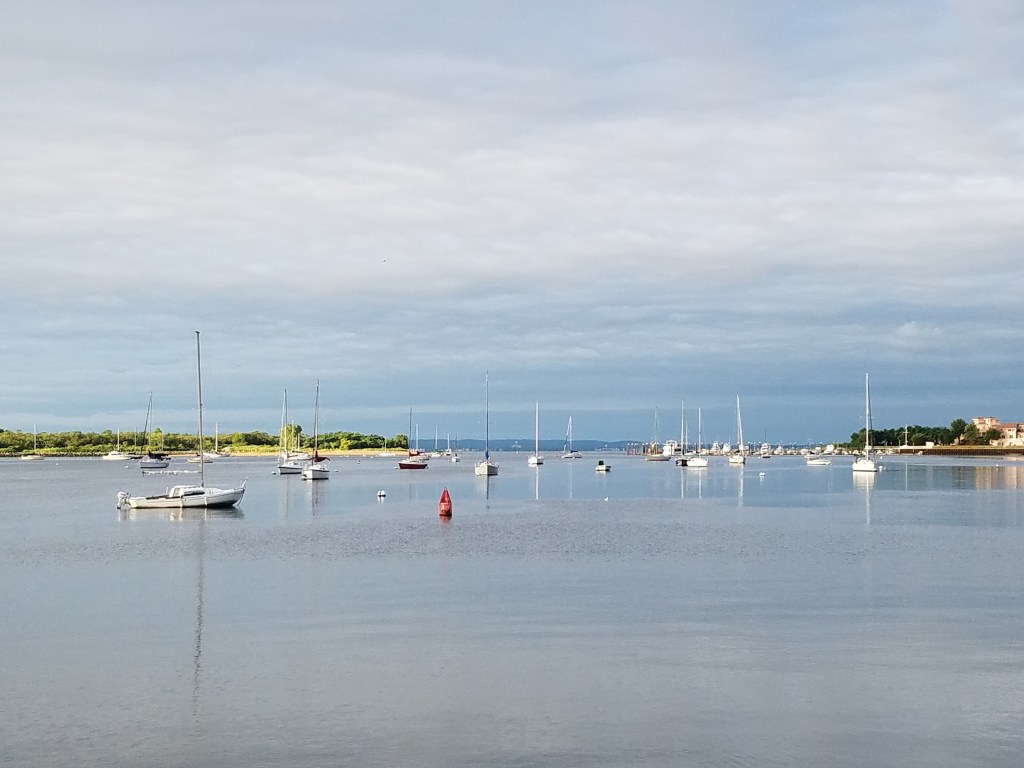
Great Kills Basin, New Jersey
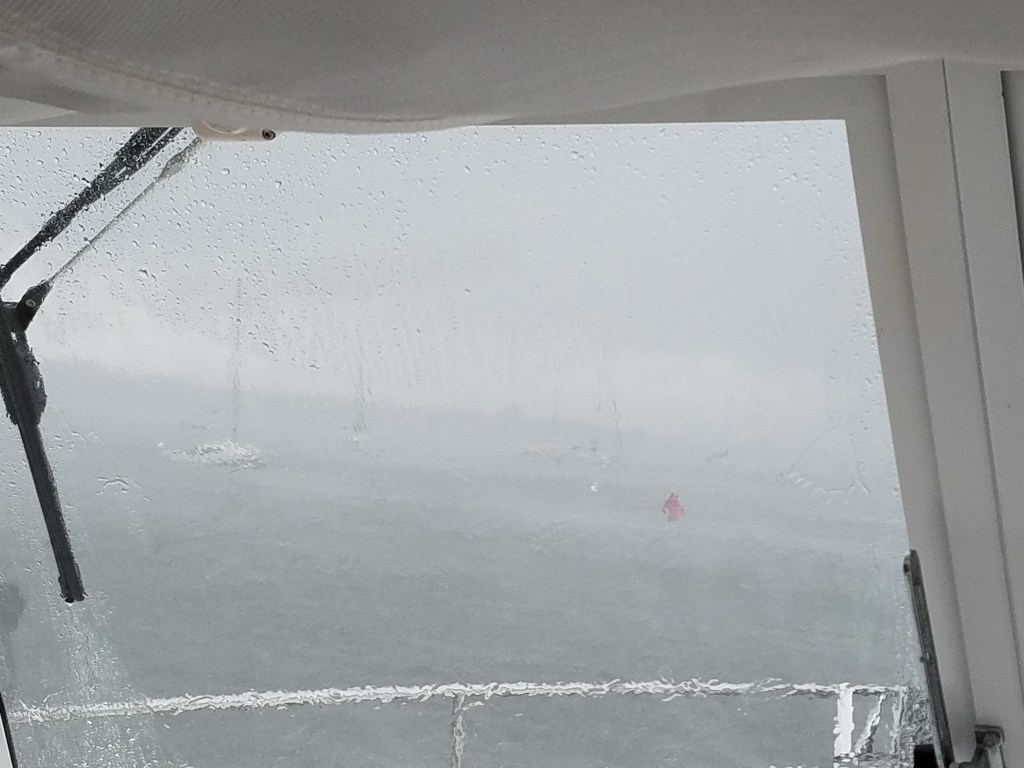
A stormy day at Great Kills

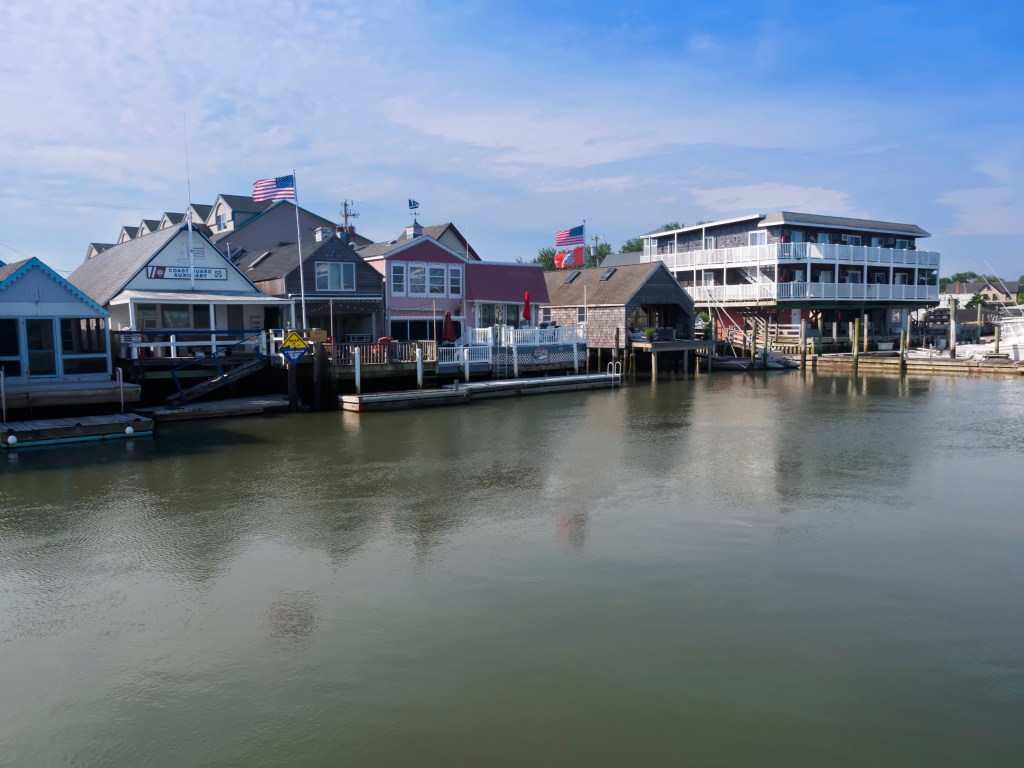
Eventually we got a one day weather window that was enough to get us to Atlantic City.  Here we were again stopped for several days.  We had planned to stay at a large marina in front of one of the casinos, but it was fully booked for the weekend and instead we docked at a small family run facility across the basin.  The Coast Guard Station was opposite, and we could hear Reveille and Taps across the water each morning and evening. The next day a huge out-of-season nor-easter blew in.  The waves were right on our beam, which meant rocking from side to side so much that one of our lines frayed nearly through.  We had to get out at the height of the storm and move the boat further into the slip and retie everything.

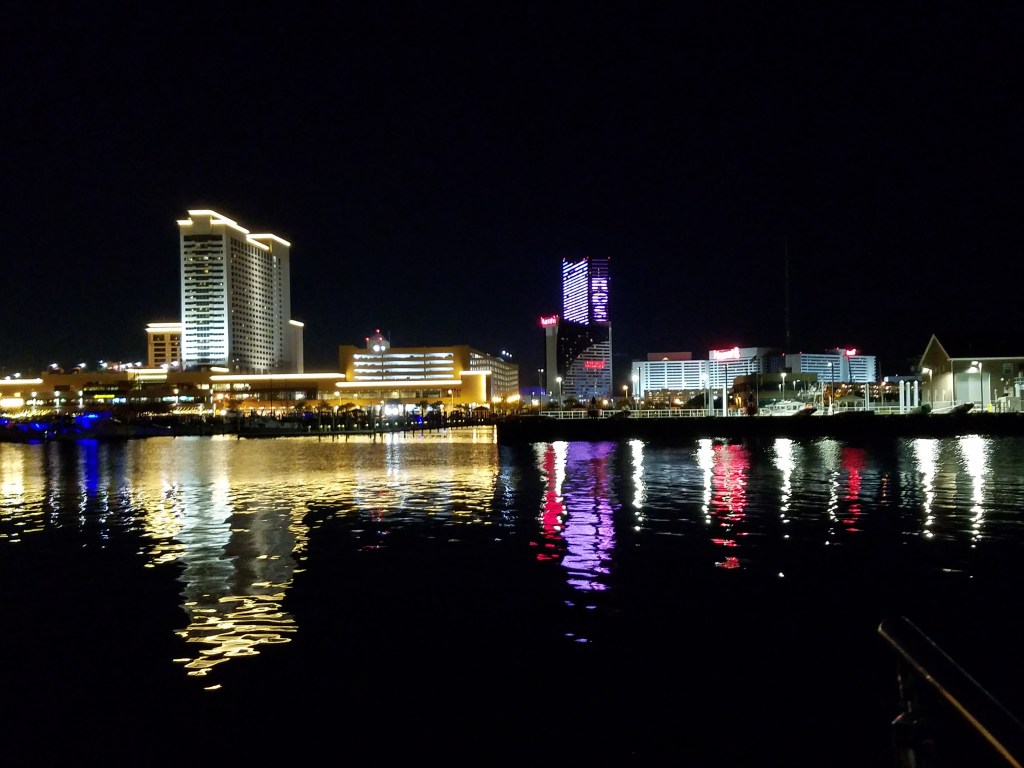
Coast Guard Station at dusk, Atlantic City
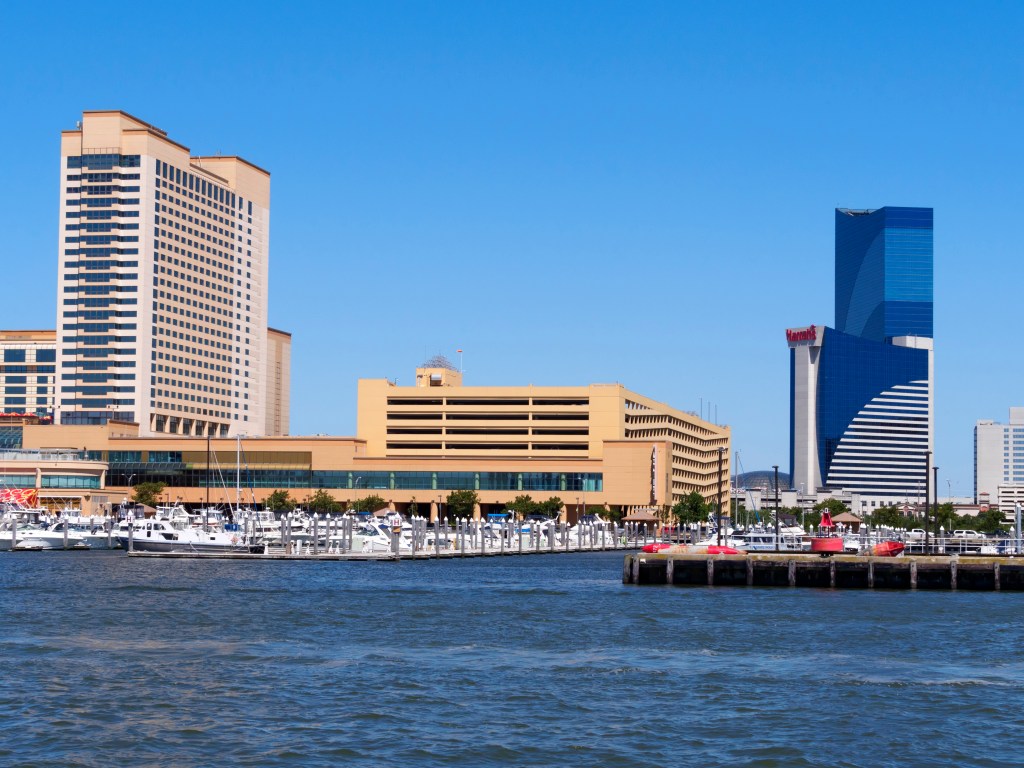
Casinos in Atlantic City

We did have an interesting stay in Atlantic City apart from the storm (which was a different kind of interesting).  We rode our bikes all the way along the boardwalk through both Atlantic City and Ventnor.  The dreadful tourist souvenir shops, attractions, and hot dog stands show that the British by no means have the monopoly on tacky when it comes to seaside resorts.  On the other hand, the mostly closed casinos are fascinating architecture, and it is rather sad that they are so quickly becoming derelict.  Ventnor is entirely different, with large gracious homes with beautiful gardens all along the shoreline. Atlantic City is trying to diversify their economy, and local residents are quite pleased that there is a university currently building a new campus near downtown.  Why they would not take over one of the enormous empty casinos I do not know, probably the casino owners or the debt holders are holding out for more money than it will take to build a new campus from scratch.  One can only shake one’s head at the waste.
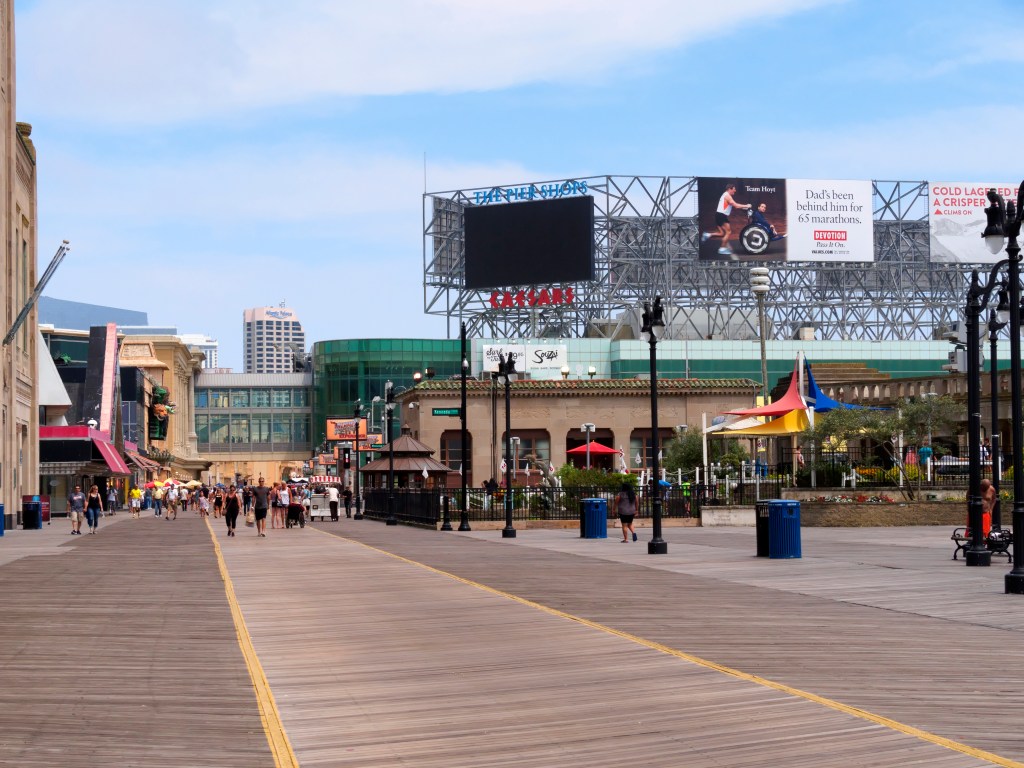
Atlantic City Boardwalk
Casinos and State Marina, Atlantic City

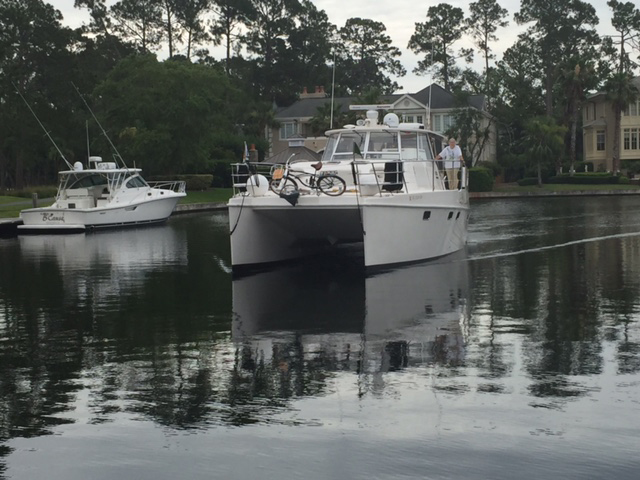
Shortly after our arrival another boat came in to the marina and the captain walked over and introduced himself.  It was a sailing catamaran, also built by Endeavour (the builder of our boat).  We enjoyed two evenings of docktails with this very nice couple, and it was fascinating to compare the similarities and differences in the two boats.

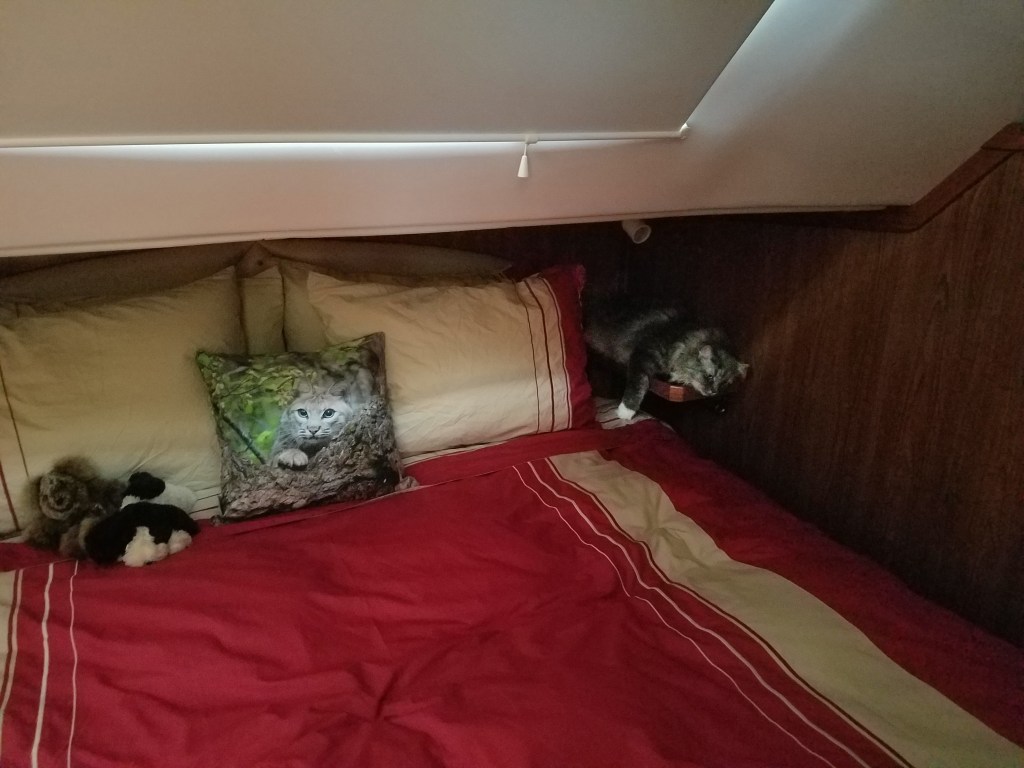
A good spot to sleep

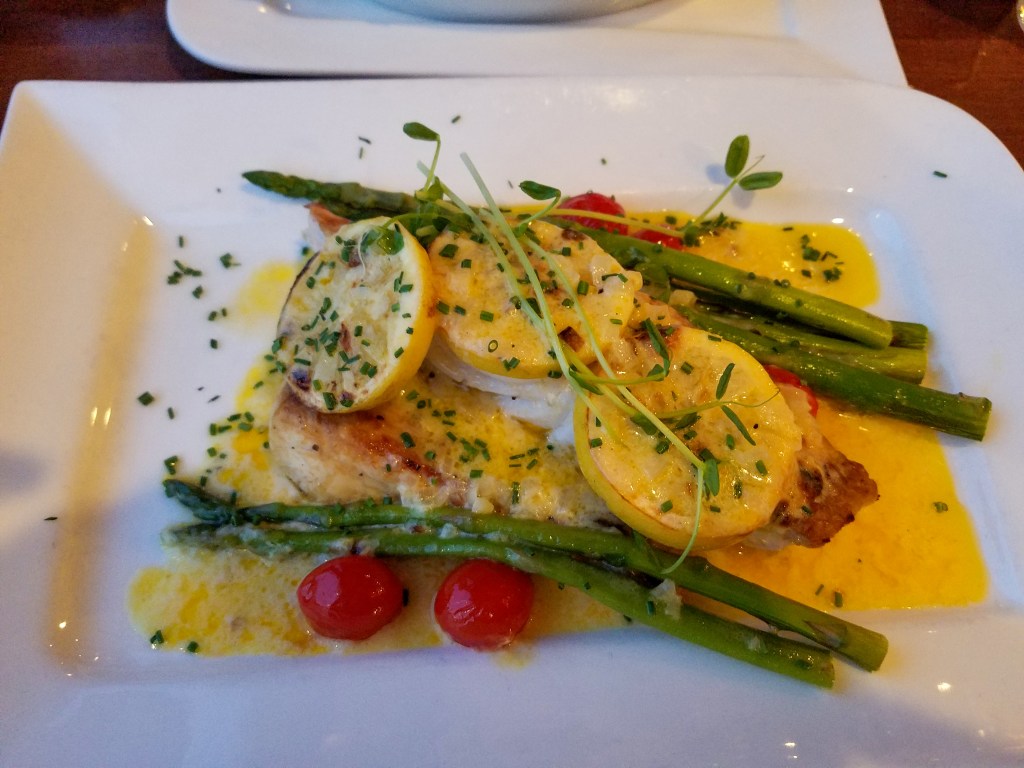
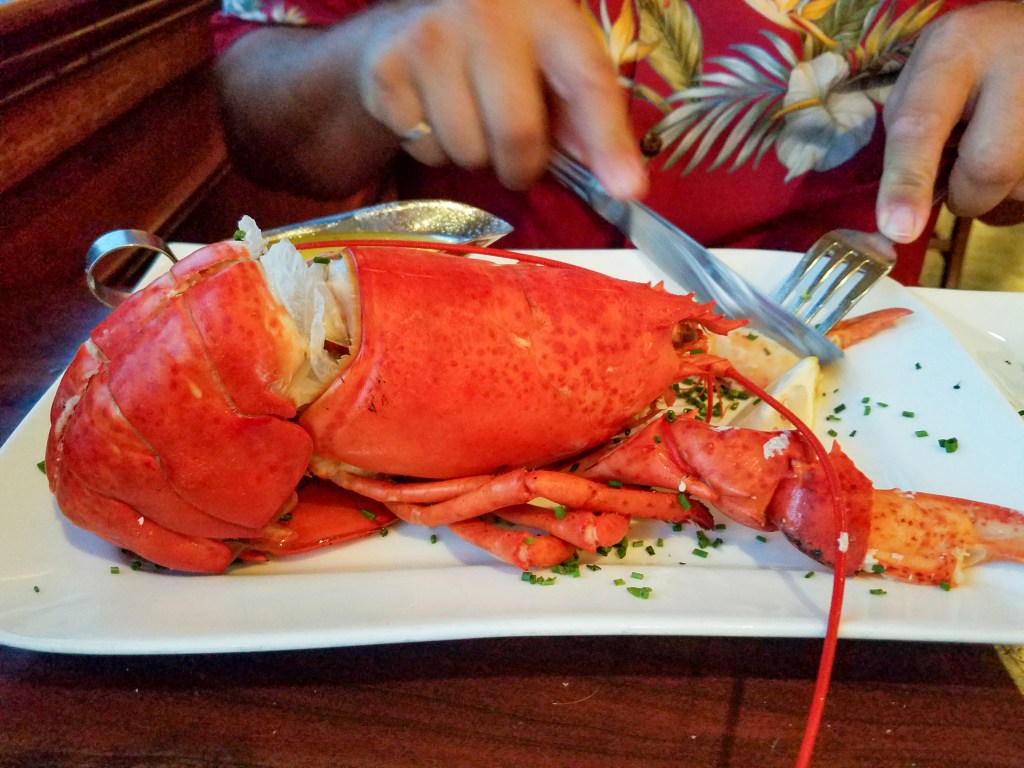
Finally, the weather calmed again and we made a fast run to Cape May.  We tried a different marina this time, and hope to return and spent a bit more time next year.  The town seems very quaint, with lots of interesting shops and restaurants to visit.  The next day was also calm and we were able to proceed up Delaware Bay and through the C&C Canal to Chesapeake City.  This is a lovely little town, that has done a wonderful job of sprucing itself up and turning into a boater’s destination.  We docked at one of the restaurants, and even though it was a weekday it was packed until very late, both the fine dining restaurant and the more casual outside deck.  We enjoyed a great meal in the dining room, lobster for Dick and red snapper for me. The houses in the village are beautifully restored, not just the mansions, and most have nicely kept lawns and gardens.
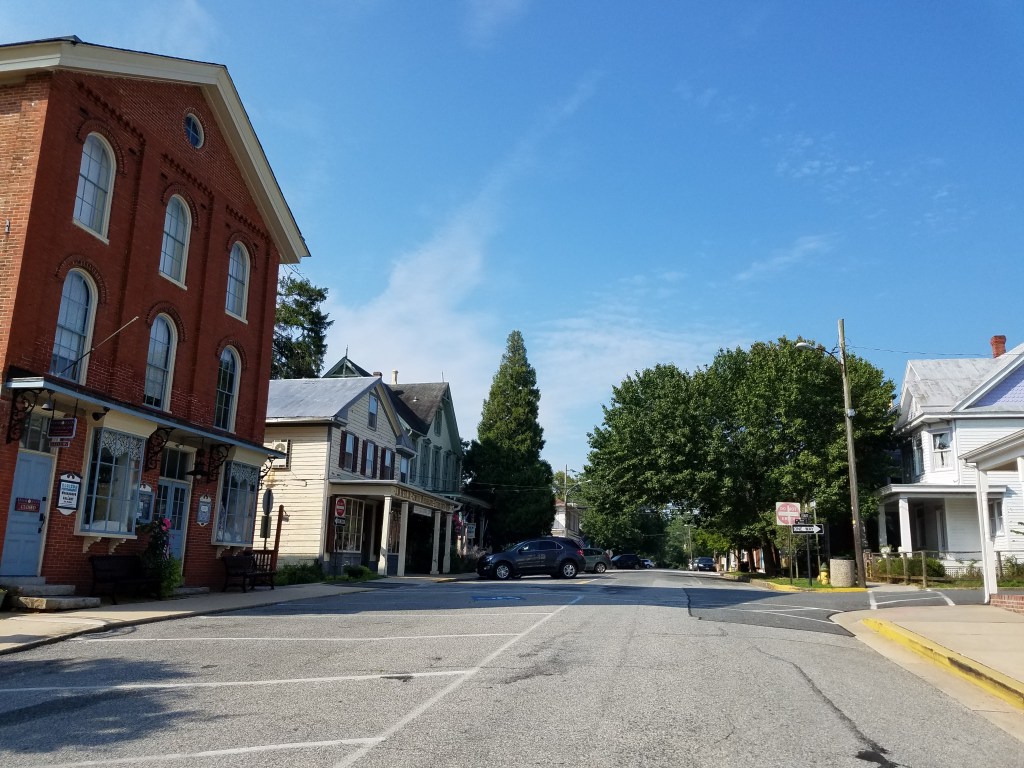
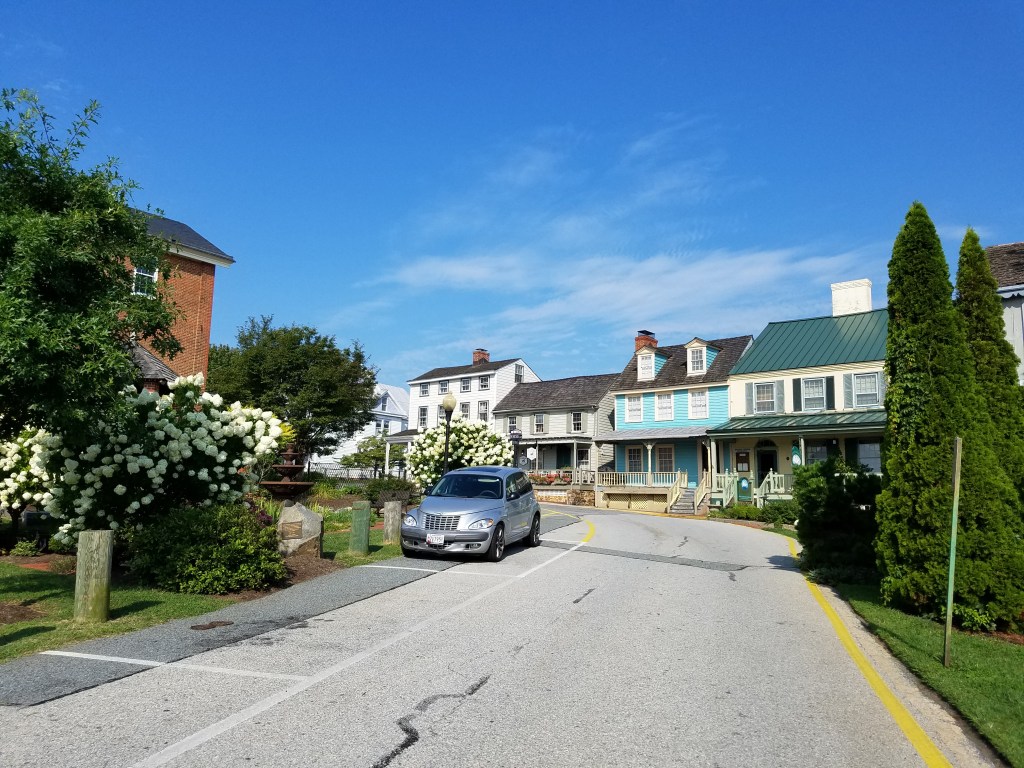
Chesapeake City
Chesapeake City
Red Snapper for dinner
The whole lobster was excellent

Our next challenge was to make our way down Chesapeake Bay.  The forecasts were good for the mornings, but blew up each afternoon to small craft warnings.  Our first stop was Annapolis, staying two nights.  We made a good run to Solomons, where we filled up with fuel and stayed two nights again.  This time I joined Dick on a bike ride around the town, and later we rode our bikes to the restaurant for dinner.  We liked Solomons on both our visits, and plan to stop there again next year.
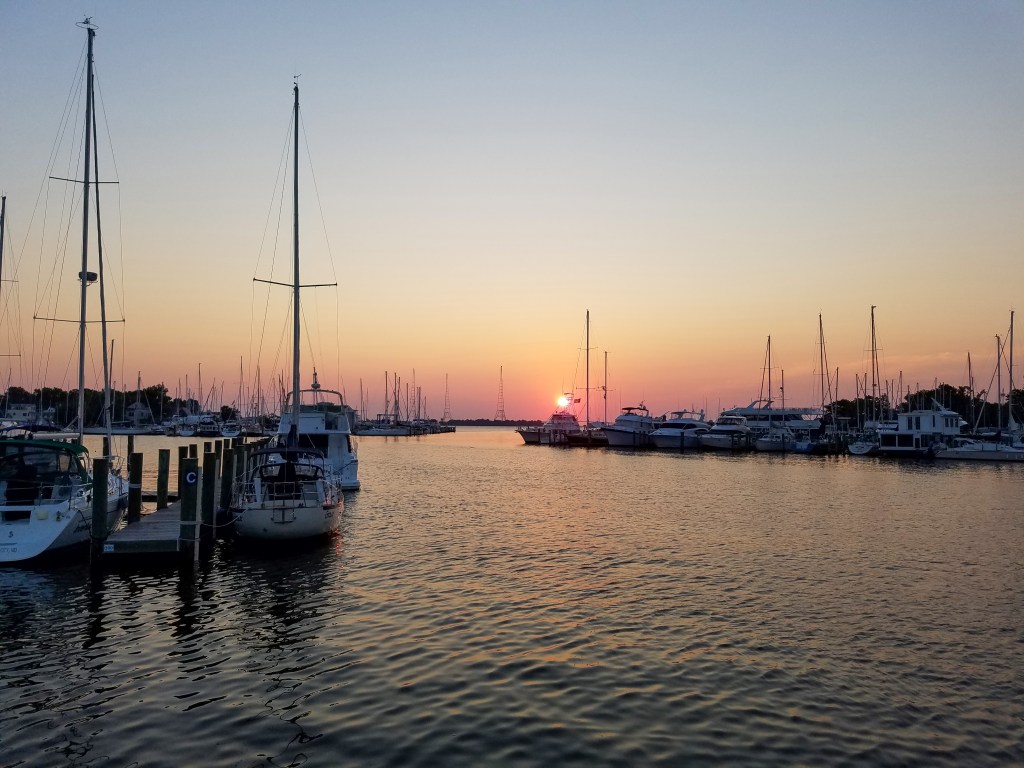
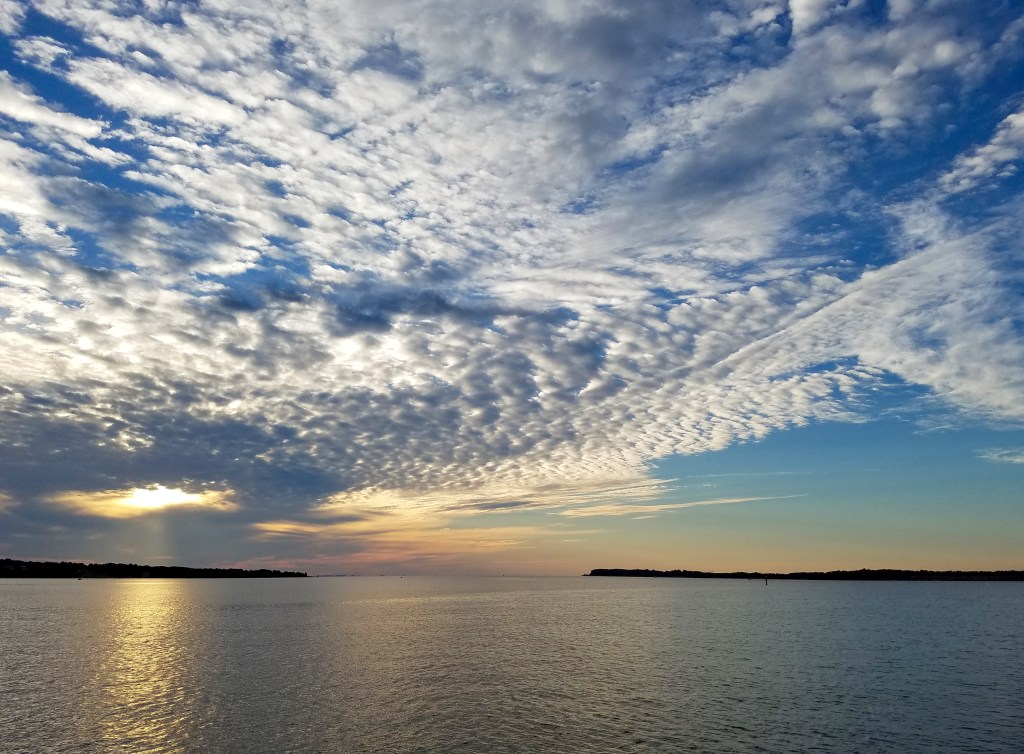
Sunrise in Annapolis
Another pretty sunrise as we left Solomons

Having taken on fuel, we decided to make a single high speed run to Portsmouth, rather than stopping overnight part way.  We left by 6:30 am, and made it to our destination before the daily blow up of wind and waves.  Being a weekend, we had to dodge sailing boats that were busy tacking back and forth across the channel, as well as watching for the huge wakes being thrown up by weekend fishermen.  No military vessels or cargo ships to avoid this time, but at least those are predictable when they are underway!

Tucker and the view of Norfolk from Portsmouth

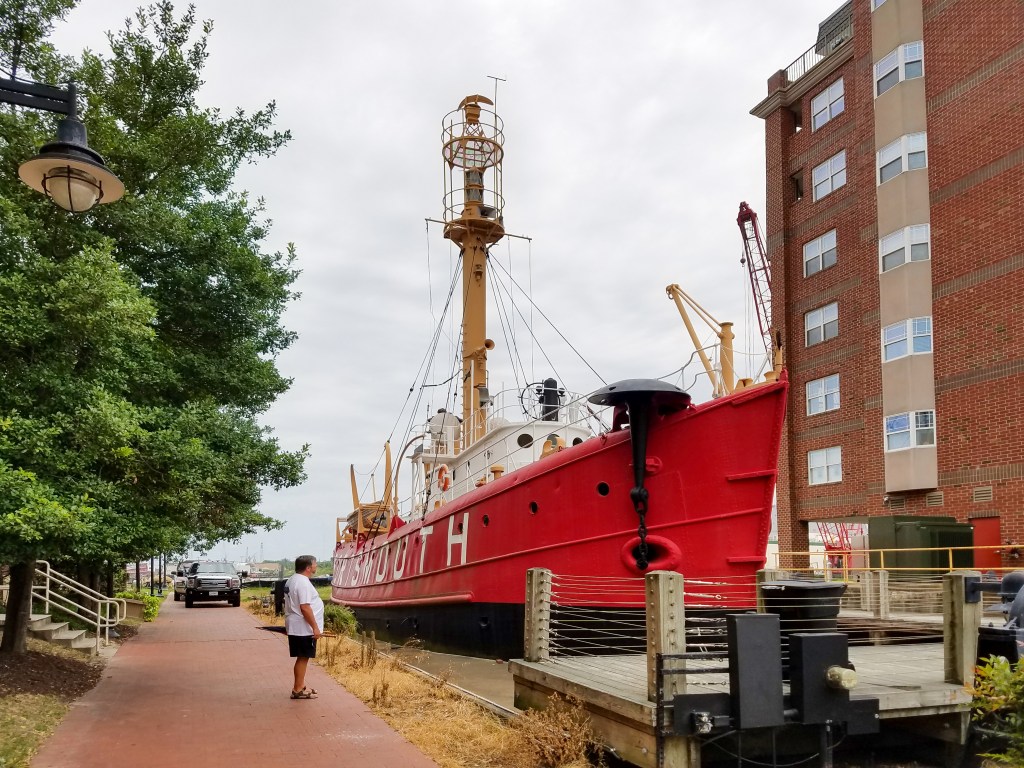
Portsmouth is struggling to attract visitors, especially with the extensive new waterfront facilities across the river in Norfolk.  They have many beautifully restored homes and downtown buildings, but as so often happens with these old towns, they don’t seem to be able to attract the mix of shops that will make downtown liveable.  We spent nearly an hour in a wonderful antique shop, and then another happy hour in one of the most interesting kitchen shops we have seen.  So many unusual gadgets and things that you never knew you needed! For the most part, we resisted temptation. The Portsmouth lightship is one of a very few lightships.  They were used when construction of a lighthouse was not practical.  Can you imagine spending time on a vessel like that, rolling around in heavy seas, not to mention climbing up to tend the light!
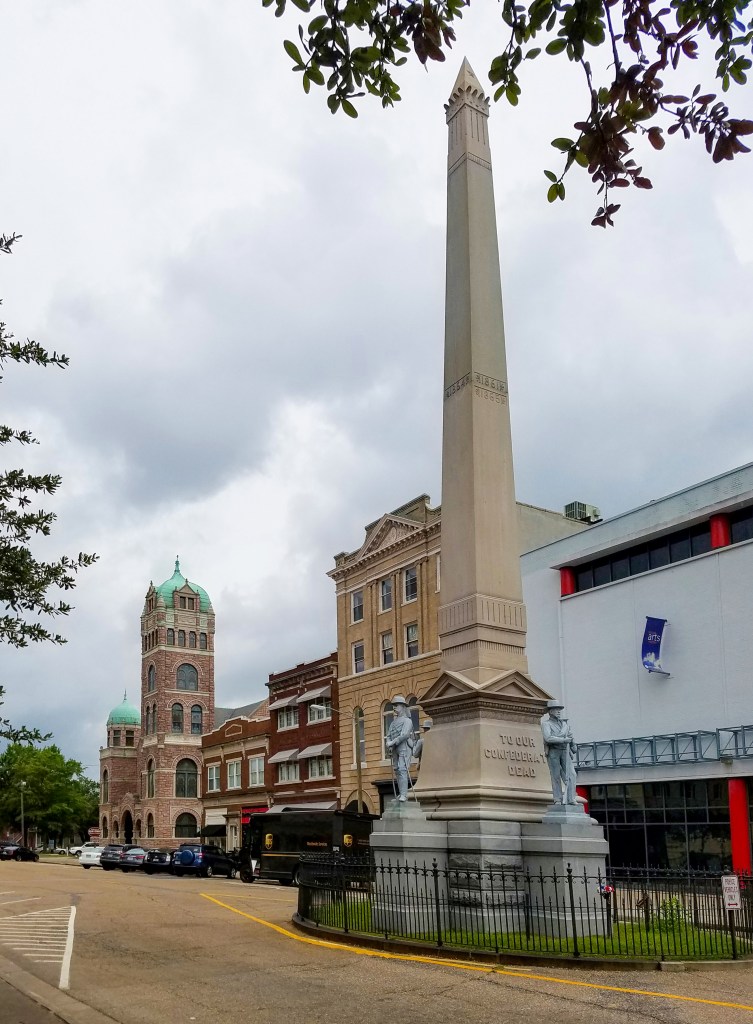
Portsmouth old town
Portsmouth Lightship

After a two night stay in Portsmouth we set off down the Elizabeth River and onward to the small town of Coinjock, about an hour north of the Albemarle Sound.  Almost immediately we were held up by a railway bridge that is usually in the open position, but it was down for a train to pass.  After fifteen minutes of stooging around (an important skill for mariners that involves maintaining position in a channel without running onto rocks or into other vessels while waiting for a bridge or lock to open), the bridge lifted and we could proceed.  That fifteen minutes put us behind on all three subsequent bridges and the single lock, turning what should have been a three hour trip into nearly five.  The offending railway bridge is next to an unusual style of highway bridge, that lifts instead of opening.  We have seen this type of bridge for railways (usually open) but never for a highway.  Just after we passed it lifted for a boat that was too tall to fit under, quite interesting to watch.
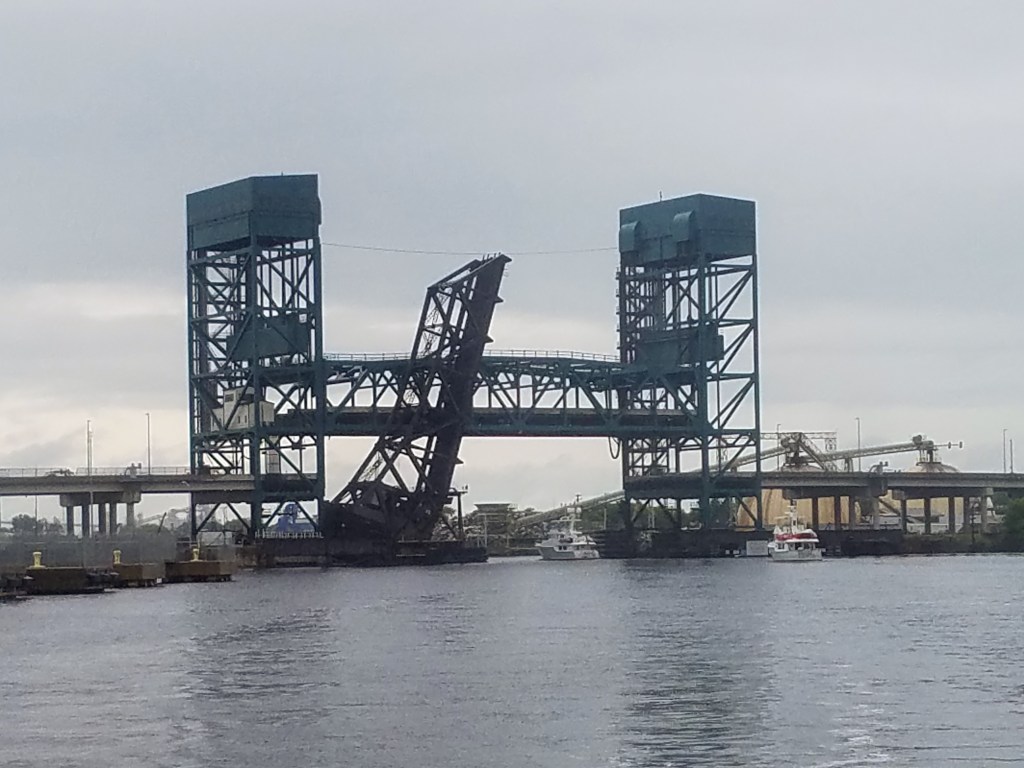
Highway lift bridge with the open railway bridge behind
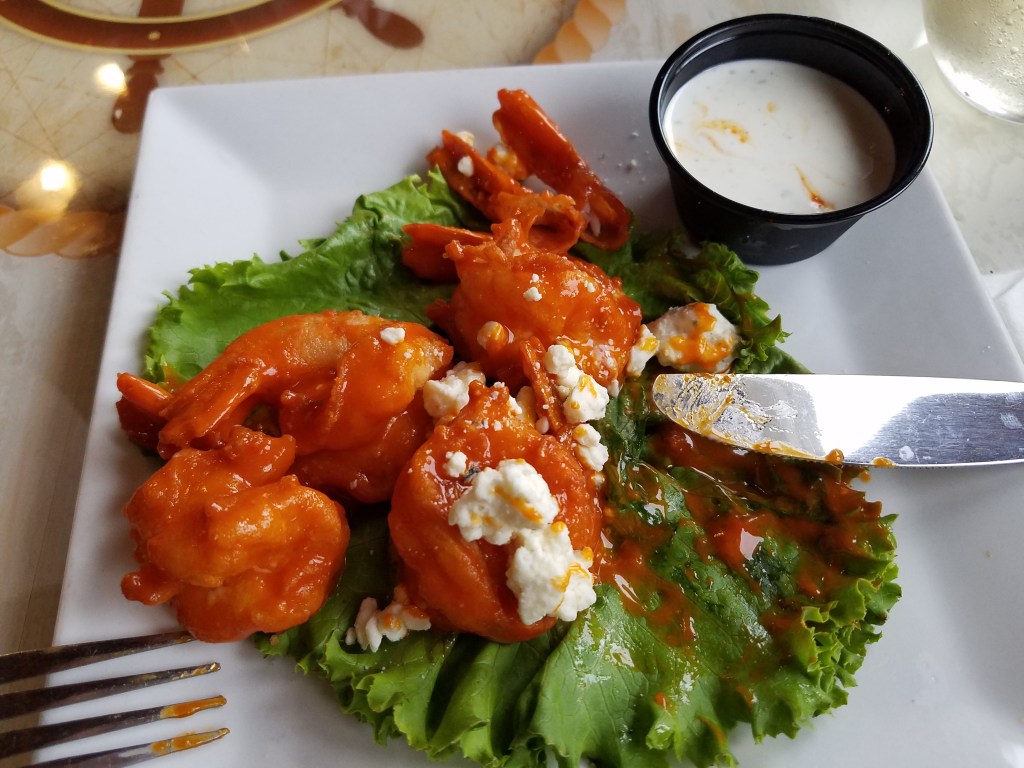
Carolina Reaper Shrimp at Coinjock. It was spicy!!

Albemarle Sound is one of the two crossings that I had been dreading, as it is very shallow and winds pile up the waves and can make a miserable trip.  This time the winds were higher than I would have liked, but they were behind us, so in theory it would not be so bad.  As the day progressed it got rougher, whitecaps appeared, and there was a corkscrew effect that made Tucker and I most unhappy.  At the end of the crossing there is a zig-zag required to get into the mouth of the Alligator River, so that put us broadside to the waves and made things worse.  Fortunately, it was only a short time before we were tied up at the marina and I could sit still and be quiet for a while!  We watched two sailboats make their way into the marina a bit later.  The broadside whitecaps had them wallowing, and even experienced sailors find that much rolling very uncomfortable.
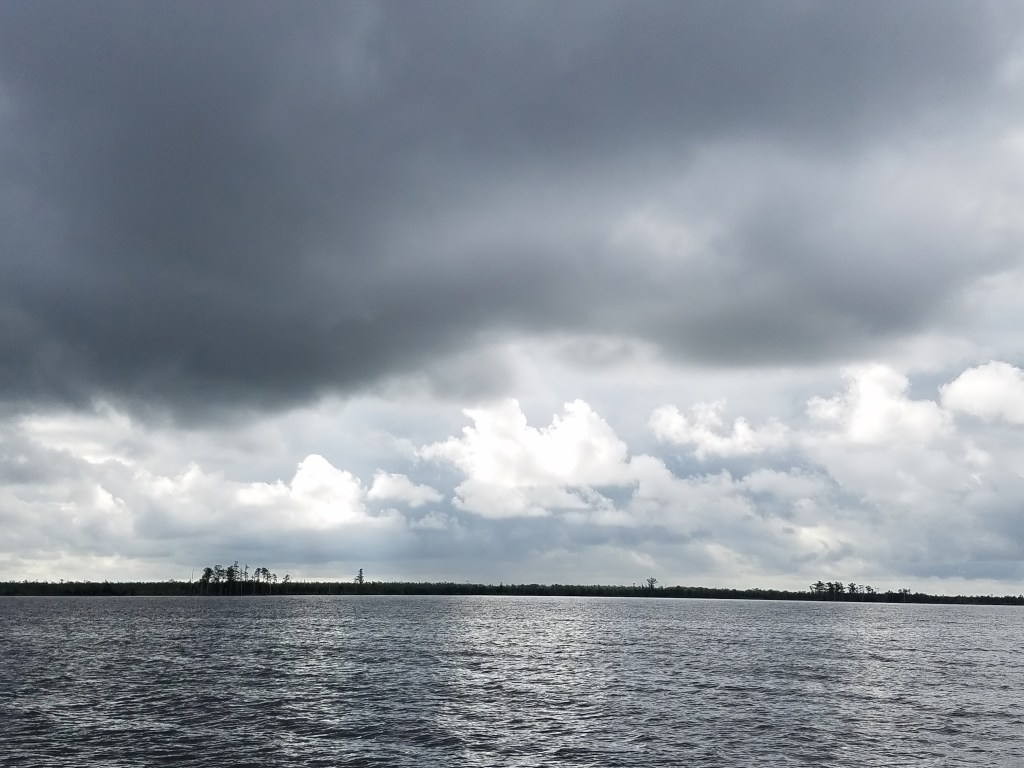
Stormy skies over the Alligator River
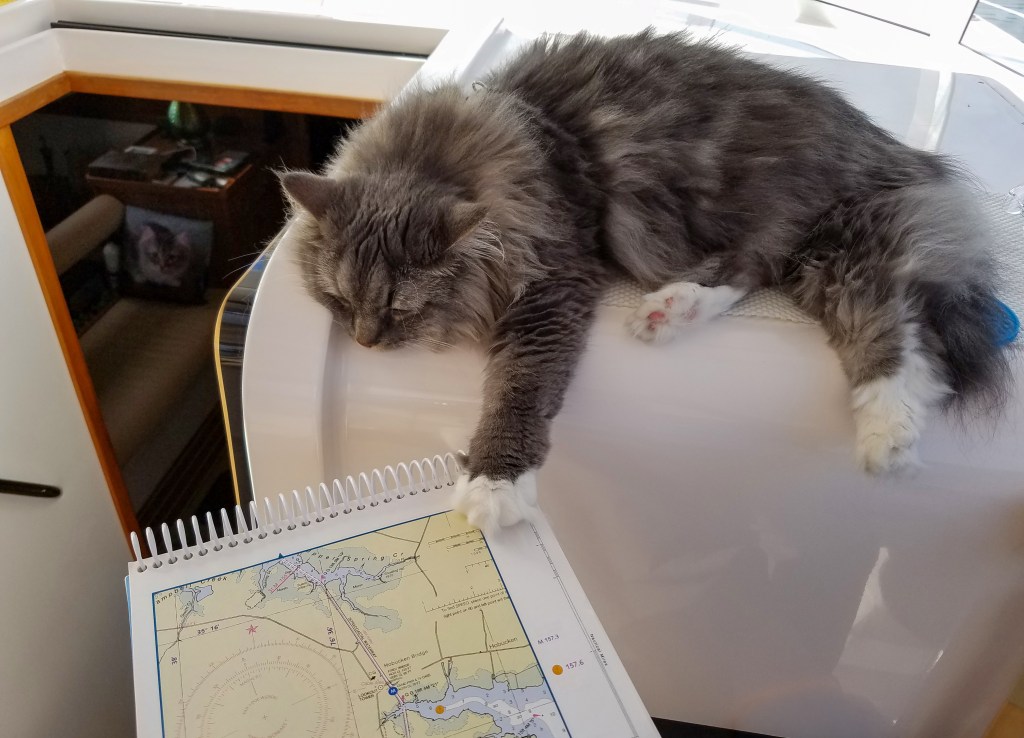
Keep an eye on the chart!

That evening we invited the couple on one of the sailboats to join us for docktails.  Such an interesting life they are leading!  They left Falmouth, England, in 2008 on their two masted sailboat headed for Spain and the Mediterranean.  A year later they crossed the Atlantic to Brazil, and spent time there, and in Uruguay and Argentina.  Some years later they came north, with stays in Panama, Cuba, and other Caribbean islands before crossing to the US and making their way north on the ICW.  Their current destination is the Chesapeake, and after that, they will go where the wind takes them!  An adventurous life that would not suit everyone, but what wonderful experiences they are having!

Our trip down the Alligator River to Belhaven was dry and uneventful, in spite of threatening skies.  In calm weather this part of the trip is two hours of boredom followed by two hours of tedium, but that is better than the excitement of a rough passage! Perhaps Belhaven is an interesting town, but apparently August is low season, and the best restaurant closes for 3 weeks.  There were very few boats in the marinas.  It is very strange to me to be told that August is low season, but I suppose with so many American schools starting mid-August there are just not that many families travelling.  Most boaters are much farther north during the summer months.  One marina owner told Dick that August is just too hot for boating! We were told that the Alligator River Marina has had up to 30 boats stopping overnight during the season for travelling south in October and November. The night we spent there, we were one of only three boats staying.

Fishing on the Alligator River

We decided to leave Belhaven very early, because we are still seeing high winds and thunderstorms coming up in the afternoons.  Our transit of the Bay and Neuse Rivers was completely calm, and a welcome change from the dreadful crossing we had on our northbound trip.  We stopped in Oriental. Waterway Guide waxes lyrical about the attractions of this sailing town, but we were seriously unimpressed.  The marinas offer little protection when the winds are from the south, so we spent an uncomfortable night rocking in the waves.  Dick went for a bike ride (dodging raindrops), and was not enthused.  Again, we decided to leave early for the short journey to Beaufort, NC. The brief crossing of the Neuse at 6:30am was calm, and the Adams Creek Canal is interesting.

A rainbow as we left Belhaven
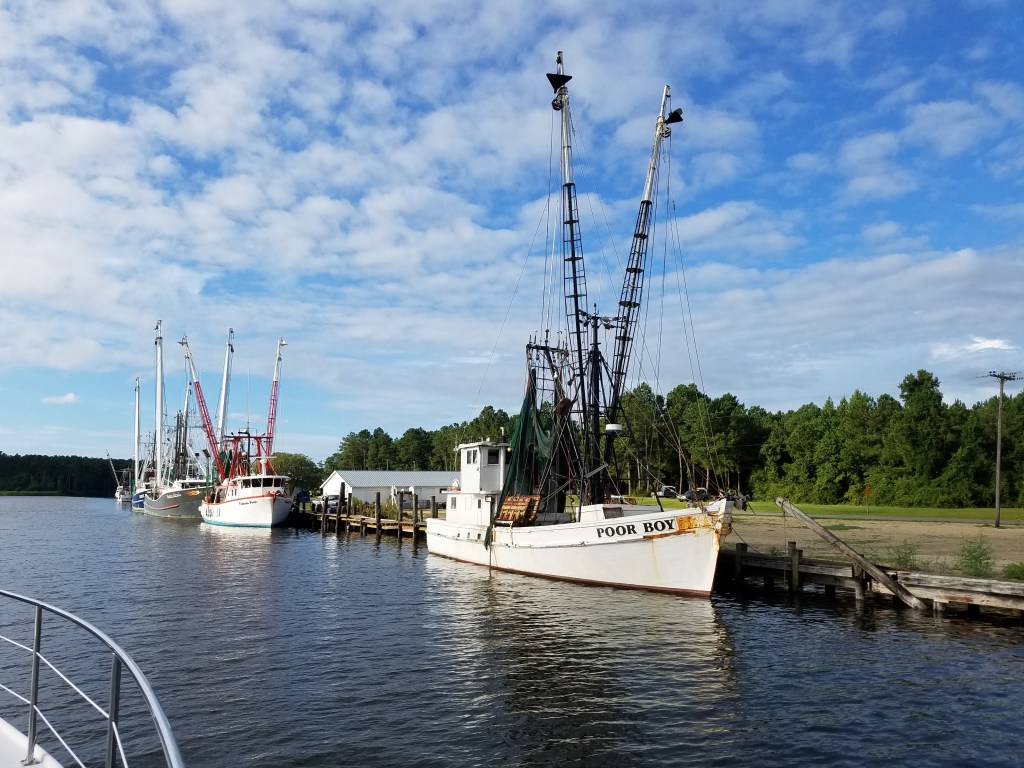
Fishing boats on the Adams Creek Canal
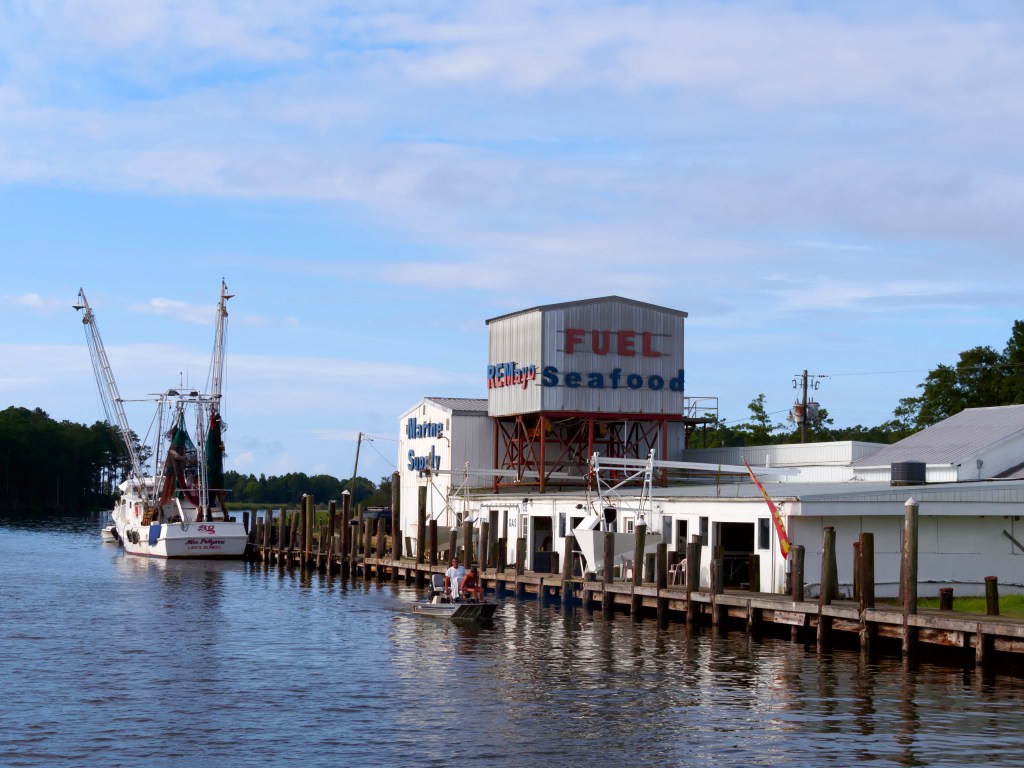
RE Mayo Seafood, Hobucken, North Carolina

We were travelling slower than usual, in order not to arrive too early in Beaufort, but that proved to be a slight error in judgement!  As we came into the tricky part of the trip, navigating through various shoals in the busy Newport river, we were enveloped in thick clouds and torrential rain accompanied by thunder and lightning.  We have radar, which we use on those rare occasions of low visibility, but when Dick updated the firmware on the chartplotter he did not realize that it would change how the radar is accessed.  He didn’t dare risk losing the chart (and taking his eye off the waters ahead) while he poked around trying to find the radar screen.  I was very concerned that not only could we not see any boat coming toward us, they couldn’t see us either.  Eventually, after what seemed like a long time but was probably only about 15 minutes, the storm cleared enough that we could see again.  In addition to a large shrimp boat ahead of us, we came on two kayakers paddling across the channel.  What possessed them to be out in busy waters in such poor visibility I do not know.

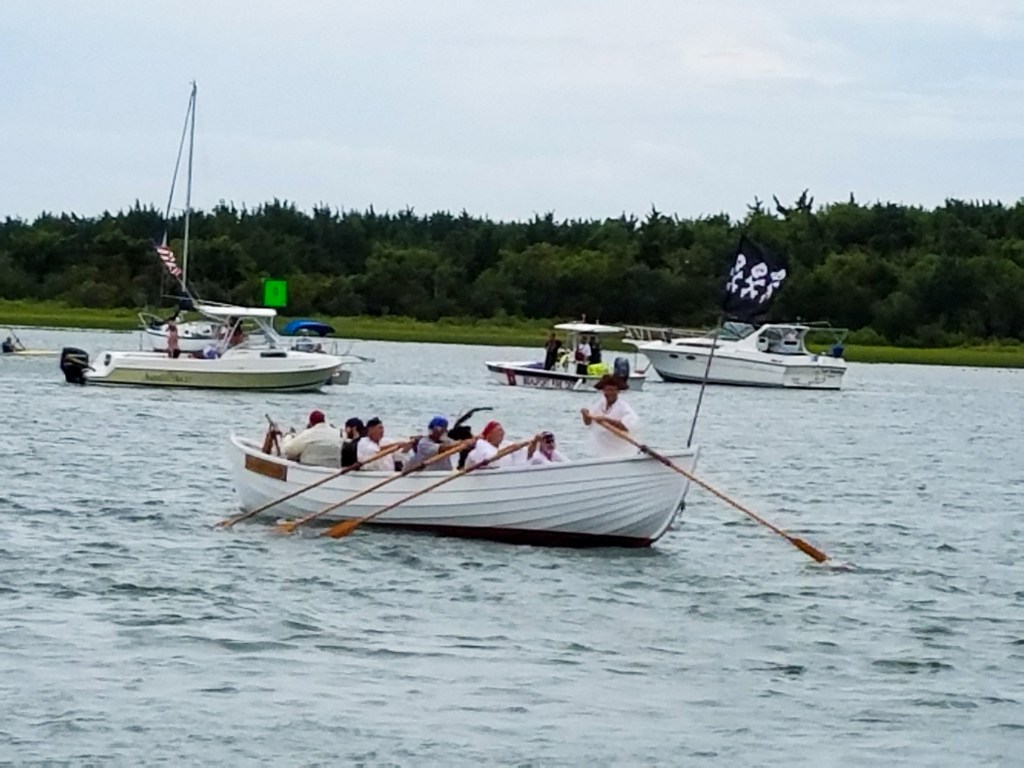
We arrived in Beaufort to find it celebrating the annual Pirate Invasion.  Beaufort was the home of the famous Blackbeard, and it celebrates all aspects of its nautical history with grand enthusiasm.  Shortly after we tied up there was a battle between a fully rigged pirate ship and a large rowboat with 8 pirates and a cannon on board.  Our view of the naval engagement was blocked, but we could hear the cannons firing and the screams!  Arrrr!  The town was infested with pirates, along with a number of women dressed as heaven knows what.  However, everyone seemed to be having a good time.
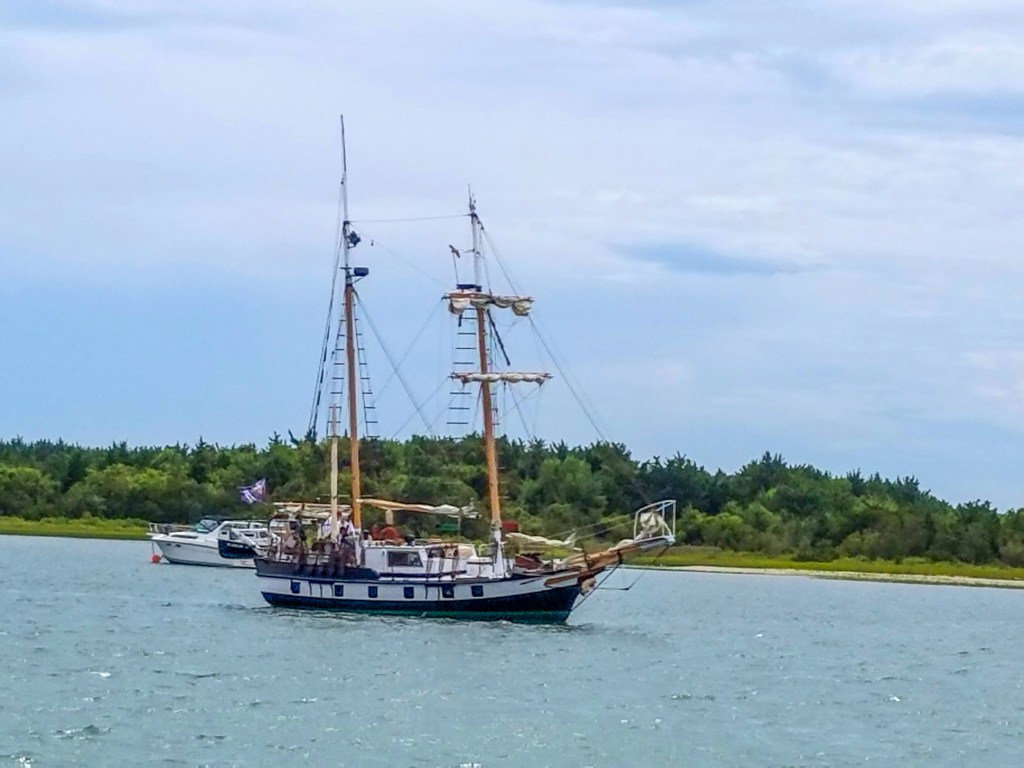
Pirate ship
Pirates

We have seen some interesting wildlife behaviours on this trip.  On our way north we passed hundreds of osprey nests; sometimes it seemed as if every channel marker had a nest with osprey rearing chicks.  Now, two months later, the chicks have flown, but I have noticed that there is often a bird perched on the empty nest.  I wonder if it is one of the young, still staying around familiar places.  On one of our ocean passages we saw at least 30 dolphins herding fish into a tight circle to feed from them.  We passed an area on the Chesapeake with hundreds of gulls swooping on waters that were literally boiling with fish.  In addition to the gulls there were pelicans, and even a few osprey diving to catch dinner.  We couldn’t tell what was making the fish rise to the surface, but there were several areas like this over a couple of miles of shallow water.  One of the most fascinating episodes I watched was while I was sitting in the cockpit at the dock in Great Kills.  I heard a repeated banging sound, and turned round to see a young gull with a huge clam.  He was jumping up about 10 feet above the dock and dropping the clam, then following it down to make sure it didn’t roll off the dock.  After dropping it about 20 times, the clam developed a crack in the shell, and the gull was able to break it open and eat the meat inside.  I was so fascinated I forgot to get a camera and take pictures!
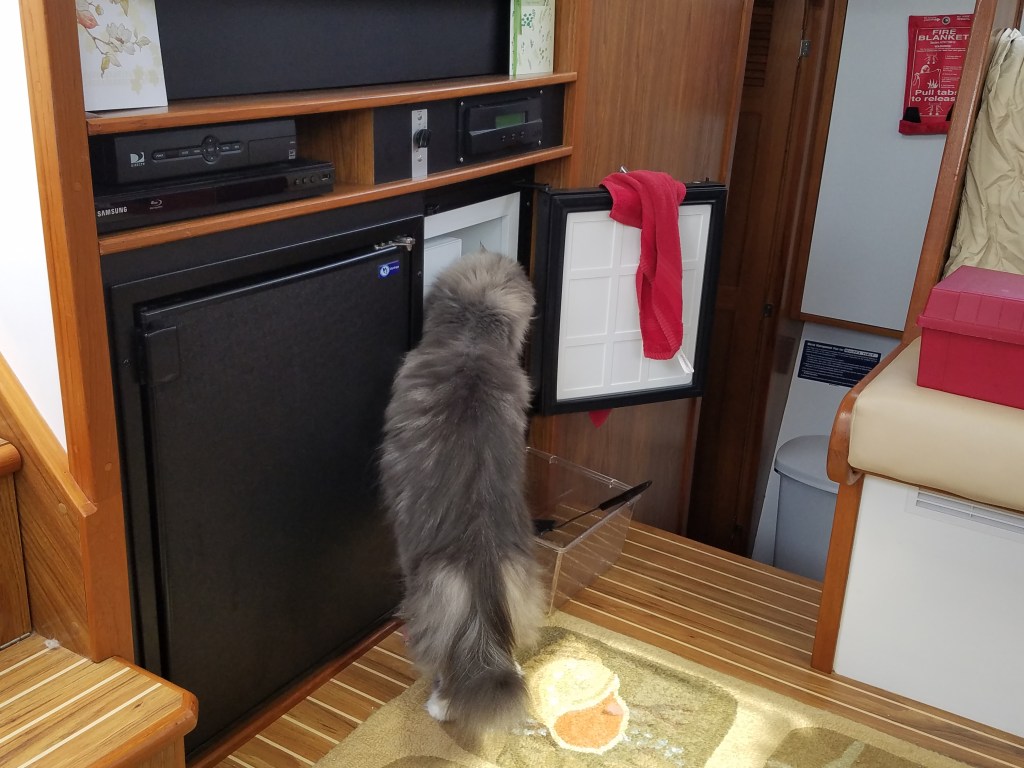
What’s in there?

We are nearly finished this year’s journey, expecting to be home in about a week.  We have not anchored overnight since we left North Carolina on our outbound journey, and we enjoy the peace and quiet, so we plan to anchor most nights, and to stop just one night at a marina in Southport and one south of Myrtle Beach.
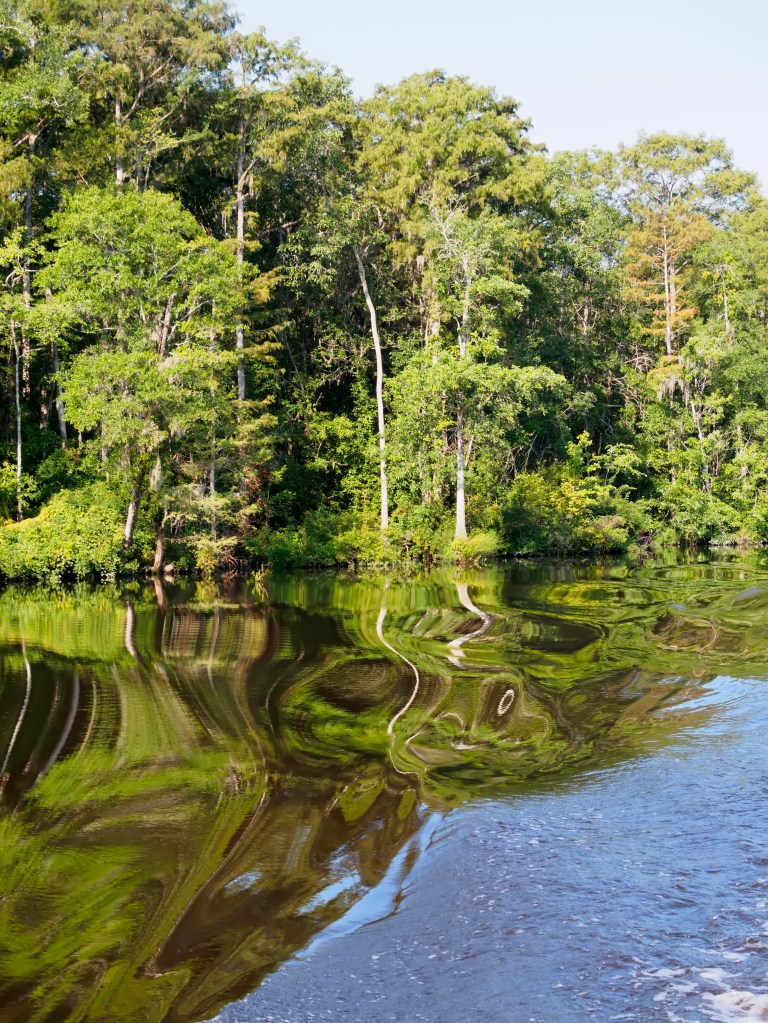
Waccamaw River, South Carolina

It has been an interesting trip.  We have made lists of things that we want to fix, or improve, before we set off again next summer.  Tucker has finally settled into the various routines, and seems to be reasonably content.  I have enjoyed cooking on board, using some of the special things I spent so much time collecting this winter.  The pressure cooker/slow cooker has been an unqualified success, but I have also found some great recipes for one pot meals and casseroles that work in the small oven.  We do plan to replace the Australian style grill for a more familiar type.  I had expected to be able to work on pictures during some of the quiet times, but this has not been possible.  Even a slight motion of the boat makes me feel queasy if I try doing close work on the laptop in the salon, and the table in the cockpit is too high for me to work on. We find that while the cockpit chairs are comfortable, the helm chair leans back too far for me to be able to sit in it and drive, and we both miss being able to relax in a recliner chair.  So we are hoping to replace both cockpit chairs with some that we saw at the boat show that have more adjustment and also a recliner position and footrest.  Dick is going to replace the bulbs on the interior lights, plus a couple of inoperable fixtures, and we hope that will solve the problem of the dim lighting at night.  We are also hoping to get screens made for the side doors of the cockpit, to add more air circulation while keeping the insects out.

A note added later. This was Tucker’s last voyage.  Between the heat and the continuously changing routines, he became more and more unhappy in the last few weeks of the summer voyage.  He now spends his summers with his other family in Hilton Head, and everyone is happier.
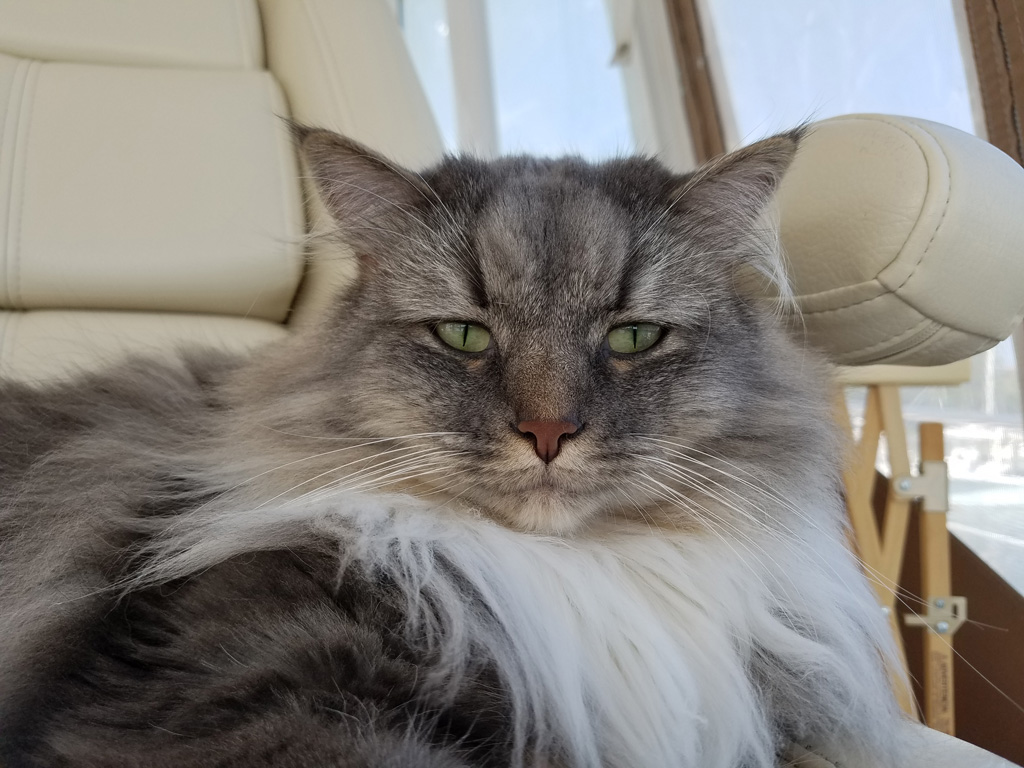
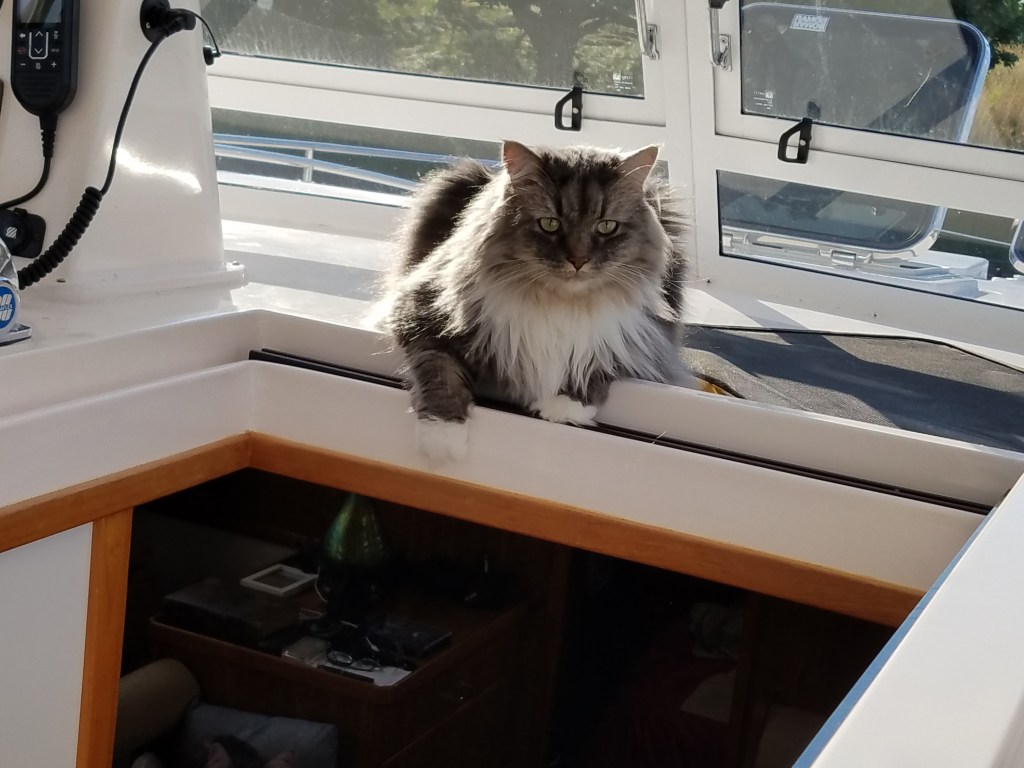
What do you want
I want to stay home!

July 5 to 24, 2017: Utica to Oswego and back to New Jersey

There and Back Again

On July 6th the lock above us on the Erie Canal finally reopened and we were able to leave Utica and head for Oswego.  The waters of the canal still looked like extra thick mushroom soup, and we had to keep a careful watch for floating logs, some of them whole trees that were partially submerged.  We passed dredgers working on silted up areas, and other barges with workmen still gathering and cutting up debris.

Clearing debris on the Erie Canal

Oneida Lake has a reputation for building up waves when the wind is from the west, and we wanted no further delays so we ran wide open (that means pushing the engines to just below their top speed, which gives us about 18 knots, as opposed to our normal travelling speed of 7 knots) and cut the journey time in half.  Brewerton is on the northern shore of the lake and was our next stop.  There is an attractive town dock, but we wanted to stop at the marina that Dick is planning to leave the boat with at the end of next season.  They have heated indoor storage, so you don’t need to go through the rigmarole of winterizing.  They also have excellent fuel prices, so we made a point of filling up!

Brewerton

North of Brewerton we passed a number of very nice cottages and full-time homes on the side of the canal before arriving at Three Rivers, the junction of the Erie and the Oswego Canals.  The Oswego Canal was completed 3 years after the Erie Canal opened, and allows boats to travel directly north into Lake Ontario.  8 locks later we arrived in Oswego.  Interestingly, the last two locks are right in the centre of town, and as you walk over the bridges you can see how the canal and the river have been kept separate.

Three Rivers Junction
Transiting one of the locks
Oswego Canal, separated from the river

Oswego is another old town that was once wealthy and has now lost much of its industry.  In addition to being an important freshwater port it was also a railway hub.  There were grain elevators and mills, the Kingsford starch factory, and textile mills.  Today there is still a cement depot in the harbour, but most of the mills and factories are gone.  We tied up at the Oswego marina, and prepared to leave the next morning for Kingston, Ontario.

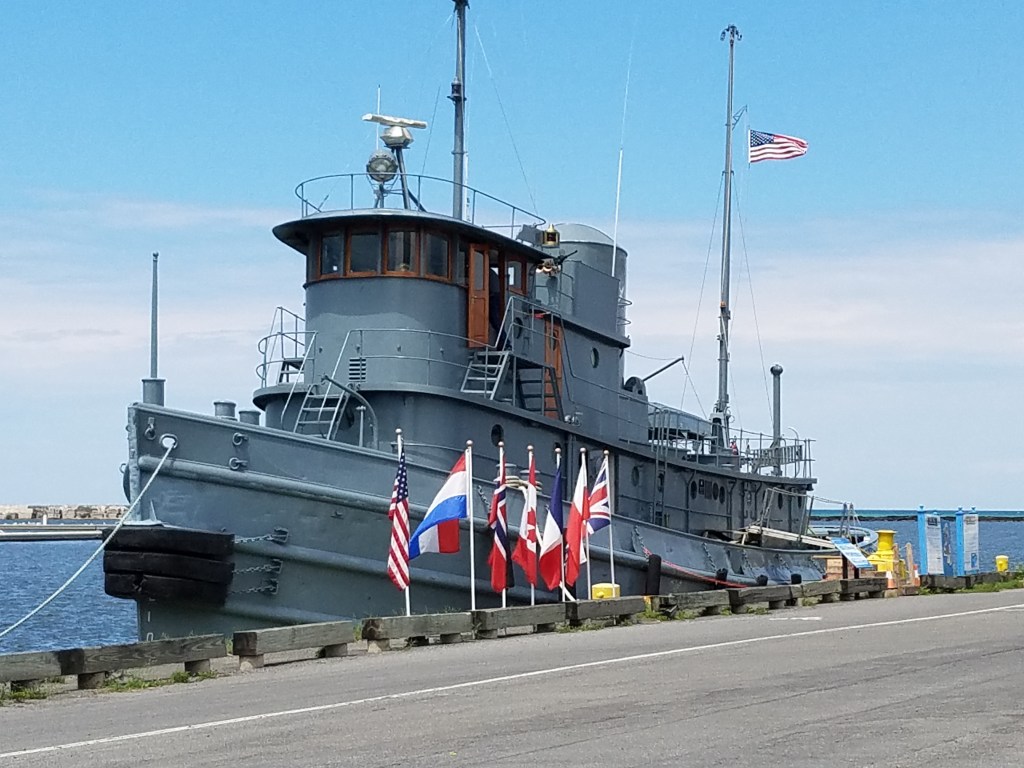
There is a historic fort at Oswego that we did not explore on this visit, but there is also a marine museum, where we saw one of the tugs that was built for Operation Overlord in WWII.  It was used to tow barges of ammunition and supplies in convoys across the English Channel to the Normandy beaches in 1944.  After the war, she continued to work as a harbour tug for more than 40 years.  We also went for a harbour ride on a solar powered wooden boat.  This was an interesting experience, the boat was quite dreadful, all plywood, and extremely basic.  The captain and his wife are very enthusiastic about their various projects, this one being their second solar powered boat, and a third is currently being built in a shed at Kingston (NY) harbor.  We had seen the project when we stayed at the museum on our outbound journey.  Dick was fascinated by the technology, whereas I was amazed at the complete lack of any safety briefing or life jackets on board when they are taking out members of the public.  The liability issues are staggering.  However, it is certainly a good cause.  The boats are built by middle school students, closely supervised of course.  It is often the first time any of these young people have ever picked up a hammer and nails.

WWII Tug
Solar powered boat

Our original plans were to explore the Thousand Islands as far as Cornwall, and then work our way west towards Hamilton, eventually circumnavigating Lake Ontario before heading south towards home.  Alas, the many weather delays changed these plans, but we were still expecting to cross Lake Ontario to Kingston and have time to visit Trenton, as well as friends and family further west.  For once the weather was in our favour, and at 8am Dick turned on the chartplotter to plan the route to Kingston.  At one mile outside Oswego Harbor, all the chart detail stopped.  It wasn’t quite “Here Be Dragons” but close! When we bought the boat, everything had been equipped to such a high spec that it never occurred to Dick that the previous owner would not have bought the complete North America charts.  With no paper charts for Canada either, we were not going to proceed, so Dick got busy and placed the order for the updated and complete charts, paying extra for “overnight” delivery.  Nothing on the Navionics website suggested that they only process orders Mon-Fri (and this was a Saturday).  Dick waited in vain on Sunday for the new charts.  Then we gave it some more thought and realized that even if we did get another weather window we would risk getting stopped more times while travelling around Lake Ontario, and with a deadline for being back in Hilton Head we decided that Oswego would be our turnaround this year.  Dick rented a car and visited his Mum while I stayed to keep an eye on Nine Lives and Mr Tucker.

Historic tavern in Oswego

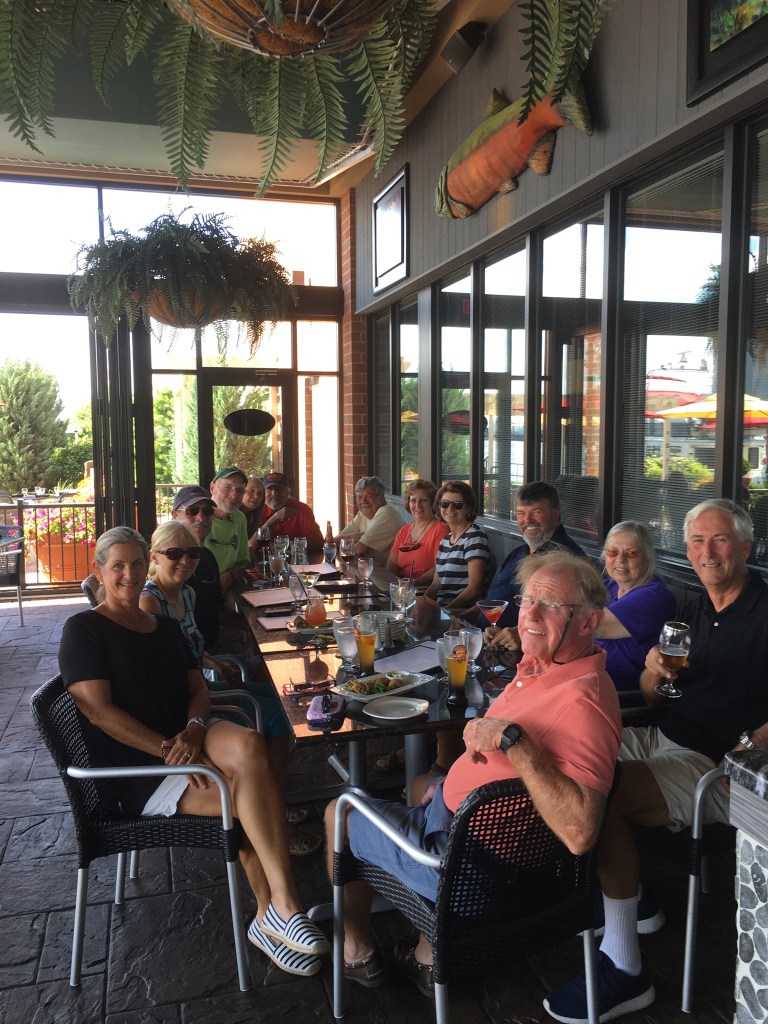
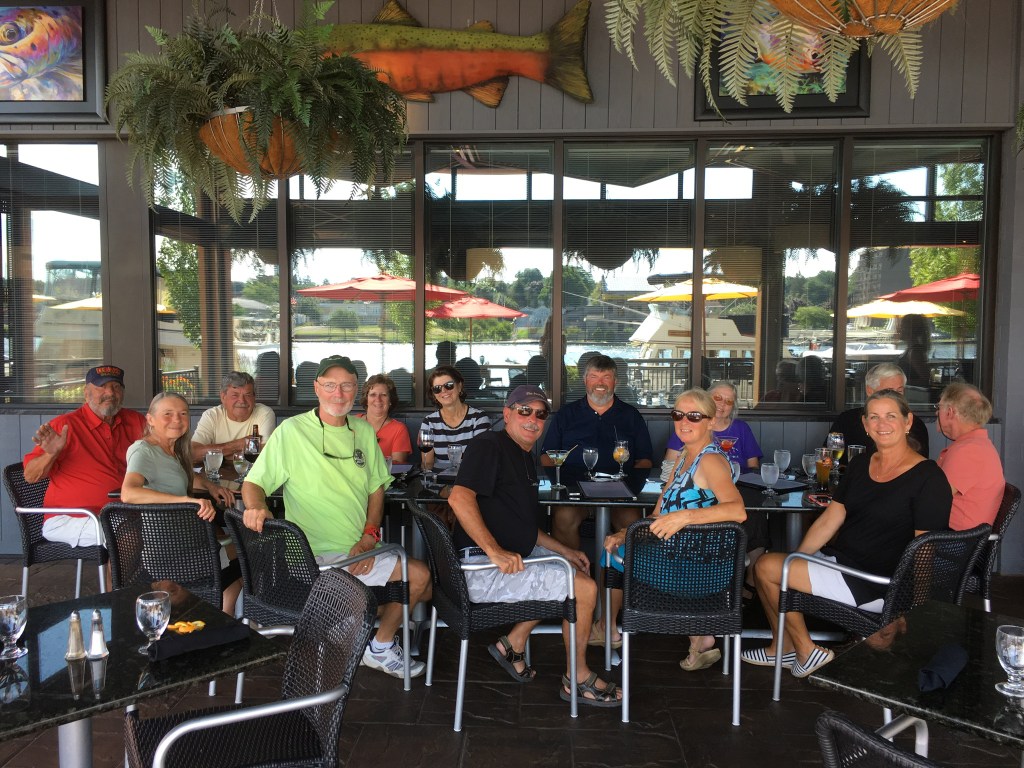
The evening before, we had one of the best get-togethers of the trip.  We had enjoyed docktails with a group of Loopers earlier on the Erie Canal.  The rest of that group got stuck in Ilion, two locks south of where we were in Utica, but once the canal reopened we all met again in Oswego.  We gathered at a local restaurant and enjoyed a very pleasant evening of chat and consultation.  One of the group is solo on a sailboat. He is Australian and has been planning to do the loop for nearly 15 years.  He had spent time in Long Island Sound, and is now making his way around the loop with the rest of the pack.  It was a great evening.  The next morning, I stood on the stern of our docked boat and waved goodbye to all our new friends as they headed out across Lake Ontario and onwards.

Looper gathering in Oswego

Dick enjoyed visiting his Mom, and made a detour on the way back to shop at Wegmans, once our favourite supermarket when we lived in NY State.  Then we waited some more for the not-even-close to overnight delivery of those pesky charts.  They finally arrived at noon on Wednesday, and we decided we were quite tired of Oswego and ready to move on immediately!

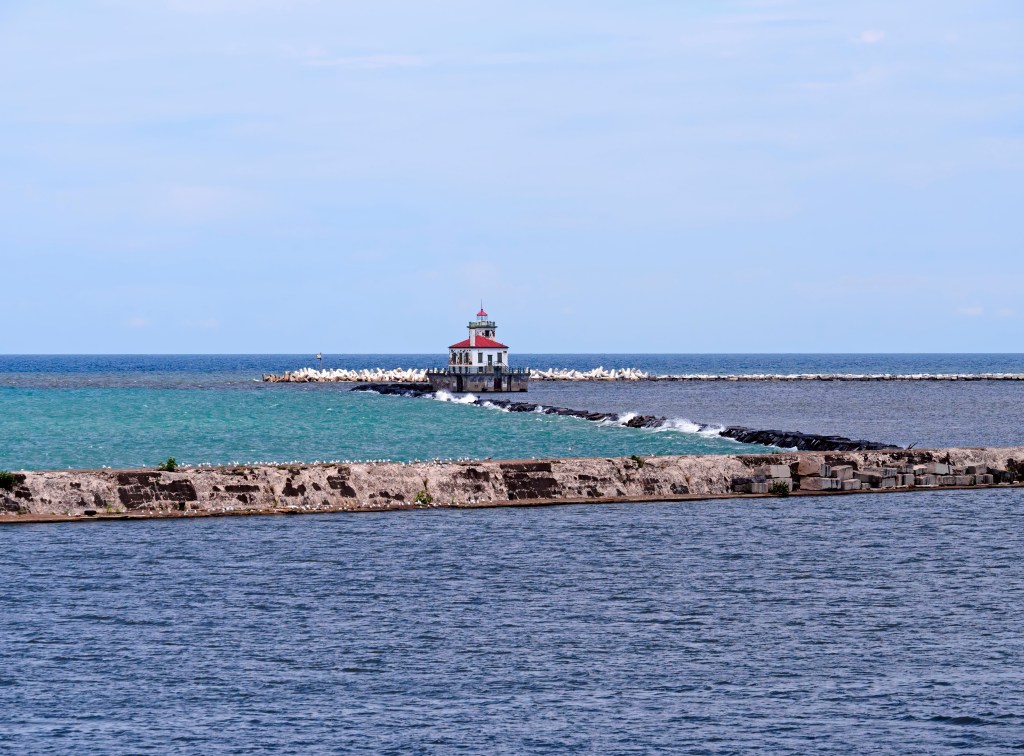
Looking out at Lake Ontario, the breakwater and lighthouse, Port of Oswego

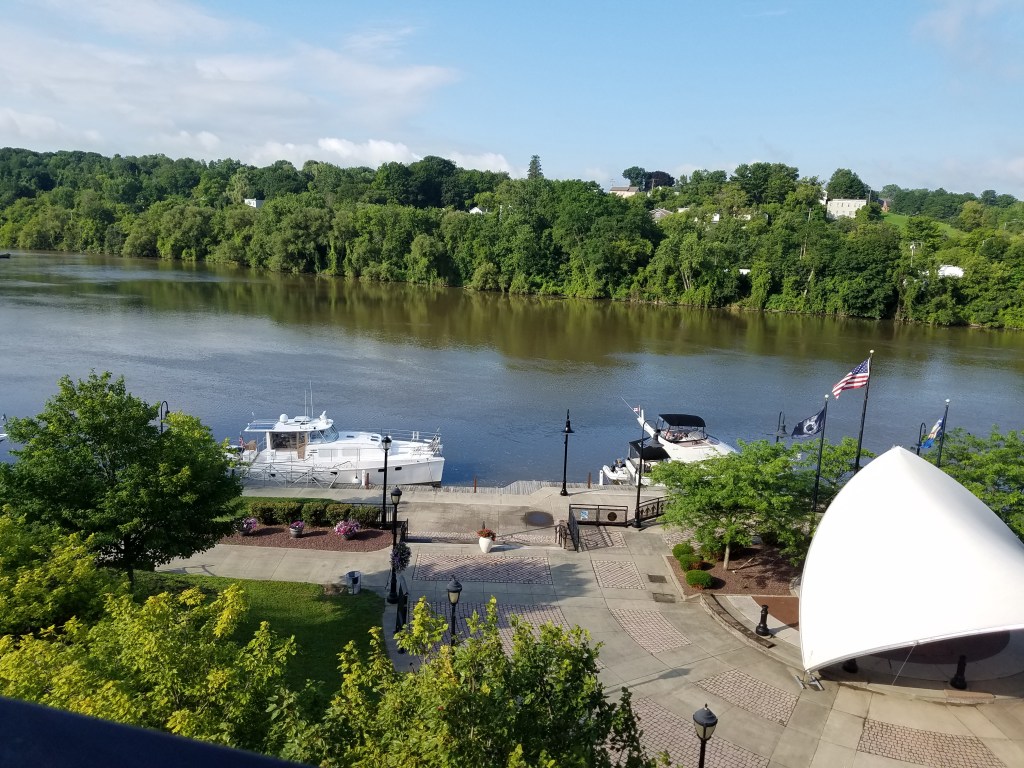
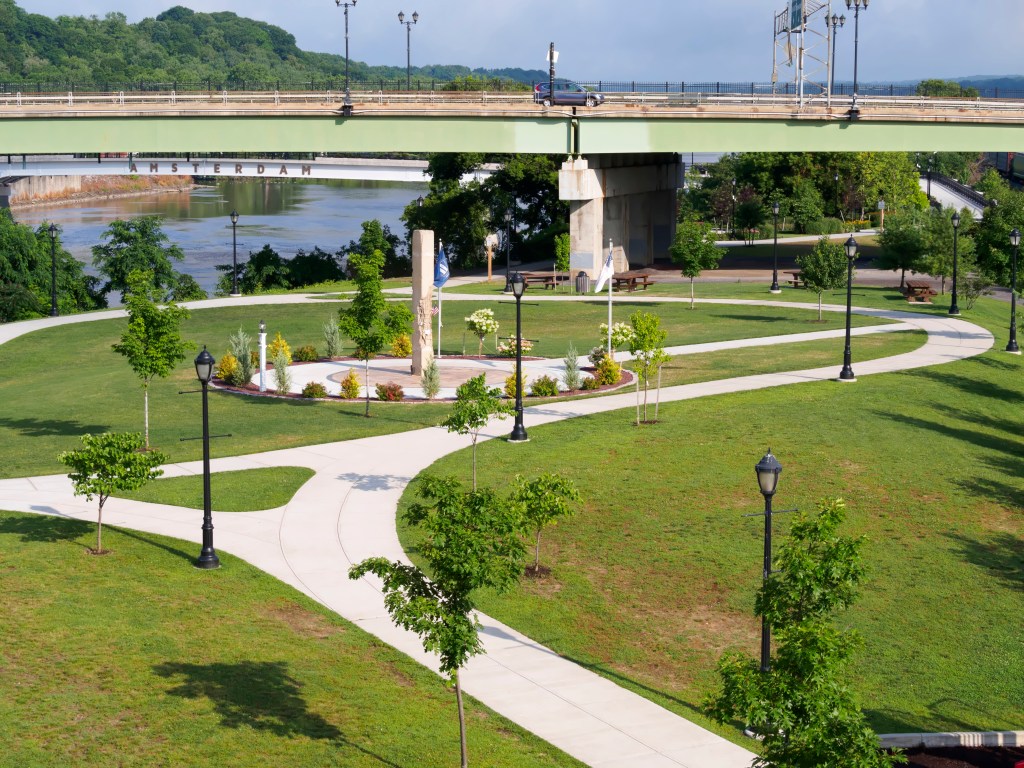
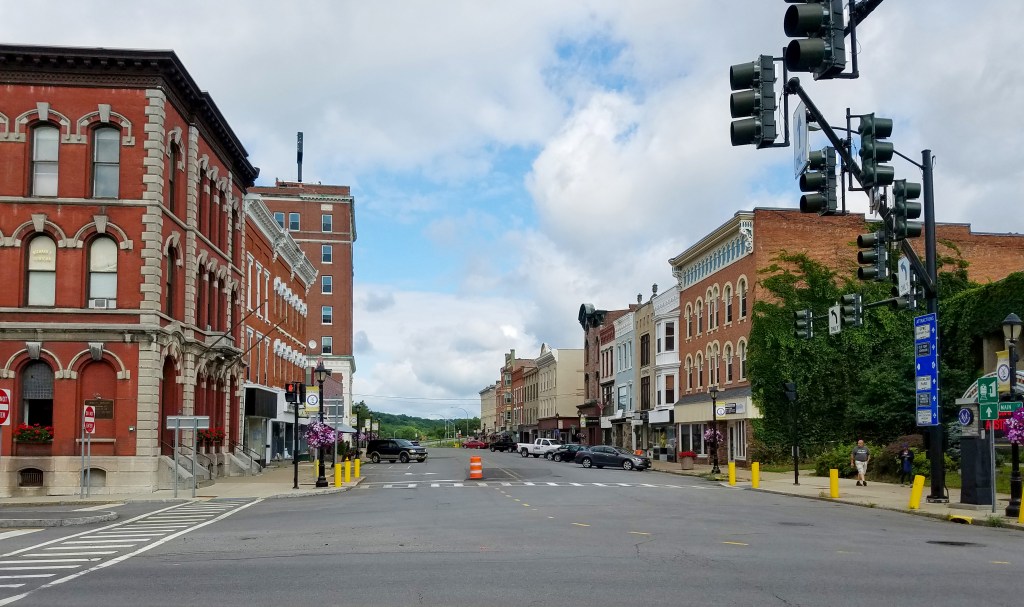
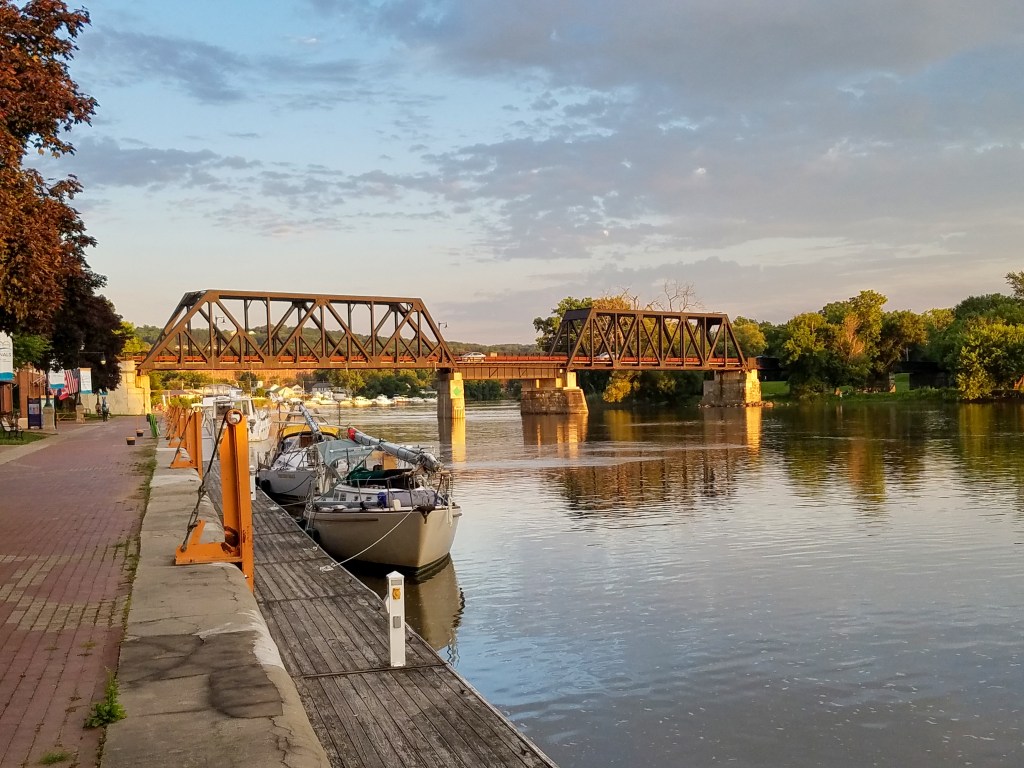
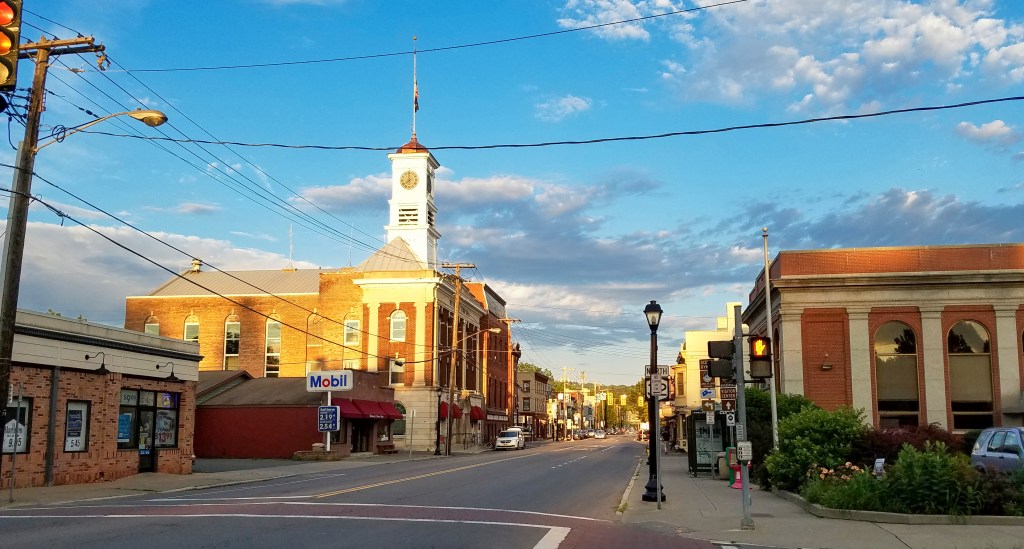
On our return journey we are planning a combination of repeat visits to places we enjoyed, and new stops just to make things different.  One new stop was Amsterdam on the Erie Canal.  Another once wealthy town, but they have made major efforts to make it an attractive destination for boaters.  There is a beautiful park on the river, with a bandshell and concerts weekly through the summer.  You can tie up on the wall right in the park.  Downtown has nicely restored buildings, but there is the usual sad problem that they are unable to attract a good mix of shopping and residential, so many of the shops are empty and those few that are open are a strange mix of tattoo parlours and wedding shops. 

Nine Lives at the dock in Amsterdam
Riverlink Park, Amsterdam
Downtown Amsterdam

East of Amsterdam we stayed overnight at the Schenectady Yacht Club, probably the prettiest location on the Erie Canal as the canal/river cuts through a gorge.  After locking down through the final 6 lock flight we stopped again at Waterford.  This is another village that has made efforts to attract boaters to the waterfront and the historic downtown. By this time, I was quite glad to get out of the Erie Canal and back into the Hudson River, with only one last lock to transit.

The view across the river from Schenectady Yacht Club
The docks at Waterford. Two sailboats have taken down their masts for the transit through the canal. They will reinstall them once they get to Oswego.
Downtown Waterford

As we approached the lock above Albany, we watched replicas of the Nina and the Pinta travelling upstream on their way to Oswego and parts west.  They looked quite strange with all their masts and rigging stepped and piled up on the decks.  The authenticity stops at propulsion… they both have efficient modern motors to supplement their sails.

Our air conditioning pump was unreliable, so we stopped for an extra couple of nights at Shady Harbour in New Baltimore on the Hudson.  The mechanic was able to get a replacement quickly.  We certainly did not want to be travelling south into even greater heat and humidity without working air conditioning! That said, the other day this area had higher temperatures than Hilton Head, and the humidity was over 90%. I used the time to scrub the fenders with soapy water to get off most of the crud from the Erie Canal, and then Dick gave the boat a good wash as well.

Washing the boat

I like the Hudson River.  There is so much history and it is both beautiful and interesting with all the commercial traffic.  One morning the river was completely covered in fog, and a big tanker passed, blowing its whistle every few minutes to warn oncoming traffic.  We later read about the requirement for all cargo vessels to take on board a Hudson River pilot.  He climbs up the side of the moving vessel in New York Harbour, and takes the ship up to Hyde Park, where another pilot takes over so they are always fully rested.  Most of these ships have foreign crews, and many have never been through New York or on the Hudson before.  The pilot must know how to navigate every kind of vessel, and these ships are huge!  They run right through the winter, sometimes travelling in convoys because of ice.

A tanker in fog on the Hudson River

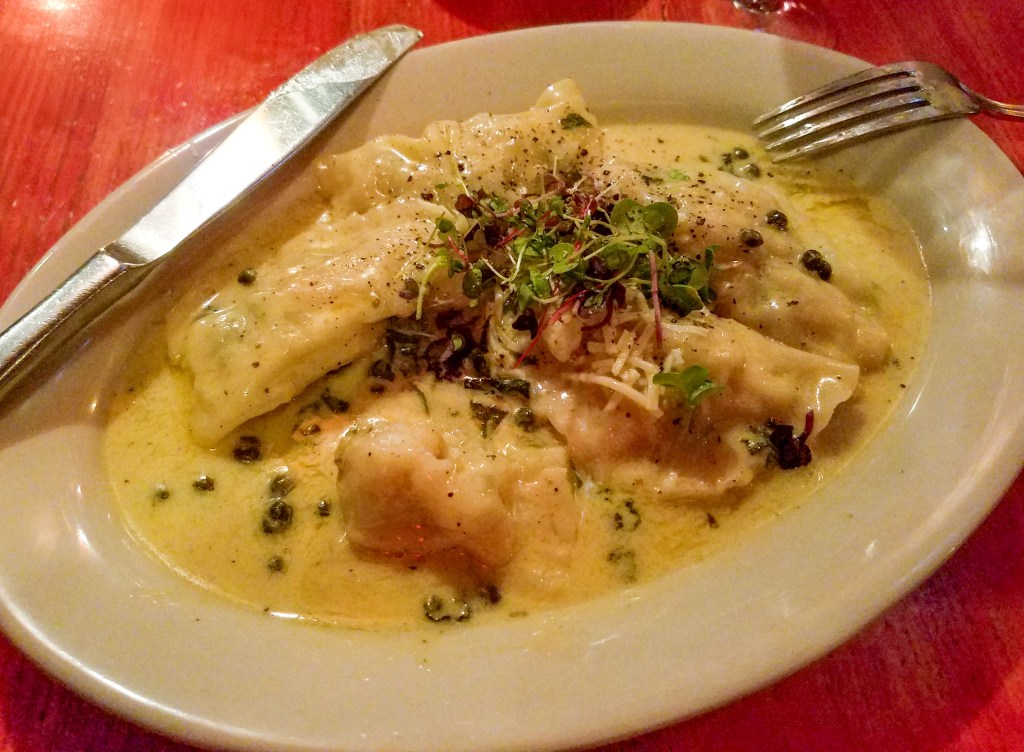
We stopped again in Kingston, having enjoyed the Marine Museum and waterfront so much on our earlier visit.  This time we tried the other restaurant we had noticed, and had the best meal so far on the trip.  I had lobster ravioli that I will dream about for some time!

Lobster ravioli
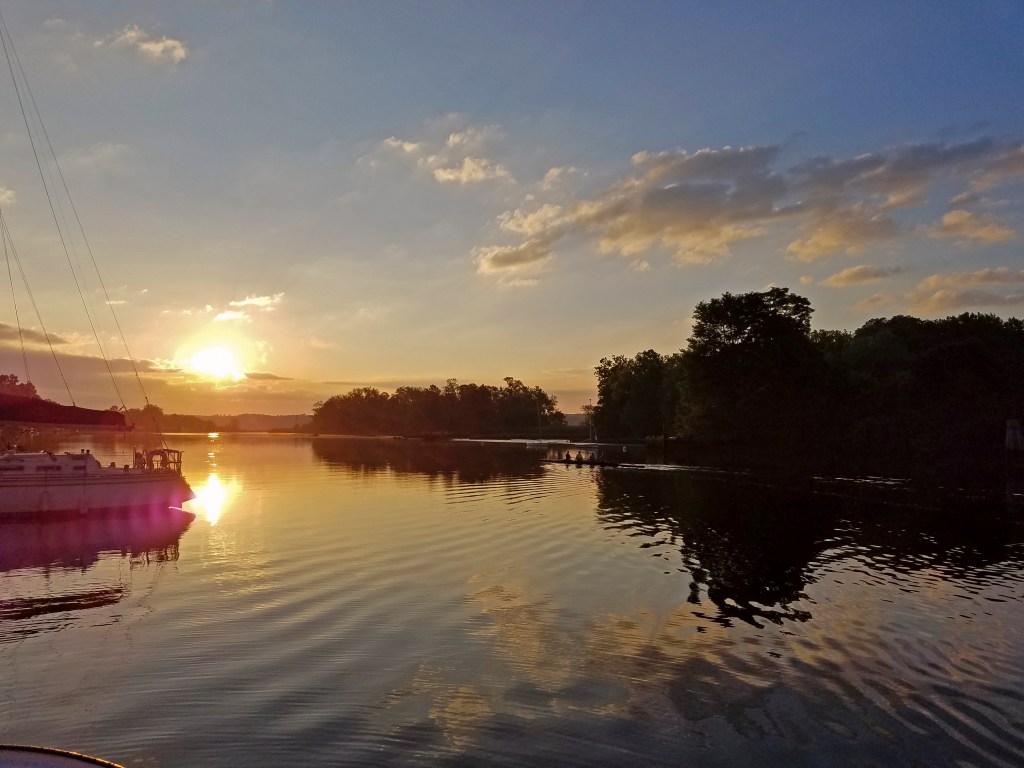
Kingston sunrise

Our transit of New York Harbor was uneventful, if lumpy.  This time most of the ferries and all of the NYFD vessels that had created such huge wakes on our outbound journey were not there, but there were a lot of sailboats enjoying the brisk winds.  They all have the right of way when they are under sail, so we had to keep a sharp lookout and try to anticipate where they might be going.  There was also very confusing chatter on the radios, with crackle, jargon, and add strong New York accents into the mix and it was impossible to work out what was going on and what we should be looking out for.  After we had passed under the Verrazano Narrows bridge and were heading west along Staten Island I looked back and could see what we missed.  There was a huge autocarrier that came out just behind us, followed by another big tanker.  Timing is everything, it would have been tricky to try to get out of their way in the busy harbour!

We are now in Great Kills, New Jersey, again waiting for a weather window.  It is incredible how weather dependent we are.  We knew intellectually that we would experience delays, but actually living it has been a big surprise to both of us.  It is not rain we worry about, it is winds and currents, as well as fog and thunderstorms.  The winds and currents must both be in our favour before we can set off.  We already know how unpleasant (and scary) it gets if we are caught in unexpected conditions.  Even when everything is “perfect” it can be very bouncy at certain times such as when we came through New York Harbor with the tide behind us, the wind in front of us, and the East River outlet on our beam!  We arrived here on Saturday and don’t expect the conditions to be acceptable until at least Thursday.  Of course, you have to keep checking, as the forecasts change continually.  I have three different weather apps on my phone, and Dick has at least two others, and we look at all of them two or three times a day.

So, what is a typical day on our boat?  Well, of course it depends on whether we are staying in port or planning to get underway.  I tend to get up pretty early, usually between 5:30 and 6:00.  I make a pot of coffee and wash up any dishes from the previous day.  We both like our quiet mornings. I sit in the cockpit with coffee and watch the world wake up.  Dick gets out his laptop and catches up with news and weather, and we both read the daily digest of the Great Loop forum.  If we are heading out we try to go sometime between 8 and 9am, but this might also be dependent on the tide.  If the tide is against us we will take longer and use more fuel to arrive at our destination, so some days it is better to wait until it has turned.  When the time comes the engines are started, various lines and fenders reorganized, Tucker gets his harness put on, and the gate at the top of the steps is put up.  Once we are underway we can close up the cockpit and take away the gate so Tucker can come up and enjoy the wind and be with his people.  Unfortunately, if it is a day on a canal with locks, Tucker has to stay below because we need to be able to step in and out through the doors.  It takes two of us to hold the boat in position in a lock.  I bring the boat in, and Dick catches the lock-side ropes or wraps a line around the pipe that goes down the side of the lock.  Then I can shut off the engines and get out and hold the stern rope to keep us in place.  When the lock doors open I start the engines and drive the boat out.

Most of the time Dick does the driving.  The seat is too far back for me to see well, so I have to stand to drive, which gets tiring very quickly.  I also prefer Dick to take the helm in tricky winds or currents.  He is calmer than I am, not to mention if somebody is going to bump hard into the dock because of winds or currents I would much rather it was him!  Instead I stand at the rail and throw the lines to the waiting dockhand, or make my best rope-toss over a cleat if there is no help available. We have headsets that are appropriately called “marriage-savers” by other cruisers in the know.  It means we can talk to each other through the various manoeuvers calmly instead of having to shout or make easily misunderstood gestures.  When asked about the headsets, I always tell people that they allow us to swear at each other in private!

Captain and crew
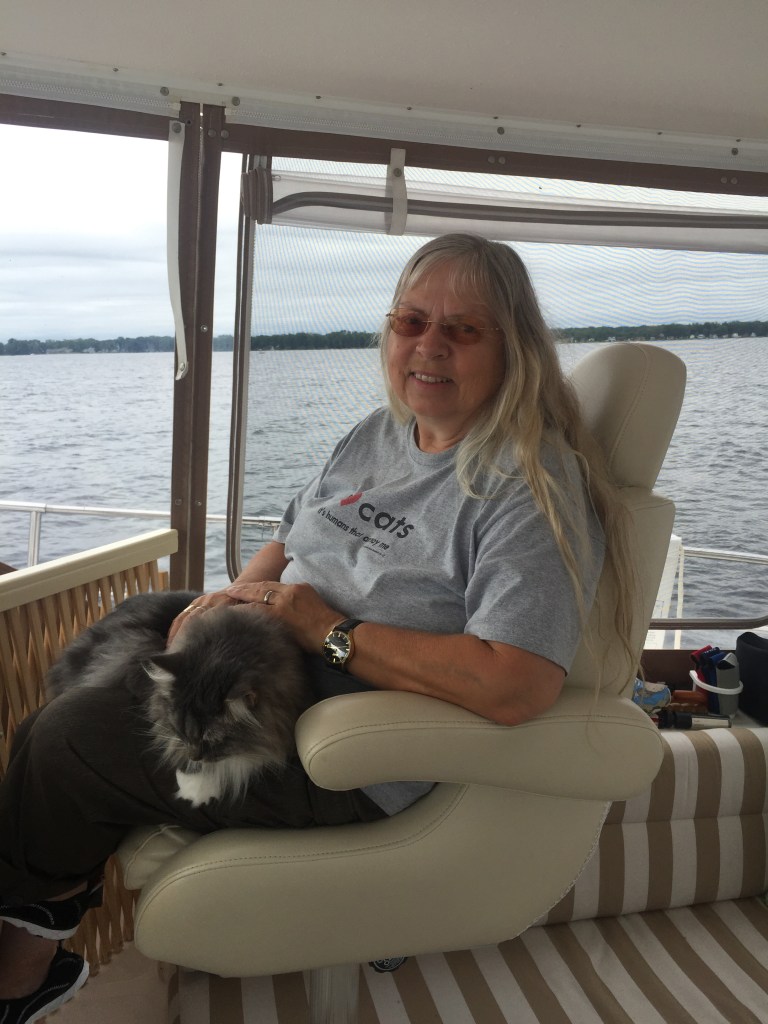
The co-captain

Days spent in port begin the same way, but after breakfast there are usually necessary chores to be done.  I am lucky to have a washer-dryer on the boat, but it uses a lot of water and power, so we have to have access to dockside services.  Dick vacuums thoroughly once a week, and every other week there is a proper cleaning to be done, just as at home.  Sheets get changed, bathrooms are cleaned, the kitchen gets a deep clean, and the rooms are dusted and the wood polished. Dick also gives the outside of the boat a good wash.

Tucker supervises

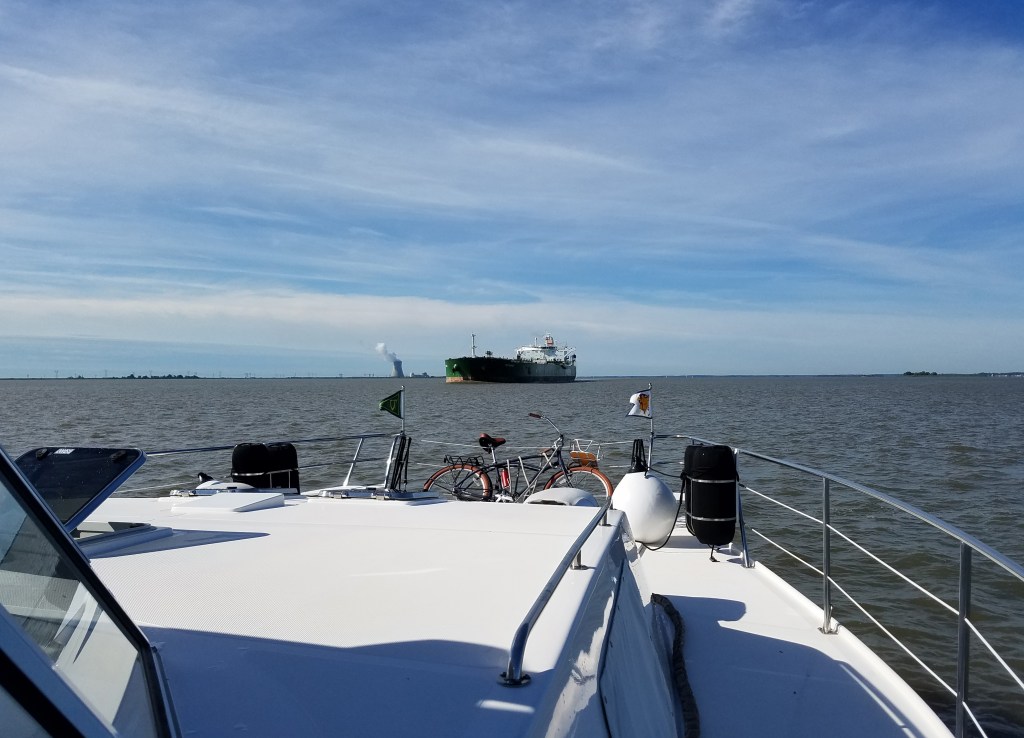
We usually alternate dinners out with cooking on board.  Mostly the restaurants that are walking distance from the boat are not exactly fine dining, but we have had some very good burgers and steaks.  I try to plan ahead for about 7 or 8 meals to be cooked on board.  When we are in a port Dick gets his bicycle off the front rail and heads out with saddle bags and a shopping list.  We have enjoyed most of the meals that have been chosen from a fairly extensive collection of on-board cookbooks left by the previous owner, plus my own cookbook.  Last night I made chicken breasts in a wine sauce with cheese and bread stuffing topping.  Other successful meals have included cooking a whole chicken in the pressure cooker, various beef or pork stews, plus we have the grill and Dick will do pork or lamb chops as well as steaks.  We have tried pizza on the grill, so far not very successful, but we will keep trying!

Our next couple of weeks are likely to be spent mostly in port waiting for weather.  We will have the trip “outside” down the coast to Atlantic City and Cape May.  Then there will need to be suitable wind and wave conditions on Delaware Bay, followed by the several days of good weather we need to transit the Chesapeake.  South of Norfolk we must again cross Albemarle Sound and the (dreaded) Neuse River.  After that we are at last back in the ICW and can expect mostly smooth traveling through North and South Carolina to get home.

Tucker snoozes on the shelf while we wait for the weather

June 20 to July 4, 2017: Delaware City to Utica

We left Delaware City early in the morning, part of a mini-convoy of 5 boats.  The group soon split up, partly because we travel at different speeds.  Dick and I followed the excellent advice of the harbourmaster in Delaware City and navigated Delaware Bay on a route that took us carefully southbound until a certain point and then on a direct line towards the canal at Cape May, New Jersey.  We could hear the conversations of the two boats following us.  One captain chose to ignore the advice and angled off towards Cape May Canal much earlier.  After questioning, the boat following took the same line.  We could tell from the conversation (and we could see for ourselves from the swells) that both of those boats had a most uncomfortable ride, while we were smooth for the whole trip.  It was an interesting lesson, going in convoy or as “buddies” may not always be a good thing, sometimes a strong-willed captain may make a poor decision and take the whole group with him.
Cape May is very pretty, with houses built right out over the harbour and painted in ice cream colours.  We passed the famous Lobster House.  Tied up below their deck was a paddleboard with an enormous Golden Retriever asleep on it, waiting for the master to return from his meal.  Sadly, I didn’t get a picture, he was a lovely dog.

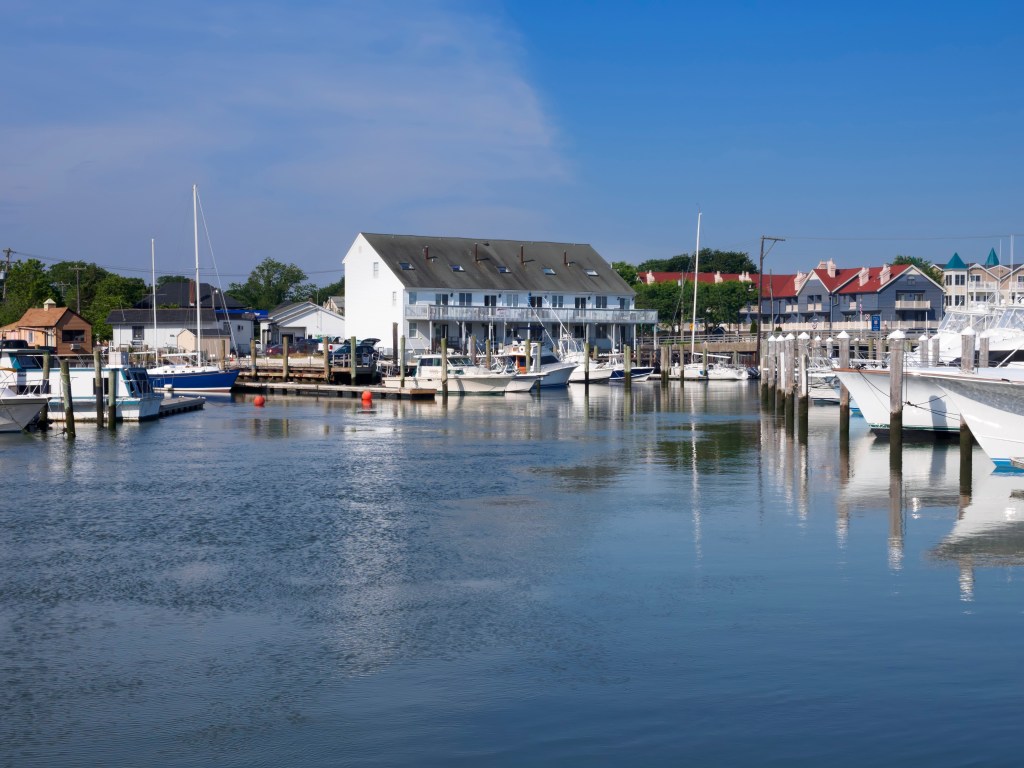
Cape May, New Jersey

We decided after reading reports from the Great Loop forum that since we only draw 3 feet, we would chance the New Jersey Intracoastal Waterway, which is notoriously shallow and seldom dredged.  It is possible that I made a poor decision and persuaded Dick to take on a full load of fuel before we set off.  So, we probably drew closer to 4 feet. We ran aground 4 times.  No, correct that, on 4 occasions the earth impeded the operation of our propellers and forward motion was temporarily halted… Fortunately we are a catamaran, and our props are a long way apart.  Dick was able to twist and turn and eventually wriggle free each time.  The route is beautiful and the small towns you pass through are interesting, but the whole trip to Ocean City was so stressful I didn’t even think about taking pictures.  The next morning we checked wind and currents and decided to “go outside”, that is, travel on the ocean about 3 miles from shore.  All day we could hear boats that had taken the ICW calling for towing companies, having run aground and been unable to free themselves, so we were happy with our decision.

Our next port of call was Shark River, where we again had to spend a few days waiting for the right wind and currents before we could continue our journey.  It is quite a nice small town, full of friendly folks who all seem to be keen fishermen.  It is also commuting distance from New York, so the newly opened marina restaurant was hopping every evening with twenty-somethings out to see and be seen.  The noise was incredible, but the food was good.

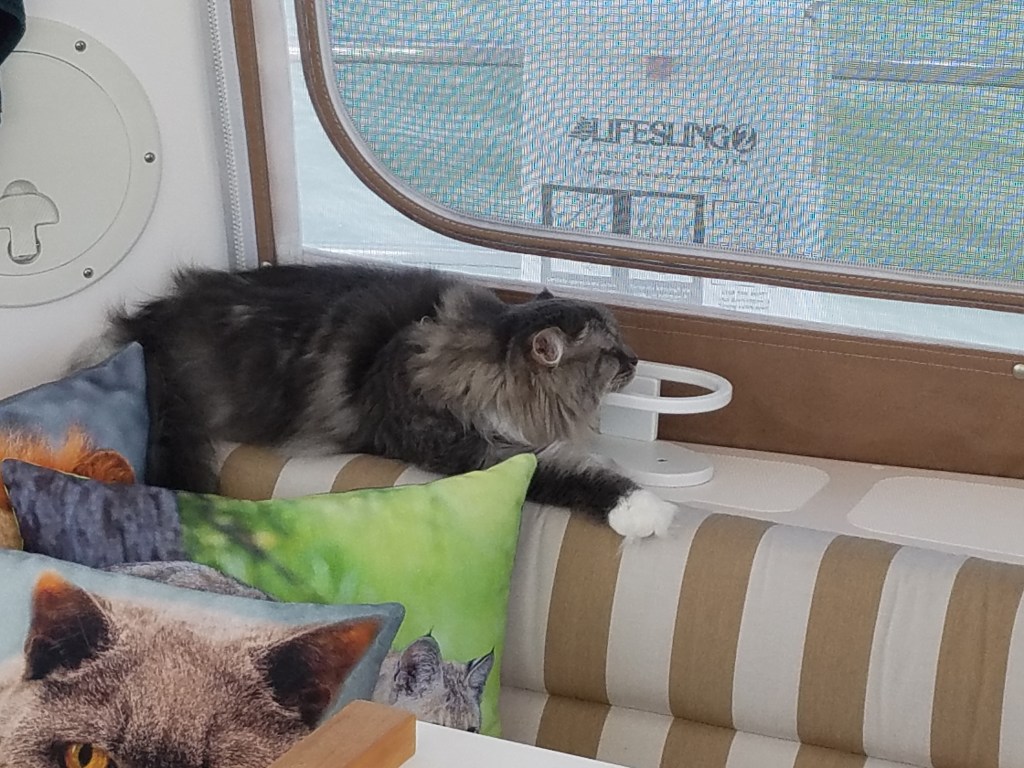
You think it’s a cup holder, but Tucker says it’s a chin rest for kitties.

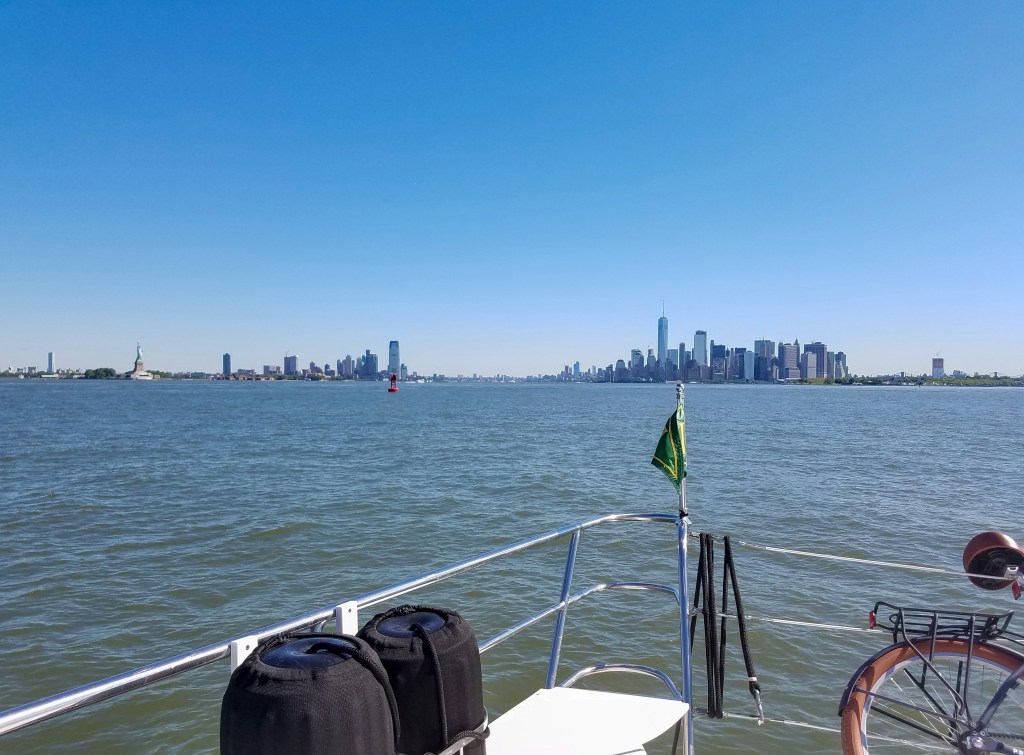
Eventually the conditions were right, and we set off early in the morning for Sandy Hook and New York Harbor.  The seas were very smooth, and we were able to push up our speed (and use 4 times the fuel) and make the first part of the run in time to catch the perfect incoming tide for passing through New York and up into the Hudson River.  New York is amazingly busy, there are ferries everywhere.  They throw huge wakes, as do the FDNY (Fire Department) vessels that seem to need to hurry past as close to unfortunate pleasure boats like ours as they can.  We were lucky that there were very few freighters that morning.  We passed under the Verrazano Narrows bridge.  I have driven over it quite a few times, but this was a different view!  Same again when we reached the Tappan Zee Bridge. I always felt I had at last left New York and was on my way home when I used to live on Long Island and commute weekly to Painted Post when I drove over the Tappan Zee..
Leaving Shark River
Approaching New York Harbor
Manhattan from New York Harbor. The Staten Island Ferry passes in front of The City.
Verrazano Narrows Bridge
Lady Liberty

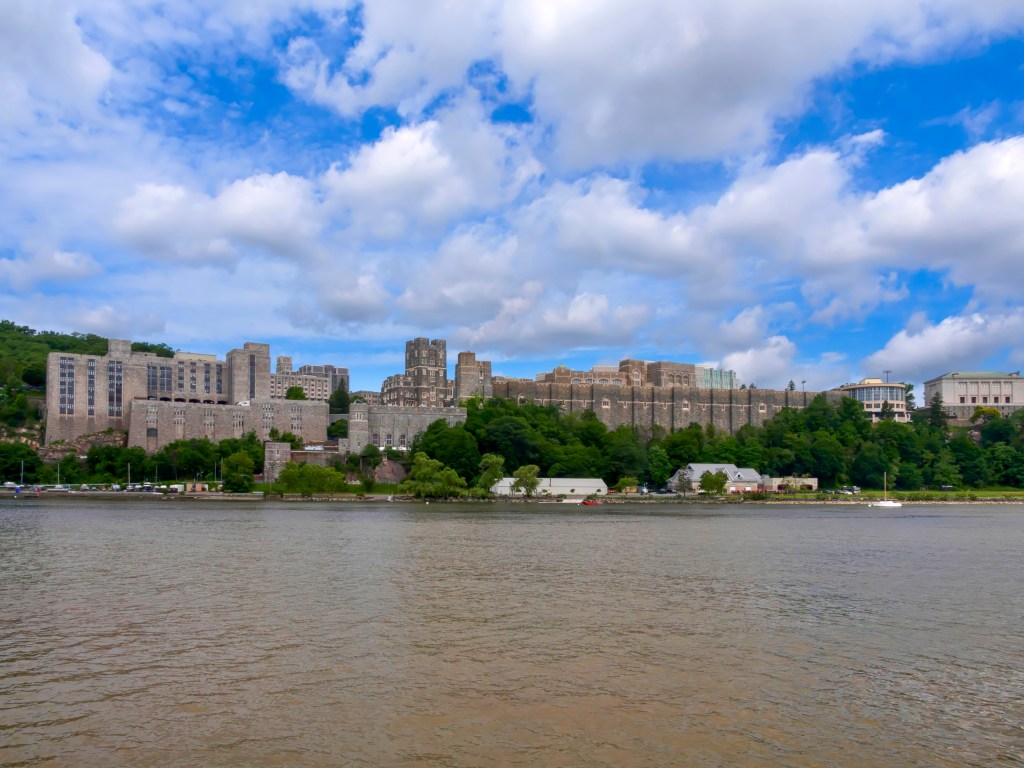
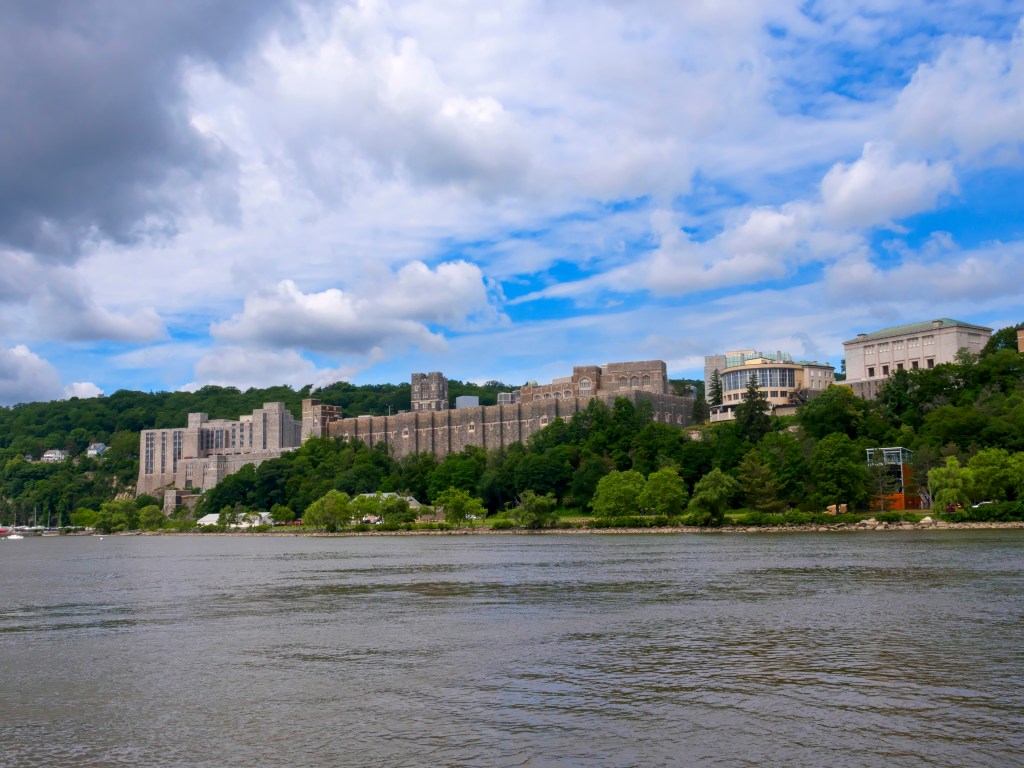
The Hudson River is very interesting.  Near to New York there are lots of very beautiful homes, and as you get further from the commuting towns, you come into the Catskill Region, and yet more beautiful estates.  West Point is an enormous campus.  We were amused by “Sink Navy” painted in huge letters on the roof of the sports stadium.

Storm King Mountain, Hudson River
West Point from the Hudson River, New York

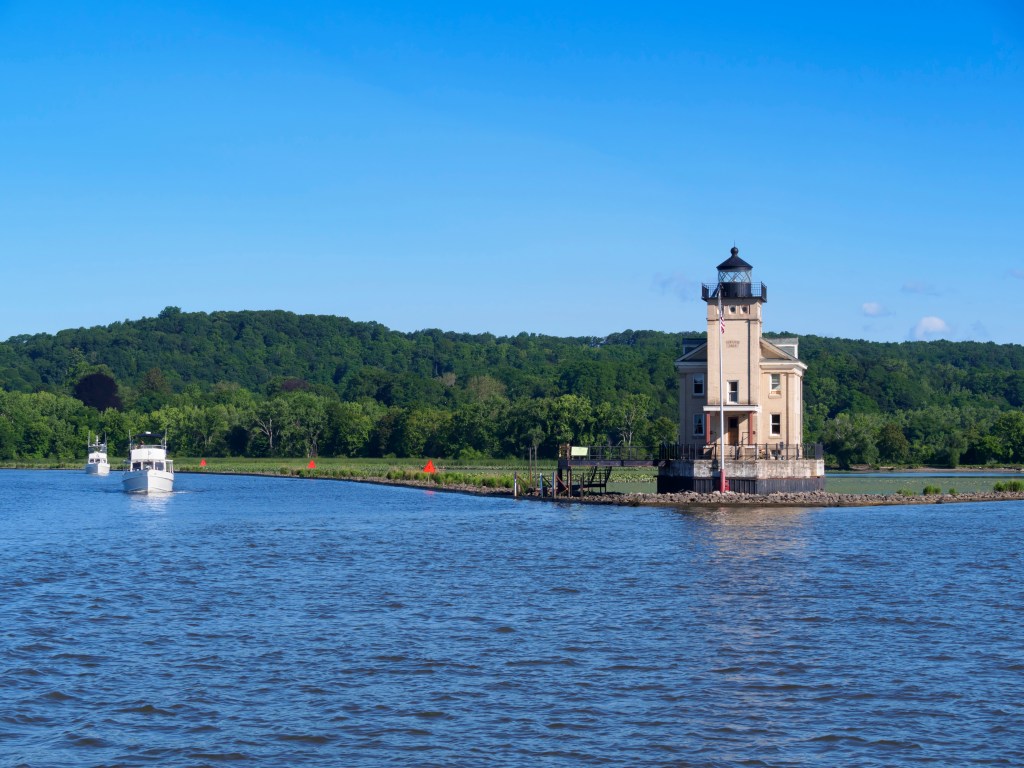
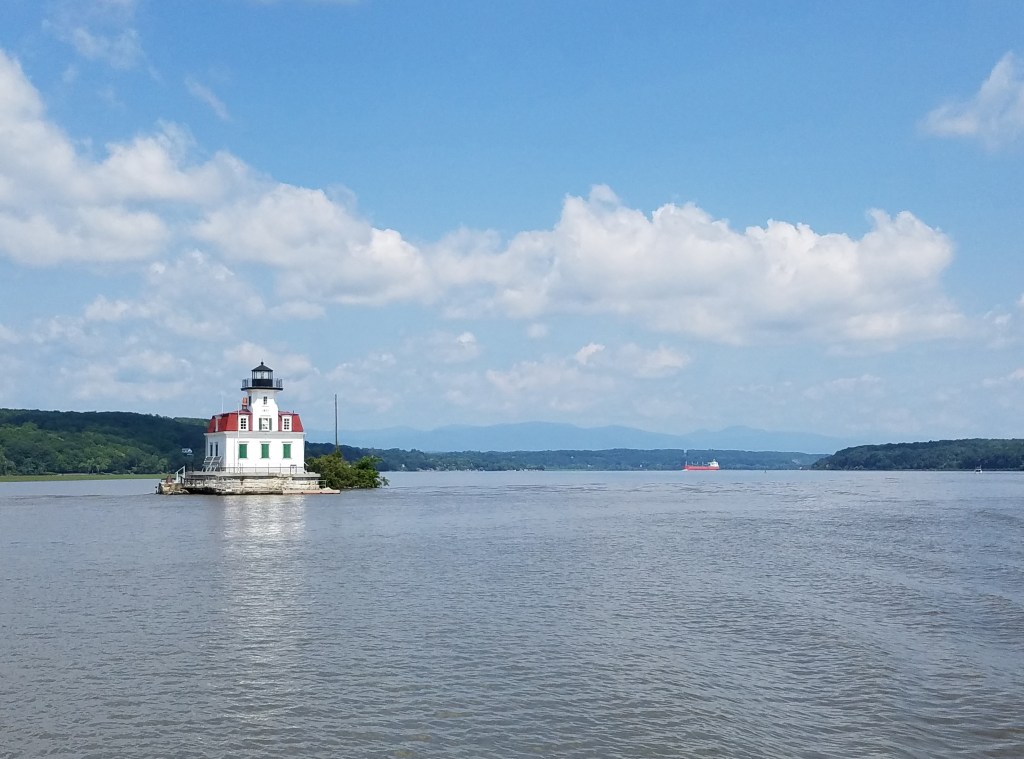
Travelling up the Hudson you see evidence of industry that is long gone.  One town we passed was once the site of over 100 factories, all gone now, or only derelict buildings left.  There is still quite a lot of freight passing up and down the river, including big tankers, cargo ships, and many barges, sometimes as many as four linked together, filled with sand or gravel and pushed by a tug.  There are some very pretty lighthouses.  Seven of the original 14 lighthouses that were built after the opening of the Erie Canal are still in existence and carefully preserved. Esopus Lighthouse is called “The Maid of the Meadow”, and is the last of the wooden lighthouses on the river.  Rondout Lighthouse was built in 1915, is still active, and can be visited.

Passing a freighter on the Hudson River
Maid of the Meadows with the Catskills and a tanker in the background
Rondout Lighthouse

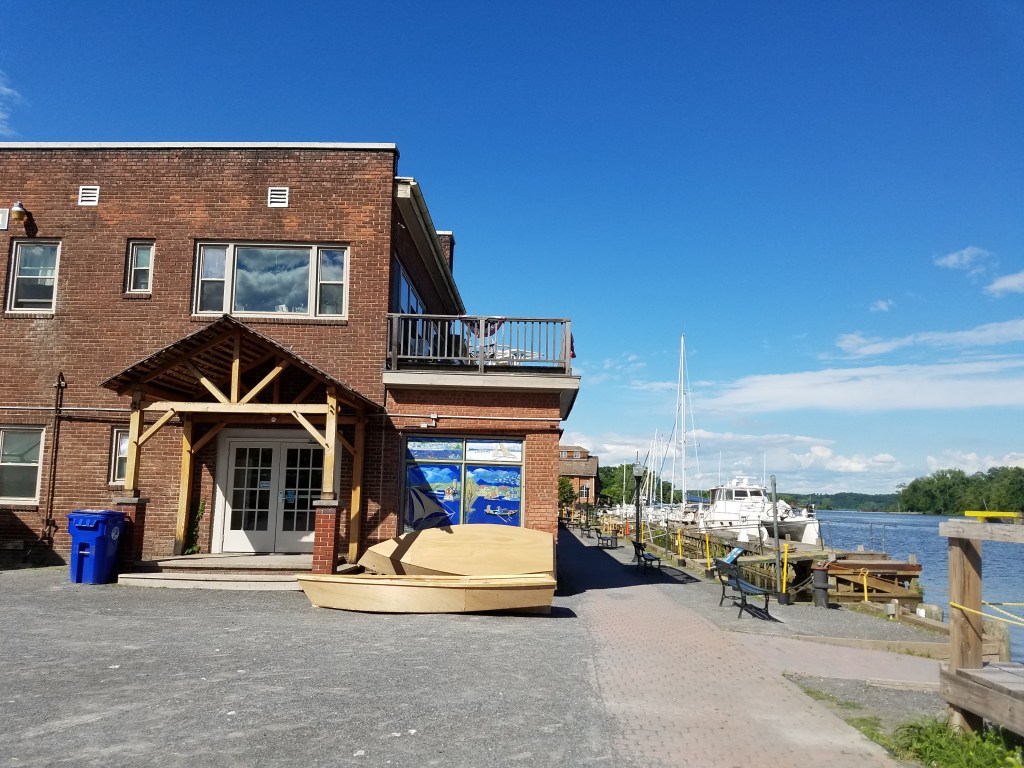
Kingston, NY, has an “old town” that was once the thriving port of Rondout.  This was the terminus of the Delaware and Hudson Canal, now defunct, but what a huge savings in time and effort there would have been in its heyday.  Rondout was also a centre of shipbuilding, and the old buildings on the waterfront have been restored and a very pleasant promenade built along the remains of the old canal.  We spent the night tied up at the Marine Museum.  They have various exhibits, including sheds for building and restoring wooden boats.  Tied up near us was a wooden tall ship that we were told was built for Pete Seeger, who was active in a campaign to clean up the very polluted waters of the Hudson.  The museum is quite popular, and I was amused when one visitor took a great deal of interest in Nine Lives.  He actually undid a barrier and walked out onto the dock to take a closer look… I wondered whether he was going to step aboard in the mistaken belief that we were part of the exhibits!

The Marine Museum at Rondout
Rondout, Kingston, New York

We spent a night at the Yacht Club in Albany.  We happened to be there on a Wednesday, and joined their “happy hour”.  In addition to generously poured and amazingly inexpensive adult beverages, for $5 you can have all you can eat of grilled chicken, sausages, pasta, salads, potatoes, and various accompaniments!

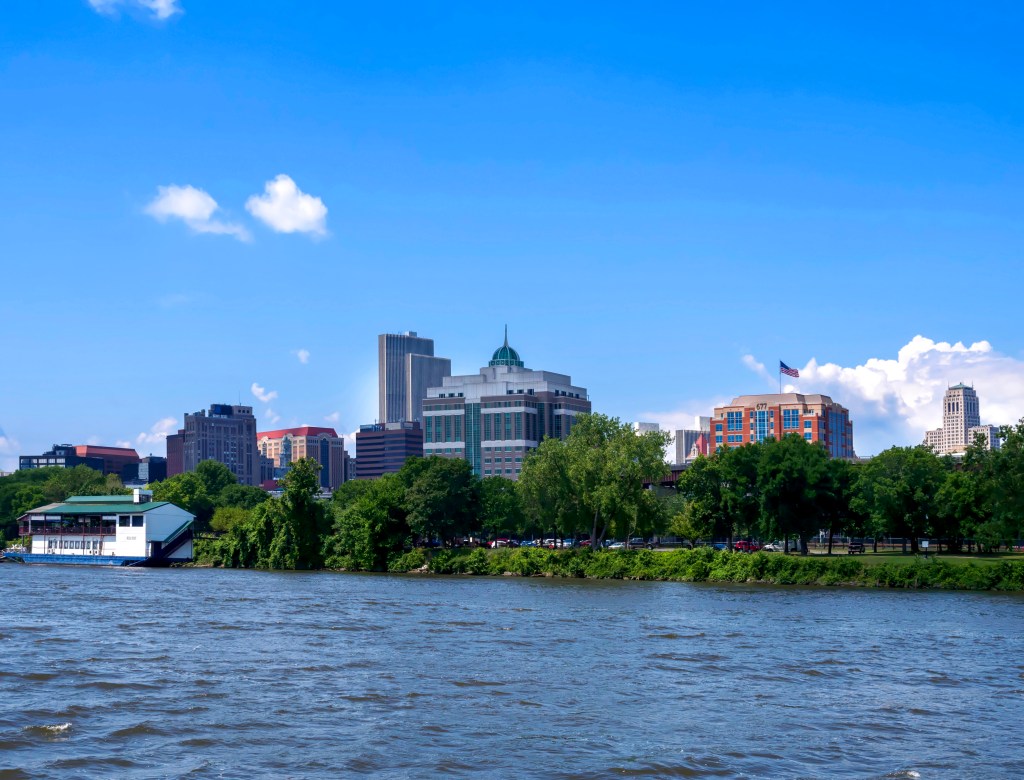
Albany, skyline and waterfront

We turned out of the Hudson and into the Erie Canal.  The first section going west is a flight of 5 locks spaced very closely together.  If we were feeling a bit rusty when we started we were well reminded once we were through!  Most of the locks on the canal lift about 20 feet each time.  They are very large, and it takes both of us to hold Nine Lives in place as the water rushes in.  Sometimes there is a pipe you can put a line around and the line moves up the pipe as the lock fills, but more often there are just ropes dangling down that you have to hold onto.  Needless to say, they are wet, slippery and very dirty.  Add to that we have to keep pushing the boat off the sides of the lock to avoid ripping the fenders off, and you finish the day exhausted and dirty.  Not to mention the boat is also filthy!

Erie Canal Lock E2, the first of the flight, and the town dock at Waterford

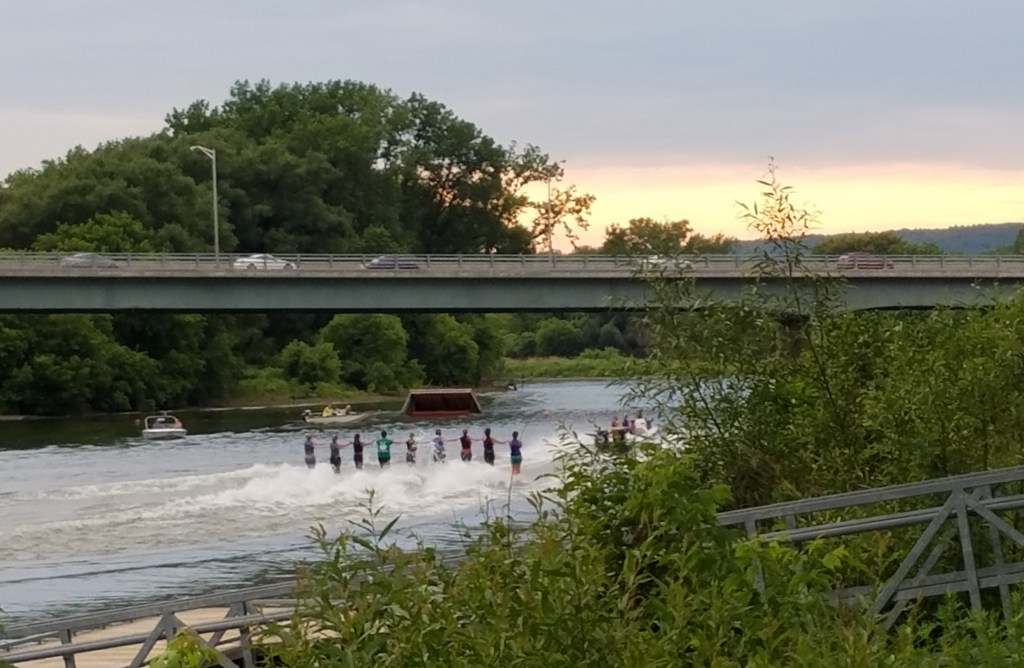
At Scotia Landing we saw a lot of preparations going on for the various 4th of July celebrations.  When we returned from dinner in a nearby restaurant we were surprised to see that a water skiing exhibition was being held that evening.  Unfortunately, we had missed most of it, but we caught the last two or three runs.

Water skiing at Scotia Landing
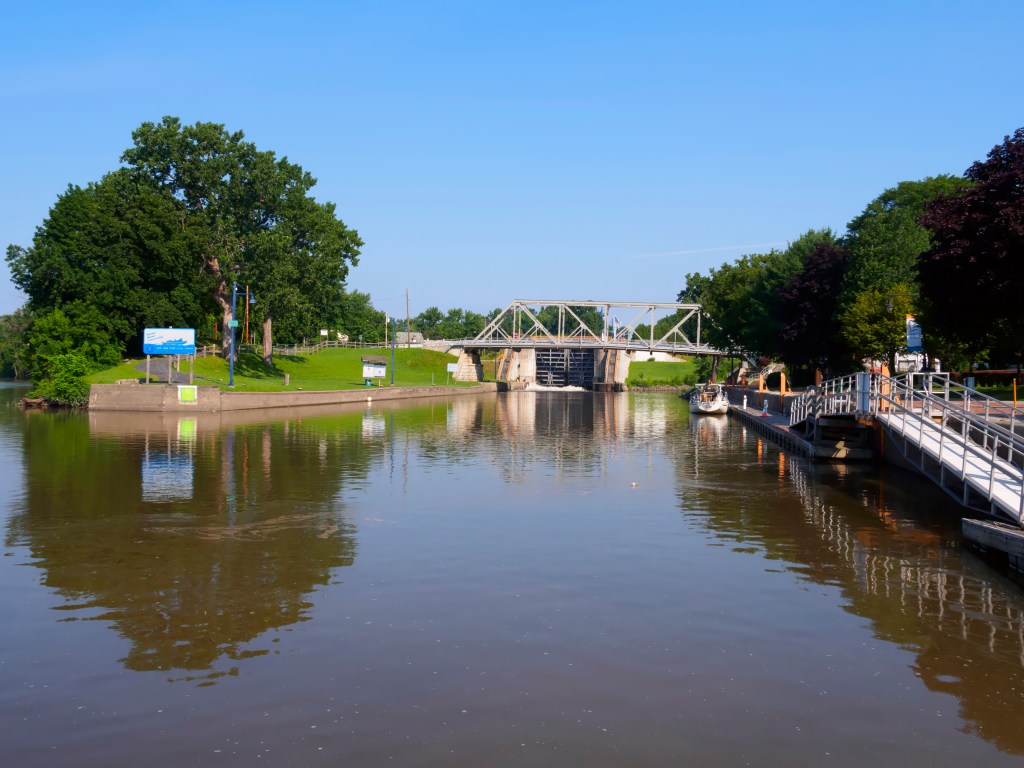
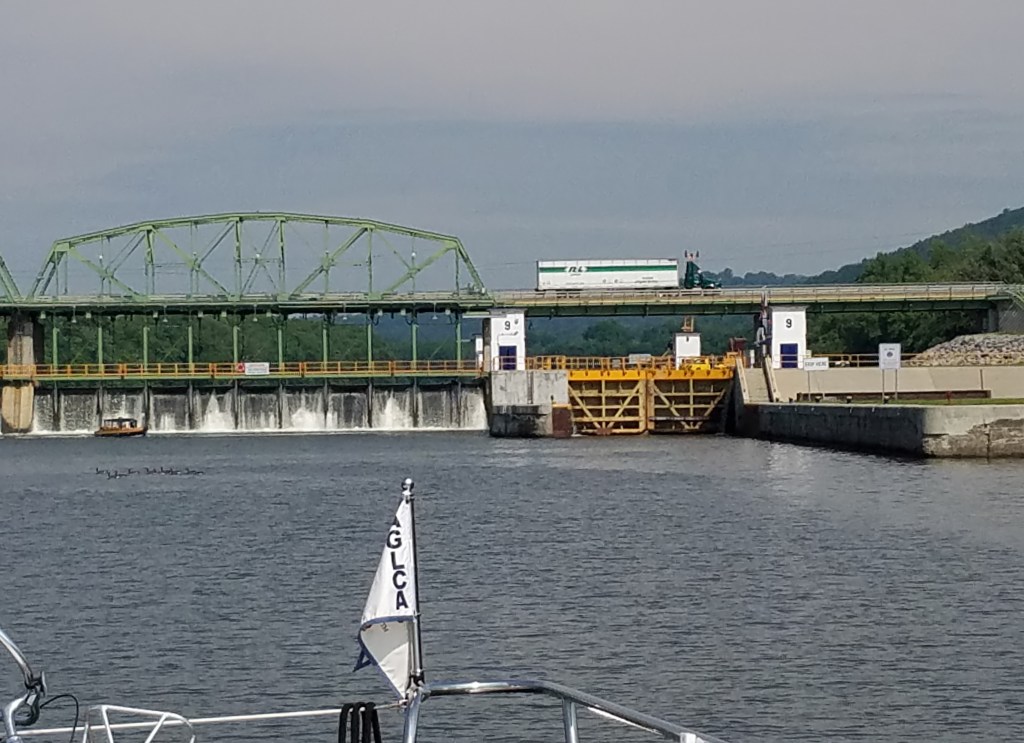
Approaching Lock 9 on the Erie Canal

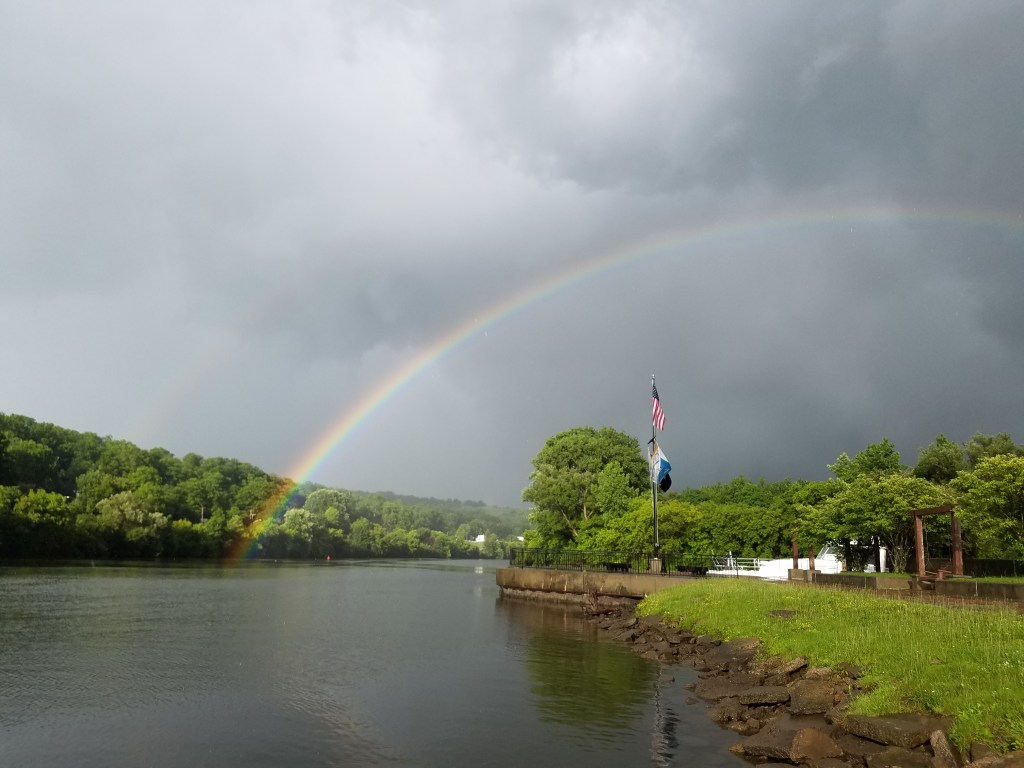
The little town of Canajoharie turned out to be a fun evening.  We tied up to the town wall and saw that there were several other boats already there.  It turned out they were also Loopers, and we all crowded aboard one of them for a convivial evening of drinks and stories.  “Loopers”, what are they you ask?  Members of the American Great Loop Cruisers Association fly a distinctive burgee (triangular flag) so they can recognize each other.  They are all in various stages of travelling the Great Loop.  Some might have finished and are going around again, some are just starting out, and everything in between.  While we were socializing the rain pounded down, and when we came out to return to our boat there was a lovely rainbow across the canal.  Little did we know that the rainbow was NOT a promise of fair weather to come!

A rainbow over the Erie Canal

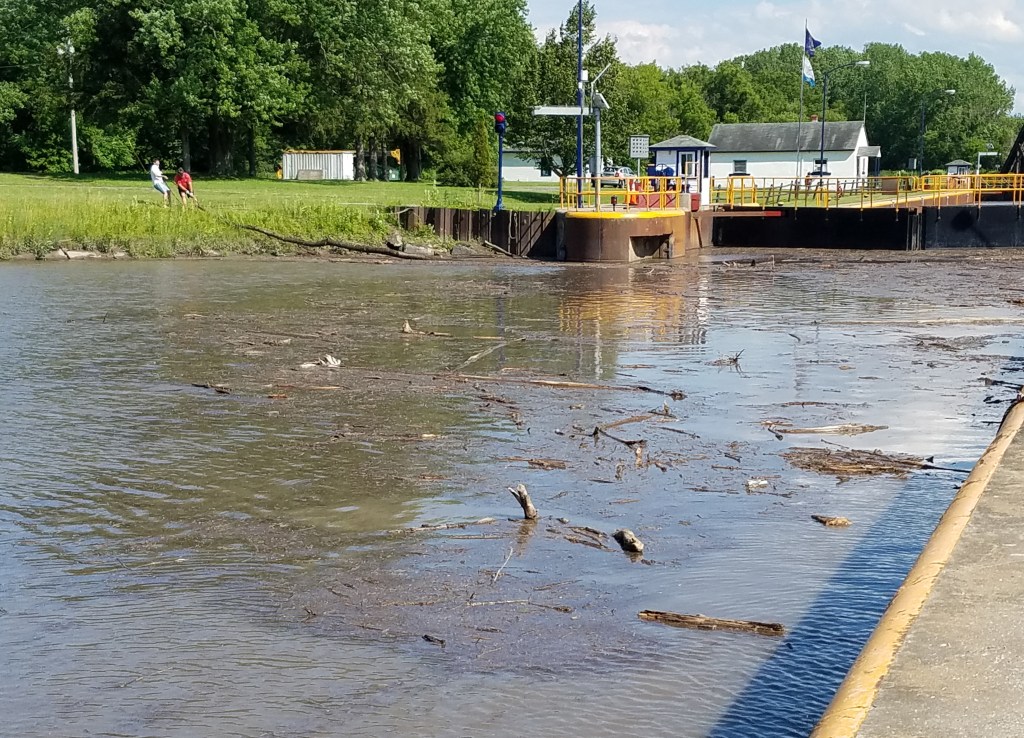
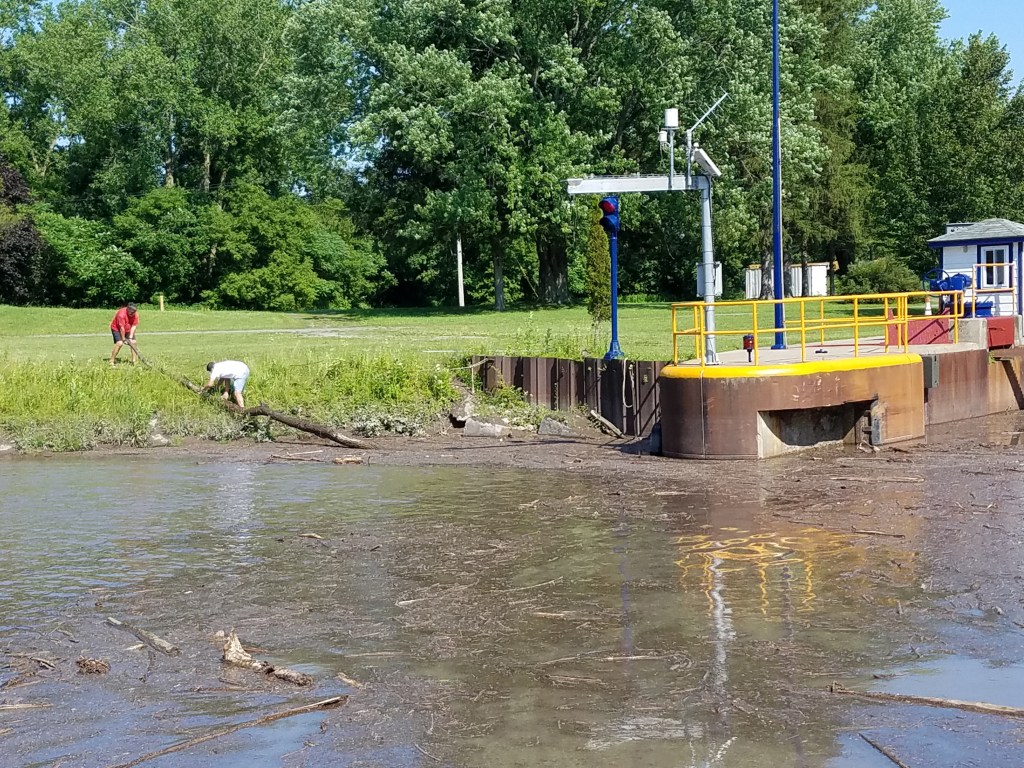
The next morning we set off, somewhat surprised at how muddy the water had become and the strength of the current we were fighting.  Our destination was Utica, just below lock 20.  The other Loopers stopped earlier, and we carried on to lock 19.  As the water brought us up to the top of the lock, we seemed to get higher and higher, until it was just a few inches below the top.  At that point, the lockmaster asked us to stop and tie up on the wall above the lock and not proceed any further that night.  We could see the water roiling just ahead, coming out from a stream and carrying whole trees as well as logs and other debris.  We spent two nights on that wall, joined the second night by a sailboat.  They had been tied up on the lower wall, which was right under a railway track and the noise was incredible.  The lockmaster took pity on them and allowed them to come up to the top wall.  First, a big sunken tree had to be moved away, it was completely blocking the lock doors.  It had apparently been taken out and tied on the bank earlier in the year, but the heavy rain had washed it back into the canal.  Dick took on the challenge of getting this incredibly heavy obstruction out of the way, helped by the captain of the sailboat.  Together they managed to haul it back up onto the bank and secured it somewhat better this time.  Appropriately, Dick was wearing the red t-shirt that says, “Keep calm and ask an engineer”.

Roiling water above lock 19
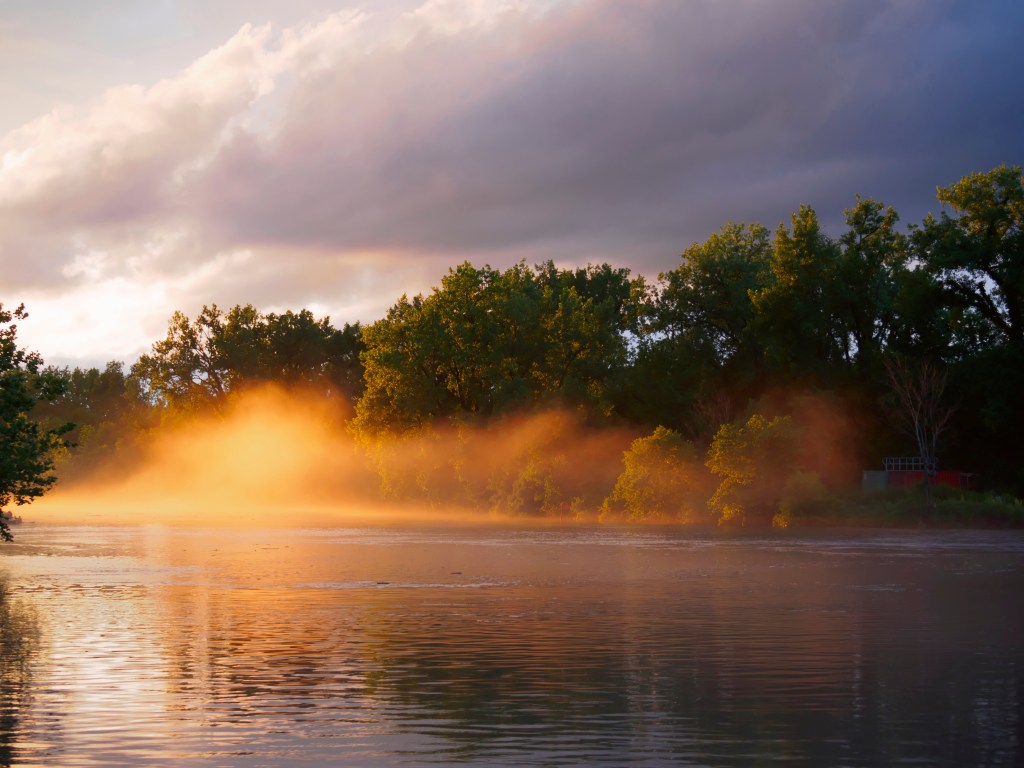
Mist at sunset above lock 19.
Dragging the log out of the water
Securing the log so it doesn’t fall back into the water.

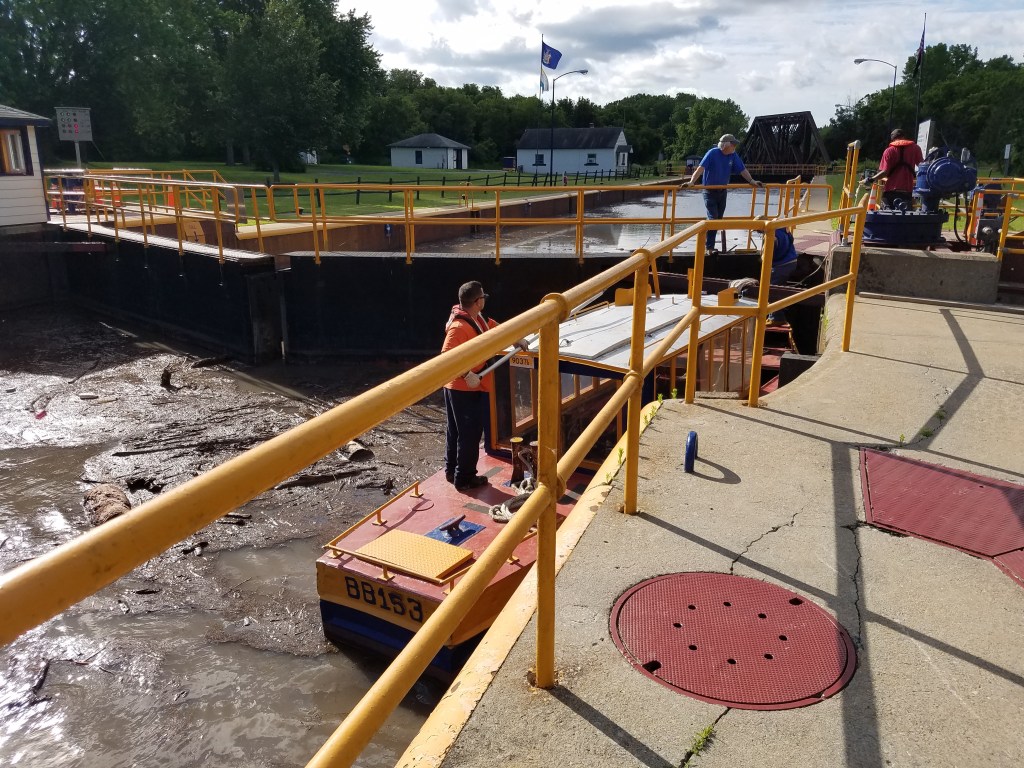
Yesterday morning we watched workmen trying to clear the accumulated debris from the lock.  Then, fortunately, we were allowed to proceed to Utica, at our own risk and only because there were no further locks between us and the town.  Utica declared a state of emergency during the rain, with many of its streets under water.  Another boat was at their dock that night, and the owner was so concerned about the number of tree limbs hitting his boat that he took his family off to a hotel for the night, rather than risk being on board.  I guess we were better off on the lock wall!  We had a nice dinner at Delmonico’s last night, and now, here we wait.  The section of the canal that we are on was expected to open this morning, but looking at the wind forecast for Lake Oneida, we decided to stay put.  A good decision.  The sailboat left this morning and a few hours later he returned, not able to get through even the first lock.  At the moment, the whole canal from the Hudson River to just before the lake is shut, and then the further section of canal that leads to Oswego and Lake Ontario is also shut.  Debris gets trapped in the lock doors and prevents them from opening and closing.  Of course, it is not helped by it being July 4th!  With luck, we will be able to carry on tomorrow, but meanwhile we are in a nice spot and at least here we have dockside electricity and water.

Workmen clearing Lock 19
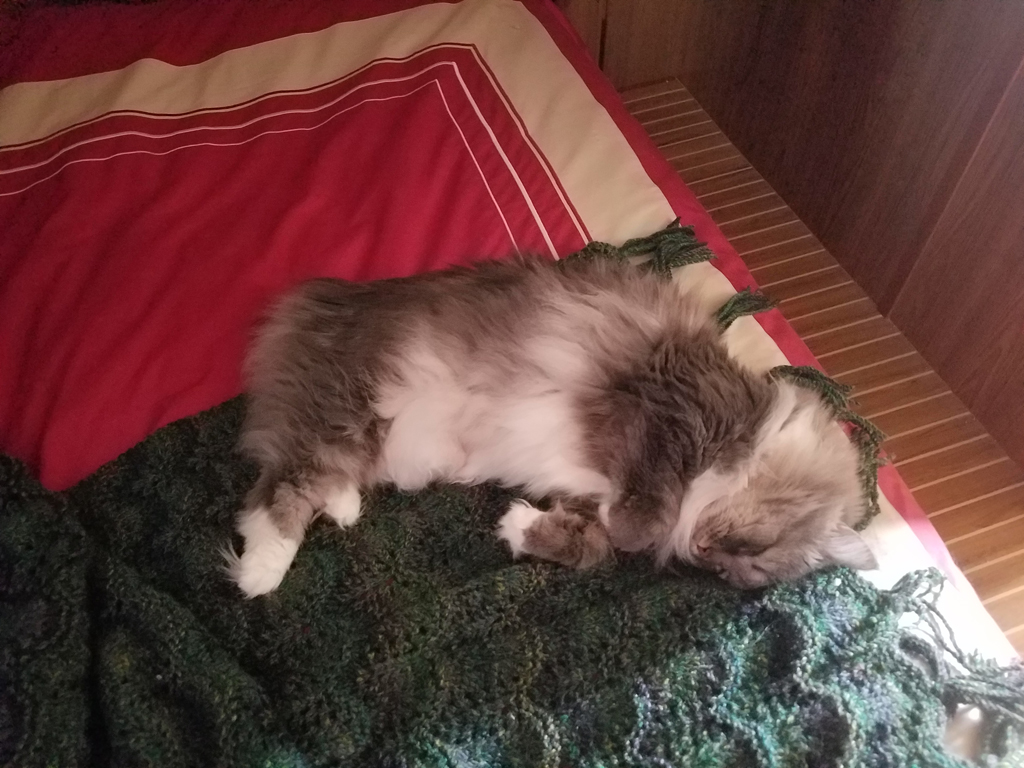
sleeping on the new throw
What else should a cat do? Asleep on the new throw.
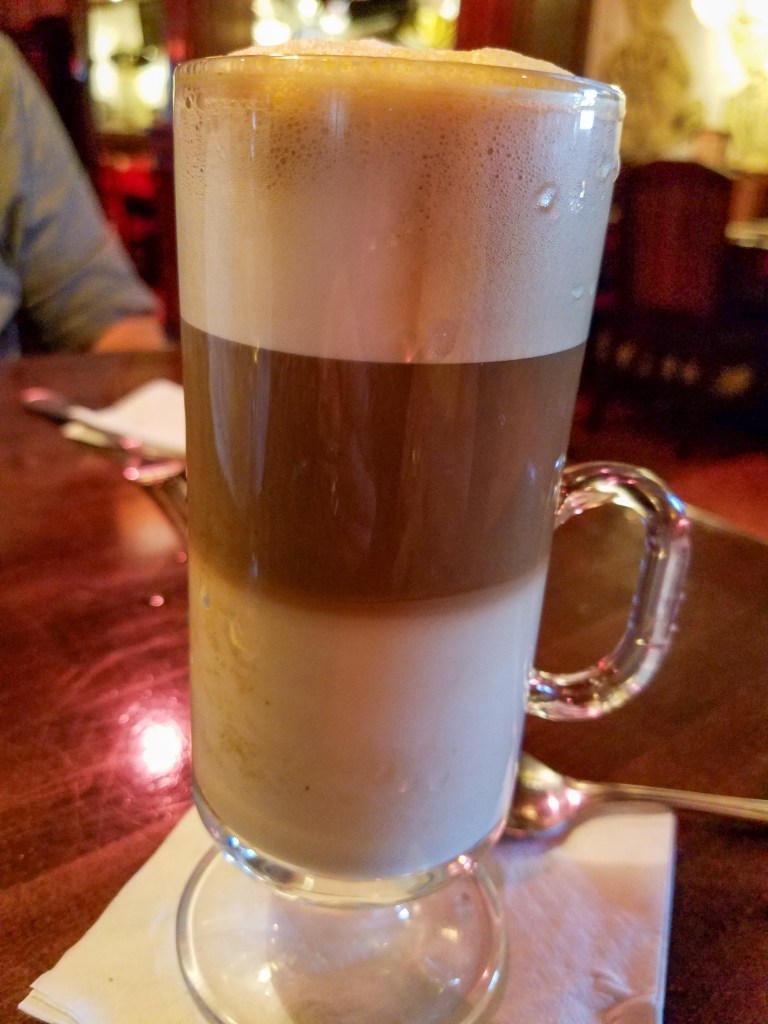
After our adventures, a cappuccino goes down well!

June 1 to 19, 2017: Hilton Head to Delaware City

We are now about 2 and a half weeks into our summer 2017 voyage.

We left Wexford on June 1st, with Tucker on board and looked forward to our first night out at anchor in a creek just north of Beaufort.  There was a small setback when we discovered that our chosen creek was silted up and no longer accessible, so after a slightly frantic search of our two guides, Waterway Guide and Skipper Bob’s, we chose an alternative slightly farther north and the rest of the evening was uneventful.  The next day we travelled through Charleston, towards our planned anchorage north of the city, and “enjoyed” a two hour unplanned excursion up one of the rivers when the helmsman failed to notice the location of the magenta line on the chart.

Nine Lives in Wexford Harbour
Leaving for our shakedown cruise
The anchorage in Tom Point Creek north of Beaufort, South Carolina
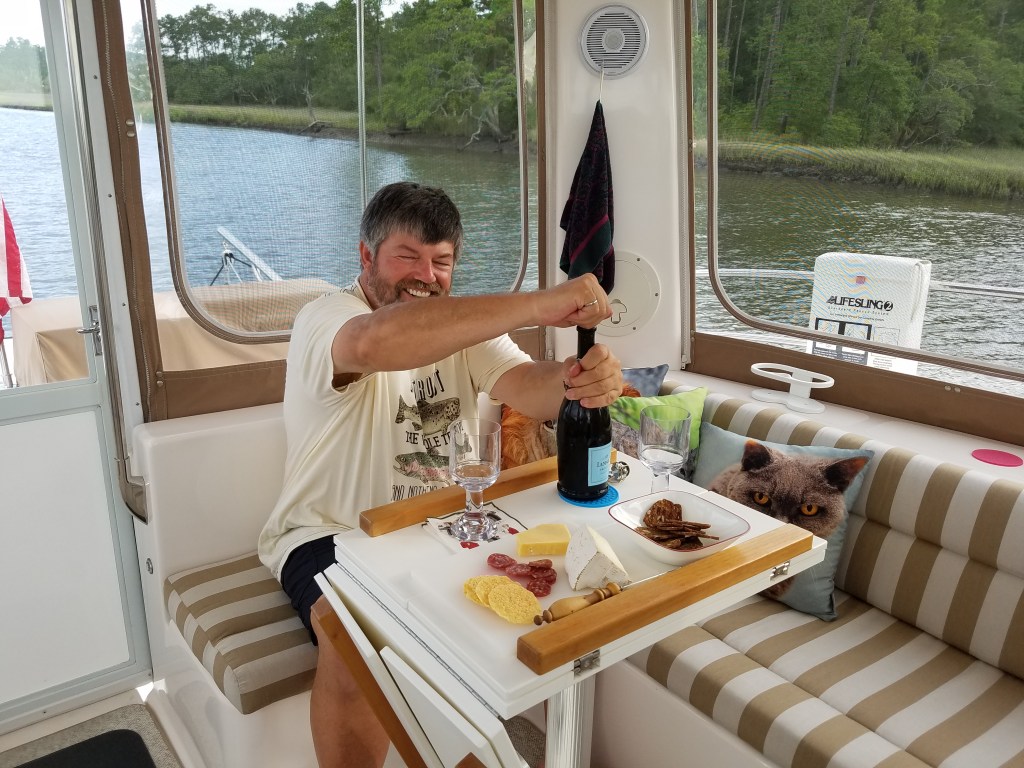
Champagne and charcuterie for our first night.

What is this magenta line?  It is the centre-line on the chart of the Intracoastal Waterway, and is a big help in staying on course.  The boat has an electronic chartplotter, so we don’t use the big paper charts.  We use autopilot, but the helm chair is never empty and it is important to remember that the actual markers in the channel are always to be followed when they disagree with the magenta line!

The Yorktown in Charleston Harbour

After Charleston we carried on north, staying with our planned itinerary and stops until we got to our first weather delay.  High winds and thunderstorms were forecast, so we extended our stay in Southport, North Carolina to 3 nights.  The thunderstorms never materialized, but it was very windy the first evening and I would not have wanted to anchor in that wind.

A calm anchorage in Enterprise Creek, South Carolina
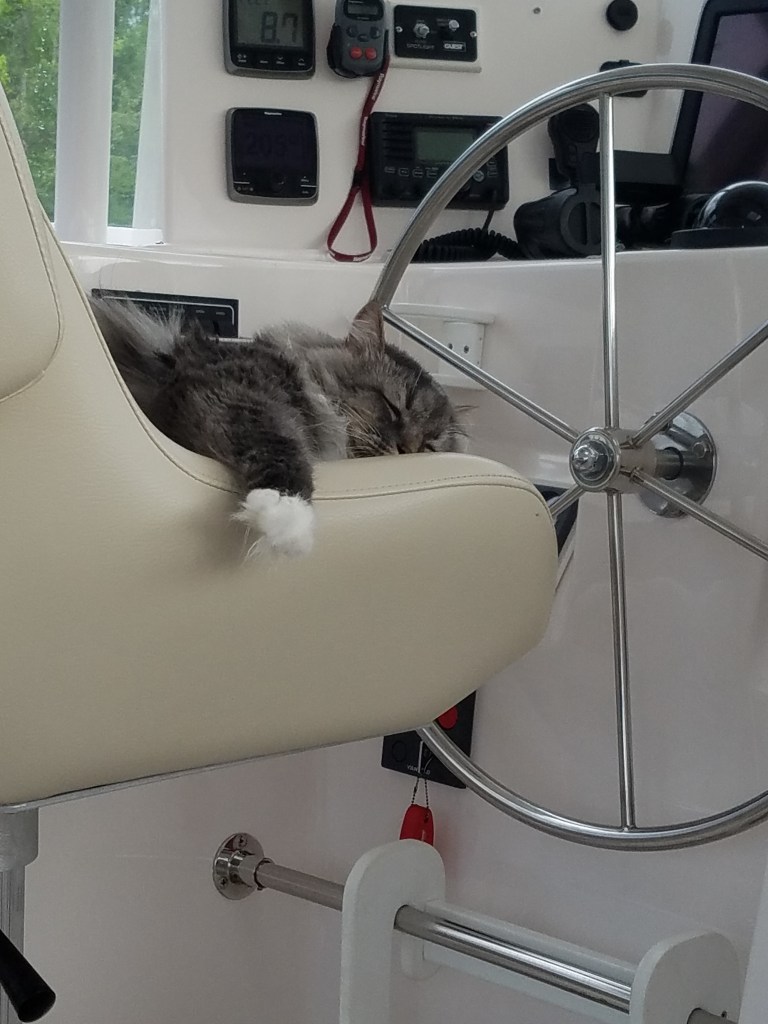
Tucker, asleep at the wheel.

The next and possibly most valuable lesson was two days later.  We set off across the Neuse River, and after his miscalculation in Charleston Harbor, Dick was determined to stick with the magenta line.  Well, we headed straight up the centre of the very wide river, and conditions got worse and worse.  The boat pounded into the waves, stuff fell down inside, and Tucker was terrified.  I had to bring him up into the cockpit and hold him on my lap.  The dinghy jumped off its support and hung in the davits (fortunately it stayed there), and Dick’s bicycle looked as though it was about to flip over the front rail at any minute.  We later discovered that most of our fresh water tank had emptied out of the overflow valves because it was so rough.  There was a certain amount of grownup language from me, and Tucker said some very rude words in Cat, but to give credit where it is due, Dick remained calm and handled the rough seas very well, and eventually we were able to make our way into a wonderfully quiet river and anchor for the night.  Two lessons were learned.  One, be sure of your actual destination, and two, when it starts to get rough, and you can see it will only get worse, turn around while you still can and find a place to wait out the weather.

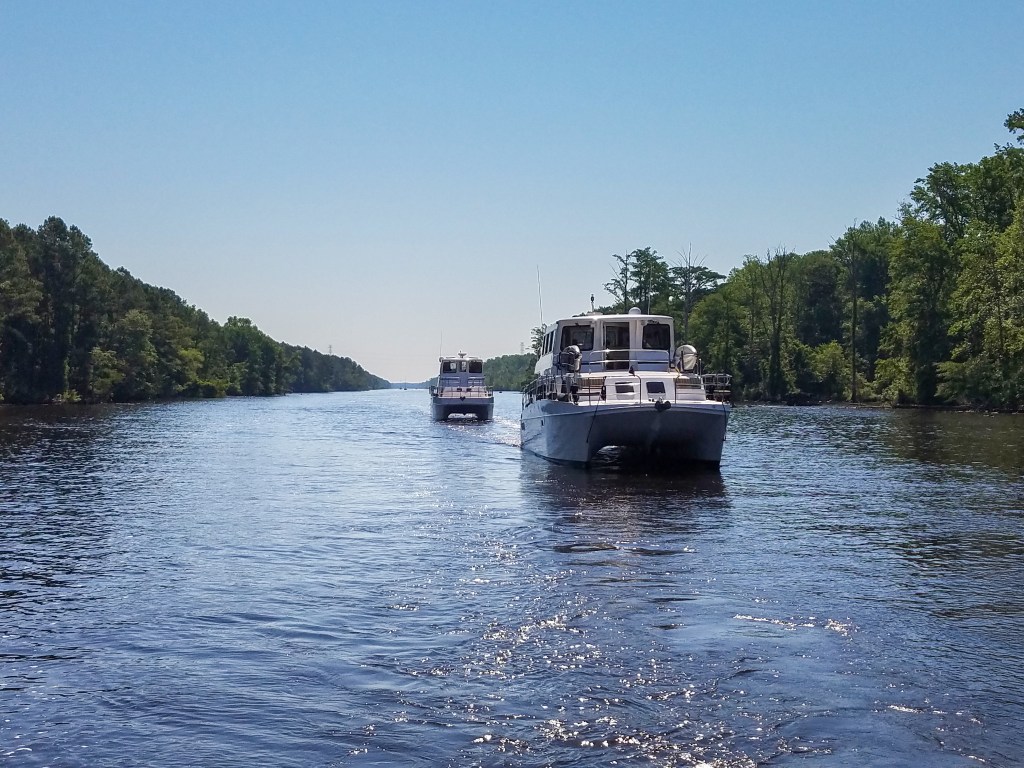
This lesson stood us in very good stead on the Chesapeake. However, before the Chesapeake, we spent a nice evening in a very small marina on Alligator Creek.  Just five boats were in, and amazingly, three of us were Endeavour TrawlerCats.  The other two were the newer style with the high bridge, a 48 and a 40.  There are very few Endeavourcats compared to other manufacturers, so to see three at once was most unusual. A very pleasant evening was spent in the large upper lounge of the 48 chatting with the other owners and comparing experiences.  Two days later, we came out of our anchorage to find both of them just behind us, so we led a parade of Endeavours through several bridges and a lock before we all went our separate ways.

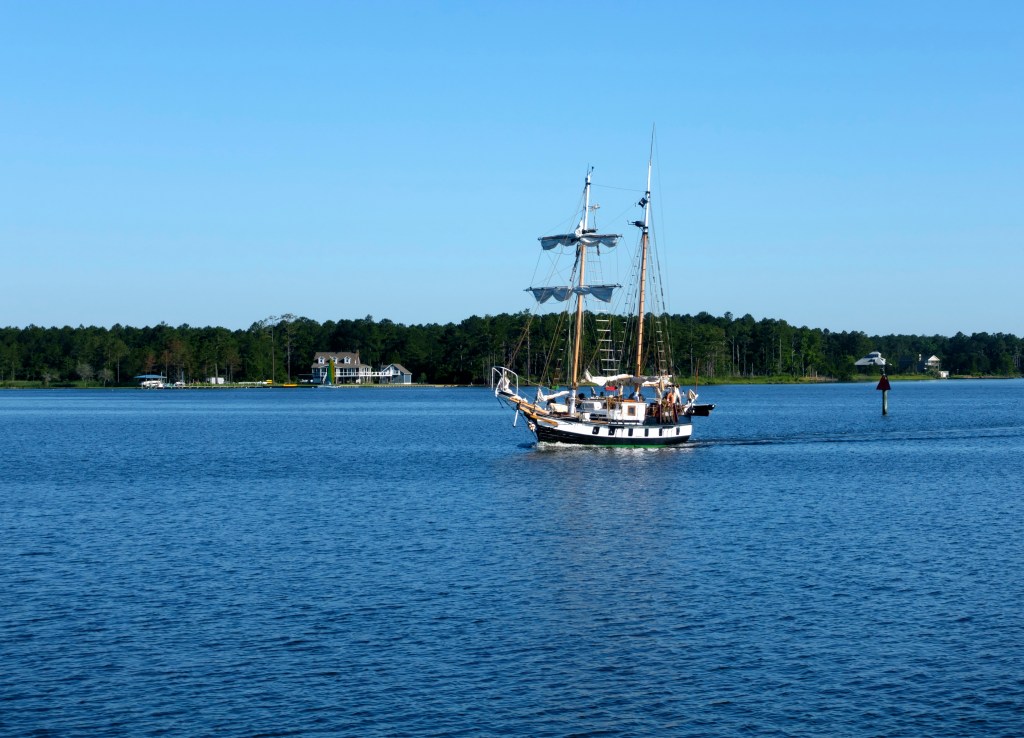
A brigantine tall ship motors north on Goose Greek
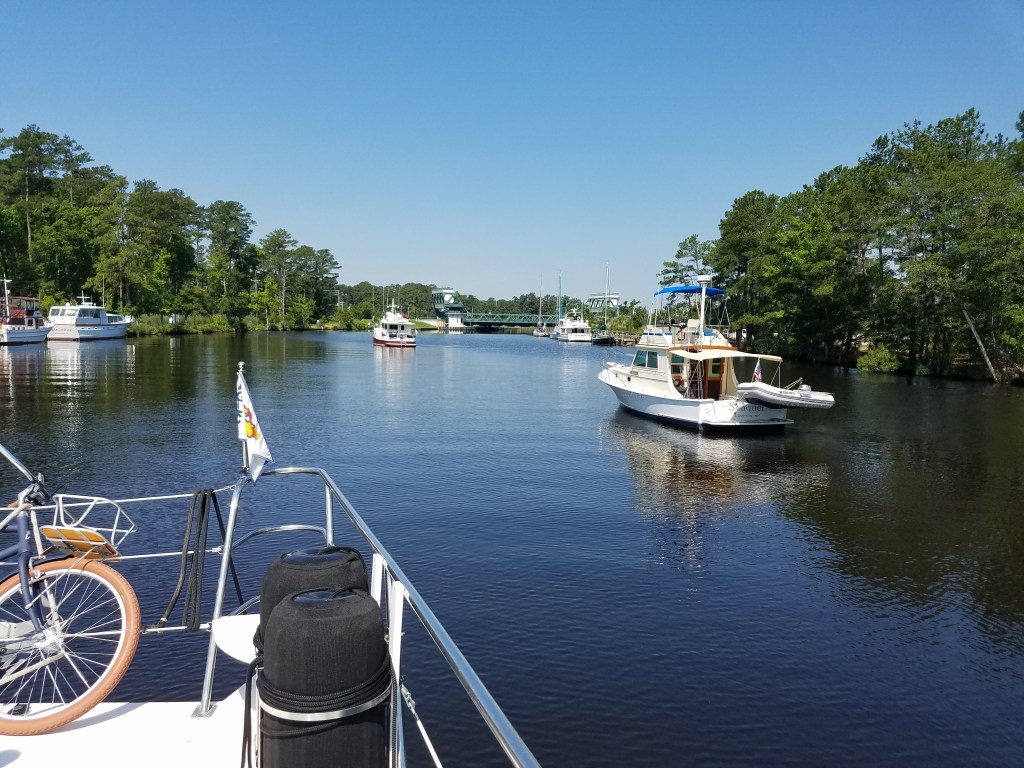
Nine Lives at Alligator Creek
Three Endeavourcats in Alligator Creek
Endeavourcats head north

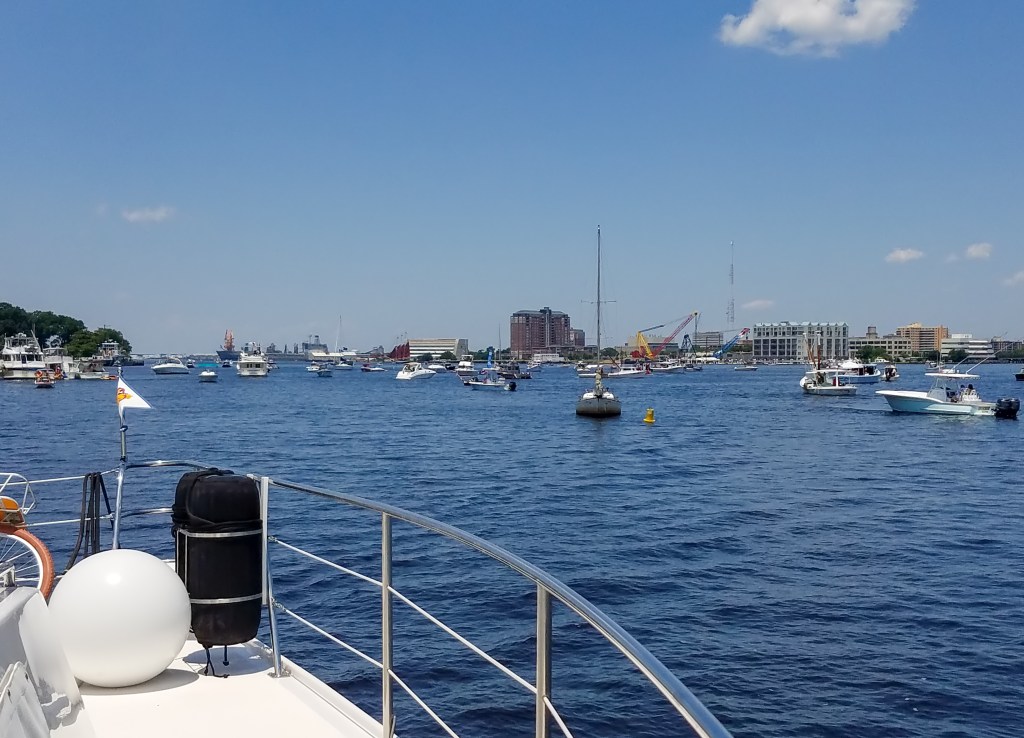
Our trip through Norfolk was fascinating.  Seeing all the navy ships was interesting in itself, but the town also has a dock with a number of tall ships.  That day there was a special event of skipjack (working fishing boat) races, so the town harbour was full of hundreds of spectator boats of all sizes, some anchored and some cruising around, and it was quite a challenge to make our way through them all.

Waiting for the lock at Great Bridge, south of Norfolk
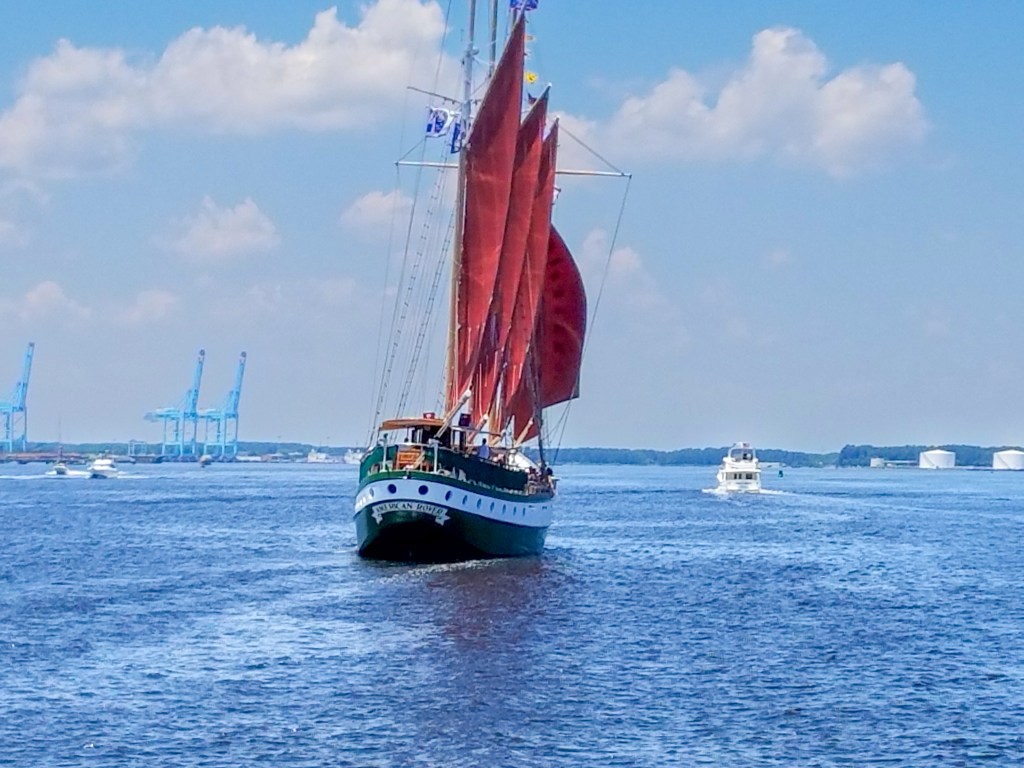
A tall ship takes tourists around Norfolk harbour
Boat traffic in Norfolk harbour

We stayed two nights at Hampton Yacht Club, and were delighted to welcome our friends Marilynn and Winkie on board for drinks and a pasta supper.  Our first dinner party on board!  I used to work with Marilynn many years ago at Brookhaven Lab.

Tucker sleeping on the companionway step. This position ensures that nobody can pass.

The day we came out of Hampton we were just ahead of a warship.  It was fascinating to listen to the radio communication between that ship, another warship that was already out to sea, and a tanker with a tug that was waiting to enter Hampton Roads.  Later that day there was more interesting communication as NASA required all vessels to observe a ten mile exclusion zone where a rocket was scheduled to plunge into the sea. One owner of a pleasure yacht was most annoyed to be told to take a specific heading, not where he planned to go, and stay on that heading for 8 miles!

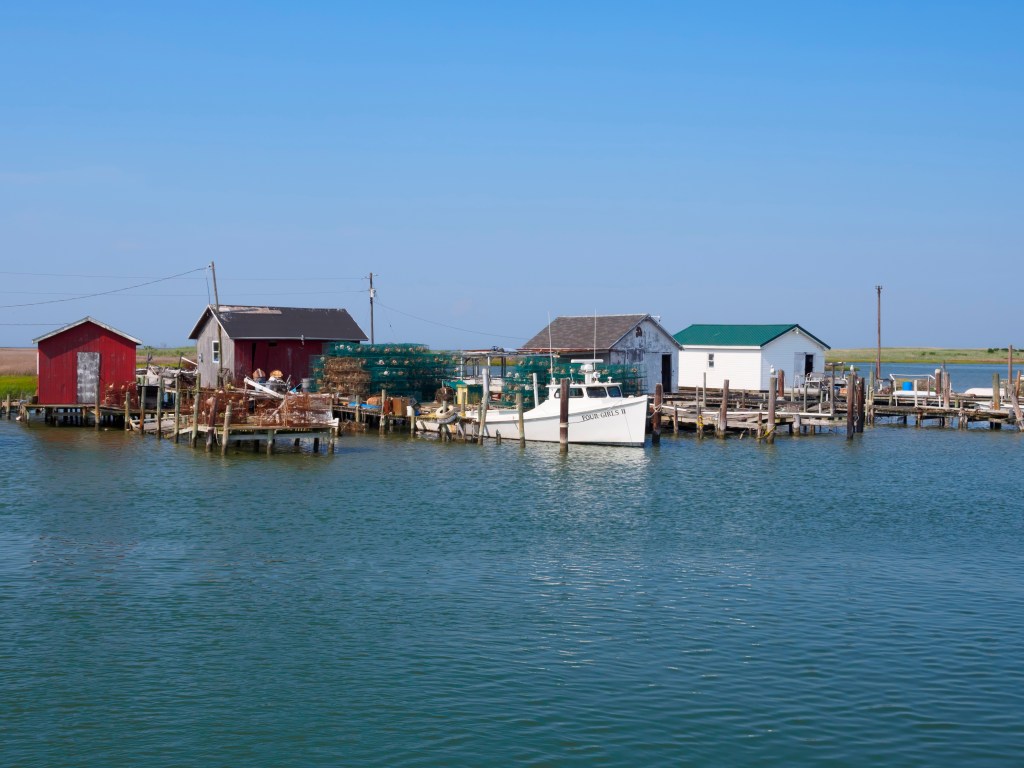
From Hampton we began our journey through the Chesapeake.  The first night was at the quaint fishing village of Tangier Island, all crab huts and working fishing boats.  Dick made me laugh.  He read in the guidebook that due to a strong Methodist influence, the island is dry.  He interpreted that to mean that there was a water shortage on the island.  (I have no idea why he thought Methodists would create a water shortage!) He was quite surprised when we sat down in the local restaurant and I had to explain that there would be no beer or wine with dinner that evening!

Tangier Island
Fishing shanty, Tangier Island
Fishing shanties at sunset, Tangier Island

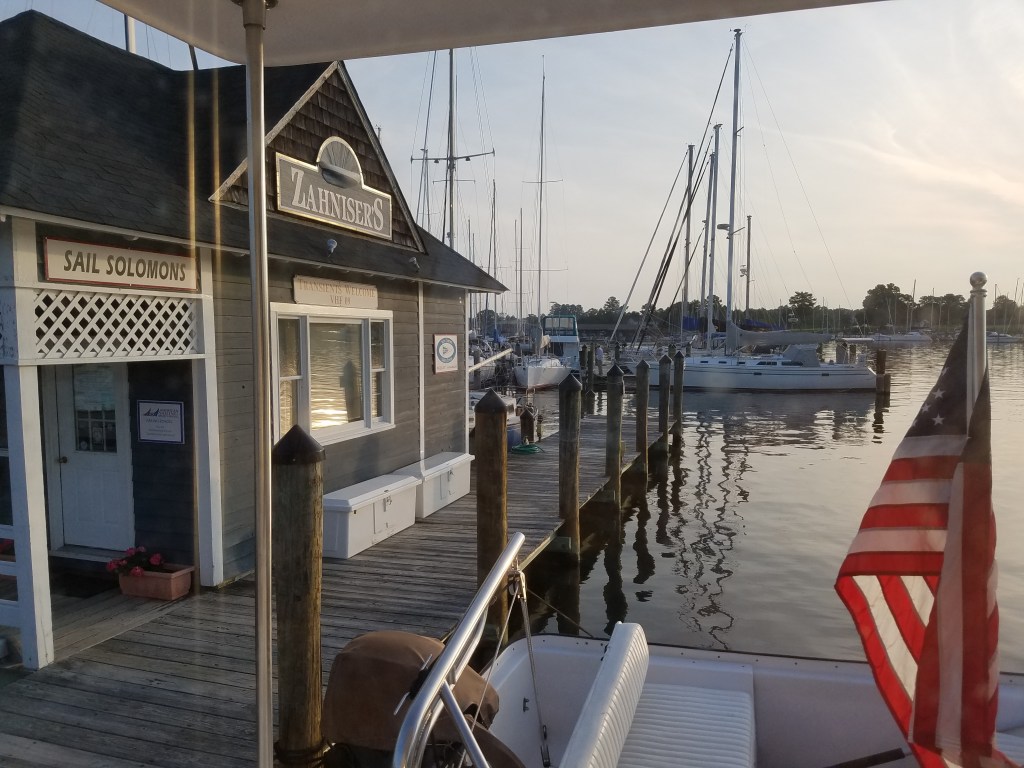
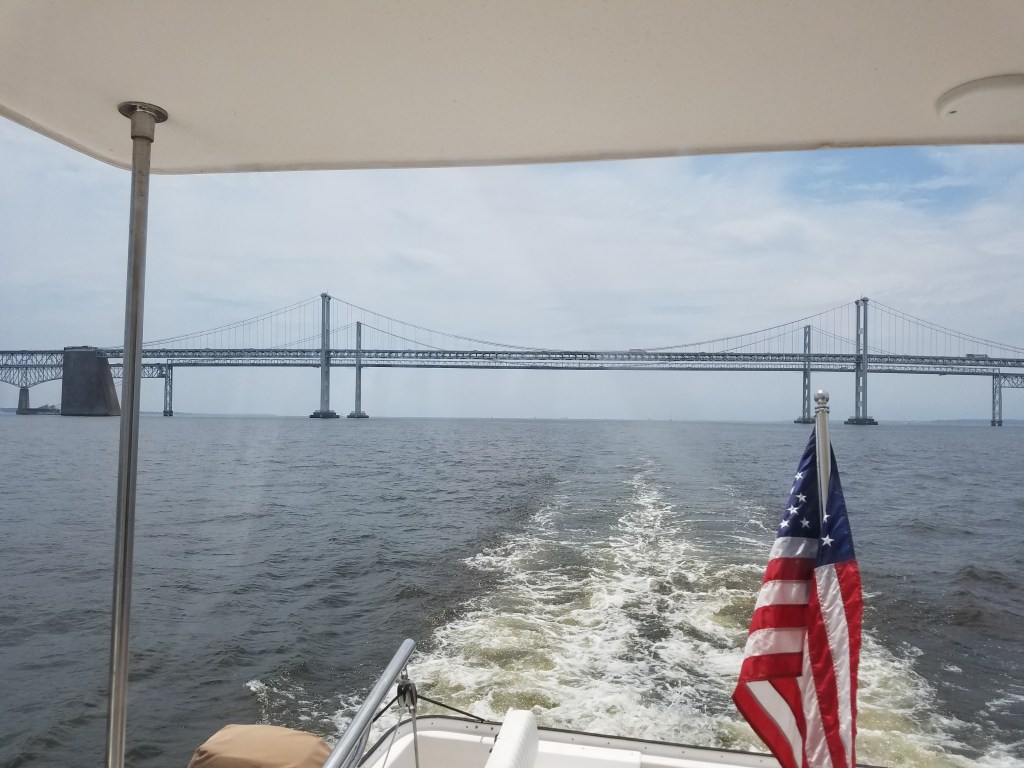
The next day the Chesapeake lived up to its reputation for misery, as a gale blew up not long after we set off.  We had to travel well south before we could get close enough to the western shore to gain some protection, and it took a long time to make our way to Solomons Island.  There we waited out the weather again, for two nights this time.  The third morning was clear and the bay was (relatively) smooth, and we were able to get as far north as Rock Hall.  From there we passed under the Chesapeake Bay Bridge and then into the Chesapeake and Delaware Canal.

Solomons Island
The marina at Solomons Island
Chesapeake Bay Bridge
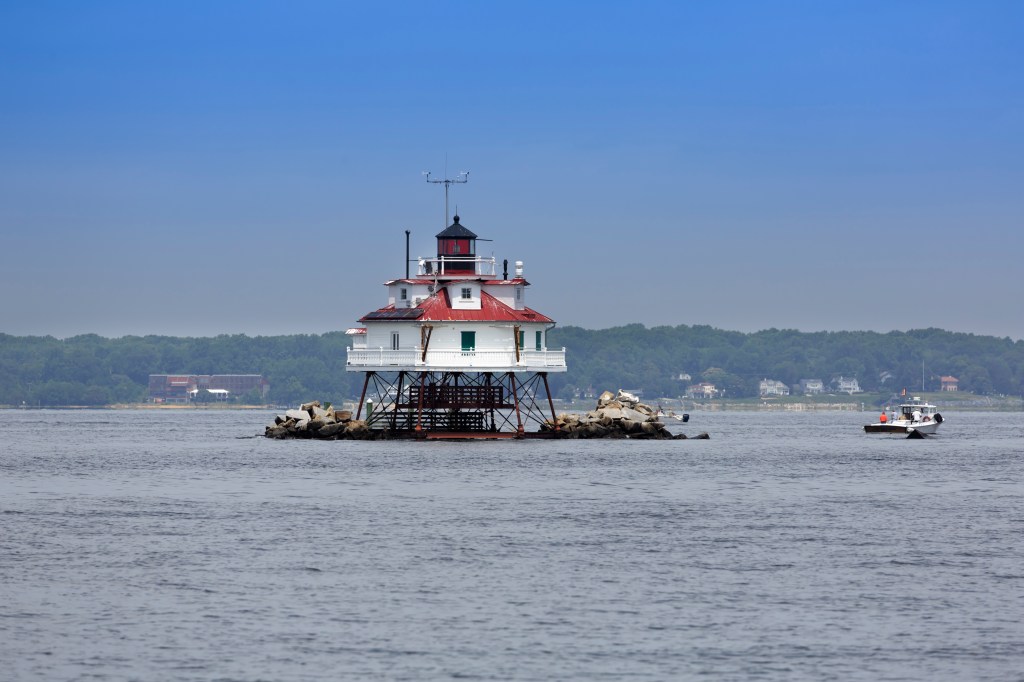
Thomas Point Shoal Light, Chesapeake Bay

The C&D Canal is the busiest in the nation.  It was built in the 19th century and widened and modernized in the 20th.  It saves 300 miles in travel between Philadelphia and Baltimore, and it is used by enormous cargo and tanker traffic.  We were very fortunate that in the 12 mile length we met only one tanker, just as we were exiting the canal.  They create huge wakes that reflect off the canal sides and make for an uncomfortable ride.

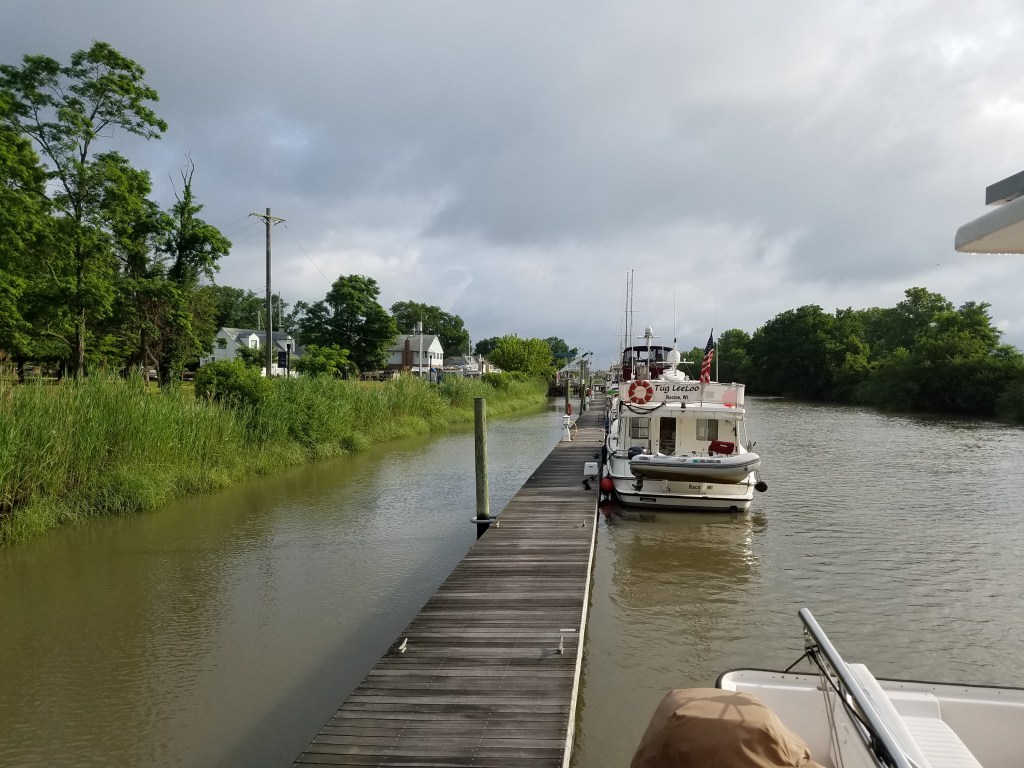
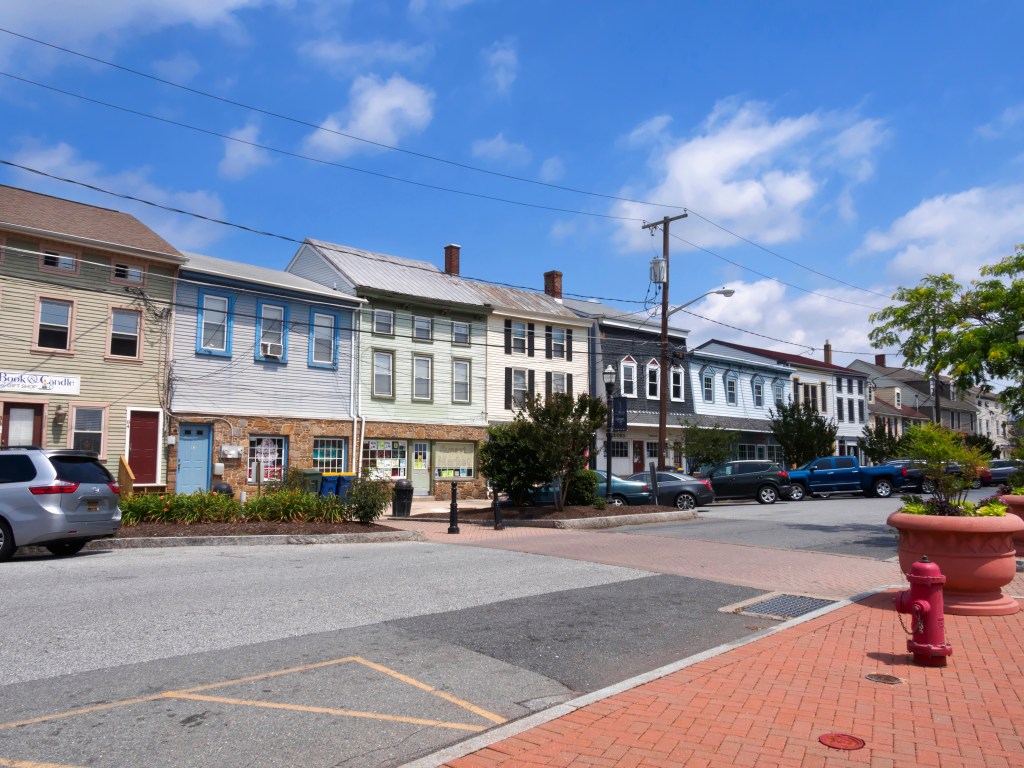
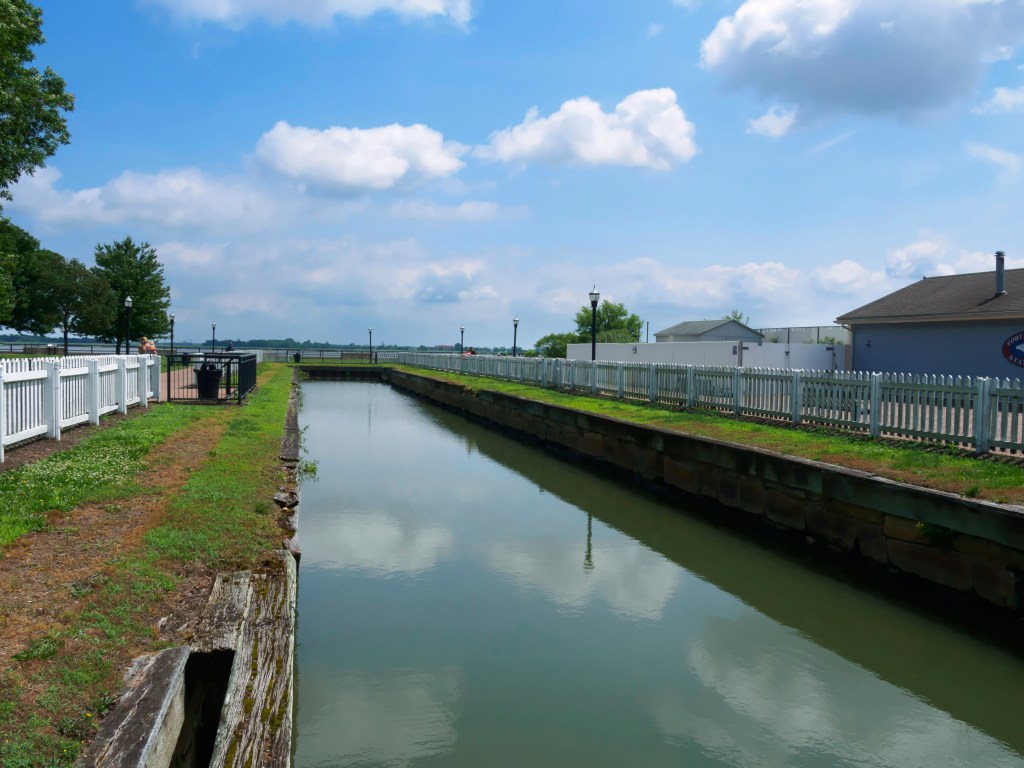
We are now at Delaware City, a picturesque old town that was once an important port between Philadelphia and Baltimore at the mouth of the canal.  The marina is on the only remaining piece of the original canal.  The old canal was dug by hand by free black people and Irish immigrants who were paid 75 cents a week.  It was (is) 100 feet wide and 10 feet deep.

Delaware City Marina
The original C&D Canal at Delaware City
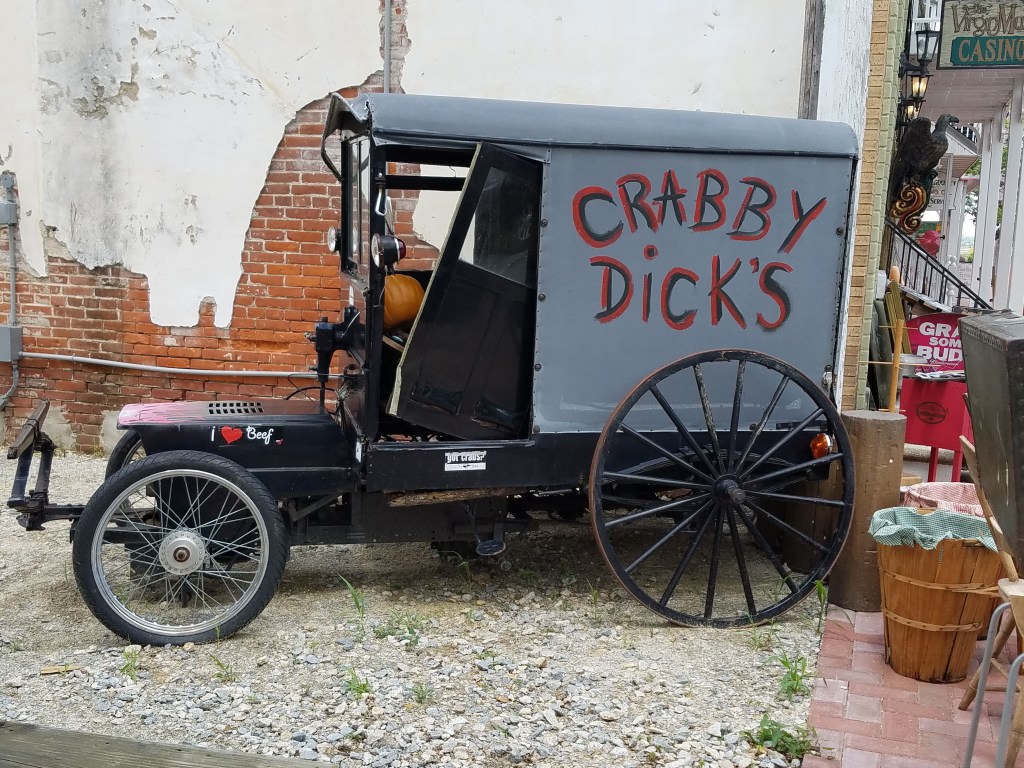
A new vehicle for Captain Dick??

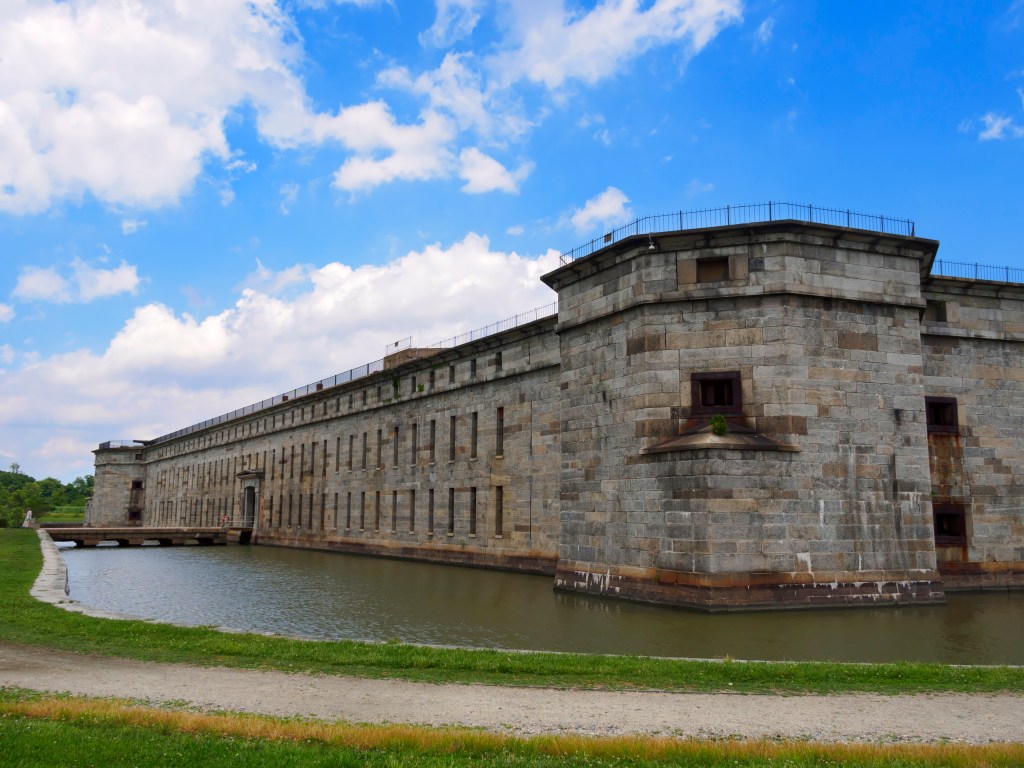
We visited Fort Delaware on Pea Patch Island, an important fort that was used to house hundreds of confederate prisoners during the civil war, and was again used for prisoners of war during world war two.  It is gradually being restored, and is staffed by volunteers in period costume who take on the characters of the civil war occupants of the fort.

Dick checks out the cannon at Fort Delaware
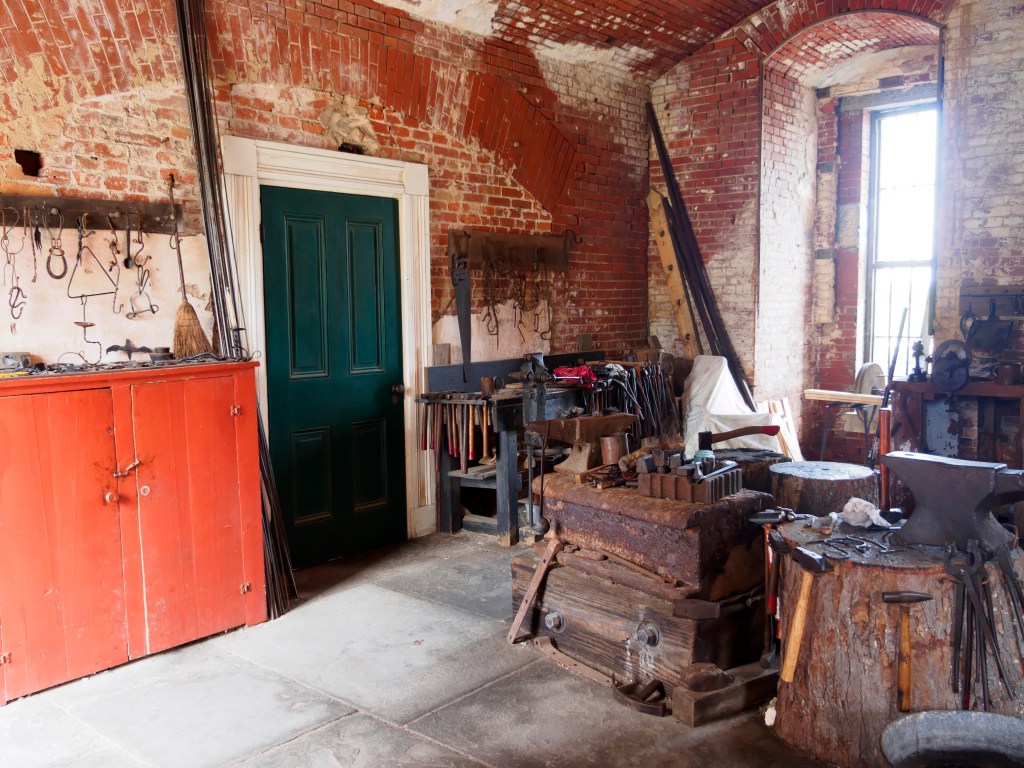
Fort Delaware blacksmith’s shop
Fort Delaware, Pea Patch Island

The marina manager gives an evening briefing for the transit of Delaware Bay.  The briefing was very interesting.  We learned how to interpret the symbols in the NOAA wind and current databases and how wind, fetch, and current combine to make huge waves.  We are delayed again by high winds in opposition to a fast current, and expect to be here at least another night if not two.  Interestingly, there are 5 other Looper boats (boats, like us, doing the Great Loop), here in the marina with us, so in spite of our late start compared to most of the pack, we are by no means the last ones heading north.  I expect there may be some docktails and trading stories in the next couple of days while we wait for calmer waters in the Delaware Bay.

One of the more interesting boaters awaiting calmer seas is a man in a rowboat.  Granted, this is not your father’s rowboat, it is a modern skiff style.  He started his trip in Miami and is heading for New York City.  He expects the whole trip to take him just 55 days.  He says he usually travels 50 miles in a day.  I am not sure where he sleeps, but his boat is full of plastic bags with all his stuff.  Needless to say, not the sort of adventure that would interest me!

Delaware City
Last remaining lock chamber of the original Chesapeake and Delaware Canal