
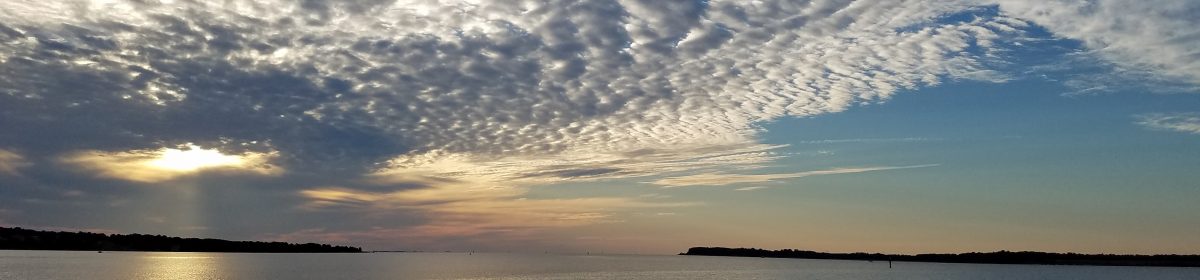
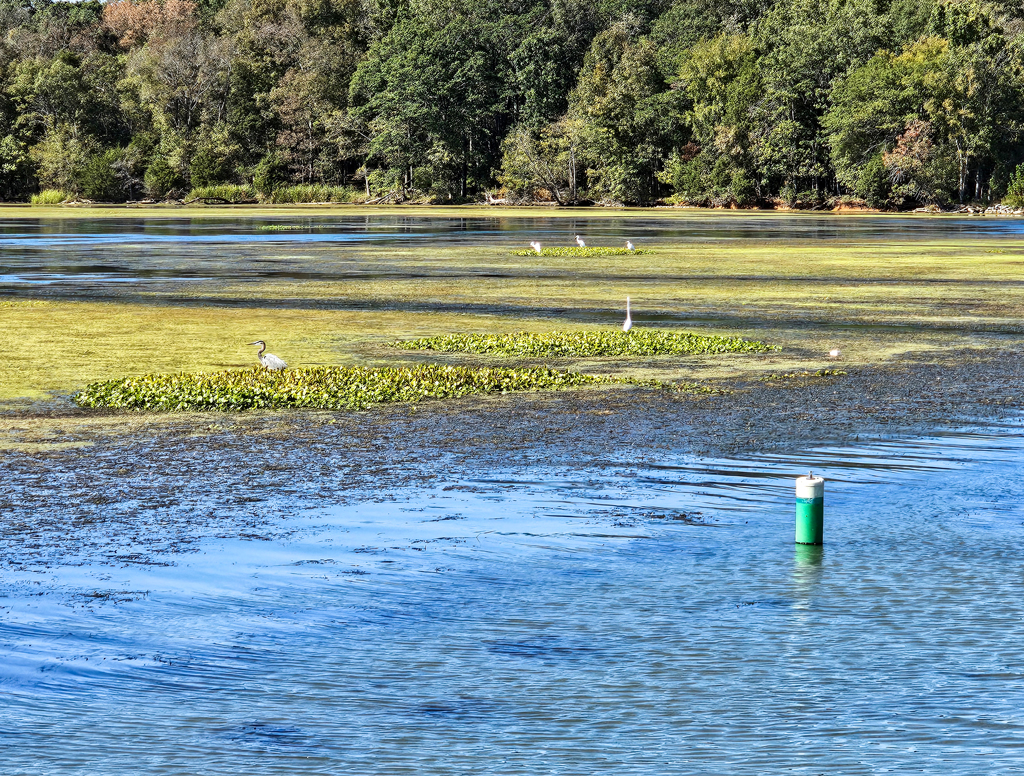
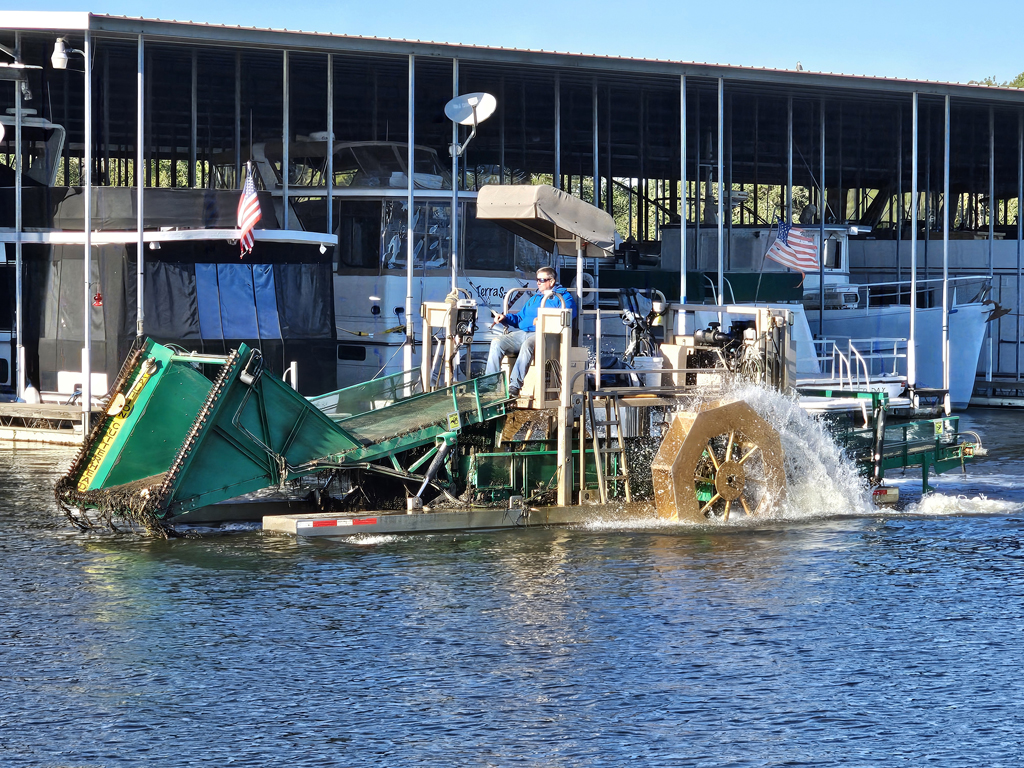
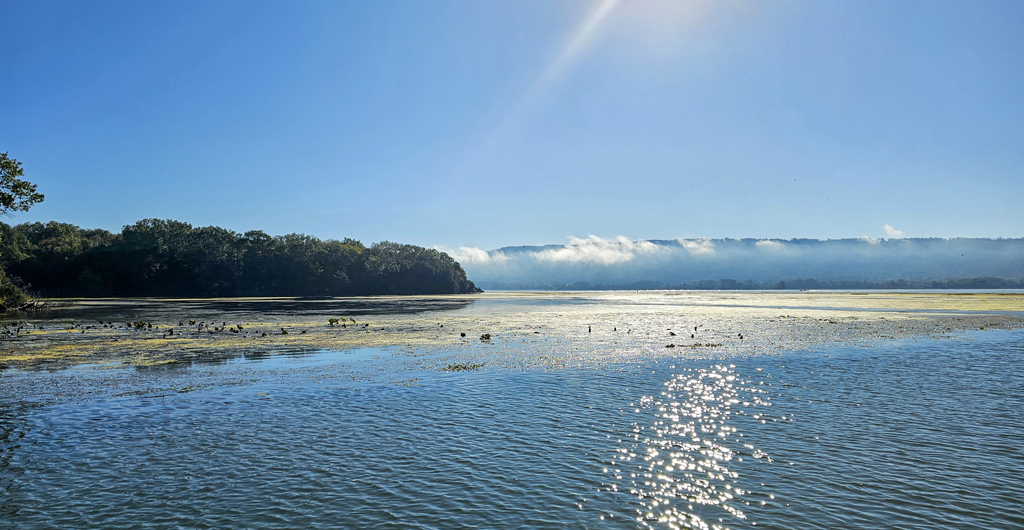
Our destination on October 16th was Goose Pond Colony Marina, near Scottsboro, Alabama. This marina is part of a large golf resort. The entrance channel is narrow, but well-marked, and with lots of shallow areas there were interesting birds to be seen as we approached. The grass is so prolific that the marina has a special machine to keep clearing the channel, and it goes out every day. Our entrance was a matter of trust, because the grass fools the depth sounder and it suggests that we are about to run aground. There were several other Loopers there, including some that we had already met. Later that afternoon, Legacy, a smart Back Cove arrived on the other side of our slip. We found out when they introduced themselves that they were just 8 hours into the Loop. Unusually, the lady will be aboard one week in four, and for the rest of the time Don will travel solo.
We were invited to join two couples who we had met earlier in Chattanooga for dinner at the onsite restaurant. It was nice to sit and chat and get to know them. It did remind us though, that while it can be rewarding, the idea of “buddy boating”, that is, travelling with another boat all the time, does make for a less inclusive experience than enjoying meeting all the diverse boaters if you follow your own agenda. By making your own plans, you find that you are leapfrogging some of the Loopers you have already met, and continue meeting new friends as you go along. The food at the restaurant was acceptable, but no need to return.
We spent a quiet day at Goose Pond. It was a good time to do some laundry and for me to finish and publish the second issue of the blog.
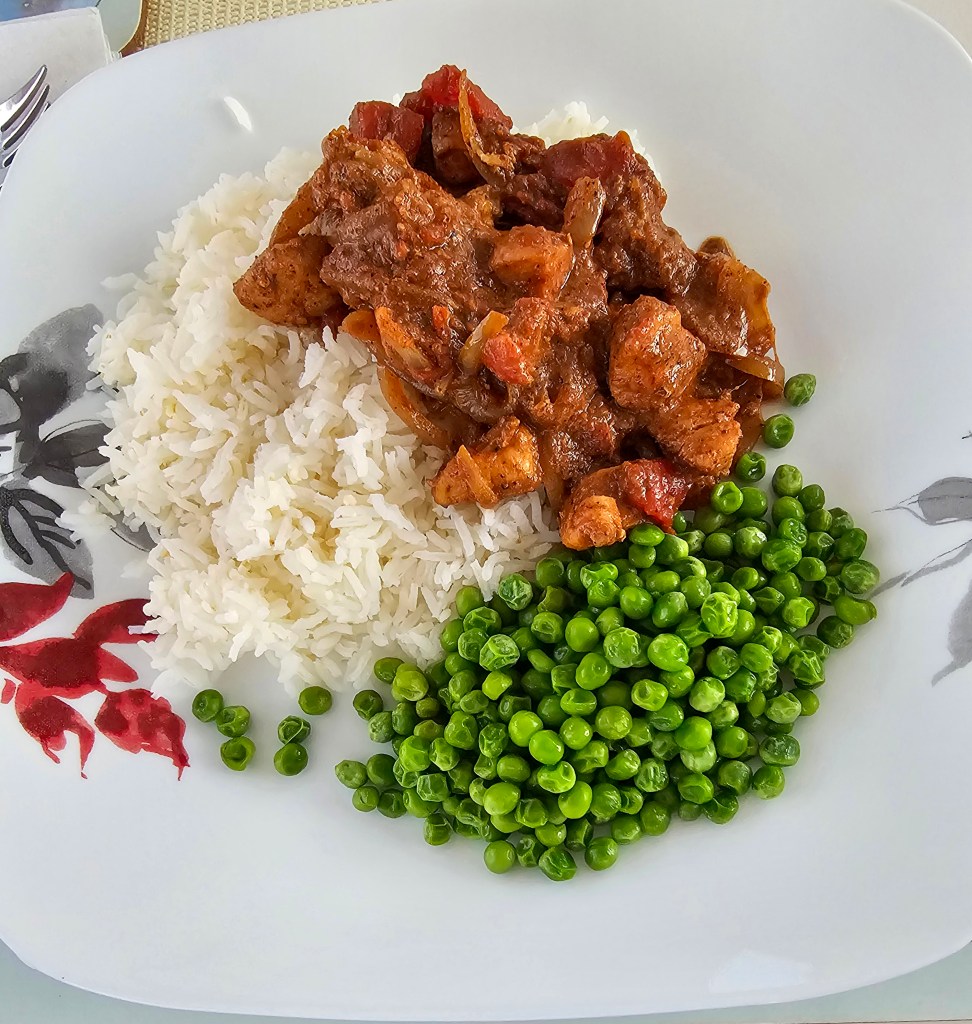
I tried a new recipe for Chicken Tikka Masala. It was tasty, but we think that in future the recipe might lend itself to using lamb and doing it in the slow cooker. We enjoy Indian food, and if I can collect western cooking-style recipes we can put together an Indian meal without using the foil packets of sauces. One is never entirely sure (and we probably don’t want to know) just how many interesting chemical concoctions are in those packages that keep them “fresh” for literally years. Better to make the dishes from scratch.
After our relaxing pause at Goose Pond, we headed downriver to Ditto Landing, arriving by early afternoon and happy to be greeted by our friends Cherie and Pete on Spring Fling. They are segment Loopers like us. Although Ditto Landing has no practical access on foot or by bike to nearby Huntsville, Cherie and Pete had a rental car and invited us to join them for dinner at a Japanese restaurant. The food was excellent, and Dick even ordered, and enjoyed, some sushi. My hibachi shrimp and chicken were also delicious.
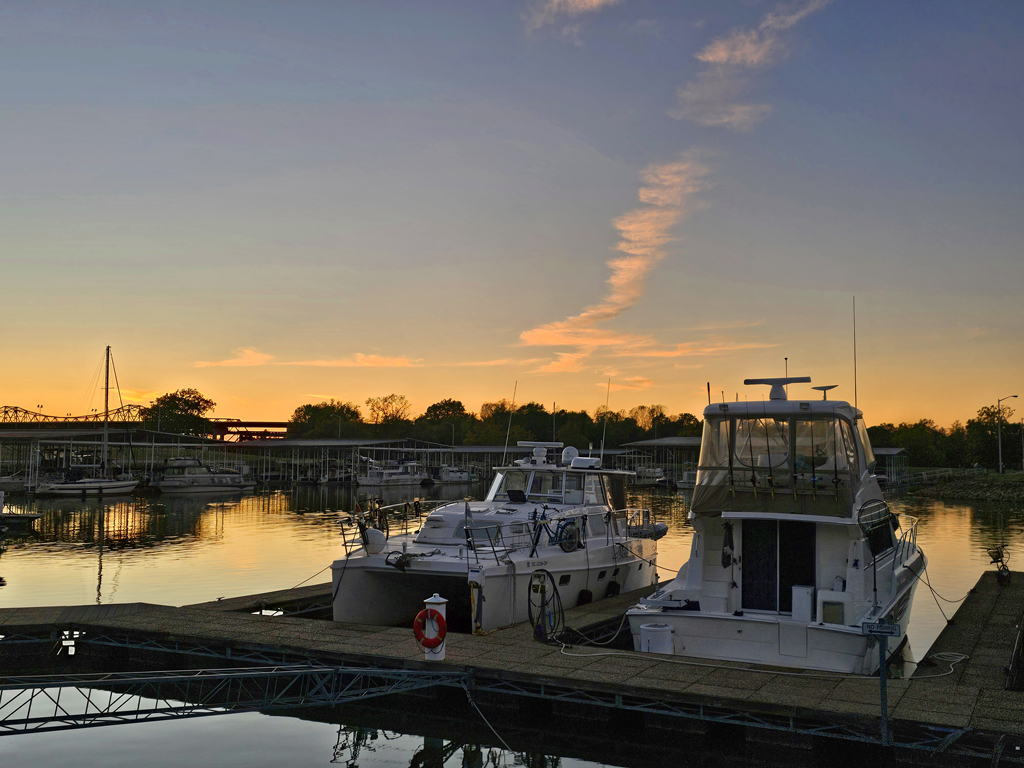
First thing next morning we began the big cleaning job, so Nine Lives would be spic and span for the boat crawl at Rendezvous. As I scrubbed my bathroom, it was obvious that no cleaning had been done before we got on board at Aqua Yacht. We haven’t been charged, so I suppose we were not cheated. Dick took advantage of being in a slip, thus having access to both sides of the hull, to get some of the outside cleaning done. It was nearly noon before we left, but already Nine Lives was starting to look spiffy.

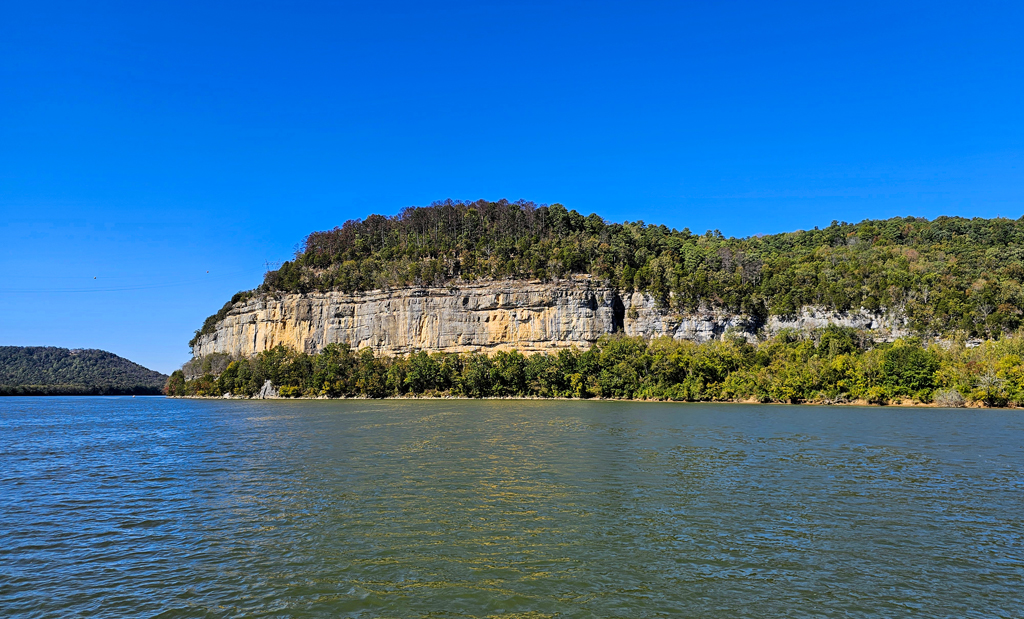
Behind Lehman’s Bluff is Redstone Arsenal. The facility was established during WWII as a base for chemical manufacturing, and was then used as a research base for rockets and ballistic missiles. Today it is still the centre for the Army’s missile programs for testing and development, and there are now over 75 tenant agencies, including NASA’s Marshall Space Flight Center. The government and contractor workforce averages 35,000 to 40,000 personnel daily.

We passed under the I-65 Bridge. This Interstate connects Chicago, Indianapolis, Louisville, Nashville, Birmingham, Montgomery, and Mobile. It is quite something to think that we have visited or will soon stop at almost all of those cities as we go through this western half of our Great Loop.
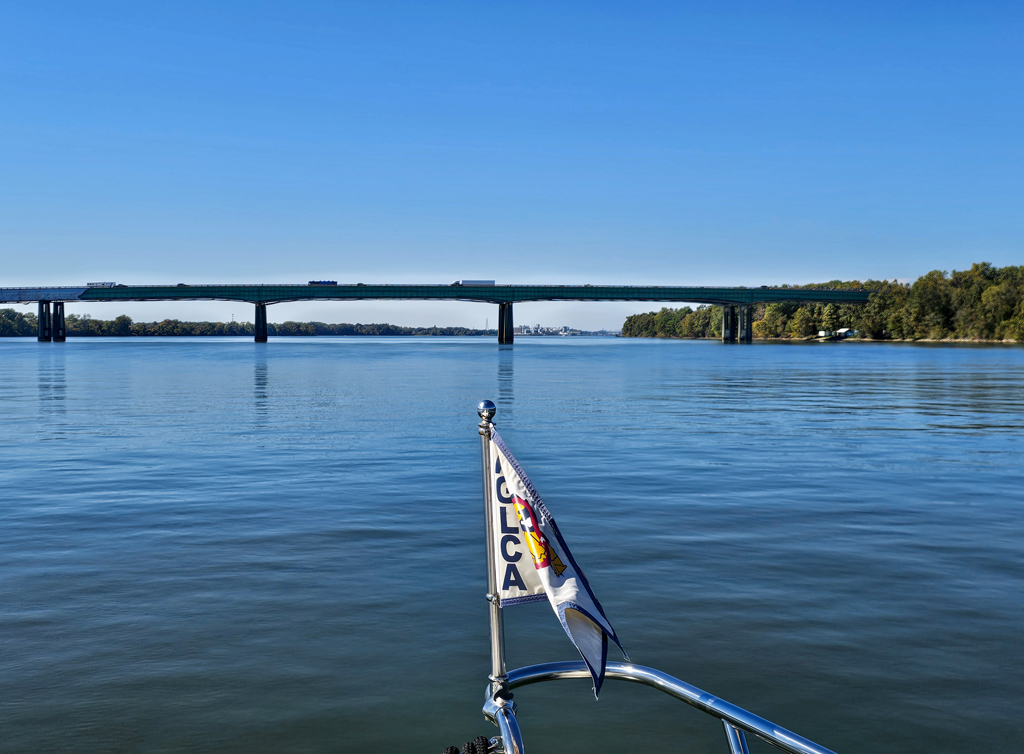
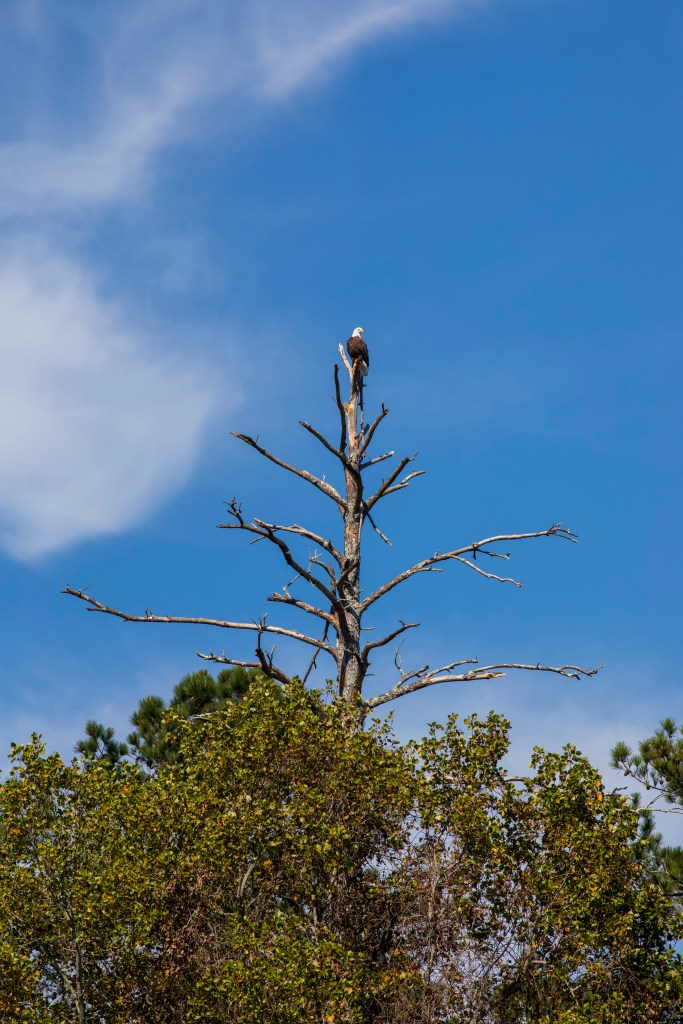
Construction of the bridge was halted for a few months so that nesting birds in that part of the Wheeler National Wildlife Reserve would not be disturbed. The NWR was created in 1938, after TWA (Tennessee Valley Authority) flooded the Tennessee River and created Wheeler Lake. Backwaters were pumped dry in spring, thus eliminating mosquitoes. When the water was returned in the fall, migratory birds were attracted to the abundant grasses and seed-bearing plants that had grown up. Thousands of Sand Hill Cranes now overwinter in the refuge, and a few of the highly endangered Whooping Cranes have been seen in the last ten years. We were too far from the grasslands to see cranes, but we were happy to see a Bald Eagle high in a tree.

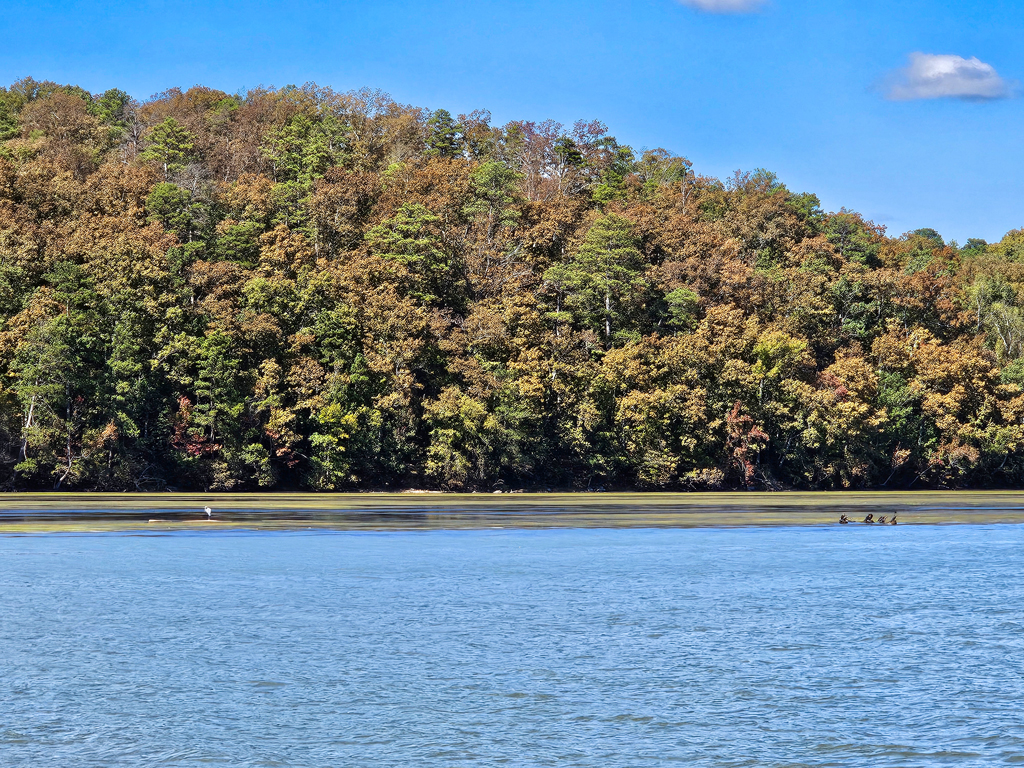
We were tied up in the marina at Decatur by 2:30. It is a strange marina, mainly boat storage. Dick spoke to the owner in mid-October, and he made a reservation, but would not take a credit card number. There is nobody in the office on weekends, and the on-site restaurant is currently closed for renovations, so there was no way to pay. We had a free dock with power and water in a very calm location.
We got down to serious boat cleaning. More than one adult beverage was required when we were finished for the day! We both hate cleaning. My frustration was that arrangements had been made for the major cleaning, inside and out, to have been done before we got on board. If it had been done, our job would have been only a touch-up. Instead, we were dealing with a year’s worth of accumulated grime from the storage period.
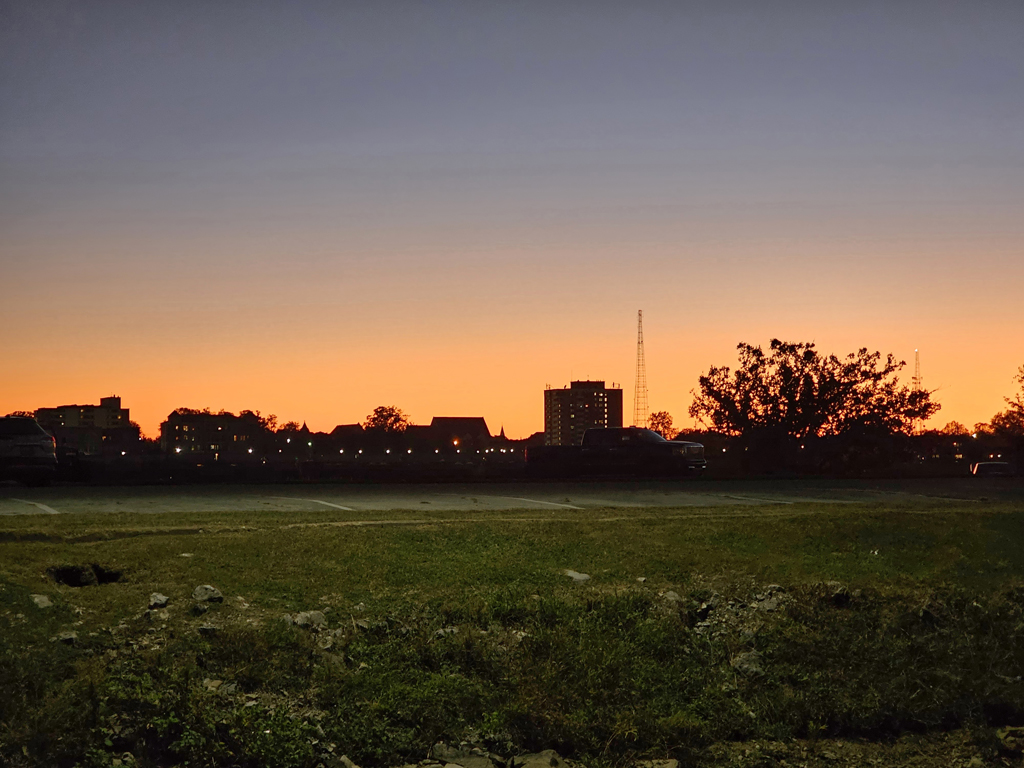
There was a pretty sunset over the industrial skyline of Decatur. We watched a fellow on the dock catch a large fish for his dinner, underneath the “No Fishing from the Dock” sign.
More cleaning in the morning before we set off. Nine Lives sparkled!
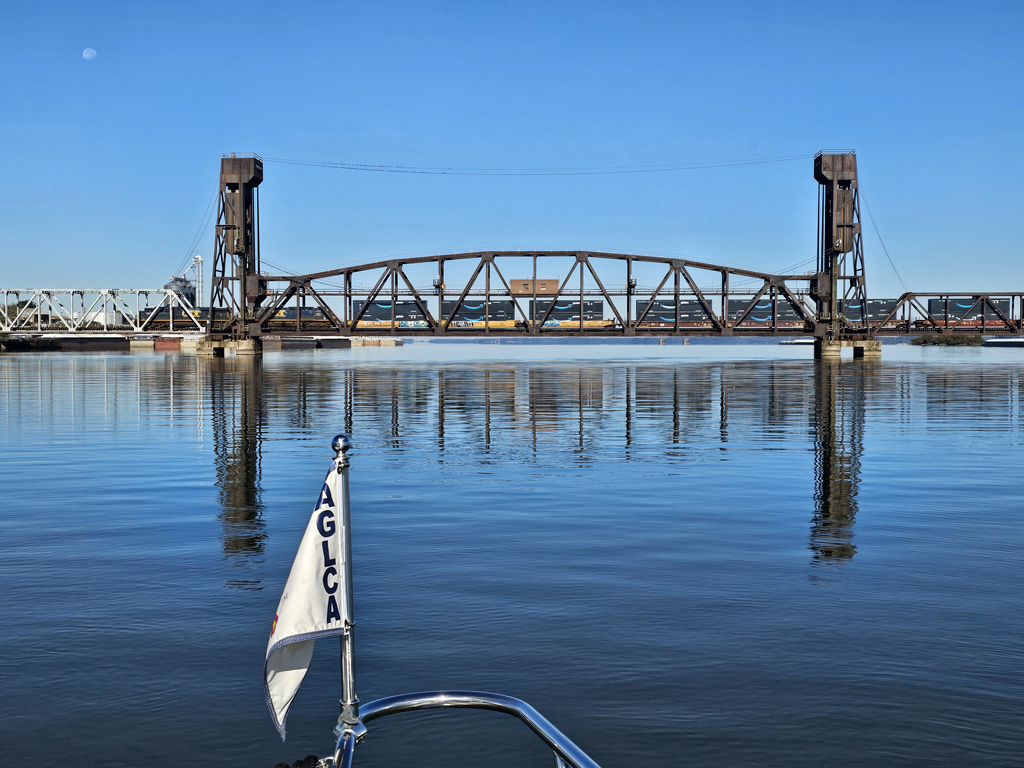
We waited 10 minutes for the Decatur Railway Bridge, as a long train of Amazon containers passed over.
We arrived at Joe Wheeler State Park by mid-afternoon. After a pump out that we suspected (rightly) was inadequate, we went over to our assigned slip. A fishing boat was diddling around exactly where we needed to be, so Dick sounded the horn. Our horn is LOUD. No effect. Horn again, in fact twice more and me making “get out of the way” gestures before they finally figured it out. As a result, we had a great deal of help with docking, having announced our imminent arrival so loudly.
After some final touches to the cleaning, I put together a spread for docktails. We had invited up to 12, but between regrets, no-shows, and a couple we already knew were unlikely to be able to make it, we were glad that we also invited our dock neighbours, giving us 7 guests. More would not have fitted into the cockpit, so just as well.
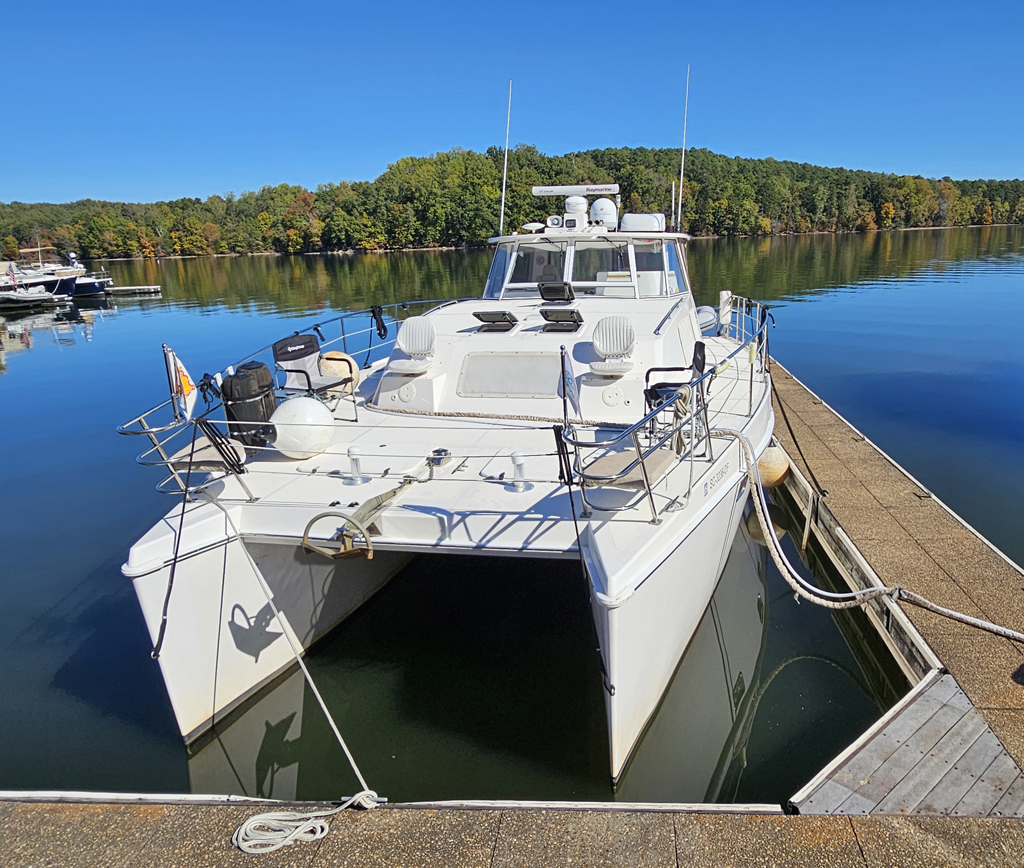
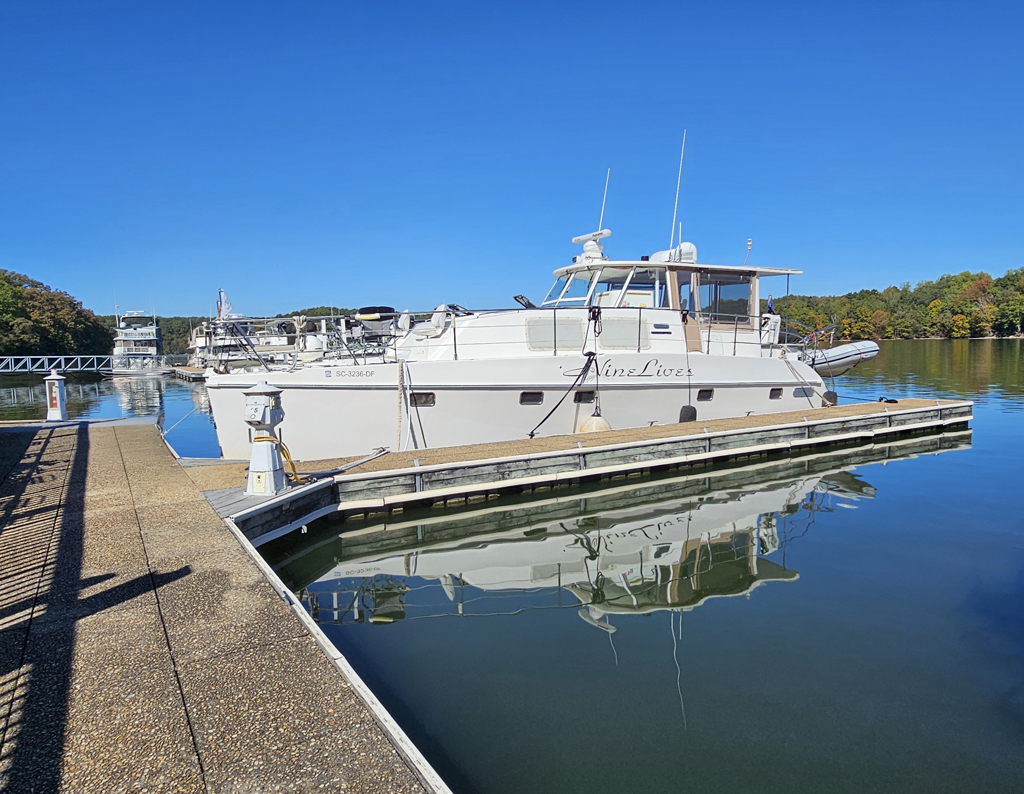
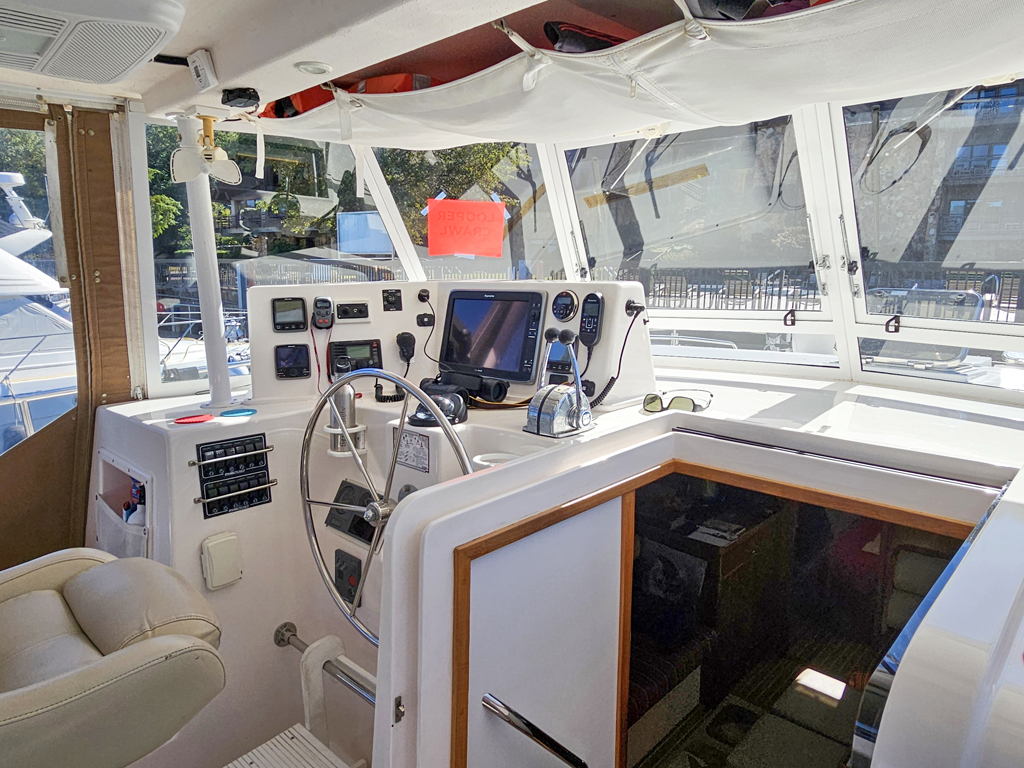
The first day of the Rendezvous was quite busy, mainly because in the afternoon, over the two-hour period of the boat crawl, we welcomed at least 50 people onto Nine Lives to look around. Some visitors were still in the boat-shopping stage. Some had their boat and were interested in storage, and what adaptations they might be able to make on their boats. Many people were simply curious, having never been on a catamaran before, and they were amazed at how much usable space there is on board.
That evening, we enjoyed sitting with a table of planners and a couple who were just two weeks into their Loop for dinner. After the meal, we, and a few others, were presented with nice engraved wooden cheeseboards as a thank you for stepping in at the last moment to make presentations during the Rendezvous.
The next day began the briefings part of the gathering. We attended the presentations, advice and suggestions for our upcoming route from folks who have done the next part of the Loop multiple times. This included preparation and advice for the Gulf Crossing, a 172-mile overnight crossing, well offshore. We will be doing this in February.
We had 3 busy days of briefings, socializing, and then the 3-hour boat crawl each afternoon. This is an opportunity for Loopers, especially planners, to get onto all sorts of different boats, and see how they really look when Looping (as opposed to being all gussied up and decluttered at a boat show). It was tiring. Dick stayed up top and talked engines and boat handling, while I was below making sure the visitors saw everything, and demonstrating how we handle storage.
The final event of the gathering for us was our presentation on locking. Dick ran over the time slot somewhat, but it was well received. We had not expected that there would be so many people in the audience. At the beginning, Dick asked how many had never been through a lock. A surprising 100 out of about 150 in the audience raised their hands! Dick did most of the presentation, while I took care of the humour with occasional interjections and comments.

Following the wrap-up lunch, there were various round-table discussions, and demonstrations, but we were both feeling quite tired and talked out, so we went back to Nine Lives and spent a relaxing afternoon and evening.
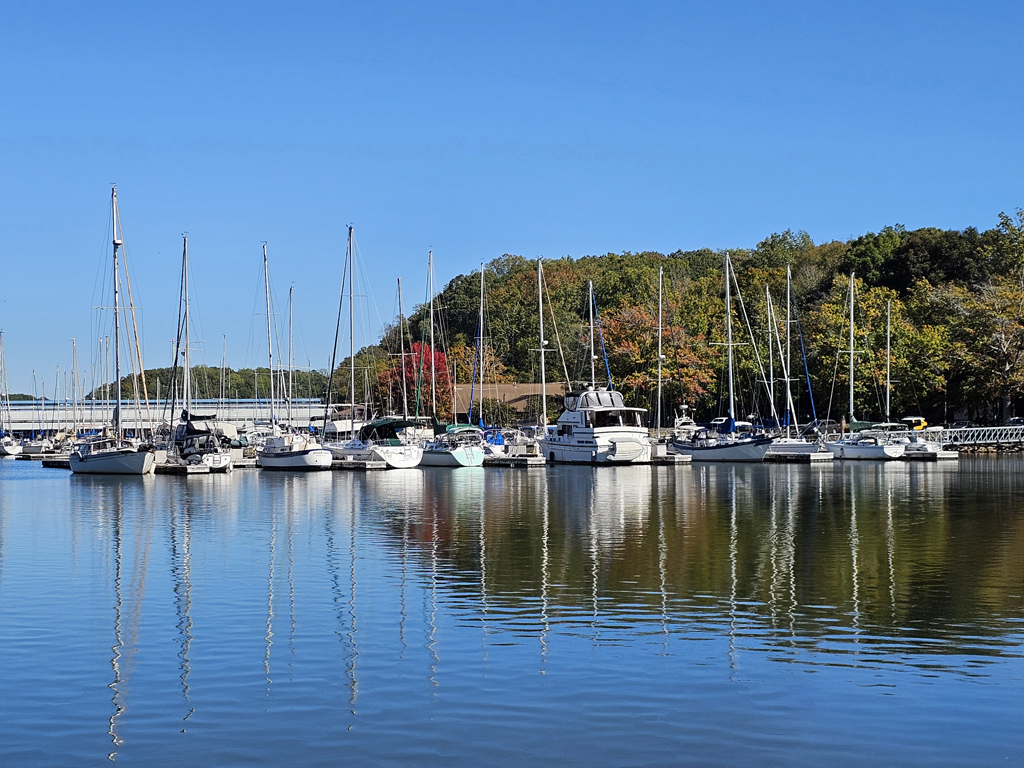

Shortly after we came through a few weeks ago, The Wilson Lock had to shut down for at least the next 3 months while repairs are made to the doors. There is a much older (built 1925) auxiliary lock, that is actually a 2-chamber stair. A reminder for new readers and those who have forgotten, typical commercial traffic on the Inland Waterways is handled by tugboats, called tows, pushing barges that are lashed together. The old lock only has space for a single barge, that must be pushed into the chamber, then pulled into the next chamber, and finally pulled out at the top (or bottom as the case may be) and eventually lashed back into the rest of the barge train. It now takes between 15 and 24 hours for a single tow with its typical 15 barges to pass through. On the day we left Joe Wheeler, there were 21 tows with their barges in the queue. This is because each barge requires an hour to transit the 2 chambers, plus additional time for maneuvering the barges, and uncoupling and re-coupling them after the transit.
The lock infrastructure here in USA is failing. At least 80% of the locks are 50 years past their design life. The locks are maintained by the Army Corps of Engineers, which is chronically underfunded. To put the importance of the canal and waterway infrastructure into context, here are some facts and figures. One 15-barge tow carries the equivalent of 214 rail cars + locomotives, or 1050 large semi-tractor-trailers (articulated lorries for our English friends). With respect to the environment, barges have the smallest carbon footprint. In terms of tons of CO2 per million ton-miles, a barge is 15.1, rail is 21.6, and trucks are a whopping 140.7. Barges move cargo 675 ton-miles per gallon of fuel. A rail car is 30% less efficient, and a truck is 78% less efficient. Speaking just of the Wilson lock, it is the gateway to 531 miles of upstream navigable waterways. 12,000,000 tons of commodities valued at roughly $4 billion pass through annually. Just in case you think that the areas of Tennessee and Alabama that are served by this waterway and specifically Wilson Lock are of little national importance, the barges serve 3 nuclear plants, United Launch Alliance, Marshall Space Flight Center, and Oakridge National Laboratory. Commercial entities include a number of large quarries. The stone that is produced in those quarries may be used for cement. Cement is an important building material for houses, and just about everything else that humans apparently need to survive. The Port cities served include Decatur, Huntsville, Guntersville, Chattanooga, and Knoxville, all of which are industrial centres.
Another way of looking at it, a single tow (with barges) costs about $500 per hour, and most of the tows have waited about 7 days since the breakdown, about 150 hours. Then factor in the factories and industries that are not getting chemicals, materials or shipping their output, and you have a serious economic situation. Some of these plants must shut down and their workers are not paid. How many of our readers have any idea how much of the economy of the area (and the country) is affected by the temporary closure of even one lock? I am guessing none (except for those who have just now waded through my facts and figures above!)
The boats that were part of the Rendezvous came up in flotillas of a maximum of 5 boats per day, helpfully staged and organized at Florence Harbor, just a few miles below Wilson Lock, by the harbormaster. Of course, everyone wanted to leave immediately after the Rendezvous! Some planned to go upstream to Knoxville, but many, including us, hoped to go downstream through Wilson. As often happens, one of the Loopers stepped up and offered to organize flotillas, so that the appropriate sized group would all arrive at the right place, on time, and only one person would be the spokesperson for the group with the lockmaster. We were able to sign up for the second group on the Friday, and the Wilson lockmaster promised to let 2 groups through each day, so we were hopeful. Somebody must have spoken to the formerly cranky and unhelpful lockkeeper at Wheeler Lock (the one between Joe Wheeler State Park and Wilson Lock), because he agreed to let all 9 boats in the Friday flotillas through at once.
We were up at 5am, in order to be sure we could have coffee, more coffee, and breakfast, before leaving the dock at 6:20am. It was a lovely sight, the lights of the boats behind us against the rising sun. It became clear that someone was going to have to raft up in Wheeler Lock. We are always ready, and happy to be the anchor, but it was a bit surprising that it was the largest boat in the flotilla, the 62-foot Halcyon, that was our companion. They commented that this was also a new experience for them, as they are usually the boat closest to the wall that others raft to. Wheeler Lock gave us all a gentle drop and we headed out, line astern, towards the next part of the adventure.
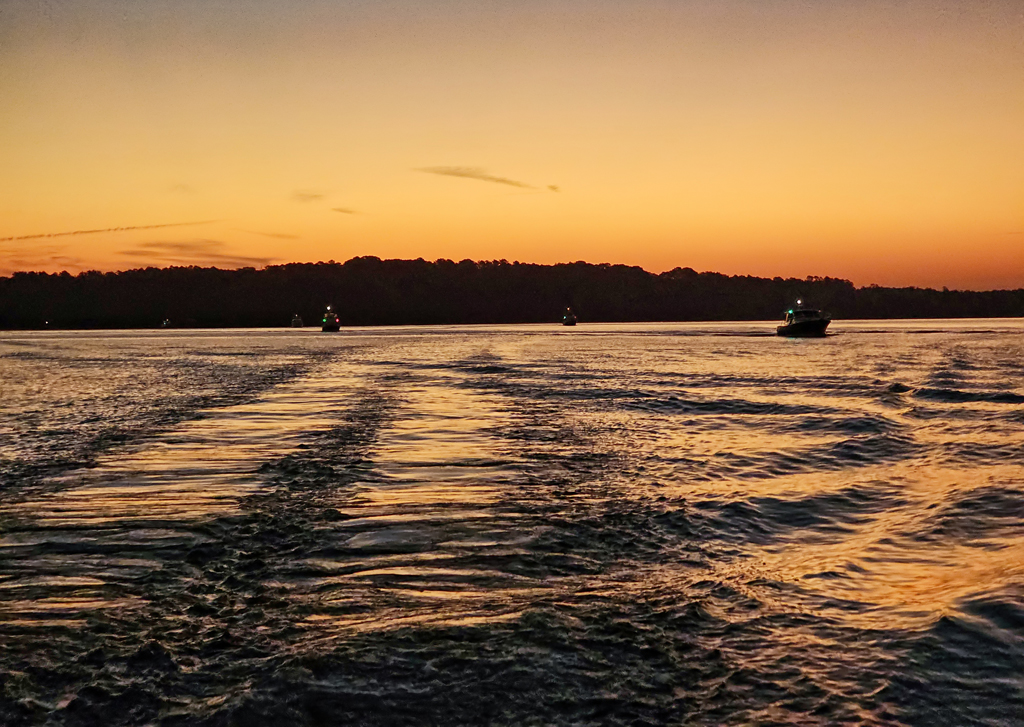

We arrived at Wilson Lock by 8:30 am and were advised to our great relief that the lock would take a break from commercial traffic, and the two parts of the 9-boat flotilla would be locked through, one after the other, starting at 10:30. They began taking the first group exactly as promised. Our group was right behind. There are very few floating bollards on either side of the two chambers (and one is under a continuous heavy shower of water). Unfortunately, the usable pins (bollards) are on opposite sides between the two chambers. Nine Lives entered first, and took the pin at the front on the starboard (right) side. Once secure, we called the next boat (Legacy) forward, and he rafted up to our port (left) side. Then the other two boats arranged themselves in a similar fashion behind. It was a day of firsts for our rafting partner. His first solo lock-through at Wheeler, first time rafting up at Wilson. After the gentle drop (thanks lockmaster!) in the first chamber, the doors opened. We untied from Legacy, and I took Nine Lives slowly and gently across to the other, port side, while Dick quickly moved our big fenders across. As soon as we were again secure, Legacy came up and tied up to our starboard side. That was a little trickier, because Don does not have a door on that side of his boat, so Dick and I had to catch and hold Legacy until we could get lines tied.
Another gentle drop, and we could all head downstream, line astern, passing all the waiting tows and their barges. We were tied up in Florence Harbor by 1pm, just ½ hour longer travel time than Dick’s original estimate that had not taken a broken lock into account! I was glad that we did not have to do part of the exercise in the dark, as we had fully expected. We were also glad that, having given a presentation at Rendezvous on how to go through a lock, with the expectation that after over 400 locks we are now experts, it all went well and we did not mess up, especially with an audience!


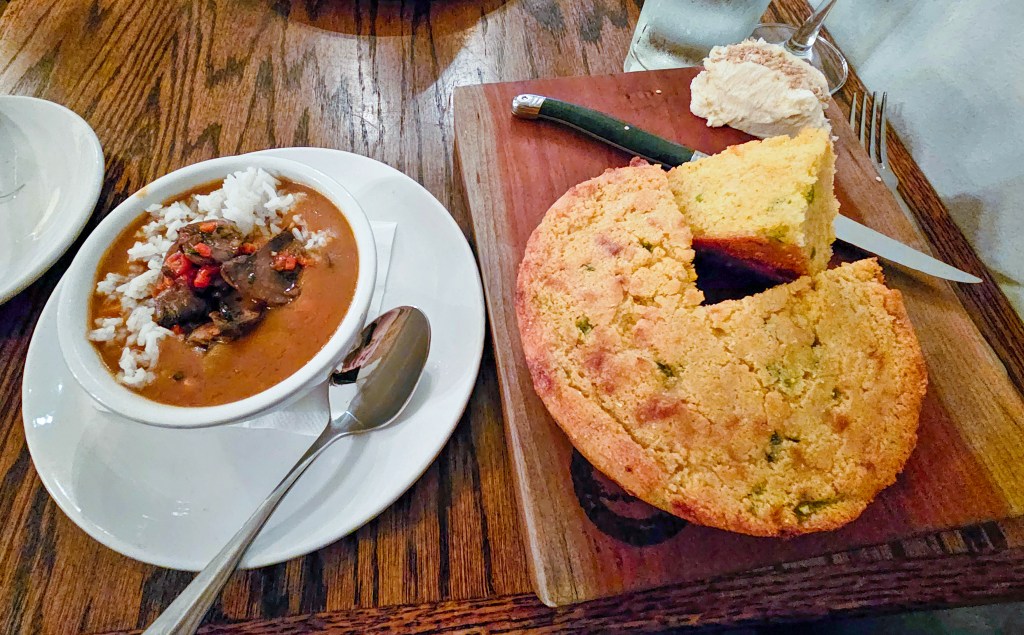
After a quiet afternoon we took an Uber to Odette’s, the restaurant we had cancelled on our last visit. The menu is very modern and unusual, but within that context, the food was both delicious and beautifully presented. Next to our table was another couple, and he asked about the cornbread that I had ordered. I offered, and he asked to try a piece (it was delicious). His Venezuelan wife of 16 years was both amazed and horrified that strangers would engage in this way. They were a lovely couple. We enjoyed chatting with them, and he gave us his number, hoping that we will call next time we visit Florence and go out to dinner with them. These chance meetings and engaging chat are some of the best experiences on the Great Loop.

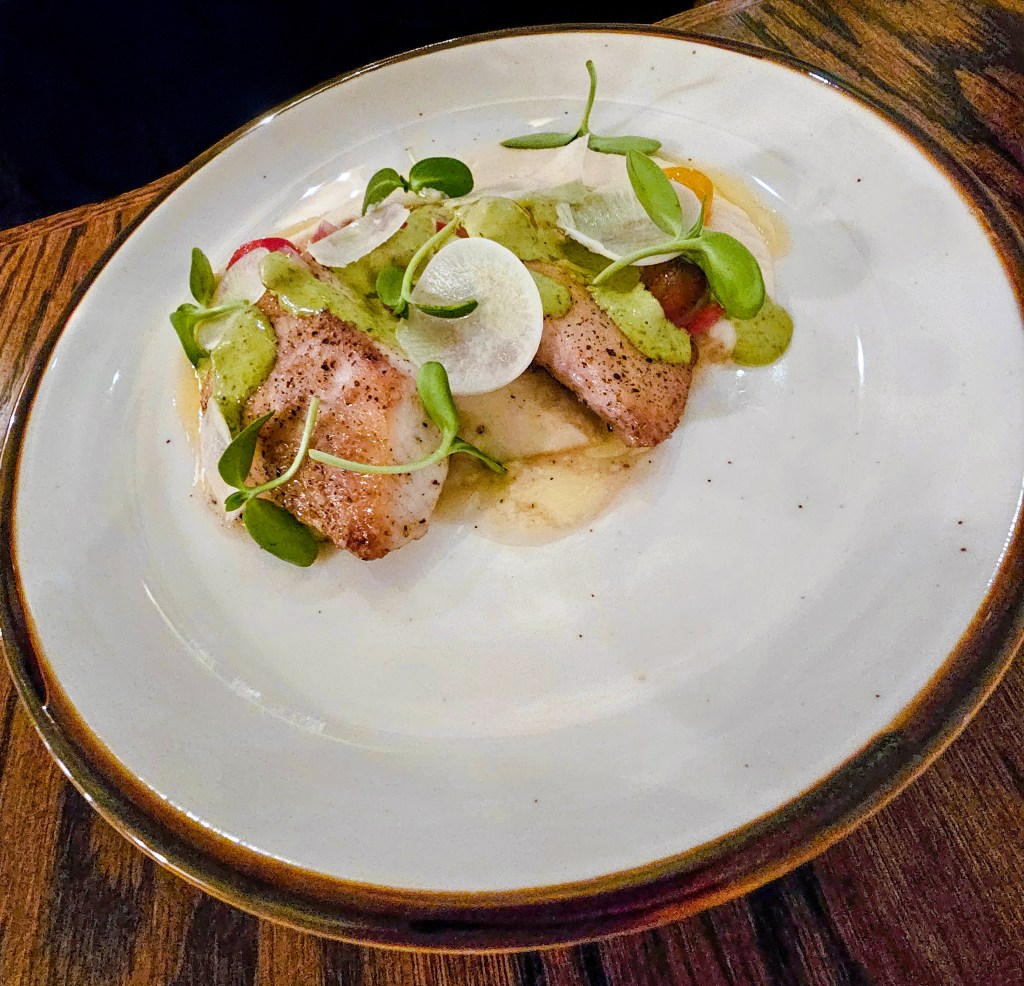
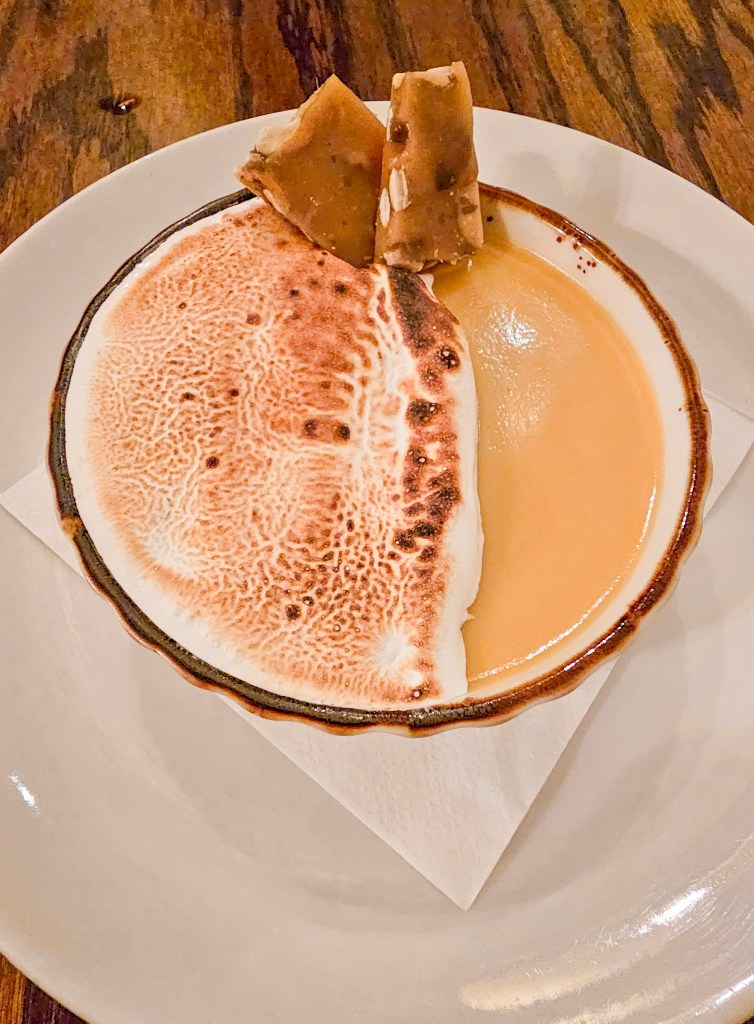
The next morning, shortly before sunrise (we were already up), we heard counting, and looked out to see what must have been 100 fishing boats heading down the River for a fishing tournament. I was just not quick enough to get a picture.
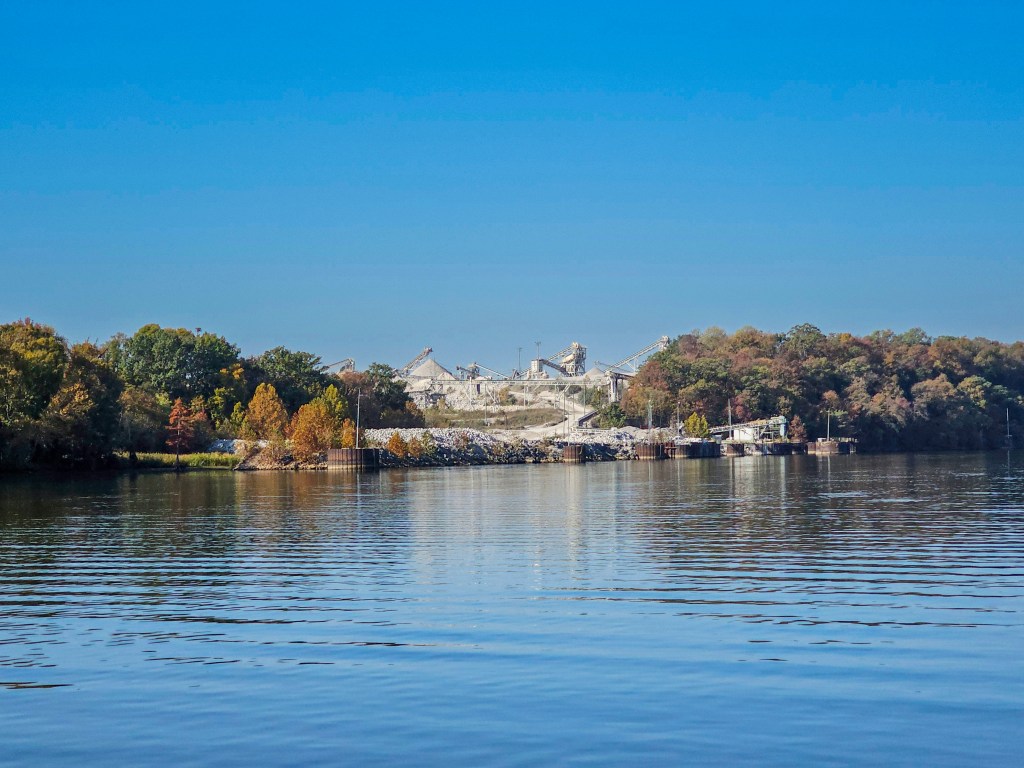
As we travelled downstream towards Aqua Yacht, we passed the now demolished Riverton Lock. Riverton was the first major landing upstream of Paducah in the 19th century. Shoals immediately upriver from Riverton prevented river traffic from getting to Florence for six months of the year when the water was low. In 1891, George Washington Goethals developed a design for a single high lift lock. He was able to convince the Army Corps of Engineers that his design was feasible and that the lock should be built to make travel possible and reliable all year round between Riverton and Florence. The lock began operation in 1911, and at the time, was the highest lift lock in the world, with a lift of 26 feet. In comparison, today, the lift in the main chamber of Wilson Lock to the south, is 100 feet, the highest single lift in any lock east of the Rockies, while Pickwick Lock to the north, has a lift of 63 feet. Goethals’ success resulted in his transfer to Panama, where he was responsible for the design and construction of the Panama Canal.

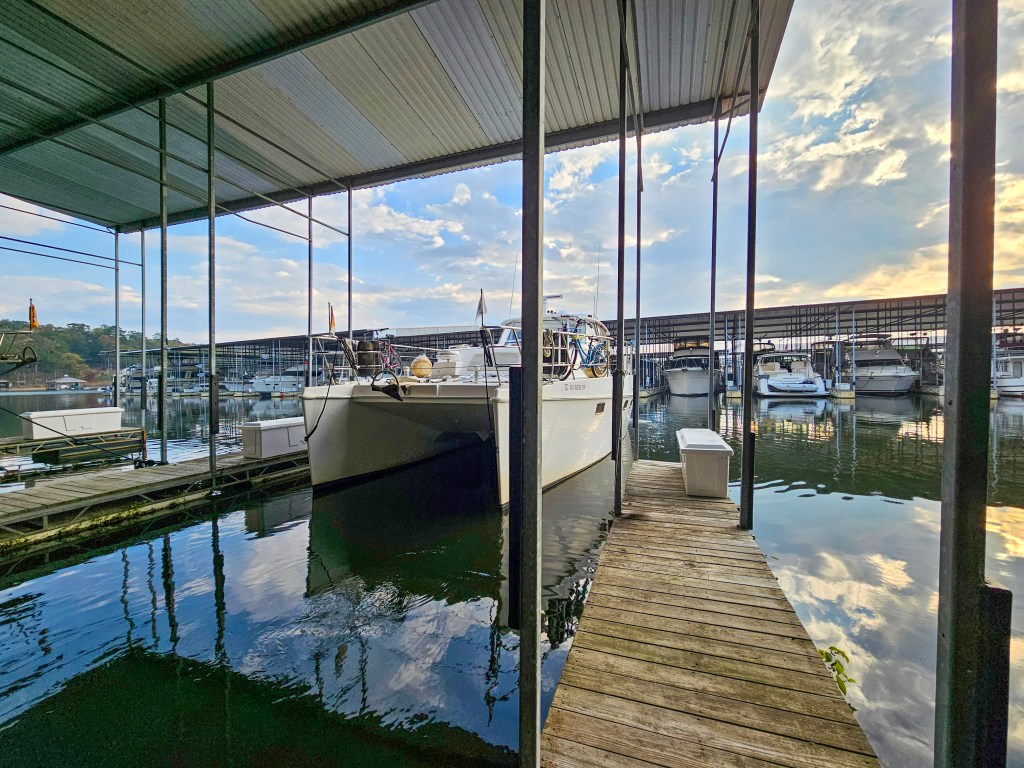
We arrived at Aqua Yacht at the same time as 5 other boats. We had hoped to be sociable, and to be either on the transient dock, or in a slip on D dock with many other Loopers. Sadly, we were assigned E56. After spending some time counting back to work out which slip we were supposed to be in, Dick turned Nine Lives into the correct slip, and it was very quickly obvious that someone’s measurement of 20 feet was faulty. This was confirmed by a friendly boater on the dock, who could see that we were not going to fit, and that it was E56 as we had been directed to. Dick called on the radio, and was given the new assignment of E47, just a few slips along, but definitely wider and longer. After 3 years of practice getting into an identical slip on F-Dock, Dick had no problem easing Nine Lives in. We already knew the best configuration for tying up to the posts.
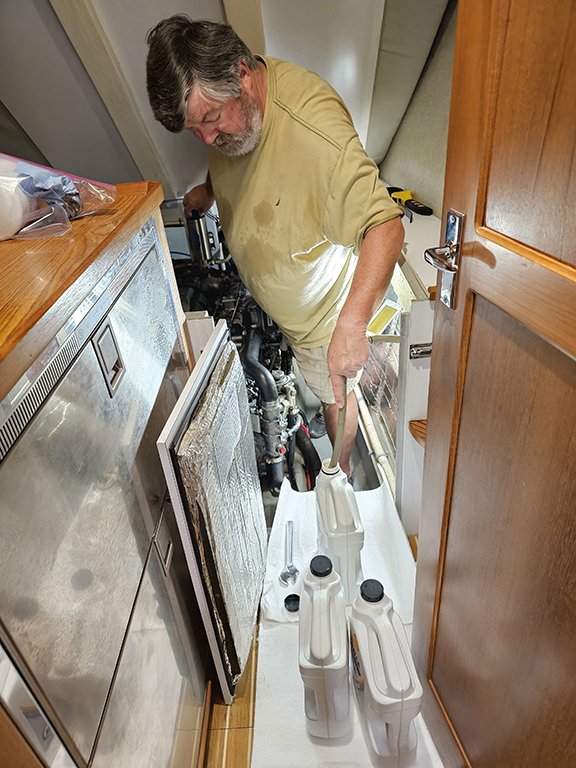
Once settled, Dick retrieved his car keys and hot-footed out to find a replacement for our leaking drinking water filter hose. Once again, he had to go farther than expected, because, for reasons known only to them, the local hardware store is closed on Saturdays, the day that most working people are off and can work on home/boat/car projects. New (stainless steel instead of unsuitable vinyl) hose duly acquired, Dick spent the next ½ hour lying on the floor in the galley doing the installation under the sink.
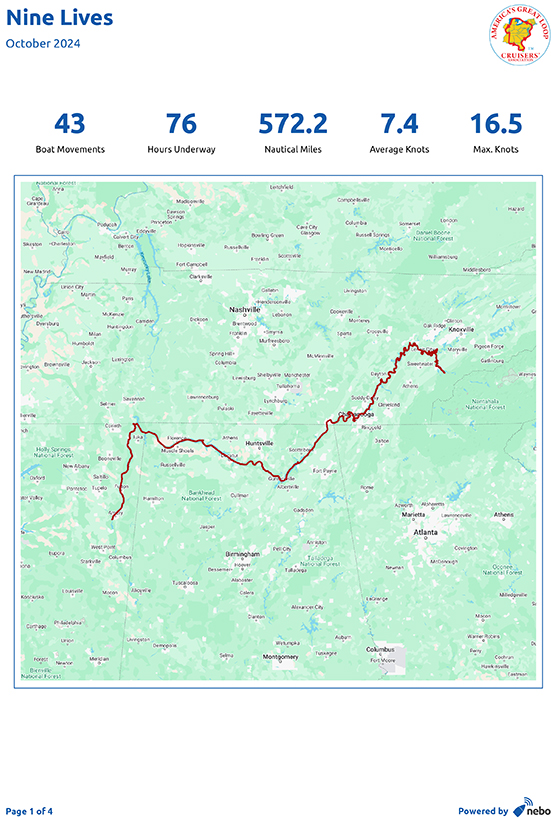
I was struck by how very lucky we were the previous day in our transit of Wilson Lock, as I watched the next groups. We use an app called Nebo, that shows where everyone is. It is very useful to keep track of other Loopers, and can also be used by friends and family to see where you are. On this day there was one group heading in each direction. The downbound group left Joe Wheeler at dawn, as we did, and arrived at Wilson shortly after 8:30am. However, a tow plus barges was in progress, so they had to wait until about 2:30 before it was their turn. That meant they arrived at Florence Harbor at about 4pm, and one of the boats in the group had chosen to travel all the way to Aqua Yacht, arriving well after dark. The upbound group was even less fortunate. Their transit began after 3:30pm, and by the time they were through and close to the next (Wheeler) lock, it was getting dark. Three chose to anchor, but two carried on through Wheeler and arrived at Joe Wheeler State Park long after all staff had left. One hopes that the few remaining Loopers on the docks were there to help them get situated.
At last it was time to head to dinner. Our final visit to our favorite restaurant. Vicari’s was every bit as good as it was on our first visit 3 years ago. Service was impeccable, and the food was outstanding. We enjoyed our usual starters, then Dick had the prime rib and I treated myself to the fried lobster tail.

Sunday was laundry day, blog writing, and Dick changed the oil and filters in both engines. He also took apart the grill to see whether he could figure out what had been making the strange noise when he grilled the breakfast sausages and bacon that morning.
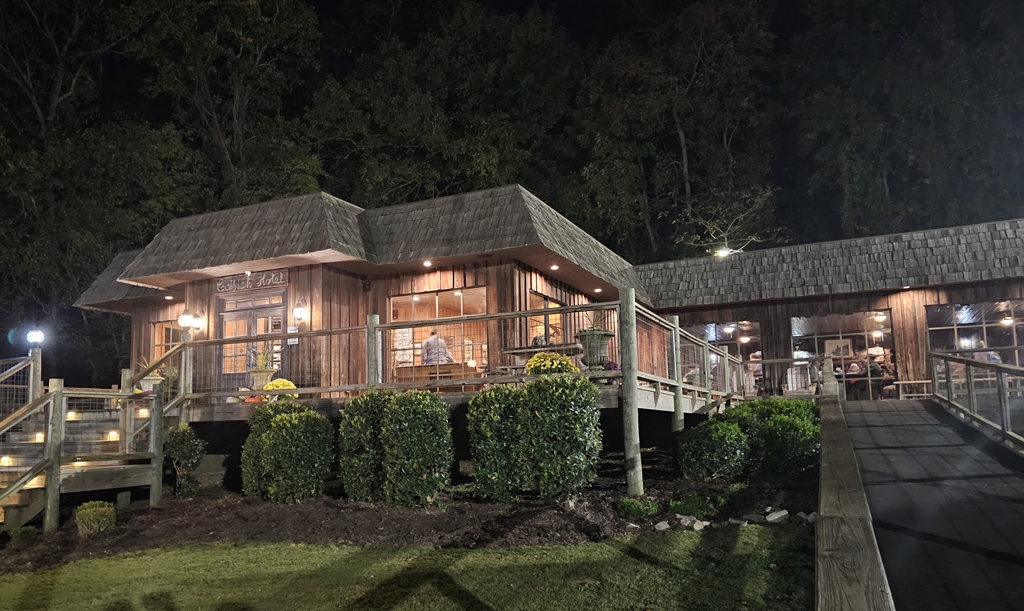
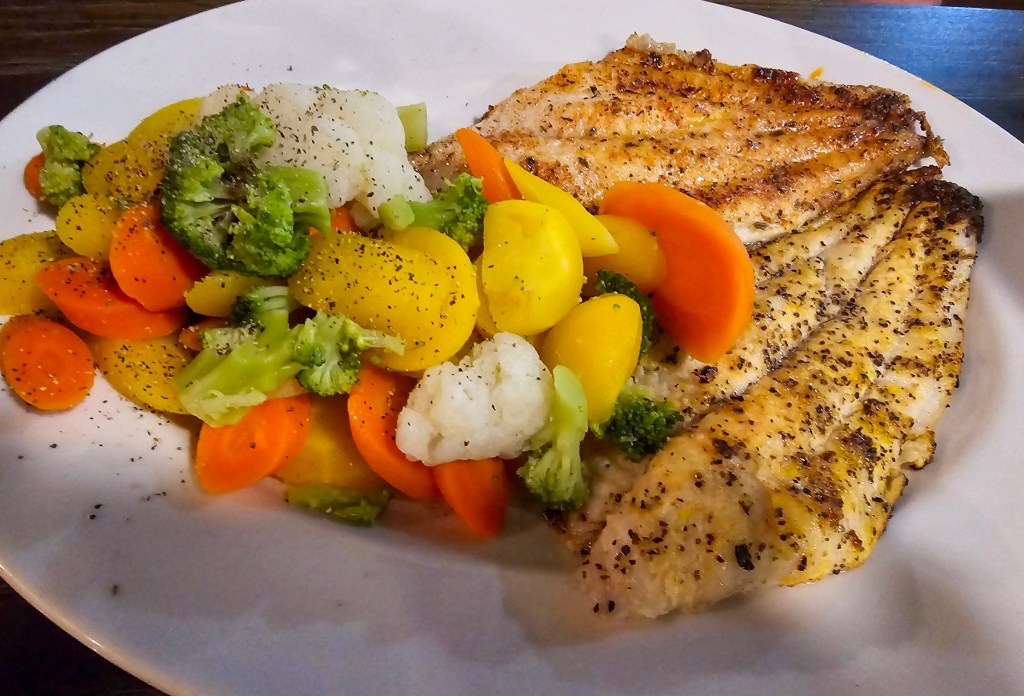
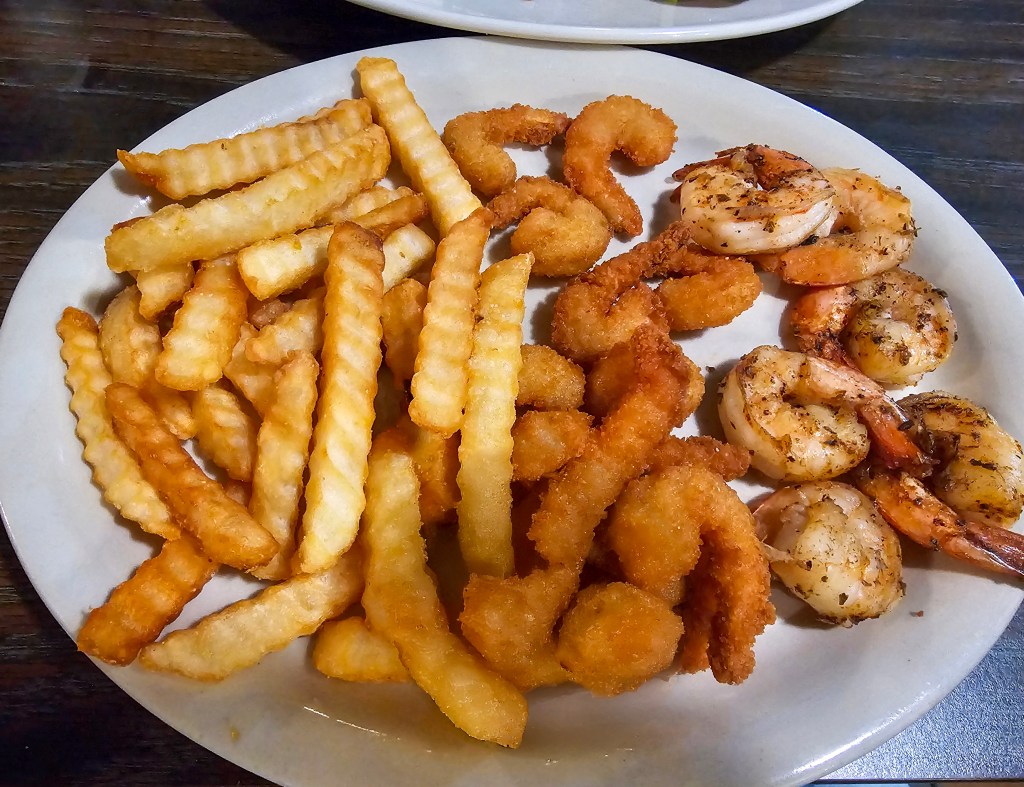
In the evening we set off for Hagy’s Catfish Hotel, a venerable, family run (for 80 years) restaurant about 20 miles away. Dick loves catfish, and it is seldom offered on menus outside these Southern states. We passed the Shiloh Battlefield. I would have liked to have stopped for some pictures, but the catfish were calling. The restaurant was full of character, and bustling. Servers and young women dashed about, taking and delivering orders and bussing tables. Meanwhile, an elegant woman made the rounds, stopping at each table to greet regulars or welcome strangers, while her equally elegant (presumed) daughter showed arriving guests to their tables. The food was very good, and for the most part, piping hot. Dick loved his two grilled catfish filets, one with lemon pepper seasoning, and the other with Cajun spice. I opted for shrimp two ways, grilled with Cajun spice, and popcorn (breaded and fried) style. Both were delicious. The accompanying hush puppies were hot and crisp. The only criticism we had was how rushed everything was. The waitress kept asking to take our main course order, even though we explained that we were not in a hurry and did not want the starters, salad, and main courses piling up together. As soon as we put our forks down, the bill was delivered – no dessert was offered. With all the people tearing about it seemed very hectic.

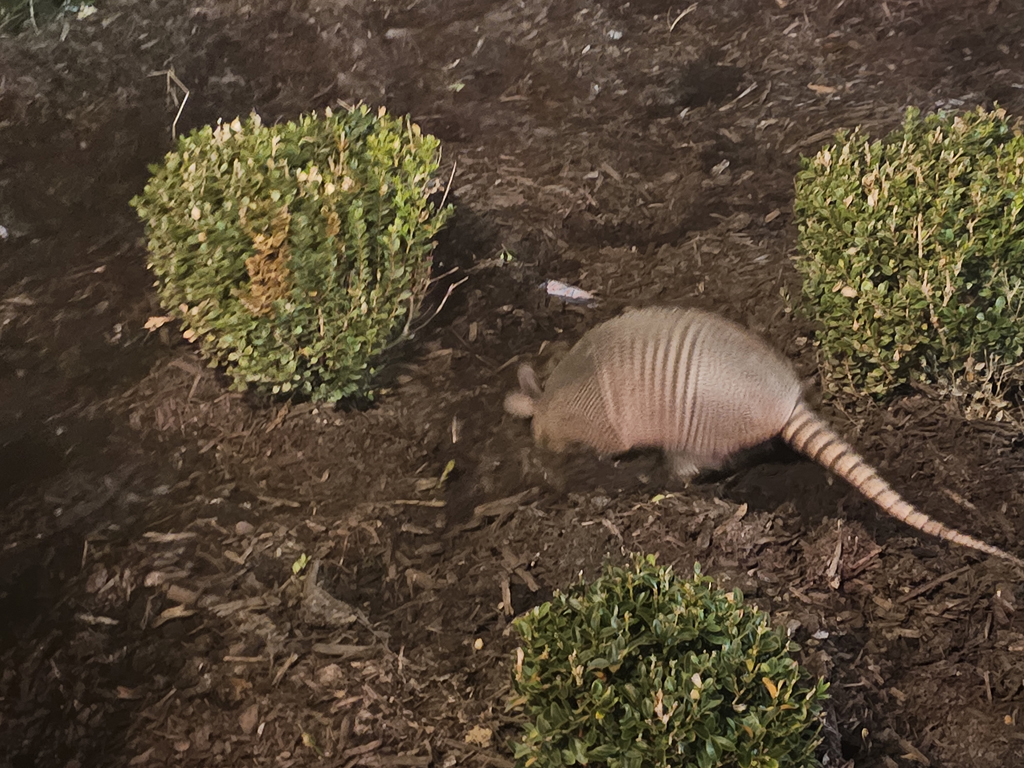
When we got outside, there were armadillos rooting in the flowerbeds. Usually they are too shy and quick for photos, but there must have been something very interesting under the mulch because I was just able to get a snap. Nine banded armadillos are native to South America, but they are gradually moving north, although they do not appear to be considered an invasive species as such. I began to tell this to Dick as we drove back, but before I could get into my stride, he said, “I hear they are good eatin’”. That certainly put an end to that conversation. I did a little research, and here are some interesting things about the nine-banded armadillo that perhaps you did not know. They can jump 3-4 feet in the air when frightened, which contributes to why so many are killed on the roads. They can inflate their intestines, and float across rivers, or alternately, they can sink to the bottom and walk across, being able to hold their breath for as much as 6 minutes. They are nocturnal, and like to burrow, so they are not popular with gardeners. In Texas, there is a small but well-established sport of armadillo racing, in which the animals scurry down a 40 foot track. Most of the usual carnivorous predators like them, but their biggest predator is humans, who hunt them and harvest them for meat and shells.
Our last day at Aqua Yacht started with a scheduled haul out. When metal is continually in the water, it starts to corrode. On a boat, there are a number of places that have metal fittings that are always in the water. To prevent corrosion, pieces of metal called sacrificial anodes are attached. These will corrode first, due to a metallurgical process that I have no need to understand! Nine Lives left salt water back in 2018, and since then, her anodes have been made of magnesium. Now that she is soon to return to salt water, we had her hauled out and new anodes made of zinc were installed. The whole process took about 2 hours, including the haul out and pressure washing the bottom. Everything worked fine, and we were ready to start south the next day.


We took advantage of having our own vehicle to check out a new grocery store in Iuka, and also stock up our critically low stores of Jack Daniels and other adult beverages.
In the evening, I made shrimp fried rice from a new recipe. It turned out very well, and I will certainly make it again. In fact it would also have been relatively quick to prepare if I hadn’t needed to peel and devein the shrimp first.
Next morning we said goodbye to Aqua Yacht (except for a brief visit in a few weeks to pick up the car). It has been a good base for the past 3 years. The yard does good work, the only frustrations being the lack of communication and getting the work done on time, and very little cleaning done despite many promises.
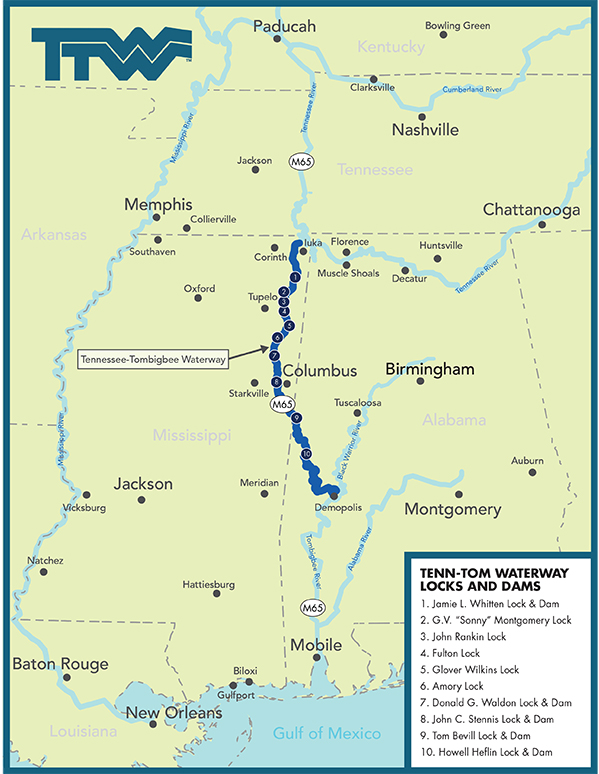
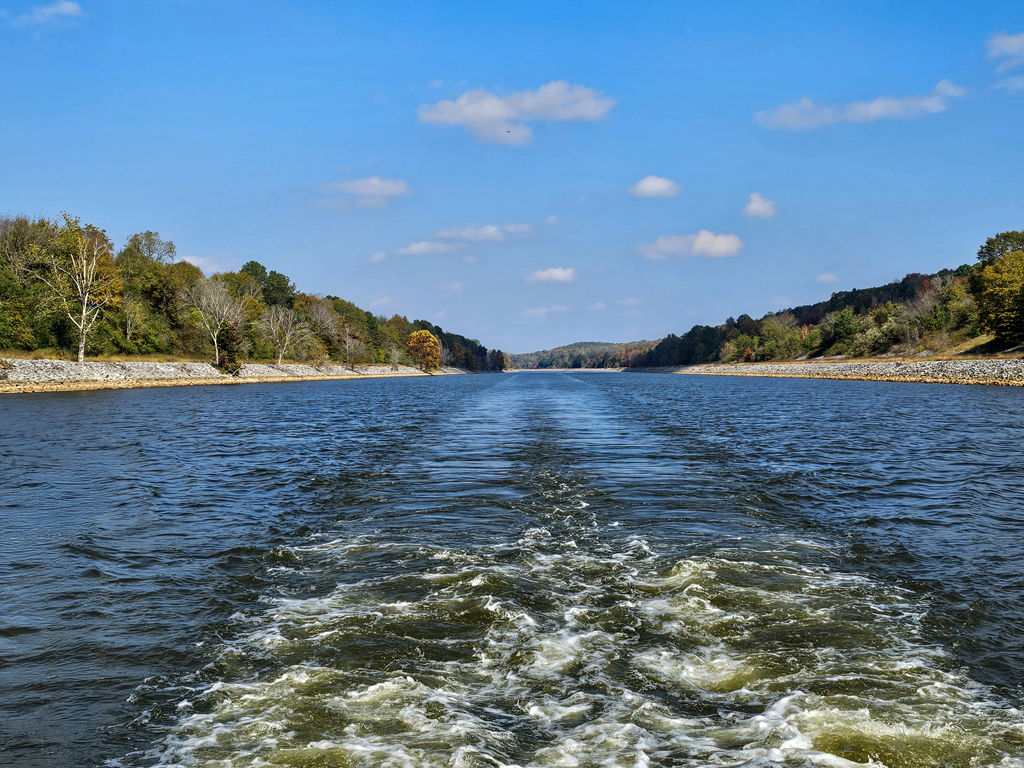
We set off south on the Tenn Tom Waterway. This connects the Tennessee River at Pickwick Lake with the Tombigbee River at Demopolis, Alabama, and then joins the Black Warrior River to bring river traffic to Mobile and the Gulf of Mexico. The first proposal for this waterway was made by a French explorer in about 1760. In 1810, citizens of Knoxville, Tennessee, lobbied Congress to build the waterway, but the first engineering investigation took place many years later in 1875-76. In 1913, another investigation took place. Congress decided again that this would be too expensive and shelved the project. More studies through the early 20th century, and eventually the project was approved in 1946. There was strong opposition from key members of Congress from other regions, and again the project was shelved. Money was budgeted in 1968 and in 1971 to build the waterway, and construction began in 1972. There were more delays, due to lawsuits, but gradually the waterway was built, at a cost of nearly 2 billion dollars and it was dedicated in 1985. Today, the waterway ships as much as 1.2 billion ton-miles of commerce each year. We have been struck by the differences between these relatively new locks and those of the other waterways we have been travelling on for the past three years.
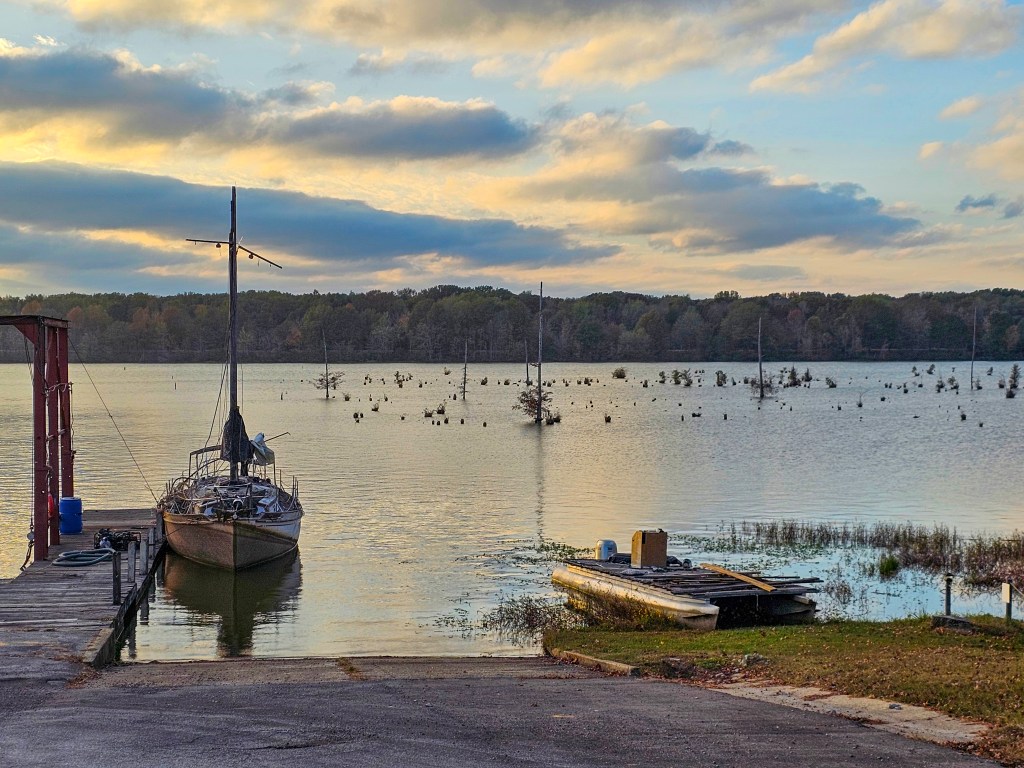
We anchored just above the first lock in a cove where there is a visitor centre. There was already a boat in there – another Endeavourcat! We set the anchor, and Nine Lives’ lady captain said, “I don’t think this is right, we are too close to the other boat, and we will not swing at the same rate and radius.” The gentleman captain said, “It’s fine.” Dick then spent a few hours replacing 3 cigarette lighter outlets (remember those?) with new USB ports. I think there were some grownup words muttered during the tricky process. After one and a half adult beverages on completion of the afternoon’s project, at dusk, the gentleman captain expressed the view that our location was not ideal, and now that the wind had dropped, we were at risk of bumping into the other boat. Headsets on and engine started, and the whole pulling up and re-anchoring process to be gone through, as it got dark. The lady captain was much happier in the new location, just wished it had not taken the gentleman captain quite so long to figure it out!

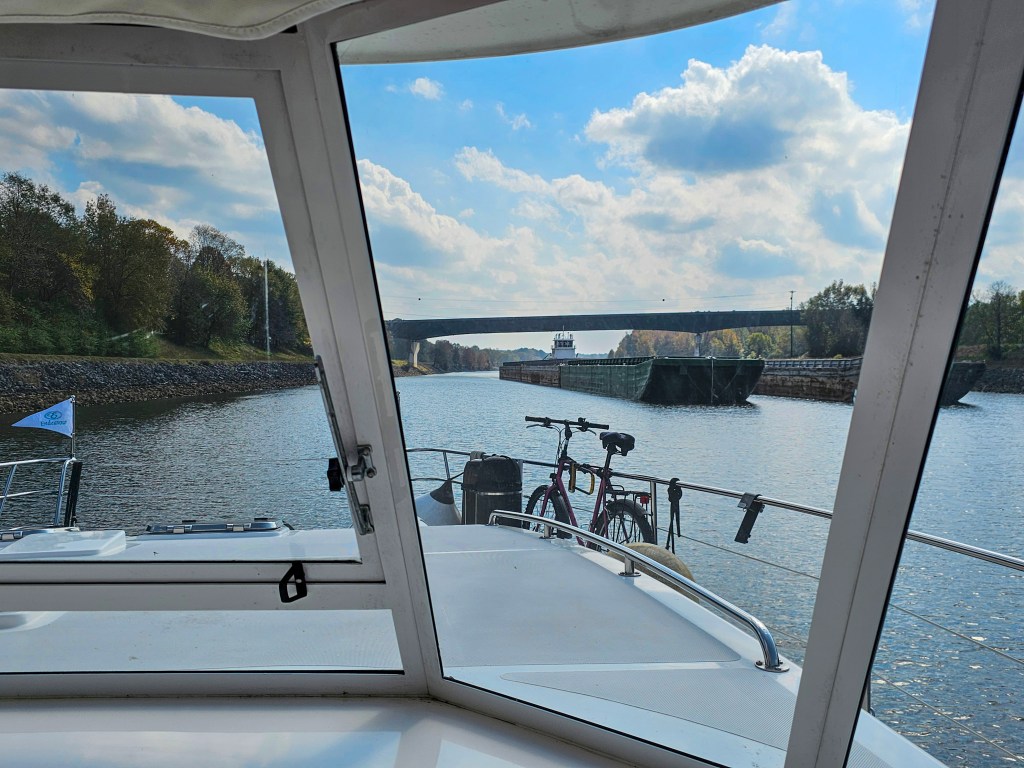
After a peaceful night we had arranged to coordinate with the other 2 boats in the area to go through the next locks together, and with one spokesman. It all went well, and with no tows on this stretch of the waterway, we got through 3 locks and were tied up in the marina in 3.5 hours.
At the last lock of the day, there was a moment when we thought that all the extraordinary measures that we know about and have never had to use, might come into play. The floating bollard that we were looped to didn’t float! I was just about to hail the lockmaster when Dick gave the bollard a heavy push and it dropped down, protesting with metallic shrieks, and bouncing up and down a few times before it settled. Definitely a good reason to have the strong man tending the pin, and what someone recently described as “the little lady” at the helm. I would not have had either the strength or the reach to get that bollard moving.
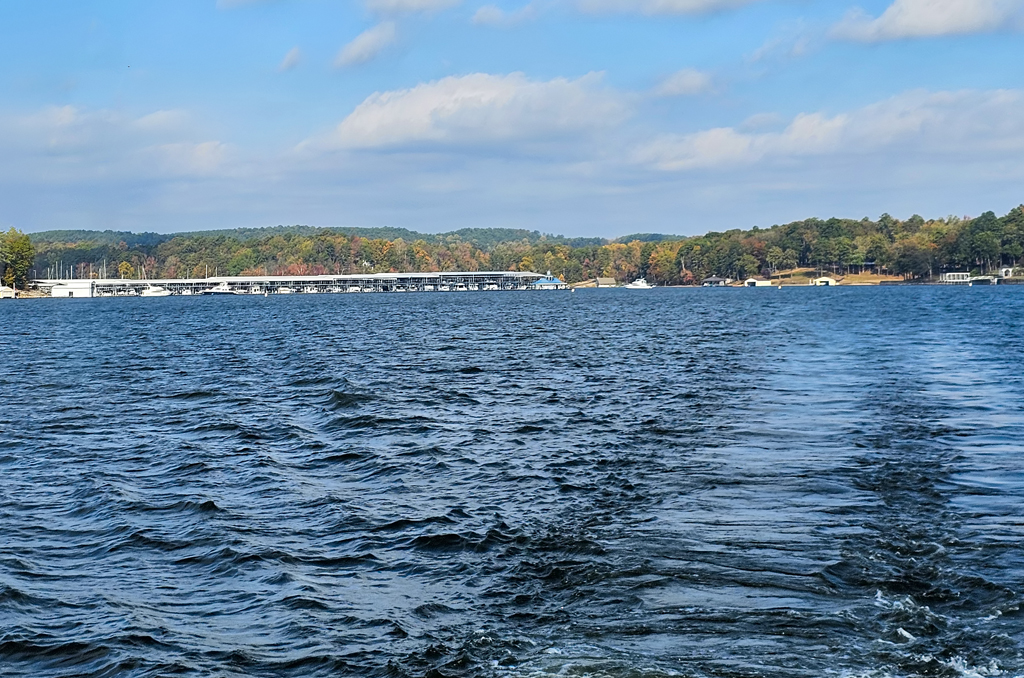
Midway Marina is a strange place. The marina itself is a mixture of very old docks with quite a bit of new wood going in to refurbish. There are a number of near derelict boats in the slips. However, there are some new and very attractive guest cabins, a huge, manicured park, and one of the best restaurants of its kind we have visited on the Loop.
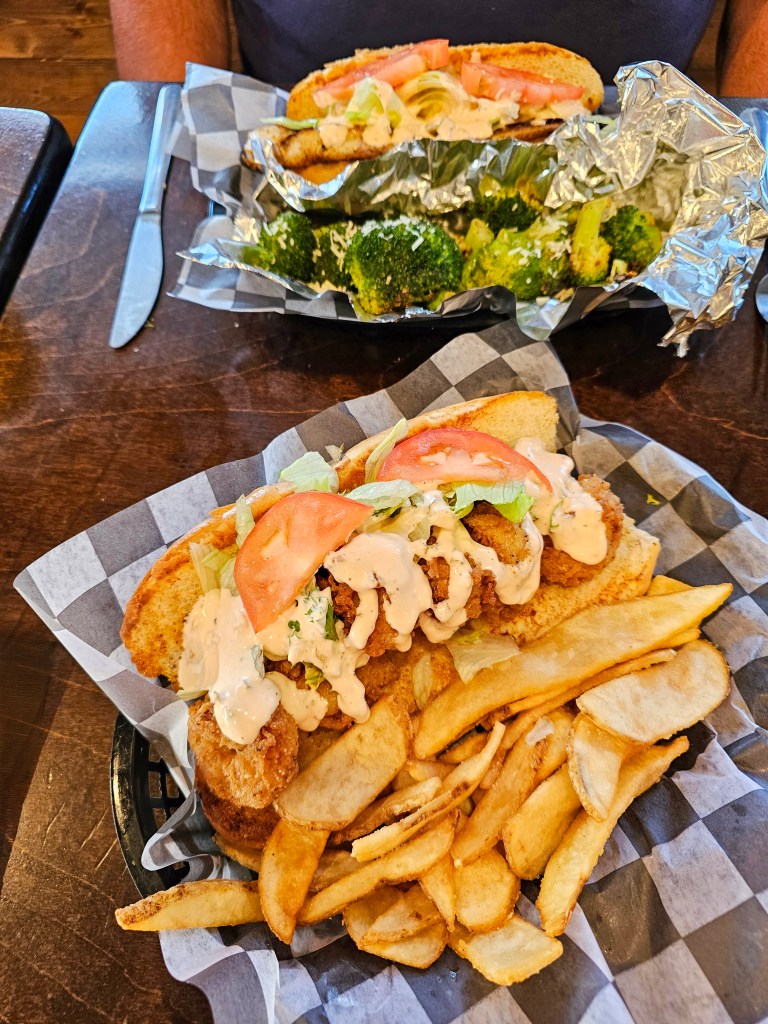
We were delighted to find our favourite cheese curds on the menu, and while we were waiting for those delectable treats, we were brought a loaf of delicious bread. We both ordered Po’ boys, Dick’s was with grilled catfish, while I had fried shrimp. It was an exceptional meal.
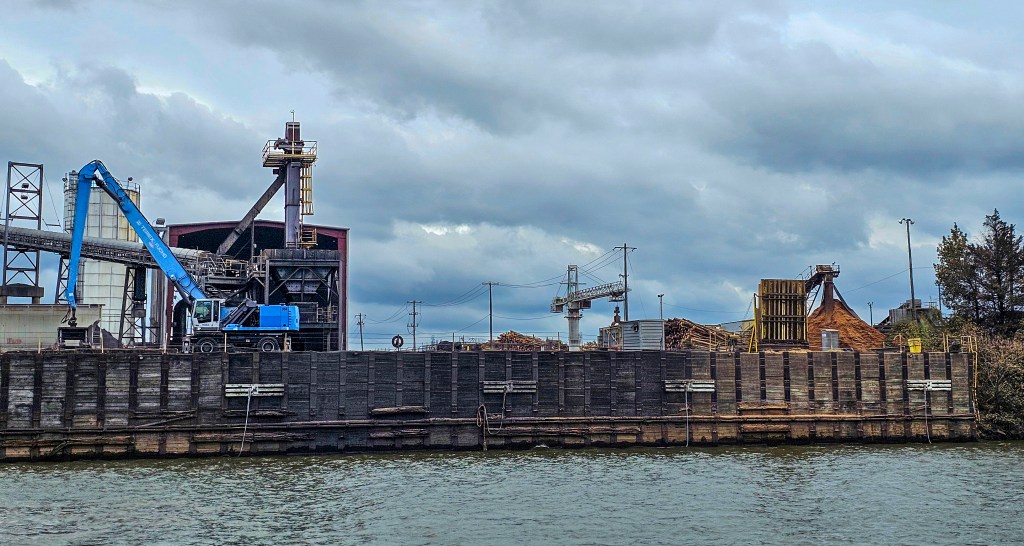
Next day was another 3-lock day. Again, 3 boats were given the go-ahead to be at the lock by 9am. We were very lucky with the tows (4 of them) as we met them either just before or just after the locks and were able to go through each lock right away.
We soon experienced our second “expect the unexpected” moment in 2 days. I brought Nine Lives slowly into position at the pin we had chosen, and it suddenly became clear that the bollard had sunk and there was nothing there. They are recessed in the lock wall, so you can’t tell until you are right beside it if there is a problem. I had to back Nine Lives up to get to the pin 150 feet behind. Since I don’t have eyes in the back of my head, it was a tricky maneuver, while Dick pushed off the lock wall and stopped the fenders from hanging up.
Our chosen anchorage for that night is popular, but reviews warn of a rocky bottom that means the anchor does not always set. Usually I can feel it when the anchor grabs, but not this time. I was not happy about the amount of swinging room either. Reviews told us to expect 180 degree changes in direction. I use two anchor alarms, and the one with the shorter radius went off several times. Between a very slight current, and an opposing light breeze, Nine Lives swung all over the channel throughout the night. We still don’t know whether the anchor ever dug in, or if just the weight of chain on the bottom held us in place. Not an anchorage I would return to or recommend.
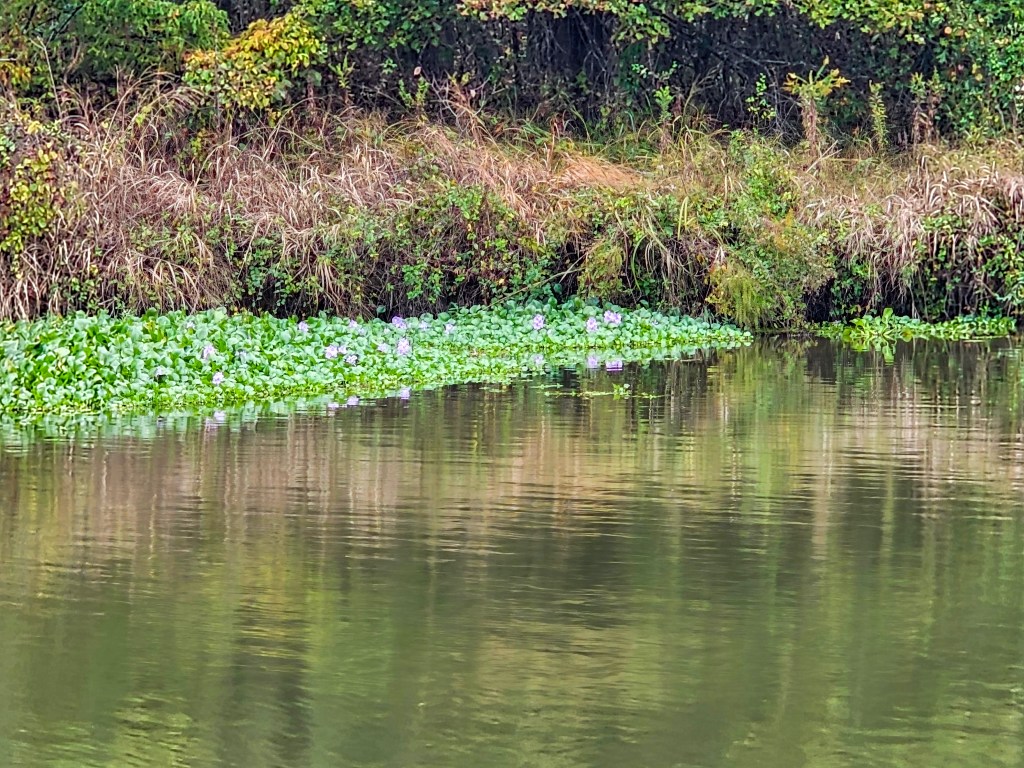
In East Lake, we passed large and small clumps of water hyacinth. This is a highly invasive species that is choking waterways all over the world. In the United States it is a particular problem in the southern, Gulf states. The plants reproduce by stolons, or runners, that create new plants. The flowers produce thousands of seeds that are viable for up to 28 years. Mats of water hyacinth can double in size in just one to two weeks. Once established, the fish and native plants die, and the waterways become choked. Harvesting the plants mechanically to try to get rid of them is a problem because they are extremely heavy, and then there is the problem of what to do with them once harvested. Many different methods of eradication and control have been tried, including steam, hot water, acids, spraying with petroleum and setting fire to it, various chemicals, introduction of species of weevils that eat them, and harvesting. In 1910 it was proposed to introduce hippopotamuses into Louisiana waters as a method of control. The plan was for the hippos to eat the water hyacinth, and the animals could also be hunted for meat, which was in shortage at the time. The proposal was lost by just a single vote, or we would have had a different problem in the southern states. The pet hippos of drug lord Pablo Escobar escaped and are multiplying in the wild in Columbia, dangerous to both humans and the environment. They are proving to be difficult to cull. They can be extremely aggressive and will charge and attack small boats. They also raid farm crops. The solution to one problem can easily create another, as history tells us again and again.
We arrived at Columbus Marina and were tied up by 1:10. It is a popular stop on this part of the Loop, so they have a 2-night maximum stay during this time. We had hoped for several Amazon packages to be waiting for us, but USPS apparently found it too difficult to deliver on the due date, and did not schedule a second attempt for 3 days. The next morning, we got the full explanation. Apparently, USPS in Columbus has decided that any packages that do not fit through the mail slot will be held at the Post Office for pickup. This information is not conveyed to Amazon (and thus the package recipient). Then, when someone arrives to pick up their parcel, all the waiting parcels for the marina are handed to them at once. Another boater had arranged for a Post Office run, and collected our two packages, so the issue was satisfactorily resolved for us.
On our first evening, we arranged for the marina courtesy car to take us to a steak house, and made a reservation at the restaurant. At the last minute, fellow boaters Sandy and Frank from Proost decided to join us. The courtesy car is quite something. It has over 270,000 miles on it. As you drive, there are interesting squeaks and rattles, and after a while the engine begins to make a sort of groaning noise, as if it is about to quit from sheer exhaustion. However it got us to the restaurant and back to the marina. Our dinner was very enjoyable, but mainly for the company. We have decided that food served cold in restaurants in this part of the country is SOP, and we should stop accepting excuses. The appetizer of deep-fried balls with broccoli, bacon, and cheese were properly hot and tasted very good. Dick’s prime rib was fine, but Frank’s was cold. My steak was reasonably hot, but the accompanying shrimp skewer was room temperature at best. The bowls of grits that Frank and I chose as sides were less than room temperature. Frank’s beef and the grits were sent back. By the time they returned, the rest of the food had been eaten. Oh, and the grits were still just as cold as before. Meanwhile, Sandy’s wine flight never arrived and had to be removed from the bill. We really enjoyed talking with Sandy and Frank, and hope that we will have a chance to spend time with them again. We first met in Florence, some weeks ago, and have been leapfrogging ever since.
Our day in the marina was a chance for me to finish this issue of the blog. Dick pottered about doing various chores, including a pump out. Unusually, this marina has in-slip pump out outlets, so you just have to go and find the hose and get the machine started, no need to move the boat to the fuel dock as is usual. We want to have everything ready before we leave tomorrow, as we will be anchoring for three nights in a row, unusual for us. Water will have to be used carefully, navy showers for the next three days!
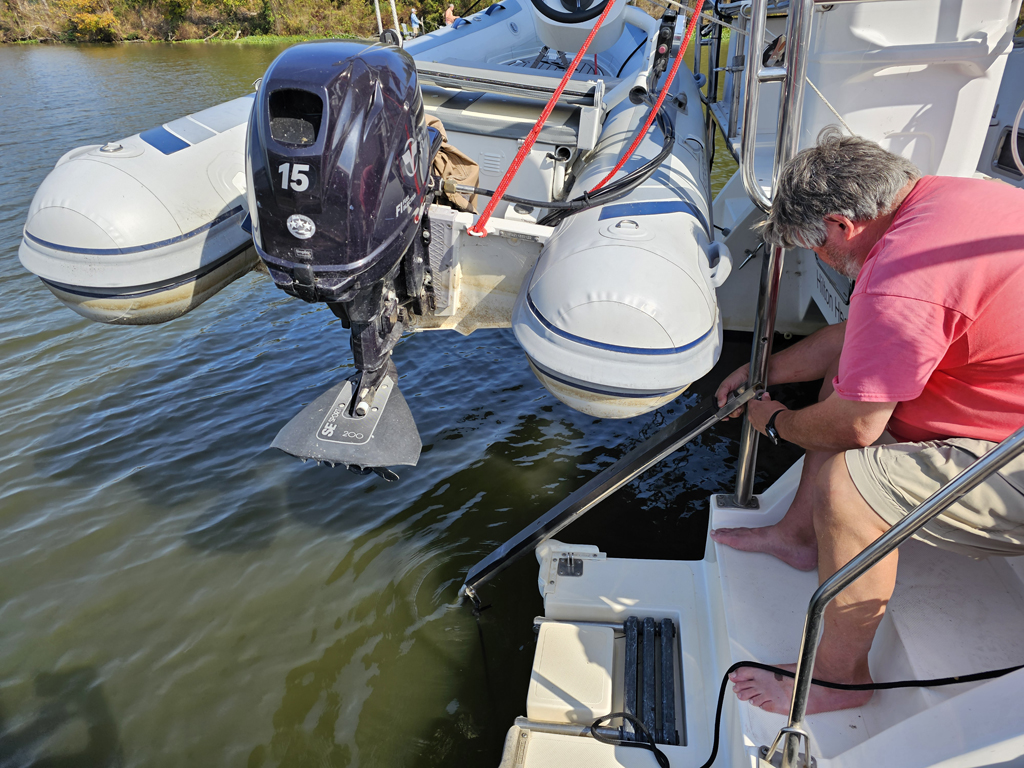
Dick also re-installed the lower supports for the dinghy. When we replaced the original fiberglass dinghy a few years ago, Dick assumed that lower supports were not required, the dinghy could just hang from the upper supports because it is so much lighter than the original. Also, he had seen that most other boats with such a configuration have the dinghy hanging from the upper supports. We have noticed that when it is rough, or we cross a large wake, the dinghy swings wildly from side to side, to the extent that it nearly came off when we went through the turbulence at Ft Louden Lock. After reading on the Endeavourcat forum that the lower supports actually serve two purposes, Dick decided to put them back. In addition to helping with sway, the lower supports allow the dinghy to slide past the swim platforms when it is being launched, requiring a lot less manual intervention (that is, heaving it about). I do remember that those supports used to behave in odd ways, engendering a fair amount of cursing, but perhaps they will not be quite so annoying with the new dinghy.
 The Voyages of Nine Lives